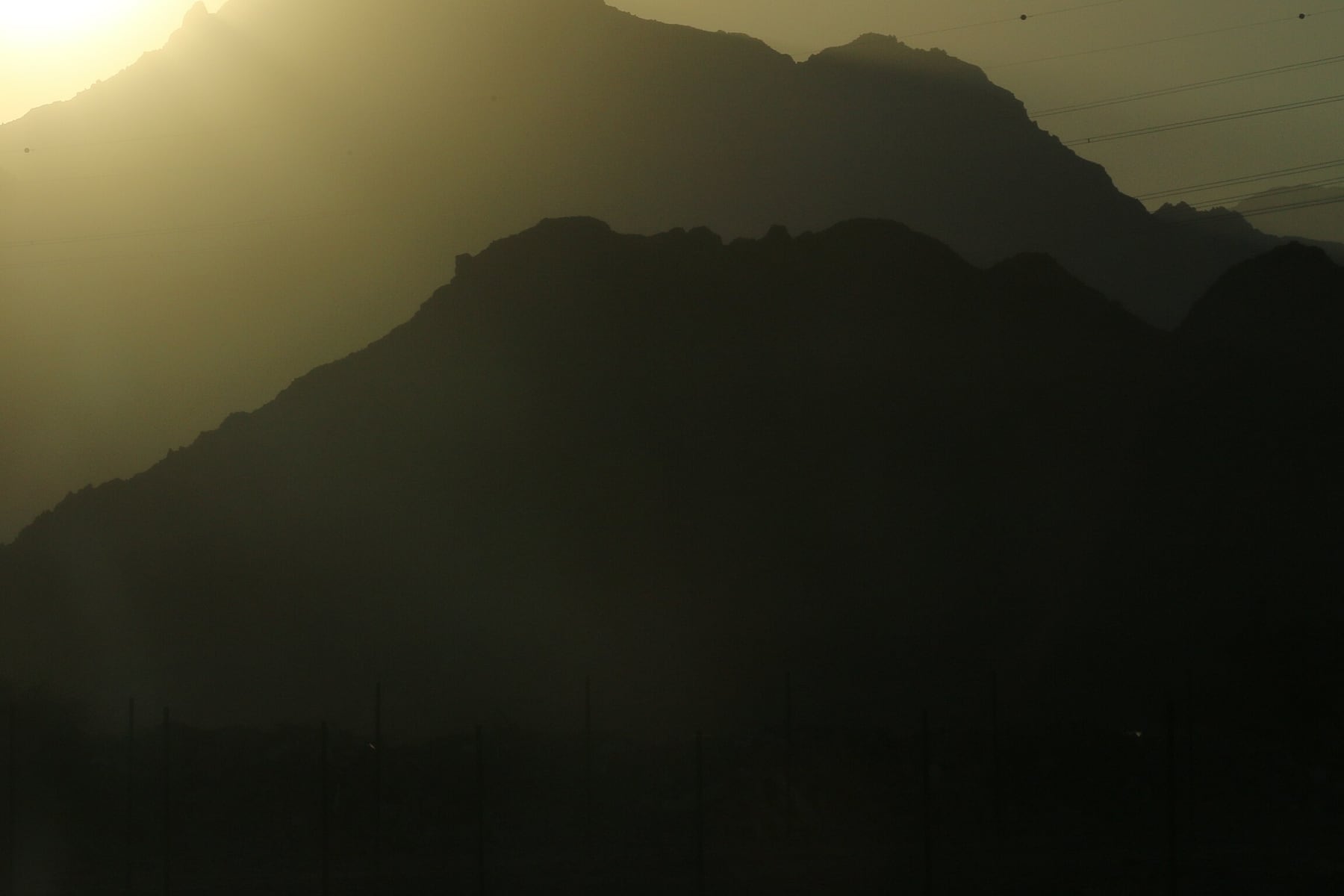
Abu Dhabi to Fujairah
Tashmetova808 / Wikimedia Commons · CC BY-SA 4.0 · 2023 · cropped
- DistancePersian Gulf to Gulf of Oman · 9 tunnels, 6.9 km of them, under the Hajar
- Duration1 h 51 min via Al Dhaid · 2 h 24 min via Dubai
- Best seasonNovember to March · take the 08:15 or the 12:43 to have the mountains in daylight
Introduction
Until 30 June 2026 there was no intercity passenger train anywhere in the United Arab Emirates. Etihad Rail was set up in 2009 and built its network freight first — sulphur out of the interior, aggregate, containers, running to the ports — and only once the line had reached the east coast did it begin selling seats. The service it opened with crosses the whole width of the country: Abu Dhabi Station, in Mohamed bin Zayed City, to Fujairah Station at Al Hilal City, the Persian Gulf to the Gulf of Oman, in one hour fifty-one minutes.
What makes it worth riding is the change of ground rather than the novelty. The train leaves the industrial southern edge of Abu Dhabi, runs east across open sand and gravel past the rock stacks at Mleiha, then reaches the Al Hajar mountains and goes straight through them — nine tunnels, 6.9 kilometres of them in total, on the last run down to the coast. The trains are diesel push-pull sets built by CAF and CRRC, rated at 200 km/h, carrying up to 400 passengers in two classes, and the passenger operation is run by Etihad Rail Passenger Services, a joint venture with Keolis. Three trains go each way, every day, each making one stop: Al Dhaid in inland Sharjah on the morning and evening trains, Dubai on the midday one. The network is still opening in stages, with Madinat Zayed and Liwa due at the end of November 2026 and Sharjah in March 2027.
The Journey
Abu Dhabi Station is not on the Corniche. It stands out at Mohamed bin Zayed City, on the mainland behind the island, among the warehouses and workshops of Mussafah — which is where the railway already ran, because this was a freight line before it was anything else. Gates close two minutes before departure and the platform is a short walk from the concourse, so ten minutes is genuinely enough.
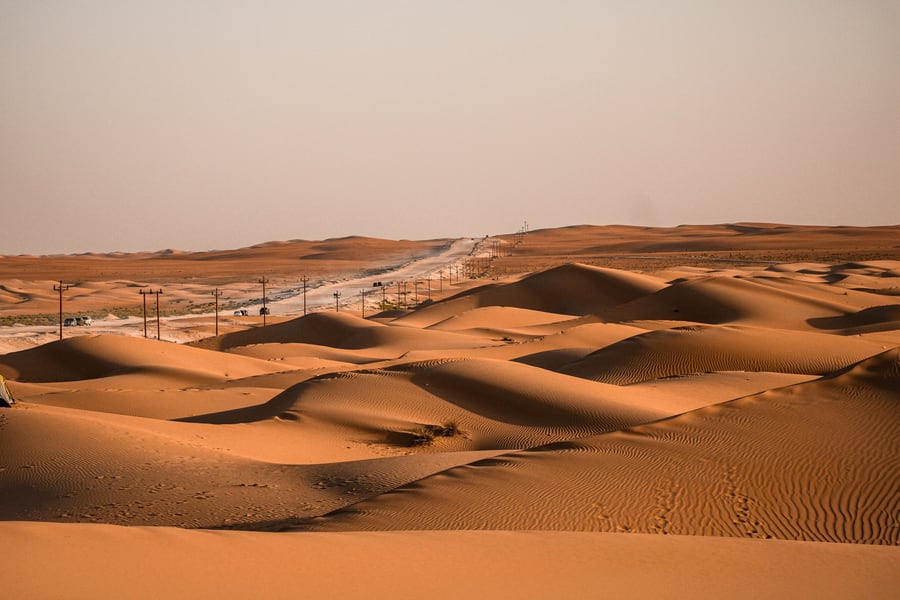
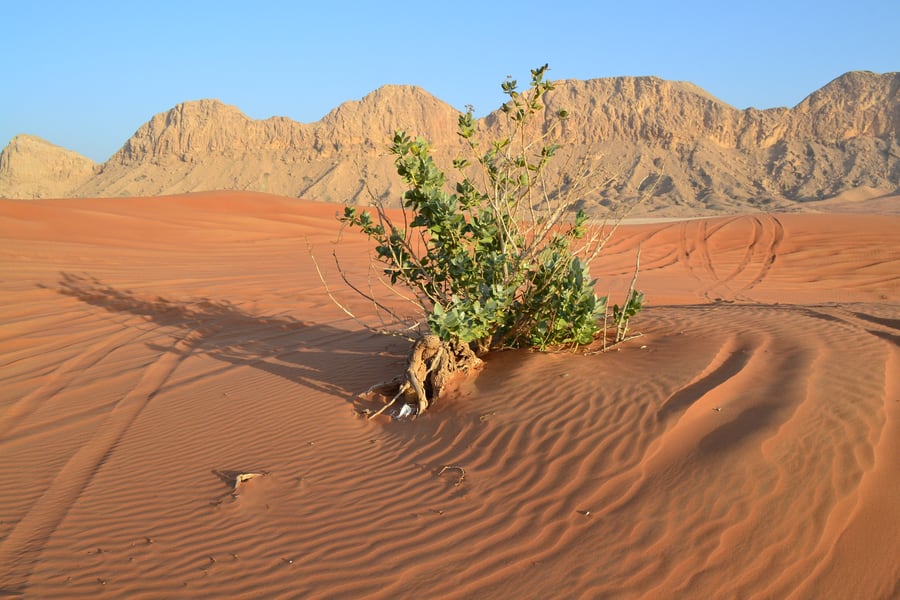
The first half-hour is the Emirates most visitors never look at: sand flats, pylons, camel fencing, the occasional ghaf tree holding its own patch of shade. Then the ground begins to lift into the long red dunes that run north-east towards Sharjah. Somewhere out to the left is Al Faya; to the right, low limestone stacks weathered into shapes that have given them their tourist names. The morning and evening trains skirt the southern edge of Dubai — Jebel Ali, then the newer suburbs — without stopping. The midday train calls at Dubai Station, at Jumeirah Golf Estates, where a bridge connects it to the Metro; it takes 2 h 24 overall rather than 1 h 51.
Mleiha, and the first sight of rock
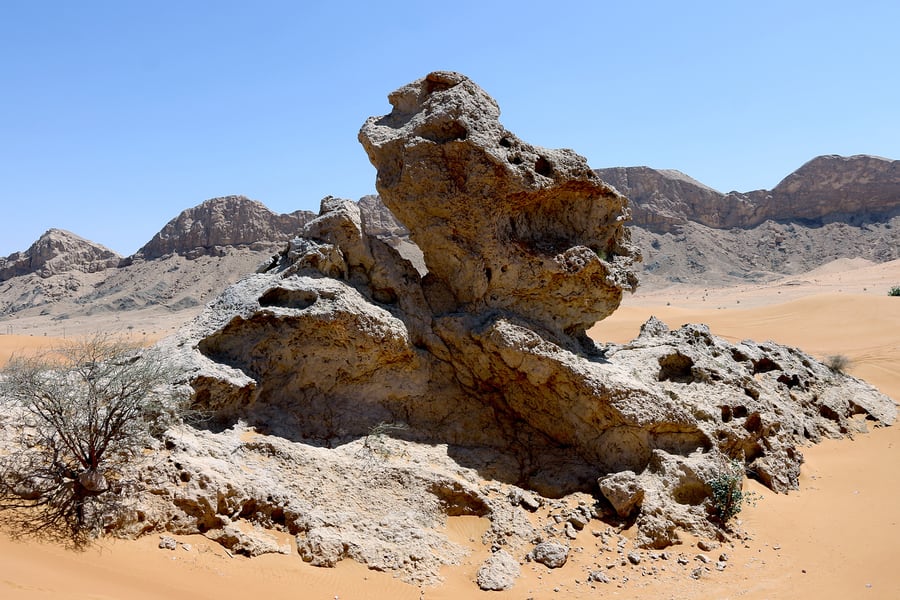
Around the hour mark the horizon hardens. Mleiha, inland Sharjah, is where the dunes break against the first outcrops of the Hajar, and it is the most interesting stretch of the run: pale fossil-bearing rock standing clear of orange sand, with the mountains behind it going from haze to outline. This is old country. The tombs and settlements excavated here run back through the Umm an-Nar period and into the Stone Age, and the modern Emirates — the towers, the ports, the railway itself — is about fifty years deep on top of several thousand. The morning and evening trains stop at Al Dhaid, in inland Sharjah, under half an hour short of Fujairah.
Through the Hajar
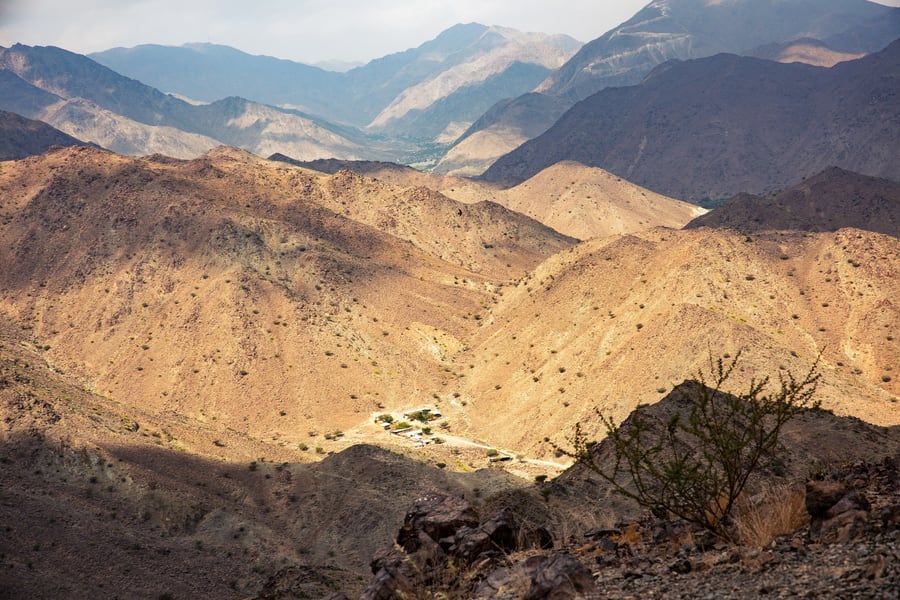
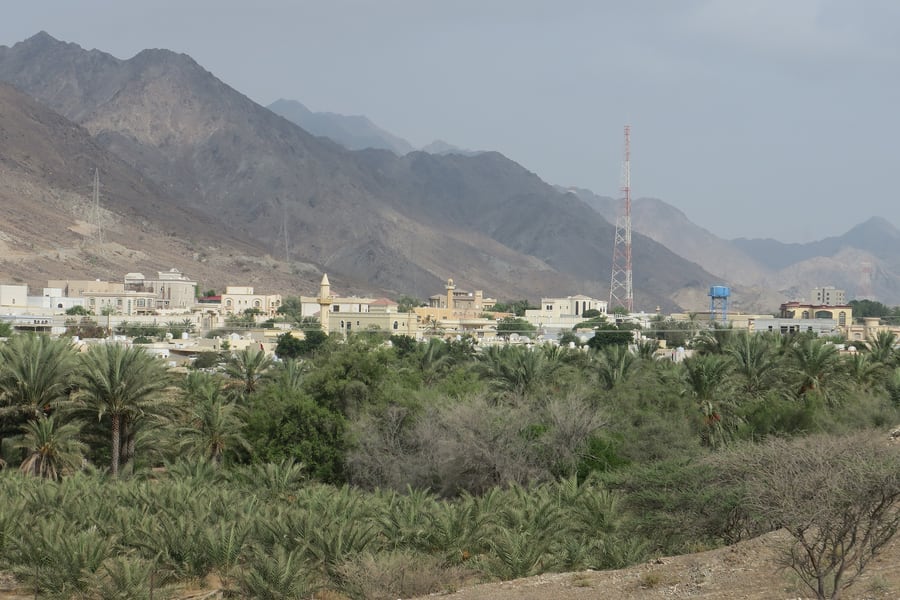
The last section is the one the engineers had to fight for. Building the 145 kilometres from the Dubai–Sharjah border to Fujairah took 35 bridges, 32 underpasses and fifteen tunnels totalling sixteen kilometres, blast-driven through the Al Hajar. Nine of those tunnels, 6.9 kilometres of them, are on the passenger route. Between them the train runs in wadi bottoms with the ridges close on both sides — grey and ochre gabbro, dry watercourses, the occasional walled date garden at a village like Bithnah, where a fort has guarded this pass for close to three centuries.
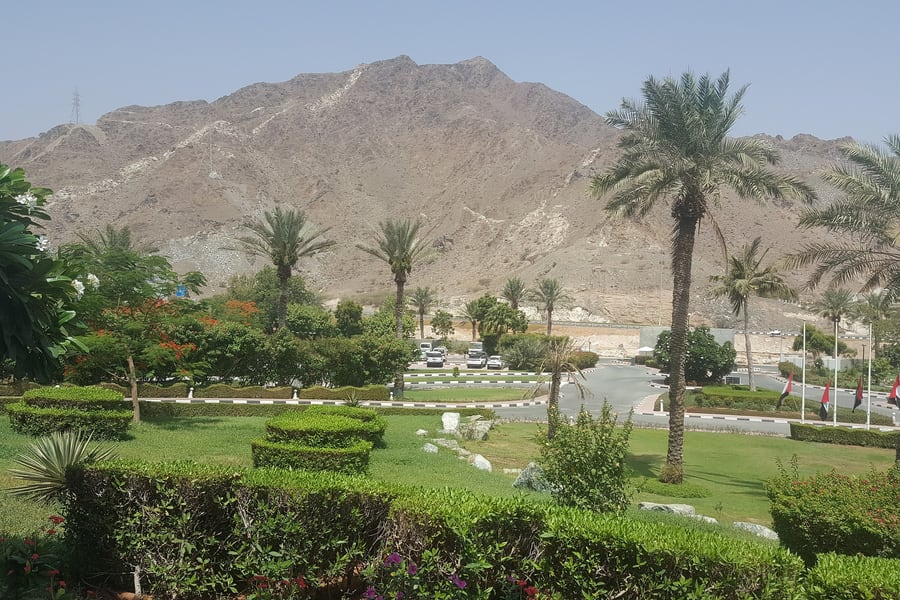
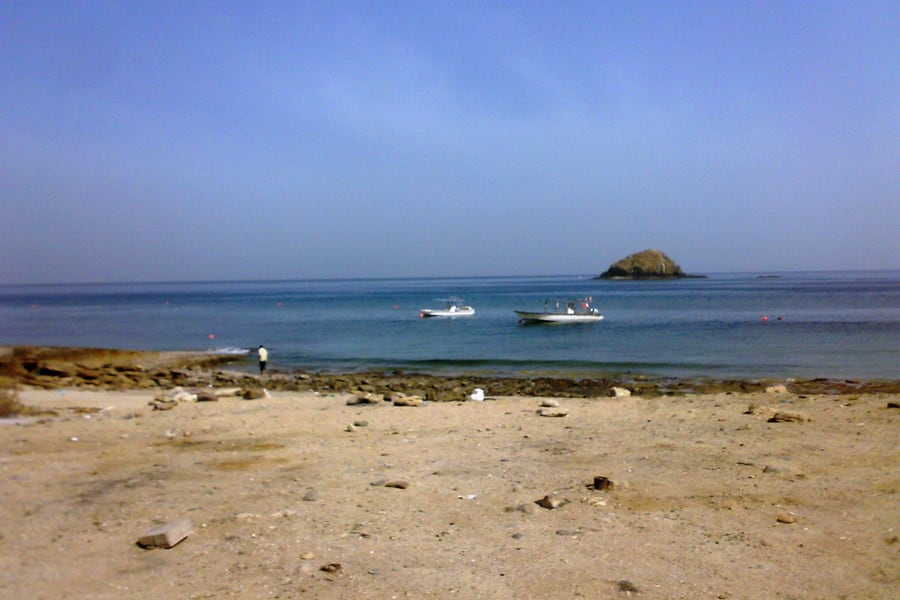
Then the mountains open and the light changes. Fujairah sits on the Gulf of Oman, not the Persian Gulf, and the difference is obvious from the window: deeper water, a working anchorage offshore, green in the wadis. Fujairah Station is at Al Hilal City, a few minutes from the Corniche and about ten from the fort and the museum. Trains are diesel throughout — the line was built with electrification in mind but has not been wired — and the sets are push-pull, a power car at each end, so nothing shunts round at either terminus.
Along the route
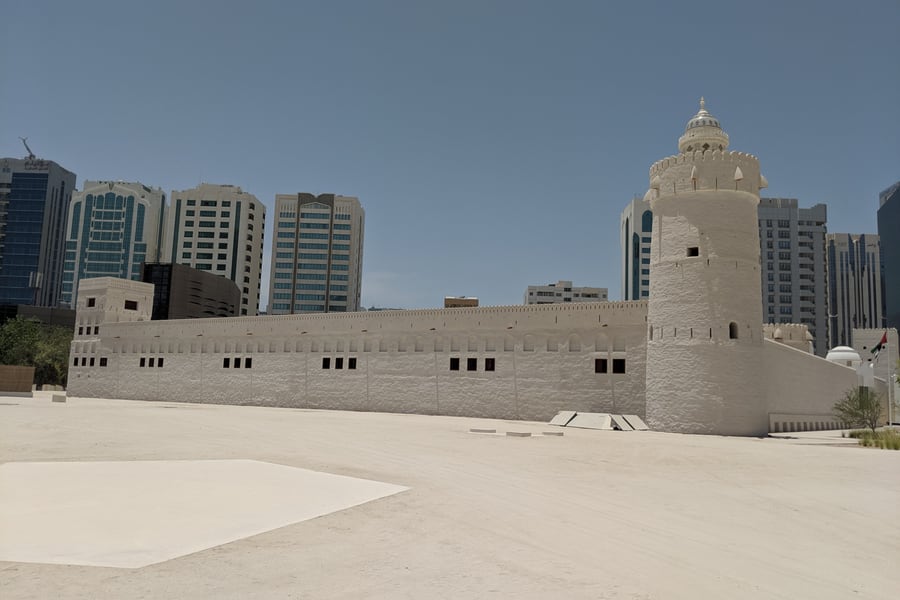
 JSPhotography2016 / Wikimedia Commons · CC BY-SA 4.0 · cropped
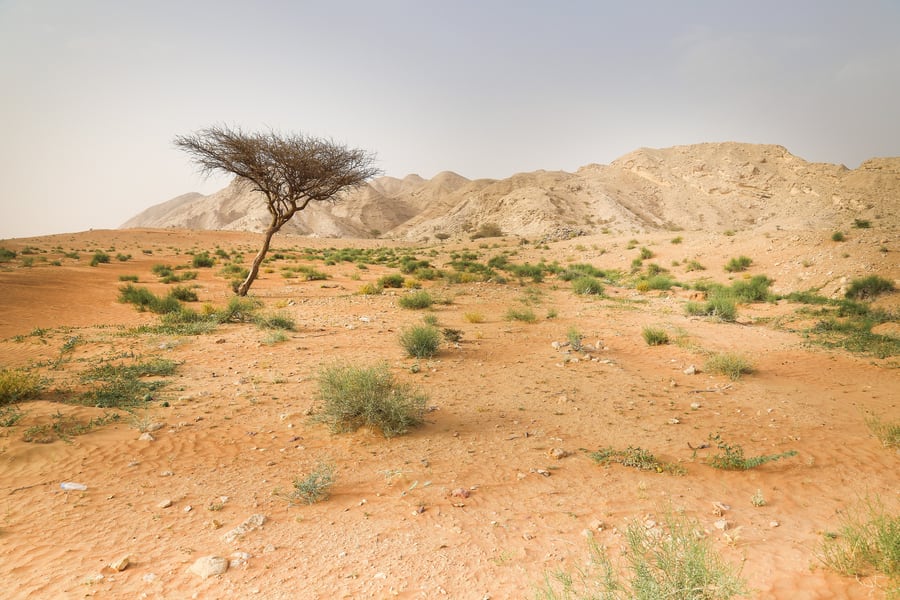
The sand, for an hour
Flat gravel and open dune from the edge of Mussafah almost to Sharjah, with ghaf trees, camel fencing and very little else. It is monotonous and it is the point: nobody could cross this by land in a morning before the railway.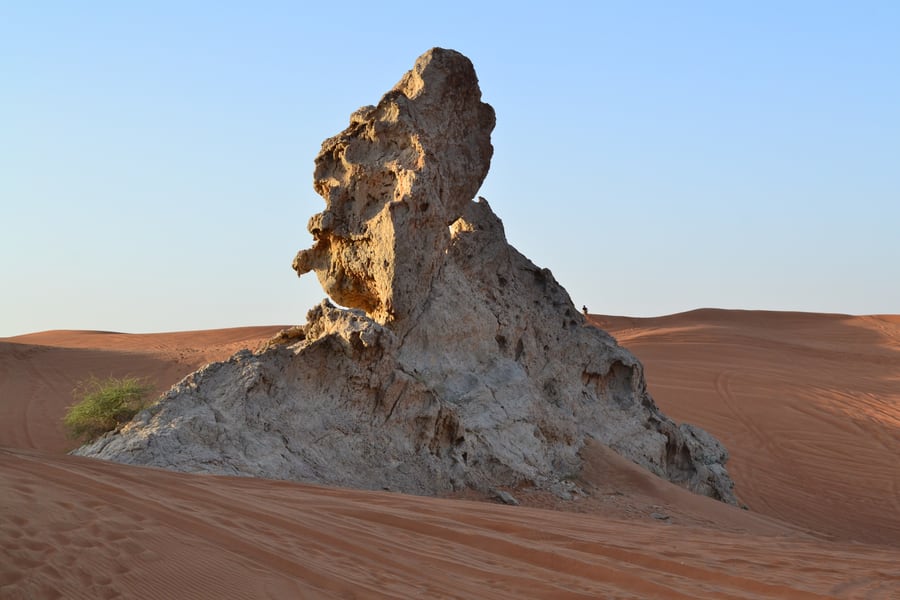 Aleksandr Serebrennikov / Wikimedia Commons · CC BY 4.0 · cropped
Fossil Rock at Mleiha
Pale marine limestone standing out of orange sand, full of shells laid down when this was seabed. The archaeology around it runs back through the Umm an-Nar period and into the Stone Age.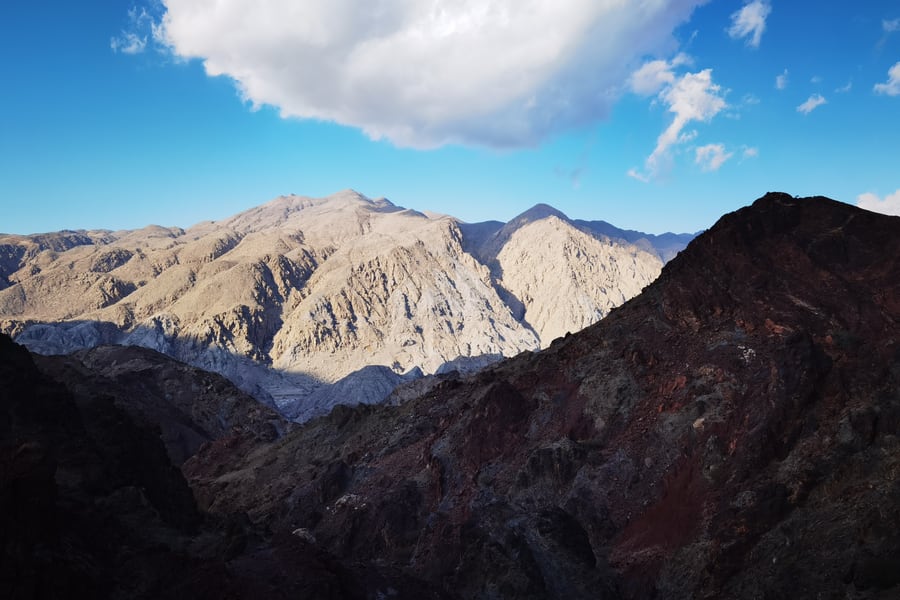 Polina Kurapova / Wikimedia Commons · CC BY-SA 4.0 · cropped
Nine tunnels in the Hajar
The last stretch is bored straight through folded gabbro and limestone like this — nine tunnels on the passenger route, 6.9 km of them, driven by blasting. Between them the line runs in wadi bottoms with the ridges close on both sides.A bit of history
Culture & experiences along the way
 Wikiemirati / Wikimedia Commons · CC BY-SA 4.0 · cropped
Karak, gahwa and what comes with the seat
Comfort class comes with sandwiches, wraps and paratha; both classes get Arabic coffee — cardamom-heavy, poured from a brass dallah into a thimble — and karak, the strong sweet milk tea that is the Emirates' real national drink. Snacks and soft drinks are also sold on board. Luqaimat, the syrup-soaked dumplings above, are what to look for once you are off the train.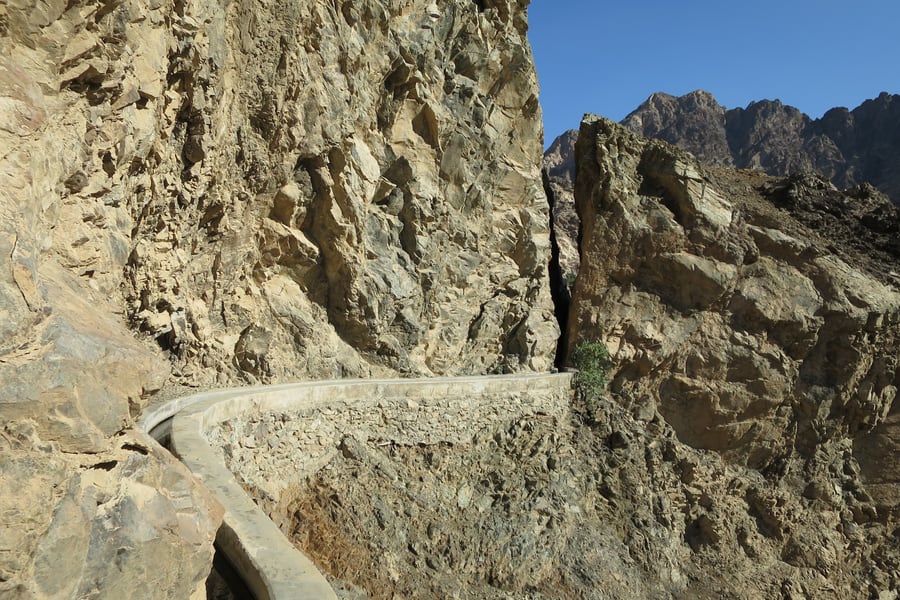 Angela Manthorpe / Wikimedia Commons · CC BY-SA 4.0 · cropped
The falaj, still running
Long before anyone tunnelled through the Hajar, people cut channels along its cliffs to move mountain water to the date gardens by gravity alone. The falaj system is roughly three thousand years old, it is what made villages like Bithnah possible, and in the wadis behind Fujairah and Khor Fakkan it is still carrying water.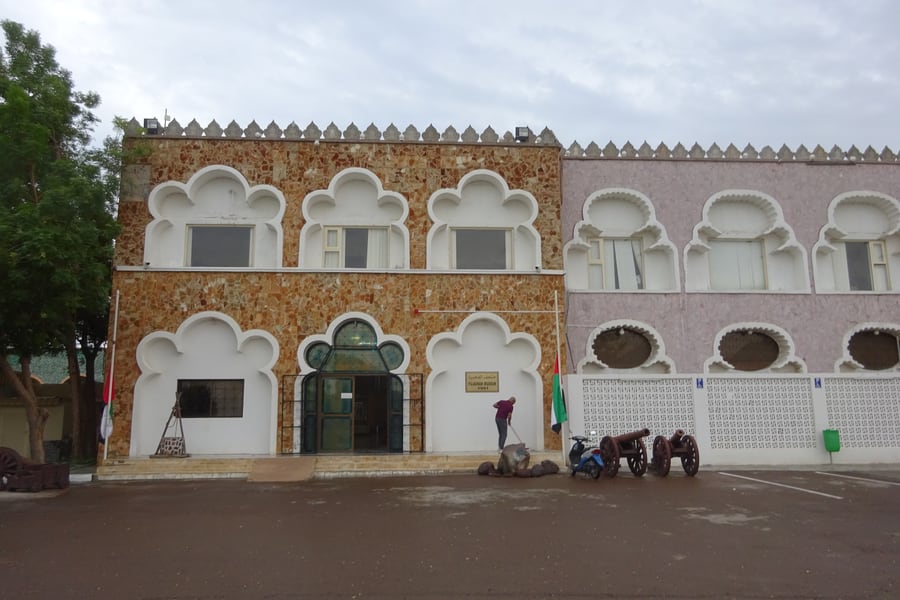 Jpbowen / Wikimedia Commons · CC BY-SA 4.0 · cropped
Fujairah Museum
Ten minutes from the terminus, below the fort, and the quickest way to understand why this coast was worth reaching. Bronze Age and Iron Age material excavated at Bithnah and Qidfa, weapons, silver, and pottery that came in by sea — the trade route the railway has just rebuilt overland.Timetables
Three trains run each way, every day, and the pattern does not change between weekdays and the weekend — the times below were identical on a Monday and the following Friday. Every service makes one stop: Al Dhaid on the morning and evening trains, which take 1 h 51 min, and Dubai on the midday train, which takes 2 h 24 min. Times are as of October 2026, taken from Etihad Rail's own booking engine and its live schedule board.
| Abu Dhabi (MBZ City) | Calls at | Fujairah (Al Hilal City) | Train |
|---|---|---|---|
| 08:15 | Al Dhaid 09:39 | 10:06 | 2AF17 |
| 12:43 | Dubai 13:47 | 15:07 | 2AF35 |
| 18:25 | Al Dhaid 19:49 | 20:16 | 2AF57 |
| Fujairah (Al Hilal City) | Calls at | Abu Dhabi (MBZ City) | Train |
|---|---|---|---|
| 06:05 | Al Dhaid 06:30 | 07:56 | 2FA10 |
| 11:54 | Dubai 13:04 | 14:18 | 2FA32 |
| 17:17 | Al Dhaid 17:42 | 19:08 | 2FA54 |
A day return works in either direction. From Abu Dhabi, the 08:15 gives about seven hours in Fujairah before the 17:17 back; from Fujairah, the 06:05 out and the 18:25 home gives a very long day in the capital. The 18:25 from Abu Dhabi runs the mountain section in the dark for much of the year, so take one of the daylight departures if the Hajar is the reason you are going.
Abu Dhabi and Dubai also have a shuttle of their own: four trains each way in the morning and evening peaks, 64 minutes between the two cities, with no stop in between. It is a commuter service rather than a journey. To reach Fujairah from Dubai, take the midday train, which calls at Dubai Station in both directions.
Etihad Rail warns that schedules may vary during Ramadan, at weekends and on public holidays, and the network is opening in phases — Madinat Zayed and Liwa are announced for 30 November 2026, the remaining Al Dhafra stations for 30 December and Sharjah for 30 March 2027. Check the operator's live schedule (opens in a new tab) before travelling.
Arrive at least ten minutes before departure. Ticket gates close two minutes before the scheduled time and there is no grace on it.
Tickets
Etihad Rail sells its own seats through its website, its app and vending machines at the stations. A valid reservation is required to board — there is no walk-on fare — although seats can still be bought up to five minutes before departure if any are left. There are two classes, Comfort and Premium, and three fare types within each: Saver (seat assigned for you, no changes, non-refundable), Value (choose your seat, changes allowed, non-refundable) and Flex (choose your seat, changes allowed, refundable).
The introductory 50 % discount was still selling most seats at half the standard fare in October 2026, though some trains now start higher. Children under 18 travel on their own fare with a seat, infants under two travel free on a lap, and there is a senior fare from 60. Figures below are Abu Dhabi to Fujairah, one way, checked in the operator's booking flow in October 2026.
Book your tickets
Comfort class
AED 55 one way while the 50% launch discount lasts, AED 109 standard
Wi-Fi and a power socket at every seat, with sandwiches and hot drinks included.
Book Tickets (opens in a new tab, on etihadrail.ae)via etihadrail.aePremium class
AED 120 one way while the discount lasts, AED 239 standard
Wider reclining seats, more legroom, priority boarding and lounge access where it exists.
Book Tickets (opens in a new tab, on etihadrail.ae)via etihadrail.aeValue and Flex fares
Add AED 10 to choose your seat, AED 20 more in Comfort to make it refundable
The cheapest Saver fare assigns your seat, allows no changes and refunds nothing.
Book Tickets (opens in a new tab, on etihadrail.ae)via etihadrail.aeRail Passes
There is no rail pass for the United Arab Emirates, and no regional pass covers it. Interrail and Eurail stop at Turkey; the Gulf has no equivalent scheme, and the long-discussed GCC network that would one day link Etihad Rail to Saudi Arabia and Oman does not carry passengers.
Etihad Rail sells only its own point-to-point tickets, by class and fare type. There is no season ticket, no loyalty scheme and no multi-journey card at the time of writing; the operator says any such product will be announced when it exists. Tickets can be bought only through Etihad Rail's own channels — the app, the website, station vending machines and the contact centre — so Dubai's nol card and Abu Dhabi's TAMM app will not buy you one.
For a network this young that is the right answer anyway: there is a single fare to pay and nothing to amortise, so buy the ticket you need and no more. If you are combining the train with city transport, budget separately for a nol card in Dubai or a Hafilat card in Abu Dhabi, which the train has nothing to do with. Checked against the operator's own conditions in September 2026.
Places to Visit
Fujairah is the only one of the seven emirates that faces the Gulf of Oman rather than the Persian Gulf, and it is the reason the train is worth taking as more than a novelty: the east coast has mountains, old stone, water in the wadis and a shoreline that looks nothing like the west. Almost everything below is within half an hour of Al Hilal City by taxi.
 Aumars / Wikimedia Commons · CC BY-SA 4.0 · cropped
Fujairah Fort
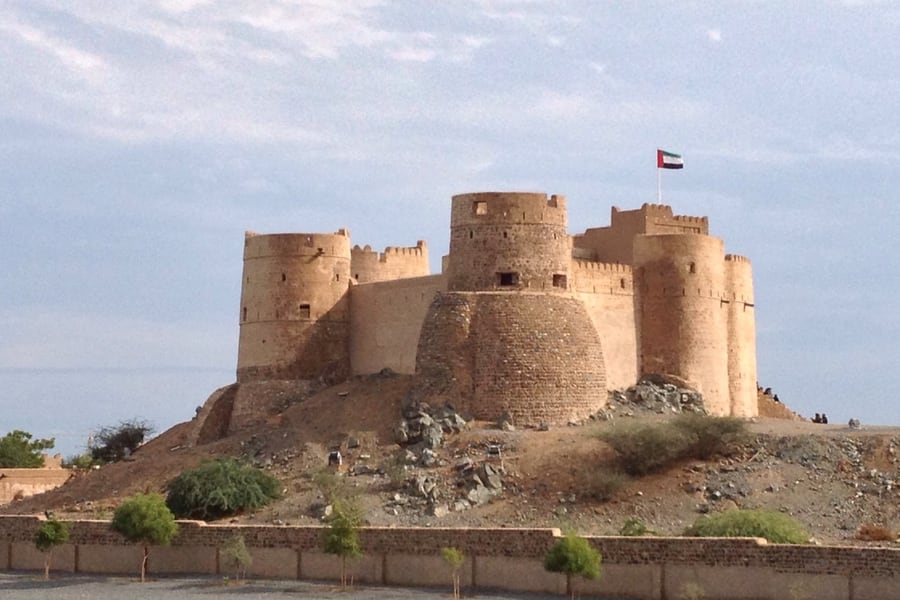
The oldest fort in the country, built of stone, mud brick and gypsum on a low mound above the old town and reckoned to date from the sixteenth century. The Portuguese took it in the 1620s; the British shelled it in 1925. Below it the restored houses of the heritage village stand among the date gardens, and the museum is a few minutes' walk away — the whole group is about ten minutes from the station.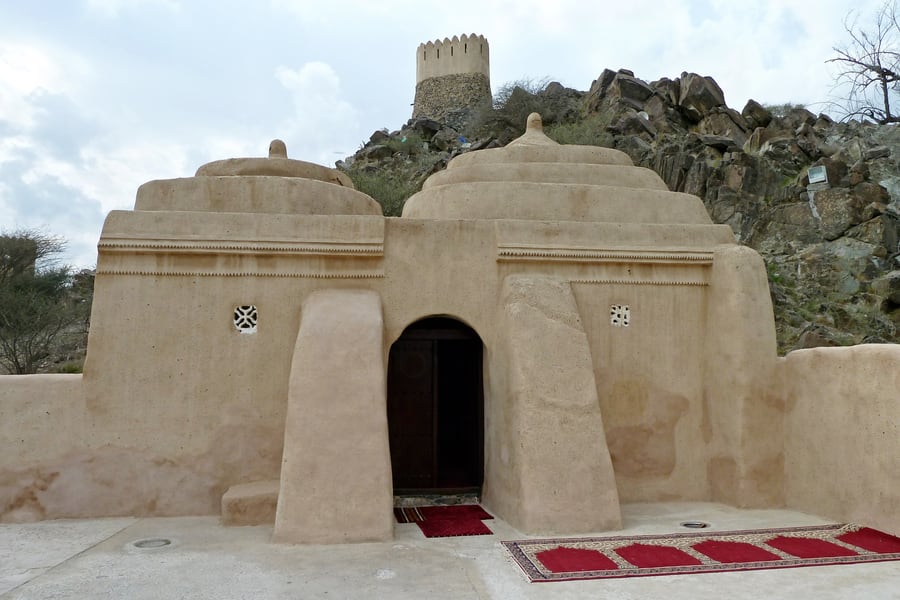 Bobak Ha'Eri / Wikimedia Commons · CC BY 3.0 · 2011 · cropped
Al-Bidyah Mosque
Forty minutes up the coast, the oldest mosque in the United Arab Emirates — four low domes over a single pillar, built of stone and mud brick and dated to around 1446. It is tiny, it is still in use for prayer, and the watchtowers on the ridge behind it are part of the same defended settlement. Visitors are welcome outside prayer times, dressed appropriately.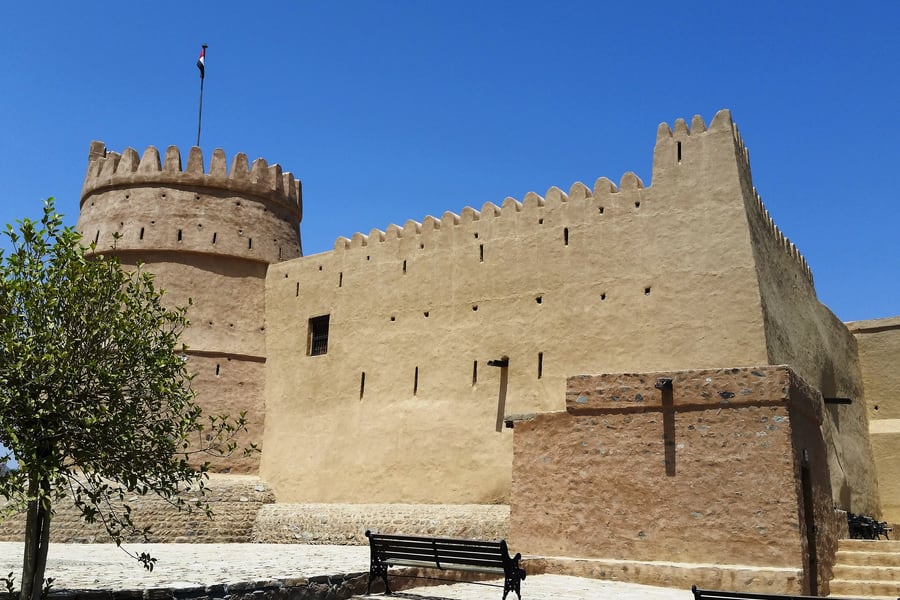 NAVEEN SHARAF A / Wikimedia Commons · CC BY-SA 4.0 · cropped
Al Bithnah Fort
Twenty minutes inland, in the Wadi Ham — the pass that has carried every road between the coast and the interior, and now carries the railway. The fort dates from about 1735 and was built precisely because whoever held this gap held the crossing. Below it the wadi still has its date gardens and its falaj channels.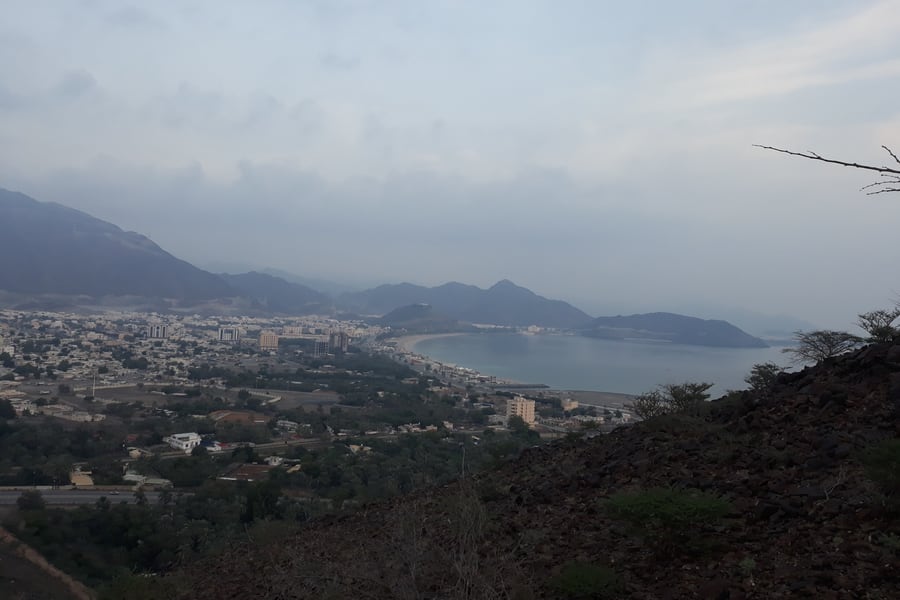 Adlus / Wikimedia Commons · CC BY-SA 4.0 · cropped
Khor Fakkan and the east coast
Half an hour north, a deep natural bay ringed by mountains — a Sharjah enclave on Fujairah's coast, and the best short trip from the terminus. The corniche runs the length of the beach, the container port works at the far end, and Al Rafisah Dam sits in the hills behind with a reservoir that turns the surrounding rock green after rain.Where to Sleep
The two ends are very different problems. Abu Dhabi Station sits out at Mohamed bin Zayed City, well south of the island, and Etihad Rail lists a shuttle transfer with pick-up points at ADNEC Center – Al Rawdah, ADNOC Headquarters – Corniche and Reem Mall – Al Reem Island, so a hotel near one of those is the least trouble. At the Fujairah end the station is a few minutes from the city centre, but the resorts are strung along the coast north of it at Al Aqah and Dibba, thirty to forty minutes by road — worth it for the beach and the diving, less so for a single night.
Both stations have parking — the operator suggests booking it through the app — and both have cafés, restaurants and shops inside the concourse.
Where to stay
Premier Inn Abu Dhabi Capital Centre
Opposite ADNEC, which is one of the train's own shuttle points
A plain business hotel 700 m from the exhibition centre, with a pool, a gym and basement parking.
Check Availability (opens in a new tab, on premierinn.com)via premierinn.comFujairah Rotana Resort & Spa
Al Aqah Beach, half an hour north of the terminus
249 rooms with balconies on 200 metres of private beach, a kilometre from Snoopy Island.
Check Availability (opens in a new tab, on rotana.com)via rotana.comRadisson Blu Resort, Fujairah
On the Dibba stretch of the coast, at the northern end
257 sea-facing rooms on 500 metres of beach, with a dive centre and five outdoor pools.
Check Availability (opens in a new tab, on radissonhotels.com)via radissonhotels.comQuestions or corrections
Planning this trip and stuck on something, or spotted a time, fare or detail that has changed? Send us a message about Abu Dhabi to Fujairah. We read every one, and we update this page when something has changed.