Adler to Roza Khutor
Leonrid / Wikimedia Commons · CC BY-SA 3.0 · cropped
- Distance48 km
- Duration30 to 34 minutes
- Best seasonYear-round
Introduction
Russia's shortest great railway journey takes half an hour. It starts at Adler, a seaside district of Sochi where the platforms are a few minutes' walk from a subtropical beach, and it ends at a buffer stop 575 metres up in the Caucasus, beside a ski resort. Between the two the train runs the length of the Mzymta gorge on a corridor that was bored, bridged and blasted into the mountainside in four years, and that was reported at the time as the most expensive single object of the whole 2014 Winter Olympics programme.
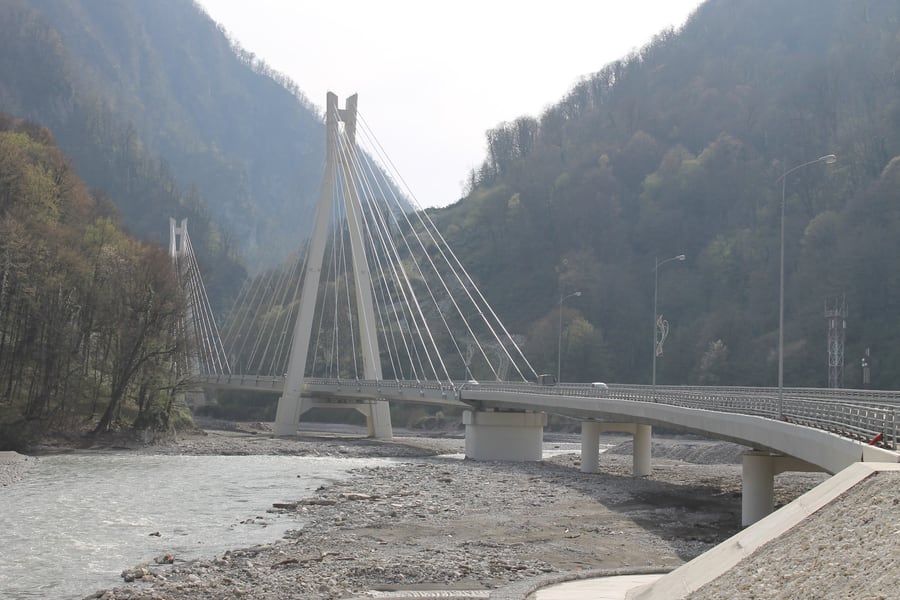
The line is 48 kilometres long and it has exactly one intermediate station. That is the measure of what it was for: not to serve the valley, but to move spectators from the coastal cluster — skating rinks, the Fisht stadium, the airport — to the mountain cluster at Krasnaya Polyana, at a rate of up to 8,500 an hour. Fourteen tunnels were driven, of which 10.3 kilometres carry the railway; thirty-seven railway bridges and viaducts were thrown across the river as the road and the rails braided past each other up the valley.
When the Games ended the traffic collapsed, the trains were halved within ten months, and for a while it looked as though the whole corridor would be written off. It was not. What runs today is an ordinary suburban service, eight departures each way, worked by the German-built ЭС1 «Ласточка» sets that were flown in for the Olympics and never left — and the ride, through a gorge most of Europe has never heard of, costs ₽300.
The Journey
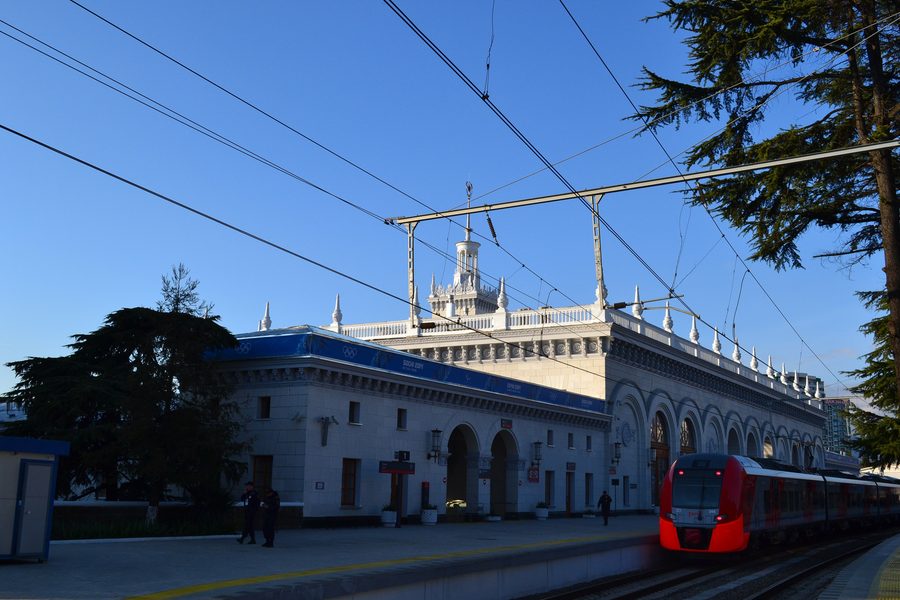
Adler station was rebuilt for the Games and reopened on 28 October 2013, a week before the mountain line itself: a long curved roof over five platforms, with the Black Sea behind it and the taxis outside going to the airport. Everything for Krasnaya Polyana leaves from here. The train is an ЭС1 «Ласточка» — five cars, red and grey, wide doors, luggage racks that fill up with skis between December and April and with nothing at all in July.
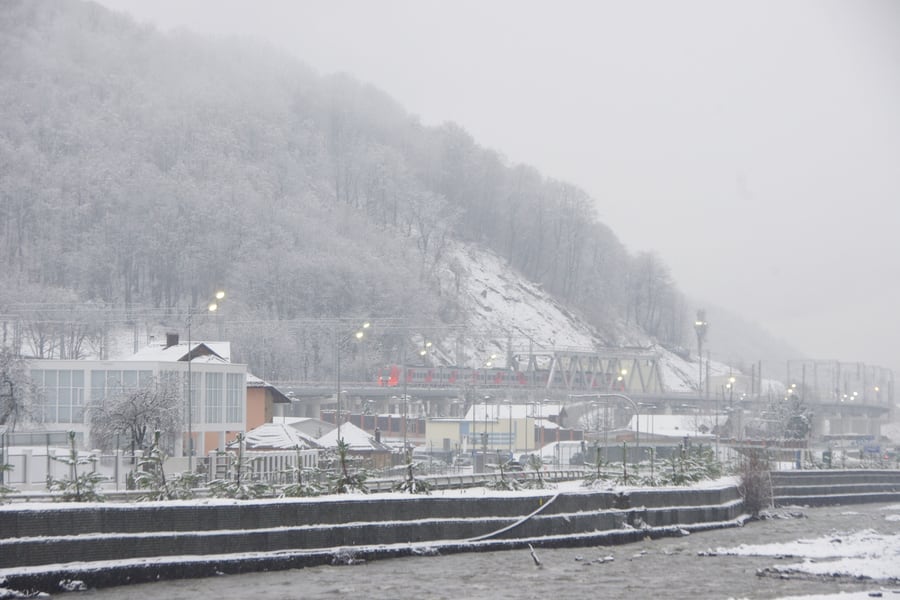
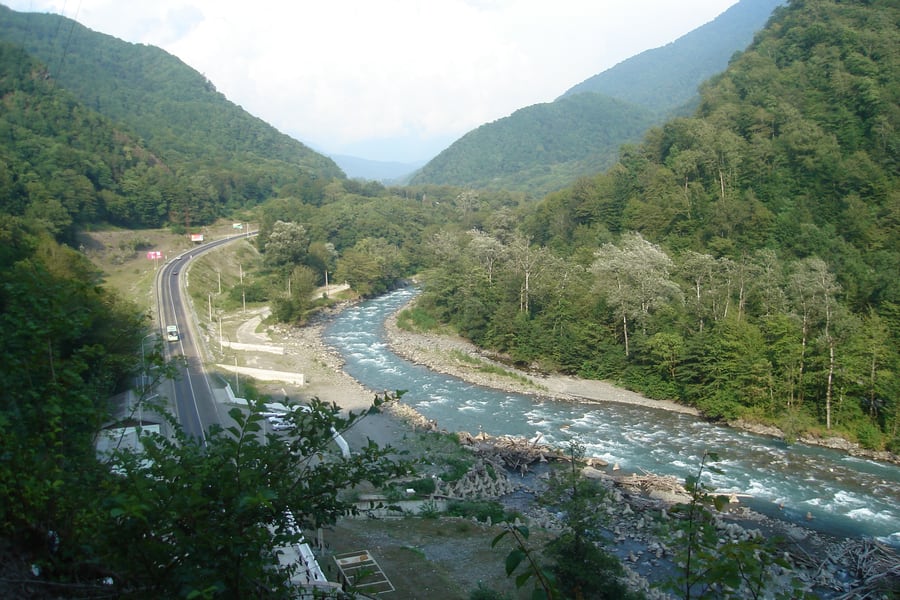
It leaves the coast almost at once. The main line to Abkhazia carries straight on; the mountain line swings left, crosses the Mzymta, and begins to climb the north bank of the river. Within ten minutes the sea has gone and the valley has closed in, and the train is running on a ledge above grey glacial water with the new Krasnaya Polyana highway on concrete legs somewhere on the other side. Road and railway change banks repeatedly on the way up — thirty-seven railway bridges and viaducts were built for 48 kilometres of route, and from the window the effect is of two lines of traffic braiding past each other between rock faces.
Fourteen tunnels and a limestone canyon
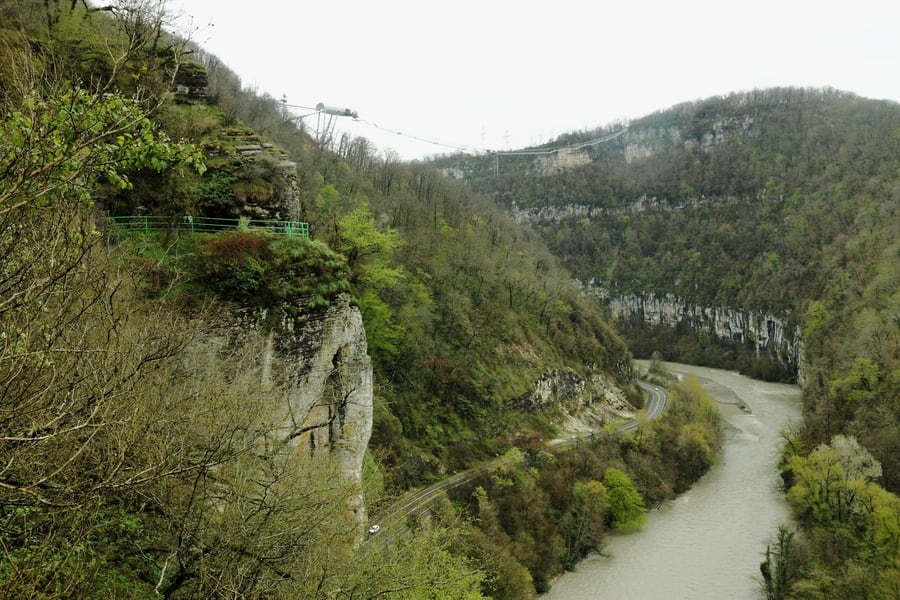
The hard part is the Akhshtyr gorge, roughly a third of the way up, where the Mzymta has cut a canyon through limestone and there is no shelf to build on. The answer was tunnel complex No. 1: a railway bore of 2,475 metres driven alongside a 2,330-metre service adit and a separate 2,287-metre road tunnel. It is the first of six complexes and fourteen tunnels on the corridor, 26.5 kilometres of them in total, of which 10.3 kilometres are railway. The longest railway bore is 4,565 metres, in complex No. 3. Tunnelling began in 2009 and the first breakthrough was celebrated on 10 December 2010, when the guests arrived at the portal over the first fifteen kilometres of track to be laid.
What the passenger sees of all this is a rhythm: two or three minutes of gorge, a bridge, a blink of daylight, then the long dark of a bore with the lights of the parallel road tunnel occasionally visible where the two run close. It is the opposite of a scenic mountain railway in the Alpine sense — no spirals, no hairpins, no viewing gallery — because the line was built for capacity rather than for the view. The view is still worth having; there is simply less of it than the map suggests.
Esto-Sadok, and the buffer stops
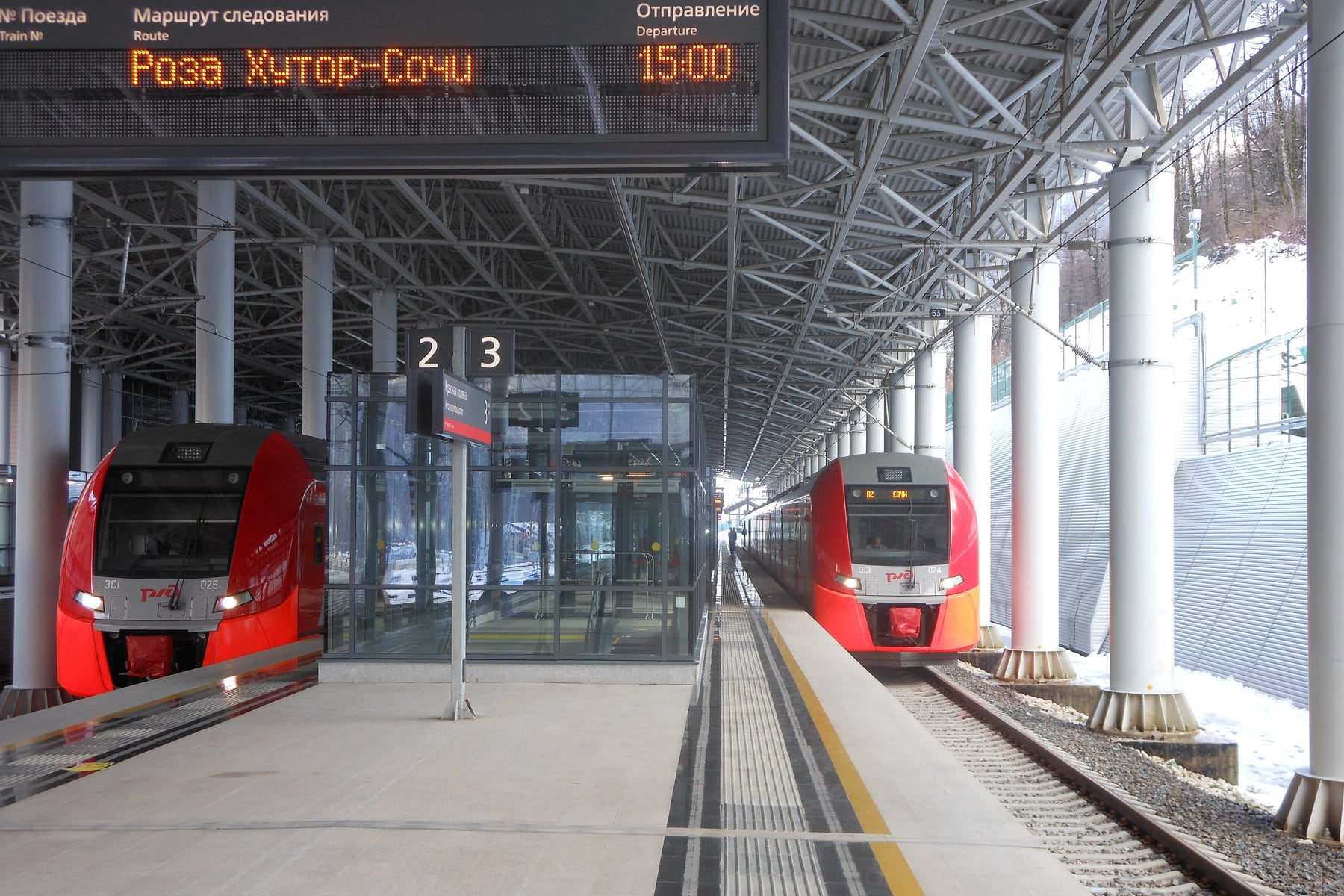
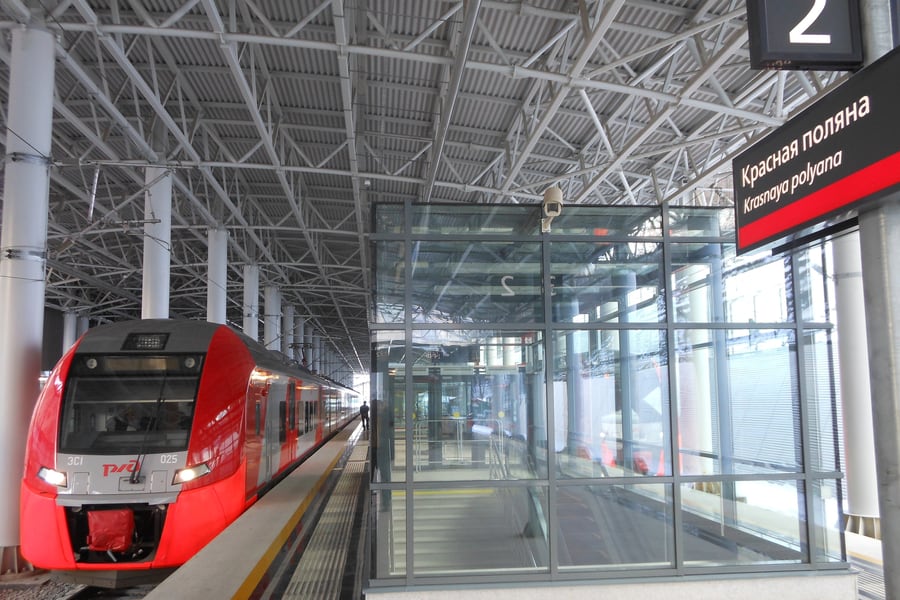
There is one stop, twenty-four minutes out. Esto-Sadok opened in 2012 and its station building is shaped like a mountain ridge, lit from inside the plane of the roof; it stands at the foot of the lifts to the RusSki Gorki ski-jumping centre, and it serves the Krasnaya Polyana resort on the terraces above. Five minutes later the train runs into Roza Khutor and stops for good. It is a dead-end station — a single island platform 300 metres long and 25 metres wide, three pedestrian subways under the tracks, turnstiles at the barrier, and the resort's first footbridge over the Mzymta a two-minute walk beyond it.
The station has had three names in about as many years. It was to have been Alpika-Servis, after the ski area at the head of the valley; it opened in 2013 as Krasnaya Polyana, the name of the settlement; and on 27 October 2014 it became Roza Khutor, to match the resort whose gondolas start across the river. For a while the two names ran side by side — the departure board over platform 3 was already calling it Roza Khutor while the sign on platform 2 still read Красная поляна. On a railway barely more than a decade old, that overlap is the closest thing it has to history.
Along the route
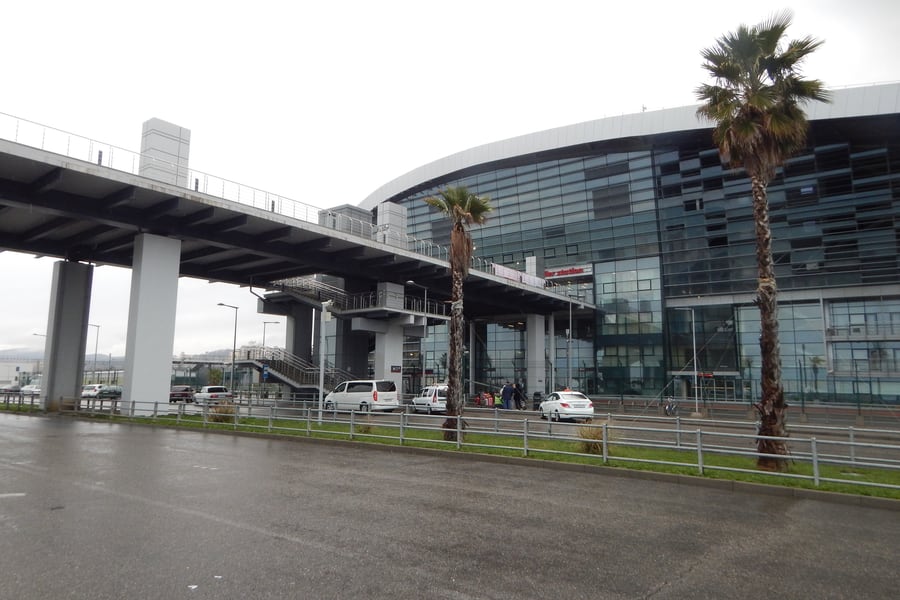 Voltmetro / Wikimedia Commons · CC BY-SA 4.0 · cropped
Out of Adler
The station was rebuilt for the Games and reopened on 28 October 2013, a week before the mountain line. Trains leave the coast at once: the Abkhazia main line carries on south, the branch swings left over the Mzymta and starts to climb.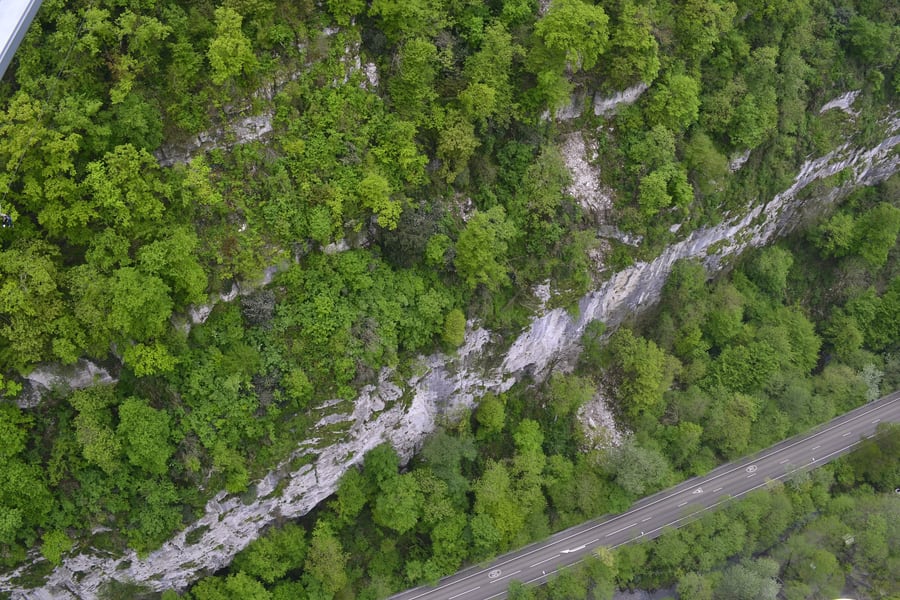 SoviaVesna / Wikimedia Commons · CC BY 4.0 · cropped
The Akhshtyr gorge
A third of the way up, the limestone closes in and the railway goes underground for 2,475 metres. It is the first of six tunnel complexes; the longest railway bore on the line, in complex No. 3, runs to 4,565 metres.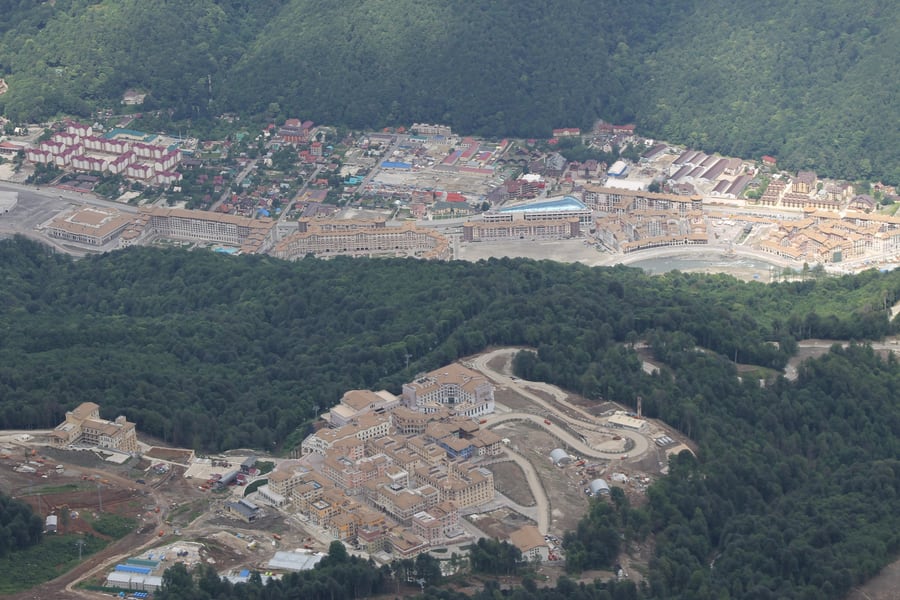 Sergei Kazantsev / Wikimedia Commons · CC BY-SA 3.0 · cropped
Esto-Sadok, the only stop
Twenty-four minutes out and the sole intermediate station, opened in 2012 with a roof shaped like a mountain ridge. Gondolas climb from beside it to the Krasnaya Polyana resort's terraces at 540 and 960 metres.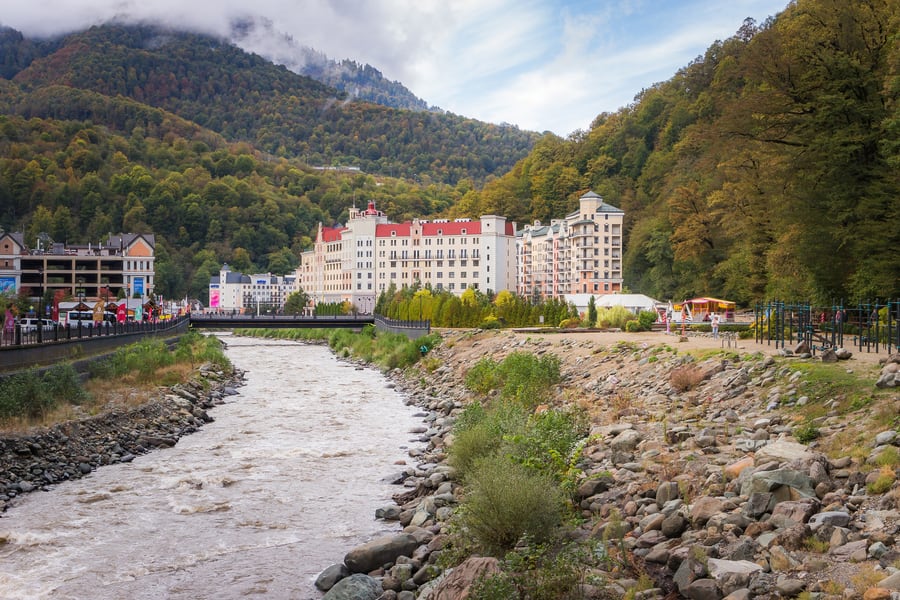 Alexander Novikov / Wikimedia Commons · CC BY-SA 4.0 · cropped
Roza Khutor
Five minutes more and the track ends. A single island platform 300 metres long, three subways, turnstiles — and the resort's footbridge over the Mzymta two minutes beyond the barrier.A bit of history
Culture & experiences along the way
 Bok / Wikimedia Commons · CC BY-SA 4.0 · cropped
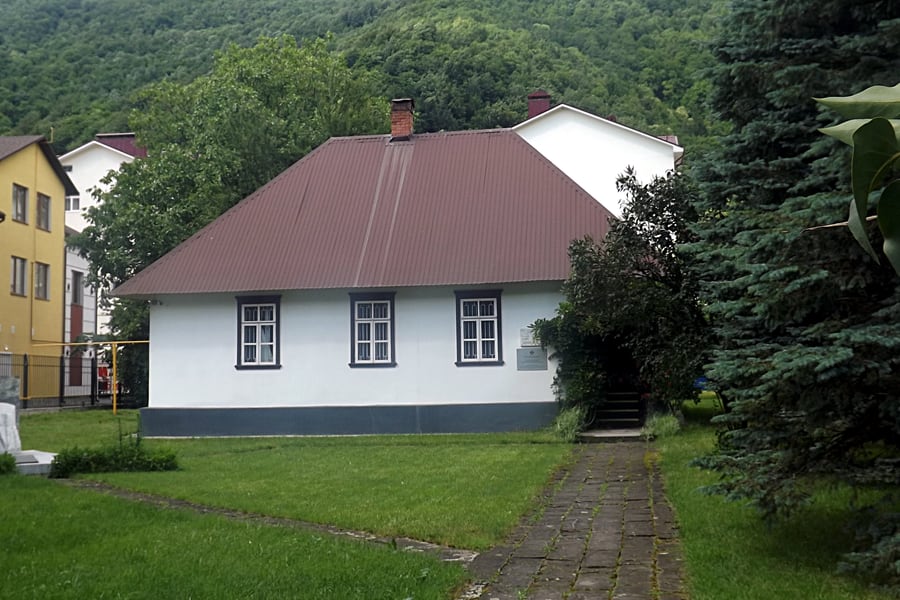
The Estonian orchard
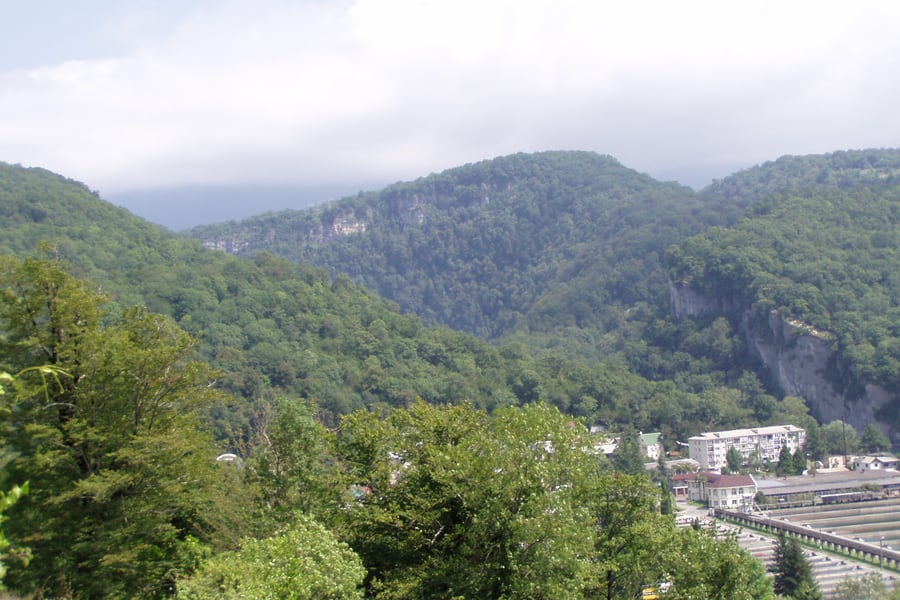
Esto-Sadok is not a resort invention. Thirty-six Estonian settler families founded it in 1886 as posyolok Estonsky, and it took its present name at a village meeting on 29 December 1912. The house where Anton Hansen Tammsaare — Estonia's great novelist — spent a few months is a museum, opened on 13 September 2008 with money from Tallinn.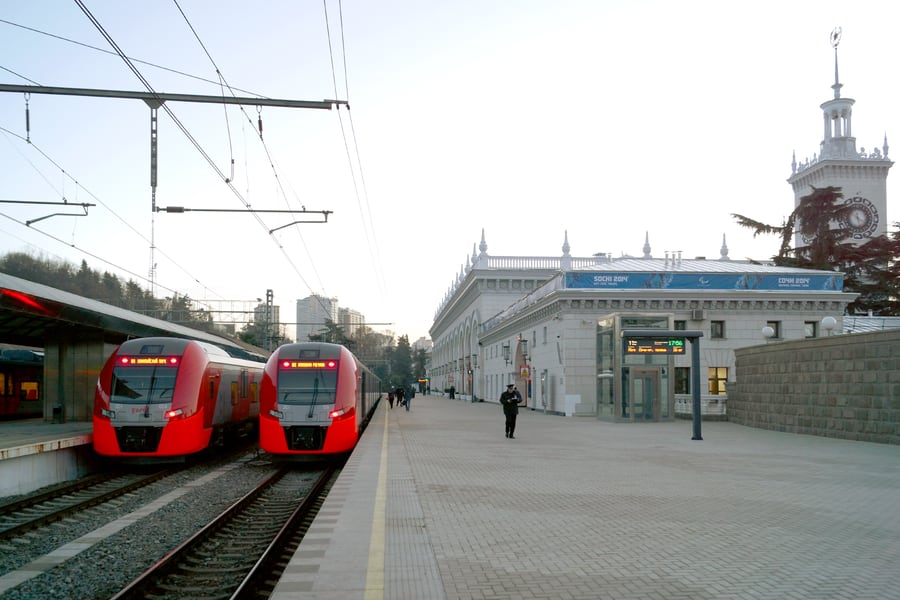 Дмитрий Селивёрстов / Wikimedia Commons · CC BY-SA 3.0 · cropped
Riding a Desiro to the mountains
The train is the story here. Russian Railways signed with Siemens on 30 July 2009 for Desiro RUS sets; 38 five-car trains were built in Germany and shipped to Sochi for the Games at a cost of €410 million, and a depot was put up at Adler to keep them. Twenty are still based there, and they are what you ride up the gorge.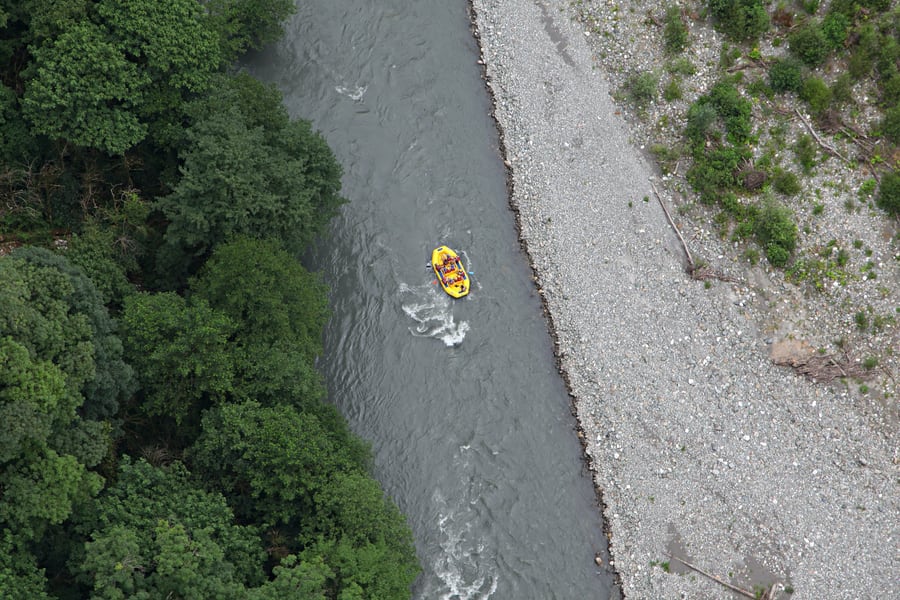 KpokeJlJla / Wikimedia Commons · CC BY-SA 4.0 · cropped
Rafting the Mzymta
The river the line follows is run commercially through the lower gorge, below the reach the train tunnels through. It is snowmelt off the Caucasus, so it is fast and cold, and it is the one way to see the corridor from underneath — bridge soffits, tunnel portals and the motorway on its legs, all at water level.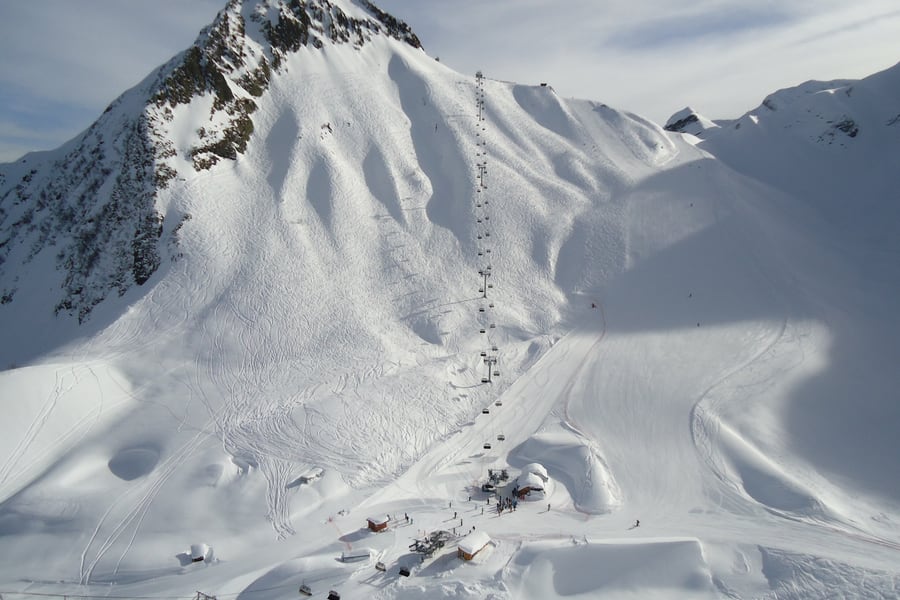 Sergei Kazantsev / Wikimedia Commons · CC BY-SA 3.0 · cropped
Snow above a subtropical coast
Nothing else on this site puts a beach and a black run half an hour apart. The Aibga ridge holds snow from December into April while the palms outside Adler station never see any, and Roza Khutor alone counts 105 kilometres of piste — with two more resorts on the terraces above Esto-Sadok, one station down.Timetables
Eight trains a day run up from Adler and eight come back down, every day of the year. All but one are suburban elektrichki worked by ЭС1 «Ласточка» sets: you walk up, buy a ticket and get on, and there is no reservation and no allocated seat. The one exception is 815С/816С, a long-distance Lastochka that starts at Krasnodar-1 and runs the whole Black Sea coast before turning up the valley — that one is sold by the seat.
Up: Adler → Roza Khutor
| Train | From | Dep. Adler | Arr. Roza Khutor | Time |
|---|---|---|---|---|
| 6101 | Lazarevskaya | 07:49 | 08:19 | 30 min |
| 6103 | Sochi | 09:10 | 09:42 | 32 min |
| 6114/6113 | Sochi Airport | 11:58 | 12:30 | 32 min |
| 815С | Krasnodar-1 | 12:12 | 12:45 | 33 min |
| 6105 | Sochi | 12:33 | 13:06 | 33 min |
| 6107 | Sochi | 15:35 | 16:07 | 32 min |
| 6109 | Sochi | 18:32 | 19:04 | 32 min |
| 6115 | Sochi | 19:56 | 20:28 | 32 min |
Down: Roza Khutor → Adler
| Train | To | Dep. Roza Khutor | Arr. Adler | Time |
|---|---|---|---|---|
| 6116 | Sochi | 08:56 | 09:29 | 33 min |
| 6104 | Sochi | 10:25 | 10:58 | 33 min |
| 6106 | Sochi | 15:11 | 15:45 | 34 min |
| 6108 | Sochi | 16:31 | 17:04 | 33 min |
| 816С | Krasnodar-1 | 16:50 | 17:23 | 33 min |
| 6112 | Sochi | 17:58 | 18:31 | 33 min |
| 6110 | Sochi | 19:30 | 20:03 | 33 min |
| 6120/6119 | Sochi Airport | 21:19 | 21:50 | 31 min |
Every train calls at Esto-Sadok, twenty-four minutes out of Adler and five minutes short of the terminus — there is nowhere else to stop. Two workings are worth singling out. 6114/6113 and 6120/6119 run through to and from Sochi Airport, which makes the resort reachable from the arrivals hall without a taxi; and 815С is a through train from Krasnodar, 5 h 36 min for the whole 07:09 → 12:45 run, which at the time of writing was advertised as daily only to the end of September.
The trains run to this pattern the year round. The board shown for a January date in the ski season is the same eight departures as the board for a September one, so do not assume extra services in winter without checking: the operator publishes changes as they are made, and a peak-season timetable is announced rather than standing.
Times as of September 2026, taken from the live board for the Adler–Roza Khutor pair. The operator is АО «Кубань Экспресс-Пригород» (opens in a new tab), which orders the service; the trains themselves are run by Russian Railways' Southern High-Speed Directorate on its behalf.
Tickets
Suburban fares here are charged by zone, not by distance, and the operator publishes the table. Adler to Roza Khutor is zone 5, which is ₽300 one way at the full tariff and ₽150 at the concessionary one; children under seven travel free. A bicycle or an outsize bag is ₽22 a zone and an animal ₽13, so skis and a dog cost rather less than the fare itself. Tickets come from the machines and windows at Adler, Esto-Sadok and Roza Khutor, all three of which are gated with turnstiles.
The one train that does not work this way is the Krasnodar service, 815С and 816С. It is a long-distance working sold by the seat through Russian Railways, so it is bought like any other reserved-seat ticket and costs more than ₽300 for the same thirty-three minutes. It is worth having only if you are joining or leaving it further down the coast.
Book your tickets
Leonrid / Wikimedia Commons · CC BY-SA 3.0 · croppedSuburban single, Adler to Roza Khutor
Zone 5, walk up
The operator's own zone table puts the whole branch in zone 5 — ₽300 full, ₽150 concessionary, free under seven.
Book Tickets (opens in a new tab, on kep23.ru)via kep23.ruArtem Svetlov / Wikimedia Commons · CC BY 2.0 · croppedSkis, a bicycle or a dog
Charged by the zone as well
A bicycle or an outsize bag is ₽22 a zone and an animal ₽13, so the extras cost a fraction of the fare.
Book Tickets (opens in a new tab, on kep23.ru)via kep23.ruKemal KOZBAEV / Wikimedia Commons · CC BY-SA 3.0 · croppedThe through train from Krasnodar
815С/816С, reserved seat
A long-distance Lastochka sold by the seat, which runs the whole coast before turning up the valley.
viaRail Passes
No international rail pass is valid here. Interrail and Eurail sell travel in 33 European countries and Russia is not one of them; the Russian network has never been part of the scheme, and a Global Pass bought for a European trip buys nothing at the Adler barrier. Nor does Russian Railways sell a national pass — РЖД Бонус is a points scheme on long-distance tickets, not a travel pass.
What exists is local and aimed at commuters. АО «Кубань Экспресс-Пригород» sells season tickets — abonementnye bilety — loaded onto a contactless card and tied to one route, in five shapes: every day, working days only, weekends only, a named list of 5 to 16 dates inside a calendar month, and a straight book of journeys (10 or 20 rides in 30 days). They are sold at the company's own ticket offices, and both Roza Khutor and Esto-Sadok have one, as does Sochi.
⚠️ For a visitor they are almost never worth it. The monthly "every day" ticket is priced for somebody making fifty journeys; two singles up and down the valley come to ₽600, and the book-of-journeys card only starts to pay if you are going to ride the line five times or more on the same stretch. If you are staying at Roza Khutor for a week and commuting down to the coast every day, ask at the station office; otherwise buy singles.
As of September 2026. Season-ticket shapes and the ticket-office list from АО «Кубань Экспресс-Пригород» (opens in a new tab); pass coverage checked against Interrail's own Global Pass page, which sells 33 countries and does not include Russia.
Places to Visit
Two stations serve the whole of Krasnaya Polyana, and almost everything worth seeing is within a gondola ride of one of them. The valley holds three linked resorts, a ski-jumping arena built for the Olympics, a bungee bridge over a 200-metre drop and a cave that was occupied in the Palaeolithic — and above all of it, the northern wall of the Caucasus.
⚠️ Most of the land either side of the line belongs to the Sochi National Park — 214,098 hectares of the southern slope of the Greater Caucasus, with 95 of its animals in Russia's Red Book. Entry to its recreation sites needs a ticket or a permit, which the park sells online (opens in a new tab) and emails to you. Buy it before you set out rather than at the gate.
 Alexxx1979 / Wikimedia Commons · CC BY-SA 4.0 · cropped
Roza Khutor
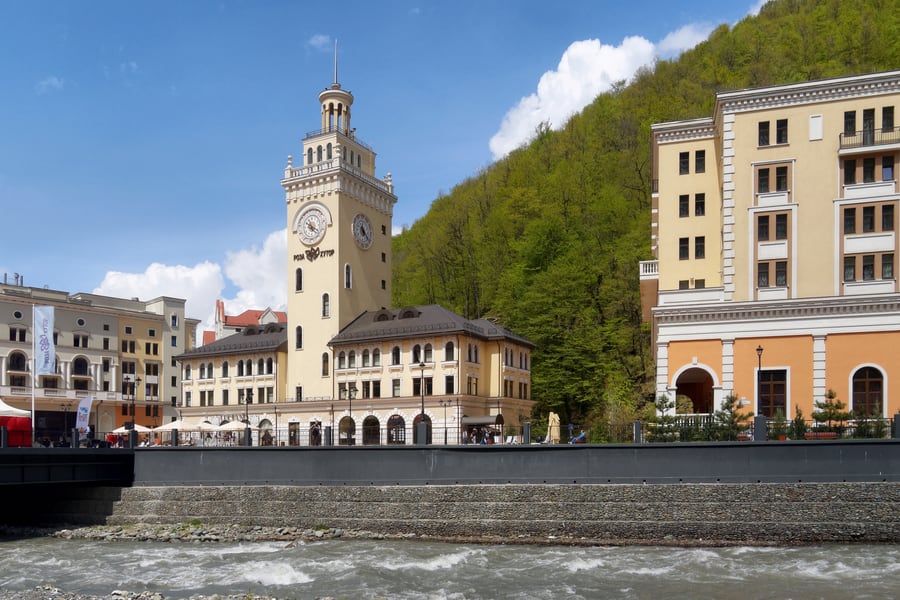
The resort the station is named for, and the reason the line still runs. It climbs the Aibga ridge from the Mzymta at 575 metres to 2,509 metres at Kamenny Stolb, over about 1,820 hectares, with 32 cable cars and 105 kilometres of piste. It held the Olympic alpine skiing, snowboard and freestyle events in February 2014. The village along the river below — embankment, clock tower, footbridges — starts at the end of the platform.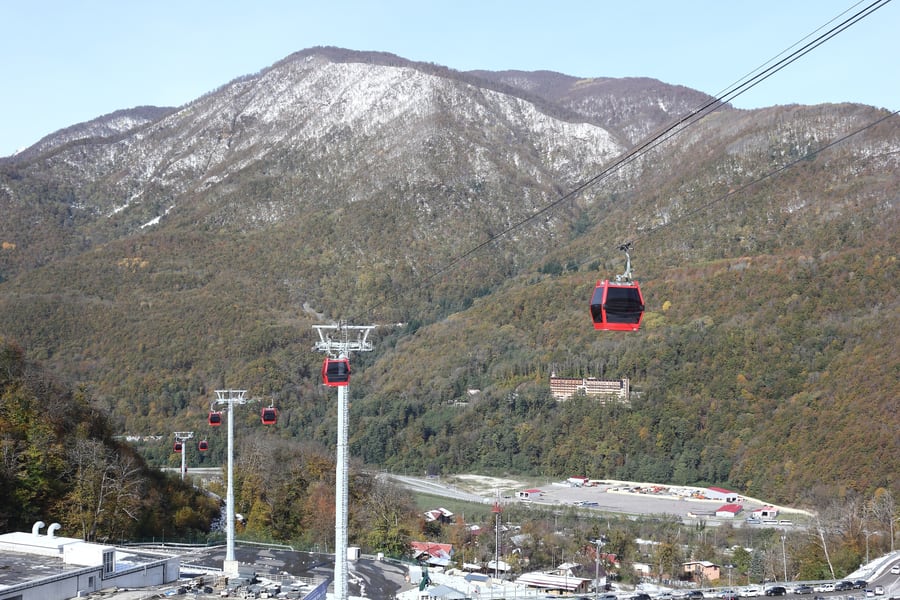 SKas / Wikimedia Commons · CC BY-SA 4.0 · cropped
The cable cars above Esto-Sadok
Two of the three resorts in the valley are reached not on foot but by gondola, and the lower stations are within sight of Esto-Sadok's platform. They lift you to shelves at 540 and 960 metres and on up the ridge from there — which is how a station at the bottom of a gorge serves a ski area two kilometres above the sea.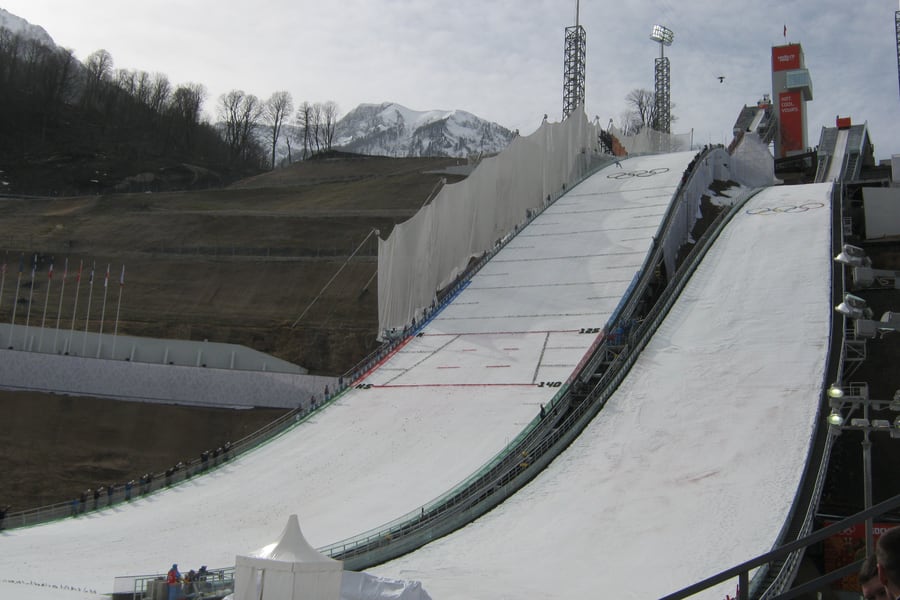 Акутагава / Wikimedia Commons · CC BY-SA 3.0 · cropped
RusSki Gorki ski-jumping centre
The Olympic jumps, K-95 and K-125, on the northern slope of the Aibga ridge. The site was chosen by international experts at the junction of two ridges so that jumpers would be sheltered from crosswinds, and the name is a triple joke — russkiye gorki is what the Romance languages call a roller coaster, what Russians call an American one, and it splits into Rus and Ski.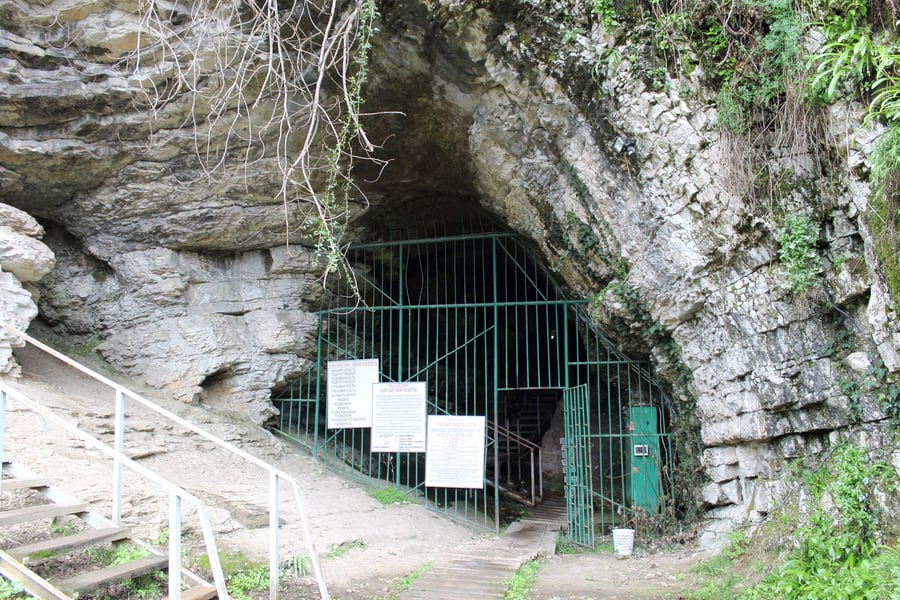 SKas / Wikimedia Commons · CC BY-SA 4.0 · cropped
The Akhshtyr cave
A limestone cave in the right wall of the gorge the railway tunnels through, its mouth 120 metres above the river. The French speleologist Édouard-Alfred Martel was shown it on 28 September 1903 by a local guide, Gavriil Revinko; it was found to have been occupied in the Palaeolithic, closed behind a grille as a protected monument in 1978, and reopened with lights and steps as a visitor site in 1999.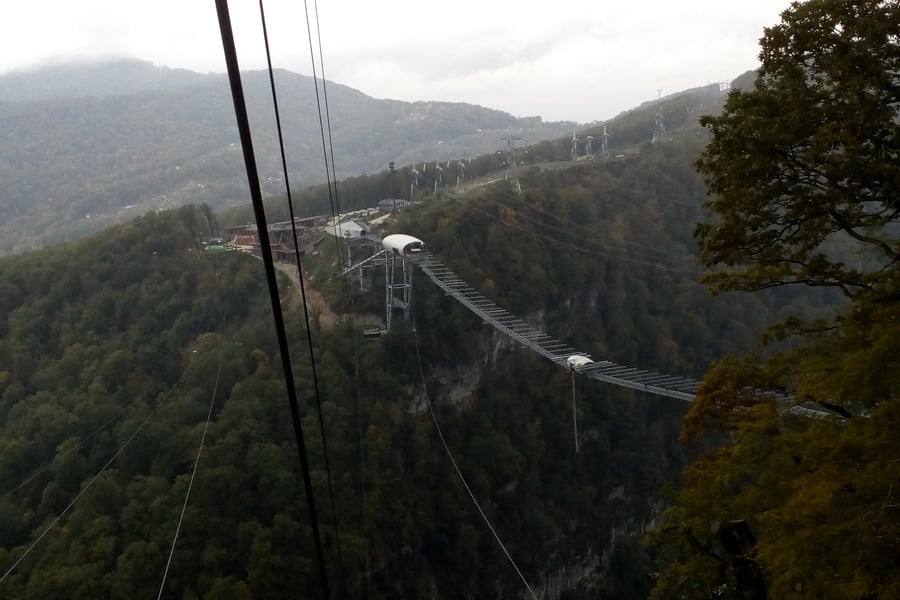 Наталья Овсянникова / Wikimedia Commons · CC BY-SA 4.0 · cropped
Skypark AJ Hackett Sochi
A suspension footbridge strung across the Akhshtyr gorge, with a 207-metre bungee jump off the middle of it, a shorter 69-metre one, a swing and a zipline. It is open daily 10:00–18:30 and it is the one place on this list the train cannot reach: it is served from the highway on the lower part of the corridor, so a bus or a taxi from Adler is the way in.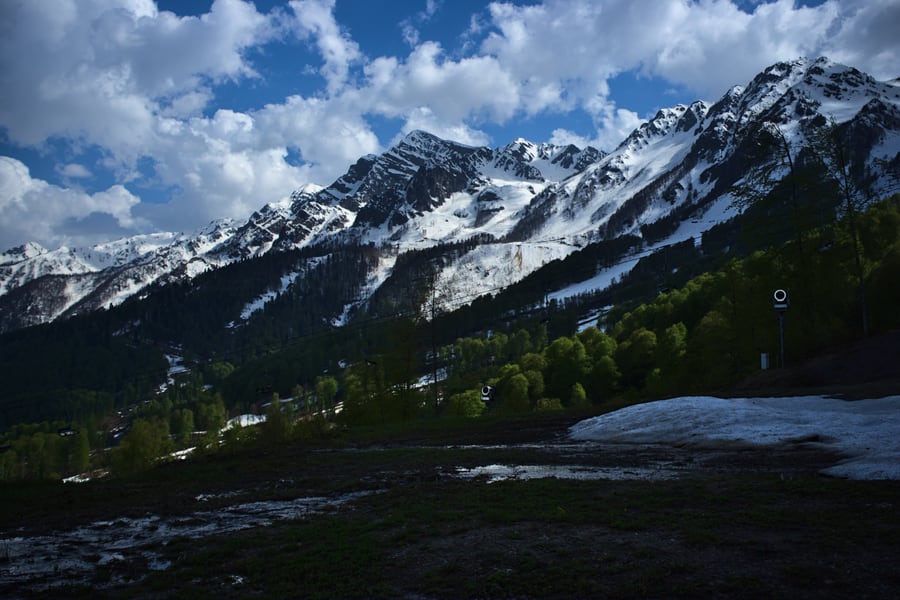 Aleksandr Zykov / Wikimedia Commons · CC BY-SA 2.0 · cropped
The Caucasus over the ridge
What you are looking at from the lifts above Roza Khutor is the edge of the Caucasus Biosphere Reserve, whose boundary runs just above Esto-Sadok: the oldest and largest protected area in the North Caucasus at more than 280,000 hectares, and since 1999 a UNESCO World Heritage site as the Western Caucasus. It descends from the Grand Ducal Kuban Hunt of 1888 and became a bison reserve on 12 May 1924.Where to Sleep
There is no shortage of beds at the top of the line — the valley was given about fourteen hotels in four years, and they all stand within walking distance of one of the two stations. The choice is really between the two terraces. Roza Khutor is the village along the Mzymta at the buffer stops, walkable from the platform in two minutes; Krasnaya Polyana resort sits above Esto-Sadok on shelves at 540 and 960 metres, reached from that station by gondola.
Staying down at Adler and riding up is perfectly workable in summer, when the trains are half empty and the sea is the point of the trip. In the ski season it is not: the first train up does not reach Roza Khutor until 08:19, which is late for a lift pass.
Where to stay
Rosa Springs
Roza Khutor village, by the river
A spa hotel in the resort village at the end of the line, with thermal pools and a wellness programme, a few minutes' walk from the platform.
Check Availability (opens in a new tab, on rosakhutor.ru)via rosakhutor.ruRiders Lodge
The cheap bunk at Roza Khutor
The resort's budget house, built for people who came to ride rather than to be looked after, with shared rooms as well as private ones.
Check Availability (opens in a new tab, on rosakhutor.ru)via rosakhutor.ruPanorama by Mercure Krasnaya Polyana
Polyana 960, above Esto-Sadok
On the upper terrace of the Krasnaya Polyana resort, reached by gondola from the line's only intermediate station, with a pool complex and a thermal zone.
Check Availability (opens in a new tab, on krasnayapolyanaresort.ru)via krasnayapolyanaresort.ruQuestions or corrections
Planning this trip and stuck on something, or spotted a time, fare or detail that has changed? Send us a message about Adler to Roza Khutor. We read every one, and we update this page when something has changed.