The Ahr Valley Railway
Tohma / Wikimedia Commons · CC BY-SA 4.0 · cropped
- Distance29 km, Remagen to Ahrbrück · 13 stations
- DurationAbout 45 minutes from Remagen, 70 from Bonn · two trains an hour
- Best seasonAll year · spring to autumn for the vineyards and the red-wine trail
Introduction
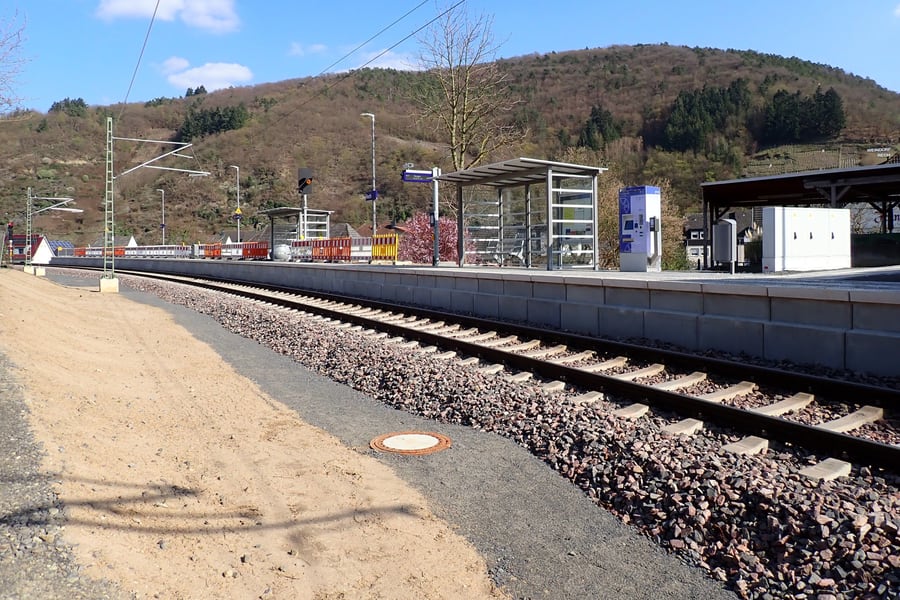
When the railway up the Ahr valley was rebuilt, it was built against the river. On the night of 14 to 15 July 2021 the Ahr flooded and destroyed most of the line above Walporzheim: track, embankments, stations and bridges. Deutsche Bahn's brief for the new one was that it should stand up to the next flood. Where the line crosses the river, the new bridges were designed with no pier standing in the water, so a flood meets as little of them as possible; nine of them span the Ahr in a single steel structure of 61 to 75 metres. At Heimersheim, where the old station sat at a narrowing of the river, the stop was moved 700 metres downstream.
The line reopened all the way to Ahrbrück on 14 December 2025, after four years and about €590 million, and for the first time it runs under electric wires. It leaves the Rhine at Remagen and climbs 29 kilometres through Bad Neuenahr, the walled town of Ahrweiler and the red-wine villages of Dernau, Rech and Mayschoß, where the valley narrows to rock and terraced vineyards, to Altenahr under its ruined castle.
Two lines share the track: the RB 30, which starts in Bonn, and the RB 32 from Remagen. Between them they run two trains an hour, and the ride from Remagen takes about 45 minutes. It is an ordinary regional train: no reservation, no supplement, and a Deutschlandticket covers it.
The Journey
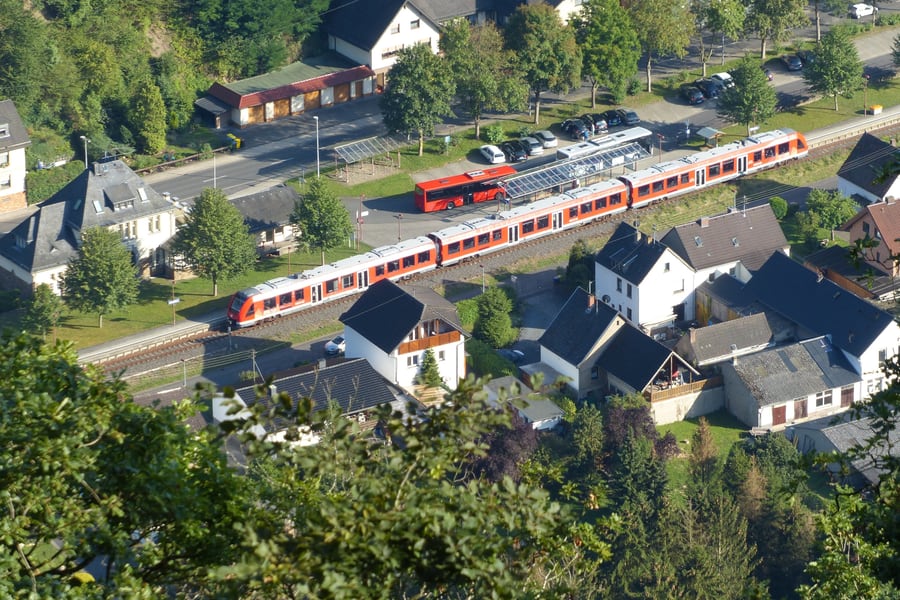
Remagen is a station on the left bank of the Rhine, on the main line between Cologne and Koblenz. The Ahr valley trains turn west, away from the river, through Bad Bodendorf and the new stop at Heimersheim/Lohrsdorf, opened in December 2024 to replace the old Heimersheim station. Bad Neuenahr is the spa town, with its Kurpark beside the Ahr. Two stops later, Ahrweiler Markt is the stop for the walled old town.
Into the vineyards
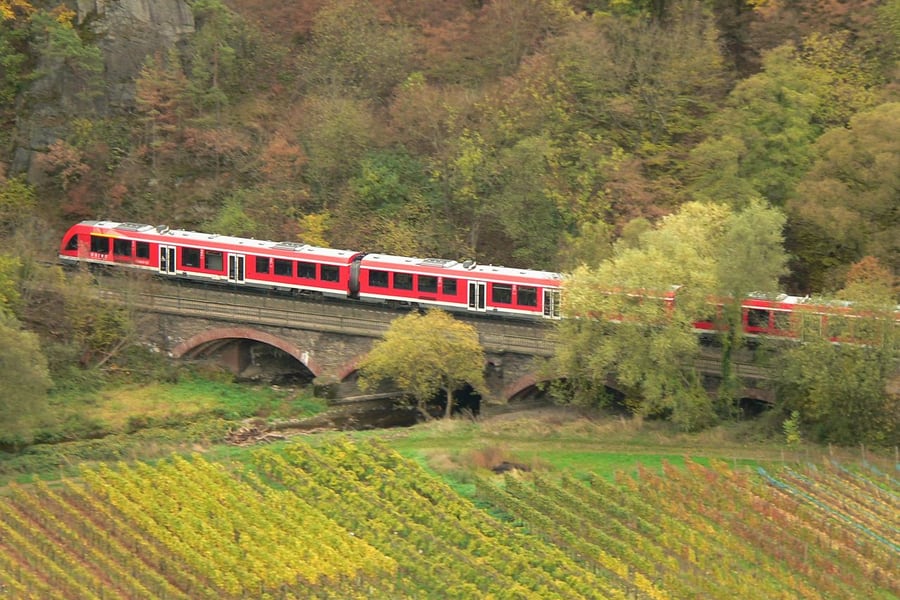
After Walporzheim the valley closes in. The train passes the Bunte Kuh rock and the former convent of Marienthal, crosses and recrosses the river, and reaches Dernau, Rech and Mayschoß, villages that live from red wine, with vineyards climbing the slopes above the line. This is the stretch the flood destroyed. Between Walporzheim and Ahrbrück the last 14 kilometres were rebuilt almost as a new railway: 15 new bridges, 7 repaired, five tunnels renovated and enlarged for the overhead line, and the stations rebuilt. The last bridge, at Pützfeld, 64 metres long, was slid into place over the Ahr in July 2025.
Altenahr is the line's great view: the castle ruin of Burg Are on its rock above the village, and the river bending under it. Kreuzberg follows, and then Ahrbrück, where the line now ends. It once went on to Adenau, but that end closed in stages, in 1985 and 1999.
A line with a strategic past
The railway opened from Remagen to Ahrweiler in 1880, to Altenahr in 1886 and to Adenau in 1888. Before the First World War it was given a strategic role: a second track was laid from 1910, and in 1918 the Ludendorff Bridge at Remagen linked it across the Rhine. A further strategic line from the north was begun towards the valley and never finished; its tunnels later held the federal government's nuclear bunker. After 1945 the second track was taken up as reparations, and between Rech and Altenahr its bed is now a cycle path.
The trains
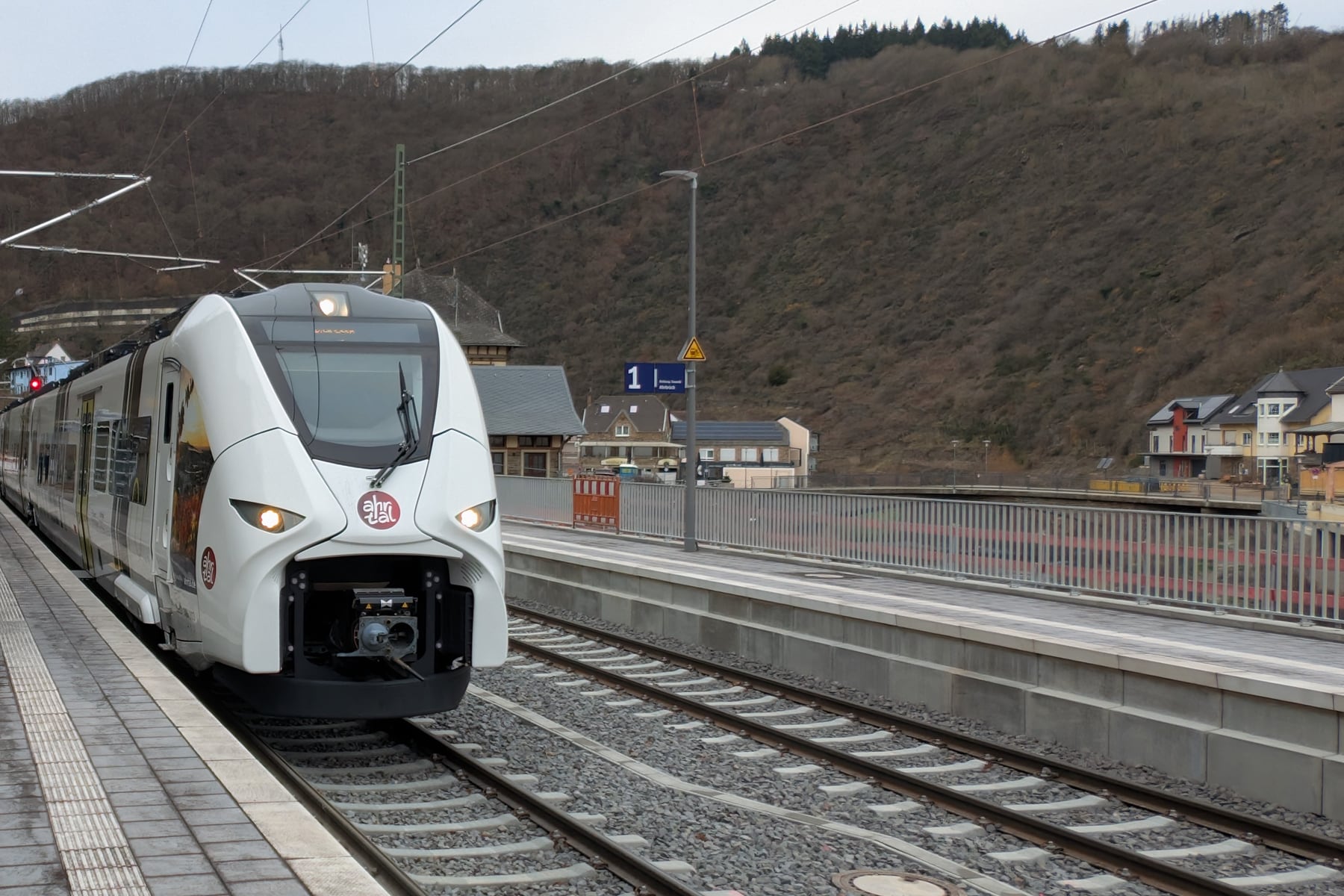
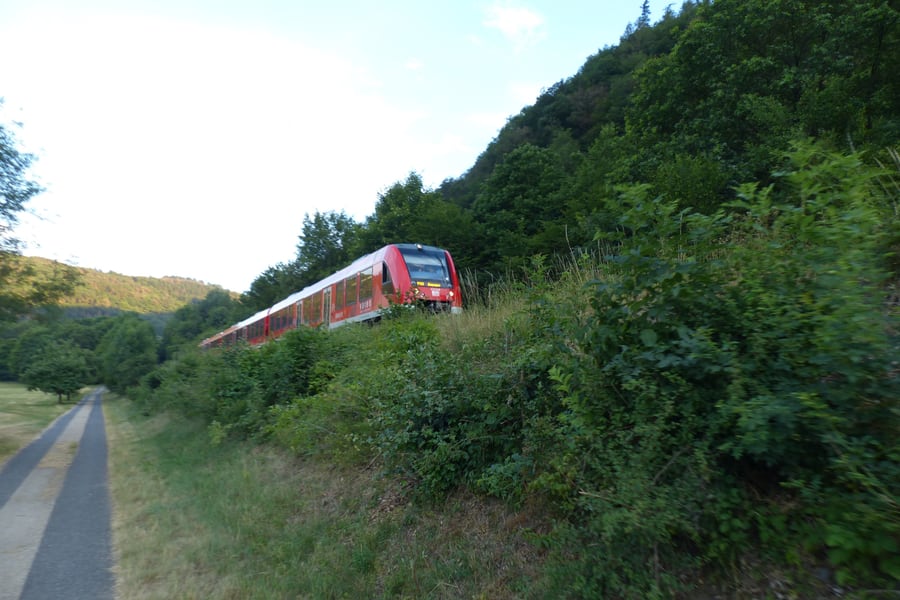
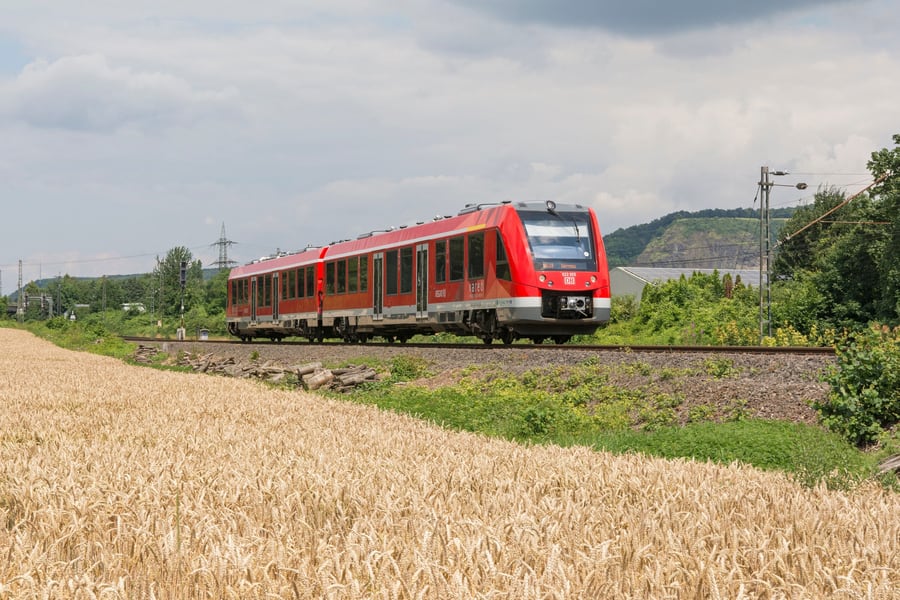
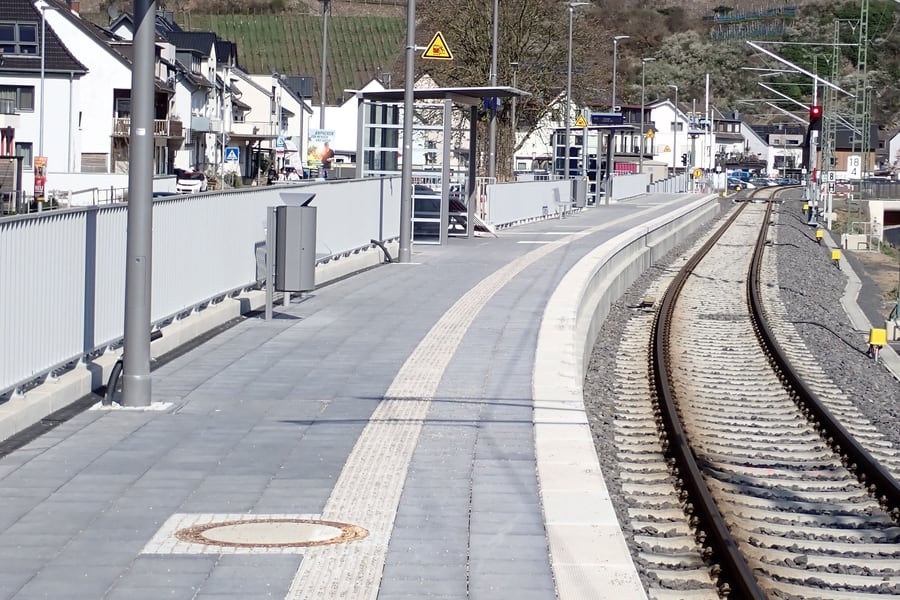
The valley's trains used to be diesel railcars. Now there are two electric types. Trans Regio runs the RB 32 with Siemens Mireo units, some of them in a livery advertising the Ahrtal, and DB Regio runs the RB 30 with Bombardier Talent 2 units, from March 2026. By the reopening every one of the 13 stations between Remagen and Ahrbrück had step-free access, except one platform at Ahrweiler Markt.
Along the route
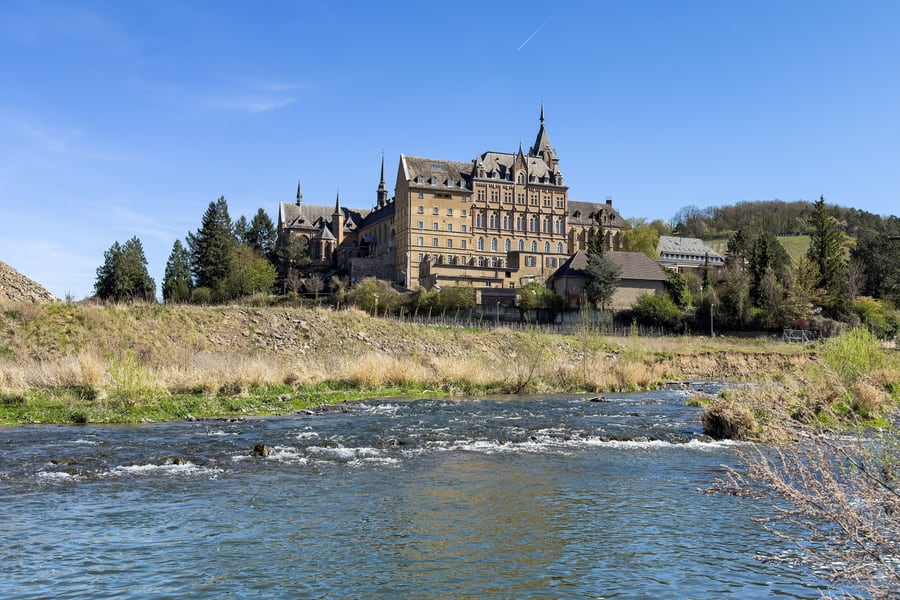 Steffen Schmitz / Wikimedia Commons · CC BY-SA 4.0 · cropped
Ahrweiler's hill of Jerusalem
Above Ahrweiler stands the Kalvarienberg. A knight back from Jerusalem in 1440 thought the hill matched Golgotha and the Ahr the Kidron, and the name stuck. Franciscans built the monastery in 1630.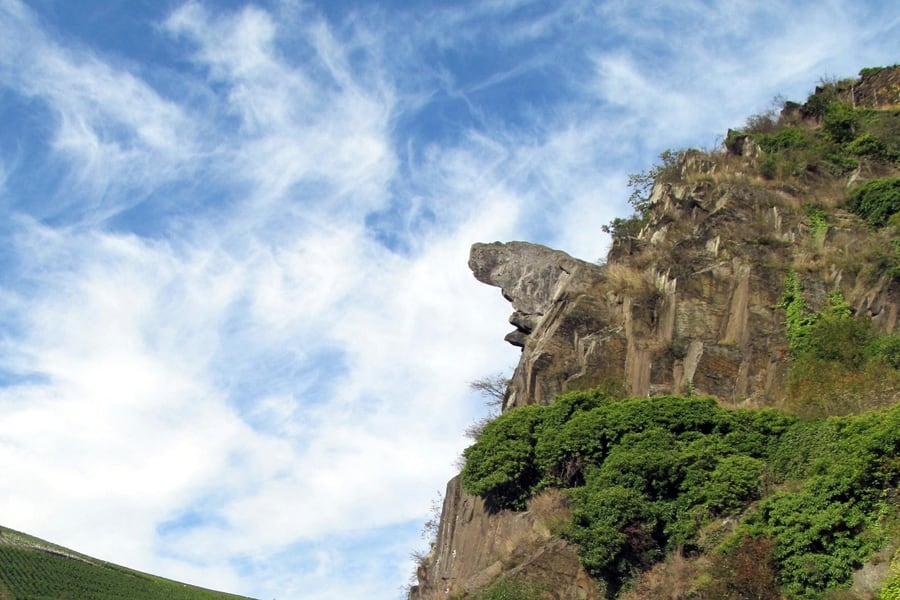 Uwe Rohwedder / Wikimedia Commons · CC BY-SA 4.0 · cropped
The Bunte Kuh
Past Walporzheim the valley narrows at the Bunte Kuh, a slab of slate that juts out about 15 metres above the road. It was left standing when the rock was blasted for the road in the 19th century, and is now a protected natural monument.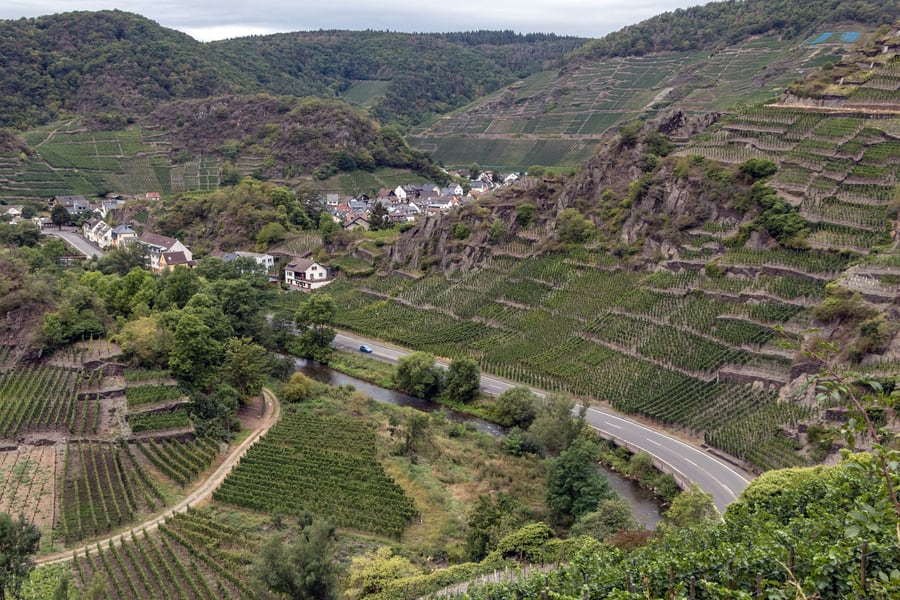 Derzno / Wikimedia Commons · CC BY-SA 4.0 · cropped
The terraces of Mayschoß
Between Rech and Altenahr the valley is at its narrowest, and the vines climb it in terraces between outcrops of rock. The line runs along the bottom, beside the river, and through tunnels where the spurs of rock reach the water.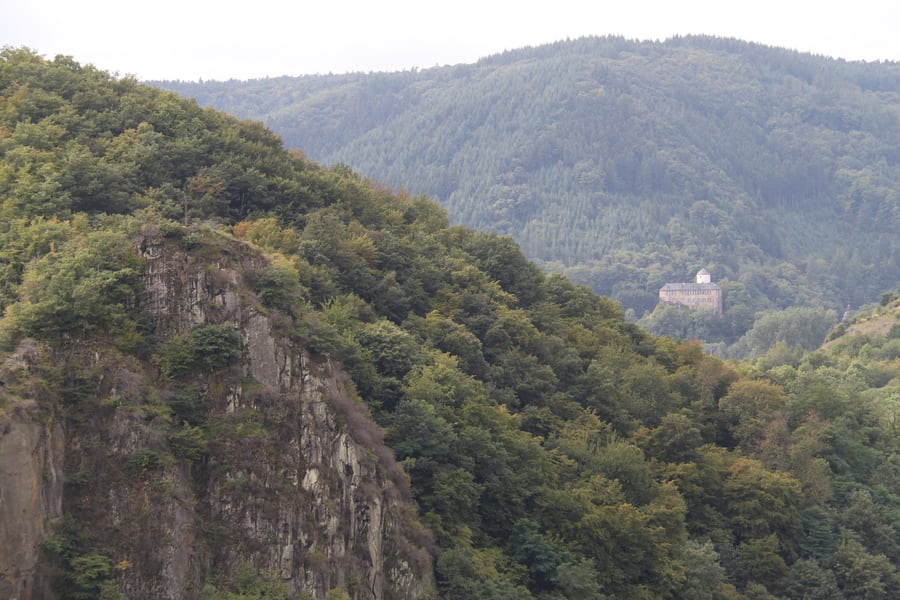 Slick / Wikimedia Commons · CC0 · cropped
Two castles at the top
At Altenahr the ruin of Burg Are looks down on the station, and from its walls you can see up the valley to Burg Kreuzberg above the next stop. Ahrbrück, the end of the line, is six minutes further on.A bit of history
Culture & experiences along the way
 © Superbass / Wikimedia Commons · CC BY-SA 4.0 · cropped
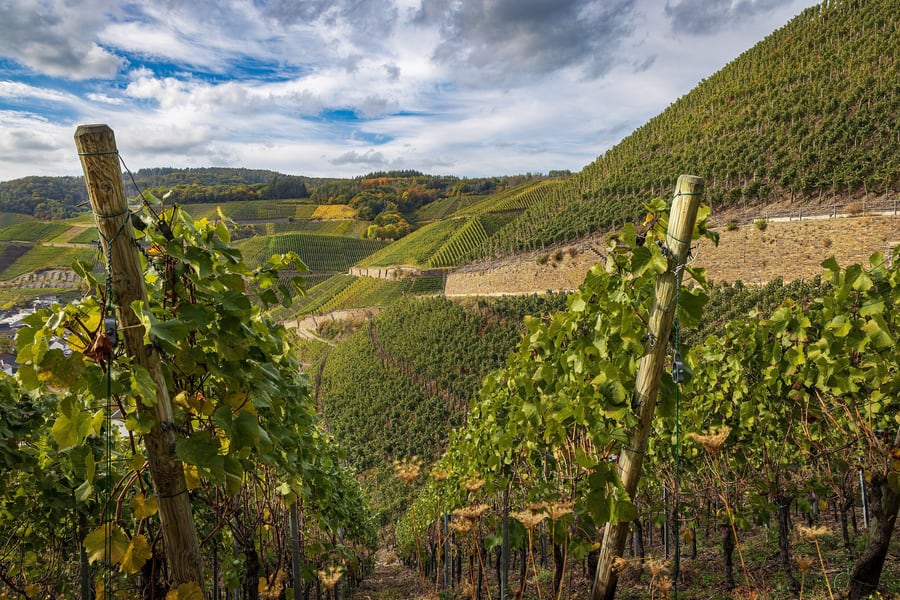
Germany's red-wine valley
The Ahr is the largest single area of red-wine vineyards in Germany: 533 hectares, 80 per cent of them planted with red grapes. Since the 1970s Spätburgunder (Pinot Noir) has driven out the older Portugieser, and the rarer Frühburgunder is grown more and more.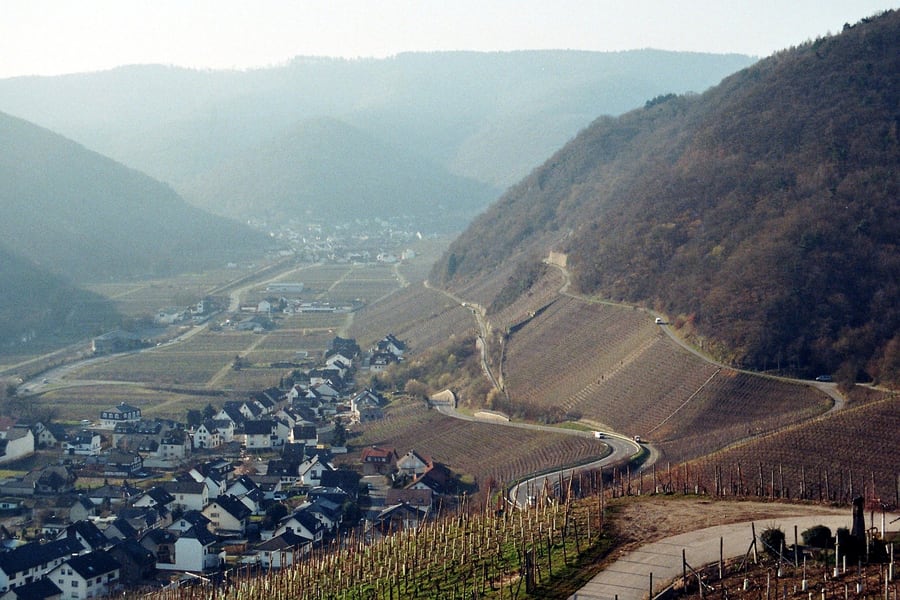 Dguendel / Wikimedia Commons · CC BY 4.0 · cropped
The Rotweinwanderweg
Opened in 1972, the red-wine trail runs about 36 km through the vineyards on the valley's north side, from Burg Are above Altenahr to the station square at Bad Bodendorf. It links the wine villages the train stops at, so you can walk a stretch and ride back.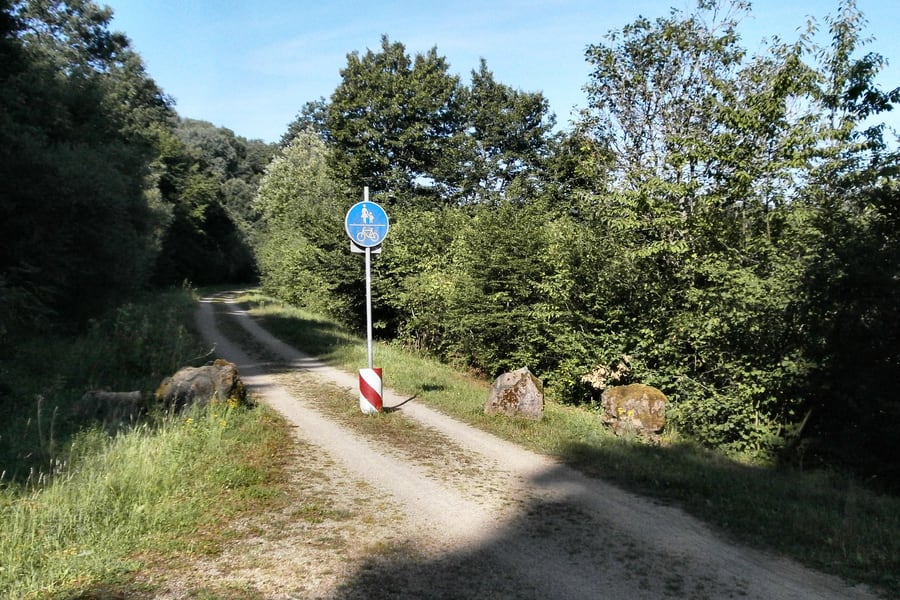 Bronstein / Wikimedia Commons · CC BY-SA 4.0 · cropped
Cycling the old second track
The line was given a second track for strategic reasons from 1910, and after 1945 it was taken up as reparations. Between Rech and Altenahr its bed is now the Ahr cycle path, running beside the trains, and bikes travel free on them after 9 on weekdays.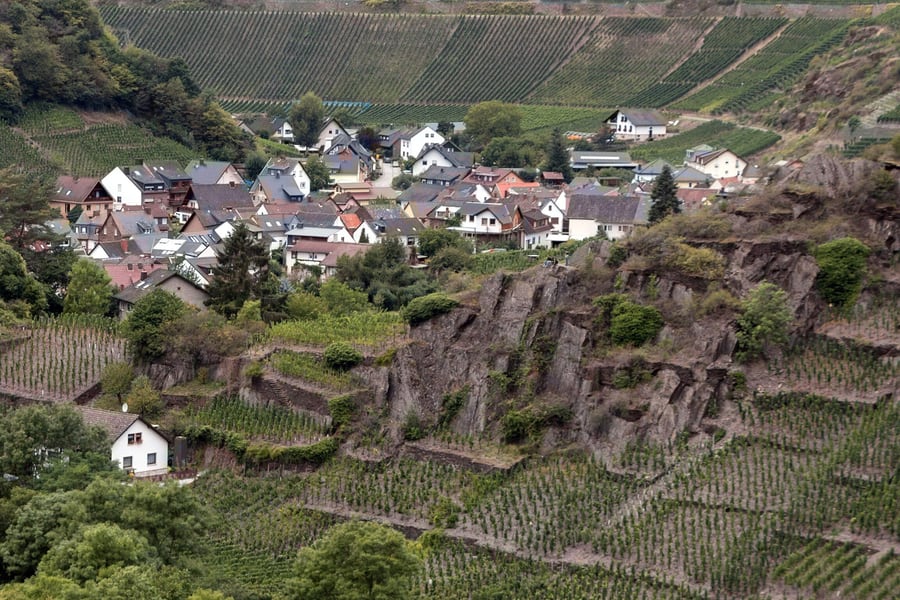 Derzno / Wikimedia Commons · CC BY-SA 4.0 · cropped
A glass at the oldest co-operative
In 1868, in a slump, eighteen winegrowers in Mayschoß joined forces to sell their wine, and the Mayschoß-Altenahr co-operative is the oldest still working anywhere. It has cellars and sales rooms in Mayschoß and Altenahr, and most of its wine is red.Timetables
From 13 December 2026 two trains an hour run the whole line every day, about half an hour apart. The RB 30 starts in Bonn and runs through Remagen to Ahrbrück; the RB 32 starts at Remagen, and every two hours runs on beyond Remagen to Koblenz and Boppard. Both stop at every station. No reservation is needed or possible.
Times below are from the timetable valid from 13 December 2026, read in October 2026. Check departures at bahn.de (opens in a new tab).
Up the valley — every hour, at the same minutes
| Train | Bonn Hbf | Remagen | Bad Neuenahr | Ahrweiler | Dernau | Altenahr | Ahrbrück |
|---|---|---|---|---|---|---|---|
| RB 30 | :46 | :11 | :23 | :27 | :36 | :50 | :56 |
| RB 32 | — | :32 | :44 | :47 | :55 | :09 | :15 |
So the 08:46 from Bonn reaches Ahrbrück at 09:56, and the 08:32 from Remagen at 09:15. The first train leaves Remagen at 04:01 on weekdays and the last at 23:32.
Down the valley
| Train | Ahrbrück | Altenahr | Dernau | Ahrweiler | Bad Neuenahr | Remagen | Bonn Hbf |
|---|---|---|---|---|---|---|---|
| RB 30 | :02 | :09 | :20 | :28 | :32 | :51 | :13 |
| RB 32 | :43 | :49 | :59 | :08 | :11 | :24 | — |
The RB 30 runs through to Bonn until the 20:02 from Ahrbrück; later ones end at Remagen. At weekends there are a few trains fewer early in the morning, and on Sundays the RB 32 starts later.
Until 12 December 2026
While the last works are finished, the RB 32 ends at Altenahr, leaving Remagen at :48 and Altenahr at :34, and the RB 30 runs only between Remagen and Ahrbrück, leaving Remagen at :18 and Ahrbrück at :04. For Bonn, change at Remagen.
Tickets
The line is in the fare zone of the Verkehrsverbund Rhein-Mosel (VRM), and singles are priced by how many zones you cross: in 2026 from €2.60 for one zone to €16.20 for the longest trips, with children aged 6 to 14 paying less. Buy them from DB ticket machines, at bahn.de (opens in a new tab) or in the DB Navigator app. Bicycles travel free after 09:00 on weekdays and all day at weekends.
For a day of getting on and off, the Rheinland-Pfalz-Ticket covers every regional train in the state, the whole line included, for €30, plus €10 for each extra traveller up to five. The Deutschlandticket, €63 a month and €66.80 from 1 January 2027, covers it too.
Book your tickets
Deutschlandticket
Monthly subscription · all regional trains
A monthly digital subscription that covers both Ahr valley lines and every other regional train, bus and tram in Germany.
Book Tickets (opens in a new tab, on bahn.de)via bahn.deRheinland-Pfalz-Ticket
A day on every regional train in the state
One day of unlimited regional travel in Rhineland-Palatinate for up to five people, from 09:00 on weekdays.
Book Tickets (opens in a new tab, on bahn.de)via bahn.deRail Passes
Interrail and Eurail passes cover this line. Interrail's table of German operators includes regional trains (RB) run by DB "and all other Regional carriers", with no reservation, so both the DB Regio RB 30 and the Trans Regio RB 32 are covered. The only German trains it excludes are FlixTrain and GoVolta.
For this journey alone a pass is not worth buying. A VRM single or a €30 Rheinland-Pfalz-Ticket costs far less than a pass day. It earns its price when the Ahr is a day out on a longer trip through Germany, as a detour from the Rhine.
Pass conditions checked against Interrail's railway-companies page, last updated 21 October 2026. Conditions change with each season, and the pass issuer's page is the one that binds.
Places to Visit
The valley is short enough to see in a day, with a stop or two on the way up and the castle at the top. Ahrweiler's old town is beside Ahrweiler Markt station. The government bunker is a walk uphill from Ahrweiler or Walporzheim, and must be booked ahead. Burg Are is a steep climb from Altenahr station. The bridge towers at Remagen are by the Rhine, before or after the ride.
 Jan Uyttebroeck / Wikimedia Commons · CC BY-SA 3.0 · cropped
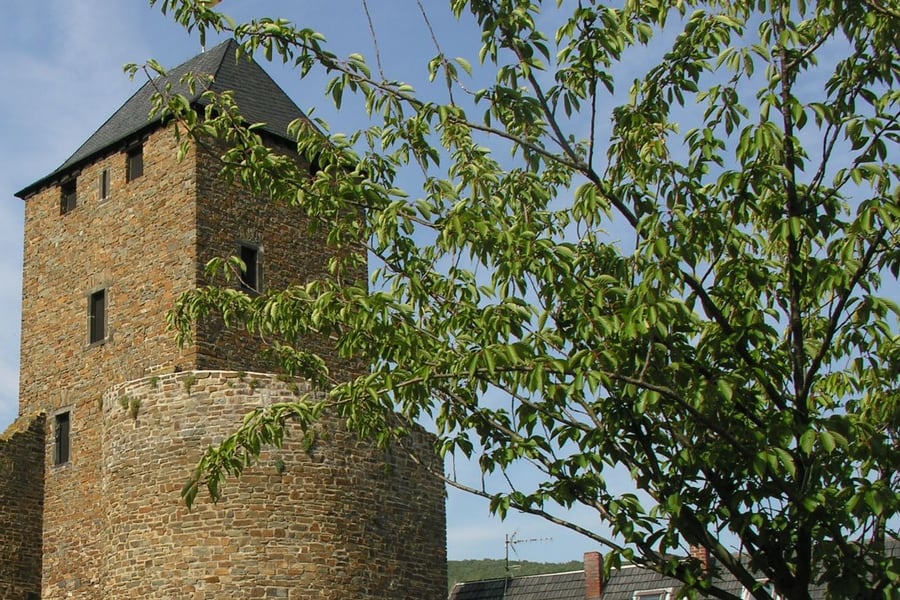
Ahrweiler inside its walls
Ahrweiler's old town is still almost entirely enclosed by its medieval wall, 1,800 metres long, first recorded in 1298. Four gates lead in, the Ahrtor, Obertor, Niedertor and Adenbachtor, and three of the defensive towers still stand. Inside, about 18 hectares of streets of half-timbered houses run down to the market square.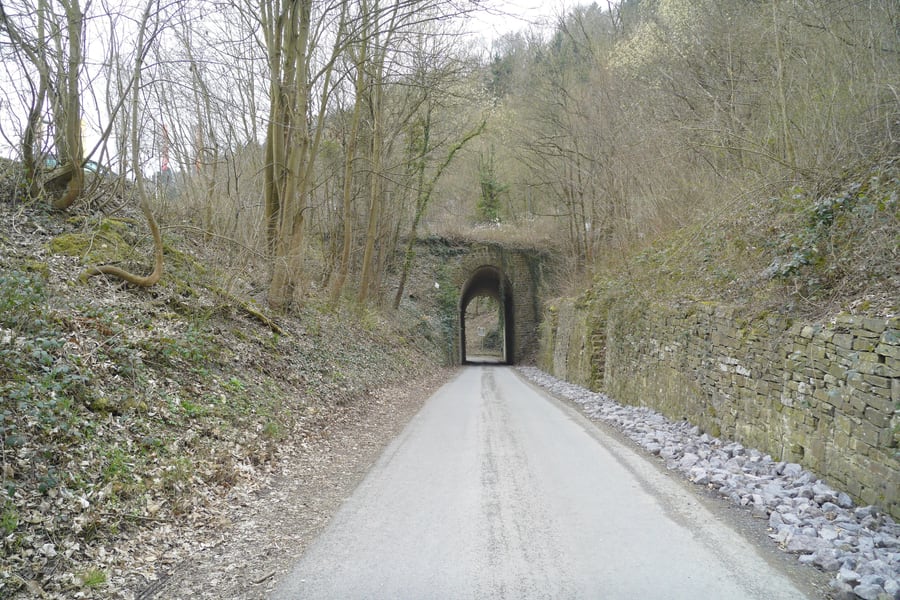 Leuni / Wikimedia Commons · CC BY 4.0 · cropped
The government bunker
In two tunnels of a strategic railway that was never finished, the Federal Republic built a 17.3 km nuclear shelter for its government between 1960 and 1972. Most of it was stripped out after the Cold War; 203 metres survive as the Dokumentationsstätte Regierungsbunker, open since 2008. Visits are by 90-minute guided tour, booked online in advance, and adults pay €15.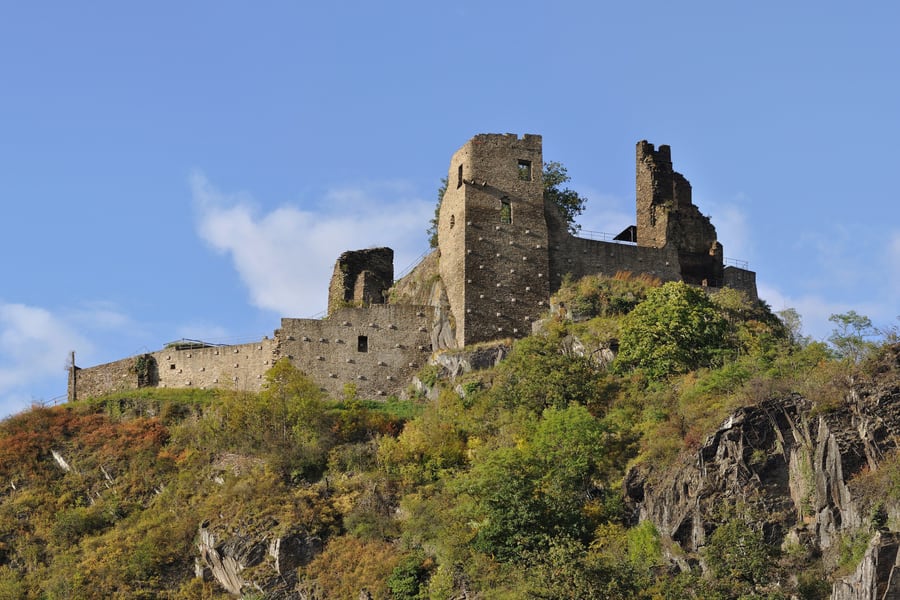 Quartl / Wikimedia Commons · CC BY-SA 3.0 · cropped
Burg Are
Count Dietrich I of Are built his castle on the rock above Altenahr between 1095 and 1105, at 240 metres. What survives is a ruin: a gate tower, the walls of the palace and the remains of a 12th-century chapel. It is the start of the red-wine trail, and the view runs down the valley over the village and up it towards Burg Kreuzberg.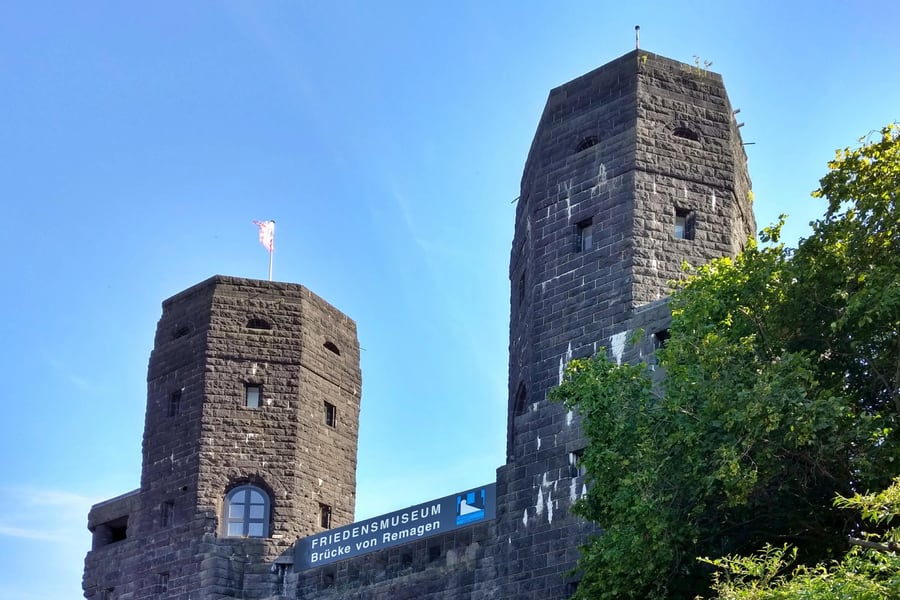 LoKiLeCh / Wikimedia Commons · CC BY-SA 4.0 · cropped
The bridge at Remagen
The Ludendorff Bridge was built from 1916 to 1918 to carry railway traffic, including the Ahr valley line's, across the Rhine. US troops captured it intact on 7 March 1945, the first Allied crossing of the river, and it collapsed ten days later. Its towers on the Remagen bank now hold the Peace Museum, open from March to the start of November; adults pay €6.Where to Sleep
The whole line takes under an hour, so the valley is easy to visit from Bonn or Koblenz. To stay in it, Bad Neuenahr has the spa hotels, Ahrweiler has rooms inside its medieval walls, and the vineyards above the valley have hotels with a view down over it.
The places below keep their own websites and take direct bookings.
Where to stay
Steigenberger Hotel Bad Neuenahr
Beside the spa gardens
A 216-room hotel next to the Kurpark, a few steps from the Ahr and the town centre, with an indoor pool.
Check Availability (opens in a new tab, on hrewards.com)via hrewards.comHotel Rodderhof
Inside Ahrweiler's town wall
A hotel in the medieval old town of Ahrweiler, among the half-timbered houses, a short walk from Ahrweiler Markt station.
Check Availability (opens in a new tab, on hotel-rodderhof-ahr.de)via hotel-rodderhof-ahr.deHotel Hohenzollern an der Ahr
Above the valley, since 1905
Opened in April 1905 as a café high above the Ahr, it stands among the vineyards, out of reach of the flood.
Check Availability (opens in a new tab, on hotelhohenzollern.com)via hotelhohenzollern.comQuestions or corrections
Planning this trip and stuck on something, or spotted a time, fare or detail that has changed? Send us a message about The Ahr Valley Railway. We read every one, and we update this page when something has changed.