The Alishan Forest Railway
eugene_o / Wikimedia Commons · CC BY 2.0 · 2024 · cropped
- Distance71.6 km
- Duration4 hr 56 min up · 3 hr 55 min down
- Best seasonFour trains a day, all year · two of them reach Alishan
Introduction
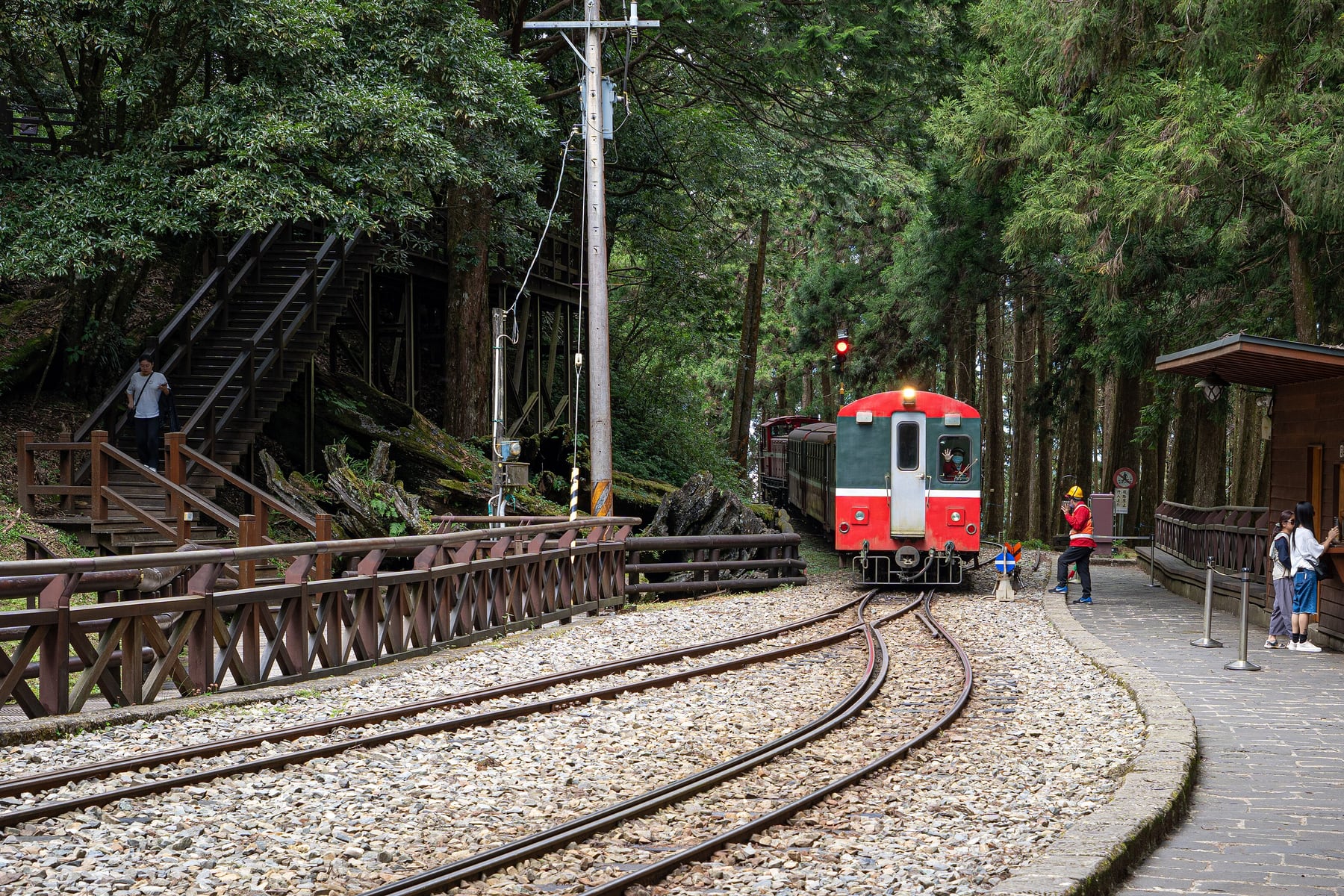
Somewhere above Pingzhena, at about 1,700 metres, the train stops in the forest where there is no station and no platform. The driver climbs down, walks the length of the train to the cab at the other end, and takes it away backwards, still climbing. A few minutes later it stops again and goes forward again. It does this four times on the way to Alishan, and passengers have a name for the moment the rails run out ahead: they say the train has hit the wall. Those four Z-shaped switchbacks are how two-foot-six-inch track gains the last five hundred metres of height, and they are the clearest thing on the line about what it was built to do.
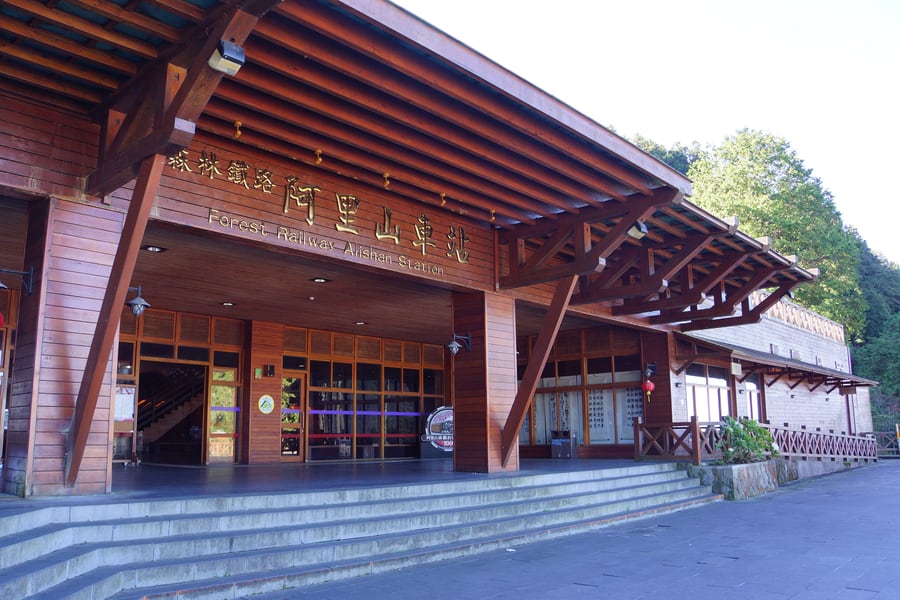
The Alishan Forest Railway runs 71.6 kilometres from Chiayi, on the coastal plain at thirty metres, to Alishan at 2,216 — a climb of more than two kilometres on 762 mm gauge, begun in 1906 by an Osaka contractor and finished by the Japanese colonial government to bring cypress and Taiwania down off the mountain. On the way the train passes through more than fifty tunnels, turns three full circles around Dulishan, and leaves the tropics for cloud forest. For fifteen years it could not make the whole climb: typhoon and landslide damage cut it back to Fenqihu, then to Shizilu, and the last 16.6 kilometres to Alishan reopened only on 6 July 2024.
The Journey
The journey starts on platform 1 at Chiayi, which is a good place to understand the rest of it. Taiwan Railway's own trains use the same platform, and their rails are 1,067 mm apart. The forest railway's are 762 mm. Everything that follows — the small red locomotives, the short carriages, the curves a standard-gauge line could never take — comes out of that gap of thirty centimetres, chosen in 1906 because a narrower track could be bent around a mountain instead of being blasted through it.
Up through the betel palms
Beimen, 1.6 kilometres out, is the railway's own station rather than the national network's, and the depot and workshops sit behind it. From there the line runs across the Chiayi plain past betel palms and bamboo to Zhuqi at 14.2 kilometres and 128 metres, which the operator calls the last of the flat section and the beginning of the climb. Zhuqi has a triangular junction for turning locomotives; in steam days engines were changed here, the 18-tonners handing over to 28-tonners for the gradient above.
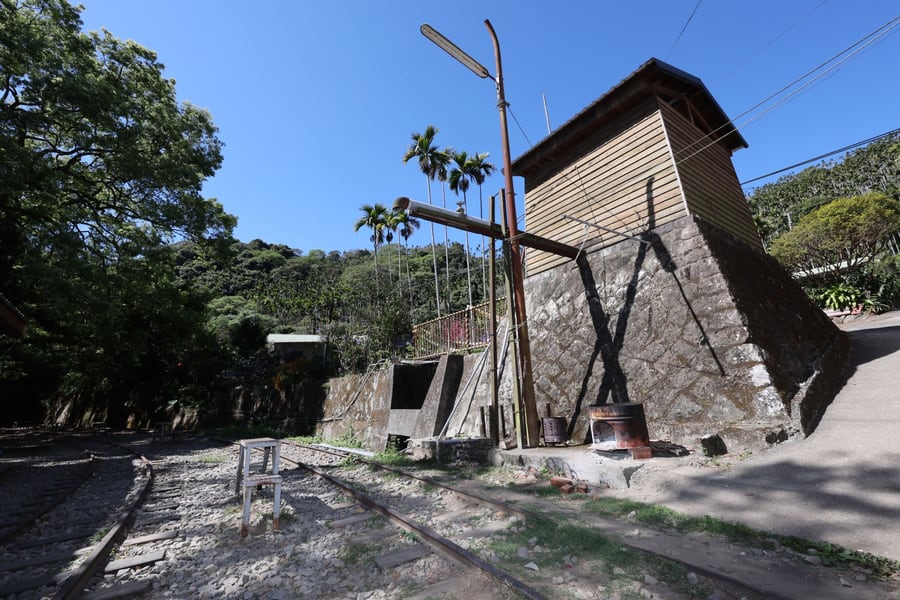
The gradient arrives immediately. Mululiao is 4.7 kilometres further on and 200 metres higher, a grade of about one in twenty, and by Zhangnaoliao at 23.3 kilometres the line is at 543 metres. Zhangnaoliao is the first place the train has to reverse: the track is laid in an X and the train backs onto the left-hand leg to reach the platform. It and Pingzhena, much higher up, are the only two switchback stations on the whole Taiwanese network.
Three times around Dulishan
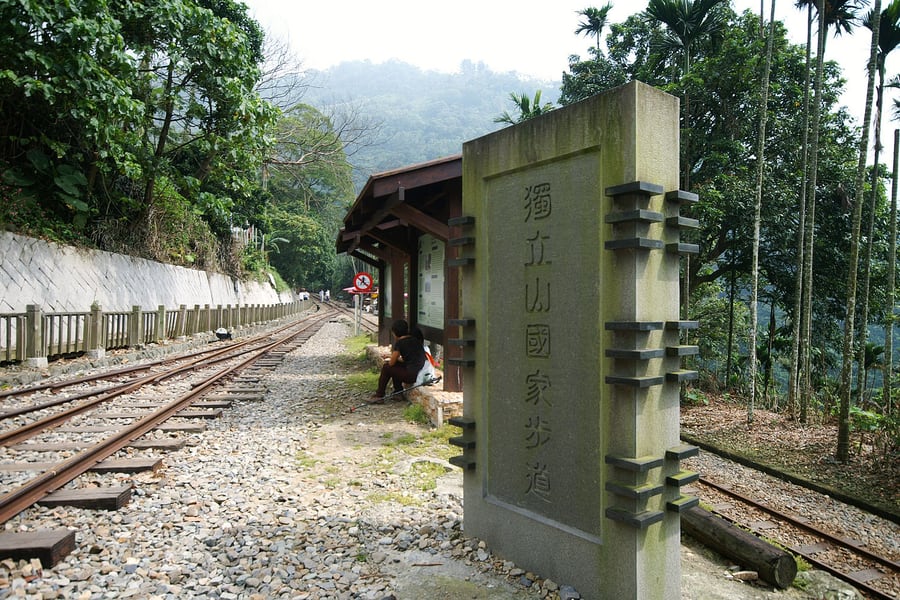
Out of Zhangnaoliao the line does the thing it is best known for. To gain height on a mountain too steep to climb head-on, the engineers wound the track around Dulishan — Independence Mountain — in a spiral of three complete circles, so the train passes over its own route twice before it reaches Dulishan station at 743 metres. Passengers who know the trick watch a particular house or a particular clearing appear three times, each time further below.
Above the spiral the tunnels begin in earnest. There are eight of them between Jiaoliping and Shuisheliao, the densest stretch on the line, and between tunnels 16 and 19 the train is winding around Dubi Mountain. At Dulishan, at about 800 metres, a sign marks the boundary between the tropical and subtropical forest — the first of the three climate zones the ride crosses.
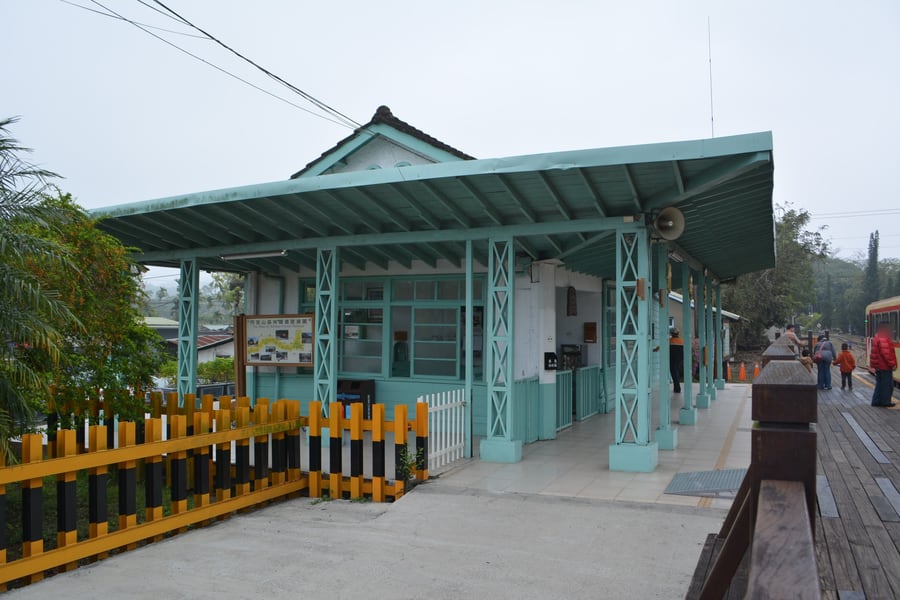
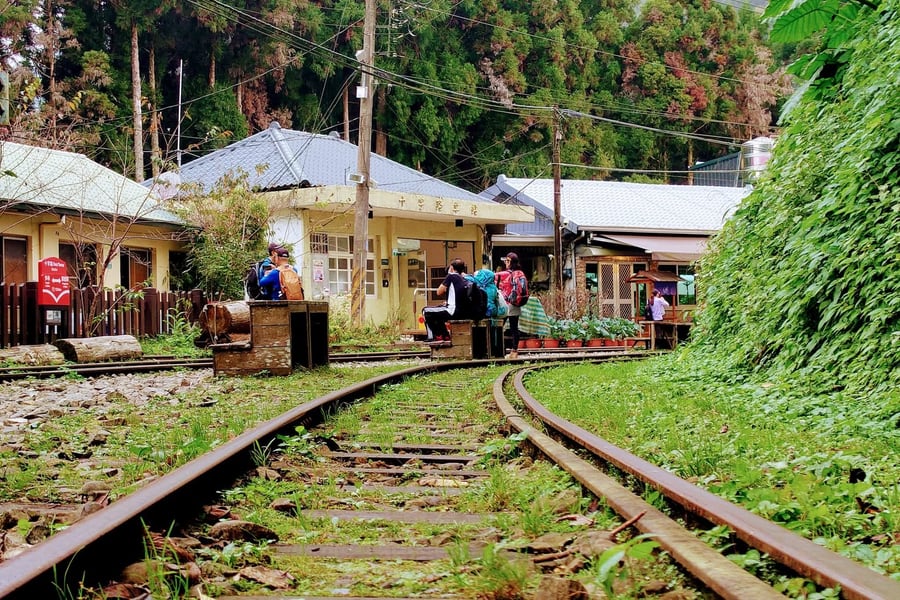
Jiaoliping, at 34.9 kilometres and 997 metres, is the middle of the railway and one of its pleasures: a handful of houses, an old grocery shop, and a line that runs down the village street with nothing between the rails and the front doors.
The hour at Fenqihu
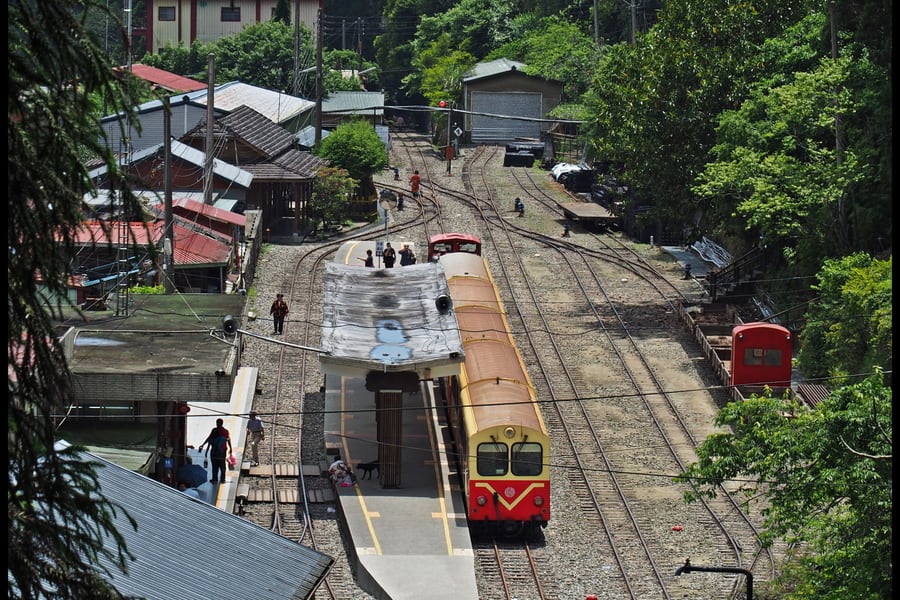
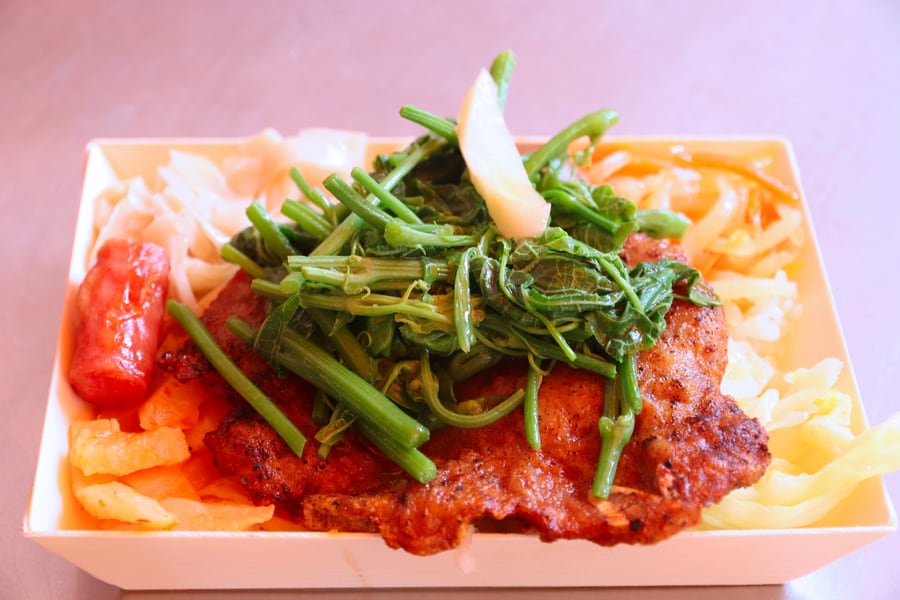
Fenqihu at 45.5 kilometres and 1,403 metres is where the train stops and everybody gets off. The name means dustpan lake, for the shape of the basin — there is no lake. The uphill Alishan Express arrives at 12:16 and does not leave until 13:21, sixty-five minutes later, and that pause is deliberate: the railway lunch box sold here has been a Taiwanese institution for more than half a century, since the days when the afternoon train reached Fenqihu at lunchtime and the platform sold the food. The old street below the station is a row of timber shopfronts, the maintenance depot is alongside, and a wooden station building stands in place of the one demolished in 2004.
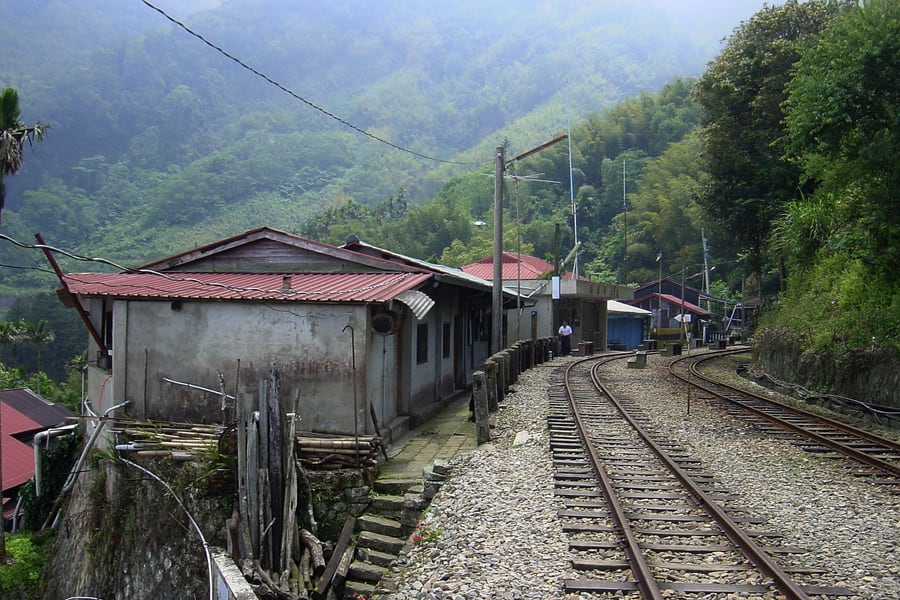
Above Fenqihu the forest changes again. Duolin, a small Tsou settlement, and Shizilu at 55 kilometres and 1,534 metres are both request stops now; Shizilu was the top of the line for seven years while the section above it was closed, and the village still trades on the passengers who had to leave the train there. Pingzhena at 1,711 metres marks the boundary between the subtropical and temperate zones.
Four switchbacks and the top
From Pingzhena the railway climbs by reversing. Four numbered switchbacks take it up the last stage; the third of them is Shenmu station, at the foot of the sacred trees, and the fourth is Alishan station itself. Erwanping, at 2,000 metres and 67.2 kilometres, was the end of the line when the railway opened in 1912 and is now the place people stand for the sunset and the sea of cloud. The train reaches Alishan at 2,216 metres at 14:56, four hours and fifty-six minutes after leaving Chiayi.
Three branch lines start at Alishan and run all day: Zhaoping, 1.3 kilometres uphill to the original 1914 terminus; Shenmu, five minutes downhill to the giant cypresses; and Zhushan, 6.25 kilometres to the highest railway station in Taiwan at 2,451 metres, which runs before dawn for the sunrise.
What pulls it
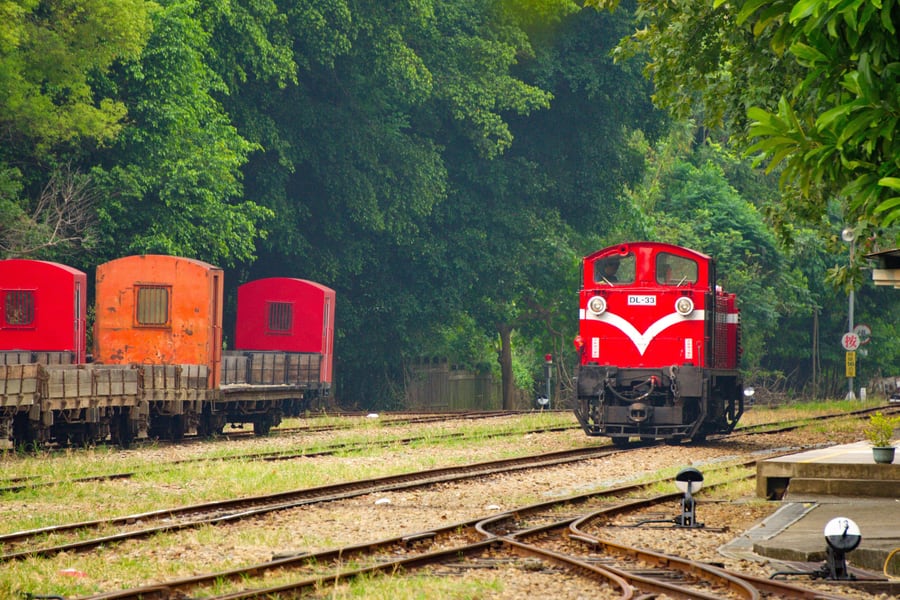
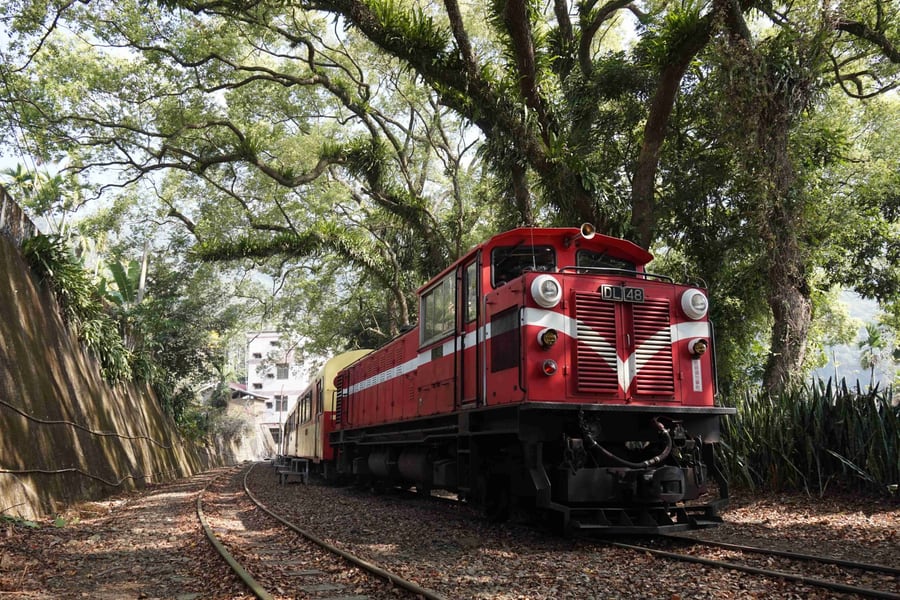
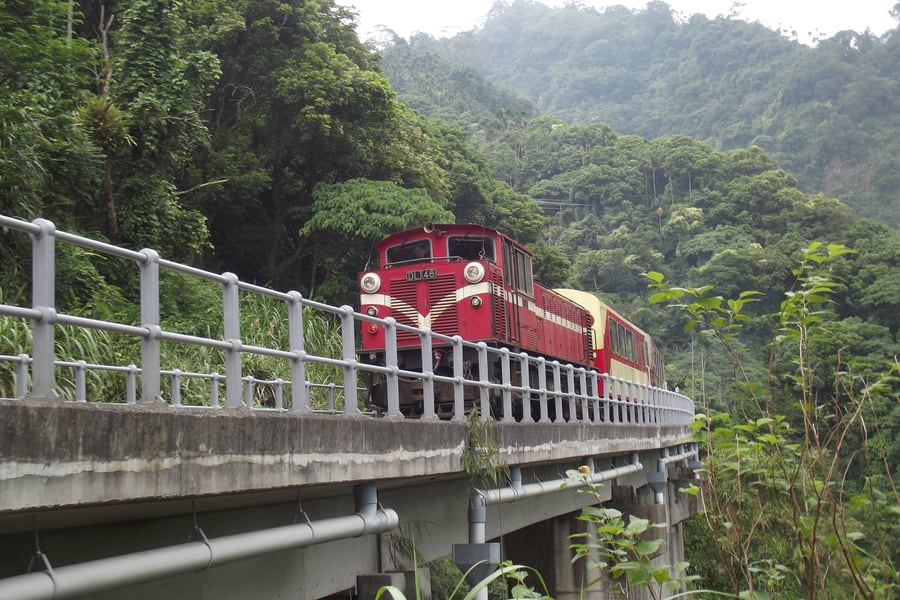
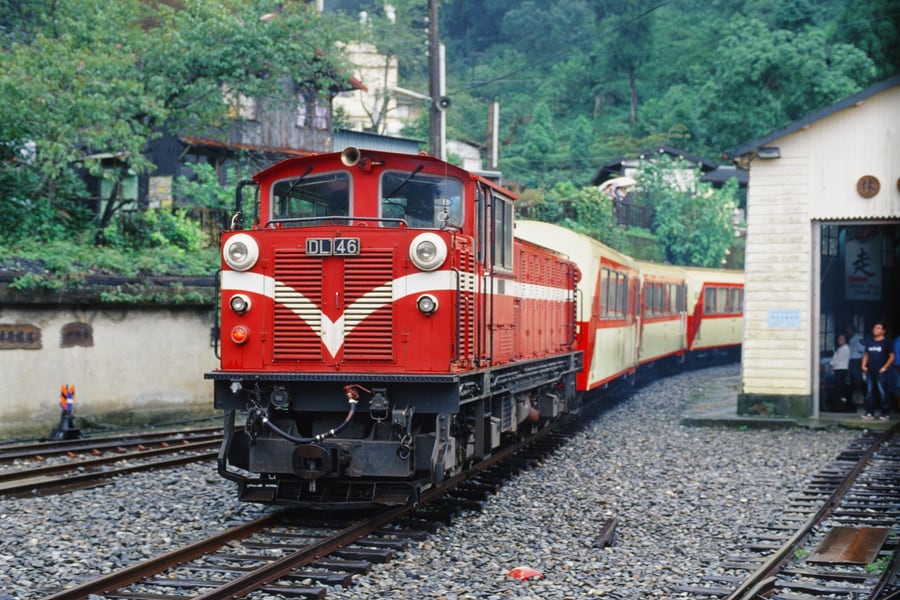
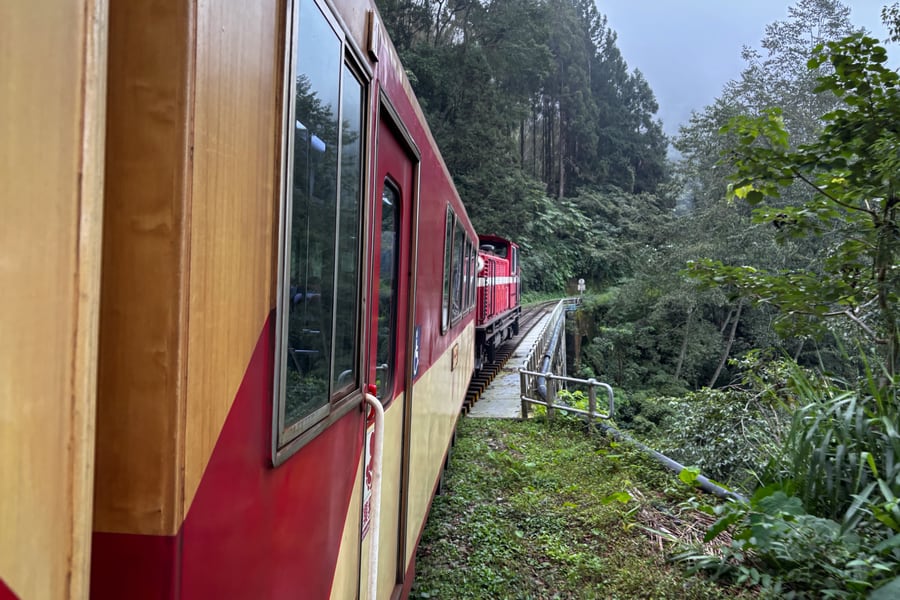
Every scheduled train is diesel-hauled. The working fleet is a set of 25- and 28-tonne diesel-hydraulics from Mitsubishi Heavy Industries and Nippon Sharyo, numbered DL-25 to DL-51 and delivered between 1969 and 2007; DL-43 and DL-46 are the ones most often at the head of the Alishan Express, and their red and white livery is what the railway is photographed in.
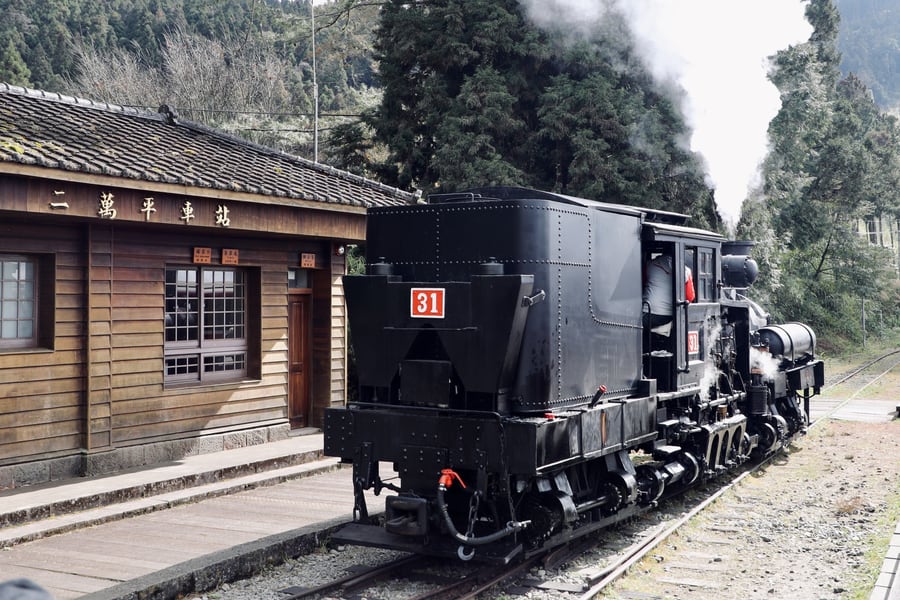
What made the railway possible, though, was the Shay. Ephraim Shay's design puts the cylinders vertically down one side of the boiler and drives every wheel through bevel gears and a jointed shaft, which gives it low speed, high torque and the ability to take a curve of thirty metres radius. Alishan bought its first 13-tonner in 1906 and then, once the government took the project over, eight 18-tonne machines from 1910. When an 18-tonner failed on the climb from Erwanping to Shenmu in 1912 the railway ordered a three-cylinder 28-tonne version instead, and took twelve of them. Two survive in running order: No. 25, restored in 2004, and No. 31, in 2006. Both now burn diesel rather than coal in their fireboxes, which gets steam pressure to eleven kilograms per square centimetre in twenty-five minutes, and both appear on special workings rather than in the timetable.
Along the route
 Peellden / Wikimedia Commons · CC BY-SA 3.0 · cropped
Three times round Independence Mountain
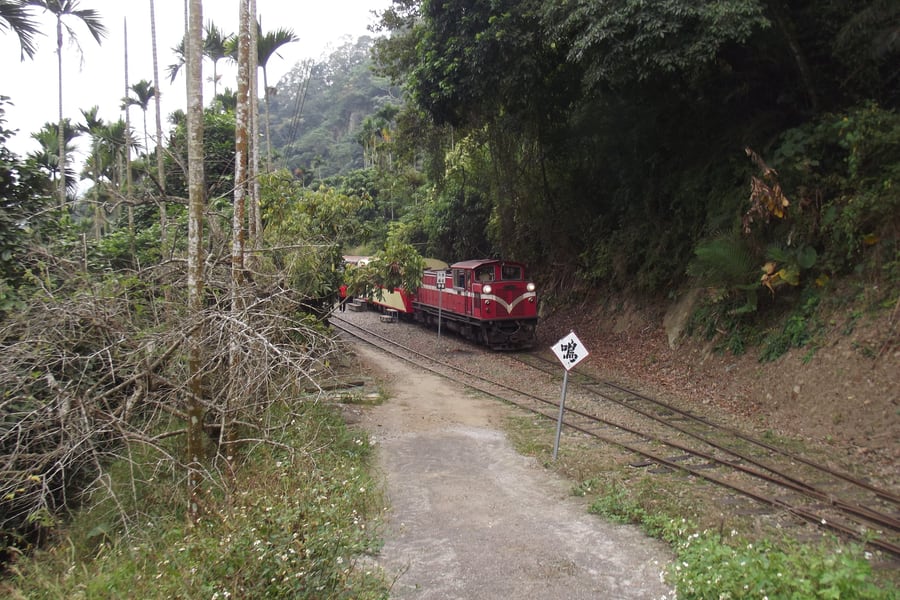
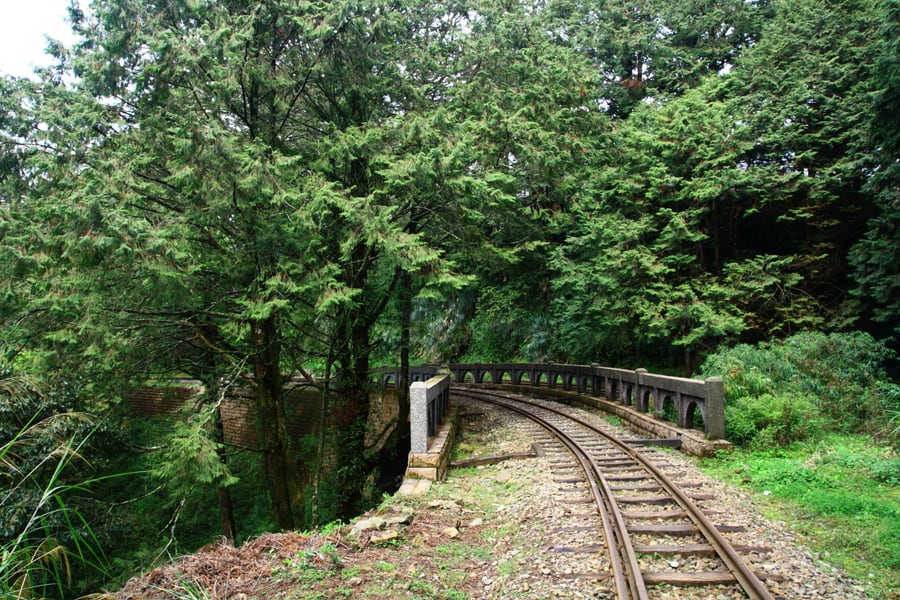
Above Zhangnaoliao the mountain is too steep to climb head-on, so the track winds round it: three complete circles of Dulishan, crossing above its own route twice. Passengers who know the trick pick out a house and watch it appear three times, further below each time.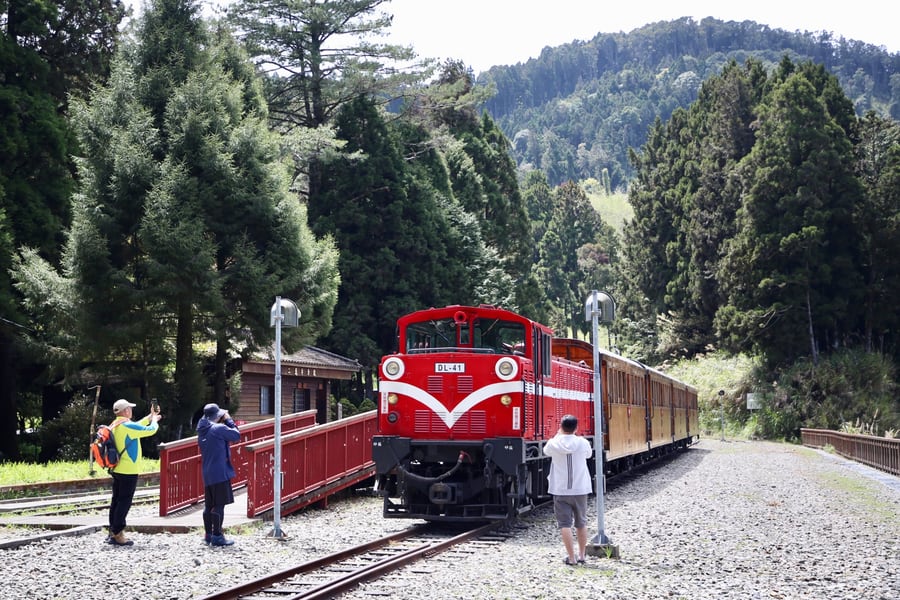 Alishan Forest Railway and Cultural Heritage Office / Wikimedia Commons · Taiwan open government data · cropped
The train that hits the wall
From Pingzhena the railway stops climbing forwards. Four switchbacks take it up the last five hundred metres: the train runs into a dead-end stub, the driver changes ends, and it sets off backwards, higher. Alishan station itself is the fourth.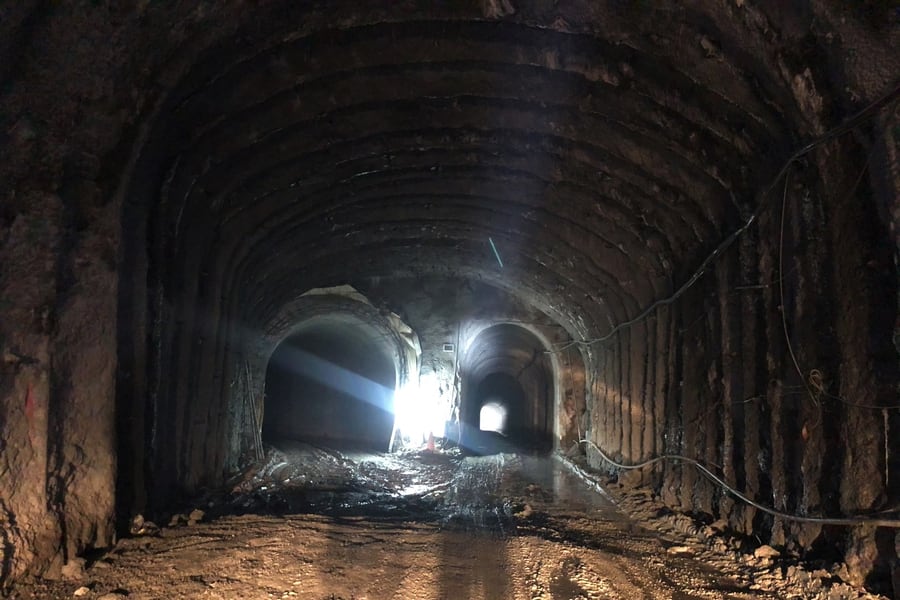 Alishan Forest Railway and Cultural Heritage Office / Wikimedia Commons · Taiwan open government data · 2023 · cropped
The tunnel that gave the line back
Two typhoons broke the upper railway and for years it ended at Fenqihu. The obstacle was tunnel 42, and it was not repaired but replaced — a new bore that let the last 16.6 kilometres reopen in July 2024, fifteen years on. Tsou artists painted the murals at its mouth.A bit of history
Culture & experiences along the way
 Marek Ślusarczyk / Wikimedia Commons · CC BY 3.0 · cropped
Sixty-five minutes at Fenqihu
The uphill express arrives at 12:16 and does not leave until 13:21, and the stop is the point of it. The railway lunch box sold at Fenqihu has been a Taiwanese institution for more than half a century, from the days when the afternoon train reached the station at lunchtime and the platform fed it. The old street below is a row of timber shopfronts; the depot is alongside; the wooden station building replaced the one pulled down in 2004.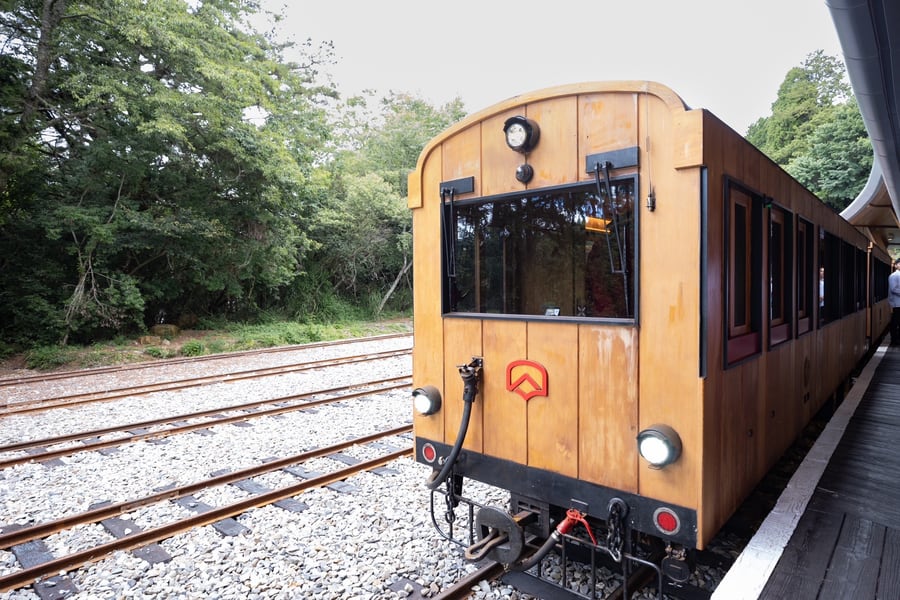 總統府 / Wikimedia Commons · CC BY 2.0 · 2024 · cropped
The sunrise train to Zhushan
Zhushan, 6.25 kilometres above Alishan at 2,451 metres, is the highest railway station in Taiwan and the first line Taiwanese engineers built themselves, opened on 13 January 1986. Its train has no fixed departure: the time is set each afternoon against the next day's sunrise and posted at 16:30 on the operator's site and at the station. On 27 August 2026 it left at 04:40 for a sunrise at 05:45.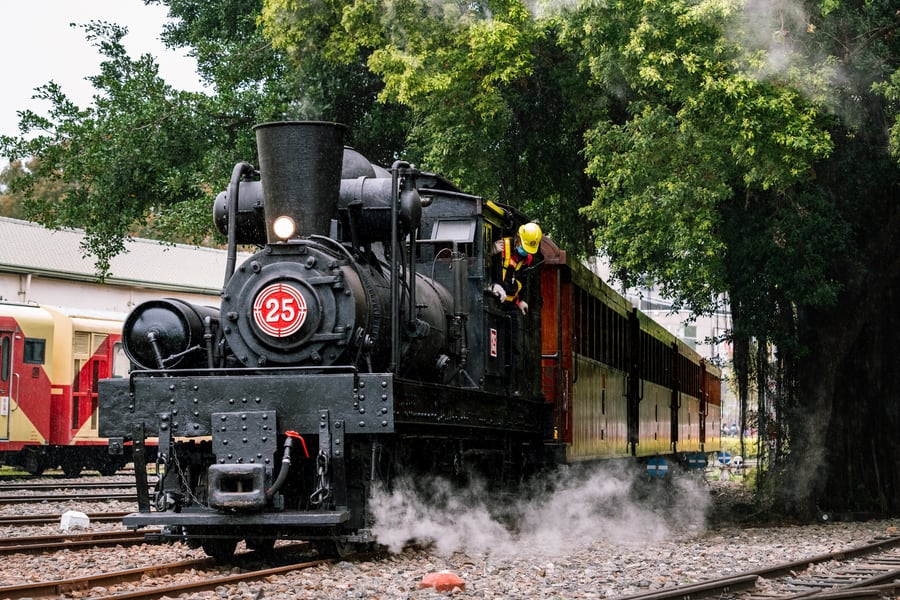 jason199567 / Wikimedia Commons · CC BY-SA 4.0 · cropped
Shay No. 25, still in steam
Ephraim Shay's geared locomotive is why a 762 mm railway could climb this mountain at all: vertical cylinders, bevel gears on every axle and a jointed drive shaft, good for a curve of thirty metres radius. Alishan took eight 18-tonners from 1910 and twelve 28-tonners from 1912. Two are back in working order, No. 25 since 2004 and No. 31 since 2006, both now firing on diesel — and both appear on special workings rather than in the timetable.Timetables
Four main-line trains run every day, and they are the whole service: two up from Chiayi in the morning, two down in the afternoon. Only one of each pair goes the full distance to Alishan. Trains 1 and 2 are the all-stations working, which calls everywhere and turns at Shizilu; trains 5 and 8 are the Alishan Express, which skips most of the small halts and waits at Fenqihu instead.
The times below are the operator's own, valid from 10 January 2025 and checked against both the English and Chinese timetables on 26 August 2026. A dash means the train does not call.
Uphill
| Station | Alishan Express 1 | Alishan Express 5 |
|---|---|---|
| Chiayi | 09:00 | 10:00 |
| Beimen | 09:10 | 10:08 |
| Lumachan | 09:33 | – |
| Zhuqi | 09:43 | 10:39 |
| Zhangnaoliao | 10:10 | – |
| Dulishan | 10:23 | – |
| Liyuanliao | 10:36 | – |
| Jiaoliping | 10:48 | 11:43 |
| Shuisheliao | 11:05 | – |
| Fenqihu | 11:30 | 12:16 arr · 13:21 dep |
| Duolin | 11:45 | – |
| Shizilu | 12:00 | – |
| Erwanping | – | 14:38 |
| Alishan | – | 14:56 |
Downhill
| Station | Alishan Express 2 | Alishan Express 8 |
|---|---|---|
| Alishan | – | 11:50 |
| Erwanping | – | 12:09 |
| Shizilu | 13:21 | – |
| Duolin | 13:36 | – |
| Fenqihu | 13:50 arr · 14:31 dep | 13:29 |
| Shuisheliao | 14:48 | – |
| Jiaoliping | 15:06 | 14:04 |
| Liyuanliao | 15:18 | – |
| Dulishan | 15:31 | – |
| Zhangnaoliao | 15:44 | – |
| Zhuqi | 16:12 | 15:07 |
| Lumachan | 16:21 | – |
| Beimen | 16:45 | 15:39 |
| Chiayi | 16:51 | 15:45 |
Chiayi to Alishan therefore takes four hours and fifty-six minutes including the sixty-five-minute stop at Fenqihu, and the return run is three hours and fifty-five minutes. There is no evening train in either direction: the last departure from Alishan is at 11:50, which is why the mountain is generally an overnight rather than a day trip.
The branch lines and the sunrise train
Above Alishan the three branch lines run their own timetables. The Shenmu line has eleven departures each way between 09:40 and 15:57, the Zhaoping line twelve between 09:00 and 16:06, and both take six or seven minutes.
The Zhushan sunrise train has no fixed departure. It is set each day against the sunrise time and the number of passengers, and the next morning's time is published at 16:30 the day before on the operator's website and at Alishan station, the recreation-area entrance and the visitor centre. On 27 August 2026 it left at 04:40 for a sunrise at 05:45, with the last train back down at 06:20. The railway's own booking site carries that announcement each afternoon, alongside a running status line for the main line and the branches.
Departures and calling points are on the operator's site, in English: Main line (opens in a new tab) · Branch lines (opens in a new tab).
Tickets
Main-line fares are worked out per kilometre, which over the full 71.6 kilometres comes to NT$600 Chiayi to Alishan on the air-conditioned Alishan Express and NT$540 on a local working. Half fare covers children between 116 and 149 cm, passengers over 65 and disabled passengers with a certificate. Every seat on the main line is reserved for a named train on a named day. The three branch lines above Alishan are flat-fare, at NT$150 and NT$100.
Booking opens 15 days ahead online and 12 days at station windows. ⚠️ Payment is not automatic: since March 2026 an online booking must be paid inside the deadline the system gives — online, at a station, or at any 7-Eleven ibon machine, which also prints the ticket — and three lapsed orders in a month suspend booking rights for six months. Read from the operator, 26 August 2026.
Book your tickets
Louis Liu / Wikimedia Commons · CC BY-SA 2.0 · 2014 · croppedChiayi to Alishan, Alishan Express
NT$600 one way · reserved for a named train
The whole 71.6 kilometres, air-conditioned, on train 5 up or train 8 down.
Book Tickets (opens in a new tab, on afrch.forest.gov.tw)via afrch.forest.gov.twChiayi to Alishan, local train
NT$540 one way
The same line without air conditioning, and the cheapest way over it.
Book Tickets (opens in a new tab, on afrch.forest.gov.tw)via afrch.forest.gov.tw總統府 / Wikimedia Commons · CC BY 2.0 · 2024 · croppedThe branch lines above Alishan
NT$150 Zhushan · NT$100 Shenmu and Zhaoping
Flat fares inside the recreation area; Zhushan sunrise seats open at noon the day before.
Book Tickets (opens in a new tab, on afrch.forest.gov.tw)via afrch.forest.gov.twRail Passes
Taiwan is outside the Interrail and Eurail systems, and there is no pass of any kind for the main line. Chiayi to Alishan is sold as an ordinary reserved ticket at NT$600 and that is the only way to buy it.
It is worth being clear about why, because the two railways look like one on a map. The forest railway belongs to the Forestry and Nature Conservation Agency, not to Taiwan Railway Corporation, and the national operator's own website sends readers off to the forestry agency's site for it. A TR-PASS — Taiwan Railway's three- and five-day rover, with longer student versions — buys travel on TRC trains and does nothing at Chiayi's platform 1. It is still the sensible ticket for getting to Chiayi if you are moving around the island by train, but budget the forest railway separately.
The one pass that does exist
Above Alishan, the operator sells a branch-line pass covering the three lines inside the national forest recreation area — Zhushan, Shenmu and Zhaoping:
| Pass | Full | Half |
|---|---|---|
| One day | NT$400 | NT$200 |
| Two days | NT$500 | NT$250 |
It goes on sale the day before travel or on the day itself, it cannot be refunded once it has been used, and it is not valid on the New Year's Day sunrise train to Zhushan, which is ticketed separately.
Whether it pays depends on how much of the mountain you ride. Singles are NT$150 on the Zhushan line and NT$100 on each of the others, so a sunrise run up and down plus one return trip to the sacred trees already comes to NT$500 and the day pass is the cheaper ticket. Ride nothing but the sunrise train and it is not.
One footnote for completeness: a used two-day branch pass can be exchanged for tickets on the Kurobe Gorge Railway or the Oigawa Railway in Japan under a sister-railway programme running through 2026 — but that offer is limited to travellers holding a Taiwanese passport.
Pass terms read from the operator on 26 August 2026: branch-line pass (opens in a new tab) · fares (opens in a new tab).
Places to Visit
Almost everything worth stopping for on this line is within a few minutes' walk of a platform, which is what happens when a railway is laid to reach trees rather than towns. At the bottom is Chiayi, the city the timber trade paid for; in the middle, Fenqihu, where the train waits an hour and the whole village exists to feed it; at the top, a forest reserve where three short branch lines do the work of footpaths.
The one thing that needs planning is the sunrise. The Zhushan train leaves in the dark, its time changes with the season, and it is announced only the previous afternoon — so it is a decision made the day you arrive, not the week before.
 lienyuan lee / Wikimedia Commons · CC BY 3.0 · cropped
Chiayi
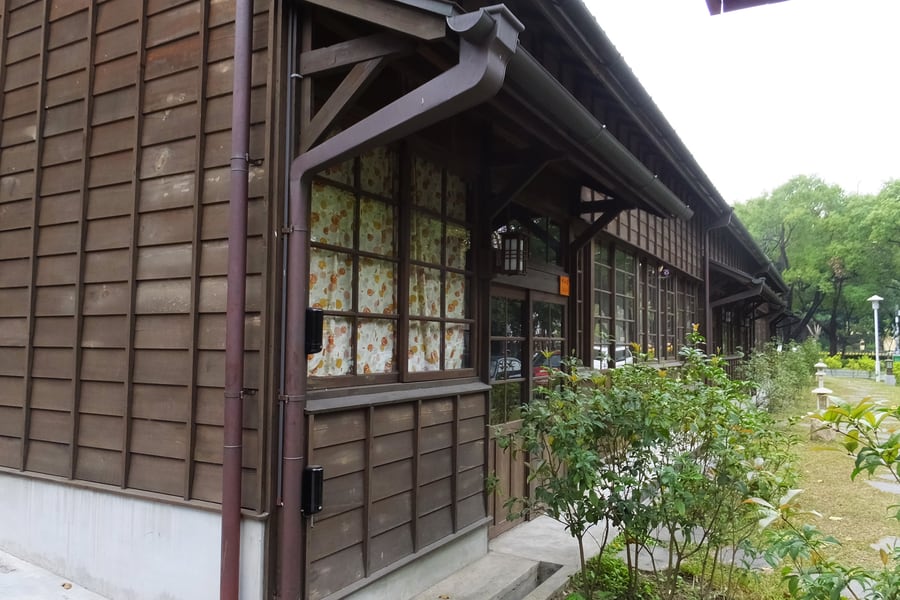
The city the mountain paid for. Chiayi was the administrative base of the Alishan logging operation from 1910 and grew rich enough on the timber trade to be counted one of the four major cities of Japanese-era Taiwan. What survives of that is Hinoki Village, a block of cypress-built forestry dormitories restored as shops and cafés, a few minutes from Beimen station and the locomotive depot. The forest railway's own head office is in the same district.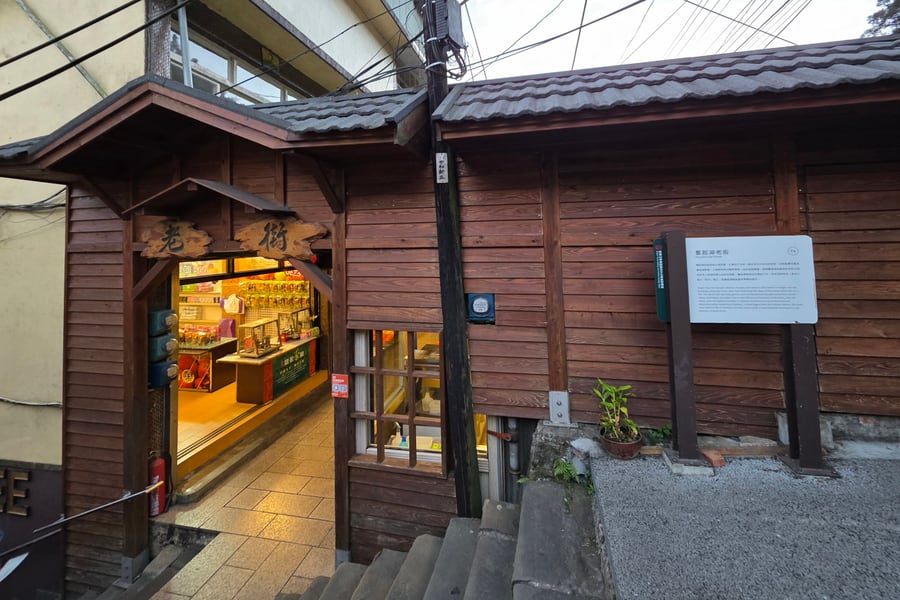 阿道 / Wikimedia Commons · CC BY-SA 4.0 · 2025 · cropped
Fenqihu
A village in a basin shaped like a dustpan, which is what its name means — there is no lake, despite the hu. It is the busiest place on the line because the train waits here, and everything about it follows from that: the lunch-box shops, the old street of timber buildings below the platform, the bamboo and the waterfall trails leading out of the village, and a maintenance depot that has been servicing the railway since the Japanese era.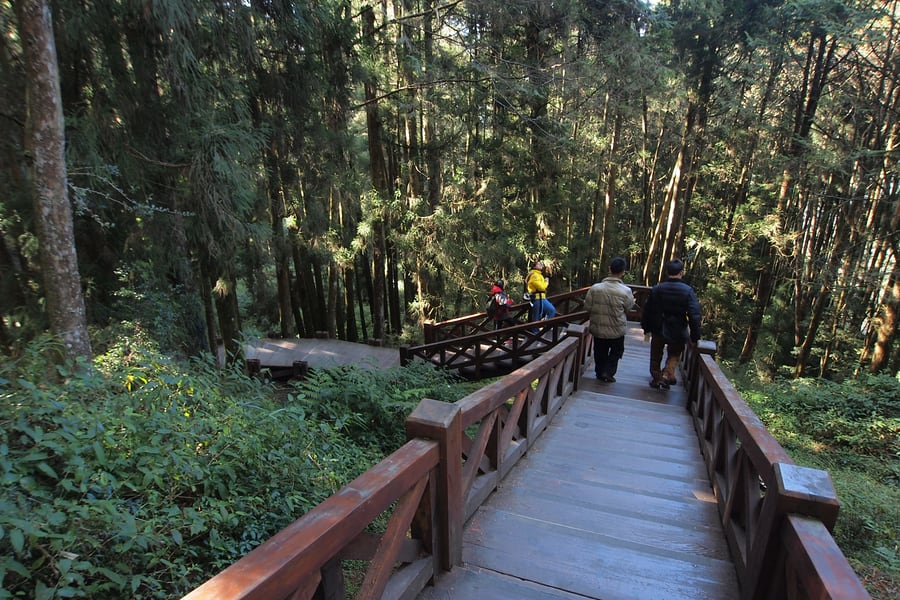 rheins / Wikimedia Commons · CC BY 3.0 · cropped
The giant trees
The reason the railway exists. Alishan's red cypress and Taiwania were what the line was built to carry down, and the survivors stand along a boardwalk of a few kilometres above Shenmu station. The tree the station is named for, a red cypress of about three thousand years, was struck by lightning and finally brought down by heavy rain; on 1 July 1997 the authorities laid it on its side and left it there as a monument rather than clearing it away.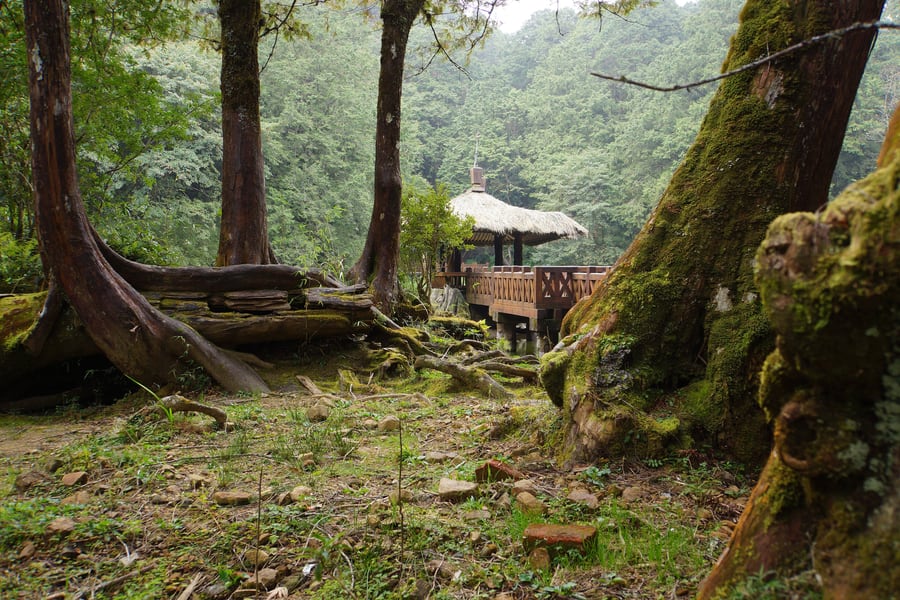 lienyuan lee / Wikimedia Commons · CC BY 3.0 · cropped
The Sister Ponds
Two small ponds in the forest between Zhaoping station and the giant trees, the larger one with a thatched pavilion set out in the water and reached by a plank bridge. They are the easiest walk in the recreation area and the one everybody does — flat, shaded, ringed by cypress stumps left from the logging years, and quiet once the first branch-line train of the morning has gone through.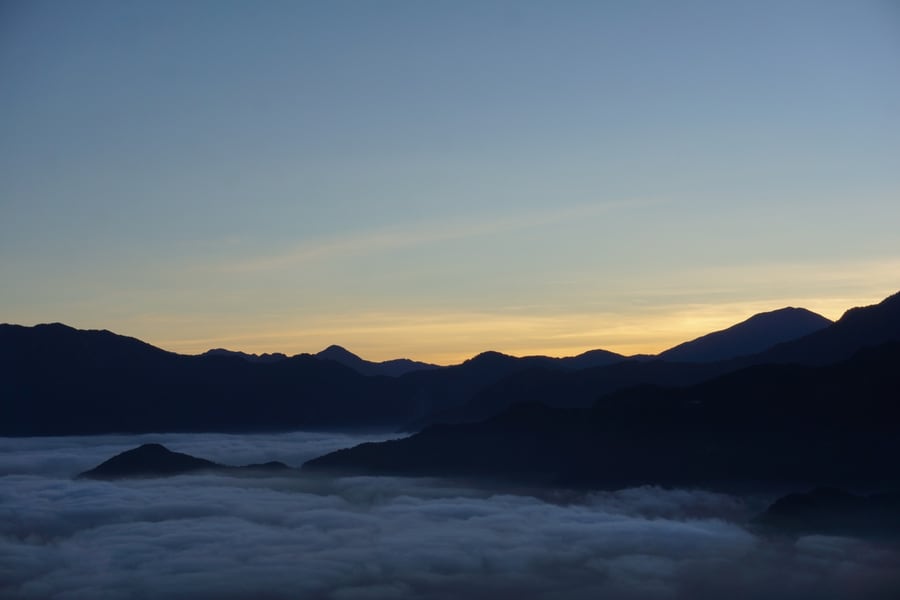 Rybloo / Wikimedia Commons · CC BY-SA 3.0 · cropped
Zhushan
The sunrise platform, and the only reason anyone sets an alarm for four in the morning on this mountain. The line was built in the 1980s specifically to carry sunrise watchers up from Alishan, and it climbs 235 metres in 6.25 kilometres to a viewing deck looking east over the Yushan range. What people come for as much as the sun is the cloud: on a good morning the valleys below fill in and the ridges stand out of a white floor.Where to Sleep
The timetable makes the decision. The last train down from Alishan leaves at 11:50, so a day return from Chiayi is not possible on the railway alone — you either come down by bus or you stay on the mountain. Staying is also the only way to reach the sunrise train, which leaves Alishan before five in the morning.
There are three sensible places to be: Chiayi, for the night before an early start; Fenqihu, if you want to break the climb where the train already pauses; and Alishan itself, inside the recreation area, where the branch lines and the trails start at the door. Prices and grades are not listed below because we have not verified them — what each card gives is what the house says about itself and where it stands on the line.
Where to stay
Maison de Chine Chiayi
Wenhua Road, East District, Chiayi
The hotel's own account of itself: one of the LDC Hotels & Resorts group's Maison de Chine houses, which it describes as blending Chinese decoration with French comfort. It stands at No. 257 Wenhua Road in Chiayi's East District — the same street as the forest railway's head office — which puts it on the right side of the city for an early start, and it publishes in English, Japanese and Chinese.
Check Availability (opens in a new tab, on maisondechinehotel.com)via maisondechinehotel.com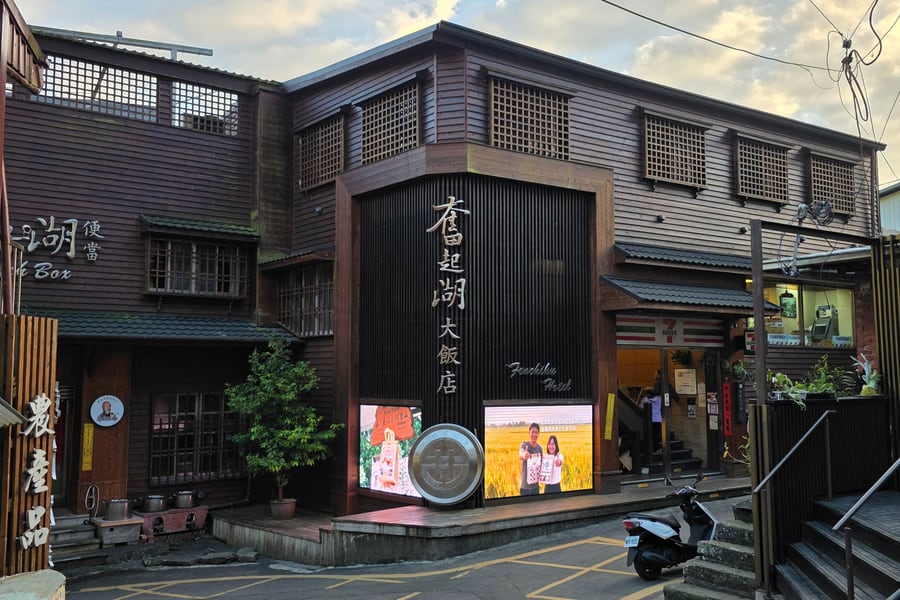 阿道 / Wikimedia Commons · CC BY-SA 4.0 · 2025 · cropped
Fenchihu Hotel
Beside the old street at Fenqihu, 1,403 m
A timber-fronted house on the old street a minute below the platform, at the point where the uphill train stops for an hour. The hotel sells the Fenchihu bento it has made its name on, runs guided walks around the village on published days, and posts the railway's own news on its front page. Entry is by keypad between midnight and seven, with the code given at check-in.
Check Availability (opens in a new tab, on fenchihu.com.tw)via fenchihu.com.tw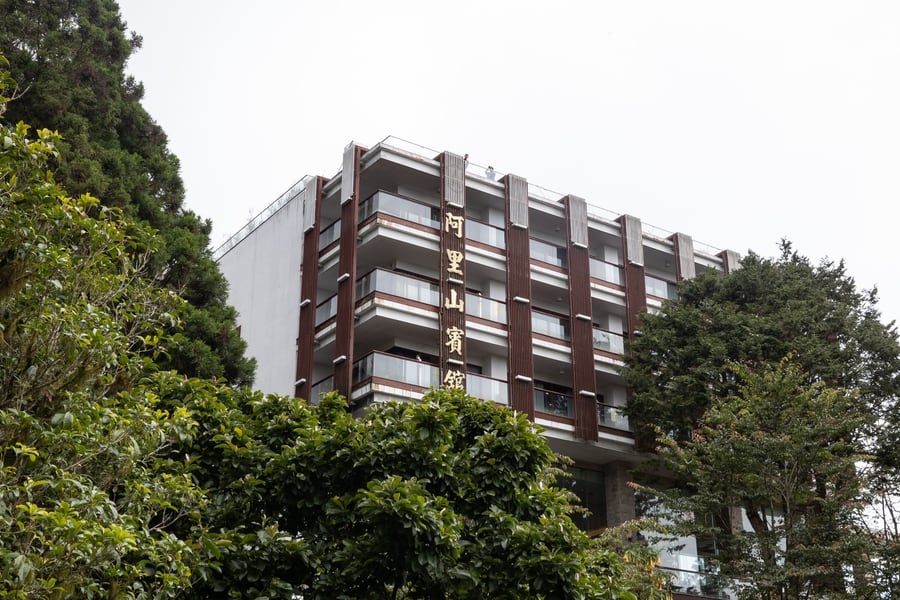 總統府 / Wikimedia Commons · CC BY 2.0 · 2024 · cropped
Alishan Hotel
In the recreation area, at the top of the line
The hotel's own account of itself: it descends from the Alishan Forest Farm Club of 1913, built in local cypress because materials were hard to bring up the new railway and the timber was standing around the site, and it calls itself the highest resort hotel in Taiwan. It sits in the middle of the forest recreation area, which puts the giant trees, the Sister Ponds and Zhaoping station within a walk rather than a drive of the door.
Check Availability (opens in a new tab, on alishanhotel.com.tw)via alishanhotel.com.twQuestions or corrections
Planning this trip and stuck on something, or spotted a time, fare or detail that has changed? Send us a message about The Alishan Forest Railway. We read every one, and we update this page when something has changed.