Appenzell to Trogen
© Appenzeller Bahnen
- DistanceAbout 30 km, Appenzell to Trogen through St. Gallen
- DurationAbout 1 hr 10 min end to end · every 30 minutes
- Best seasonAll year · the Alpstein is at its best in spring and under snow
Introduction
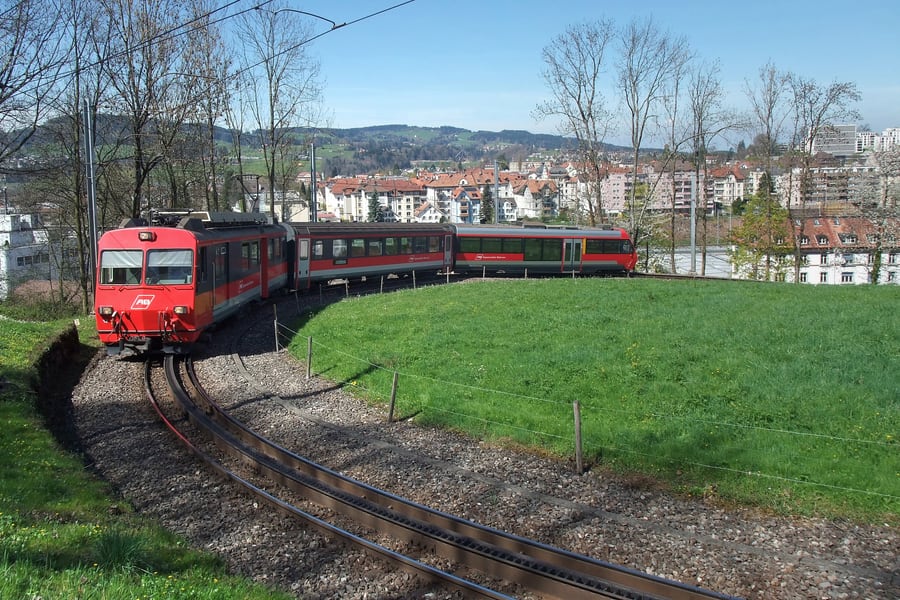
Until April 2018, trains from St. Gallen to Appenzell left the city on a rack, climbing through the Ruckhalde round a curve with a radius of just 30 metres. Swiss television called it the tightest rack curve in the world. It was also the reason the trains could not run more often. The Appenzeller Bahnen wanted a train every quarter of an hour between St. Gallen and Teufen, and the slow crawl on and off the rack made that impossible. So the railway dug a tunnel of about 700 metres beneath the hill, graded to be climbed without a rack, and took the record curve out of use.
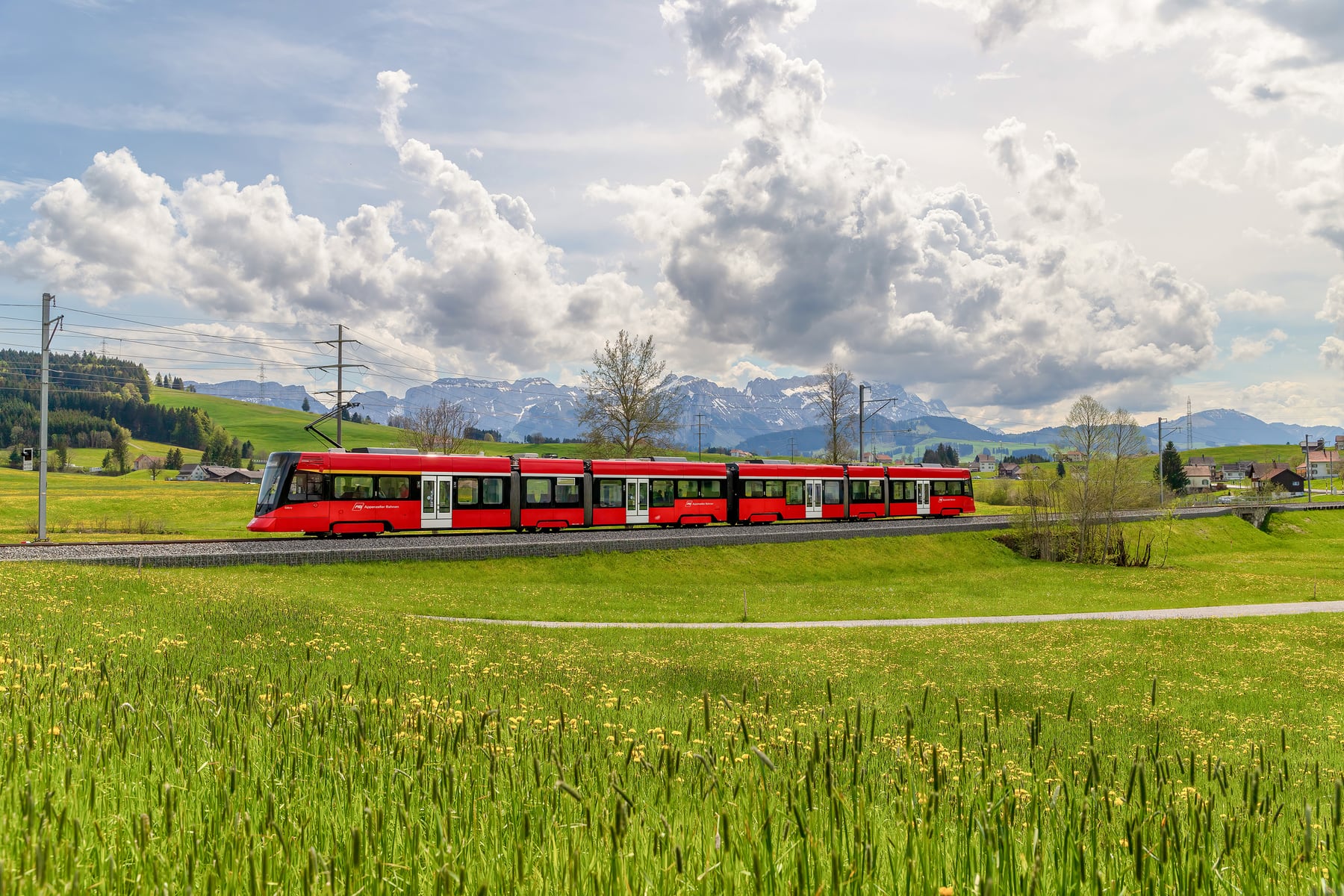
The tunnel did one more thing. It let two railways of very different character become one line. Since December 2018 the same train runs from Appenzell, under the peaks of the Alpstein, across the open hill country of Gais and Teufen, through the tunnel and the streets of St. Gallen, and up again to Trogen, where the open-air assembly of Ausserrhoden once met. It is about 30 kilometres of metre gauge, part mountain railway and part tramway, and it takes a little over an hour.
The S21 runs every half hour, all day and all year, and no reservation is needed. A ticket for the whole ride costs CHF 10, and every Swiss and Interrail pass covers it.
The Journey
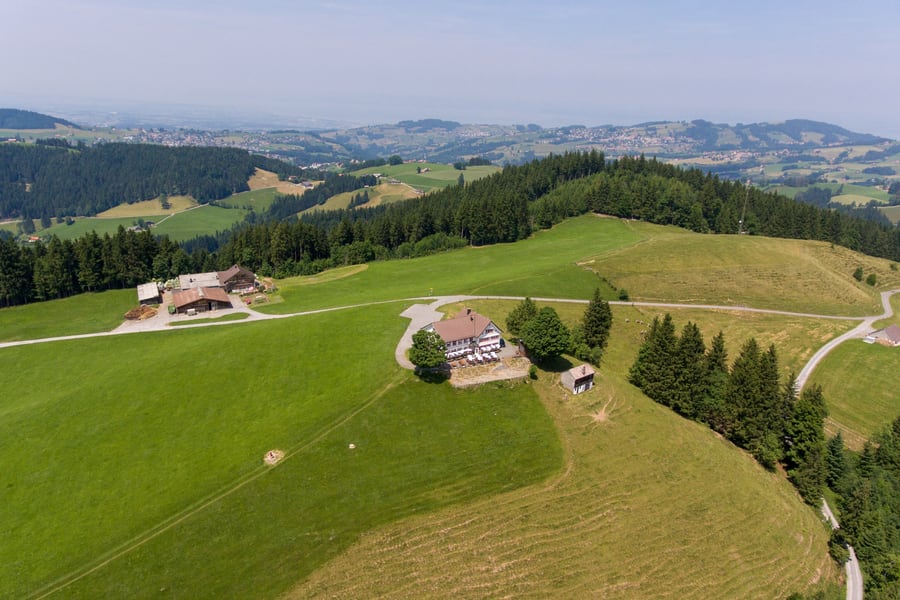
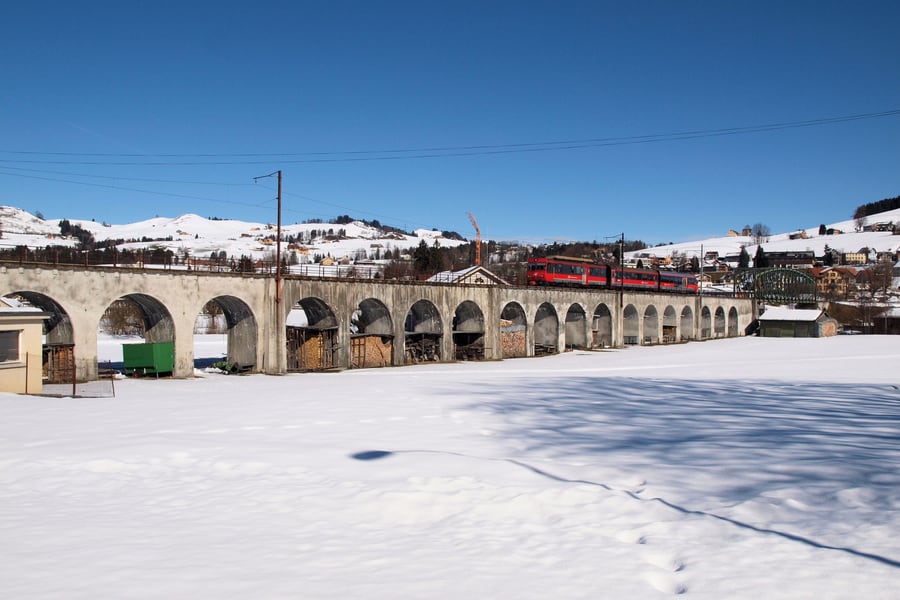
The red trains leave Appenzell past the depot and cross the Sitter on a long stone viaduct, then loop round the Hirschberg with the village and the Alpstein spread out behind. The line climbs alongside the road to the passing loop at Sammelplatz, the highest point of the Appenzell section at 928 metres, and runs down in a tight curve into Gais, where the rack line to Altstätten waits in the next platform. From here the train follows the main road through Bühler and into Teufen, sharing the village street with cars and front doors. After Niederteufen and Lustmühle it reaches Riethüsli, on the edge of St. Gallen, and dives into the Ruckhalde tunnel.
The curve that was given up
The first trains reached Gais from St. Gallen on 1 October 1889, on a line that needed seven rack sections for its gradients. The others were taken out one by one as the line was rebuilt, and the last, about 940 metres long at an average of 90 per mille, climbed out of the city through the Ruckhalde, and at its heart was the 30-metre curve. Tunnels to replace it were planned from the 1970s, and each plan failed on cost. What changed it was the merger of four Appenzell railway companies in 2006 and the new company's wish for a train every 15 minutes to Teufen. Building began in spring 2016, the tunnel opened with a public festival on 6 October 2018, and the rack curve had closed that April. The work cost about CHF 90 million, of which the three cantons and their communes paid 49 million.
Two railways, one train
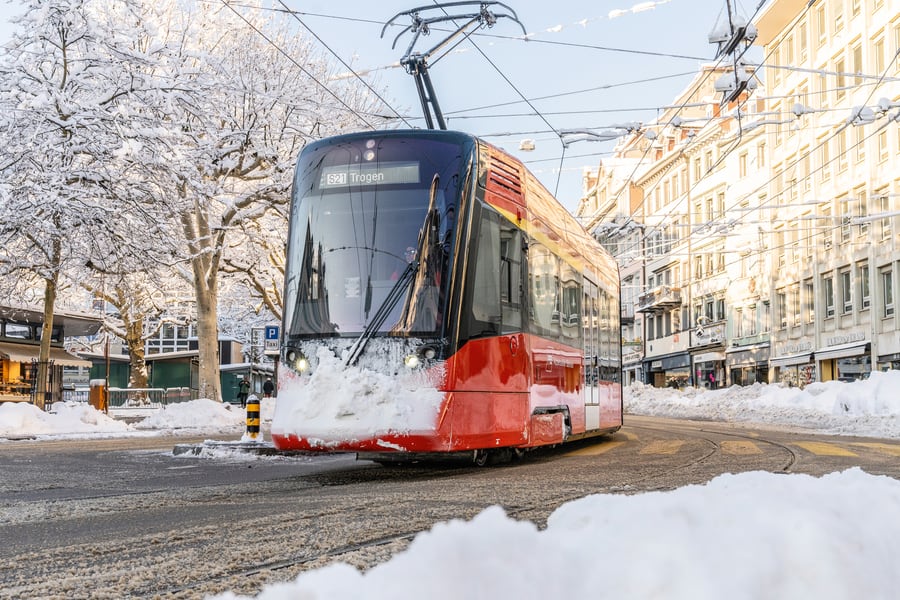
The line to Trogen opened on 10 July 1903, two days before Speicher celebrated the 500th anniversary of the battle of Vögelinsegg, fought on the hill the railway crosses. It ran through the old town on the tracks of the St. Gallen city tramway, and it still runs in the street there: after a pause at the main station, the trains pass the Marktplatz and the Spisertor, then climb through Notkersegg and over the ridge at Vögelinsegg, with the city and the lowlands below, to Speicher and Trogen. Since the December 2018 timetable, trains from Appenzell have run straight through, with no change in St. Gallen.
The whole line is now worked by Tango trains, the ABe 8/12 built by Stadler: low-floor articulated units, eleven of which entered service with the new line. On the climb out of St. Gallen towards Riethüsli they take a gradient of 80 per mille on their wheels alone.
The rack that remains
The rack has not vanished from the Appenzeller Bahnen. From Gais, the S24 runs every hour down a line of 1911 to Altstätten Stadt in the Rhine valley, 23 minutes away, on a rack for the steep descent. It is the obvious detour from the through line, and the OSTWIND day pass and every rail pass cover it.
Along the route
 Bobo11 / Wikimedia Commons · CC BY-SA 3.0 · cropped
Over the Sitter
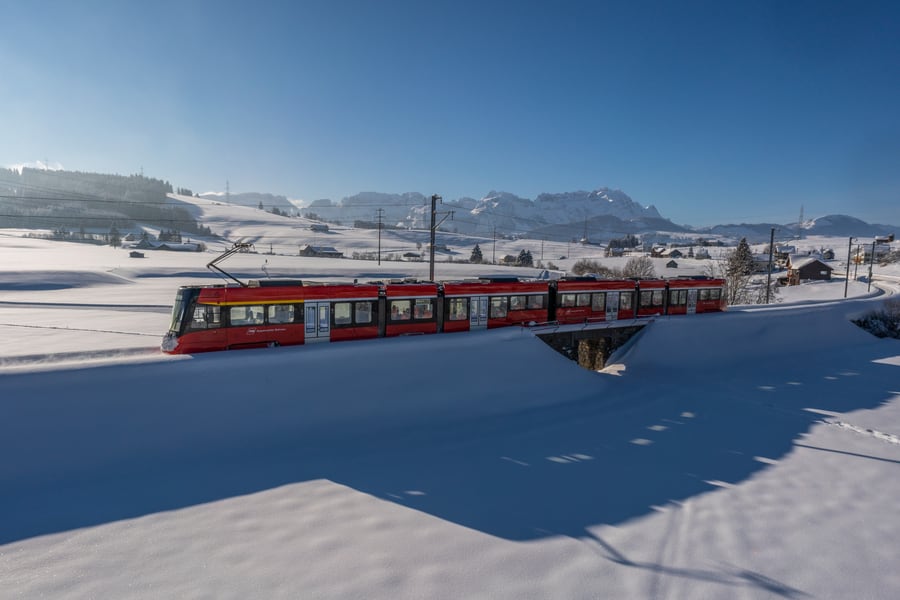
Leaving Appenzell, the train crosses the Sitter on a stone viaduct of 296 metres, then swings round the Hirschberg loop for a long look back over the village and up at the Alpstein.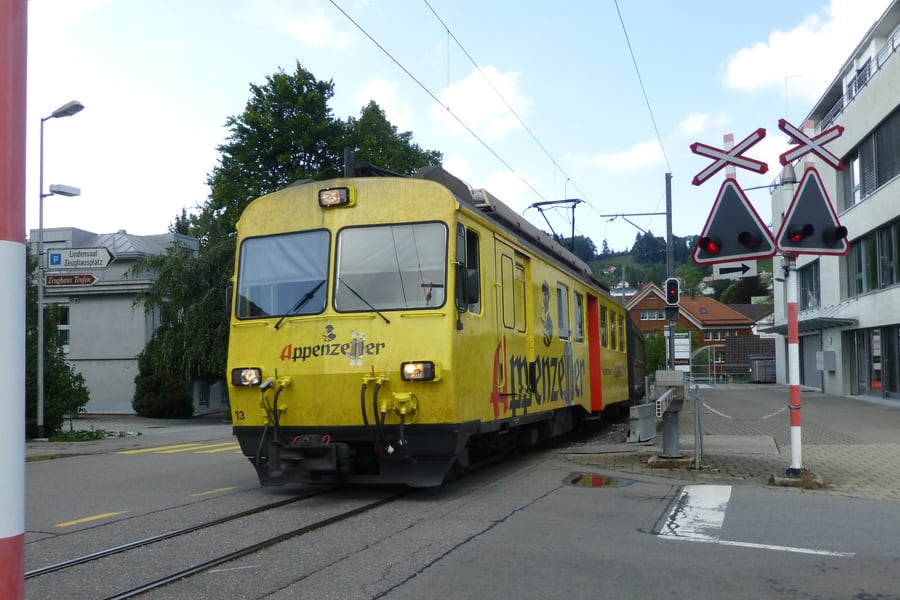 Jacquesverlaeken / Wikimedia Commons · CC BY-SA 4.0 · cropped
Down the village street in Teufen
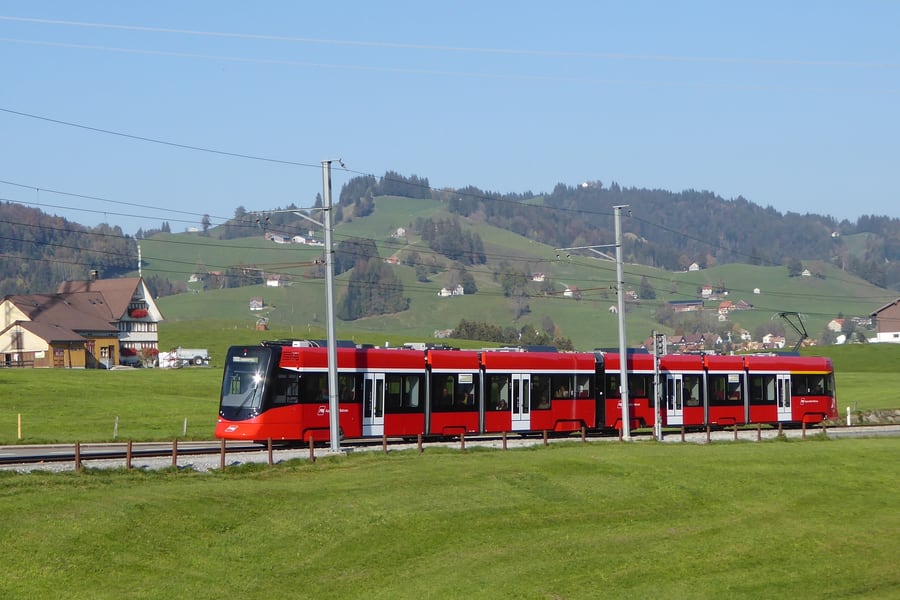
In Teufen the line runs beside and across the main road, past house fronts and driveways, and calls at a station building of 1909. Between here and St. Gallen the trains come every quarter of an hour in the busy hours.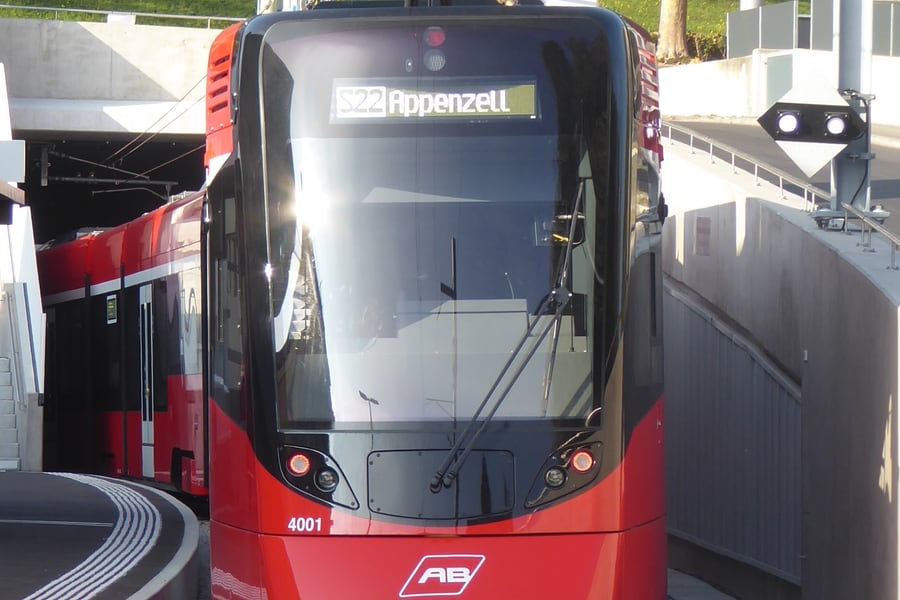 Plutowiki / Wikimedia Commons · CC0 · cropped
Through the Ruckhalde tunnel
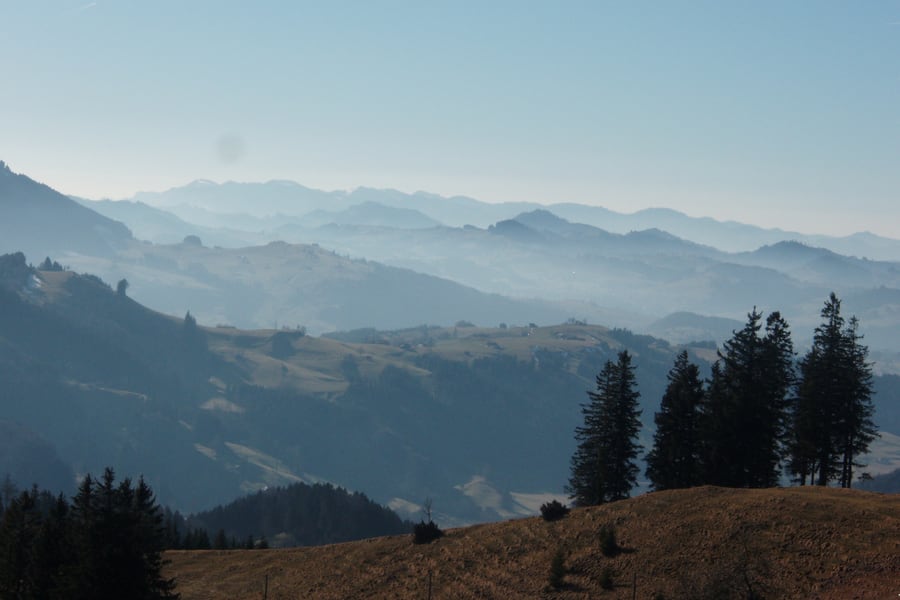
Below Riethüsli the train drops into a tunnel of about 700 metres, descending at up to 80 per mille without a rack. Along one wall runs Pirmin Breu's Alpine cattle procession, some 250 painted figures long.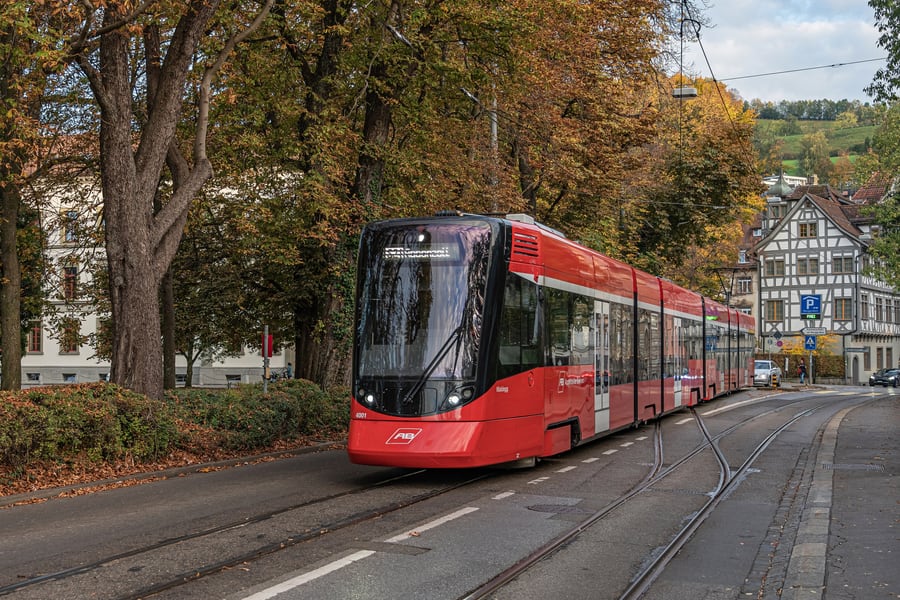 A.Savin / Wikimedia Commons · Free Art License · cropped
Through the old town of St. Gallen
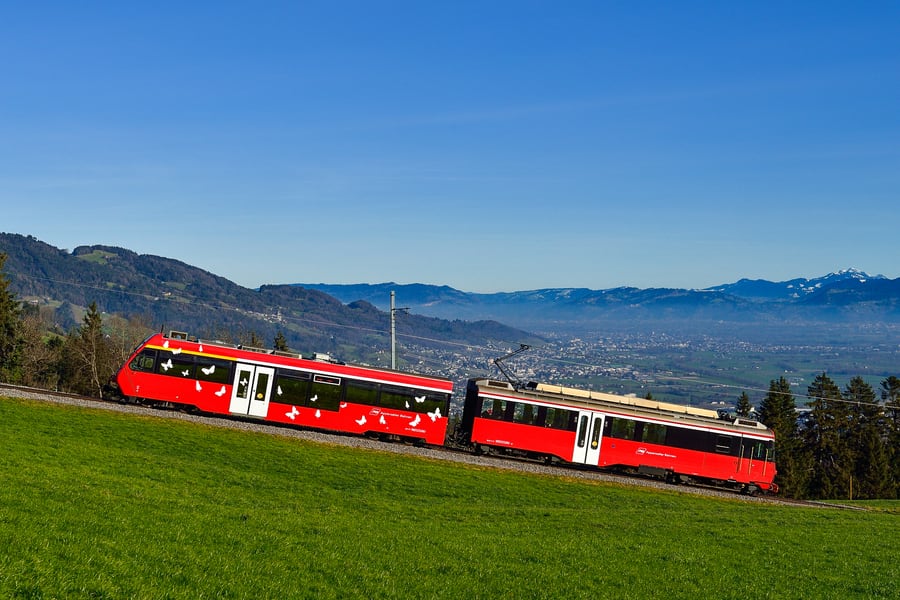
After a pause at the main station, the train becomes a street tramway, running past the Marktplatz and the Spisertor before climbing out of the city towards Speicher and Trogen.A bit of history
Culture & experiences along the way
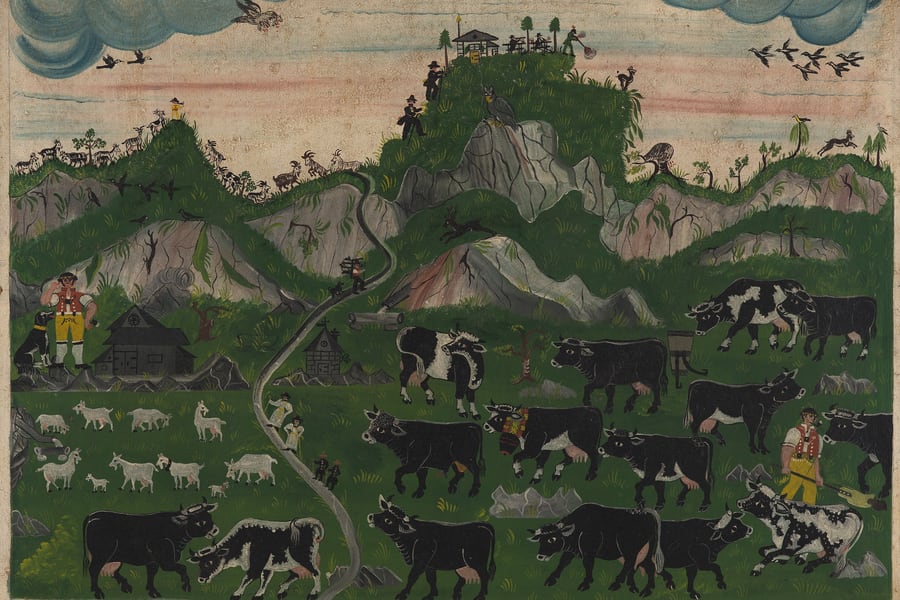 Bartholomäus Lämmler, 1854 · Kunstmuseum St. Gallen / Wikimedia Commons · public domain
Appenzell folk painting
The region's farmhouse painters turned the cattle procession up to the summer pastures into a genre of its own, the Senntumsmalerei. Bartholomäus Lämmler of Herisau, painter of this 1854 scene below the Hoher Kasten, pioneered the panel pictures, made alongside long strips of the procession and painted milk-pail bottoms.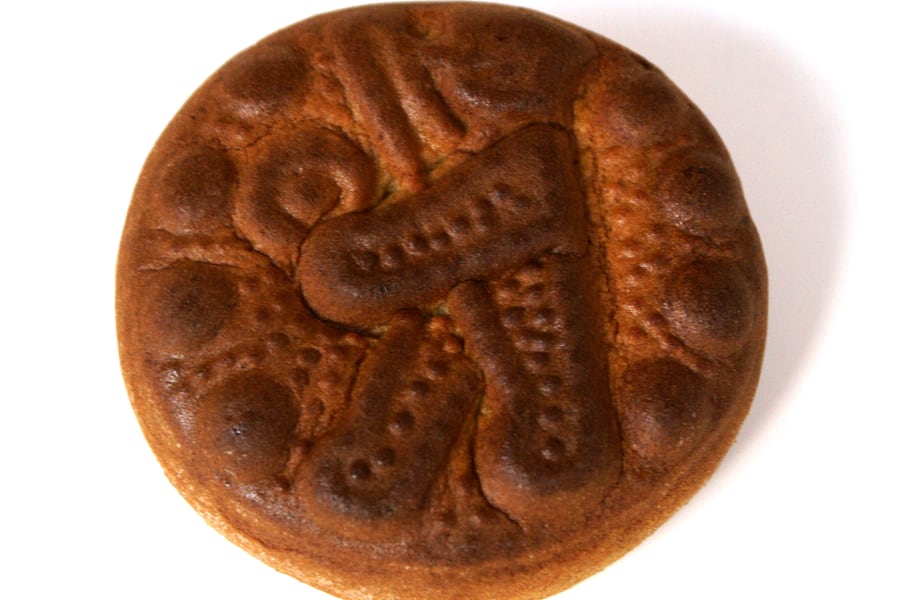 Sandstein / Wikimedia Commons · CC BY 3.0 · cropped
Appenzeller Biber
Appenzell's gingerbread, the Biber, is made by hand from a honey dough flavoured with a secret blend of spices and filled with a pale almond paste, itself made to a closely guarded recipe. The aim is a balance of honey and almond in which no single spice stands out.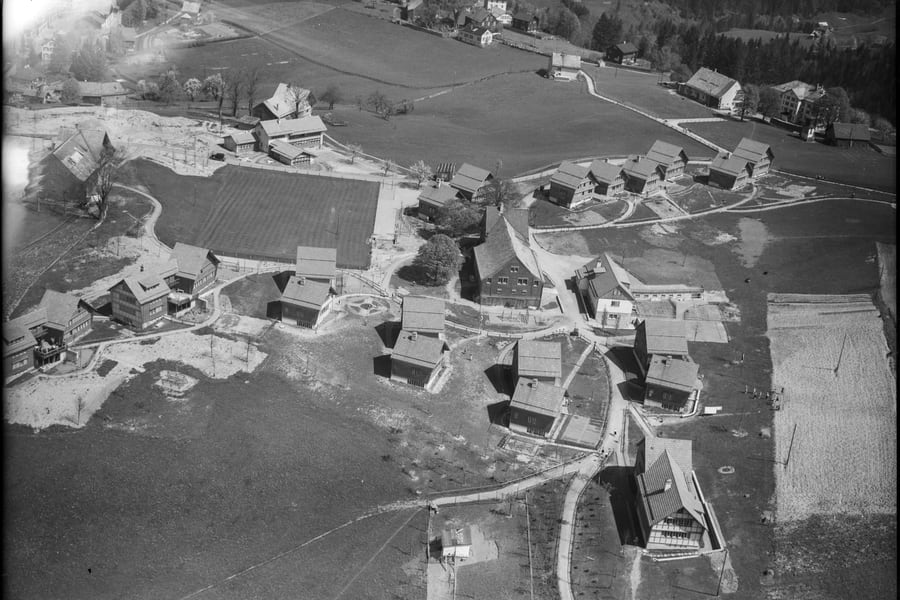 Werner Friedli, 1949 / ETH-Bibliothek / Wikimedia Commons · CC BY-SA 4.0 · cropped
The Pestalozzi Children's Village
At Trogen stands a village built after the Second World War for children orphaned by it, founded on 28 April 1946 and now a centre for education and children's rights. Its three founding houses reopened in 2026, and an exhibition tells its story.Timetables
The S21 runs through from Appenzell to Trogen, and back, every 30 minutes from about 05:00 to 23:00, every day of the year. The same timetable runs on weekdays and at weekends, and it is unchanged in the timetable that starts on 13 December 2026. Between St. Gallen and Teufen extra trains make it a train every 15 minutes in the morning, at midday and in the late afternoon. There are no reservations: buy a ticket and get on.
Times below are for the 2026 and 2027 timetables, read from the Swiss national timetable in November 2026. Check them before travelling on the Appenzeller Bahnen (opens in a new tab) site or at sbb.ch (opens in a new tab).
Appenzell to Trogen
| Appenzell | 08:09 | 10:10 | 12:14 | 14:14 | 16:14 | 18:12 |
| Gais | 08:22 | 10:23 | 12:27 | 14:27 | 16:27 | 18:27 |
| Teufen AR | 08:35 | 10:36 | 12:40 | 14:40 | 16:40 | 18:40 |
| St. Gallen | 08:56 | 10:56 | 12:56 | 14:56 | 16:56 | 18:56 |
| Speicher | 09:16 | 11:16 | 13:16 | 15:16 | 17:16 | 19:16 |
| Trogen | 09:22 | 11:22 | 13:22 | 15:22 | 17:22 | 19:22 |
Trains leave Appenzell at roughly :10 and :40 past each hour. Towards Trogen they wait four minutes at Gais to cross the train coming the other way.
Trogen to Appenzell
| Trogen | 08:23 | 10:25 | 12:25 | 14:25 | 16:25 | 18:25 |
| Speicher | 08:28 | 10:30 | 12:30 | 14:30 | 16:30 | 18:30 |
| St. Gallen | 08:52 | 10:52 | 12:56 | 14:56 | 16:56 | 18:56 |
| Teufen AR | 09:06 | 11:06 | 13:10 | 15:10 | 17:10 | 19:10 |
| Gais | 09:19 | 11:19 | 13:23 | 15:23 | 17:23 | 19:23 |
| Appenzell | 09:28 | 11:28 | 13:33 | 15:33 | 17:33 | 19:33 |
Trains leave Trogen at :25 and :55 past each hour.
Connections
St. Gallen is about an hour from Zurich, with fast trains every half hour, and the narrow-gauge platforms are beside the main station. From Gais, the S24 rack line runs hourly to Altstätten Stadt in 23 minutes. From Appenzell, the S23 runs on to Wasserauen in 12 minutes.
Tickets
The line is part of the OSTWIND fare network of eastern Switzerland, and tickets are priced by zone. Appenzell to Trogen, or St. Gallen to Appenzell, is a four-zone single at CHF 10.00 in second class and CHF 17.60 in first, valid for two hours; with a Half Fare Travelcard or for a child it is CHF 5.00. Tickets are sold online and in the SBB, OSTWIND and FAIRTIQ apps, and must be bought before the train leaves.
For a day on the line and its branches, the OSTWIND 9 o'clock day pass covers every zone from 09:00 for CHF 40.00, or CHF 20.00 with a Half Fare Travelcard. Fares read from ostwind.ch (opens in a new tab) and sbb.ch (opens in a new tab) in November 2026.
Book your tickets
OSTWIND single, end to end
CHF 10.00 second class · CHF 5.00 with a Half Fare Travelcard
Appenzell to Trogen, or St. Gallen to Appenzell, is a four-zone ticket valid for two hours.
Book Tickets (opens in a new tab, on ostwind.ch)via ostwind.chOSTWIND 9 o'clock day pass
CHF 40.00 second class · CHF 20.00 with a Half Fare Travelcard
Every OSTWIND zone from 9 in the morning, including the rack line to Altstätten and the branch to Wasserauen.
Book Tickets (opens in a new tab, on ostwind.ch)via ostwind.chRail Passes
Every pass that covers Switzerland covers this line in full, with no reservation and no supplement.
Swiss Travel Pass and GA Travelcard
The Appenzeller Bahnen state that the Swiss Travel Pass is valid on all their lines, so the through line, the rack railway from Gais to Altstätten and the branch to Wasserauen are all included. The GA Travelcard covers them too, and a Half Fare Travelcard halves the fare.
Interrail and Eurail
Included. Interrail's table of Swiss railway companies lists the Appenzeller Bahnen among the operators covered by both the Global Pass and the One Country Pass, with no reservation required.
Is a pass worth it here?
Not for this journey alone. The whole ride costs CHF 10, and a day on every line in the region costs CHF 40 from nine in the morning. Visitors staying three nights or more with the same host in and around Appenzell are usually given the Appenzeller Ferienkarte, which includes free second-class travel in 21 OSTWIND zones.
Pass conditions checked in November 2026 against the Appenzeller Bahnen's own pages and Interrail's railway-companies page, last updated 21 October 2026. Conditions change with each season, and the pass issuer's page is the one that binds.
Places to Visit
The line strings together a town of painted houses, a village square rebuilt after a fire, a city with a World Heritage abbey and a village of merchants' palaces, and the trains run often enough to stop at all of them in a day. The rack line from Gais adds a small town in the Rhine valley.
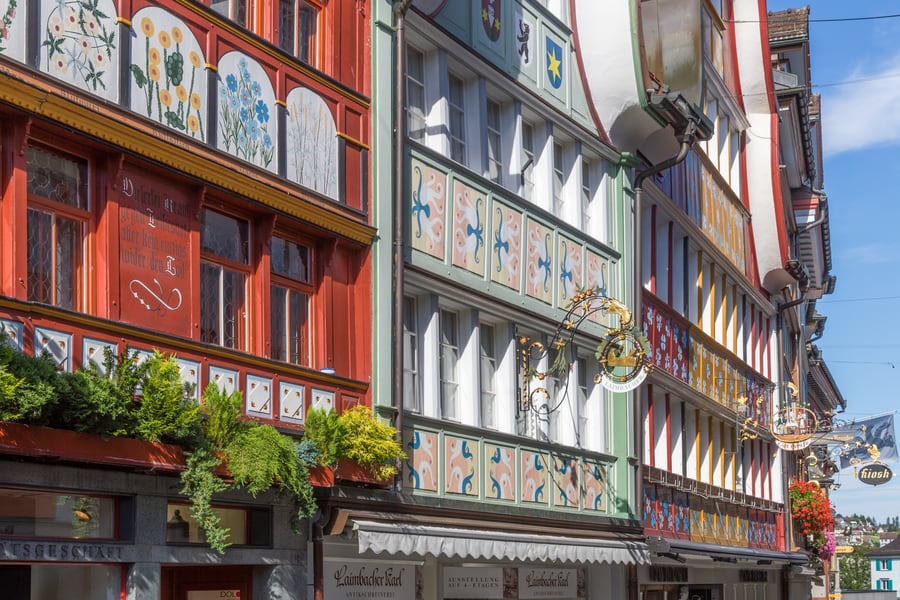 JoachimKohler-HB / Wikimedia Commons · CC BY-SA 4.0 · cropped
Appenzell
After a fire in 1560 Appenzell was rebuilt in wood, and the houses of the Hauptgasse still carry their curved gables and painted fronts. The town hall of 1561–1563 holds the Museum Appenzell, devoted to the Catholic, rural history of Innerrhoden. The S23 continues from the station to Wasserauen, at the foot of the Alpstein, in 12 minutes.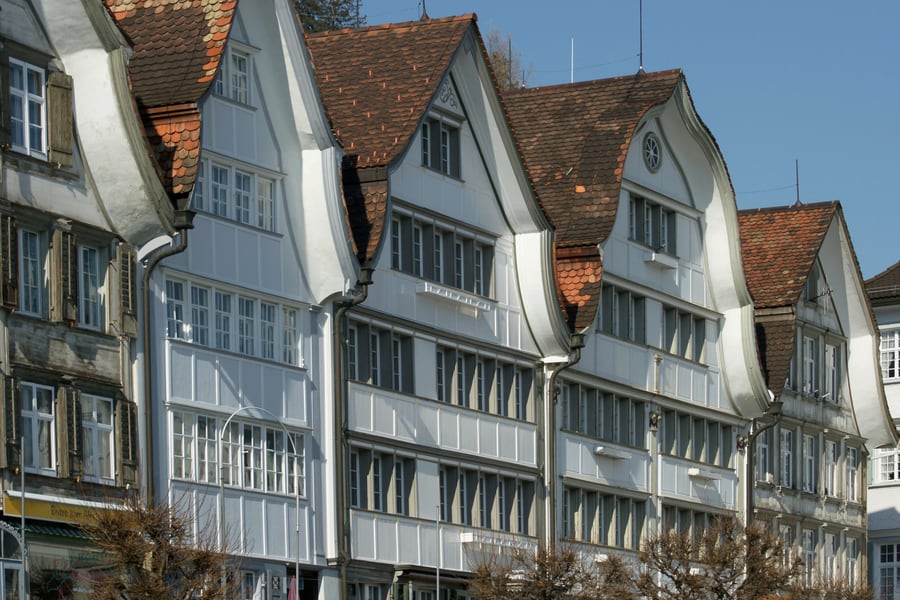 böhringer friedrich / Wikimedia Commons · CC BY-SA 2.5 · cropped
Gais
A fire on 18 September 1780 destroyed almost all of Gais, and it was rebuilt on the old plan around the Dorfplatz, with the swung wooden gables that won the village the Wakker Prize for its townscape in 1977. Between 1749 and 1860 it was a spa where visitors came to take whey cures. Trains towards Trogen wait here four minutes.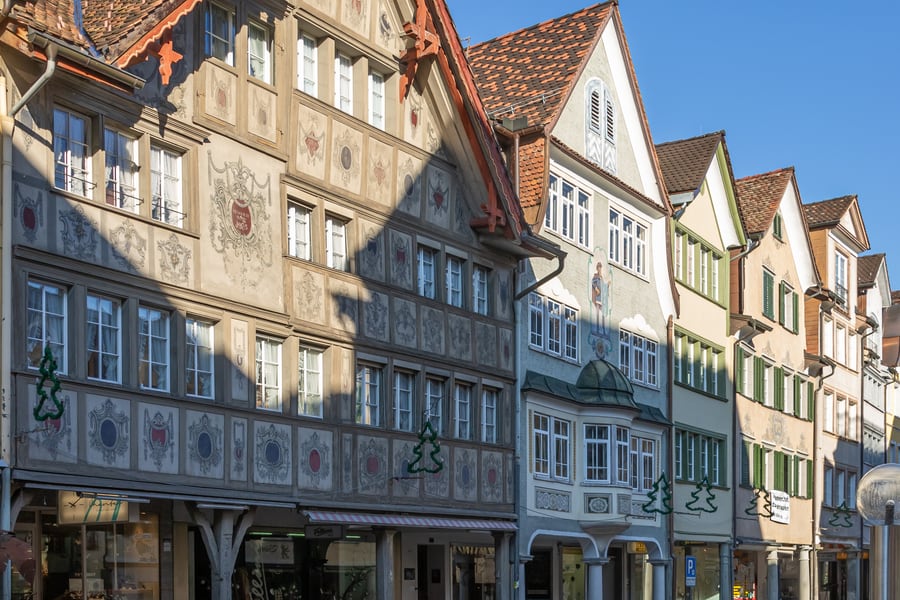 JoachimKohler-HB / Wikimedia Commons · CC BY-SA 4.0 · cropped
Altstätten, by rack railway
The S24 leaves Gais every hour and drops on a rack line, opened in 1911, to Altstätten in the Rhine valley. Its old town was rebuilt after a fire in 1567, and merchants of the 18th century added their houses with curved gables along the arcaded Marktgasse. The last two evening runs are buses.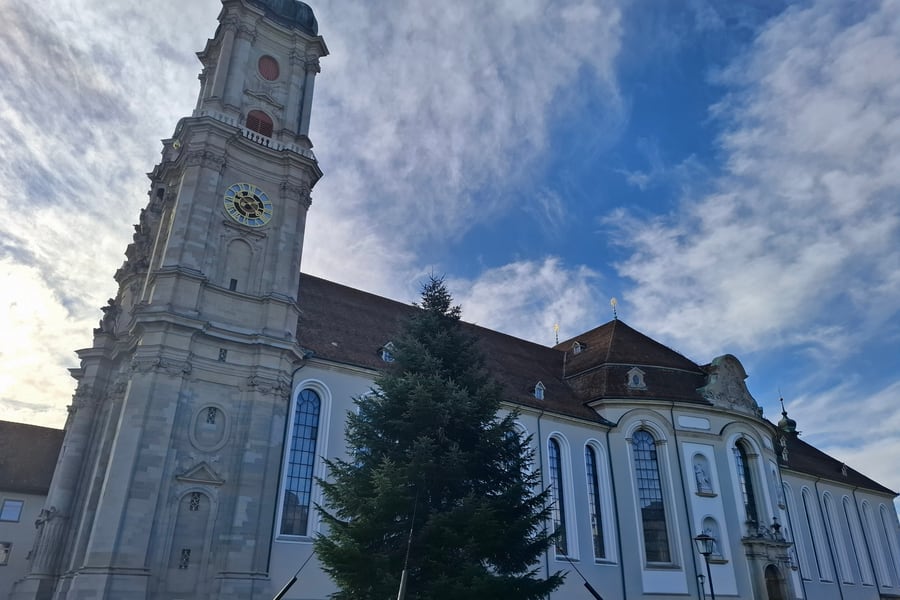 Pablodbds / Wikimedia Commons · CC0 · cropped
St. Gallen and its abbey
The Abbey of St Gall, on UNESCO's World Heritage List, was one of Europe's great centres of learning from the 8th century until 1805. Its present buildings are mostly of the 18th century: the cathedral with its two towers, and the Baroque hall of the abbey library, which keeps Irish manuscripts of the 7th and 8th centuries.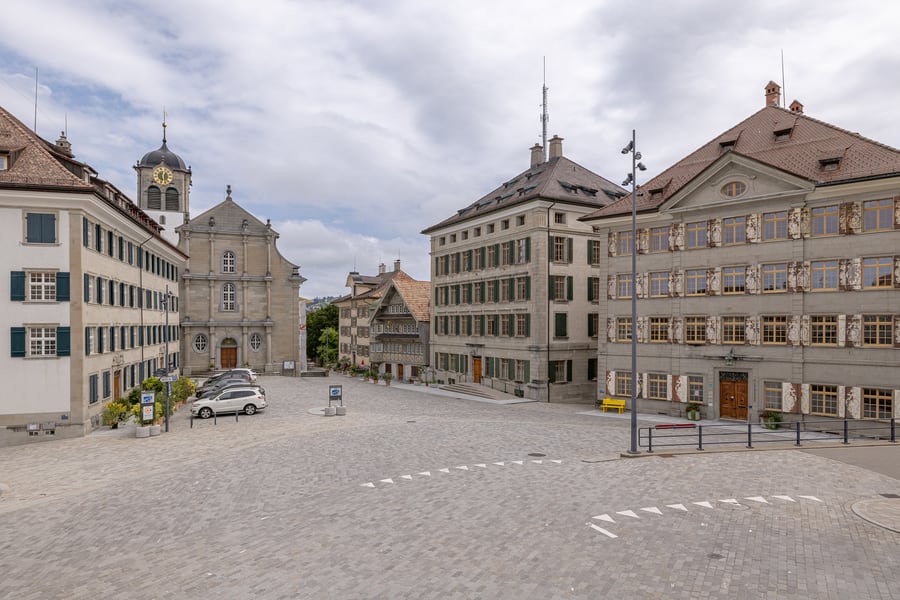 Mario Baronchelli / Wikimedia Commons · CC BY-SA 4.0 · cropped
Trogen
In the 17th and 18th centuries the Zellweger family grew rich trading linen and cotton, and built the stone palaces around Trogen's Landsgemeindeplatz. The open-air assembly of Appenzell Ausserrhoden met on this square every other year until it was abolished in 1997. The square was rebuilt between 2019 and 2021.Where to Sleep
St. Gallen, in the middle of the line, is the easiest base, with the most hotels and the fastest trains to Zurich. To wake up under the Alpstein, stay in Appenzell; for a quiet night on a village square, stay in Trogen. A stay of three nights or more around Appenzell usually brings the Appenzeller Ferienkarte and free travel on the line.
The places below keep their own websites and take direct bookings.
Where to stay
Hotel Appenzell
A café and hotel on the Landsgemeindeplatz
A family café with rooms on the main square of Appenzell, a few minutes' walk from the station.
Check Availability (opens in a new tab, on hotel-appenzell.ch)via hotel-appenzell.chHotel Einstein
In the centre of St. Gallen
A large city hotel with a restaurant and a wellness area, midway along the line.
Check Availability (opens in a new tab, on einstein.ch)via einstein.chKrone Trogen
Ten rooms on the Landsgemeindeplatz
A bistro, a hall and ten rooms over three floors on Trogen's main square, run by a local association.
Check Availability (opens in a new tab, on krone-trogen.ch)via krone-trogen.chQuestions or corrections
Planning this trip and stuck on something, or spotted a time, fare or detail that has changed? Send us a message about Appenzell to Trogen. We read every one, and we update this page when something has changed.