Arosa Line
Markus Giger / Wikimedia Commons · CC BY-SA 4.0 · 2022 · cropped
- Distance25.7 km
- Duration61 min each way
- Best seasonAll year · hourly
Introduction
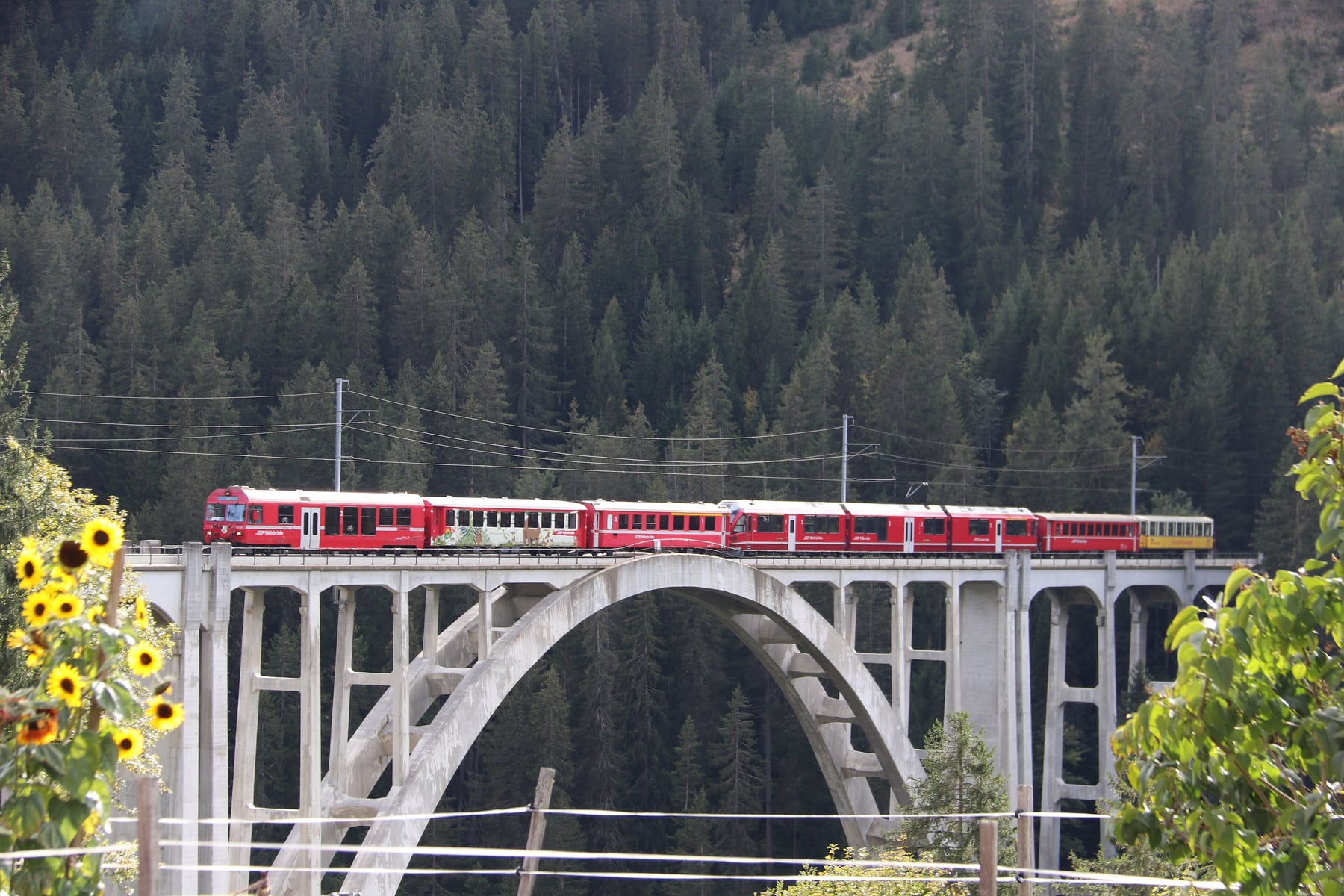
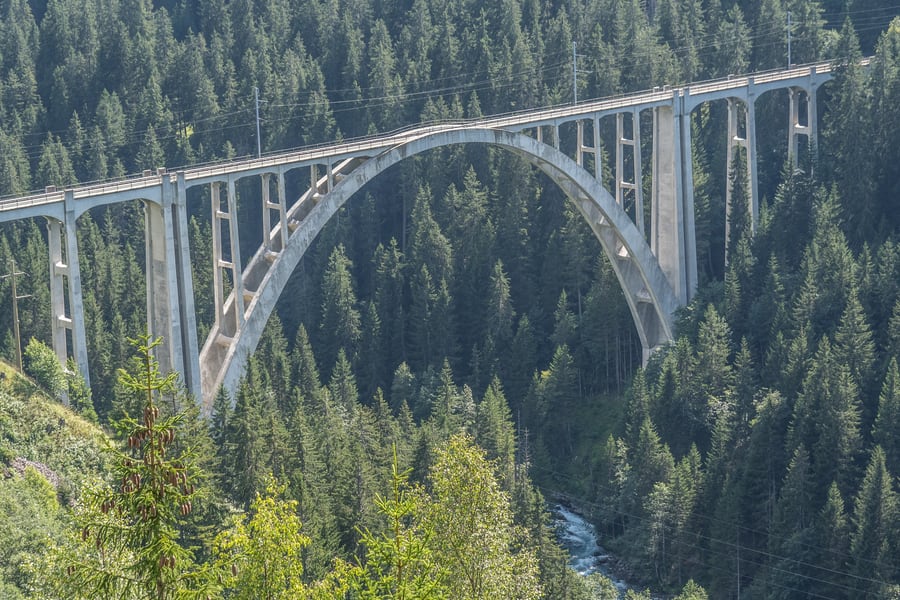
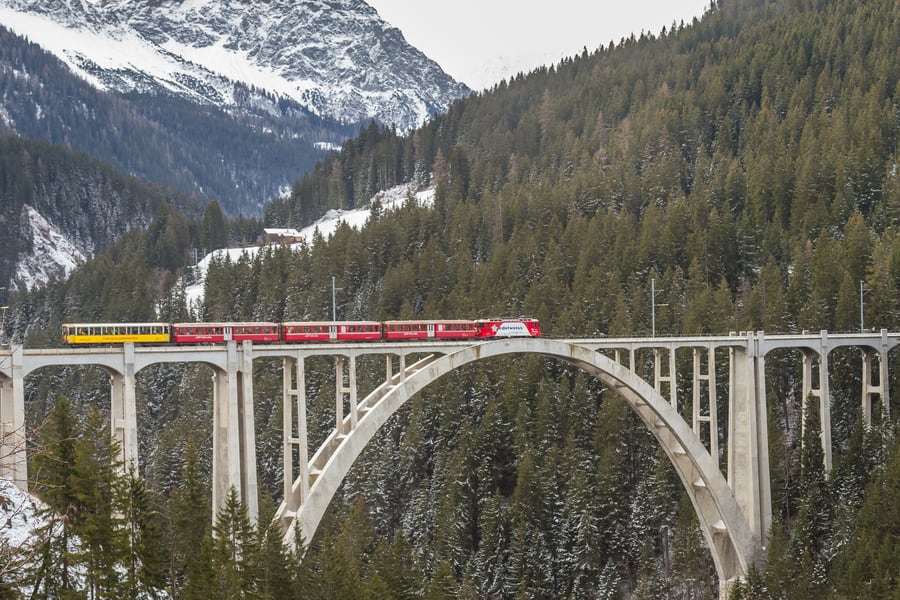
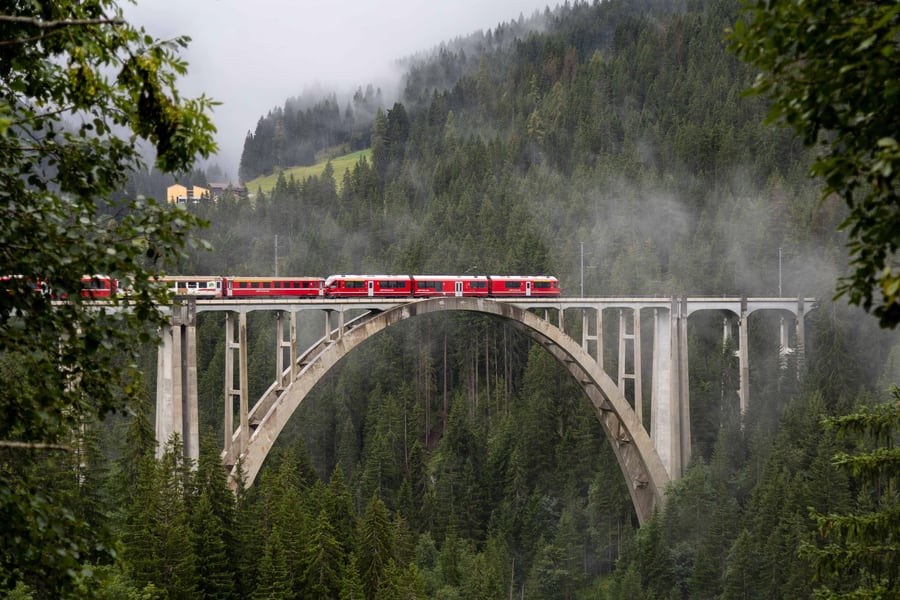
The most famous structure on this railway is made of concrete because nothing else could be got up the road. In 1912 the only way into the upper Schanfigg was a mountain road on which a four-horse team could pull two and a half tonnes, and took a day and a half to do it; iron girders were therefore undeliverable, and the valley is moraine, with sand and gravel in abundance and almost no building stone. That left reinforced concrete, a material then barely twenty years old and untried at any real scale. What came of it was the Langwieser Viadukt: a hundred-metre arch sixty-two metres above the Plessur, the widest-spanning reinforced-concrete railway bridge in the world when it opened in 1914.
Building it took about a thousand horse journeys and eight hundred cubic metres of local timber, cut into a fan of falsework by a Graubünden carpenter named Richard Coray. The bridge has no hinges and no bearings; it takes up summer and winter by flexing, the crown of the arch rising and falling some two centimetres over the year. At the load test in October 1914, a steam locomotive and three loaded wagons pushed it down by less than a millimetre. One of the railcars crossing it today carries Coray's name.
The rest of the line is quieter but no less odd. Trains leave the forecourt of Chur station on grooved rails, run down the middle of a public street, cross a roundabout diagonally, and only then begin to climb — 1,155 metres in twenty-six kilometres, on plain adhesion, without a metre of rack.
The Journey
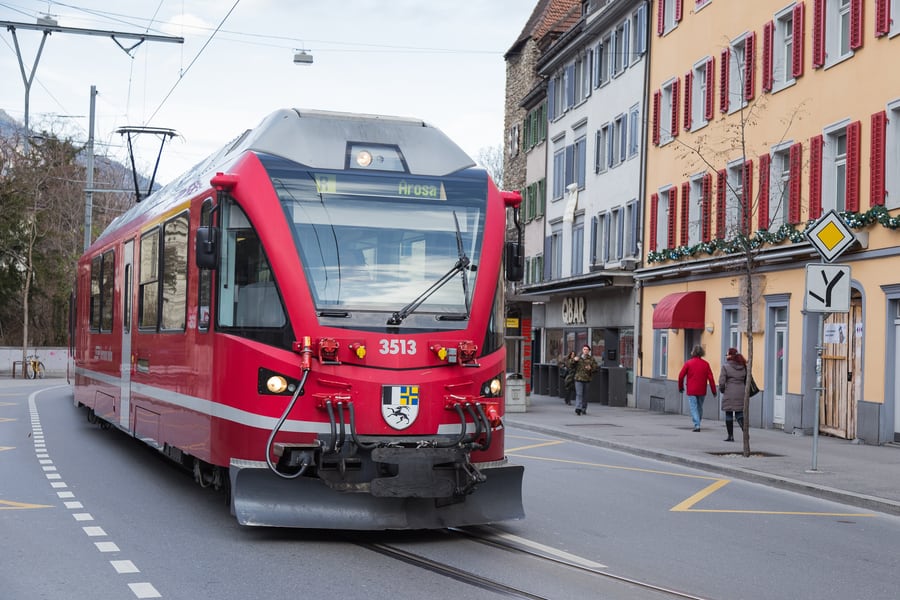
Trains for Arosa do not use the main platforms at Chur. They stand on tracks 1 and 2 in the station forecourt, alongside the bus stands, and they leave by turning into the traffic. For the first half kilometre the line is double track laid in grooved rails down the middle of the Engadinstrasse; it crosses a roundabout on the diagonal, narrows to a single track before the Grabenstrasse junction, reaches the right bank of the Plessur and stops at Chur Altstadt, a kerbside halt beside the river a few minutes' walk from the old town. Cars queue behind the train at the lights. Beyond the former Sand depot the rails move off the carriageway onto their own alignment beside a narrower road, and about 1.6 kilometres out of Chur the railway leaves the roadway for good and becomes a mountain line.
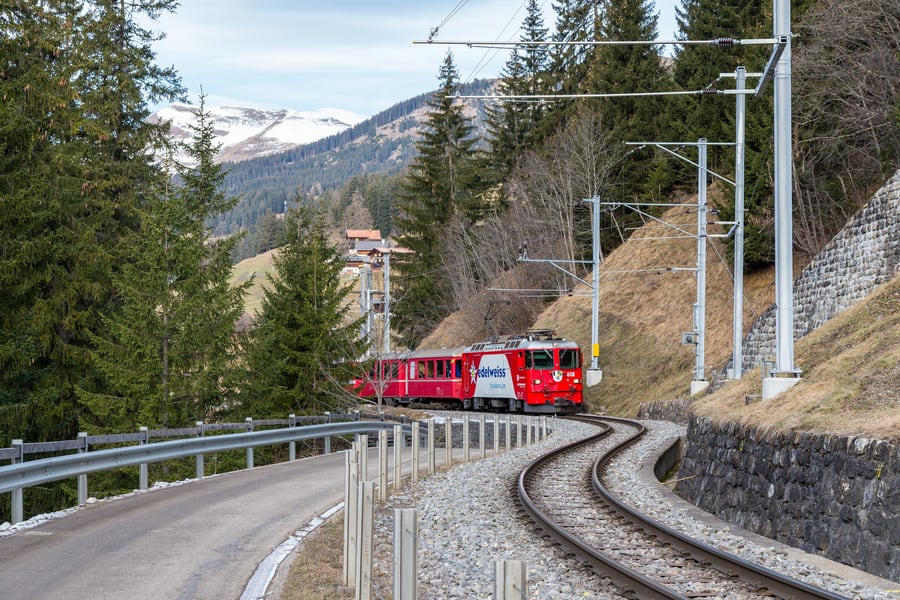
What follows is one of the busiest short stretches of civil engineering in Switzerland: nineteen tunnels, more than fifty bridges and twelve avalanche galleries in twenty-six kilometres. The railway climbs at up to sixty per mille — one in seventeen — and never uses a rack. Two of the schemes put forward in the early planning proposed rack sections, and the consulting engineer whom Arosa itself had commissioned advised expressly against them; by 1910 the surviving proposal was a pure adhesion railway with a ceiling of sixty per mille. Because the promoters wanted Rhaetian Railway stock to be able to run through, the curves were kept generous by mountain-railway standards; the tightest is fifty-two metres. The price of adhesion working is speed. The line limit is thirty-five kilometres an hour, and the whole 25.681 kilometres take about an hour.
Up the Schanfigg
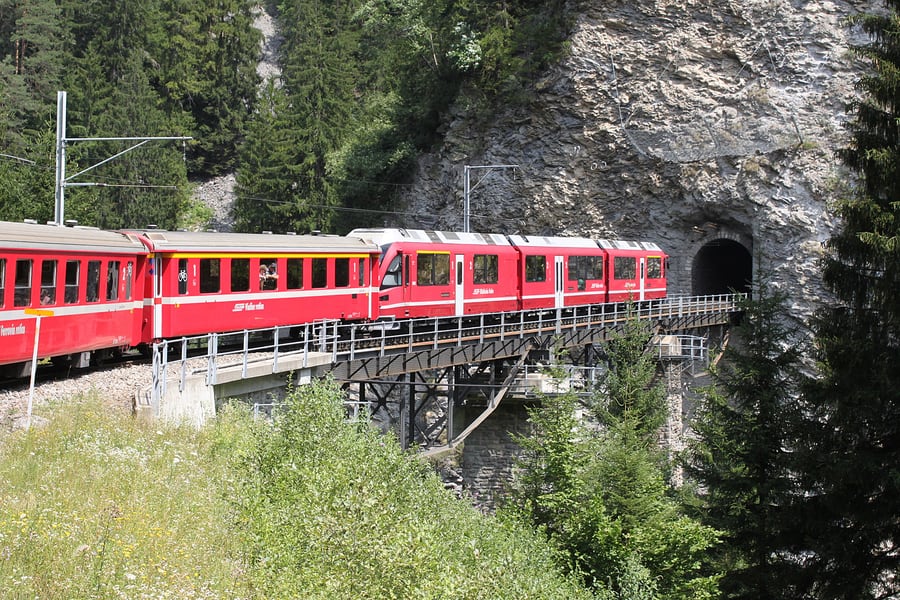
Above Chur the line runs along the valley side below the Schanfiggerstrasse, in a sequence of short tunnels and rock galleries — Sassal, Meiersboden, Nesslaries, Spundätscha, Gitzistein, Saxernase — with the Plessur out of sight below. It crosses the Calfreisertobel and then the Castielertobel on a steel viaduct that runs straight into a tunnel mouth, and reaches Lüen-Castiel at 938 metres, the first passing loop and the place where the up and down trains cross each other every hour. The villages here are small and scattered on the slopes above the track: Lüen is beside the line, and Castiel is half an hour's walk up the hill from it.
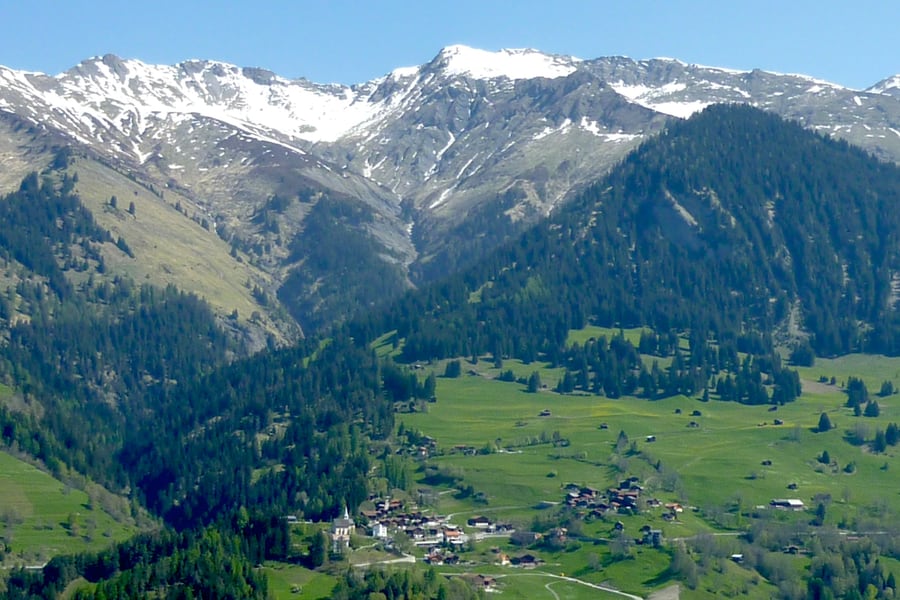
Past the four-hundred-metre Lüener Rüfe tunnel — the longest on the line, and the site of the rockfalls that closed the railway twice in 2013 — the valley narrows and the gradient bites. St. Peter-Molinis comes at 1,157 metres and Peist at 1,244, both request stops with the dark timber station buildings the line opened with. The church above St. Peter was the mother church of the Schanfigg and was first recorded in 831; its tower, pierced with arrow slits, is eleventh- or twelfth-century and probably began as a watchtower. After Peist the line crosses the Farbtobel and the Frauentobel, threads the Matten tunnel and goes over the Gründjitobel-Viadukt, a concrete arch of eighty-five metres' span built at the same time as its bigger brother, by the same contractor, and usually described as its little brother.
Langwies
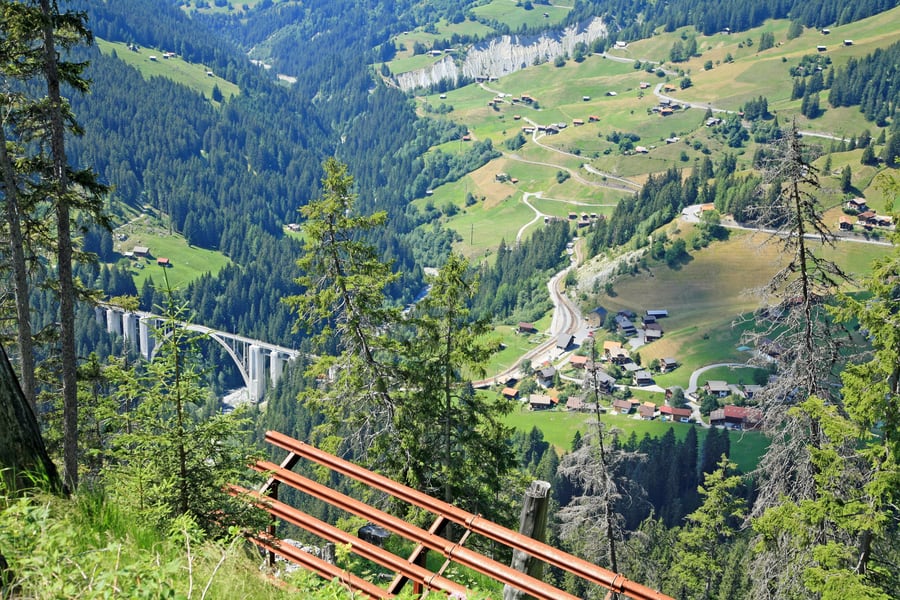
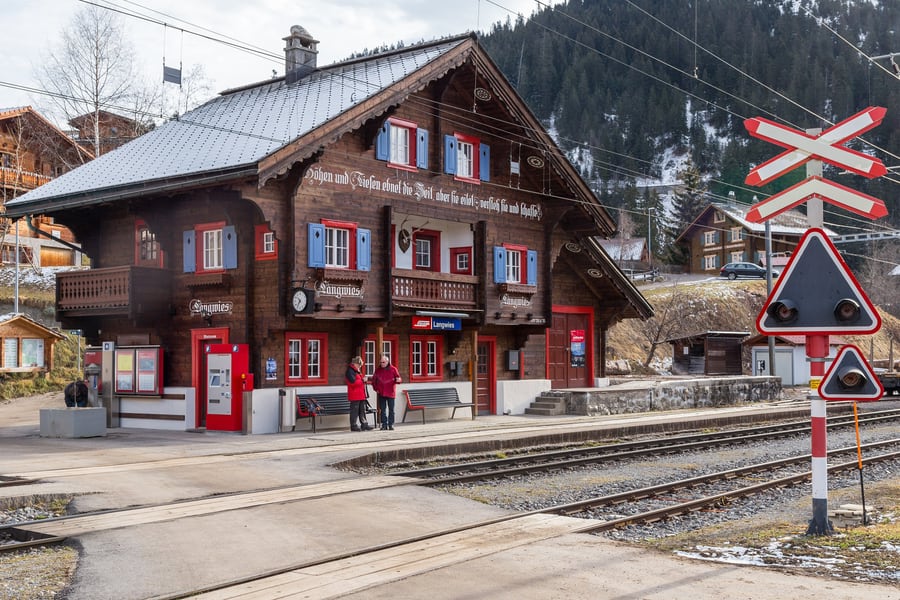
Langwies station, at 1,317 metres, is the only intermediate stop the railway treats as a proper station rather than a request halt, and it is where the line's set piece begins. A hundred metres past the platform the track runs out onto the Langwieser Viadukt: 287 metres long, 62 metres above the confluence of the Plessur and the Sapünerbach, thirteen openings, and in the middle a single hundred-metre arch with a rise of forty-two metres. It is a Swiss cultural property of national significance and the largest bridge on the Rhaetian Railway.
Its two arch ribs, set on edge and braced with sixteen cross-beams, were unusual in 1913 and became the model for a whole family of concrete bridges. The design deliberately avoids hinges and bearings, letting the piers grow more slender as they grow taller so that the deck can expand and contract without being restrained. The regulator thought a hundred metres too ambitious, so the drawings submitted to the federal railway department gave the span as ninety-eight or ninety-nine. The old station buildings around the platform now house the Viadukt Museum, and one of the bridge's own piers is a walk-in exhibition room.
Litzirüti to Arosa
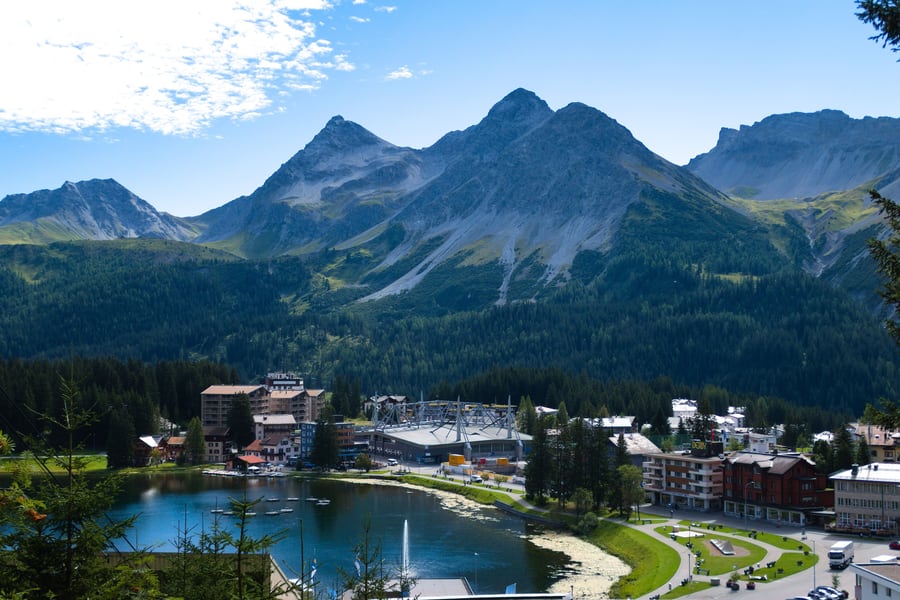
Above Langwies the railway doubles back on itself twice in a pair of horseshoes to gain height, reaching Litzirüti at 1,452 metres, the second crossing loop. The last stretch runs through open snow country above the treeline of the Welschtobel, past the Haspelgrube passing place at 1,582 metres and the Iselsee, and then dives into the straight 299-metre Arosa tunnel under the village to surface at the terminus beside the Obersee at 1,739 metres. The station is a dead end with a small depot beyond it, the cable car to the Aroser Weisshorn is next door, and the whole of Arosa's bus network starts from the square outside.
What runs
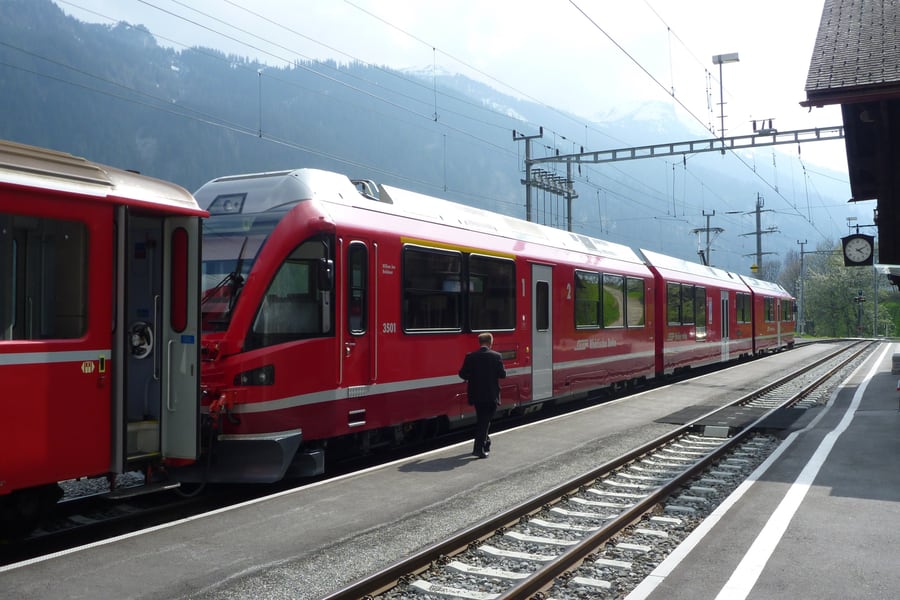
Since 2010 the timetable has been worked mainly by Allegra railcars — class ABe 8/12, numbers 3501 to 3515, three-section dual-voltage units built for the RhB from 2010 that can switch between direct and alternating current while moving. On the Arosa line they work as power cars hauling ordinary Rhaetian Railway coaches rather than running as fixed sets. Number 3508 is named after Richard Coray, the carpenter who built the falsework for the arch it crosses several times a day. Ge 4/4 II electric locomotives still appear on strengthening and charter workings.
The line has run on the Rhaetian Railway's standard 11 kilovolt alternating current only since 29 November 1997. For its first eighty-three years it used 2,400 volts direct current, a voltage almost nobody else in Europe adopted, fed from a power station at Lüen built for the purpose, and its blue and white trains could not leave the branch. The conversion cost 58.3 million francs, ninety-six per cent of it federal money, and it is why main-network stock can work to Arosa today.
Freight still uses the line. Timber, gravel, sand and cement account for more than fifty thousand tonnes a year, and rather than run separate trains the Rhaetian Railway usually attaches the wagons to a scheduled passenger service — which is why a train down from Arosa sometimes has a couple of loaded flats on the back.
Along the route
 Brückenfotograf / Wikimedia Commons · CC BY 4.0 · 2025 · cropped
The bridge the road chose
Gustav Bener wanted every bridge on this line in local stone, but the upper Schanfigg is moraine and has none, and iron was ruled out by the road. Concrete was what was left — and it made the widest-spanning concrete railway bridge in the world.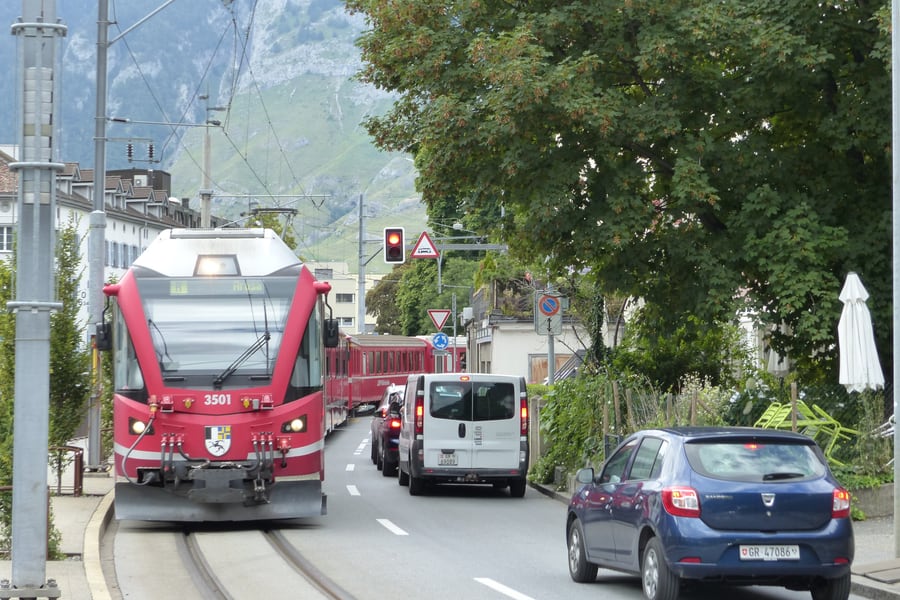 Whgler / Wikimedia Commons · CC BY-SA 4.0 · cropped
Out of Chur in the traffic
The Arosa trains have never used the main platforms at Chur. They start from the station forecourt and leave by turning into the road, on grooved rails down the middle of the Engadinstrasse. An underground station was approved in 1988 and died in 1996.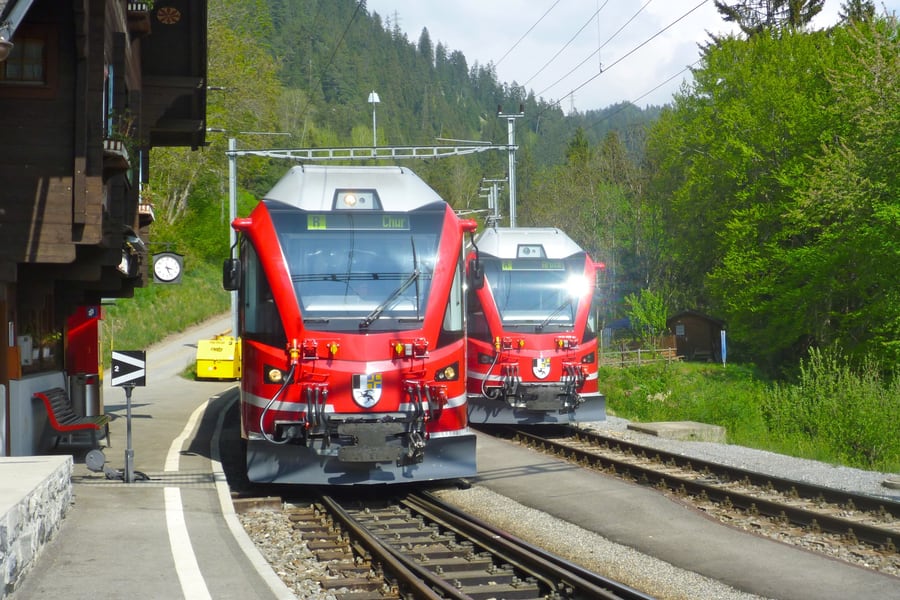 Andres Passwirth / Wikimedia Commons · CC BY-SA 3.0 · cropped
Three trains, one track, every hour
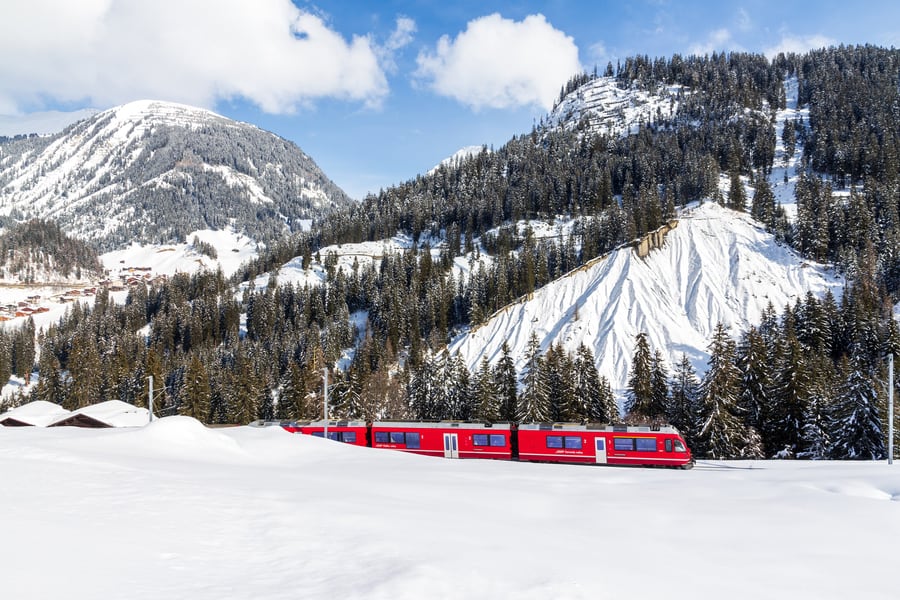
1,155 metres of climb in twenty-six kilometres, at up to sixty per mille, and not a metre of rack anywhere. The line was built for adhesion and for curves no tighter than fifty-two metres, which is why main-network stock can work through. The price is a 35 km/h limit.A bit of history
Culture & experiences along the way
 JoachimKohler-HB / Wikimedia Commons · CC BY-SA 4.0 · cropped
The Viadukt Museum at Langwies
The old station rooms at Langwies — waiting room, station office, goods shed, permanent-way store — are now a museum about the bridge and the line, and one of the viaduct's own concrete piers is a walk-in exhibition room. Open Wednesday to Saturday, 13 June to 25 October 2026, 10.00 to 17.00. Adults CHF 10, under-16s CHF 5, free with an Arosa Card, and 25% off with the RhB combined ticket.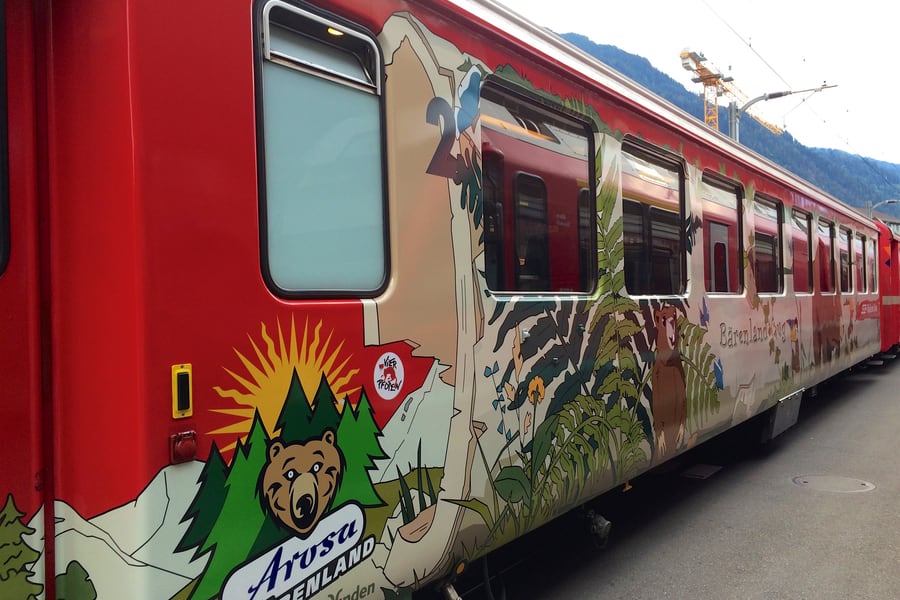 Andres Passwirth / Wikimedia Commons · CC BY-SA 4.0 · cropped
The bear carriage to Arosa Bärenland
The Rhaetian Railway runs a carriage fitted out as a hollow tree trunk, with illustrations and books about bears, for families going up to the Arosa Bärenland — a sanctuary run by the Arosa Bären Foundation and Four Paws where bears rescued from poor captivity live on the mountainside above the resort, watched from a visitor platform.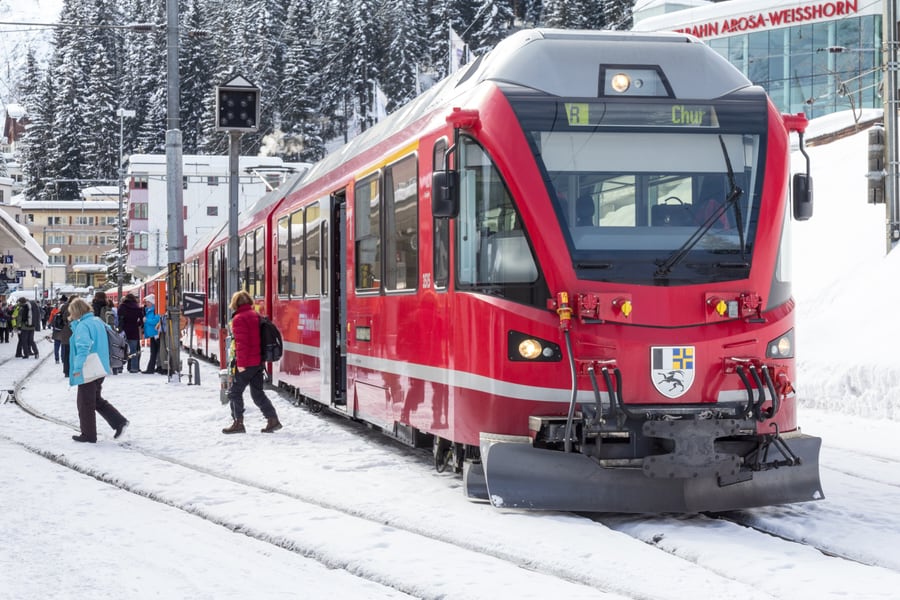 NAC / Wikimedia Commons · CC BY-SA 4.0 · cropped
Arriving at Arosa in winter
The terminus is a dead-end platform beside the Obersee with the Weisshorn cable car next door and every Arosa bus route starting from the square outside, so skis go from the luggage van to the lift without a taxi in between. The station takes checked luggage, including skis and snowboards, at CHF 12 an item.Timetables
The Arosa line runs all year, with a Regio service every hour in each direction and no seasonal shutdown. Three train sets hold the timetable, crossing at Lüen-Castiel and at Litzirüti.
Times below are the Swiss national timetable for timetable year 2026 — table 930, valid 14 December 2025 to 12 December 2026 — and were checked departure by departure against the live Swiss public-transport timetable in August 2026. Lüen-Castiel, St. Peter-Molinis and Peist are request stops; Langwies and Litzirüti are not.
Chur → Arosa
The climb takes 61 minutes and gains 1,155 metres. Trains leave Chur at :08 past the hour from 07:08 to 19:08, with three extras at the ends of the day.
| Chur | Lüen-Castiel | St. Peter-Molinis | Peist | Langwies GR | Litzirüti | Arosa |
|---|---|---|---|---|---|---|
| 04:59 | 05:20 | 05:28 | 05:32 | 05:40 | 05:46 | 05:57 |
| 06:00 | 06:21 | 06:30 | 06:33 | 06:41 | 06:48 | 07:00 |
| 07:08 | 07:28 | 07:37 | 07:41 | 07:50 | 07:58 | 08:09 |
| 08:08 | 08:28 | 08:37 | 08:41 | 08:50 | 08:58 | 09:09 |
| …hourly at :08… | ||||||
| 18:08 | 18:28 | 18:37 | 18:41 | 18:50 | 18:58 | 19:09 |
| 19:08 | 19:28 | 19:37 | 19:41 | 19:50 | 19:58 | 20:09 |
| 20:06 | 20:25 | 20:33 | 20:37 | 20:44 | 20:51 | 21:02 |
| 21:00 | 21:20 | 21:28 | 21:32 | 21:40 | 21:46 | 21:57 |
Arosa → Chur
The descent takes 61 minutes. Trains leave Arosa at :49 past the hour from 06:49 to 19:49. There is no 20:49; the evening gap is filled by the 21:07.
| Arosa | Litzirüti | Langwies GR | Peist | St. Peter-Molinis | Lüen-Castiel | Chur |
|---|---|---|---|---|---|---|
| 06:02 | 06:12 | 06:18 | 06:26 | 06:30 | 06:39 | 07:00 |
| 06:37 | 06:47 | 06:53 | 07:01 | 07:05 | 07:14 | 07:35 |
| 06:49 | 06:58 | 07:05 | 07:12 | 07:16 | 07:28 | 07:51 |
| 07:49 | 07:58 | 08:05 | 08:12 | 08:16 | 08:28 | 08:51 |
| …hourly at :49… | ||||||
| 18:49 | 18:58 | 19:05 | 19:12 | 19:16 | 19:28 | 19:48 |
| 19:49 | 19:58 | 20:04 | 20:12 | 20:15 | 20:25 | 20:45 |
| 21:07 | 21:17 | 21:23 | 21:32 | 21:36 | 21:44 | 22:05 |
| 22:03 | 22:13 | 22:19 | 22:28 | 22:32 | 22:40 | 23:00 |
Weekends and holidays: the RegioExpress
On Saturdays, Sundays and public holidays from 14 May to 25 October, and again through the winter season, the Rhaetian Railway adds three RegioExpress pairs. They call only at Chur Altstadt, Langwies and Litzirüti, and they save two minutes going up and nothing at all coming down. Skipping four stops buys almost nothing, because what governs the run is the thirty-five kilometre an hour line limit rather than the time spent at platforms.
| Chur | Langwies GR | Litzirüti | Arosa |
|---|---|---|---|
| 09:37 | 10:19 | 10:25 | 10:36 |
| 12:37 | 13:19 | 13:25 | 13:36 |
| 15:37 | 16:19 | 16:25 | 16:36 |
| Arosa | Litzirüti | Langwies GR | Chur |
|---|---|---|---|
| 11:17 | 11:27 | 11:33 | 12:19 |
| 14:17 | 14:27 | 14:33 | 15:19 |
| 17:17 | 17:27 | 17:33 | 18:19 |
After the last train
Once the trains stop, RhB bus line 41 covers the valley overnight, leaving Chur Bahnhofplatz at 22:00, 23:00 and 00:10 and Arosa at 23:03, 00:03 and 01:05, taking about the same hour by road. Some of those runs are operated as a taxi or minibus on demand, with reservation by 22:00 on +41 78 202 24 26. On Friday and Saturday nights, and through the winter season, a few extra trains run later than the times in the tables above.
Connections at Chur
Chur is 1 hour 15 minutes from Zürich HB on the half-hourly InterCity 3 and InterRegio 35. The Arosa platforms are on the station forecourt rather than inside the train shed, a short walk from the SBB concourse; the national timetable allows three minutes for the change.
Tickets
The Arosa line is an ordinary Swiss branch line as far as its fares are concerned. It sits inside the national tariff, so a ticket is bought exactly as for any other Swiss train and the price is set by distance rather than by what the scenery is worth: twenty-six kilometres and 1,155 metres of climb cost CHF 16.00 single, CHF 32.00 return, half that with a Half Fare Travelcard. There are no seat reservations and no supplements on this line — a valid second-class ticket is all any departure needs, the weekend RegioExpress included.
Anyone staying overnight in Arosa or the Schanfigg villages is given the Arosa Card, which between 13 June and 25 October 2026 includes free travel between Lüen-Castiel and Arosa — the whole mountain section, though not the leg in from Chur. Fares read off the SBB checkout in August 2026 for a midweek date.
Book your tickets
Chur – Arosa, return
CHF 32.00 full fare · CHF 16.00 with a Half Fare Travelcard
The whole line and back, an hour each way, valid on any departure.
Book Tickets (opens in a new tab, on Rhätische Bahn)via Rhätische BahnChur – Arosa, single
CHF 16.00 full fare · CHF 8.00 reduced · CHF 27.20 in first class
For anyone walking down the Schanfigg, or going on by the Urdenbahn cable car.
Book Tickets (opens in a new tab, on Rhätische Bahn)via Rhätische BahnArosa Gourmet Express
CHF 115.00 · Friday evenings, selected dates
The RhB's nostalgic Gourmino dining car on the evening service, with a three-course menu.
Book Tickets (opens in a new tab, on Rhätische Bahn)via Rhätische BahnRail Passes
This is one of the easy ones. The Arosa line is part of the Rhaetian Railway's main network and sits inside the Swiss national tariff, so the passes cover it outright — no percentage reduction, no house tariff, no supplement to pay on top. That is unlike most Swiss mountain railways, where a pass buys a discount rather than the ride.
Checked against the operators' own documents in August 2026.
Swiss Travel Pass
Chur–Arosa is covered in full. The Swiss Travel Pass is valid on the whole SBB network and on the Rhaetian Railway including this branch, and because there are no reservations or supplements on the line, the pass is the entire cost of the journey. It comes for 3, 4, 6, 8 or 15 consecutive days, or the same counts chosen freely within a month as the Flex version, and it is sold only to people resident outside Switzerland and Liechtenstein, checked against a passport or ID card.
The same applies to the Swiss GA Travelcard, and a Half Fare Travelcard halves the ordinary fare to CHF 8.00 single and CHF 16.00 return.
Interrail and Eurail
Also covered in full. The Swiss validity map that Interrail and Eurail publish for 2026 lists "RhB Rhätische Bahn: Chur–Arosa" under free ride, alongside the Landquart–Davos, Thusis–St. Moritz and Bernina lines — not in the list of reduced lines further down the page, where the Jungfrau region, the Pilatus and the Rigi all sit at 25 or 50 per cent. A global pass or a Switzerland One Country Pass therefore needs nothing added to it here.
⚠️ The One Country Pass for Switzerland cannot be used for the journey into or out of the country, which matters if the plan is to arrive from Austria or Italy on the same ticket.
The graubünden Pass
For anyone spending several days in the canton, the Rhaetian Railway's own regional pass is often the better buy. It gives unlimited travel by train and bus across Graubünden — the whole RhB network, SBB Chur–Bad Ragaz, the Matterhorn Gotthard Railway to the Oberalp Pass, PostBus, the Chur town bus and the Arosa local buses — on two or five days, either in one zone or across the canton.
| graubünden Pass, 2nd class | Adult | With a Half Fare Travelcard |
|---|---|---|
| 2 days, one zone | CHF 82.00 | CHF 62.00 |
| 5 days, one zone | CHF 115.00 | CHF 92.00 |
| 2 days, all zones | CHF 125.00 | CHF 95.00 |
| 5 days, all zones | CHF 175.00 | CHF 140.00 |
Children and dogs are CHF 30.00 flat, and accompanied children of six to fifteen travel free, up to two per adult. The whole Arosa line is inside the north zone, so the one-zone version covers a trip built around Chur, the Schanfigg, the Prättigau and the Surselva. Two Chur–Arosa returns already come to CHF 64, so the two-day pass pays for itself quickly once anything else is added.
Is a pass worth it for this journey alone?
For the Arosa line by itself, no. A return costs thirty-two francs, and nothing about the line justifies a pass bought for it. The calculation changes the moment the trip includes the Bernina or the Albula, both of which are on the same passes and both of which do charge a reservation fee on their panoramic trains — the Bernina Express at CHF 32 to 44 by season, the Glacier Express at CHF 54. Those supplements are payable whatever pass is held; on the Arosa line there is nothing extra to pay at all.
Places to Visit
The Schanfigg is not a valley of big sights. It is a string of small terraced villages on the sunny side of a steep trench, most of them a few hundred metres above the railway, each with a church tower and a scatter of dark timber houses, and the whole point of a day here is getting off the train at one of them. The intermediate stations are request stops, so a hand raised on the platform or a button pressed in the carriage is what makes the train call.
Because trains run hourly in both directions all year, a stop costs exactly sixty minutes, and the half-hour walks between neighbouring villages fit the interval neatly. Chur at the bottom and Arosa at the top are the two places worth a day rather than an hour.
 Cayambe / Wikimedia Commons · CC BY-SA 4.0 · cropped
Chur
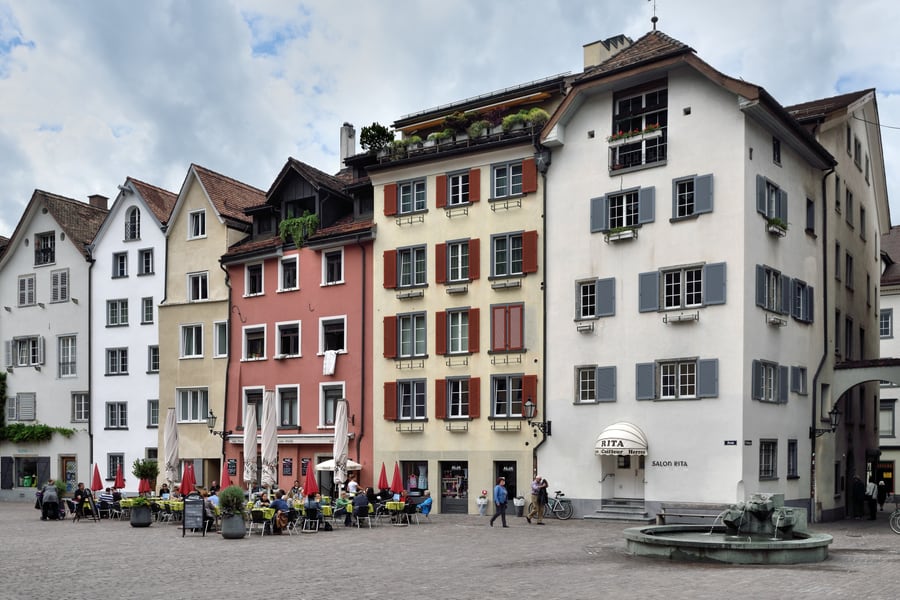
The capital of Graubünden and, by its own reckoning, the oldest town in Switzerland, with just under forty thousand people. The Arcas is its best room: a long cobbled square of painted burgher houses with a fountain at one end, cafés along the front and the bishop's court and cathedral quarter immediately above. The station is a short walk away, and the Arosa trains leave from the square in front of it rather than from inside it.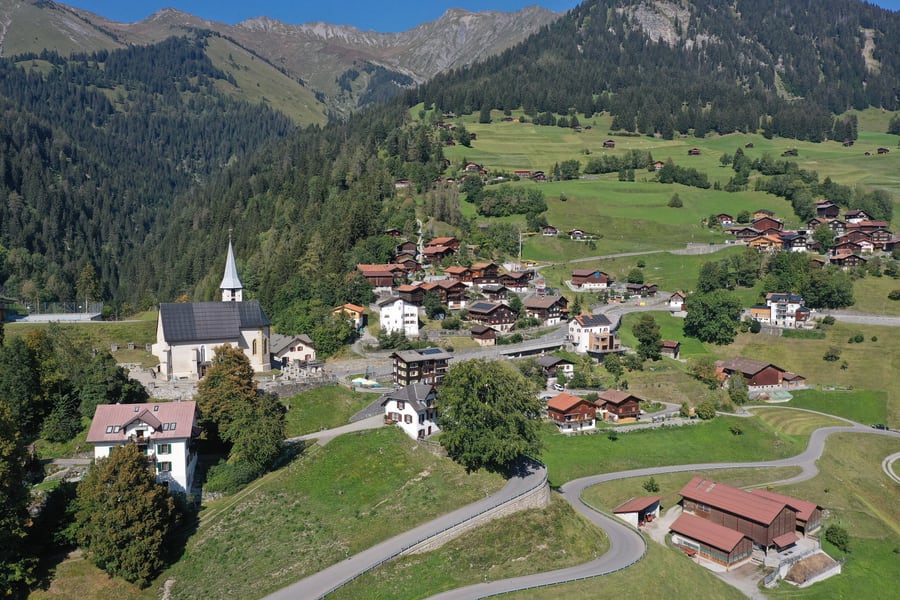 Orlando Mugwyler / Wikimedia Commons · CC BY-SA 4.0 · cropped
Lüen-Castiel
One station for two villages and, in practice, three. Lüen sits by the line and calls itself the Schanfigg Riviera: mild enough for grapes, kiwis and apricots, and arranged around a large fountain in notched timber. Castiel is half an hour up the slope, on a hill that has produced prehistoric and Roman finds, and its Haus Podestà of 1916 is reckoned the valley's finest house. Trains pass each other here every hour, so anyone getting off has exactly sixty minutes.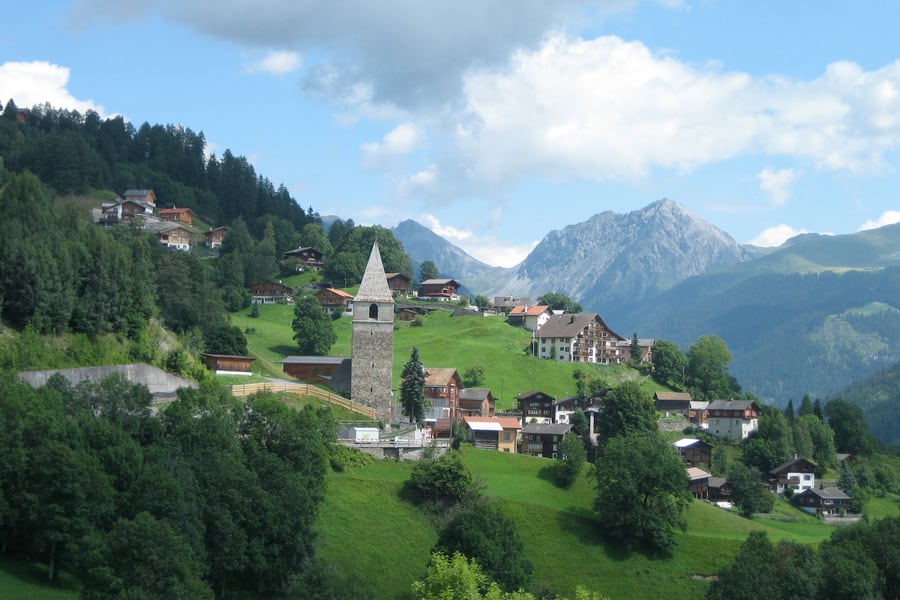 Adrian Michael / Wikimedia Commons · CC BY-SA 3.0 · cropped
St. Peter-Molinis
The church at St. Peter was the mother church of the valley and was first recorded in 831; its tower carries arrow slits, dates from the eleventh or twelfth century and probably began as a watchtower. Inside are a tabernacle wall of 1500 and extensive murals. Molinis below was two-thirds buried by a debris flow in 1980, and a mark on the rebuilt church records how high the mud came.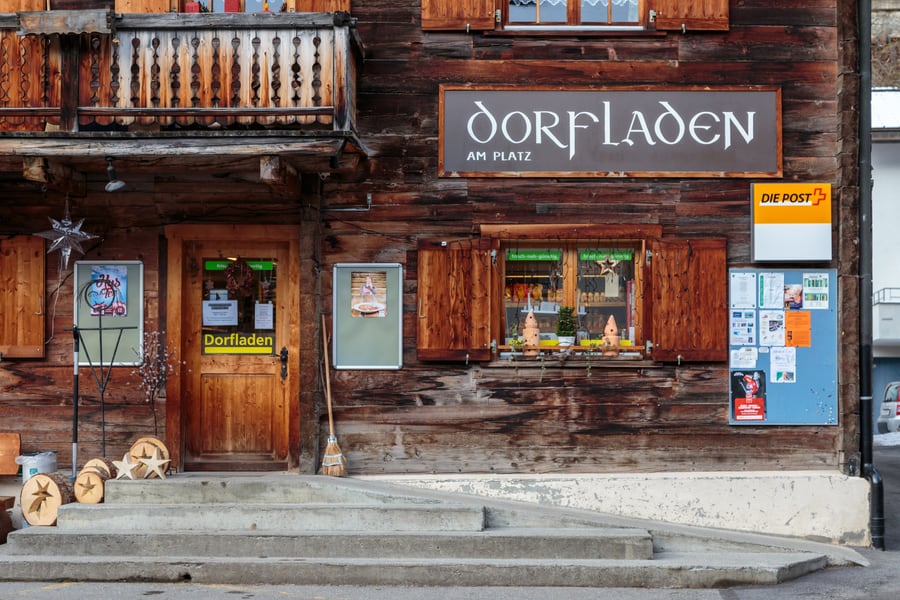 JoachimKohler-HB / Wikimedia Commons · CC BY-SA 4.0 · cropped
Langwies
A hamlet whose village shop and post office share one dark timber building, and whose station is famous. Its church began as a chapel consecrated in 1385 and was given its late-Gothic vault in 1488. The Viadukt Museum occupies the original station rooms and one pier of the bridge, and its own advice is to be inside the pier when a train crosses, at roughly ten to and three past the hour. The viaduct has no footway and walking on it is forbidden.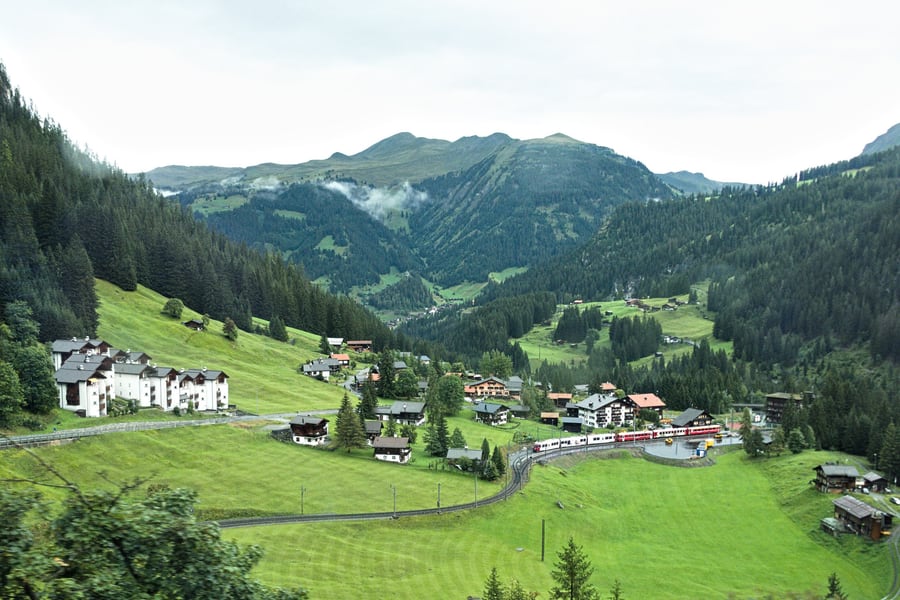 Tiia Monto / Wikimedia Commons · CC BY-SA 3.0 · cropped
Litzirüti
The last settlement before Arosa, reached after the railway has doubled back on itself twice to gain height. The station building of 1914 stands in a green bowl with the Welschtobel opening to the west, and the village is a junction of walking routes — the path over to Tschiertschen and St. Peter starts here, and so does the way down the valley to Langwies and the viaduct.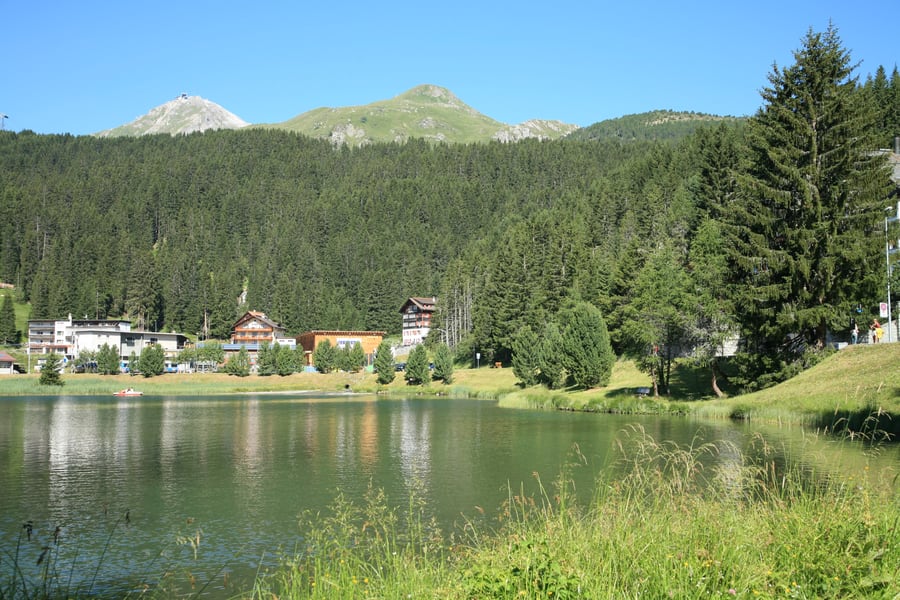 W. Bulach / Wikimedia Commons · CC BY-SA 4.0 · cropped
Arosa
A resort of about three thousand people at the head of the valley, built around the Obersee and the Untersee with the Aroser Weisshorn above it. The lakes are the middle of the town rather than an outing from it: the path round the Obersee starts at the station square, and in winter it is a skating surface. The Weisshorn cable car is next to the station, and the Urdenbahn from Hörnli crosses to the Lenzerheide, which makes the whole ski area reachable without a car.Where to Sleep
The Arosa line has two very different ends to sleep at. Chur is a working cantonal capital of just under forty thousand people, with a medieval core, restaurants that stay open, and a station that puts Zürich seventy-five minutes away; a night there costs less than a night in the resort and makes the morning climb the first thing of the day. Arosa is a mountain resort at 1,739 metres with a lake in the middle of it, and the argument for staying is the Arosa Card that comes with the room, which covers the railway between Lüen-Castiel and Arosa free of charge through the summer season.
In between, the Schanfigg villages have guesthouses rather than hotels, and their online presence is patchy — several of the addresses the tourist office lists no longer resolve. Anyone set on staying mid-valley is better off asking the Arosa tourist office directly than booking from a search result.
Where to stay
Romantik Hotel Stern
In the old town of Chur
A member of the Swiss Historic Hotels association, in the centre of Chur a few minutes' walk from the station and from the Arcas. The house restaurant is a Veltliner Weinstube, the wine list leans on the Bündner Herrschaft, and the hotel runs a restored 1933 Buick out to the vineyards of the Herrschaft and the Domleschg, which is a fair indication of the register it is playing in.
Check Availability (opens in a new tab, on stern-chur.ch)via stern-chur.ch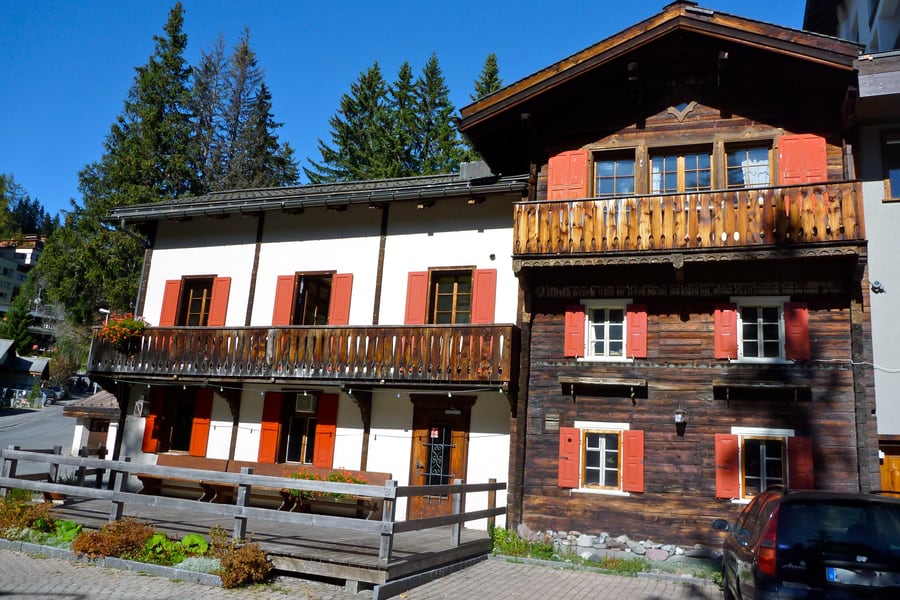 Andres Passwirth / Wikimedia Commons · CC BY-SA 3.0 · cropped
Hotel Seehof Arosa
By the Obersee, a short walk from the terminus
A family house on the lake shore near Arosa station, part of it an old Walser building of dark timber and white render. Its restaurant cooks a regional menu, and it sells multi-night summer packages built around the mountain railways and the hiking. Staying overnight anywhere in Arosa brings the Arosa Card, which covers the train between Lüen-Castiel and Arosa free of charge through the summer season.
Check Availability (opens in a new tab, on seehof-arosa.com)via seehof-arosa.com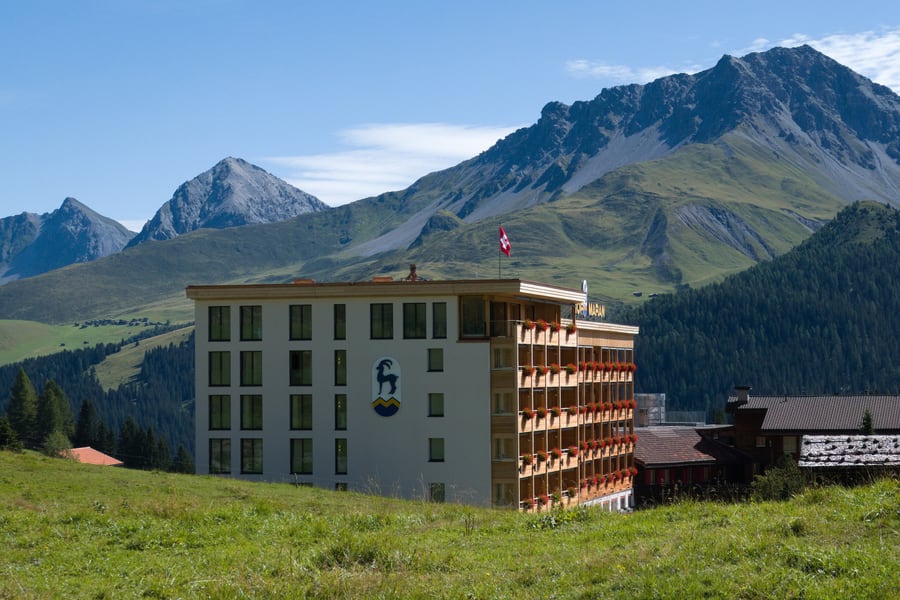 Tiia Monto / Wikimedia Commons · CC BY-SA 3.0 · cropped
Hof Maran
On the Maran plateau above Arosa
A golf and sport hotel on the open meadows at Maran above the resort, served by the free Arosa local bus, facing the Schiahorn, the Chüpfenflue and the Mederger Flue. It sits on the golf course and at the start of the hiking and cross-country network, so it suits a stay built around the mountain rather than around the village. It runs to seasons and closes between them: the 2026 summer season is 12 June to 18 October.
Check Availability (opens in a new tab, on hofmaran.ch)via hofmaran.chQuestions or corrections
Planning this trip and stuck on something, or spotted a time, fare or detail that has changed? Send us a message about Arosa Line. We read every one, and we update this page when something has changed.