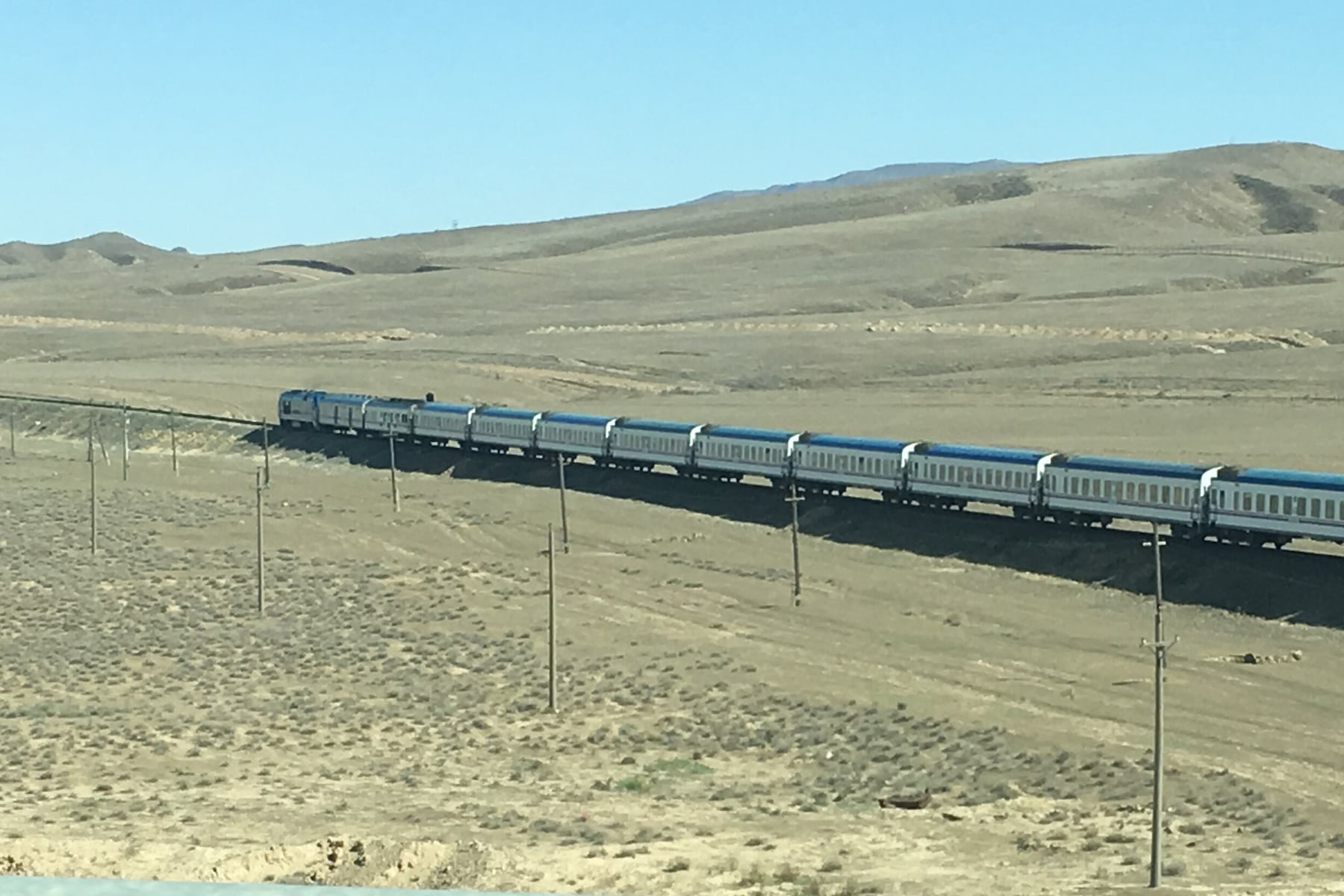
Ashgabat to Türkmenabat
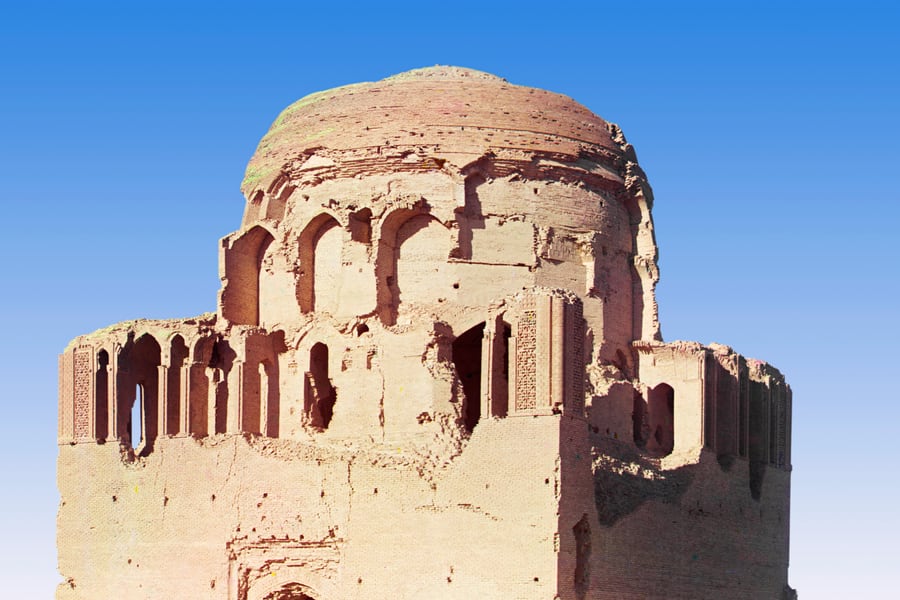
Allan Mustard / Wikimedia Commons · CC BY-SA 4.0 · 2018 · cropped
- Distance587 km, Ashgabat to Türkmenabat
- Duration13 hr 39 min eastbound, 14 hr 19 min westbound
- Best seasonOvernight every day of the year, both directions
Introduction
This is the line the Trans-Caspian Railway was built to be. The Russian army began it on the Caspian shore in 1879 to carry a war, and once the Akhal oasis had fallen it kept going: through Ashgabat, along the foot of the Kopet Dag, across the plain to Merv in 1886, and on to the Amu Darya — the Oxus of the ancient world — which it crossed on a wooden bridge more than two miles from bank to bank, before running on to Bukhara and Samarkand.
Trains 03 and 04 cover the 587 km between Ashgabat and Türkmenabat overnight, every day, in both directions, and they are booked as tiz otly, fast trains, with eight stops. The longest stand is at Mary, the Russian town of 1884 on the Murgab, and the next stop, Baýramaly, is the one for the ruins of ancient Merv — in UNESCO's words the oldest and most completely preserved of the oasis cities on the Silk Roads, inscribed as a World Heritage Site in 1999. Then come the sands of the Eastern Karakum, and the train arrives in the morning on the banks of the Amu Darya, close to the Uzbek border.
The Journey
Türkmendemirýollary books trains 03 and 04 as tiz otly, fast trains, and on this line the label means stopping at eight places in 587 km rather than at every halt. They are not the only trains on the rails. Train 95 to Amyderýa follows the same route as far as Türkmenabat and then turns south up the Amu Darya; the stopping trains 601 and 602 to Serhetabat share it as far as Mary. Of the three, 03 and 04 are the ones that start and finish at the two ends of this page, and the ones that make the whole run overnight.
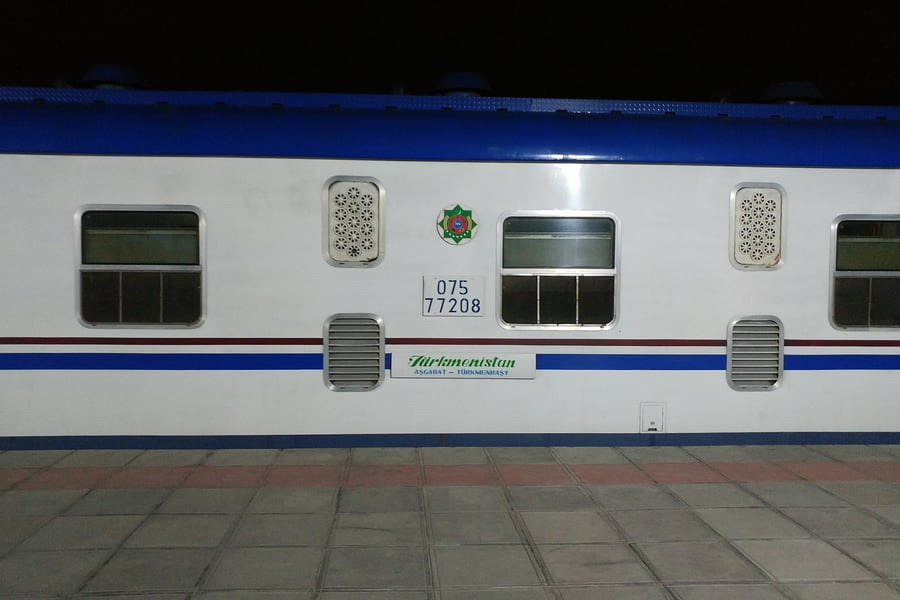
Traction is the network's standard. Passenger work is in the hands of Chinese-built CKD9A diesels, white with a broad blue flash and TÜRKMENISTAN along the flank, and the cars behind are sleepers in the operator's three grades.
East along the mountain
Train 03 leaves Ashgabat at ten to eight in the evening. For its first two hundred kilometres it runs along the foot of the Kopet Dag, the mountain wall of the Iranian border, calling at Ýaşlyk, Kaka and Duşak — oasis towns under the range, and, at Kaka and Duşak, the scene of fighting in 1918 between the Transcaspian Mensheviks, with British Indian troops in support, and the Bolsheviks of Tashkent. At Tejen, 217 km out, the line leaves the mountains and turns north-east across the plain, in company with the Karakum Canal, which brings Amu Darya water the other way.
Through the Merv oasis
Mary, 343 km from Ashgabat, is the capital of the province and the train stands there twenty minutes; westbound, train 04 stands forty. The town was founded by the Russian army in 1884 on the Murgab, thirty kilometres from the ruins of the city whose name it took, and it was itself called Merv until 1937. Twenty-nine kilometres on is Baýramaly, laid out in 1887 as the Murgab Imperial Estate of the Russian crown, with irrigation canals, factories and orchards. The ruins of ancient Merv lie just outside it: four thousand years of walled cities spread across the oasis, from the Achaemenid citadel of Erk Kala to the Seljuk capital that may have been, around 1200, the largest city in the world.
Across the Eastern Karakum
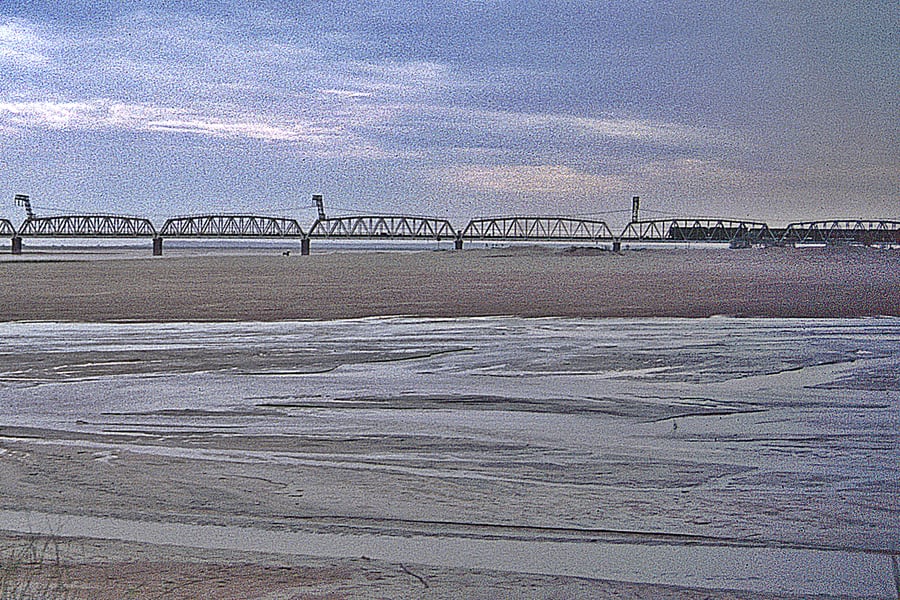
After Zähmet and Üçaji the timetable lists nothing for the last 134 km, across the sand of the Eastern Karakum, and the train comes off it at Türkmenabat, the country's second-largest city, at half past nine in the morning. It was Chardzhou under the Russians and the Soviets — the modern town was founded in 1886 to build the railway — and it stands on the left bank of the Amu Darya. The first railway bridge here was wooden and ran more than two miles from bank to bank; the permanent one followed in 1901, and since 2017 a new bridge has replaced it.
Along the route
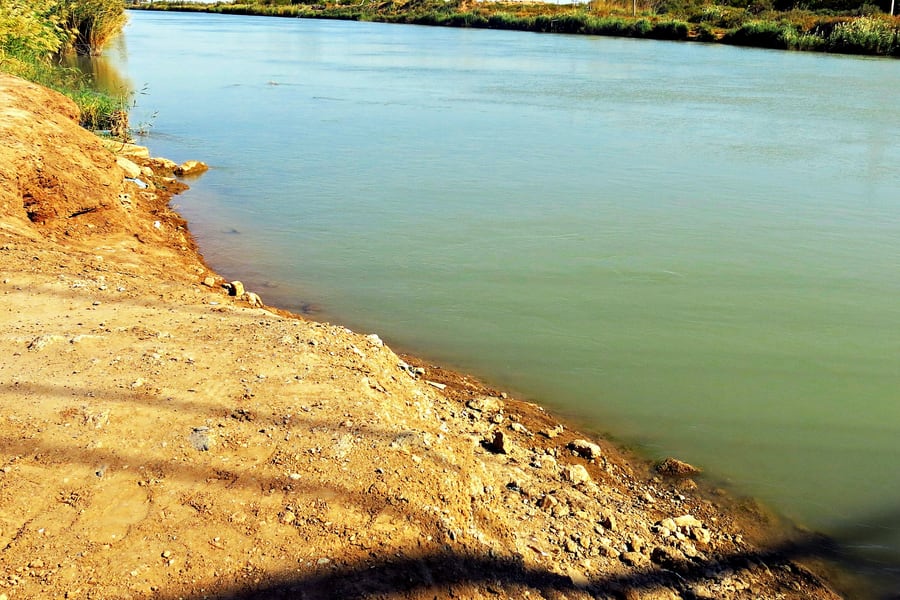 Bohndorf Film-Team / Wikimedia Commons · CC BY 4.0 · 2015 · cropped
Tejen and the Karakum Canal
At Tejen the line leaves the foot of the Kopet Dag and turns north-east for Mary, keeping company with the Karakum Canal, which carries Amu Darya water west to Ashgabat.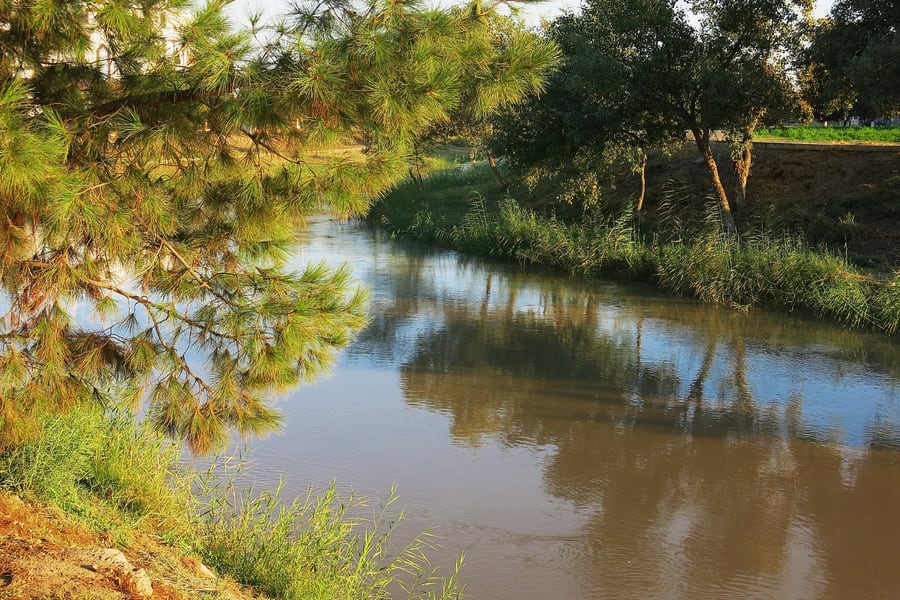 Bohndorf Film-Team / Wikimedia Commons · CC BY 4.0 · 2015 · cropped
Forty minutes at Mary
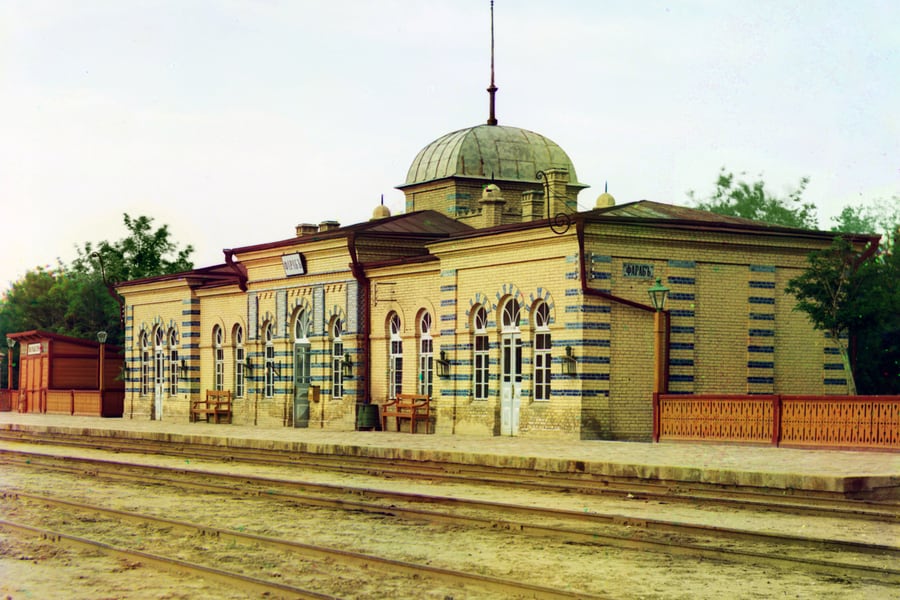
Mary is the longest stand on the route — twenty minutes eastbound, forty westbound. The town is a Russian foundation of 1884 on the Murgab, and was itself called Merv until 1937.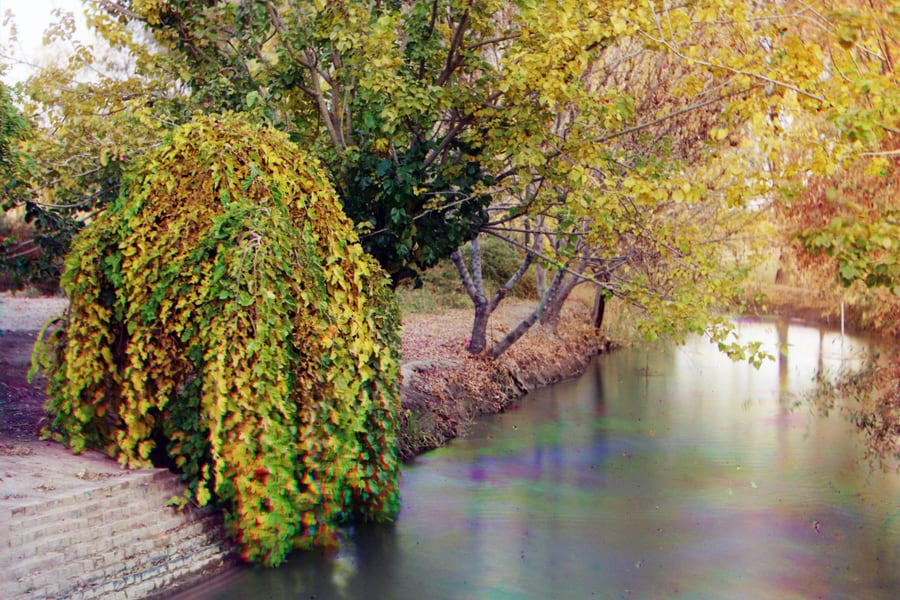 Sergei Prokudin-Gorskii / Library of Congress / Wikimedia Commons · Public domain · about 1911 · cropped
Baýramaly, the Tsar's estate
The next stop was founded in 1887 as the Murgab Imperial Estate, property of the Russian crown, with irrigation canals, orchards and factories. The ruins of old Merv lie just outside it.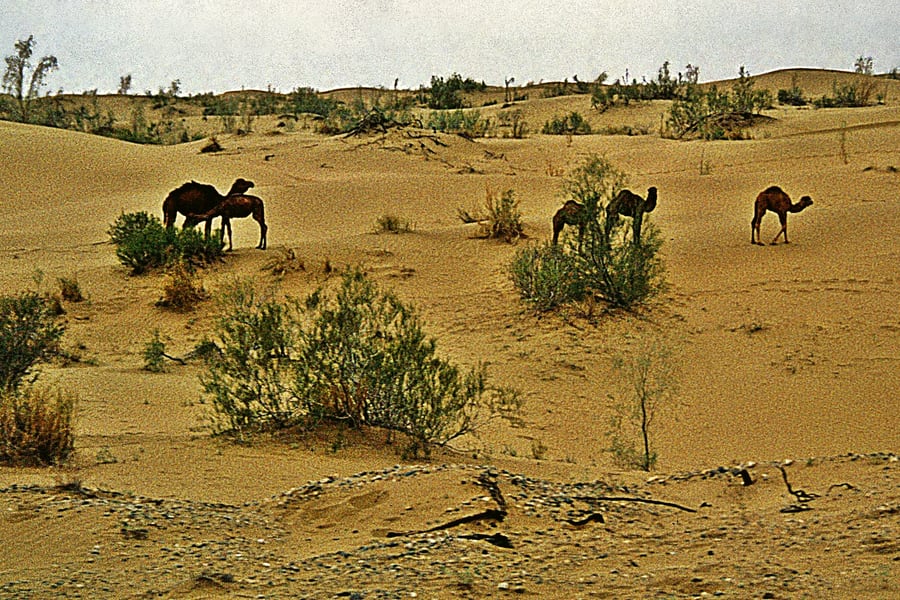 Ziegler175 / Wikimedia Commons · CC BY-SA 4.0 · 1992 · cropped
The Eastern Karakum
Beyond Üçaji the timetable lists nothing for 134 km of sand. Train 03 comes off it at Türkmenabat, on the Amu Darya and the Uzbek border, at half past nine in the morning.A bit of history
Culture & experiences along the way
 The Metropolitan Museum of Art / Wikimedia Commons · CC0 · cropped
The carpet as a tribal signature
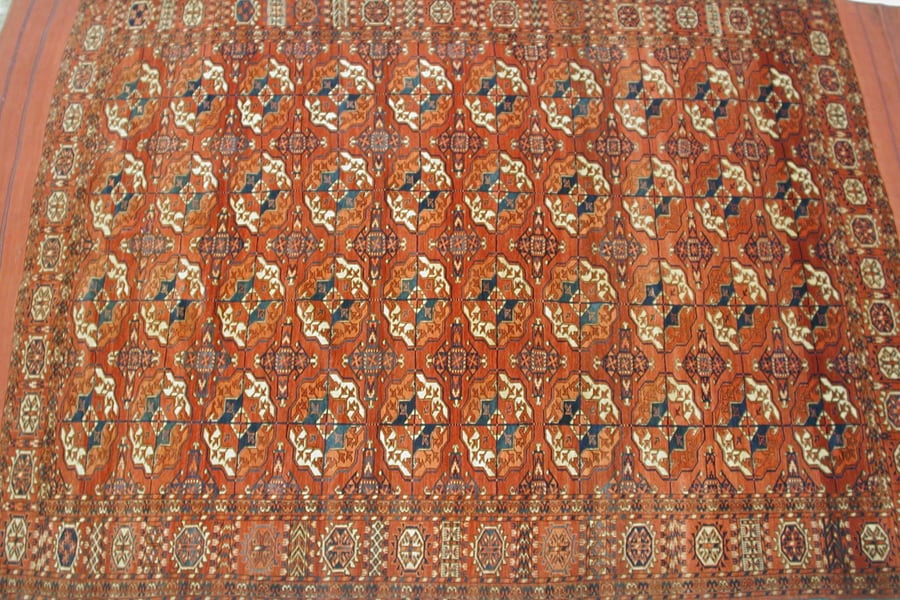
A Turkmen carpet is hand-knotted wool in deep reds, laid out in clear geometric rows, and its pattern belongs to one of the five main Turkmen tribes. Carpets are woven for births, weddings, prayer and mourning as well as for the floor, and the craft keeps its own national holiday, Carpet Day, on the last Sunday of May. UNESCO listed it in 2019.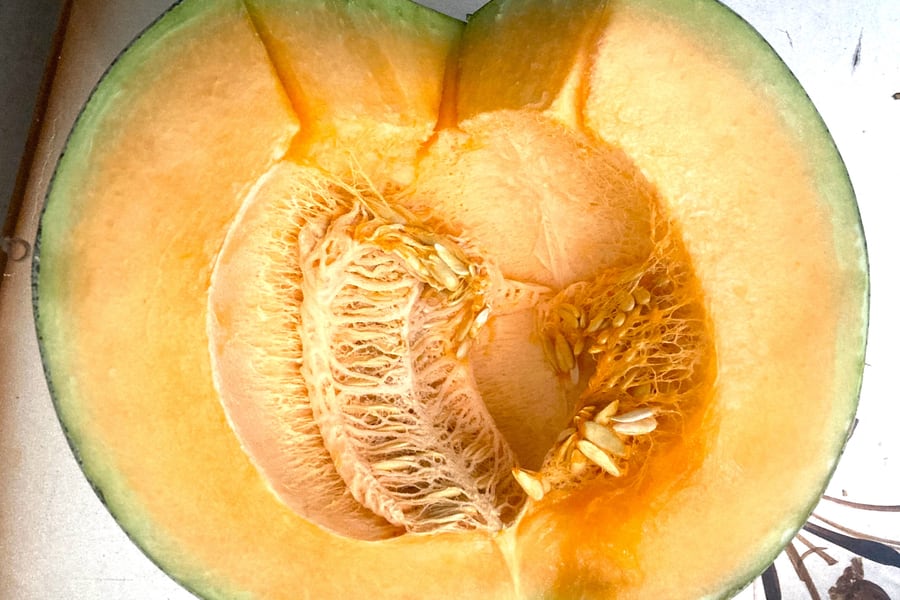 Bayram A / Wikimedia Commons · CC BY-SA 4.0 · 2022 · cropped
The melon has a holiday
Since 1994 Turkmenistan has kept a national Melon Day on the second Sunday of August, with displays of every variety the country grows and music and dancing in Ashgabat. The gurbek is one of them: a green rind, and orange flesh inside.Timetables
One pair of trains works the whole line and both run daily, all year. Times are the operator's own, read from the Türkmendemirýollary timetable in November 2026.
Türkmendemirýollary publishes the departure from the originating station and the total running time, but no intermediate times and no arrival. The arrivals below are the operator's departure plus the operator's own duration.
| Train 03 · eastbound | Train 04 · westbound | |
|---|---|---|
| Departs | Ashgabat 19:50 | Türkmenabat 18:45 |
| Arrives | Türkmenabat 09:29 next day | Ashgabat 09:04 next day |
| Runs | Every day | Every day |
| Journey | 13 hr 39 min | 14 hr 19 min |
| Distance | 587 km | 587 km |
| Type | Tiz otly — fast train | Tiz otly — fast train |
The calling list
Distances are from the originating station, and the stand is the operator's published dwell time.
| Eastbound, from Ashgabat | Westbound, from Türkmenabat | ||
|---|---|---|---|
| Ashgabat | 0 km | Türkmenabat | 0 km |
| Ýaşlyk | 49 km · 5 min | Üçaji | 134 km · 5 min |
| Kaka | 129 km · 5 min | Zähmet | 178 km · 6 min |
| Duşak | 171 km · 10 min | Baýramaly | 215 km · 10 min |
| Tejen | 217 km · 5 min | Mary | 244 km · 40 min |
| Mary | 343 km · 20 min | Tejen | 370 km · 10 min |
| Baýramaly | 372 km · 10 min | Duşak | 416 km · 10 min |
| Zähmet | 409 km · 2 min | Kaka | 458 km · 5 min |
| Üçaji | 453 km · 5 min | Ýaşlyk | 538 km · 10 min |
| Türkmenabat | 587 km | Ashgabat | 587 km |
Other trains on the line
Two more pairs share the rails. Trains 95 and 96, Ashgabat to Amyderýa, run through Mary, Baýramaly and Üçaji to Türkmenabat and stand there about forty minutes before going on: 95 leaves Ashgabat daily at 13:50, 96 leaves Amyderýa daily at 12:15 and reaches Ashgabat at 06:05 the next morning. The operator gives no time at Türkmenabat for either, so they are not tabled here. Trains 601 and 602, stopping trains to Serhetabat, follow this line only as far as Mary, where they turn south.
The full timetable for all of the operator's routes is at railway.gov.tm/en/schedule (opens in a new tab).
Tickets
Türkmendemirýollary sells online through its own site and app ten days ahead, and at the booking office five days ahead, from one system. Online payment works only with Turkmen Altyn Asyr or Senagat bank cards, and the operator says payments are accepted only from inside Turkmenistan — so a visitor buys at the booking office. Take the passport the ticket was bought against, and be at the station at least 45 minutes before departure; each passenger may carry up to 100 kg of luggage.
The sleeping accommodation comes in the operator's three grades, below. There is no published fare table for this route; the one figure the operator does publish is the 50-manat VIP service fee.
Book your tickets
Kupe
Four berths behind a door
The operator's middle grade — a closed compartment of two sleeping berths a side, four passengers.
Book Tickets (opens in a new tab, on railway.gov.tm)via railway.gov.tmPlaskart
Open six-berth bays
Sections of three berths a side with no door onto the corridor, and the cheapest way to lie down.
Book Tickets (opens in a new tab, on railway.gov.tm)via railway.gov.tmSW and VIP
Two berths, and a supplement
SW compartments take two passengers; VIP adds a 50-manat service fee to the Kupe price, refunded in full if the ticket is returned.
Book Tickets (opens in a new tab, on railway.gov.tm)via railway.gov.tmRail Passes
No rail pass covers Turkmenistan. Türkmendemirýollary sells single berths on named trains and nothing else, and for 587 km the fare is small, so nothing is lost.
The document that governs the trip is the visa. The Embassy of Turkmenistan's instruction is to go through a travel agency, which obtains a Letter of Invitation from the State Migration Service; the visa is issued against that letter. A transit visa is a separate route. Checked against the embassy's published guidance, November 2026.
Places to Visit
The reason to break this journey is ancient Merv, just outside Baýramaly and thirty kilometres from Mary. It is not one ruin but a sequence of them: walled cities built side by side over two thousand years, each abandoned for the next, so that the Achaemenid citadel, the Hellenistic city, the Seljuk capital and the post-medieval town all stand on open ground within sight of one another. The Mongols took it in 1221 and it never recovered. UNESCO inscribed it in 1999; the cards below are the parts of it most worth the walk.
 Hans Birger Nilsen / Wikimedia Commons · CC BY-SA 2.0 · 2018 · cropped
The mausoleum of Sultan Sanjar
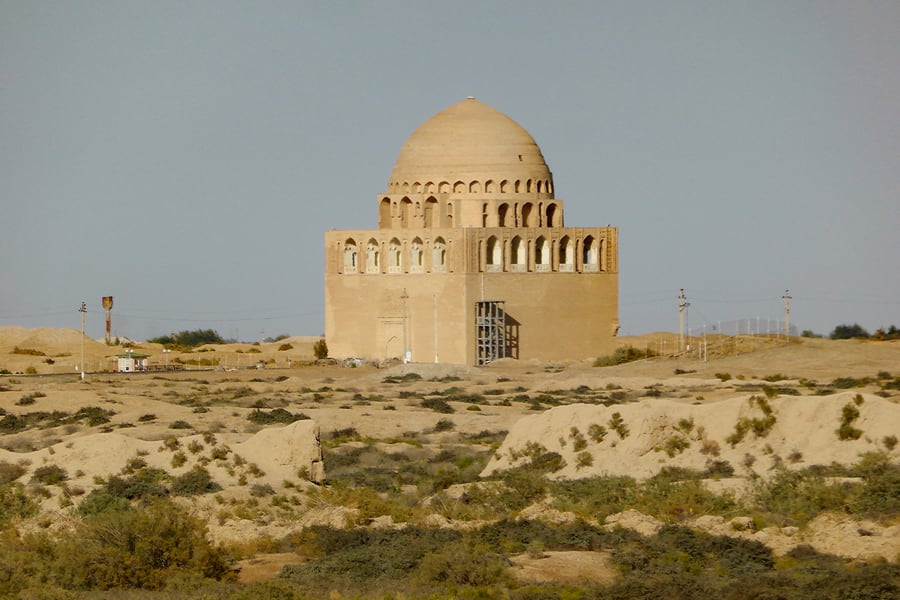
The best-preserved building at Merv, and to UNESCO one of the finest of the Seljuk age: a square of brick 27 metres a side under a great dome, built for the sultan who ruled from 1118 to 1157 and made Merv his residence. Caravans were said to see it a day's march out. The Mongols burned the tomb in 1221; the building itself still stands in the walled medieval city of Sultan Kala.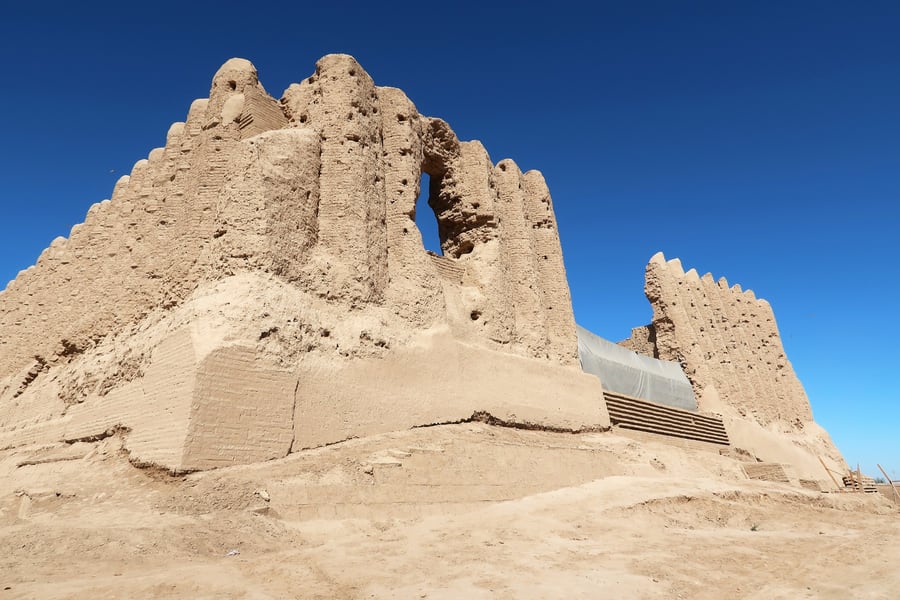 John Pavelka / Wikimedia Commons · CC BY 2.0 · 2018 · cropped
The Great Kyz Kala
Just outside Sultan Kala's western wall stands the largest and best-preserved of Merv's köşks — fortified two-storey mansions of mud brick, unique to Central Asia, whose deeply corrugated walls give them their look. The Great Kyz Kala had seventeen rooms around a courtyard, and its name means the maiden's fortress.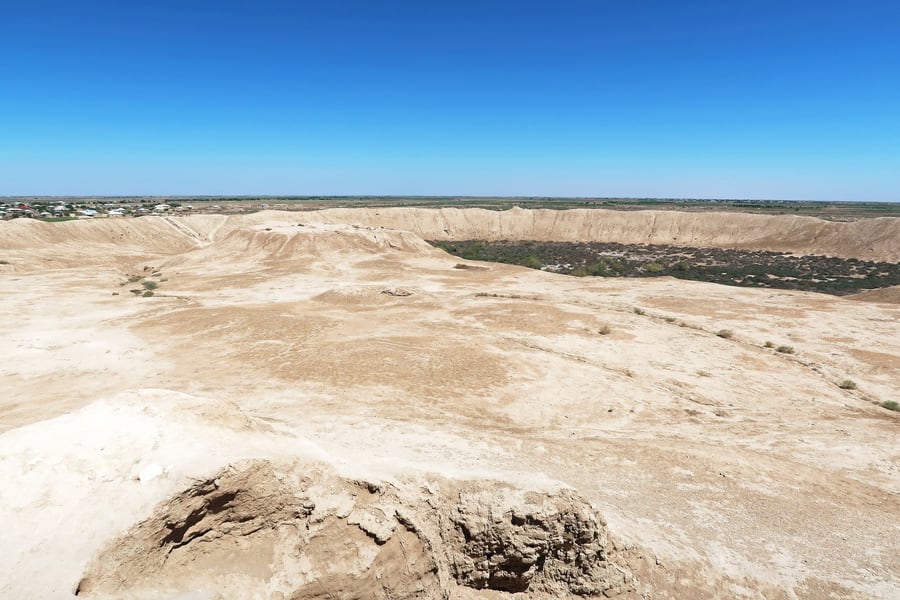 John Pavelka / Wikimedia Commons · CC BY 2.0 · 2018 · cropped
Erk Kala and Gyaur Kala
The oldest city at Merv is a walled and moated polygon of twenty hectares, its walls still standing to some 30 metres, built as a Persian fortress over the Murgab oasis. Around it lies Gyaur Kala, the square Hellenistic and Sasanian city with walls about two kilometres long, a Buddhist stupa and monastery, and the Beni Makhan mosque.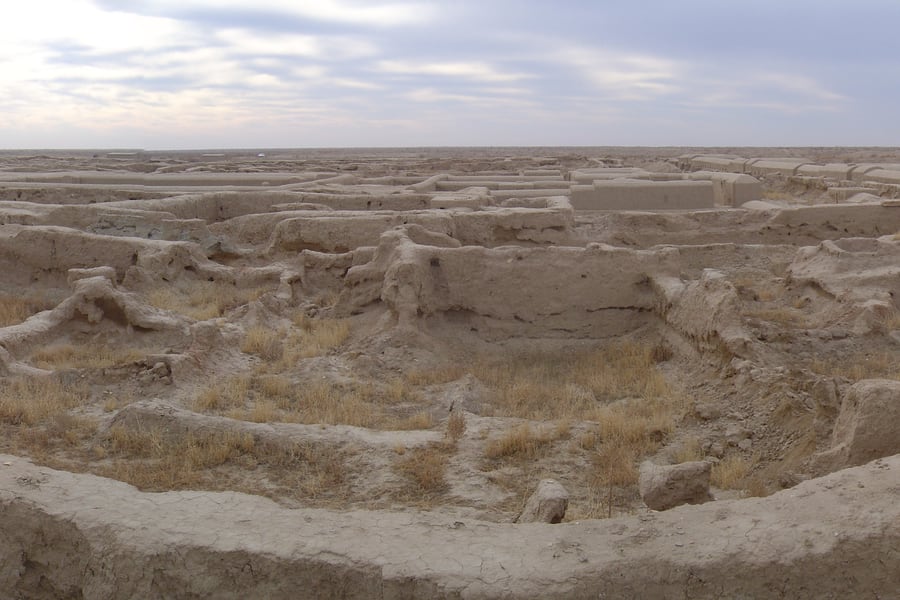 Allan Mustard / Wikimedia Commons · CC BY-SA 4.0 · 2015 · cropped
Gonur Depe, in the northern desert
Some 60 km north of Mary, and part of the Ancient Merv archaeological park, is the Bronze Age capital of the Margiana culture: a palace, temples and fortified enclosures of mud brick from about 2400 to 1600 BC, dug by Viktor Sarianidi from 1974 until 2013. It lies out in the desert, well beyond the reach of the train.Where to Sleep
Turkmenistan is not a country where a bed is booked directly. The travel agency that obtains the Letter of Invitation normally arranges the hotels as well. On this line the place to stop is Mary, thirty kilometres from the ruins of Merv.
The train itself is the other bed. Both trains run overnight, so the berth covers the night, and they arrive in the morning — 09:29 into Türkmenabat, 09:04 into Ashgabat — which leaves the whole day free at either end.
Questions or corrections
Planning this trip and stuck on something, or spotted a time, fare or detail that has changed? Send us a message about Ashgabat to Türkmenabat. We read every one, and we update this page when something has changed.