Ashgabat to Türkmenbaşy
Hans Birger Nilsen / Wikimedia Commons · CC BY-SA 2.0 · 2018 · cropped
- Distance557 km, Ashgabat to Türkmenbaşy
- Duration14 hr 12 min westbound, 14 hr 35 min eastbound
- Best seasonOvernight every day of the year, both directions
Introduction
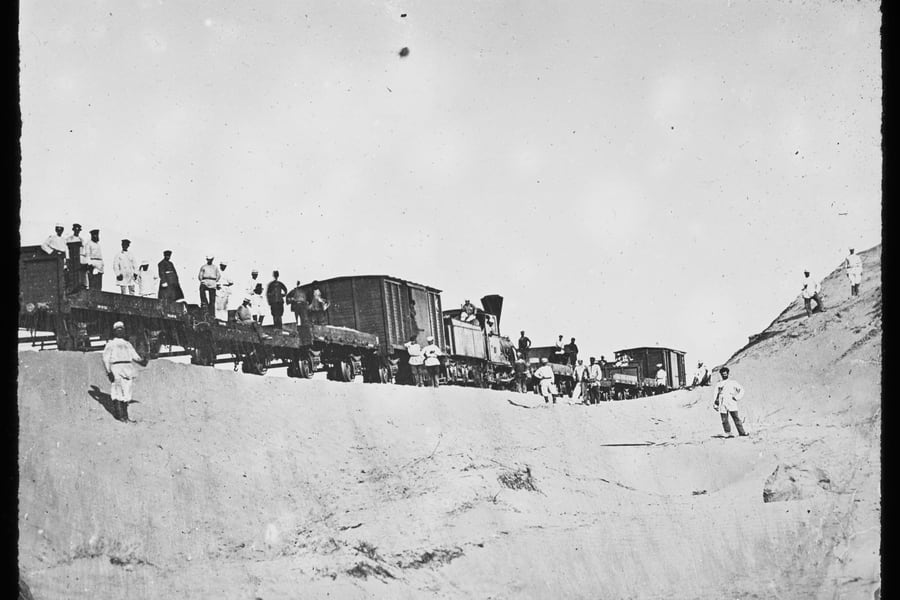
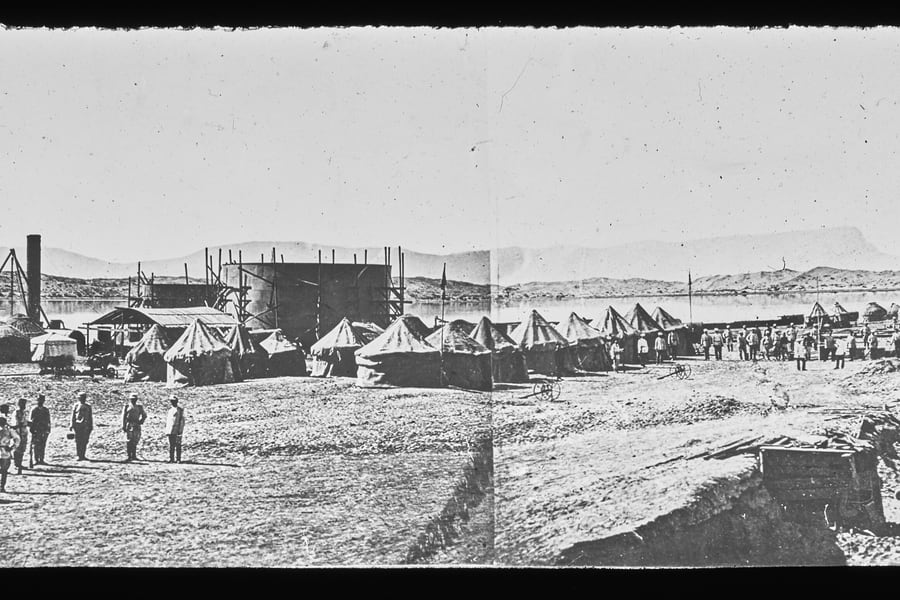
The Trans-Caspian Railway was driven east from the Caspian shore in 1879 across ground that had no drinking water in it. For the first hundred miles there was none to be had at all, so the engineers distilled the Caspian itself — Nobel's condensers and their cisterns stood on the beach at Mikhailovsk Bay — and sent the result inland in vats, one to a flat wagon. Artesian wells failed. Where the line reached mountains it was easier: pipes were laid down from the streams. The port it started from, Uzun-Ada, was given up within fifteen years and the head of the line moved north to Krasnovodsk, a place whose older Turkmen name, Kyzyl-Su, means Red Water.
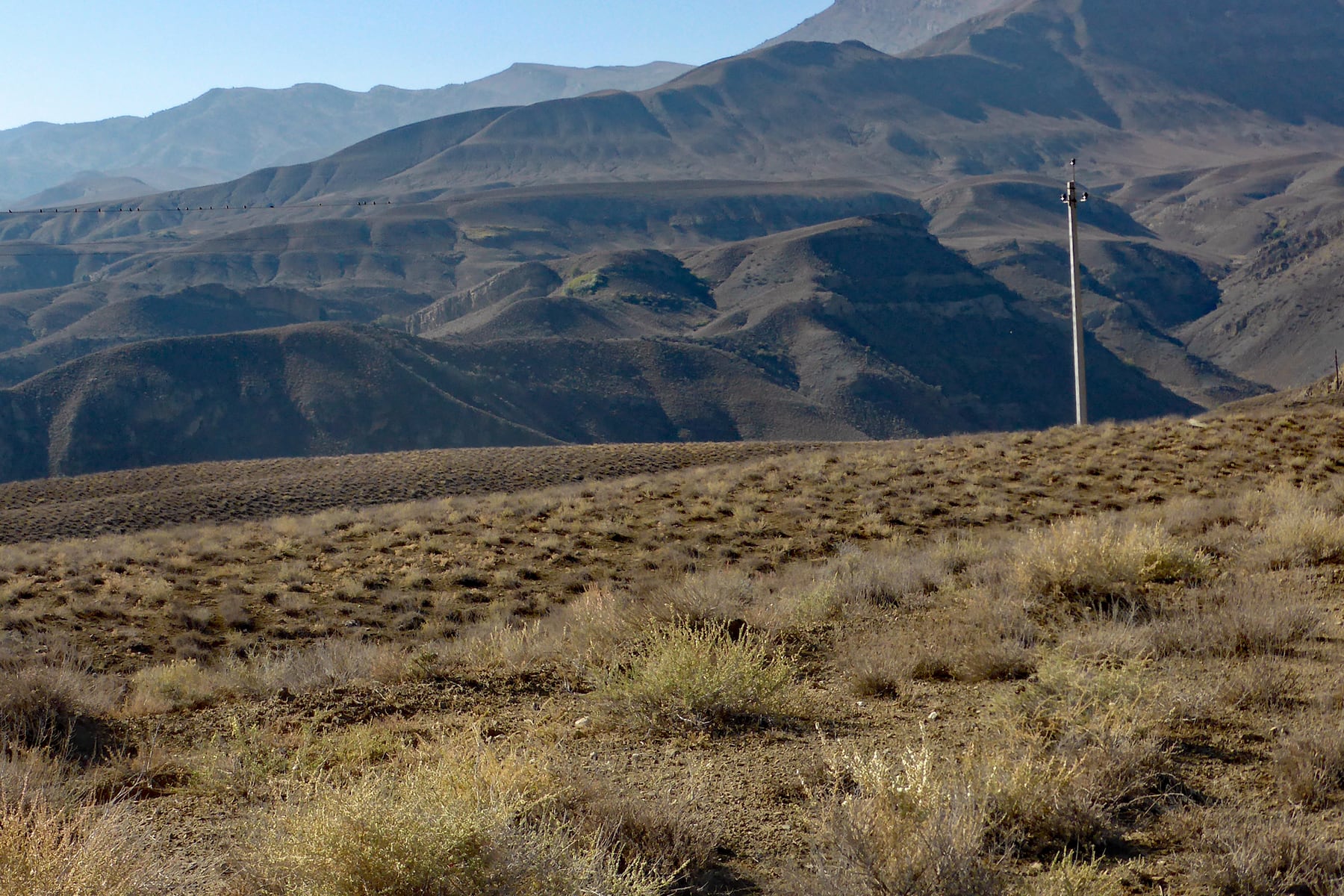
That history is why this train goes where it goes. Trains 605 and 606 cover the 557 km between Ashgabat and Türkmenbaşy overnight, every day, in both directions, and for two thirds of the way they hug the foot of the Kopet Dag — the mountain wall that is also the Iranian border — because the foot of the mountain is where the water is. Most of the calling list is a spring, a well or an oasis: Arçman with its sulphur sanatorium, Bäherden under a thermal lake in a cave, Gökdepe, Bamy, the chain of oases that ends at Gyzylarbat. West of there the line leaves the mountains for open desert, meets the north–south railway at the junction and locomotive works at Bereket, and comes down at last to the Caspian at the port the whole thing was built to reach.
The Journey
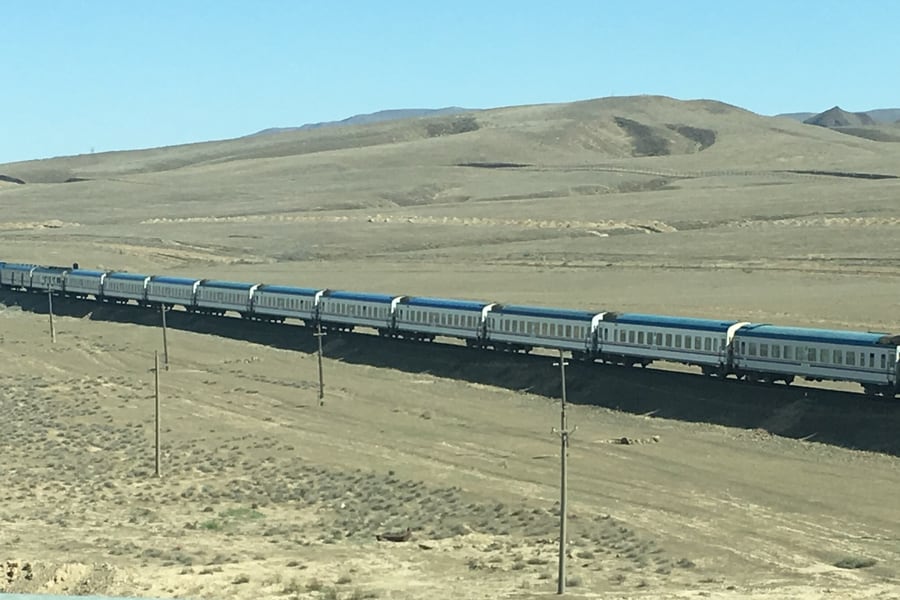
Türkmendemirýollary runs one pair of trains over this line and they are not the country's fastest. Ashgabat's other main-line services — east to Türkmenabat, north across the Karakum to Daşoguz, on to Amyderýa — are all booked in the timetable as tiz otly, fast trains. The Caspian train is a ýolagçy otly, a stopping train, and it calls at all fourteen intermediate stations. What it gives up in speed it returns in coverage: this is the original main line of the Trans-Caspian, and 605 and 606 are the only way to ride the whole of it behind a scheduled ticket.
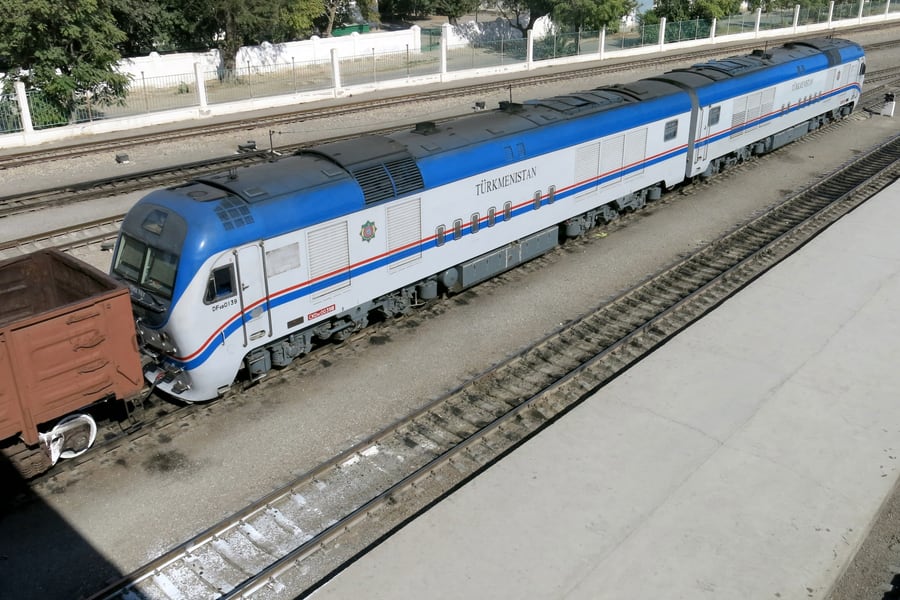
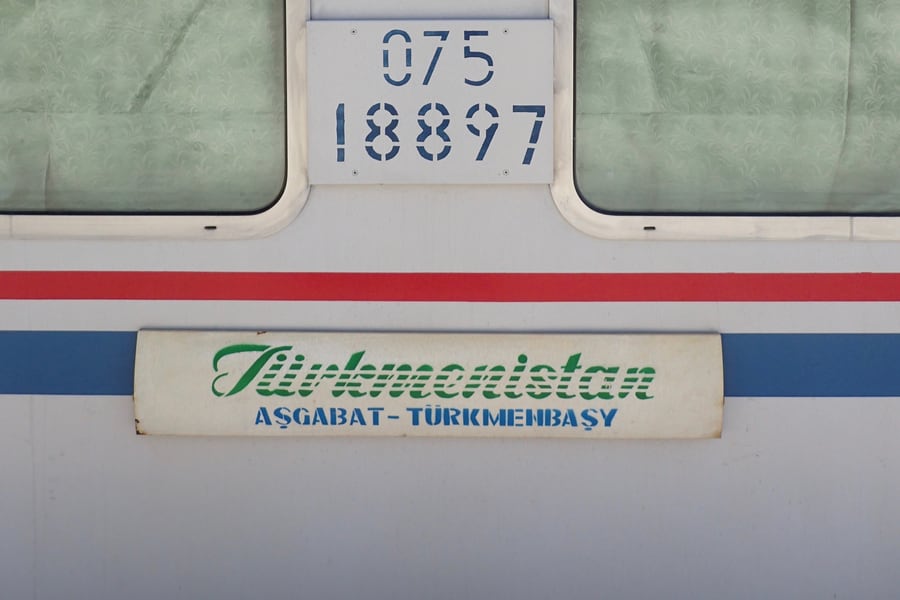
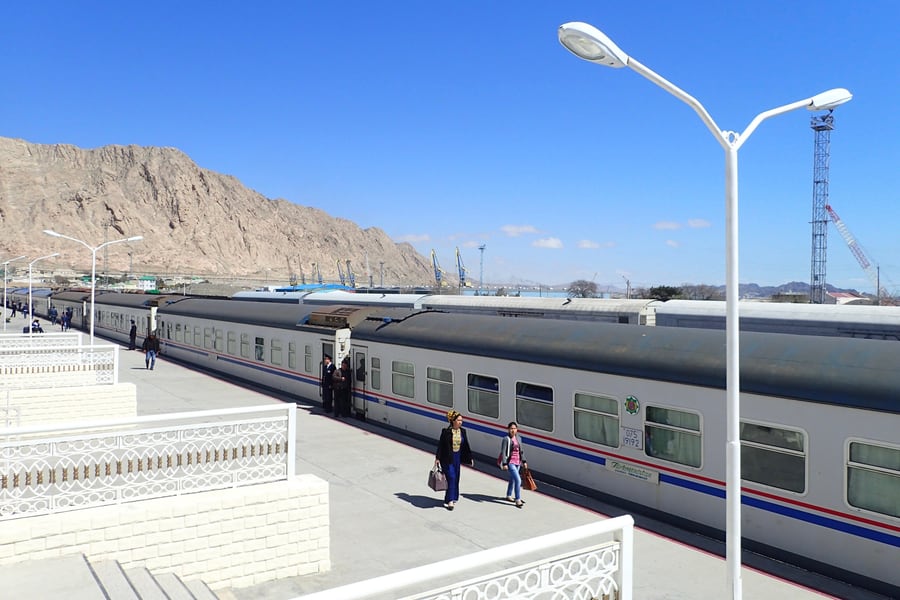
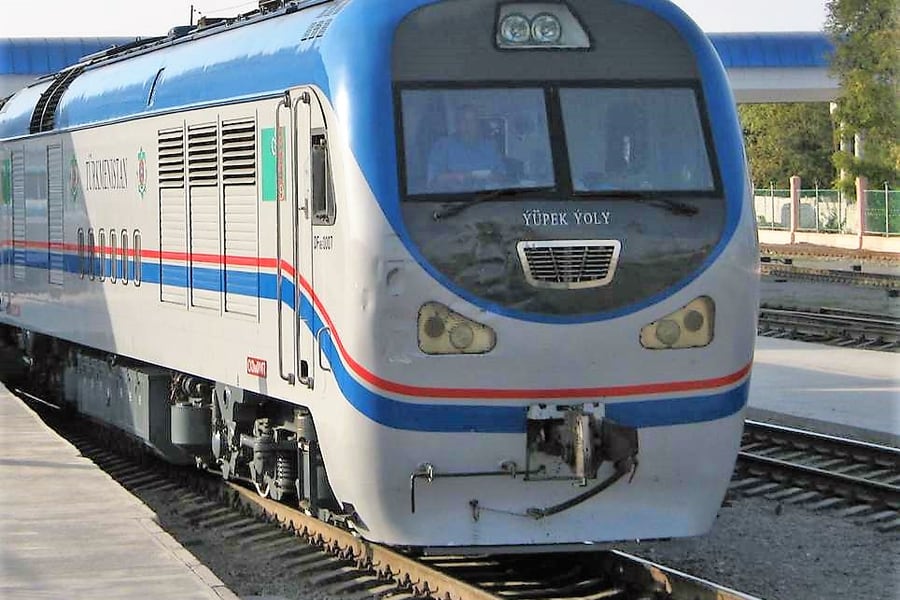
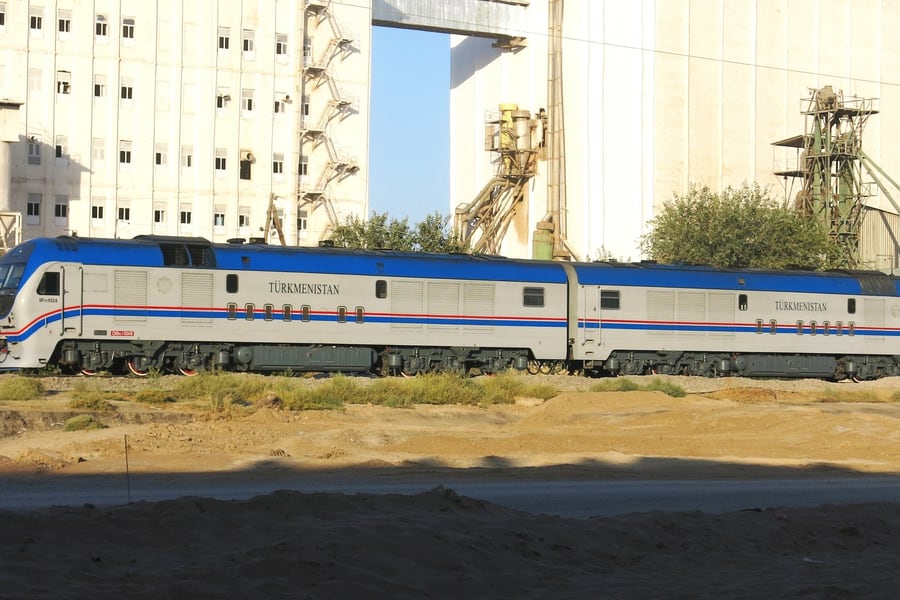
Traction is Chinese and diesel. There are no wires anywhere on the Turkmen network; the Asian Development Bank's 2021 sector assessment counted a fleet of 119 diesel locomotives in 2019, of which twenty-five were CKD9A machines bought for passenger work and eighty-three CKD9C for freight, all of them from CRRC Ziyang. They are unmistakable — a long white body under a broad blue flash and a red stripe, TÜRKMENISTAN along the flank, and on some noses the words ÝÜPEK ÝOLY, the Silk Road. The coaches behind them are Chinese too: 154 were ordered from CSR in 2013, and each one carries a painted route board on its side reading AŞGABAT – TÜRKMENBAŞY.
Out of Ashgabat along the mountain
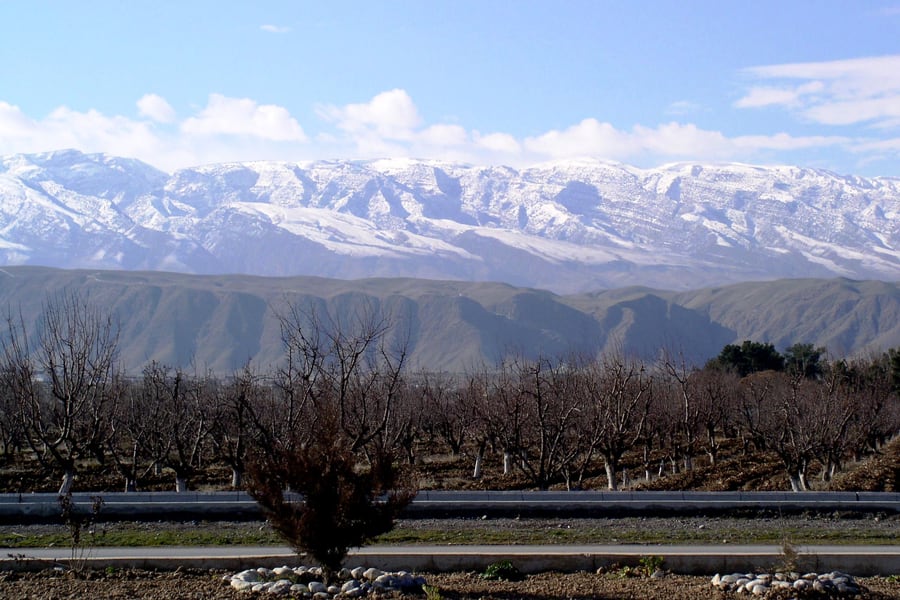
Westbound, 606 leaves Ashgabat at ten to six in the evening and calls first at Gökdepe, 48 km out. Gökdepe is where the Russian conquest of the Akhal oasis ended: the Tekke fortress here was stormed on 12 January 1881 after a twenty-three-day siege, and the railway that had begun the previous year as a military line was pushed on past it to Gyzylarbat within nine months. For the next three hours the train works along a corridor perhaps ten kilometres wide, with the Kopet Dag on the left and the Karakum starting on the right, calling at Kelete, Bäherden, Arçman and Bamy — every one of them a place where water comes out of the mountain.
Gyzylarbat, 224 km out, is where the oases stop. The town has changed its name twice in living memory: Kyzyl-Arvat under the Russians and the Soviet Union, Serdar from 29 December 1999, and Gyzylarbat again by decree of 9 November 2022 — which is why the operator's timetable and the Ministry of Railways' own schedule page still disagree about what to call it.
Across the desert to the sea
Past Gyzylarbat the mountains fall away and the line runs out into open country. Bereket, 302 km from Ashgabat, gets the longest stand of the journey — twenty minutes, the only stop over ten — and it earns it. This is the crossing point of the Trans-Caspian and the North–South corridor opened on 3 December 2014, the line that runs from Uzen in Kazakhstan through Turkmenistan to Gorgan in Iran and on to the Gulf. Bereket also holds the railway's large locomotive maintenance and repair depot.
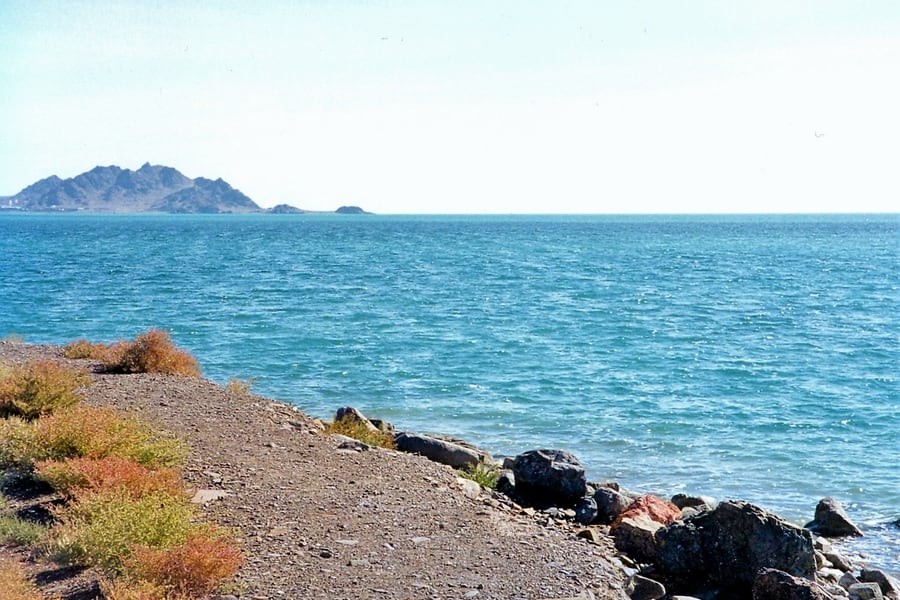
The last stretch is the emptiest and the least changed: Akjaguýma, then Balkanabat — founded in 1933 as Neftedag, Oil Mountain, and a station on this railway before it was a town — then Jebel, Belek, Ýangaja and Guşa, and down to the water. The train runs in along the shore of the Türkmenbaşy Gulf and stops at two minutes past eight in the morning under the bare coastal mountains, beside a port that has been the end of this railway since the 1890s and an oil refinery that is the largest in the country.
Along the route
 Bohndorf Film-Team / Wikimedia Commons · CC BY-SA 4.0 · 2015 · cropped
Out of Ashgabat at ten to six
606 leaves the capital in the evening and is on the mountain corridor within the hour, the Kopet Dag to the left and the Karakum opening out to the right.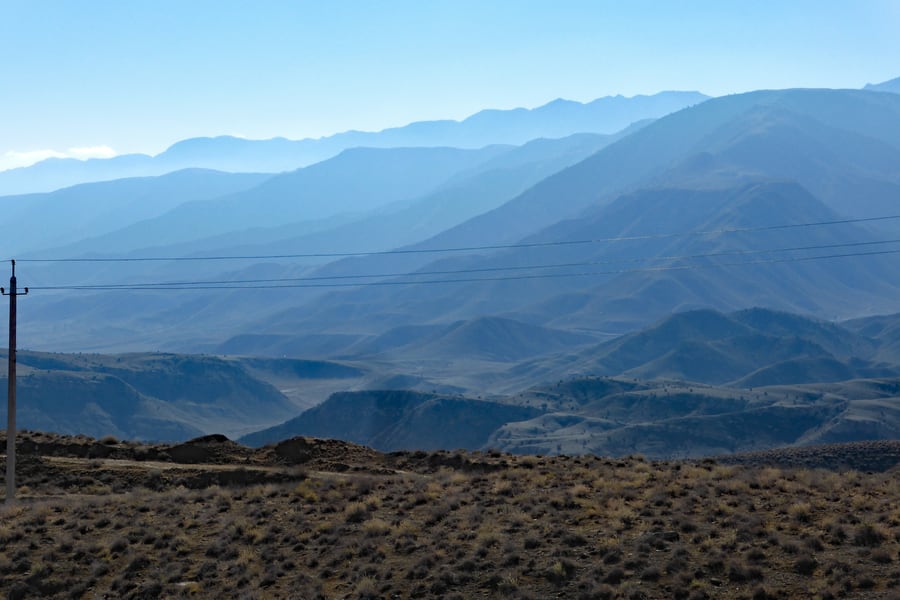 Hans Birger Nilsen / Wikimedia Commons · CC BY-SA 2.0 · 2018 · cropped
Along the foot of the Kopet Dag
Gökdepe, Bäherden, Arçman, Bamy, Gyzylarbat — two hundred kilometres of oases, and the reason the surveyors put the line where they did.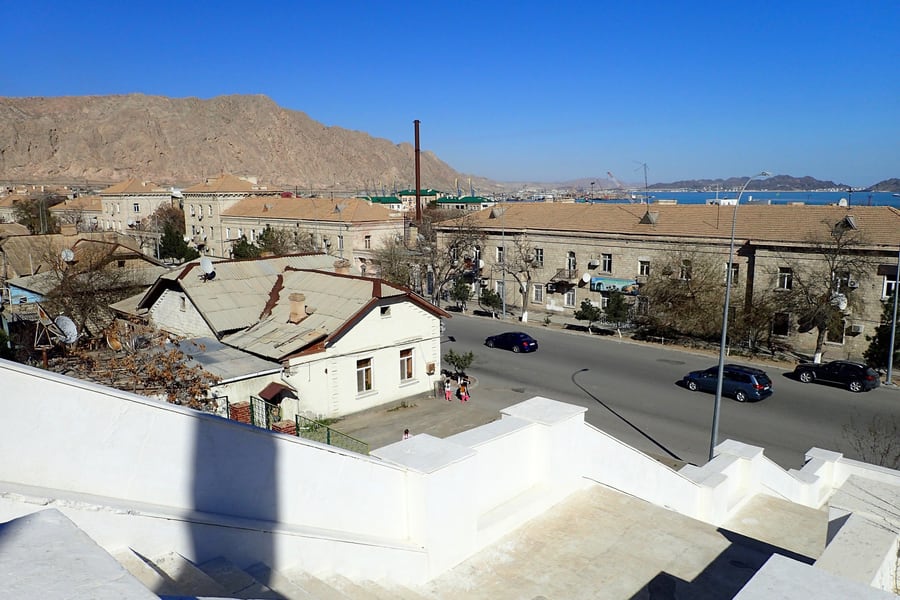 David Stanley / Wikimedia Commons · CC BY 2.0 · 2011 · cropped
Down to the Caspian at eight
Past Bereket the mountains end and the desert runs to the sea. The train comes in along the Türkmenbaşy Gulf under the coastal hills.A bit of history
Culture & experiences along the way
 EugeneHorsemanship / Wikimedia Commons · CC0 · cropped
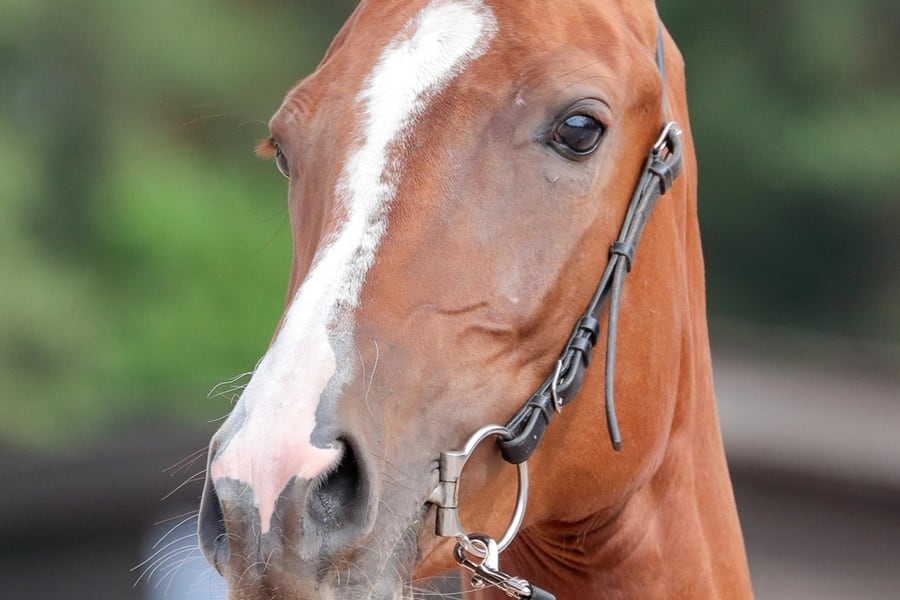
The horse the country is named after
The first half of this line crosses the Akhal oasis, and the oasis gave its name to the Akhal-Teke — the thin-skinned desert horse whose coat carries a metallic sheen. It is on the state emblem and the banknotes, it has its own national holiday in April, and the hippodrome and stud farms outside Ashgabat are where you go to see one.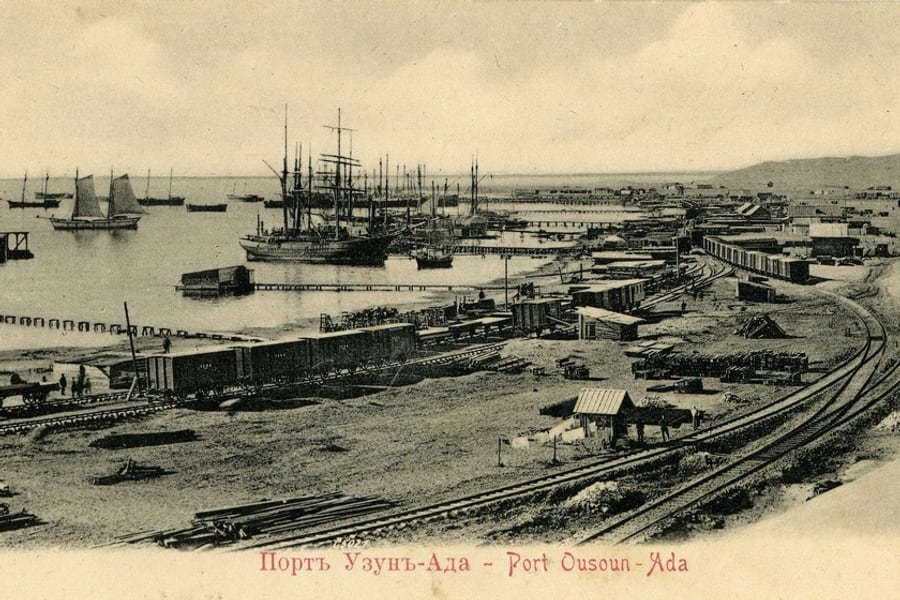 Unknown / Wikimedia Commons · Public domain · before 1900 · cropped
The terminus that was abandoned
The railway did not start at Türkmenbaşy. It started at Uzun-Ada, a port on a sandspit south of it, where Nobel's condensers turned the Caspian into drinking water for the construction camps. Within fifteen years the head of the line had been relaid north to Krasnovodsk and Uzun-Ada was finished — flooded, and abandoned so completely that in 1895 Russian soldiers carried its wooden church across to the new town, where it still stands.Timetables
One pair of trains works the line and both run daily, all year. Times are the operator's own, read from the Türkmendemirýollary timetable in September 2026.
Türkmendemirýollary publishes the departure from the originating station and the total running time, but no intermediate times and no arrival. The arrivals below are the operator's departure plus the operator's own duration; everything else in the tables is exactly as published.
| Train 606 · westbound | Train 605 · eastbound | |
|---|---|---|
| Departs | Ashgabat 17:50 | Türkmenbaşy 14:50 |
| Arrives | Türkmenbaşy 08:02 next day | Ashgabat 05:25 next day |
| Runs | Every day | Every day |
| Journey | 14 hr 12 min | 14 hr 35 min |
| Distance | 557 km | 557 km |
| Type | Ýolagçy otly — all stations | Ýolagçy otly — all stations |
The calling list
Distances are from the originating station, and the stand is the operator's published dwell time.
| Westbound, from Ashgabat | Eastbound, from Türkmenbaşy | ||
|---|---|---|---|
| Ashgabat | 0 km | Türkmenbaşy | 0 km |
| Gökdepe | 48 km · 5 min | Guşa | 6 km · 2 min |
| Kelete | 76 km · 2 min | Ýangaja | 30 km · 2 min |
| Bäherden | 105 km · 2 min | Belek | 77 km · 2 min |
| Arçman | 137 km · 2 min | Jebel | 129 km · 10 min |
| Bamy | 169 km · 10 min | Balkanabat | 148 km · 10 min |
| Gyzylarbat | 224 km · 5 min | Akjaguýma | 225 km · 2 min |
| Uzynsuw | 280 km · 2 min | Bereket | 255 km · 20 min |
| Bereket | 302 km · 20 min | Uzynsuw | 277 km · 2 min |
| Akjaguýma | 332 km · 2 min | Gyzylarbat | 333 km · 5 min |
| Balkanabat | 409 km · 10 min | Bamy | 388 km · 10 min |
| Jebel | 428 km · 10 min | Arçman | 420 km · 2 min |
| Belek | 480 km · 2 min | Bäherden | 452 km · 2 min |
| Ýangaja | 527 km · 2 min | Kelete | 481 km · 2 min |
| Guşa | 551 km · 2 min | Gökdepe | 509 km · 5 min |
| Türkmenbaşy | 557 km | Ashgabat | 557 km |
Two timetables, and which one to believe
Turkmenistan publishes this schedule twice. The operator, Türkmendemirýollary, posts it at railway.gov.tm/schedule (opens in a new tab), where it sells the tickets. The Ministry of Railways posts a second version at turkmendemiryollary.gov.tm/schedules (opens in a new tab) which does give arrival times and a few intermediate ones — but it is the older document. Its running times, 14 hr 45 min and 14 hr 22 min, are the ones the operator's own page carried until the middle of 2026, and it still calls Gyzylarbat by the name the town gave up in November 2022. The times on this page are the operator's, because the operator is the one selling the seat.
Tickets
Türkmendemirýollary sells online through its own site and app, ten days ahead; booking offices open five days ahead, and the operator states plainly that both draw on one system, so if the website shows nothing the ticket window has nothing either. Payment online works only with Turkmen Altyn Asyr or Senagat bank cards, and the operator says payments are accepted only from inside Turkmenistan — so a visitor buys at the booking office. Take the passport the ticket was bought against, and be at the station 45 minutes before departure.
Sleeping accommodation comes in three grades, described here in the operator's own terms. There is no published fare table, and prices on the Turkmen railway are very low by international standards; the one figure the operator does publish is the VIP supplement.
Book your tickets
Kupe
Four berths behind a door
The operator's middle grade — a closed compartment of two sleeping berths a side, four passengers.
Book Tickets (opens in a new tab, on railway.gov.tm)via railway.gov.tmPlaskart
Open six-berth bays
Sections of three berths a side with no door onto the corridor, and the cheapest way to lie down.
Book Tickets (opens in a new tab, on railway.gov.tm)via railway.gov.tmSW and VIP
Two berths, and a supplement
SW compartments take two passengers; VIP adds a flat 50 manat to the Kupe price, with bedding and a meal.
Book Tickets (opens in a new tab, on railway.gov.tm)via railway.gov.tmRail Passes
No rail pass covers Turkmenistan. Interrail and Eurail stop well short of the Caspian, and there is no Central Asian equivalent and no Turkmen multi-journey ticket — Türkmendemirýollary sells single seats on named trains and nothing else. For this journey that costs a visitor nothing: the fare for 557 km is small, and a pass would have no second journey to spread itself over unless the trip took in the Daşoguz or Türkmenabat trains as well.
The document that actually governs the trip is the visa. Turkmenistan does not issue visas on arrival to most nationalities: the Embassy of Turkmenistan's own instruction is to go through a travel agency, which obtains a Letter of Invitation from the State Migration Service, and that letter is what the embassy issues the visa against. The embassy quotes roughly a month for the invitation, so start well before booking anything. A transit visa is a separate route with a maximum stay of five days. Checked against the embassy's published guidance, September 2026.
Places to Visit
The stops on this line are not tourist towns. They are oasis settlements, an oil town, a railway junction and a port, and what is worth breaking the journey for is mostly what brought people to each place to begin with — water coming out of the ground, or the sea at the end. Two of the six below are within reach of Ashgabat before the train leaves; the rest are strung along the way west.
 David Stanley / Wikimedia Commons · CC BY 2.0 · 2012 · cropped
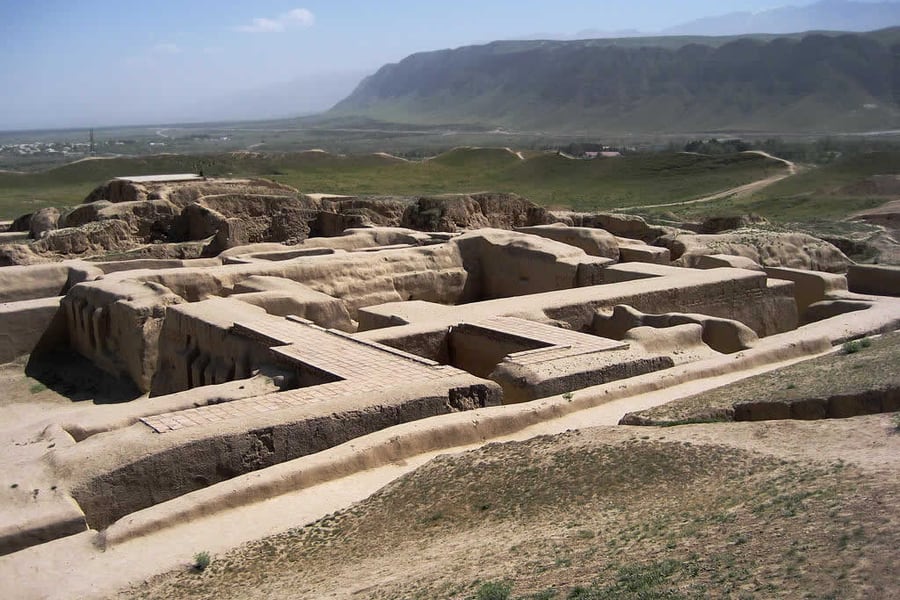
Nisa, above the Ashgabat plain
Eighteen kilometres west of the capital, on a spur below the Kopet Dag, stand the two mounds of Old and New Nisa — the Parthian royal seat, mud brick and unroofed, inscribed by UNESCO in 2007. What comes out of the ground here is exceptional: carved ivory rhytons, a marble of Rodogune, the clay head of a helmeted warrior, all now in the national museum in Ashgabat. Go before the evening train.Gökdepe, the first stop
Forty-eight kilometres out, and the reason the railway exists in this form. The Tekke fortress at Gökdepe held a wall 2.8 km round and 5.5 metres high, and in December 1880 General Skobelev laid siege to it with six thousand men. It fell on 12 January 1881 when a mine was fired under the wall. Construction of the railway had begun the year before, to carry that campaign; nine months after the fortress fell the rails were at Gyzylarbat.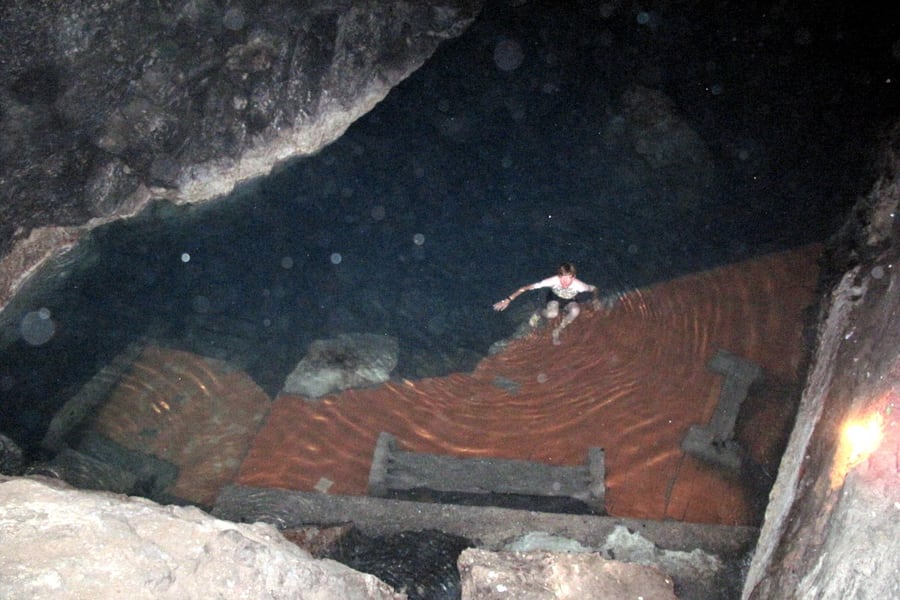 Peretz Partensky / Wikimedia Commons · CC BY-SA 2.0 · 2009 · cropped
Kow Ata, under Bäherden
A cave 250 metres long in the flank of the Kopet Dag, with an underground lake at the bottom of it 55 metres below the entrance — the largest in the former Soviet Union. The water is sulphurous, blue-green, and stays between 33 and 38 °C all year, and people swim in it. The railway made it famous: in 1896 the local press reported that the authorities at Bäherden station had put in a wooden staircase, and visitors from Ashgabat have been coming ever since.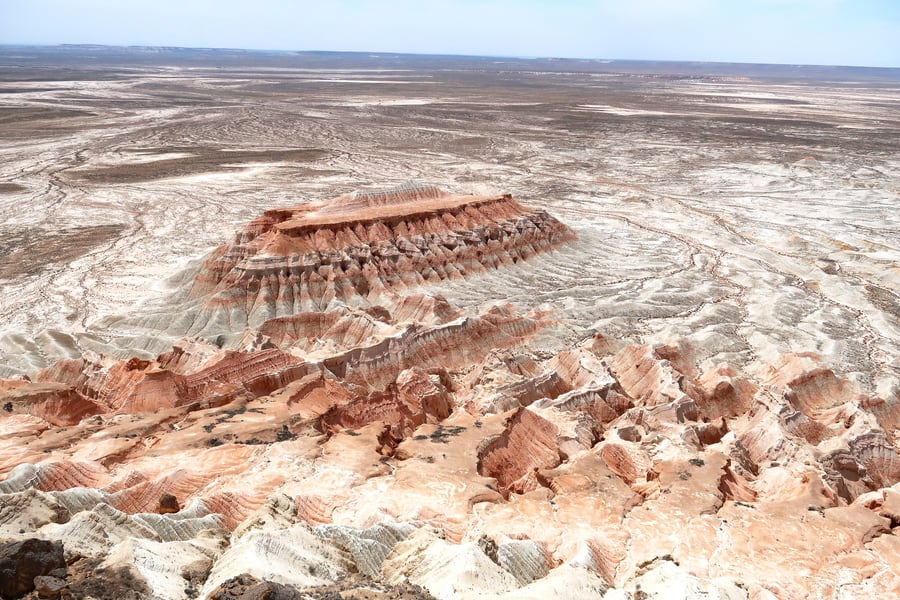 John Pavelka / Wikimedia Commons · CC BY 2.0 · 2018 · cropped
Yangykala, north of the line
The most extraordinary landscape in western Turkmenistan is off the railway rather than on it: a canyon system of banded pink, white and ochre rock on the old Caspian seabed, reached across open desert from Balkanabat or Türkmenbaşy. There is no public transport and no settlement — it is a chartered vehicle and a long day — but the walls are hundreds of metres of horizontal strata laid down when this was all under water.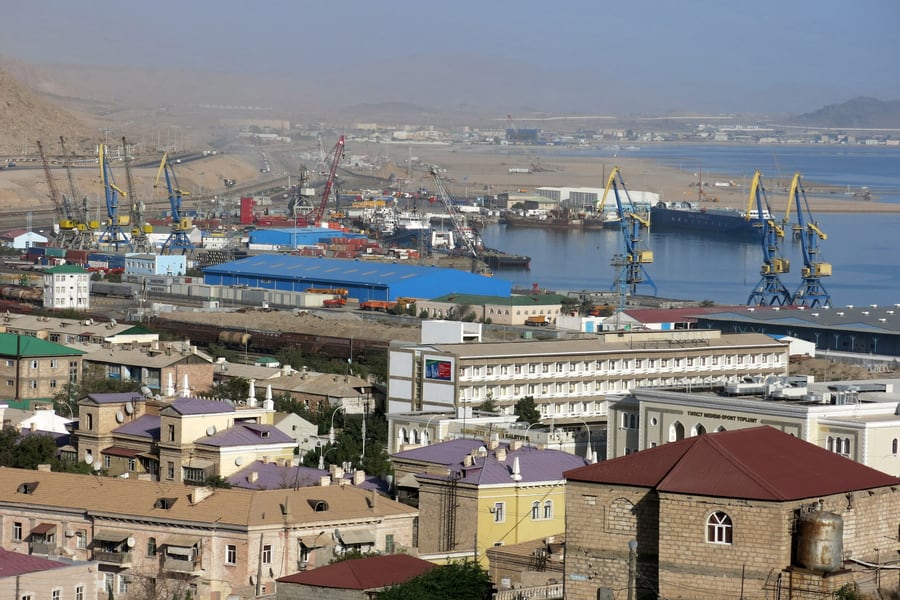 Bohndorf Film-Team / Wikimedia Commons · CC BY-SA 4.0 · 2015 · cropped
Türkmenbaşy town
The port at the end of the line was Krasnovodsk until 1993 and a Russian fort before that, established in 1869 on a spot the Turkmen called Kyzyl-Su, Red Water. It is a small city of about eighty-seven thousand wedged between the bare coastal mountains and the Türkmenbaşy Gulf, with the country's largest oil refinery at one end and, in the old quarter above the harbour, the low pre-Soviet streets the railway arrived into.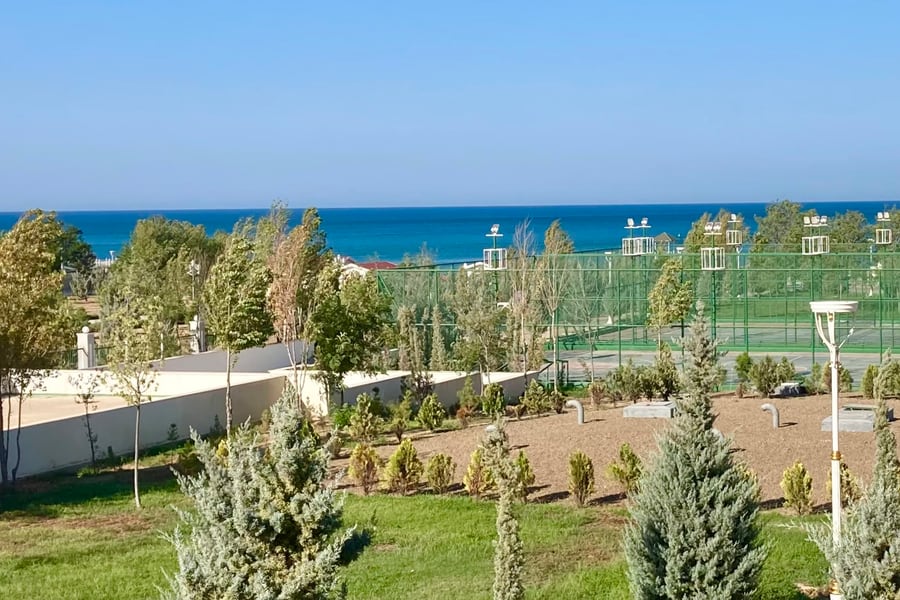 Bayram A / Wikimedia Commons · CC BY-SA 4.0 · 2022 · cropped
Awaza, twelve kilometres up the coast
Turkmenistan's answer to a seaside resort, begun in 2007 on an empty stretch of Caspian shore west of the town, and now a strip of some sixty hotels, a yacht harbour and an artificial river along sixteen kilometres of beach. It is startlingly quiet for its size. The sea here is shallow and warm in summer, and it is where most visitors who come off this train actually sleep.Where to Sleep
Turkmenistan is not a country where a bed is booked directly. The travel agency that obtains the Letter of Invitation normally arranges the hotels with it, and the state-owned hotels at both ends of this line have little or no independent web presence — none of the obvious addresses resolved when this page was written, so the cards below carry no booking link and are here for orientation only.
At the Ashgabat end the choice is the capital's own stock of marble towers; at the Caspian end it is Türkmenbaşy's older Soviet hotels or the newer strip at Awaza, twelve kilometres up the coast, where sixty-odd hotels have been built along the shore since 2007. Awaza is the more comfortable end of the journey and the more artificial; the town is the more interesting place to wake up in.
Where to stay
Yyldyz Hotel
Ashgabat, on the hill above the city
A 24-storey teardrop tower of 155 rooms, built in 2013, with a panoramic restaurant on the eighteenth floor.
viaGrand Turkmen Hotel
Ashgabat, by the administrative centre
Opened in 1995 as the Sheraton Grand Turkmen, 120 rooms on six floors, refaced in white marble in 2015.
viaHazar Hotel
Türkmenbaşy, in the town itself
The Soviet-era hotel in Türkmenbaşy, and the alternative to sleeping out at Awaza on the coast.
viaQuestions or corrections
Planning this trip and stuck on something, or spotted a time, fare or detail that has changed? Send us a message about Ashgabat to Türkmenbaşy. We read every one, and we update this page when something has changed.