The Aubrac Line
Cramos / Wikimedia Commons · CC BY-SA 3.0
- DistanceClermont-Ferrand to Béziers, about 397 km; some 275 km of it on the mountain line from Neussargues
- DurationAbout 6½ hours
- Best seasonAll year; May to October for the cattle on the Aubrac pastures
Introduction
This train crosses one record-breaking bridge and runs underneath another.
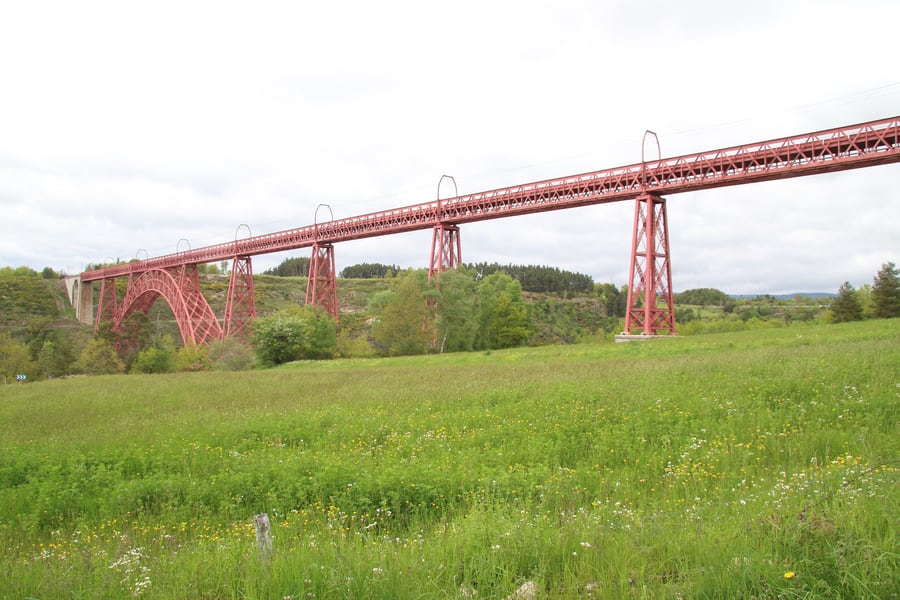
The first is the Garabit viaduct, finished in 1884 to carry the line over the gorge of the Truyère: a single iron arch, designed by the engineer Léon Boyer and built by Gustave Eiffel's company, with the track 122 metres above the river, then the highest viaduct in the world. The second came 120 years later. The motorway from Clermont-Ferrand to Béziers follows much the same route as the railway, and in 2004 it took the valley of the Tarn at Millau on a viaduct whose deck stands 270 metres above the water. A few minutes out of Millau station, the train passes beneath it.
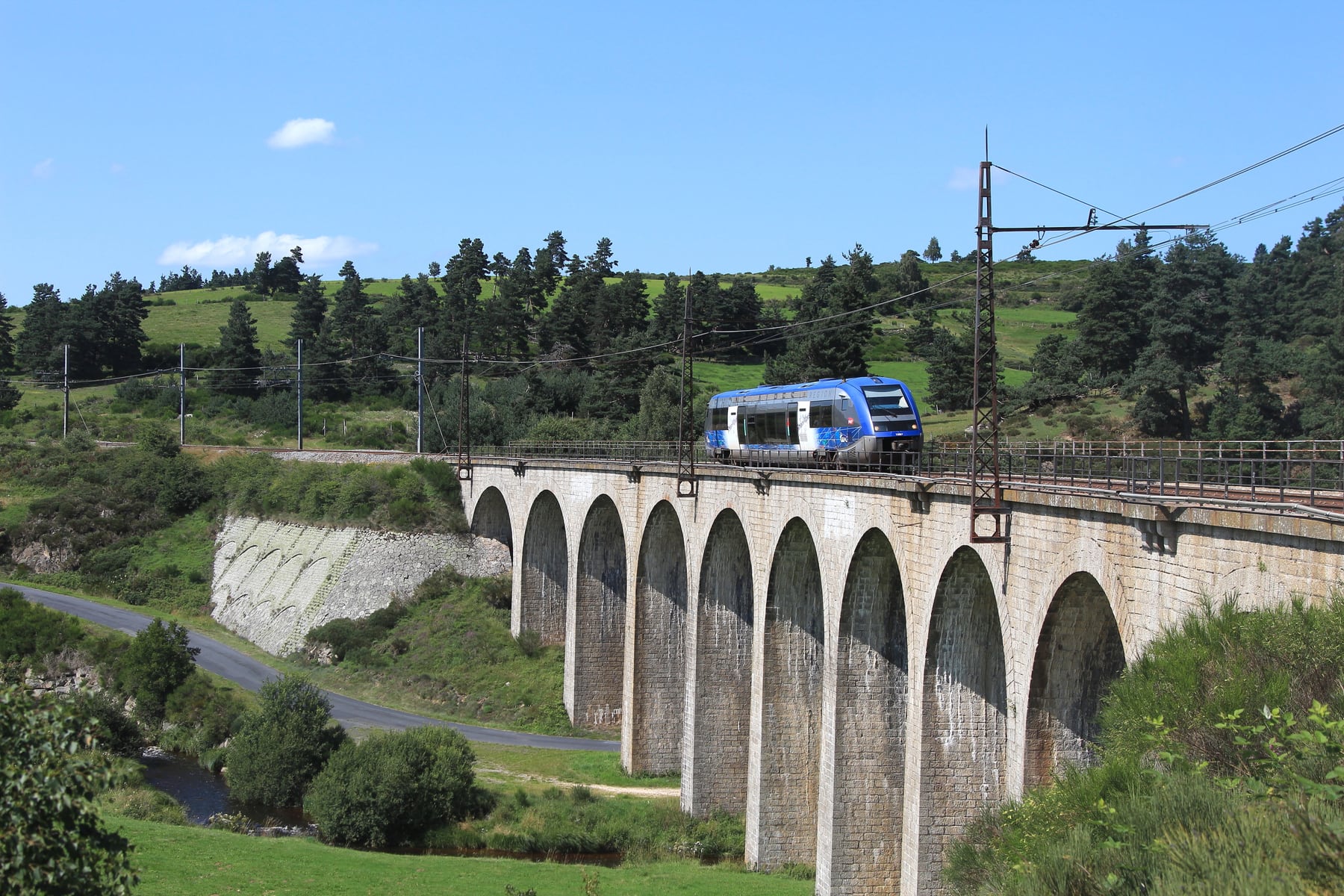
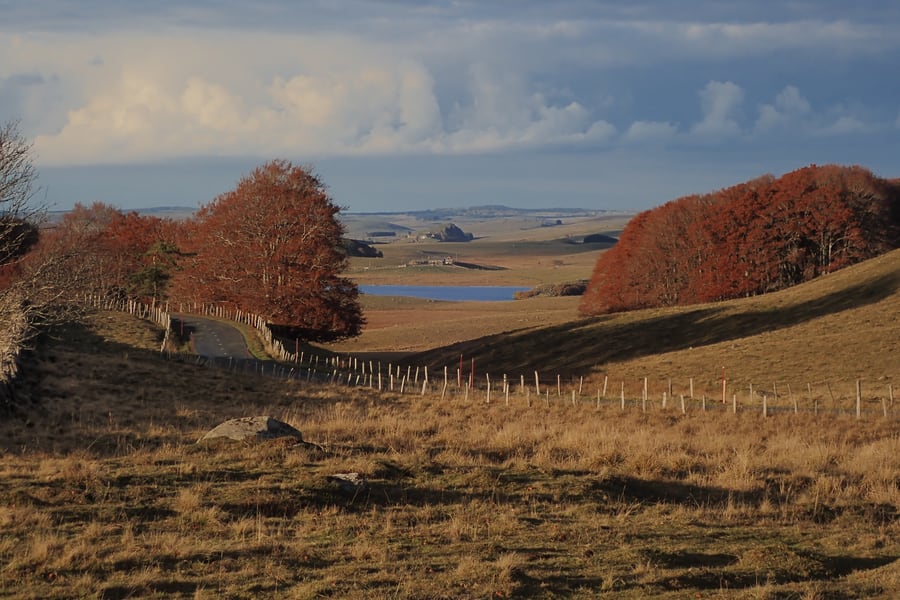
Between the two bridges is one of the emptiest stretches of France. The Aubrac, as the train has been called since 1984, runs once a day each way, about 397 kilometres in six and a half hours: from the volcanic country of Auvergne up over the Margeride and the Aubrac plateau, where its highest stop stands at 1,041 metres, across the limestone causses and down the valley of the Orb to the vineyards of Languedoc. It is a small diesel railcar on a single track, with no reservation needed, and between Neussargues and Saint-Chély-d'Apcher it is the only passenger train on the line.
The Journey
The train leaves Clermont-Ferrand a little after one in the afternoon and runs south up the Allier, past Issoire, then turns up the valley of the Alagnon to Neussargues, at 809 metres. This is where the mountain line proper begins: the Ligne de Béziers à Neussargues, about 275 kilometres of single track built by the Compagnie du Midi and finished in 1888. The train stands here for ten minutes southbound and twenty northbound, and on recent journeys passengers have changed at Neussargues to a second train continuing under the same number, so listen for the announcement.
Over the plateaus
South of Neussargues the line crosses the Planèze to Saint-Flour, its upper town on the edge of the volcanic plateau, then reaches the gorge of the Truyère and the Garabit viaduct. Beyond it the train climbs through the Margeride to Saint-Chély-d'Apcher, where the steel works still receives its coils by rail, and to Aumont-Aubrac, at 1,041 metres the highest stop of the journey. The line keeps to the high ground from here to Marvejols, bridging the valleys on Léon Boyer's stone viaducts rather than winding down into them.
Down through the causses
From Marvejols the line drops to the Lot at Banassac and crosses the limestone plateaus to Sévérac-le-Château, then descends into the valley of the Tarn at Millau, at 379 metres. It follows the river beneath the motorway viaduct, climbs again past Tournemire-Roquefort, along the edge of the Larzac, and comes down the valley of the Orb by Bédarieux to Béziers, 18 metres above the sea. The line has 38 tunnels, 17.5 kilometres of them in all, and nearly 700 curves.
The train
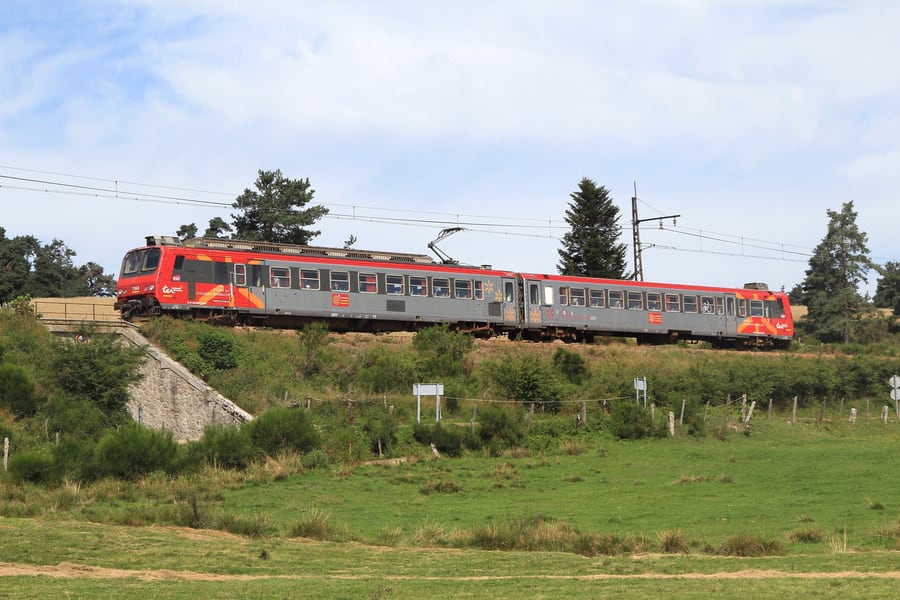
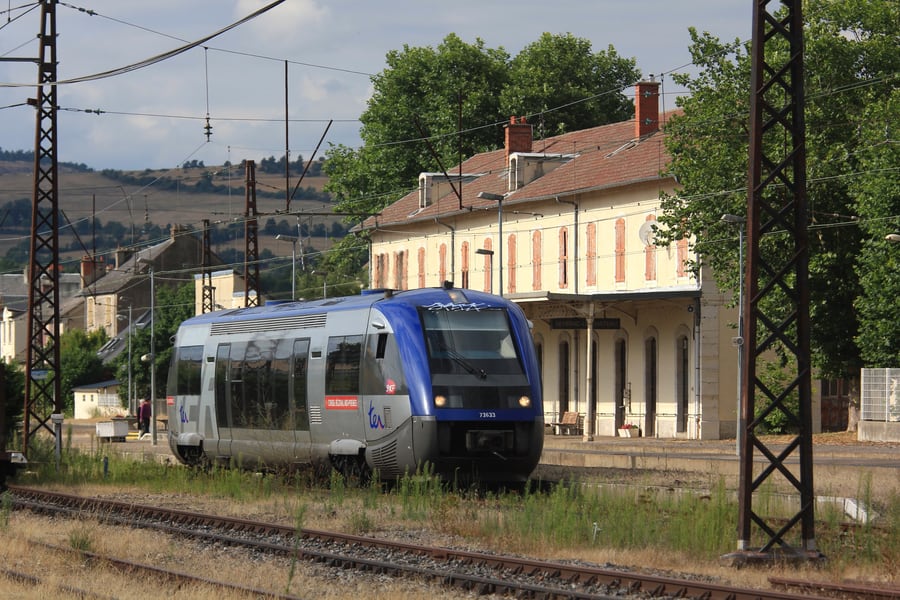
The line was electrified by the Midi at 1,500 volts in 1931 and 1932, but the Aubrac itself has been a diesel railcar since 1 July 2010: one or more X 73500 units, coupled together when the train is busy. The train used to start from Paris; since December 2007 it has run from Clermont-Ferrand, where there are Intercités to and from Paris.
Along the route
 Pymouss / Wikimedia Commons · CC BY-SA 4.0
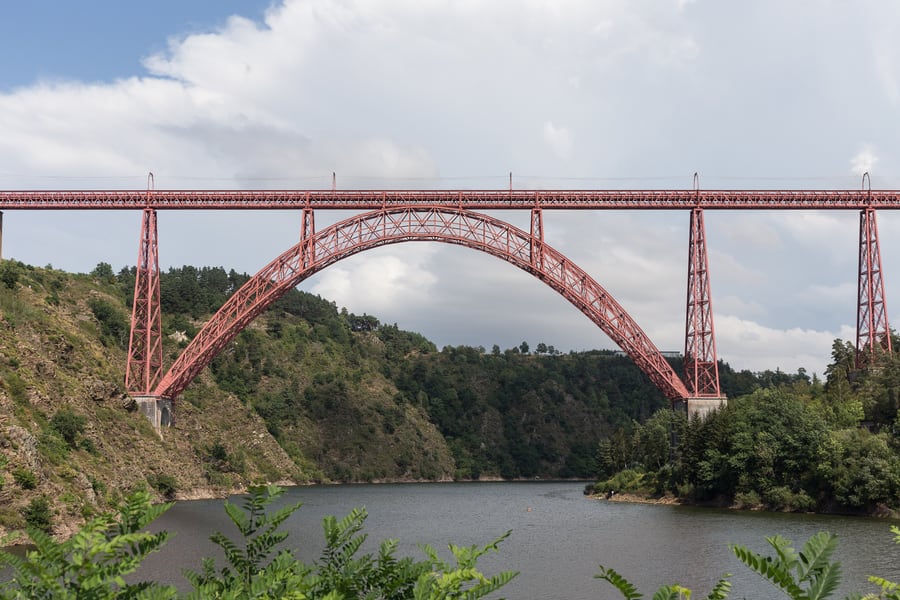
The Garabit viaduct
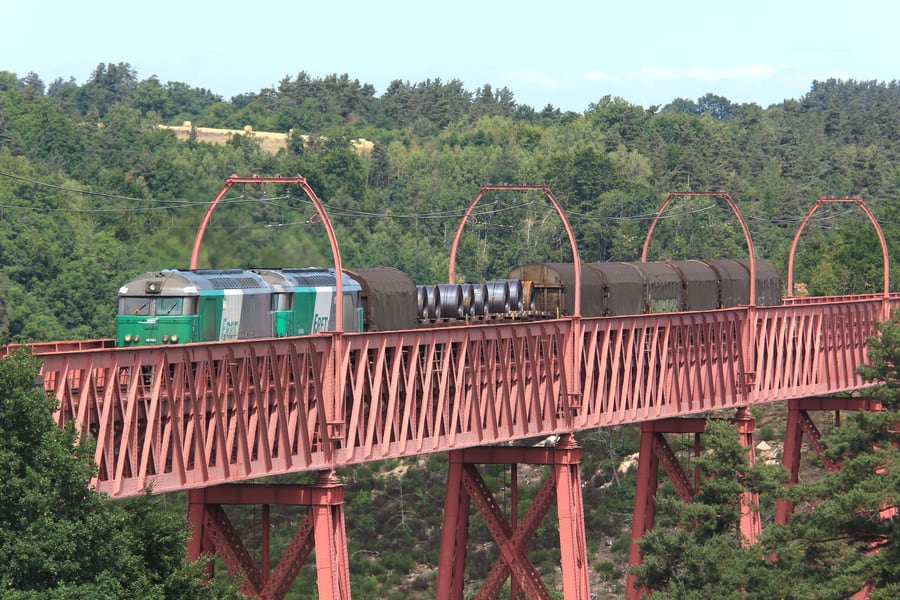
Léon Boyer's design, built by Eiffel's company between 1880 and 1884: a single iron arch of 165 metres carrying the track 122 metres above the Truyère, then the highest viaduct in the world. Since the Grandval dam of 1959 it crosses a lake.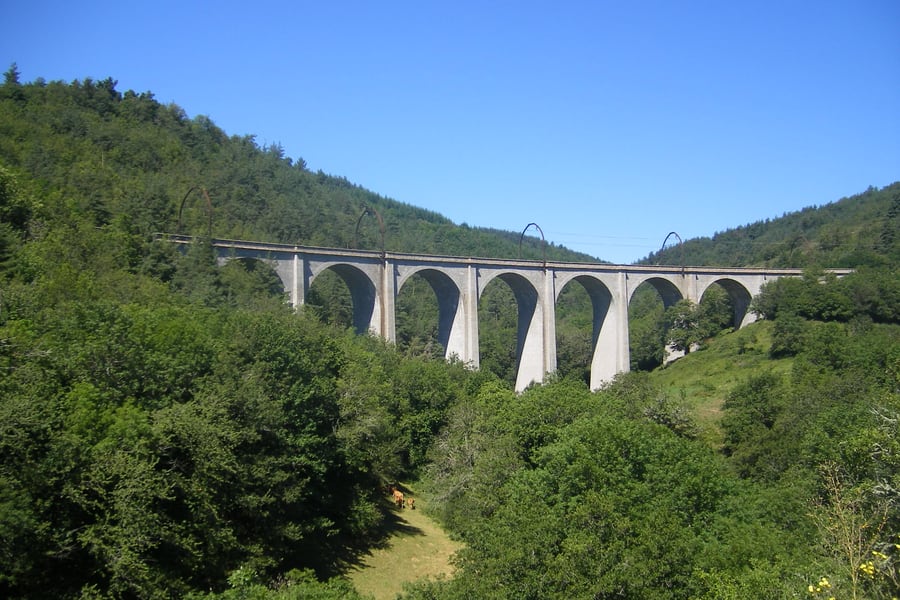 Szeder László / Wikimedia Commons · CC BY-SA 4.0
Boyer's stone viaducts
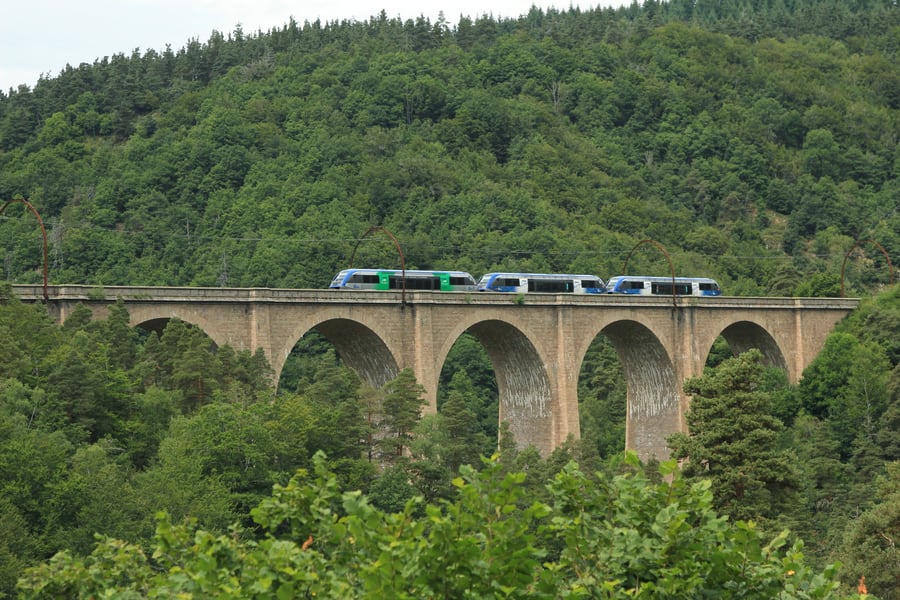
Between Saint-Chély and Marvejols the line keeps to the high plateau and bridges the valleys instead of dropping into them: the curved Chanteperdrix viaduct, 235 metres long, and the Crueize, 63 metres high at 905 metres above sea level.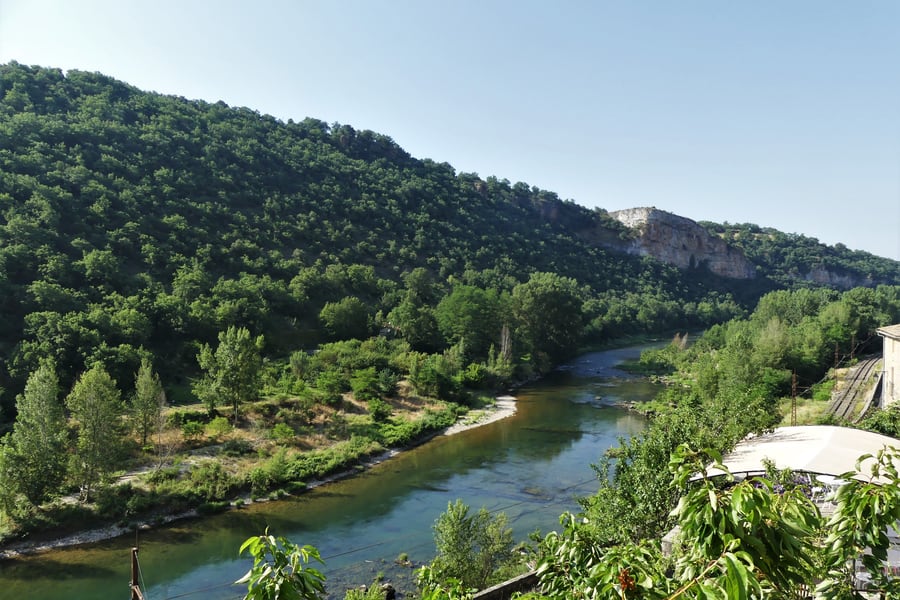 Père Igor / Wikimedia Commons · CC BY-SA 4.0
Under the Millau viaduct
Out of Millau the train follows the Tarn downstream, passes beneath the motorway viaduct of 2004, whose deck stands 270 metres above the river, and runs below the cliff village of Peyre before turning up the Cernon.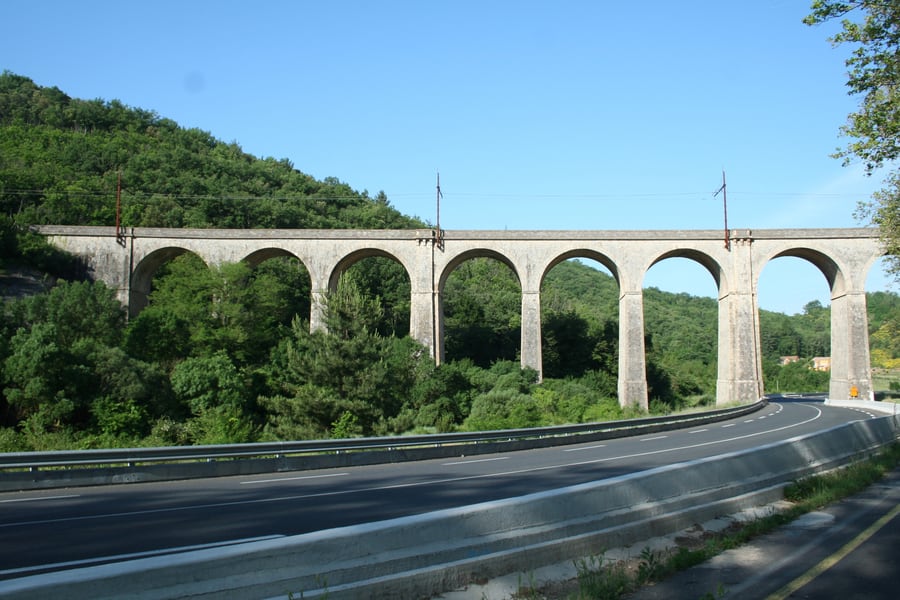 Fagairolles 34 / Wikimedia Commons · CC BY-SA 4.0
Down the Orb
Past Ceilhes the line comes down the valley of the Orb, over a stone viaduct at Hérépian, to Bédarieux at 196 metres. On to Béziers it runs on the route's oldest part, opened in 1858 for the coal of Graissessac.A bit of history
Culture & experiences along the way
 Thesupermat / Wikimedia Commons · CC BY-SA 4.0
Roquefort
Tournemire-Roquefort station is named for the village whose caves ripen this blue cheese of raw ewe's milk, first recorded in the eleventh century. Fissures in the rock, the fleurines, keep air moving through the caves, and in 1925 Roquefort became the first French cheese with a protected name.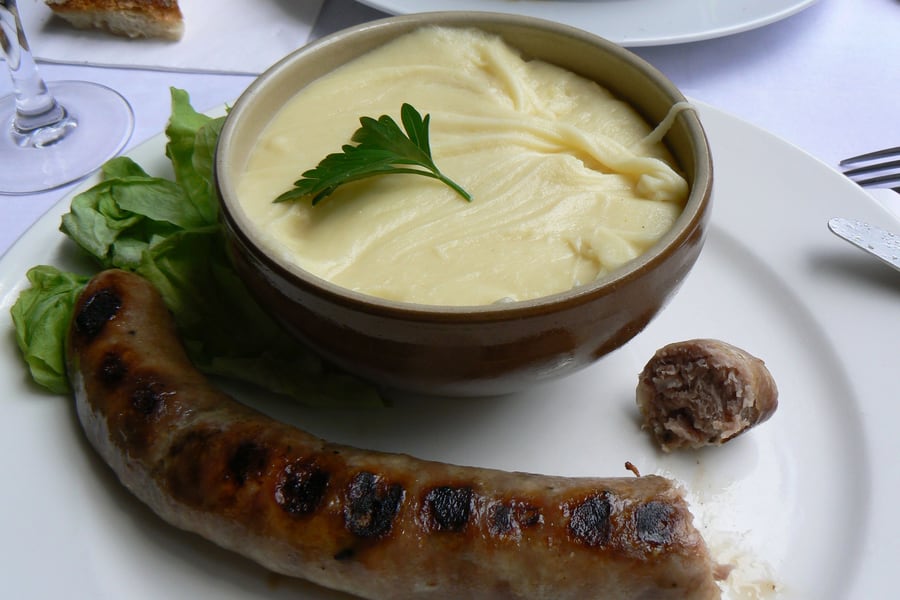 Slastic / Wikimedia Commons · public domain
Aligot
The dish of the Aubrac: mashed potato worked with fresh tome cheese, cream, butter and garlic for a long time, until it turns smooth and very elastic. It often comes with a country sausage, and no village festival on the plateau goes without it.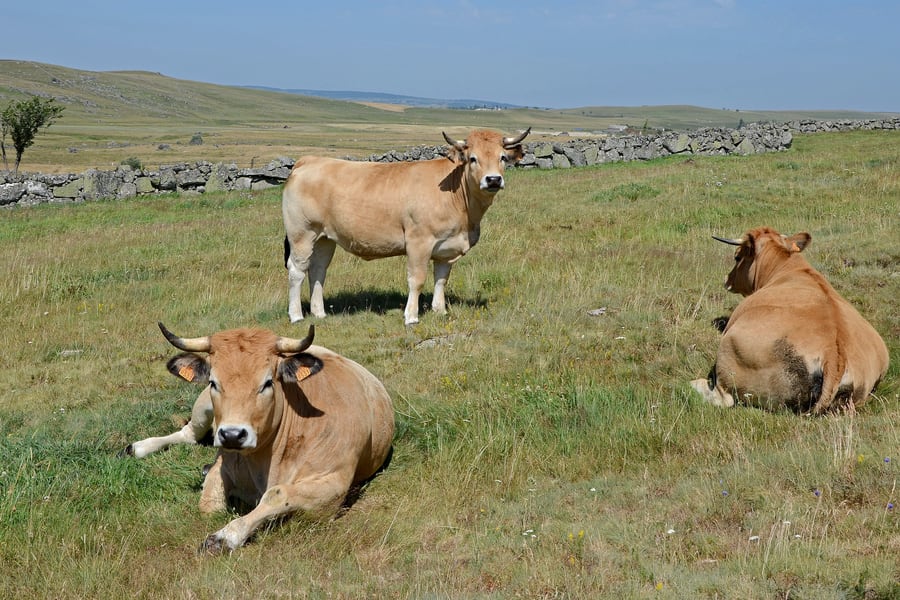 Pline / Wikimedia Commons · CC BY-SA 3.0
Aubrac cattle on the high pastures
The fawn Aubrac cows, with their lyre-shaped horns, spend the summer on the plateau from 25 May, the feast of Saint Urban, to 13 October. Until the 1960s their milk was made into fourme de Laguiole in stone huts, the burons, through the summer.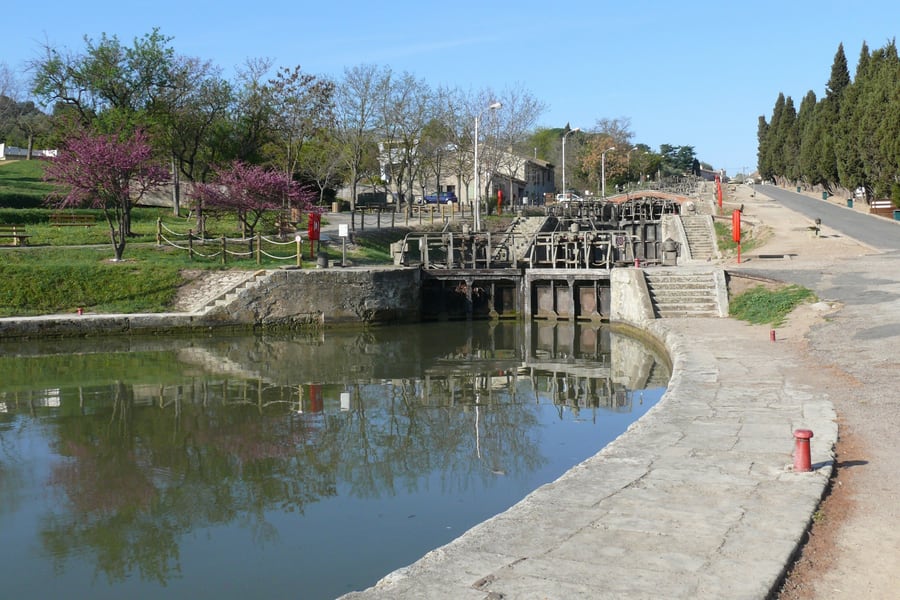 Ad Meskens / Wikimedia Commons · CC BY-SA 3.0
The Fonseranes locks
At Béziers the Canal du Midi climbs 21.5 metres in a staircase of oval locks, nine gates and eight basins over 312 metres, finished when the canal opened in 1681. The canal has been a World Heritage Site since 1996, and boats still work six of the locks.Timetables
One train a day in each direction, every day. No reservation is needed. On Saturdays 14 and 21 November 2026 a coach replaces the train between Bédarieux and Béziers in both directions, at about the train's times.
Clermont-Ferrand to Béziers — train 15941
| Clermont-Ferrand | Neussargues | Saint-Flour | Aumont-Aubrac | Marvejols | Millau | Tournemire-Roquefort | Bédarieux | Béziers |
|---|---|---|---|---|---|---|---|---|
| 13:06 | 14:42 | 15:02 | 15:50 | 16:14 | 17:37 | 18:06 | 18:58 | 19:32 |
Béziers to Clermont-Ferrand — train 15940
| Béziers | Bédarieux | Tournemire-Roquefort | Millau | Marvejols | Aumont-Aubrac | Saint-Flour | Neussargues | Clermont-Ferrand |
|---|---|---|---|---|---|---|---|---|
| 09:30 | 10:05 | 10:58 | 11:28 | 12:54 | 13:18 | 14:05 | 14:45 | 16:11 |
Until 12 December the northbound train leaves Béziers at 09:32, and the southbound times move by a minute or so. Both trains also call at Issoire, Brassac-les-Mines, Arvant, Massiac-Blesle, Saint-Chély-d'Apcher, Le Monastier, Banassac-La Canourgue, Campagnac-Saint-Geniez, Sévérac-le-Château, Saint-Georges-de-Luzençon, Saint-Rome-de-Cernon, Ceilhes-Roqueredonde, Le Bousquet-d'Orb and Magalas.
Times as of October 2026, from SNCF's timetable as carried by ÖBB's journey planner, checked day by day from 18 October 2026 to 15 January 2027. Check your date on SNCF Connect (opens in a new tab).
Tickets
Tickets are sold by SNCF, on SNCF Connect (opens in a new tab) and at stations, for the whole line or any part of it. The Aubrac is one of SNCF's Intercités without compulsory reservation, so a ticket is not tied to a seat: board and sit where there is room.
SNCF's Carte Avantage takes 30% off the normal Intercités fare, and the Carte Liberté 50%. Checked October 2026.
Book your tickets
Intercités ticket
No reservation needed · the whole line or any part of it
Book on SNCF Connect or buy at the station; a Carte Avantage takes 30% off the normal fare.
Book Tickets (opens in a new tab, on SNCF Connect)via SNCF ConnectRail Passes
Interrail and Eurail passes are valid, with no reservation and no supplement. Interrail's table of railway companies lists SNCF's Intercités in both the Global Pass and the One Country Pass for France, with a reservation compulsory only on some lines, and SNCF's own network map shows the Clermont-Ferrand–Béziers line among the day Intercités without one. With a pass, simply board.
A pass pays if this is one day of a longer trip through France. For the Aubrac alone, compare a travel day of the pass with the fare SNCF quotes for your date.
Checked October 2026 against Interrail's table of railway companies (opens in a new tab) and SNCF's Intercités destinations (opens in a new tab).
Places to Visit
With one train a day each way, getting off on the way means waiting a day for the next one, so plan to stay. Issoire, Saint-Flour, Marvejols and Millau all have their own stations on the line, and the Aubrac plateau begins at Aumont-Aubrac.
 Selmoval / Wikimedia Commons · CC BY-SA 4.0
Issoire
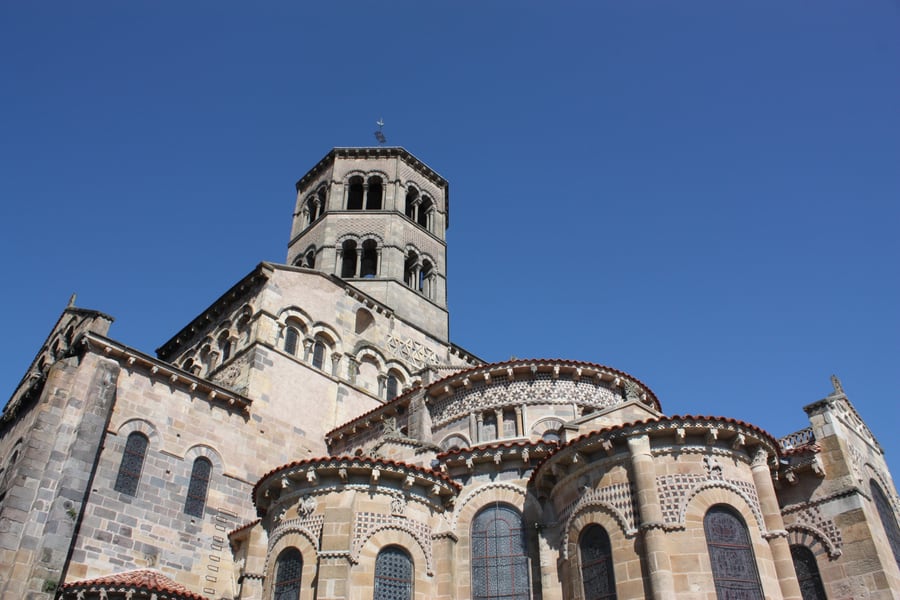
The abbey church of Saint-Austremoine, built around 1130, is one of the five major Romanesque churches of Auvergne. Its east end steps up in tiers of chapels and roofs to an octagonal tower, with a mosaic of basalt triangles and rosettes and carved signs of the zodiac. It was on the first list of French historic monuments, in 1840, and its painted interior was restored in the 1850s.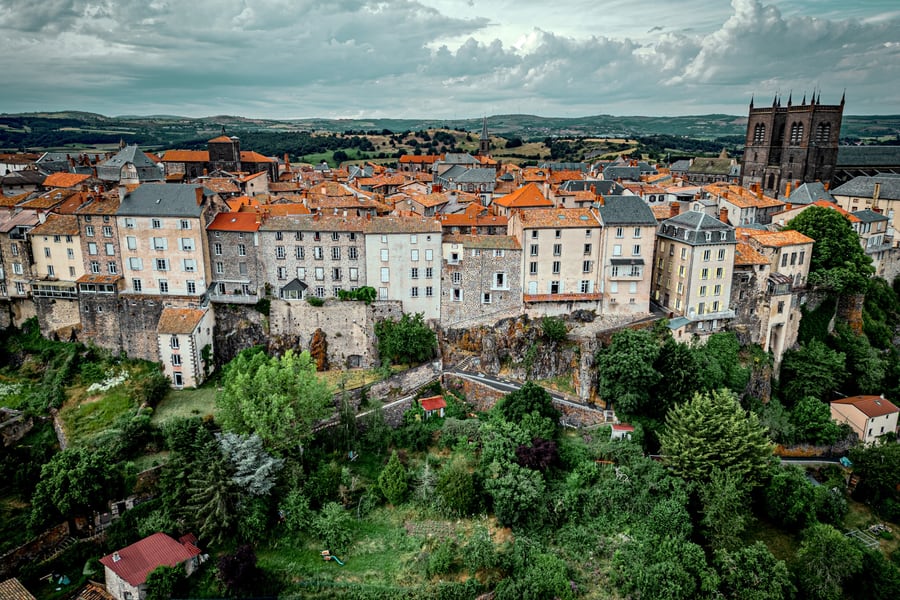 Eole / Wikimedia Commons · CC BY 4.0
Saint-Flour
The upper town stands on the edge of the Planèze, a volcanic plateau, about 900 metres up, with the lower town below in the valley of the Ander. Its Gothic cathedral, consecrated in 1466, is built of dark local lava, and the basalt columns along the road between the two towns look like fortifications but are natural.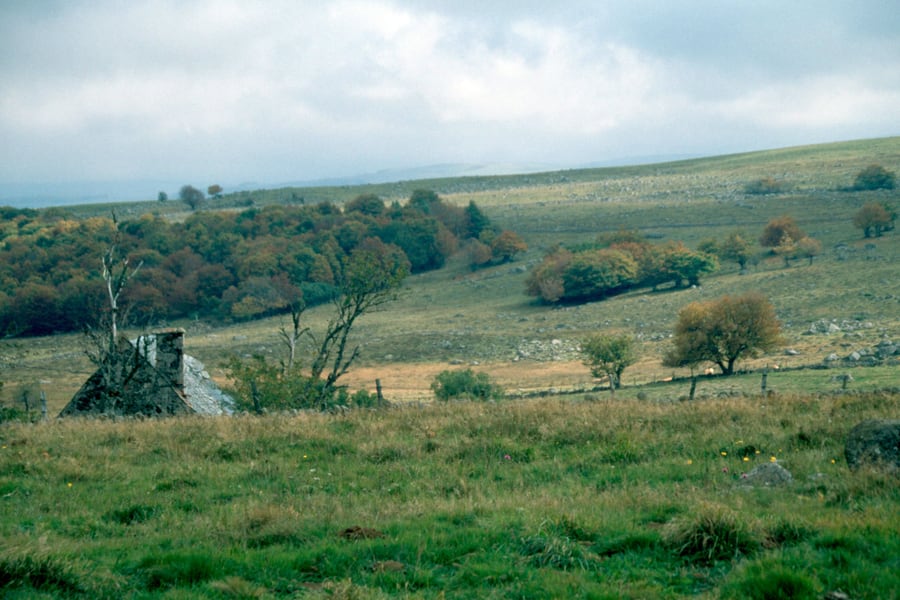 Gerd Eichmann / Wikimedia Commons · CC BY-SA 4.0
The Aubrac plateau
From Aumont-Aubrac, the line's highest stop, the basalt plateau runs south-west in open pasture, beech woods on its slopes and peat bogs left by an ice-age cap; snow can fall from October to May. The village of Aubrac keeps the remains of a hospital founded between 1108 and 1125 for pilgrims bound for Santiago, and Laguiole, at the plateau's far end, makes the knife.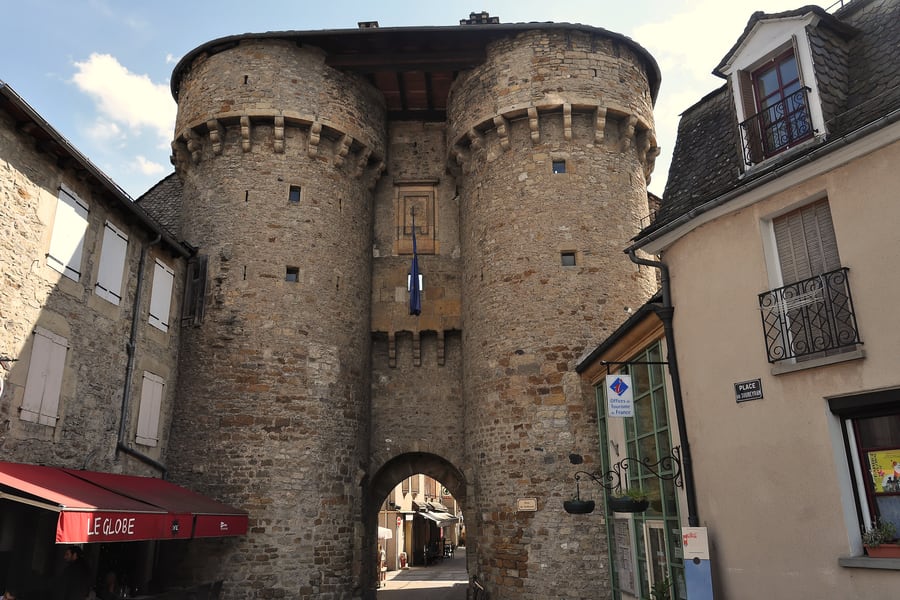 Marvejolais48 / Wikimedia Commons · CC BY-SA 4.0
Marvejols
The town was walled in the 1360s, and three fortified gates still stand: Soubeyran, Chanelles and Théron. Wrecked in the Wars of Religion, it was rebuilt with Henri IV's help from 1589 and entirely restored by 1601. The fourteenth-century Porte du Soubeyran houses a small archaeological museum.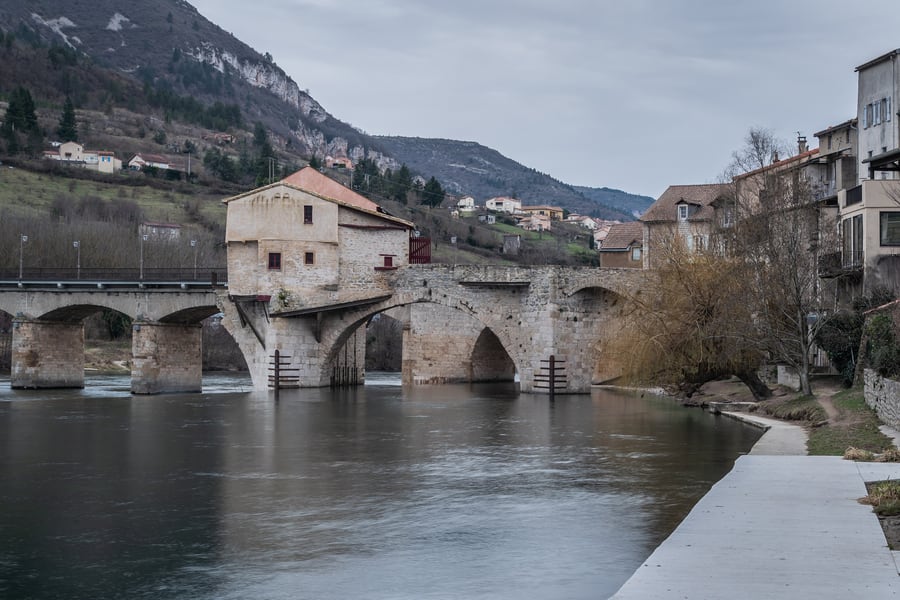 Krzysztof Golik / Wikimedia Commons · CC BY-SA 4.0
Millau
A glove-making town for centuries: in the twentieth century some 12,000 of its 18,000 people lived from leather, and its workshops still make about a third of France's gloves. The old bridge over the Tarn carries a mill on its second pier, the town museum tells the history of the glove, and from the belfry's platform, 42 metres up, the view takes in the causses around the town.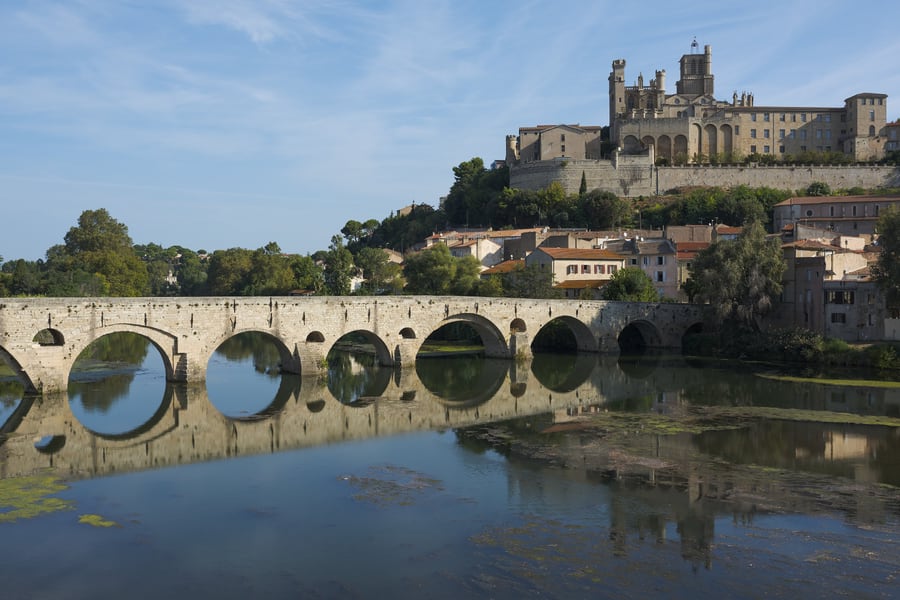 Christian Ferrer / Wikimedia Commons · CC BY-SA 4.0
Béziers
The cathedral of Saint-Nazaire stands on a promontory above the Orb, rebuilt after the town was sacked and burned in 1209. Its west front carries a rose window ten metres across and its square tower rises 48 metres. Below it the Pont Vieux crosses the river, and the Fonseranes locks of the Canal du Midi are within the town.Where to Sleep
The journey fits in an afternoon, but the line rewards a stop on the way. Saint-Flour, about two hours from Clermont-Ferrand and just past Garabit, is the natural place to break it.
Where to stay
Hôtel du Nord
Town centre, Saint-Flour
About twenty rooms with Art Deco interiors, 500 metres from the cathedral, with a closed garage.
Check Availability (opens in a new tab, on hoteldunord-saintflour.com)via hoteldunord-saintflour.comQuestions or corrections
Planning this trip and stuck on something, or spotted a time, fare or detail that has changed? Send us a message about The Aubrac Line. We read every one, and we update this page when something has changed.