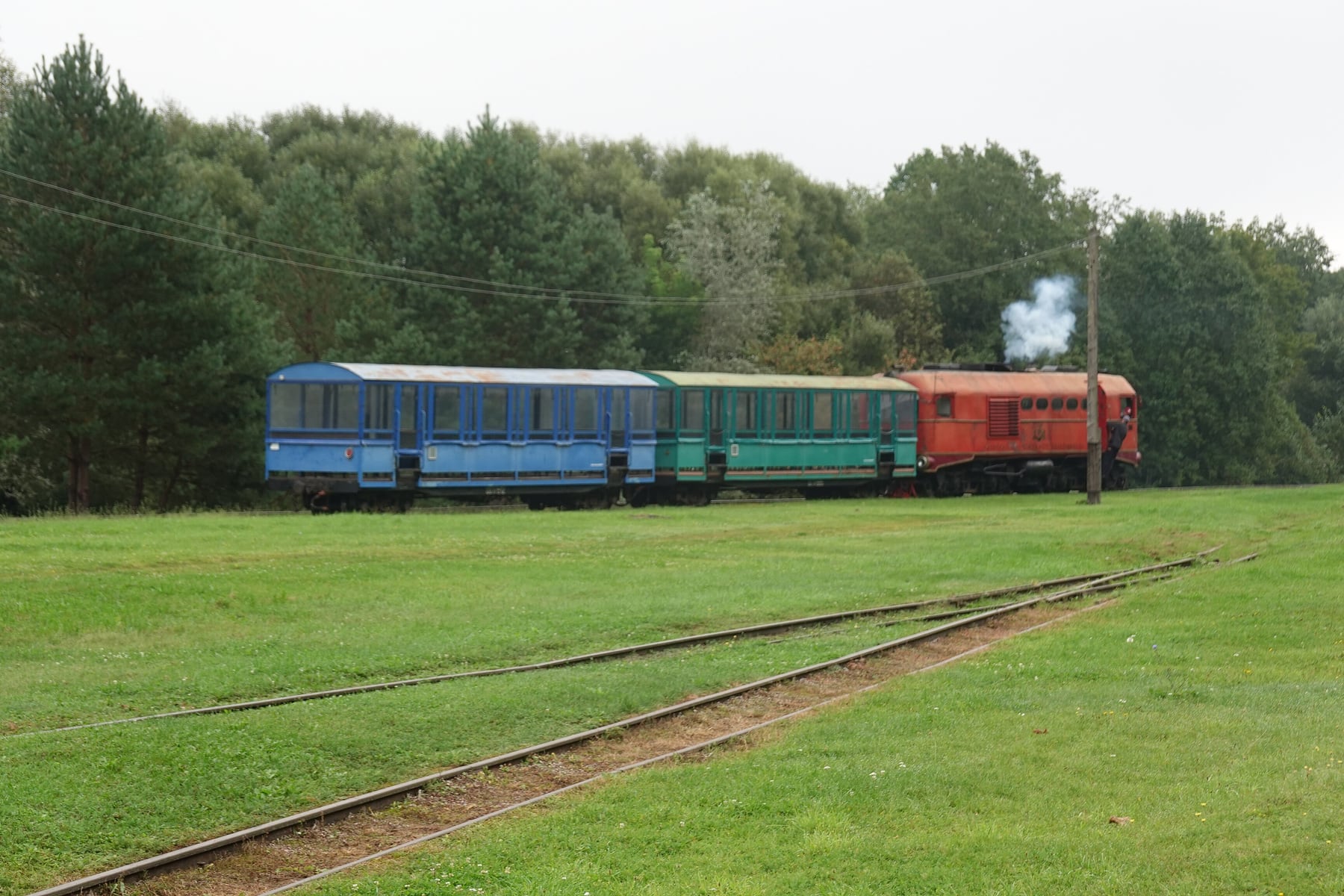
The Aukštaitija Narrow Gauge — Anykščiai to Rubikiai
Smiley.toerist / Wikimedia Commons · CC BY-SA 4.0 · 2025 · cropped
- Distance12.3 km, on a 68.4 km line
- Duration50 min each way
- Best seasonSaturdays and Sundays, early May to the end of October
Introduction
Lithuania has one heritage railway, and it is 750 mm wide. The Aukštaitija narrow gauge runs 68.4 kilometres from Panevėžys through Troškūnai to Anykščiai and on to Rubikiai, and what makes it unusual is not the gauge but the paperwork: in 1996 the state listed the whole thing as a cultural heritage object, and in 2003 it went further and gave individual protection to the trackbed, the Panevėžys depot and its viaduct, and the station buildings at Taruškos, Raguvėlė, Surdegis, Troškūnai and Anykščiai — the water towers, the workshops and a water crane among them. Most preserved railways protect their locomotives. This one is protected as architecture.
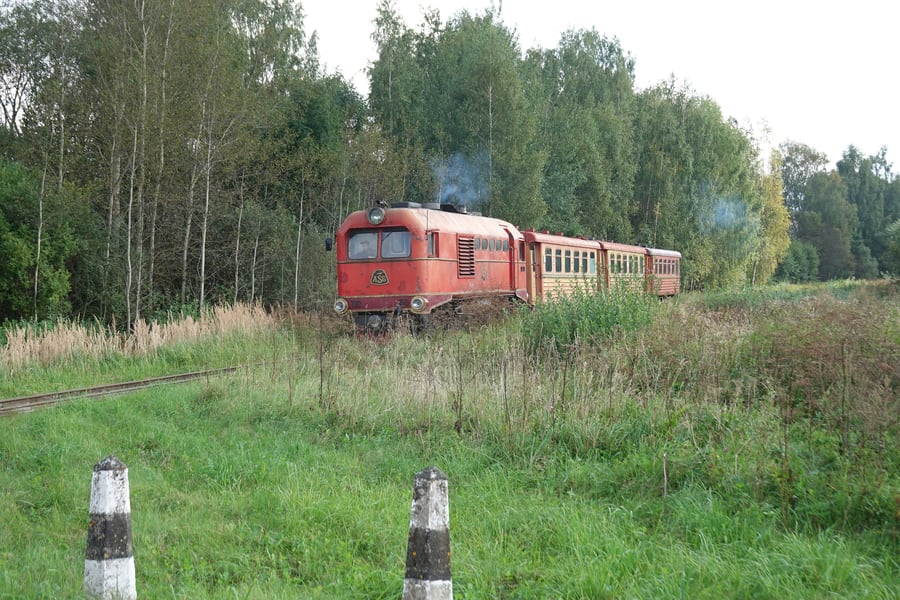
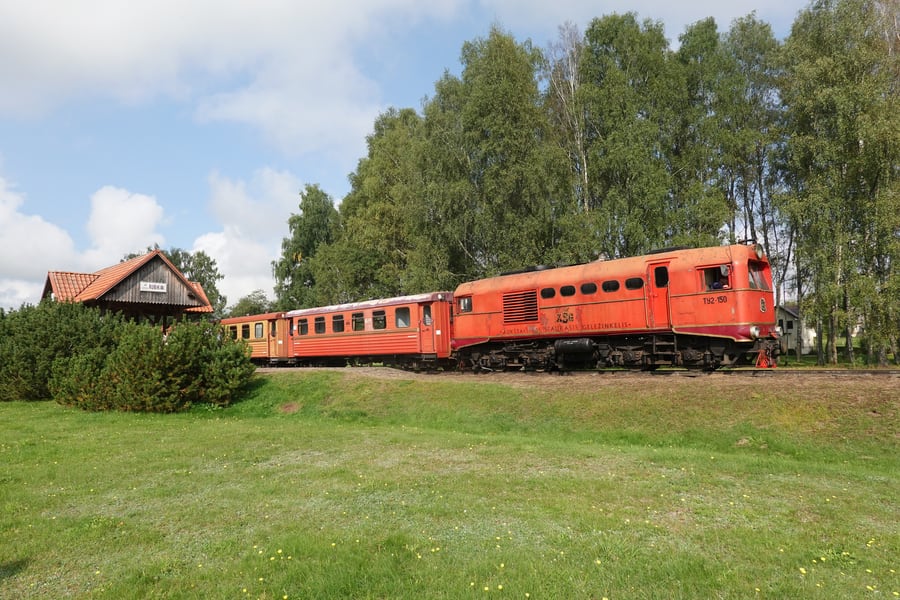
The part a visitor can turn up and ride is the eastern end. From early May to the end of October, on Saturdays and Sundays, one train leaves Anykščiai at eleven in the morning and runs the 12.3 kilometres to Rubikiai, over the iron bridge across the Šventoji and out through birch scrub and hayfields to a lake with seventeen islands in it. There are nearly two hours at the far end and the same train comes back in the afternoon. It is hauled by a TU2, a 750 mm diesel built in Kaluga in the 1950s, and behind it are open-sided carriages with no glass in the window frames. Everything west of Anykščiai — Troškūnai, Surdegis, the depot at Panevėžys — runs by charter, which is a different proposition and, on this line, a genuinely common one.
The Journey
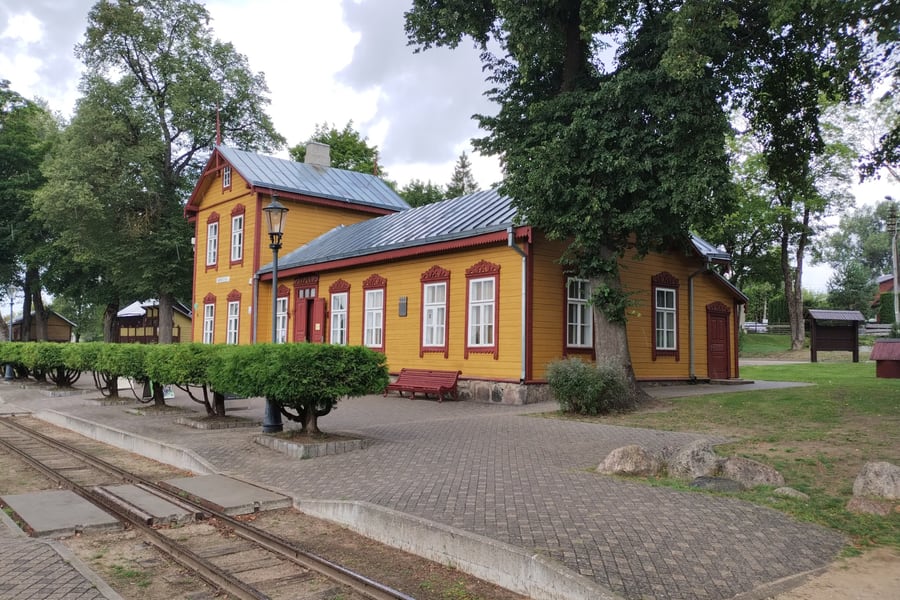
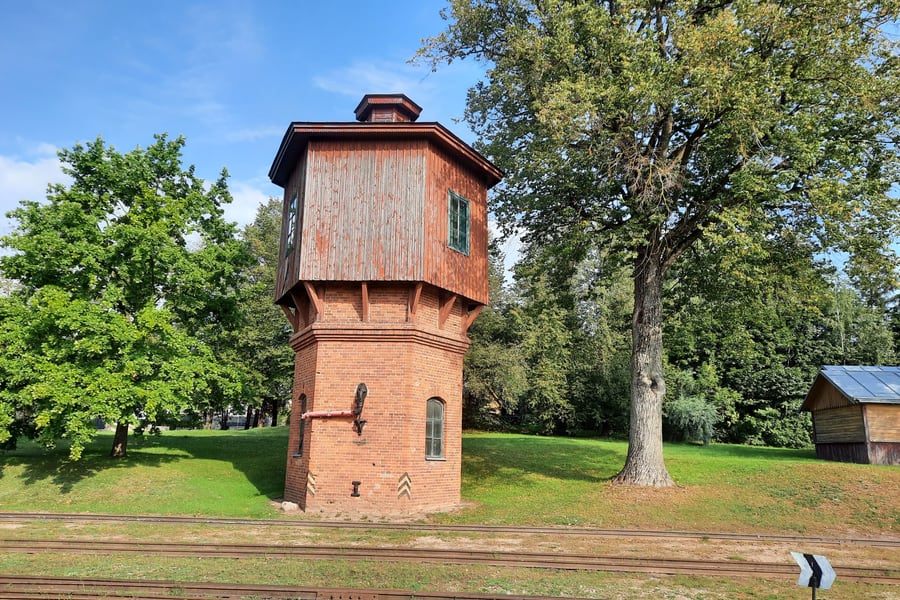
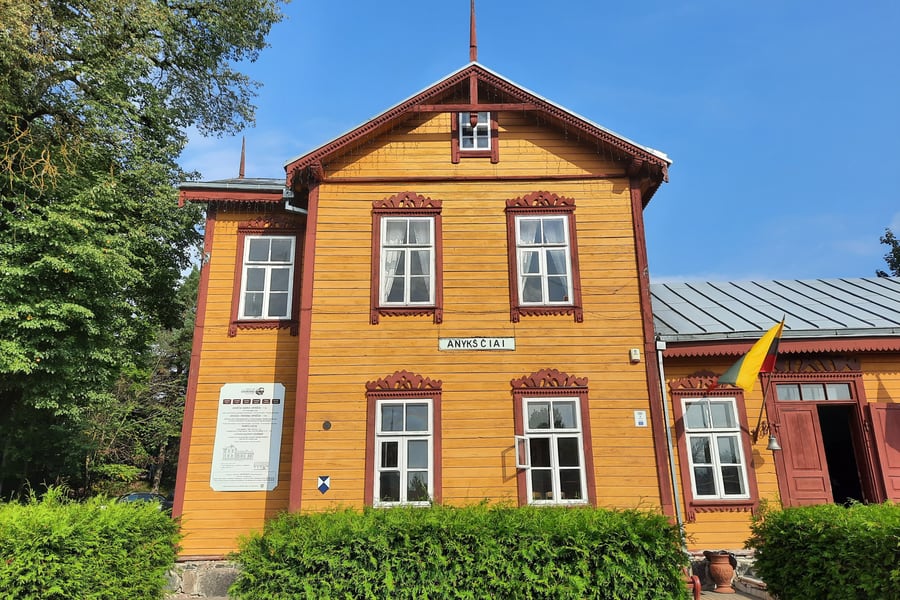
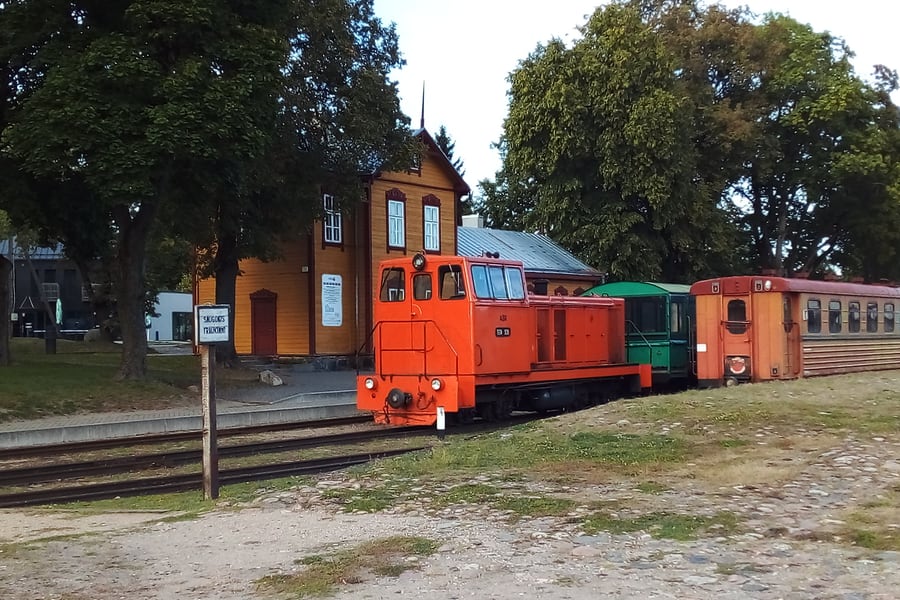
Anykščiai station stands on Vilties gatvė, a two-storey wooden building painted ochre with the town name across its gable, and it has been there since 1901. It is the operating centre of the line and also, in effect, its museum: the yard around it holds TU2s, the Škoda-built locomotive Kč4-107 that has become the station's landmark, goods wagons, a hand-worked platelayer's trolley and a brick water tower, and the whole ensemble is on the state's protected list rather than in a shed somewhere. The narrow gauge reached Panevėžys in 1898, the first trains ran in the autumn of 1899, and by 1903 the system was carrying 65,000 tonnes of freight and 40,632 passengers a year.
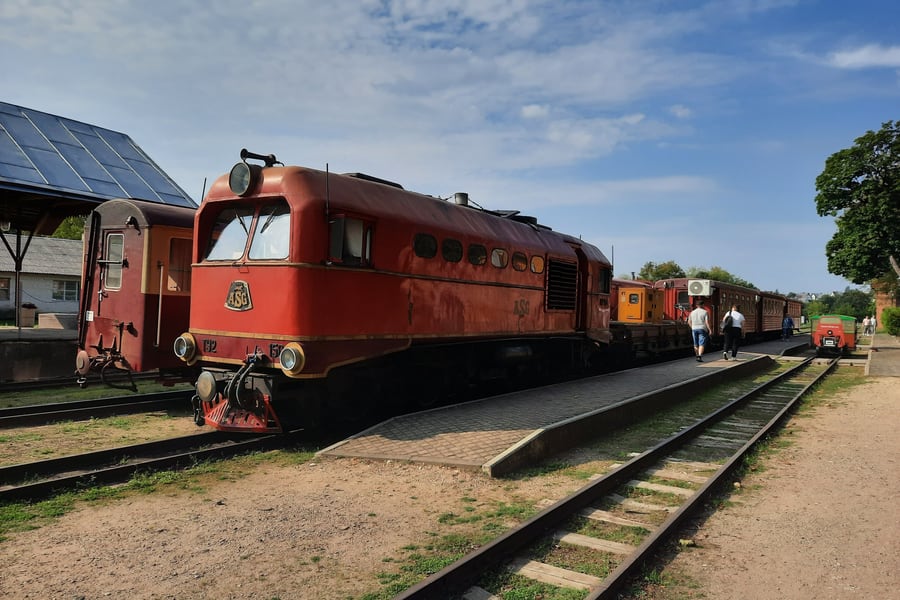
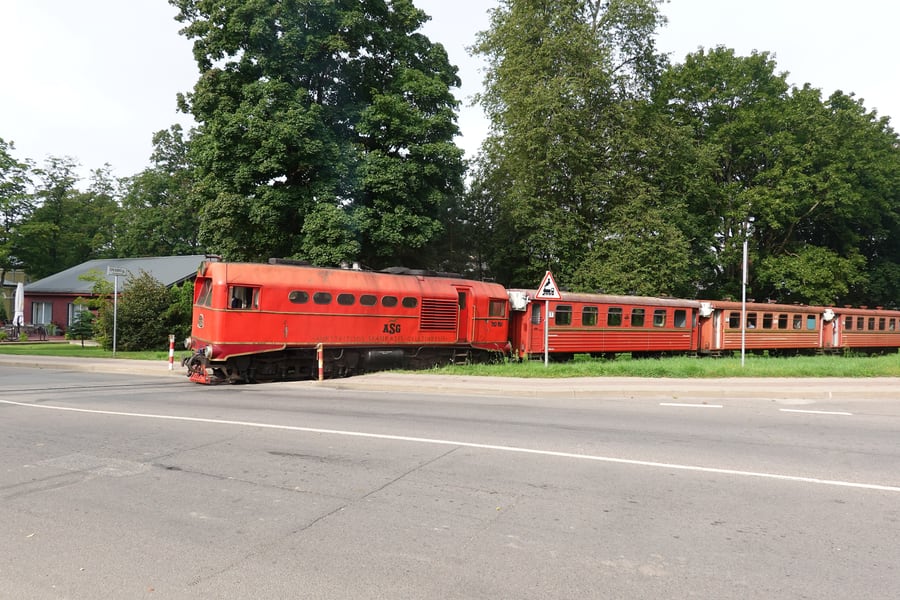
The train forms up on the platform road a little before eleven. Two or three carriages is the normal load — the enclosed ones with wooden seats, and in summer the open cars, which are steel frames with roofs and nothing in the window openings at all. The locomotive is a TU2, and it is worth knowing what it is: a 750 mm diesel-hydraulic built at the Kaluga works from 1955, the standard machine of the Soviet narrow gauge, and the operator still runs seven of them. Three more stand as monuments in Lithuanian towns whose narrow-gauge lines did not survive.
Over the Šventoji
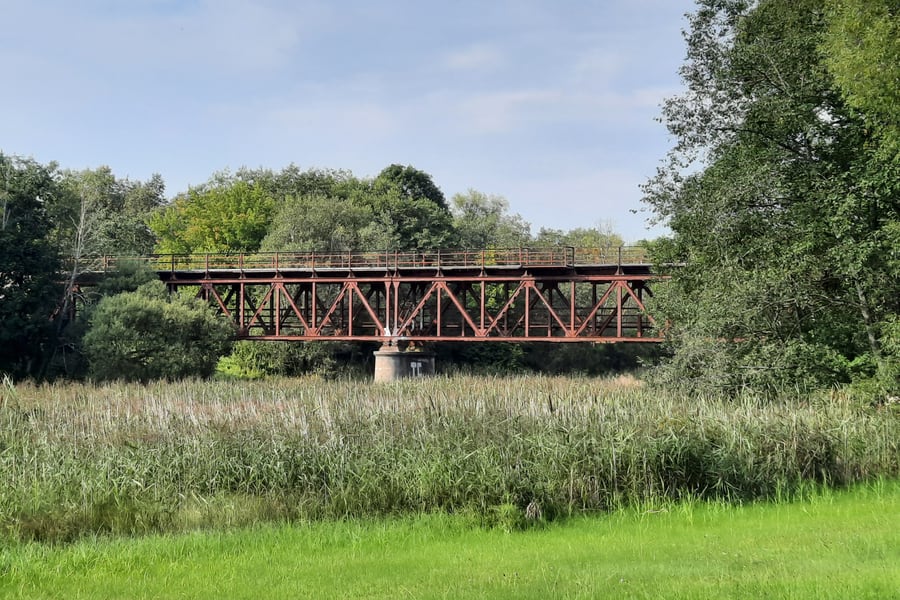
Out of the station the line curves left and immediately crosses the Šventoji on an iron truss bridge, which is the one moment of the journey that feels like a main-line railway in miniature — riveted lattice girders, a long drop to green water, and the river swinging away north through the pine forest of Anykščių šilelis. The bridge is on the protected list in its own right. From the open carriage the view is straight down.
Then the country opens. The line runs east across low farmland, through birch scrub and reed beds, past kilometre posts painted in black and white, and over a series of ungated road crossings where the train stops, a member of the crew gets down, and the road traffic waits. Žažumbris is 5.7 kilometres out and Bičionys 7.2, both of them halts rather than stations. Speed is about fifteen kilometres an hour. Fifty minutes covers the twelve kilometres, which tells you most of what you need to know about the ride.
Rubikiai
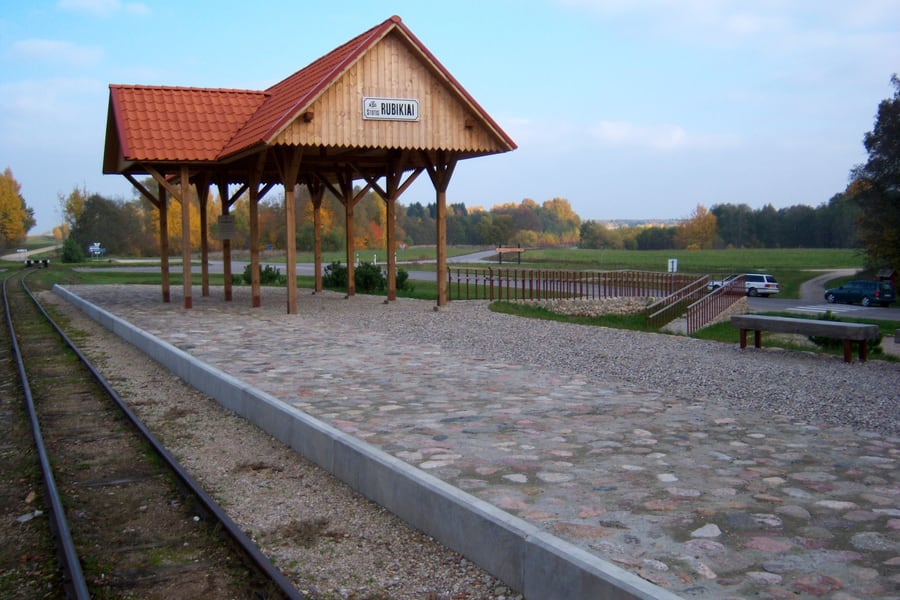
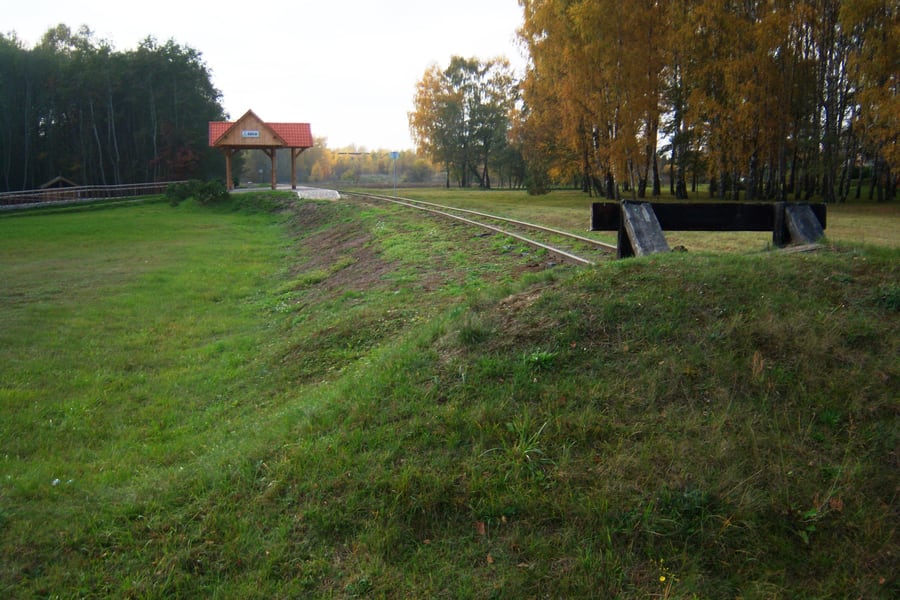
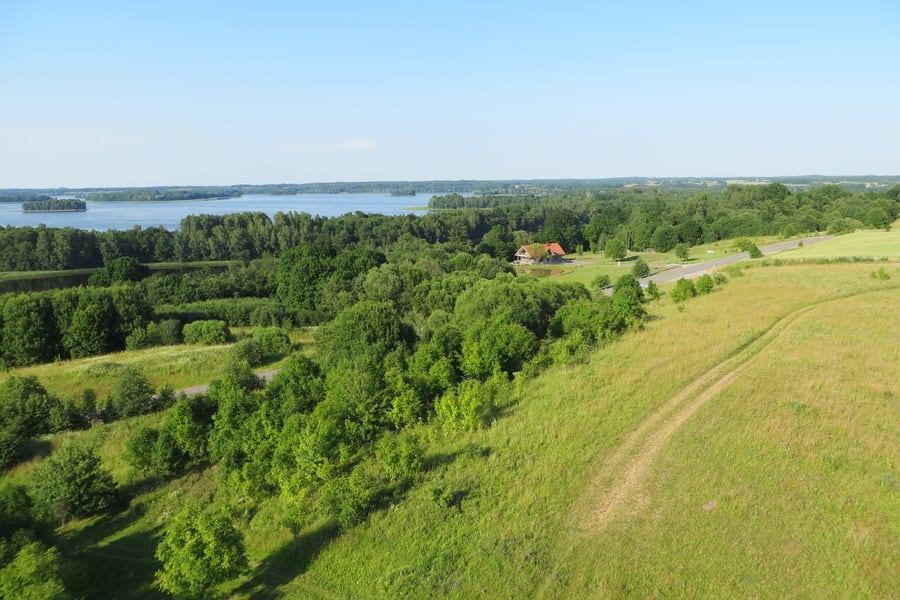
The terminus is a timber shelter with a tiled roof and the name RUBIKIAI on a board, built new on the old alignment, and the track ends a few metres beyond it at a pair of buffer stops in the grass. The lake begins on the other side of the road. Rubikių ežeras covers 9.77 square kilometres, is 16.1 metres deep at its eastern end, and holds seventeen wooded islands — the largest, Didžioji, is nearly fourteen hectares. Before the village lent it a name the lake was called Anykštis, and the Anykšta that drains it runs back to the Šventoji the train has just crossed.
The layover is about two hours. There is a white sand beach, boats and pedaloes for hire, and a fish soup shack at the water's edge. The train leaves again at ten to two and is back in Anykščiai by twenty to three.
The other end of the line
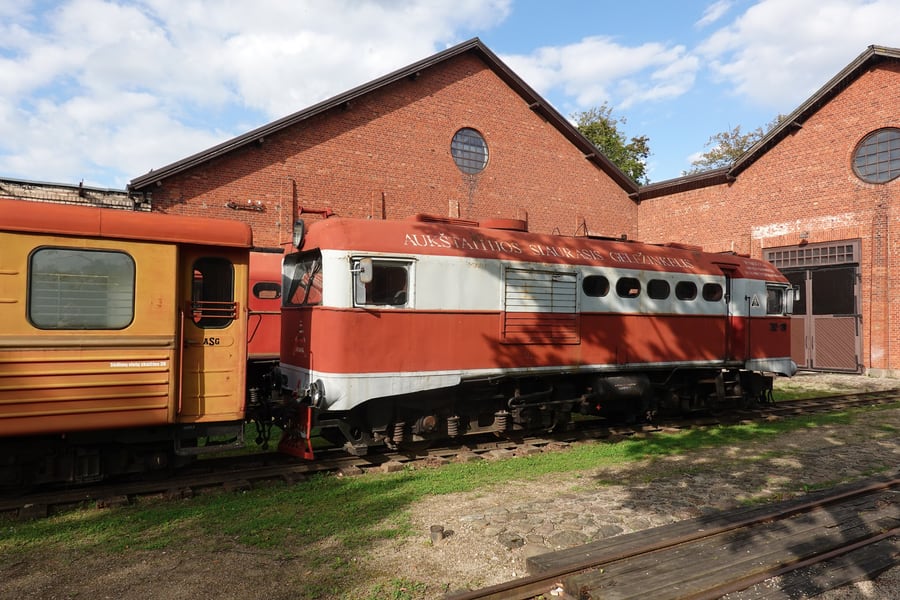
Beyond Anykščiai the railway keeps going for another 56 kilometres, and it is not derelict — it is simply not scheduled. Charter trains run Anykščiai–Troškūnai, Anykščiai–Surdegis, Panevėžys–Anykščiai and, at three hours each way, the full Panevėžys–Rubikiai. Panevėžys itself has the depot: brick roundhouse sheds, a rolling-stock collection, a map room, a smithy, and since 2023 the steam locomotive KP4-708, built by Fablok in Poland in 1957, worked at the Panevėžys sugar factory until 1970, and now restored. Fewer than twenty of the 885 built survive anywhere. It does not haul trains; it is there to be looked at, on a short experience trip from the narrow-gauge station to the depot that runs on Thursday afternoons.
Along the route
 user:CD / Wikimedia Commons · CC BY-SA 4.0 · 2025 · cropped
Protected as architecture
Lithuania listed the narrow gauge as cultural heritage in 1996, and what a 2003 resolution protected was not the trains: the line itself, the depot and viaduct, five stations, two water towers and a bridge. Most preserved railways are machines that happen to have buildings. This one was saved the other way round.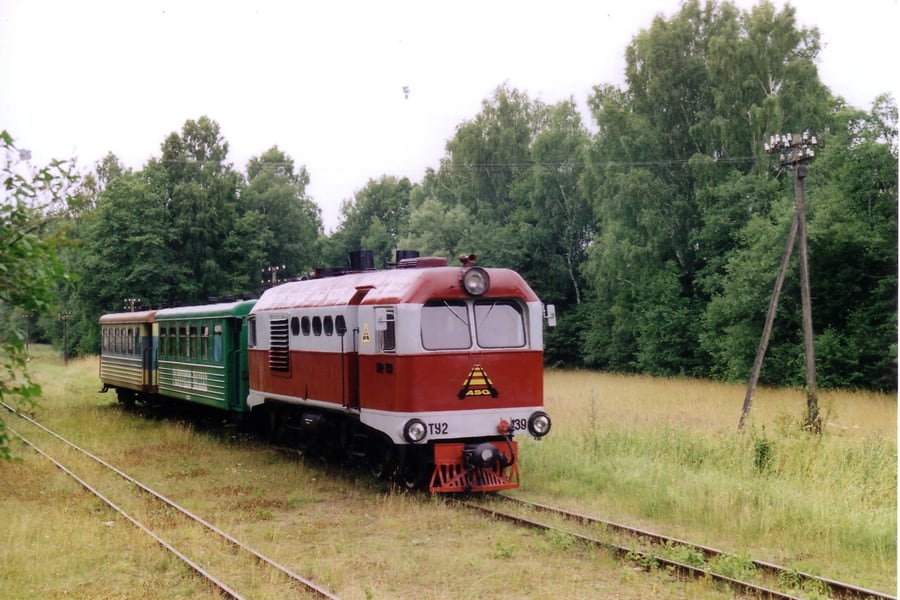 Peter van den Bossche / Wikimedia Commons · CC BY-SA 2.0 · 2005 · cropped
The Kaluga machines
Everything here is worked by a TU2, the 750 mm diesel the Soviet narrow gauge ran on from the Baltic to the Pacific. Seven are in traffic. Three more stand as monuments in towns whose own narrow-gauge railways did not survive — the sharpest thing anyone could say about how close this one came.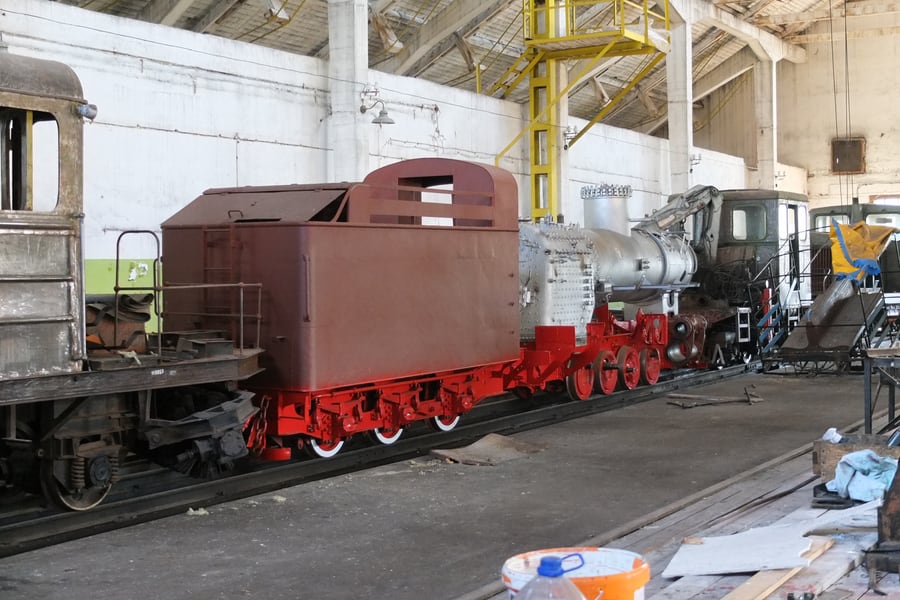 Nordwaldedampflok / Wikimedia Commons · CC BY 4.0 · 2022 · cropped
The steam locomotive that does not run
KP4-708 was built in Poland in 1957, worked a sugar factory until 1970, then stood outside for decades until the city handed the parts back in 2023 and it was rebuilt. It hauls nothing. It is the reason the Thursday trip to the depot exists.A bit of history
Culture & experiences along the way
 VietovesLt / Wikimedia Commons · CC BY 3.0 · 2015 · cropped
Two hours at the lake
The timetable is built around the stop rather than the ride. The train reaches Rubikiai at ten to twelve and does not leave again until ten to two, which is long enough for the thing most passengers came for: Rubikių ežeras, 9.77 square kilometres of water with seventeen wooded islands in it, a white sand beach, boats, rafts and pedaloes for hire, and a fish soup shack at the water's edge. The lake is a hydrographic reserve and 16.1 metres deep at its eastern end.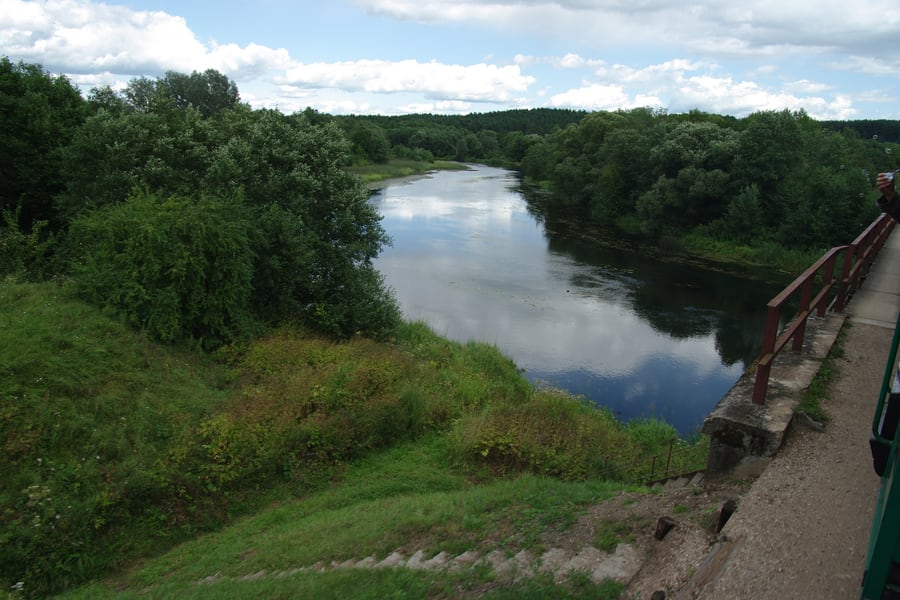 Darius Smalskys / Wikimedia Commons · CC BY-SA 3.0 · 2009 · cropped
Twenty minutes over the river
Midweek, when the Rubikiai train is not running, the operator still sends an open carriage out of Anykščiai station and over the Šventoji bridge and back — twenty minutes, €6, at 11:00 and 14:00 from Wednesday to Friday and three times on weekend afternoons. It exists to let people ride the siaurukas at all rather than to go anywhere, and the view from the bridge over the river and into the pine forest is the whole of it.Timetables
The scheduled service is one return working a day, on Saturdays and Sundays only, from the beginning of May to the end of October. Times below are the operator's own, read from siaurukas.eu in August 2026.
| Anykščiai | Rubikiai | |
|---|---|---|
| Outward | dep 11:00 | arr 11:50 |
| Return | arr 14:40 | dep 13:50 |
That leaves two hours at the lake between arrival and departure. Outside those months and on weekdays there is no timetabled train over this section at all.
Short trips from Anykščiai
Separate from the Rubikiai working, the operator runs a twenty-minute out-and-back from Anykščiai station over the Šventoji bridge in an open carriage, and a longer run to the Anykščiai Arts Incubator.
| Trip | Days | Departures |
|---|---|---|
| Anykščiai – Arts Incubator – Anykščiai (20 min) | Wednesday to Friday | 11:00, 14:00 |
| Anykščiai – Arts Incubator – Anykščiai (20 min) | Saturday and Sunday | 15:30, 16:00, 16:30 |
| Anykščiai – Arts Incubator, with time to look round | Wednesday to Friday | 12:30 out, 14:15 back |
Short trips at Panevėžys
At the western end of the line a short experience trip runs from the Panevėžys narrow-gauge station to the depot and its locomotive shed, on Thursdays at 14:00.
Everything else is charter
The rest of the 68.4 km is worked on demand rather than to a timetable — Anykščiai–Troškūnai, Anykščiai–Surdegis, Panevėžys–Surdegis, Panevėžys–Anykščiai and the full Panevėžys–Rubikiai, which takes about three hours each way. Those are booked by the trainload rather than by the seat; the fares are in the tickets section below.
Dated departures and the current season are published by the operator at siaurukas.eu (opens in a new tab), which also sells the tickets. The Anykščiai office is on +370 663 65377, the Panevėžys office on +370 610 36085.
Tickets
A seat on the Anykščiai–Rubikiai train is €15 return, and that is the whole fare structure for it. The operator sells a dated ticket for each departure through its own shop at siaurukas.eu (opens in a new tab), and the Anykščiai office takes bookings by telephone or email. The short trips are cheaper and separate: €6 for the twenty-minute run out of Anykščiai, €5 for the Panevėžys station-to-depot trip.
Because most of the line has no timetable, the operator's price list is written for whole trains rather than seats — a first-class carriage seats 36, a second-class 40, and up to ten can be coupled. Split between a carriage-load, the Anykščiai–Rubikiai charter works out close to the price of an ordinary weekend seat, which is why it is the common way for groups to ride the line midweek. Rates valid from 1 May 2026.
Book your tickets
Anykščiai to Rubikiai and back
€15 return, weekends from May to October
One train a day each way, out at 11:00 and back at 13:50, with two hours at the lake between.
Book Tickets (opens in a new tab, on siaurukas.eu)via siaurukas.euThe short trips
€6 from Anykščiai · €5 at Panevėžys
Twenty minutes out of Anykščiai station, or the run from Panevėžys station to the depot.
Book Tickets (opens in a new tab, on siaurukas.eu)via siaurukas.euCharter a train
From €355 for one second-class carriage
How most of the network is ridden, since only the Rubikiai leg has a timetable.
Book Tickets (opens in a new tab, on siaurukas.eu)via siaurukas.euRail Passes
A rail pass does not cover this train, and it is worth being plain about why. Interrail publishes a per-country table of participating railway companies, and the Lithuania row — read on 28 August 2026, the date the table itself carries — lists two operators: LTG Link, for ordinary trains, and PKP Intercity. The excluded column is empty, but that is not the point: the list of who is included is closed, and VšĮ Aukštaitijos siaurasis geležinkelis is not on it. The narrow gauge is a separate public institution with its own ticket shop, and its €15 fare is bought from the operator whatever else is in your wallet.
That leaves the question of whether a pass earns its keep getting to the line at all, and for most itineraries the answer is no. Interrail does sell a Lithuania One Country Pass, but LTG Link fares are low, the country is small, and Anykščiai is not on the main-line network in any case — the nearest LTG Link railhead is Panevėžys, at the far end of the narrow gauge, and the last stage to Anykščiai is by road. A pass makes more sense as part of a longer Baltic run, where the same ticket carries you north on the coordinated Vilnius–Riga–Tallinn chain, than as a way of reaching this particular railway.
Pass conditions were checked against interrail.com in August 2026 and change from year to year.
Places to Visit
Anykščiai is a resort town of pine forest, a river and a lake, and everything below is within a few kilometres of the narrow-gauge station — except the last, which is at the other end of the line and needs its own trip.
 Yuri937 / Wikimedia Commons · CC0 · 2024
Anykščiai station and its railway collection
The station is the sight as much as the departure point. A two-storey wooden building of 1901 in ochre and red, with the town name across the gable, standing in a yard that holds TU2 diesels, the Škoda-built Kč4-107 that has become the station's landmark, goods stock, a hand-worked platelayer's trolley and a brick water tower — all of it protected, none of it behind glass. Inside hangs a surviving fares and destinations board, headed LENTELĖ–ТАБЛИЦА in Lithuanian and Russian.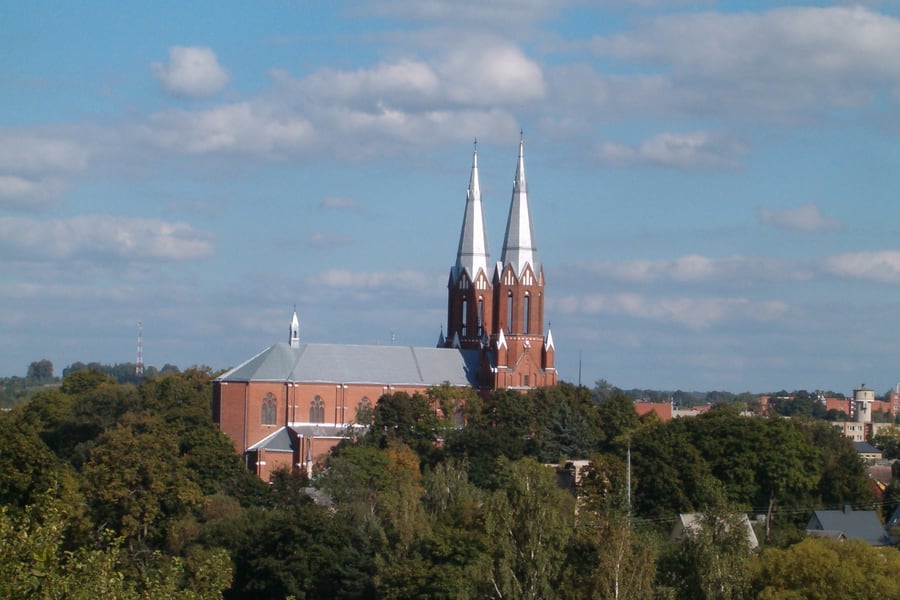 VietovesLt / Wikimedia Commons · CC BY 3.0 · 2003 · cropped
The Church of St Matthew
Anykščiai's twin brick spires reach 79 metres, which makes this the tallest church in Lithuania — and they were 84 metres until the First World War. Nikolai Andreyev's neo-Gothic design was approved in 1898 and the building went up between 1899 and 1909, which makes it almost exactly contemporary with the railway; it was finally consecrated on 8 December 1914. It stands in the centre of the town on the left bank of the Šventoji and is cultural heritage object No 32802.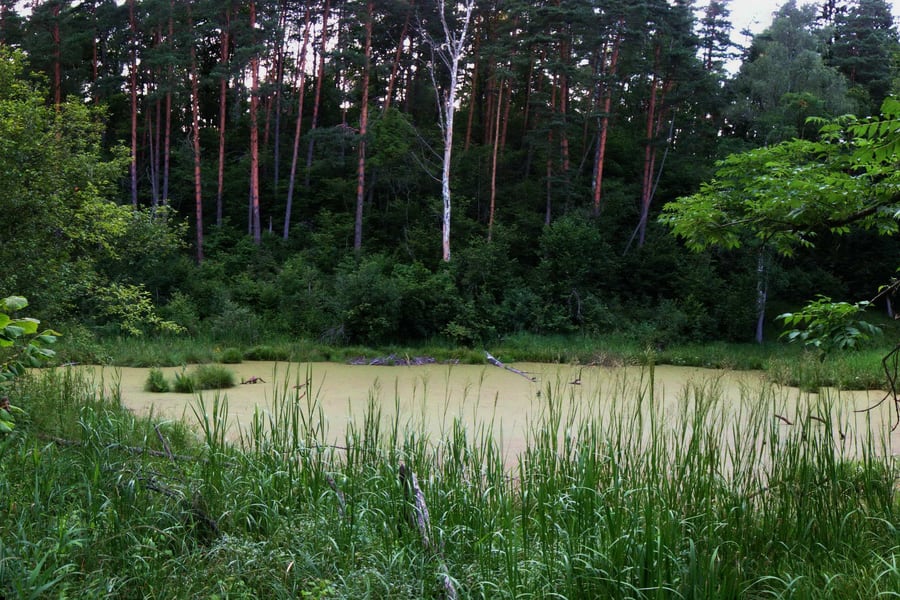 Vilensija / Wikimedia Commons · Public domain · 2011 · cropped
Anykščių šilelis and Puntukas
The pine forest south of Anykščiai is the one Antanas Baranauskas made famous in a poem published in 1861. Paths lead from the town to the Karalienės liūnas, the Queen's Mire, a still pool ringed by pines, and on to Puntukas, the second-largest boulder in Lithuania and a protected natural monument, on the left bank of the Šventoji about five kilometres out. Laid out beside it is the Treetop Walking Path, a raised walkway through the canopy.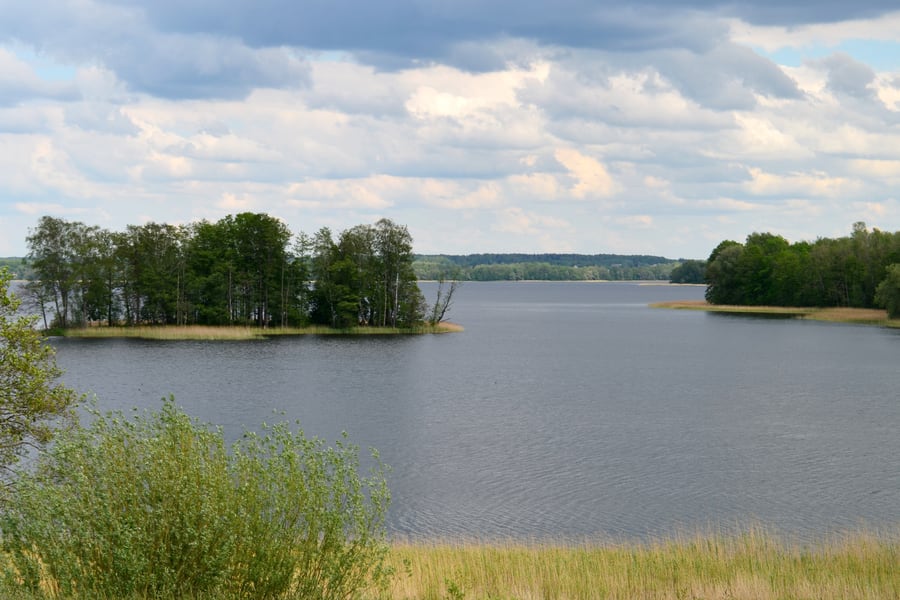 Hugo.arg / Wikimedia Commons · Public domain · 2020 · cropped
Rubikiai Lake
Seventeen islands, 25.35 kilometres of very crooked shoreline, a maximum depth of 16.1 metres and long narrow inlets down the southern and western sides. The largest island, Didžioji, runs to nearly fourteen hectares; Pertako, at a hectare and a half, carries a hillfort. Two more hillforts stand on the shores. The lake was called Anykštis before the village lent it a new name, and the river that drains it northward, the Anykšta, is a tributary of the Šventoji the train crossed on the way out.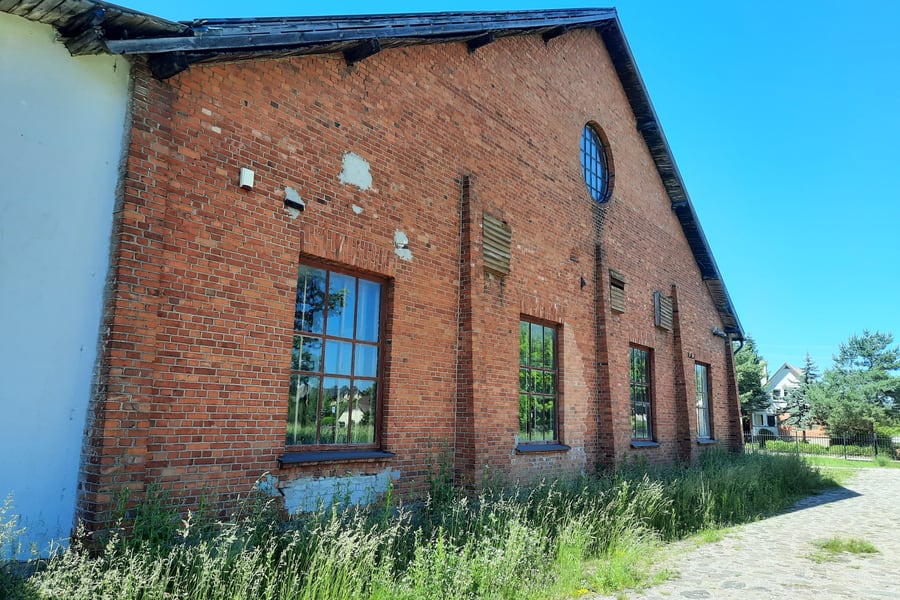 user:CD / Wikimedia Commons · CC BY-SA 4.0 · 2026 · cropped
The Panevėžys depot
Panevėžys got the railway first, in 1898, and it kept the works. The depot is a group of brick sheds on Geležinkelio gatvė holding the rolling-stock collection, a map room, a smithy and the restored steam locomotive KP4-708, and the buildings are on the protected list with the line. A short experience trip runs from the narrow-gauge station to the depot on Thursday afternoons for €5; otherwise it is reached by charter. Panevėžys is also on the LTG Link network, which Anykščiai is not.Where to Sleep
Anykščiai has a resort status in Lithuania and a matching supply of spa hotels; Rubikiai has lakeside cottages and campsites and nothing that resembles a hotel. The three below were opened and read on their own websites in August 2026. No prices, grades or star counts are given here, because none have been verified — each description says only what the house says about itself.
Where to stay
Nykščio namai & SPA
Anykščiai, at the edge of the pine forest
A hotel its own site places in the shelter of the Anykščiai šilelis, aimed squarely at families and weekends away. There is a spa, a renovated outdoor pool open in the warm season with a shallower zone for children and an ice-cream cart beside it, a conference centre and a restaurant serving breakfast, lunch and dinner. Rooms run from standard doubles to two-bedroom apartments. The site warns that the spa closes on occasional maintenance days.
Check Availability (opens in a new tab, on nykscionamai.lt)via nykscionamai.ltVILNIUS SPA Anykščiai
Anykščiai, in the woods outside the town
The Anykščiai house of a Lithuanian spa group that also has hotels in Vilnius and Druskininkai, and the one it describes as its hideaway. What it sells is treatment rather than sightseeing: spa day packages, health packages and wellness packages, alongside ordinary rooms and a restaurant called Miške — 'in the forest'. Bookings and the current offers are on its own site.
Check Availability (opens in a new tab, on spavilnius.lt)via spavilnius.ltHotel Romantic
Panevėžys, at the far end of the line
A boutique hotel in Panevėžys, which is where the narrow gauge starts and where the depot and the steam locomotive are. It opened in 2002 and was renovated in 2011, and its own site makes a point of the authentic brickwork and beams kept through that work. Single, double, triple and luxury rooms, a restaurant, a conference facility and a spa it calls ETNO. Panevėžys is on the LTG Link network, which Anykščiai is not.
Check Availability (opens in a new tab, on romantic.lt)via romantic.ltQuestions or corrections
Planning this trip and stuck on something, or spotted a time, fare or detail that has changed? Send us a message about The Aukštaitija Narrow Gauge — Anykščiai to Rubikiai. We read every one, and we update this page when something has changed.