The Bäderbahn Molli to the Baltic
GFreihalter / Wikimedia Commons · CC BY-SA 4.0
- Distance15.43 km on 900 mm gauge, Bad Doberan to Kühlungsborn West
- DurationAbout 40 minutes, eleven trains a day each way in summer
- Best seasonYear-round — it runs 365 days a year, with the summer timetable from 28 March to 31 October 2026
Introduction
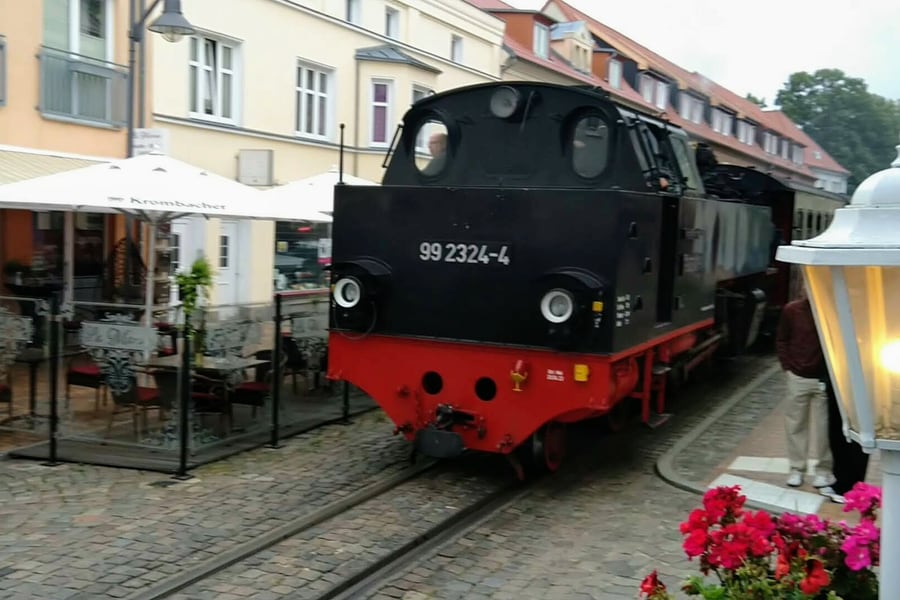
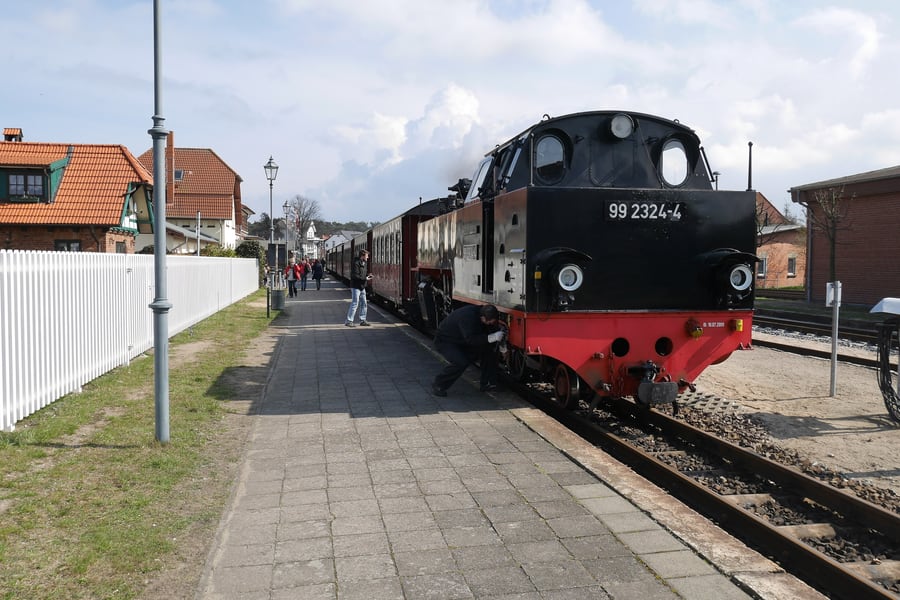
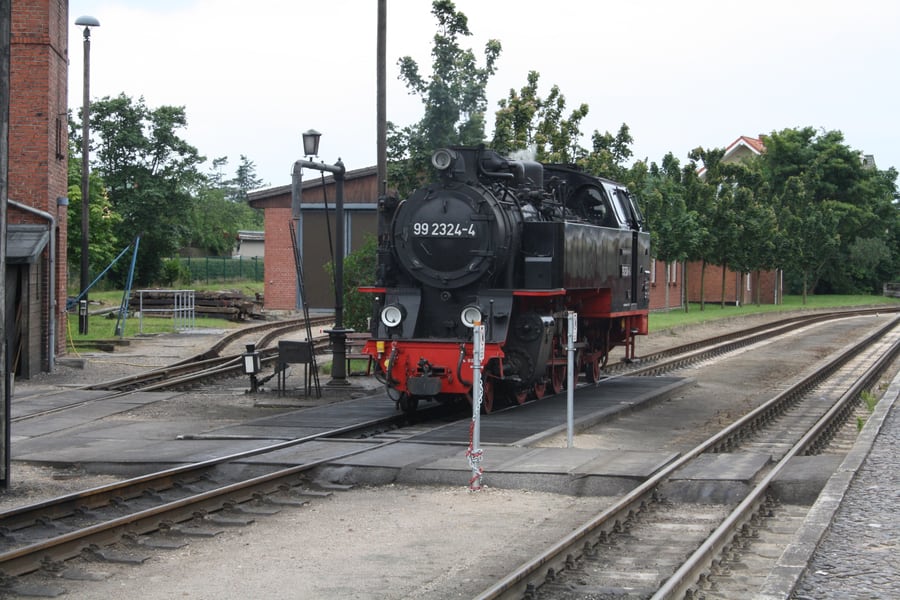
In 2008 the Dampflokwerk Meiningen built a new steam locomotive. Not a replica for a museum, not a restoration, and not a commemorative one-off: a working engine, 99 2324, delivered to this railway and put into traffic in 2009 because the existing three could not cover the summer timetable. It was the first steam locomotive built in Germany for scheduled service in nearly fifty years.
That is the fact that tells you what the Bäderbahn Molli actually is, and it is not what the postcards suggest. This is not a preserved line run by volunteers at weekends. It is the local train. It carries the number RB 31, it has been inside the Verkehrsverbund Warnow fare network since 27 February 1997, and it runs every day of the year. When a railway like that runs short of locomotives, it does not launch an appeal. It orders one.
What it does
Fifteen and a half kilometres of 900-millimetre gauge, from Bad Doberan on the Rostock–Wismar main line to the Baltic at Kühlungsborn West, by way of Heiligendamm. Forty minutes end to end, at up to forty kilometres an hour, eight stops.
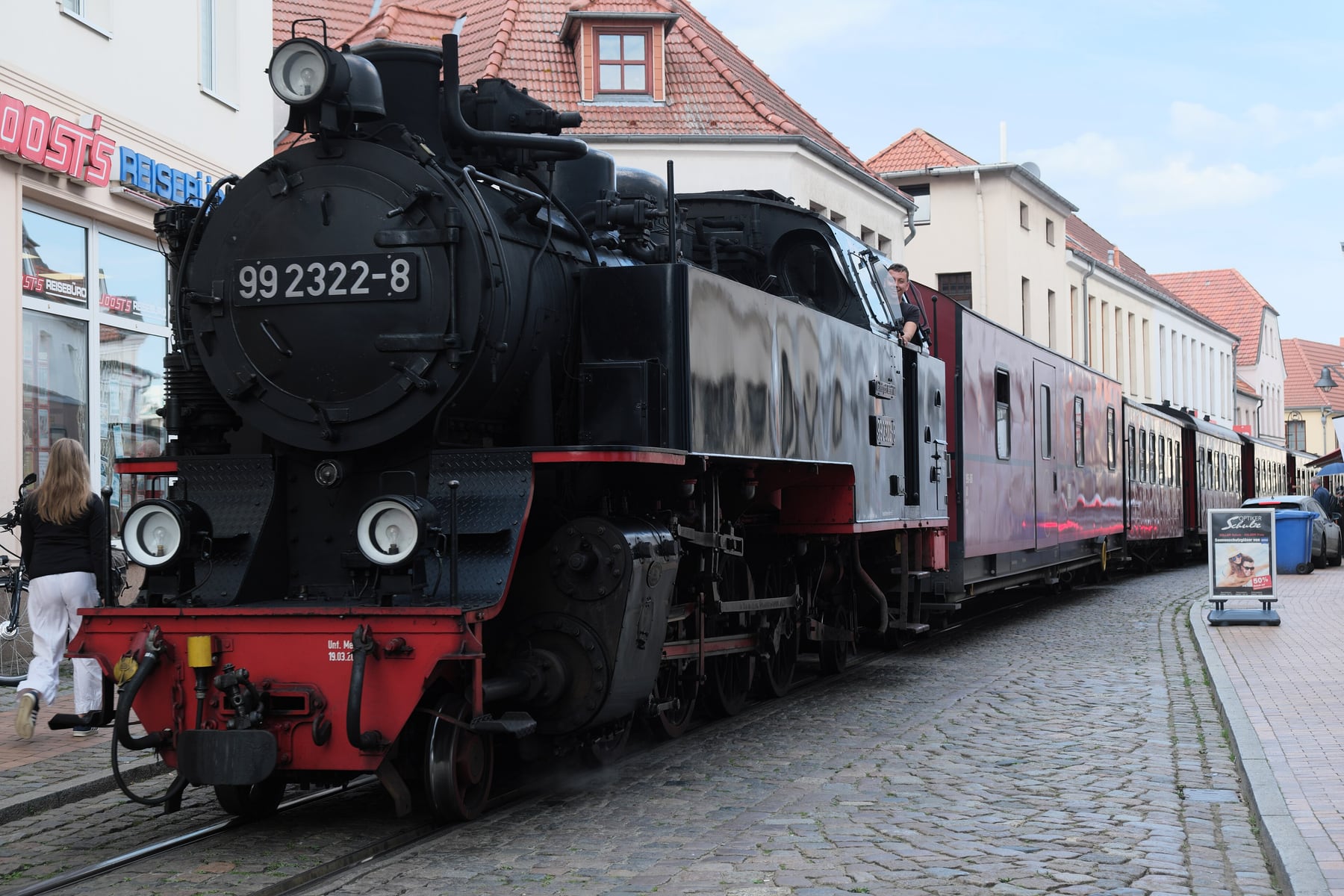
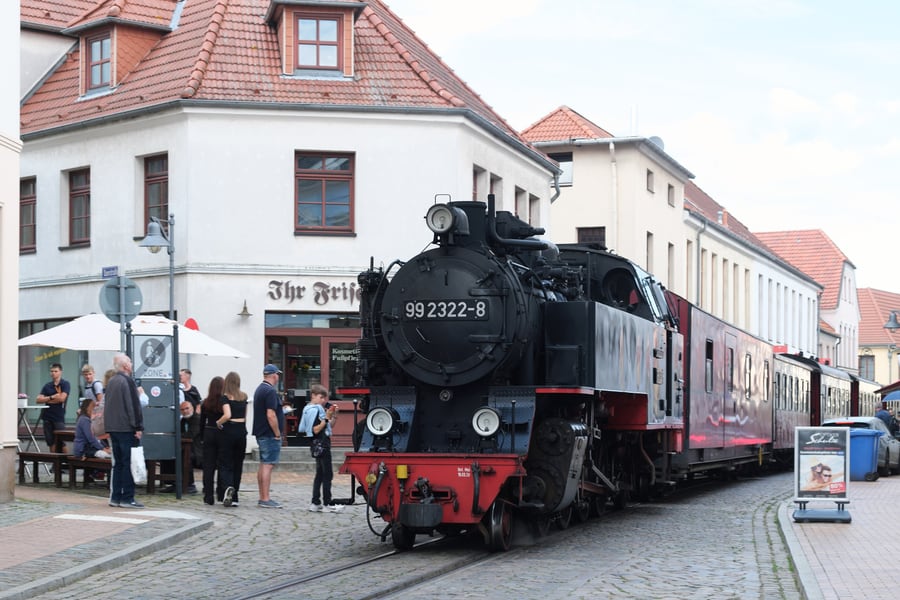
The first of those kilometres is the one everybody photographs. Leaving Bad Doberan the train runs down the middle of the Mollistraße on grooved rails set into the paving, between shopfronts and café tables, at walking pace, with pedestrians stepping aside — a full-size steam locomotive working as a tram through a market town. It is not a stunt laid on for visitors. It is how the trains have got out of Bad Doberan since 1886, and it is how they got out this morning.
Then the street ends, the line finds its own alignment along a tree-lined avenue, and it runs through farmland to the sea.
The evidence that it is a working railway
The timetable gives it away. On a weekday there are eleven trains each way, roughly hourly, and the first one leaves Kühlungsborn West at 06:40 — before any holidaymaker wants it, and it does not run on Sundays. That is a train for people going to work and to school.
At the other end the connection is real: the regional trains between Rostock and Wismar call at Bad Doberan at about half past each hour, and the Molli leaves five or six minutes later. Somebody timetabled that deliberately.
The ownership matches. The company is municipally owned — Landkreis Rostock holds 64 per cent, the town of Bad Doberan 19.7, Ostseebad Kühlungsborn 14.8, and a private shareholder the remaining 1.5. Three local authorities and a working steam railway that answers to them.
None of which stops it being one of the most enjoyable forty minutes in northern Germany. It simply means the enjoyment is a by-product of a railway that has a job.
The Journey
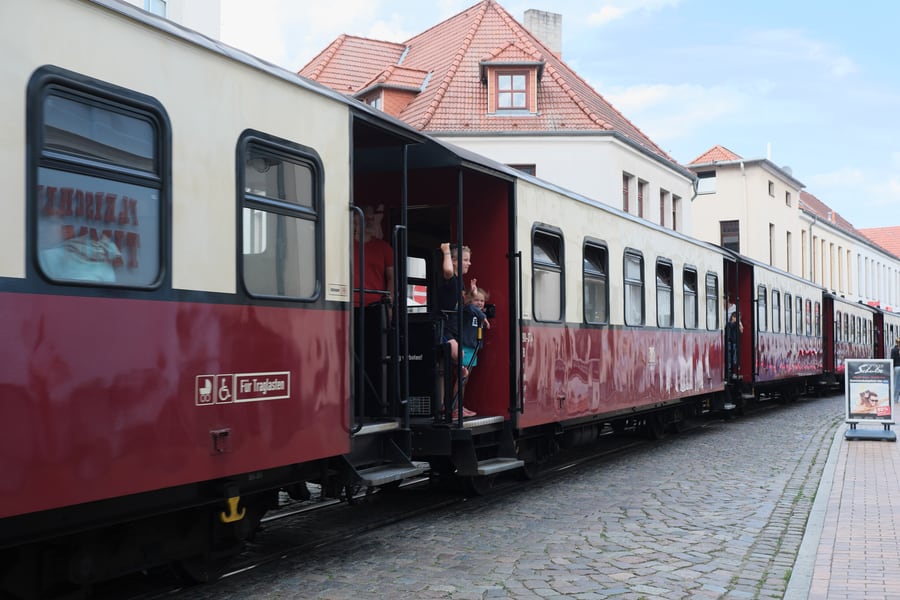
Bad Doberan's Molli platform sits beside the main-line station, and the train that waits there is substantial: a 1'D1' tank engine of forty-three tonnes at the head of a rake of dark red carriages. On 900-millimetre gauge that looks slightly wrong, in the way a large dog in a small car looks wrong, and it is part of the pleasure.
The departure is the famous part. The line leaves the station, turns into the Mollistraße and runs down the middle of it on grooved rail laid flush into the road surface. There are shops on both sides, tables out in front of them, and no fence, no barrier and no platform — just a locomotive easing through a shopping street at the speed of the people walking beside it. The town takes no notice whatever.
At Goethestraße the street running ends. The line picks up its own formation, runs out through an avenue of trees, and settles into farmland and open country for the middle of the journey.
Heiligendamm, and the sea
Heiligendamm is the halfway point and the reason the railway exists. It was founded on 22 July 1793 by Friedrich Franz I, Duke of Mecklenburg-Schwerin, and it is the oldest seaside resort in Germany and in continental Europe. The idea came from a question: the physicist Georg Christoph Lichtenberg asked in print that year why Germany still had no seaside resort, the duke's physician read it, and the duke acted on it.
Between 1793 and 1870 Johann Christoph Heinrich von Seydewitz, Carl Theodor Severin, Georg Adolph Demmler and others built the white classicist ensemble that gave the place its nickname, the white town by the sea. Severin's reception and assembly building of 1814–16 is the one that became its emblem — and the same architect built the Prinzenpalais in Bad Doberan in 1821, so the two ends of this railway were partly designed by one man.
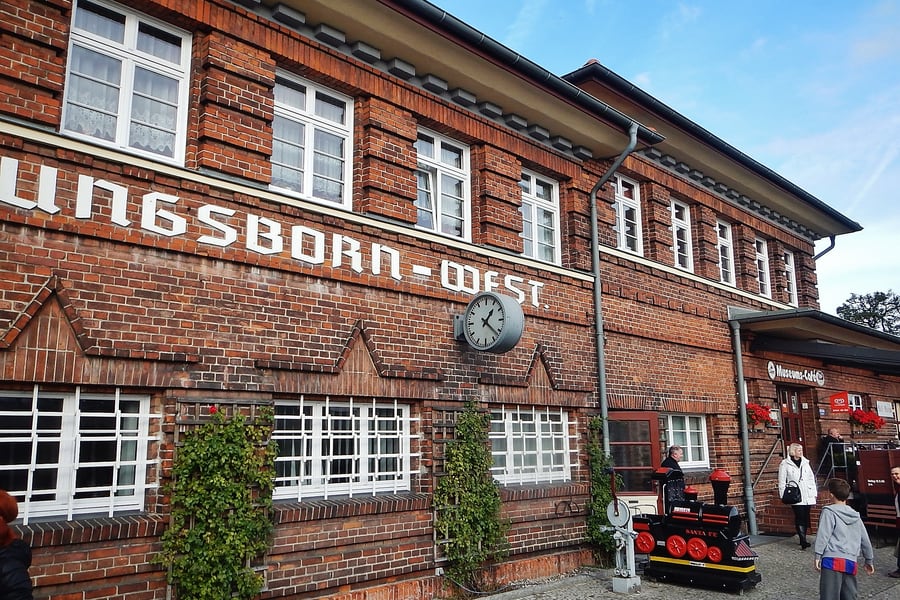
From Heiligendamm the line runs behind the coast, calls at Steilküste, and comes into Kühlungsborn through Ost and Mitte to the terminus at West, where the station is a solid brick building with the name in raised letters across the front and a small locomotive standing outside it.
The locomotives
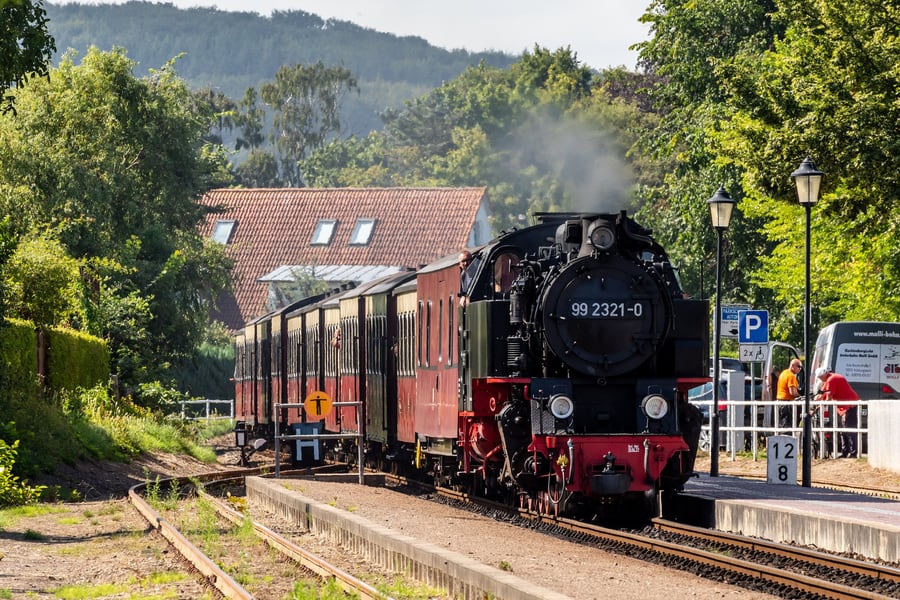
Three of the four steam engines were built in 1932 by Orenstein & Koppel for this railway and have worked it ever since: 99 2321-0, 99 2322-8 and 99 2323-6. They are 1'D1' h2t tanks, 43.68 tonnes in service, 460 indicated horsepower, and good for 50 kilometres an hour — more than the line allows. A fourth engine, 99 2331, came from the Wismut mining company in 1961.
99 2324-4 is the new one. Meiningen built it in 2008 to the 1932 design with the accumulated improvements of eighty years, and it entered service in 2009. The German Wikipedia puts the point plainly: with it, for the first time in almost fifty years, a steam locomotive was built in Germany for scheduled service. Four LKM diesels, 199 014-2 to 199 017-5, shunt and stand in.
Freight ran here too, from 1910, and ended on 31 May 1969 — transhipping between gauges cost more than it was worth. Passengers stayed.
What the line has survived
A concession from Grand Duke Friedrich Franz III on 19 June 1886; opening on 9 July 1886 over the first 6.61 kilometres, built by Lenz & Co; nationalisation by the Grand Duchy on 13 March 1890; the extension to Arendsee — now Kühlungsborn — on 12 May 1910, adding 8.82 kilometres and year-round operation; the Deutsche Reichsbahn from 1 April 1920; Deutsche Bahn AG from 1 January 1994; and a return to local public ownership on 1 October 1995, which is the arrangement that still holds.
⚠️ It has also had a bad accident recently. On 26 September 2021, at an unsecured crossing near Wittenbeck, a train struck a motorhome; the driver of the motorhome was killed and locomotive 99 2324 was badly damaged.
Along the route
Metrophil44 / Wikimedia Commons · CC BY-SA 3.0They had a new steam locomotive built
In 2008 the Dampflokwerk Meiningen built 99 2324 for this railway — not as a replica for a museum but because three engines could not cover the summer timetable. It was the first steam locomotive built in Germany for scheduled service in almost fifty years.GFreihalter / Wikimedia Commons · CC BY-SA 4.0Down the middle of the shopping street
The line leaves Bad Doberan along the Mollistraße on grooved rails laid flush into the road, with shops and café tables on both sides. A full-size steam locomotive works through at walking pace and the town takes no notice.Dietmar Rabich / Wikimedia Commons · CC BY-SA 4.0The 06:40 gives it away
The first train leaves Kühlungsborn West at 06:40, runs inland rather than towards the beach, and does not run on Sundays. No tourist operation puts a steam locomotive on the road before seven six days a week. This one does, because people need to get to work.A bit of history
Culture & experiences along the way
GFreihalter / Wikimedia Commons · CC BY-SA 4.0Standing in the Mollistraße as it comes through
The best view of this railway is not from inside it. Waiting on the pavement in Bad Doberan while a 43-tonne tank engine comes down the middle of the street towards you, whistle going, is the thing people remember, and it costs nothing. The trains leave Bad Doberan at around thirty-five minutes past the hour through the day.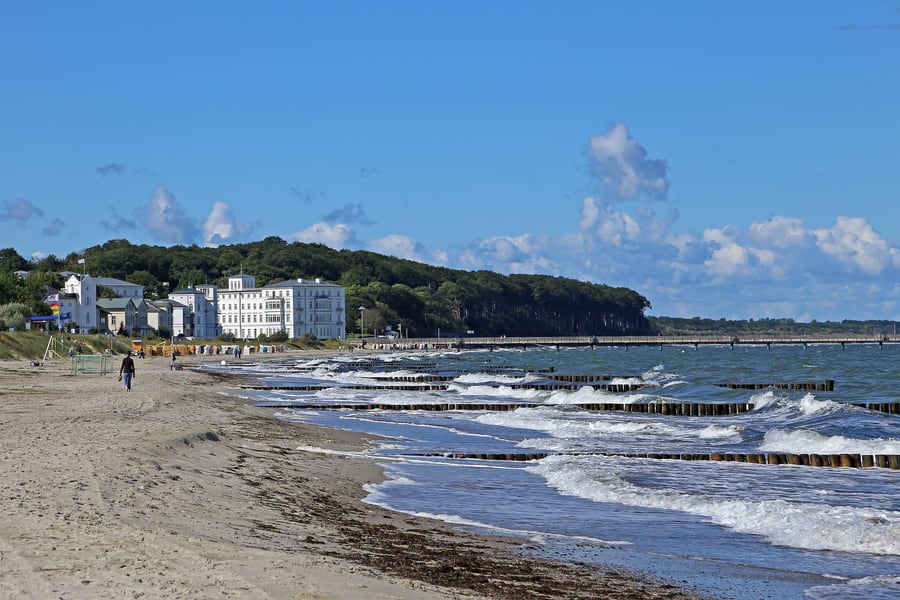 W. Bulach / Wikimedia Commons · CC BY-SA 4.0
Breaking the journey at Heiligendamm
A single or return is valid only on the day it is bought, but breaking the journey within that day is expressly allowed — and Heiligendamm sits at the halfway point. An afternoon on the beach below the white classicist terraces, and then a later train onward to Kühlungsborn or back inland, is what the ticket is designed for.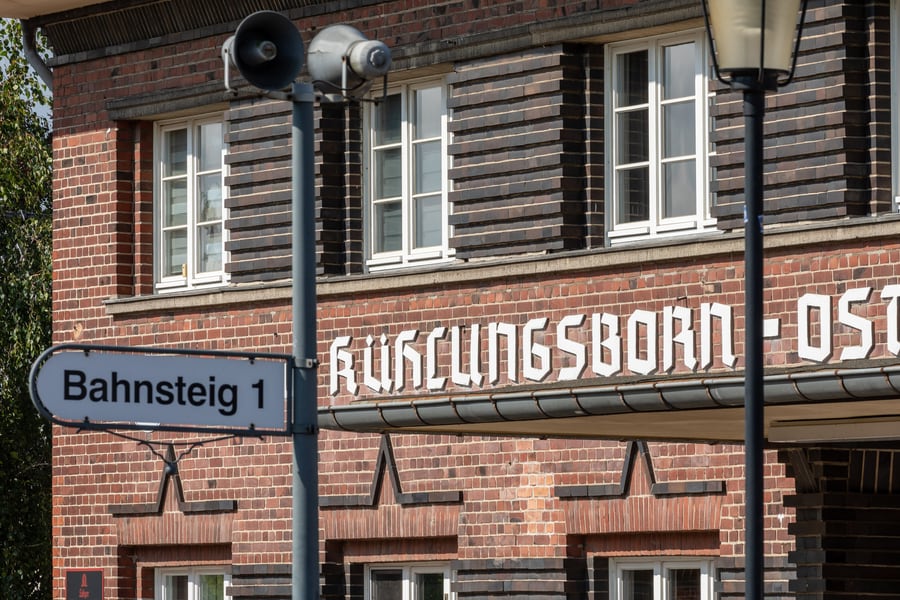 Dietmar Rabich / Wikimedia Commons · CC BY-SA 4.0
Arriving in winter
The line runs every day of the year, which almost no other steam railway in Germany does. The Baltic coast out of season is a different proposition — the resorts quiet, the beach empty, the steam far more visible in cold air — and the winter timetable is thinner rather than absent, so the operator's own sheet is the thing to check for exact times.Timetables
The Molli runs every day of the year, which almost no other steam railway in Germany does. There are two timetables: a summer timetable from 28 March to 31 October 2026, and a winter one either side of it.
Times below are as of August 2026, taken from live schedule data for named dates on the summer timetable and checked in both directions.
A weekday in the summer timetable
From Bad Doberan to Kühlungsborn West: 08:35, 09:36, 10:36, 11:35, 12:36, 13:36, 14:36, 15:35, 16:36, 17:45 and 18:45 — eleven trains, essentially hourly through the middle of the day.
From Kühlungsborn West to Bad Doberan: 06:40, 08:28, 09:35, 10:35, 11:35, 12:35, 13:35, 14:35, 15:35, 16:35 and 17:35.
The journey takes about forty minutes either way.
The 06:40 is the interesting one
It is the first train of the day, it runs from the seaside towards the town rather than the other way round, and it does not run on Sundays — a Sunday has ten departures from Kühlungsborn West instead of eleven, and the 06:40 is the one missing.
A tourist railway has no reason to put a steam locomotive on the road before seven in the morning, six days a week, in the direction away from the beach. A local railway does, because people need to get to work.
Connecting at Bad Doberan
The Molli platform is beside the main-line station, and the connection is timetabled rather than coincidental. Regional trains on the Rostock–Wismar line call at Bad Doberan at about :30 and :32 past each hour — for Wismar, for Rostock Hbf, for Tessin and for Graal-Müritz — and the Molli leaves at :35 or :36. Five or six minutes, on the same forecourt.
Winter
The winter timetable runs either side of the summer one — the current one covered 3 November 2025 to 27 March 2026 — and the railway keeps going through it. The operator publishes both as downloads, and the winter service is thinner than the summer one, so the exact times are worth taking from the operator's own sheet for the dates in question rather than assumed from the summer pattern above.
Timetables, the summer and winter PDFs and a journey planner are published by the operator at molli-bahn.de (opens in a new tab).
Tickets
The line has its own house tariff, in force since 1 February 2026 and priced by zones rather than by station. Bad Doberan to Kühlungsborn West is the full three zones: €13.00 single, €19.00 return, with children of 6 to 14 at €11.00 and €15.00 and under-sixes free. ⚠️ There is no reduction for seniors — the operator says so explicitly, which is worth knowing on a line whose passengers skew older.
A single or return is valid only on the day it was bought, but within that day breaking the journey is explicitly permitted, which on a line with Heiligendamm in the middle of it is the whole point. ⚠️ Buying on the train costs €2.00 extra if a ticket window was open, and on-train sales are cash only. A Deutschlandticket does not cover this railway, but it buys the €12.00 daily supplement.
Book your tickets
Return, three zones
€19.00 end to end · €13.00 over two zones
The whole line and back, with breaks of journey allowed on the day of purchase.
Book Tickets (opens in a new tab, on Mecklenburgische Bäderbahn Molli)via Mecklenburgische Bäderbahn MolliDeutschlandticket supplement
€12.00 a day · €36.00 a week
Cheaper than a return for anyone already carrying the pass, and it covers the whole line.
Book Tickets (opens in a new tab, on Mecklenburgische Bäderbahn Molli)via Mecklenburgische Bäderbahn MolliFamily ticket
€44.00 return, two adults and up to three children
Or one adult with up to four children; €31.00 return over two zones.
Book Tickets (opens in a new tab, on Mecklenburgische Bäderbahn Molli)via Mecklenburgische Bäderbahn MolliBicycles and dogs
€10.00 return for a bicycle · €6.00 single for a dog
Bicycles go in the luggage van and passengers load them, with the crew helping.
Book Tickets (opens in a new tab, on Mecklenburgische Bäderbahn Molli)via Mecklenburgische Bäderbahn MolliRail Passes
This is the rare German narrow-gauge line where the national pass has a defined, published place in the tariff — because the railway is inside a fare network rather than outside one.
The Deutschlandticket, plus a supplement
A Deutschlandticket does not by itself carry you on the Molli. What it does is entitle you to the Schmalspurbahn-Zuschlag — the narrow-gauge supplement — which is €12.00 for a day or €36.00 for a week, the same in both the two-zone and three-zone bands. The operator states that the supplement is valid only in combination with the Deutschland-Ticket.
Against a three-zone return at €19.00, a €12.00 day supplement is the cheaper way to ride for anyone who already holds the pass — and it covers the whole line for the day rather than one journey, so it absorbs the breaks of journey that Heiligendamm invites.
The identical figures appear on the Zittauer Schmalspurbahn in Saxony, where the same €12.00 daily and €36.00 weekly supplement applies. That is not a coincidence; it is what German narrow-gauge operators have settled on as the price of admitting a national flat-fare ticket onto a railway that costs a great deal more per kilometre than a bus.
Interrail and Eurail, which are a different matter
⚠️ A place in the Warnow tariff is not a place in the pass network, and the two are easy to confuse here. The Molli carries a regional line number and sits in a Verkehrsverbund, which is exactly the shape of a railway a pass usually covers — but Interrail's coverage table for Germany names DB and the regional carriers and then defers everything else to a closed roster of companies inside the national tariff, and Mecklenburgische Bäderbahn Molli is not on it.
So an Interrail or Eurail pass carries you to Bad Doberan on the ordinary regional train and stops there, with no pass-holder rate on the narrow gauge. The supplement described above is a Deutschlandticket arrangement and cannot be bought against a pass instead.
The Verkehrsverbund Warnow
The Molli has been part of the Warnow network since 27 February 1997 and carries the line number RB 31. In practice this matters most for the connection at Bad Doberan, where the regional trains to Rostock and Wismar use the same fare system, and for the buses at either end — on the buses the Warnow conditions apply rather than the railway's own.
Is a pass worth it here?
If you are already carrying a Deutschlandticket, the €12.00 supplement is straightforwardly the right buy and needs no arithmetic. If you are not, one is not worth buying for this railway: a three-zone return at €19.00, or €13.00 over two zones, is cheaper than a month of anything, and the house tariff already has a family ticket and a weekly ticket for the cases where volume matters.
Supplements and fares from the operator, Mecklenburgische Bäderbahn Molli, and pass coverage from Interrail's published list of railway companies, August 2026.
Places to Visit
Three places in fifteen kilometres, and they are unusually distinct from one another: an inland market town built round a brick cathedral, a white classicist bathing resort that invented the idea in Germany, and a long modern seaside town with a pier.
They run in the order the train reaches them, leaving Bad Doberan.
 Radomianin / Wikimedia Commons · CC BY-SA 4.0 · cropped
Doberaner Münster
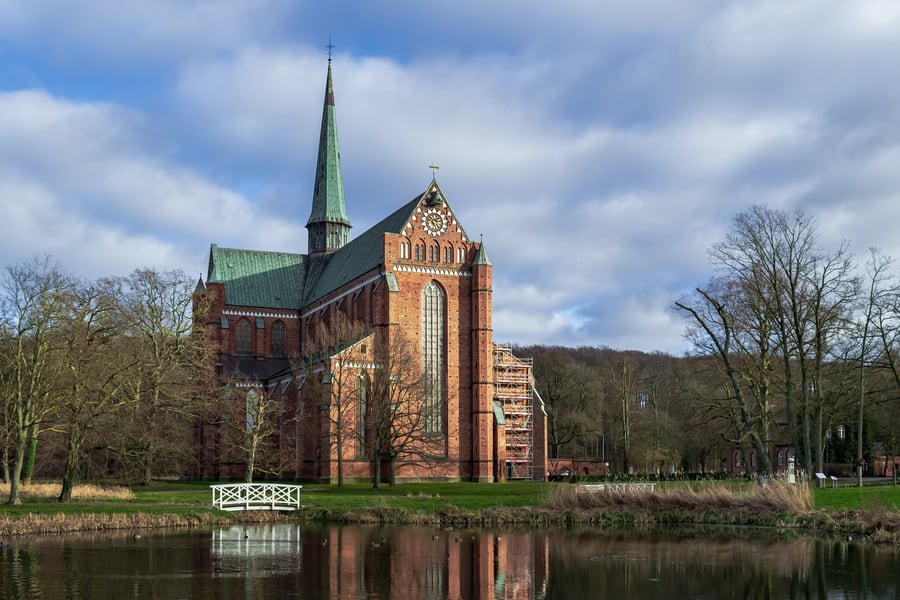
A Cistercian monastery was founded here in 1171, destroyed in 1179 and re-founded in 1186. The brick Gothic church that stands now was begun around 1280 and consecrated on 3 June 1368 — 76 metres long inside, the nave 26 metres high, with a roof rider instead of towers because the Cistercian rule forbade them. Around 85 per cent of its medieval furnishings survive, including a sacrament tower of about 1350–60 that is 11.60 metres tall and the oldest in Germany.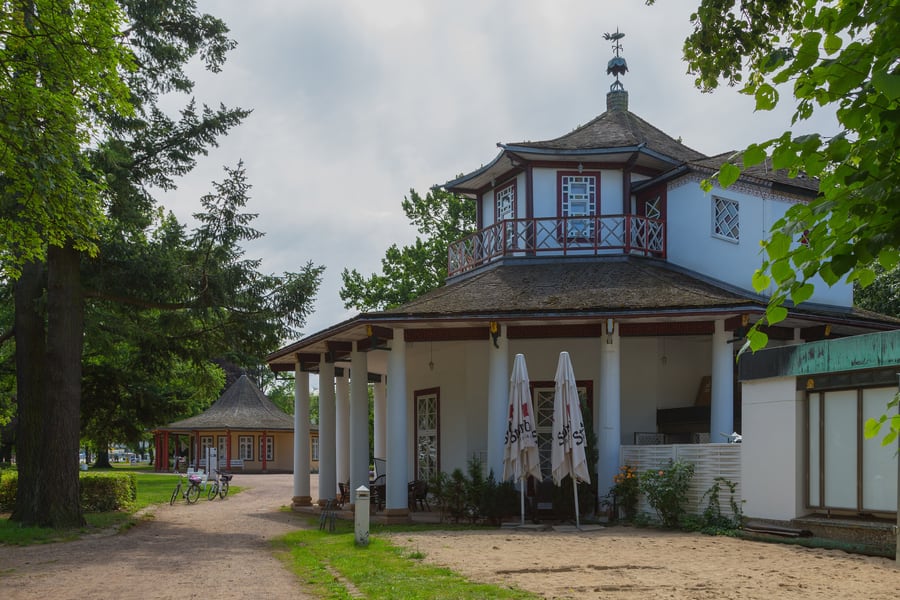 J.-H. Janßen / Wikimedia Commons · CC BY-SA 4.0 · cropped
The Kamp
The green at the centre of the town, laid out when Bad Doberan was the summer residence of the Mecklenburg dukes, with two ornamental pavilions in a Chinese manner standing in the trees. It is a short walk from where the train runs down the Mollistraße, and it is the reason the town looks like a spa rather than a market centre.W. Bulach / Wikimedia Commons · CC BY-SA 4.0 · croppedHeiligendamm
The oldest seaside resort in Germany and in continental Europe, founded on 22 July 1793 by Friedrich Franz I of Mecklenburg-Schwerin after the physicist Georg Christoph Lichtenberg asked in print why Germany had none. Carl Theodor Severin and others built the white classicist ensemble between 1793 and 1870. The G8 summit was held here from 6 to 8 June 2007, behind about 13 kilometres of fencing that ran out into the Baltic.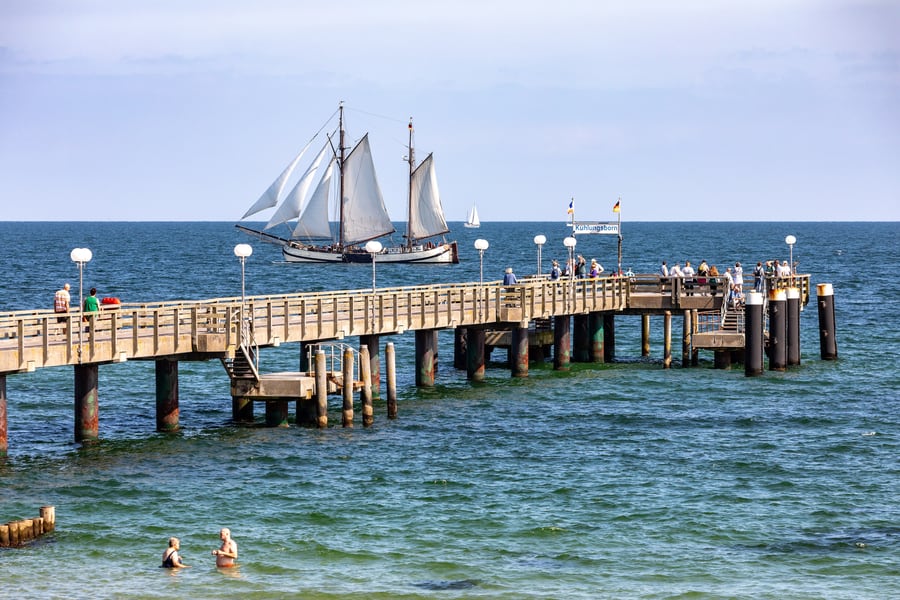 Dietmar Rabich / Wikimedia Commons · CC BY-SA 4.0 · cropped
Kühlungsborn and its pier
The largest seaside resort on this stretch of coast, and a different thing entirely from Heiligendamm — long, modern, busy, with a broad sand beach and a pier running out into the Baltic. The railway reaches it through Ost and Mitte before ending at West, so the town can be entered or left at whichever end suits.Where to Sleep
The line has a hotel at each end and a famous one in the middle, and because it runs all year they are all reachable by train in January as well as July.
One architect turns up at both ends of the line. Carl Theodor Severin built Heiligendamm's reception and assembly building between 1814 and 1816 — the one that became the resort's emblem — and then the Prinzenpalais in Bad Doberan in 1821, which is a hotel today.
Where to stay
Hotel Prinzenpalais Bad Doberan
A ducal summer residence of 1821, at the inland end
Carl Theodor Severin built this classicist palace on the Alexandrinenplatz in 1821, and it served for decades as the private summer residence of the Mecklenburg princes and dukes. After a full restoration it reopened in July 2009 as a hotel, with thirty guest rooms and junior suites. A Molli stop is a stone's throw from the door and the minster a few minutes on foot.
Check Availability (opens in a new tab, on hotel-prinzenpalais.de)via hotel-prinzenpalais.deGrand Hotel Heiligendamm
In the white town by the sea, halfway along
On the seafront at Prof.-Dr.-Vogel-Straße 6, among the classicist buildings of Germany's first seaside resort, with the beach and the promenade immediately outside. The house makes a point of its historic architecture and its position directly on the Baltic. The Molli station at Heiligendamm is within the resort itself.
Check Availability (opens in a new tab, on grandhotel-heiligendamm.de)via grandhotel-heiligendamm.deHotel am Strand
Family-run, near the beach at Kühlungsborn
At Ostseeallee 16 in Kühlungsborn, in a quiet position close to the water and run by the Kühn family. There is a Finnish sauna, a herbal sauna, a steam bath and an infrared sauna, a restaurant of its own serving seasonal food, and separate apartments in a villa fifty metres away. Reception is open from 08:00 to 20:00.
Check Availability (opens in a new tab, on hotel-am-strand.de)via hotel-am-strand.deQuestions or corrections
Planning this trip and stuck on something, or spotted a time, fare or detail that has changed? Send us a message about The Bäderbahn Molli to the Baltic. We read every one, and we update this page when something has changed.