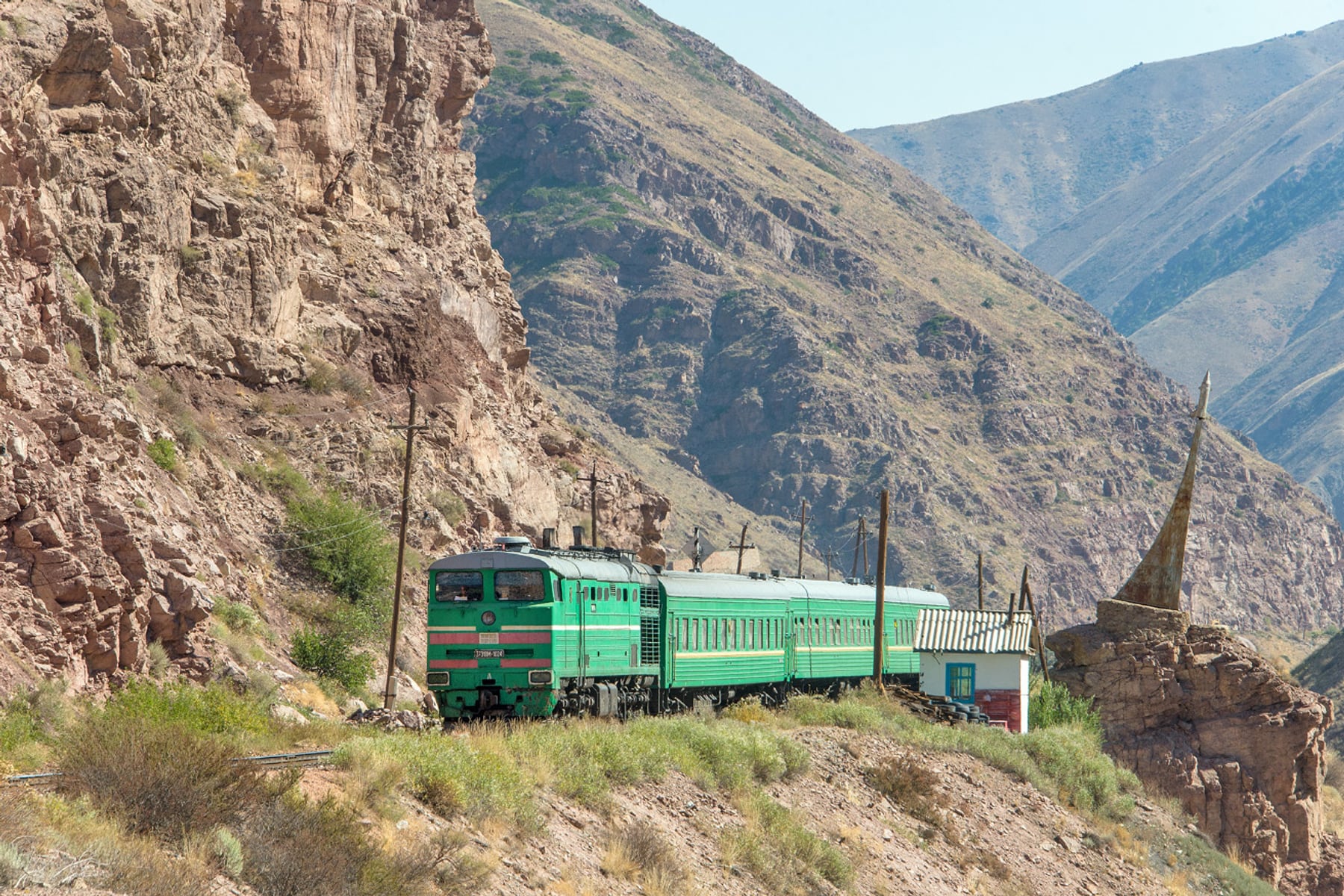
Bishkek to Balykchy — the summer train to Issyk-Kul
Mikolalex / trainpix.org via Wikimedia Commons · CC BY-SA 4.0 · 2017 · cropped
- DistanceAbout 180 km, Bishkek-2 to Balykchy Beach
- Duration4 hr 31 min, and the same coming back
- Best seasonSummer only — 5 June to 13 September in 2026
Introduction
Kyrgyz Temir Jolu runs three passenger trains inside its own country, and only one of them is worth crossing a border for. Train 608 leaves Bishkek-2 at 08:06, calls at four towns along the Chüy valley, turns into the Boom gorge behind Kemin and climbs beside the Chu river for the best part of two hours without stopping. It reaches Balykchy, on the western tip of Lake Issyk-Kul, at 12:12 — and then does not finish. Twenty-five minutes later it sets its passengers down at a halt called Balykchy Beach, on the water. Train 609 collects them at 18:40 and is back in Bishkek by 23:11. It runs in summer only: in 2026, Fridays to Sundays from 5 June, then daily until 13 September.
The station it climbs to spent thirty-four years under a name its own town had given up. The place was Rybachye until 1992, when it took the Kyrgyz word for a fisherman instead — Balykchy is a literal translation of the Russian name — and the railway went on using the old one in its station register and its tariff tables long after the maps had changed. Kyrgyz Temir Jolu renamed it on 1 March 2026, along with eleven others, keeping the code 717703. Its own fare table has not caught up: the standard-class row still reads Bishkek-2 – Rybachye Beach, while the row below it, for the rebuilt carriages, says Balykchy. Six months on, the summer train arrives at two different stations depending on which line of the price list you read.
The Journey
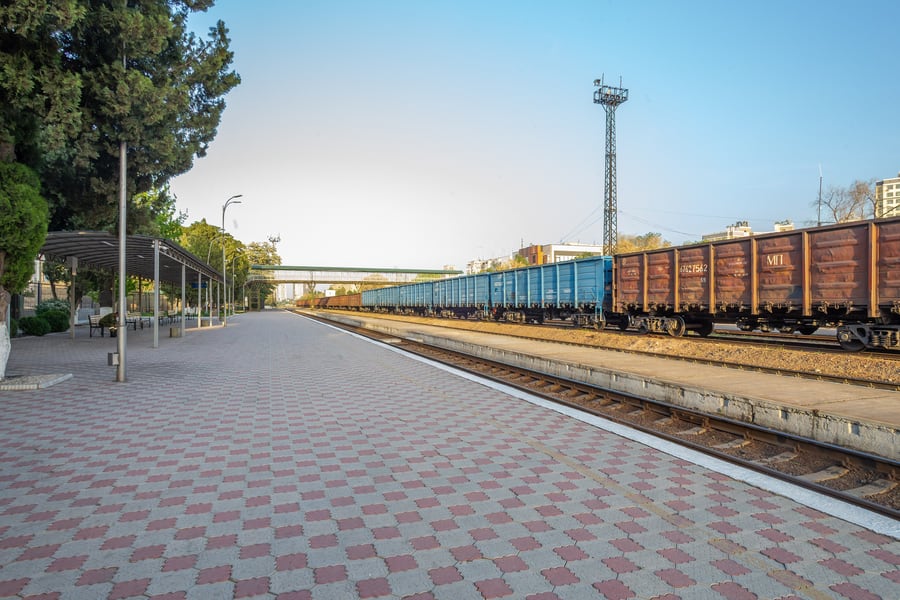
Bishkek-2 is on Erkindik boulevard, a tree-lined avenue that runs down the middle of the capital, and the station has been there since 25 May 1931, when it was called Frunze. The morning train stands at a platform otherwise given over to freight, coal among it — hauling coal north from the lake is much of what this railway does the rest of the year. Sixteen carriages is the advertised maximum, and the operator numbers them in the order they are coupled: eight standard interregional cars, one Lux, six VIP, and at the far end a single VIP compartment car sold whole rather than by the seat.
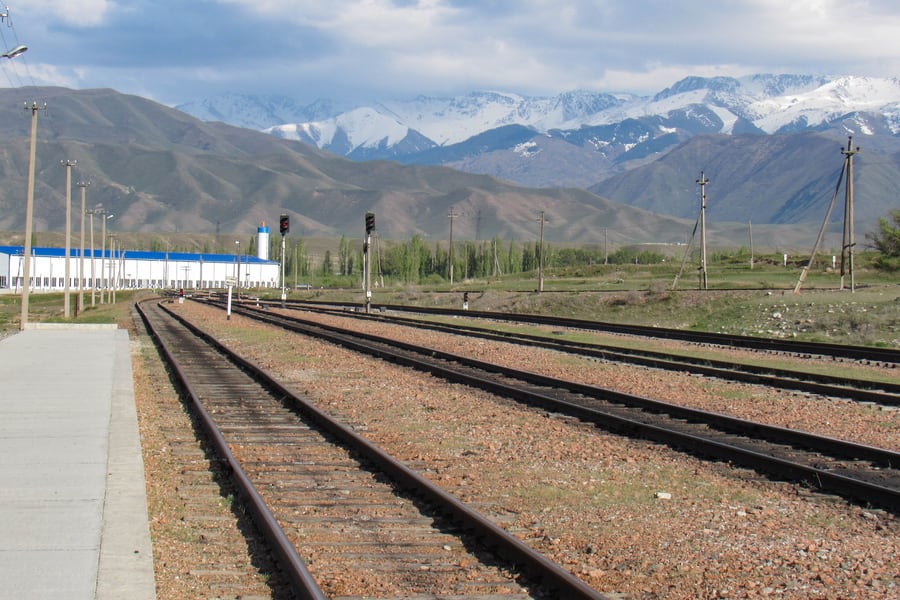
The first two hours are flat. Kant at 08:38, Ivanovka at 09:07, Tokmok at 09:38, Kemin at 10:24 — two minutes at each, in a valley of orchards and beet with the Kyrgyz Ala-Too along the right-hand side, its crest averaging 3,700 metres. Kemin was Bystrovka until the same renaming of March 2026, and it matters more than its two minutes suggest: it is where the railway ran out in 1942 and stayed for eight years, and where the line stops being a valley branch and becomes something else.
Into the Boom gorge
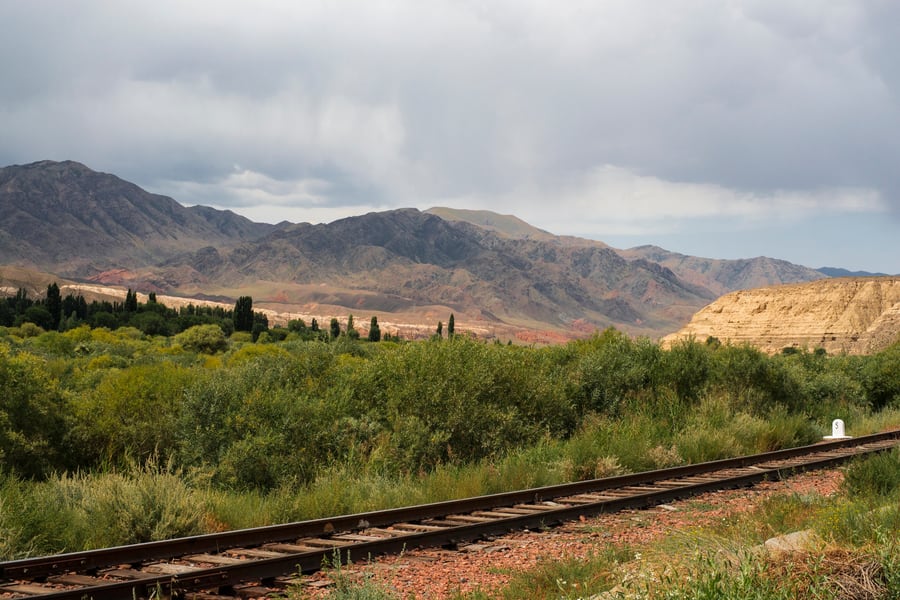
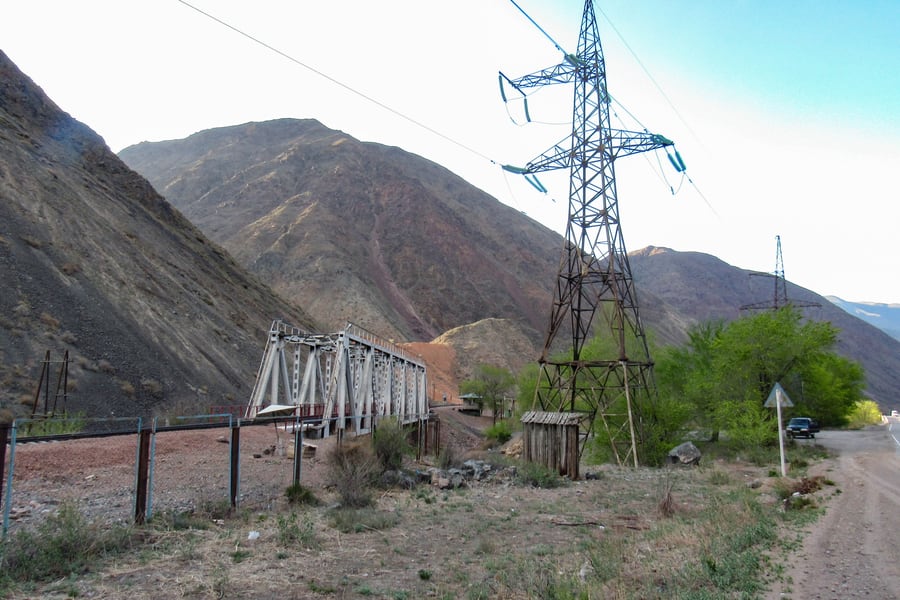
Behind Kemin the Chu river turns south into a thirty-kilometre cut between two ranges — the Kyrgyz Ala-Too on one side, the Kungey Ala-Too on the other — and the railway goes with it. There are no booked stops in the gorge. The train is timed 10:24 out of Kemin and 12:12 into Balykchy, one hour and forty-eight minutes for a stretch that has passing loops with names and platforms but nothing to pick up: Jil-Aryk, Kyz-Kuyo, Kayamat-Kurkol. The lower gorge is a canyon with the river doubling back under cliffs; the upper half opens out. Halfway along, the Krasny Most — the red bridge that carries the road over the river — is the boundary between Chüy and Issyk-Kul provinces. Bishkek sits between 700 and 900 metres. The lake is at 1,607. All of the difference is made here.
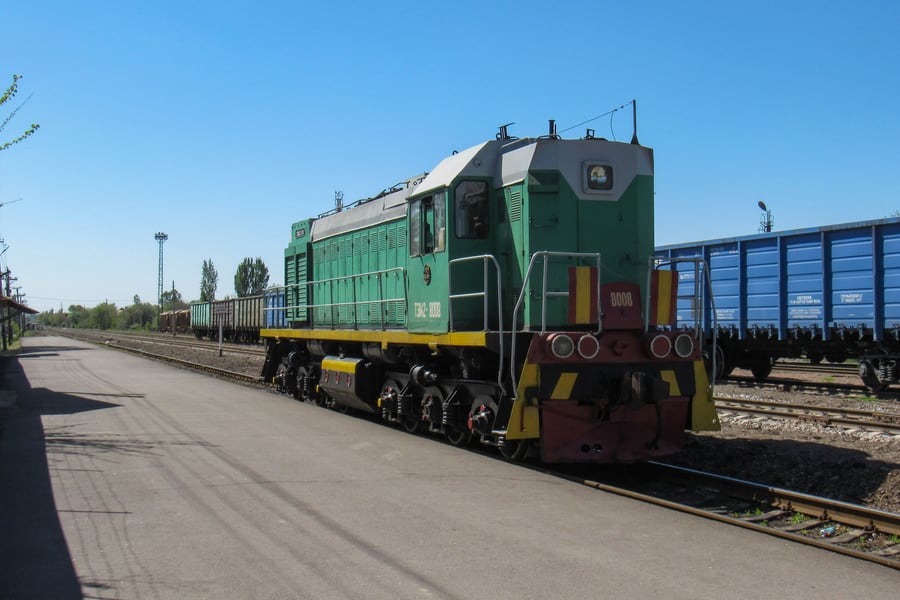
There are no wires anywhere on the Kyrgyz network, so everything is diesel, and the summer train carries its own power station: a generator car of the railway's own design, 600 kW from two 300 kW sets, either of which takes over automatically if the other stops. It is rated to supply forty carriages, which is more than twice what this train has. Kazakhstan handed Kyrgyz Temir Jolu five locomotives in March 2025 — two shunters and three main-line machines — and the railway said at the time that the main-line engines were meant for this section, on account of the traffic it now carries.
Balykchy, and then the beach
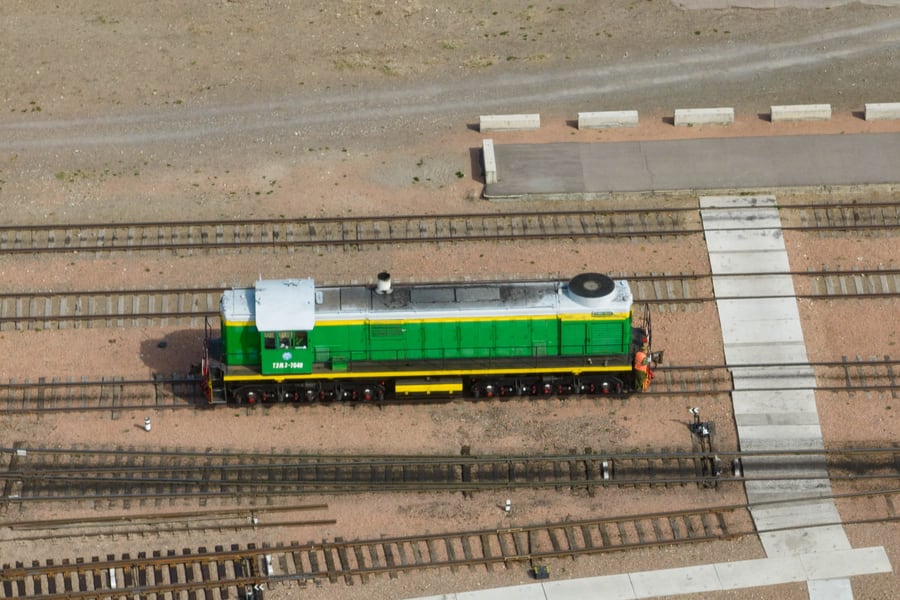
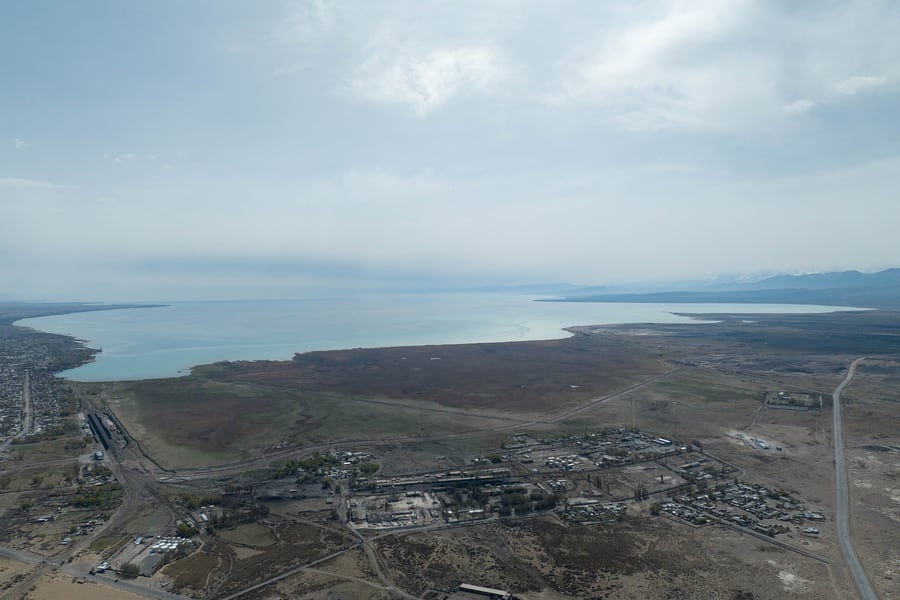
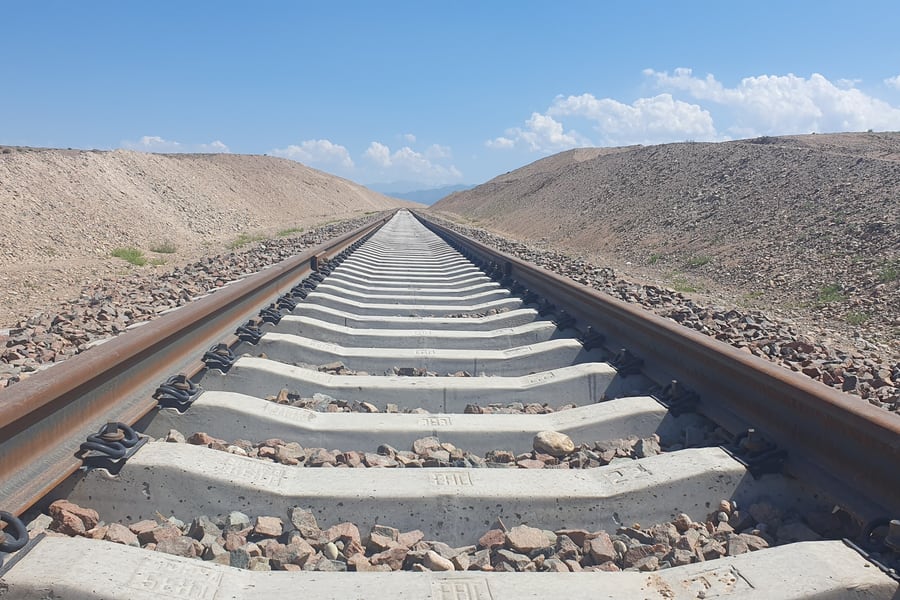
Balykchy is a working town rather than a resort: a lake port, a wool and produce works, a railway yard, most of it built when this was the end of the Soviet line and much of it shut since. The train stands five minutes there, then runs the last six kilometres out past the harbour to a halt on the shore. That short spur was relaid from end to end in 2025 — the railway's own account calls it a capital overhaul of six kilometres from Rybachye station to Priportovaya, done specifically to put passengers on the town's central beach. Issyk-Kul is 182 km long and 668 m deep, the second-largest mountain lake in the world after Titicaca, and salty enough that it does not freeze while the mountains around it are under snow. The train waits there all afternoon and leaves at 18:40.
Along the route
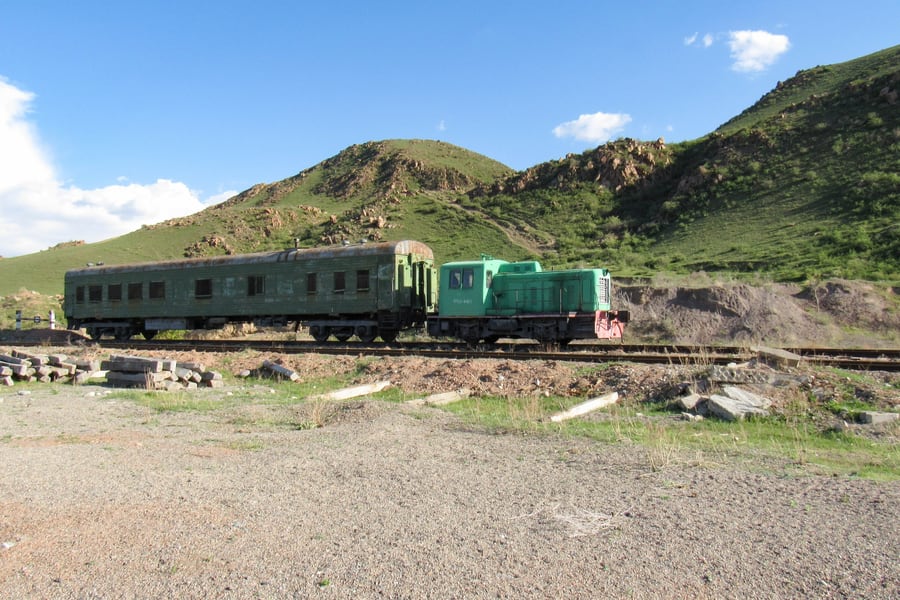
 Nikolai Bulykin / Wikimedia Commons · CC BY-SA 4.0 · cropped
Four stops and then nothing
Kant, Ivanovka, Tokmok, Kemin — two minutes at each, and after Kemin the train is not booked to stand anywhere at all until the lake.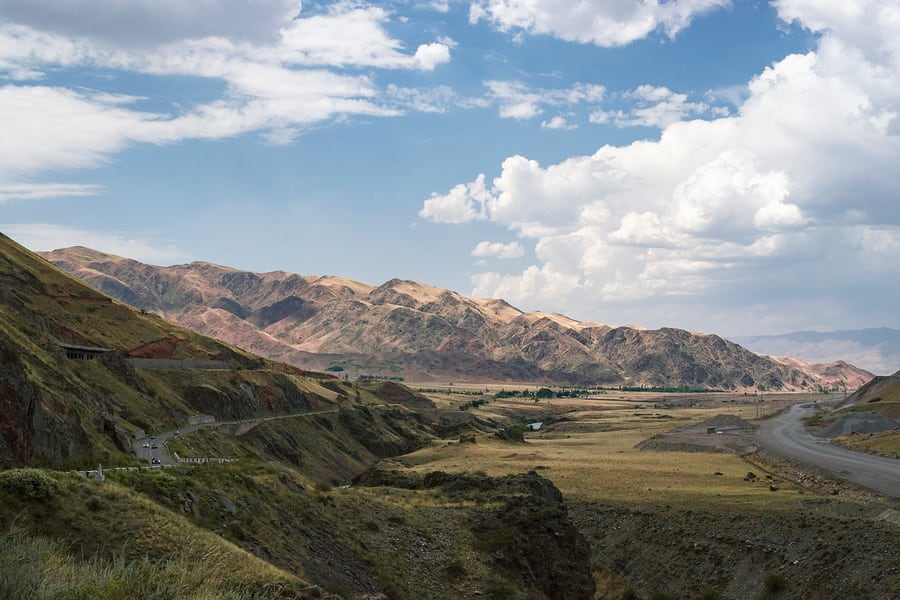 Vilya Shoni / Wikimedia Commons · CC BY 4.0 · cropped
An hour and forty-eight in the gorge
Thirty kilometres of canyon between two four-thousand-metre ranges, climbing from the Chüy valley to a lake at 1,607 metres with the Chu river alongside the whole way.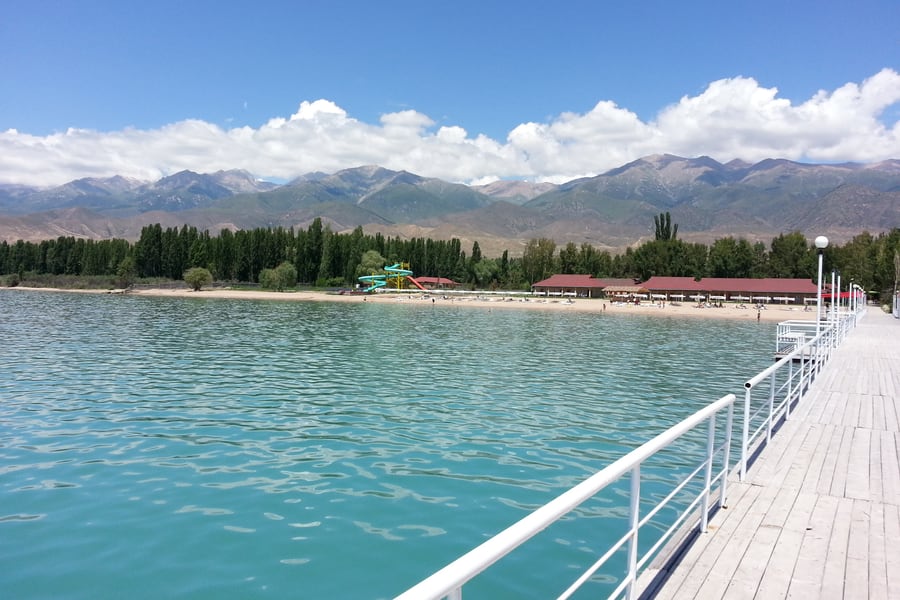 john panfilov / Wikimedia Commons · CC BY 3.0 · 2014 · cropped
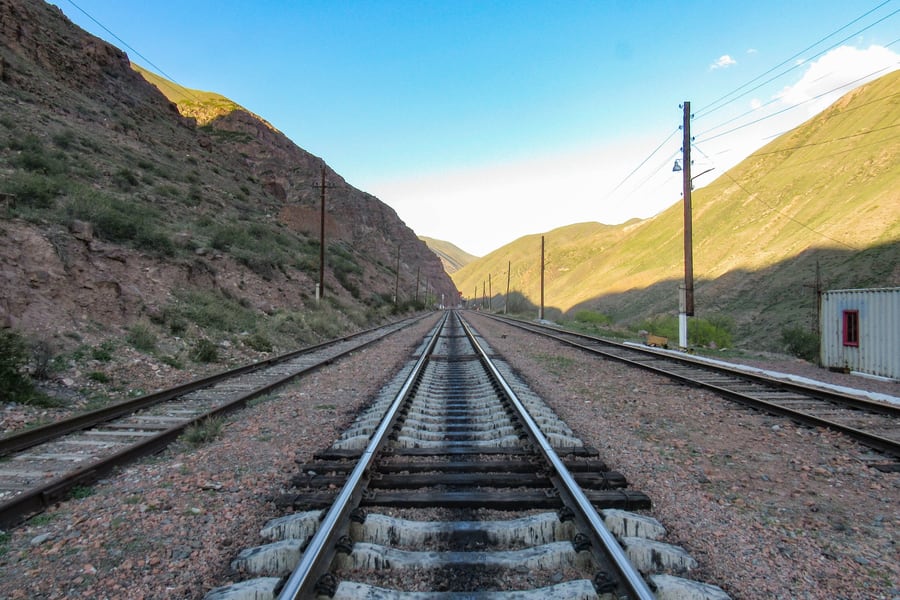
The last twenty-five minutes
Past the town, past the harbour, along six kilometres relaid in 2025 for this purpose alone, and out onto the beach at 12:37.A bit of history
Culture & experiences along the way
 Ada Awa / Wikimedia Commons · CC BY-SA 2.0 · cropped
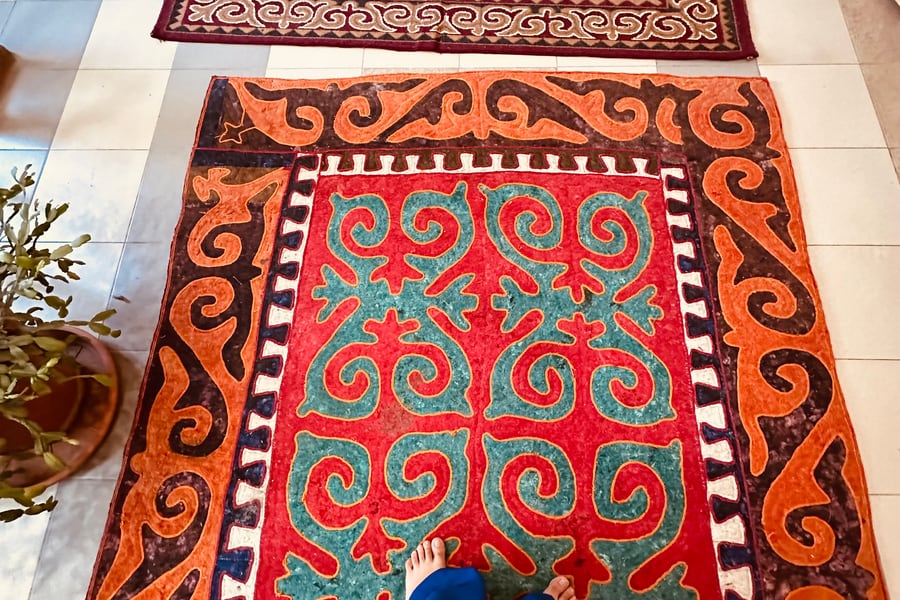
The felt carpet that takes a winter to make
A shyrdak is cut, not woven: two contrasting sheets of felt are laid together, one pattern cut through both, and the pieces swapped so each becomes the other's background — no offcut wasted. UNESCO put the craft on its urgent-safeguarding list in 2012, and the workshops at Kochkor, at the new end of the line, are where you can watch it done.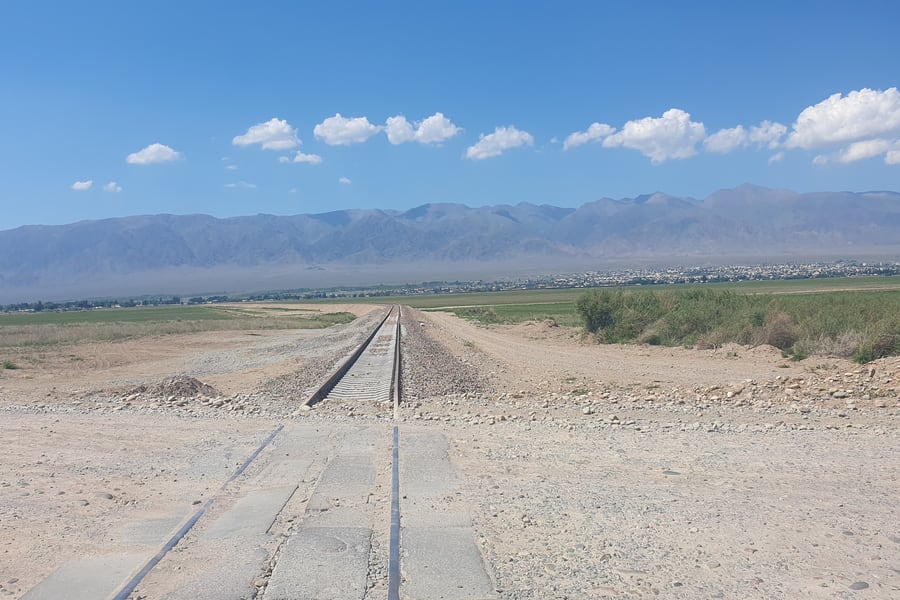 Kmaksat / Wikimedia Commons · CC BY-SA 4.0 · cropped
The terminus that stopped being one
Balykchy had been the end of Kyrgyzstan's railway since 1950. On 25 July 2026 the president drove the first train into Kochkor, 63.4 km further on, over the first new line built in the republic in 78 years — laid by Kyrgyz contractors without foreign money, and turning up Scytho-Saka burial mounds near Boz-Barmak on the way. Stage one of 186 km to the Kara-Keche coalfield.Timetables
One train a day each way, in summer only. Southbound it is 608, northbound 609, and the two are timed to the minute against each other: four hours thirty-one from Bishkek-2 to the beach, and four hours thirty-one back. Times below are Kyrgyz Temir Jolu's own, read from its published domestic timetable in August 2026.
| Station | 608 to the lake | 609 to Bishkek |
|---|---|---|
| Bishkek-2 | 08:06 dep | 23:11 arr |
| Kant | 08:36 arr · 08:38 dep | 22:39 arr · 22:41 dep |
| Ivanovka | 09:05 arr · 09:07 dep | 22:10 arr · 22:12 dep |
| Tokmok | 09:36 arr · 09:38 dep | 21:39 arr · 21:41 dep |
| Kemin | 10:22 arr · 10:24 dep | 20:53 arr · 20:55 dep |
| Balykchy | 12:12 arr · 12:17 dep | 19:00 arr · 19:05 dep |
| Balykchy Beach | 12:37 arr | 18:40 dep |
Nothing is booked between Kemin and Balykchy: the hour and forty-eight minutes in the middle of the day are the Boom gorge, without a stop.
The season is the thing to check. In 2026 the train ran on Fridays, Saturdays and Sundays from 5 June to 21 June, then daily from 26 June to 13 September, and not at all outside those dates. Individual workings are dropped at short notice — the evening return of 25 July 2026 was cancelled for the operator's own internal reasons, with the morning train running as booked. The dates change from year to year and are announced in May, so the current season has to be looked up rather than assumed.
The operator publishes the timetable and sells the train at
railway.kg (opens in a new tab), and its ticket site is ticket.railway.kg. That sales site
did not answer from outside Kyrgyzstan when it was tried in August 2026, from two different
networks, while the operator's own site and its timetable answered normally.
Tickets
The fare does not depend on where you get on or off — the operator says so plainly — so a seat from Kant costs what a seat from Bishkek costs. What it does depend on is how you pay: cash is 20 per cent dearer than card in every class. Prices below are Kyrgyz Temir Jolu's published tariff for the 2026 season, in som; children between five and ten pay half.
Sales open in late May, about two weeks before the first departure, through the operator's own site and app and at the Bishkek-2 booking hall. A whole VIP compartment can be bought outright rather than by the seat, at 6,000 som cashless. Each passenger may carry 50 kg of hand luggage, one dismantled bicycle and up to two animals in carriers.
Book your tickets
Interregional carriage
Eight of the sixteen cars
The standard seat on this train, and the same price whichever station you join at.
Book Tickets (opens in a new tab, on railway.kg)via railway.kgLux carriage
Car number nine
One carriage of the rake, a grade above standard and a grade below VIP.
Book Tickets (opens in a new tab, on railway.kg)via railway.kgVIP carriage
Six rebuilt cars with panoramic windows
The carriages the railway rebuilt for this route, with air-conditioning and Kyrgyz interiors.
Book Tickets (opens in a new tab, on railway.kg)via railway.kgRail Passes
No rail pass covers this journey. Kyrgyzstan is not an Interrail or Eurail country — checked in August 2026, it appears on none of Interrail's country pass lists, which reach no further east than Türkiye — and there is no national multi-journey ticket either. Kyrgyz Temir Jolu sells single tickets and nothing else.
That costs the traveller very little. A seat in a standard carriage is 150 som paid by card, which is a few euros for a four-and-a-half-hour run, and even the dearest single seat on the train is 800 som. There is nothing here a pass could usefully be spread across: three domestic passenger trains exist in the whole country, and one of them runs only in summer.
Places to Visit
The train's four intermediate stops are all in the Chüy valley, and one of them opens onto something much older than the railway. Beyond the gorge everything is the lake: the beach the train ends at, and the north shore running east from it.
 Bgag / Wikimedia Commons · CC0 · cropped
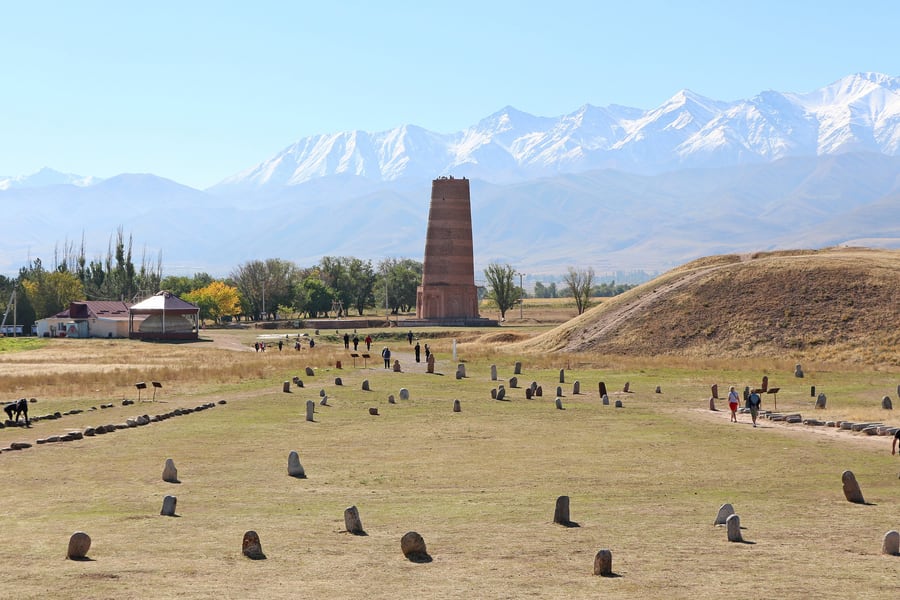
The Burana tower, from Tokmok
Fifteen kilometres south of the train's third stop stands an eleventh-century Karakhanid minaret, all that is left upright of Balasagun. It was 45 metres tall until a fifteenth-century earthquake took the top half off; the 25 that remain can be climbed, by an outside stair and a winding one inside. Around it in the grass stands a field of balbals — carved grave markers — and the mounds of the old citadel.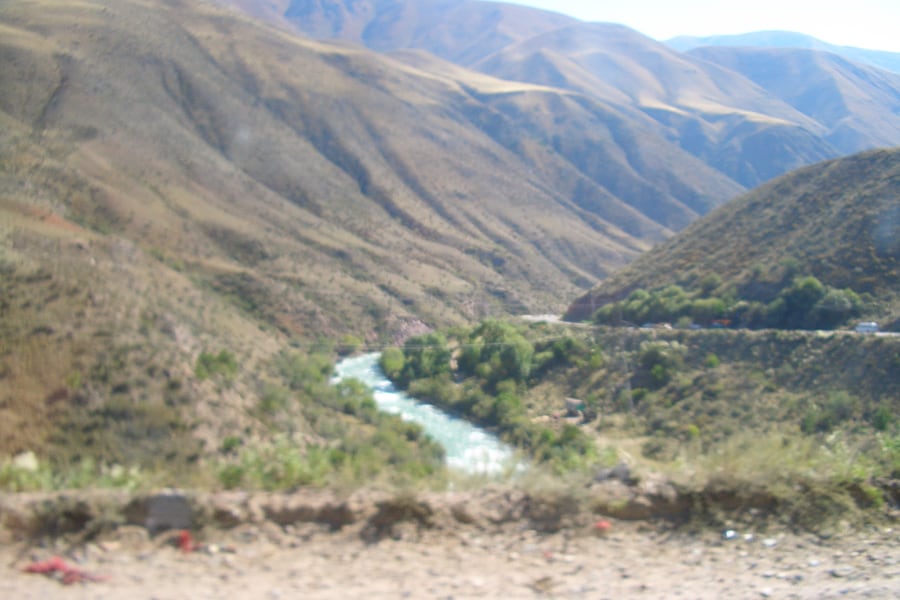 Vmenkov / Wikimedia Commons · CC BY-SA 3.0 · cropped
The Boom gorge
The thirty kilometres between Kemin and the lake are the journey, and they can be walked into as well as ridden through. The Chu runs the length of the cut, doubling back under cliffs in the lower half and opening into wide floodplain above; road and railway share it the whole way. It is one of the country's rafting rivers, and the spring at the entrance is where drivers stop before the climb.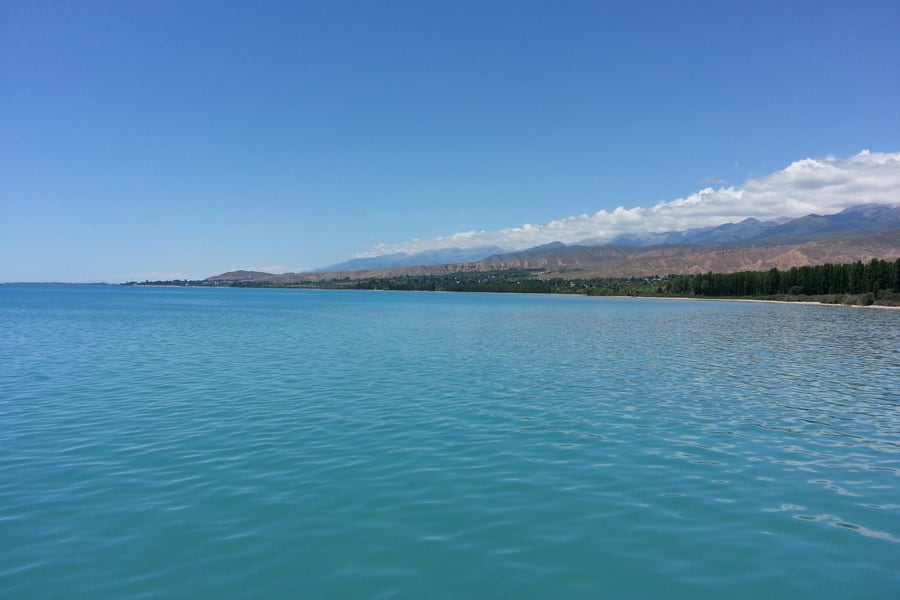 john panfilov / Wikimedia Commons · CC BY 3.0 · 2014 · cropped
Issyk-Kul, from the beach the train ends on
The lake is 182 kilometres long, up to 60 wide and 668 metres deep — the second largest mountain lake in the world after Titicaca, and the eighth deepest anywhere. It is saline and fed by hot springs, which is why it does not freeze while the Tian Shan around it is under snow. The water warms to the low twenties in summer, and the train sets its passengers down on the town's central beach.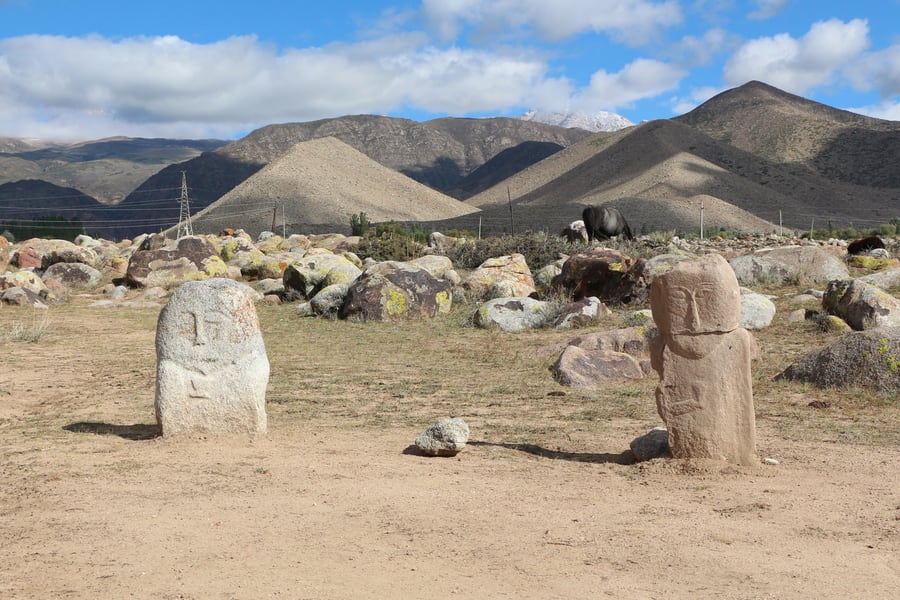 Bgag / Wikimedia Commons · CC0 · cropped
The petroglyph field at Cholpon-Ata
Seventy kilometres east of the railhead, on a moraine above the north shore, several thousand boulders carry pecked figures of ibex, snow leopards and hunters, left by the Saka and their successors. The stones lie where the glacier dropped them, in an open-air museum rather than a gallery, with kurgan stelae standing among them and the Kungey Ala-Too behind.Where to Sleep
The train is a day trip as it stands — out at 08:06, back at 23:11 — so most people who take it sleep in Bishkek at both ends. Balykchy itself has guest houses rather than hotels, and none of them publishes a website of its own; the resorts are further along the north shore, an hour or so by road from the railhead.
Where to stay
Orion Hotel Bishkek
Erkindik Boulevard 21
On the same boulevard as the station, with an indoor pool, a spa and three conference halls.
Check Availability (opens in a new tab, on orionbishkek.com)via orionbishkek.comAmbassador
Orozobekova Street 32, Bishkek
Two blocks from Erkindik boulevard, in the embassy quarter, with a sauna, gym and airport transfer.
Check Availability (opens in a new tab, on ambassador.kg)via ambassador.kgKapriz Issyk-Kul
Baktuu-Dolonotu, on the north shore
A year-round resort five kilometres from Cholpon-Ata with its own beach, orchard and pools.
Check Availability (opens in a new tab, on kaprizissykkul.kg)via kaprizissykkul.kgQuestions or corrections
Planning this trip and stuck on something, or spotted a time, fare or detail that has changed? Send us a message about Bishkek to Balykchy — the summer train to Issyk-Kul. We read every one, and we update this page when something has changed.