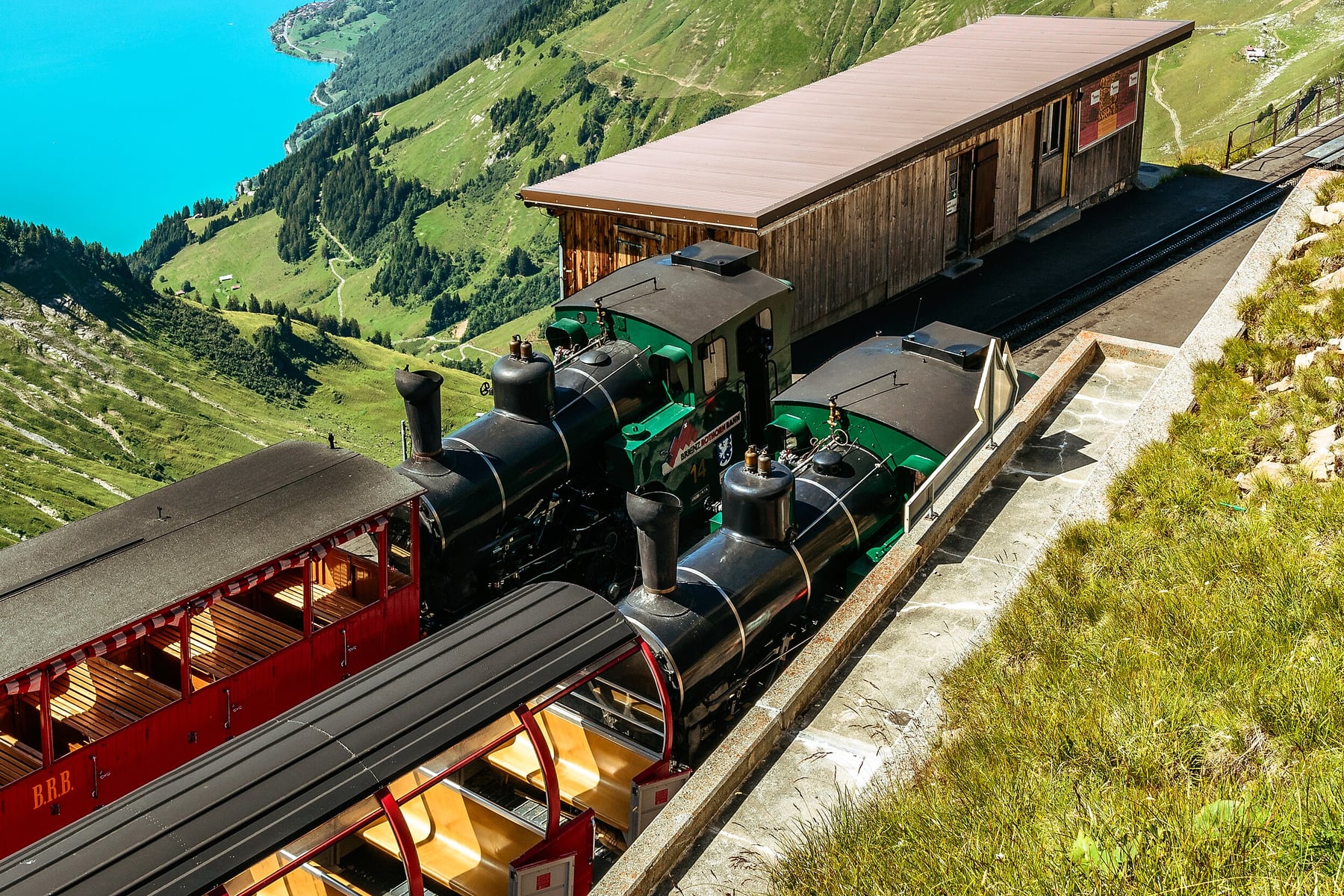
Brienz Rothorn Bahn
dconvertini / Wikimedia Commons · CC BY-SA 2.0
- Distance7.6 km
- Duration60 minutes
- Best season6 June – 25 October 2026; nine departures a day, steam on all of them
Introduction
Every mountain railway in Switzerland was electrified sooner or later. This one missed its turn, because it was shut at the time.
The Brienz Rothorn Bahn stopped running on 1 August 1914, a few days after the First World War began. The whole staff was paid off, the line was mothballed, and demolition was discussed more than once. It did not carry a passenger again until 13 June 1931 — seventeen years standing still, and they were precisely the years in which the rest of Switzerland strung wire over its rack railways. The operator draws the conclusion itself: that sleep is the reason the BRB was never electrified. What kept it out of the modern age was that it was not there to be modernised.
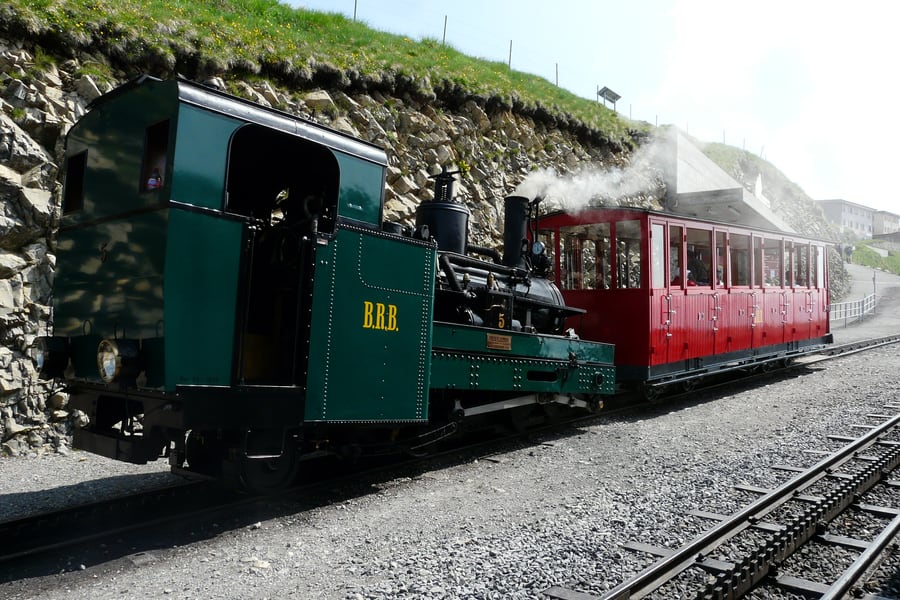
So the railway that woke up in 1931 was the one that had closed, and it still is. Eleven steam locomotives are on the books, eight of them in working order and five built in 1891 and 1892; between 1953 and 1990 this was the only steam-worked line left in Switzerland, and it remains the highest railway in Europe with no wire over it. One of the 1891 engines burns 300 kilos of coal and two thousand litres of water to push a train to the summit and let it back down. What that buys is 7.6 kilometres of 800-millimetre track and 1,678 metres of height, from Brienz on the lake at 566 metres to Rothorn Kulm at 2,244, on Abt rack the whole way at gradients reaching 250 per thousand. The climb takes an hour, with a five-minute halt at Planalp where the older engines take water, and at the top there are two restaurants, a colony of some 150 ibex, and — when the weather agrees — a view the operator counts at 693 named summits, from Pilatus and the Rigi round to the Eiger, Mönch and Jungfrau and out to the Chasseral in the Jura.
The Journey
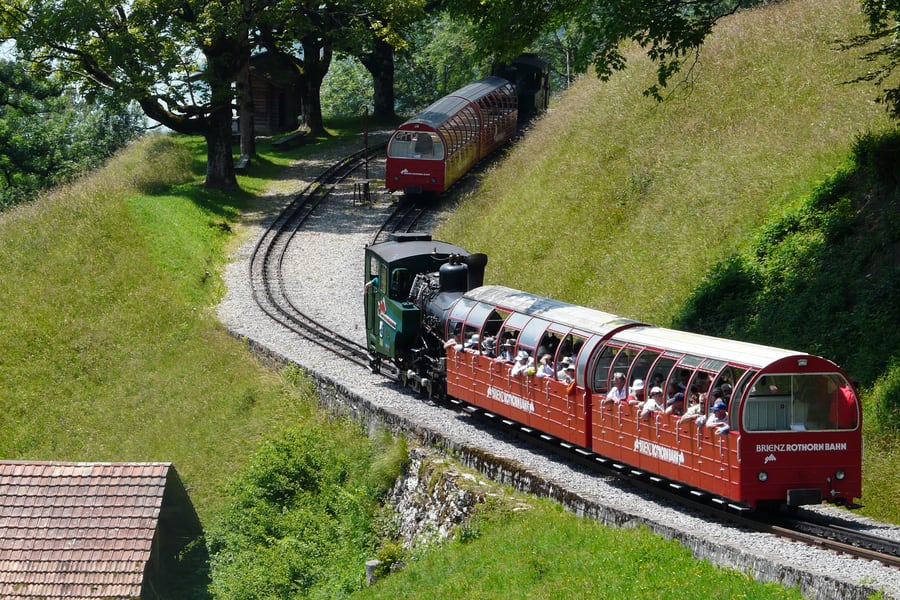
The train is waiting on the far side of the road from the Zentralbahn platforms, and it is short: a locomotive at the downhill end and one or two open-sided coaches above it, because the engine always pushes. Compartments seat eight; the seats are not numbered and cannot be chosen in advance, and what can be bought instead is a guaranteed place on a named departure. Then the whistle goes, the exhaust starts its slow four-beat, and the line climbs into the woods behind the village, over the Trachtbach on the Wellenberg bridge.
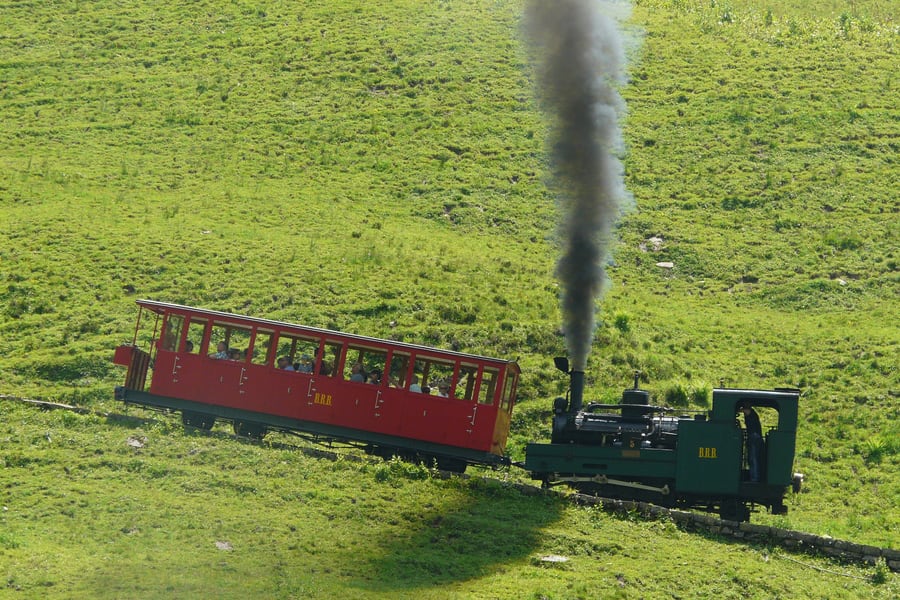
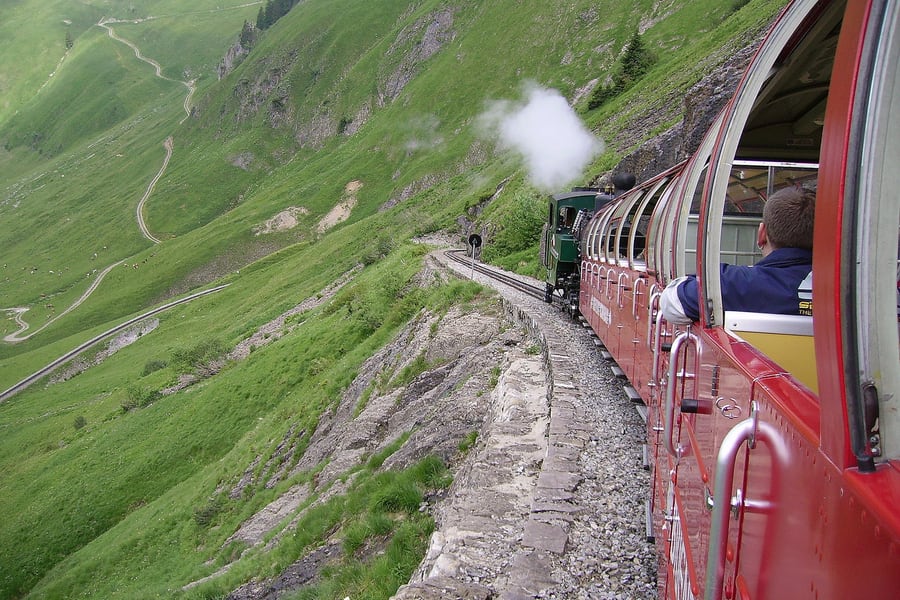
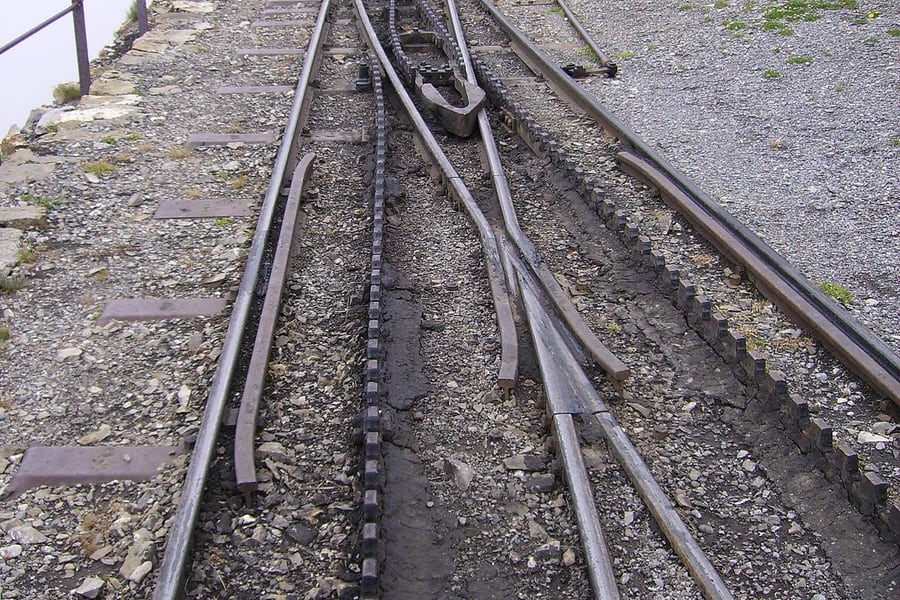
The gradient is the point. The line averages 225 per thousand and reaches 250 — a metre of height for every four metres travelled — and the rack is under the train for the whole 7.6 kilometres. It is Abt's double-lamella pattern: two toothed bars side by side, their teeth offset by half a tooth and each driven by its own pinion, so one is always fully in mesh. Roman Abt's system was barely a decade old when this railway was built, and he took responsibility for fitting it here. The men who built the line were the engineer Alexander Lindner and the contractor Theodor Bertschinger of Lenzburg, working with about seven hundred labourers, most of them Italian, who finished it in sixteen months.
An hour in three landscapes
The first half is forest, and it is where the engineering shows. Six tunnels are drilled through the spurs — the Schwarzfluh at 19 metres, the Härd at 119, the Planalpfluh at 290 with two large windows cut in its outer wall, the Chüemad at 92 and the two Schonegg bores at 37 and 133 metres — and two avalanche galleries, at Chüemad and Schonegg, carry the track under 140 metres of roof. The tightest curve has a radius of 60 metres. At Geldried, 1,019 metres up, the single track opens into the first passing loop, and if the timing is right there is another train standing in it.
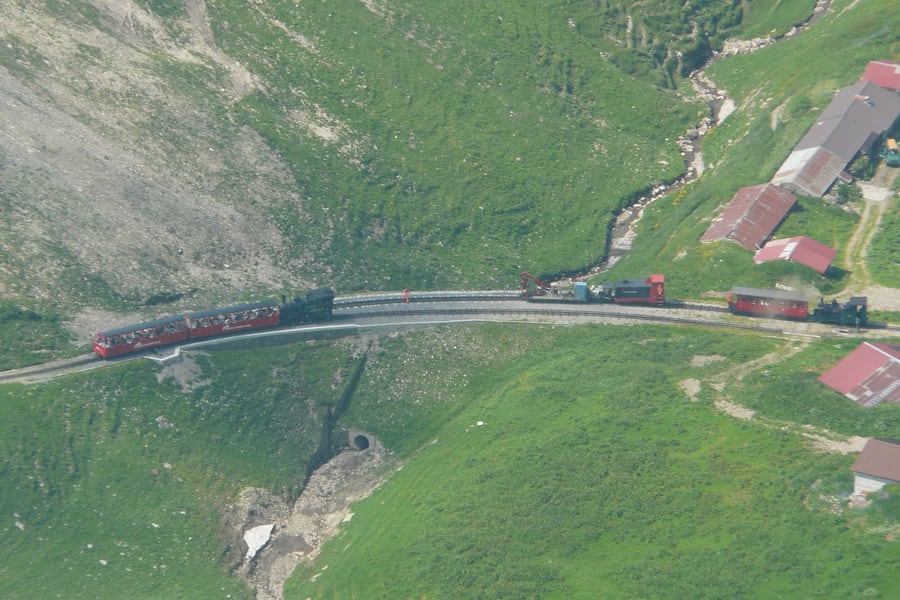
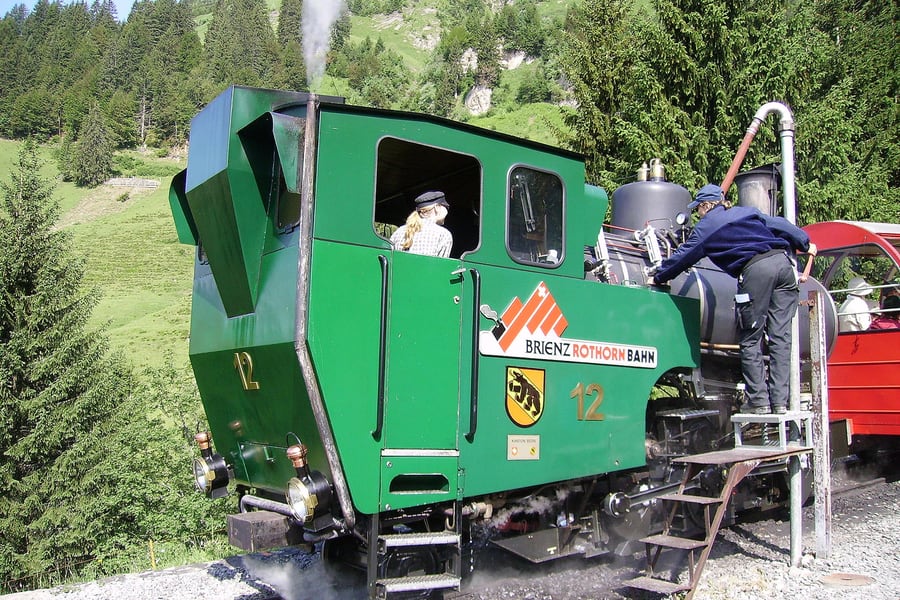
Planalp comes at 1,341 metres, thirty minutes out, halfway in both distance and height. It is the only stop, and for the coal-fired engines it is not optional: the fireman swings the hose across from the water column and tops up the tank while the train stands for about five minutes. Passengers going further are asked to stay in their seats. Around the station is a working alp — cattle through the summer, hay barns, cheese sold at the field gate — and above it the trees give out.
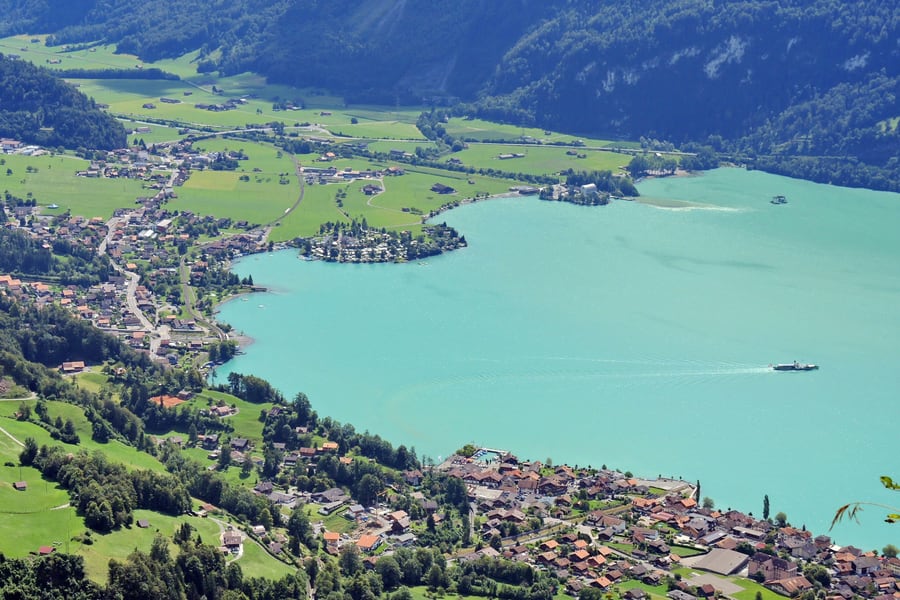
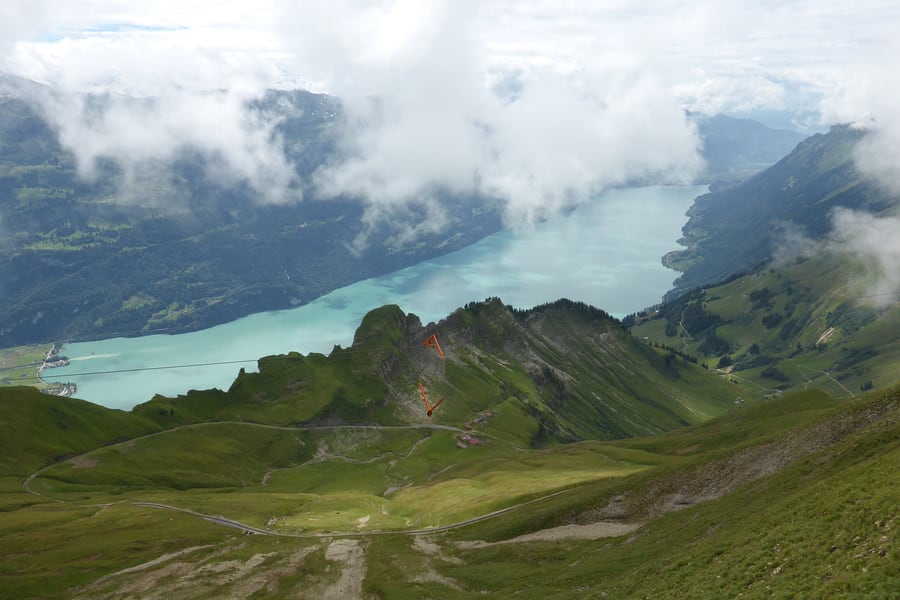
The last half hour is open mountain. The line crosses the Milibach, swings round the head of the Oberstafel bowl at 1,819 metres, where the third loop is, and climbs the final bare slope in a series of curves with Lake Brienz a kilometre and a half below and the Bernese Alps opposite. Rothorn Kulm is at 2,244 metres, cut into the ridge a little under the top; the summit itself, the Brienzer Rothorn at 2,350 metres and the highest point of the Emmental Alps, is a quarter of an hour's walk above the platform.
Coming down is the harder half
On the descent the driver works the engine as an air pump — the counter-pressure brake — so the machine that pushed the train up holds it back the whole way down, with a steam brake and hand brakes behind it. The timetable allows slightly longer for the descent than for the climb, which is the opposite of what most people expect.
The fleet
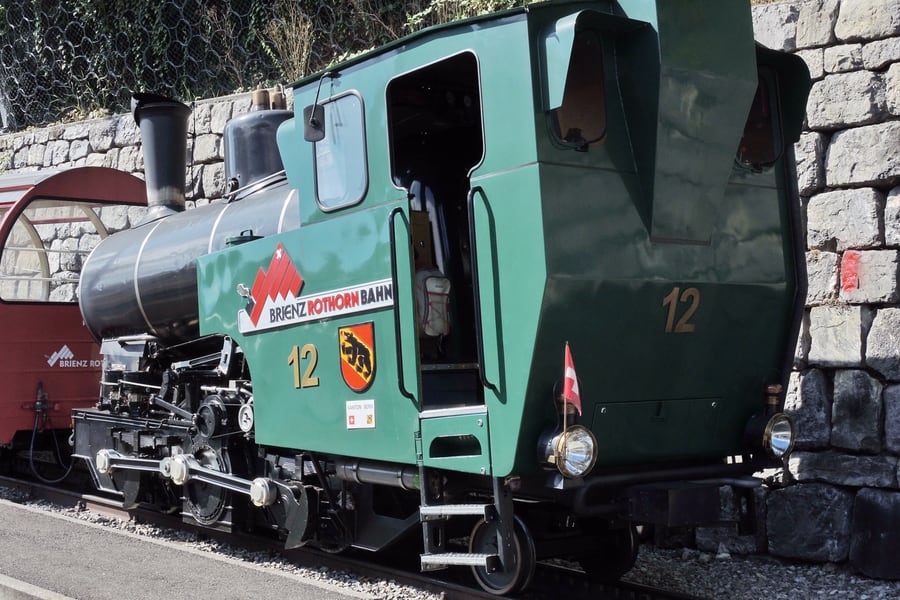
Three generations of steam are in traffic at once. Locomotives 1 to 5, built by SLM in 1891 and 1892, are coal-fired, need a driver, a fireman and a conductor, and can take 40 passengers. Two of them, numbers 2 and 5, are in regular service; number 5 came second-hand from the Wengernalp Railway in 1912, and number 1 arrived from the Monte Generoso railway in 1962. Numbers 6 and 7, of 1933 and 1936, are also coal-fired and take 72. Numbers 12, 14, 15 and 16 were ordered from SLM at Winterthur in 1988 and delivered from 1992: they burn low-sulphur oil, hold 16 bar against the older engines' 14, are rated at 408 horsepower against their 230 and 300, and carry a dead-man's device, which is how a crew of two rather than three can take 104 passengers up the hill. The new engines turn round in two hours; the old ones need two and a half. Three diesels, numbers 9, 10 and 11, do the permanent-way work and appear in front of passengers only when the day is very busy or a steam engine has failed.
Every machine gets around a thousand working hours of attention over the winter and a full overhaul about every eight years. The people who do that work in the shed are the people who drive in summer, which is why a fault on the mountain is often put right on the mountain.
Weather is not a detail here
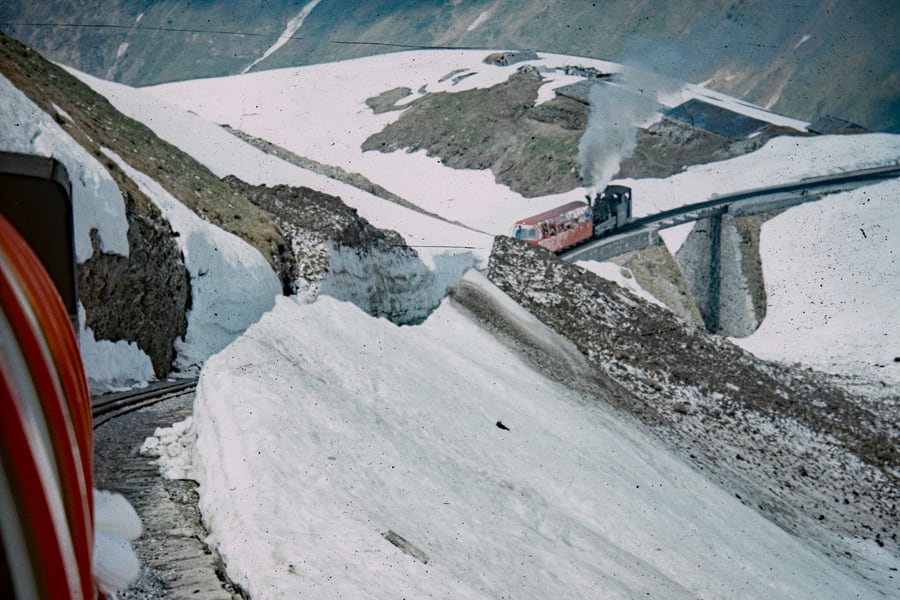
Snow has shaped the railway from the start. In the early years up to seventy men were hired each spring to dig the line out by hand — the Schneebruch — and the wage bill was a serious drag on the accounts; the first mechanical snow-blower came in 1951, and today a wheel-driven blower and piste machines do it faster and, as the company puts it, make the opening date something that can be planned. Water has been less predictable. On the evening of 12 August 2024 the Milibach came out of its bed in a thunderstorm and pushed rock, boulders and timber through Brienz; 2.2 kilometres of the railway's formation were badly damaged and the ballast was fouled for another 1.4 kilometres. The season was stopped early and the repairs cost around five million francs. The walking route from Brienz to Planalp through the Milibachgraben has not reopened.
Along the route
 Bybbisch94, Christian Gebhardt / Wikimedia Commons · CC BY-SA 4.0 · cropped
Abt rack, every metre of it
The rack is under the train from the platform at Brienz to the platform at Rothorn Kulm, on gradients that average 225 per thousand and reach 250. Roman Abt took charge of fitting his own double-lamella pattern when the line was built.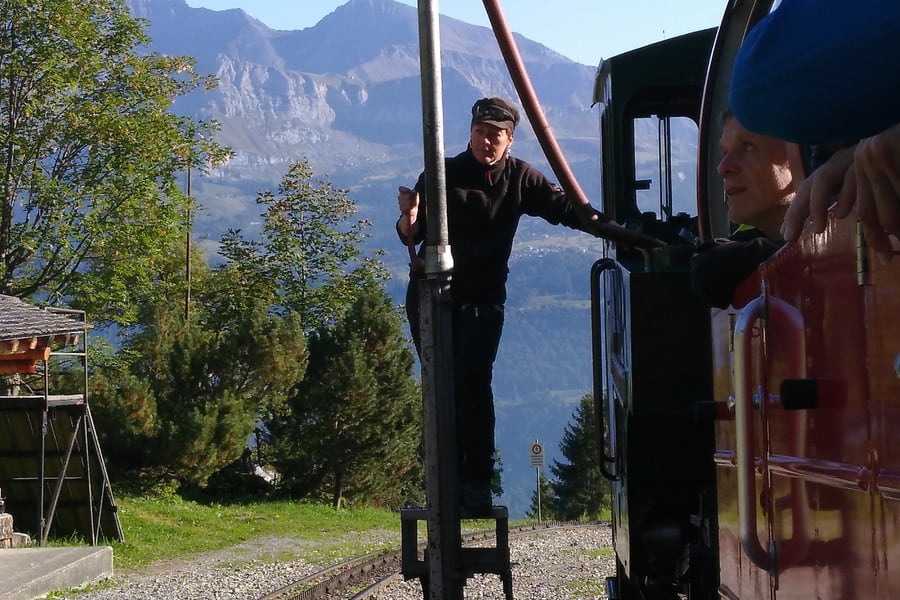 MHM55 / Wikimedia Commons · CC BY-SA 4.0 · cropped
Five minutes for water at Planalp
Halfway up, at 1,341 metres, the coal-fired engines take water from the column. A return trip to the summit costs one of them 2,000 litres and 300 kilos of coal, and the tank does not hold enough for both halves.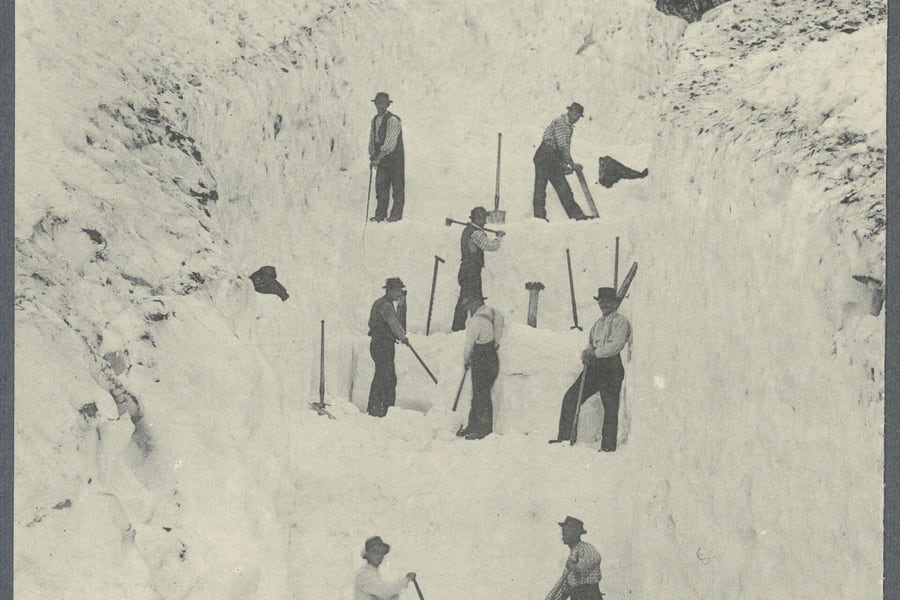 SBB Historic / Wikimedia Commons · CC0 · postcard of about 1905 · cropped
Digging it out by hand
Reopening the line each spring used to take up to seventy men with shovels, working the Schneebruch — welcome winter wages in Brienz. The first mechanical snow-blower arrived in 1951, which is why the opening date can now be planned rather than hoped for.A bit of history
Culture & experiences along the way
 Bybbisch94, Christian Gebhardt / Wikimedia Commons · CC BY-SA 4.0 · cropped
Dampfwürstlibummler
Sausages cooked in the locomotive's boiler and handed round by the driver at Planalp.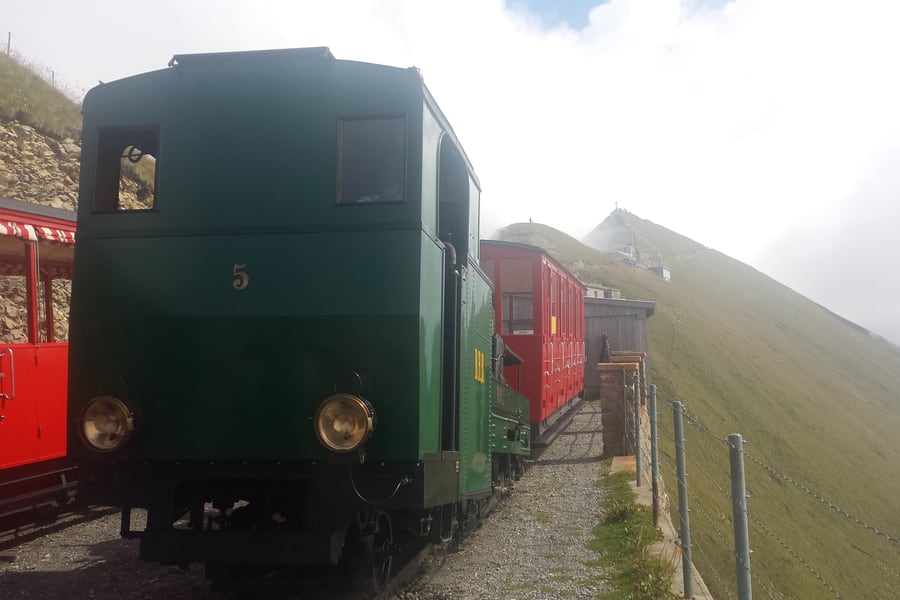 Chris j wood / Wikimedia Commons · CC BY-SA 4.0 · cropped
Salon Rouge
A depot tour, then eleven courses in a Belle Époque dining car behind a coal-fired engine.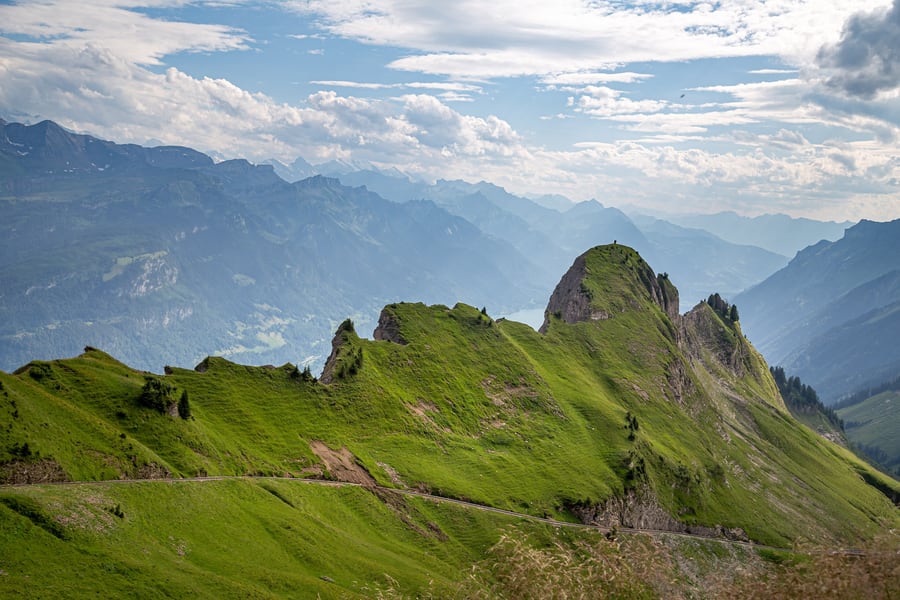 Philipp Ramseier / Wikimedia Commons · CC BY-SA 4.0 · cropped
Walk one leg of it
The Wanderticket covers three sections by train and leaves one — any one — on foot.Timetables
The Brienz Rothorn Bahn runs to a fixed published timetable for one season a year. In 2026 that season is 6 June to 25 October, and there are nine departures a day in each direction — but one of those nine only exists at weekends in high summer.
Up the mountain, 2026
| Brienz | Planalp | Rothorn Kulm |
|---|---|---|
| 07.36 * | 08.02 | 08.36 |
| 08.36 | 09.03 | 09.31 |
| 09.40 | 10.07 | 10.35 |
| 10.45 | 11.12 | 11.43 |
| 11.45 | 12.15 | 12.45 |
| 12.58 | 13.27 | 13.57 |
| 13.58 | 14.27 | 14.57 |
| 14.58 | 15.27 | 15.57 |
| 16.36 | 17.03 | 17.31 |
Down again
| Rothorn Kulm | Planalp | Brienz |
|---|---|---|
| 09.06 * | 09.35 | 10.10 |
| 09.38 | 10.10 | 10.38 |
| 11.15 | 11.50 | 12.20 |
| 12.20 | 12.58 | 13.30 |
| 13.28 | 14.02 | 14.32 |
| 14.28 | 15.02 | 15.32 |
| 15.28 | 16.02 | 16.32 |
| 16.28 | 17.02 | 17.32 |
| 17.40 | 18.12 | 18.40 |
* The 07.36 from Brienz and the 09.06 down from Rothorn Kulm run only on Saturdays and Sundays in July, August and September. Checked in the operator's own booking system, a Wednesday in September and a Tuesday in October both offered eight departures, starting at 08.36; a Saturday in August offered nine.
The climb takes an hour and the descent a little longer — around 62 to 65 minutes, depending on the working. Planalp is thirty minutes from the bottom. The last train down leaves Rothorn Kulm at 17.40, and there is nothing after it.
How long to allow
The operator's own minimum is two and a half hours for the whole outing: two hours of riding and thirty minutes on top. That is enough to walk the quarter-hour path to the summit cairn and come back. Anything more ambitious — the Gipfelweg at leisure, a meal, or one of the ridge walks — wants a whole day, and the temperature at the top is generally about ten degrees below Brienz.
Trains do sell out
This is the part that catches people. The line is single track with only three crossing places, and the length of the loops caps each departure at three train sets, so the number of people who can be carried in a day is fixed and fairly small. On fine summer days every train can be full: checked in the shop for a Saturday in August 2026, all nine departures up and all nine down were showing sold out. The operator's advice is to buy a ticket with a seat guarantee in advance, which also opens the turnstile straight to the platform.
Trains run in rain. They can be cancelled if the weather makes the line unsafe, or if too few people turn up to justify lighting a fire.
Getting to Brienz
Brienz is a stop on the Zentralbahn's Brünig line between Lucerne and Interlaken Ost, and the Brienz Rothorn Bahn's terminus stands across the road from those platforms. The lake steamers of the Lake Brienz fleet tie up a couple of minutes away, opposite the valley station — which is how most early visitors arrived, because the Brünig line reached Brienz from Lucerne in 1888 but was not extended westwards to Interlaken until 1916.
Coming by car, there is paid parking beside the valley station at CHF 8.00 for the day, and free long-stay coach parking at the boat station opposite. Arriving on public transport earns 20% off the Brienz–Rothorn return, booked through SBB.
Timetable, season dates and access from brienz-rothorn-bahn.ch, cross-checked departure by departure against the operator's own ticket shop for 22 August, 16 September and 20 October 2026. All as of August 2026.
Tickets
Tickets come from the counter at Brienz or the operator's own web shop. One fare structure covers the whole season — no peak and off-peak, and no classes, since the coaches are open compartments for eight and everyone sits in the same kind of seat. The Half Fare Card, GA travelcard and Swiss Travel Pass halve the fare; the Berner Oberland and Lucerne Travel Passes carry you free; children under six travel free and 6–15s pay CHF 10 return. Municipal and communal day passes are not valid.
Buying in advance adds CHF 8 a head for a seat guarantee, and it is the practical answer to a line that sells out: the turnstile opens thirty minutes before departure. Seats are not numbered, so arriving early simply means more choice. A booked guarantee cannot be changed, cancelled or refunded. Read from the operator in August 2026, for the 2026 season.
Book your tickets
Brienz – Rothorn Kulm return
CHF 98 full fare · CHF 49 with a Half Fare Card, GA or Swiss Travel Pass
The whole line and back, an hour each way with about five minutes for water at Planalp.
Book Tickets (opens in a new tab, on Brienz Rothorn Bahn)via Brienz Rothorn BahnSeat guarantee
Per person, added to any advance ticket
Trains sell out on fine days; this opens the turnstile half an hour early.
Book Tickets (opens in a new tab, on Brienz Rothorn Bahn)via Brienz Rothorn BahnBrienz – Planalp return
Half the climb, half the day
As far as the water stop at 1,341 metres and back, thirty minutes each way.
Book Tickets (opens in a new tab, on Brienz Rothorn Bahn)via Brienz Rothorn BahnNostalgiebummler
Wednesdays and Saturdays, to Planalp
Brienz to Planalp and back behind a coal-fired engine.
Book Tickets (opens in a new tab, on Brienz Rothorn Bahn)via Brienz Rothorn BahnSalon Rouge
A depot tour and the Belle Époque dining car
Eleven courses with wine behind a coal-fired engine, 10.15 to 14.35.
Book Tickets (opens in a new tab, on Brienz Rothorn Bahn)via Brienz Rothorn BahnRail Passes
This is one of the few Swiss mountain railways where a regional pass carries you up for nothing and the famous national one does not. Which pass you are holding changes the answer completely.
The Bernese Oberland Pass — free travel
The operator's own wording is unambiguous: "With the Bernese Oberland Pass, you travel for free on the Brienz Rothorn Railway." The same goes for the Lucerne Travel Pass, the red VöV card, the FVP tourism supplementary card and the SBB companion card.
The Bernese Oberland Pass is sold for 3, 4, 6, 8 or 10 consecutive days and is valid from Bern, Brig, Montreux, Lucerne and anywhere inside the region, covering trains, buses, the boats on Lakes Thun and Brienz and more than twenty-five mountain railways.
| Days | Full fare, 2nd class | With a Swiss Travel Pass, Half Fare Card or GA | Children and dogs |
|---|---|---|---|
| 3 | CHF 240 | CHF 168 | CHF 30 |
| 4 | CHF 280 | CHF 196 | CHF 30 |
| 6 | CHF 350 | CHF 254 | CHF 30 |
| 8 | CHF 395 | CHF 287 | CHF 30 |
| 10 | CHF 435 | — | CHF 30 |
⚠️ Free travel is not the same as a seat. The railway sells out, and the operator asks Bernese Oberland and Lucerne Travel Pass holders to buy the CHF 8.00 seat guarantee online for the departure they want, then collect the ticket at the counter.
Swiss Travel Pass, GA and Half Fare Card — 50%
A Swiss Travel Pass, a GA travelcard or a Swiss Half Fare Card halves the fare: the return becomes CHF 49.00 instead of CHF 98.00. An international FIP card does the same.
⭐ Worth knowing, because the operator's own pages disagree with each other: the German version of the fares table labels the reduced column "Halbtax oder GA" and never mentions the Swiss Travel Pass, while the English version of the same table labels it "Half Fare Card or Swiss Travel Pass" and never mentions the GA. Neither list is complete. The web shop settles it — the ticket line reads "Brienz - Rothorn - Brienz | with Swiss Travel Pass or Half Fare Card — CHF 49.00" — and the FIP card appears only in the German FAQ.
Interrail and Eurail
The operator publishes a full list of the cards it accepts, in two languages and again at the checkout, and Interrail and Eurail appear on none of them. Nor does the railway appear on Interrail's own Switzerland page. A European pass will get you to Brienz — the Brünig line from Lucerne or Interlaken is an ordinary Zentralbahn service — and the rack railway is a separate ticket bought on the spot.
Swiss municipal and communal day passes are explicitly not valid either.
Other reductions
The Brienz Guest Card and the Camping Card Bernese Oberland give 20% off the full fare and 10% off the reduced one. Booking through SBB as part of a public-transport journey takes 20% off the return. Groups of ten or more paying adults get a reduction. None of these applies to the special trains, or on top of another discount.
Is a pass worth buying for this?
For the railway on its own, no. The cheapest way to halve the fare is the Swiss Half Fare Card, and if you already hold one, or a Swiss Travel Pass, the return costs CHF 49 and there is nothing more to buy.
The Bernese Oberland Pass is a different calculation. Three days costs CHF 240 at full fare, which is two and a half Rothorn returns; it only pays if the Rothorn is one of several mountains in the same few days — Grindelwald–Männlichen, Meiringen–Hasliberg and the Thun and Brienz lake boats are among the things it carries you on for nothing, and so is the Lucerne–Interlaken Express, which calls at Brienz. A Swiss Travel Pass does not replace the regional pass here so much as discount it: holders pay CHF 168 for three days rather than CHF 240.
Pass conditions from brienz-rothorn-bahn.ch in both German and English, from the operator's web shop, and from berneseoberlandpass.ch, whose prices are stated as valid to 31 December 2026. All read in August 2026.
Places to Visit
The railway itself has only three stopping places, so a day here is really a day on Lake Brienz with an hour of steam at either end of it. These five are the village at the bottom, the alp in the middle, the ridge at the top, and the two things worth crossing the water for.
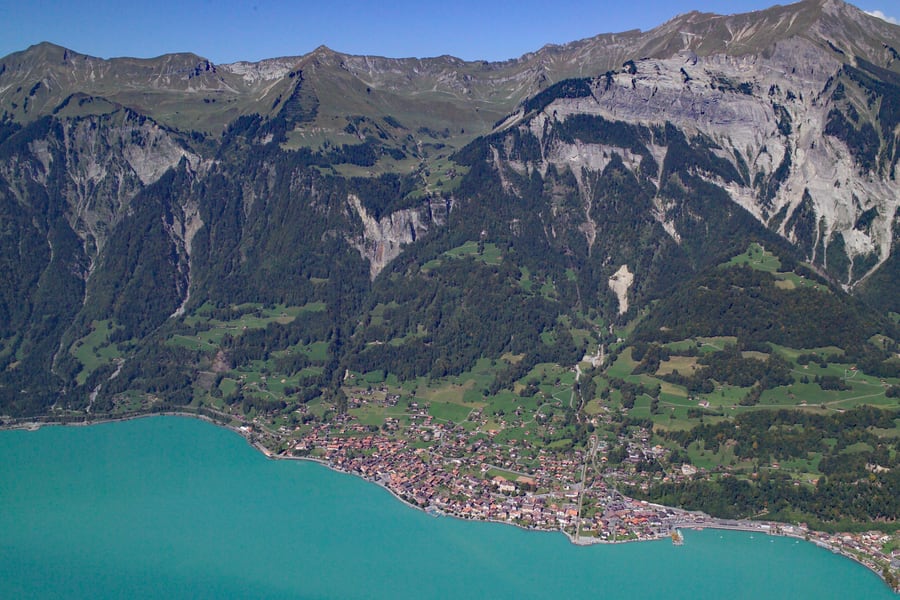 Richard Ziebold / Wikimedia Commons · CC BY 4.0 · cropped
Brienz
A village of woodcarvers on the north shore of the lake, with the rack railway's terminus on one side of the main road and the Zentralbahn's Brünig line platforms on the other, and the boat quay two minutes away. Carving began here in the famine year of 1816 and turned into a trade; the school founded in 1884 as the Schnitzlerschule Brienz is still the only place in Switzerland where woodcarving can be learnt, and the violin-making school of 1944 is the only one of those too.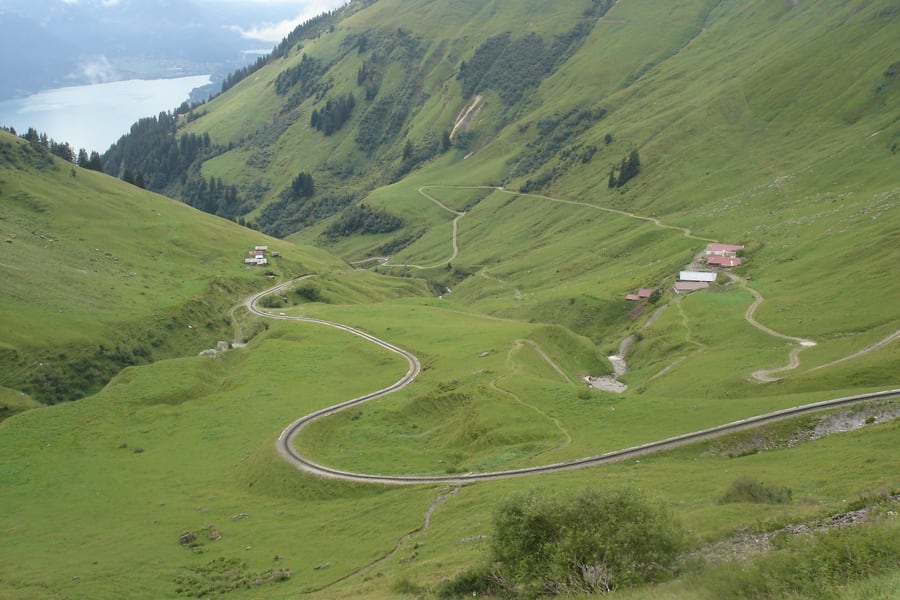 Andre Schild / Wikimedia Commons · CC BY 2.5 · cropped
Planalp
A working alp halfway up, and the only place on the line where the train stops. Cattle graze here through the summer, the hay barns are still used, and alp cheese is sold at the field gate. One of the operator's special workings, the Nostalgiebummler, turns round here rather than going on to the top, and the walk down to Brienz by way of Mettli takes about two hours.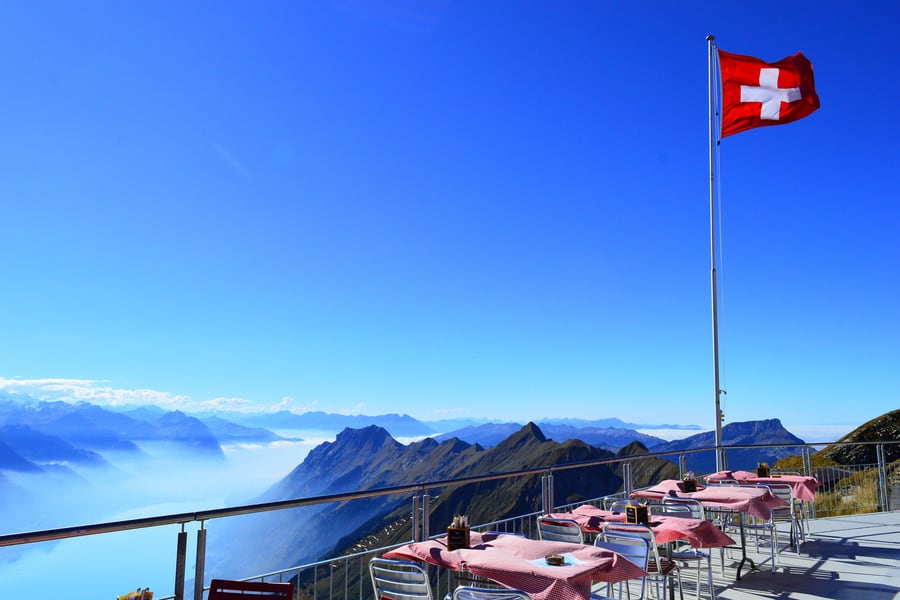 Barbara Steinemann / Wikimedia Commons · CC BY-SA 4.0 · cropped
Rothorn Kulm
Two restaurants, a terrace above the cloud, and on a clear day a horizon the operator counts at 693 named summits — Pilatus, the Rigi and the Titlis to the east, the Eiger, Mönch and Jungfrau opposite, the Chasseral away in the Jura. A colony of more than 150 ibex lives on the mountain. The true summit, the Brienzer Rothorn at 2,350 metres, is a quarter of an hour's walk above the station, and it is about ten degrees colder up here than beside the lake.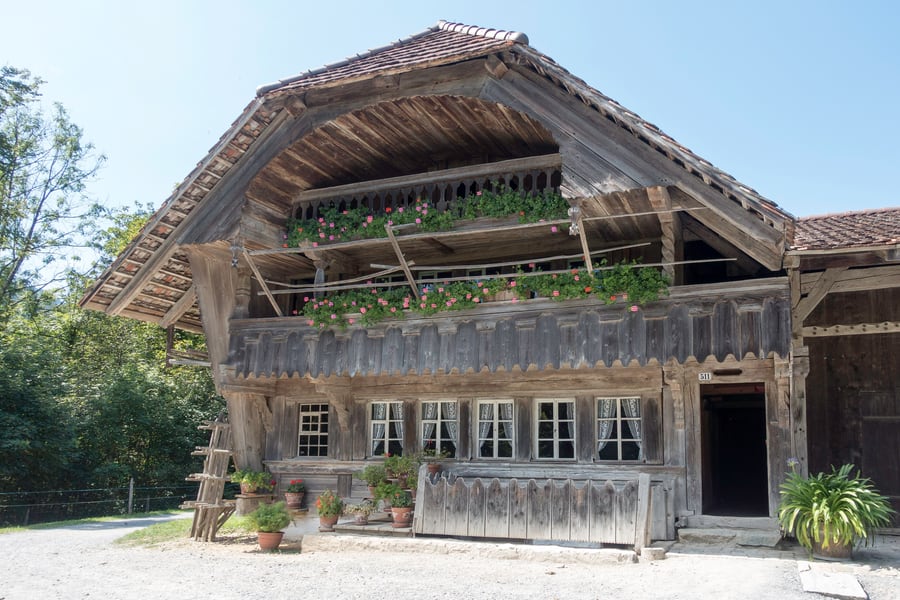 Foto-Max 1234 / Wikimedia Commons · CC BY-SA 4.0 · cropped
Ballenberg
The Swiss open-air museum, on the plateau above the lake at Hofstetten bei Brienz: more than a hundred rural buildings taken down where they stood, all over the country, and rebuilt here with their gardens, their fields and their livestock. It is a heritage site of national significance, and it is the other reason people get off the train at Brienz.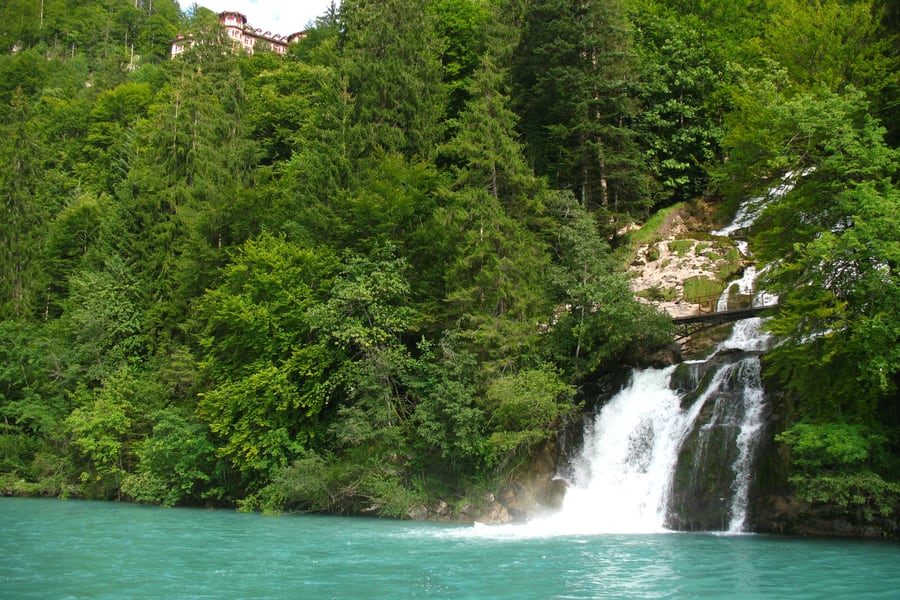 Andrew Bossi / Wikimedia Commons · CC BY-SA 2.5 · cropped
The Giessbach falls
The hotel's own description is hard to improve on: fourteen tiers, four hundred metres of descent into Lake Brienz, with paths running alongside. The boat from Brienz calls at the Giessbach landing stage, and a funicular of 1879 climbs 363 metres of track from there to the hotel — the first funicular built as a single track with a passing loop in the middle, its turnouts made with no moving parts, designed by Roman Abt, whose rack carries the trains up the Rothorn opposite.Where to Sleep
There are two ways to spend the night on this outing: at the summit, in the mountain house the railway runs itself, or down beside the water in Brienz. Both have their argument — the summit for a sunrise reached by nobody who did not come up the night before, the lake for everything else.
Where to stay
Berghaus Rothorn Kulm
At the summit, run by the railway
About a hundred metres above the mountain station up a rising path, with room for up to a hundred people. Every room faces north or south, with hot and cold water in the room and showers and lavatories on the floor; the breakfast buffet is always included and dogs stay free. The restaurant is self-service and open around the clock through the season.
Check Availability (opens in a new tab, on brienz-rothorn-bahn.ch)via brienz-rothorn-bahn.chHotel Brienz
On the lake, a few minutes from the valley station
A multi-generation family house on the Hauptstrasse at Brienz am See, where the hosts Fabienne and Benjamin Hormann-Wettach work alongside her parents. Rooms look out at either the lake or the mountains, the kitchen is regional and seasonal, and booking direct carries the house's own best-price guarantee.
Check Availability (opens in a new tab, on hotel-brienz.ch)via hotel-brienz.ch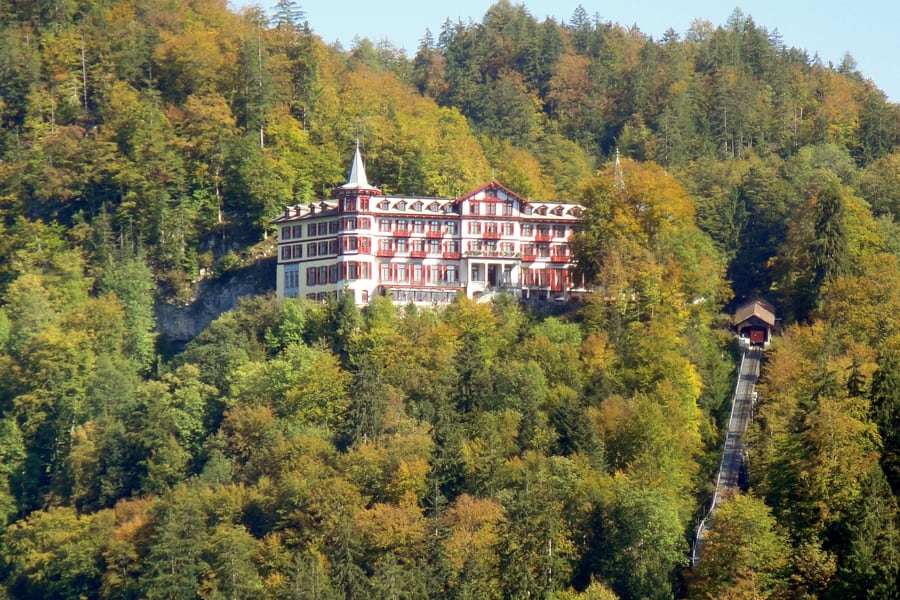 Krol:k / Wikimedia Commons · CC BY-SA 3.0 · cropped
Grandhotel Giessbach
Above the falls, reached by boat and funicular
Built in 1873–75 for the Hauser family of hoteliers to designs by the French architect Horace Edouard Davinet, and a summer address for European society until 1914. It closed in 1979 and was to be demolished; in November 1983 Franz Weber bought the estate and its 22 hectares through Helvetia Nostra and had it listed. The funicular from the lake belongs to the hotel.
Check Availability (opens in a new tab, on giessbach.ch)via giessbach.chQuestions or corrections
Planning this trip and stuck on something, or spotted a time, fare or detail that has changed? Send us a message about Brienz Rothorn Bahn. We read every one, and we update this page when something has changed.