Brussels Tram Museum to Tervuren
Smiley.toerist / Wikimedia Commons · CC BY-SA 4.0 · cropped
- DistanceAvenue de Tervuren and the Sonian Forest · standard gauge
- DurationAbout 25 minutes each way
- Best seasonApril–September weekends · one weekend a month in winter
Introduction
In 1897 Brussels held a Universal Exhibition on two sites: the palaces of the Cinquantenaire park in the city, and a colonial section in the royal estate at Tervuren. King Leopold II wanted them joined by something grander than a road, so he had one built — the Avenue de Tervuren — and insisted that a tram run along it. The avenue, the tram line and a depot at Woluwe to work it were ready when the line opened in May 1897.
All three are still there. The avenue still runs from the Cinquantenaire to the gates of Tervuren park. The line is STIB's tram 44, which still ends at Tervuren. And the depot at Woluwe is now the Brussels Tram Museum, whose volunteers take the city's old trams out of the sheds on weekends and drive them over the route they were built for.
That is the journey: twenty-five minutes from the museum gates, along the avenue, through the beechwoods of the Sonian Forest and into the loop at Tervuren, in a tram from the 1910s or 1930s, often with an open trailer behind. The ordinary 44 runs beside you on the same rails. The fare includes the museum, and there is no booking: you buy a ticket at the depot and get on.
A museum that kept its trams running
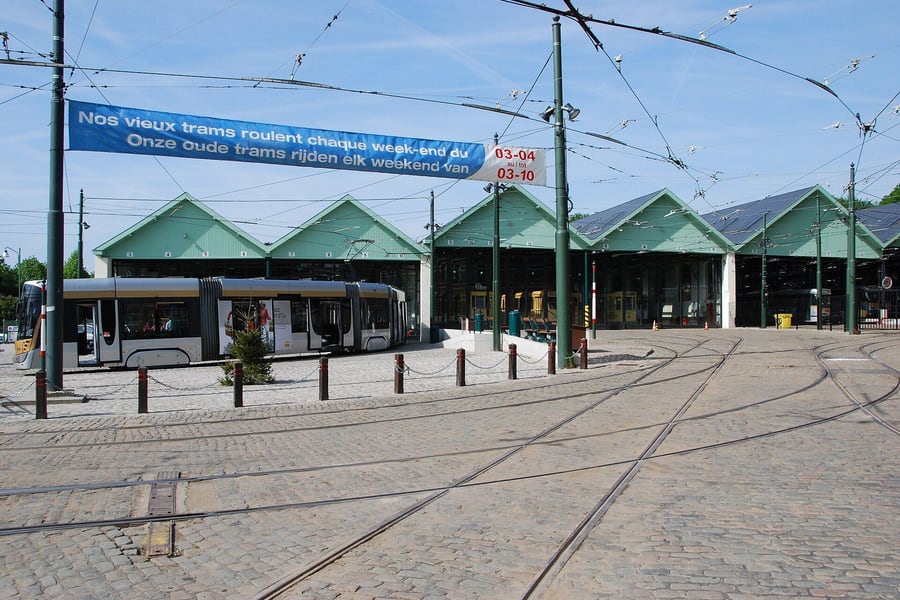
The depot was a working STIB shed until 1976, when its first two halls were given up and turned into exhibition space. The MTUB — the Musée du Transport Urbain Bruxellois, an association of volunteers founded with STIB in 1982 — has run it ever since. The third hall is still a live depot for the modern trams of lines 39, 44 and 8, so the museum's cars leave through a yard that has never stopped being part of the network.
The Journey
The heritage trams start from the museum itself, at Avenue de Tervuren 364b in Woluwe-Saint-Pierre, opposite Woluwe Park — the Musée du Tram / Trammuseum stop on lines 39, 44 and 8.
Along the avenue
The first five minutes are on the Avenue de Tervuren, a broad boulevard laid out for Leopold II, with the tram on its own track for most of the way. At Madoux, line 39 turns off towards Stockel — the museum runs its own trams that way too — and the Tervuren line carries on along the Chaussée de Tervuren.
Through the Sonian Forest
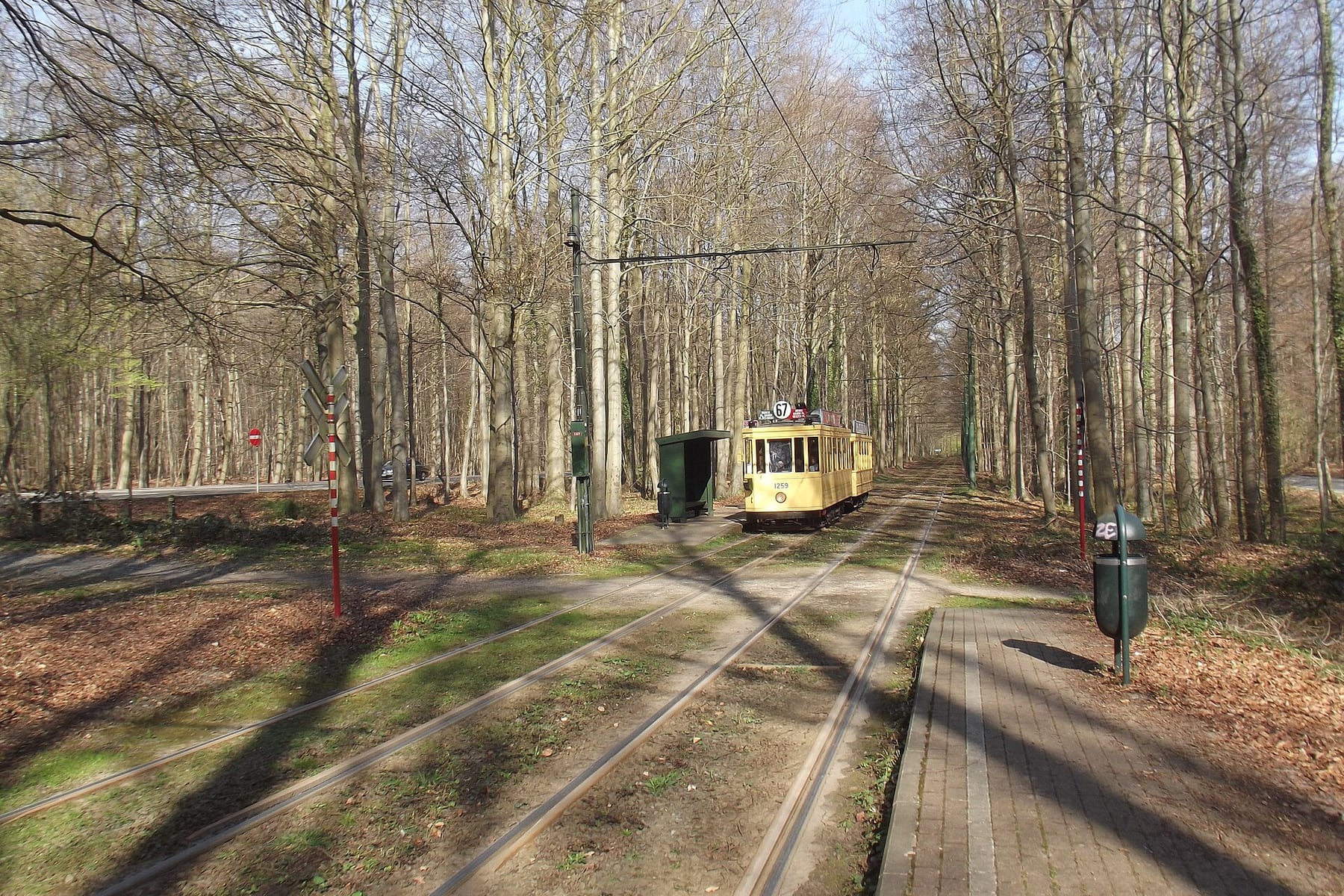
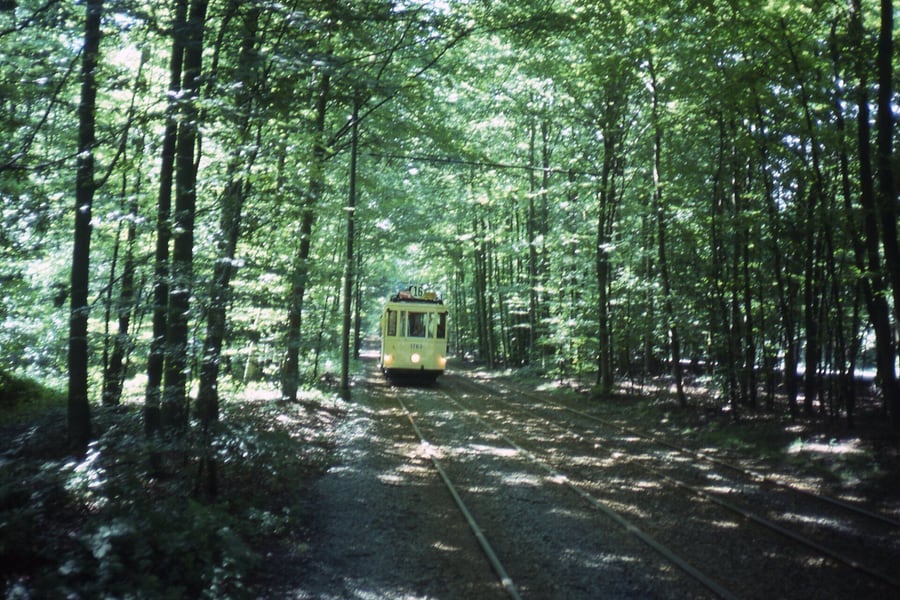
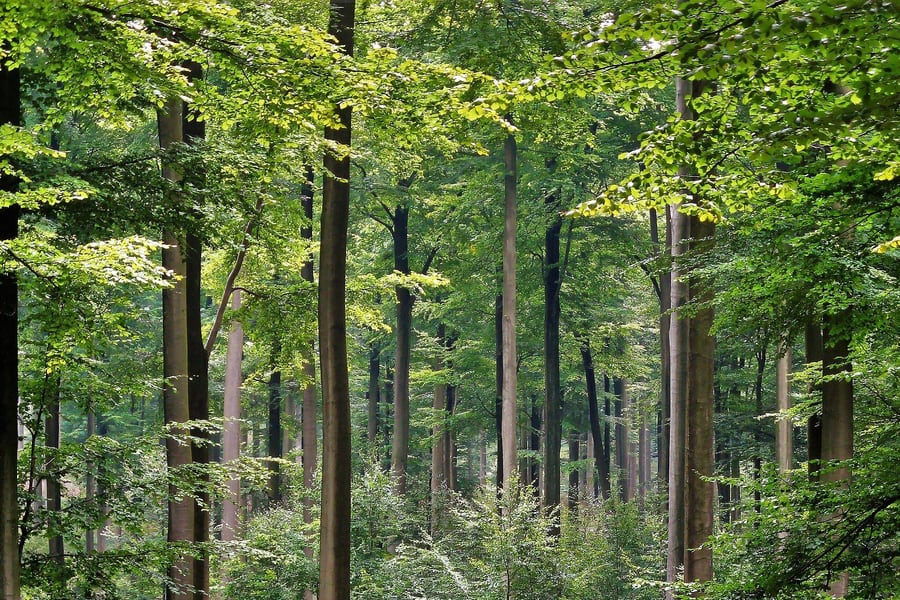
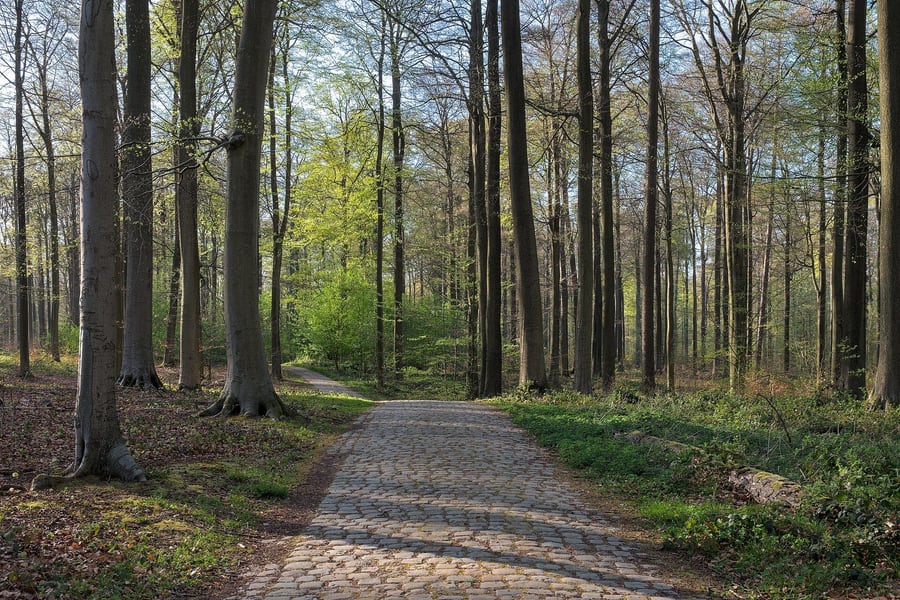
Then the houses stop. The Sonian Forest is 4,421 hectares of beechwood on the south-eastern edge of Brussels, the remnant of a forest that once reached the city walls, and part of it has been a UNESCO World Heritage Site since 2017. The tram runs straight through it on double track, with tall, grey trunks on both sides and the canopy closing overhead in summer. This is the stretch people come for, and it is the stretch the photographers have always come for too: most of the pictures on this page were taken in it.
At Quatre-Bras, seventeen minutes out, the line crosses the ring road. The crossing here used to have railway-style St Andrew's crosses, a flashing white light and a bell — the only tram crossing in Belgium with both lights and a bell — until traffic lights replaced them in 2024.
Into Tervuren
The last stretch runs into Tervuren, to a wooded turning loop called Tervuren Station. The name recalls Tervuren's railway station on line 160, which closed to passengers at the end of 1958; the tram has outlived it by almost seventy years. The loop is the stop for the AfricaMuseum and the park. The tram waits at the loop for a few minutes and goes back the way it came; a round trip is roughly an hour.
The trams
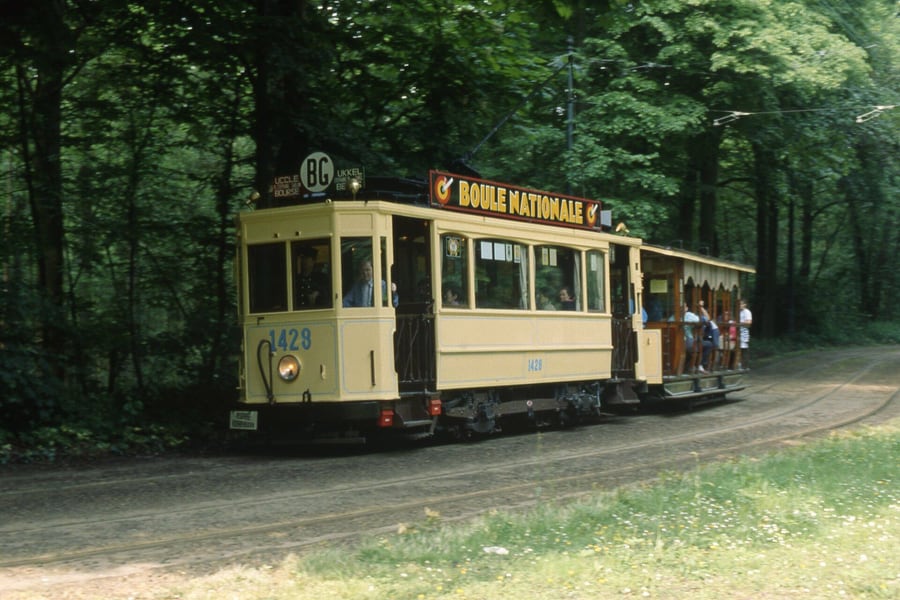
The collection runs to about 130 vehicles, all owned by STIB and kept by the volunteers, and some ninety are on show in the halls. The ones that go out on the line change from day to day. Those in the photographs on this page include:
- 1259, a yellow motor car in Brussels service from 1934 to 1973.
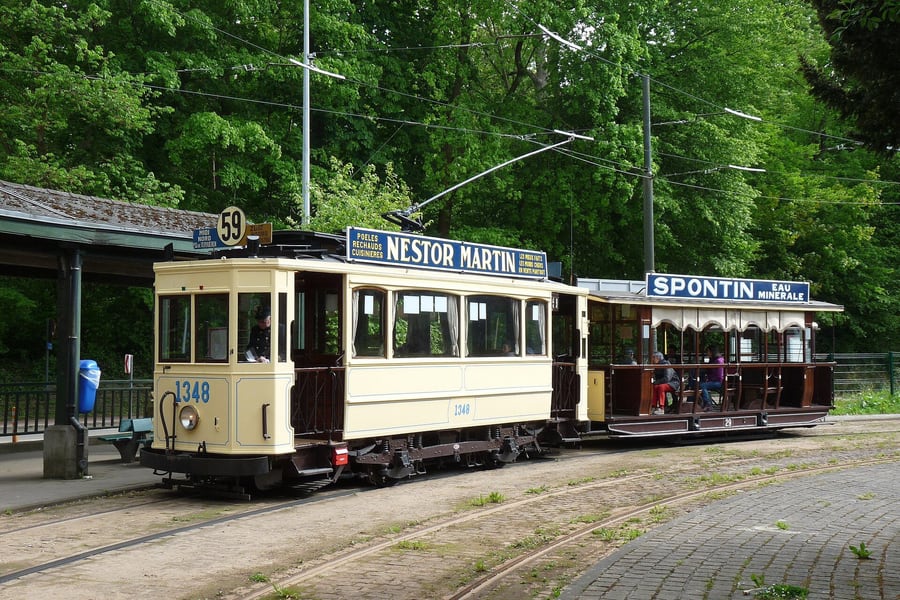
- 1348, a cream-and-varnish car that ran from 1914 to 1960.
- 1305, a green car of 1910, with its trailer 671.
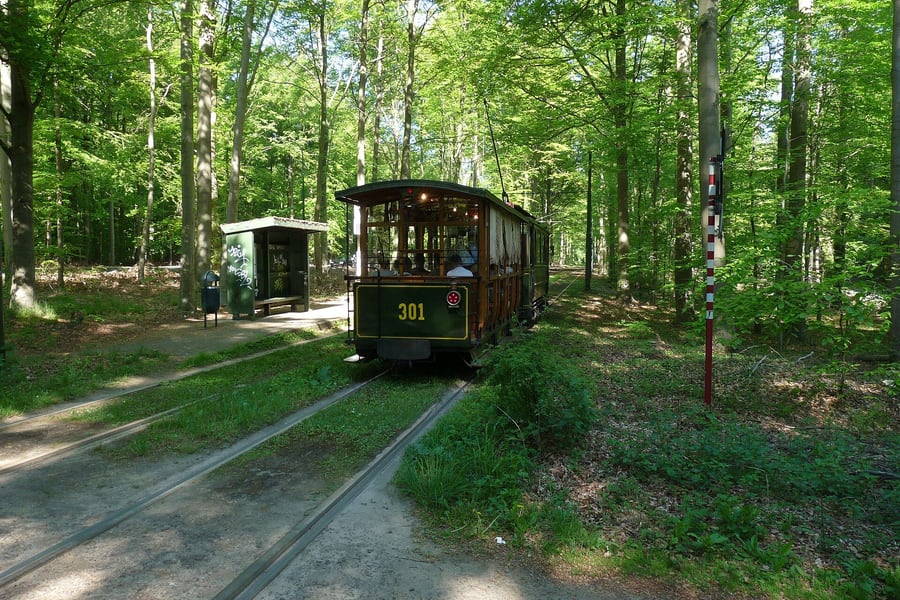
- Open trailers such as 301 (1910–1930): wooden benches, a roof and nothing at the sides.
The cars carry period advertising boards on their roofs — mineral water, stoves, soap powder — and route numbers long since retired. A 45 on the roof means the old service from Anderlecht to Tervuren, withdrawn in 1976.
The vehicles are not wheelchair-accessible, though the museum itself is.
Along the route
 Stephane Mignon / Wikimedia Commons · CC BY 2.0 · cropped
A depot built for one exhibition
The Woluwe depot opened with the line in 1897, and the museum now fills its first two halls. The third is still a working STIB depot, with about thirty modern trams for lines 39, 44 and 8 — the old trams leave through the same yard.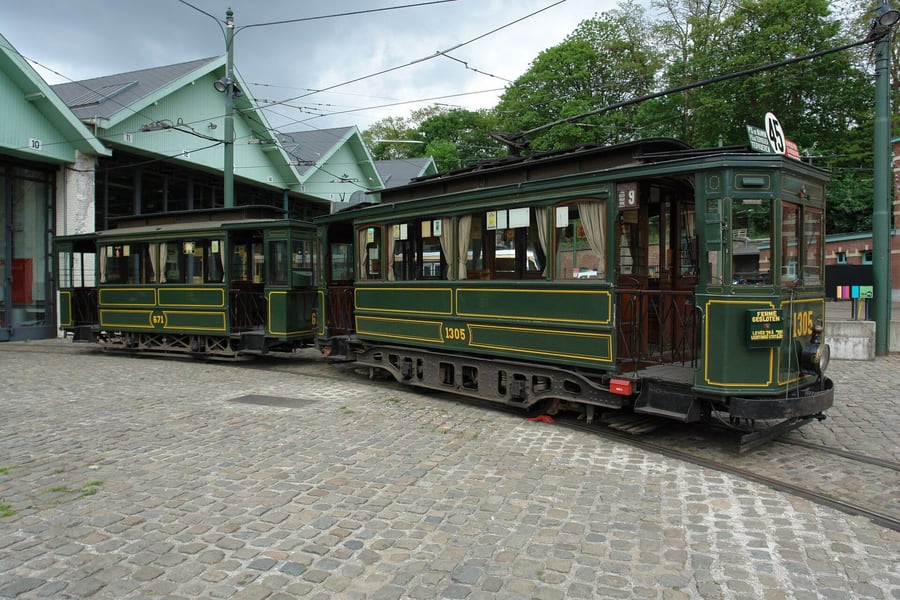 NearEMPTiness / Wikimedia Commons · CC BY-SA 4.0 · cropped
The fleet in the yard
About ninety of the museum's 130 vehicles are on show, and some of them still go out on the line. Car 1305 and trailer 671, both new in 1910, stand in the cobbled yard between the sheds.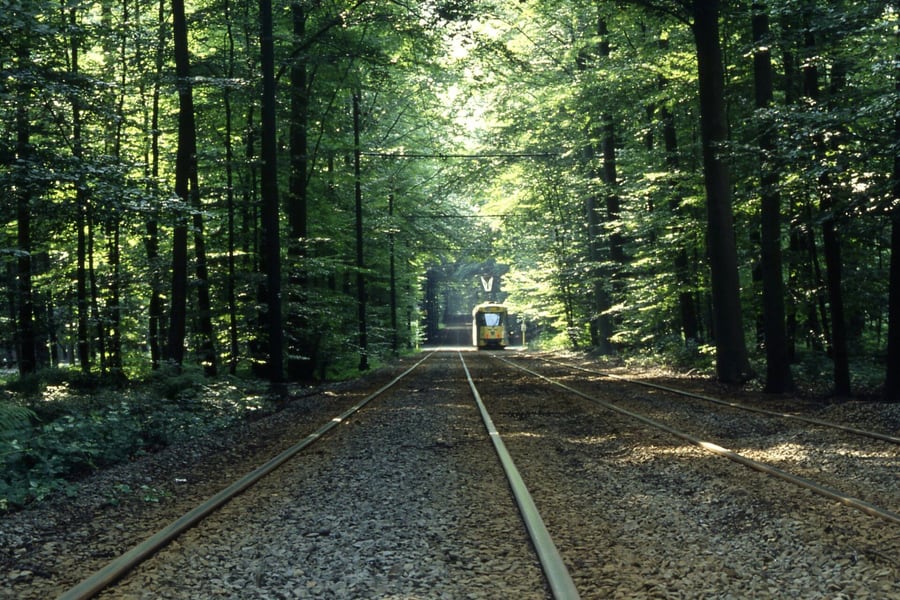 Smiley.toerist / Wikimedia Commons · CC BY-SA 4.0 · cropped
Into the forest
Beyond Madoux, where line 39 turns away, the tram takes the Chaussée de Tervuren into the Sonian Forest: double track on its own strip, dead straight between the beeches, as far as the ring road at Quatre-Bras.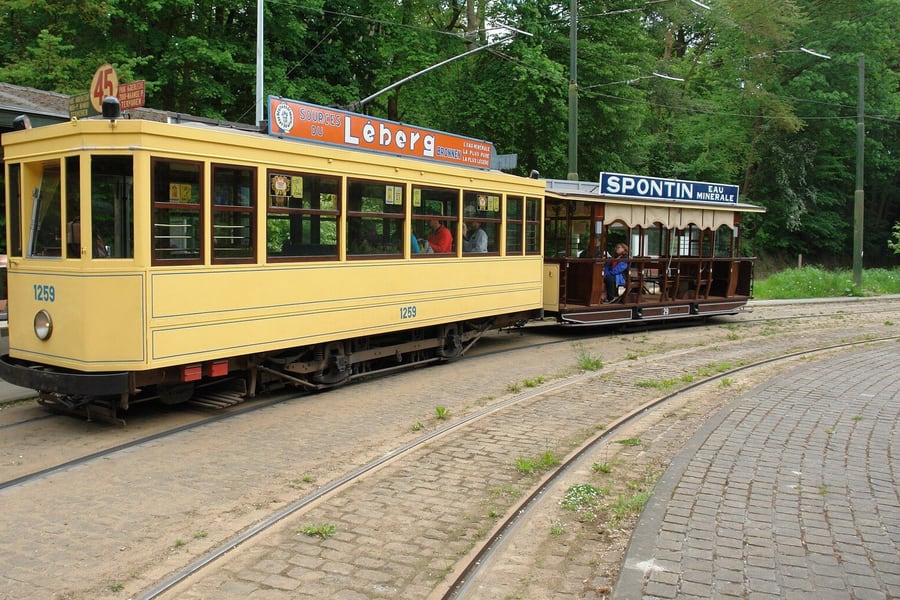 NearEMPTiness / Wikimedia Commons · CC BY-SA 4.0 · cropped
The loop at Tervuren
The line ends in a wooded turning loop at Tervuren Station, named after a railway station that closed to passengers in 1958. Car 1259 carries a 45 board here, a number that ran to Tervuren until 1976.A bit of history
Culture & experiences along the way
 NearEMPTiness / Wikimedia Commons · CC BY-SA 4.0 · cropped
The halls of the museum
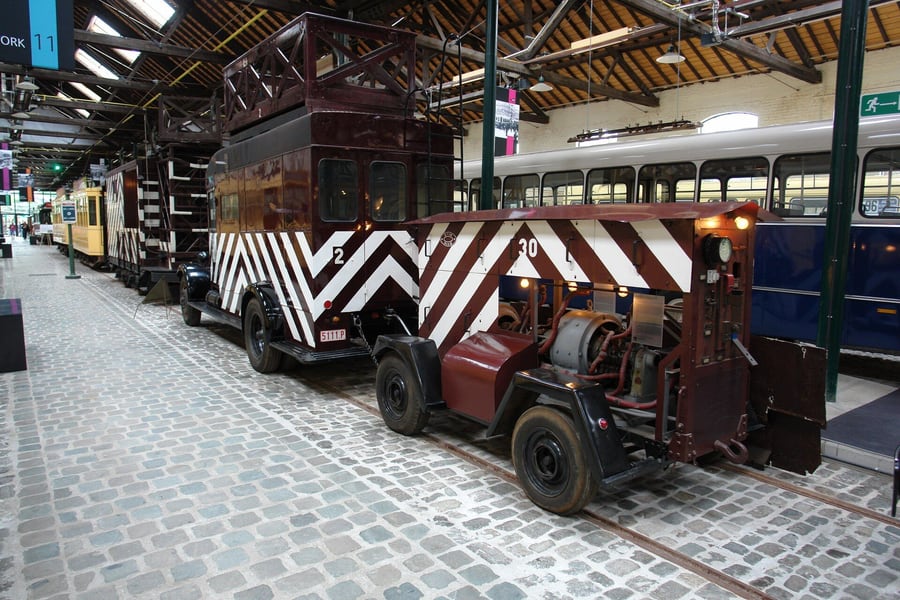
The ticket covers the museum too, and its halls are the old car sheds: cobbled floors, timber roof trusses and track still set into the ground. Horse trams, tower wagons for the overhead wires, buses and trolleybuses stand in long rows, covering about a century and a half of getting around Brussels.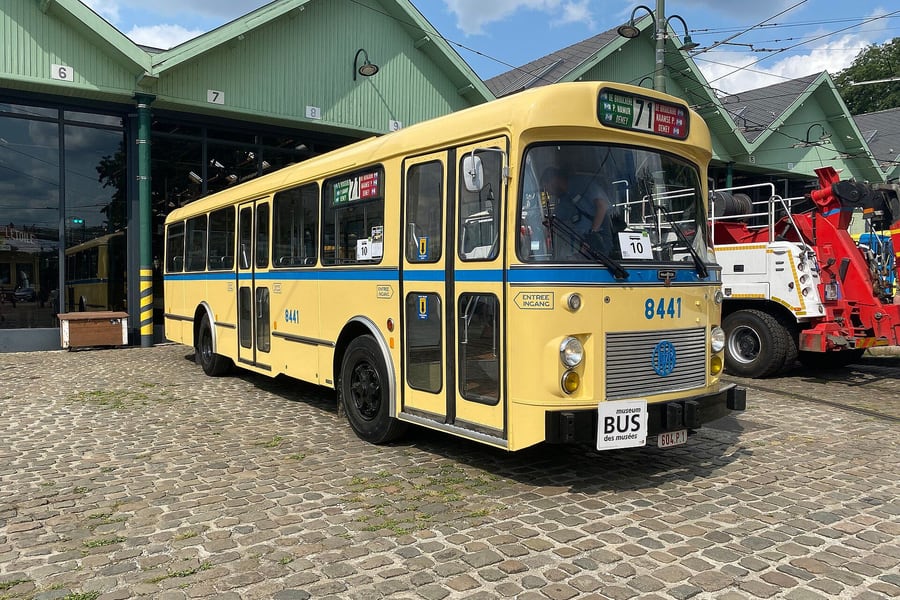 Niiko233 / Wikimedia Commons · CC BY-SA 4.0 · cropped
The old bus to the European quarter
On summer Sundays the museum also runs a heritage bus from the depot to Place du Luxembourg, in the European quarter, by way of Merode. Bus 8441 worked in Brussels from 1969 to 1984. There are no heritage buses in winter 2026–27, until further notice.Timetables
The heritage trams run only on the museum's opening days: every weekend and public holiday from April to the end of September, 13:00–18:30, and one weekend a month from October to March, with an extra weekend in December. There is no booking for an ordinary ride — turn up at the museum and board. Times below are from the museum's own timetables, read on 24 November 2026.
Summer 2026 (from 4 July)
Saturday — three round trips:
| Musée du Tram | Madoux | Quatre-Bras | Tervuren Station | Back at the museum |
|---|---|---|---|---|
| 13:54 | 13:59 | 14:11 | 14:19 | 14:51 |
| 15:09 | 15:14 | 15:26 | 15:34 | 16:06 |
| 16:24 | 16:29 | 16:41 | 16:49 | 17:21 |
Sunday — six round trips, every forty minutes:
| Musée du Tram | Tervuren Station | Leaves Tervuren | Back at the museum |
|---|---|---|---|
| 13:47 | 14:12 | 14:23 | 14:48 |
| 14:27 | 14:52 | 15:02 | 15:27 |
| 15:07 | 15:32 | 15:43 | 16:08 |
| 15:47 | 16:12 | 16:23 | 16:48 |
| 16:27 | 16:52 | 17:03 | 17:28 |
| 17:07 | 17:32 | 17:43 | 18:08 |
On Sundays the museum also runs heritage trams to Stockel and to Merode by the Cinquantenaire, and a heritage bus to Place du Luxembourg, all on the same ticket. On Saturdays there is one late round trip to Stockel, leaving the museum at 17:32.
The 2027 summer timetables are not out yet; the museum posts each season's on its homepage.
Winter 2026–27
One weekend a month, 13:00–18:30, with trams to Tervuren and Stockel. Each weekend takes a decade of the city's transport as its theme. All the vehicles are heated. There are no heritage buses until further notice.
- 12–13 December 2026 — the museum's Christmas market, open from 10:30. Trams leave for Tervuren every forty to forty-five minutes: on the Saturday from 10:52 to 17:22, on the Sunday from 11:08 to 17:08. A round trip takes an hour.
- 19–20 December 2026 — the 1980s
- 9–10 January 2027 — the 1970s
- 13–14 February 2027 — the 1960s
- 13–14 March 2027 — the 1950s
Getting to the museum
The museum is on STIB's own tram route. From Brussels-Central take metro 1 towards Stockel and change at Montgomery to tram 39 or 44; get off at Musée du Tram / Trammuseum. Tram 8 stops there too, from Roodebeek or Hermann-Debroux. There is a Villo bike-share station less than 100 metres away. If you drive, park on Rue du Leybeek or Boulevard du Souverain, not in the museum courtyard.
If you miss the last heritage tram back from Tervuren, the ordinary tram 44 covers the same route to the museum and on to Montgomery.
Check the calendar and timetables on the Brussels Tram Museum's website (opens in a new tab) before you travel.
Tickets
There is one ticket, bought at the museum on the day: museum entry and every heritage ride for the whole day, at €13 for adults (13–64), €10 for over-65s and groups of twenty or more, and €6 for children aged 6–12. Under-sixes ride free, two per adult. Museum entry alone is €9, with a €5 supplement per ride. These are the prices on the tariff sheet the museum links from its homepage, which is dated 2024 and was still the one linked in November 2026.
Buy the day ticket. It lets you go out to Tervuren, walk the park, ride back, then take another tram to Stockel or, on a summer Sunday, the old bus into the European quarter. The Brussels Tourist Tramway is a different product: a three-hour city tour, booked online in advance.
Book your tickets
Museum and heritage rides, one day
€13 adult · €10 over 65 · €6 child 6–12
One ticket covers the museum and every heritage tram and bus that day, bought at the depot.
Book Tickets (opens in a new tab, on trammuseum.brussels)via trammuseum.brusselsBrussels Tourist Tramway
€22 adult · €16 child 6–11 · about three hours
The museum's separate, bookable tour of the city by heritage tram, sold online in advance.
Book Tickets (opens in a new tab, on trammuseum.brussels)via trammuseum.brusselsRail Passes
No rail pass covers the museum's trams, and none is worth buying for this trip.
An Interrail or Eurail pass is valid on the trains of SNCB/NMBS, the Belgian national railway, and will get you to Brussels. The heritage trams belong to the museum's volunteer association and take only the museum's own day ticket, which costs €13 and includes the museum. The ordinary trams and metro that take you to the museum are run by STIB, Brussels' city transport operator, which sells its own tickets.
So a pass is for getting to Brussels. For the ride itself, the museum ticket is the whole cost.
Places to Visit
The Avenue de Tervuren was built to connect two exhibition grounds, and both are still there to visit, one at each end of the line. At the city end is the Cinquantenaire, with its triple arch and three museums. At the Tervuren end are the AfricaMuseum and the park behind it, which runs straight into the Sonian Forest.
Between them, on the avenue itself, is one of the great private houses of the twentieth century. A half-day on the tram leaves time for one of these; a full day can take in the museum at Tervuren and a walk in the park before the last tram back.
 Jmh2o / Wikimedia Commons · CC BY-SA 4.0 · cropped
The AfricaMuseum
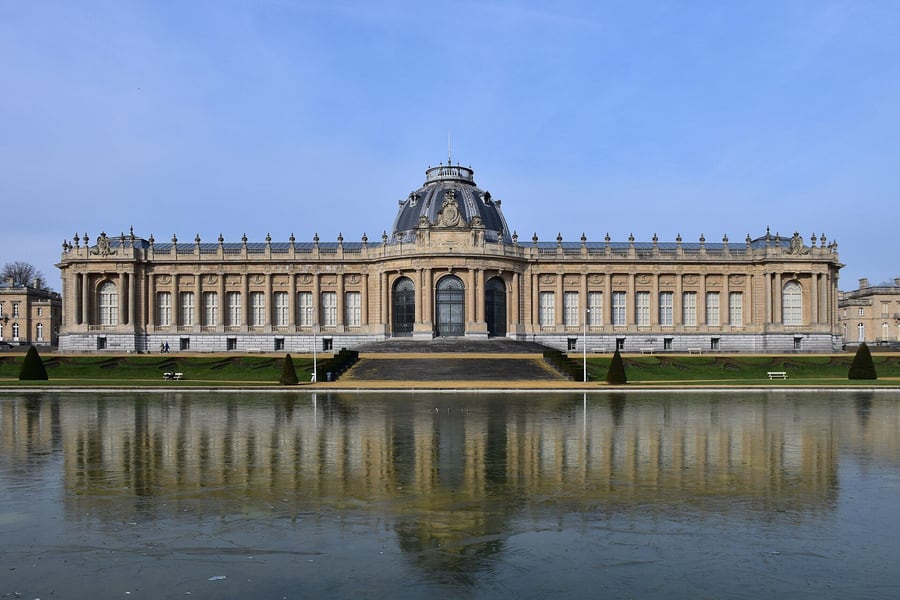
The tram stops a short walk from the building it was built to reach. The Palace of the Colonies went up in Tervuren for the 1897 exhibition, and the museum that grew out of it was the showcase for Leopold II's Congo; since 1960 it has turned to ethnography, anthropology and natural history across Central Africa. It closed for rebuilding in 2013 and reopened in December 2018 as the AfricaMuseum.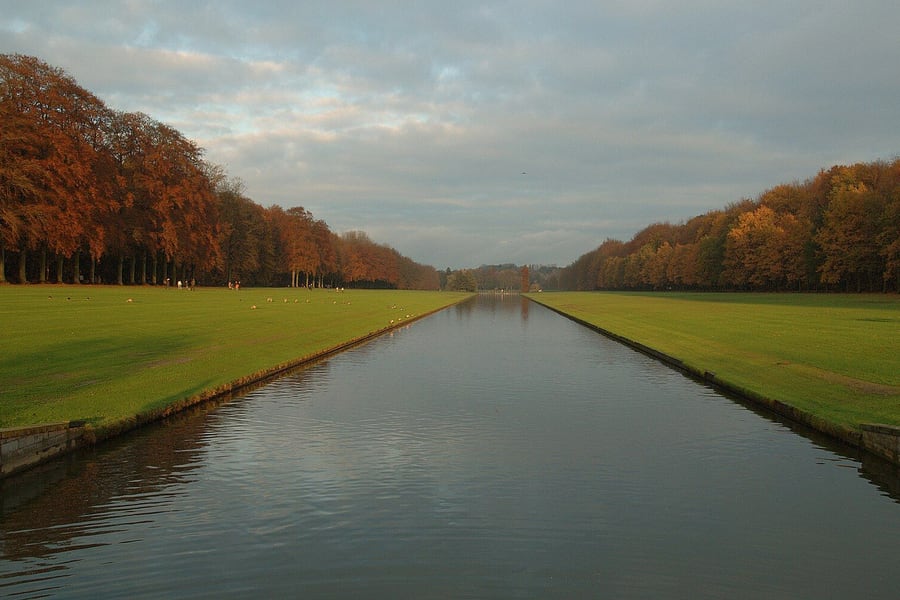 Luc Viatour / https://Lucnix.be · Wikimedia Commons · CC BY-SA 3.0 · cropped
The Park of Tervuren
The Avenue de Tervuren ends in front of the museum, and behind it the old ducal hunting park opens out: formal lawns, a long straight canal, eight ponds, the little Saint Hubert chapel, and avenues that meet in a star. The dukes of Brabant had a castle here from the thirteenth century until it was pulled down in 1782. The park runs straight into the Sonian Forest.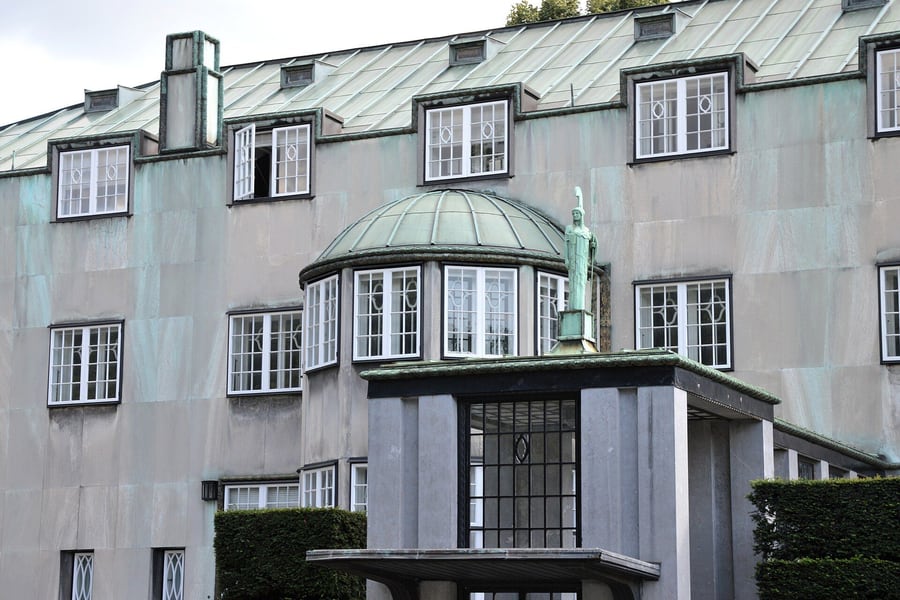 Busoni / Wikimedia Commons · CC BY-SA 3.0 · cropped
The Stoclet Palace
On the Avenue de Tervuren itself, at numbers 279–281, stands the house Josef Hoffmann built for the banker Adolphe Stoclet between 1905 and 1911: plain geometric blocks faced in marble plaques, with mosaic friezes by Gustav Klimt inside. It has been a UNESCO World Heritage Site since 2009 and is still the Stoclet family's private home, so the street front is all anyone sees. It stands nearer the city than the museum, on the same avenue.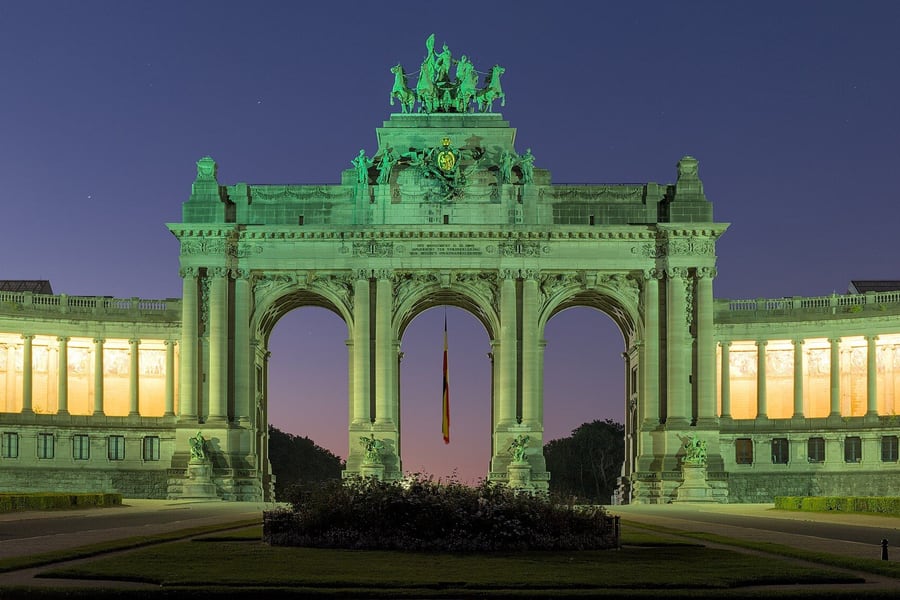 Trougnouf (Benoit Brummer) / Wikimedia Commons · CC BY 4.0 · cropped
The Cinquantenaire
The other end of Leopold II's avenue. The park and its colonnades were built for the national exhibition of 1880, and the triple arch went up in 1905. The wings hold the Art & History Museum, the Royal Museum of the Armed Forces and Autoworld. On summer Sundays a museum tram runs from the depot to Merode, at the park's edge.Where to Sleep
This is a day out from Brussels, and most people will stay in the city. Two hotels make particular sense for it.
Eurostars Montgomery is on Square Montgomery, at the city end of the Avenue de Tervuren, where the metro meets trams 39 and 44. From its door the museum is a short tram ride along the avenue. Hotel Rastelli is in the middle of Tervuren, at the far end of the line, and suits a weekend that pairs the tram with the AfricaMuseum, the park and a walk in the Sonian Forest. It has free parking.
The cards carry no price, star rating or review score, because we have checked none of those. We did open and read both hotels' own websites in November 2026: both are trading and both take direct bookings.
Where to stay
Eurostars Montgomery
Sixty-three rooms on Square Montgomery
A hotel dressed in Victorian-British style at Avenue de Tervuren 134, by the metro stop where you change for the tram to the museum.
Check Availability (opens in a new tab, on eurostarshotels.co.uk)via eurostarshotels.co.ukHotel Rastelli
Forty-four rooms in Tervuren
A hotel in the middle of Tervuren with free private parking, close to the park and the AfricaMuseum.
Check Availability (opens in a new tab, on hotelrastelli.be)via hotelrastelli.beQuestions or corrections
Planning this trip and stuck on something, or spotted a time, fare or detail that has changed? Send us a message about Brussels Tram Museum to Tervuren. We read every one, and we update this page when something has changed.