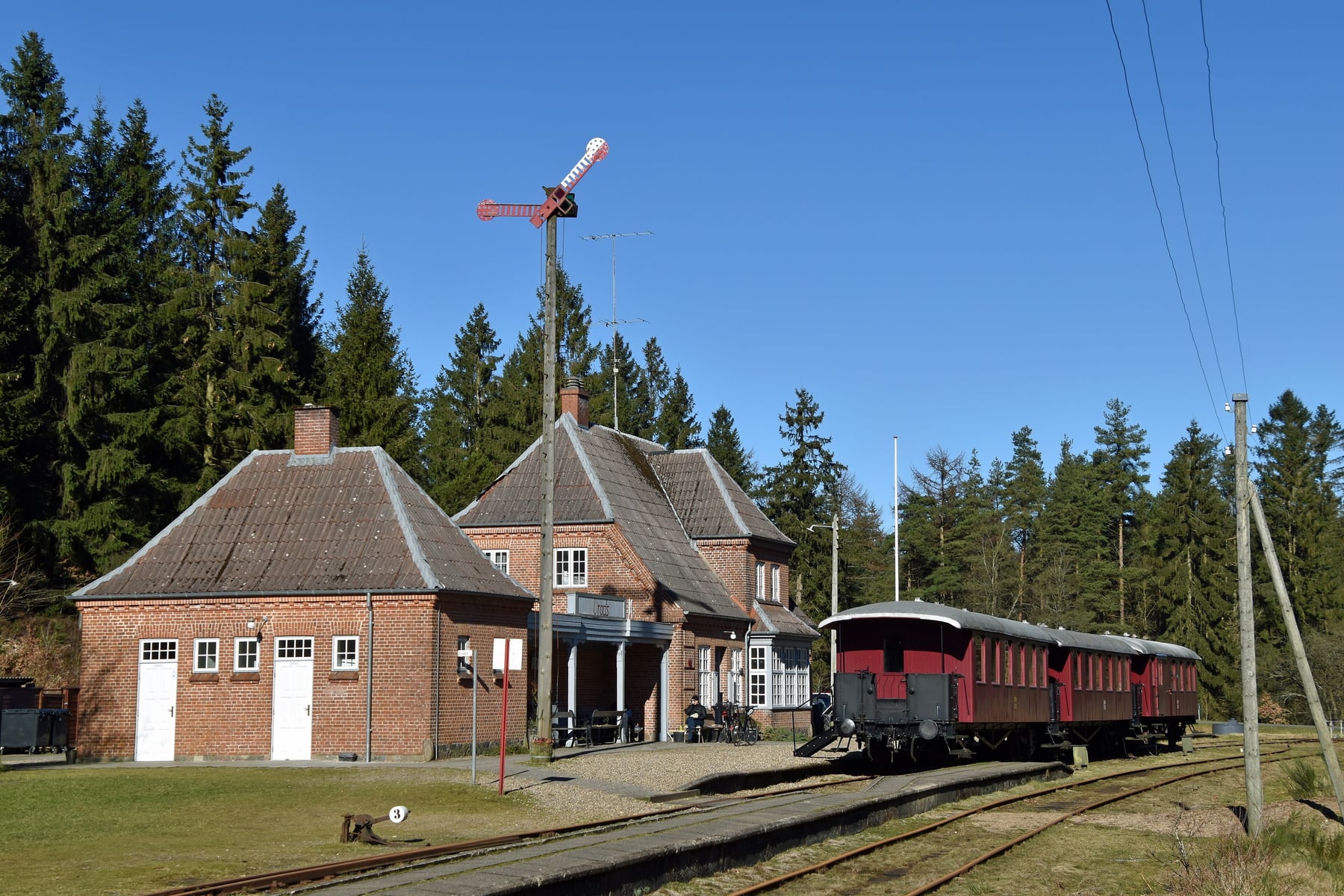
Bryrup to Vrads: Denmark's Most Beautiful Railway
Tdn70 / Wikimedia Commons · CC BY 4.0
- Distance5 km · Bryrup to Vrads
- Duration15 min each way · four return trips a day
- Best season29 March – 17 October · steam on summer Sundays
Introduction
Five kilometres of railway run west out of Bryrup, through spruce and birch, past three small lakes, and stop at a brick station in a clearing. The trip takes fifteen minutes. It is the only surviving piece of the Horsens–Bryrup–Silkeborg Jernbane, which was sixty-one kilometres long, opened in 1929 as the last private railway Denmark ever built, and closed thirty-nine years later.
The company that built it was in trouble almost from the start. Motor cars were already taking its traffic, and the deficit grew through the 1930s and after the war. So its management tried other things. It ran excursion trains out to the woods for people who wanted a day in the country. It ran Christmas tree trains on the last Sundays before Christmas, the trees cut off the railway's own embankments by the permanent-way foreman and carried back to the station on his rail cycle. And in 1963 it parked a locomotive and two carriages at Vrads for the summer and served coffee in them, with a menu of railway jokes — sveller, sleepers, for the kringle; udsnit af drejeskive, a slice of turntable, for the layer cake; tandhjul, cogwheels, for the vanilla biscuits.
None of it worked. The deficit passed half a million kroner in 1964–65, the municipalities withdrew, and the last railbus left Horsens on 30 March 1968.
What is remarkable is which part of the railway survived. Not the route, which is a cycle path. Not the traffic, which went to the roads. The sidelines survived. Veteranbanen Bryrup-Vrads runs excursion trains, four round trips on a running day; it runs the Christmas tree trains on the last three weekends before Christmas; and the two carriages and the luggage van from that 1963 restaurant train are still standing at Vrads Station, still serving food, with the old post compartment still doing duty as the kitchen. The things a dying company invented to keep itself alive are the whole of what outlived it.
The Journey
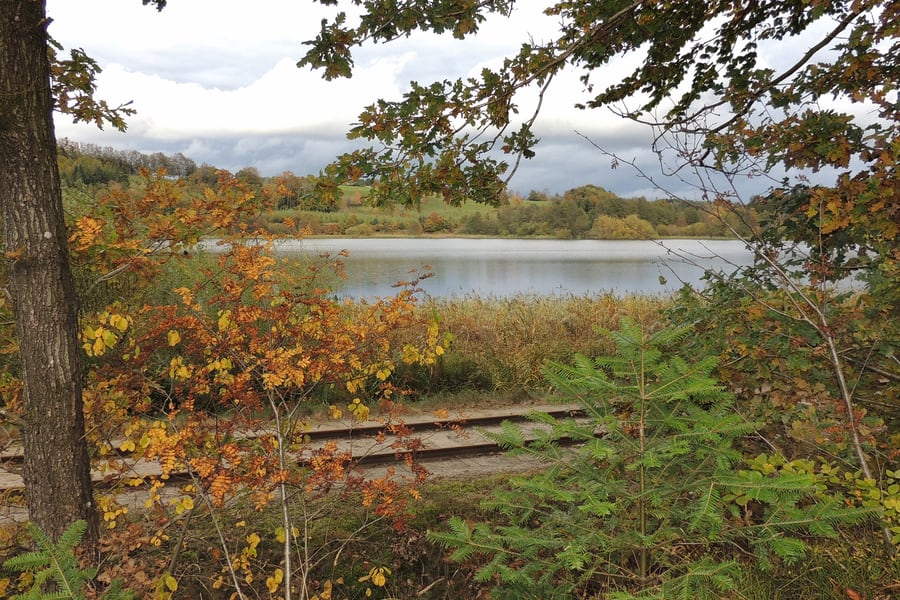
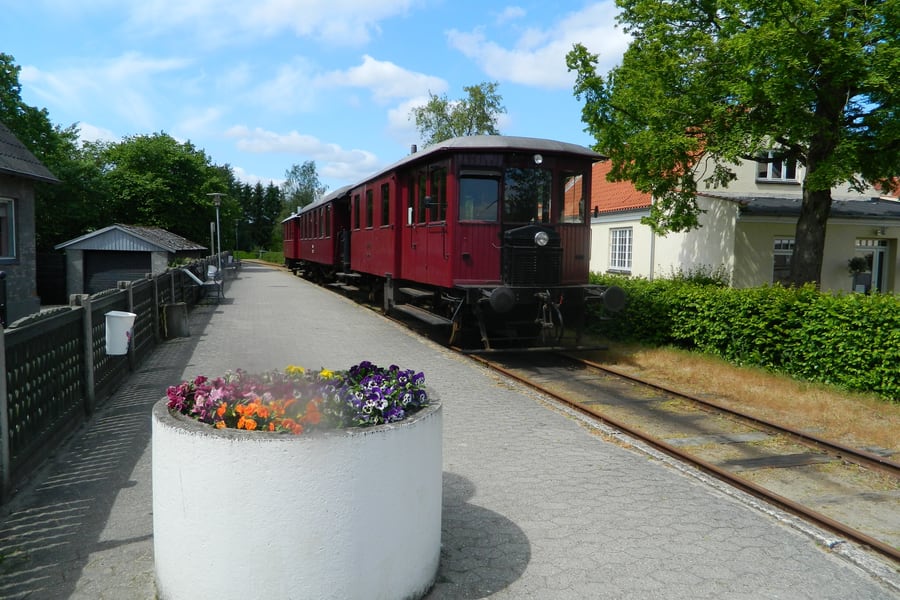
The train leaves Bryrup from a platform beside Hovedgaden, the main street, and is clear of the village within a minute. The line runs west and slightly north through plantation woodland, past Kvindsø, Kulsø and Snabe Igelsø — three small lakes in a landscape of heather hills and inland dunes — and climbs gently to Vrads, where the rails end a few metres beyond the platform. There is a halt on the way at Skåningbro, a survivor of the old line, whose shelter is a hut clad in leaves.
Fifteen minutes is not long, and the carriages were designed with that in mind. The five coaches bought for the extension in 1929 were two-axle wooden vehicles with open platforms at each end, divided into a smoking and a non-smoking compartment with a lavatory at one end, and they were given deliberately oversized windows so that passengers could see out into the country the line ran through. Two of them, HBS C 225 and C 227, are still in traffic.
The trains
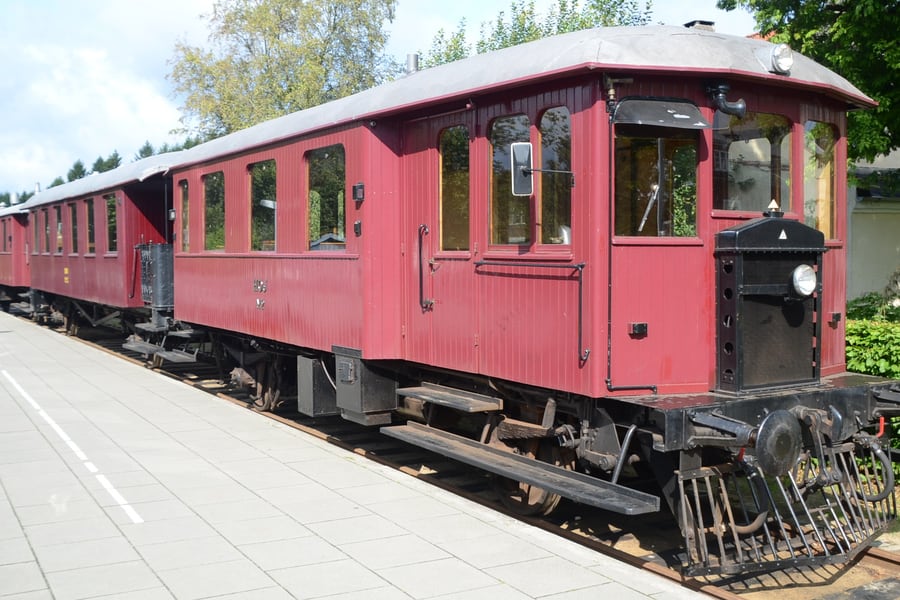
The everyday traction is not steam. The line's normal train is a Triangel motor coach, built by the Triangel works in Odense between 1928 and 1932 — a single-ended wooden railcar on three axles, with a manual gearbox, a reversing gear and thirty-odd seats. HBS bought Triangel stock from the day it opened in 1929, and the motor coaches went on working the goods trains until the line shut in 1968. Four of them survive here. The petrol engines they were built with were replaced by Leyland diesels in the early 1950s, which is what they still run on.
Steam appears on Sundays through the summer, and it is not the line's own. Its three original engines were sold or scrapped between 1952 and 1962. The society bought back a twin of them at the founding — HV 2, built by Henschel of Kassel in 1928, the same year as Vrads Station, and the very locomotive that stood at Vrads with the restaurant train in 1963 — but it has been out of use since 1983 with a cracked firebox and is waiting for repair. The engines in steam today are two Danish State Railways tank locomotives, F 658 and F 665, built by Frich of Aarhus in 1949. F 665 came back into traffic in 2024 after thirty years standing still.
Why the railway is here at all
The first plans for a line north-west out of Horsens date from about 1875, and the legal basis came with the great Railway Act of 1894. A concession was issued on 20 May 1896, and the Horsens–Bryrup Jernbane opened on 22 April 1899 — metre gauge, on rails weighing twelve and a half kilos a metre, unfenced, with nobody watching the crossings. It took over two hours to cover thirty-eight kilometres. Bryrup at the time had a church, a school and a poorhouse whose land could conveniently be parcelled out for a terminus; thirty years later it had fifty-two shops and businesses.
Silkeborg then wanted the line carried on to meet it. The licence came on 31 March 1920 and required the whole thing to be rebuilt to standard gauge, and it took two years of argument merely to agree that Bryrup needed a new station — the alignment through the village was moved so the train could cross the road on the level and pass south of Kvindsø instead of north of it.
Then something quietly decisive happened. Earthworks were started in June 1922 as state-supported relief work for the post-war unemployed, which committed the councils and the county to finishing the job. It also had an effect nobody advertises: schemes with earthworks already under way escaped scrutiny by the state committee appointed to look critically at the many projects in the Railway Act of 1918 — and not one of the schemes that committee did examine was ever built. The Bryrup line was digging before the committee could reach it.
Construction through the hills took the rest of the decade. The regauged section opened on 15 April 1929 and Bryrup–Silkeborg on 10 May 1929, making sixty-point-nine kilometres in all — a kilometre longer than the state railway's own route from Horsens to Silkeborg by way of Skanderborg. It was the last private railway line to open in Denmark, and it acquired the nickname Danmarks smukkeste jernbane, Denmark's most beautiful railway, almost at once.
Buying a railway at auction
When the closure came, the county conservation committee wanted a cycle path along the whole route. A group in Bryrup led by the watchmaker Noes Tholstrup wanted to keep the Silkeborg half running, and settled for the five kilometres to Vrads, where alternative cycle routes could be offered and the parish council was behind them. A Veteran Railways Act passed that same year gave municipalities a way to hold a concession for a museum line and pass the operating to a club — the law that also made Mariager–Handest possible.
At the auction of the rolling stock on 5 November 1968 they bought a steam locomotive, a Triangel motor coach, two railbuses, a luggage van, an open wagon, four carriages, a draisine, Vrads Station and the track. Eleven days later the whole lot ran home from Horsens under its own steam along a railway that had been officially closed for seven months, and reached Bryrup just before sunset to a crowd. The same afternoon, in the same yard, the surplus was being marshalled into the train that went to the breakers at Odense.
The society had been formed on 4 November 1968. Its first train ran on 26 April 1969.
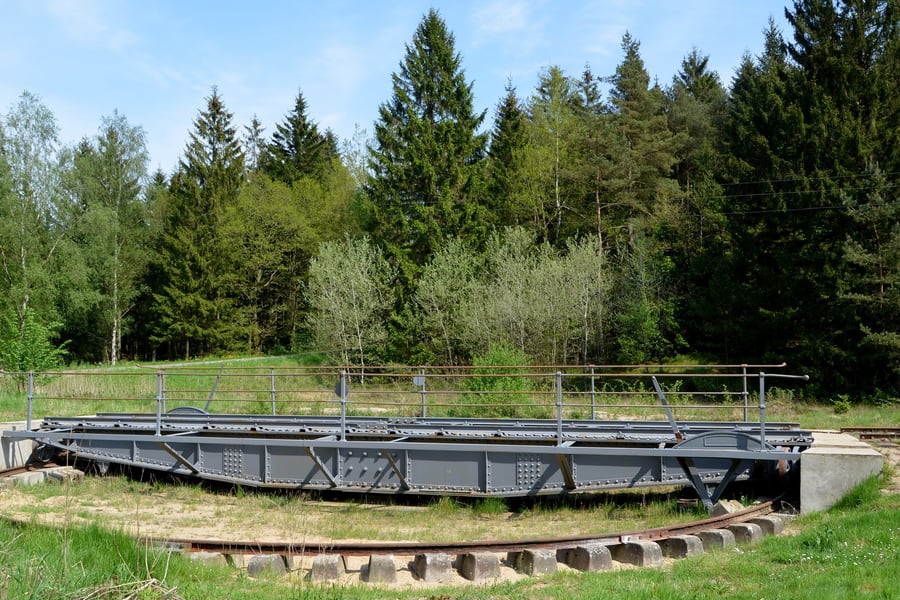
Along the route
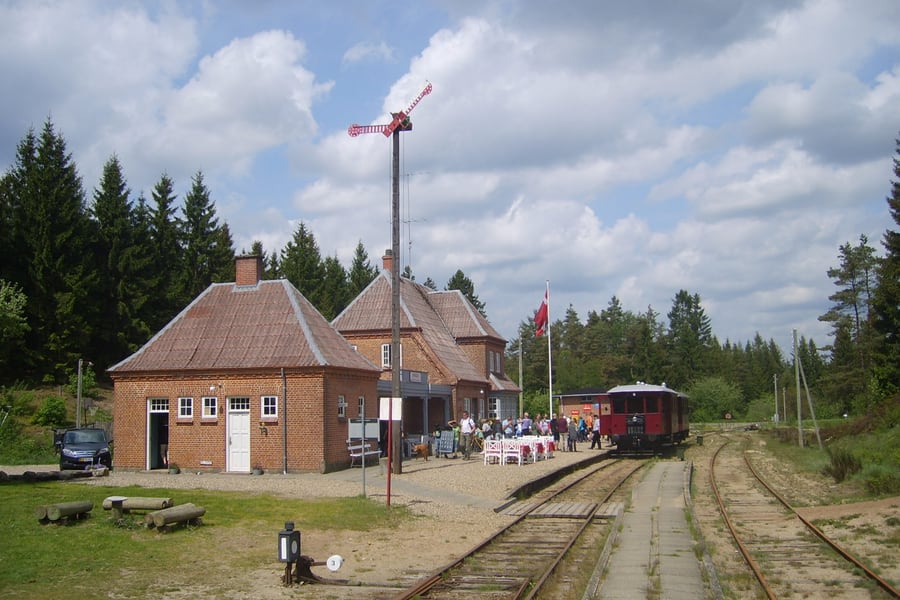 Jan Pešula / Wikimedia Commons · CC0
The restaurant that was always a train
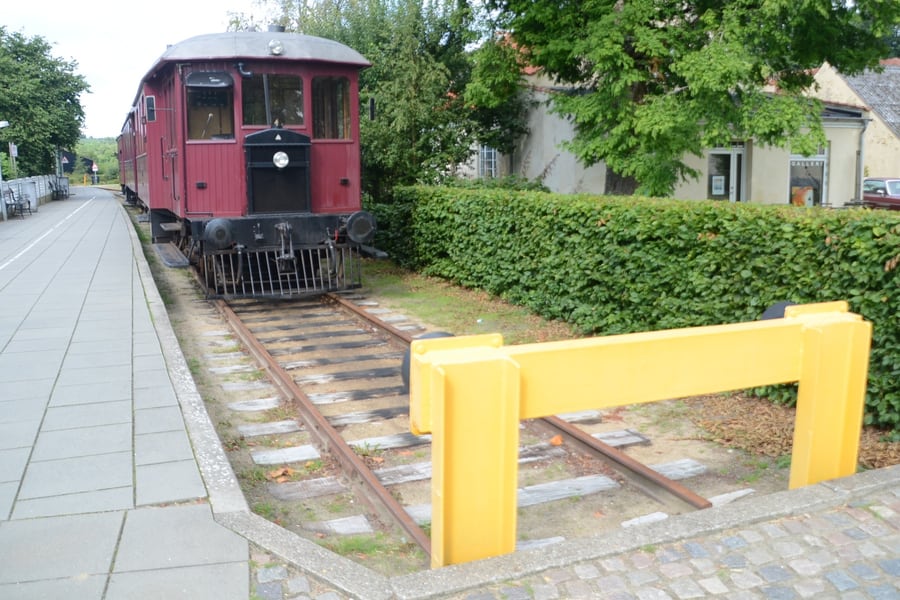
In 1963 a railway losing money put a restaurant train at Vrads for the summer, cutting a kitchen into the luggage van's post compartment. Coffee came with sveller — sleepers — for the kringle and tandhjul, cogwheels, for the biscuits. Those carriages are still there, still serving.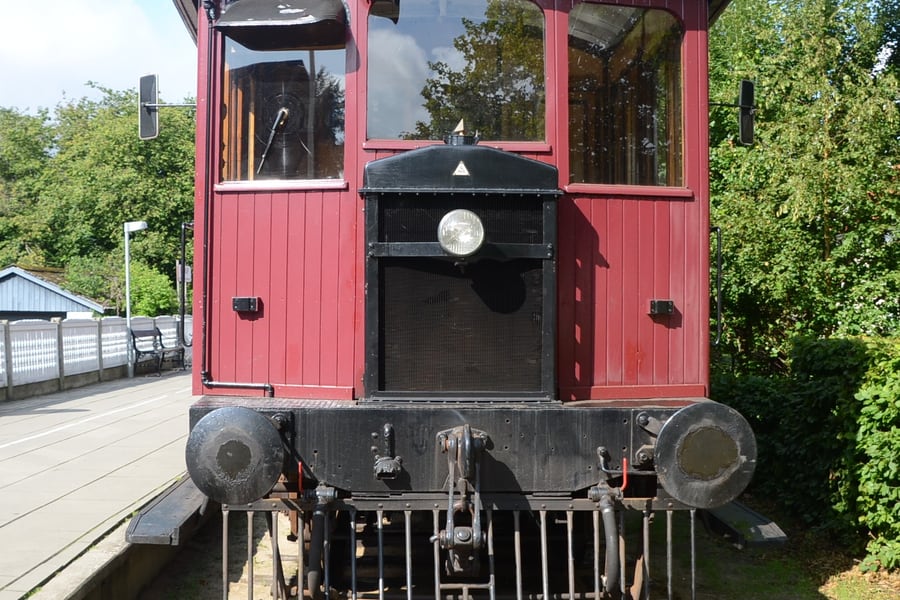 Hjart / Wikimedia Commons · CC BY-SA 4.0 · cropped
Triangel of Odense, 1928 to 1932
The normal traction is a Triangel motor coach — a wooden railcar on three axles with a manual gearbox, thirty-odd seats, and a driver who also sold the tickets. Four survive here, the oldest built in 1928, now on Leyland diesels.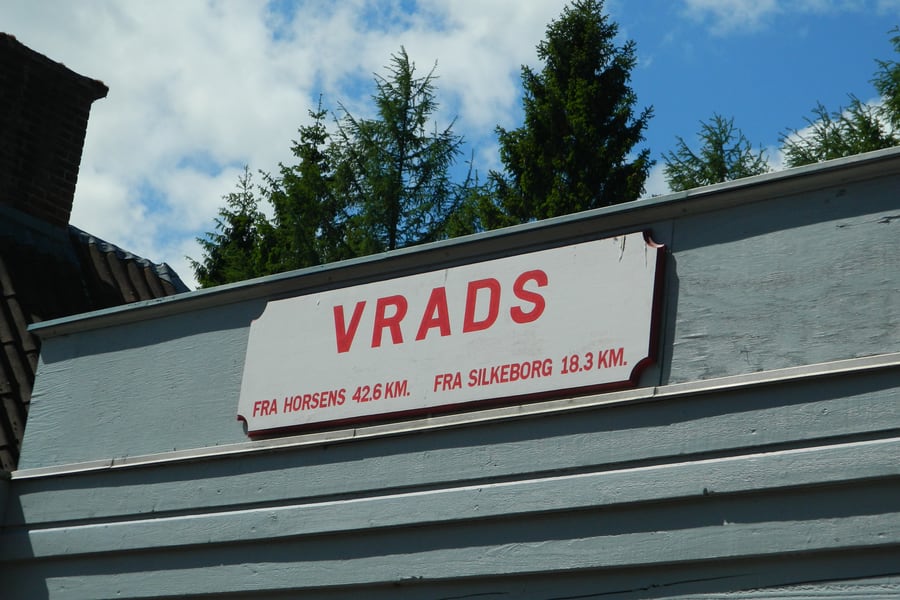 FinlayCox143 / Wikimedia Commons · CC BY-SA 3.0 · cropped
A board that still counts from Horsens
The nameboard at Vrads gives the distances to two towns whose trains have not called since 1968. Add them and you get 60.9 kilometres, the whole length of the closed railway. Five still carry trains; fifty-one are a cycle route.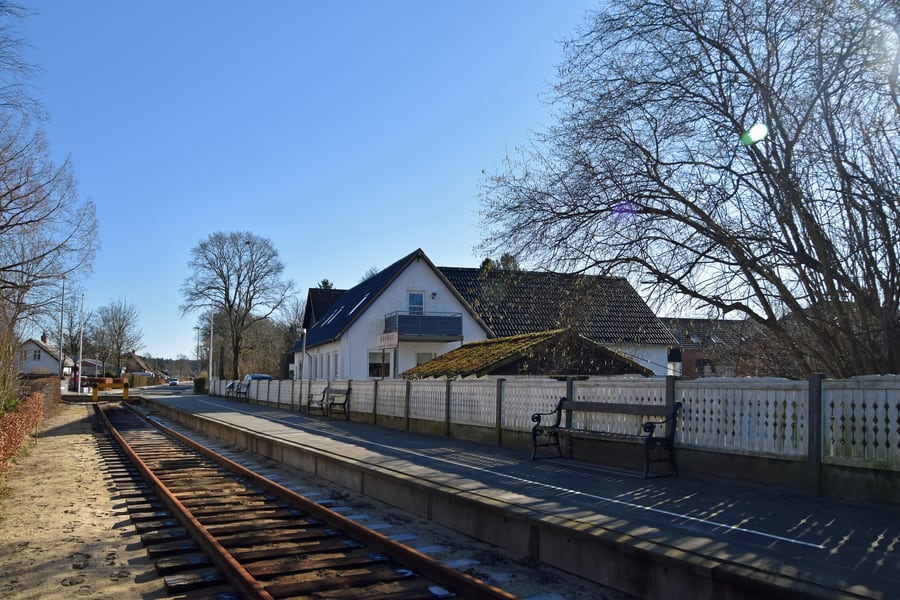 Thomas Dahlstrøm Nielsen / Wikimedia Commons · CC BY 4.0 · cropped
Bought at auction, driven home at dusk
At the sale of the dead railway's equipment in November 1968, a group from Bryrup bought a locomotive, four carriages, a railcar — and Vrads Station and the track. Eleven days later the lot ran home under its own power, along a railway seven months closed.A bit of history
Culture & experiences along the way
 Nationalmuseet, Copenhagen / Wikimedia Commons · CC BY-SA 3.0 · cropped
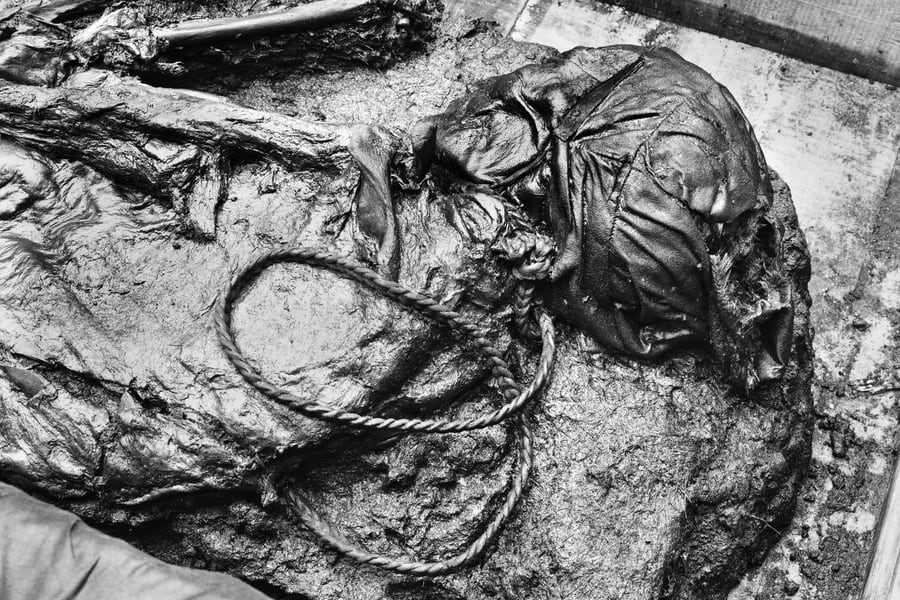
The Tollund Man
Twenty-odd kilometres north, Museum Silkeborg keeps the best-preserved bog body ever found: a man cut out of the peat at Bjældskovdal on 6 May 1950, dead some 2,400 years, the plaited leather rope still round his neck and his face entirely calm. He has been on display since 1952.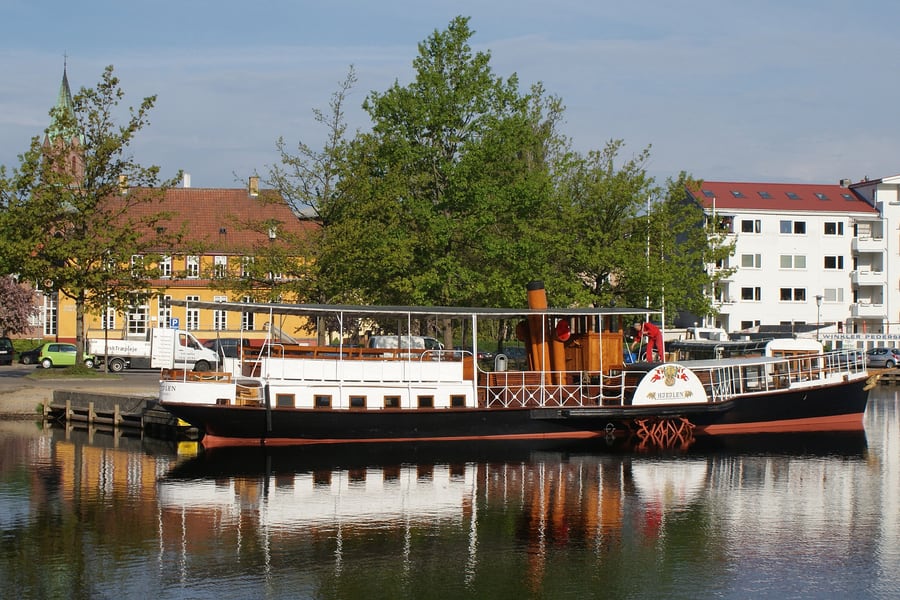 Carsten Wiehe / Wikimedia Commons · CC BY-SA 3.0 · cropped
Steam on the water as well
The Hjejlen has been running out of Silkeborg to the Himmelbjerget since 1861 and is the oldest coal-fired paddle steamer still working anywhere. She takes about an hour and a half each way through the lakes, on her original engine, and she is the obvious second half of a day that starts on this railway.Timetables
Times below are from the railway's own published Køreplan i 2026, read in August 2026. The current sheet is at veteranbanen.dk (opens in a new tab).
Four round trips run on every operating day, and the pattern is the same whatever is at the front.
| From Bryrup | Arrive Vrads | From Vrads | Arrive Bryrup |
|---|---|---|---|
| 11:30 | 11:45 | 12:30 | 12:45 |
| 13:00 | 13:15 | 13:45 | 14:00 |
| 14:15 | 14:30 | 15:00 | 15:15 |
| 15:30 | 15:45 | 16:15 | 16:30 |
Fifteen minutes each way, and roughly three quarters of an hour at Vrads if you take the following train back — long enough for the reason most people go, which is the station restaurant. Vrads Station is open whenever trains are running to this timetable.
The 2026 season
The railway runs from 29 March to 17 October 2026.
Weekends and public holidays carry the service through the whole of that period, including the five days from Maundy Thursday to Easter Monday, Ascension Day, Constitution Day on 5 June and both days of Whitsun.
Midweek trains run on Tuesdays, Wednesdays and Thursdays in the Danish school summer holiday — 7 July to 6 August — and again in the autumn half-term week, 13 to 15 October.
31 May and 11 October are event days with their own timetable, not the one above.
Which train runs on which day
Saturdays and midweek days are worked by a motor train — one of the Triangel railcars of 1928–32.
Sundays from 24 May to 13 September are steam days, marked D on the operator's calendar, with the steam locomotive and the Triangel train together. Sundays outside that window, and the last two running weekends in September and October, are motor trains again.
Two caveats, both the railway's own. In dry spells steam running may be suspended because of the fire risk, and a motor train runs in its place. And on steam days the locomotive does not work the last round trip — the 15:30 out and the 16:15 back are marked with a star on the timetable for exactly that reason. The Triangel motor train is also occasionally replaced by a railbus.
Getting to Bryrup
Bryrup lost its main-line connection in 1968 and has not had one since; the nearest railheads are Silkeborg to the north and Horsens to the south-east, the two towns the old line joined. Midttrafik's regional bus route 215, which runs Vejle–Nørre Snede–Silkeborg, calls at Bryrup and takes about half an hour to Silkeborg Trafikterminal. That is four fare zones, 46.00 kroner for an adult single at the fares published by Midttrafik (opens in a new tab) in August 2026, and a day ticket for the whole of Central Jutland is 109 kroner. The station is at Hovedgaden 32, Bryrup 8654.
Tickets
Fares are the railway's own: 60 kr single and 100 kr return for an adult, 30 kr and 50 kr for a child of 3 to 11, and free below that. A ticket is valid on any departure that day, so there is no need to decide in advance which train to come back on, and nothing needs booking for the ordinary timetable. Payment differs by station — MobilePay at Bryrup, cards at Vrads, cash at both.
The society is unusually direct about access, and the wording matters: disabled passengers can be carried only so far as their own helpers can lift them and their aids into the train. These are wooden carriages of 1929 with steps up to open end platforms, and helpers are not carried free. Better to know now than at the platform. Read from veteranbanen.dk (opens in a new tab), August 2026.
Book your tickets
Return
100 kr adult · 50 kr child 3–11 · under-3s free
Valid on any departure that day, so the return train is decided on the platform.
Book Tickets (opens in a new tab, on veteranbanen.dk)via veteranbanen.dkSingle
60 kr adult · 30 kr child 3–11
One way, for anyone walking or cycling the old trackbed back.
Book Tickets (opens in a new tab, on veteranbanen.dk)via veteranbanen.dkHire the whole train
Outside the public timetable, by arrangement
How most photographic and society visits are arranged, with prices on the operator's page.
Book Tickets (opens in a new tab, on veteranbanen.dk)via veteranbanen.dkRail Passes
No rail pass covers this train, and none is worth buying for it. Veteranbanen Bryrup-Vrads is a volunteer preservation society running its own five kilometres of track and selling its own tickets at sixty kroner a single. It is not part of the Danish fare system and does not appear anywhere in the Interrail scheme, either as an included operator or as an excluded one.
Midttrafik's zone tickets do not help either. Midttrafik states that its prices apply to travel by bus, flexbus, the Aarhus light rail and Midtjyske Jernbaner — a list that does not include this railway.
Where a pass does earn its keep
Getting to the area. Interrail's own railway-companies table, last updated 28 August 2026, lists these Danish operators as included: DSB (S-Tog, Regional, InterCity and InterCity Lyn), Lokaltog, Go Collective, Nordjyllands Trafikselskab, Öresundståg and Nordjyske Jernbaner. The one Danish operator in the excluded column is Midtjyske Jernbaner.
That covers both approaches to Bryrup. Horsens is a DSB InterCity stop on the main line up eastern Jutland. Silkeborg is on the Skanderborg–Skjern line, and those trains changed hands in 2026: Go Collective told the Ministry of Transport in June that it could not meet about 100 million kroner of expenses then due, its contract was ended by agreement, and from 1 September 2026 DSB runs the Central and West Jutland services through a subsidiary based in Go Collective's old headquarters at Silkeborg, with the same train sets and the same staff. Both names sit in Interrail's included column, so the change makes no difference to a pass holder. Either approach is a pass journey; the bus onward is not, and costs 46.00 kroner for the four zones between Silkeborg and Bryrup.
Whether to buy one at all
For a trip built around this railway, almost certainly not. A day out here is a bus ride, a hundred-kroner return ticket and lunch at Vrads. A pass makes sense only if the Bryrup line is one stop on a longer Danish or Scandinavian itinerary, in which case the sums are decided by everything else on it — the run up from Hamburg, the Copenhagen–Aarhus main line, the Öresund crossing — and not by the five kilometres to Vrads.
Interrail also sells the Nordic Pass (opens in a new tab), valid in Denmark, Norway, Sweden and Finland and across the borders between them: €218 for 3 travel days in a month for an adult in second class, against €137 for the Denmark Pass. It cannot be used in the country you live in, only in the other three. It pays only when the trip goes on into another Nordic country. Checked October 2026.
Pass conditions were checked against interrail.com in October 2026 and are worth re-checking before travel, since the operator lists change with each timetable year.
Places to Visit
Almost everything worth seeing here is the railway's own country, or the railway itself in another form. The five kilometres that still carry trains are the short end of a sixty-one-kilometre line, and the other fifty-six have been a walking and cycling route since 1968 — which means the embankments, cuttings and one remarkable bridge are all still there to be walked.
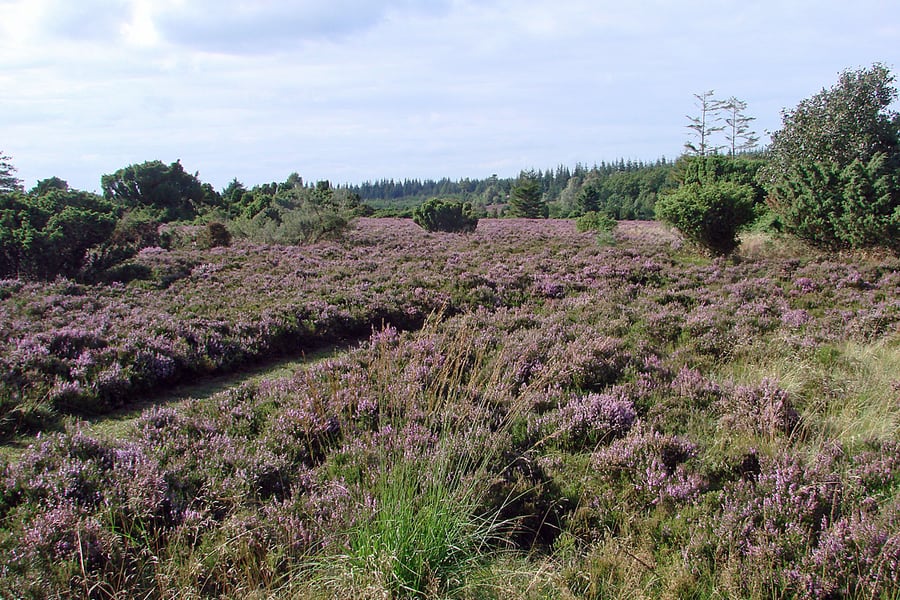
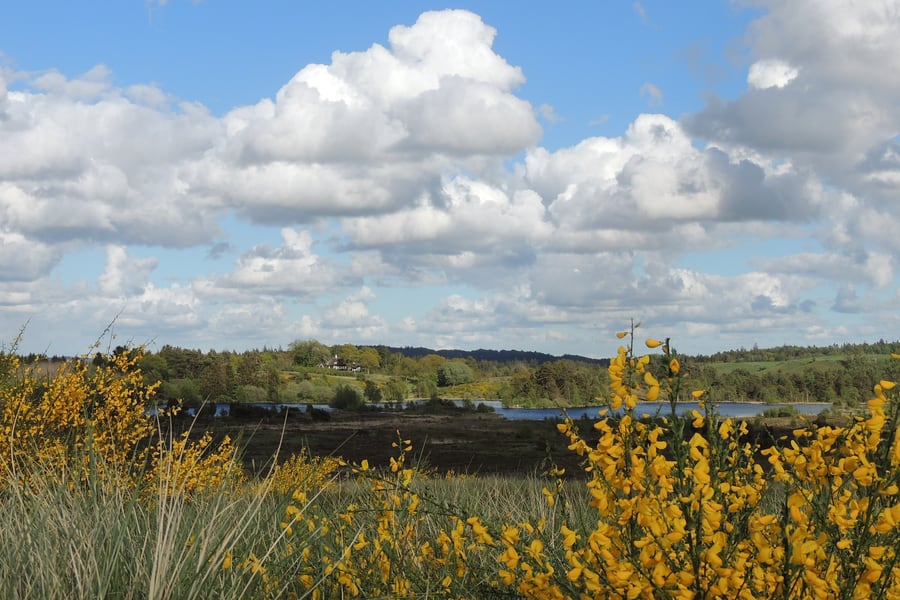
The land the train crosses is heath and inland dune, the leavings of a sand drift that moved across Jutland between the 1500s and the 1800s and was only finally pinned down by planting. Much of it is grazed and protected, and it changes colour completely between the gorse of May and the heather of August.
 Carsten Wiehe / Wikimedia Commons · CC BY 3.0 · cropped
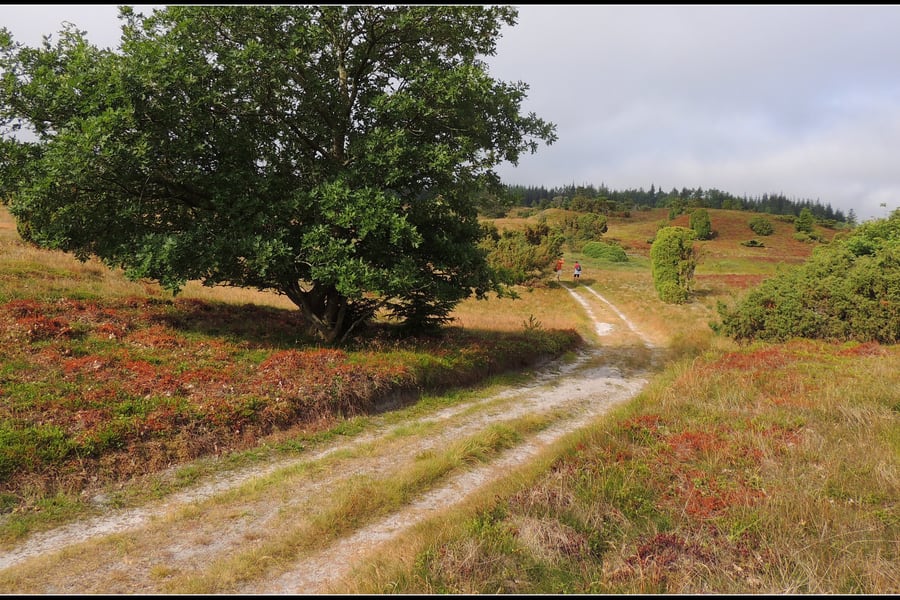
Vrads Sande
The heath between Vrads and Hjøllund, and the reason this landscape looks nothing like the rest of Denmark. These are inland dunes, thrown up by the sand drift that moved across Jutland between the 1500s and the 1800s and buried farms as it went. A hundred and forty-six hectares were protected in 1968 and three hundred more around Snabegård in 1976. Sandy tracks cross it, sheep and goats keep it open, and the Horsens–Silkeborg nature trail — the old railway — runs straight through.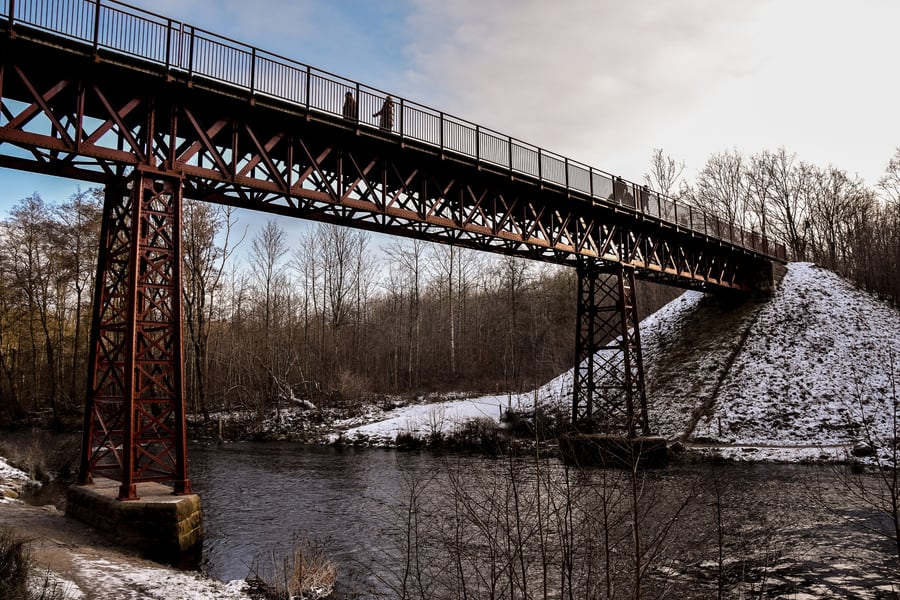 Thomas Dahlstrøm Nielsen / Wikimedia Commons · CC BY-SA 4.0 · cropped
Den Genfundne Bro
The narrow-gauge line crossed the Gudenå on a 45.7-metre lattice bridge, 13.4 metres up — the largest railway bridge in Denmark when it was built. By the 1920s rebuilding the river had been diverted, so the stream went into culverts and an embankment over the top. Scrap was too cheap to make demolition pay, so the embankment was laid around the bridge and buried it. Dug out again in 2014, only 200 kilos of its 40 tonnes of iron needed replacing; 140,000 people came in 2020.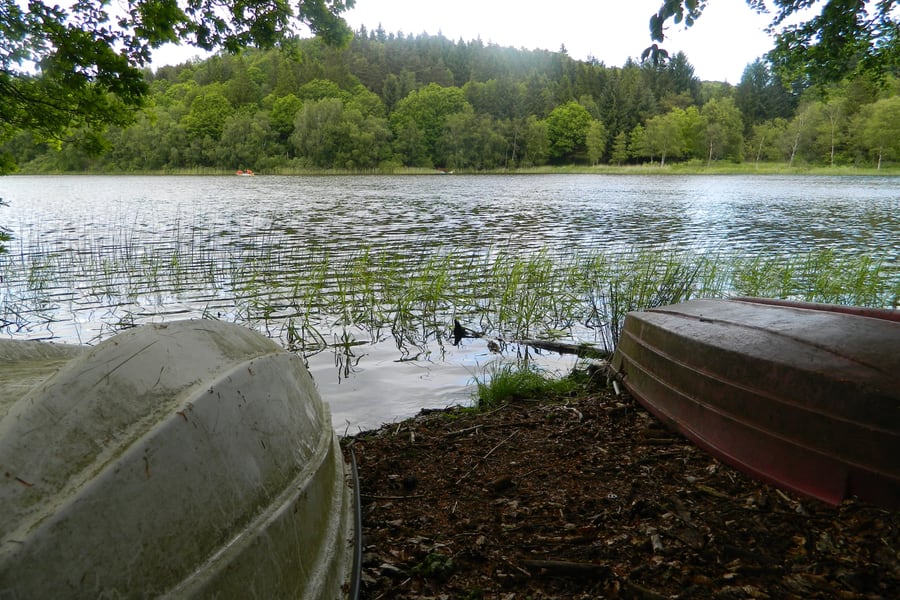 FinlayCox143 / Wikimedia Commons · CC BY-SA 3.0 · cropped
The Bryrup lakes
Bryrup sits in a steep little valley holding Karlsø, Bryrup Langsø and Kvindsø, which drain by Bryrup Å into Kulsø and on towards the Salten Å. The train passes three of the lakes in its fifteen minutes. Around Bryrup Langsø, 124 hectares of heather hills are protected ground, and rowing boats lie along the shores. The village itself had 255 people when the railway arrived in 1899; it has about 1,650 now.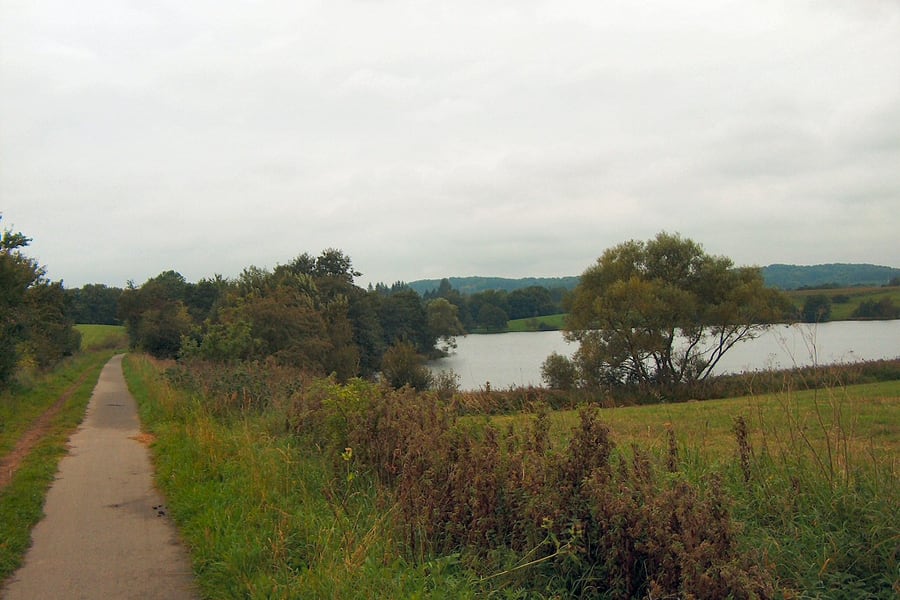 Villy Fink Isaksen / Wikimedia Commons · public domain
The old line, on foot and by bicycle
When the railway was sold off in August 1968 the county conservation committee bought 50.4 kilometres of the formation, and it became the Bryrupbanesti — the Horsens–Silkeborg nature trail. Of the line's 61 kilometres the trackbed survives on 51, and 45 of those are walkable and rideable, through cuttings, along embankments and past platform edges going back to grass. It was the plan for the whole route, and the five kilometres to Vrads were the exception carved out of it.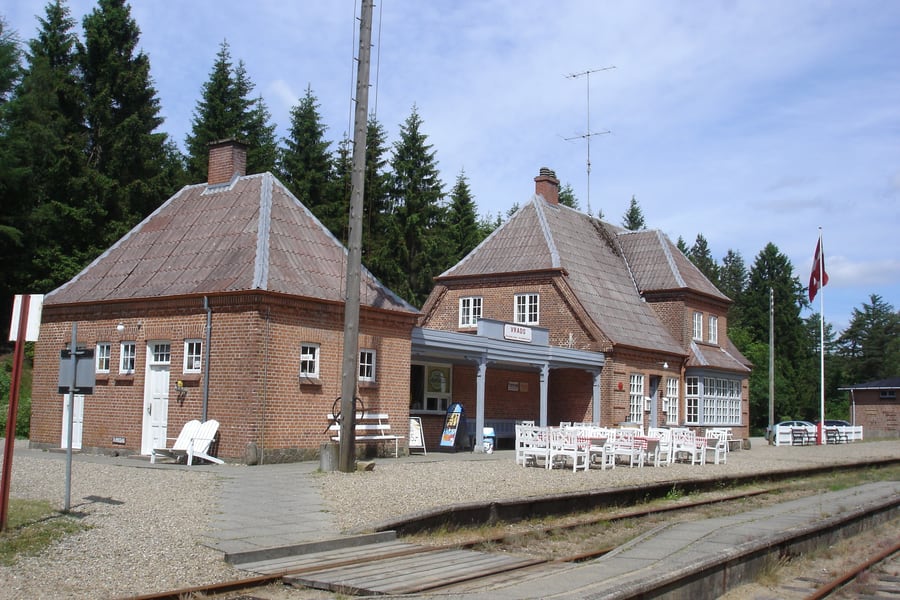 Beethoven9 / Wikimedia Commons · CC BY-SA 3.0 · cropped
Vrads Station, the restaurant
The station of 1928, designed by the Silkeborg architect Edvard Jensen, is a restaurant owned by the railway itself. The waiting room stands almost as it was built and the ticket window is still in the wall; eating goes on partly indoors and partly in two wooden carriages of 1929 outside, one with its seats and a partition taken out to make an open dining car for about thirty. It opens whenever trains run, and tables are booked direct rather than through the railway.Where to Sleep
Bryrup is a village of about 1,650 people and does not have a hotel of its own in the middle of it. What it has instead is a place on the hill above the lakes that has been putting travellers up since the year after the railway arrived, and which turns out to be tangled up with the line's history more than once.
Beyond that, the nearest choice of rooms is at Brædstrup, twenty-odd kilometres down the old formation, which was the line's second most important station after Horsens.
Where to stay
Hotel Velling Koller
On the hill above Bryrup, and older than the extension
A wooded hotel on the southernmost hill of the Søhøjlandet, a short way outside Bryrup. Its own history begins with a photographer's pavilion that Silkeborg Dagblad wrote up in May 1900 — the year after the railway reached Bryrup, and its account credits the station for bringing the visitors. There are 12 rooms, each with its own bath, and deliberately no restaurant and no television: guests cook in a shared tea kitchen. They also get a discount at Restaurant Vrads Station, which this house's hosts were the first to run for the railway back in 1969. Owned since 2022 by a non-profit foundation.
Check Availability (opens in a new tab, on vellingkoller.dk)via vellingkoller.dkHotel Pejsegaarden
In Brædstrup, the old line's second town
In the middle of Brædstrup, which was the biggest intermediate station on the Horsens–Bryrup–Silkeborg railway and is about twenty kilometres down the old formation from Bryrup. It is a family hotel with a restaurant, a bowling alley, an indoor pool and a playground, part of the Danske Hoteller group. It holds Green Key environmental certification and the Danish food authority's organic dining mark in bronze, meaning between 30 and 60 per cent of what it buys is organic.
Check Availability (opens in a new tab, on hotelpejsegaarden.dk)via hotelpejsegaarden.dkQuestions or corrections
Planning this trip and stuck on something, or spotted a time, fare or detail that has changed? Send us a message about Bryrup to Vrads: Denmark's Most Beautiful Railway. We read every one, and we update this page when something has changed.