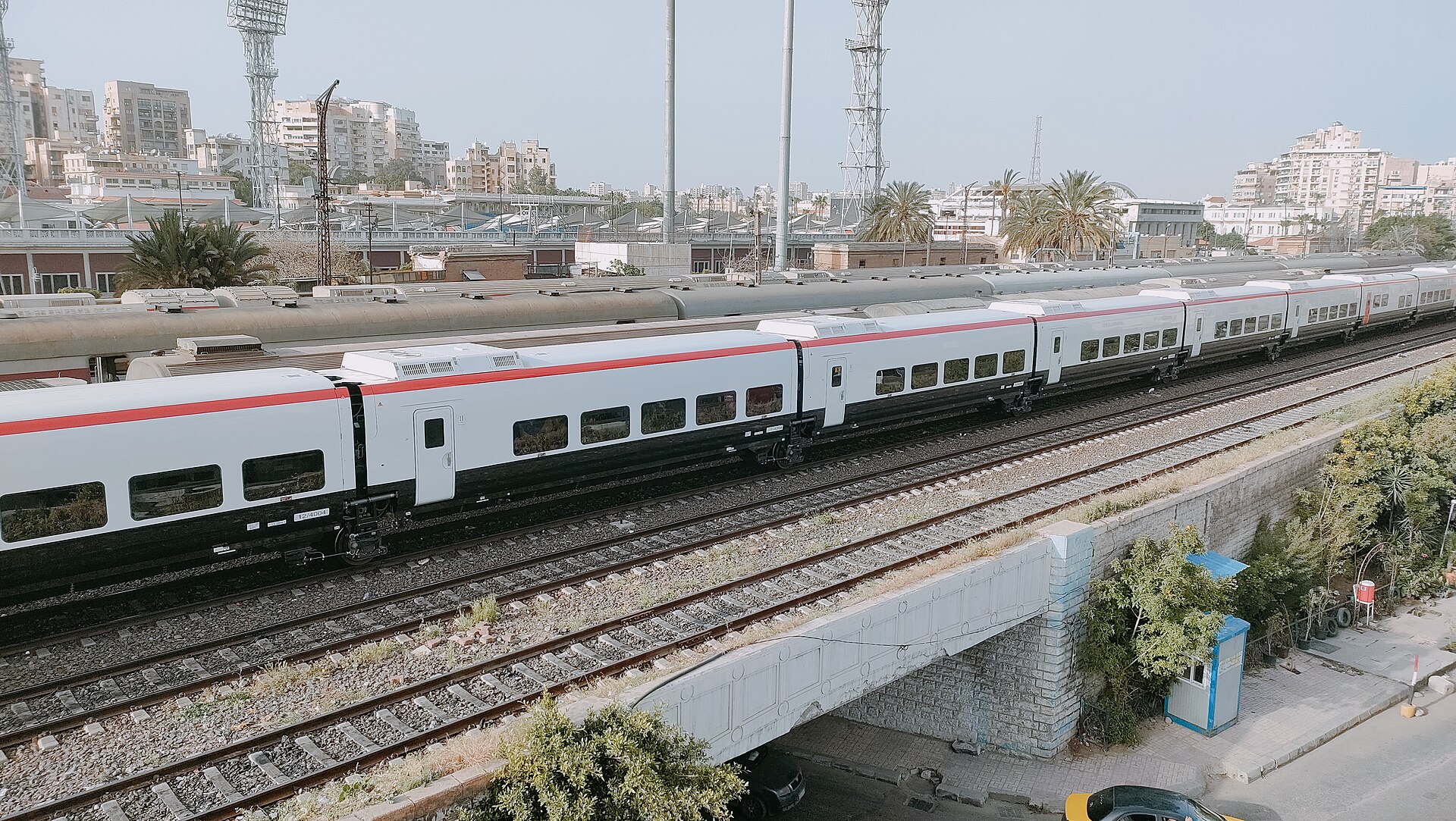
Cairo to Alexandria
Abdelrhman 1990 / Wikimedia Commons · CC BY-SA 4.0
- DistanceCairo–Alexandria · 208 km (129 miles)
- DurationAbout 2–2½ hours by fast Talgo
- Best seasonYear-round · May–September for the coast
Introduction
The train from Cairo to Alexandria is the oldest journey in Africa. When the first stretch of line opened in 1854, it was the first railway on the continent, the first in the Middle East, the first anywhere in the Ottoman Empire — and only the second in the world outside Britain. It was engineered by Robert Stephenson, son of the man who built the Rocket, and it was carrying passengers between the Mediterranean and the Nile fifteen years before the Suez Canal was even opened.
You would never guess so much history from the ride, which is short, fast and cheap. Modern Spanish-built Talgo trains now run the 208 kilometres across the Nile Delta in about two and a half hours, air-conditioned and Wi-Fi'd, alongside dozens of older VIP and express trains that leave at almost every hour of the day. It is the busiest intercity corridor in Egypt, and the easiest of all Egyptian rail journeys to make on a whim.
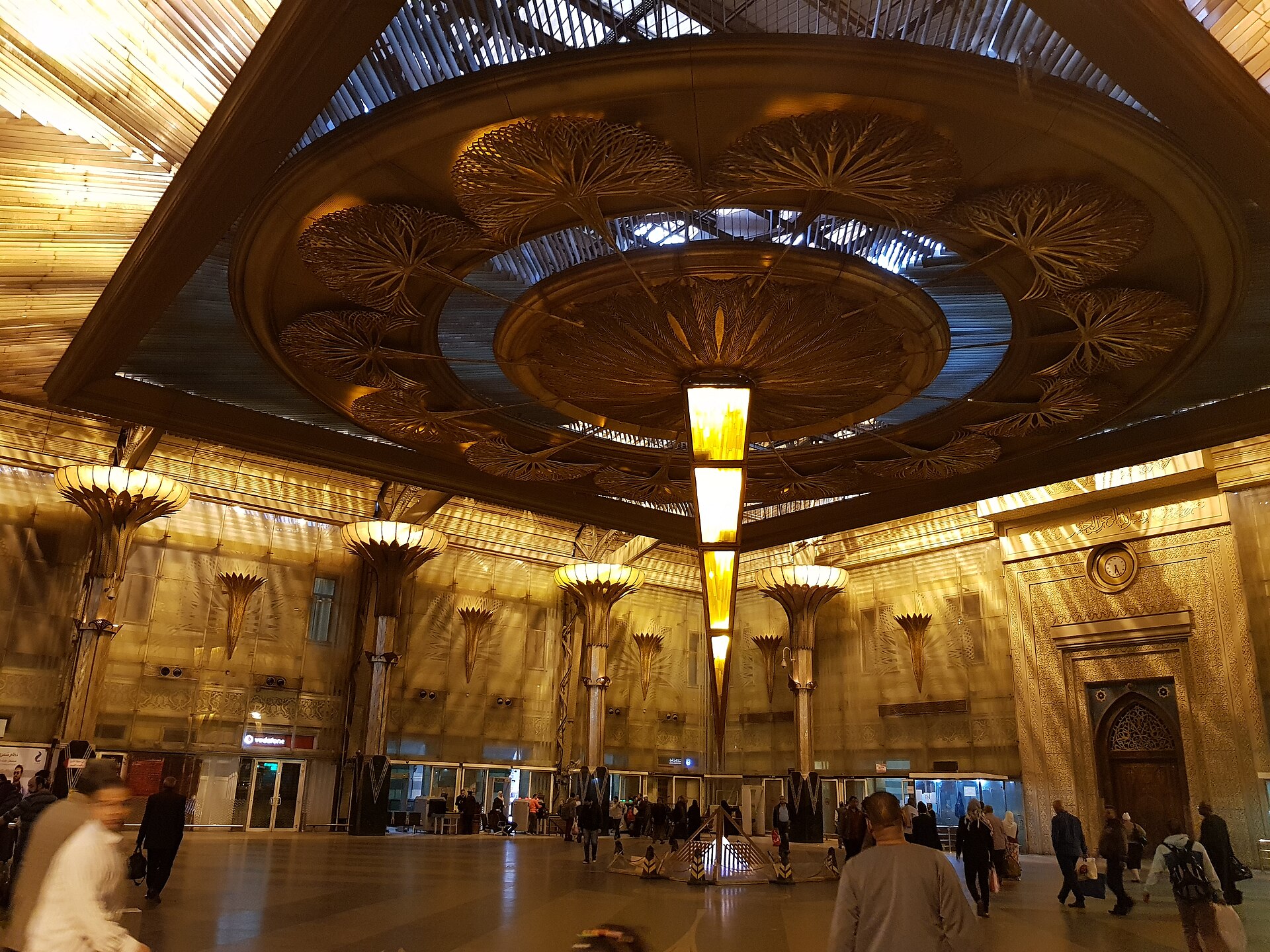
What you get for those two hours is a cross-section of the country: out of the golden concourse of Ramses Station in Cairo, across the green fan of the Delta — cotton and rice and canals, water buffalo and mud-brick villages — and into Alexandria, the Greco-Roman city on the sea, where the train slides at last into the oldest station in Africa a few minutes' walk from the Mediterranean.
The Journey
The journey begins in the heart of Cairo, under the vast gilded ceiling of Ramses Station — the hub of the whole Egyptian network, its great hall lit like the inside of a lantern. You find your Talgo or your express on the platform, settle into an air-conditioned seat, and pull out northward through the endless suburbs of the largest city in Africa.
Then, quite suddenly, the city ends and the Nile Delta begins. This is the greenest, most densely farmed land in Egypt — a level patchwork of cotton, rice, maize and clover, stitched together with irrigation canals, dotted with water buffalo and date palms, and crowded with villages of mud brick and towns whose minarets rise straight out of the fields. The train runs dead flat across it, calling (or simply rushing through) the old Delta towns of Benha, Tanta and Damanhur, each a market city in its own right.
Twice the line has to cross the arms of the Nile, and this is where its history shows. At Kafr el-Zayyat, the carriages were once floated over the river on a train ferry — until, in 1858, a special train ran off the ferry into the water and drowned the heir to the throne, after which Stephenson built a great swing bridge instead. At Benha he had already thrown a tubular iron bridge over another branch of the Nile, a sister to the famous Britannia Bridge he built across the Menai Strait in Wales.
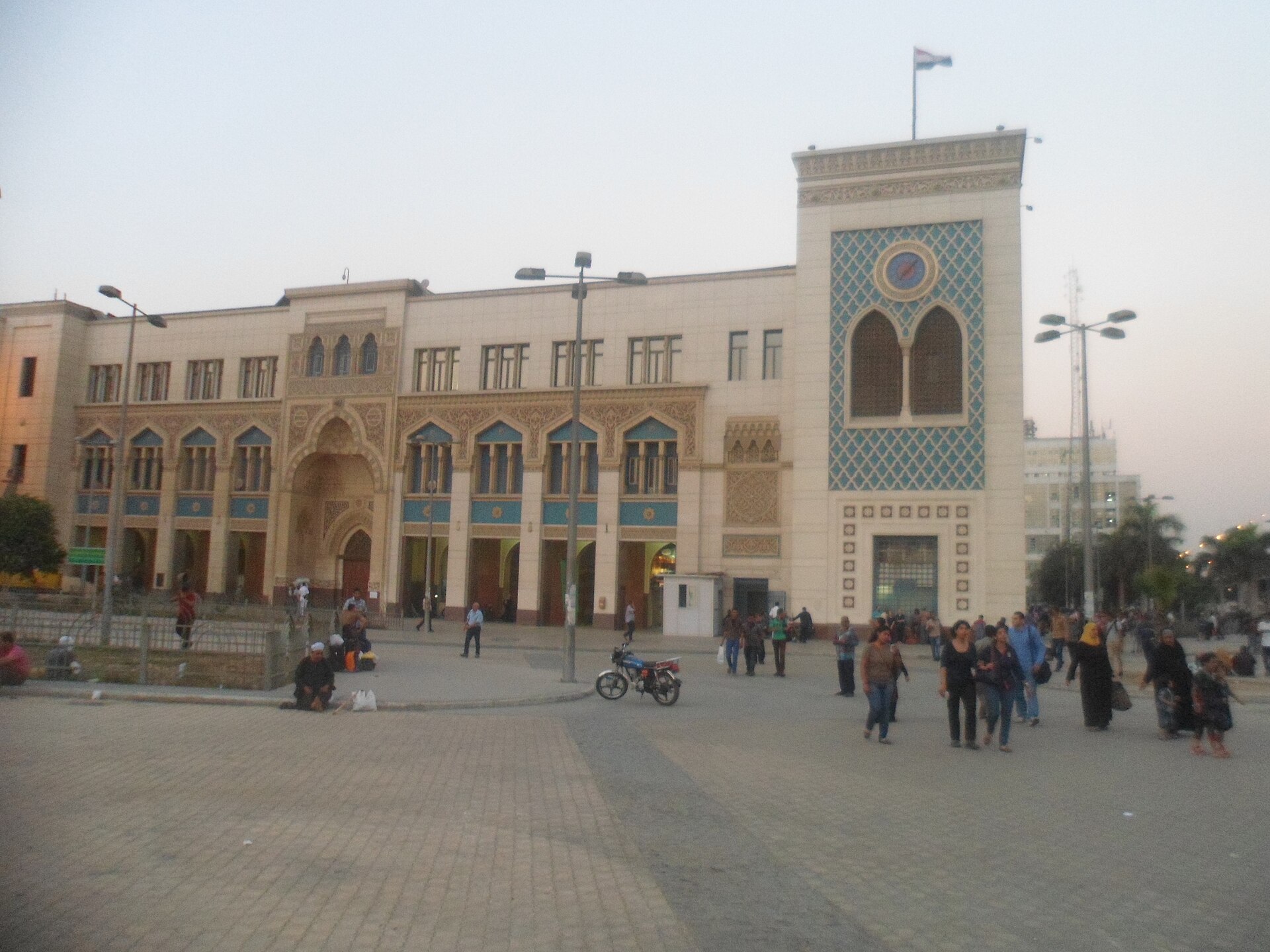
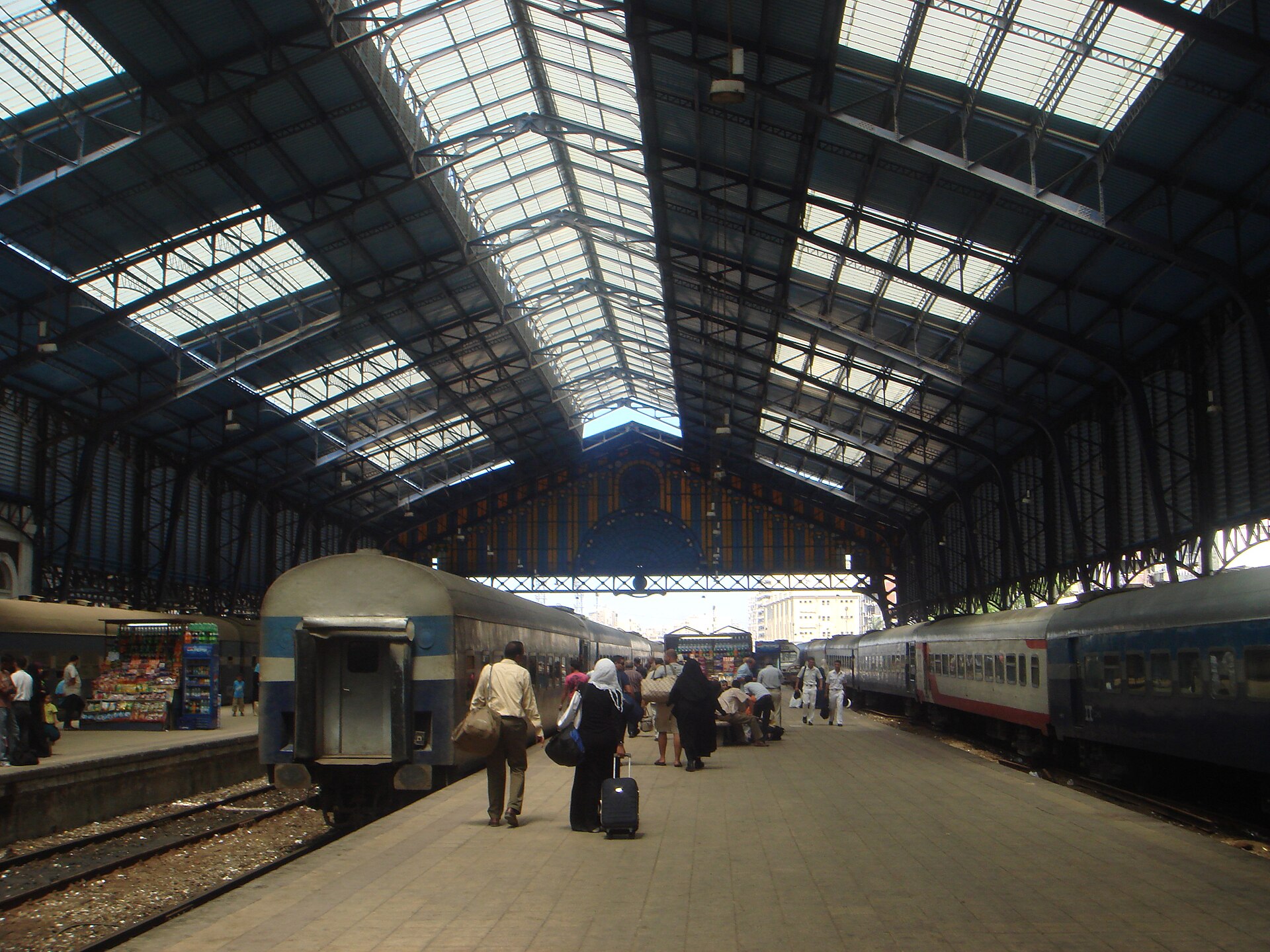
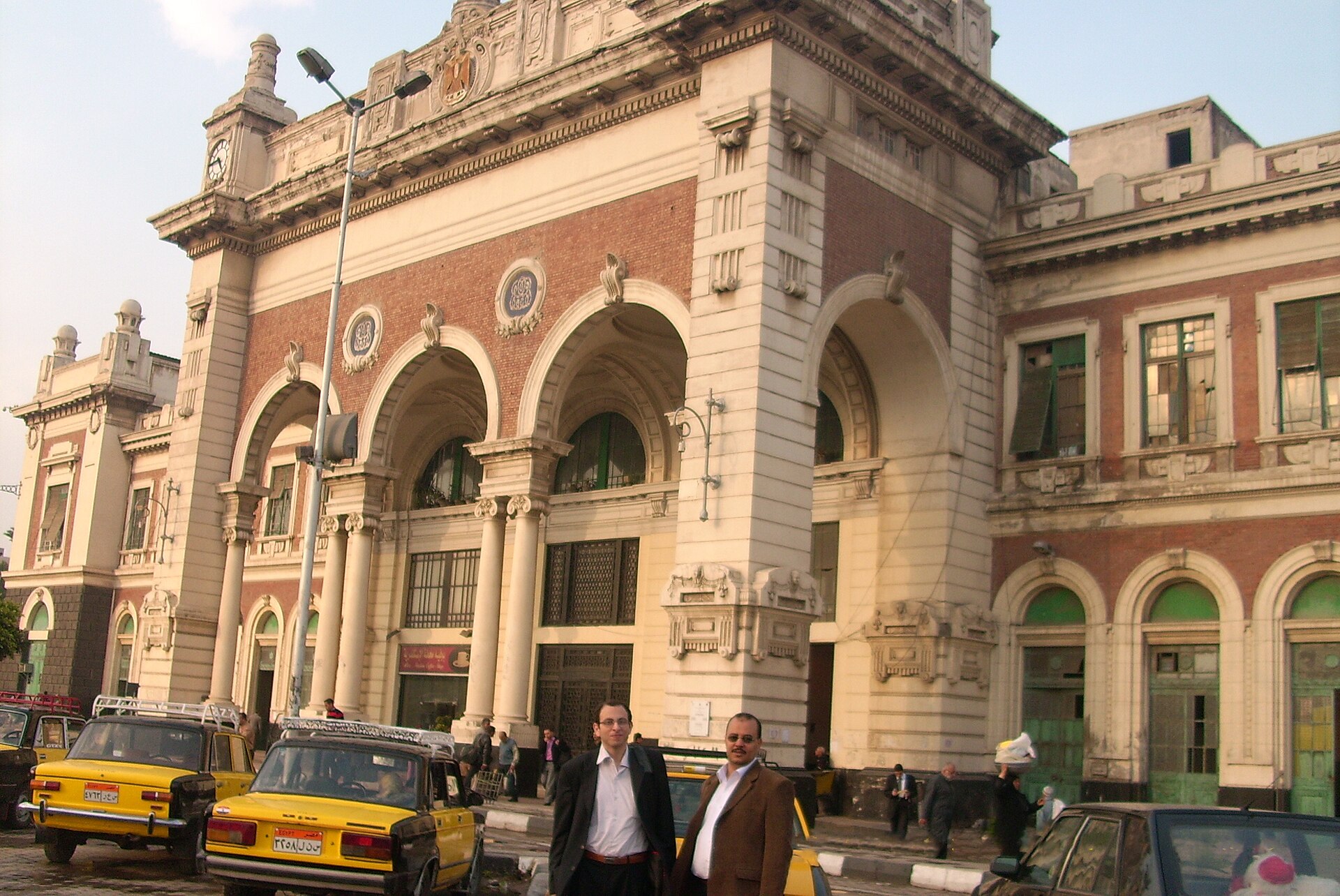
By the time the fields give way to salt marsh and the first glimpse of the sea, you are running into Alexandria — and the train draws up beneath the iron-and-glass roof of Misr Station, the oldest railway station on the continent.
A few things worth knowing about the run:
- It follows the Cairo–Alexandria main line, the oldest railway in Africa and the Middle East, opened in stages from 1854.
- The distance is 208 km (129 miles); the fast Talgo covers it in about 2½ hours, with VIP and express trains a little slower.
- Trains are air-conditioned, with first and second class; the Talgo also has Wi-Fi and e-tickets.
- There are 30 or more trains a day in each direction — one of the most frequent intercity services in Africa.
Many travellers ride up in the morning, spend the day by the sea in Alexandria, and take an evening train back to Cairo — a whole second city visited between breakfast and bed.
Along the route
Riad Shehata / Wikimedia Commons · Public domainAfrica's oldest railway
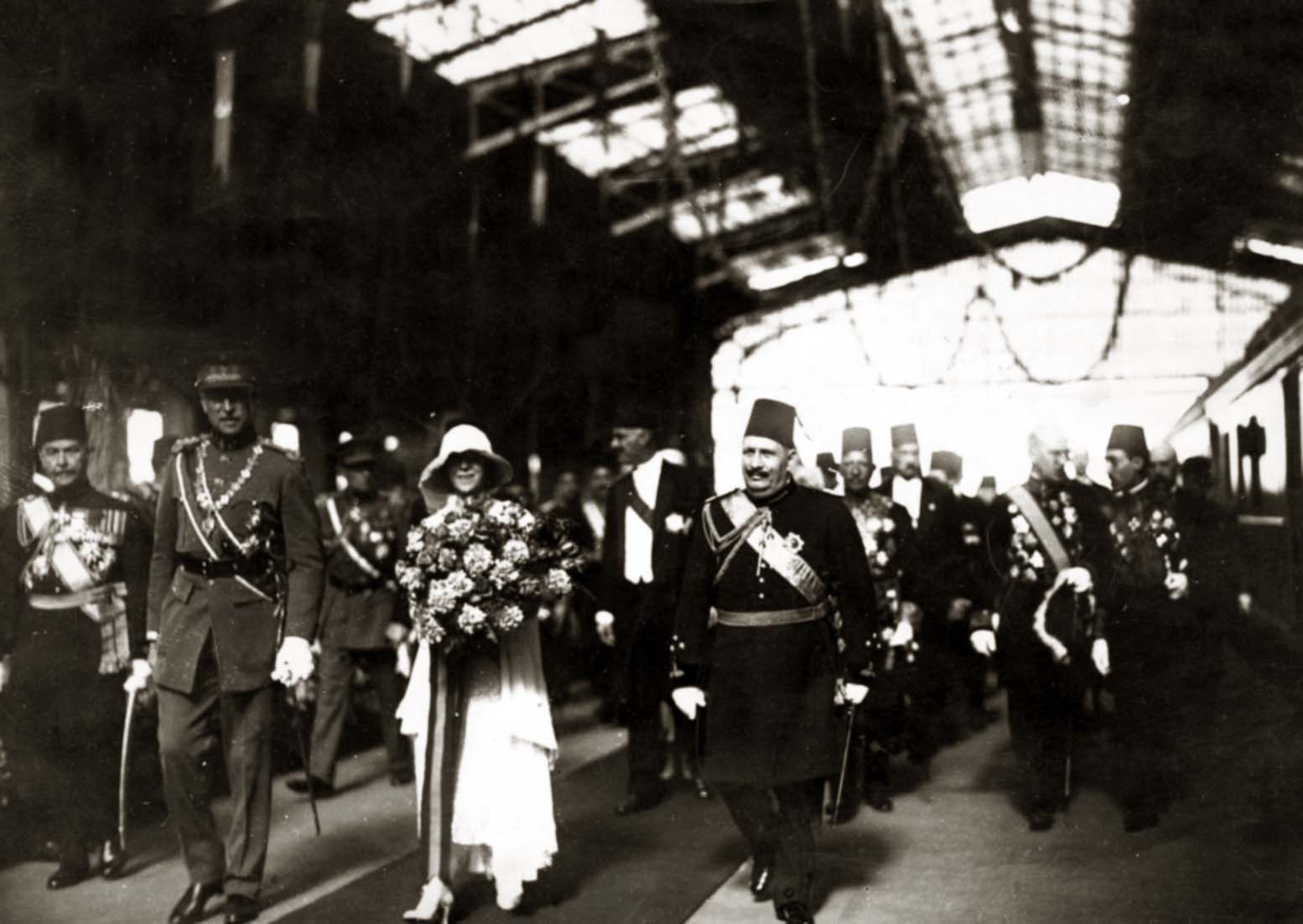
Egypt opened the first railway in Africa, the Middle East and the Ottoman Empire — the second in the world after Britain — when the line from Alexandria reached Kafr el-Zayyat in 1854. Robert Stephenson engineered it, and it carried travellers to India years before the Suez Canal.Abdelrhman 1990 / Wikimedia Commons · CC BY-SA 4.0Across the green Delta
The line runs dead level across the fan of the Nile Delta — cotton, rice and maize threaded with irrigation canals, water buffalo and villages of mud brick. It is the greenest, most crowded corner of Egypt, crossed in a couple of hours.Johnny 201 / Wikimedia Commons · CC BY-SA 3.0Two great cities, end to end
Few short rides link two cities like these — the medieval-Islamic capital on the Nile and the Greco-Roman port founded by Alexander. You start under the dome of Ramses Station and step out at Misr, the oldest railway station in Africa.A bit of history
Culture & experiences along the way
Xhelona Haveriku / Wikimedia Commons · CC BY-SA 4.0The fast Talgo
Since 2023 Egypt has run brand-new Spanish-built Talgo intercity trains on the line — air-conditioned, with Wi-Fi, e-tickets and first- and second-class seating — covering the 208 kilometres to the coast in around two and a half hours. Older VIP and express trains run the same route more cheaply and only a little slower.timsdad / Wikimedia Commons · CC BY-SA 3.0Stephenson's bridges
The line's greatest works are its Nile crossings. At Kafr el-Zayyat, where a train ferry once carried the carriages — and where a prince drowned in 1858 — Stephenson threw a long swing bridge across the river; and at Benha he built a wrought-iron tubular bridge, a sister to his famous Britannia Bridge in Wales.Francisco Anzola / Wikimedia Commons · CC BY 2.0Alexandria by the sea
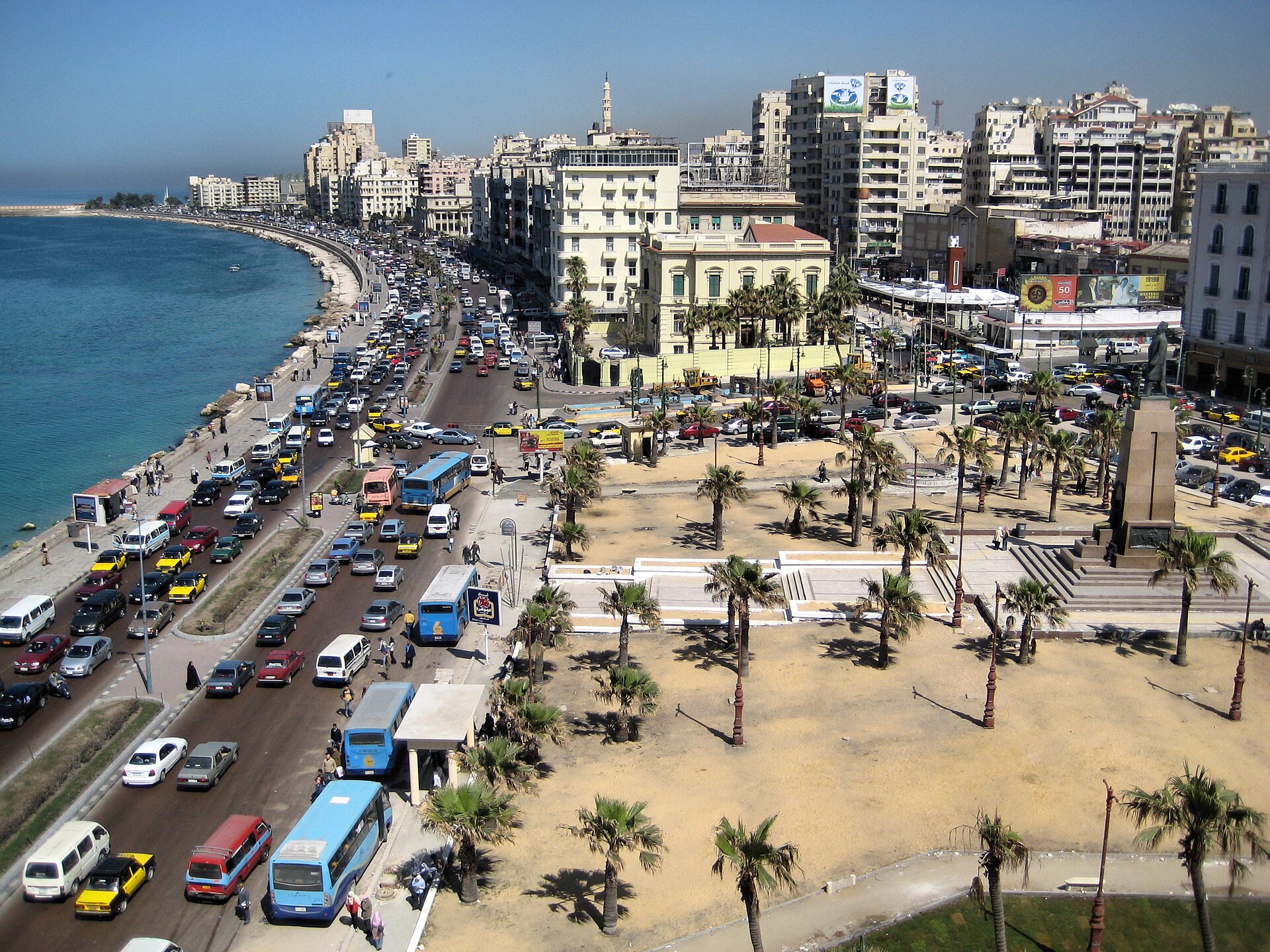
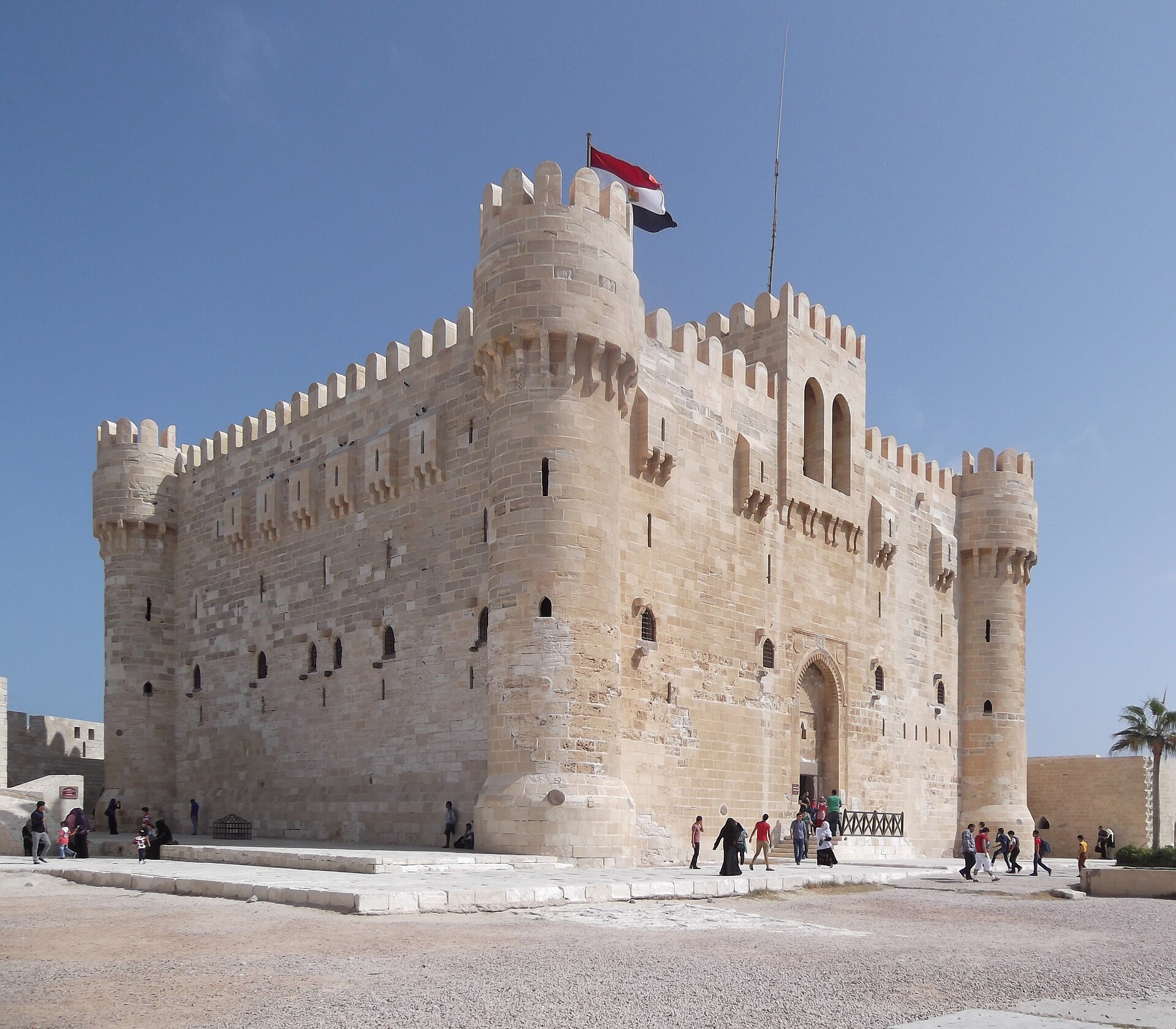
Step out of Misr Station and Alexandria unfolds: the great curve of the Corniche, the Citadel of Qaitbay on the site of the ancient Lighthouse, the modern Bibliotheca Alexandrina reviving the most famous library of antiquity, and seafood in the cafés along the Mediterranean. It is Egypt's second city and its coolest escape.Timetables
The Cairo–Alexandria corridor is one of the busiest in Egypt, with more than thirty trains a day in each direction, so you rarely wait long. Services run from early morning until late evening, in broadly three grades: the fast Talgo intercity trains, comfortable VIP expresses, and ordinary air-conditioned expresses.
Real departures from Cairo (Ramses) to Alexandria give the shape of the day (times as of early 2026 — always confirm before travelling):
| Train | Depart Cairo | Arrive Alexandria |
|---|---|---|
| Talgo (fast) | 08:00 | 10:30 |
| Talgo | 14:00 | — |
| Talgo | 19:00 | 21:30 |
| VIP express | 08:10 | 11:15 |
| VIP express (last) | 22:30 | 01:05 (+1) |
The Talgo covers the 208 km in about 2½ hours; the VIP and ordinary expresses take around 3 hours. Between the first departures around 08:00 and the last near 22:30 there are dozens of trains, so in practice you can often just turn up at Ramses and take the next suitable service — though reserving a Talgo seat ahead in summer does no harm.
All the main trains use Ramses (Misr) Station in Cairo and Misr Station in Alexandria, both central. Full, current times and live fares are published by the operator, Egyptian National Railways — see the Tickets section below.
Tickets
Tickets are inexpensive by international standards and easy to arrange. The trains are run by Egyptian National Railways, and there are three practical ways to buy: at the window — Ramses Station in Cairo directs foreign travellers to the Arab and Foreign Reservation Office, and Alexandria sells from Misr Station; through an online agent, which resells ENR tickets in English with a card-friendly checkout and a modest mark-up; or direct at enr.gov.eg (opens in a new tab).
Fares depend on the train and class. The Talgo is the priciest, the VIP and express trains cost less for a similar seat, and some services carry cheaper, more basic air-conditioned classes. Even first class on the fastest train is a modest sum for a two-and-a-half-hour intercity journey. Prices and schedules change, so the operator holds the current figure.
Book your tickets
Talgo Intercity · Cairo to Alexandria
First & second class, the fast train
The newest and quickest way down the line — a Spanish-built Talgo intercity train, air conditioned, with Wi-Fi and reserved first- and second-class seats, from Cairo's Ramses Station to Alexandria in about two and a half hours. Booked with Egyptian National Railways.
Book Tickets (opens in a new tab, on Egyptian National Railways)via Egyptian National RailwaysVIP & Express trains
Air-conditioned, more frequent
Dozens of air-conditioned VIP and express trains also run the Cairo–Alexandria route each day, a little slower than the Talgo but cheaper and departing at almost any hour. First and second class; buy at the station or through a booking agent.
Book Tickets (opens in a new tab, on Egyptian National Railways)via Egyptian National RailwaysRail Passes
No rail pass covers this journey. Interrail and Eurail are European schemes, and Egypt is not among the 33 countries in Interrail's list of covered railway companies (opens in a new tab). Egyptian National Railways sells each journey as a ticket, at the station, online or through agents.
Checked October 2026 against Interrail's list of covered railway companies (opens in a new tab).
Places to Visit
The whole point of this line is that it joins two of the great cities of the Mediterranean world, and both deserve time. Give Alexandria a day or two and Cairo as long as you can spare.
At the Alexandria end, the sights the cards below miss are worth knowing about. The Corniche curves around the eastern harbour from a few minutes' walk from Misr Station, and at its tip stands the Citadel of Qaitbay, a 15th-century fortress built on the foundations of the vanished Lighthouse. The Bibliotheca Alexandrina, a vast tilted disc of a building opened in 2002, consciously revives the memory of the ancient Library. Underground, the 2nd-century catacombs of Kom el-Shoqafa mix Egyptian, Greek and Roman funerary art in one strange hybrid. And the Graeco-Roman Museum reopened in 2023 after nearly two decades shut.
Cairo needs no introduction, and its two greatest draws belong to the other Egyptian journey on this site: the Pyramids of Giza and the treasures of Tutankhamun, now shown at the Grand Egyptian Museum. Ramses Station puts you in the middle of everything — and at the start of the overnight sleeper south to Luxor and Aswan if you want to carry on up the Nile.
Between the two, the Delta towns the train passes — Tanta, famous for its huge autumn moulid festival; Benha; Damanhur — are working market cities rather than tourist sights, but they give the ride its texture: the real, farmed, densely lived-in heart of the country.
 Joonas Plaan / Wikimedia Commons · CC BY 2.0 · cropped
Islamic Cairo
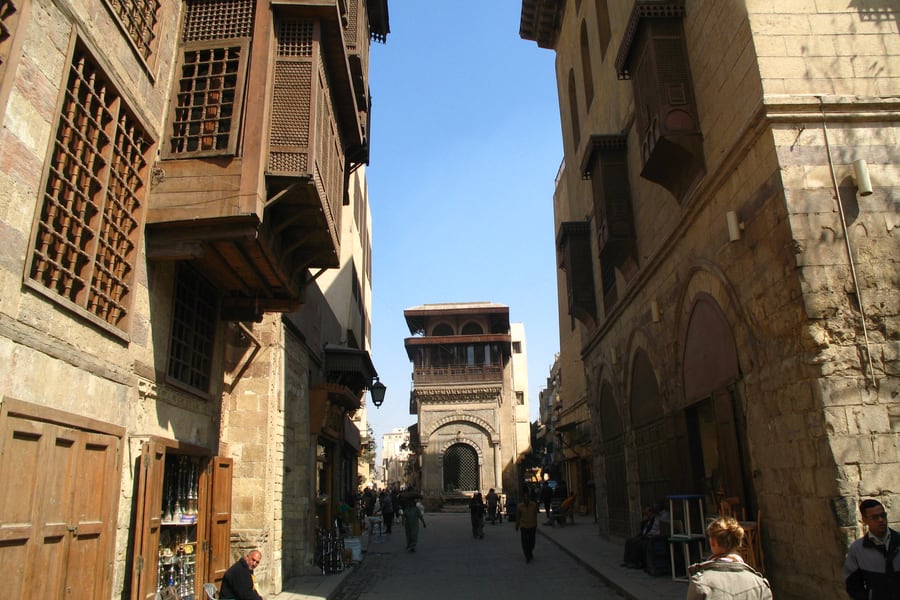
Ramses Station puts you a short ride from the mediaeval city. Al-Muizz Street, the old Qasaba, still runs between the gates of Bab al-Futuh and Bab Zuweila past mosques, madrasas and mashrabiya balconies. Off it spreads Khan el-Khalili, built in 1382–89 by Jaharkas al-Khalili, master of the stables to Sultan Barquq, on the site of a Fatimid palace cemetery. El-Fishawy's café, going since 1773, is the place to stop.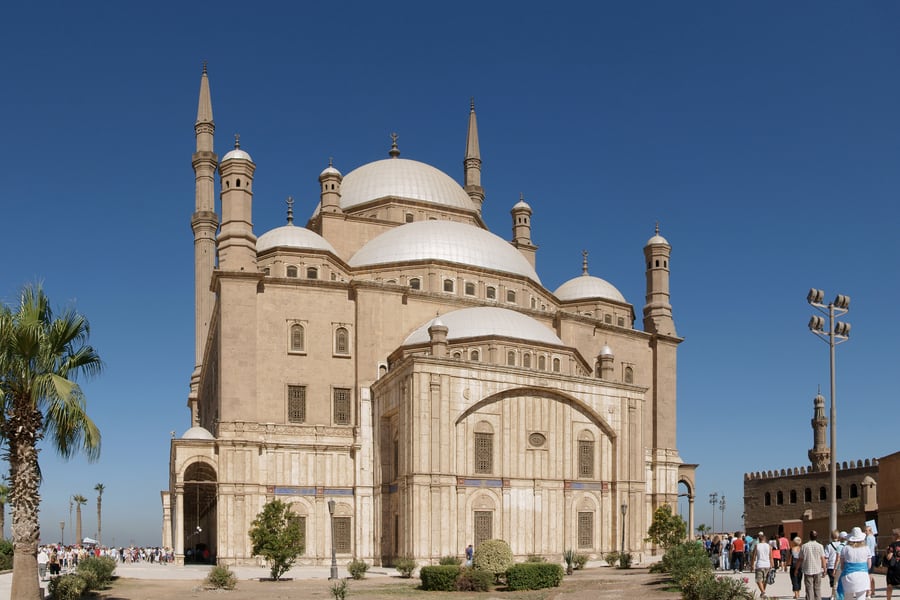 kallerna / Wikimedia Commons · CC BY-SA 3.0 · cropped
The Citadel and the Alabaster Mosque
Saladin's citadel crowns the ridge above Cairo, and the Mosque of Muhammad Ali (1832–57) crowns the citadel — a great Ottoman pile modelled on Istanbul's Sultan Ahmed, its lower walls faced in alabaster, its dome 52 metres up and its two minarets over 80. In the courtyard stands a clock given by Louis Philippe of France in 1846 — in exchange for the Luxor obelisk that now stands in the Place de la Concorde.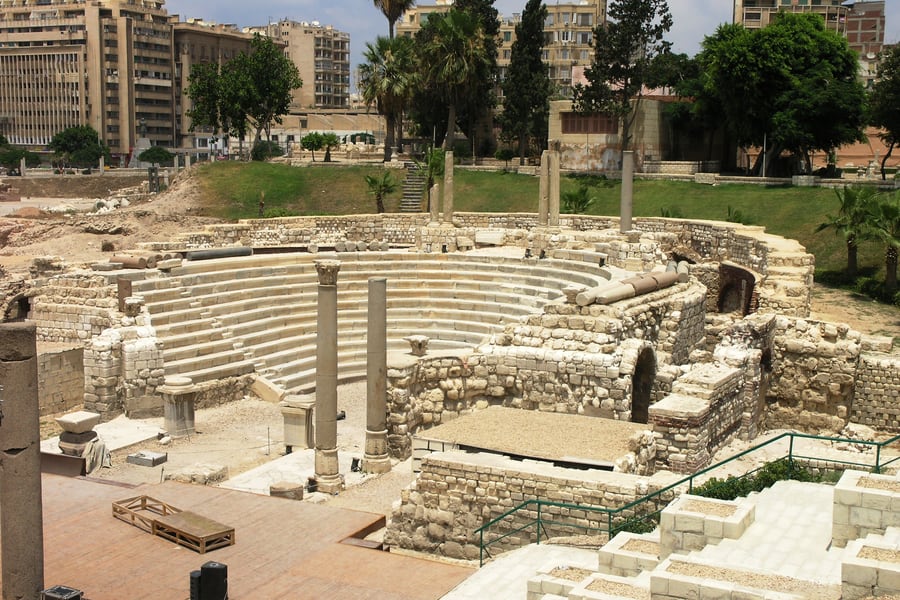 Daniel Mayer / Wikimedia Commons · CC BY-SA 4.0 · cropped
The Roman Theatre, Kom el-Dikka
Alexandria hides its antiquity, and this is where most of it surfaced. Digging began at Kom el-Dikka in 1960 under the Polish archaeologist Kazimierz Michałowski, and uncovered a raked hemicycle of seats — marble recycled from older buildings, walls of limestone — alongside a 4th-century imperial bath, twenty-odd lecture halls, and the mosaics of the Villa of the Birds. It is the city's fullest surviving ancient site.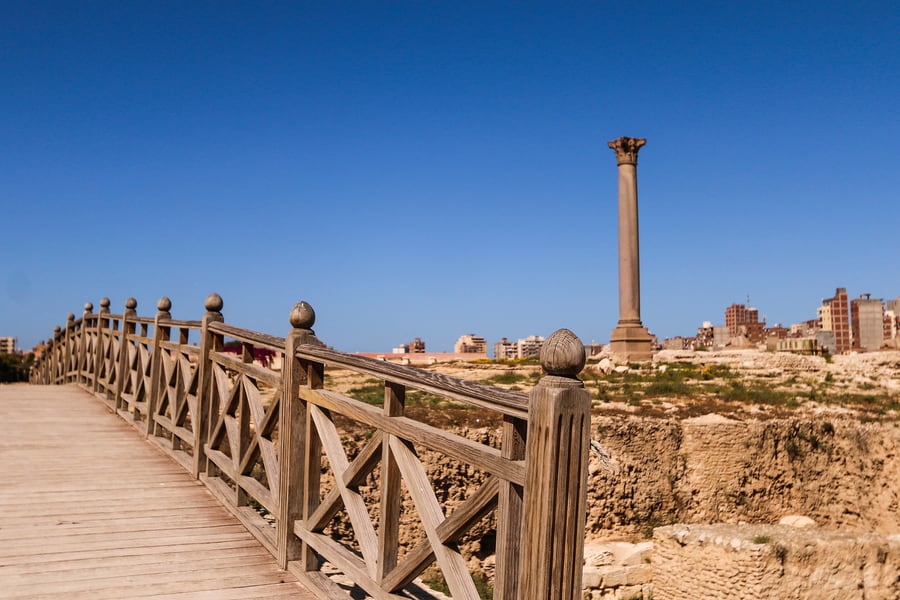 Aya Mahmoud Naguib Ibrahim / Wikimedia Commons · CC BY-SA 4.0 · cropped
Pompey's Pillar
The tallest ancient column still standing in Egypt has nothing to do with Pompey. A prefect named Publius raised it between 297 and 302 AD for the emperor Diocletian; crusaders misread the Greek Pouplios as Pompeios and the wrong name stuck. It is 26.85 metres overall, the shaft a single piece of pink Aswan granite, and it marks the ruined precinct of the Serapeum, once a rival to the great temples of Rome.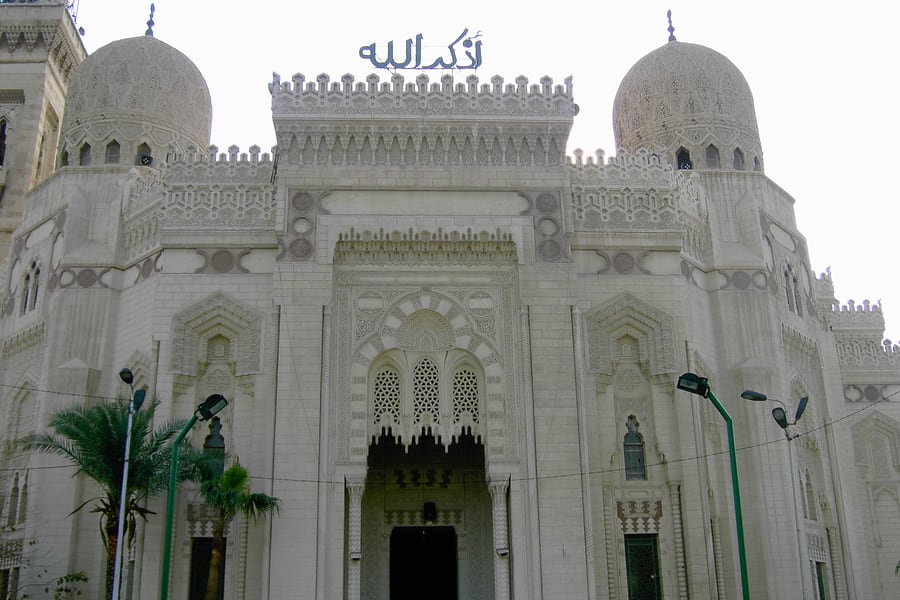 Papillus / Wikimedia Commons · CC BY-SA 3.0 · cropped
Abu al-Abbas al-Mursi Mosque
The great mosque of the Anfoushi quarter honours a 13th-century Andalusian Sufi who died in Alexandria in 1286 and lies buried inside it. The present building went up in the 1930s and 40s to designs by the Italian architect Mario Rossi, who worked for Egypt's religious endowments and gave the city several of its finest mosques. Its 73-metre minaret and cluster of domes are landmarks from the harbour.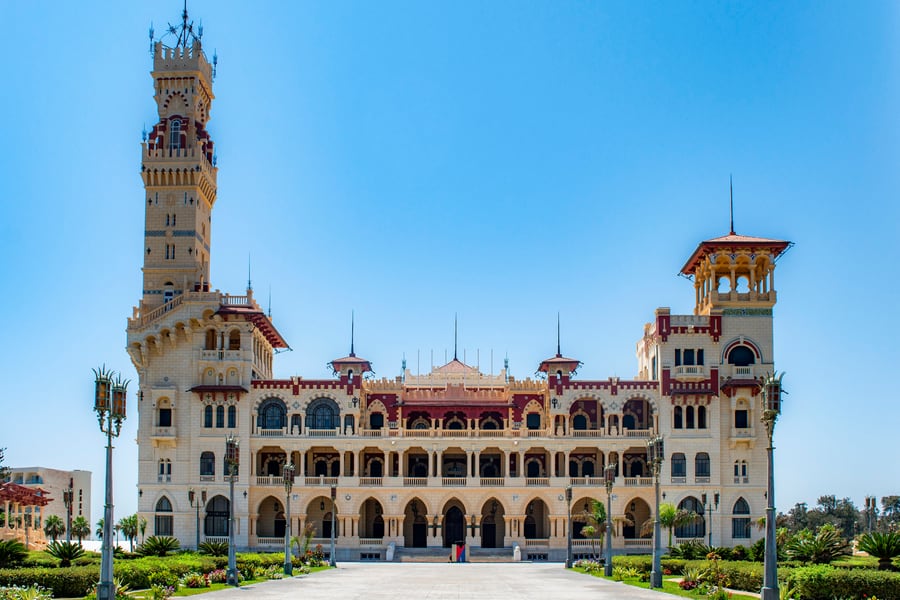 ASaber91 / Wikimedia Commons · CC BY-SA 4.0 · cropped
Montazah gardens
At the eastern end of the Corniche, the khedives and kings kept their summer retreat. The Salamlek was built for Abbas II in 1892 as a hunting lodge; the larger, tower-topped Haramlik followed for King Fuad I in 1932, in a mix of Ottoman and Florentine styles. The palaces are a museum and a hotel now, but the point is the 120 hectares of pine and garden running down to private coves — Alexandria's best afternoon.Where to Sleep
Because the train is so quick and so frequent, plenty of people make Cairo–Alexandria a day trip and sleep at neither end especially for the journey. But both cities reward an overnight stay, and the choice of where to base yourself is really a choice of which city you want to wake up in.
In Alexandria, the romantic option is a room on the Corniche, looking out over the Mediterranean. The grande dame is the historic Cecil Hotel on Saad Zaghloul Square — a 1929 landmark that once hosted Winston Churchill and Somerset Maugham — but the seafront is lined with hotels of every grade, from restored old-world addresses to plain modern towers, most within a short taxi ride of Misr Station. Staying by the water, with the fishing boats and the evening promenade below your window, is the essence of Alexandria.
In Cairo, the classic setting is a room overlooking the Nile in the central districts of Garden City, Zamalek or Downtown — many of the big riverfront hotels are a short drive from Ramses Station, and some offer views across the water to the lights of the city. If the Pyramids are your priority, there are also hotels out at Giza with the monuments themselves on the skyline.
Wherever you stay, both stations sit in the busy centre of their cities, so an early train or a late arrival is never far from your bed. We keep this guide to the lie of the land rather than specific bookings; choose the city and the view first, and the right hotel usually follows.
Questions or corrections
Planning this trip and stuck on something, or spotted a time, fare or detail that has changed? Send us a message about Cairo to Alexandria. We read every one, and we update this page when something has changed.