Centovalli Railway
NAC / Wikimedia Commons · CC BY-SA 4.0 · 2024 · cropped
- Distance52 km
- Duration1 hr 54 min
- Best seasonEvery day of the year · nine or ten trains each way
Introduction
A return ticket from Locarno to Domodossola costs 31.00. The operator's own price list does not say of what. It prints CHF/EUR 31.00, one figure for two currencies, and leaves the passenger to decide which money to hand over — which is as good a summary of this railway as any sentence could manage. Fifty-two kilometres of metre gauge run from a Swiss lakeside town to an Italian market town, and the line has never entirely settled which country it belongs to. Twenty kilometres of it lie in Ticino and thirty-two in Piedmont. It is owned outright by two separate companies, FART on the Swiss side and SSIF on the Italian, which hand over at a village called Camedo without the train so much as pausing. It even has two names: the Centovallina in Switzerland, the Vigezzina in Italy.
It opened on 25 November 1923, the work of an Italian–Swiss committee that spent five years pushing a railway through country too broken to make it easy. The operator counts 83 bridges and viaducts and 31 tunnels in those 52 kilometres; the gradient reaches six per cent, the curves close to a fifty-metre radius, and the summit is only 830 metres above the sea. Trains run every day of the year and take a few minutes under two hours end to end. A valid identity card is needed to cross the border. Nothing else about the journey is complicated.
The Journey
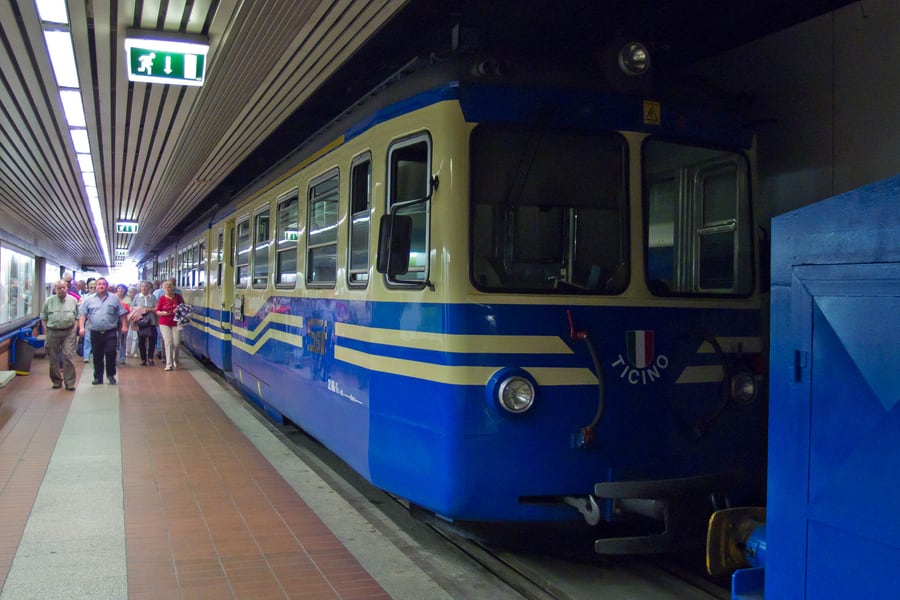
The through train leaves Locarno from underground. The FART platforms sit in a cut-and-cover box beneath the town, built in 1990 to get the railway off the streets it had used since 1923, and for the first two minutes the Centovalli railway is a metro. It surfaces at Solduno, crosses the Maggia on a girder bridge shared with the cantonal road at Ponte Brolla, and turns west into a side valley that immediately becomes the whole point of the journey.
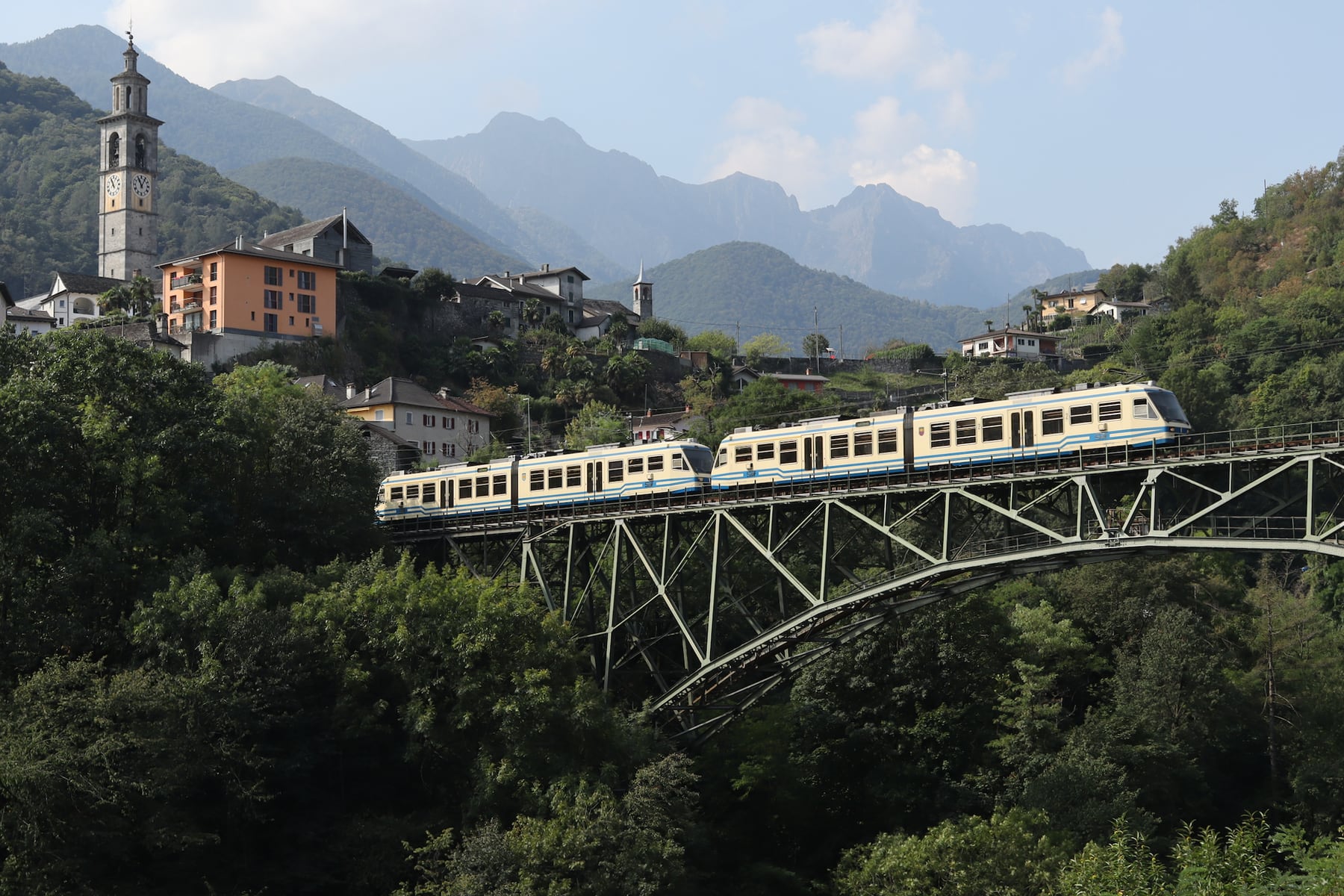
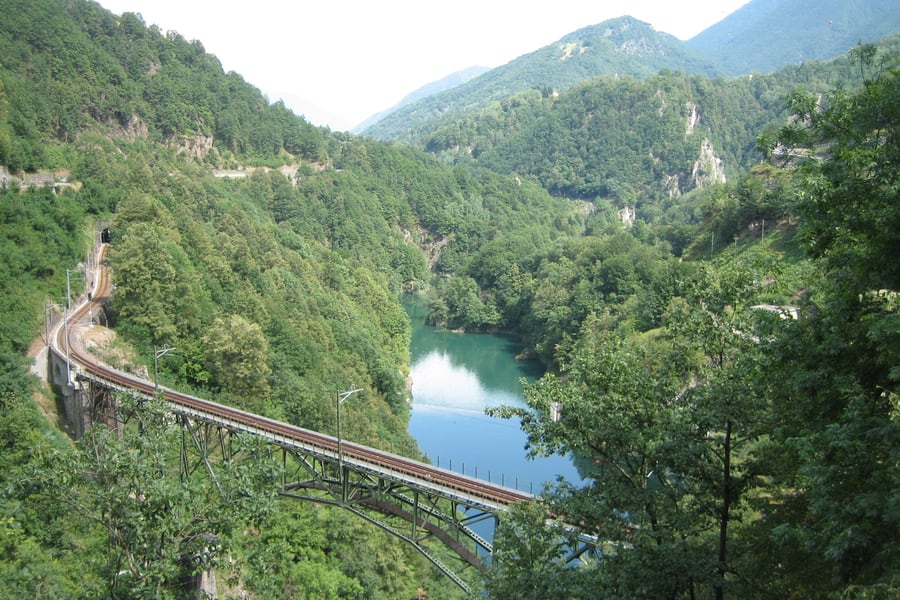
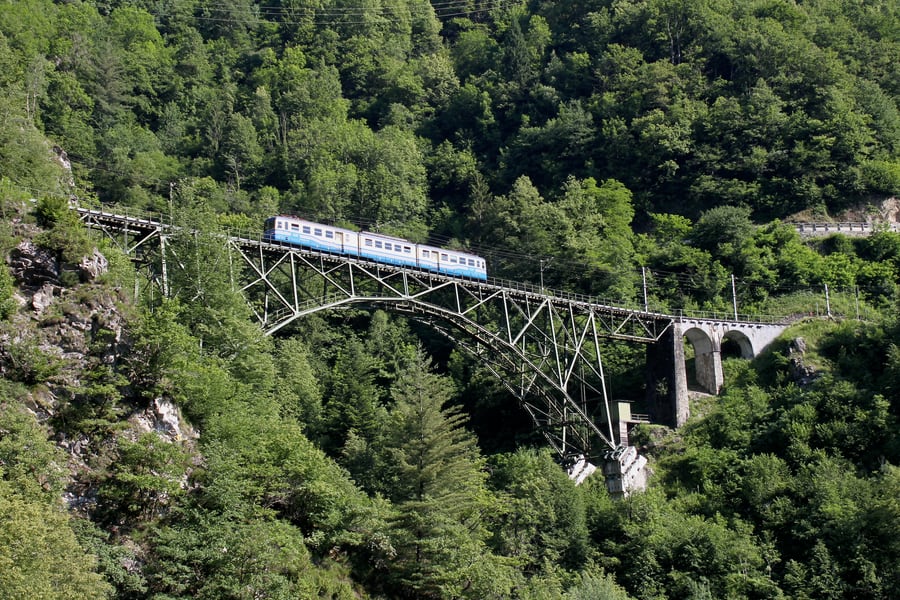
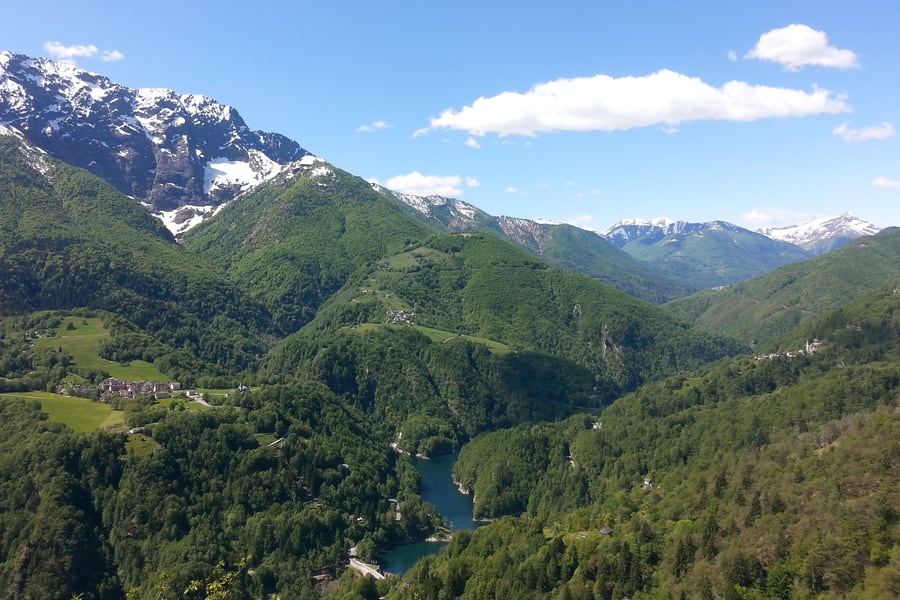
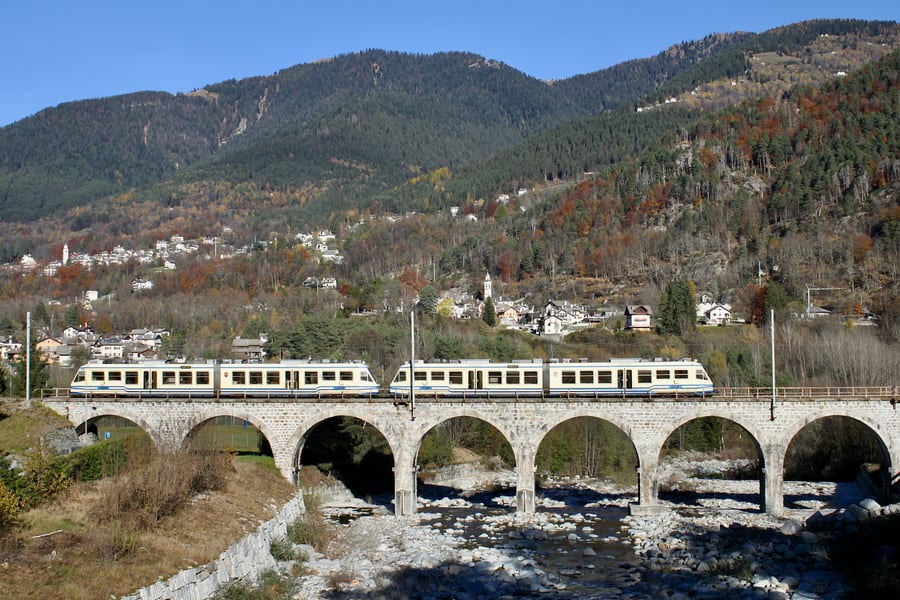
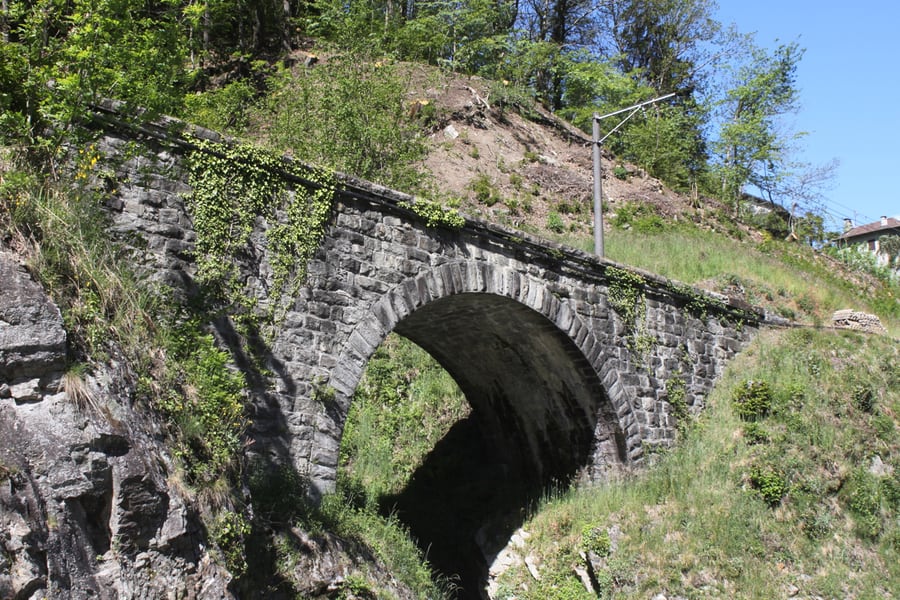
The Centovalli — the hundred valleys — is not one valley but a slot cut by the Melezza between two ridges, with a hundred smaller clefts running down into it from either side. There is no room on the floor for a railway, so there is no railway on the floor. The line is carried along the northern wall on a ledge, and every time a side stream interrupts the ledge it is bridged. That is where the 83 bridges come from. Some are stone arches thrown across a gully in a single span; the largest are steel, and the two worth waiting for are the Isorno bridge just west of Intragna, where the train crosses the gorge on an iron arch with the village and its bell tower directly above, and the Ruinacci viaduct near Camedo, a lattice arch on the lip of the Palagnedra reservoir.
The Swiss half
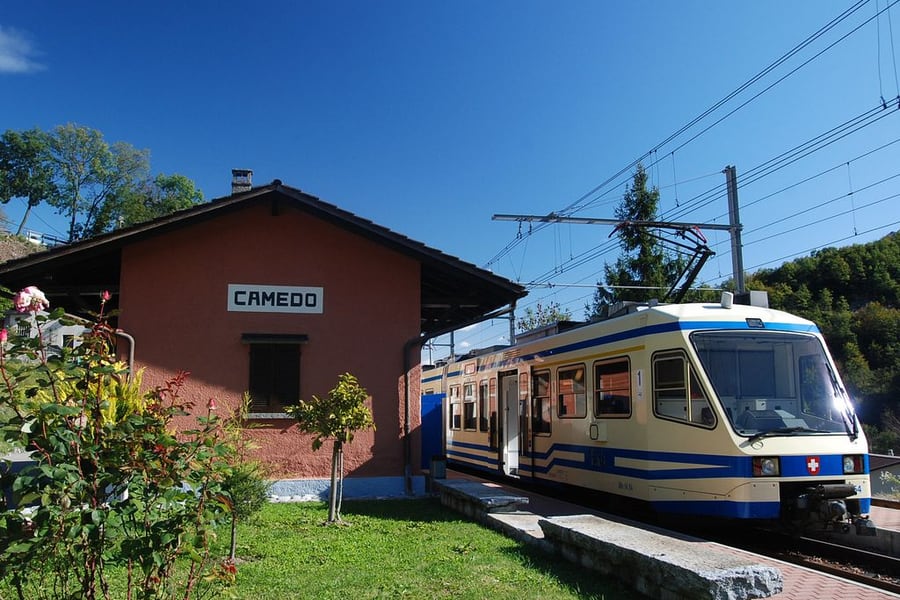
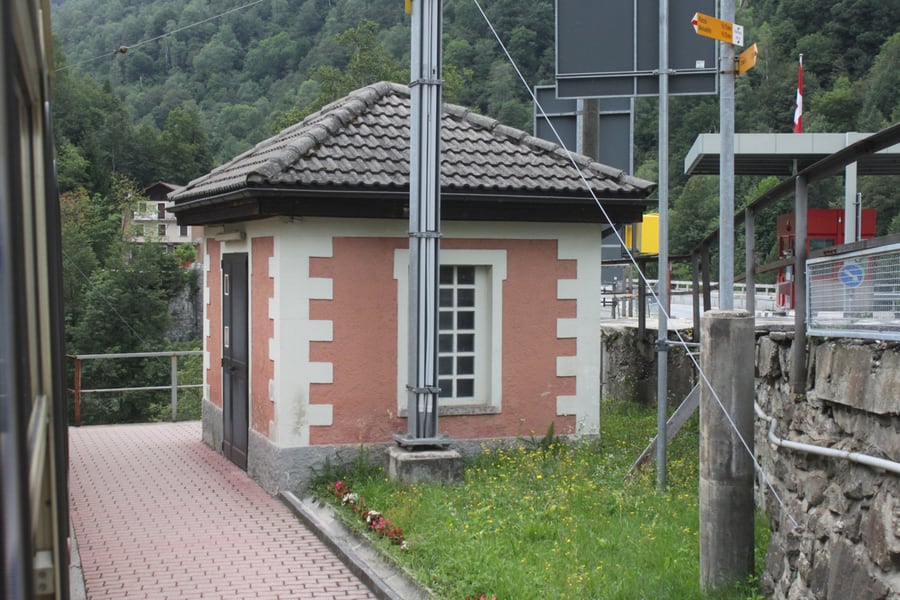
Between Ponte Brolla and Camedo the villages sit high on the slopes and the stations sit below them. Intragna is the largest, and its parish church of San Gottardo carries the tallest bell tower in Ticino at 65 metres — visible from the train for several minutes before the station and several after. Verdasio has two cable cars from beside the platform, and Palagnedra has a dammed reservoir, green and still under the wooded slopes. Camedo is the last Swiss station, a red goods-shed of a building with a small Swiss customs house on the platform, and the frontier itself is a few hundred metres beyond it at the Ribellasca bridge.
The gradients on this stretch are the steepest on the line. Between Verdasio and Intragna the railway climbs at six per cent, which for a line with no rack and no cable is close to the limit of what adhesion will hold, and the curves are tight enough that a 60 km/h limit is academic for most of the way.
The Italian half
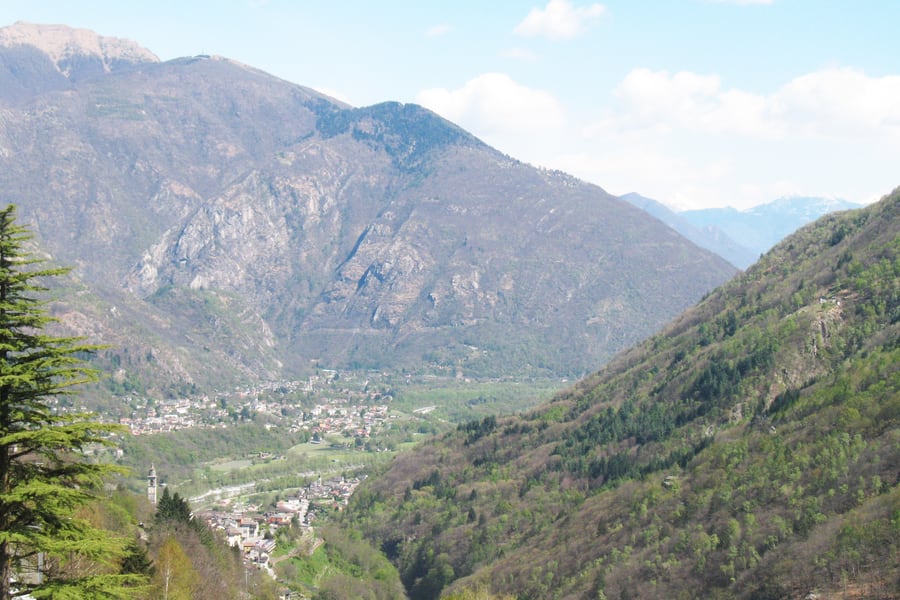
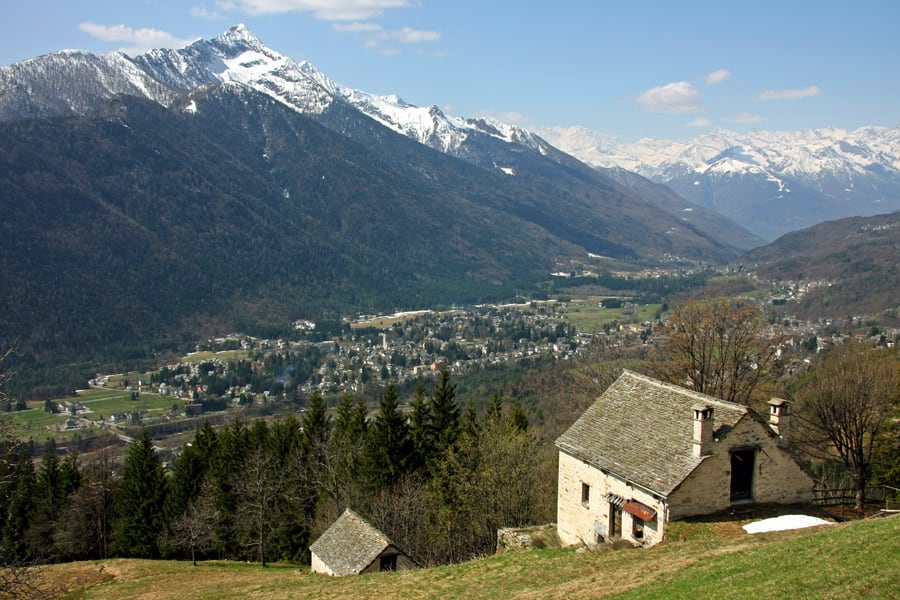
Past the border the country opens. The Valle Vigezzo is a broad, flat-floored, sunlit valley — the only alpine valley in the region that runs east to west, which is why it gets the light it does — and after two hours of gorge it comes as a shock. Re is the first Italian stop, with the domed basilica of the Madonna del Sangue directly above the platform. Malesco, Santa Maria Maggiore and Druogno follow across the valley floor, the summit at 830 metres somewhere among them, and then the line falls off the western end of the valley towards the Ossola in a long descent through Trontano and Masera to Domodossola, where it dives underground again into the SSIF platforms beside the Italian state station.
What runs
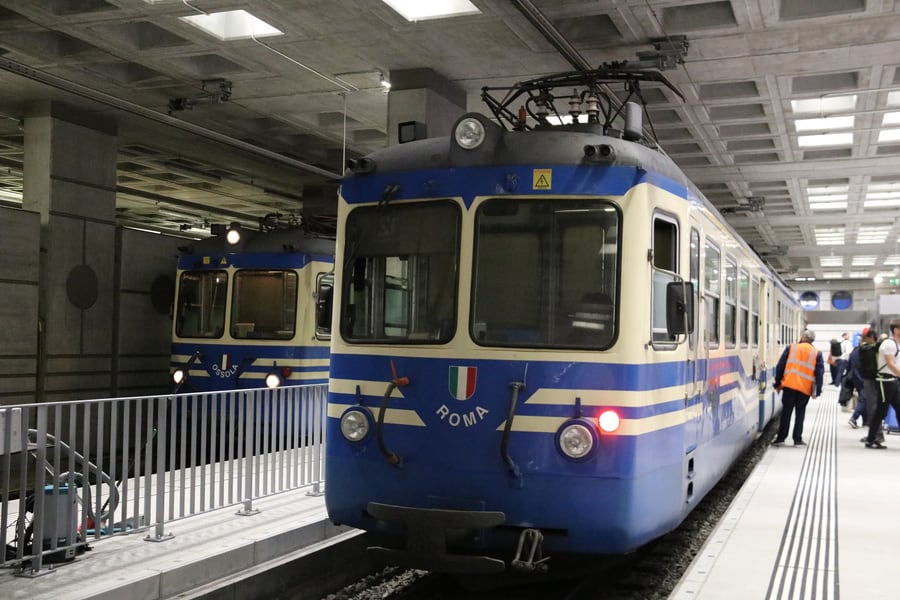
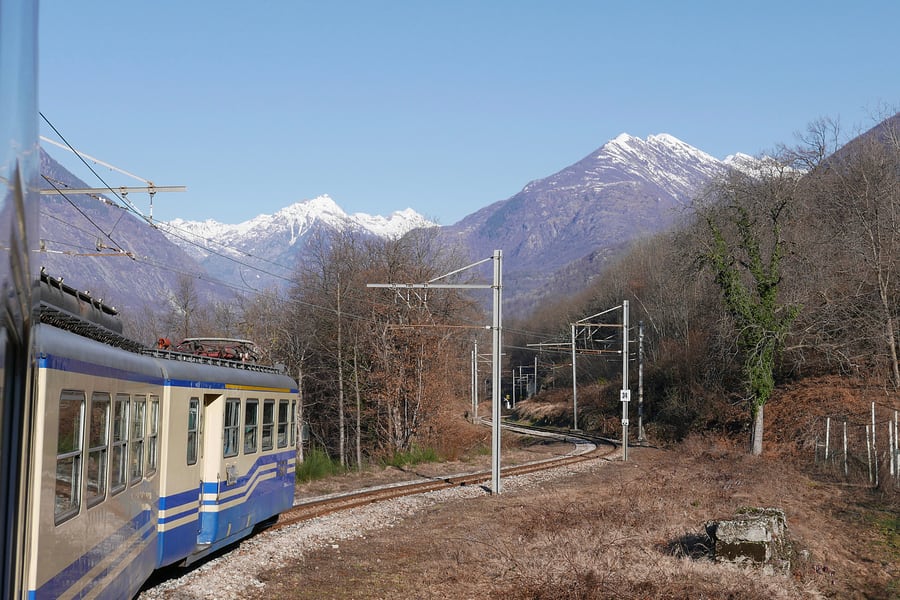
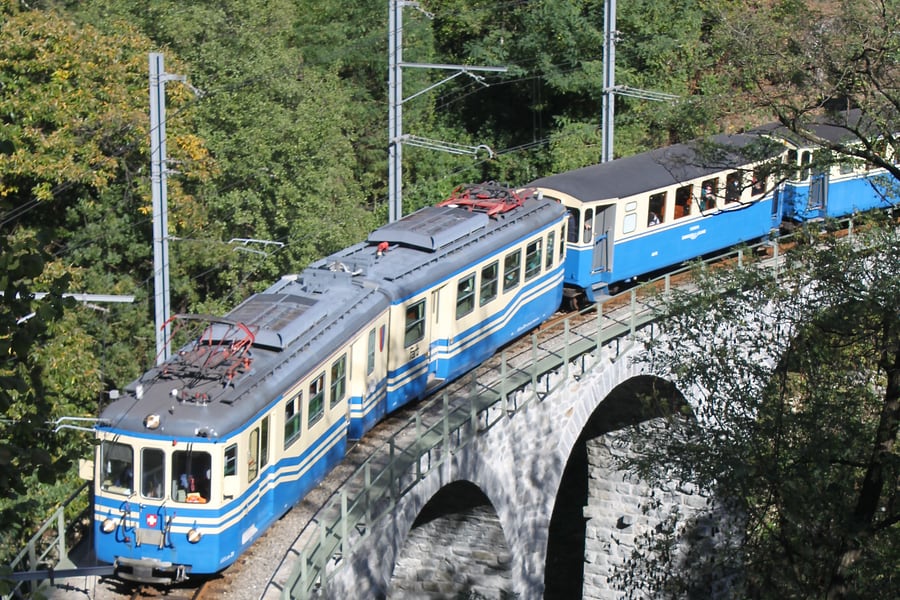
The international services come in two families. The Centovalli Express sets are the Swiss-owned stock, rebuilt in recent years with first and second class and large windows. The Vigezzo Vision panorama trains are the reason some departures carry a supplement: they have a trapezium cross section, so the glass leans out over the passenger's head, and they sell a seat immediately behind the driver's cab. Alongside both, the SSIF still owns the ABe 8/8 twin railcars of 1959 — blue-and-cream, articulated, unmistakable — and puts them back on the through workings when the panorama sets are in the shops, which is what one photographer caught them doing in April 2024.
The shortcut nobody notices
There is a practical reason this railway is busier than a valley of five thousand people would suggest. It is the shortest link between the Simplon and the Gotthard, and that makes it the fastest way from the Valais to Ticino. Brig to Locarno takes 2 hours 40 minutes by way of Domodossola and the Centovalli. The all-Swiss alternative, by Bern, Lucerne and Bellinzona, takes 4 hours 30. The quickest route between two Swiss cantons leaves the country to do it.
Along the route
 NAC / Wikimedia Commons · CC BY-SA 3.0 · 2014 · cropped
Seven hundred metres of track, gone in a night
On 7 August 1978 a flood came down the valley and destroyed almost seven hundred metres of railway. Nobody was hurt, and the line reopened before the year was out. It is what happens to a railway carried on a ledge above a torrent for twenty kilometres.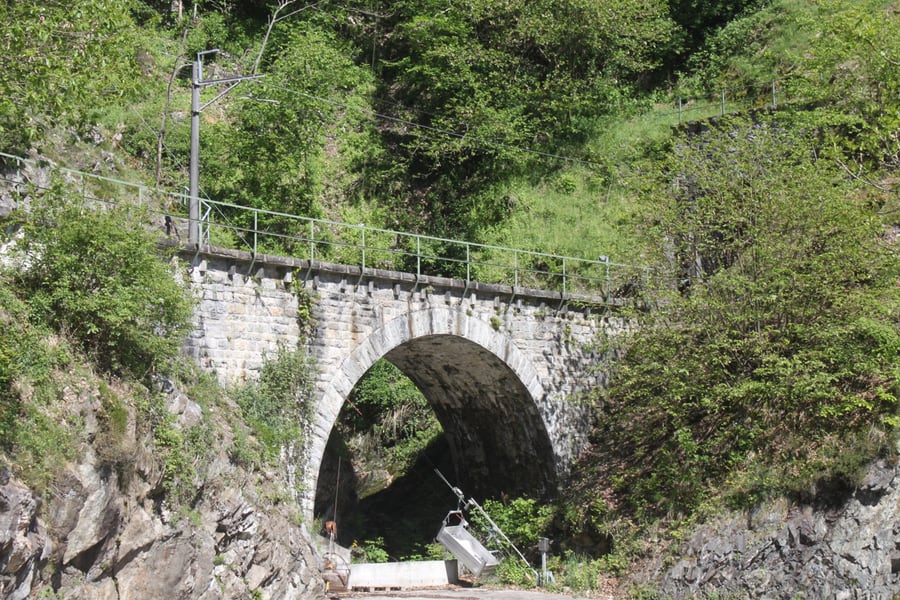 NAC / Wikimedia Commons · CC BY-SA 3.0 · 2014 · cropped
The gauge it inherited
The Centovalli railway did not choose to be metre gauge. Its builders used part of an existing metre-gauge line at the Locarno end, and that decided the gauge of everything west of it. The borrowed line closed in 1965; this one is still running.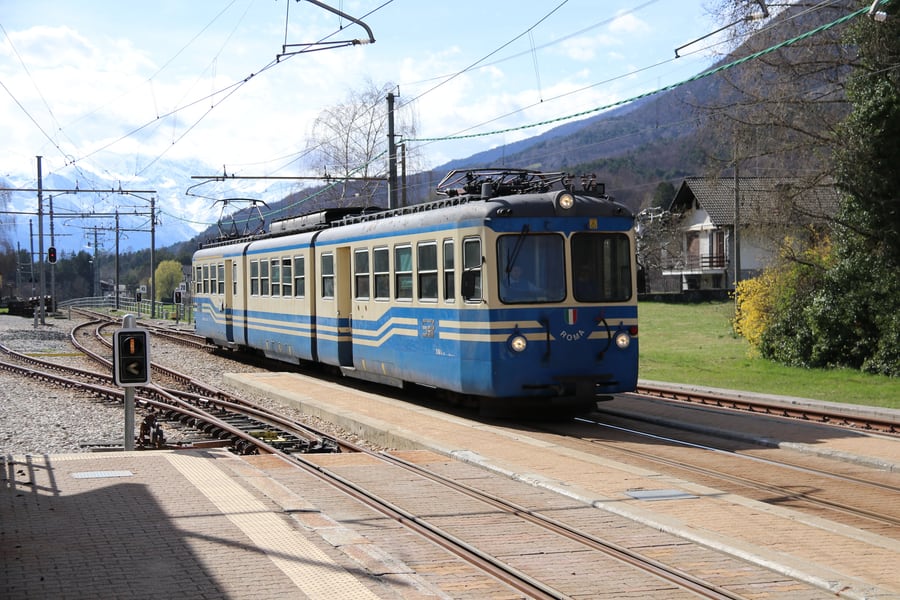 Markus Giger / Wikimedia Commons · CC BY-SA 4.0 · 2024 · cropped
Sixty-five years old and still on the main line
The SSIF's ABe 8/8 twin railcars date from 1959 and are the oldest stock in front-line use: blue and cream, articulated, one carrying the name ROMA on its nose. They still take through workings when the panorama sets are in the works.A bit of history
Culture & experiences along the way
 NAC / Wikimedia Commons · CC BY-SA 4.0 · 2020 · cropped
The historic train to Camedo
FART runs a heritage train over the Swiss half with the Società Esercizio Ferroviario Turistico: an ABDe 6/6 electric railcar of 1963 and a matching coach of the same year, limited to 40 km/h, with windows that open. It runs on announced dates rather than to a timetable — the 2026 programme has a murder-mystery dinner on 22 August, sold out, and a Centovalli Bread run on Sunday 4 October — and it can be chartered for private groups.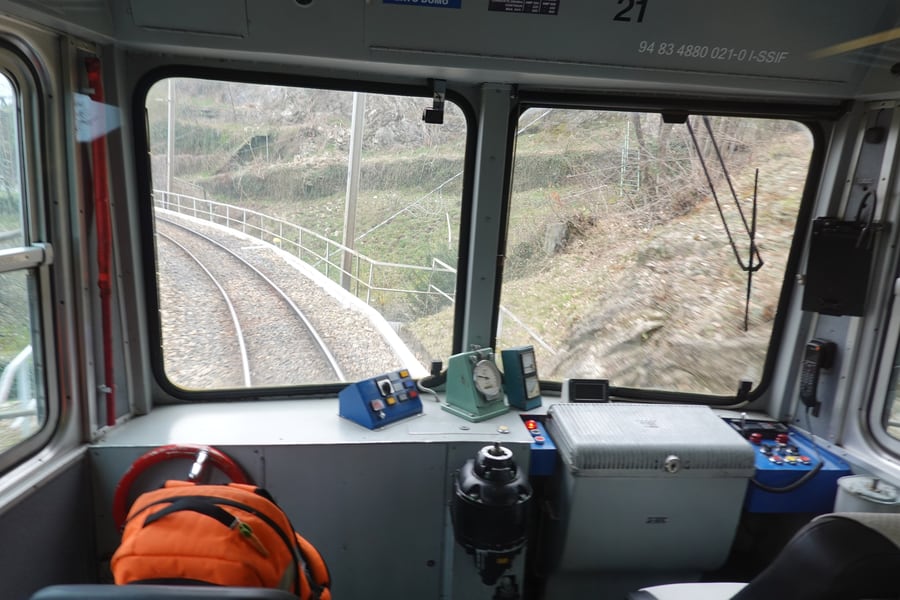 Smiley.toerist / Wikimedia Commons · CC BY-SA 4.0 · 2026 · cropped
The seat behind the driver
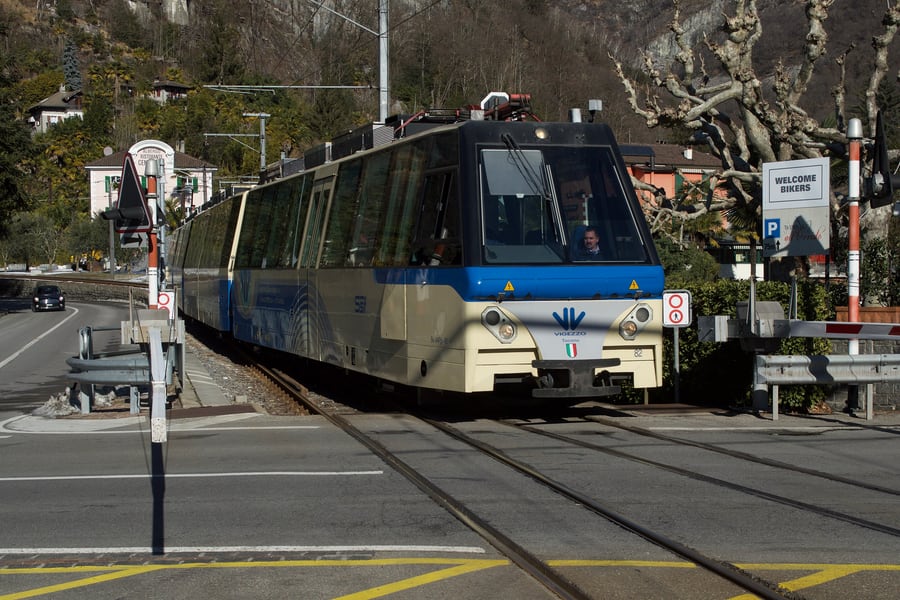
The Vigezzo Vision panorama sets are built with a trapezium cross section, so the glass leans outwards above head height, and they sell a panorama seat immediately behind the driver's cab. Six departures a day are worked by them, four from Domodossola and two from Locarno, and they carry a supplement of CHF/EUR 1.50 on top of any ticket or pass. Standing is not permitted on these trains, so the CHF 5.00 / EUR 4.00 reservation is the sensible companion to the supplement.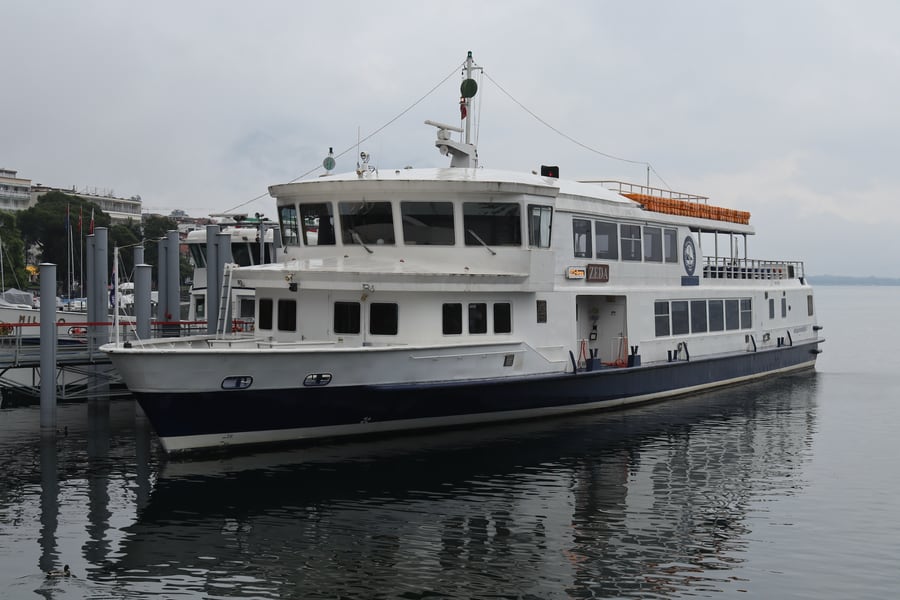 NAC / Wikimedia Commons · CC BY-SA 4.0 · 2024 · cropped
Lago Maggiore Express
A circuit that uses the railway one way and Lake Maggiore the other: the Vigezzina from Domodossola to Locarno, then Navigazione Lago Maggiore's service 203 from Locarno at 16:00 down the lake to Stresa or Arona. It runs on Saturdays and Sundays, costs €32 for adults and €16 for children aged 4 to 12, and is sold only at a ticket office — the railway's at Domodossola or Santa Maria Maggiore, on board the train, or the boat company's. The Trenitalia leg back is not included.Timetables
The Centovalli railway runs every day of the year, on one timetable valid from 14 December 2025 to 12 December 2026. There is no summer service and no winter service — the same trains run in January as in August.
Through trains between Locarno and Domodossola are labelled either PE 72 (PanoramaExpress) or RE 73 (RegioExpress), and both take about 1 hour 50 minutes to 1 hour 55 end to end. The difference between them is the small Italian halts: the RegioExpress adds Folsogno-Dissimo, Zornasco, Prestinone, Gagnone-Orcesco, Verigo and Creggio, which the PanoramaExpress runs through. Neither calls at the Swiss halts between Locarno and Intragna — Solduno, Ponte Brolla, Tegna, Verscio, Cavigliano, Corcapolo, Verdasio and Palagnedra are the business of the local R 70, which works the Swiss half only, Locarno to Camedo or Verdasio, roughly hourly through the day.
The pattern below was queried against the Swiss national timetable database in August 2026 for a Thursday, a Friday, a Saturday and a Sunday in September 2026, a Saturday in October 2026 and a Wednesday in January 2027. Every date returned the same service but for one late train each way, which is noted where it belongs.
Through trains, Locarno to Domodossola
Nine departures: 06:50, 07:51, 09:51, 10:51, 12:51, 14:51, 15:51, 16:51, 17:50 — and, on Fridays and Sundays only, a tenth at 18:51. The intermediate times below are those of the 12:51.
| Station | 12:51 departure |
|---|---|
| Locarno FART | 12:51 |
| Intragna | 13:09 |
| Camedo | 13:26 |
| Re | 13:42 |
| Malesco | 13:48 |
| Santa Maria Maggiore | 13:55 |
| Druogno | 14:00 |
| Trontano | 14:22 |
| Masera | 14:33 |
| Domodossola | 14:40 |
Through trains, Domodossola to Locarno
Nine departures: 08:26, 09:26, 10:26, 11:26, 12:26, 13:26, 15:26, 17:26, 19:00 — and, again on Fridays and Sundays only, a tenth at 20:26. The intermediate times are those of the 11:26.
| Station | 11:26 departure |
|---|---|
| Domodossola | 11:26 |
| Masera | 11:34 |
| Trontano | 11:45 |
| Druogno | 12:07 |
| Santa Maria Maggiore | 12:12 |
| Malesco | 12:18 |
| Re | 12:24 |
| Camedo | 12:40 |
| Intragna | 12:58 |
| Locarno FART | 13:20 |
The operator's own FAQ gives the same shape from the other end: the last train from Domodossola is 19:00 from Monday to Thursday and on Saturday, and 20:25 on Friday and Sunday.
The trains that carry a supplement
Four eastbound and two westbound departures are worked by the Vigezzo Vision panorama sets and attract a €1.50 panorama supplement, payable to the conductor or online. As published by the operator on 4 April 2026, until further notice:
| From Domodossola | From Locarno |
|---|---|
| 10.26 (train 47) | 12.51 (train 54) |
| 11.26 (train 53) | 15.51 (train 72) |
| 13.26 (train 61) | |
| 15.26 (train 69) |
Standing is not allowed on a panorama train, so a seat reservation is worth having on those six departures.
Connections at each end
At Locarno the FART platforms are underground beneath the SBB station at Muralto; the S20 to Bellinzona and the trains to Lugano and the Gotthard leave from above. At Domodossola the SSIF platforms are likewise underground, beside the Italian state station, which sits on the Simplon main line to Brig and on the line to Milan. ⚠️ Some Simplon regional services between Iselle di Trasquera and Domodossola were running as replacement buses in September 2026 because of engineering work; the EuroCity and InterRegio trains through the tunnel were not affected.
Timetable: Ferrovia Vigezzina-Centovalli and the Swiss national timetable database, checked August 2026.
Tickets
Tickets are sold in francs or in euros, and the operator prints the same figure for both. The standard product for the whole line is the International Tourist Ticket, a return valid for two days with one intermediate stop allowed each way: CHF/EUR 31.00 in second class, 41.00 in first, half that for children aged 6 to 15. A seat reservation is CHF 5.00 / EUR 4.00 a journey, compulsory for groups of ten and effectively so on the six panorama departures, where standing is not permitted.
Two cheaper ways are easy to miss. Vigezzina No Limits buys unlimited travel on the Italian half for €12 a day, which beats the through fare for anyone staying in the Valle Vigezzo. And the Ticino Ticket, issued free to overnight guests in the canton, covers Locarno to Camedo outright and takes 20 per cent off the rest. Fares read from the operator's own price tables, August 2026.
Book your tickets
International Tourist Ticket
CHF/EUR 31.00 second class · CHF/EUR 41.00 first
The standard product — a return valid two days, with one intermediate stop each way.
Book Tickets (opens in a new tab, on vigezzinacentovalli.com)via vigezzinacentovalli.comFamily offer
CHF/EUR 62.00 for two adults and one child · 77.50 with two children
The same two-day return, discounted automatically when two adult tickets are bought.
Book Tickets (opens in a new tab, on vigezzinacentovalli.com)via vigezzinacentovalli.comVigezzina No Limits
EUR 12.00 for a day · EUR 20.00 for two consecutive days
Unlimited second-class travel on the Italian half, on and off as often as you like.
Book Tickets (opens in a new tab, on vigezzinacentovalli.com)via vigezzinacentovalli.comCamedo – Domodossola with a Ticino Ticket
CHF 18.40 adults · CHF 11.50 children 6–15
The discounted upgrade that carries a Ticino Ticket holder on into Italy.
Book Tickets (opens in a new tab, on vigezzinacentovalli.com)via vigezzinacentovalli.comFoliage Train
EUR 36.00 midweek · EUR 42.00 at weekends, second class
The autumn version of the same journey, dearer than the ordinary return, 10 October to 15 November 2026.
Book Tickets (opens in a new tab, on vigezzinacentovalli.com)via vigezzinacentovalli.comRail Passes
This is one of the few railways where a Swiss pass is worth having for a journey that spends most of its length in Italy. The whole line, both halves, is inside the Swiss fare system.
Swiss Travel Pass, GA and Half Fare
The operator states it plainly: AG (GA), FVP, day passes and the Swiss Travel Pass give free travel over the whole line, Locarno to Domodossola. What they do not cover is the seat reservation (CHF 5.00 / EUR 4.00 per journey) or the panorama supplement (CHF/EUR 1.50), both of which remain payable. A Swiss Half Fare Card halves the fare in the ordinary way.
Two exclusions are worth knowing. The Half Fare Card and FVP are not recognised in combination with the International Tourist Ticket — the discounted return described under Tickets — and the Junior Card and Children's Co-travelcard are likewise not valid with it, although they do work if the accompanying adult holds a GA, a day pass or a Swiss Travel Pass.
Interrail and Eurail
Both halves are free, and the Swiss validity map for 2026 lists them separately because they are separate companies:
- FART: Locarno – Camedo transito
- SSIF: Camedo transito – Domodossola
Neither appears in the bonus column, which is where discounted operators go. They are in the free column, so a Global Pass covers the line end to end at no extra cost beyond the reservation and any panorama supplement. The same page also puts Iselle transito – Domodossola in the free column, which means the Simplon connection to Brig is covered too, and a Domodossola circuit — out over the Centovalli, back through the Simplon tunnel — costs a pass holder nothing at all.
⛔ An Interrail or Eurail One Country Pass for Switzerland will not do. A one-country pass cannot be used to travel into or out of the country it covers, and half of this line is in Italy. On this railway that is not a footnote: it rules out the journey. A One Country Pass for Italy has the mirror-image problem.
Is a pass worth buying for this journey alone?
No — a return costs CHF 31.00, and no pass sold for a single line would pay for itself against that. The point is the other way round: if you already hold a Swiss Travel Pass, a GA or a Global Pass, this is a two-hour international journey that costs you nothing, and most pass holders never find out it is there.
Checked August 2026 against the operator's conditions and the 2026 Swiss validity map for Eurail and Interrail passes.
Places to Visit
The International Tourist Ticket is a two-day return that allows one intermediate stop each way, so breaking the journey is built into the fare rather than charged for. With nine or ten through trains a day in each direction, a stop of two hours or of a whole afternoon costs nothing but the wait.
The six places below run west to east, in the order the train from Locarno reaches them. Three are in Switzerland and three in Italy, and the character changes at the border as sharply as the language does: gorge villages on shelves above the Melezza on the Swiss side, a wide sunlit valley floor with market towns on it once the train is past Camedo.
 Pimlico27 / Wikimedia Commons · CC BY-SA 4.0 · 2020 · cropped
Locarno
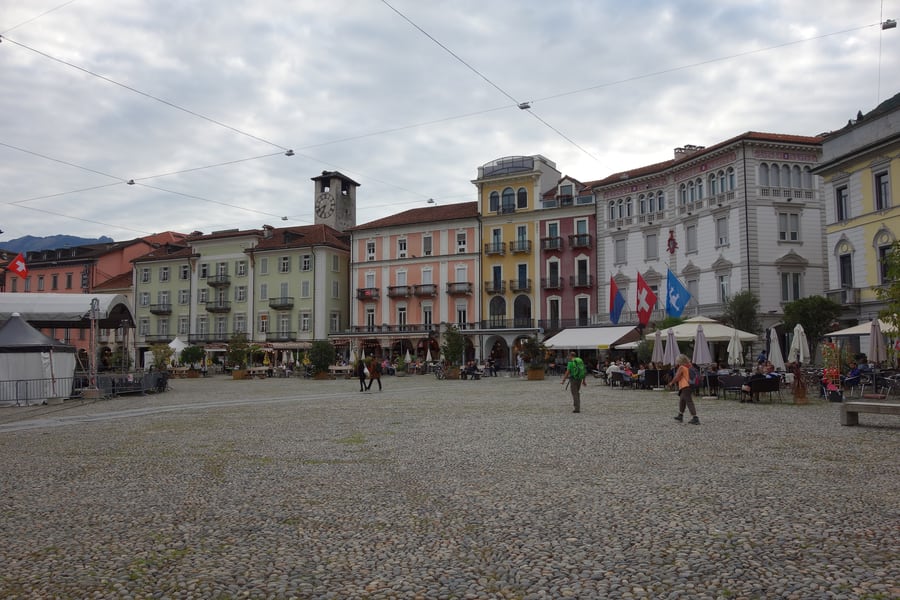
The trains start under the town, and Piazza Grande is five minutes above them: a long arcaded square on the Lago Maggiore shore that has been the open-air venue of the Locarno Film Festival since 1946, seating eight thousand people in front of one very large screen each August. Above the town a funicular climbs to Madonna del Sasso, and the Castello Visconteo stands at the western end of the square.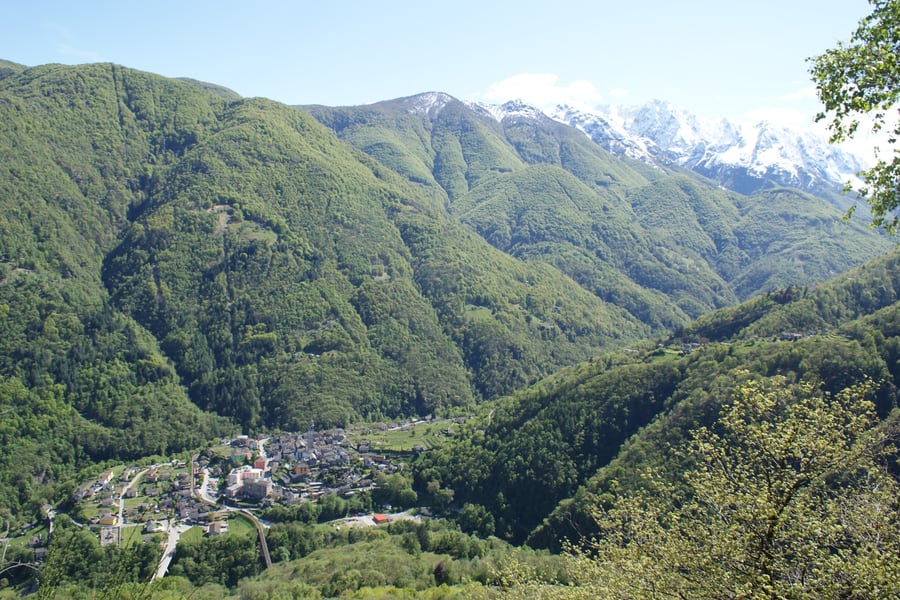 Joris Egger / Wikimedia Commons · CC BY-SA 4.0 · 2009 · cropped
Intragna
The largest village on the Swiss half, on a spur above the meeting of the Isorno and the Melezza, with the railway crossing the gorge on an iron arch immediately below it. The bell tower of San Gottardo, built between 1765 and 1772, is 65 metres high — the tallest in Ticino — and the regional museum that looks after it lets visitors climb the 166 granite steps to the bell platform for a view over the whole valley.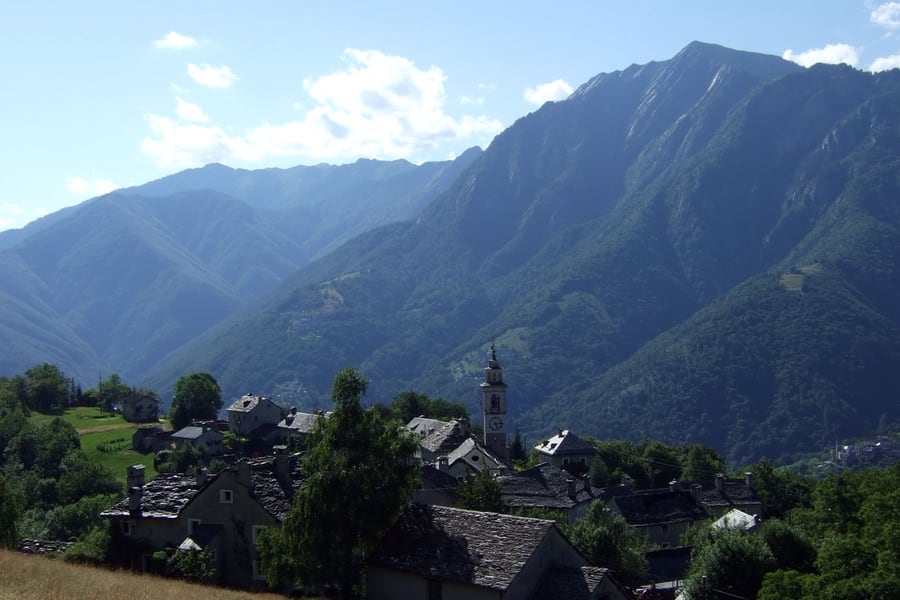 Nitrato / Wikimedia Commons · CC BY-SA 3.0 · cropped
Rasa
A stone hamlet on a terrace on the sunny side of the Centovalli, with about ten people living in it all year and no road to it at all. The cable car from beside Verdasio station has served it since 1957 — ⚠️ it is closed for renovation at present — and the walking routes remain: from Palagnedra, from Corcapolo over the Salmina bridge, or from Intragna by the old stone bridge. The other cable car at Verdasio, up to Monte Comino at 1,200 metres, runs from 1 April to 8 November 2026.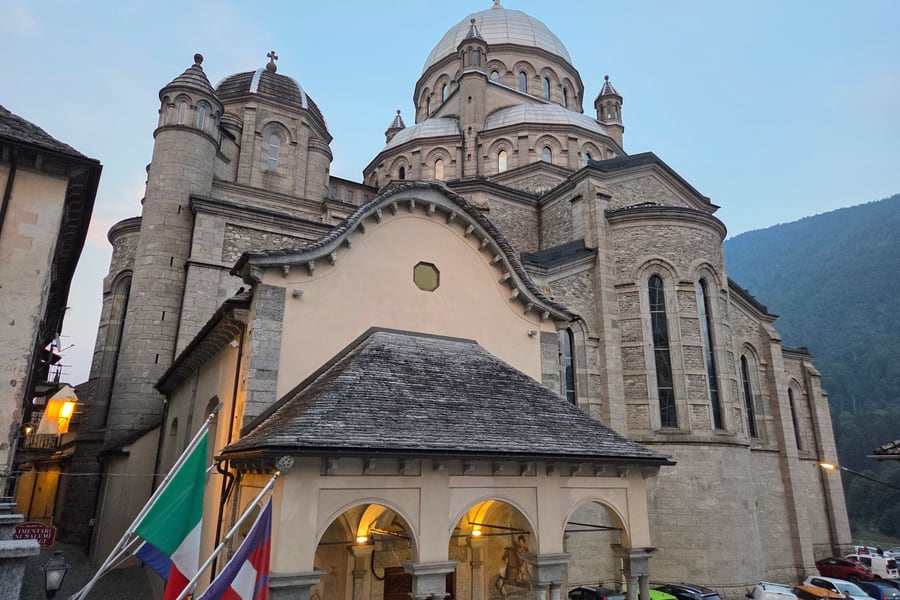 3Pappa3 / Wikimedia Commons · CC BY-SA 4.0 · 2026 · cropped
Re
The station sits under a basilica far larger than a village of this size would explain. In 1494 a man losing at dice threw a stone at a fresco of the Madonna on the wall of the church of San Maurizio, and the next morning it was found to be bleeding; the documents drawn up days later still exist. The pilgrimage that followed eventually needed more room, and the neo-Byzantine sanctuary beside the old church — begun in 1922, consecrated in 1958, its dome 51 metres high — is the result.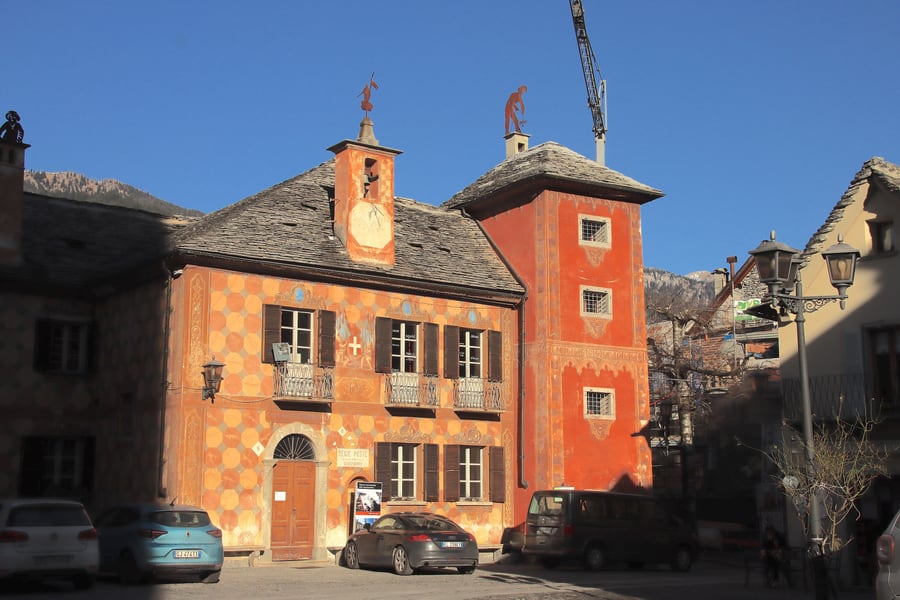 Hp.Baumeler / Wikimedia Commons · CC BY-SA 4.0 · 2024 · cropped
Santa Maria Maggiore
The valley's main town, and the one place on the line with both a ticket office and a museum worth planning around. The Valle Vigezzo sent its boys out as chimney sweeps for centuries, some of them very young, and the Museo dello Spazzacamino on Piazza Risorgimento is the only museum in Italy about that trade. The international gathering of chimney sweeps has been held here for more than forty years; in 2026 it falls on 4 to 7 September, and the trains fill up for it.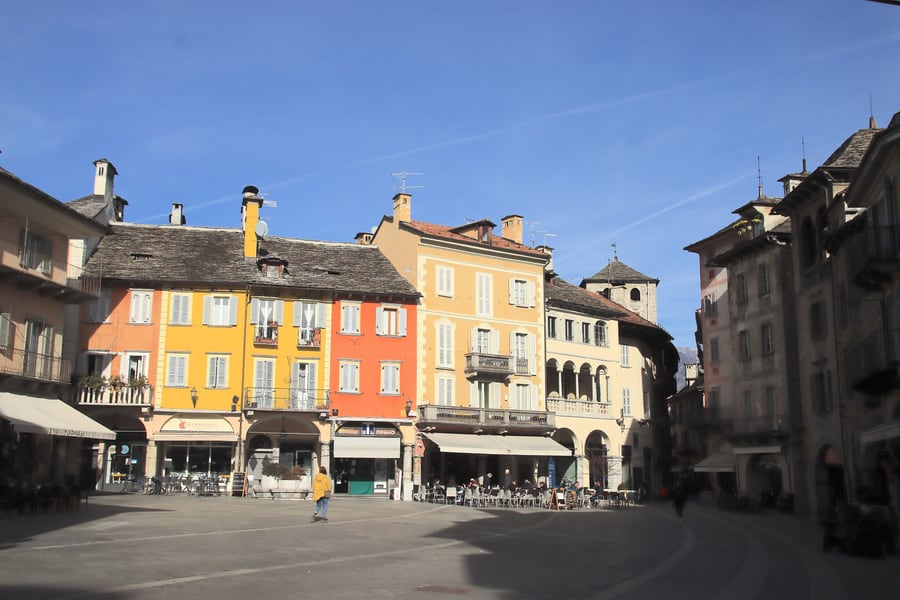 Hp.Baumeler / Wikimedia Commons · CC BY-SA 4.0 · 2024 · cropped
Domodossola
A market town at the foot of the Simplon, with its medieval core a few minutes from the station. Piazza Mercato is the centre of it, an arcaded square of fifteenth- and sixteenth-century houses that still holds a market every Saturday. Above the town the Sacro Monte Calvario, a devotional way of chapels begun in 1657, has been on the UNESCO World Heritage list with the other Sacri Monti of Piedmont and Lombardy since 2003.Where to Sleep
Two hours each way makes this an easy day out from either end, but the valley rewards a night in it, and the two-day tourist ticket is written for exactly that. The four houses below stand at the two termini and at two points along the line, and every one of them is within a few minutes of a platform — one of them close enough that the track runs past the front door.
Prices and star ratings are not listed here because we have not checked them. What is described is what each house says about itself and what can be verified about where it stands.
Where to stay
Hotel Muralto
A few steps from the Locarno terminus
A town hotel in Muralto, immediately above the underground platforms the Centovalli trains leave from, and within walking distance of the lake, the old town and Piazza Grande. Rooms are air-conditioned and there are meeting rooms; the house describes itself as the starting point for exploring the town and its surroundings, which here is literally true.
Check Availability (opens in a new tab, on hotelmuralto.ch)via hotelmuralto.ch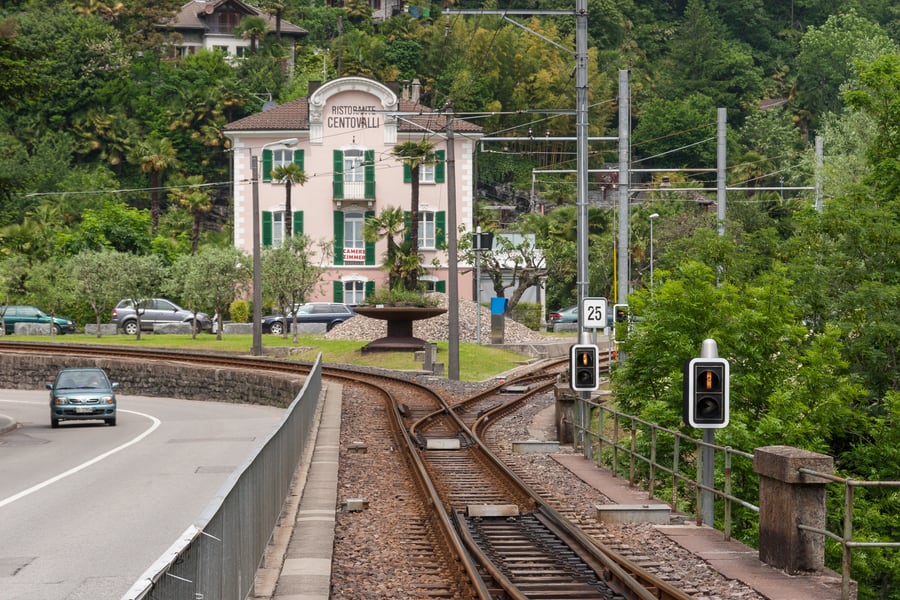 JoachimKohler-HB / Wikimedia Commons · CC BY-SA 4.0 · 2009 · cropped
Albergo Ristorante Centovalli
At Ponte Brolla, where the line enters the valley
A pink house on Via Vecchia Stazione at Ponte Brolla, with the railway and the cantonal road crossing the Maggia gorge directly in front of it. Rooms come with breakfast included — home-made jam, fresh bread — and there is a shared terrace. ⚠️ It is seasonal: hotel and restaurant are open from 4 March to 21 December 2026, and the restaurant is closed on Mondays and Tuesdays. No smoking and no pets.
Check Availability (opens in a new tab, on centovalli.com)via centovalli.comHotel Ristorante Miramonti
On the station square at Santa Maria Maggiore
The house was built as an osteria in 1922 by Carlo Giorgis, deliberately beside the station of a railway then still under construction, and the same family has run it since — five generations of them. It stands on Piazzale Diaz, has a restaurant and a bistro, keeps pages of its own about arriving by train, and serves something it calls a Vigezzina breakfast.
Check Availability (opens in a new tab, on almiramonti.com)via almiramonti.comHotel Ristorante Eurossola
In the centre of Domodossola
A restored historic building in the middle of Domodossola, a few minutes from both the state station and the SSIF platforms. It has rooms and junior suites, a separate residence, a rooftop solarium with a whirlpool, and two places to eat — the Atelier restaurant and a bistrot — which between them make it the obvious stop if the Italian end of the line is where the journey finishes.
Check Availability (opens in a new tab, on eurossola.com)via eurossola.comQuestions or corrections
Planning this trip and stuck on something, or spotted a time, fare or detail that has changed? Send us a message about Centovalli Railway. We read every one, and we update this page when something has changed.