Chemin de Fer du Bocq
Nenea hartia / Wikimedia Commons · CC BY-SA 4.0
- Distance18 km line · Spontin–Ciney and Spontin–Bauche
- Duration≈1 h 25 min round trip
- Best seasonMay–November operating calendar
Introduction
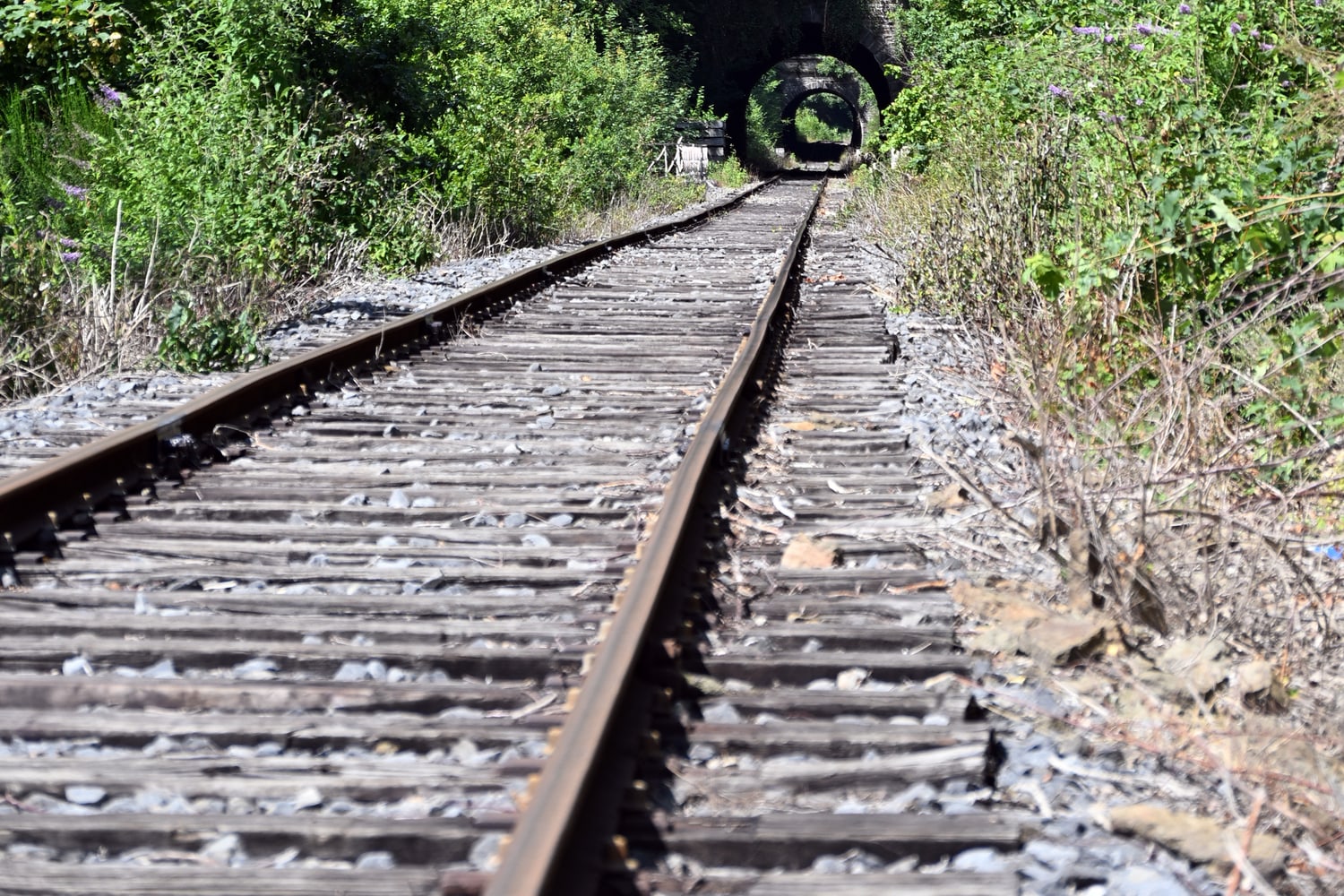
The Bocq is not a large river. It rises in the Condroz, the rolling limestone country between the Meuse and the Ardennes proper, and works its way north-west through a valley that narrows, twists and closes in until the trees meet overhead. When engineers put a railway down it at the turn of the twentieth century, they had to bore five tunnels and throw twelve viaducts across the water to keep the track on a sane gradient. The result is one of the most heavily engineered eighteen kilometres of railway in Belgium, built for a valley that never had much traffic to give it.
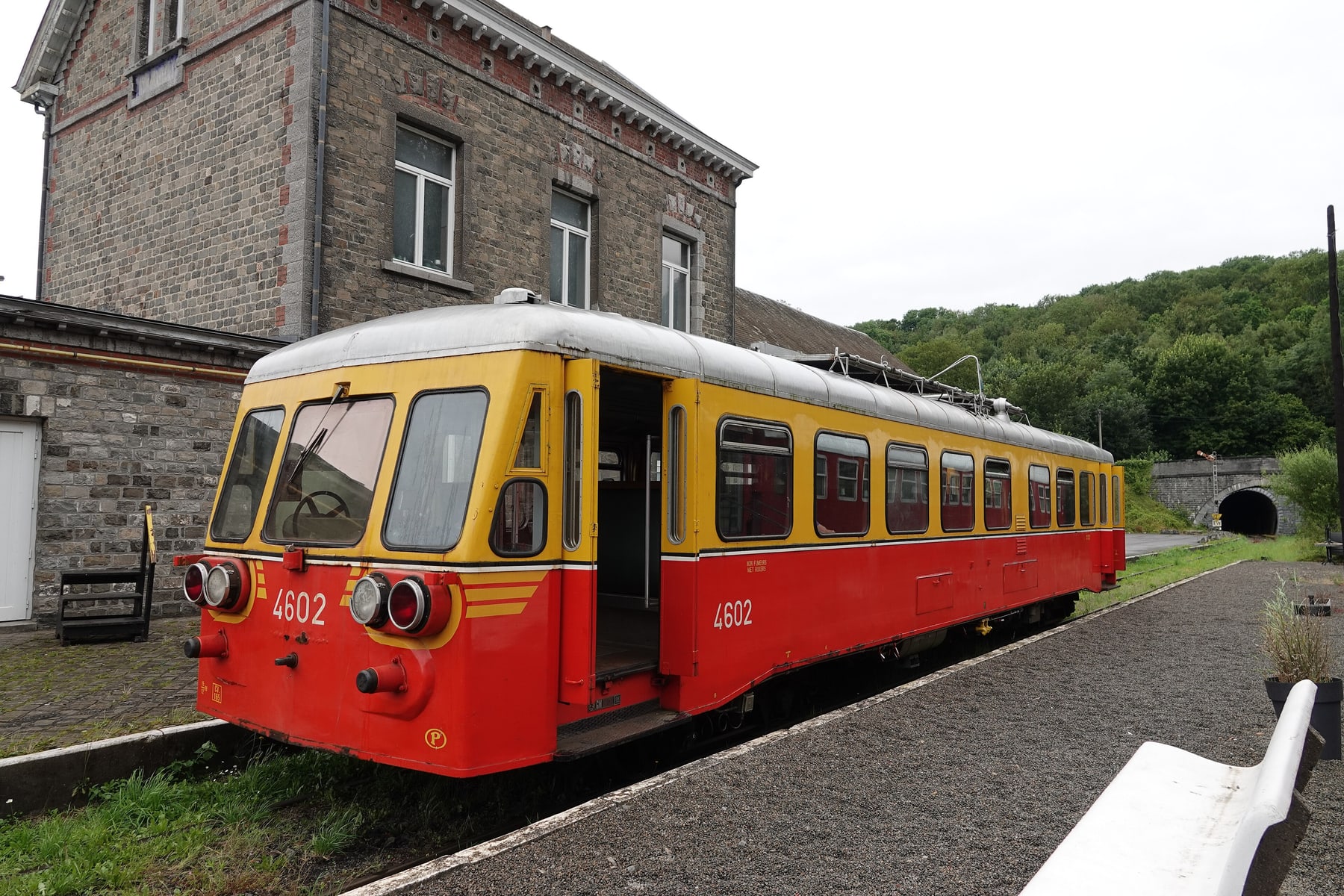
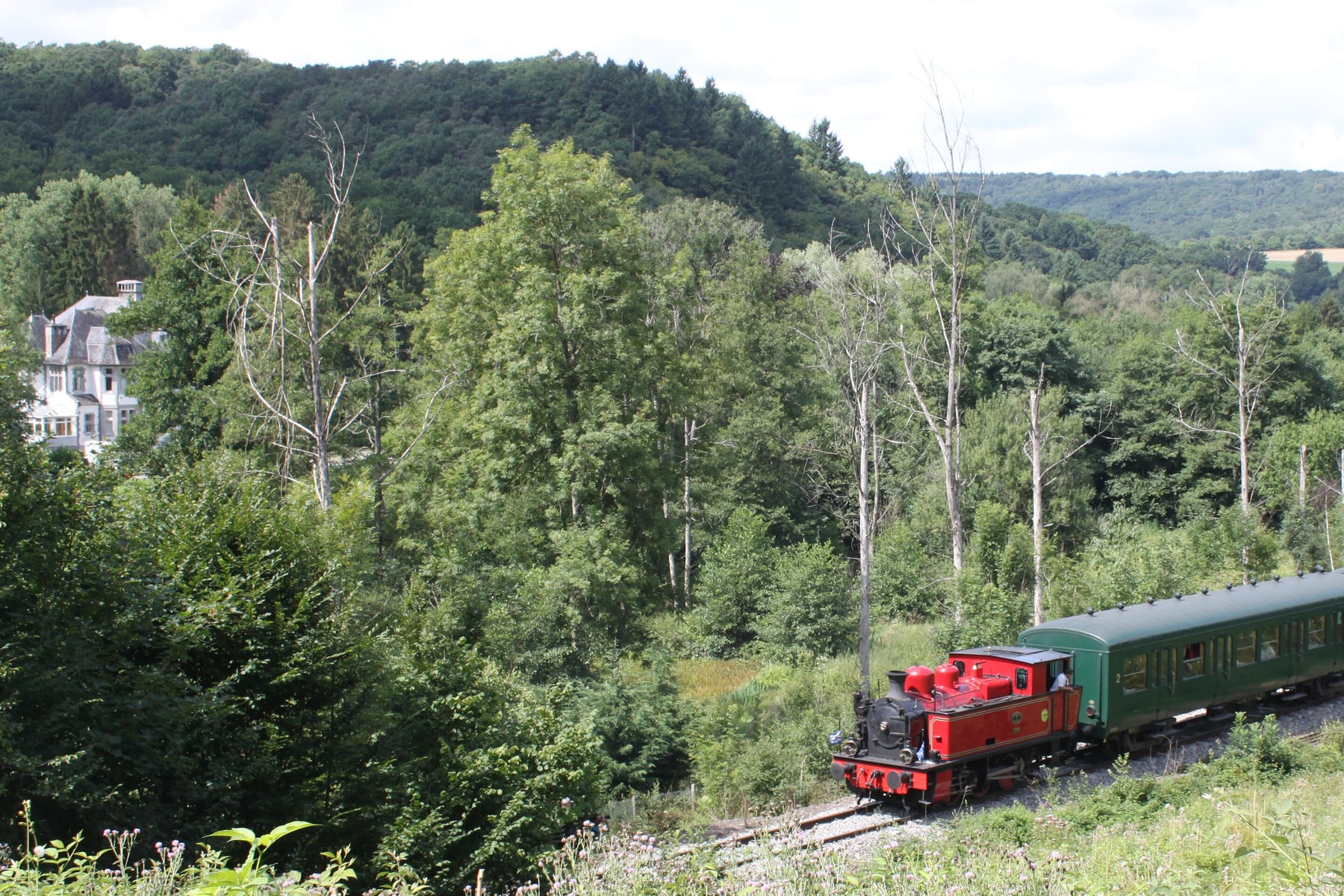
That is precisely why it survives. The line lost its purpose, and instead of being lifted it was taken over by an association of volunteers — Patrimoine Ferroviaire et Tourisme — who ran their first railcar over it on 11 September 1992 and have been running trains ever since. Today a red-and-yellow Belgian diesel railcar of the 1950s, or a short rake of M1 coaches behind a preserved locomotive, works up and down the valley on summer weekends, commentary provided by whichever volunteer is aboard.
What makes 2026 a good year to come is that the railway has just got a great deal longer in reach. After two winters of works, the connection into Ciney's national-network station has been restored and Spontin — the railway's own headquarters and main departure point — has been rebuilt. For the first time in years you can arrive at Ciney on an ordinary Belgian train and step almost straight onto a fifty-year-old railcar.
The works are not quite finished, though: as of August 2026 the railway's own notice says the stop at Évrehailles-Bauche, at the southern end of the line, is temporarily closed while work continues, with the timetable otherwise unchanged.
It is a modest trip: about an hour and a half, there and back, with the valley doing the work. But it is a genuine piece of Belgian railway rather than a re-creation of one, and the people running it are the reason it is still here.
The Journey
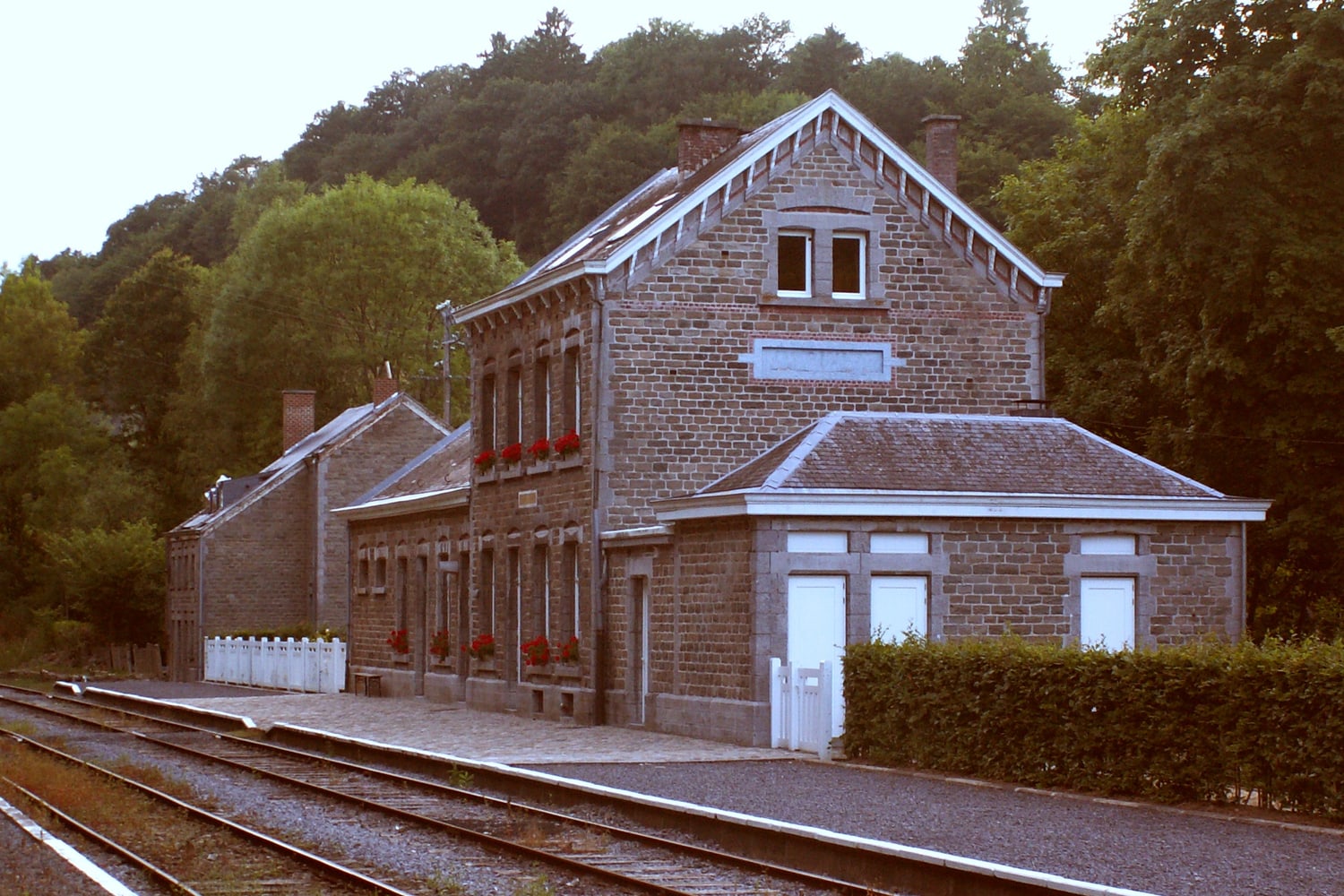
The railway's home is Spontin, a village on the N937 south-east of Namur, where the station building, the workshops and a good deal of stored rolling stock sit together beside the road. There is a large free car park in front of it, and — a detail that matters on a line whose trains have no lavatories — the station does.
A typical trip is a there-and-back in two halves, and it is worth understanding the shape of it before you board, because the train passes through Spontin twice.
North first, towards Ciney
From Spontin the train sets off north-east, climbing gently away from the village through Senenne, Sovet, Braibant and Halloy towards Ciney. This is the open half of the run: the valley has not yet closed in, and the line runs through farmland and hedgerow on the Condroz plateau. At the top the heritage track meets the national network, and on many dates the train now runs right into Ciney's SNCB station — a connection restored in 2026 after two years of works, and the reason you can now do this trip without a car. The train then reverses and comes back down the same way, through Spontin, and keeps going.
Then south, into the gorge
South of Spontin is the good half. The valley tightens, the woods close over the track, and the engineering starts in earnest. The line threads Dorinne-Durnal, a small stone station on a shelf above the water, then Purnode, and in between crosses most of the railway's twelve viaducts and dives into tunnel after tunnel. Five tunnels pierce this valley in all — Spontin at 501 metres, Dorinne at 314, Lèche at 74, Purnode at 222, and the long Yvoir bore at 1,055 metres at the far end.
The southern end of the run is Évrehailles-Bauche, which the railway rebuilt with a central platform and a second track as part of its 2025–26 programme of works.
⚠️ As of August 2026 the stop at Bauche is not being served. The railway's own notice, in both French and English, reads: "Construction work at Bauche Station: the station is temporarily closed. Schedules remain unchanged." The train still works south to the end of the line and back on the published times — it simply does not set anyone down there. Check the operator's front page before you travel, because this is exactly the sort of notice that changes without warning.
What you should not expect
The tourist train does not run the whole of Line 128. The line proper continues from Bauche down to Yvoir on the Meuse — that is where the 1,055-metre tunnel and the great eight-arch viaduct are — but the passenger service today turns at Bauche. The full eighteen kilometres is the length of the railway, not the length of your ride.
Nor is this a steam railway in the ordinary sense. The everyday train is a 1950s autorail — railcar 4602 or 4506 — or M1 coaches hauled by locomotive 5205 or 5183. Steam runs on particular dates, and the ticket price tells you which days those are.
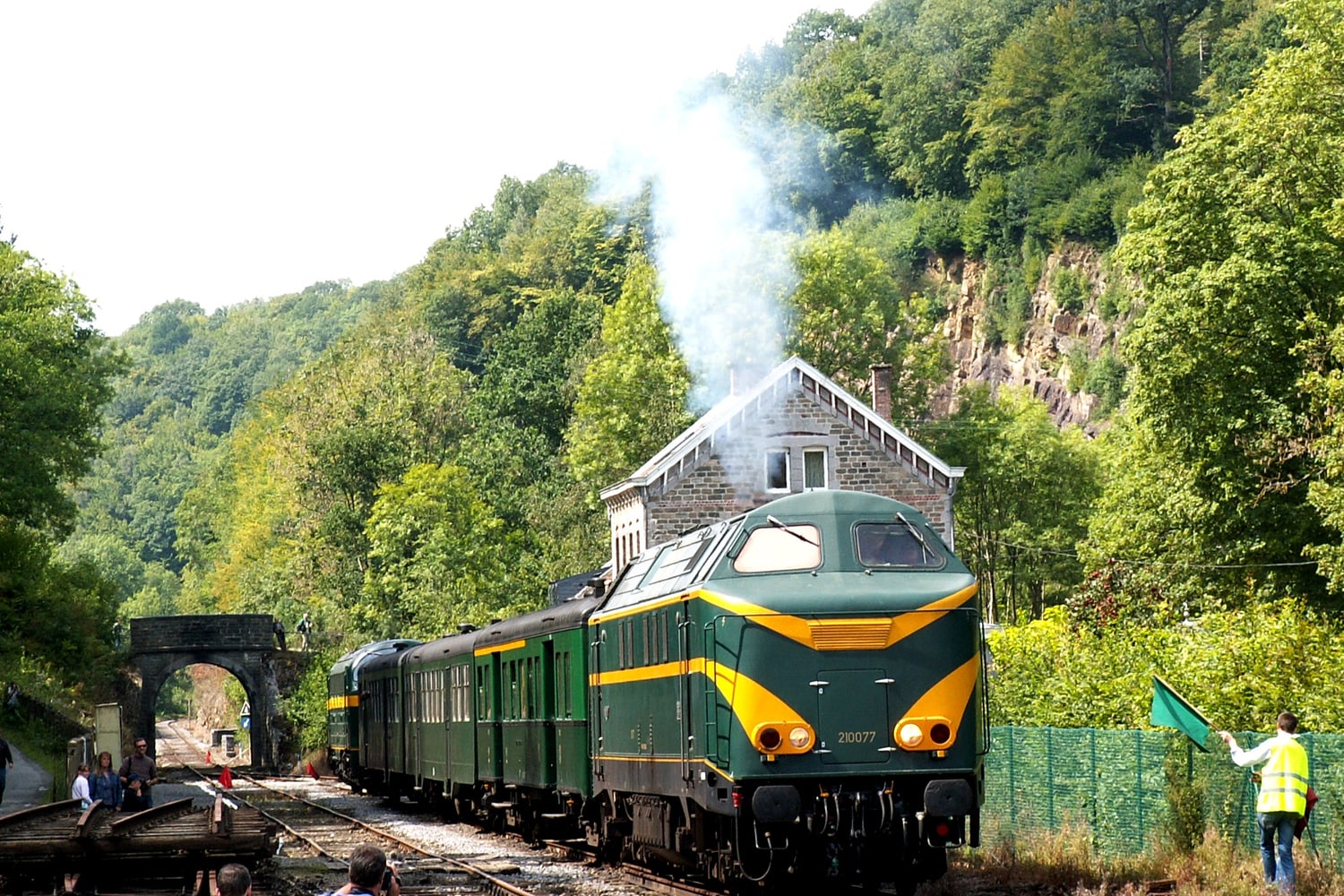
One last thing to watch for: the line has no fixed signals. On days when more than one train is out, the volunteers dispatch them by flag, by hand, at the passing places. It is the clearest possible illustration of what a preserved railway actually is — not a museum with the rope up, but a working line kept going by people who turn up.
Along the route
DimiTalen / Wikimedia Commons · CC0Five tunnels and twelve viaducts
For a line just 18 kilometres long the engineering is extravagant: five tunnels bored through the limestone, the longest 1,055 metres, and twelve viaducts over the valley floor. The Bocq is a small river; it simply chose an awkward way down.Noben k / Wikimedia Commons · CC BY-SA 3.0Signalled by hand, with a flag
The line carries no fixed signals. When more than one train is out, the volunteers work it the old way, with flags. You can watch it happening from the window at Dorinne-Durnal.Nenea hartia / Wikimedia Commons · CC BY-SA 4.0A 1950s railcar, not a steam special
The train you will most likely ride is an autorail, a Belgian diesel railcar of the 1950s, or a rake of M1 coaches behind a diesel. Steam appears on particular dates rather than as a matter of course.A bit of history
Culture & experiences along the way
 Soti / Wikimedia Commons · CC BY-SA 4.0 · cropped
The brewery in the village the train runs through
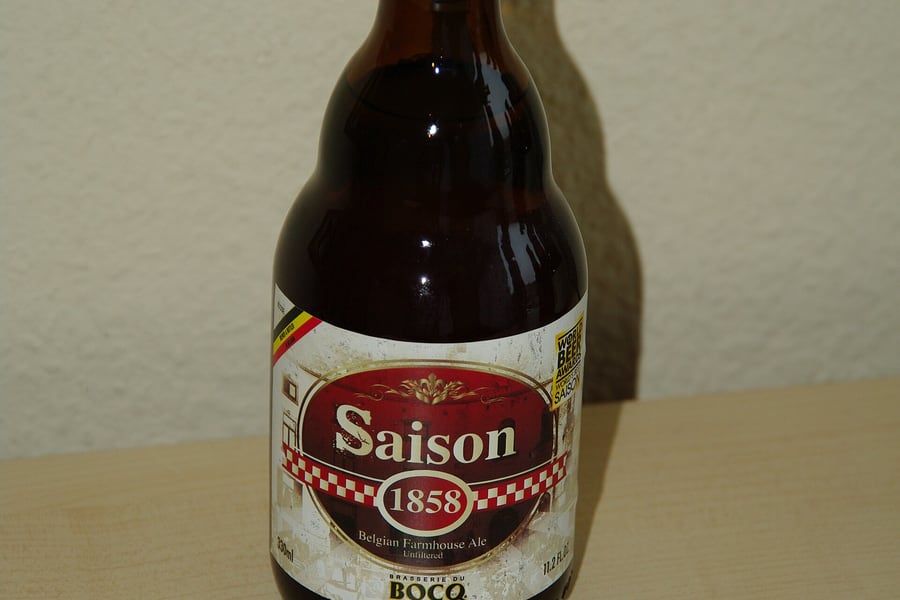
Brasserie du Bocq has been at Purnode since 1858, when Martin Belot started brewing between harvests, and it is still in the family and still refermenting its beer in the bottle. Saison 1858, Blanche de Namur and the Gauloise are all made a few hundred metres from the platform.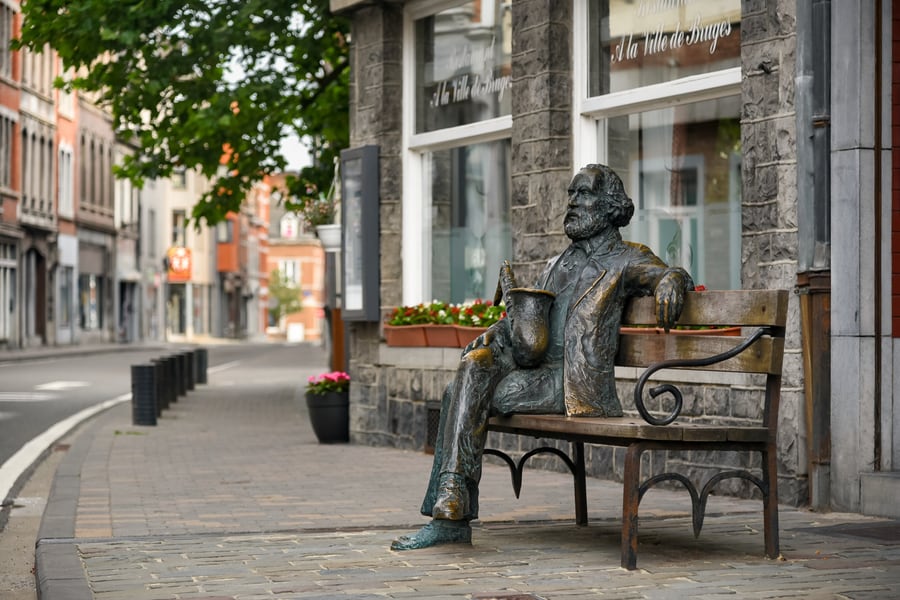 Jorge Franganillo / Wikimedia Commons · CC BY 2.0 · cropped
Adolphe Sax was born down the road
Dinant is ten kilometres off the bottom of the line, and it has never let anyone forget that Adolphe Sax was born there in 1814 and patented the saxophone in 1846. He sits in bronze on a bench on the rue Adolphe Sax; painted saxophones stand along the bridge over the Meuse.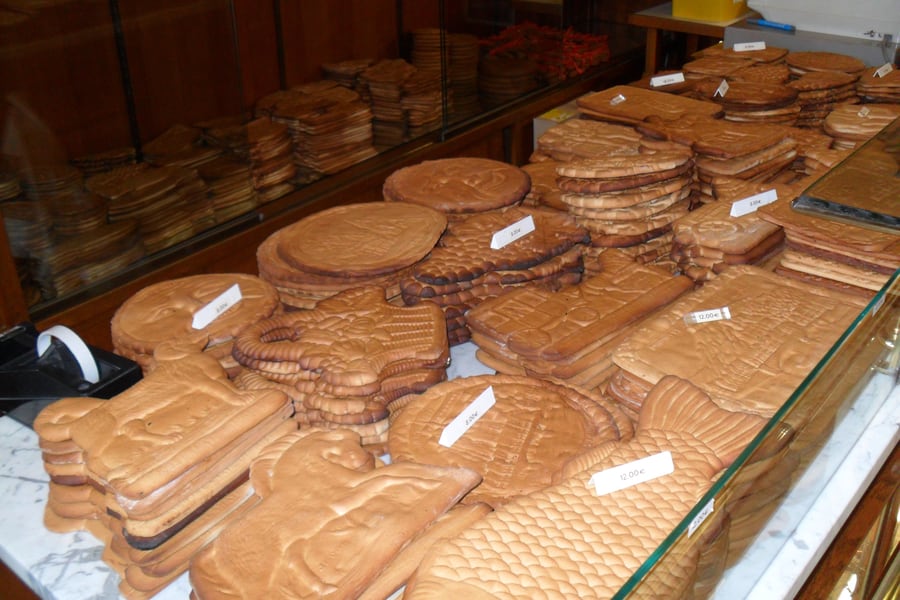 Oreo Priest / Wikimedia Commons · CC0 · cropped
A biscuit you are not meant to bite
The couque de Dinant is flour and honey and nothing else, pressed into carved walnut moulds and baked until it is effectively hard wood. You break a piece off and let it soften in your mouth. The moulds — saints, animals, coats of arms — are the reason people buy them.Timetables
Times below are taken from the railway's own 2026 timetable sheet, version 5, dated 26 May 2026, and are correct as of August 2026. The Chemin de Fer du Bocq publishes a separate day-by-day calendar because the service pattern changes with the date — so read the shape of the day here, then check the calendar for the date you want.
The 2026 operating calendar runs from May to November, and the operator's own page gives the tourist trains as running Fridays, Saturdays and Sundays. Every departure is from Spontin unless the calendar marks the date as a Ciney start.
⚠️ Bauche is currently not served. The railway's front page carries a works notice — "the station is temporarily closed. Schedules remain unchanged" — so the Bauche times below are the published ones and the train still runs to the end of the line, but you cannot get on or off there while the notice stands. It was correct in August 2026; check before you travel.
Days when one train runs
Three departures from Spontin: 11h00, 13h00 and 15h00. Each is a complete round trip of about 1 h 25, north towards Ciney and then south to Bauche.
| dep 1 | dep 2 | dep 3 | |
|---|---|---|---|
| Spontin | 11h00 | 13h00 | 15h00 |
| Senenne | 11h04 | 13h04 | 15h04 |
| Braibant | 11h13 | 13h13 | 15h13 |
| (reverse at the junction) | 11h19 | 13h19 | 15h19 |
| Braibant | 11h27 | 13h27 | 15h27 |
| Senenne | 11h36 | 13h36 | 15h36 |
| Spontin | 11h40 | 13h40 | 15h40 |
| Dorinne-Durnal | 11h48 | 13h48 | 15h48 |
| Purnode | 11h56 | 13h56 | 15h56 |
| Évrehailles-Bauche arr | 12h00 | 14h00 | 16h00 |
| Évrehailles-Bauche dep | 12h03 | 14h03 | 16h03 |
| Purnode | 12h08 | 14h08 | 16h08 |
| Dorinne-Durnal | 12h16 | 14h16 | 16h16 |
| Spontin arr | 12h24 | 14h24 | 16h24 |
Days when the train enters Ciney station
On dates marked for it, the same three departures run but the train continues into Ciney's SNCB station instead of reversing short of it — arriving 11h21 and leaving again 11h31, and correspondingly for the 13h00 and 15h00 trips. That pushes everything twelve minutes later down the line and makes the round trip about 1 h 36, back at Spontin at 12h36.
This is the pattern worth planning around if you are coming by train: Ciney is on the national network, and the connection was restored in 2026 after two years of works.
Days when two trains run
On the busiest dates two trains work the line and the service becomes roughly hourly from 11h00 to 17h00. One train takes the northern leg — leaving Spontin on the hour, back at 45 past — while the second works the southern leg to Bauche, leaving Spontin at half past and returning about an hour and a quarter later. Your ticket is valid all day, so this is the pattern that lets you break the trip and pick up a later train.
The Fête du Rail falls on 15 and 16 August 2026, which is the busiest weekend of the year and the one where you are most likely to see several trains out at once — and the flag signalling that goes with them.
Full calendar, day types and any late changes: cfbocq.be (opens in a new tab).
Tickets
Tickets are sold on the railway's own site and the price depends on how much is running that day — one train, two trains, or two trains of which one is steam-hauled. An adult pays €16.00, €18.00 or €19.25, a child of 4 to 11 half that, and under-fours travel free; a 6% booking fee is added at checkout. A ticket is valid all day, so the journey can be broken at a station and picked up on a later train, though the departure time and the two stations printed on it have to be respected.
The main departure station is Spontin, with a large free car park; on certain dates the train starts from Ciney instead, and the calendar says which. Two things worth knowing before boarding: there are no lavatories on the train except in the bar car, and the commentary is given in French. Dogs travel free on a lead.
Book your tickets
One train running
€16.00 adult · €8.00 child 4–11
The ordinary running day, valid all day with a break of journey allowed.
Book Tickets (opens in a new tab, on cfbocq.be)via cfbocq.beTwo trains running
€18.00 adult · €9.00 child 4–11
The busier dates, when the timetable doubles and the flags come out at Dorinne.
Book Tickets (opens in a new tab, on cfbocq.be)via cfbocq.beTwo trains, one in steam
€19.25 adult · €9.50 child 4–11
The dearest tariff, and the only one that guarantees smoke.
Book Tickets (opens in a new tab, on cfbocq.be)via cfbocq.beRail Passes
A rail pass will not get you onto this train. The Chemin de Fer du Bocq is run by the non-profit association Patrimoine Ferroviaire et Tourisme on its own concession — it is not an SNCB service, so Interrail, Eurail and SNCB's own products have no standing on it. The railway sells its own tickets, and those are covered in the previous section.
What a pass is good for is getting to the railhead, and since 2026 that matters more than it used to.
Using a pass to reach the line
Interrail and Eurail Global Passes are valid on SNCB/NMBS trains, with no reservation and no supplement on Belgian domestic services. That takes you to Ciney, which sits on the national network — and after two years of works the tourist train now runs into Ciney's SNCB station on many operating dates.
That combination is the useful one: arrive at Ciney on your pass, and on the right date step straight from a national-network platform onto a 1950s railcar without needing a car at all. Check the railway's calendar for a Ciney-start date before relying on it; on other dates the train reverses short of the station and everything begins at Spontin, which has no rail service of its own.
If you are not on a pass
SNCB's ordinary products get you to Ciney just as well — Youth (under 26), Senior (65+) and Child (under 12) fares, the Train+ subscription for frequent travel, and group fares from four people up. None of them touch the heritage fare.
Budget for the two separately: a national ticket or pass to Ciney, and the railway's own ticket from there.
SNCB products: belgiantrain.be (opens in a new tab). Correct as of August 2026.
Places to Visit
The railway sits in a pocket of Wallonia that rewards a whole day rather than an hour and a half. Spontin has a castle a short walk from the platform; the Meuse and Dinant are twenty minutes away by road; and the valley itself, walked rather than ridden, is the reason the line was worth saving.
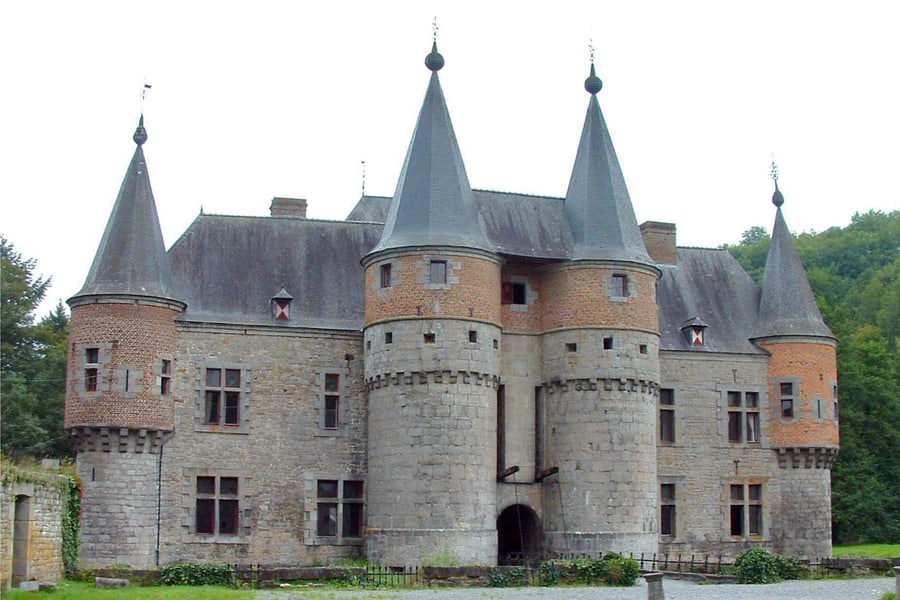 Diggy Benesou / Wikimedia Commons · CC BY-SA 3.0
Château de Spontin
A few minutes from the platform stands one of the best-preserved feudal castles in Belgium — a 12th-century keep built up into a fortress in the 14th century, then softened in the late 16th with pink brick and pepper-pot turrets, and still standing in its moat. The railway sells a combined ticket: add the castle when you book your train and 10% comes off the entry price.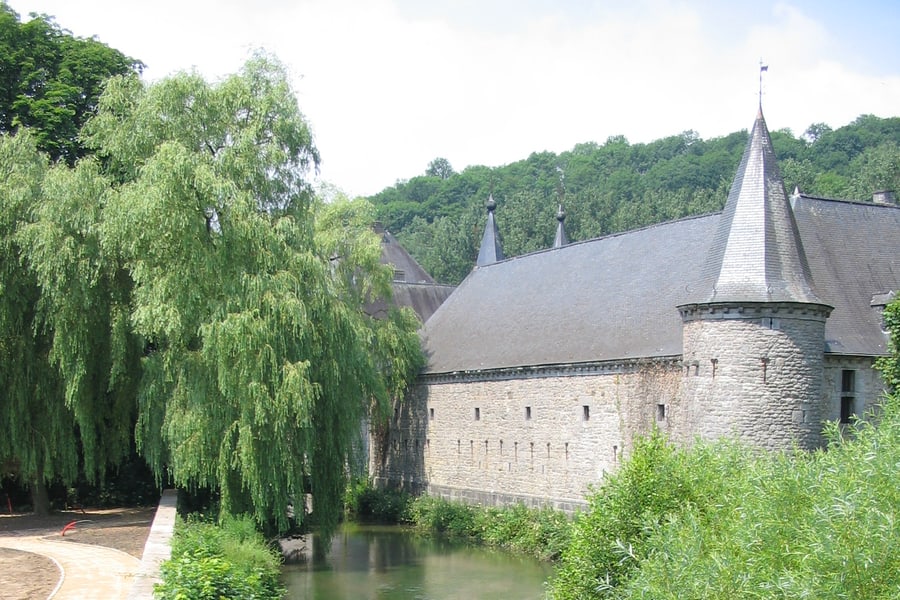 Boerkevitz / Wikimedia Commons · Public domain
The Bocq itself
The river the railway is named for is small enough to step across in places, and it is worth going down to look at it. At Spontin it slides past the castle walls under the willows, clear and green over limestone — the whole reason the valley is as steep, as wooded and as awkward to build a railway through as it is.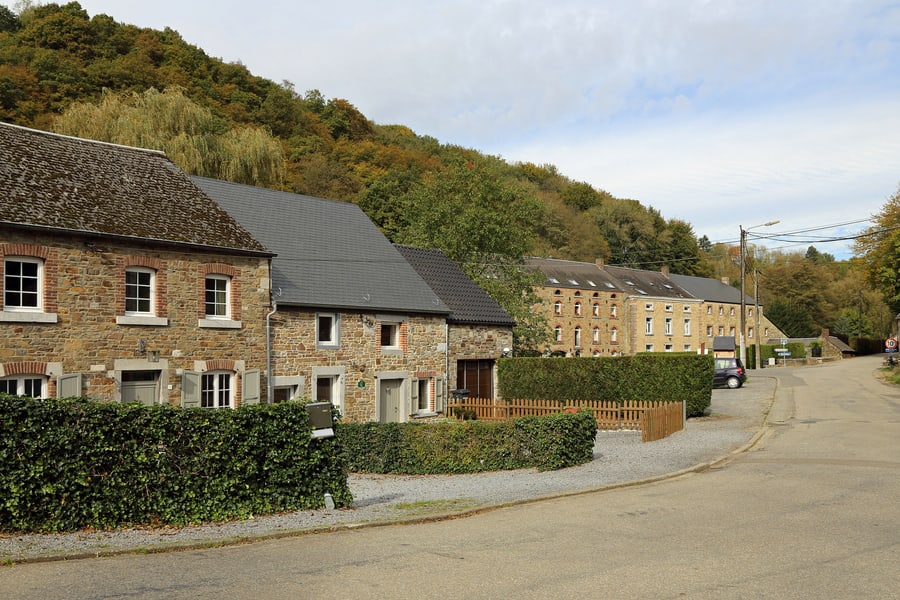 Marc Ryckaert (MJJR) / Wikimedia Commons · CC BY 3.0
Crupet
Two valleys north, Crupet is one of the officially recognised most beautiful villages of Wallonia — a tight knot of grey limestone houses and slate roofs under wooded hills, with a fortified 13th-century tower-house standing in its own water. It makes the obvious half-day to pair with a morning on the train.Where to Sleep
This is a day trip for most people rather than a base — Namur is half an hour away, Dinant a little less, and both have far more beds than the Bocq valley does. But the valley itself is quiet in a way those towns are not, and there is a case for staying in it.
In the valley. Spontin, Durnal, Purnode and Crupet are small stone villages with a scattering of chambres d'hôtes and gîtes rather than hotels — the Walloon pattern of a few rooms in a farmhouse or a converted barn. Book ahead: there are not many, and the August festival weekend fills what there is.
Ciney, at the northern end of the line, is the practical choice if you are travelling without a car. It is a working country town rather than a pretty one, but it is on the national network, it has ordinary hotels, and since 2026 the tourist train comes into its station on many operating dates — you can step off a Belgian intercity and onto a 1950s railcar without a taxi in between.
Dinant, twenty minutes south-west on the Meuse, is the scenic option: a town wedged between the river and a cliff under its citadel, with hotels along the quays. It is busier and more expensive in season, and it is not on the Bocq line — you will need a car or a bus to reach Spontin — but it makes the better base if the railway is one item on a longer Meuse trip.
Namur, the provincial capital, has the widest choice by a distance and fast trains to Ciney.
Whichever you choose, check the railway's operating calendar before you book the night rather than after: the trains run on selected dates between May and November, not daily, and the valley is a long way to come on a day when nothing is moving.
Questions or corrections
Planning this trip and stuck on something, or spotted a time, fare or detail that has changed? Send us a message about Chemin de Fer du Bocq. We read every one, and we update this page when something has changed.