The Chiemsee-Bahn to the Lake Steamers
-wuppertaler / Wikimedia Commons · CC BY 4.0
- Distance1.79 km today — 1.9 km when it was built in 1887
- DurationAbout 8 minutes each way, ten pairs a day
- Best season14 May to 20 September for the daily service — and a Saturday, Sunday or public holiday if the steam locomotive is the point
Introduction
Ludwig II of Bavaria bought the Herreninsel, the larger island in the Chiemsee, in 1873 for 350,000 gulden. He laid the foundation stone of a new palace on it on 21 May 1878 and set about copying Versailles — the central block of it, and André Le Nôtre's gardens in front. It was never meant to be lived in by anyone else. It was never really finished either: the main three-winged building went up, the north wing stayed a shell and was pulled down in 1907, the south wing got as far as its foundations, and the chapel, the stables and the eastern courtyard buildings were never begun. The estimate had been 5.7 million marks. By the time he died it had cost about 16.6 million, more than Linderhof and Neuschwanstein put together.
He stayed in it for ten days, from 7 to 16 September 1885.
He died in June 1886. By August the administration had opened the half-built palace to the public, and visiting a king's private house was a sensation in a country that still had kings. People came to Prien by train, and then had to get two kilometres from the station to the boat jetty at Stock. Horse-drawn carriages did that job, in whatever numbers turned up, and the result — in the words of the company that runs the line today — was traffic chaos in Prien.
So this railway is not a scenic line, a mountain line or a heritage revival. It is a traffic measure. In 1886 Ludwig Feßler and Georg Krauss, the principal owner of the Krauss locomotive works in Munich, applied for permission to build a metre-gauge railway from the station to the harbour. Construction started on 2 May 1887, the 1.9 kilometres were finished in seventy days, and it opened on 9 July 1887 with regular service from Sunday the 10th.
What it is now
The same railway, doing the same job, with the same locomotive.
It runs 1.79 kilometres from Prien Bahnhof to Prien/Stock Hafen in about eight minutes, at 20 kilometres an hour, on metre gauge. There has never been an intermediate stop. At one end it meets the main line from Munich to Salzburg; at the other it meets the Chiemsee steamers, and the whole point of it is the transfer between the two.
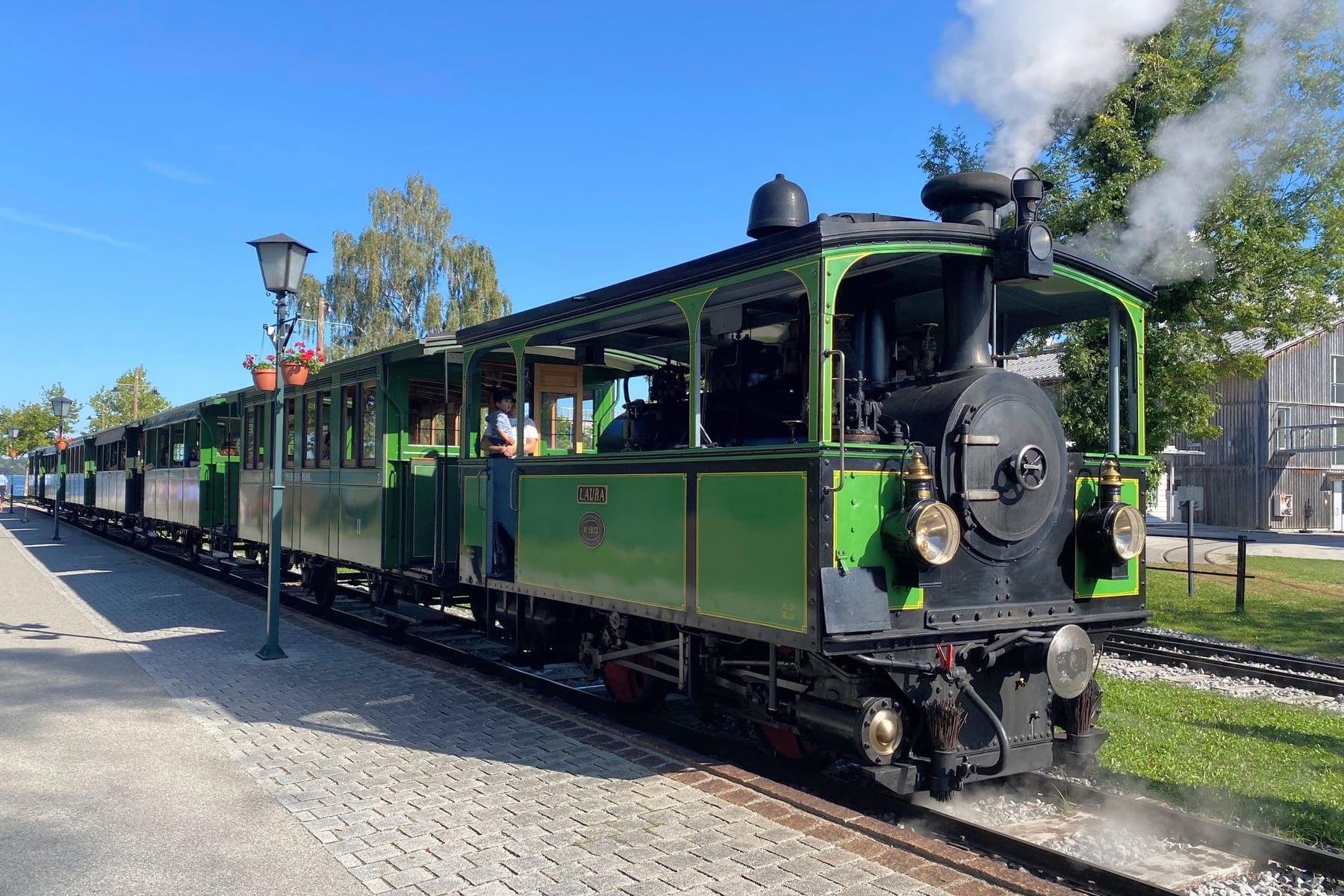
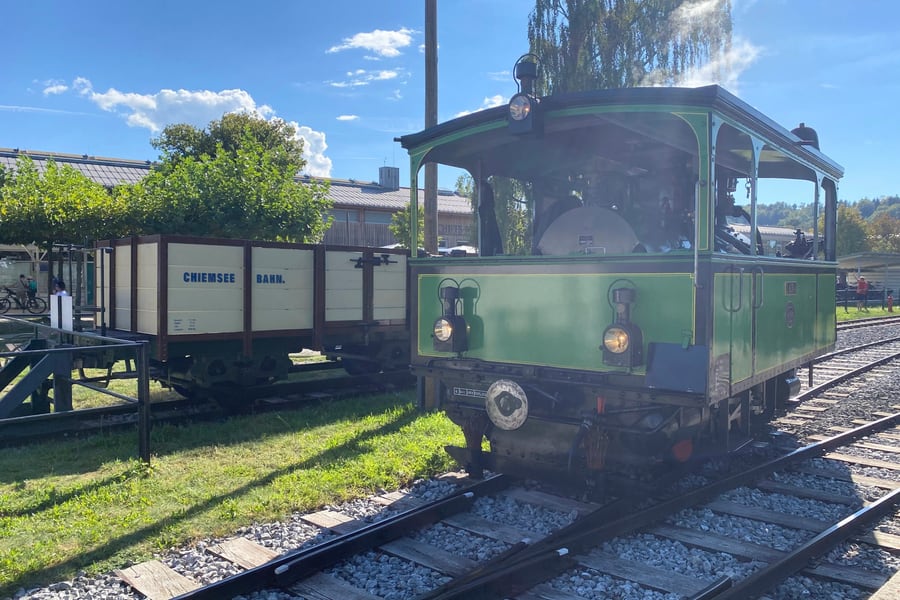
The locomotive is a Krauss box tram engine, works number 1813, delivered in 1887 and named Laura. It has been on this two-kilometre stretch of railway ever since — the operator describes it, with some care, as one of the oldest working steam locomotives in the world. The carriages are open-sided tramcars with slatted benches, and there is a first-class saloon among them that was given away to a museum in 1975, never displayed, and bought back in 1993 for 12,000 marks.
The thing nobody mentions in the brochures is that Laura mostly works weekends. On an ordinary weekday the train is pulled by a 1962 Deutz diesel called Lisa, and that is worth knowing before choosing a day.
The Journey
The Chiemsee-Bahn's own station stands on the east side of the state railway station at Prien. It has not always: the line originally started on the west side and crossed the main-line tracks on the level, at the point where the Seestraße underpass now runs. When the state station was enlarged, the narrow-gauge terminus was moved across in the winter of 1908/09, and the dangerous crossing went with it.
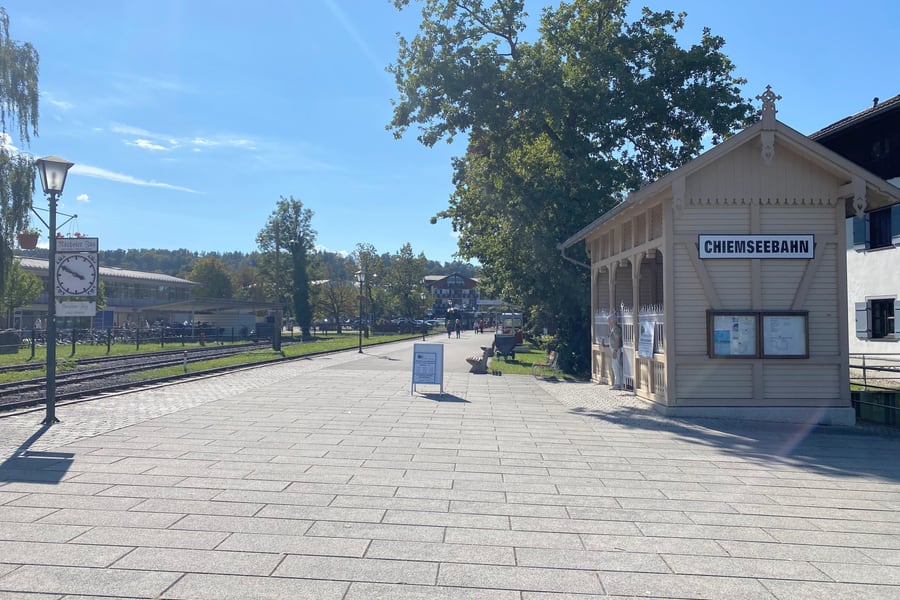
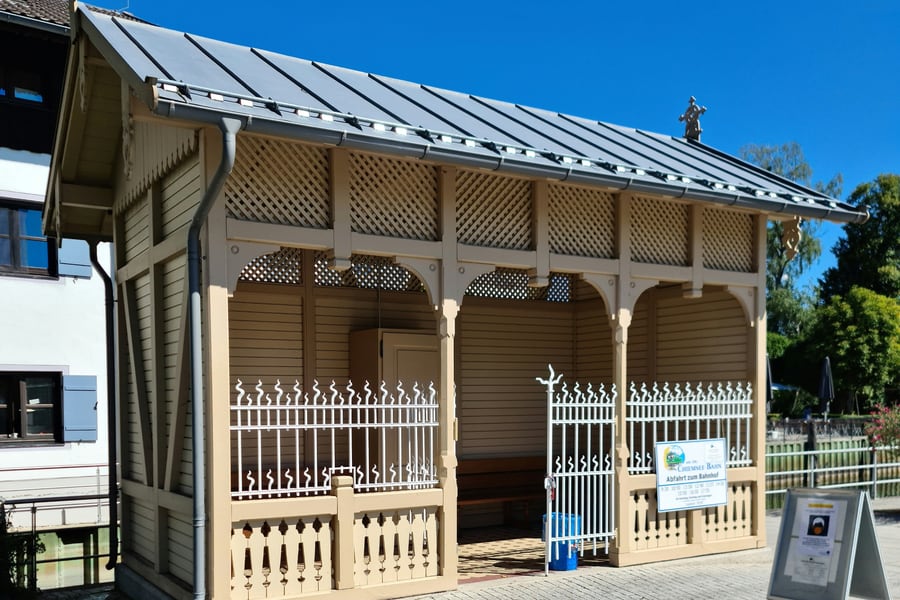
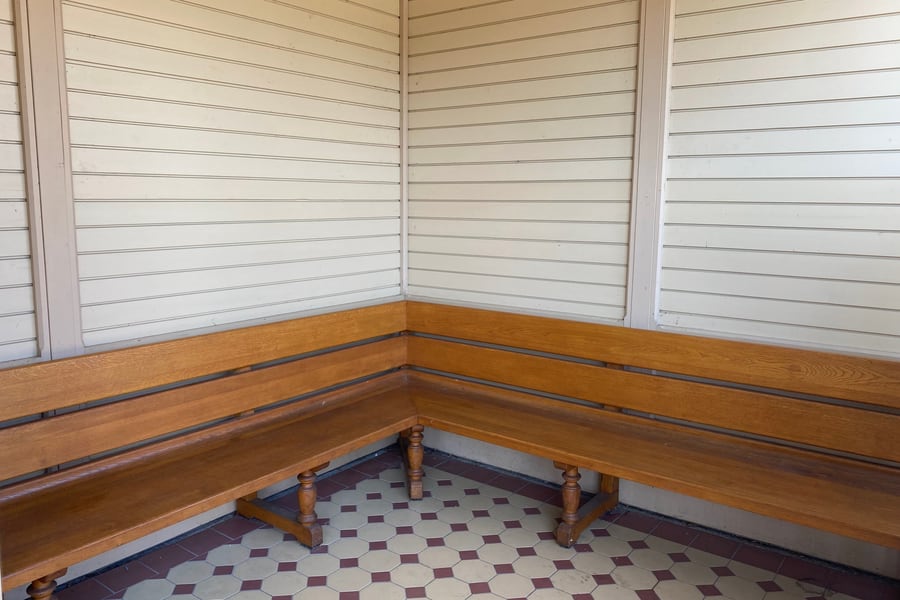
From there the train runs east through the town towards the lake, on street track for much of the way, the rails set into the paving with the road alongside — and comes out at the harbour at Stock. Eight minutes, no stops, and at the far end a wooden station building with CHIEMSEEBAHN painted across it and a fenced timber waiting shelter with a gilded figure on the ridge.
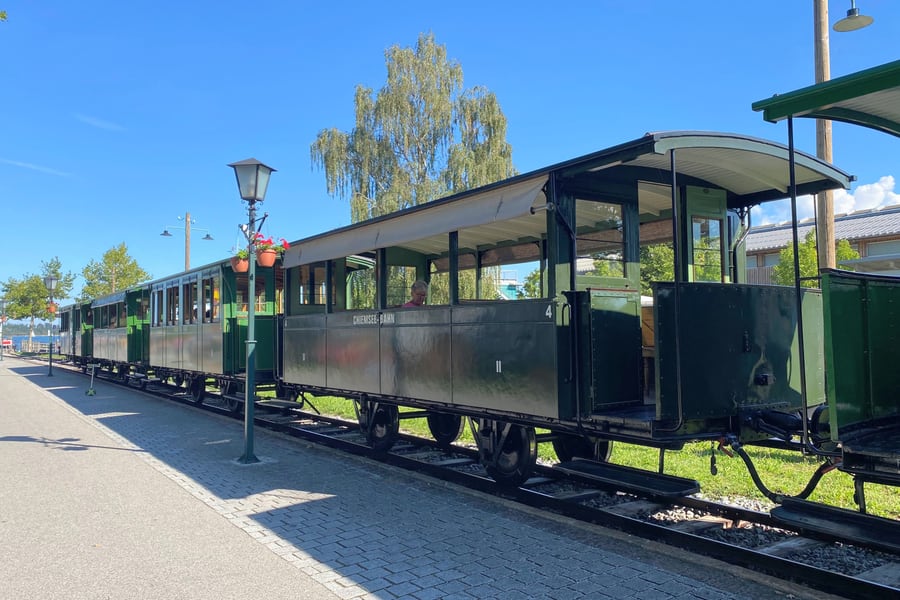
The carriages are the interesting part. They are open-sided — a roof on posts, slatted seats, no glass — which on a warm afternoon is exactly right and in October is a decision. There is a closed saloon as well. It was in the original 1887 fleet, built by MAN to the pattern of the Kaysersberg valley railway, ran until just after the Second World War and was taken out of service in 1949. In 1975 it was handed over, without payment, to a private museum at Marxzell near Karlsruhe, where it was never put on display and sat in a dark shed. The railway bought it back in 1993 for 12,000 D-mark, restored it in its own workshop, and put it back into traffic on 29 April 1995. With that, all nine of the line's carriages were together again.
Laura, and the engine that pretended to be her
Laura is a Krauss type L VII box locomotive, works number 1813, built in Munich in 1887 — the same year as the railway and by the works whose owner had helped promote it. She is a two-axle tank engine with Stephenson valve gear, 5.1 metres long, 13.3 tonnes, 60 horsepower, good for 25 kilometres an hour, and her boiler was replaced by Jung in 1950. She has never worked anywhere else.
The second engine has a stranger history. In 1961 the Halberger Hütte ironworks at Brebach in the Saarland ordered a diesel-hydraulic shunter from Deutz; it worked there from 1962 to 1981, and the Chiemsee-Bahn bought it in December 1982. In Prien it was then disguised. The sheet-metal bodywork came off, the engine block was wrapped in a casing shaped like a boiler, and a dummy chimney was screwed on top, so that a 1962 diesel would read at a distance as an 1887 steam tram. It ran like that for thirty-four years. In the spring of 2016 the railway took the costume off again. Lisa is now unmistakably a red diesel shunter with a green carriage behind her, and the effect is more honest than the pretence was.
What the line used to carry
Coal, mostly, and it came full circle. Coal arrived at Prien by main line, was shovelled at the station into the Chiemsee-Bahn's two goods wagons and taken down to Stock. There it went either straight into the fireboxes of the lake steamers or across the water to the Herreninsel, where a brewery and the palace waterworks burned it. The steamers began taking their coal directly from lorries in 1966, and the goods traffic on the railway stopped.
The line came through both wars, on a reduced service and then none at all from 1944, and reopened with the summer timetable of 1949. It could not answer the post-war rise in car ownership, and on 5 July 1965 the Chiemsee-Bahn Feßler & Comp. was wound up as a company and folded into Chiemsee-Schifffahrt Ludwig Feßler KG, which still runs it. On 4 June 1986 the Bavarian state renewed the operating concession for another fifty years, to 4 June 2036.
Along the route
-wuppertaler / Wikimedia Commons · CC BY 4.0Built in seventy days, to unblock a town
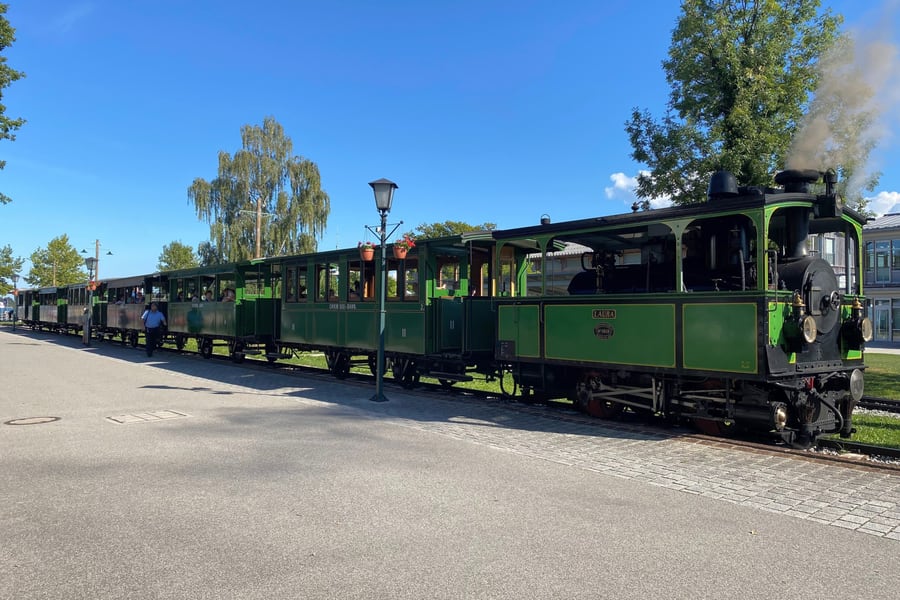
When the palace opened to visitors in 1886 the horse carriages taking people from Prien station to the jetty jammed the streets. Work on a railway started on 2 May 1887 and the line was finished seventy days later. It has done nothing else since.-wuppertaler / Wikimedia Commons · CC BY 4.0The locomotive is the original one
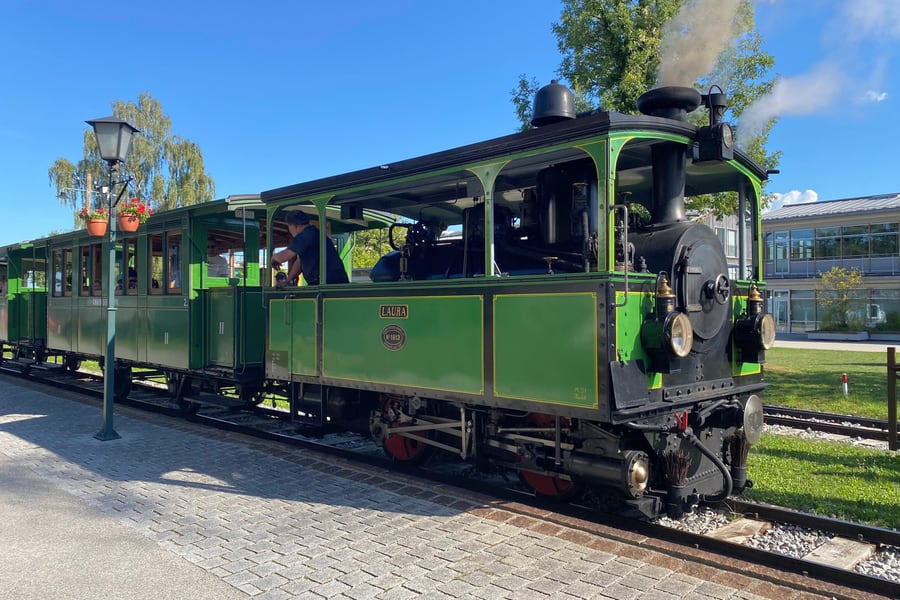
Krauss & Comp. of Munich delivered works number 1813 in 1887, the year the line opened. The operator describes Laura, carefully, as one of the oldest working steam locomotives in the world. She has spent every year of it on the same 1.79 kilometres.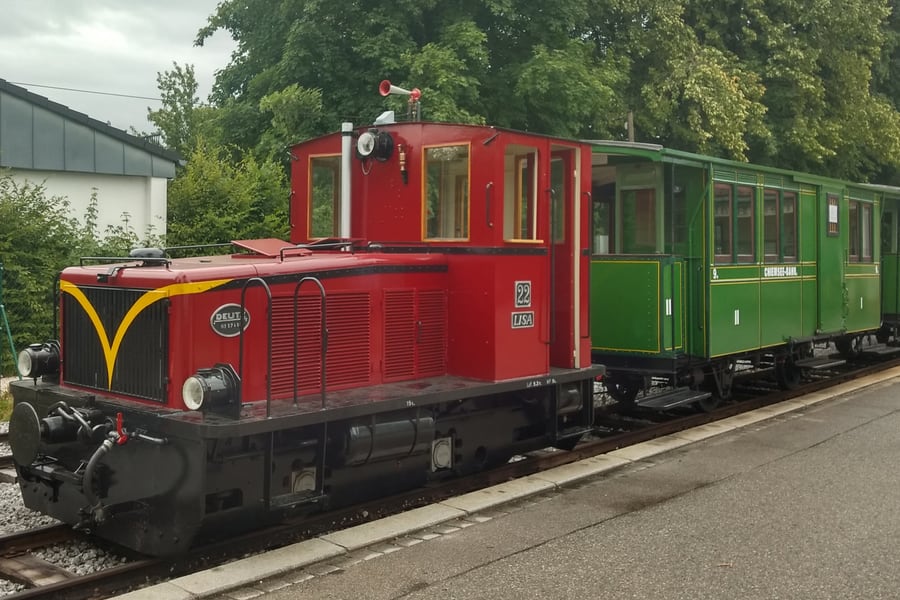 WikiMax / Wikimedia Commons · CC BY-SA 4.0
The diesel that spent 34 years in costume
The second engine is a 1962 Deutz shunter. In Prien its bodywork was stripped, the engine block wrapped in a casing shaped like a boiler and a dummy chimney fitted, so from a distance it read as an 1887 steam tram. The disguise came off in 2016.A bit of history
Culture & experiences along the way
-wuppertaler / Wikimedia Commons · CC BY 4.0Steam at the weekend, diesel midweek
The operator says it in one line and almost nobody repeats it: steam trips take place predominantly on Saturdays and Sundays, and weekday trips are worked by the diesel. Laura starts on 1 May and runs on Saturdays, Sundays and public holidays; the daily service that begins on 14 May is not the same thing as daily steam. It is the single fact worth checking before picking a date.-wuppertaler / Wikimedia Commons · CC BY 4.0A seat in the 1887 saloon
One closed carriage among the nine is the first-class saloon that came with the railway, built by MAN to the pattern of the Kaysersberg valley line. It ran until just after the Second World War, was withdrawn in 1949, and in 1975 was handed to a private museum near Karlsruhe that never put it on show. The railway bought it back in 1993 for 12,000 marks and returned it to traffic on 29 April 1995. The first-class supplement is a euro.-wuppertaler / Wikimedia Commons · CC BY 4.0Straight onto a boat
The train is timed against the steamers rather than the clock, which is why two of the ten daily departures sit at 14:38 and 13:40 instead of on the quarter hour. The harbour station is a short walk from the jetties, and the combined ticket covers both — for the Herreninsel, for both islands and Gstadt, or for the full circuit of the lake.Timetables
This is a seasonal railway, and the season has three stages rather than one. All of the following is as of August 2026, from the operator's own published dates and summer timetable.
The 2026 season
- From Saturday 25 April 2026 the railway restarts, worked by the diesel Lisa.
- From 1 May 2026 the steam locomotive Laura runs on Saturdays, Sundays and public holidays.
- From Thursday 14 May to 20 September 2026 there is a daily service on the summer timetable.
The winter timetable begins on 21 September 2026, and the Chiemsee-Bahn does not run under it. The boats do — the shipping company operates 365 days a year — but the train's year ends with the summer timetable.
The summer timetable
Ten pairs a day, roughly hourly, with two of them shifted to meet a boat.
From Prien Bahnhof to Prien/Stock Hafen: 10:15, 11:15, 12:15, 13:15, 14:38, 15:15, 16:15, 17:15, 18:15, and 19:15 on Saturdays, Sundays and public holidays only.
From Prien/Stock Hafen to Prien Bahnhof: 09:30, 10:50, 11:50, 12:50, 13:40, 14:55, 15:50, 16:50, 17:50, and 18:50 on Saturdays, Sundays and public holidays only.
The journey takes about eight minutes either way, so the last train up from the harbour on a weekday leaves at 17:50 and the last one down leaves the station at 18:15.
Which engine you get
The operator states it plainly and it is the single most useful line on its site: journeys with the steam train take place predominantly on Saturdays and Sundays, and weekday journeys are worked by the diesel locomotive.
That is not a fault — Lisa is a 1962 Deutz shunter with a history of her own — but anyone travelling for Laura specifically will want a weekend or a public holiday, and from 1 May rather than late April.
Connecting with the boats
The railway exists to meet the steamers, and the summer boat timetable is the other half of the plan. Sailings from Prien/Stock to the Herreninsel, the Fraueninsel and Gstadt — the Inseltour West — leave at 06:40 (Monday to Saturday, not holidays), 07:15 (Herreninsel only), 08:00, then 09:30, 10:00, 10:30, 11:00, 11:30, 12:30, 13:00, 13:30, 14:00, 14:30, 15:45, 16:25, 18:00 and 19:30. The Große Chiemseetour, which calls at the lakeside villages as well as both islands, leaves at 09:00, 12:00, 15:00 and 17:00.
⚠️ From Monday 3 August 2026 the boats no longer call at Seebruck or Übersee/Feldwies, because of low water. The Große Chiemseetour runs without the Seebruck stop; the nearest landing stages instead are Gstadt and Chieming for Seebruck, and Bernau and Chieming for Übersee/Feldwies. Nothing else in the summer timetable changes, and the island sailings that matter for this railway are unaffected.
Getting to Prien
Prien am Chiemsee is on the main line from Munich to Salzburg, and that line is the reason the railway was built where it was. The Chiemsee-Bahn's own platform is on the east side of the main-line station, and its ticket office is open from 09:00 to 15:30.
Timetables and the summer PDF are published by the operator at chiemsee-schifffahrt.de (opens in a new tab).
Tickets
For the railway alone a return is €4.80 for an adult and €2.40 for a child of 6 to 15; a family card is €13.20 return, and children up to five travel free. First class exists, in the restored 1887 saloon, at €1.00 a journey. Fares are the operator's 2026 list, valid until 31 December 2026.
Almost nobody rides this line and then goes home — they ride it to catch a boat, and the combined railway-and-ship tickets are the normal purchase: €15.30 return with the crossing to the Herreninsel, €16.80 with the Inseltour West, €21.00 with the full lake circuit. Each saves between one and three and a half euros, and is one transaction instead of two at a busy jetty. ⚠️ On the train it is cash only and full-price singles and returns only — every combined and reduced ticket has to come from a desk, and nothing is sold online.
Book your tickets
Return on the railway
€4.80 adult · €2.40 child · €13.20 family
The obvious buy on a line where everyone comes back; first class adds €1.00.
Book Tickets (opens in a new tab, on Chiemsee-Schifffahrt Ludwig Feßler)via Chiemsee-Schifffahrt Ludwig Feßler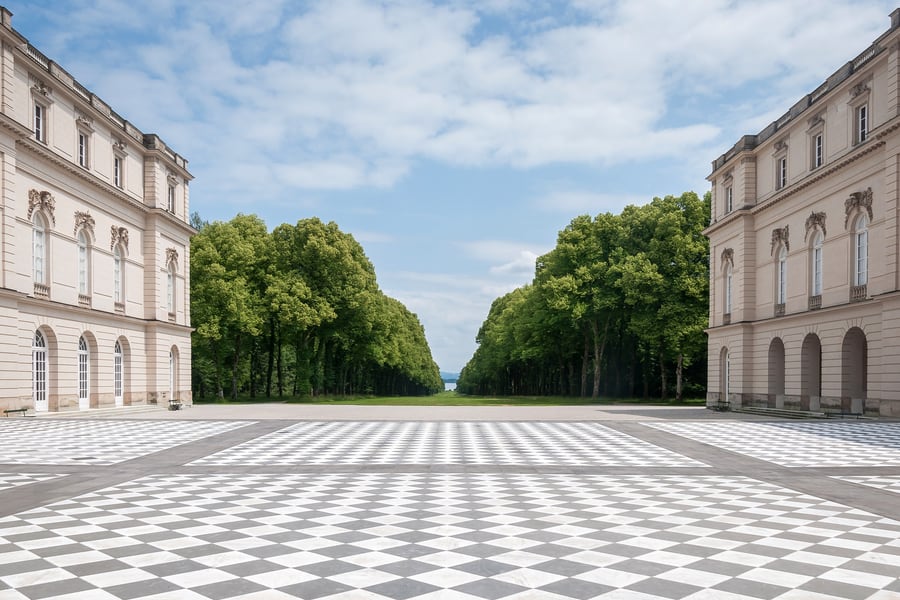
Railway and boat together
From €15.30 return, to the Herreninsel
Cheaper than the two bought apart, and what most passengers actually want.
Book Tickets (opens in a new tab, on Chiemsee-Schifffahrt Ludwig Feßler)via Chiemsee-Schifffahrt Ludwig FeßlerTen-journey ticket
Ten rides for the price of nine, valid a year
Good on every route the company runs, railway and boats alike.
Book Tickets (opens in a new tab, on Chiemsee-Schifffahrt Ludwig Feßler)via Chiemsee-Schifffahrt Ludwig FeßlerRail Passes
This is one of the few private railways in Germany where a pass does something, and the operator is unusually precise about which one.
The Bayern-Ticket works
The Bayern-Ticket is accepted on the Chiemsee-Bahn and on the Chiemsee steamers, and it gets about 10% off the current fare. The reduction is given for as many people as are named on the ticket, up to a maximum of five. ⚠️ It has to be claimed at the ticket desk at the Chiemsee-Bahn's station — no reduction is given if the ticket is bought on the train.
On a €4.80 return the saving is about fifty cents, so nobody should buy a Bayern-Ticket for this railway alone. But the Bayern-Ticket is the sensible way to reach Prien from Munich in the first place, and the discount is a small bonus on arrival.
The Deutschlandticket does not
The 2026 price list states it plainly: no reduction for the Deutschlandticket, and none for the Ehrenamtskarte or for guest and spa cards either. The Deutschlandticket will carry you to Prien am Chiemsee on the main line, and stops there.
Free travel under German disability law
Worth knowing, because it applies to remarkably little else on the lake. The operator's own leaflet for passengers with a disability limits the statutory right to free carriage to the railway between Prien Bahnhof and Prien/Stock Hafen and the Inseltour West boat service, on production of a severe-disability pass with a valid token. A companion also travels free where the pass is marked "B". ⚠️ Even with that entitlement a Freiticket has to be collected at the counter before boarding — the right does not replace the ticket.
On every other route the shipping company gives a voluntary reduction of about 10% on production of a pass showing a degree of disability of at least 70%.
Is a pass worth it here?
For the railway itself, no — the whole journey is 1.79 kilometres and €4.80 there and back. The question worth asking is the other way round: a Bayern-Ticket that brings you from Munich also shaves a little off the fare at both the railway and the boat, and that is the only pass on this lake that does.
An Interrail or Eurail pass does nothing here either. Interrail's coverage table for Germany sends any company it does not name to a closed list of the German operators a pass is valid on, and the Chiemsee-Bahn — a private railway belonging to the lake's shipping company — is not on it. What the pass does cover is the main line to Prien am Chiemsee, which is five minutes' walk from the railway's own station.
Fares, discounts and the disability conditions from the operator, Chiemsee-Schifffahrt Ludwig Feßler KG, and pass coverage from Interrail's published list of railway companies, August 2026. The price list is stated as valid to 31 December 2026.
Places to Visit
The railway is two kilometres long and everything it exists for is at the far end of a boat trip. What follows runs in the order of a normal day out: the town, the harbour the train delivers you to, and then the two islands the steamers go to.
 -wuppertaler / Wikimedia Commons · CC BY 4.0 · cropped
Prien am Chiemsee
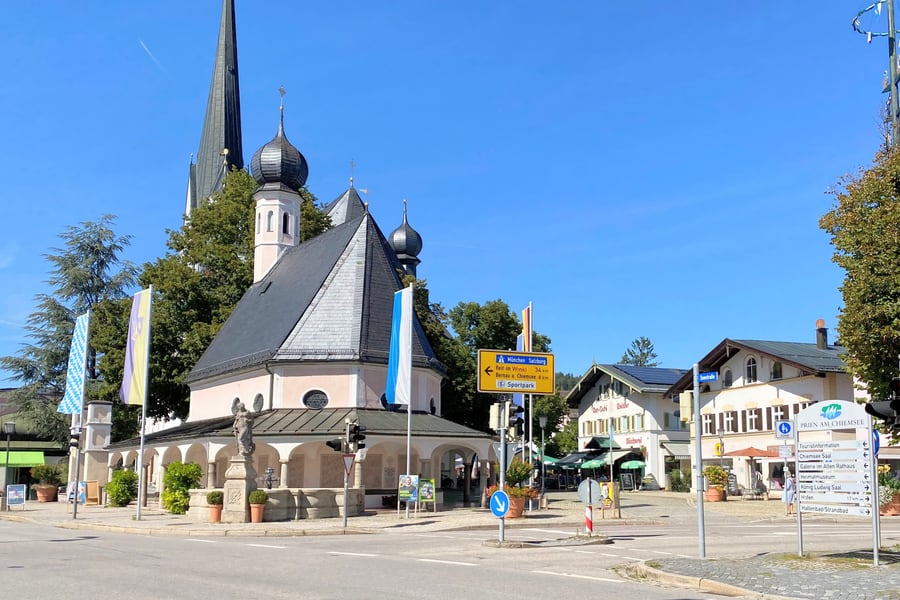
A town of about 10,900 people on the western shore of the lake, and a certified air and Kneipp spa. The market square is the middle of it, with the parish church and its onion domes on one side and the cafés under the trees on the other. The main line from Munich to Salzburg runs through, which is the whole reason the narrow gauge was built where it was.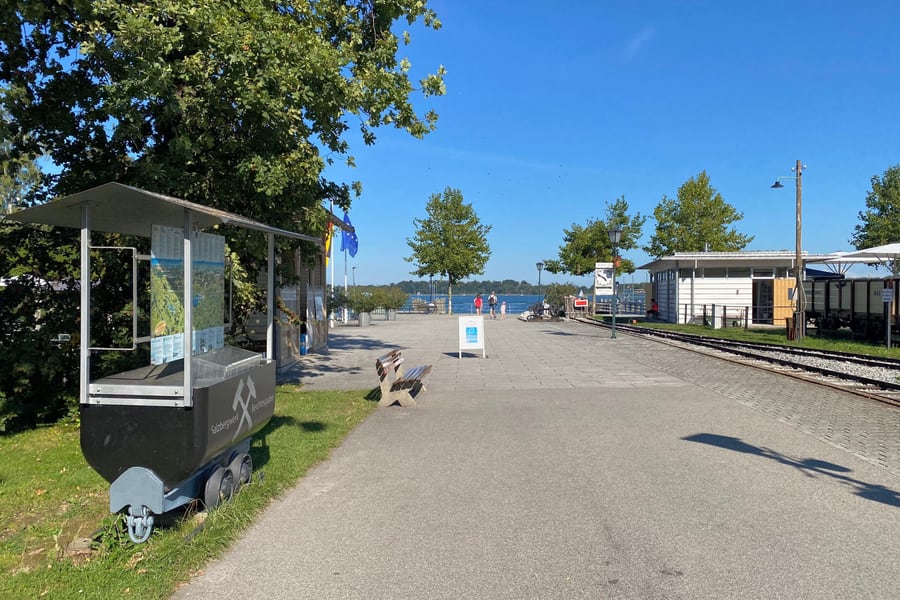 -wuppertaler / Wikimedia Commons · CC BY 4.0 · cropped
The harbour at Prien/Stock
Two kilometres of railway end here, on the lake shore, a few steps from the jetties the steamers leave from. There is a large paid car park, a kiosk, the wooden station and the listed waiting shelter. It is not a picturesque harbour and it does not try to be — it is an interchange, and it has been doing that job since 1887.Isiwal / Wikimedia Commons · CC BY-SA 3.0 · croppedSchloss Herrenchiemsee
Ludwig II's copy of Versailles, begun in 1878 and never finished. What stands is the three-winged central block; the north wing was left a shell and demolished in 1907, the south wing never got past its foundations, and the chapel, stables and eastern courtyard were never begun. It cost around 16.6 million marks against an estimate of 5.7, more than Linderhof and Neuschwanstein together, and the king slept in it for ten nights.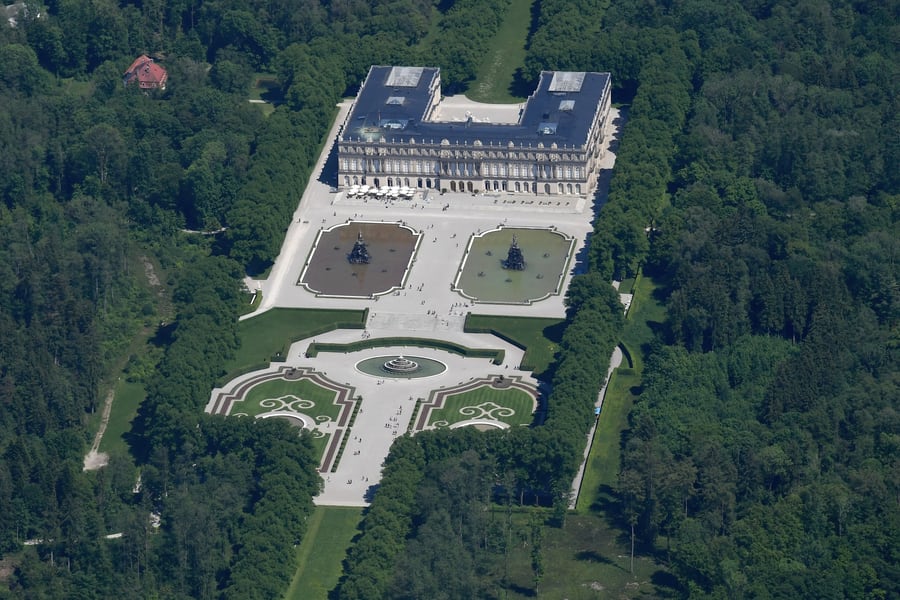 Carsten Steger / Wikimedia Commons · CC BY-SA 4.0 · cropped
The gardens, seen whole
The formal gardens were laid out after Le Nôtre's work at Versailles, and from above the plan reads at once: the parterres, the basins and the axis running down to the water. They are the part of the project that was largely completed, and they are free to walk in. The palace has been open to visitors since August 1886 and takes something like 357,000 of them a year.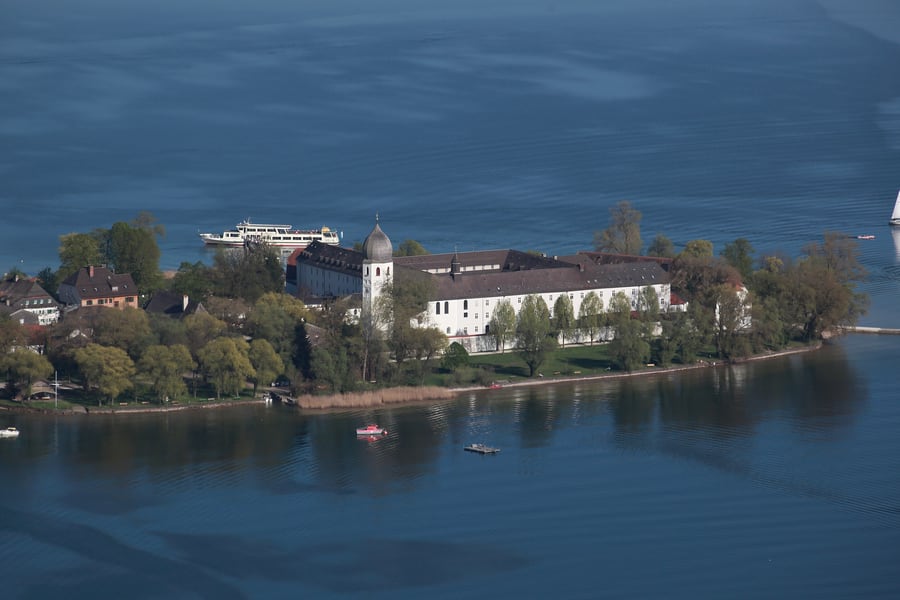 Schreinermeister / Wikimedia Commons · CC BY-SA 4.0 · cropped
The Fraueninsel
Six hundred and twenty metres long, three hundred wide, fifteen and a half hectares, about two hundred people in some fifty houses, and no cars. Duke Tassilo III founded the abbey of Frauenwörth here in 782; the gatehouse dates from around 850 and the free-standing bell tower from the twelfth century, its onion dome added in 1626. Thirteen sisters still live in the convent. A path round the island takes about a kilometre and a half.Where to Sleep
Prien is a small town of about eleven thousand people and a certified air and Kneipp spa, which means it has more beds than its size suggests. The three below are all in Prien itself and all take bookings directly: one in the middle of the town near the station end of the railway, and two down by the water at the harbour end.
A night here is worth more than it looks. The last boat back from the islands leaves in the early evening and the last train up from the harbour is not long after it, so a day trip from Munich spends most of its time watching the clock.
Where to stay
Hotel Lindenhof
In the middle of Prien, eight minutes from the station
A small hotel in the Alte Rathausstraße, three minutes' walk from the market square and eight from the main-line station — which is also where the Chiemsee-Bahn starts. There is no restaurant and no hotel breakfast; the house points guests at the cafés around the square and down by the water instead. The boat jetties at Stock are about twenty minutes away on foot, or one stop on the train.
Check Availability (opens in a new tab, on lindenhof-prien.de)via lindenhof-prien.deHotel Neuer am See
Two hundred metres from the lake, at the harbour end
A family-run house in the Seestraße, a couple of hundred metres from the water and a short walk from the boats to the islands, the lakeside path and the Prienavera baths. The kitchen is open from eight in the morning until half past ten at night, with hot food served until half past nine, and the house asks for a reservation.
Check Availability (opens in a new tab, on neuer-am-see.de)via neuer-am-see.deHotel Schlossblick Chiemsee
On the shore, looking across at the Herreninsel
At the far end of the Seestraße, directly on the lake, with an uninterrupted view over the water to the island the whole journey is aimed at. There is a main house of modern rooms and a separate guest house with seven more, and a steakhouse attached. The Chiemsee-Bahn's harbour terminus and the jetties are within walking distance.
Check Availability (opens in a new tab, on schlossblick-chiemsee.de)via schlossblick-chiemsee.deQuestions or corrections
Planning this trip and stuck on something, or spotted a time, fare or detail that has changed? Send us a message about The Chiemsee-Bahn to the Lake Steamers. We read every one, and we update this page when something has changed.