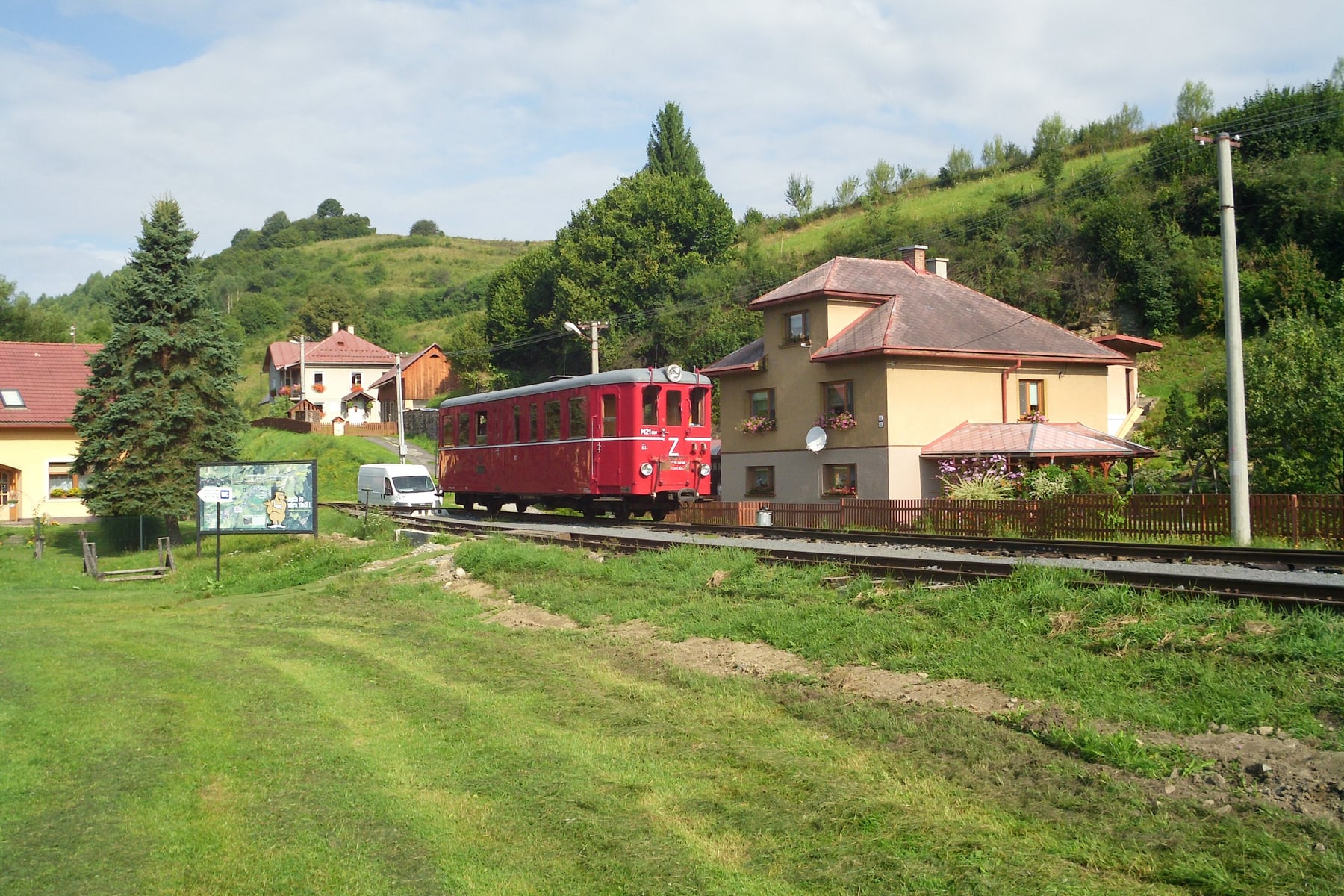
The Čierny Hron Forest Railway
Jan Pešula / Wikimedia Commons · CC0 · 2014 · cropped
- Distance13 km on three routes
- Duration45–50 min per route, return
- Best seasonDaily steam late June–August · diesel to Vydrovo March–mid-September
Introduction
At its height the Čierny Hron forest railway ran 131.98 kilometres of 760 mm track up nearly every side valley of the Black Hron, in the Veporské vrchy south of Brezno, and up to seven steam locomotives a day brought timber down to the sawmills at Čierny Balog and the transfer sidings at Hronec. The first section, 10.4 kilometres from Hronec to Čierny Balog, was built from 1908 and inspected on 8 January 1909. Lorries won in the end, as they did everywhere: by order of the Slovak government the last 36 kilometres closed on 31 December 1982, the last forest railway still working in Slovakia, and everything on it was marked for scrap.
It survived because people refused to let it go. Local conservationists had it entered on the state list of cultural monuments, volunteer work camps began rebuilding it in the summer of 1983, and the first restored section, from Čierny Balog into the Vydrovo valley, reopened on 1 May 1992. A non-profit company has owned and run it since 2003, and the operator is plain about what the ticket pays for: the fare is a contribution to restoring a cultural monument, not a commercial service.
What runs today is three short out-and-back routes from the station at Čierny Balog — steam to Šánske and to Dobroč, a diesel into the Vydrovo valley — and on the Dobroč run the train passes between the grandstand and the pitch of the village football ground.
The Journey
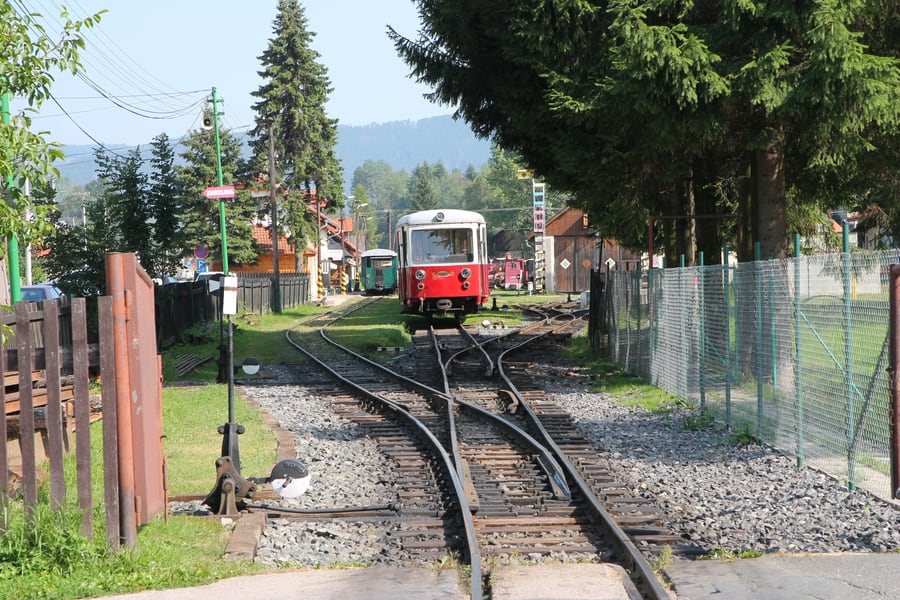
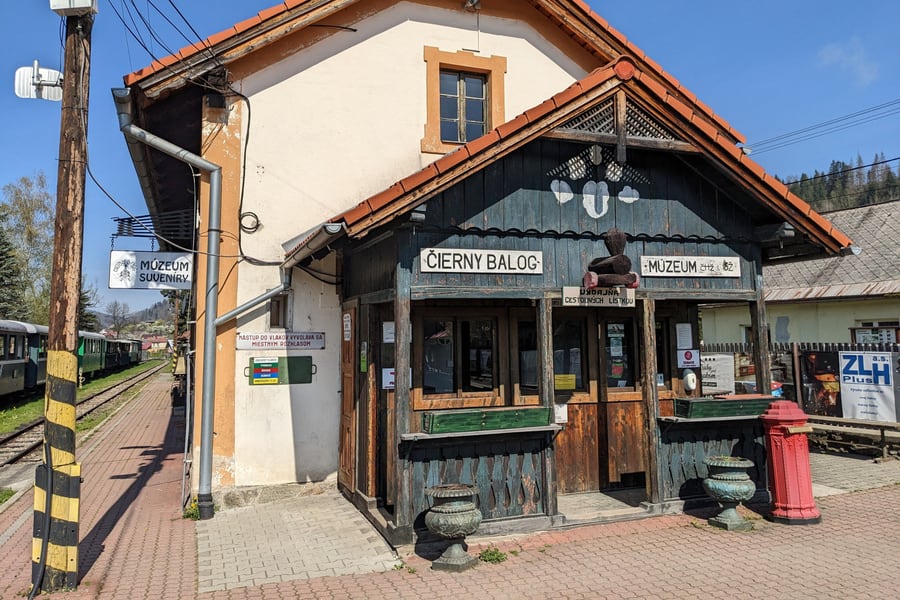
Every train starts and finishes at Čierny Balog, where the station building doubles as the railway's museum and ticket office, and the museum and depot can be looked round before each steam departure. The village is not one place but thirteen hamlets strung along the Black Hron and its side valleys, and the three routes run out from the middle of it in three directions. They can be combined on one ticket and linked up according to the day's timetable.
Red: up the Hron valley to Šánske
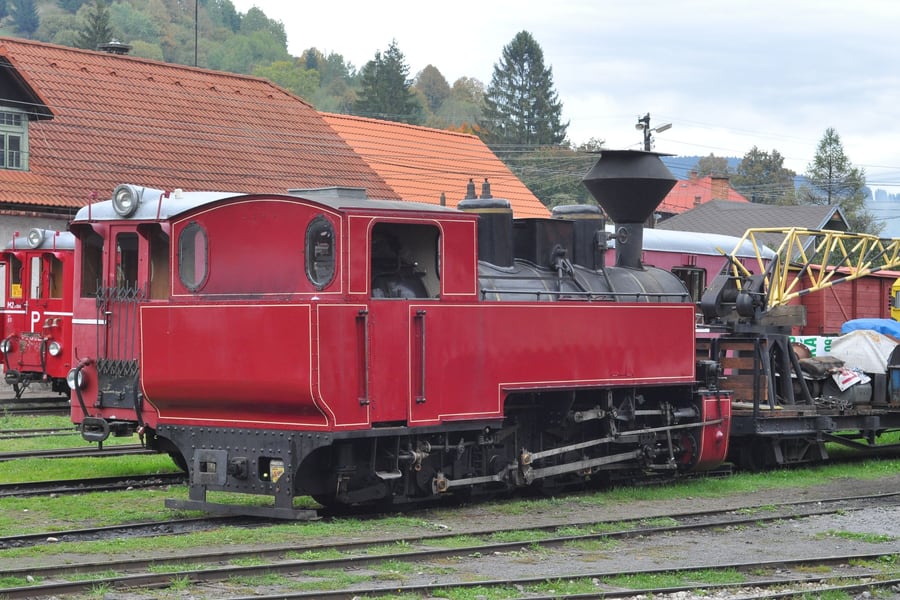
Five kilometres north-west, past Krám — the oldest of the hamlets, founded around 1563 as the woodcutters' base — and on up the valley to the passing loop at Šánske, where the train waits about a quarter of an hour before returning. In summer this is a steam route. The engines are a Smoschewer of 1918, a ČKD of 1948 and a Reşiţa built in Romania as late as 1985, hauling open excursion coaches dating from 1898 to 1938. The track beyond Šánske, on through Svätý Ján and Hronec to the main line at Chvatimech, is out of regular use because it is worn out; only works trains and specials go down it, and rail bikes, which can be hired to ride it.
Blue: through the football ground to Dobroč
Four kilometres the other way, out through the hamlets to Dobroč, with a pause of about ten minutes at the end. This was the last section to reopen, on 30 April 2012, and it is the one people come for: at the ground of TJ Tatran Čierny Balog the track runs along the touchline, between the grandstand and the pitch, so the train goes straight through the stadium. The operator calls it unique in the world.
Green: into the Vydrovo valley
The third route is a diesel, four kilometres up the Vydrovo valley to the forestry open-air museum, with two stops inside it and a five-minute turn at the top. It is worked by the Hungarian-built Rába TU 45.001 of 1961 with open coaches of 1959 and a driving trailer of 1954, or by the railcar M 21.004, built in 1939. This is the section that reopened first, in 1992, and it is the one that runs the longest season.
The Swiss trams in the yard
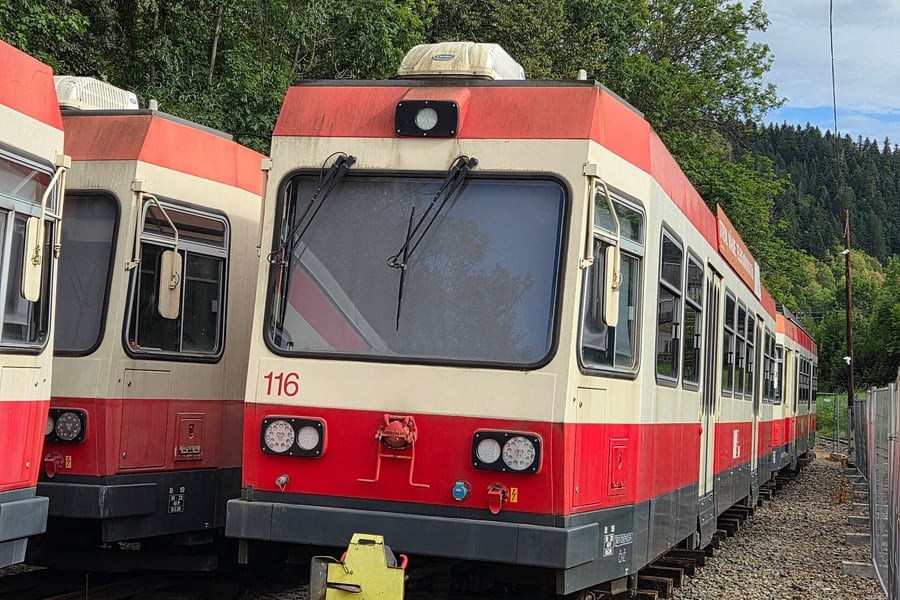
The cream-and-red cars parked at the railway's sidings are the next chapter, if it happens. In 2020 the railway won the tender for seventeen vehicles of the Waldenburgerbahn near Basel, which was being regauged — seven BDe 4/4 motor cars and ten Bt driving trailers, built between 1985 and 1993 for 750 mm track and 1,500 V DC. They cost CHF 80,000, came down the Rhine, the Main and the Danube by barge in the spring of 2021, and were unloaded at Hronec on 14 May. The plan is to electrify the line and run them as a year-round regional service. Until then they run on demonstration days, powered by a diesel generator.
Along the route
 Patrik Kunec / Wikimedia Commons · CC BY 4.0 · 2024 · cropped
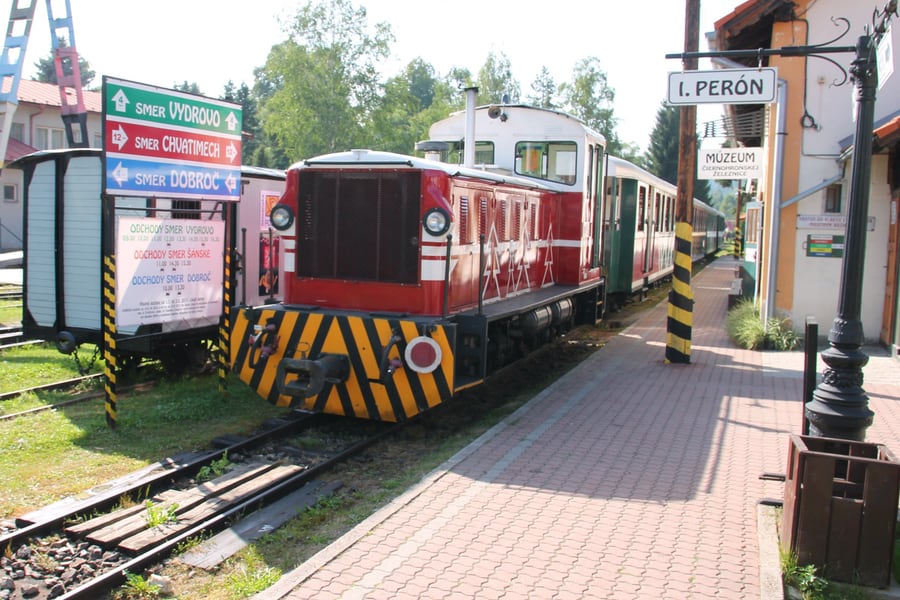
A station that is also the museum
Čierny Balog's station sells the tickets, houses the railway's museum and has the depot beside it. Before every steam departure there is half an hour to look round, and the Lampáreň restaurant on the station serves the waiting.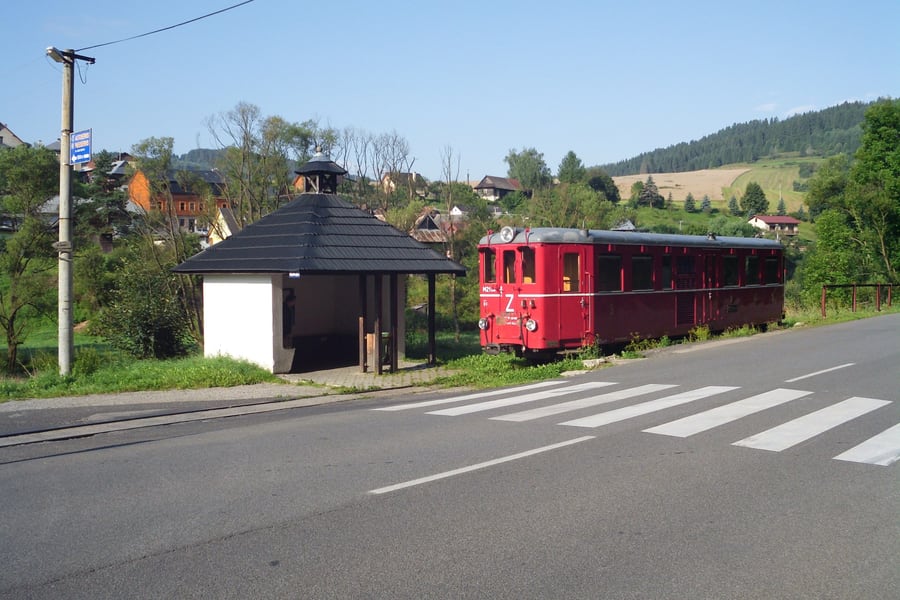 Jan Pešula / Wikimedia Commons · CC0 · 2014 · cropped
Krám, on the red route
The Šánske train calls at Krám, a shared bus and train stop on the valley road. The name is German for a store: the hamlet began around 1563 as the woodcutters' base, with their master's house and the stores of tools and food.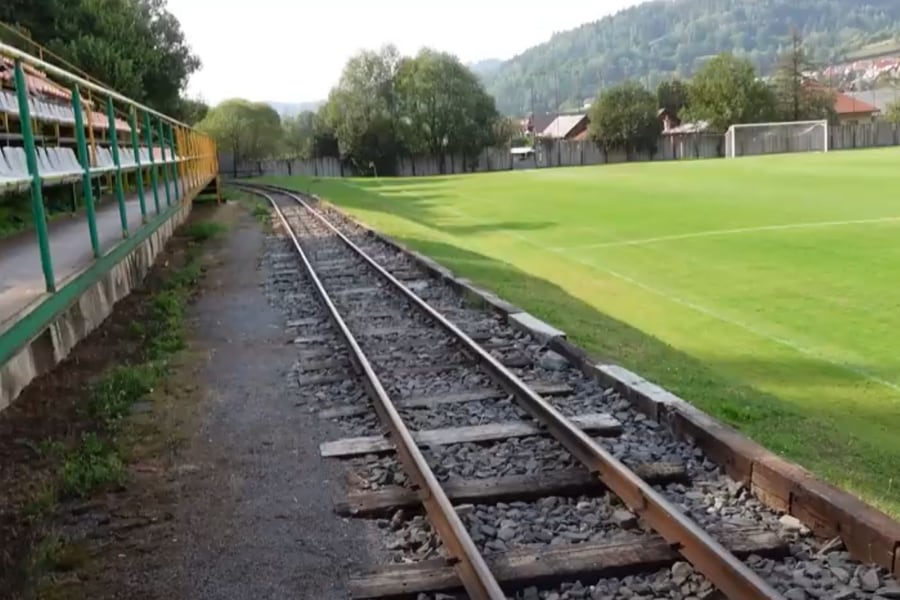 Fcstmani / Wikimedia Commons · CC BY 4.0 · 2022 · cropped
Through the football ground
On the blue route to Dobroč the track runs along the touchline of the TJ Tatran Čierny Balog ground, between the grandstand and the pitch. The section reopened on 30 April 2012, the last to come back.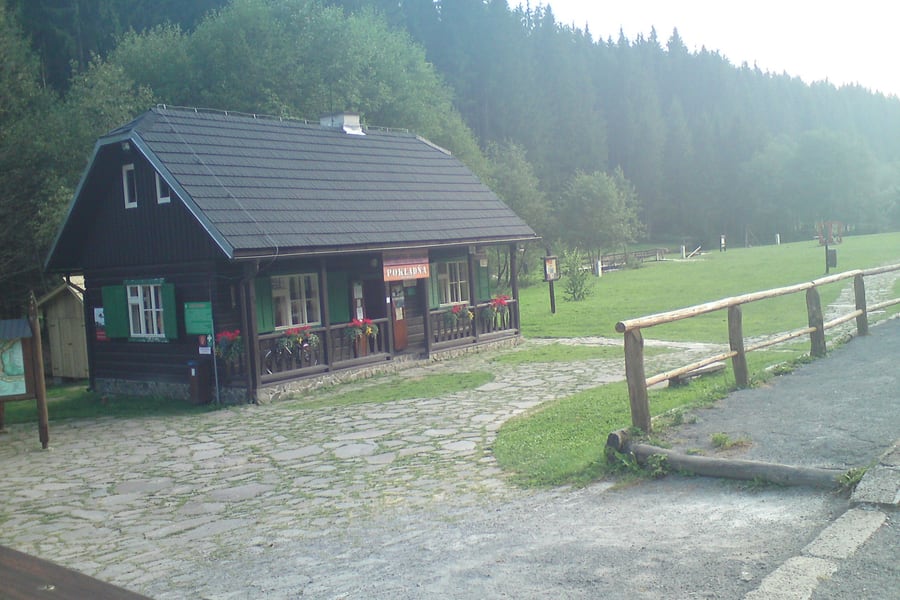 Pe3kZA / Wikimedia Commons · CC BY-SA 3.0 · 2011 · cropped
Up the Vydrovo valley
The green route was the first to reopen, on 1 May 1992, and climbs four kilometres up the Vydrovo valley through the forestry museum, which has two stops of its own. It is the diesel run, and the one with the longest season.A bit of history
Culture & experiences along the way
 Pe3kZA / Wikimedia Commons · CC BY-SA 4.0 · 2015 · cropped
The forestry museum at Vydrovo
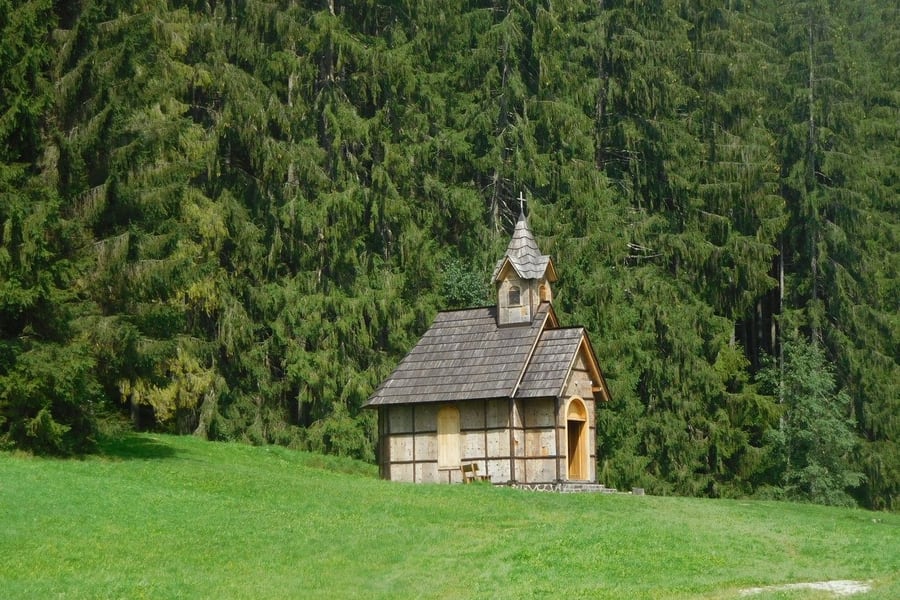
Founded in 2002 by the state forestry company, the open-air museum lines a trail of about four kilometres up the Vydrovo valley with 75 stops: a forester's lodge, the woodmen's shelters and caravans, a water-powered sawmill, a tree nursery, a steam engine with its wagons and this small wooden chapel. The signs are in Slovak and English.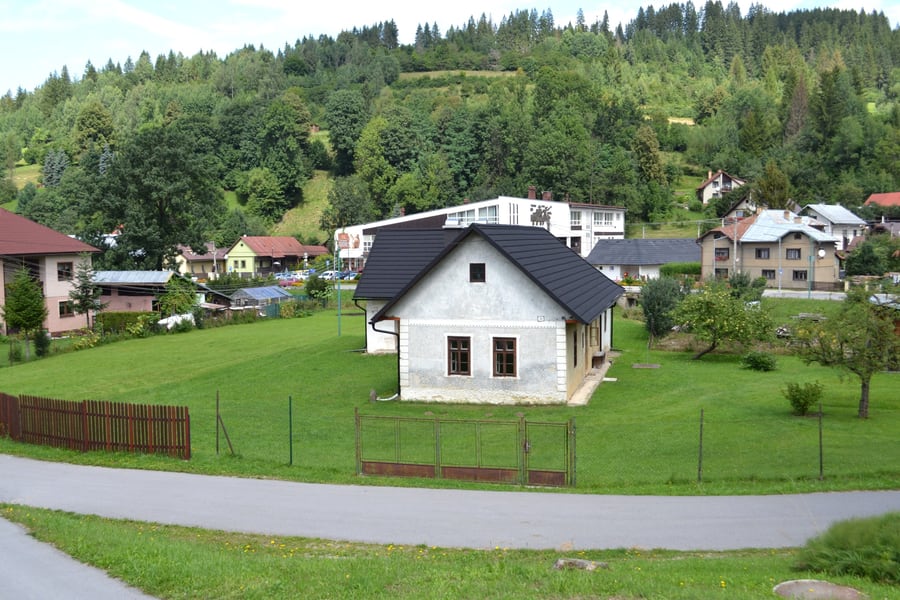 Ladislav Luppa / Wikimedia Commons · CC BY-SA 4.0 · 2021 · cropped
The "United States of Balog"
Čierny Balog is thirteen hamlets — Krám, Jergov, Balog, Závodie, Vydrovo, Medveďovo, Dolina, Fajtov, Komov, Latky, Jánošovka, Pustô and Dobroč — settled by woodcutters along the river and its side valleys, and nicknamed for it the United States of Balog. The blue route is the easiest way to see how they string together.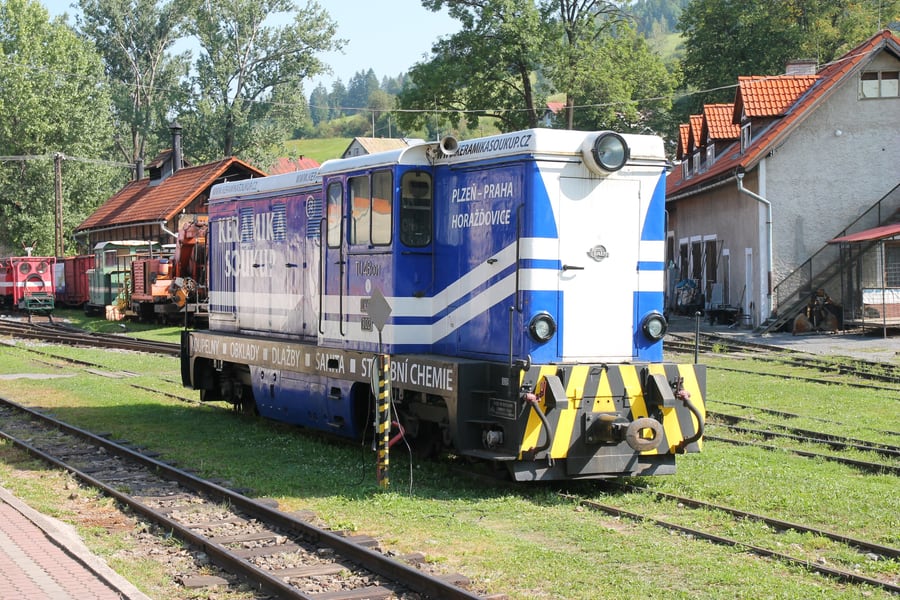 Draceane / Wikimedia Commons · CC BY-SA 4.0 · 2017
Steam engines old and borrowed
The steam roster runs from a Smoschewer of 1918 through a ČKD of 1948 to a Reşiţa of 1985, and in summer 2026 it was joined by the Krauss U 23.901 Wolf, lent by the steam museum at Žamberk in Czechia, which worked the trains from Sunday to Wednesday.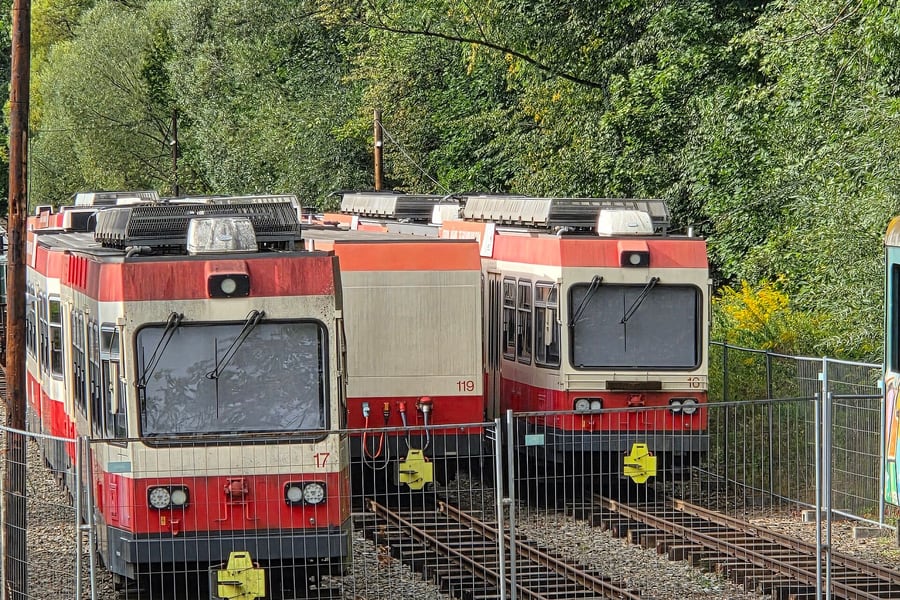 Dieter Zoubek / Wikimedia Commons · CC BY-SA 4.0 · 2026 · cropped
The Swiss trams on May Day
Each spring since 2024 the railway has run the Waldenburgerbahn cars on demonstration days to show what a regional service could look like. On 1 May 2026 they shuttled between Hronec and Chvatimech hourly from nine to four, the third year running.Timetables
Every train leaves from and returns to Čierny Balog. There are two timetables, one for the steam trains and one for the diesels, and both are seasonal. The times below are the railway's own 2026 timetable, read on chz.sk in October 2026; the next season's is published on the same page in the spring.
Steam — to Šánske and to Dobroč
Every Saturday from 4 April to 20 June, plus 1 and 8 May; daily from 27 June to 29 August; then Saturdays 5 and 12 September and Sunday 13 September. The museum and depot can be visited for half an hour before each departure.
| Route | Leaves Čierny Balog | Back in Čierny Balog |
|---|---|---|
| Šánske | 10:30 | 11:30 |
| Dobroč | 12:00 | 12:50 |
| Šánske | 14:00 | 15:00 |
| Dobroč | 15:30 | 16:20 |
Diesel — into the Vydrovo valley
Daily from 28 February to 15 September, provided at least six full tickets are sold for the departure.
| Route | Leaves Čierny Balog | Back in Čierny Balog |
|---|---|---|
| Vydrovo | 10:00 | 10:45 |
| Vydrovo | 11:00 | 11:45 |
| Vydrovo | 12:30 | 13:15 |
| Vydrovo | 13:30 | 14:15 |
| Vydrovo | 14:30 | 15:15 |
| Vydrovo | 15:30 | 16:15 |
Out of season
After mid-September the regular season is over and the railway runs announced days instead. In autumn 2026 there were two, on 17 and 31 October, worked by the historic diesel on all three routes:
| Route | Leaves Čierny Balog |
|---|---|
| Dobroč | 10:00 |
| Šánske | 11:00 |
| Vydrovo | 12:00 |
| Vydrovo | 13:30 |
| Šánske | 14:30 |
| Dobroč | 15:30 |
No booking was needed for those: arrive about a quarter of an hour early and buy a ticket in the station museum. Groups of twenty or more can hire a train on any date. Check the timetable on chz.sk (opens in a new tab) and the railway's news page before travelling, because special days are announced there and nowhere else.
Tickets
Fares are by the number of routes ridden, not by distance, and every route is a return trip. One route is €15.00; two cost €26.00, and all three €38.00. Pensioners, children from three to fifteen, students with an ISIC card up to 26 and disabled travellers pay less, under-threes ride free, and a family ticket for two or more routes takes 10 % off. A steam train costs €2.00 a head on top, whatever the age.
Tickets cannot be bought online: they are sold at the station, and cards are taken for payments of €15 or more. One route takes about 45 minutes by diesel and 50 by steam, so two routes fill a morning and all three most of a day. Prices from the 2026 price list on chz.sk, October 2026.
Book your tickets
One route, return
€15.00 · €11.00 pensioners · €7.50 children
Any one of the three routes, there and back, with €2.00 extra for steam.
Book Tickets (opens in a new tab, on chz.sk)via chz.skTwo routes
€26.00 · €18.00 pensioners · €13.00 children
Any two routes in any combination of steam and diesel, about two hours of riding.
Book Tickets (opens in a new tab, on chz.sk)via chz.skAll three routes
€38.00 · €26.50 pensioners · €19.00 children
Šánske, Dobroč and Vydrovo in any order, three to five hours in all.
Book Tickets (opens in a new tab, on chz.sk)via chz.skRail Passes
No pass covers this railway. Interrail's railway-companies table, updated on 21 October 2026, lists the Čiernohronská železnica by name among the trains not included in the pass in Slovakia, alongside the country's other preserved forest and narrow-gauge lines — the Oravská, Považská and Beskydská lesná železnica and the Nitrianská poľná železnica. Every ride here is paid at the station, at the railway's own fares.
Whether it is worth buying
Not for this. The nearest stations on the national network are Brezno and Chvatimech, on the Banská Bystrica–Červená Skala line, and an Interrail or Eurail pass is valid on the ordinary ZSSK trains that serve them. That makes a pass useful only if the trip to Čierny Balog is one day of a longer journey around Slovakia; for the forest railway itself, buy the €15.00 route ticket at the station.
Places to Visit
The railway is a half-day, and the country around it fills the rest of a visit: the ironworks village at the bottom of the old line, the mountain the forest branches climbed towards, a show cave under the Low Tatras and the market town a few kilometres to the north.
 Patrik Kunec / Wikimedia Commons · CC BY-SA 4.0 · 2015 · cropped
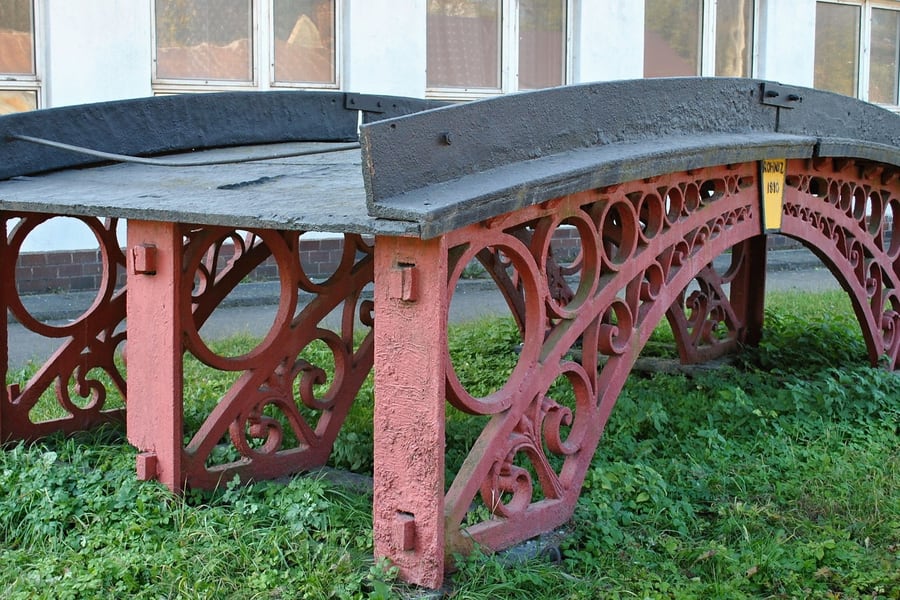
Hronec and its cast-iron bridge
Hronec, where the old line met the state railway, has had a foundry since the end of the eighteenth century, and the remains of a blast furnace of 1795 stand in the valley at Tri vody. In 1810 its ironworks cast a bridge that is reputedly the first cast-iron bridge in Central Europe; it is a protected monument, and the village made a ceremony of unveiling it on 1 May 2026.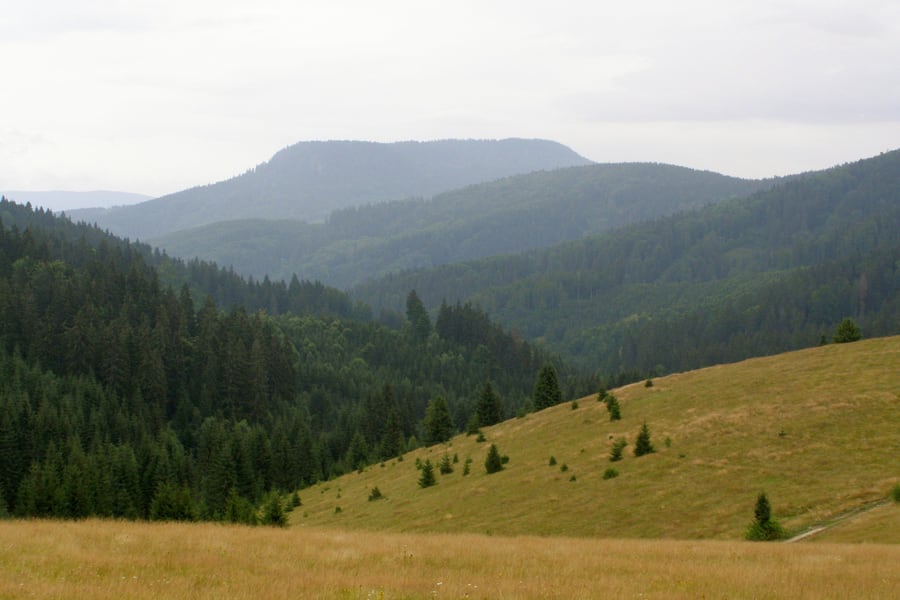 Daniel Baránek / Wikimedia Commons · CC BY-SA 3.0 · 2009 · cropped
Klenovský Vepor
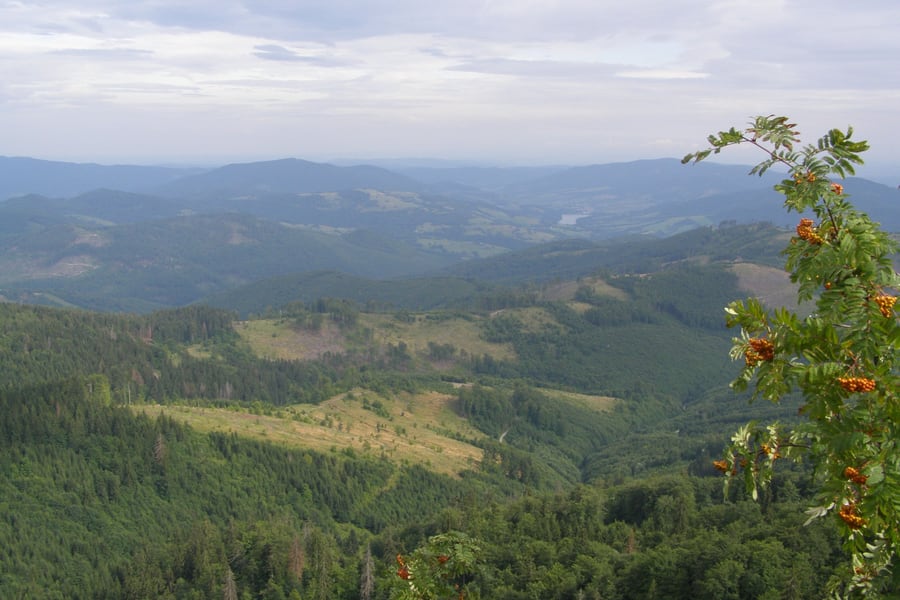
The broad forested mountain of 1,338 metres on the southern skyline is the highest ground the railway's branches climbed towards, in the Balocké vrchy above Čierny Balog. Geologists read it as a lava flow of andesite cut off by erosion, and much of the massif is a national nature reserve, its summit covered in spruce, beech and fir.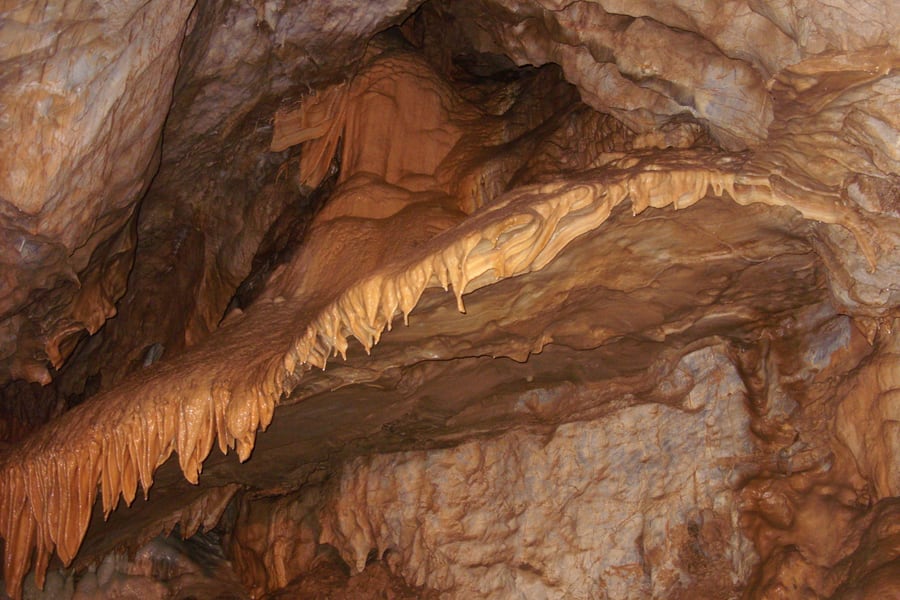 Pe3kZA / Wikimedia Commons · CC BY-SA 3.0 · 2011 · cropped
Bystrianska jaskyňa
The largest cave on the southern side of the Low Tatras, at the edge of the village of Bystrá north of Brezno. Its old passages were always known; the new ones were found in 1926 through a shaft called Peklo, Hell. About three kilometres have been mapped, and 580 metres have been open to visitors since 1968.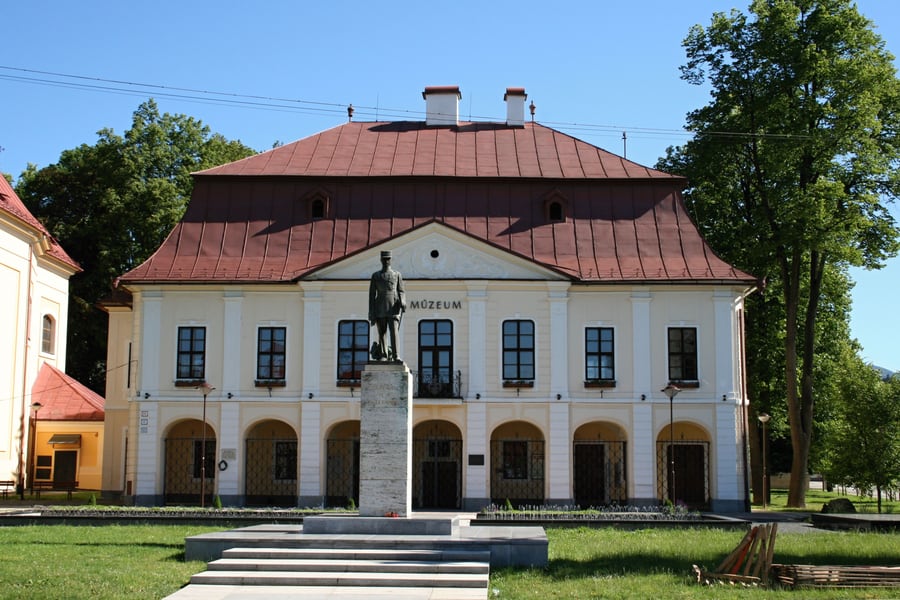 Patrik Kunec / Wikimedia Commons · CC BY-SA 4.0 · 2016 · cropped
Brezno
The district town, a few kilometres north, has one of the largest squares in Slovakia, named for General Štefánik, whose monument has stood on it again since 1990. The baroque-classicist town hall of 1779 in the middle of the square now houses the Horehronské múzeum, and the white bell tower of 1830 beside it is the town's symbol.Where to Sleep
Čierny Balog lies a few kilometres south of Brezno, the district town, and the two hotels below are on the Brezno side: one on the edge of the town itself, and one up under the southern slopes of the Low Tatras for anyone combining the railway with walking or the cave at Bystrá.
Where to stay
Red Deer Hotel
At Rohožná, on the edge of Brezno
Five kilometres from the centre of Brezno, with a restaurant and double rooms and apartments, and guests get free use of the pool at the car museum beside it.
Check Availability (opens in a new tab, on reddeerhotel.sk)via reddeerhotel.skHotel Stupka
At Tále, under the Low Tatras
A mountain hotel beside the Gray Bear golf course and the Tále ski area, with double rooms and family apartments looking over both.
Check Availability (opens in a new tab, on tale.sk)via tale.skQuestions or corrections
Planning this trip and stuck on something, or spotted a time, fare or detail that has changed? Send us a message about The Čierny Hron Forest Railway. We read every one, and we update this page when something has changed.