Slovakia
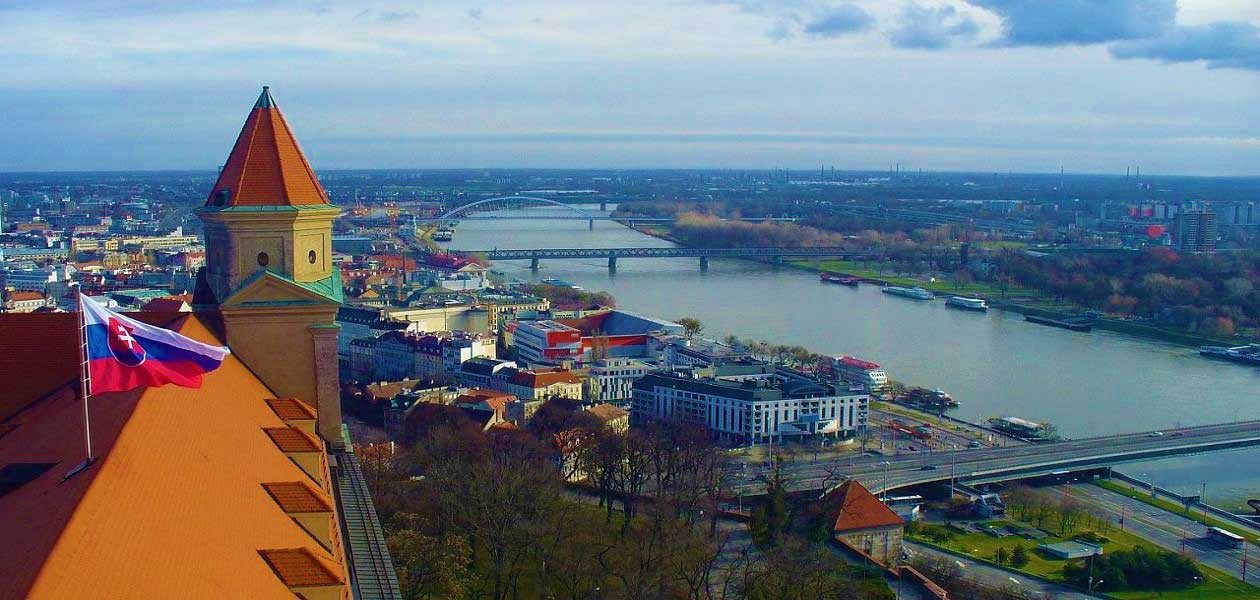
Slovakia is a landlocked country of 49,035 km² with about 5.4 million people, bordered by Poland to the north, Ukraine to the east, Hungary to the south, Austria to the west and the Czech Republic to the north-west. Most of it is mountainous. The Carpathians run the length of the country and culminate in the High Tatras, a compact alpine range on the Polish border that is the highest ground between the Alps and the Caucasus. Bratislava, the capital, sits at the opposite corner on the Danube, within sight of both Austria and Hungary.
The main network runs to about 3,658 km of standard gauge, with ZSSK working passenger services and ŽSR owning the track. What makes Slovakia unusual is what sits alongside it: a self-contained 1,000 mm electric railway serving the Tatra resorts, a rack railway climbing to a mountain lake, and preserved forest railways of 760 mm gauge in the central uplands — narrow-gauge mountain railways of a kind most of Europe demolished.
Rail journeys in Slovakia
Good to know
How do you get around the High Tatras by rail?
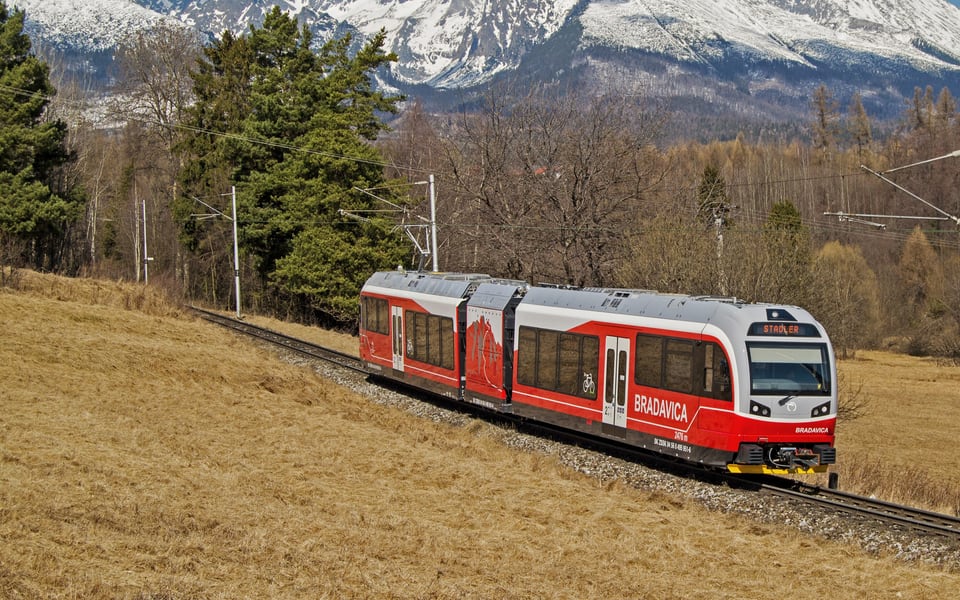
By a railway of its own. The Tatra Electric Railway is a 1,000 mm gauge, 1500 V DC line running 29.1 km from Poprad on the main line up through Starý Smokovec to Štrbské Pleso, with a 5.9 km branch to Tatranská Lomnica. It opened in stages between 1908 and 1912 and has carried passengers only since 1970. There is a train every hour on both arms, every day of the year, and a €6.00 ticket covers 24 hours on the whole network. At Štrbské Pleso it meets the rack railway down to Štrba, and at Starý Smokovec a funicular up to Hrebienok.
Is there a rack railway in Slovakia?
One. The Štrbské Pleso–Štrba rack railway, 1,000 mm gauge, was built in 1896 and later reconstructed, climbing from the main line at Štrba to the lake at Štrbské Pleso. It predates the electric railway by twelve years and was the original way up to the resort.
What are the forest railways?
Narrow-gauge lines of 760 mm built to move timber and preserved after their working lives ended. The best known is the Čierny Hron Railway around Čierny Balog, once the most extensive forest railway in Czechoslovakia at nearly 132 km and now about 17 km, reopened by volunteers in 1992. A second, at Vychylovka, is a switchback line that gains height by reversing.
Is an Interrail or Eurail pass worth it in Slovakia?
Interrail sells a one-country pass for Slovakia, and it covers ZSSK on the national network. Whether it pays depends on distance — fares are moderate and the country is not large. The mountain lines are the thing to check rather than assume: narrow-gauge and preserved railways frequently sit outside pass validity, or give only a reduction.