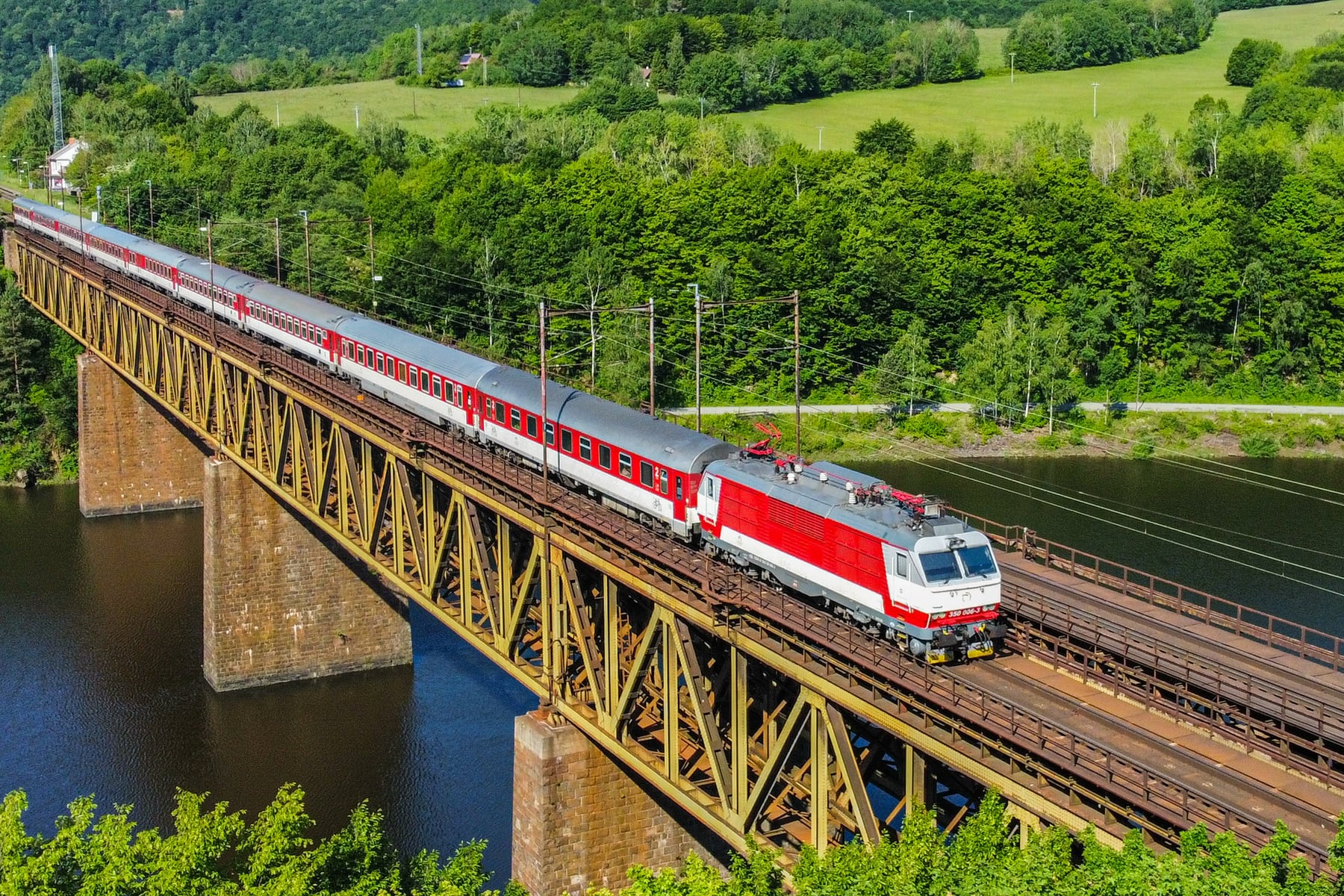
Bratislava to Košice
Viktor Šesták / Flickr · CC BY 2.0 · cropped
- DistanceBratislava hl. st.–Košice · 443 km
- Duration5 h 05 to 5 h 51
- Best seasonDaily all year · late spring for the green Váh valley
Introduction
Somewhere east of Žilina, the express to Košice changes the kind of electricity it runs on. Behind it, the wires carry 25,000 volts of alternating current; ahead, 3,000 volts direct. The locomotive lowers its pantograph, coasts through a short dead section and raises it again on the other side. The line is two railways joined end to end at Žilina: the Košice–Bohumín railway, finished in 1872 and electrified with direct current by 1964, and the line up the Váh valley from Bratislava, which reached Žilina only in 1883. That one was wired from both ends: direct current from Žilina to Púchov in 1960, alternating current from Bratislava to Púchov in 1988.
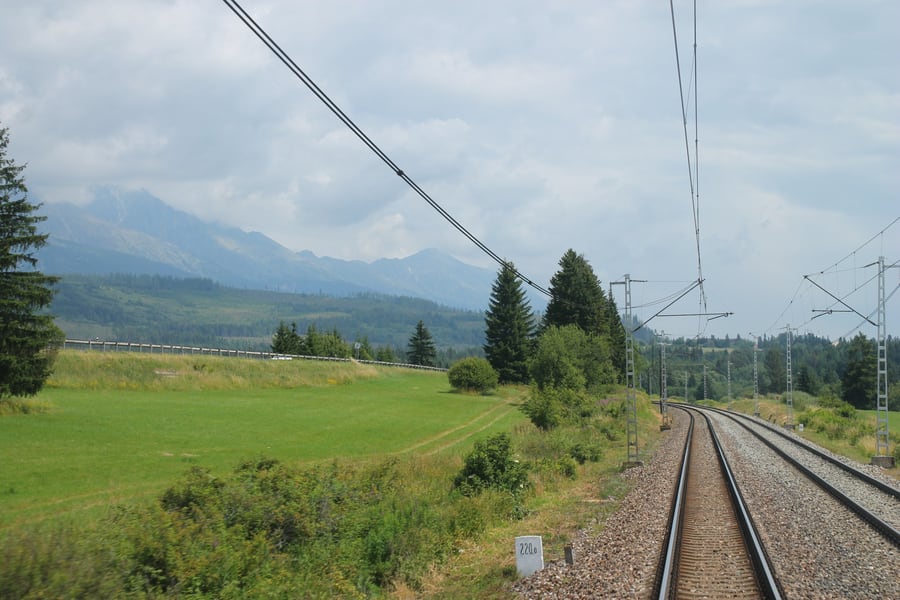
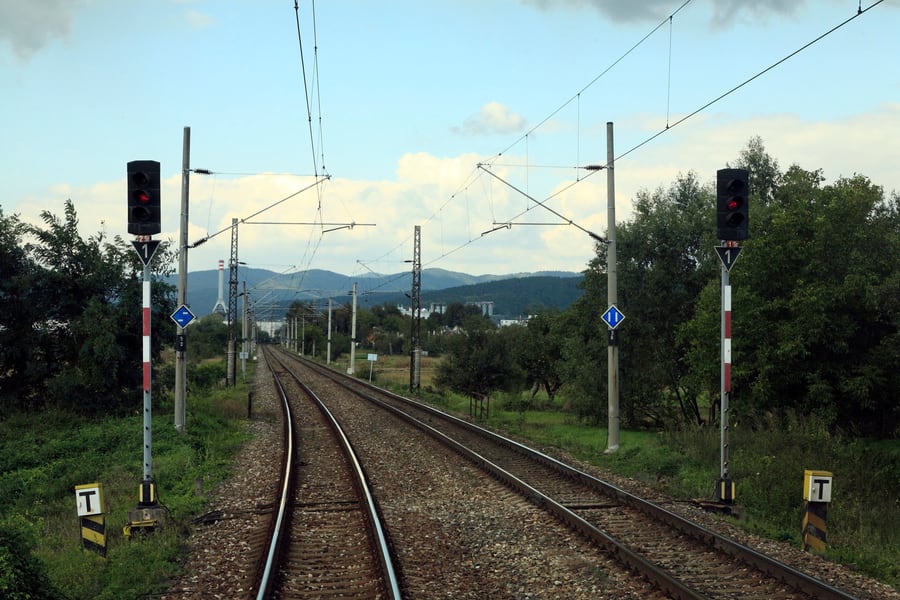
The change-over does not stay put. From February 1988 until July 2015 it sat by the halt at Dolné Kočkovce, just south of Púchov. Púchov station went over to alternating current on 1 August 2015, the line to Bytča in June 2024, the line to the edge of Žilina in spring 2025, and the Žilina junction itself between 14 and 28 September 2026. The boundary towards Vrútky now lies near Strečno, in the gorge where the Váh cuts through the Malá Fatra. Each step has moved more of the line onto the southern system, and the engines at the front have to work on both.
ZSSK runs an express about every hour, 443 kilometres in five to six hours: up the Váh past Trenčín, through the Strečno gorge, across the Liptov basin, over the top at Štrba under the High Tatras, and down through Spiš and the Hornád valley into Košice.
The Journey
The expresses leave Bratislava hlavná stanica and run out past Svätý Jur, where Slovakia's first railway, drawn by horses, arrived from Bratislava on 27 September 1840. After Trnava the line turns north up the Váh, and for the next two hours the river is never far away. At Trenčín the castle stands on its rock above the town, and a new railway bridge has carried the trains across the Váh since 2017. Beyond Púchov the line was rebuilt on a new alignment for 160 km/h: a bridge over the Nosice canal, the Diel tunnel (1,082 m), a 653-metre bridge over the Nosice reservoir and the Milochov tunnel (1,861 m), then the river again to Žilina.
East of Žilina
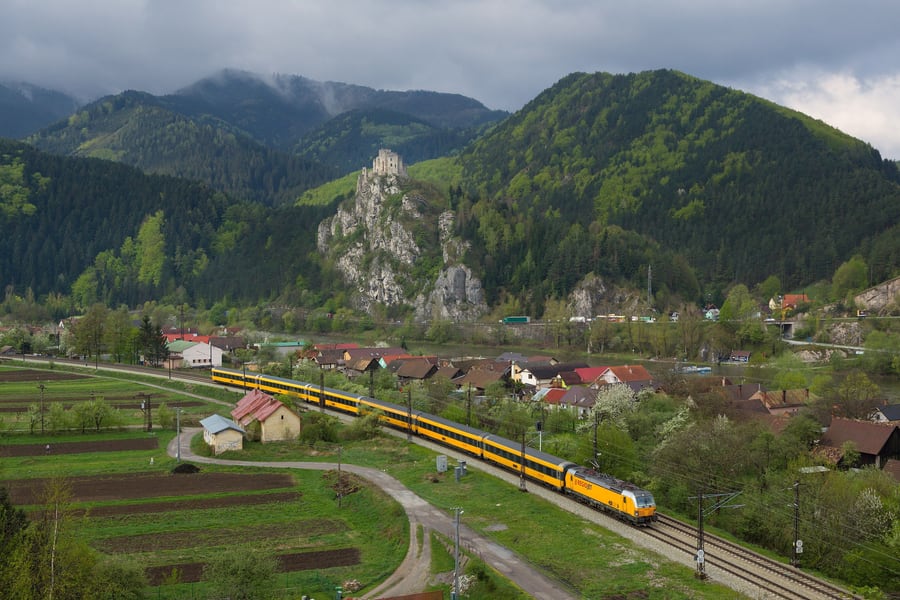
At Žilina the older railway takes over, the one that came down the Kysuca valley from Bohumín in 1871. Within minutes it enters the Strečno gorge, where the Váh splits the Malá Fatra in two. River, road and railway squeeze through side by side under Strečno Castle, and the line takes three tunnels at Strečno and another under the Domašín meander, where the river loops round a wooded hill below the ruin of Starhrad. Somewhere in here the current changes.
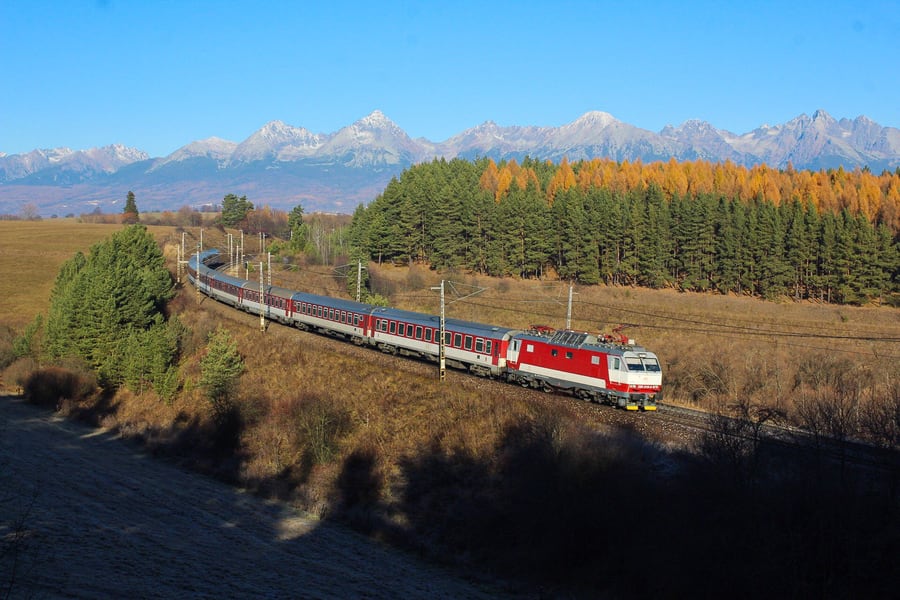
Past Vrútky and Kraľovany the line follows the Váh into Liptov. Beyond Ružomberok it runs along Liptovská Mara, the reservoir built in 1965–1975, for which thirteen villages were flooded and the main line moved. Then it climbs steadily to Štrba, at 900 metres the highest station in Slovakia where expresses stop, with the High Tatras standing up to the north. The descent to Poprad-Tatry keeps them in view, and Poprad is where the Tatra Electric Railway leaves for the mountains.
Spiš and the Hornád
East of Poprad the line drops into the valley of the Hornád and the old region of Spiš: Spišská Nová Ves, the edge of the Slovak Paradise, Krompachy, Margecany. The last stretch is the newest. In the early 1950s the line between Margecany and Kysak was rebuilt as double track on a new route, the Trať družby, through the Bujanov tunnel — 3,410 metres, still the longest double-track tunnel in Slovakia — and over the Ružín viaduct, 35 metres above the old valley floor. Both came into use on 5 November 1955, and in 1963–1970 a reservoir filled the valley beneath the viaduct. At Kysak the line from Prešov joins, and a quarter of an hour later the train is in Košice.
The locomotive
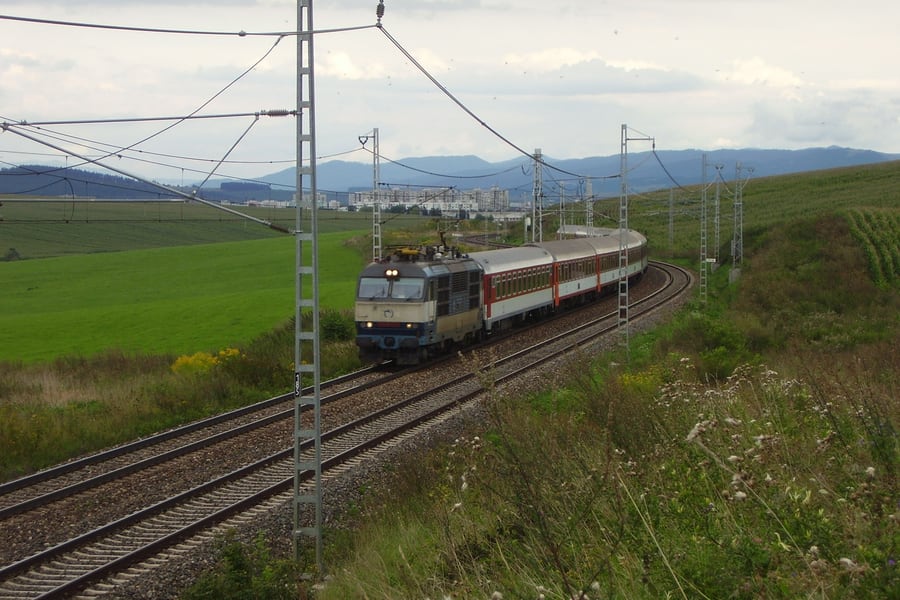
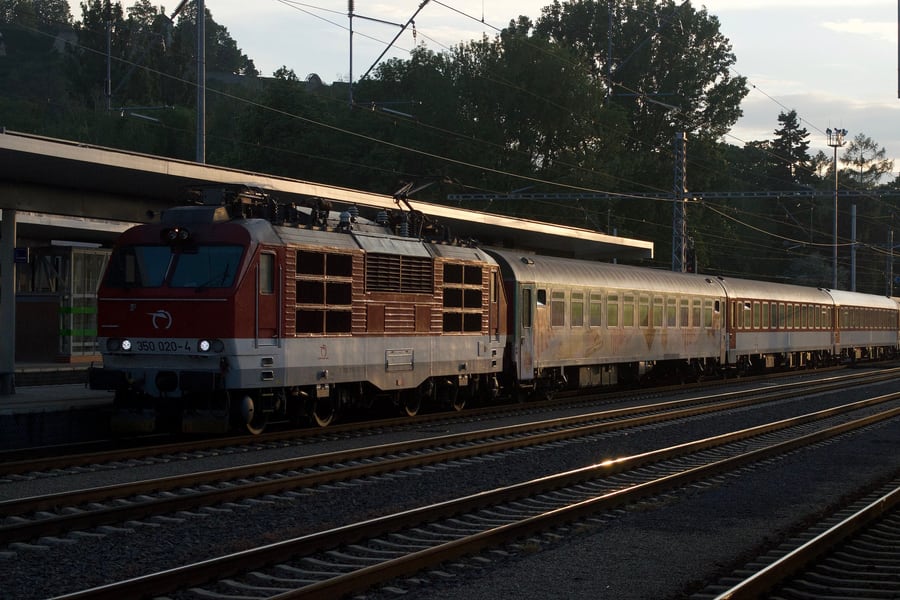
Because the line runs on two systems, the trains need engines that work on both. The best known is the class 350, built by Škoda in Plzeň for the Czechoslovak railways: ordered in 1969 as a dual-system express engine of 4,000 kW and 160 km/h, with the first prototype in 1973 and eighteen production engines in the autumn of 1975. Twenty were built, nicknamed Gorila. Twelve were still in regular service in 2025, sharing the Bratislava–Košice expresses with the newer classes 361, 362 and 383.
Along the route
 Falk2 / Wikimedia Commons · CC BY-SA 4.0
Where the current changes
From 1988 to July 2015 the change from 25 kV AC to 3 kV DC sat at Dolné Kočkovce, south of Púchov; this is the approach to it from Beluša in 2012. Since September 2026 it lies east of Žilina, near Strečno.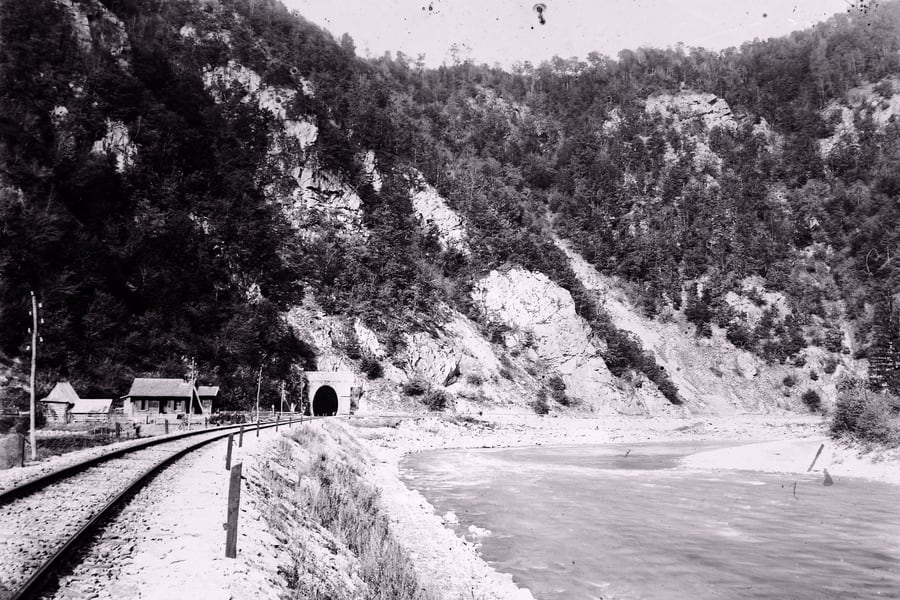 Fortepan / Magyar Földrajzi Múzeum / Wikimedia Commons · Public domain
The Strečno gorge
The Váh breaks through the Malá Fatra here, and river, road and railway squeeze through together. The line takes three tunnels at Strečno and another under the Domašín meander. The photograph is from 1914.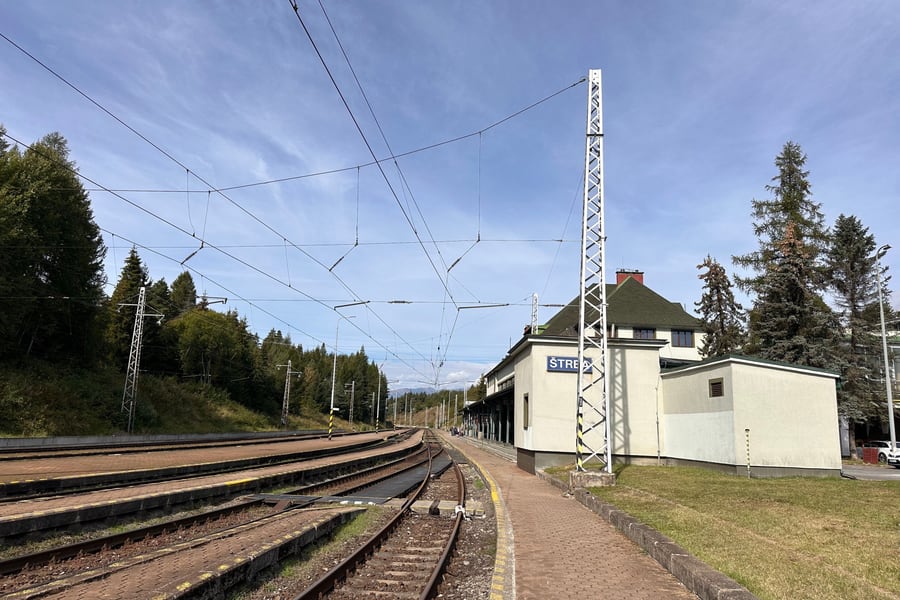 Punteador / Wikimedia Commons · CC BY-SA 4.0 · cropped
Štrba, 900 metres
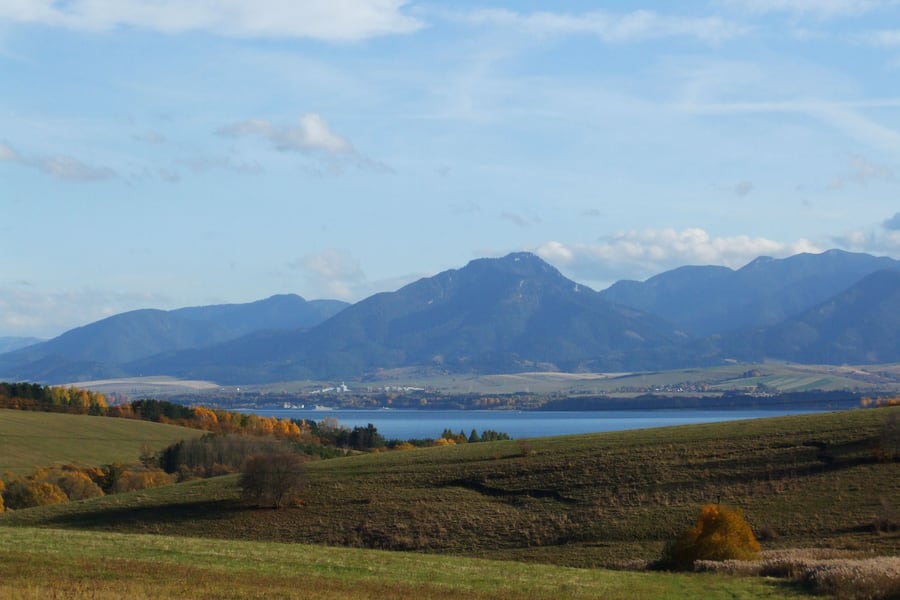
The highest station on the Slovak network where expresses stop. The TATRANs call here; the faster KRIVÁŇs do not. A rack railway climbs from Štrba to Štrbské Pleso, under the peaks.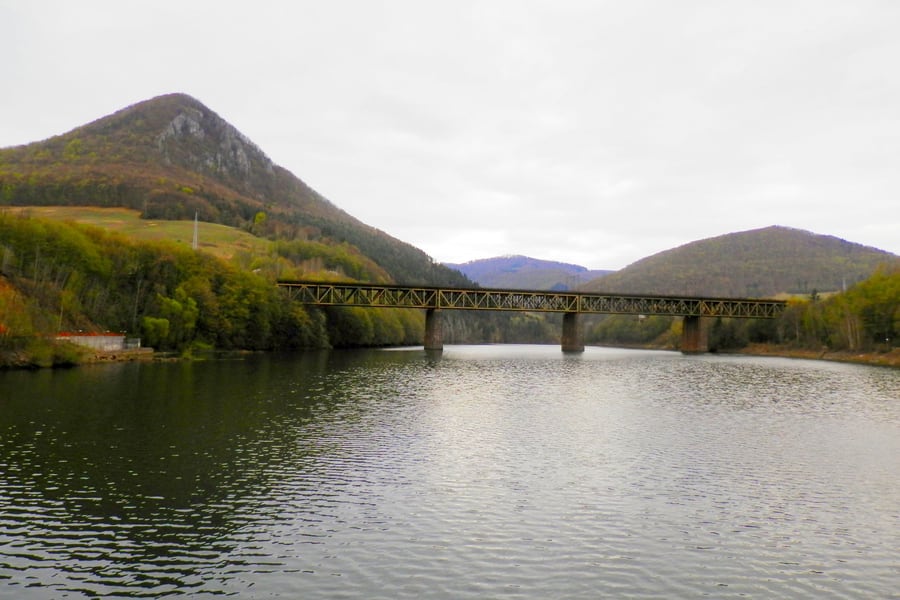 Jozef Kotulič / Wikimedia Commons · CC BY-SA 4.0 · cropped
The Ružín viaduct
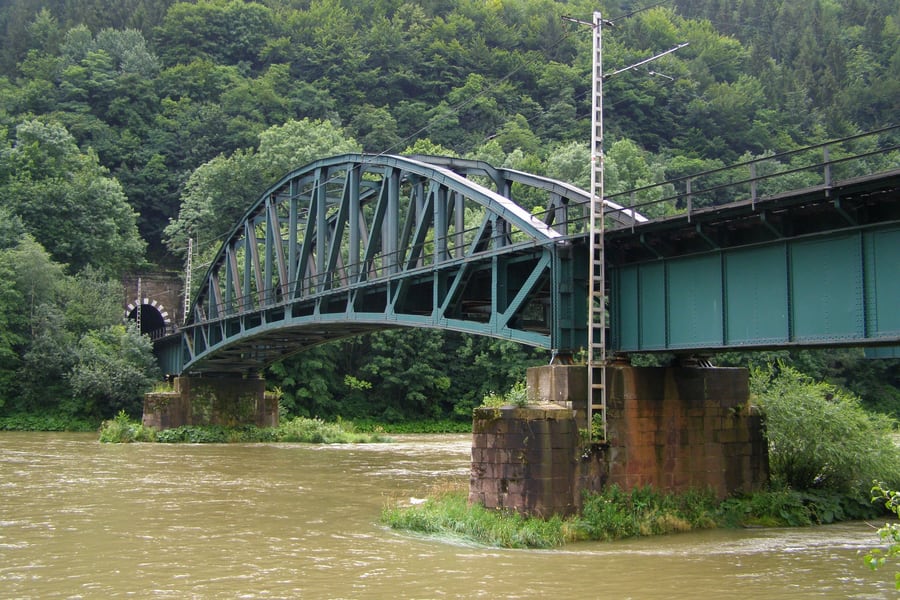
Built for the double-tracking finished on 5 November 1955, 35 metres above the old valley floor, a steel span for each track. The reservoir filled beneath it in 1963–1970. The Bujanov tunnel beside it, 3,410 m, is Slovakia's longest double-track tunnel.A bit of history
Culture & experiences along the way
 Qasinka / Wikimedia Commons · CC0 · cropped
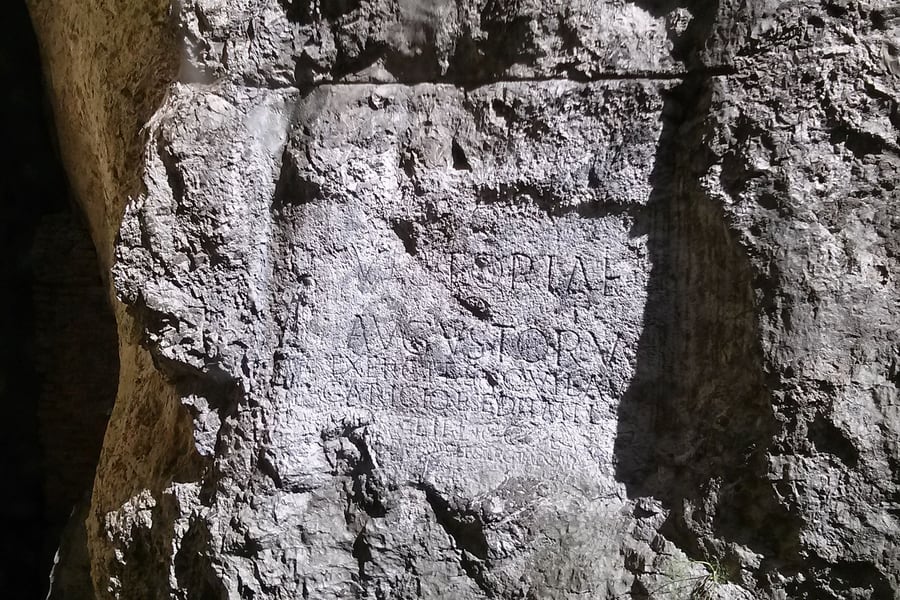
The Roman inscription at Trenčín
In the winter of 179, during the Marcomannic Wars, 855 soldiers of the Second Legion wintered at Laugaricio, and their victory was carved into the castle rock at Trenčín. It is the most important Roman inscription in Central Europe north of the Danube still in its original place.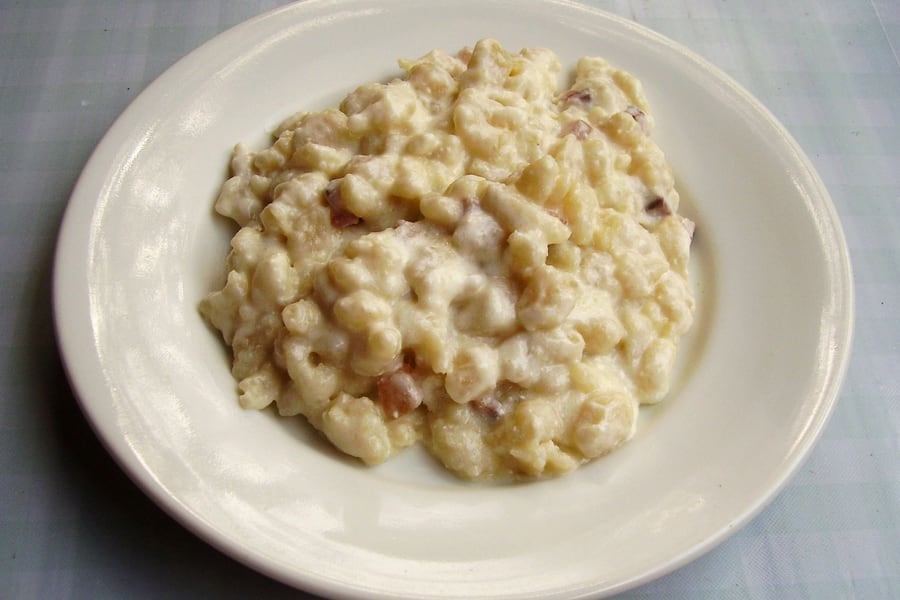 Honza Groh (Jagro) / Wikimedia Commons · CC BY 3.0 · cropped
Bryndzové halušky
Slovakia's national dish: small potato dumplings tossed in bryndza, a soft sheep's cheese, often with fried bacon on top. The traditional drink with it is žinčica, the whey left from the cheese-making, and the village of Turecká holds a halušky festival every year, eating contest included.Timetables
ZSSK runs an express between Bratislava and Košice about every hour, every day, from early morning to early evening. There are two kinds. The TATRAN expresses call at seventeen stations, Štrba among them, and take 5 hours 37 to 5 hours 51. The KRIVÁŇ expresses, twice a day each way, call only at the larger towns and take 5 hours 05 to 5 hours 33. All of them are through trains, with no change. A night train runs as well: R 681 leaves Bratislava at 22:50 and reaches Košice at 05:12, and R 680 leaves Košice at 23:45 and reaches Bratislava at 05:40.
Times as of November 2026, in the timetable valid from 5 October to 12 December 2026. Check departures in ZSSK's journey planner (opens in a new tab) or its timetable book (opens in a new tab).
Bratislava to Košice
| Train | Bratislava hl. st. | Žilina | Poprad-Tatry | Košice |
|---|---|---|---|---|
| Ex 603 TATRAN | 04:16 | 06:31 | 08:31 | 10:03 |
| Ex 505 KRIVÁŇ | 05:16 | 07:23 | 09:11 | 10:49 |
| Ex 609 TATRAN | 07:16 | 09:31 | 11:31 | 13:03 |
| Ex 525 KRIVÁŇ | 15:16 | 17:23 | 19:09 | 20:26 |
| Ex 631 TATRAN | 18:16 | 20:31 | 22:31 | 23:53 |
TATRANs leave Bratislava at :16 past every hour from 04:16 to 18:16, with a gap at 11:16 on some days.
Košice to Bratislava
| Train | Košice | Poprad-Tatry | Žilina | Bratislava hl. st. |
|---|---|---|---|---|
| Ex 600 TATRAN | 04:07 | 05:35 | 07:32 | 09:44 |
| Ex 502 KRIVÁŇ | 05:34 | 06:55 | 08:33 | 10:44 |
| Ex 608 TATRAN | 07:53 | 09:35 | 11:32 | 13:44 |
| Ex 526 KRIVÁŇ | 17:34 | 18:55 | 20:33 | 22:39 |
| Ex 628 TATRAN | 18:07 | 19:35 | 21:32 | 23:44 |
TATRANs leave Košice at :53 past every hour from 06:53 to 15:53, plus 04:07, 06:07 and 18:07. Times at Žilina and Poprad-Tatry are departures.
Tickets
The fare is set by distance, and Bratislava to Košice is 443 kilometres: €19.20 in second class and €25.70 in first. By government decision, second-class fares inside Slovakia are halved until 30 November 2026, so a ticket bought before then costs €9.60. First class is not reduced. There is no supplement on either kind of express.
Seats can be reserved for €1 in second class and €2 in first. On a KRIVÁŇ every seat must be reserved; on a TATRAN reservation is compulsory in first class and in some second-class cars. Buy from ZSSK's e-shop or app, or at the station: a ticket bought at a ticket office carries a service fee.
Book your tickets
Second class, Bratislava to Košice
€9.60 until 30 November 2026 · then €19.20
A single on any TATRAN or KRIVÁŇ, at half price while the government's cut lasts.
Book Tickets (opens in a new tab, on zssk.sk)via zssk.skFirst class, Bratislava to Košice
€25.70 · seat reservation €2
Reservation is compulsory in first class on every express.
Book Tickets (opens in a new tab, on zssk.sk)via zssk.skRail Passes
Interrail and Eurail passes cover these trains. Interrail's list of railway companies includes ZSSK's Expresný vlak (EX), the category of every TATRAN and KRIVÁŇ, in both the Global Pass and the One Country Pass for Slovakia. Reservation is optional for pass holders in second class and compulsory in first; on a KRIVÁŇ, ZSSK requires a reservation in every car, at €1 a seat.
For this journey alone a pass is not worth buying: a second-class single is €19.20, and €9.60 until 30 November 2026. It pays only if Bratislava–Košice is one leg of a longer trip around Slovakia, or a leg of a Global Pass journey across Central Europe.
Pass conditions checked against Interrail's railway-companies page, last updated 21 October 2026. Conditions change with each season, and the pass issuer's page is the one that binds.
Places to Visit
The line passes two castles on the Váh, two UNESCO sites lie within reach of its stations, and a national park begins just south of Spišská Nová Ves. Trenčín, Žilina, Ružomberok, Poprad-Tatry and Spišská Nová Ves are all express stops.
For the High Tatras themselves, see the Tatra Electric Railway, which leaves from Poprad-Tatry. For Košice, where this journey ends, see Košice to Mukachevo.
 Andrzej Otrębski / Wikimedia Commons · CC BY-SA 4.0
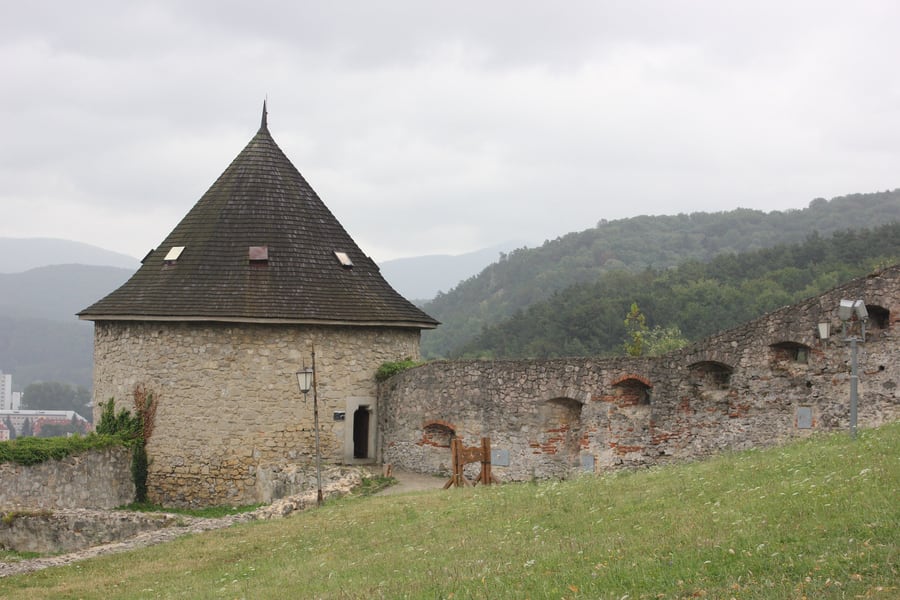
Trenčín Castle
Around 1300 the castle belonged to Matúš Čák, the "Lord of the Váh and the Tatras", whose keep still dominates the town. The Treaty of Trenčín between the kings of Bohemia, Hungary and Poland was concluded here in 1335. The well in the lower castle, some 80 metres deep, took the garrison 40 years to dig. The castle houses the Trenčín Museum.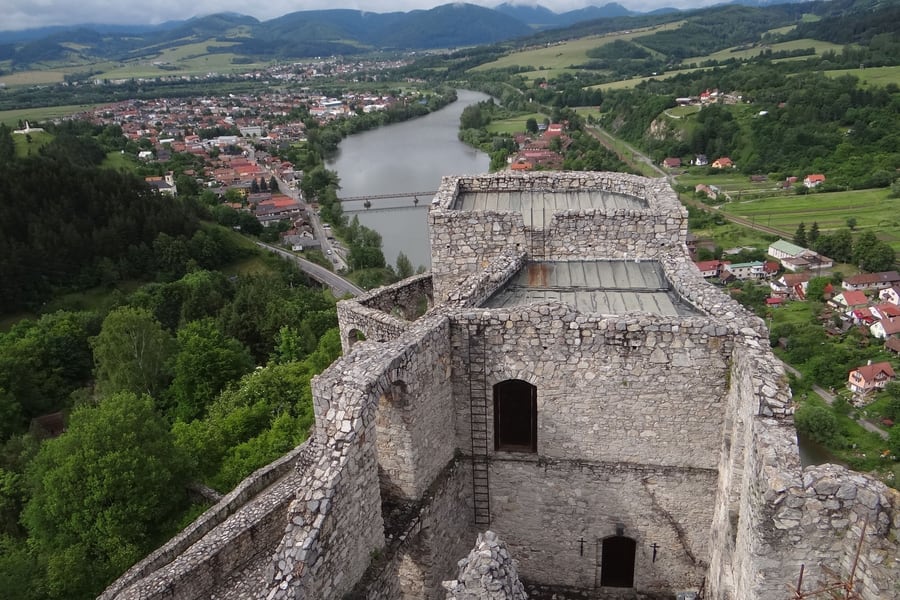 Jerzy Opioła / Wikimedia Commons · CC BY-SA 4.0 · cropped
Strečno Castle
The castle stands on a calcite cliff 103 metres above the Váh, at the mouth of the gorge the railway runs through. It is first mentioned in 1316, and in 1358 it collected a toll on the crossing of the river below. Reconstructed from its ruin, it now holds exhibitions of the Váh region museum, with the valley spread out below the walls.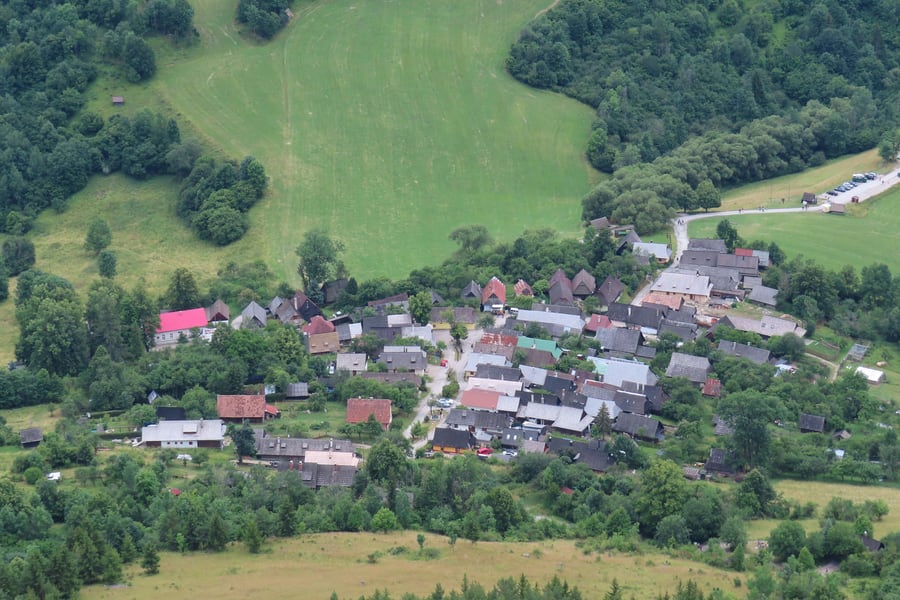 Fallaner / Wikimedia Commons · CC BY 4.0 · cropped
Vlkolínec
A village of more than 45 log houses in the hills above Ružomberok, first recorded in 1376 and a UNESCO World Heritage Site since 1993 as an untouched example of the folk architecture of the Northern Carpathians. An 18th-century wooden belfry and a baroque chapel survive, and two of the houses are a folk museum.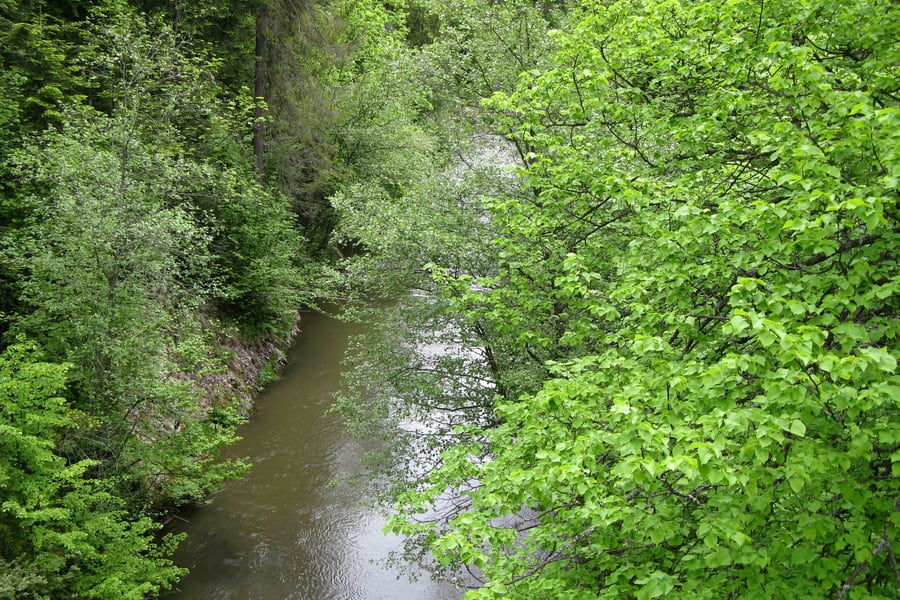 Margoz / Wikimedia Commons · CC BY-SA 4.0 · cropped
Slovak Paradise
A national park since 1988, run from Spišská Nová Ves: 197 square kilometres of gorges and plateaus in the north of the Slovak Ore Mountains, with about 300 kilometres of trails, many of them on ladders, chains and footbridges. The Hornád runs through it in a gorge of its own.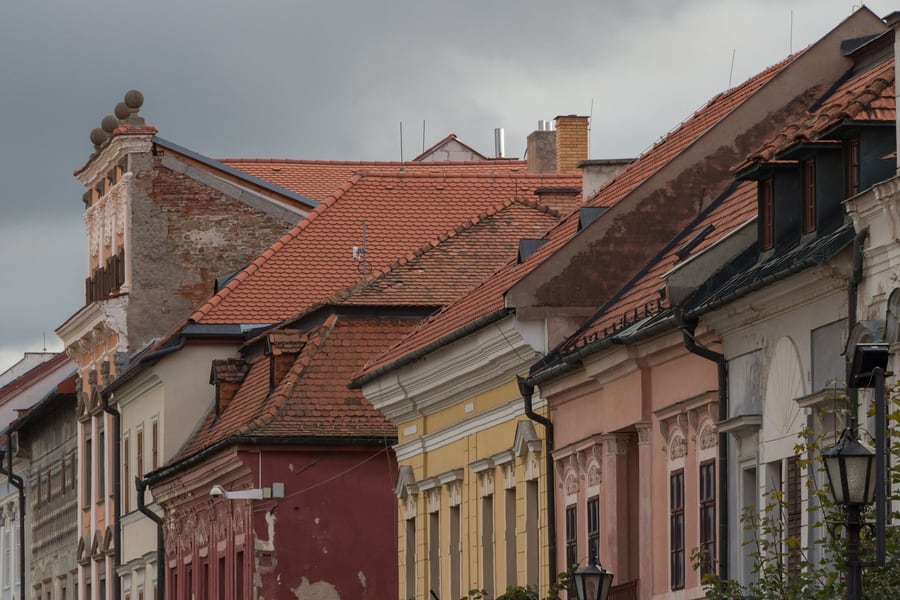 Michal Klajban / Wikimedia Commons · CC BY-SA 4.0 · cropped
Levoča
A town of Renaissance houses inside a well-preserved wall, at 628 metres in the Hornád basin. Its Gothic church holds the tallest wooden altar in the world, carved by Master Paul of Levoča. UNESCO added Levoča to its World Heritage List on 28 June 2009.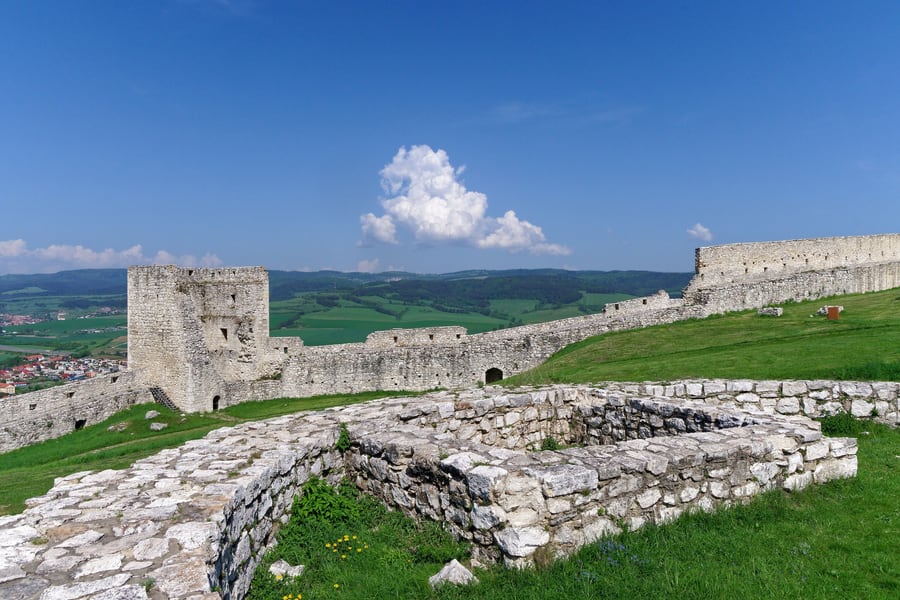 Jakub Hałun / Wikimedia Commons · CC BY-SA 4.0 · cropped
Spiš Castle
The ruins cover 3.9 hectares of a travertine hill above Spišské Podhradie and Žehra. First recorded in 1120, the castle was the seat of the Spiš county for centuries and passed through the Zápolya, Thurzó and Csáky families before the state took it in 1945. It has been a UNESCO site since 1993.Where to Sleep
The whole run takes under six hours, so most travellers do it in a day. To stop for the castles of the Váh, stay in Žilina, the junction where the two railways meet. To see Spiš and the Slovak Paradise, stay in Košice at the end of the line, or in Poprad or Spišská Nová Ves on the way.
Where to stay
Hotel Dubná Skala
Boutique hotel, central Žilina
Rooms and apartments, a restaurant and café, and a private relax centre in the middle of Žilina.
Check Availability (opens in a new tab, on hoteldubnaskala.sk)via hoteldubnaskala.skHotel Bankov
In the Bankov forest park, Košice
In Košice's green Bankov forest park, 4 km from the pedestrian zone on Hlavná, with a wellness centre and the Lujza restaurant.
Check Availability (opens in a new tab, on hotelbankov.sk)via hotelbankov.skQuestions or corrections
Planning this trip and stuck on something, or spotted a time, fare or detail that has changed? Send us a message about Bratislava to Košice. We read every one, and we update this page when something has changed.