Circum-Baikal Railway
Artem Svetlov / Wikimedia Commons · CC BY 2.0 · cropped
- Distance94 km
- Duration~4 h 30 min
- Best seasonYear-round
Introduction
Every great railway has a stretch that cost more than the rest. On the Trans-Siberian it was the last ninety-odd kilometres, along the southern shore of Lake Baikal, where the mountains come down into the deepest lake on earth and leave no room for a train. Engineers called the finished line the Golden Buckle of the Steel Belt of Russia — a buckle because it joined the two halves of a Trans-Siberian that Baikal had kept apart, and golden because of what it cost. A kilometre of main line between Chelyabinsk and Vladivostok came to about 93,000 roubles. A kilometre here came to roughly 130,000.
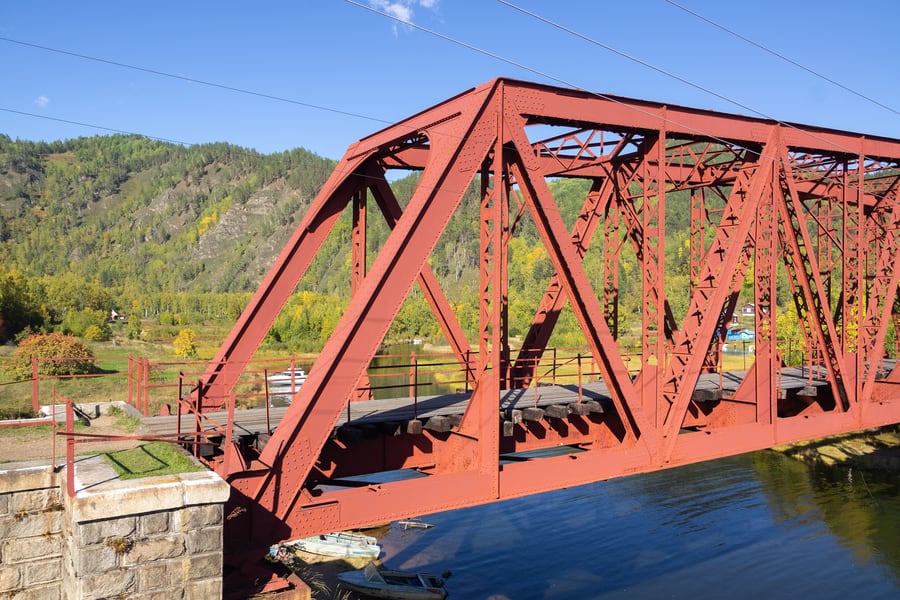
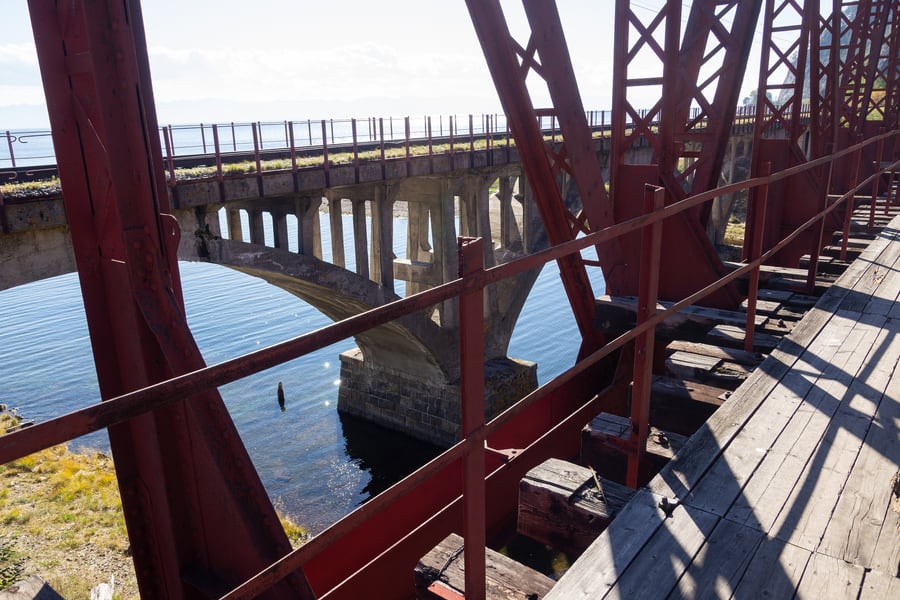
What they bought was a shelf blasted along the base of a cliff, and the densest concentration of railway engineering in Russia: 39 tunnels, seventeen free-standing galleries, some 280 retaining walls and around 470 bridges, viaducts and culverts, which works out at roughly one structure every hundred metres. Then, half a century later, the railway walked away from it. A new line was cut over the Olkha plateau and opened on 1 January 1949, and in 1956 the old approach from Irkutsk was lifted and drowned under the reservoir of a new hydroelectric dam. The Golden Buckle was left attached at one end only.
That is what makes it worth the day. This is the piece of the Trans-Siberian that the Trans-Siberian abandoned, and it is still open — not as a preserved museum line but as an ordinary local railway, with a handful of trains a week, tickets at the regional tariff, and villages along it that have no road. You board at Slyudyanka, on the working main line, and four and a half hours later you stop at a buffer beam at Port Baikal, facing the water that swallowed the rest.
The Journey
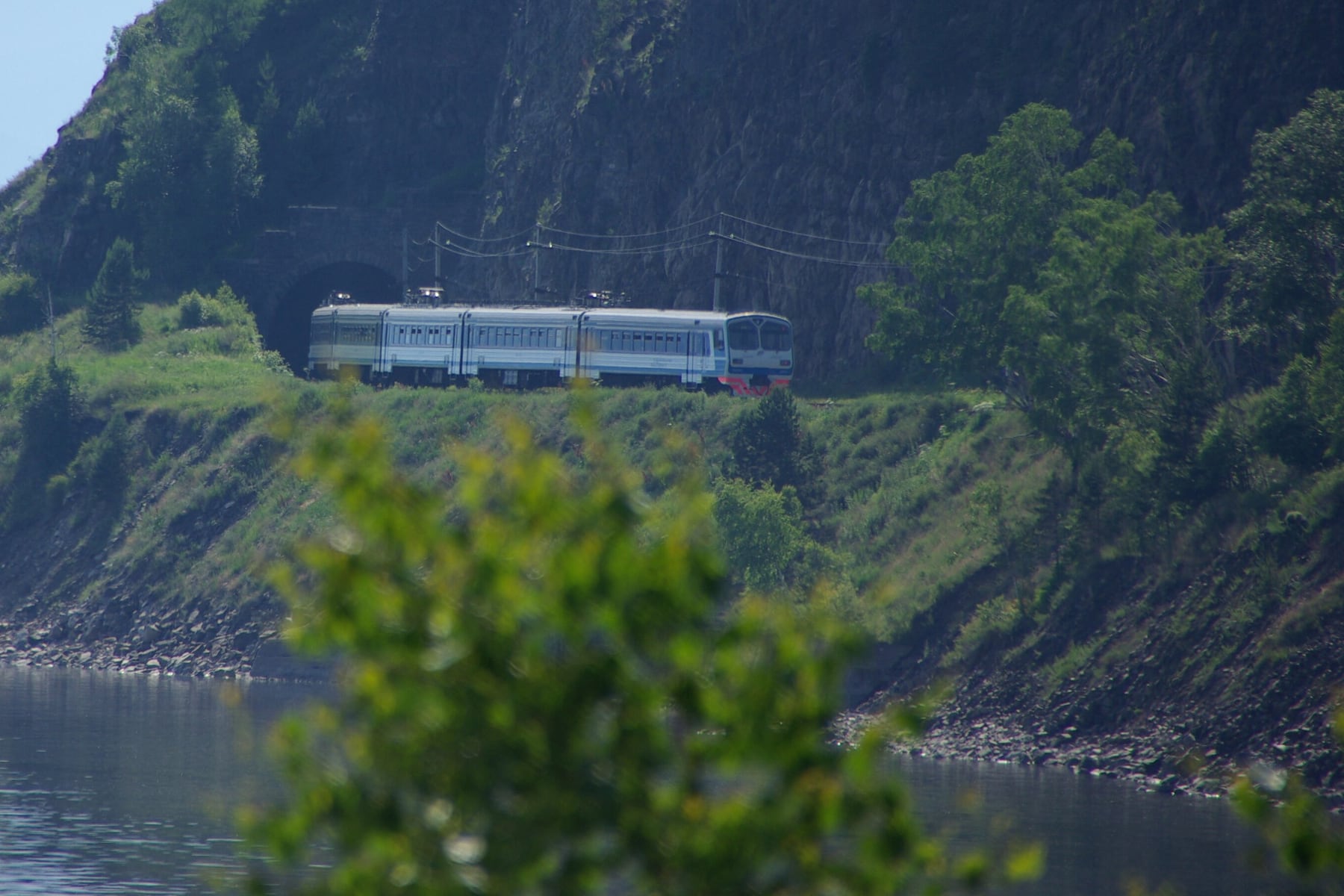
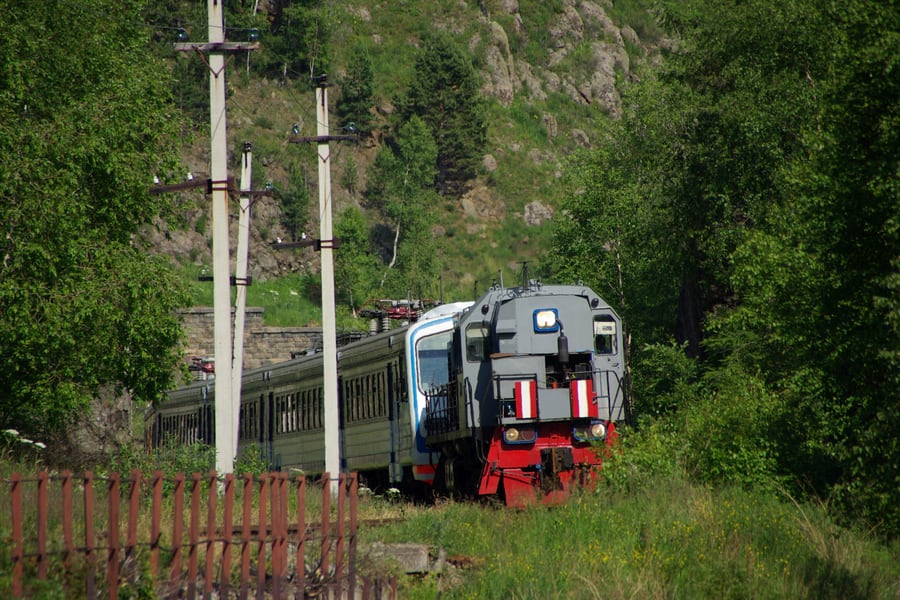
The train leaves Slyudyanka I and, for a few minutes, behaves like part of the main line — climbing away west with the Trans-Siberian's wires overhead and freight standing in the loops. Then the wires stop. From Kultuk onward nothing is electrified, and everything that runs here runs behind a diesel; the excursion sets are electric units towed with their pantographs folded, which is a small absurdity you will notice in every photograph of this railway.
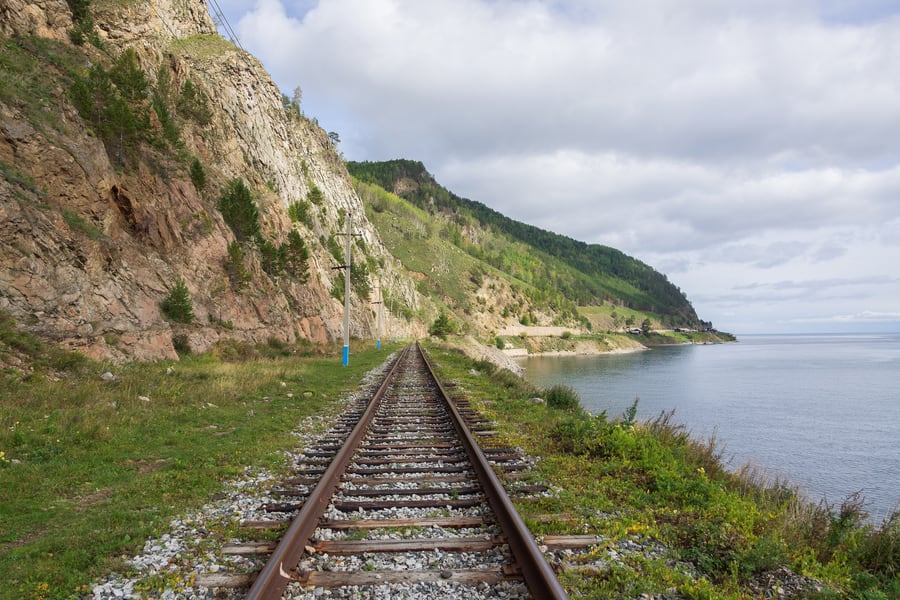
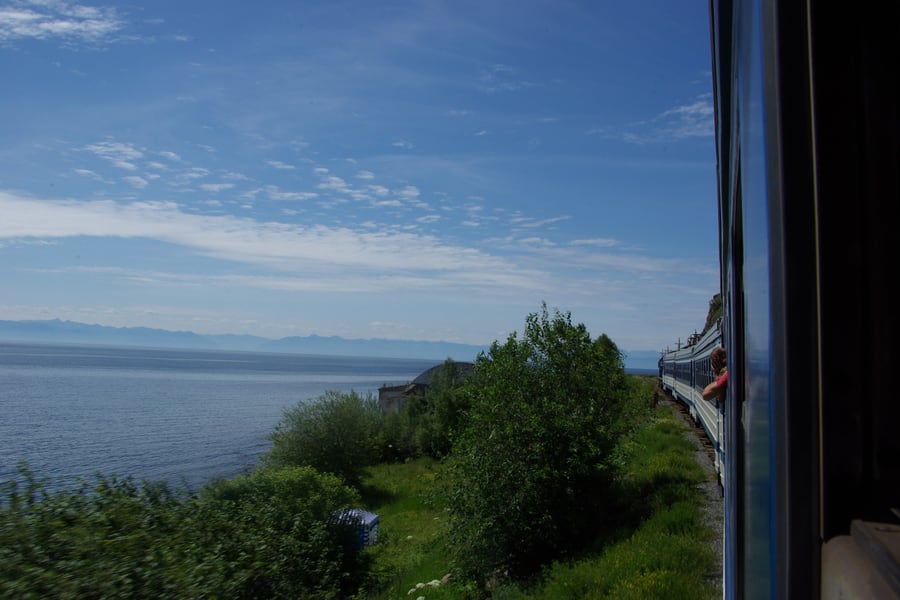
From Kultuk the line drops to the water and turns north-west, and the character never changes again. On the right there is rock; on the left there is Baikal, close enough that in calm weather the carriage windows catch the reflection of the cliff. Speed settles to 20–25 km/h. The stopping places are not villages so much as kilometre posts with names — 149 km Staraya Angasolka, 129 km Baklan, 123 km Kirkirey, 120 km Rechka Marituyka, 110 km Polovinnaya, 107 km Ponomaryovka, 102 km Shumikha, 98 km Khvoynaya — and the numbers count down towards Port Baikal because they are the original mileage of a main line that no longer exists.
The engineering, seen from the window
The tunnels come in bursts. There are 39 of them along 8,994 metres of bore, and the longest, Polovinny, runs 778 metres straight through a headland at the midpoint of the line. Where the cliff was too loose to tunnel and too steep to cut, the builders roofed the track instead: stone galleries open on the lake side, so that the train runs through a colonnade with the water flashing between the piers. Between them are the viaducts — steel spans on masonry arches, most of them over streams that arrive off the mountain in a few violent weeks each spring.
It is worth knowing what you are looking at. Almost all of it is original, because the line was double-tracked as a main route and then, when the traffic left, one road was lifted and taken away for use elsewhere. The wide, grassy formation beside the single running line at places like Marituy is not neglect. It is the space where the other track used to be.
What the ride is actually like
Slow, and not luxurious. The ordinary services are suburban trains — bench seats, no catering, no electrical sockets — and they exist to serve people who live along a shore with no road. The excursion trains that run from Irkutsk are a different proposition: first and second class saloons, a guide on the public address, monitors showing the driver's-eye view, and stops long enough to walk to a portal and back. Both take the same line at the same speed past the same cliffs.
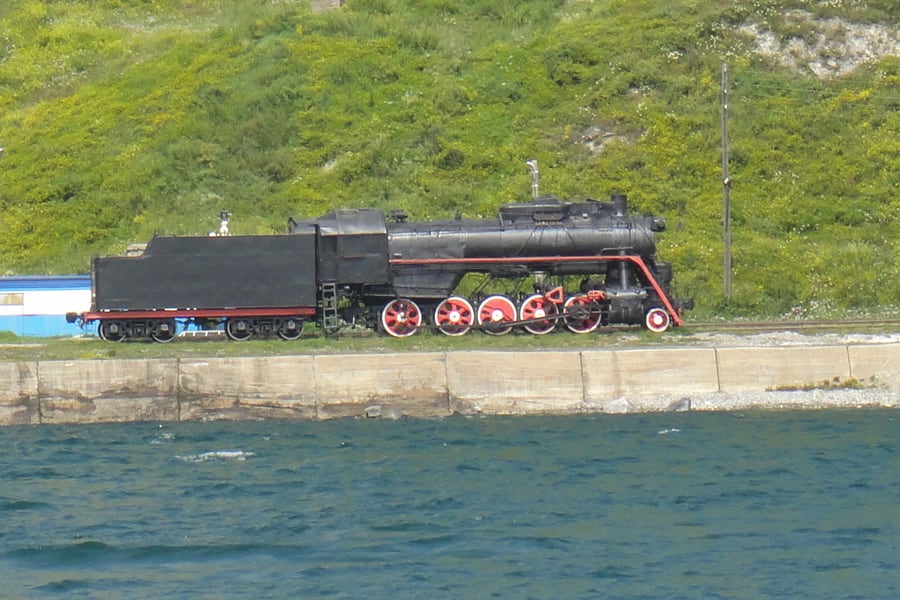
The last stretch runs out onto the flat at the mouth of the Angara, and the line ends. Port Baikal is a village of wooden houses, a locomotive on a plinth, and rails running down to a quay where the train ferries once loaded. Across the water, twenty minutes by boat, is Listvyanka. There is no way onward by rail, and that is the point of the place.
Along the route
 Алексей Задонский / Wikimedia Commons · CC BY-SA 4.0 · cropped
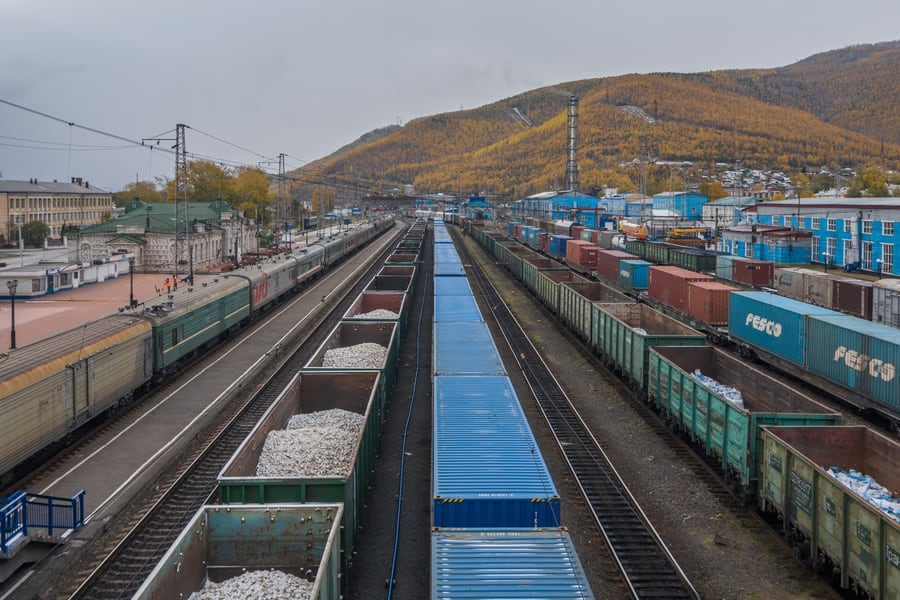
Slyudyanka, where the branch begins
Every ride starts here, on the working Trans-Siberian. Container trains and ballast hoppers roll through while the little Baikal service waits in a bay platform — a reminder that the main line went somewhere else, and that this is now the quiet way out.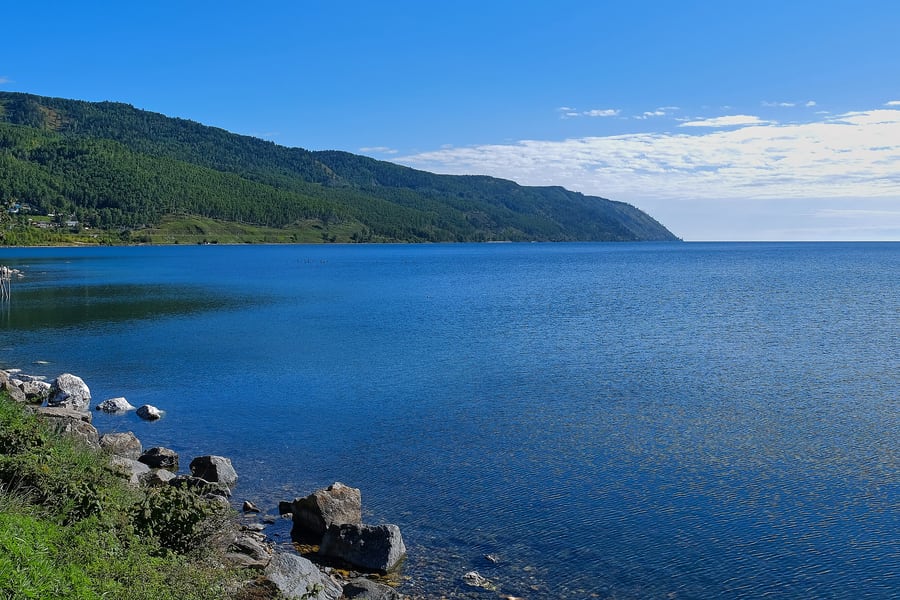 Vyacheslav Bukharov / Wikimedia Commons · CC BY-SA 4.0 · cropped
Kultuk and the turn to the west
At the lake's south-western tip the train swings north and the water opens out. Kultuk is where the historic 84 km of protected railway formally begins, and where the gradient finally lets go of the mountains and settles onto the shore.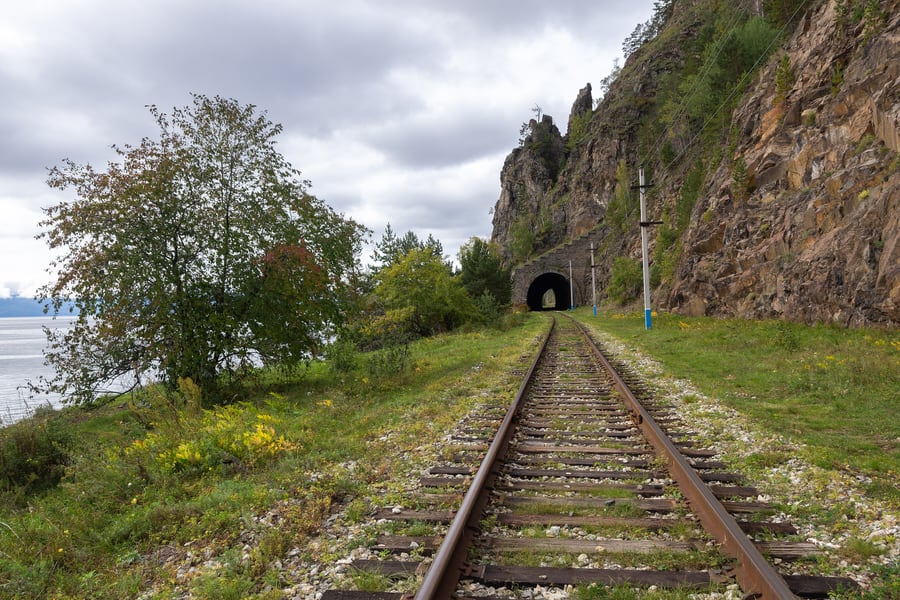 Vyacheslav Argenberg / Wikimedia Commons · CC BY 4.0 · cropped
Polovinnaya, the longest tunnel
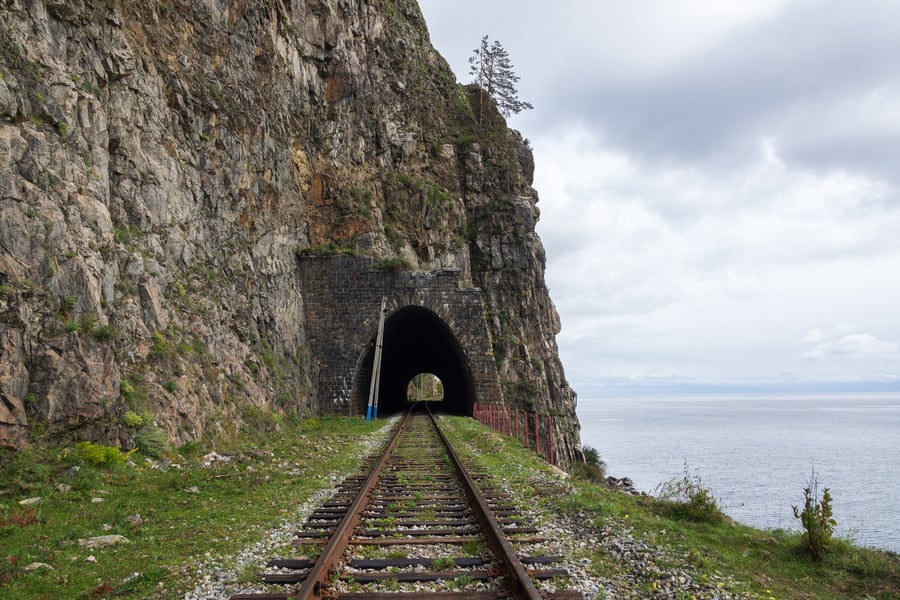
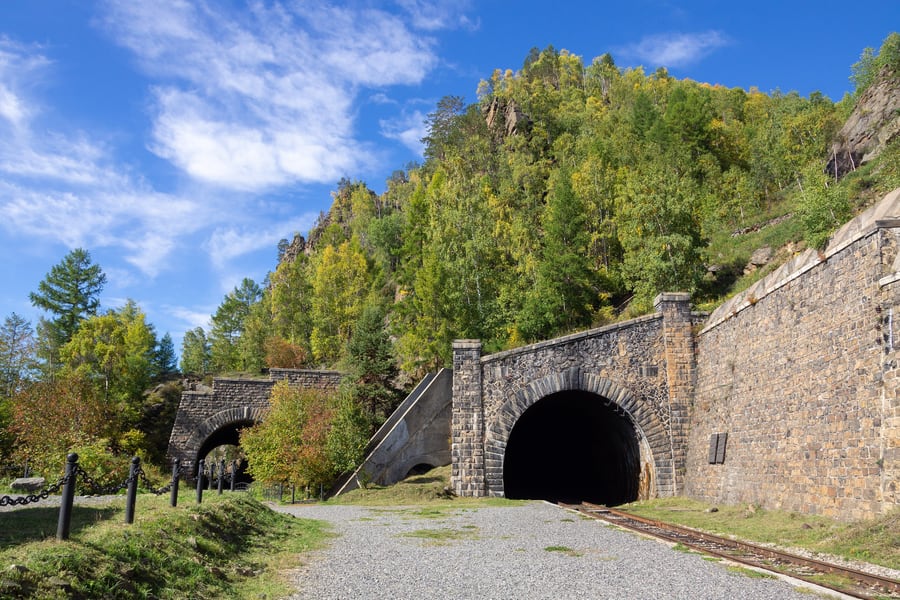
Roughly halfway, the Polovinny tunnel runs 778 metres through the headland — the longest on the line. Trains dawdle at 20–25 km/h here, and the excursion services stop long enough to walk to the portal and back.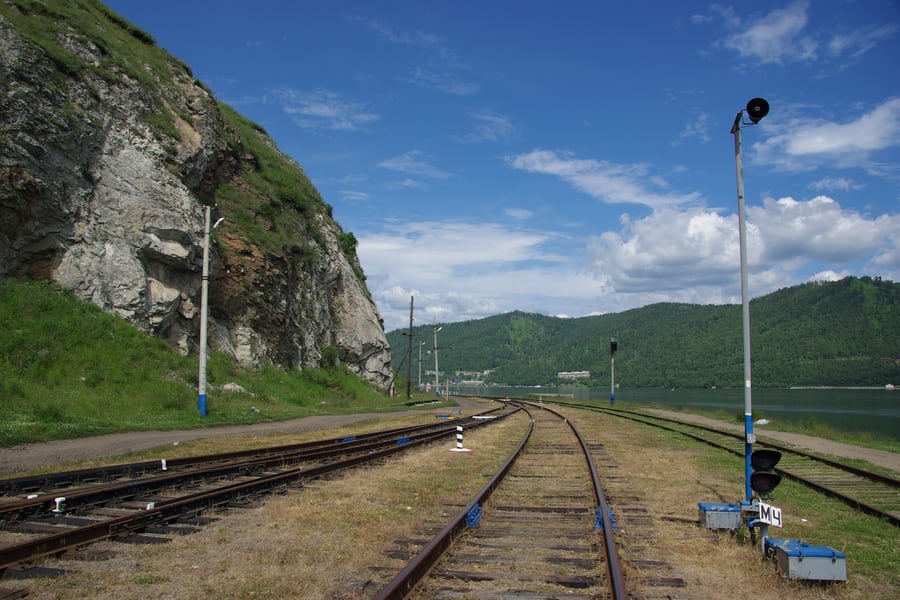 Artem Svetlov / Wikimedia Commons · CC BY 2.0 · cropped
Port Baikal, the buffer stop
The line simply ends at the Angara's mouth, facing the water that swallowed its continuation in 1956. Rails run down to a quay where the train ferries once loaded, and a small boat takes foot passengers across to Listvyanka.A bit of history
Culture & experiences along the way
 Brücke-Osteuropa / Wikimedia Commons · Public domain · cropped
The ship the railway put out of work
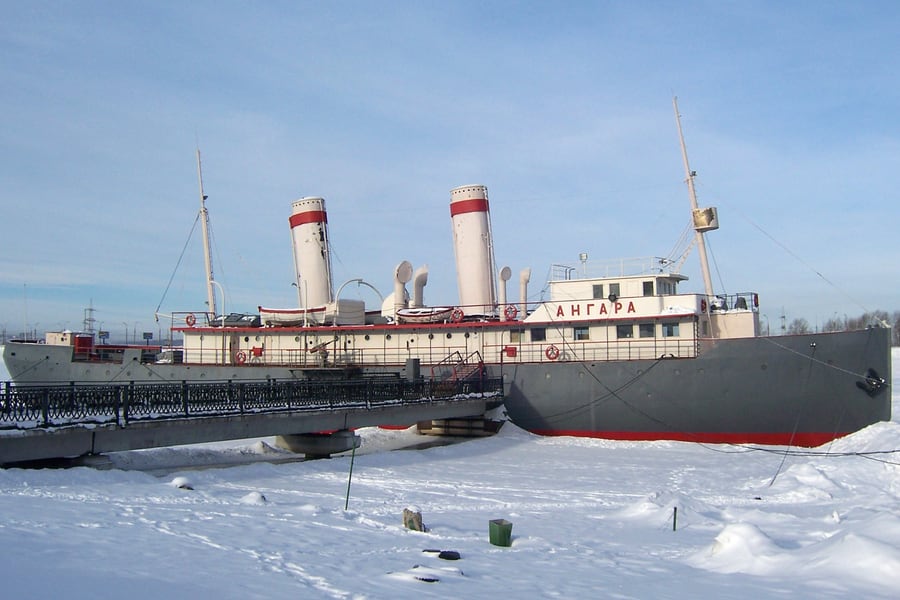
Before this line opened, trains crossed Baikal by ferry. One of the ships survives: the Angara, built by Armstrong Whitworth at Newcastle-upon-Tyne, shipped east in pieces and first floated here on 25 July 1900. She worked Port Baikal to Mysovaya twice a day until the railway took the traffic in 1905, and has been a museum at Irkutsk since 1991.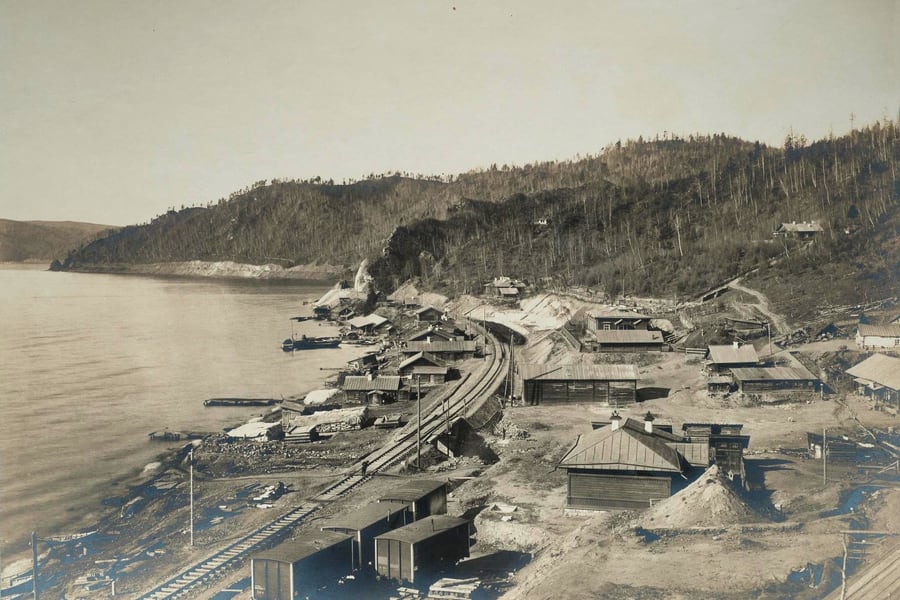 Unknown photographer / Wikimedia Commons · Public domain · cropped
How the Golden Buckle was cut
The construction album of 1900–04 shows what the figures mean: a settlement of timber sheds on a raw shore, a single track threading through, and rock being taken out by hand and blasting powder. The whole shore road was built in two years and three months. Alexander Klink / Wikimedia Commons · CC BY 4.0 · cropped
Smoked omul on the platform
Omul is Baikal's own whitefish, hot-smoked to a deep gold and sold wrapped in paper at the halts and quaysides. Eat it warm, with bread, standing up. It is the single most Baikal thing you can do between two tunnels.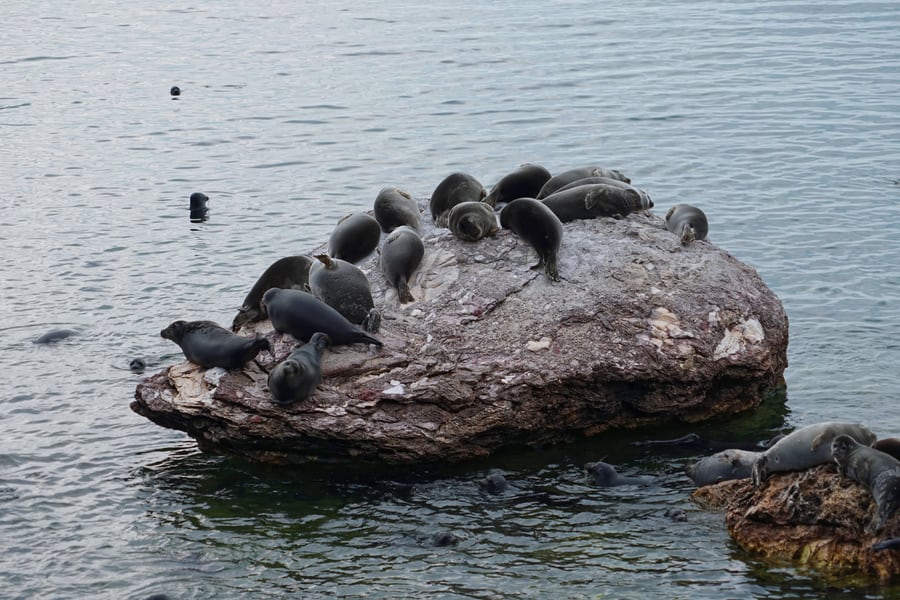 Sergio Tittarini / Wikimedia Commons · CC BY 2.0 · cropped
Watching for nerpa
The nerpa is the only seal that lives in fresh water, and it lives only here. From the train you are unlikely to see one; from the shore at a long stop, with the lake flat, you might spot a dark head. Bring binoculars and low expectations.Timetables
Two named local trains work the line, both run by the Baikal Suburban Passenger Company (BPPK): the Nerpochka ("little seal", trains 6801/6802) and the Baikal Wind (Baikalsky Veter, trains 6201–6204). Between them they give one or two round trips a day — and nothing at all on Wednesdays, when the line closes.
All times are Irkutsk time (MSK+5), as of September 2026.
Slyudyanka I → Port Baikal
| Train | Name | Departs | Arrives | Days |
|---|---|---|---|---|
| 6801 | Nerpochka | 09:55 | 14:26 | Daily except Wednesday |
| 6201 | Baikal Wind | 14:45 | 19:45 | Mon, Thu, Fri, Sun |
| 6203 | Baikal Wind | 14:45 | 19:45 | Saturday |
Port Baikal → Slyudyanka I
| Train | Name | Departs | Arrives | Days |
|---|---|---|---|---|
| 6202 | Baikal Wind | 03:08 | 07:33 | Mon, Tue, Fri, Sat |
| 6204 | Baikal Wind | 09:47 | 14:58 | Sunday |
| 6802 | Nerpochka | 15:19 | 19:53 | Daily except Wednesday |
The Nerpochka is the useful one: out in the morning, back in the afternoon, and it runs six days a week. Doing the line as a day trip on the Baikal Wind is not really possible in one direction — the return working leaves Port Baikal at 03:08 — so the westbound Baikal Wind is for people staying the night at the far end, at Port Baikal or at one of the trackside bases at Sharyzhalgay, Khvoynaya and Shumikha, all of which need booking in advance.
The line is open for independent travel all year, and the operator says so explicitly; winter services run to the same pattern. Excursion trains from Irkutsk keep their own calendar and are sold separately — see Tickets.
⚠️ Check before you travel. These are lightly used rural services and the pattern is revised seasonally. The live board is on the operator's own site: irkppk.ru (opens in a new tab).
Tickets
There are two ways to ride, and they cost very different amounts. The local trains charge the ordinary suburban fare, set by the Irkutsk Oblast tariff service rather than by the railway, and revised each January; tickets are sold in the RZD Passengers app, at self-service terminals and at suburban booking offices across Irkutsk Oblast and Buryatia. There is no reservation and no allocated seat.
The alternative is a guided excursion train from Irkutsk, sold by the line's named tour operator, which includes commentary, walking stops at the tunnels and the boat back across the Angara. It runs year-round — an electric set in summer, a railbus in winter and late autumn — and costs from ₽7,500 for the day.
⚠️ The railway crosses Pribaikalsky National Park, and a permit is required to be there. Tour prices normally include it; if you travel independently, arrange it yourself before you go.
Book your tickets
Suburban ticket
The ordinary fare, Slyudyanka ↔ Port Baikal
The everyday way to ride: a regional-tariff ticket on the Nerpochka or the Baikal Wind, bought in the RZD Passengers app, at a self-service terminal or at a suburban ticket office.
Book Tickets (opens in a new tab, on irkppk.ru)via irkppk.ruOne-day excursion train
Irkutsk – Slyudyanka – Port Baikal, year-round
The guided run on a tourist train, with commentary, walking stops at the tunnels and a crossing back to Listvyanka by boat.
Book Experience (opens in a new tab, on baikaltrain.ru)via baikaltrain.ru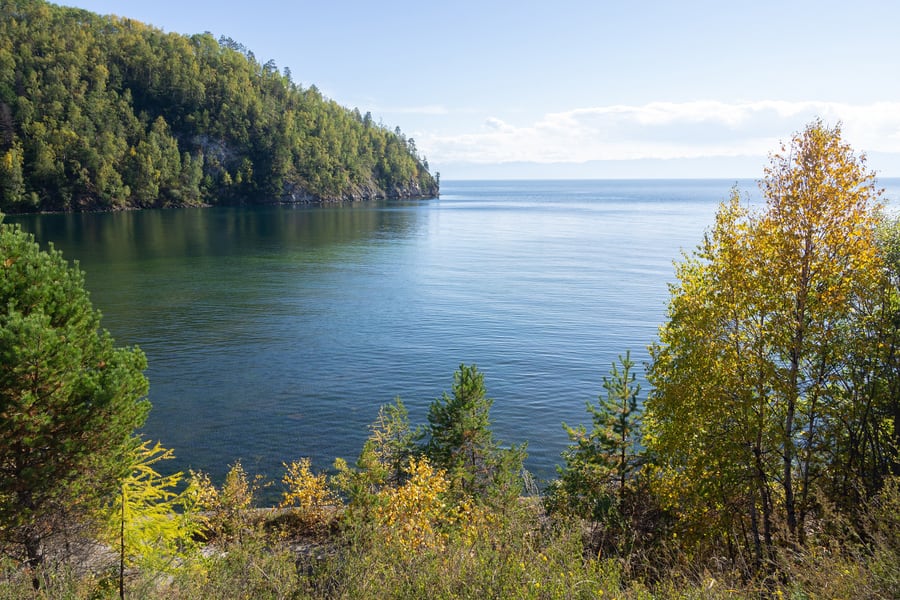
Two-day trip with a night on the lake
2 days / 1 night
The same line at a slower pace, with an overnight stay on the shore instead of the late return to Irkutsk.
Book Experience (opens in a new tab, on baikaltrain.ru)via baikaltrain.ruRail Passes
No rail pass covers this line, and none is worth buying for it. Interrail and Eurail do not extend to Russia at all, so the European passes are simply not in play.
Nor would a pass help if one existed. The Circum-Baikal is worked as an ordinary suburban service at a regionally regulated tariff — the cheapest kind of ticket Russian Railways sells, bought on the day in an app or at a window, with no reservation to make and no supplement to pay. There is no first-class option on the local trains to upgrade into.
The one thing worth pre-arranging is not a ticket at all. The line lies inside Pribaikalsky National Park, and visitors need a permit from the park authority; a guided excursion normally includes it, while independent travellers should obtain it before setting out.
Checked September 2026.
Places to Visit
The line is the attraction, and most of what there is to see stands beside the track: portals, galleries, viaducts and the halts that serve villages with no road to them. The stops below run west to east in the order the kilometre posts count them, from Port Baikal at 72 km to Slyudyanka at the far end — which is the opposite of the way most people ride, so read them backwards if you are coming from Slyudyanka.
Two practical notes. The whole railway sits inside Pribaikalsky National Park, so a permit is needed to be here at all, and camping is confined to marked places. And the halts are halts: there is no shop at most of them, no shelter worth the name, and the next train may be a day away. Whatever you get off to see, work out first how you are getting back on.
 SJabberwocky / Wikimedia Commons · CC BY-SA 4.0 · cropped
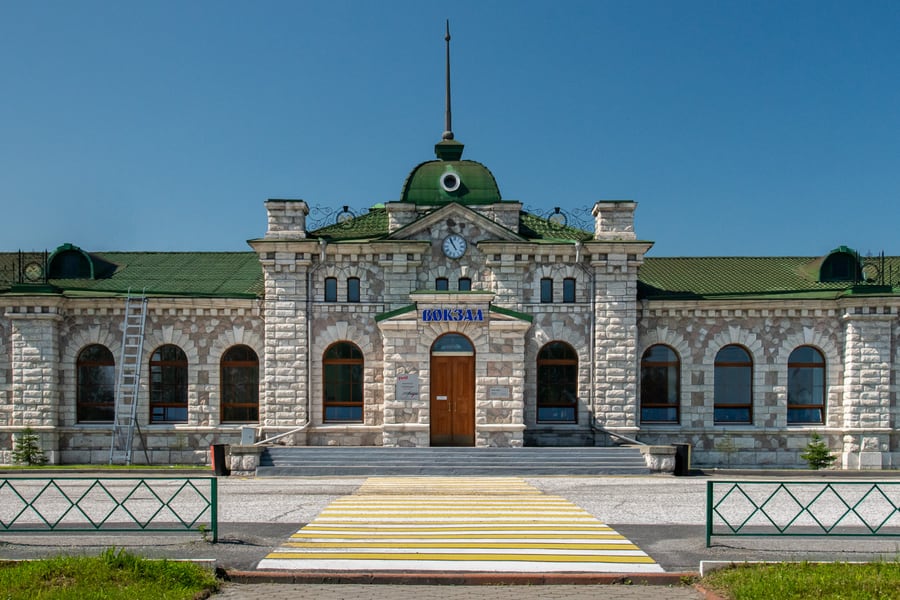
Slyudyanka's marble station
The building you wait in is the reason many people photograph Slyudyanka at all. Begun on 23 May 1903 and finished in 1904, it is faced entirely in unpolished white and pink marble quarried in the hills behind the town, and Russian sources call it the only station in the country built that way. It is single-storey, low and unshowy, and the stone has weathered to the colour of old bone.Vyacheslav Argenberg / Wikimedia Commons · CC BY 4.0 · croppedPolovinnaya Bay
The halt at 110 km sits on a shallow bay with a beach of grey shingle, and it is where most trains pause longest. The Polovinny tunnel, at 778 metres the longest on the line, opens at one end of it; a smaller bore and a steel bridge sit at the other, so the two ends of the bay show you both ways the builders got past a headland. The name means "halfway", which is exactly where you are. If you only get off once, get off here.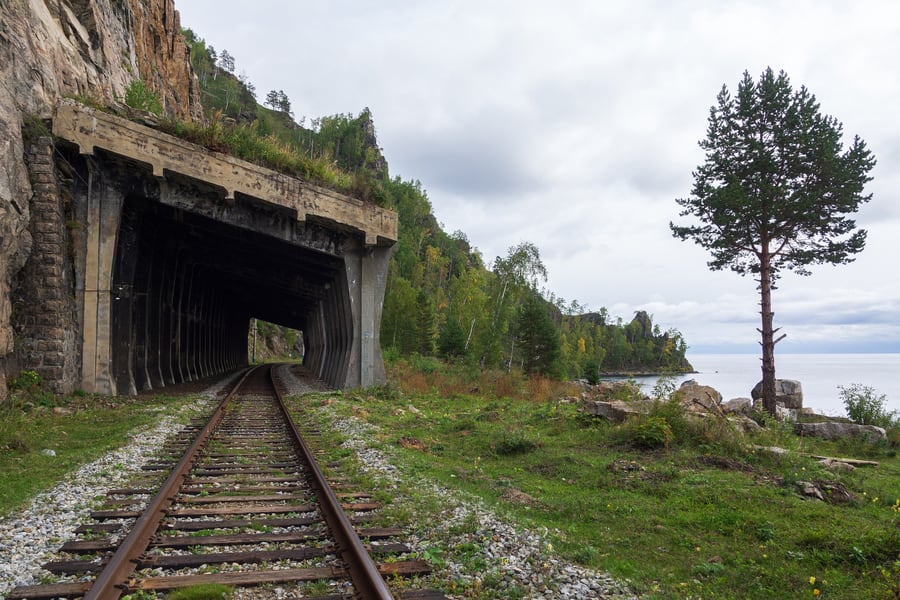 Vyacheslav Argenberg / Wikimedia Commons · CC BY 4.0 · cropped
The galleries at Cape Stolby
Where the cliff sheds rock onto the track, the builders roofed the railway instead of moving it — stone galleries, open on the lake side, that work as tunnels with a view. There are 17 free-standing galleries on the line among some 280 retaining walls, and the group at Stolby is the easiest to see properly from the ground.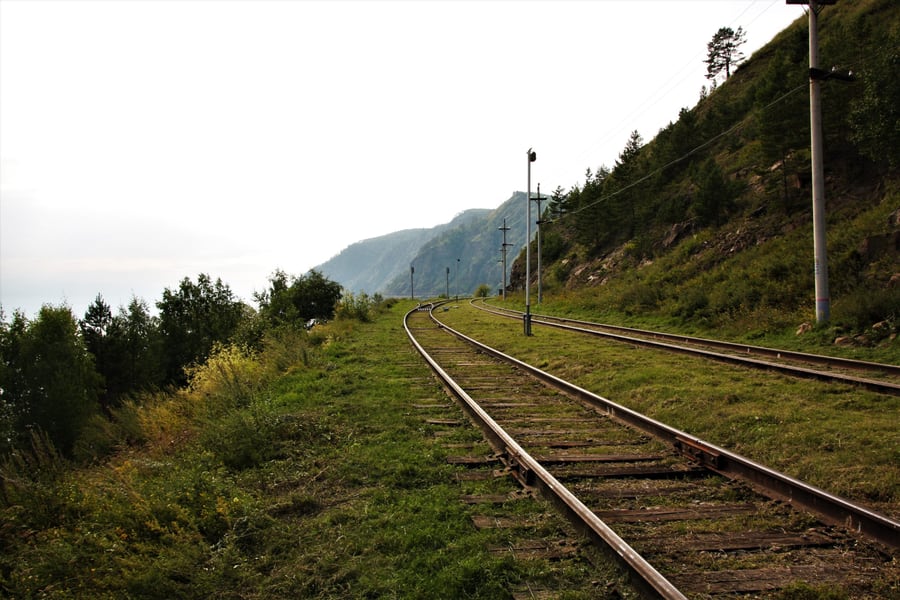 Daria Smolyarova / Wikimedia Commons · CC BY-SA 4.0 · cropped
Marituy
A scatter of houses and a passing loop in the grass, Marituy was a construction camp that never quite became a village. The double track through it is a leftover: this was a two-track main line until the through trains went away, and the second road was lifted for use elsewhere. What is left is a wide, empty formation full of wildflowers.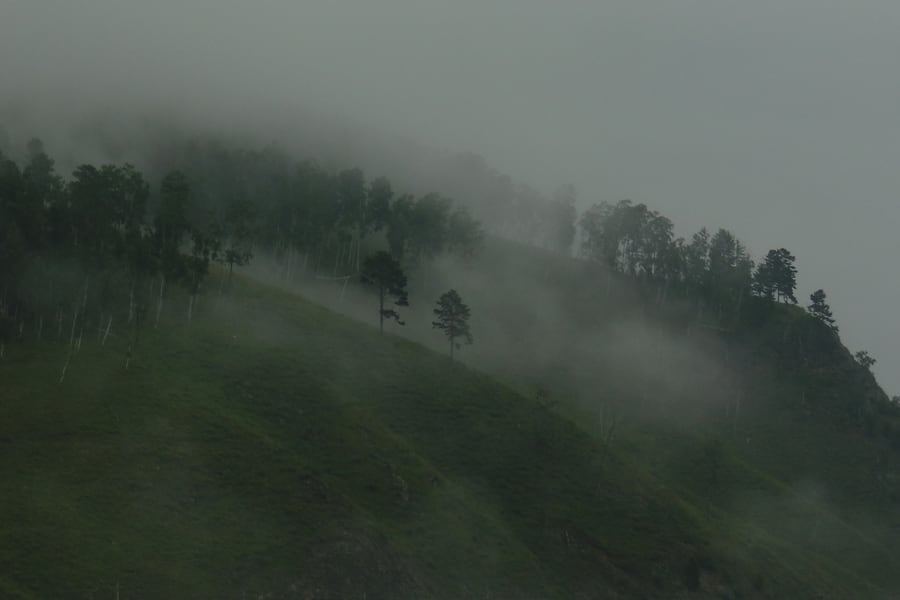 Anton Tokarev / Wikimedia Commons · CC BY 4.0 · cropped
Staraya Angasolka
A village at the Kultuk end reached by rail or on foot, and now almost empty — the photographer who took this picture recorded that only a few permanent residents remain. Morning fog comes off the water and sits in the trees above the track. There is a footbridge, a chapel and very little else, which is the appeal.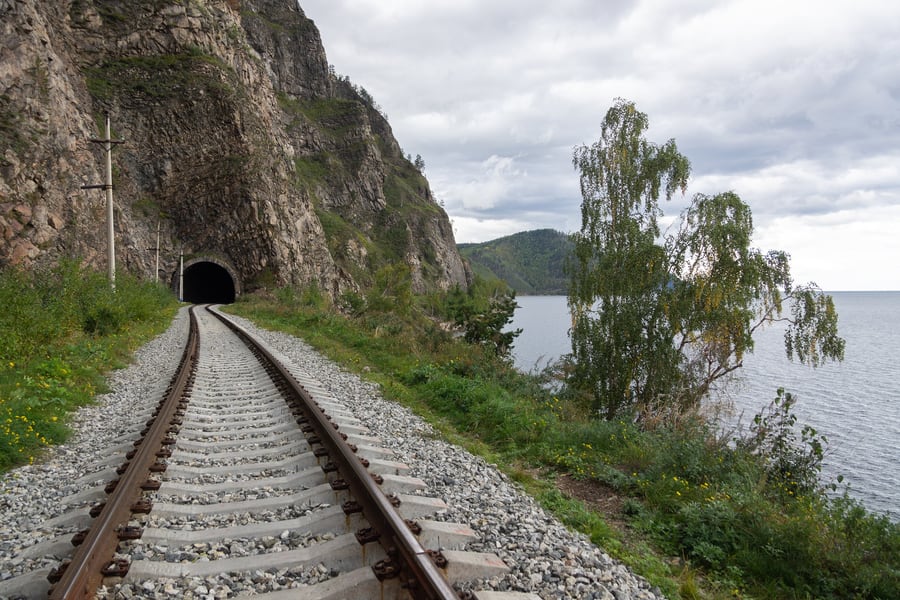 Vyacheslav Argenberg / Wikimedia Commons · CC BY 4.0 · cropped
The Khabartuy tunnels
Cape Khabartuy carries two bores, the longer of them 548 metres, driven where the rock comes straight down into deep water. The approach is one of the few places you can stand on the trackbed with the lake immediately below you and the portal immediately ahead, which is how the whole line felt to build.Where to Sleep
Where you sleep depends on which end you finish at. Most people ride out from Irkutsk and come back the same night, in which case the city is the answer and there is plenty of it. If you take the afternoon Baikal Wind, though, you are committed to a night at the far end, because the return working leaves Port Baikal at 03:08.
At that end the natural base is Listvyanka, twenty minutes across the mouth of the Angara by boat from Port Baikal and the closest thing to a resort on this shore. The two hotels below are there, both on their own sites.
There is also lodging on the railway itself. The operator lists holiday bases at Sharyzhalgay (139 km), Khvoynaya (98 km, at Ulanovo), Shumikha and Port Baikal — the Sharyzhalgay one partly made up of old railway carriages parked by the water. All of them take advance bookings only, none has a website we can safely point you at, and none is reachable except by train or on foot. Arrange them through the tour operator or by telephone before you travel, and do not turn up hoping.
Where to stay
Krestovaya Pad
Listvyanka, above the lake
A hotel and Siberian restaurant on the hillside at Listvyanka, across the water from the end of the line.
Check Availability (opens in a new tab, on krestovayapad.ru)via krestovayapad.ruMayak
Listvyanka, on the waterfront
The larger of Listvyanka's two long-standing hotels, on the shore road with a panoramic bar looking out over Baikal.
Check Availability (opens in a new tab, on mayakhotel.ru)via mayakhotel.ruQuestions or corrections
Planning this trip and stuck on something, or spotted a time, fare or detail that has changed? Send us a message about Circum-Baikal Railway. We read every one, and we update this page when something has changed.