The Coast Line
Cha973 / Wikimedia Commons · CC BY-SA 4.0 · 2026 · cropped
- Distance157 km
- Duration3 hr 02 min
- Best seasonFour expresses daily, two each way · commuter trains all day
Introduction
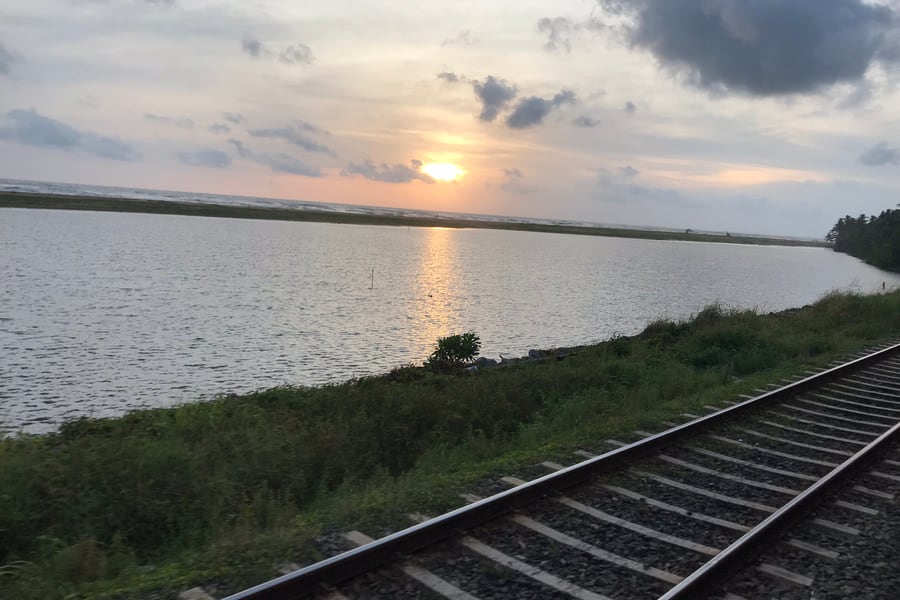
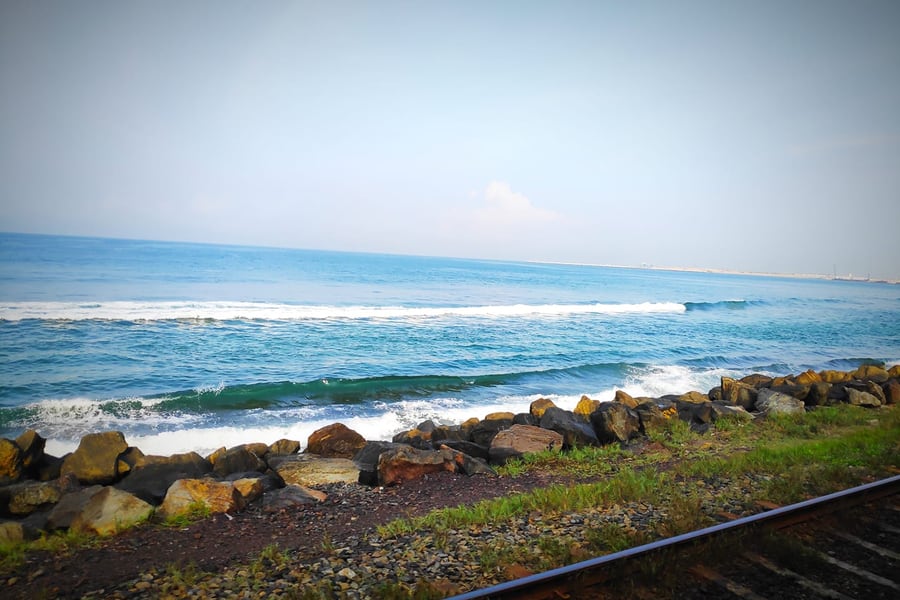
Sri Lanka's other great railway does not climb anything. The Coast Line leaves Colombo Fort, turns south at the edge of the city and then simply follows the water for a hundred and fifty-seven kilometres to Matara, close enough for long stretches that the rock armour holding the sea off the island is the same embankment the track is laid on. It opened in pieces between 1877 and 1895, built to serve the coconut plantations of the south-west, and it now carries some of the busiest services on the network.
It is also the line that carries the island's heaviest memory. On the morning of 26 December 2004 the Indian Ocean tsunami struck a crowded train at Peraliya, just north of Hikkaduwa. At least nine hundred bodies were recovered and the death toll is usually put well above a thousand, which makes it the largest railway disaster there has ever been. Trains run past the spot every day.
Nothing here is preserved or curated. It is a working railway with third-class carriages, open doorways and, often enough, a Canadian locomotive of the 1950s on the front, and the sea is simply where it happens to run.
The Journey
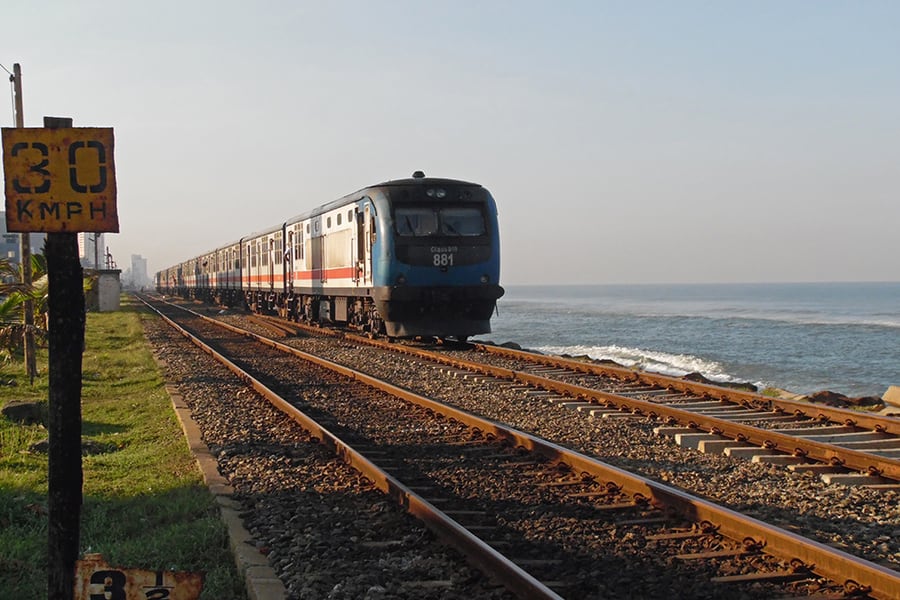
Colombo Fort is the centre of the whole network and it behaves like it: a riveted train shed, boards in three scripts, and departures for every line on the island. The Coast Line leaves from the seaward side and is out of the city almost before it has started. Secretariat Halt is 666 metres from the buffers, Kompanna Vidiya 1.7 kilometres, and by Kollupitiya at 3.1 the track has run out of land on the left-hand side and is sitting on the shore.
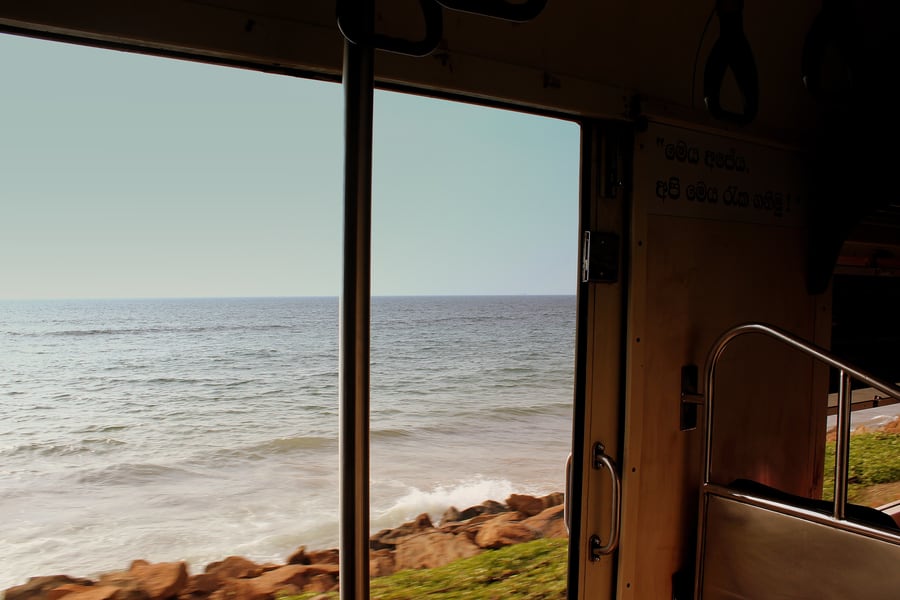
That is the first thing to know about this railway. For nine kilometres, from Kollupitiya through Bambalapitiya and Wellawatte to Mount Lavinia, the line is the sea defence: granite rock armour below the rail on one side, the Galle Road on the other, and Colombo's beaches, cricket games and fishing boats in between. The carriage doors stay open and people ride in them, which is most of why the stretch has the reputation it has.
Out of the suburbs
South of Mount Lavinia the coast opens out and the stations come at two- and three-kilometre intervals, most of them a single-storey block under a tiled canopy with the nameboard in Sinhala, Tamil and English. Moratuwa is 19 kilometres out, Panadura 26 — a pink-washed station with an arcaded front — and at Kalutara, 42 kilometres, the line crosses the Kalu Ganga, the black river, on the last of the wide western estuaries.
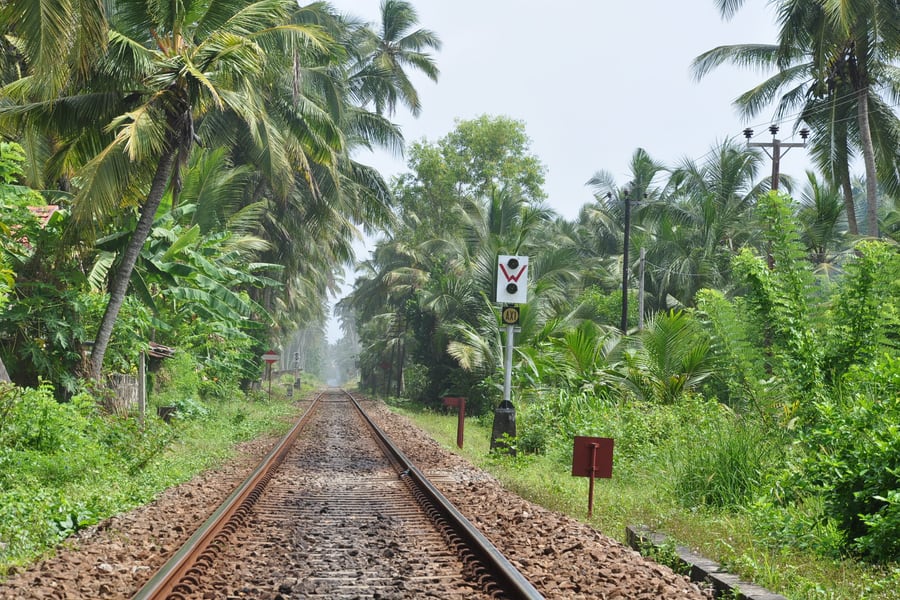
Then comes coconut. From Wadduwa to Ambalangoda the railway runs through the plantations it was built to serve, close enough to the water that the palms lean. Aluthgama at 60 kilometres is the busiest intermediate stop on the northern half, with a long island platform; Bentota is 1.3 kilometres further on across the Bentota Ganga, and the two towns share a river mouth and a coast full of hotels between them. Kosgoda, at 71, has the turtle hatchery.
Peraliya
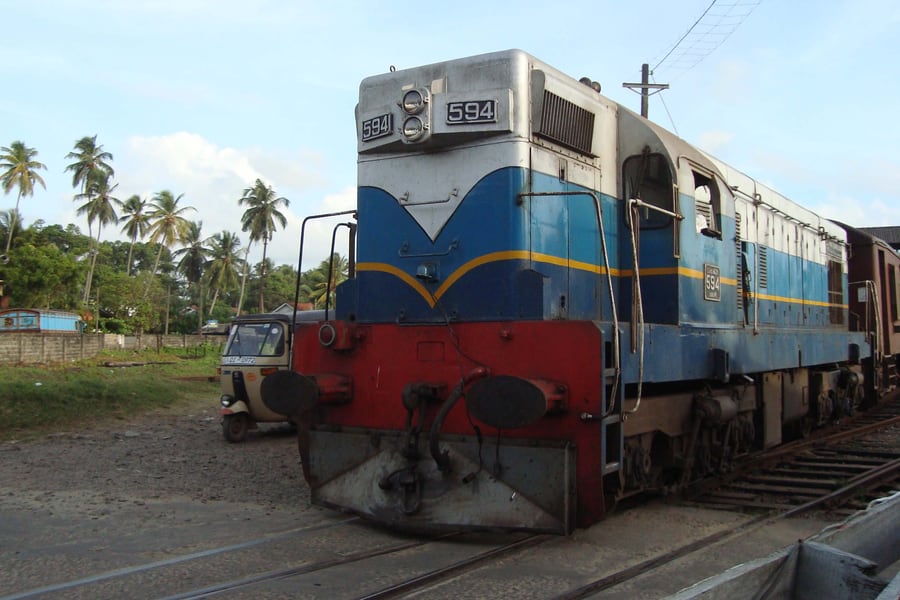
At Telwatte, 92 kilometres from Colombo, the line runs a few hundred metres inland behind a strip of houses. On the morning of 26 December 2004 the ocean came over that strip and took the train with it. Train No. 50, the Matara Express, eight carriages, was standing at the village of Peraliya at about half past nine when the wave reached it; the carriages were rolled off the track and driven into the houses, and the locomotive — class M2 No. 591, Manitoba — was carried a hundred metres and left in a swamp. At least nine hundred bodies were recovered and the toll is generally put well above a thousand. It remains the worst railway disaster in the world.
A thirty-metre standing Buddha given by Japan now stands at the site, and there is nothing at all from the railway's side: the train does not slow, and most passengers pass it without knowing. The locomotive was recovered and rebuilt, and Manitoba is still at work on the island seventy years after its class first arrived.
Galle, and the turn east
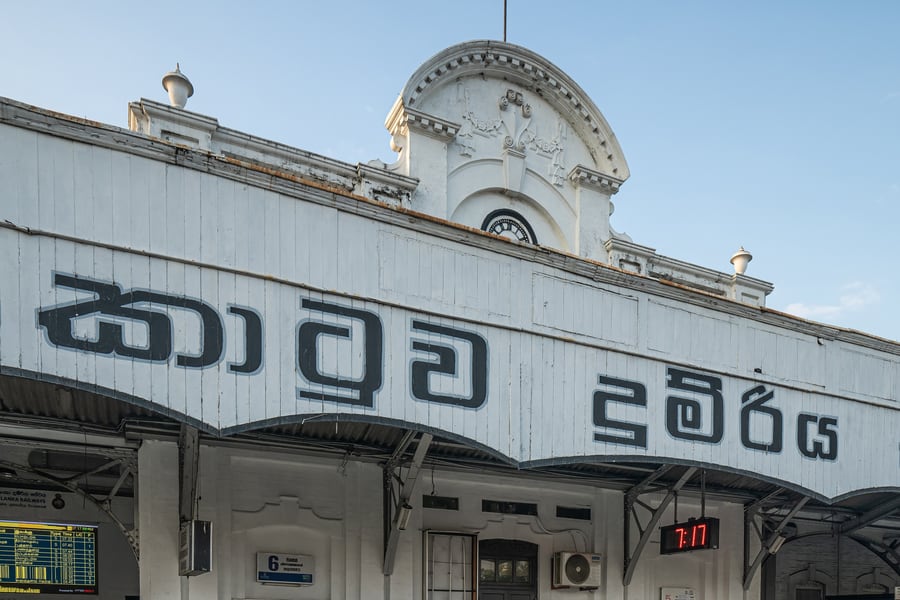
Galle is 113.88 kilometres from Colombo Fort and is where the ride changes character. The station stands just outside the ramparts of the Dutch fort that UNESCO inscribed in 1988 as the best example of a fortified city built by Europeans in South and South-East Asia, and a good half of the train gets off for it. Beyond Galle the line swings east along the underside of the island, and the sea moves from the right-hand window to the left.
The last forty-three kilometres are the best of it. Unawatuna, Habaraduwa and Koggala are strung along a shore of small headlands and bays; at Koggala the runway of what was, in the Second World War, the largest flying-boat base in the eastern world runs beside the track. Weligama at 143 kilometres has Taprobane Island just offshore, and Mirissa at 148 is where the whale boats go out. Matara, 156.8 kilometres from Colombo, is a low terminus with a deep canopy and a Dutch star fort a few streets away — and since 2019 it has not quite been the end of the line, because a new 26.75-kilometre railway carries on inland to Beliatta and two of the four expresses run through to it.
What runs, and what pulls it
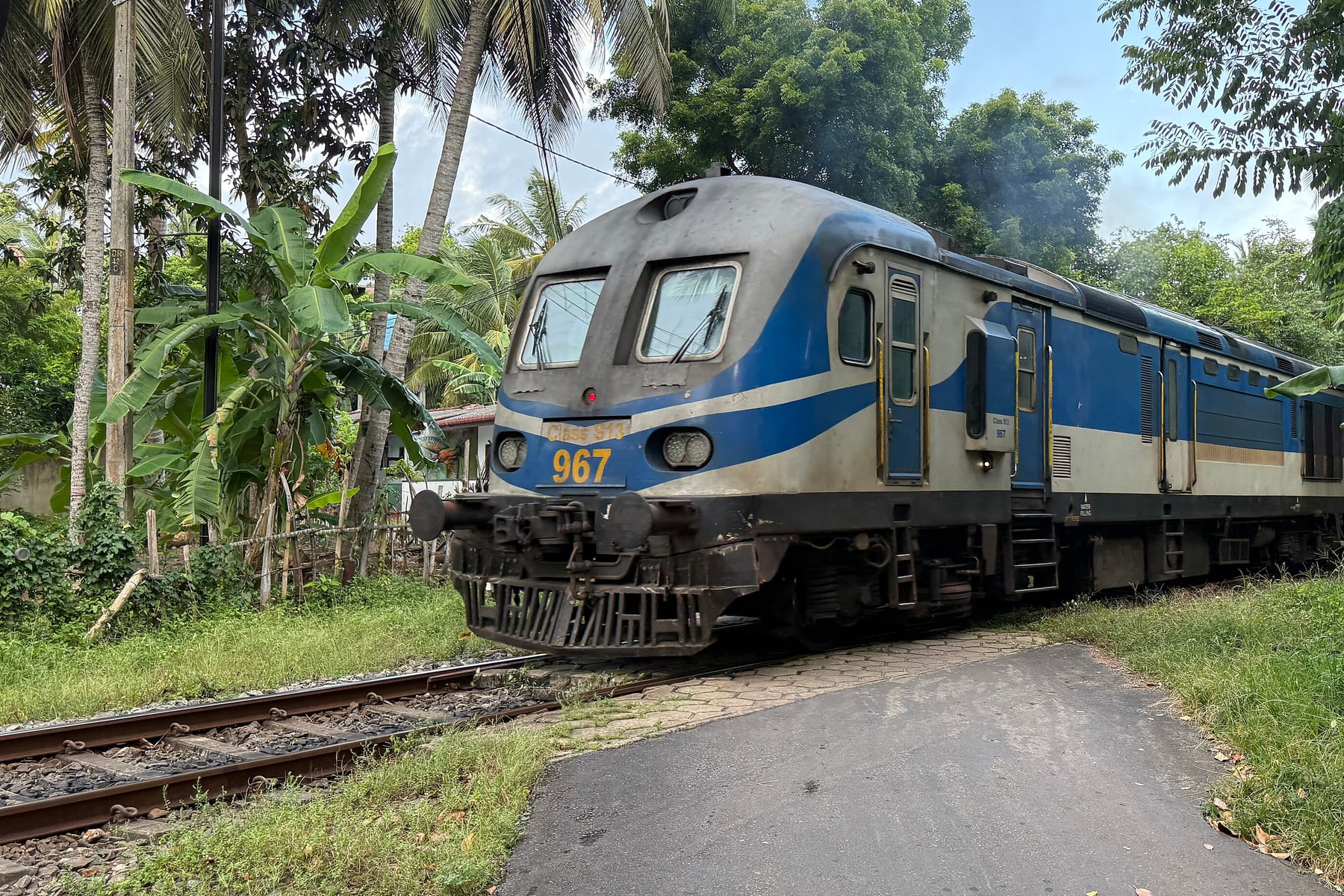
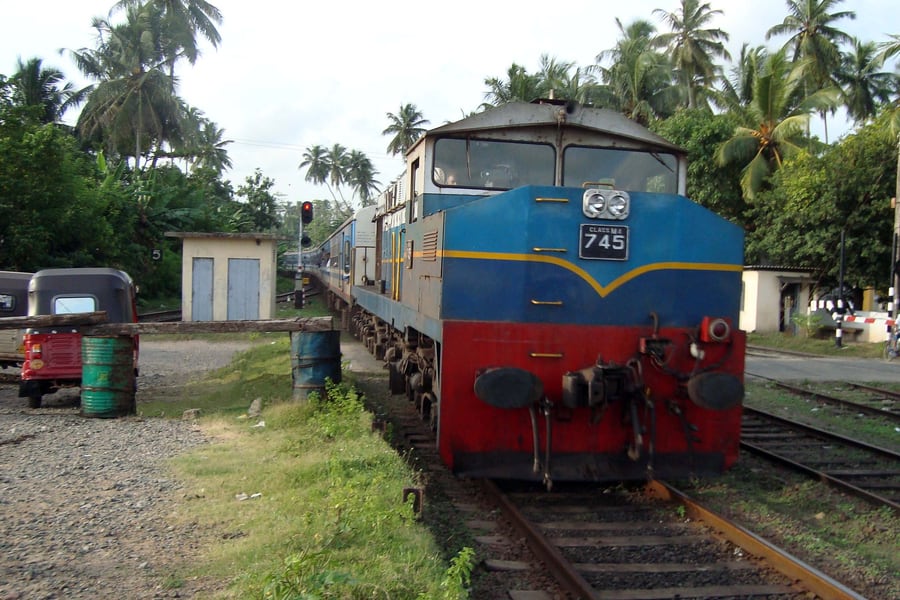
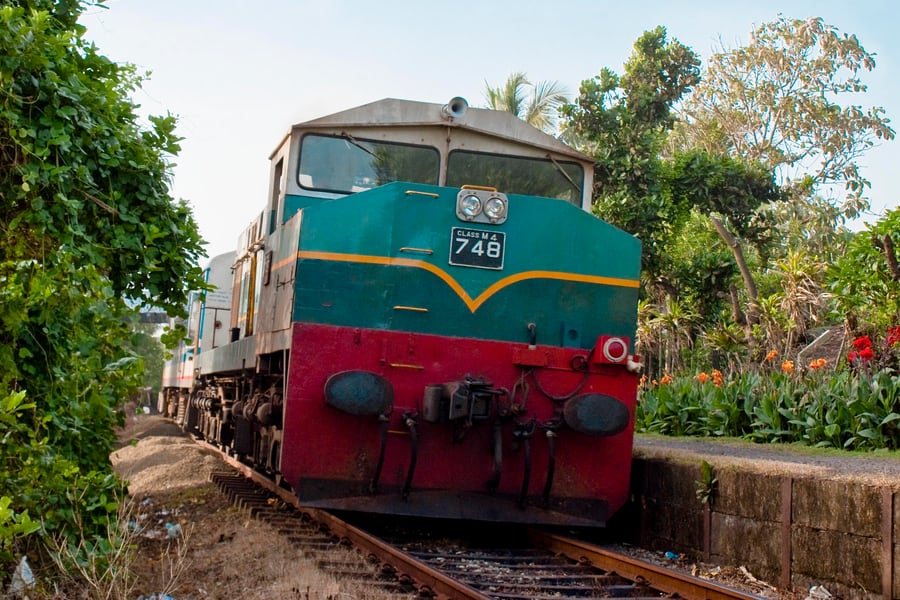
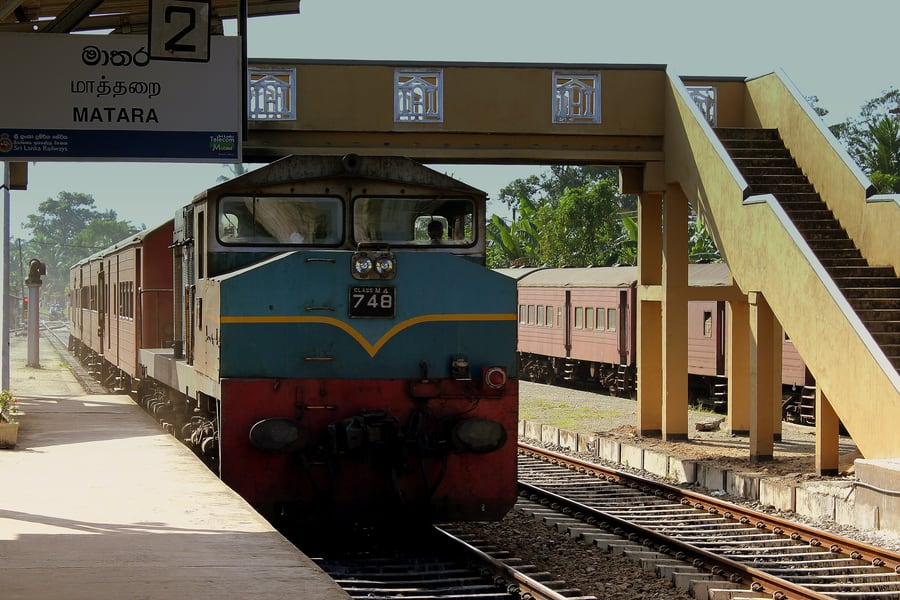
The fast trains have names. 8059 is the Ruhunu Kumari and 8057 the Galu Kumari, with the Sagarika working 8097 up from Beliatta. What is on the front varies more than the names do. The loco-hauled sets run behind a class M4, an MLW–Alco–Bombardier machine in blue, yellow and red, many of them carrying a name on the nose — 745 is Ruwanveli, 748 Walawe. The multiple units are class S11, twenty sets built by the Integral Coach Factory at Chennai in 2011 and 2012 and put straight onto this line, and the Chinese-built class S13.
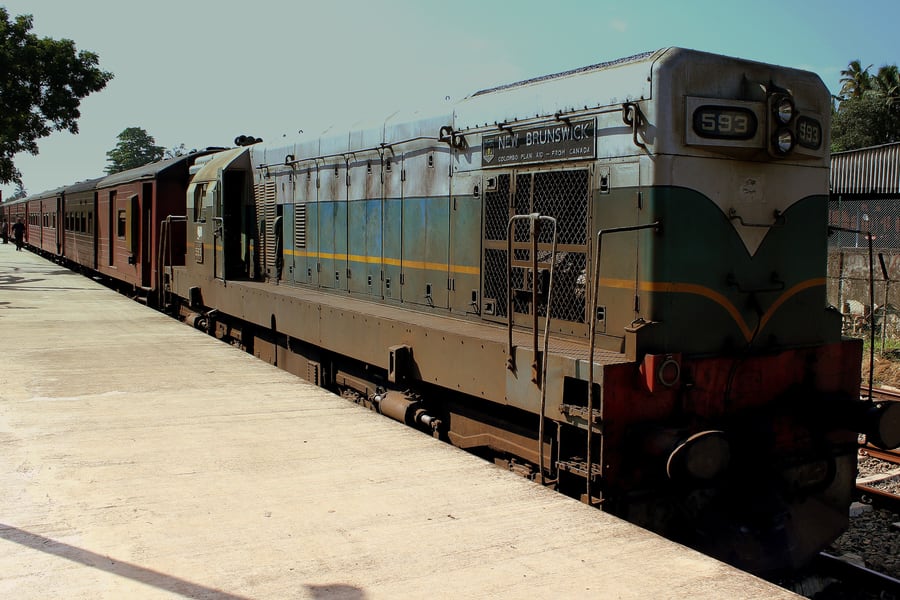
The oldest thing on the coast is the class M2. Fourteen EMD G12s were delivered between 1954 and 1966, twelve of them from General Motors Diesel in Canada, and they were named for Canadian provinces and cities — Manitoba, Alberta, Prince Edward Island, Newfoundland — all except the last two, 628 and 629, which were called Kankesanthurai and Galle after the Sri Lankan cement towns they were bought to serve. Thirteen of the fourteen are still running. Look at the nose of one standing at Galle and the plate under the number reads NEW BRUNSWICK, and under that, Colombo Plan Aid — from Canada.
Along the route
 Hafiz Issadeen / Flickr · CC BY 2.0 · 2008 · cropped
The locomotives are Canadian
Fourteen EMD G12s came to Ceylon between 1954 and 1966, twelve of them built by General Motors Diesel in Canada, and they were named for Canadian provinces and cities. Thirteen of the fourteen are still running, seventy years on, and most of their work is here.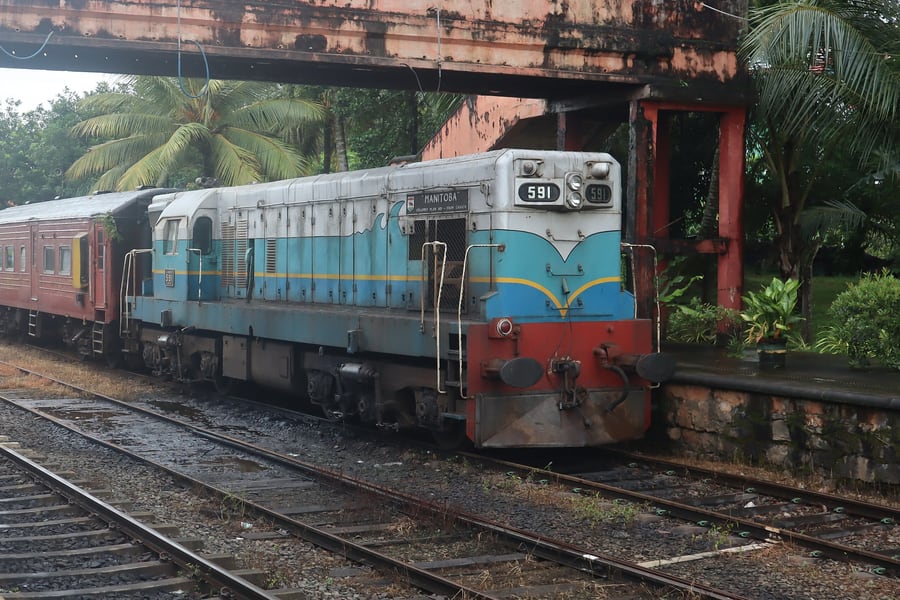 Isira Direckz / Wikimedia Commons · CC BY-SA 4.0 · 2024 · cropped
The one that the wave carried away
No. 591 Manitoba was on the front of the Matara Express at Peraliya on 26 December 2004 and was rolled a hundred metres into a swamp. It was dug out, rebuilt and returned to traffic, and it is still earning its keep on the island twenty years later.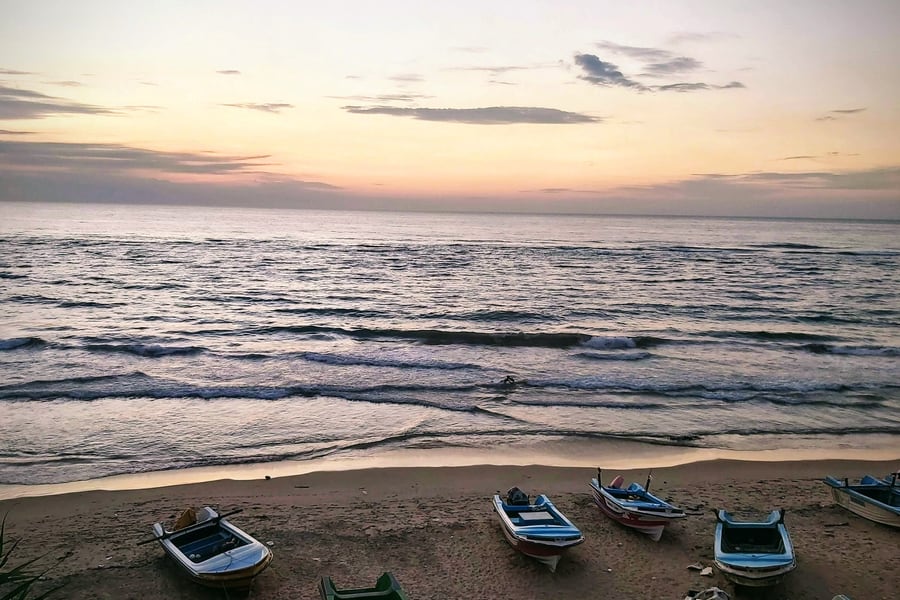 Yakoob Nowfer / Wikimedia Commons · CC BY-SA 4.0 · 2019 · cropped
Nine kilometres of sea defence
From Kollupitiya to Mount Lavinia there is no land left. The railway sits on the granite armour that holds the ocean off Colombo, the Galle Road runs behind it, and the beach in between is where the city spends its evenings.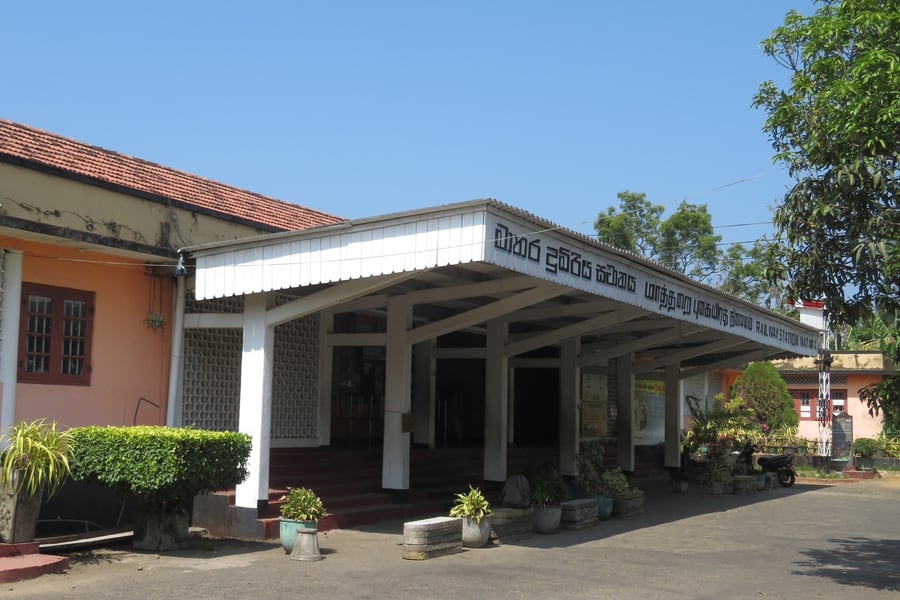 Torbenbrinker / Wikimedia Commons · CC BY-SA 4.0 · 2024 · cropped
Matara is not quite the end
On 8 April 2019 the railway opened 26.75 kilometres of new line inland from Matara to Beliatta — four stations and two halts, the first stage of a planned route to Kataragama. Two of the four expresses run straight through.A bit of history
Culture & experiences along the way
 calflier001 / Wikimedia Commons · CC BY-SA 2.0 · 2013 · cropped
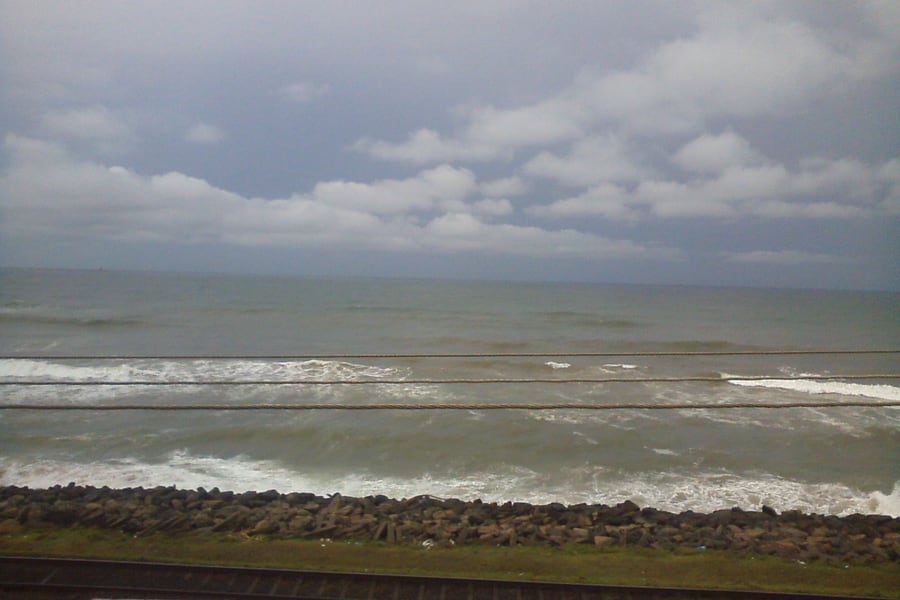
The doors stay open
Sri Lankan carriage doors are not locked and nobody expects them to be, which on this line makes the doorway the best place on the train: a hand on the rail and the surf going past a couple of metres below. Between Kollupitiya and Mount Lavinia there is nothing at all between the step and the water.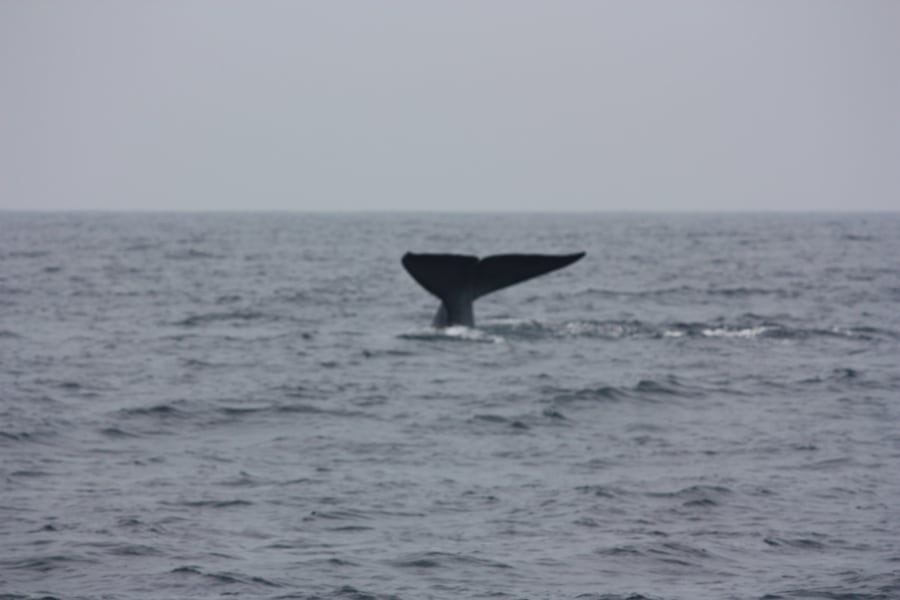 Arian Zwegers / Wikimedia Commons · CC BY 2.0 · 2010 · cropped
Whales off Mirissa
Deep water comes close to the island's southern tip, and the boats go out of Mirissa harbour at first light to find it. Blue whales and sperm whales are both seen off this coast, and the animals are usually a few miles out rather than a few hundred. Mirissa station is 147.6 kilometres from Colombo Fort and the harbour is a short walk from it.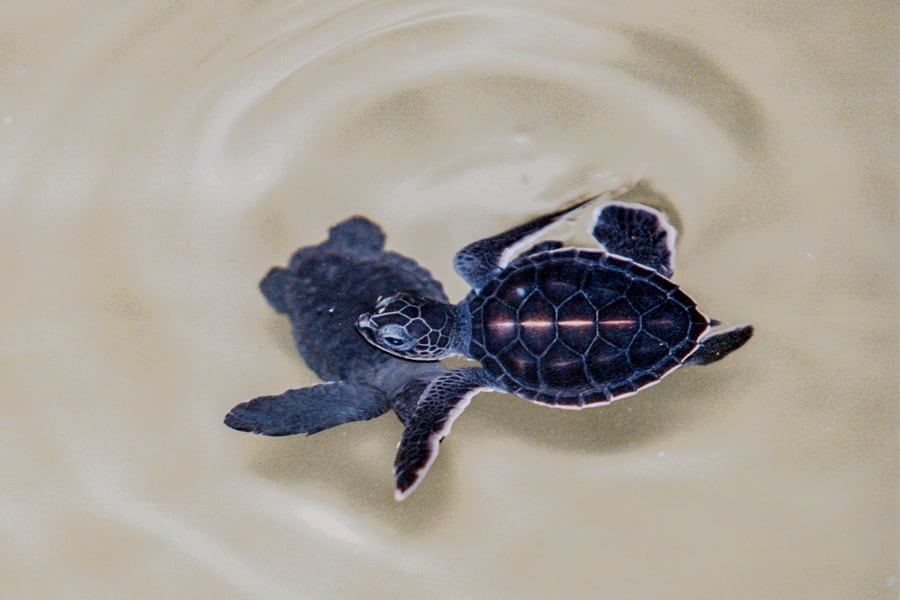 Jerzy Strzelecki / Wikimedia Commons · CC BY-SA 3.0 · 1998 · cropped
The turtle hatchery at Kosgoda
Five of the world's seven marine turtle species nest on the beaches here — green, olive ridley, loggerhead, hawksbill and leatherback. A hatchery was set up at Kosgoda in 1981 to buy the eggs off the beach before anyone else did, incubate them and release the hatchlings, and it is run by the Wild Life and Nature Protection Society. The station is 71 kilometres from Colombo Fort.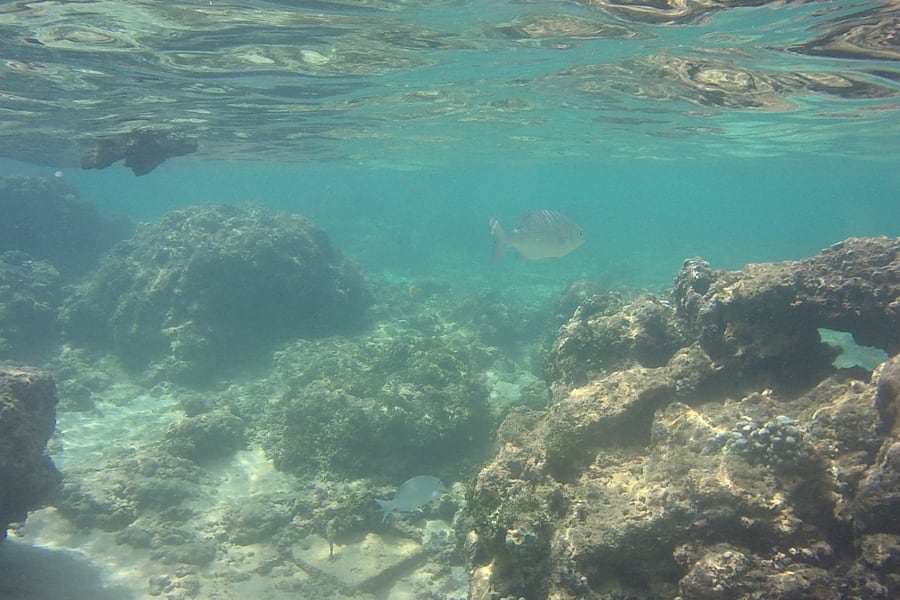 Janindu wijesoorya / Wikimedia Commons · CC BY-SA 4.0 · 2020 · cropped
The reef at Hikkaduwa
A hundred and two hectares of coral directly off the beach, protected as a sanctuary from 1979 and made a national park in 2002: sixty coral species and more than a hundred and seventy reef fish, in about five metres of water. You can swim to it from the shore. The 1998 bleaching took live coral cover from 47 per cent to 13, and the reef has been coming back since.Timetables
Sri Lanka Railways is not publishing a timetable at the moment. Its own Train Schedule page has
said "Page Under Development" since the summer, and the old schedule site at
eservices.railway.gov.lk answers with "This Site temporarily offline due to system maintenance.
The public will be notified once operations resume." What is live is the reservation system,
and that is where the times below come from: four expresses, read off the operator's own booking
engine in September 2026 and cross-checked against the department's published revision of
16 January 2024, which the current times still match to the minute.
Colombo to the south
| Station | 8056 | 8058 |
|---|---|---|
| Maradana | 14:30 | 15:40 |
| Colombo Fort | 14:40 | 15:50 |
| Galle | 17:05 | 18:10 |
| Matara | 18:09 | 18:52 |
| Beliatta | 18:47 | — |
The south to Colombo
| Station | 8057 · Galu Kumari | 8059 · Ruhunu Kumari |
|---|---|---|
| Beliatta | 05:25 | — |
| Matara | 06:00 | 06:05 |
| Galle | 07:15 | 06:48 |
| Colombo Fort | 09:40 | 09:07 |
| Maradana | 09:46 | 09:13 |
All four run daily. Colombo Fort to Galle takes 2 hr 20 min on 8058 and 2 hr 25 min on 8056; Colombo Fort to Matara is 3 hr 02 min at best. The two morning trains leave the south five minutes apart and then separate — 8059 is the faster of them and reaches Colombo half an hour ahead — so the 06:00 and the 06:05 from Matara are not the same offer at all.
The other trains
These four are the ones that can be pinned to a time, because they are the ones with reserved air-conditioned seats in the booking system. They are not the whole service. The rest of the line's trains are ordinary second and third class, unreserved, and the department sells them as a ticket for the date, not for a train — you buy Colombo Fort to Galle and take whichever one turns up. Its published fare notice prices exactly that, by station, for Aluthgama and Weligama among others. What it does not publish is when they go, and with the schedule pages down there is no honest way to print a time for them. The note on commuter tickets is worth reading before you buy one: "e-tickets issued for commuter trains are not valid for use on intercity trains."
There is one more named express, the Sagarika, working 8097 up from Beliatta to Maradana. It has no air-conditioned saloon, so it does not appear in the reservation system and its times cannot be quoted here.
The line is open
This matters in Sri Lanka in 2026. Cyclone Ditwa wrecked the railway network in November 2025, and the Main Line into the hill country is still cut. The Coast Line is not: the department's own recovery bulletin of 29 December 2025 lists "Coastal Line – Maradana to Beliatta" among the routes on which passenger services had resumed, and the booking engine has been selling seats over the whole length of it ever since.
Times read from Sri Lanka Railways' reservation system on 15 September 2026 and checked against the department's timetable revision of 16 January 2024 — railway.gov.lk (opens in a new tab).
Tickets
Sri Lankan fares are famously low and the Coast Line is no exception: Colombo Fort to Galle costs LKR 240 in third class and LKR 500 in second, and Colombo Fort to Matara LKR 300 and LKR 600. Those are walk-up tickets, sold for the day rather than for a train, and they are bought at the station window or through the operator's own commuter site.
The one thing worth reserving is the air-conditioned saloon on the four expresses. It costs LKR 1,100 to Galle, LKR 1,400 to Matara and LKR 1,600 through to Beliatta, there are 104 seats on each train, and it is booked through the railway's reservation system rather than at the window. In mid-September 2026 those trains were still showing seventy-eight to eighty-nine seats free a week ahead — nothing like the hill country, where the tourist trains sell out a fortnight out.
Book your tickets
Vincent van Zeijst / Wikimedia Commons · CC BY-SA 3.0 · 2015 · croppedThird class, unreserved
LKR 240 to Galle · LKR 300 to Matara
Bought at the window for the date, not for a train — take whichever one turns up.
Book Tickets (opens in a new tab, on railway.gov.lk)via railway.gov.lkRambukwelladk / Wikimedia Commons · CC BY-SA 4.0 · croppedSecond class, unreserved
LKR 500 to Galle · LKR 600 to Matara
The same freedom with a seat you have a better chance of getting.
Book Tickets (opens in a new tab, on railway.gov.lk)via railway.gov.lkHafiz Issadeen / Wikimedia Commons · CC BY 2.0 · 2008 · croppedAir-conditioned saloon, reserved
LKR 1,100 to Galle · LKR 1,400 to Matara · LKR 1,600 to Beliatta
A numbered seat on one of the four expresses, 104 to a train, booked in advance.
Book Tickets (opens in a new tab, on railway.gov.lk)via railway.gov.lkRail Passes
There is no rail pass for Sri Lanka, and on this line there is nothing for one to do.
Sri Lanka Railways is a single state operator with no national rover, no tourist card and no part in any international scheme. Interrail and Eurail do not reach the island and the Indian passes stop at the Palk Strait. Every journey is a ticket: unreserved second or third class bought for the date, or a reserved air-conditioned seat bought for a named train.
Even if a pass existed it would not pay here. A pass earns its keep where fares are high, and the whole hundred and fifty-seven kilometres from Colombo Fort to Matara costs LKR 300 in third class — less than the booking fee on most European reservations. The only ticket on this line worth buying in advance is the air-conditioned seat on one of the four expresses, and that is bought individually through the operator's reservation system, not covered by anything.
Checked against Sri Lanka Railways' published tariffs, its commuter ticketing site and its reservation system, September 2026.
Places to Visit
The operator's own station list gives more than sixty stations and halts between Colombo Fort and Matara, and almost every one of them is a beach. What follows is the eight worth breaking the journey for, north to south, each with its distance from Colombo Fort as the railway measures it — and one of them, Galle, is worth the whole ride on its own.
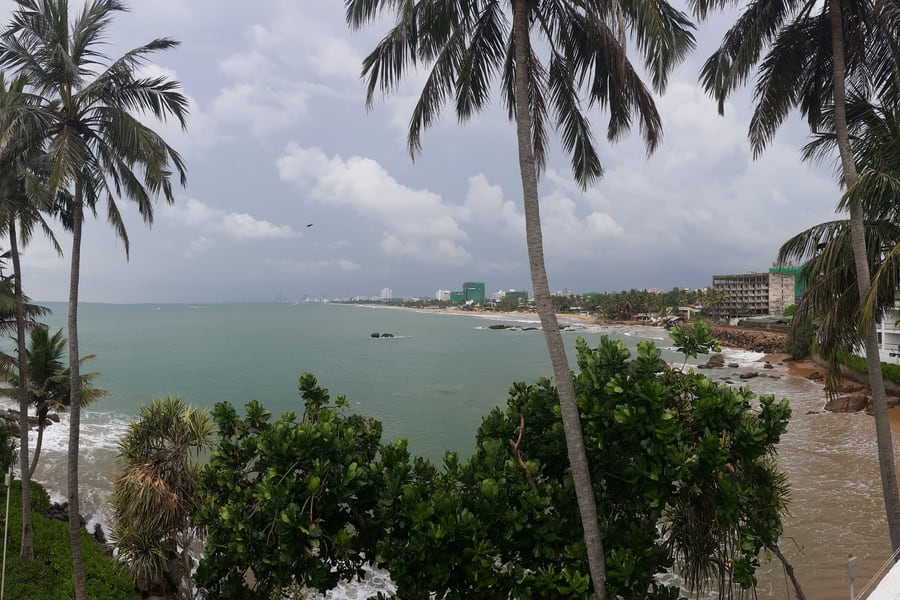 Rilwan19760430 / Wikimedia Commons · CC BY-SA 4.0 · 2017 · cropped
Mount Lavinia
The first place the city stops. Mount Lavinia is where Colombo's suburbs run out into a long curve of sand with a headland at the north end, and the station sits on the low cliff just above it. The beach fills up on Sunday afternoons and empties again by dark. From the point you can see the whole Colombo skyline back up the coast, which is the best argument for making this the first stop out rather than the last one back.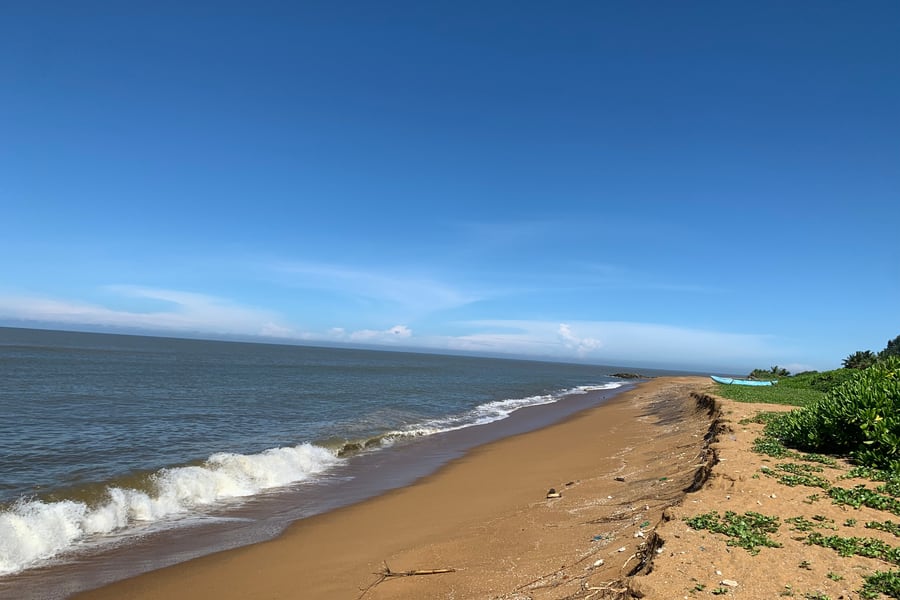 Muunaa-Selva / Wikimedia Commons · CC BY 4.0 · 2023 · cropped
Kalutara
A river town where the Kalu Ganga — the black river — comes down off the hills and meets the sea in a wide sandy mouth the railway crosses on a bridge. Kalutara is roughly the point at which the coast changes character: north of it the line is a suburban railway running every few minutes, south of it a country one. The beach runs for kilometres either side of the river and is almost empty midweek.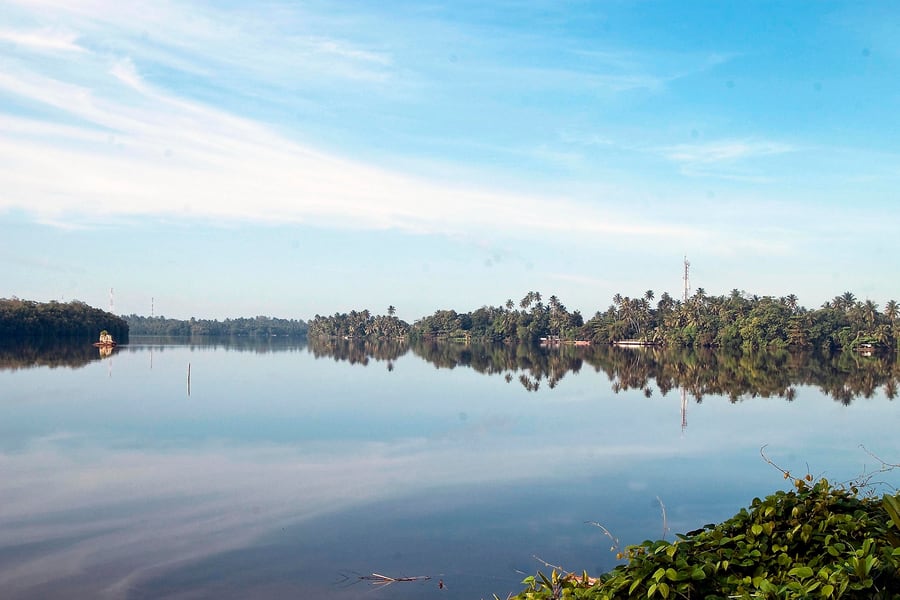 Hafiz Issadeen / Wikimedia Commons · CC BY 2.0 · cropped
Bentota
The Bentota Ganga comes down to the sea beside the railway and is kept out of it by a long sand spit, so the town has the ocean on one side and a broad quiet river on the other. Boats go up into the mangroves from the bridge at Aluthgama, a station back down the line. Bentota station is 1.3 kilometres from Aluthgama and the two share the river mouth between them.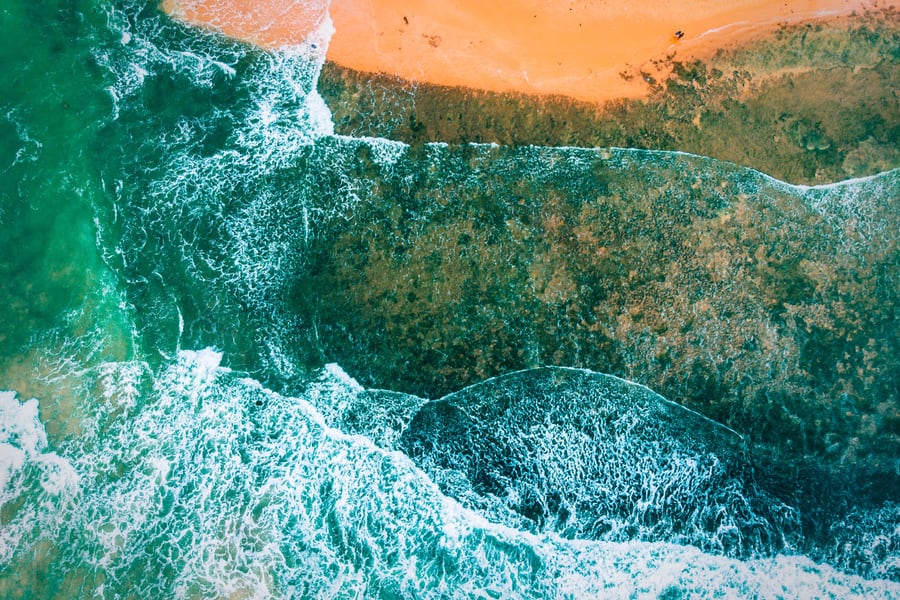 Rovin Shanila / Wikimedia Commons · CC BY-SA 4.0 · cropped
Hikkaduwa
Sri Lanka's original beach town, and still the one with the reef. The coral sanctuary lies directly off the shore in shallow water, so the snorkelling starts where the sand ends — no boat needed. The town behind it is a single long street of guest houses, board hire and restaurants between the Galle Road and the sea, and the station is in the middle of it.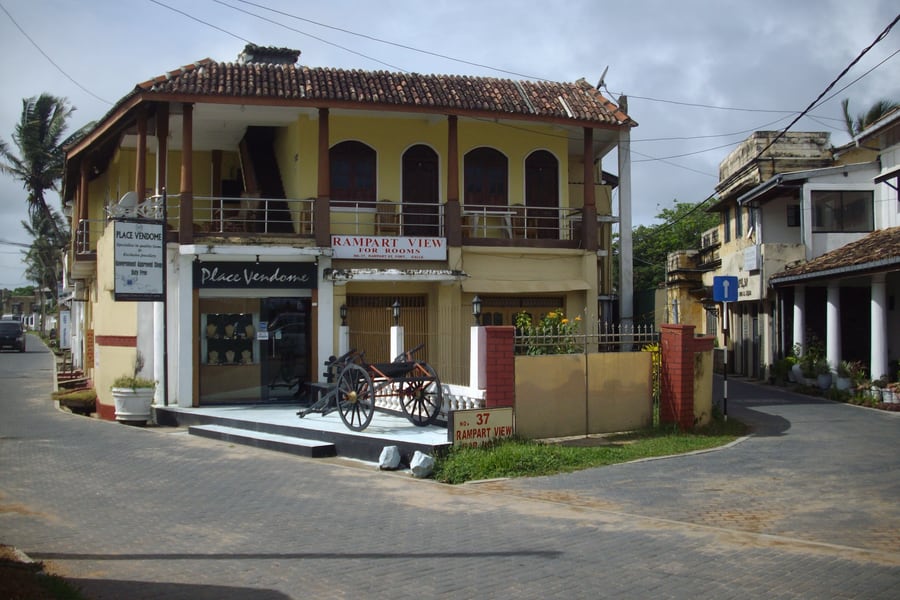 Rudolph.A.furtado / Wikimedia Commons · CC0 · 2012 · cropped
Galle
The reason to ride this line. The Portuguese threw up the first fort here in 1588; the Dutch took it in 1640 and then walled the whole headland, thirteen more bastions in coral and granite over fifty-two hectares. What stands inside is a grid of streets and verandahed houses still lived in rather than preserved, with a lighthouse at one corner and the harbour at another. UNESCO inscribed it in 1988. The station is just outside the walls.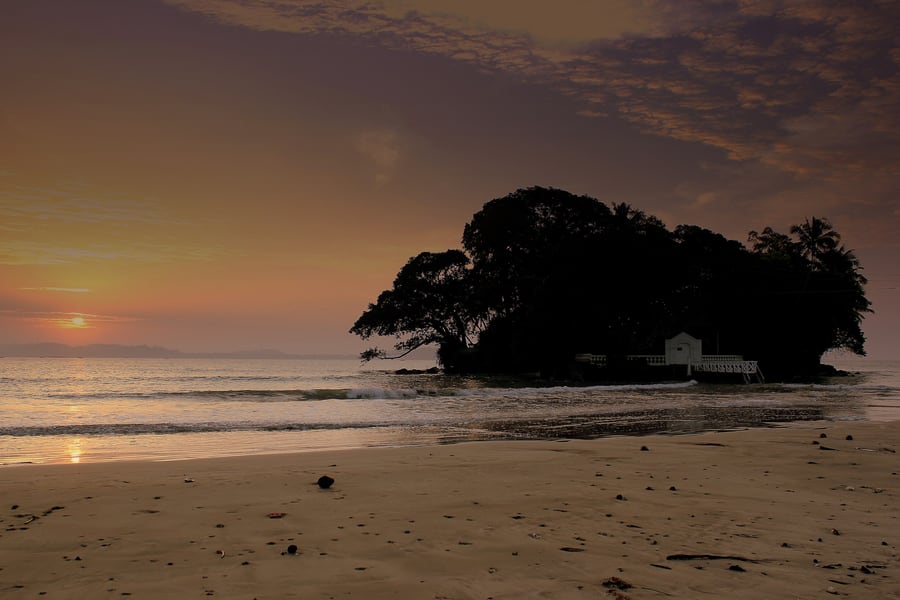 calflier001 / Wikimedia Commons · CC BY-SA 2.0 · 2013 · cropped
Weligama
A wide shallow bay with a fishing fleet at one end and a beginners' surf break at the other, and a hundred metres out, its own small island: Taprobane, a rock with a villa on it built by the French Count de Mauny. The bay is where the stilt fishermen of the south coast are most often seen, perched on a single pole in chest-deep water with a bamboo rod.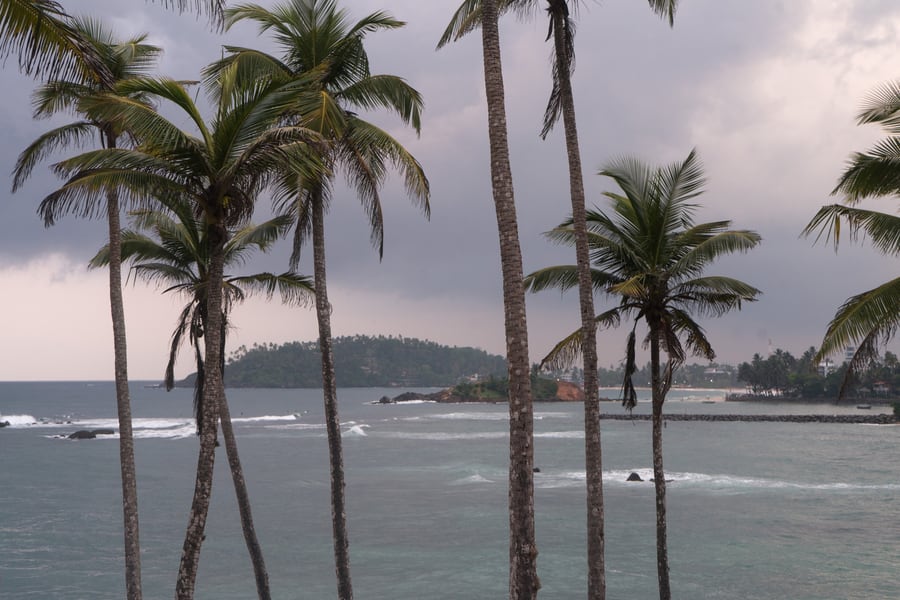 Alexey Komarov / Wikimedia Commons · CC BY-SA 4.0 · cropped
Mirissa
A crescent of sand between two headlands, a fishing harbour that doubles as the departure point for the whale boats, and the palm-covered spur above the west end that everybody photographs. Mirissa had fewer than five thousand people at the last census and has more visitors than that in a good week; go up onto the headland at either end and the crowd disappears.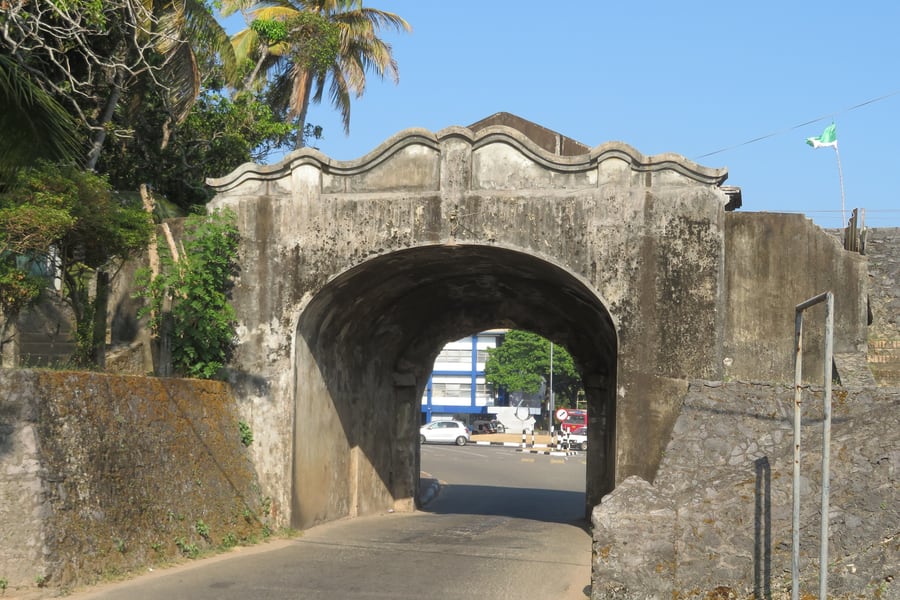 Torbenbrinker / Wikimedia Commons · CC BY-SA 4.0 · 2024 · cropped
Matara
A working southern city rather than a resort, and it has two Dutch forts. The big one walls off the promontory between the Nilwala Ganga and the sea; the Star Fort, built in 1765 about 350 metres away on the far bank, is a small six-pointed redoubt put there to cover the river crossing, and its gate still reads Redoute Van Eck 1763 under the governor's arms. Dondra Head, the southernmost point of the island, is a short ride on.Where to Sleep
This is the most heavily built coast in Sri Lanka and there is somewhere to stay at almost every station, from guest houses above the beach at Hikkaduwa to the resort strip at Bentota. Three houses are described below, one at each end of the line and one in the middle, chosen because each sits within a few minutes of a station and each has a story as old as the railway or older.
All three sites were opened and read in September 2026. No price, no rating and no star count appears here, because none of that has been verified — what is quoted is what the hotel says about itself.
Where to stay
Galle Face Hotel
2 Galle Road, Colombo — on the seafront, by the line
The hotel's own account of itself: a Dutch villa called Galle Face House, turned into a hotel by four British entrepreneurs, open since 1864 and named for the kilometre of open ground beside it where Victorian Colombo went to take the sea air. It faces Galle Face Green and the Indian Ocean, and the Coast Line runs along the far side of it — Kompanna Vidiya is the nearest stop, about a kilometre and a half out of Colombo Fort.
Check Availability (opens in a new tab, on gallefacehotel.com)via gallefacehotel.com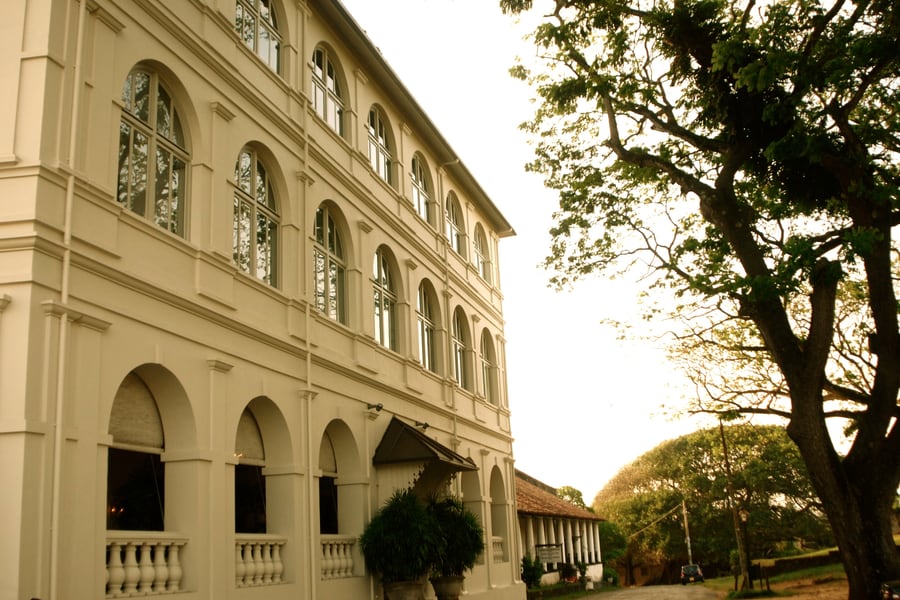 richardmichaelshaw / Wikimedia Commons · CC BY 2.0 · cropped
Amangalla
Church Street, inside Galle Fort
The house stands inside the ramparts on Church Street, and it is the building that was the New Oriental Hotel before Aman took it on. The hotel describes lofty-ceilinged rooms and suites with original wooden floors, high sash windows and four-poster beds, a dining room that opens onto a verandah over the street, and a garden and pool behind. Galle station is a walk away, just outside the walls.
Check Availability (opens in a new tab, on aman.com)via aman.comCape Weligama
On the cliff above Weligama Bay
Villas and suites along the top of a headland between Weligama and Mirissa, with the sea below on two sides and pools cut into the clifftop. The house describes itself as a member of Relais & Châteaux and puts golden beaches within easy reach; the whale boats go out of Mirissa harbour, the next station down. Weligama station is 142.8 kilometres from Colombo Fort.
Check Availability (opens in a new tab, on resplendentceylon.com)via resplendentceylon.comQuestions or corrections
Planning this trip and stuck on something, or spotted a time, fare or detail that has changed? Send us a message about The Coast Line. We read every one, and we update this page when something has changed.