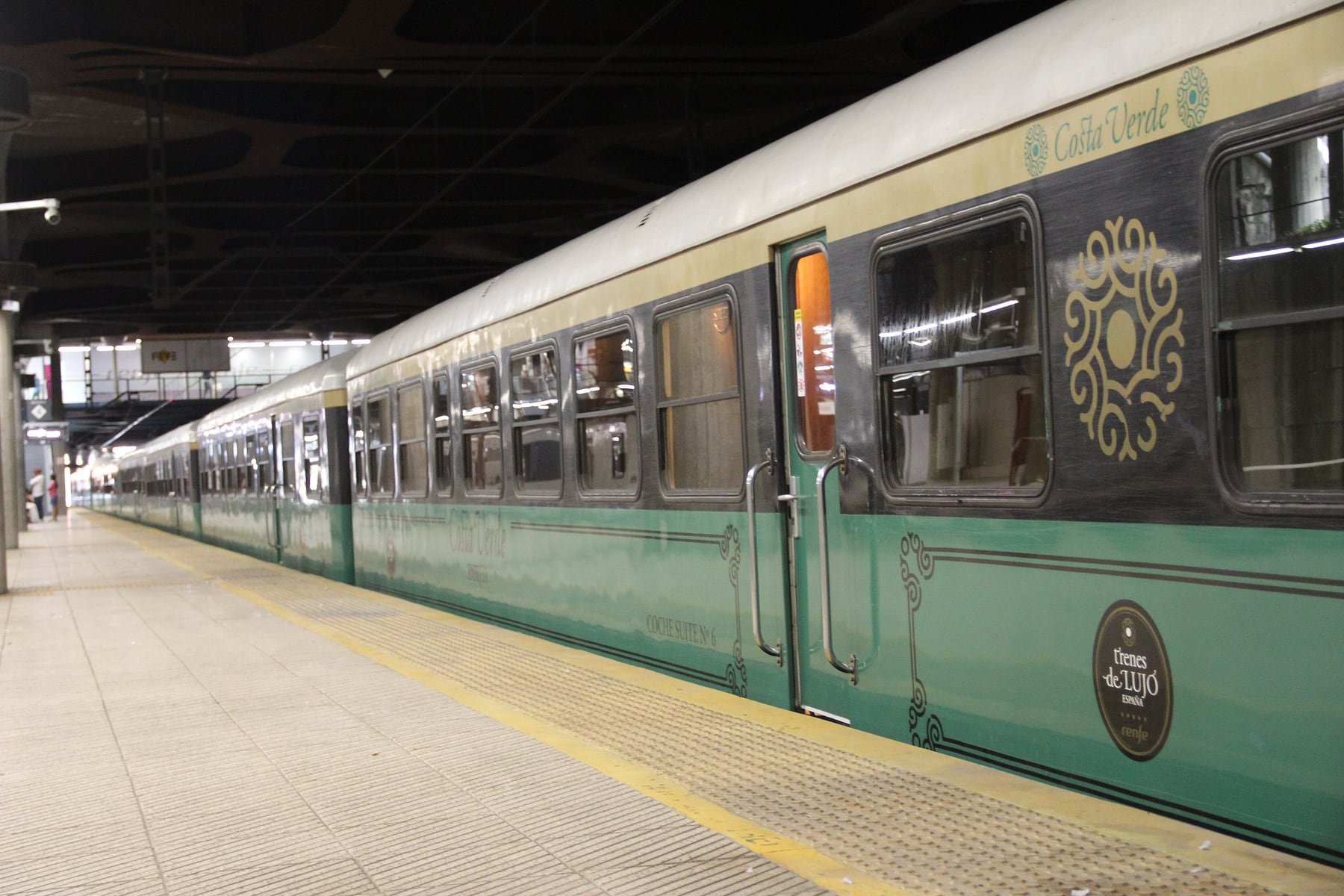
Costa Verde Express — nothing about it is old except the styling
Xuliu Pombar / Wikimedia Commons · CC0 · cropped
- DistanceBilbao-Concordia to Ferrol by rail · Santiago de Compostela by road
- Duration6 days / 5 nights
- Best seasonMay, June, September and October
Introduction
Renfe sells the Costa Verde Express as a return to the golden age of rail travel, and the marketing is not wrong about the effect. The lounge cars have table lamps and heavy curtains, the suites are lined in wood veneer, there is a bar with a dance floor, and the whole thing crawls along the Cantabrian coast at a pace that belongs to another century.
Almost none of it is actually old.
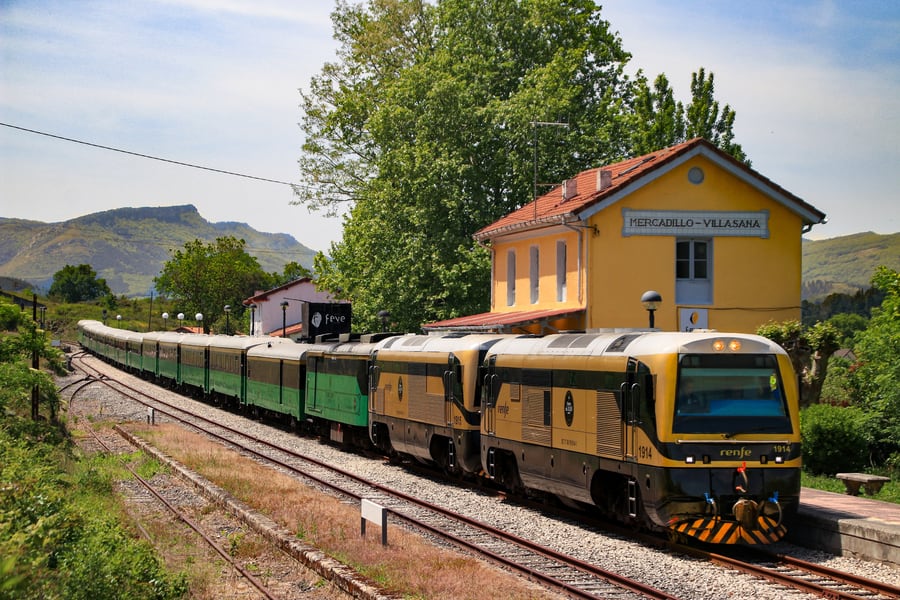
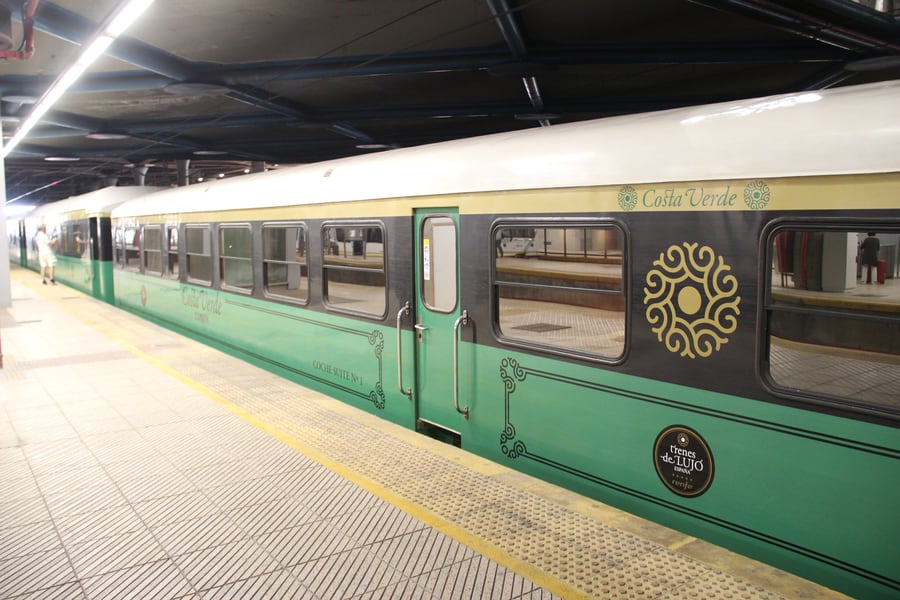
The train was built in 2000, in FEVE's own workshops in Asturias, as a straight copy of El Transcantábrico — a twin ordered because one train could not meet the demand. It ran as Transcantábrico II, then as Transcantábrico Clásico from 2011, and took the name Costa Verde Express in 2022 along with a shorter route and the dark green livery it wears now. The locomotives that haul it are older in origin and newer in substance: 1960s machines stripped to the frames between 2002 and 2004 and rebuilt as hybrids that can draw current from the overhead wire or run on their own diesel engine, a combination that had no precedent in Spain when it appeared.
Which is presumably why, when Renfe wanted to find out whether a train could run on diesel made from used cooking oil, this was the train it picked. In August 2026 a Series 619 was drained at the El Berrón depot in Asturias, refilled with a thousand litres of renewable HVO, and sent out at the head of the Costa Verde Express. It worked. The operator now has a protocol with Repsol to push the fuel onto the six per cent of its network that diesel still runs.
So the most convincingly antique train in Spain turns out to be the one doing the experimental work. The reader gets six days along the green north — Bilbao to Santiago de Compostela or the reverse, sleeping on board in a station every night — on a machine whose only genuinely old thing is the idea of it.
The Journey
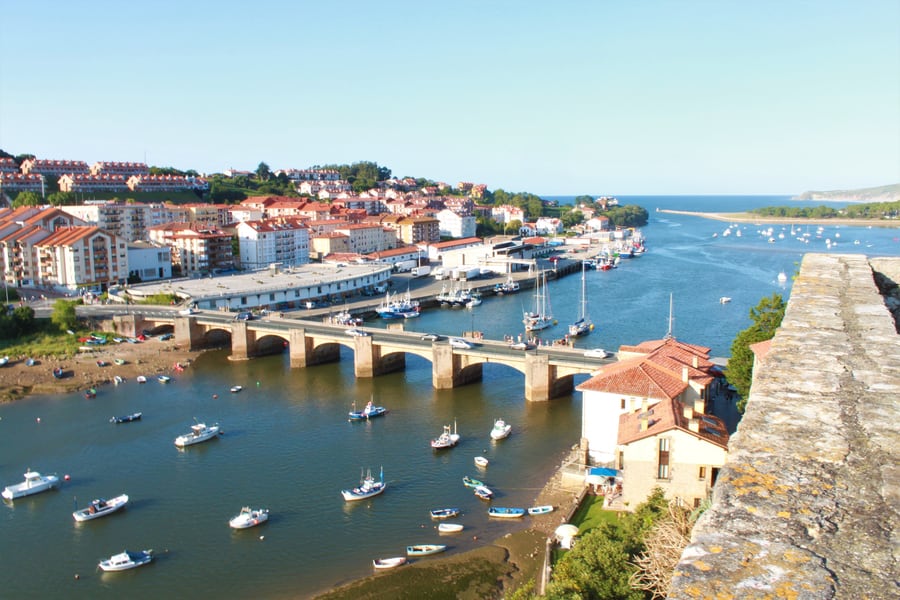
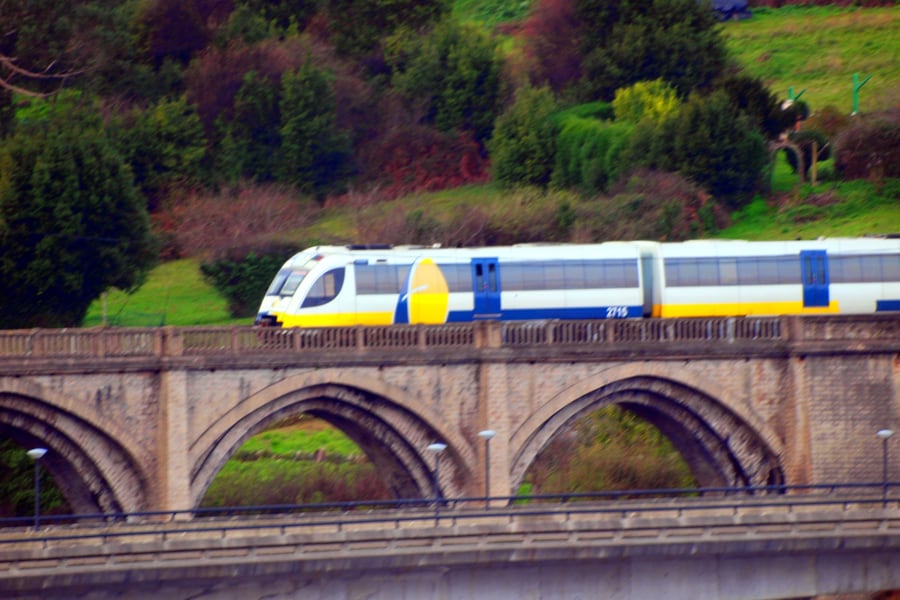
The rails run from Bilbao-Concordia to Ferrol, about six hundred and fifty kilometres of metre gauge strung along the Bay of Biscay. This is the old FEVE network — narrow gauge because the Cantabrian mountains made anything wider ruinously expensive to build — and it is still, taken as a whole, the largest metre-gauge system in western Europe. Renfe absorbed it in 2013. The Costa Verde Express uses it as a corridor and a hotel at once.
The six-day itinerary runs in both directions on alternate Saturdays. Westbound it starts at Bilbao-Concordia at ten in the morning with the Guggenheim and lunch on board, then works along the coast through Santander, Cabezón de la Sal, Llanes, Oviedo, Gijón, Luarca, Ribadeo and Viveiro to Ferrol, where a coach takes over for the last stretch to Santiago de Compostela. Eastbound reverses it. Santiago is on the package but not on the railway: the metre gauge stops at Ferrol, and it has always stopped at Ferrol.
The train does its travelling while you are somewhere else
It is worth being clear about how little of the day is spent moving. The pattern is that the train runs a short leg while breakfast is served, sits in a station while a coach takes everybody inland to the Picos de Europa or the Cabrales cheese caves or the Altamira neo-cave, then makes another short hop in the late afternoon before dinner. Every night is spent stabled in a station — Viveiro, Luarca, Llanes, Cabezón de la Sal, Santander — with the train shut down and quiet.
Renfe is unusually candid about what this means. Its own conditions of contract state that it accepts no commitment on punctuality for these trains, on the grounds that their purpose is not the transport of passengers but the delivery of a programme. A reader looking for a day at the window watching the Cantabrian coast go by will find the Costa Verde Express spends more of the daylight stationary than in motion.
Twenty-four suites and four lounges
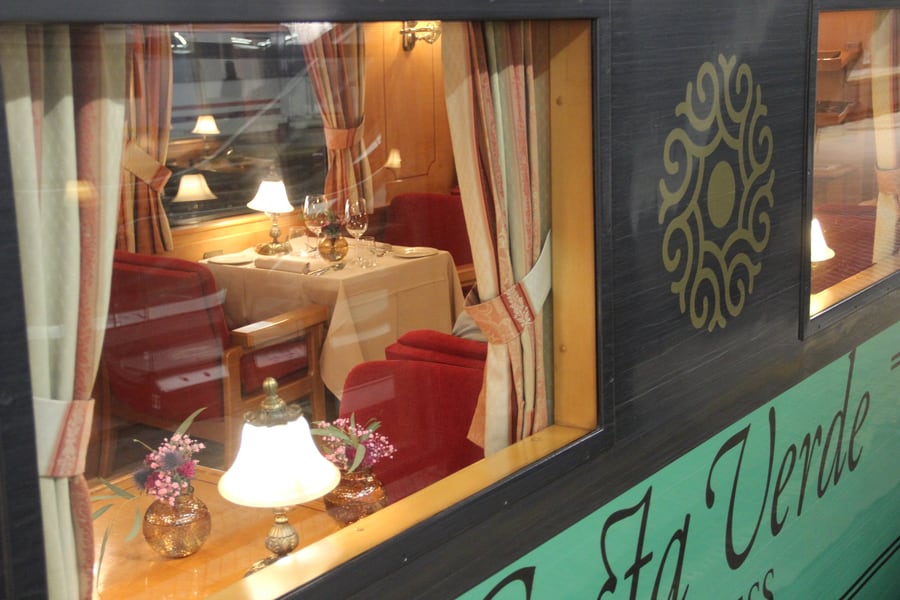
Accommodation is the Gran Clase Suite, and there is only one grade of it: about six square metres including the bathroom, wood-veneer panelling, a sofa by day and a 1.35-metre double bed by night, desk, minibar, safe, wardrobe, private bathroom, air conditioning on its own regulator. Spanish Wikipedia puts the count at twenty-four; Renfe's own figure is that the whole train can be chartered for a maximum of fifty-four people, which is the only capacity number the operator publishes.
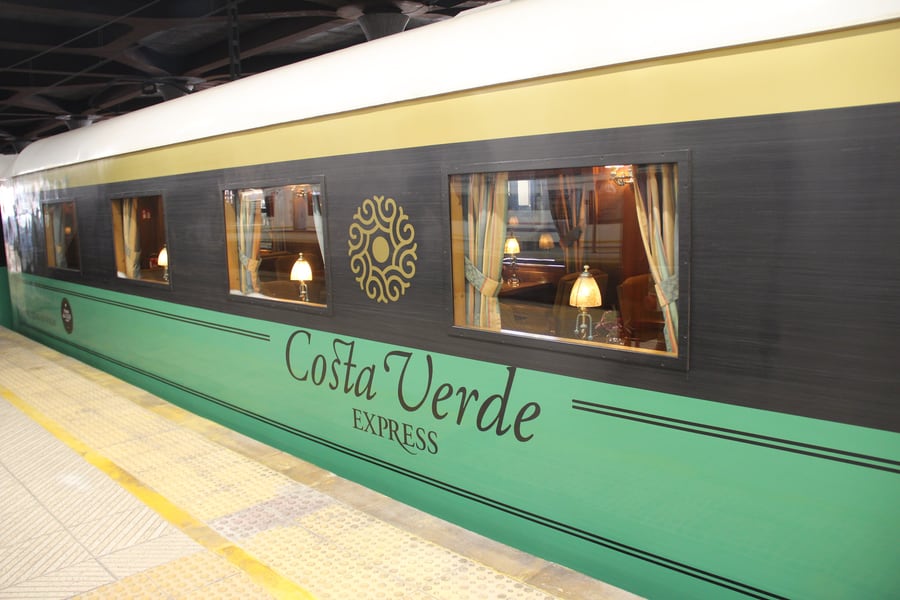
The four saloon cars are the part the operator is proudest of. One carries a bar and a dance floor, another a second and quieter bar, and the remaining two are for sitting and looking out. The train is gangwayed throughout, so passengers move freely from end to end.
Naming the traction
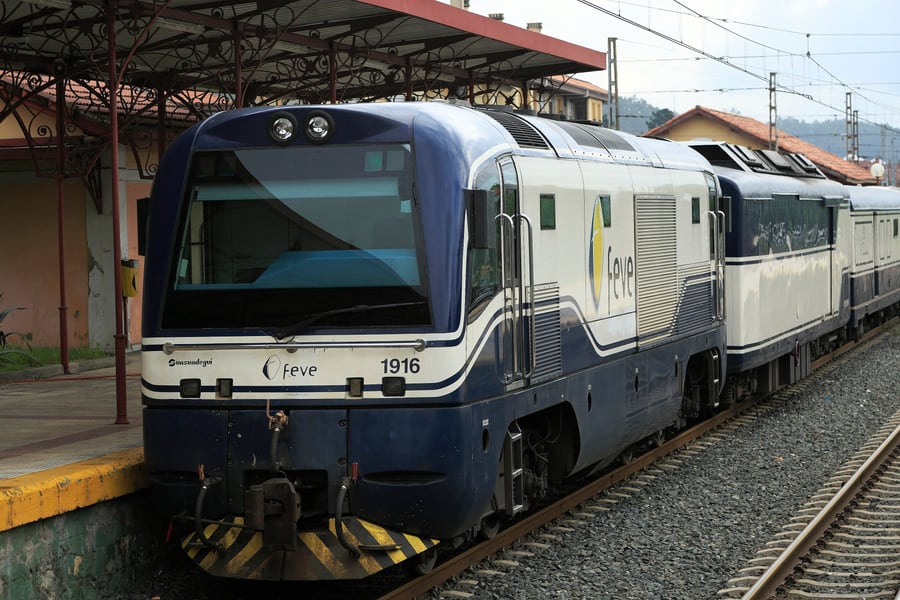
The locomotives are Renfe Series 619, and they are the reason this page exists at all. Seventeen were produced between 2002 and 2004 by taking FEVE's worn-out Series 1000 machines — Alsthom products — and replacing the body and the engine entirely. The work was done at Alsasua by a CAF–Sunsundegui joint venture with Siemens electrical equipment. What came out is a Bo′Bo′ of sixty tonnes carrying one Caterpillar 3512B diesel and four Siemens traction motors, able to work off the catenary where the coast is wired and off its own engine where it is not, at roughly the same power either way. FEVE numbered them 1901–1917; Renfe renumbered them Series 619 when it took the narrow-gauge network over in 2013.
That dual capability is exactly the problem the HVO trial is aimed at. Where the wire runs out — and on the metre-gauge north it runs out often — the engine is burning diesel, and Renfe's stated position is that 94% of its passenger demand in 2025 was already met by carbon-neutral electric traction while the remaining 6% was not. The Costa Verde Express was the train sent out to prove that the last 6% could run on waste instead.
Along the route
 Xuliu Pombar / Wikimedia Commons · CC0 · cropped
A copy of a train, built because one was not enough
El Transcantábrico had been running since 1983 and could not meet demand, so in 2000 FEVE built a second one in its Asturian workshops. In 2011 the original became the Gran Lujo; in 2022 the twin was given a shorter route, a dark green livery and the name it carries now.Falk2 / Wikimedia Commons · CC BY-SA 4.0 · croppedThe locomotive is the modern part
Seventeen of FEVE's Alsthom machines were stripped to the frames between 2002 and 2004 and rebuilt into something Spain had not had before: a metre-gauge locomotive that can take current from the wire or run on its own diesel, at about the same power either way.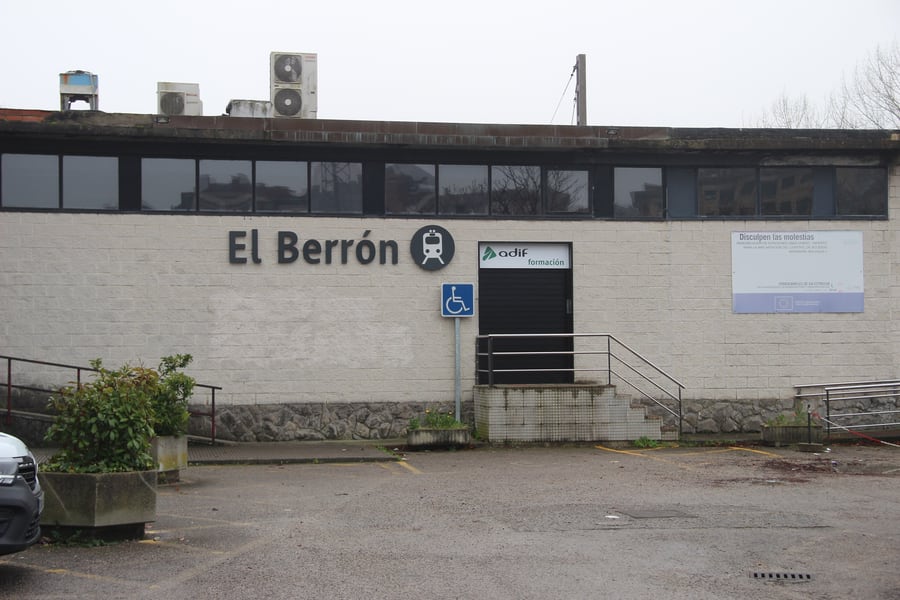 Xuliu Pombar / Wikimedia Commons · CC0 · cropped
A thousand litres of used cooking oil
In August 2026 Renfe and Repsol refuelled a Series 619 with 1,000 litres of renewable HVO — diesel hydrotreated from waste oils and fats — and sent it out on the Costa Verde Express. Renfe called the trial technically successful.A bit of history
Culture & experiences along the way
 Luis Rogelio HM / Wikimedia Commons · CC BY-SA 2.0 · cropped
The train moves while you are on the bus
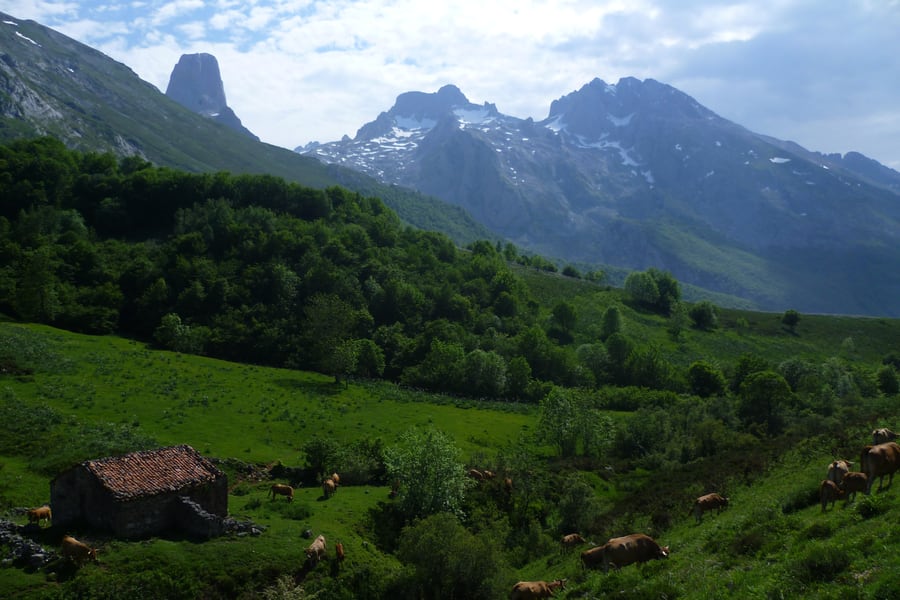
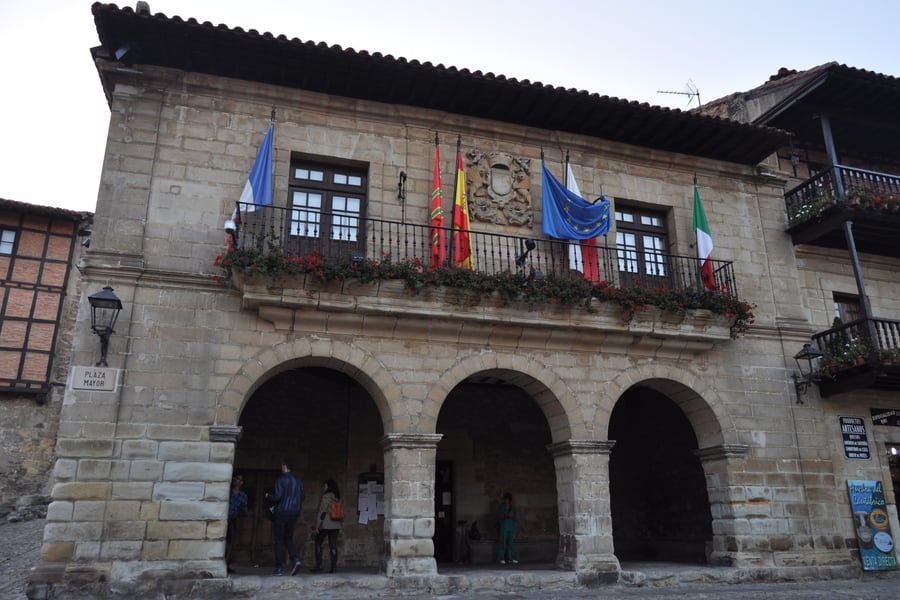
The daily pattern is a short rail leg over breakfast, a coach excursion inland while the train repositions, and another short hop before dinner. Every night is spent stabled in a station. Renfe's own conditions of contract accept no commitment on punctuality, because the purpose is the programme rather than the transport — which is a fair description of how the six days actually work. The coach reaches Santillana del Mar, shown here, while the train is somewhere else entirely.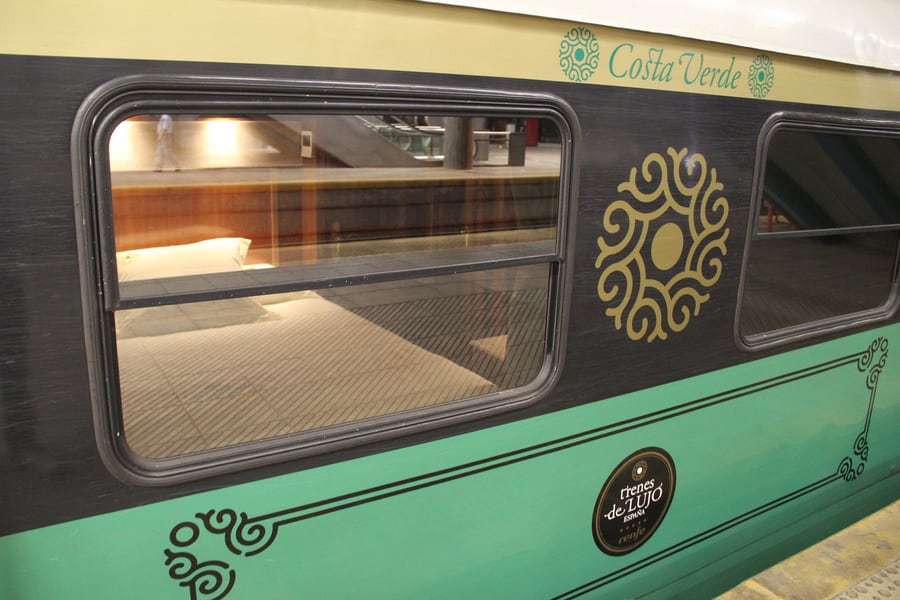 Xuliu Pombar / Wikimedia Commons · CC0 · cropped
One grade of room, and only one
There is no class system on board. Everybody has the same Gran Clase Suite — wood veneer, sofa by day and double bed by night, desk, minibar, safe, wardrobe, full private bathroom and its own air-conditioning control. Spanish Wikipedia counts twenty-four of them; the only capacity figure Renfe itself publishes is that the whole train can be chartered for up to fifty-four people.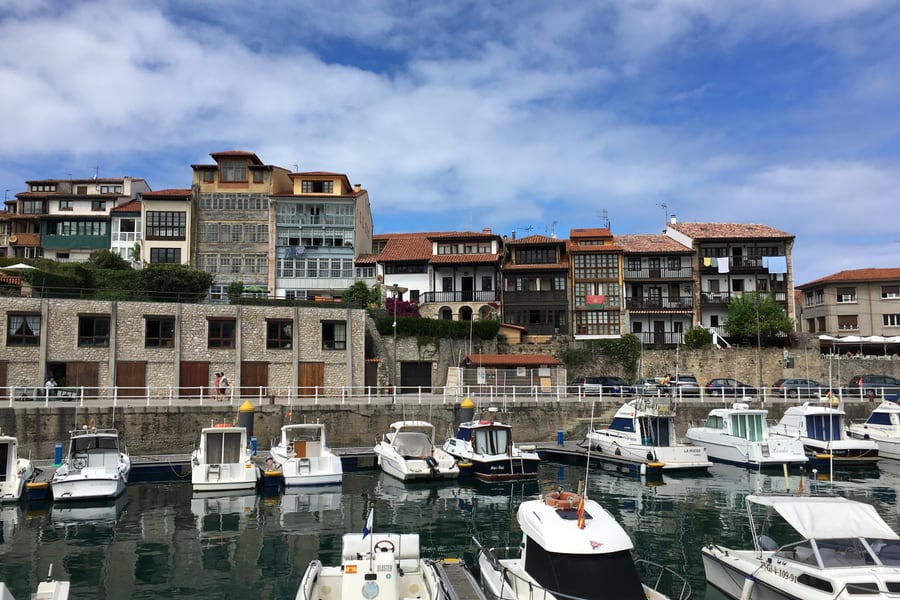 Aliciagholgado / Wikimedia Commons · CC BY-SA 4.0 · cropped
The summer train that goes nowhere
The six-day itinerary skips July and August. For 2027 Renfe has filled the gap with a Friday-to-Sunday Weekend working out of Oviedo that its own page describes as having no excursions: board at 18:30, dinner as the train slides out to El Berrón at 21:30, a whole day at Llanes — its old town and harbour, shown here — and back. The programme has been removed and what is left is the train.Timetables
There is no daily timetable to quote. The Costa Verde Express runs a fixed list of dated departures,
each one a package with a set programme, and the dates below were read on 18 August 2026 from
Renfe's own itinerary pages at
spanishluxurytrain.com (opens in a new tab)
and cross-checked against the live booking system at venta.renfe.com, which sells them.
The six-day run, 2026
Departures alternate direction on consecutive Saturdays. Reception is at 10:00 on the first day, and the trip finishes at about 16:30 on the sixth.
| Direction | Remaining 2026 departures |
|---|---|
| Santiago de Compostela → Bilbao | 5 September · 19 September · 3 October · 17 October |
| Bilbao → Santiago de Compostela | 12 September · 26 September · 10 October · 24 October |
The two dates in bold are the ones Renfe's booking system still showed as available. The other four came back marked Tren Completo — the train is full. There is also one short trip left in 2026: Santiago de Compostela to Oviedo, 31 October to 2 November, three days and two nights, finishing about 14:00.
The 2027 season
The 2027 dates went on sale during the summer of 2026 and are already bookable.
| Itinerary | 2027 departures |
|---|---|
| Bilbao → Santiago de Compostela (6 days / 5 nights) | 15 and 29 May · 12 June · 18 September · 2 October |
| Santiago de Compostela → Bilbao (6 days / 5 nights) | 22 May · 5 and 19 June · 25 September |
| Oviedo → Bilbao (3 days / 2 nights) | 12 May |
| Santiago de Compostela → Oviedo (3 days / 2 nights) | 9 October |
| Oviedo → Oviedo, "Weekend" (3 days / 2 nights) | 2, 9, 16, 23 and 30 July · 13, 20 and 27 August |
The July and August gap, and what fills it
The long itinerary does not run in high summer. Across both seasons there is a single July departure and no August one at all, and the same pattern holds for 2027: May, June, September, October, and nothing in between.
For 2027 Renfe has put something else in that gap. The Weekend itinerary is new, it runs on Friday evenings through July and August, and it goes almost nowhere: boarding at Oviedo from 18:30, dinner served as the train slips out to El Berrón at 21:30, a day at Llanes, a dinner with live performance, and back into Oviedo the following afternoon. The operator's own description carries the words "no excursions". It is the same train and the same suites with the coach programme taken out, and it stables the first night at El Berrón — the depot where the renewable-fuel trial was run a fortnight before these dates went on sale.
Renfe's reservation centre is on +34 91 255 59 12 and trenesturisticosdelujo@renfe.es, and the
same departures are sold through travel agents and through the booking form on the operator's site.
Tickets
Renfe publishes the fare per person, sharing a Gran Clase double suite, while its booking engine quotes the same trips per suite. The two are consistent once that is understood, and the confusion is why third-party sites carry wildly varying numbers for this train — "about €9,000" is the price of a suite for one person, not a price per head. For 2027 the six-day trip is €5,300 per person sharing, with a €4,250 single supplement. Prices read from Renfe's 2027 tariff page on 18 August 2026.
Everything is in the fare: all meals, the guided excursions and the coach, entry to the museums on the programme, and compulsory travel insurance. So is getting there — Renfe issues a promotional code for free travel to the start and home from the end on any of its long-distance services. A booking is confirmed against a 15% deposit, with the balance due thirty days out.
Book your tickets
Xuliu Pombar / Wikimedia Commons · CC0 · croppedCosta Verde Express, six days along the green north
€5,300 per person sharing · €10,600 per double suite
Bilbao to Santiago de Compostela or the reverse, all-inclusive.
Book Tickets (opens in a new tab, on spanishluxurytrain.com)via spanishluxurytrain.comAnaisGoepner / Wikimedia Commons · CC BY-SA 4.0 · croppedThe short trips
€2,800 per person sharing · three days and two nights
Oviedo to Bilbao by way of the Picos de Europa, or Santiago to Oviedo down the Galician side.
Book Tickets (opens in a new tab, on spanishluxurytrain.com)via spanishluxurytrain.comEnrique Pernas / Wikimedia Commons · CC BY-SA 3.0 · croppedThe same coast on the ordinary train
Renfe metre gauge, Ferrol to Oviedo to Santander
The scheduled service runs the same railway daily for a few euros, and Interrail covers it.
Book Tickets (opens in a new tab, on renfe.com)via renfe.comRail Passes
No rail pass applies to this train, and no rail pass is worth buying because of it.
An Interrail or Eurail pass covers scheduled Renfe services, and Interrail draws the line itself: beside the Renfe services it lists as included, its table of railway companies for Spain keeps a column of exclusions, and the first two entries in it are "RENFE Luxury trains" and "RENFE Tourist trains". This train is one of those. It is sold as an all-inclusive package with accommodation, meals, coaches and museum entry folded into a single price, and the fare is not a rail fare a pass can be set against. There is no pass-holder discount and no reduced rate for arriving with a pass in a pocket.
The useful thing in this area comes from the operator instead. Renfe includes free travel to and from the start and end of the trip anywhere in its Spanish network — AVE, Alvia, Avlo, Long Distance and Media Distancia — issued as promotional codes, one per person per journey. The conditions are that the connecting journeys run on consecutive days and that no more than 48 hours separates them from the trip itself. For a passenger joining at Bilbao or Santiago from Madrid, Barcelona, Seville or Valencia, that is worth considerably more than any pass would be, and it is already in the price.
The scheduled metre-gauge service over the same coast is a different matter. Renfe's ordinary narrow-gauge trains run Ferrol to Oviedo and Oviedo to Santander every day, they cost a few euros, and they are covered by Interrail and Eurail in the normal way. A traveller who wants the Cantabrian coast from a train window rather than the Cantabrian coast as a hotel programme can have most of the same scenery that way, without a suite and without the excursions.
Pass conditions checked against Interrail's published list of railway companies on 20 August 2026.
Places to Visit
The excursions are fixed and included, so the list below is not a menu — it is what the programme actually does with the days while the train waits in a station.
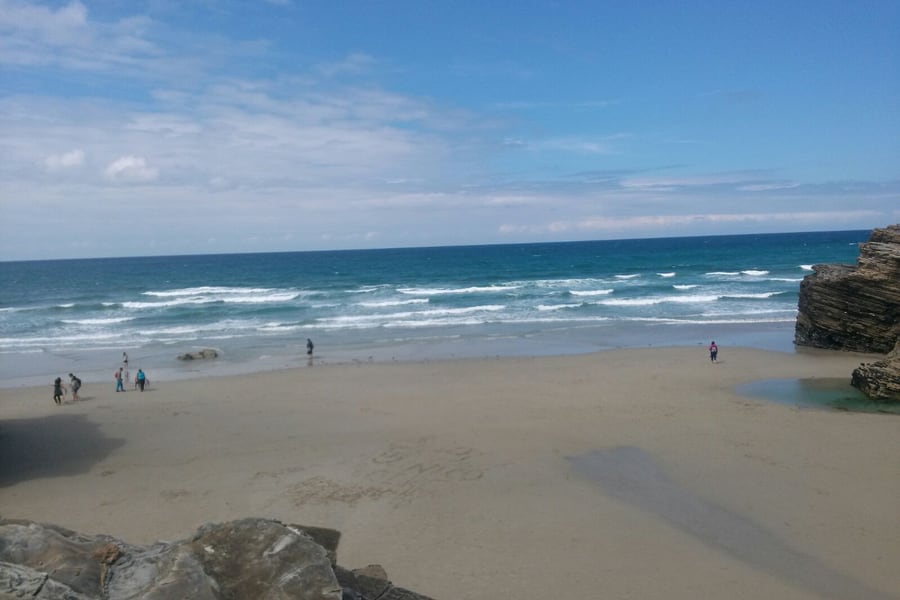
Between them the two directions take in the Guggenheim at Bilbao, the medieval streets of Santillana del Mar and the Altamira neo-cave, the Picos de Europa by way of Arenas de Cabrales and its cheese caves, the old town of Oviedo and the seafront at Gijón, the water-powered workshops above Taramundi, the harbours at Luarca and Viveiro, and a farewell lunch at the Parador in Santiago de Compostela. The eastbound run adds a boat across the bay to Santoña and an anchovy cannery; the 2027 short trip from Santiago picks up the Playa de las Catedrales on the Lugo coast.
The cards below cover six of them.
 PA / Wikimedia Commons · CC BY-SA 4.0 · cropped
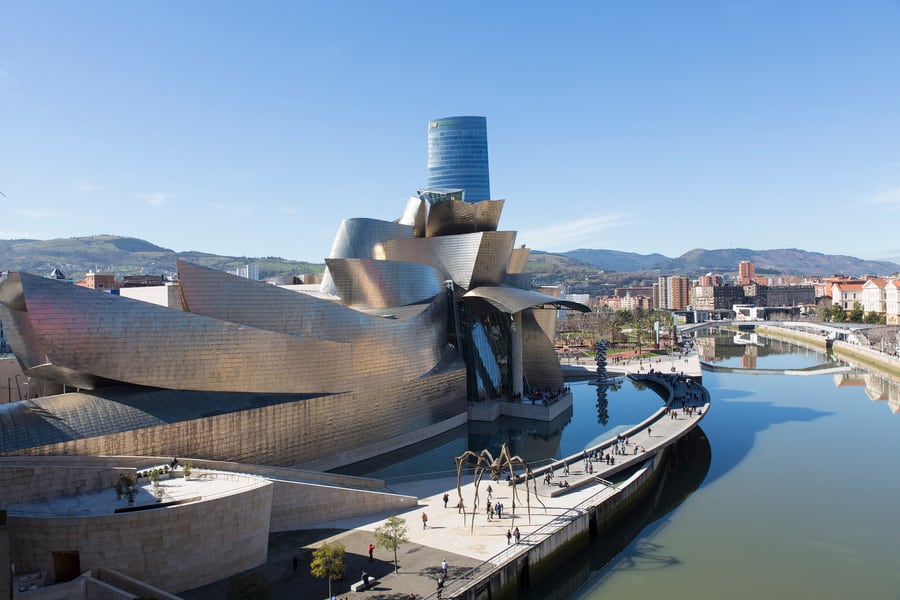
The Guggenheim, Bilbao
The westbound trip opens with it, entry included, a short walk from the Concordia station where the train is boarded. Frank Gehry's titanium building on the Nervión is the thing Bilbao rebuilt itself around after its heavy industry went, and the train's own itinerary describes the city in exactly those terms.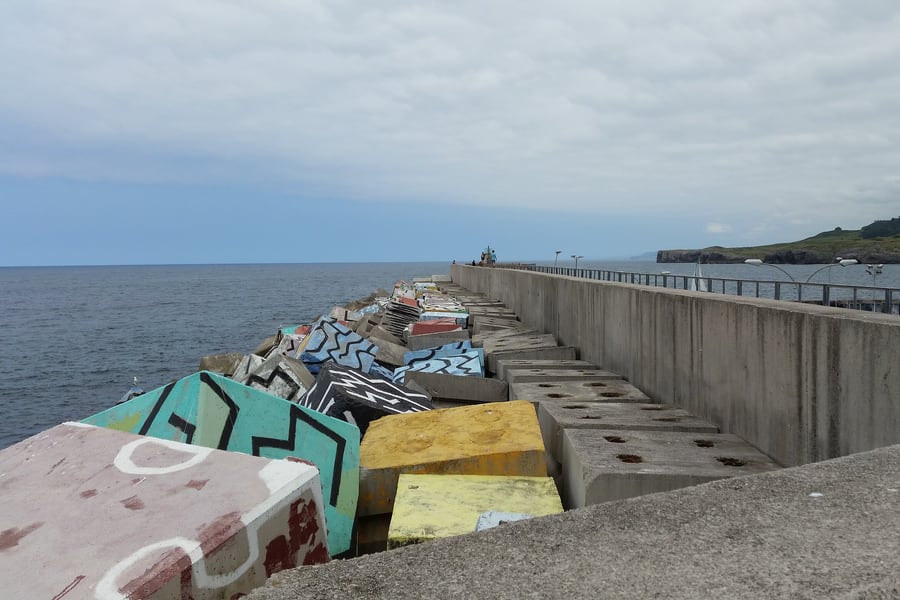 Ecelan / Wikimedia Commons · CC BY-SA 4.0 · cropped
Los Cubos de la Memoria, Llanes
The breakwater at Llanes is built of the plain concrete blocks that armour any harbour wall, and Agustín Ibarrola painted them — faces, eyes and hard geometry in colours chosen to survive the Cantabrian weather. Ibarrola was one of the leading figures of Spanish avant-garde and land art, and the blocks are walked on and climbed over rather than fenced off. The train stables at Llanes overnight in both directions of the six-day run, and the harbour is a few minutes from the station.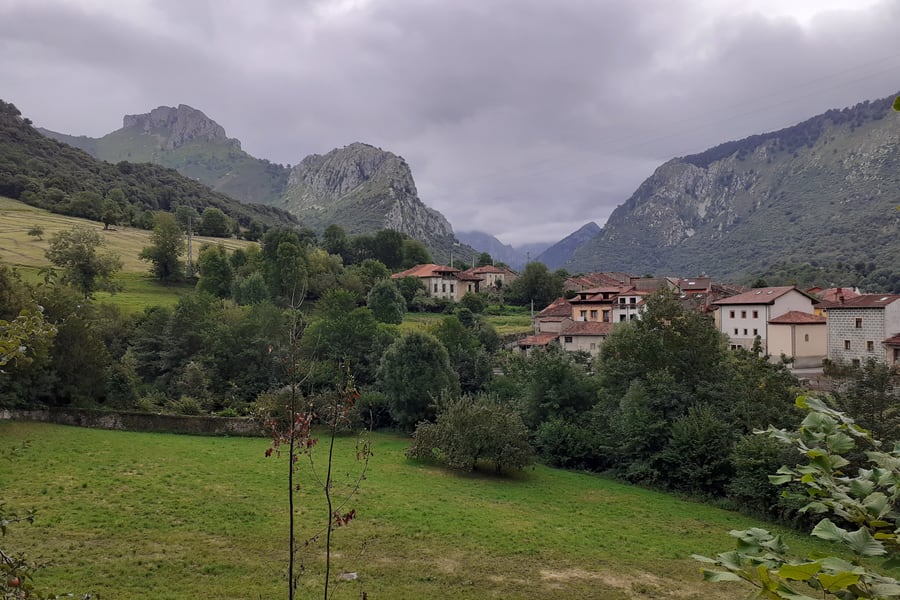 Jordi Gili / Wikimedia Commons · CC BY-SA 4.0 · cropped
Arenas de Cabrales and the Picos de Europa
The excursion leaves the coast for the limestone. Arenas de Cabrales sits at the foot of the Picos de Europa, where the green valley floor runs straight into grey rock walls, and the programme includes the cave-museum devoted to the cheese the village gives its name to. Cabrales is a protected-origin blue, made from unpasteurised cow's, goat's or sheep's milk — or a mixture of two or three of them — and matured in the natural caves of the mountain rather than in a dairy.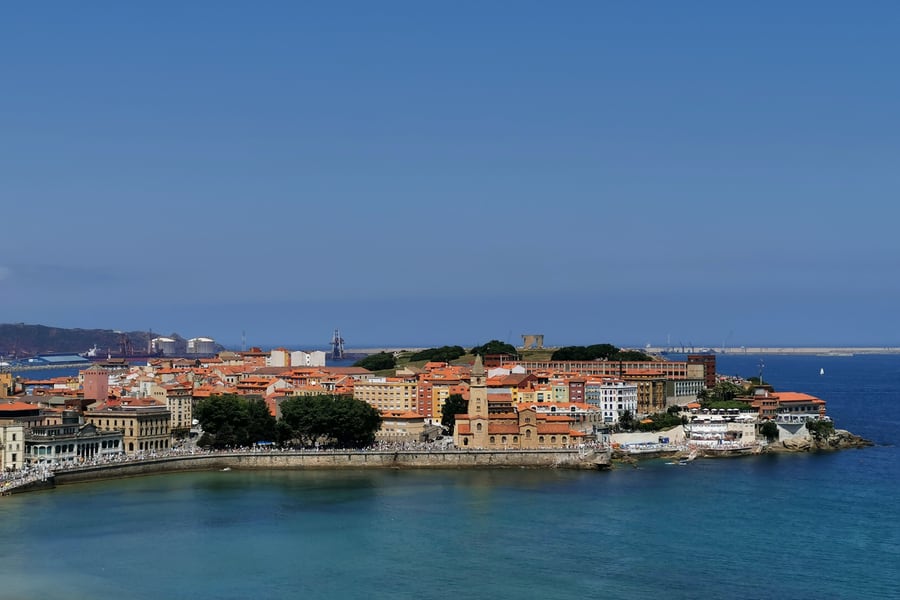 Torres05 / Wikimedia Commons · CC BY-SA 4.0 · cropped
Cimadevilla, Gijón
Gijón's oldest quarter occupies the peninsula of Santa Catalina, a fishermen's district of narrow streets wrapped around a hill with the sea on three sides. On the high ground above it stands Eduardo Chillida's Elogio del Horizonte, a great concrete horseshoe raised in 1990, now the symbol of the city and known to everyone in it by a considerably ruder nickname. The itinerary calls Gijón "open to the sea and full of dynamism", and gives it a morning and lunch.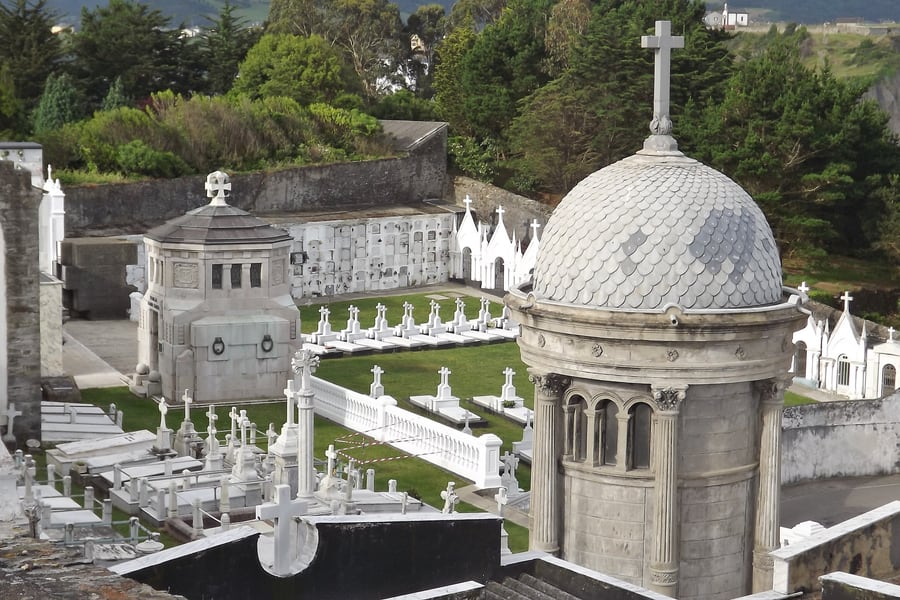 Wolffoxylady / Wikimedia Commons · CC BY-SA 4.0 · cropped
Luarca
A fishing port folded into a ravine so tight that the town has nowhere to go but up the two walls of it. The strangest thing in Luarca is the one shown here: a cemetery terraced across the headland, its white mausoleums and domed chapels ranked above the water with a view down the whole coast. Below it the fleet still works out of the harbour. The operator calls the town la Villa Blanca de la Costa Verde, and the train spends a night alongside.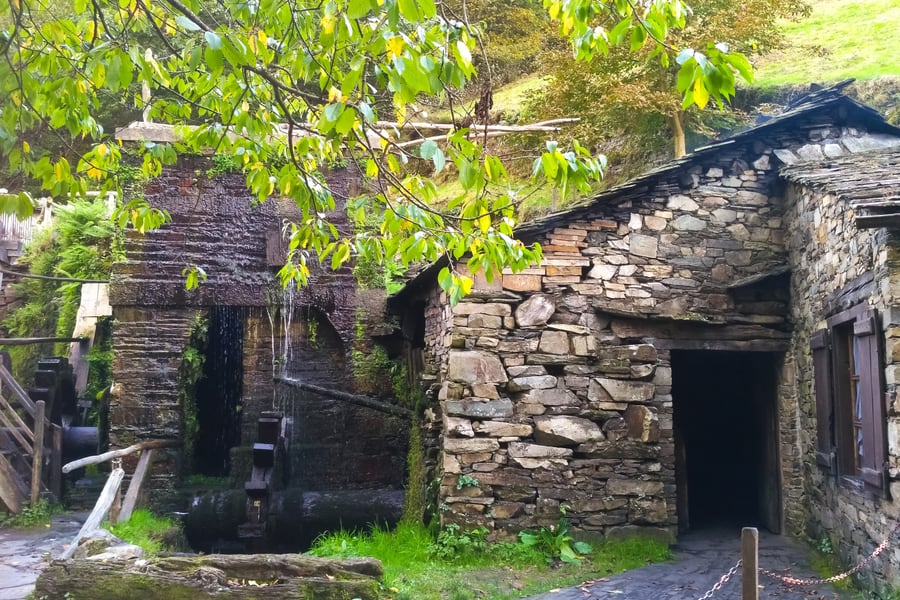 D.Rovchak / Wikimedia Commons · CC BY-SA 4.0 · cropped
Os Teixois, Taramundi
An entire hamlet run on water. Teixois is a casería of the parish of Veigas, in the Taramundi council in the Eo-Navia country, and one channelled stream drives the lot of it — a forge with its hammer, a grindstone, a grain mill and a fulling mill, all under slate roofs in a fold of the hills. The ensemble is protected and still working. Taramundi's knife-making museum, in a district that has made blades by hand for centuries, is on the same excursion.Where to Sleep
Every night of the trip is spent on the train, in the suite that comes with the fare, in a station with the train shut down for the night. There is no hotel to book and no choice to make about it.
What a traveller does need is somewhere for the night before and the night after, because the programme begins at ten in the morning at one end of Spain and finishes in the late afternoon at the other. The three houses below are at the points where the package hands you over: the Parador that is itself the meeting point in Santiago, the station-side grand hotel in Bilbao, and the one in Oviedo where the short itineraries and the 2027 weekend trips begin and end.
None of them is affiliated with Renfe and none is included in the fare.
Where to stay
 Angel Torres / Wikimedia Commons · CC BY 2.0 · cropped
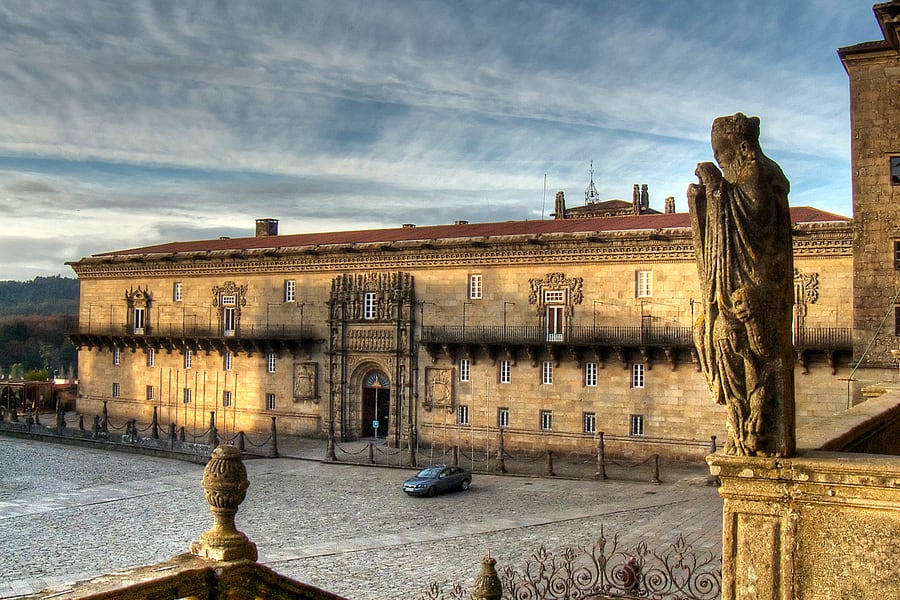
Parador de Santiago de Compostela
The Hostal dos Reis Católicos, on the Praza do Obradoiro
The meeting point for the whole trip in one direction and the farewell lunch in the other. Its own account is that it began as a Royal Hospital founded by the Catholic Monarchs to shelter pilgrims, that it calls itself the oldest hotel in Spain, and that the building keeps its Plateresque façade, four cloisters and a museum inside. It shares the Praza do Obradoiro with the cathedral and the town hall.
Check Availability (opens in a new tab, on paradores.es)via paradores.es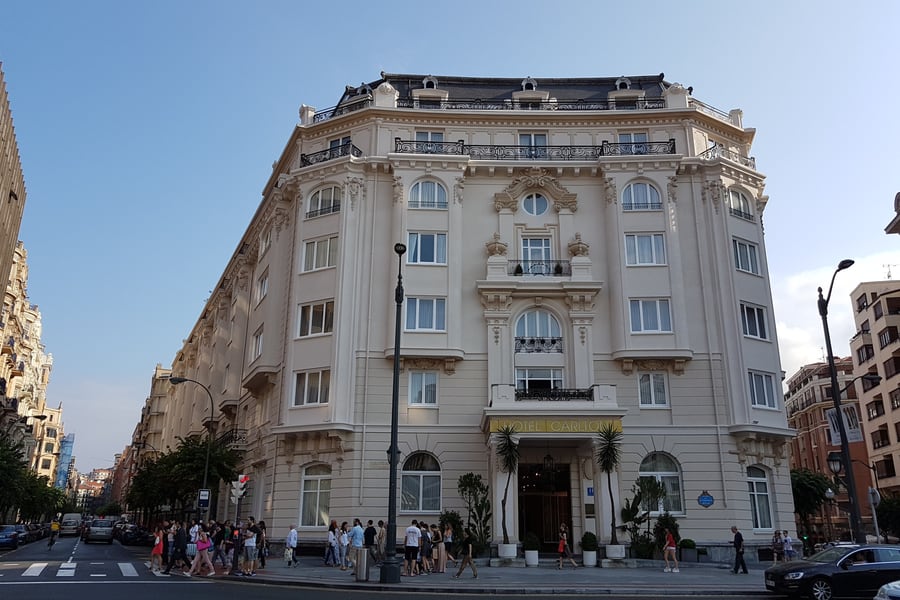 Xabier / Wikimedia Commons · CC BY-SA 4.0 · cropped
Hotel Carlton
On Plaza Moyúa, ten minutes from Bilbao-Concordia
Designed in 1919 by Manuel María de Smith and modelled on the Carlton in London, opened in 1926 and marking its centenary through 2026. Bilbao's tourist board records it as a listed cultural monument of the Provincial Council of Bizkaia, the seat of the Basque Government during the Civil War, a hall where Federico García Lorca lectured and a hotel where Albert Einstein slept.
Check Availability (opens in a new tab, on hotelcarlton.es)via hotelcarlton.es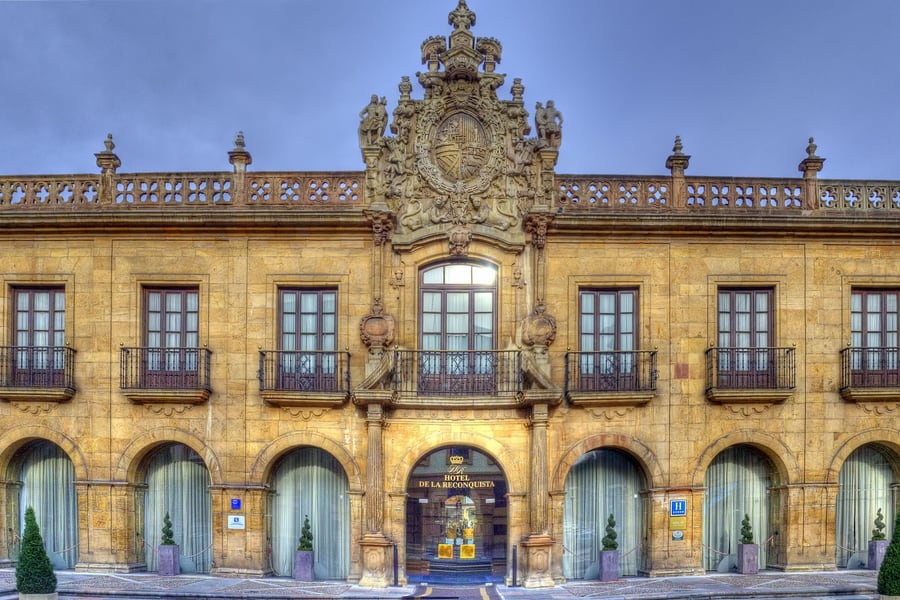 Ángel M. Felicísimo / Wikimedia Commons · CC BY-SA 2.0 · cropped
Eurostars Hotel de la Reconquista
Where the short itineraries and the 2027 weekends begin
The Provincial Hospice of Oviedo from 1752 until 1965, converted to a hotel in 1974 and declared a national monument the year before that. Its own description gives a Baroque façade, two courtyards, an octagonal chapel by Ventura Rodríguez and a collection of Asturian painters. Every October it houses the winners of the Princess of Asturias Awards.
Check Availability (opens in a new tab, on eurostarshotels.com)via eurostarshotels.comQuestions or corrections
Planning this trip and stuck on something, or spotted a time, fare or detail that has changed? Send us a message about Costa Verde Express — nothing about it is old except the styling. We read every one, and we update this page when something has changed.