The Montserrat Rack Railway — the line that was taken away and put back
1997 / Wikimedia Commons · CC BY-SA 3.0 · cropped
- DistanceMonistrol de Montserrat–Montserrat · 5 km
- Duration15 minutes from Monistrol-Vila · 20 from the foot of the line
- Best seasonEvery day of the year · three trains an hour in high season
Introduction
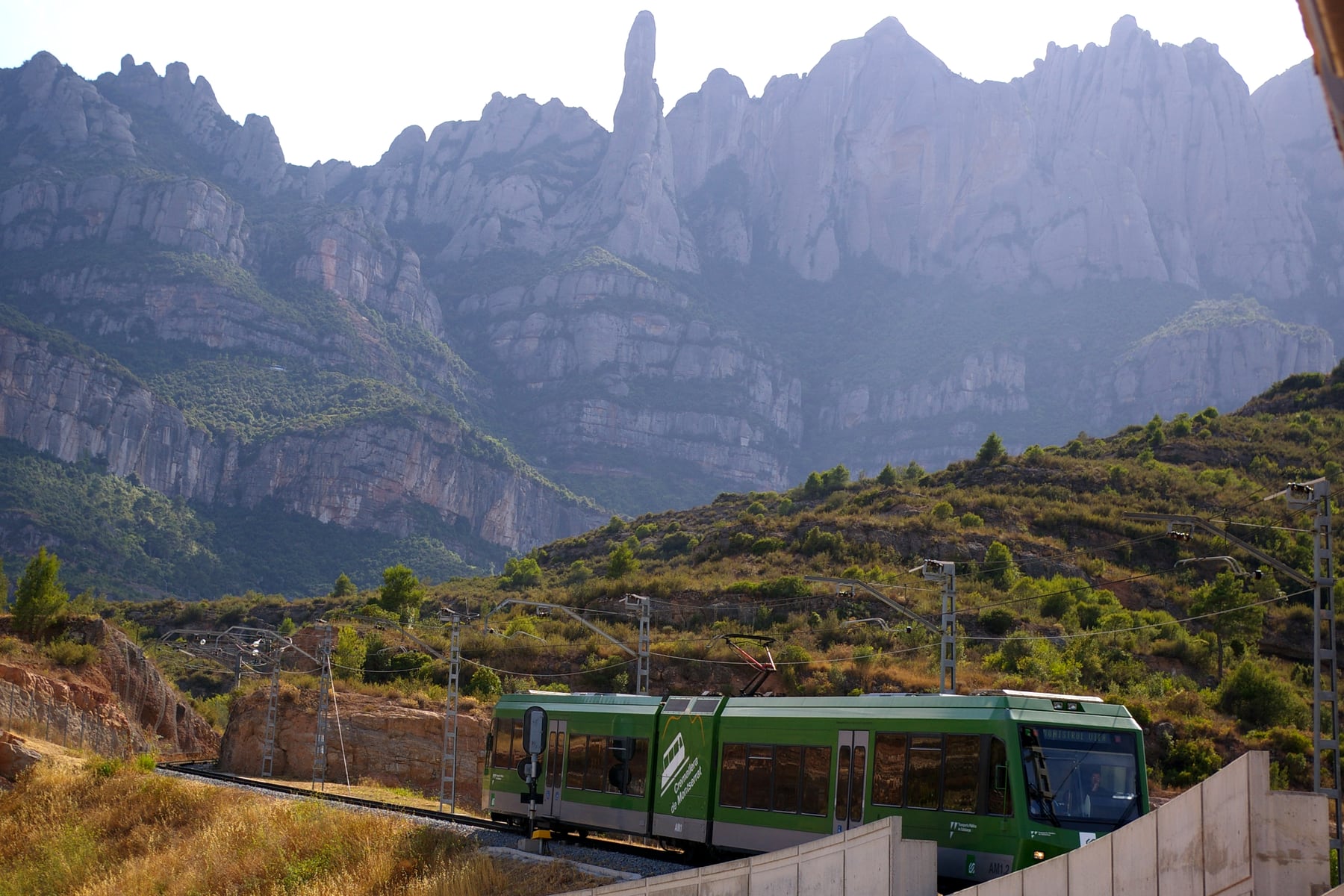
Montserrat is the mountain that Catalonia keeps its monastery on: a mass of conglomerate rock west of Barcelona whose summit ridge has weathered into hundreds of rounded pillars, the agulles — needles — that give the mountain its serrated profile and its name — mont serrat, the sawn mountain. A Benedictine abbey founded in 1025 stands halfway up it, and the whole complex of basilica, museum, shops and hostelries sits on a shelf with cliffs above, a gorge below and the summit of Sant Jeroni at 1,236 metres behind.
Getting people up there has occupied engineers for a hundred and forty years. A rack railway opened from Monistrol to the monastery on 6 October 1892 and quickly became the most popular railway in Catalonia, because linking it with the broad-gauge line at Monistrol made Montserrat a day trip from Barcelona for the first time. Then a road was built, a cable car was strung across the valley in 1930, and in 1957 the rack railway ran for the last time and its track was lifted.
That is where most abandoned mountain railways stop. This one did not. The traffic that had beaten it kept growing until the mountain's road access was congested enough to be a problem in its own right, the Generalitat and Ferrocarrils de la Generalitat de Catalunya studied the alternatives through the 1980s and 1990s, and on 11 June 2003 — forty-six years after the last train — a new rack railway opened on substantially the old alignment.
So the journey has an unusual quality for a heritage-looking line: nothing about it is old. The trains are Stadler articulated cars of 2003, the rack is new steel, the bridge over the Llobregat was built for it, and the whole run takes fifteen minutes. What is old is the idea, and the proof that it was right is that the thing which replaced the railway is exactly why the railway was rebuilt.
The Journey
The line is short enough to describe stop by stop and steep enough that it needs three different kinds of railway to do it. Five kilometres, of which four are worked on the rack, three stations, and a climb of nearly 550 metres between the middle station and the top.
Monistrol de Montserrat: where the two railways meet
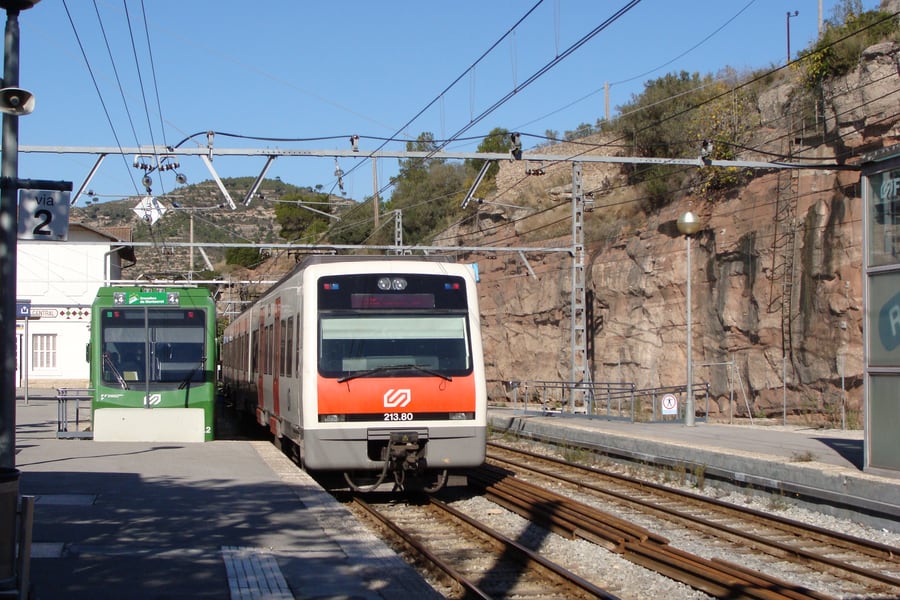
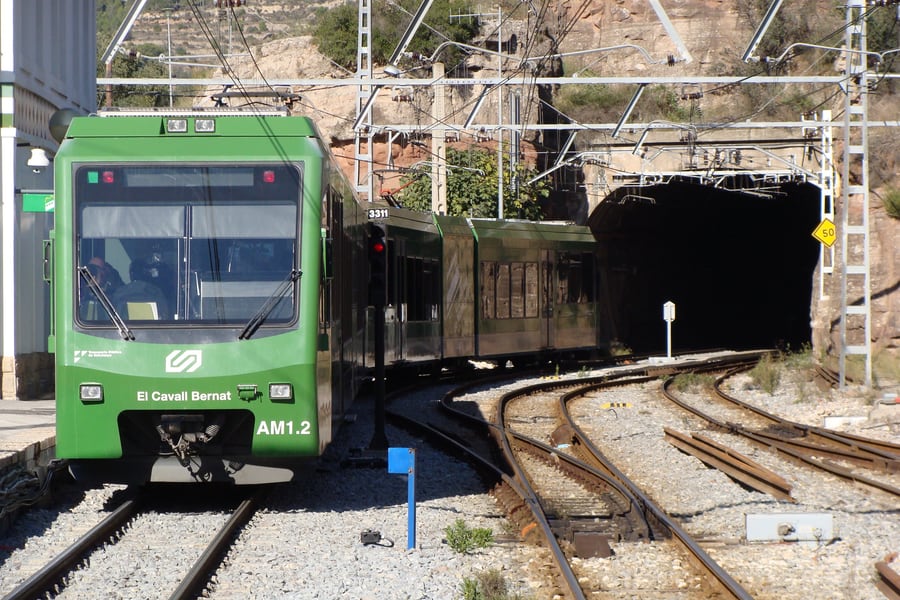
The bottom station is not a rack-railway station at all in origin. Monistrol de Montserrat is a stop on FGC's own Llobregat–Anoia line, the metre-gauge route that runs from Barcelona Plaça d'Espanya to Manresa on 1,500 volts — the same gauge and the same voltage as the rack railway, so that the only real difference between the two is the toothed rail. It is the only place on the journey where the green two-car rack sets stand alongside the orange-fronted commuter trains, and the visual difference between them says most of what needs saying about the gradient ahead.
From there the train runs down the valley floor, through the Foradada tunnel, over the Centenari bridge across the Llobregat and beneath the C-55 road, all on plain adhesion, like any other railway.
Monistrol-Vila: where the teeth start
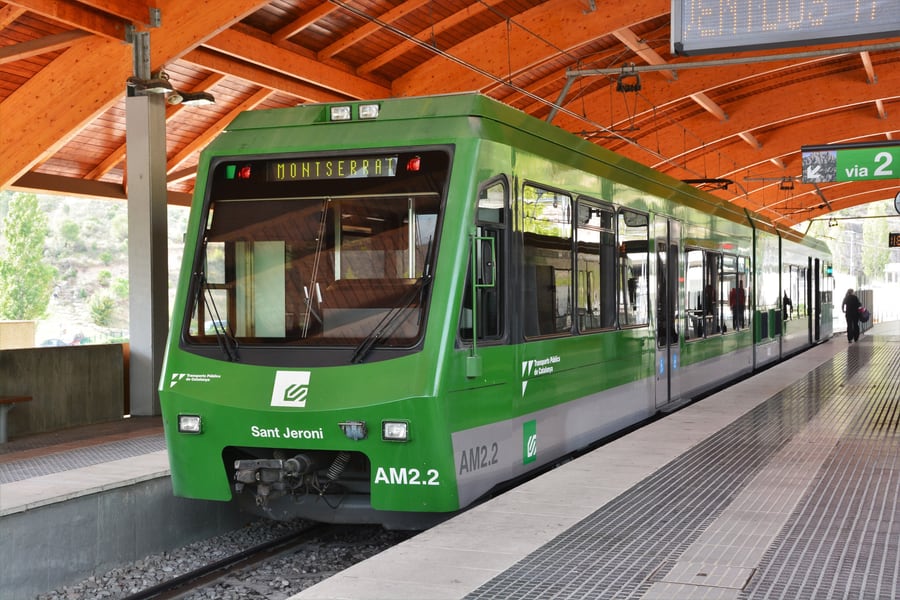
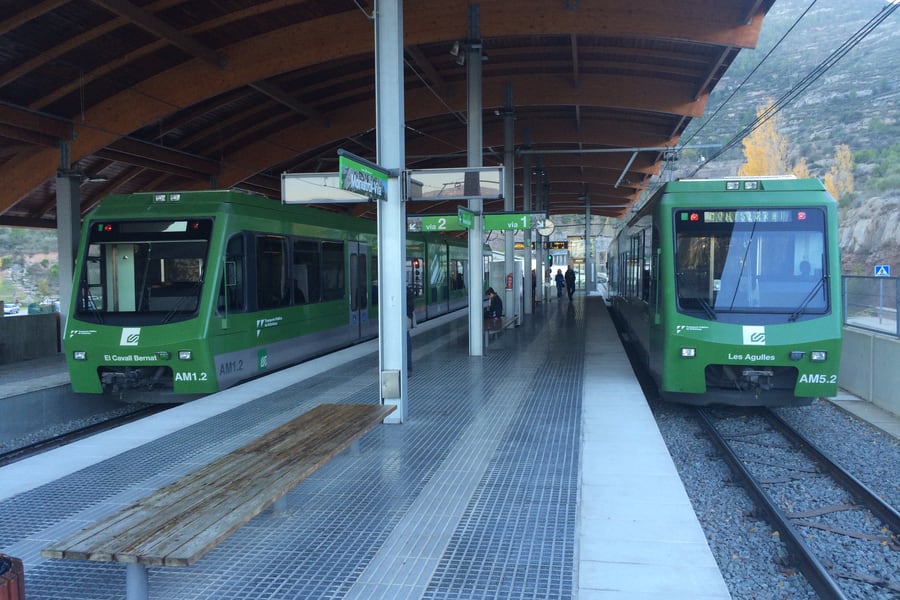
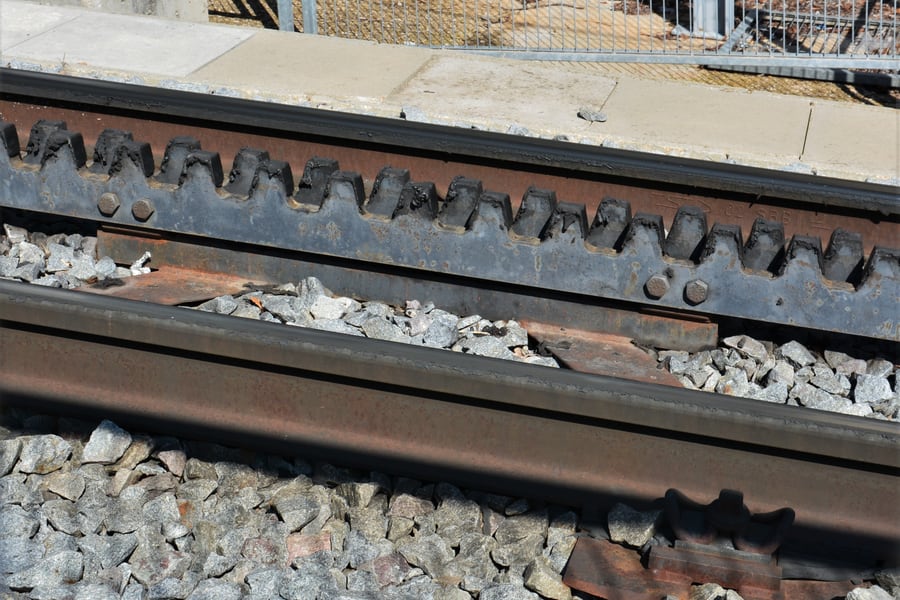
Monistrol-Vila is where most passengers actually join. It has the free car park — the operator gives its capacity as 1,000 cars and 70 coaches — a restaurant, and a timber-vaulted train shed under which the units wait with MONTSERRAT on the blind. It is also where the Abt rack begins, and the character of the journey changes within a few hundred metres: the pinion drops into the toothed rail, the note of the motors changes, and the train starts to climb at a rate no adhesion railway could hold.
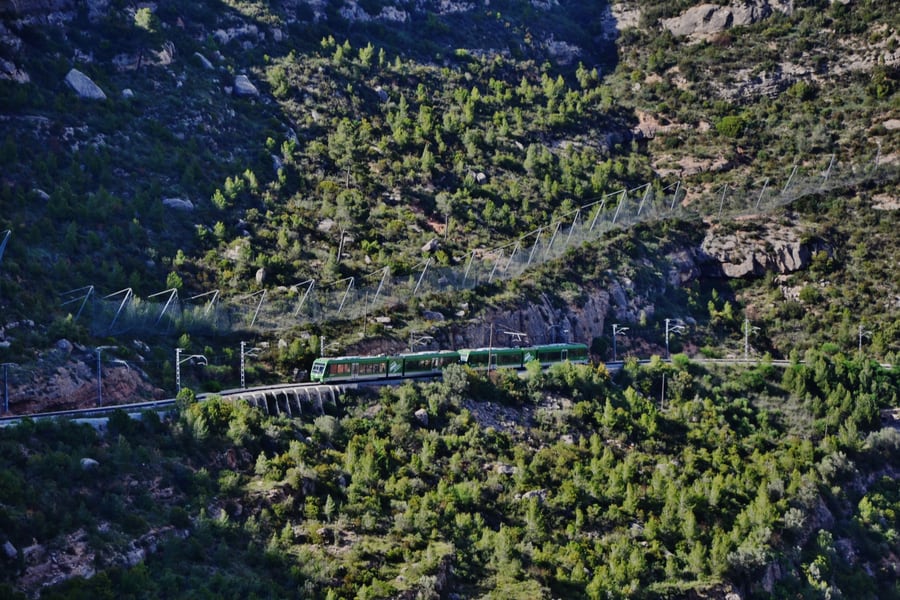
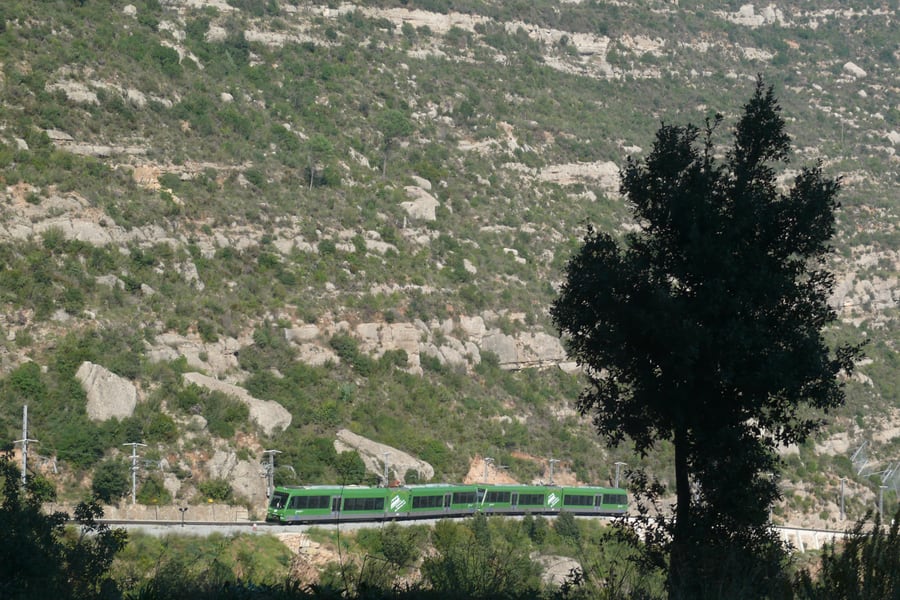
Above the station the line goes through the Àngel tunnel, which the trains of 1892 also used, crosses a new bridge where there was once a level crossing, and then swings onto the Guilleumes bridge, from which the whole serrated skyline appears at once. The last tunnel is the Apòstols, and after it comes the final pull to the terminus, which sits directly below the Plaça de la Creu — the monastery's own front doorstep.
The trains, and what they are called
Six Stadler GTW 2/6 articulated cars work the line, each holding up to 200 passengers, and every one of them is named after something visible from the window. AM1 is El Cavall Bernat, the free-standing pillar that is the mountain's most photographed rock; AM2 is Sant Jeroni, the summit; AM3 is El Montgròs; AM4 is Els Flautats; AM5 is Les Agulles, the needles themselves. The sixth is the odd one out: it came from FGC's other rack railway, the Cremallera de Núria in the Pyrenees, transferred in 2020 and renamed La Roca Foradada.
Naming a fleet after the scenery is a small thing, but it is the detail that tells you what the railway thinks it is for. There is no observation car and no premium seat here. The train is a 15-minute working climb with panoramic windows, and the show is outside.
The one that did not survive
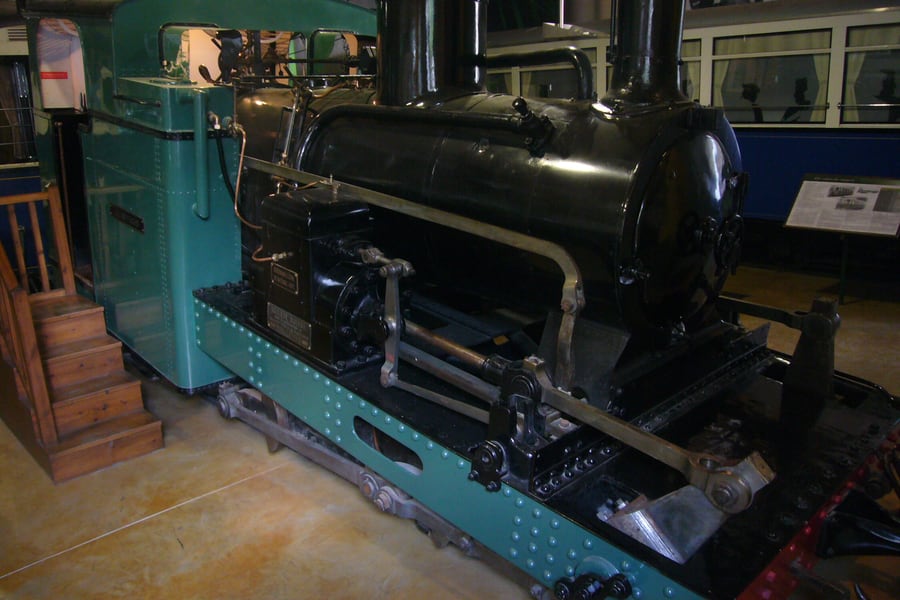
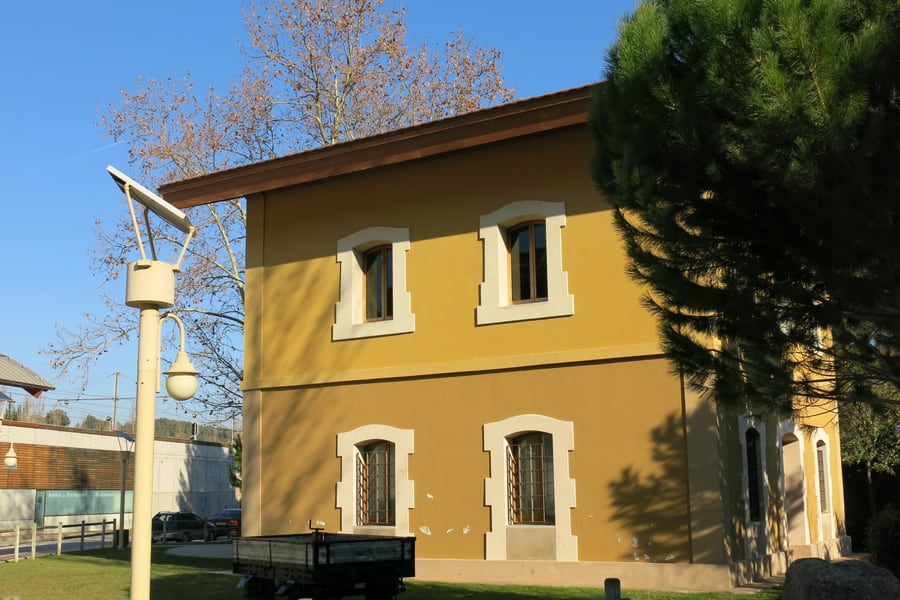
Of the railway that opened in 1892 almost nothing is left on the ground. The old rack-railway station building at Monistrol still stands, restored, and one of the original Abt steam locomotives survives — not here, but up in the Pyrenees, in the old carriage sheds at Ribes-Vila on FGC's other rack railway, the Cremallera de Núria, which was electric from its first day in 1931 and never closed at all.
Along the route
Enric / Wikimedia Commons · CC BY-SA 3.0 · croppedForty-six years off the map
The first railway opened on 6 October 1892 and made Montserrat a day trip from Barcelona. Then a road came, a cable car was strung across the valley in 1930, and in 1957 it ran for the last time and the track was lifted. Today's line opened in 2003.Maria Rosa Ferré / Wikimedia Commons · CC BY-SA 2.0 · croppedRebuilt because the road won
What brought it back was not nostalgia but the traffic on the mountain road. FGC puts it plainly: the rack railway is the alternative to the car for reaching the natural park. In its first twelve months back it carried 462,964 passengers.NearEMPTiness / Wikimedia Commons · CC BY-SA 4.0 · croppedA fleet named after the view
Six Stadler GTW 2/6 cars work the line, each carrying up to 200 people and each named after a feature of the mountain — El Cavall Bernat, Sant Jeroni, Els Flautats. The sixth came second-hand from the Cremallera de Núria in 2020.A bit of history
Culture & experiences along the way
The STB / Wikimedia Commons · CC BY-SA 4.0 · croppedWhere the teeth start
The first kilometre out of Monistrol de Montserrat is ordinary railway — the Foradada tunnel, the Centenari bridge over the Llobregat, the C-55 road passing underneath. At Monistrol-Vila the Abt rack begins, and within a few hundred metres the pinion has dropped into the toothed rail, the note of the motors changes and the train starts to climb at a rate no adhesion railway could hold.DagafeSQV / Wikimedia Commons · CC BY-SA 3.0 · croppedThe Guilleumes bridge
Above the Àngel tunnel, which the trains of 1892 also used, the line swings out onto the Guilleumes bridge and the whole serrated skyline arrives at once — the rounded conglomerate pillars that give the mountain its name. It is the moment the ride stops being a transfer and becomes the reason for coming.The STB / Wikimedia Commons · CC BY-SA 4.0 · croppedFifteen minutes, three times an hour
There is no timetable to memorise. In high season trains leave Monistrol-Vila at :15, :35 and :55 past every hour and take 13 minutes to the monastery; in low season it is :15 and :55. One train an hour runs the full length from the FGC station at the bottom, at :48 up and :15 down. The last train down is between 18:35 and 20:35 depending on the season.Luis Zamora (eldelinux) / Wikimedia Commons · CC BY 2.0 · croppedArriving under Plaça de la Creu
The last tunnel is the Apòstols, and after it the train stops directly below the Plaça de la Creu, the monastery's own square. Everything — basilica, museum, shops, the two funiculars — is within a few minutes on foot, which is what the railway was rebuilt to make possible without a car park.Timetables
The Montserrat rack railway runs every day of the year, and it runs to a clock-face pattern rather than to a list of departures. What changes with the season is how many trains an hour there are, and how late the last one leaves.
All the times below were read on 17 August 2026 from FGC's own timetables for the line and from the operator's live departure search, which returns the actual service for a named date.
The pattern
| Season | Departures from Monistrol-Vila | Frequency |
|---|---|---|
| High | at :15, :35 and :55 past each hour | three an hour |
| Mid | :15, :35 and :55 until mid-afternoon, then :15 and :55 | three an hour, falling to two |
| Low | at :15 and :55 past each hour | two an hour |
The climb from Monistrol-Vila to the monastery takes 13 minutes; the full run from Monistrol de Montserrat takes 20. Coming down, the monastery departures are at the same :15, :35 and :55.
Only one train an hour starts from Monistrol de Montserrat, the station shared with the FGC line from Barcelona: it leaves at 48 minutes past the hour going up, and the corresponding train down leaves the monastery at :15. Everything else begins and ends a stop higher, at Monistrol-Vila, where the car park is.
What that meant on two real dates
On Tuesday 18 August 2026, high season, the operator's own search returned 37 departures up from Monistrol-Vila and 38 down from the monastery. The first train up was 07:55 and the last 20:15; the first down was 08:15 and the last 20:35.
On Wednesday 18 November 2026, low season, the same search returned 22 up and 23 down, at :15 and :55 past each hour, with the last train up at 18:15 and the last down at 18:35.
A note that matters for the first train of the day: FGC sells a cheaper return ticket valid only on the 08:35 and 08:55 from Monistrol-Vila, which is a fair indication of when the mountain is at its quietest.
The funiculars — and one that is not running
Two funiculars belong to the same operator and the same ticket family at the top of the line, and their situation in 2026 is not what the guidebooks say.
The Sant Joan funicular, which climbs from beside the monastery towards the ridge, is running. On 18 August 2026 it made 43 trips, from 09:30 to 18:00, every 12 minutes once the day was under way. It closes for a few weeks each January for its annual overhaul.
The Santa Cova funicular, which drops towards the holy cave, is out of service. FGC's page for the line states it plainly — out of service for maintenance until further notice — and the operator's departure search confirms it rather than merely repeating it: for 18 August 2026 it returns no departures at all, while the same search for 18 August 2025 returns 23. The combined tickets that include it are now sold with the words "when operational" attached to that line, and its fares are still published.
Reaching the bottom of the line
Monistrol de Montserrat is served by FGC's R5 from Barcelona Plaça d'Espanya, which runs about hourly and is in FGC's January 2026 timetable at 36 minutes past the hour for much of the day. The operator puts the whole door-to-door journey from Plaça d'Espanya to the monastery at about an hour and a half each way. Only one rack departure an hour meets that station, so the connection is the part of the day where the two timetables have to agree; arriving at Monistrol-Vila by car gives the more frequent service, and free parking.
FGC publishes the season calendar, day by day, on the Montserrat rack railway page at turistren.cat (opens in a new tab).
Tickets
Tickets for the rack railway are sold at the stations and through FGC's own online shop; the fares here were read on 17 August 2026 and are stated as valid until 31 December 2026. An adult return is €15.00 and a single €9.00, with reductions for children, over-65s and large or single-parent families. Holders of the Catalan disability card travel at half price, as does a companion where one is needed. Dogs travel free, muzzled and on a lead — the ticket office sells a muzzle for €5 to anyone who arrives without one.
Two things catch people out. The Barcelona area's T-Mobilitat card is not valid, because neither the rack railway nor the funiculars belong to the integrated fare network. And the two day-out packages, Trans Montserrat and Tot Montserrat, have to be exchanged for the actual tickets at the welcome point in Plaça d'Espanya station before 14:00 on the day of travel.
Book your tickets
The STB / Wikimedia Commons · CC BY-SA 4.0 · croppedThe rack railway, there and back
€15.00 adult return · €13.50 over 65 · €7.50 child
Monistrol-Vila to the monastery and back, on FGC's own 2026 tariff.
Book Tickets (opens in a new tab, on turistren.cat)via turistren.catLuis Zamora (eldelinux) / Wikimedia Commons · CC BY 2.0 · croppedFGC train and rack railway together
€28.80 adult return from Barcelona Plaça d'Espanya
One ticket for the train out and the rack railway up, priced by fare zone.
Book Tickets (opens in a new tab, on turistren.cat)via turistren.catMaria Rosa Ferré / Wikimedia Commons · CC BY-SA 2.0 · croppedTrans Montserrat
€50.00, open-dated
Metro, the FGC return, the rack railway, the Sant Joan funicular and the basilica.
Book Tickets (opens in a new tab, on turistren.cat)via turistren.catTot Montserrat
€71.50, open-dated
The same as Trans Montserrat plus the Montserrat Museum and a buffet lunch.
Book Tickets (opens in a new tab, on turistren.cat)via turistren.catRail Passes
An Interrail or Eurail pass is of no use on this railway, and it is better to know that at Plaça d'Espanya than at Monistrol.
Interrail and Eurail
This is not a case of an operator quietly missing from a list. Interrail's table of railway companies for Spain covers RENFE, iryo, SNCF, FEVE Cercanías and CP, and keeps a column beside them headed Excluded trains. Ferrocarrils de la Generalitat de Catalunya is written into that column by name, along with Euskotren, the Valencian and Mallorcan networks and Renfe's own tourist and luxury trains.
FGC operates both halves of the journey here — the R5 from Barcelona and the rack railway itself. So unlike most Spanish day trips, a pass covers neither leg, and the €28.80 combined return is payable in full.
That is worth spelling out because the equivalent journey to FGC's other rack railway works differently: the approach to Núria is on a Renfe-operated Rodalies line, which a pass does cover. Here the whole chain is FGC's, and the pass buys nothing at all.
The Turistren Passport
FGC's own answer is the Turistren Passport, a digital record covering the four tourist lines it runs — the Montserrat rack railway and funiculars, the Cremallera de Núria, the Tren dels Llacs and the Tren del Ciment. It registers each journey made and unlocks discounts of up to 20% on the others from the first trip onward.
For a single visit to Montserrat it changes nothing. For anyone spending a week in Catalonia with two or three of the four lines in mind, it is the only pass on this page that applies, and Montserrat is the natural place to start it, because it is the one most people ride first.
What actually saves money
The honest answer for a day out from Barcelona is a through ticket rather than a pass. The rack railway return alone is €15.00; the four-zone combined ticket at €28.80 adds the whole FGC journey from Plaça d'Espanya for €13.80. Trans Montserrat at €50.00 adds the metro, the Sant Joan funicular and the audiovisual space on top of that, and Tot Montserrat at €71.50 adds the museum and lunch. Which of the three is worth it depends entirely on whether the funicular and the museum are part of the plan — the arithmetic is simple, and it is set out under Tickets.
Fares checked against FGC on 17 August 2026; pass conditions re-checked against Interrail's published list of railway companies on 20 August 2026.
Places to Visit
Everything on this journey is within about five kilometres of everything else, which makes it one of the rare railways where the stops are not really the point — the mountain is. The monastery is a minute from the top platform, the needles are overhead, and the two funiculars go on upward and downward from the same square. What follows is what a day here reasonably holds, starting at the bottom of the line.
 EliziR / Wikimedia Commons · CC BY-SA 3.0 · cropped
Monistrol de Montserrat
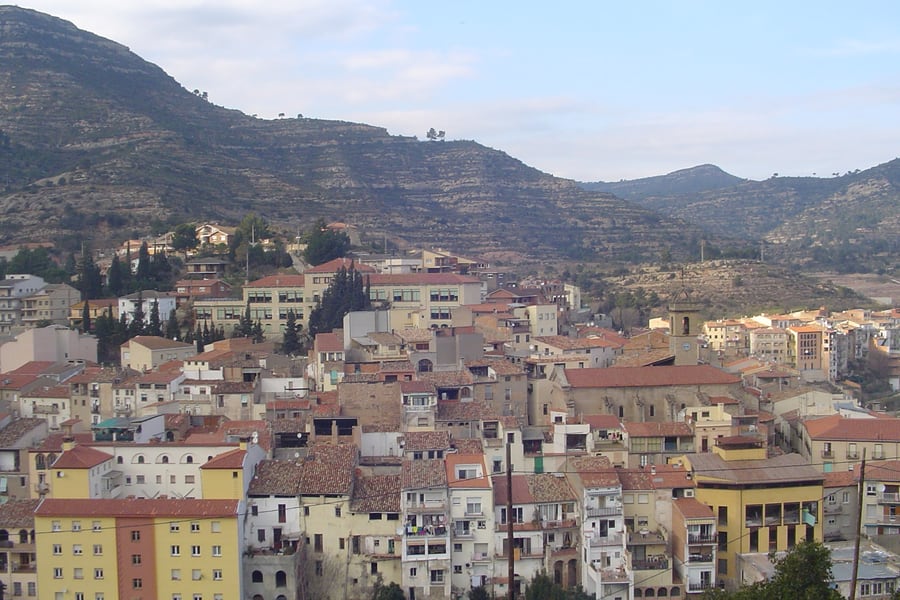
A stone village stacked above the Llobregat, where the FGC line from Barcelona and the rack railway share the same platforms. It is where the railway of 1892 began, where its restored station building still stands, and it has the one thing the mountain does not — somewhere to eat and sleep that is not run by the abbey.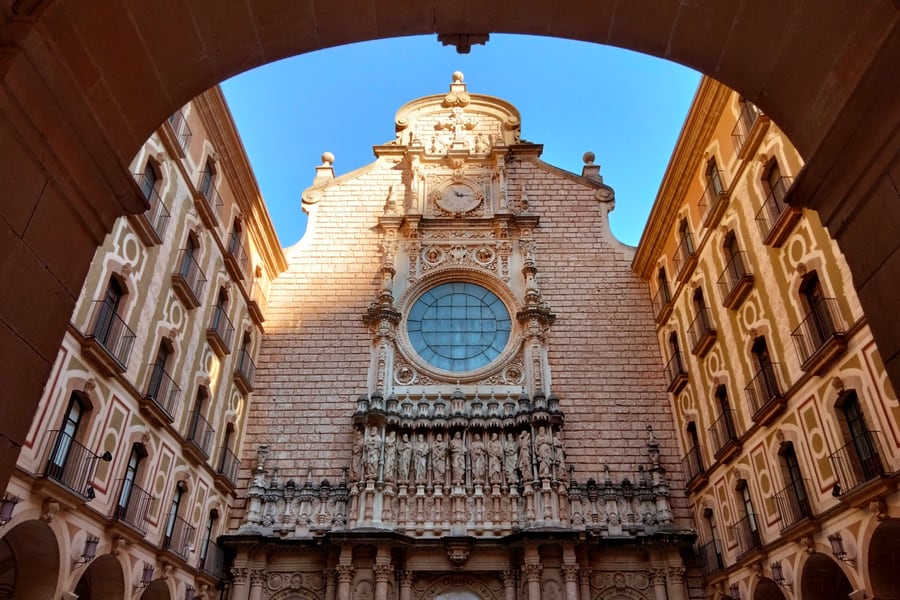 Enric / Wikimedia Commons · CC BY-SA 4.0 · cropped
The monastery and the basilica
A Benedictine abbey has stood here since 1025, when Abbot Oliba founded it on the site of an older hermitage. Napoleon's troops burned and sacked it in 1811, so most of what a visitor sees is later rebuilding around a sixteenth-century core. The basilica holds the Virgin of Montserrat, la Moreneta, proclaimed patron of Catalonia by Leo XIII in 1881.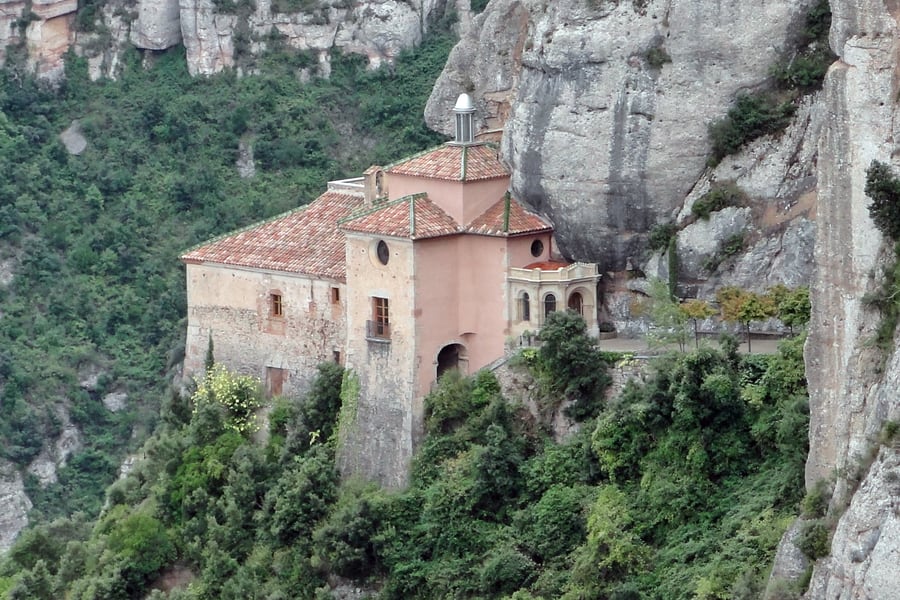 Bernard Gagnon / Wikimedia Commons · CC BY-SA 3.0 · cropped
The Santa Cova
A chapel built onto the cliff below the monastery, at the place where, by tradition, the image of the Virgin was found. A funicular used to save the climb back up — but it has been out of service for maintenance, and FGC's own departure listings return no trips at all for it in 2026, against 23 on the same date a year earlier.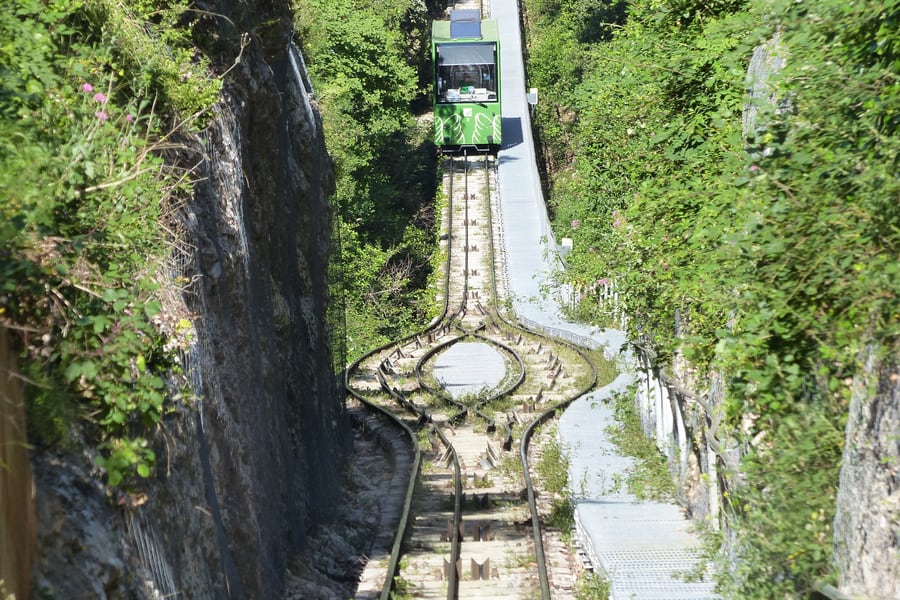 Benjamín Núñez González / Wikimedia Commons · CC BY-SA 4.0 · cropped
The Sant Joan funicular
The other funicular climbs from beside the monastery towards the ridge and the Mirador de Sant Joan, where FGC's interpretation centre for the Geopark and natural park stands. It runs every 12 minutes in season, and it is the quickest way to see how completely the mountain encloses the buildings below.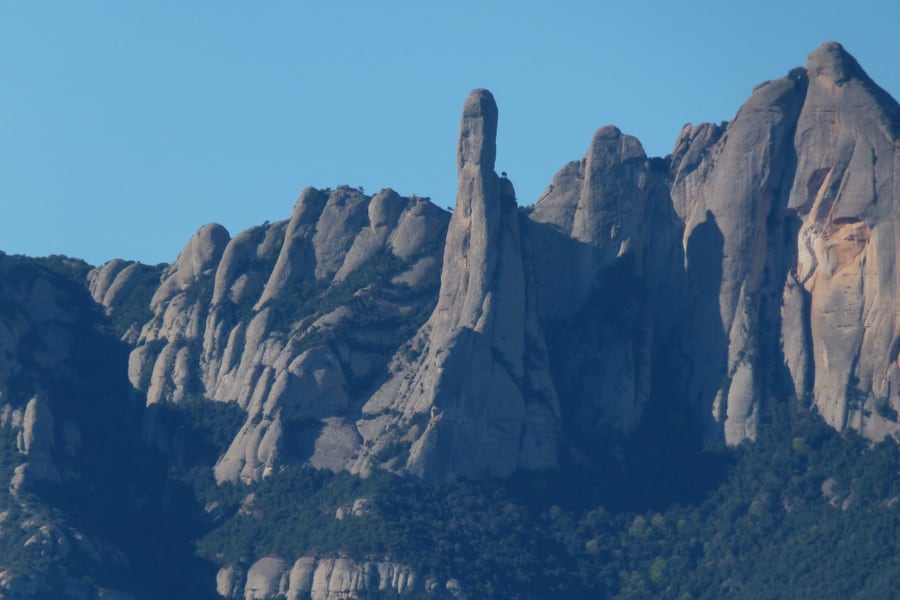 Pere López Brosa / Wikimedia Commons · CC BY-SA 4.0 · cropped
The needles
Montserrat is a mass of conglomerate laid down in a fan delta in the middle Eocene and since weathered into hundreds of rounded pillars — the agulles. The highest point is Sant Jeroni at 1,236 metres; the most famous single rock is El Cavall Bernat. The mountain has been a protected natural park since 1987, and the railway's whole fleet is named after its rocks.Where to Sleep
Almost everyone comes to Montserrat for the day, which is exactly why staying the night is worth considering: the last train down is between 18:35 and 20:35 depending on the season, and after it leaves, a mountain that had thousands of people on it empties.
There are only two places to sleep in this story. On the mountain itself, the abbey runs all the accommodation — a hotel, a block of apartments and a hostel, all within the sanctuary complex, all booked through the same office. At the bottom, in the village of Monistrol de Montserrat, there is a small family hotel by the station where the FGC train and the rack railway meet.
One detail is unusual enough to be worth stating plainly: both the hotel and the apartments say their prices include the rack railway free of charge for the length of the stay, provided the booking is made through the abbey's own site, with the tickets collected at Monistrol-Vila where the car park is also free. That is the operator and the destination cooperating in a way that is rarely so explicit.
Where to stay
Hostal Abat Cisneros
In the sanctuary, beside the basilica
The building has housed pilgrims since 1563 and was converted into a hostal in the late 1950s. Its own site lists 82 rooms and a capacity of 153, with 62 of them looking onto the mountain or the square, a bar and restaurant, lift, meeting rooms, a reading room and a children's playground. Rooms booked through the abbey's site include the rack railway free for the length of the stay, collected at Monistrol-Vila.
Check Availability (opens in a new tab, on montserratvisita.com)via montserratvisita.comCel·les Abat Marcet
Self-catering apartments at the monastery
Ninety-two apartments for one to four people, up to 260 guests in all, each with bathroom, kitchen, heating and television, in a building put up in the 1960s to plans by Father Pere Busquets and named for the abbot who served from 1912 to 1946. The site describes an energy refurbishment completed in 2023, and here too the rack railway is included for the stay when booked directly.
Check Availability (opens in a new tab, on montserratvisita.com)via montserratvisita.comAlberg Abat Oliba
The hostel inside the monastery grounds
A hostel in a building of 1952, renovated in 2018, named after the abbot who founded the monastery. It offers bunk rooms for four to ten, thirty-eight family rooms for four to eight with their own bathrooms, and studios for one or two, with communal and family kitchens, a dining room, bicycle parking, lift and step-free access.
Check Availability (opens in a new tab, on montserratvisita.com)via montserratvisita.comHotel Guilleumes
Monistrol de Montserrat, at the foot of the line
A small family hotel in the village where the FGC line and the rack railway meet, run by Pere and Carme, who are refreshingly direct about it on their own site: no luxury, rooms that are simple and not very large, a village with no shopping centre and not many people, and in exchange quiet, the mountain and good company. Double, single, twin and family rooms, and dogs are welcome.
Check Availability (opens in a new tab, on guilleumes.com)via guilleumes.comQuestions or corrections
Planning this trip and stuck on something, or spotted a time, fare or detail that has changed? Send us a message about The Montserrat Rack Railway — the line that was taken away and put back. We read every one, and we update this page when something has changed.