The Núria Rack Railway — the valley with no road
Otto Hundsdorfer (Ottomuc) / Wikimedia Commons · CC BY-SA 3.0 · cropped
- DistanceRibes-Enllaç–Núria · 12.5 km
- DurationAbout 40 minutes each way
- Best seasonEvery day of the year · most departures from late June to early September
Introduction
Most mountain railways are an alternative. There is a road, usually a good one, and the train is the nicer way to arrive — slower, older, better to look out of. The Cremallera de Núria is not that kind of railway. Six kilometres above Ribes de Freser the tarmac reaches the village of Queralbs and simply stops. Beyond it the valley closes into a gorge, and everything on the far side of that gorge — a basilica, a hotel, a hostel with a hundred and ninety beds, a lake, a ski area, the people who work in all of them and every crate of food they use — arrives on this line or does not arrive at all.
That single fact rearranges the whole page. The timetable is not a leisure schedule but a supply line, which is why it runs on every day of the year rather than at weekends in season, and why the departure that matters most is the 21:00 down from the top, the one that gets the kitchen staff home. The fares have two entirely different characters: thirty-four euros return for a visitor coming up from the valley floor, and six euros for a resident going one stop between Ribes and Queralbs, because on its lower half the same railway is somebody's bus.
The line opened on 22 March 1931 and has never known any other form of power — it was electrified from the first day, at 1500 volts, by four Swiss-built locomotives that arrived before the railway did. It climbs 12.5 kilometres in about forty minutes, gaining over a thousand metres to finish at Núria, 1,964 metres up. For the first 5.5 kilometres it behaves like any other metre-gauge railway, running on plain adhesion. Then, above Queralbs, a toothed third rail appears between the running rails, the driver moves a switch on the console from a plain wheel to a cogwheel, and the train starts hauling itself up gradients of one in six and a half.
What follows is the part nobody forgets: a shelf cut into the rock wall of the Núria gorge, short tunnels, and long concrete galleries built not for scenery but because avalanches come down here every winter and the road that does not exist would not have survived them either. The train emerges at the top into a wide green hollow ringed by peaks, with a stream, a small lake and one long ochre building that contains the sanctuary, the hotel and the station all at once.
It is a short journey by any measure — you can ride it up and down inside two hours. It is also one of the few railways left in Europe where the question "why not just drive?" has a complete and final answer.
The Journey
The journey has two halves, and they are not the same railway.
Ribes de Freser to Queralbs — the adhesion half
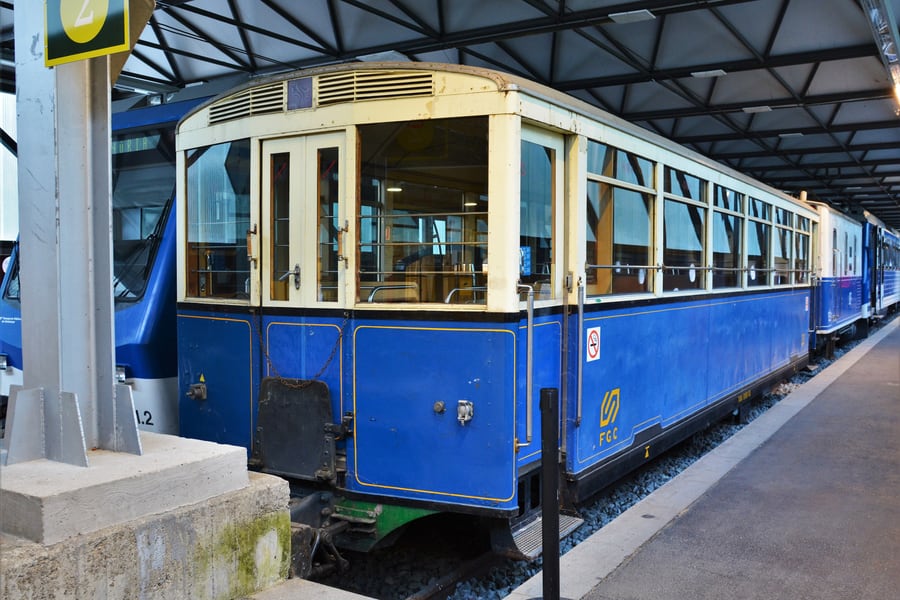
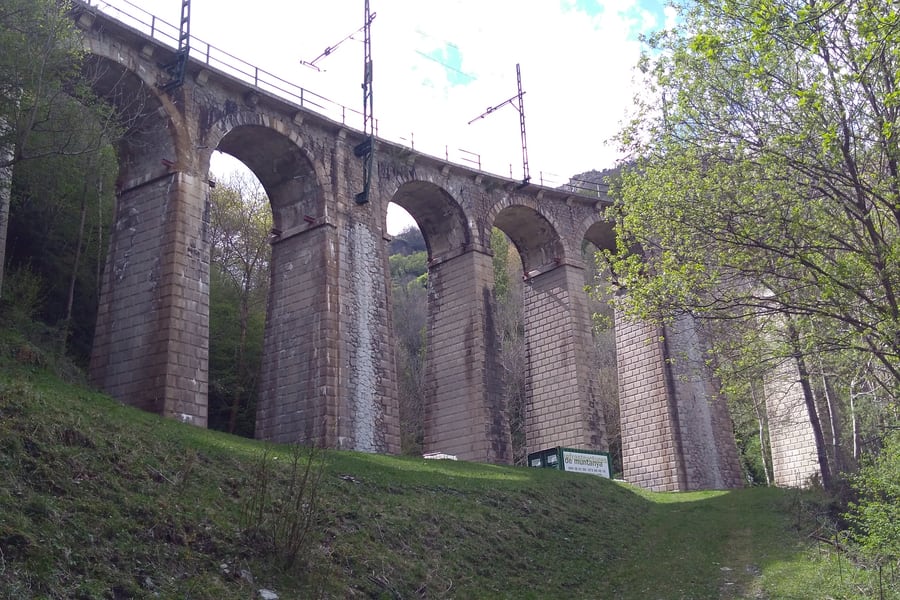
Trains start from Ribes-Enllaç, the interchange beside the Rodalies station, at kilometre zero. A little over a kilometre on is Ribes-Vila, the station actually in the town, where FGC keeps its rolling-stock exhibition — old cars in the cream and blue the line wore when it opened, kept under cover on a spur. Between the two the train crosses the masonry viaducts that carried it in 1931 and still do.
This first section, 5.5 kilometres of it, is worked on plain adhesion. There is no rack. The train climbs steadily through pasture and broadleaf woods with the Freser below on the right, and behaves like the local railway it partly is: this is the stretch that people from Queralbs use to get to Ribes and back, priced accordingly, and the train that leaves Ribes at 07:30 exists at least as much for them as for anybody with a camera.
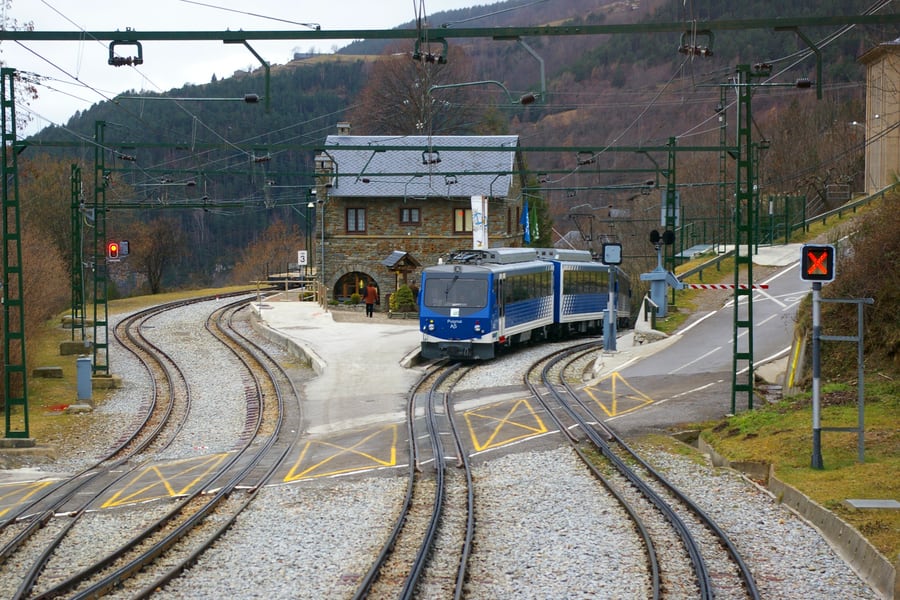
Queralbs, at kilometre 6.406, is the hinge of the whole journey. It is a village of stone houses and wooden balconies stacked on a shelf above the river, first recorded as Keros Albos in 836, and it is the last place on this line that a public road reaches. Everyone who gets off here could have driven. Nobody continuing past can.
Queralbs to Núria — the rack half
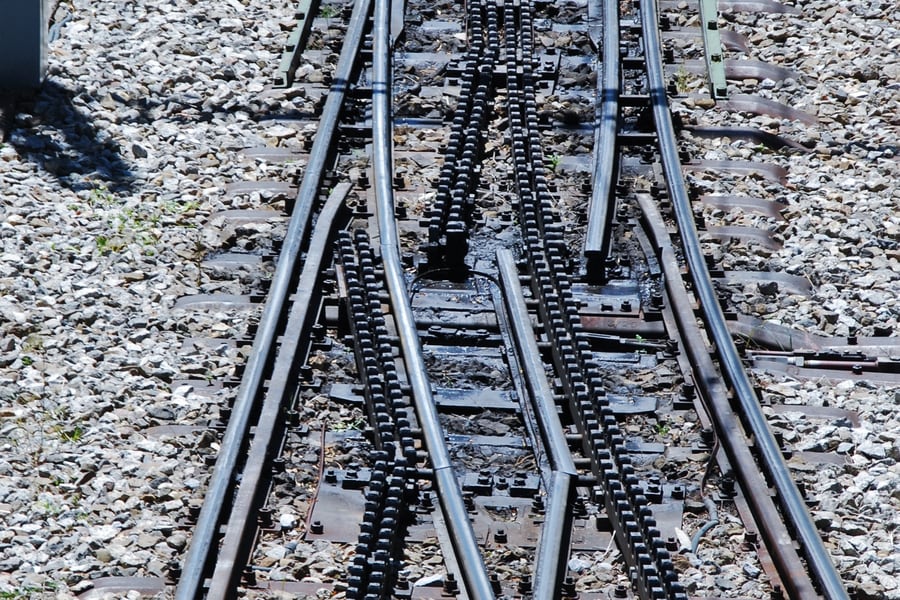
Above the village the toothed rail of the Abt system begins, and the line turns into the wall of the Núria gorge. The Abt rack is two toothed bars laid side by side with their teeth offset, so that the pinion under the train is always engaged in one of them and never has a moment of nothing to push against. That is what makes gradients of 15% — one in six and a half — routine here, where a railway relying on friction alone gives up at about a tenth of that.
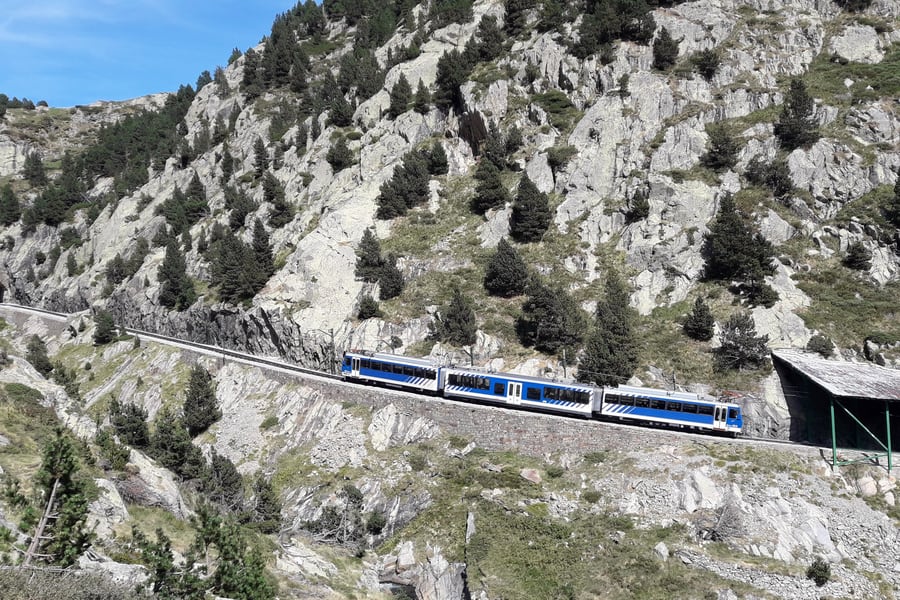
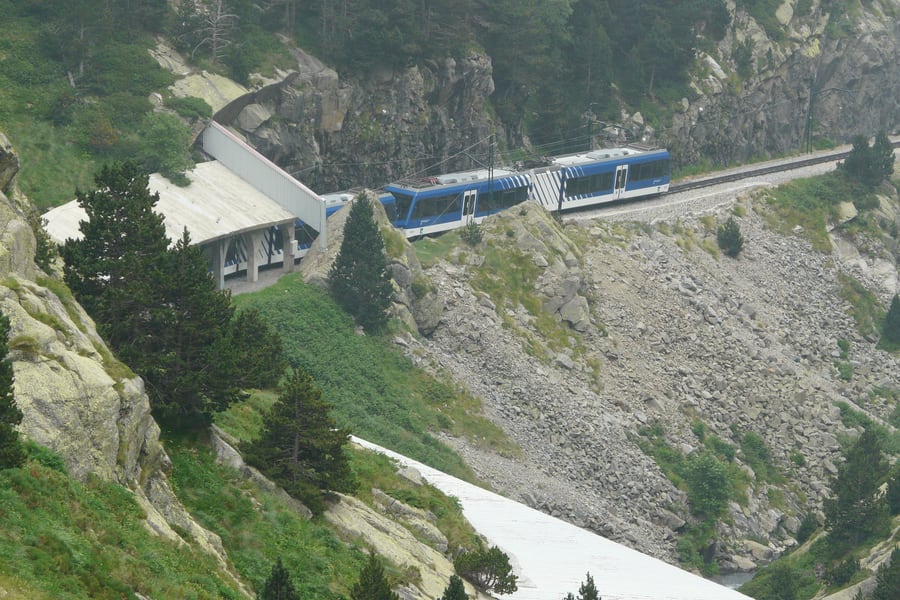
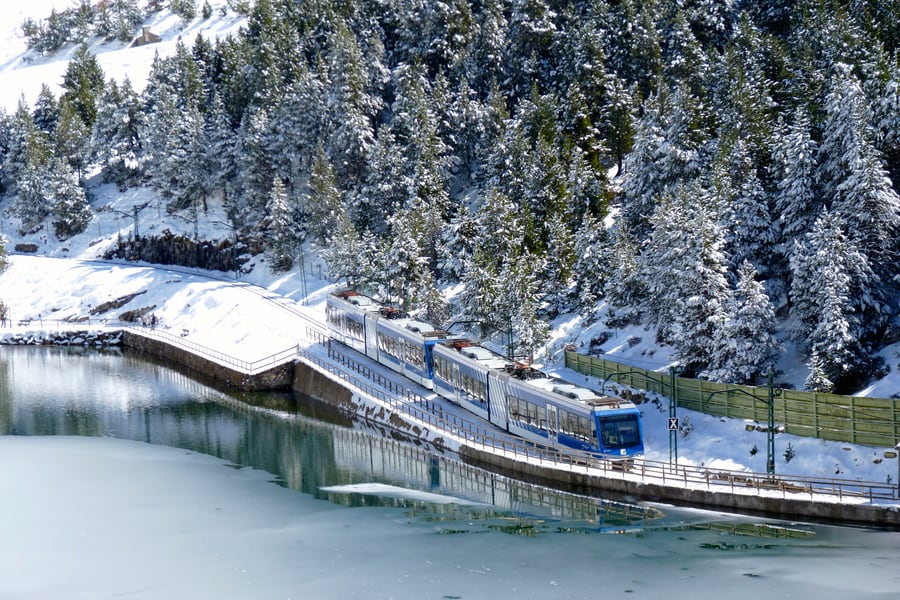
What the train is doing becomes visible from the window. The line runs on ledges blasted out of near-vertical rock, ducks through short tunnels, and passes under long concrete galleries that look like tunnels with one side missing. Those galleries are avalanche protection. This gorge fills with snow, and the railway has to keep working through it, because if it stops the valley above has no other supply.
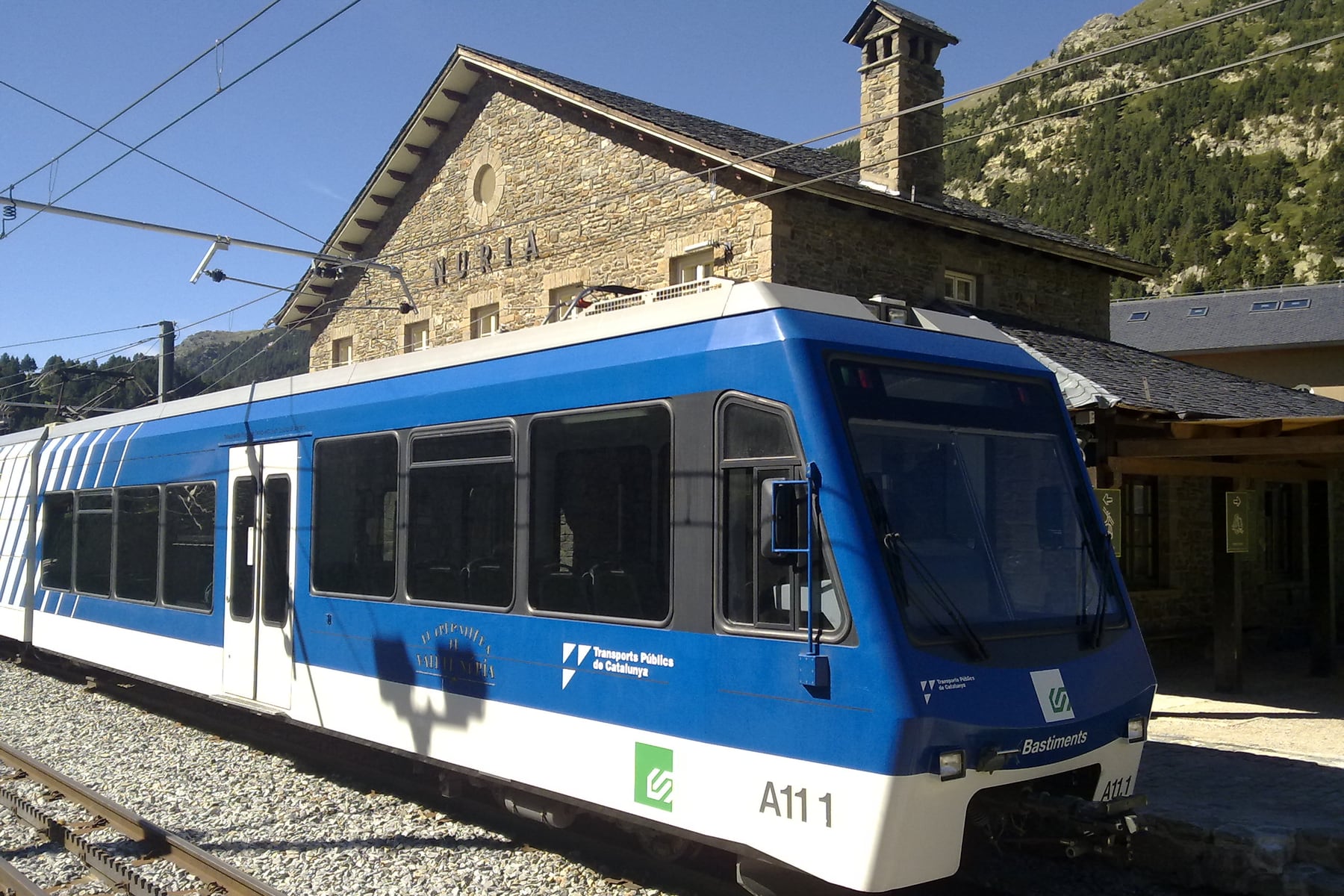
Then the gorge opens, quite suddenly, into the wide grassy bowl of Vall de Núria at 1,964 metres, and the train runs its last few hundred metres along the edge of the lake to a stone station with NÚRIA carved into the gable.
What is likely to be pulling you
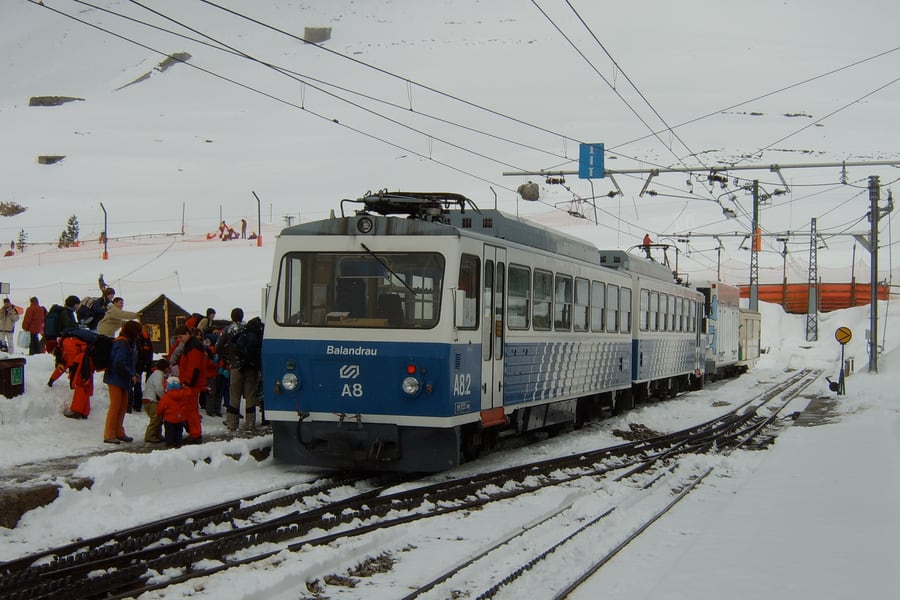
The line was electric from its first day in 1931, at 1500 V DC — there was never a steam era. Its original four locomotives, E1 to E4, were six-wheeled machines built by the Swiss firms SLM and BBC in 1930–31, delivered before the railway they were meant to work was finished. Four more cars, A5 to A8, followed from the same two builders in 1985. The newest passenger vehicles are two low-floor Stadler GTW units of 2003, which is what most visitors now ride.
The cars are named, and named locally: A8 carries Balandrau, the 2,585-metre summit on the ridge that divides Queralbs from the Camprodon valley, and one of the Stadler units carries Bastiments, the 2,800-metre peak that is the easternmost in the whole Pyrenean chain to reach that height. Both stand above the valley the train is climbing into, which means the nameplate on the front is usually pointing at something you can see from the window. The railway also keeps a 1995 Stadler diesel and a 2019 dual-mode locomotive for works trains — necessary, because when this line is blocked there is no relief road to send a lorry up.
The railway passed to Ferrocarrils de la Generalitat de Catalunya on 2 January 1984 and has been theirs ever since.
Along the route
1997 / Wikimedia Commons · CC BY-SA 3.0 · croppedThe road stops at Queralbs
Queralbs is the last station a public road reaches. Above it the valley narrows into a gorge, the tarmac ends, and the only way on for a hotel guest, a hostel cook, a skier or a delivery is the rack railway.The STB / Wikimedia Commons · CC BY-SA 4.0 · croppedHalf a railway, twice over
The first 5.5 kilometres out of Ribes are worked on plain adhesion. Only above that does the Abt rack begin, and with it a maximum of 15%. The driver's console has a switch for the change, marked with a wheel on one side and a cogwheel on the other.The STB / Wikimedia Commons · CC BY-SA 4.0 · croppedElectric since the first day
The railway opened on 22 March 1931 and has never worked any other way — there was no steam era to be nostalgic about, because it was electrified at 1500 V DC from the outset. Its first four locomotives came from the Swiss builders SLM and BBC.A bit of history
Culture & experiences along the way
Victor molas / Wikimedia Commons · CC BY-SA 3.0 · croppedA timetable that behaves like a road
Because there is no alternative route, the service does not thin out to a weekend novelty. It runs every day of the year, and in high season there are fourteen departures each way, the first up from Ribes-Vila at 07:30 and the last down from Núria at 21:00. On a line that exists to please tourists, the 21:00 would be unnecessary. On a line that is the valley's only road, it is the one that gets the staff home.Pere López Brosa / Wikimedia Commons · CC BY-SA 4.0 · croppedThe gorge section
Above Queralbs the railway is cut into the wall of the Núria gorge — a shelf of rock ledges, short tunnels and concrete avalanche galleries with the Freser a long way below. It is the part of the ride that photographs badly and is unforgettable in person, because the scale only reads when the opposite wall is moving past the window.Phil Richards / Wikimedia Commons · CC BY-SA 2.0 · croppedWhat the ticket already covers
The rack-railway fare is not only transport. FGC includes the Coma del Clot cable car up to the Pic de l'Àliga, the new lake viewpoint, the rolling-stock and "Memòries de Neu" exhibitions at Ribes-Vila, the Vall dels 5 Elements visitor centre and audiovisual, entry to the basilica, and an audio guide. At weekends there is also a guided run with a stop at Fontalba.Pere López / Wikimedia Commons · CC BY-SA 3.0 · croppedArriving at 1,964 metres
The train runs the last stretch beside the lake and stops under the gable of the station building, which has NÚRIA carved into the stonework and the sanctuary attached behind it. Everything in the valley is within a few minutes' walk of that platform, because everything in the valley had to be carried up on this railway to get there.Timetables
The Núria rack railway runs every day of the year. It has to: it is the only access to the valley, so there is no closed season and no weekends-only timetable. What changes is how many trains run, and FGC divides the year into a high season and a low season, publishing both in the same leaflet.
All times below are from FGC's own fare-and-timetable leaflet for spring, summer and autumn 2026, read on 17 August 2026. The fares in it are stated as valid until 30 November 2026.
High season — up from Ribes
Fourteen departures a day. Times are Ribes-Enllaç, Ribes-Vila, Queralbs, Núria.
| Ribes-Enllaç | Ribes-Vila | Queralbs | Núria |
|---|---|---|---|
| — | 07:30 | 07:46 | 08:03 |
| 08:35 | 08:41 | 08:57 | 09:14 |
| 09:35 | 09:41 | 09:57 | 10:14 |
| 10:20 | 10:26 | 10:42 | 10:59 |
| 11:10 | 11:16 | 11:32 | 11:58 |
| 12:05 | 12:11 | 12:27 | 12:44 |
| 12:55 | 13:01 | 13:17 | 13:34 |
| 13:40 | 13:46 | 14:02 | 14:19 |
| 14:30 | 14:36 | 14:52 | 15:09 |
| 15:35 | 15:41 | 15:57 | 16:14 |
| 16:25 | 16:31 | 16:47 | 17:04 |
| 17:10 | 17:16 | 17:32 | 17:49 |
| 18:05 | 18:11 | 18:27 | 18:44 |
| 20:10 | 20:16 | 20:32 | 20:49 |
The 18:05 runs on Fridays only. The 20:10 runs every Friday and daily from 2 to 31 August. The 07:30 starts from Ribes-Vila, not from the interchange.
High season — down from Núria
| Núria | Queralbs | Ribes-Vila | Ribes-Enllaç |
|---|---|---|---|
| 08:35 | 08:57 | 09:11 | 09:15 |
| 09:35 | 09:57 | 10:11 | 10:15 |
| 10:20 | 10:42 | 10:56 | 11:00 |
| 11:10 | 11:32 | 11:46 | 11:50 |
| 12:05 | 12:27 | 12:41 | 12:45 |
| 12:55 | 13:17 | 13:31 | 13:35 |
| 13:40 | 14:02 | 14:16 | 14:20 |
| 14:30 | 14:52 | 15:06 | 15:10 |
| 15:35 | 15:57 | 16:11 | 16:15 |
| 16:25 | 16:47 | 17:01 | 17:05 |
| 17:10 | 17:32 | 17:46 | 17:50 |
| 18:05 | 18:27 | 18:41 | 18:45 |
| 19:00 | 19:32 | 19:46 | 19:50 |
| 21:00 | 21:22 | 21:36 | 21:40 |
The 19:00 runs on Fridays only; the 21:00 runs every Friday and daily from 2 to 31 August.
Low season
The low-season table drops to ten departures each way. Upward, it keeps the 07:30 from Ribes-Vila and then runs at 08:35, 09:35, 11:10, 12:55, 14:30, 16:25, 17:10, 18:05 and 20:10 — the 10:20, 12:05, 13:40 and 15:35 paths are the ones that disappear. Downward it runs 08:35, 10:20, 12:05, 13:40, 15:35, 17:10, 18:05, 19:00 and 21:00. The 08:35 up carries a note that it runs at weekends in May, on 6, 7, 13 and 14 June, and daily from 27 June to 8 September.
FGC publishes the current leaflet, with the season calendar shaded day by day, on the Núria rack railway page at turistren.cat (opens in a new tab).
Getting to Ribes de Freser — and a warning for 2026
Ribes-Enllaç is an interchange with the Renfe-operated Rodalies de Catalunya line R3, which runs from Barcelona up the Ter valley to Ripoll, Ribes de Freser, Puigcerdà and the French border.
The R3 is not whole in 2026. Rodalies' own service notice, last updated 6 July 2026, sets out the position: the section between L'Hospitalet de Llobregat and La Garriga is closed for Adif engineering works with replacement buses, R4 trains cover L'Hospitalet to Montcada Bifurcació, and only half the pre-January circulations are running between La Garriga and Puigcerdà, with journey times longer than the printed schedule. The line north of Ripoll had itself been shut by storm Harry in January and only reopened as far as Ribes de Freser on 5 May 2026.
In practice that means five trains a day each way reach Ribes de Freser. From the official R3 timetable dated 6 July 2026, the northbound arrivals at Ribes de Freser are 08:29, 12:01, 14:59, 17:59 and 19:59, and the southbound departures are 07:04, 09:03, 11:33, 15:19 and 18:19.
The connections are workable but two of them are tight — the 08:29 arrival gives six minutes for the 08:35 rack departure, and the 12:01 gives four for the 12:05. The 14:59 and 17:59 arrivals connect comfortably into the 15:35 and 18:05. Anyone travelling from Barcelona in 2026 would do well to check the Rodalies R3 service notice (opens in a new tab) on the day, because this is a situation that has changed repeatedly through the year.
There are also three free car parks at the bottom of the line, at Ribes-Enllaç, Ribes-Vila and Queralbs, for anyone driving to the point where the road runs out.
Tickets
FGC asks for rack-railway tickets to be bought online before travelling. The trains have a fixed number of places, so arriving at Ribes on an August Saturday hoping to buy at the window is the one way this journey goes wrong. The full return from Ribes is €34.00 for an adult, €29.00 from 65 and €22.00 for a child from 4 to 13; both legs have to be used on the same day. Prices are FGC's own 2026 leaflet, valid until 30 November 2026.
The fare is not only the train. It also covers the Coma del Clot cable car up to the Pic de l'Àliga, the lake viewpoint, the exhibitions at Ribes-Vila, the Vall dels 5 Elements visitor centre and entry to the basilica of Núria. The lower half of the line, Ribes to Queralbs, is priced separately as local transport — €6.00 single — and that urban ticket is sold at the ticket offices rather than online.
Book your tickets
1997 / Wikimedia Commons · CC BY-SA 3.0 · croppedRibes – Núria, there and back
€34.00 adult · €29.00 from 65 · €22.00 child · booked online
The full line, with the cable car, the exhibitions and the basilica included.
Book Tickets (opens in a new tab, on turistren.cat)via turistren.catVictor molas / Wikimedia Commons · CC BY-SA 3.0 · croppedTrenatura
€40.20 adult · €30.70 child, any day of the week
The R3 return from the Rodalies network, the rack railway and the cable car on one ticket.
Book Tickets (opens in a new tab, on rodalies.gencat.cat)via rodalies.gencat.catSki Tren
€47.70 adult · €40.20 child
The same combined ticket with a day's lift pass at Vall de Núria added.
Book Tickets (opens in a new tab, on rodalies.gencat.cat)via rodalies.gencat.catRiujoanriu / Wikimedia Commons · CC BY-SA 4.0 · croppedThe local fare, Ribes to Queralbs
€6.00 single · €7.50 return
The adhesion half of the line, priced as the bus it also is, and sold at the counter.
Book Tickets (opens in a new tab, on turistren.cat)via turistren.catRail Passes
The short answer is that an Interrail or Eurail pass does not pay for this journey, and it is worth knowing that before arriving at Ribes with one in a pocket.
Interrail and Eurail
Interrail's own list of participating railway companies names Renfe, iryo, SNCF, FEVE Cercanías and CP for Spain. Ferrocarrils de la Generalitat de Catalunya appears in the opposite column, under excluded trains. FGC operates the Núria rack railway, so a pass buys nothing on it — the full €34.00 return is payable on top, and there is no pass-holder discount to ask for.
What a pass does cover is the approach. The Rodalies de Catalunya R3, which brings you from Barcelona to Ribes-Enllaç, is operated by Renfe and is therefore pass territory, with no reservation needed. So a pass-holder's journey splits neatly in two: the R3 is free with the pass, the rack railway is not.
That split is why a pass is rarely the reason to come here. It makes sense if Núria is one stop on a longer Spanish itinerary that the pass is already earning its keep on. It makes no sense bought for this trip alone.
The Turistren Passport
FGC has its own answer, introduced for the four tourist lines it runs: the Turistren Passport, a digital record that brings the Montserrat rack railway and funiculars, the Núria rack railway, the Tren dels Llacs and the Tren del Ciment together in one place. It registers each journey made, and from the very first trip it unlocks discounts of up to 20% on travel on the others.
For anyone spending a week in Catalonia and intending to ride more than one of the four — and Montserrat and Núria between them make a natural pair, the same rack system at opposite ends of the same operator — this is the pass that actually applies, and the discount begins as soon as one journey has been registered rather than after some threshold. FGC explains it on the Turistren site (opens in a new tab).
The combined Renfe tickets
The nearest thing to a pass for a single visit is not a pass at all but the through ticket described under Tickets: Trenatura at €40.20, or Ski Tren at €47.70 with a day's lift pass added. Both bundle the R3 and the rack railway into one purchase. The rack railway alone is €34.00 and already includes the cable car, so Trenatura adds the entire Rodalies return from Barcelona for €6.20 — comfortably less than that journey would cost bought separately, and the best value on this page for anyone coming up for the day without a pass.
Prices and conditions checked against FGC and Interrail on 17 August 2026.
Places to Visit
This is a short line with four stations, and that turns out to be an advantage: there is nothing to plan around. Everything worth stopping for is either at one end, at the other, or a few minutes' walk from a platform.
The two ends are genuinely different places. Ribes de Freser is a working Pyrenean town at the junction of three valleys, with the Rodalies interchange at Ribes-Enllaç and the town's own station a kilometre further up. Vall de Núria is a single building in a bowl of grass at 1,964 metres with no road to it. Between them, Queralbs is the hinge — the last village the tarmac reaches, and the one most people ride straight past without getting off.
Breaking the journey at Queralbs costs a wait for the next train and repays it. In high season the gap is under an hour for most of the day, which is long enough to walk up through the stone streets to Sant Jaume and back down to the platform.
At the top, the walking is the point. The valley floor beyond the sanctuary opens into wide grass with a stream running through it and a small lake at the far end, and it is some of the most accessible high-mountain ground in the Pyrenees precisely because the climb was done by the train. The Coma del Clot cable car — already paid for by the rack-railway ticket — lifts you another few hundred metres to the Pic de l'Àliga, from where the shape of the whole thing becomes obvious: a hanging valley, closed on every side, with one thin line of railway threading in through the gorge.
 Judesba / Wikimedia Commons · CC BY-SA 4.0 · cropped
Ribes de Freser
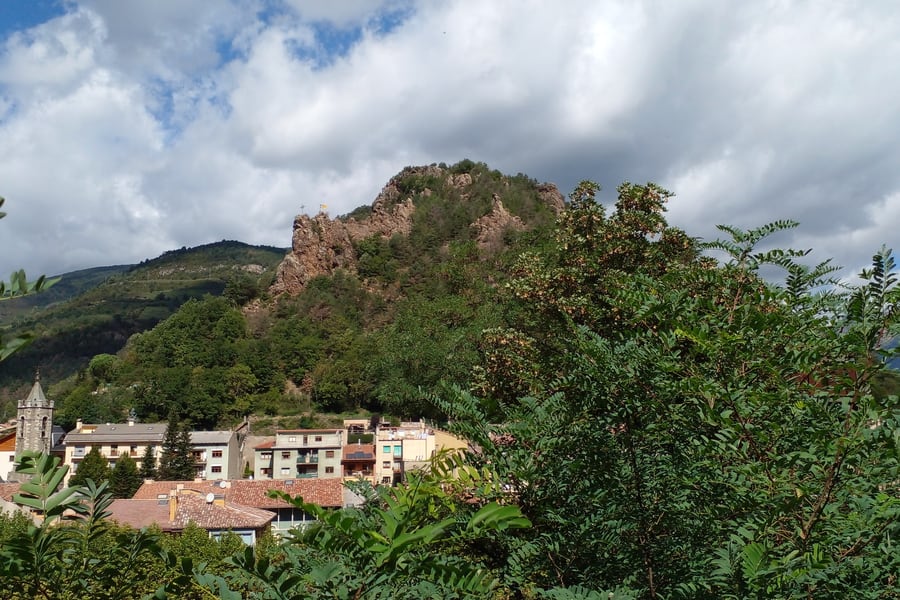
A small town at the meeting of three valleys, under a wooded crag with the ruins of its castle on top, and the reason the rack railway has two stations at the bottom rather than one: Ribes-Enllaç is the interchange with the Rodalies line, and Ribes-Vila, a kilometre further on, is the one actually in the town. Ribes-Vila holds the railway's own rolling-stock exhibition, and the town is the natural place to spend the night before an early train.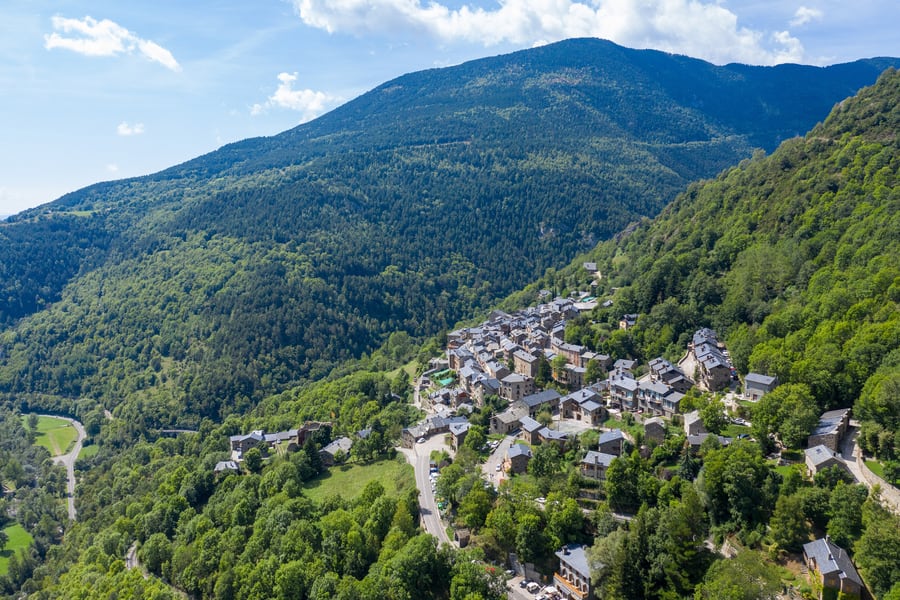 Kent Wang / Wikimedia Commons · CC BY-SA 2.0 · cropped
Queralbs
Stone houses with wooden balconies stacked on a shelf above the Freser — the municipality that Vall de Núria itself belongs to, and the point where the public road gives up. It appears as Keros Albos in the consecration act of the cathedral of La Seu d'Urgell in 836, which is why it calls itself a thousand-year village, and its Romanesque church of Sant Jaume is of the tenth century. The station has a permanent exhibition about the line.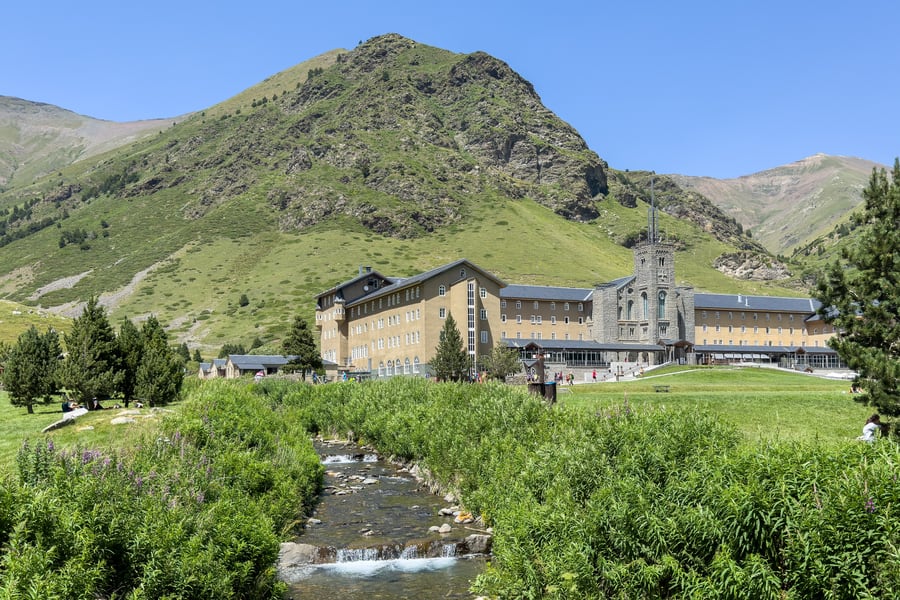 Kent Wang / Wikimedia Commons · CC BY-SA 4.0 · cropped
The sanctuary of Núria
The long ochre block at the head of the valley is a Marian sanctuary that has drawn pilgrims to this hollow in the Pyrenees, rebuilt in its present form in the twentieth century and now holding the basilica, the hotel and the station under one roof. Entry to the basilica is included in the rack-railway ticket, and the whole complex is one building — a traveller can arrive, sleep and attend without ever going outdoors.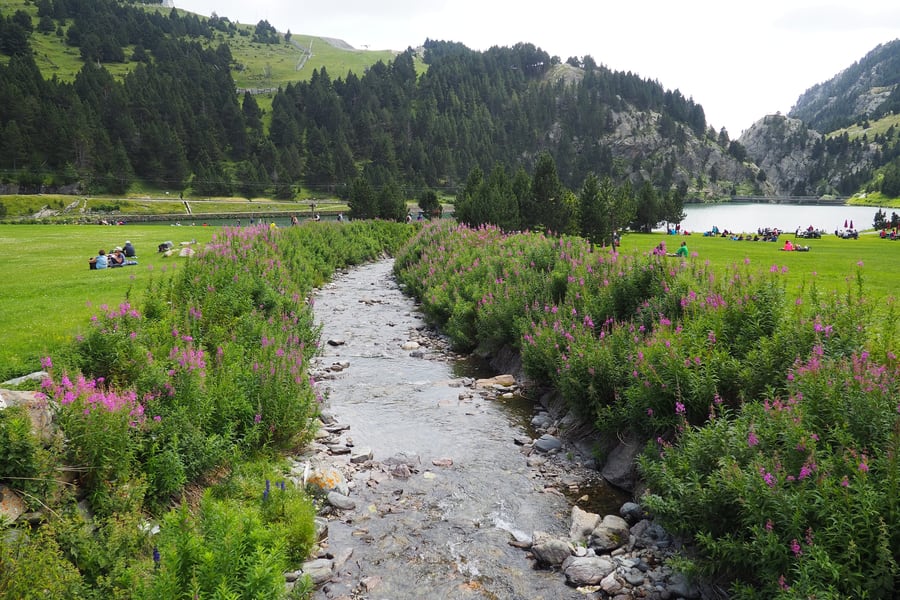 Teresa Grau Ros / Wikimedia Commons · CC BY-SA 4.0 · cropped
The valley floor and its lake
Above the buildings the ground opens out into wide grass, a stream lined with willowherb and a small lake with rowing boats, ringed by the peaks at the head of the Freser. It is the easiest walking in the Pyrenees to reach, because the hard part is done by the train, and in summer the meadow fills with people who have carried nothing further than the station steps.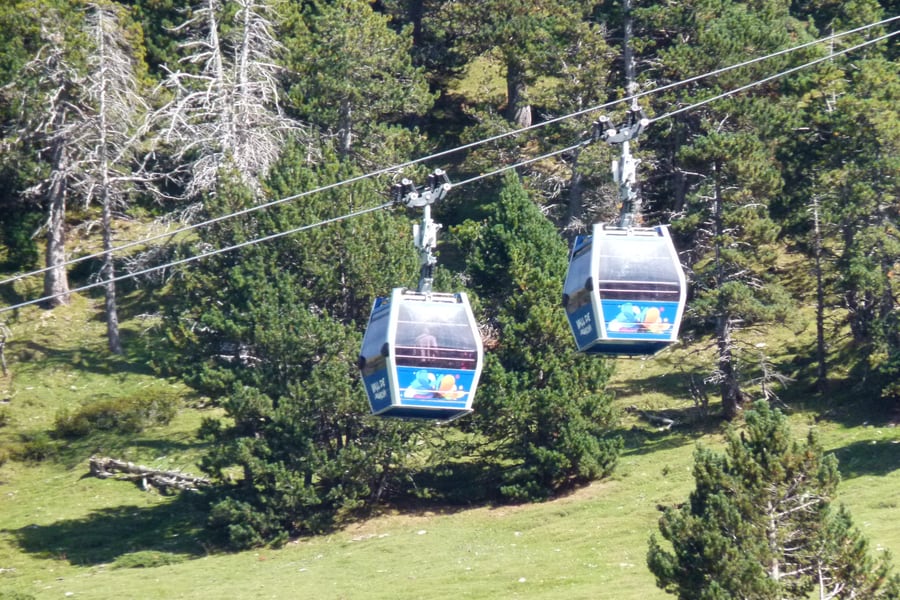 Pere López Brosa / Wikimedia Commons · CC BY-SA 4.0 · cropped
The Coma del Clot cable car
A gondola lift climbs from the valley floor to the Pic de l'Àliga at around 2,120 metres, where the hostel sits on the shoulder with the whole valley below it. The ride is already paid for by the train ticket, which makes it the cheapest thousand-metre view in Catalonia — and the way to see, from above, how completely the gorge shuts the valley off from every direction but the railway's.Where to Sleep
There is a decision to make here that most short railway journeys do not offer: whether to sleep at the bottom or at the top.
Staying at the top means being in the valley after the last train has gone down and before the first comes up — a few hours in which Vall de Núria has no day visitors in it at all, and the only people present are the ones who are staying. In winter that is a genuinely unusual thing to arrange at 1,964 metres without a car, a road or a walk in. There are two options up there, both reached only by the railway: the hotel inside the sanctuary building the train arrives at, and the Xanascat hostel higher up the slope at 2,122 metres, reached in turn by the cable car.
Staying at the bottom, in Ribes de Freser, is the practical choice for anyone who wants the 07:30. That departure leaves before there is any realistic way of getting up the valley from elsewhere, and it is the quietest train of the day.
None of the three cards below carries a photograph. Wikimedia Commons has no freely licensed picture of any of them, and the one building that could stand in for the first — the sanctuary block at the top — already appears twice on this page. A card with an honest gap is better than a card with the wrong building on it.
No prices, ratings or star counts appear below, because none of those has been verified. Each description says only what that hotel's own site says about itself, and all three sites were opened and read on 17 August 2026.
Where to stay
Hotel Vall de Núria
At the top station, 1,964 m
The hotel at the head of the valley, at Estació Vall de Núria, inside the sanctuary complex the train arrives at. Its own site is direct about the access: the rack railway is the only way to reach it, climbing more than a thousand metres to get there. It lists family accommodation, restaurants and bars, massage and beauty treatments, free wi-fi throughout, pet-friendly rooms and accessible facilities, and takes bookings directly.
Check Availability (opens in a new tab, on hotelvalldenuria.cat)via hotelvalldenuria.catNúria Xanascat
The hostel above the valley, at 2,122 m
Part of the Generalitat's Xanascat network, this hostel stands higher than the station at 2,122 metres and is reached, like everything else here, by the rack railway. It has 190 places in rooms of three, four, five, six, eight and eighteen beds, eight of them adapted for guests with reduced mobility, and it books directly.
Check Availability (opens in a new tab, on xanascat.gencat.cat)via xanascat.gencat.catHotel Els Caçadors de Ribes
Ribes de Freser, a few metres from the bottom station
A family hotel in Ribes de Freser which describes itself as standing just a few metres from the Vall de Núria rack railway — useful for the 07:30, which leaves before most people could get up the valley. The restaurant dates from 1920 and the family running it is the fourth generation of innkeepers. It lists rooms with parquet floors, some with balconies, a terrace with a heated jacuzzi, a games room for children and apartments.
Check Availability (opens in a new tab, on hotelsderibes.com)via hotelsderibes.comQuestions or corrections
Planning this trip and stuck on something, or spotted a time, fare or detail that has changed? Send us a message about The Núria Rack Railway — the valley with no road. We read every one, and we update this page when something has changed.