Dhaka to Cox's Bazar
Riaz / Wikimedia Commons · CC BY-SA 4.0 · cropped
- Distance551 km (342 miles)
- Duration8 hr 20 min
- Best seasonNovember to March
Introduction
For most of Bangladesh's history the country's most famous stretch of coast had no railway at all. Cox's Bazar sits at the far south-eastern corner of the country, past Chattogram and the Karnaphuli, where the land narrows between the hills and the Bay of Bengal, and the only way there was the road. That changed on 1 December 2023, when Bangladesh Railway began running trains over a new 102-kilometre line from Dohazari to Cox's Bazar and put the beach within a single night's ride of the capital.
The journey is 551 kilometres and takes about eight and a half hours. It runs down the busy Dhaka–Chattogram main line, pauses at Chattogram to reverse and change crews, and then turns south onto the new railway — single track, dual gauge, and quiet in a way the first two-thirds of the trip never is. Two named trains work it in each direction: the overnight Cox's Bazar Express, which leaves Dhaka at eleven at night and arrives in time for breakfast, and the daytime Parjotak Express — parjotak is Bengali for tourist — which leaves at quarter past six in the morning and gets in mid-afternoon.
What makes the last hundred kilometres worth staying awake for is what the line had to cross. Roughly 27 kilometres of it run through the Chunati and Fasiakhali wildlife sanctuaries and Medhakoccopia National Park, which are elephant country, and the railway was built with a green bridge over the top of it — the first elephant overpass on any railway in South Asia.
The Journey
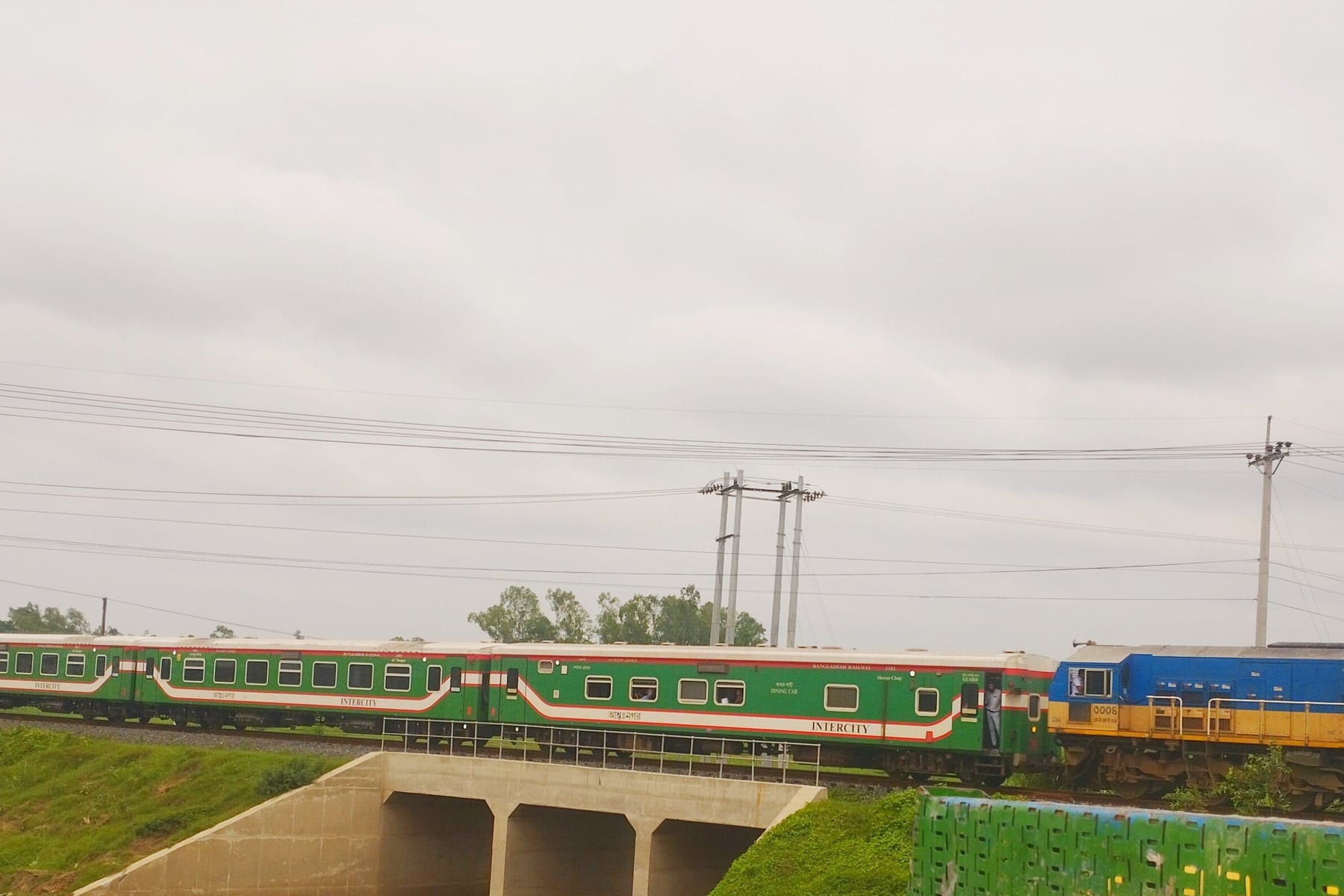
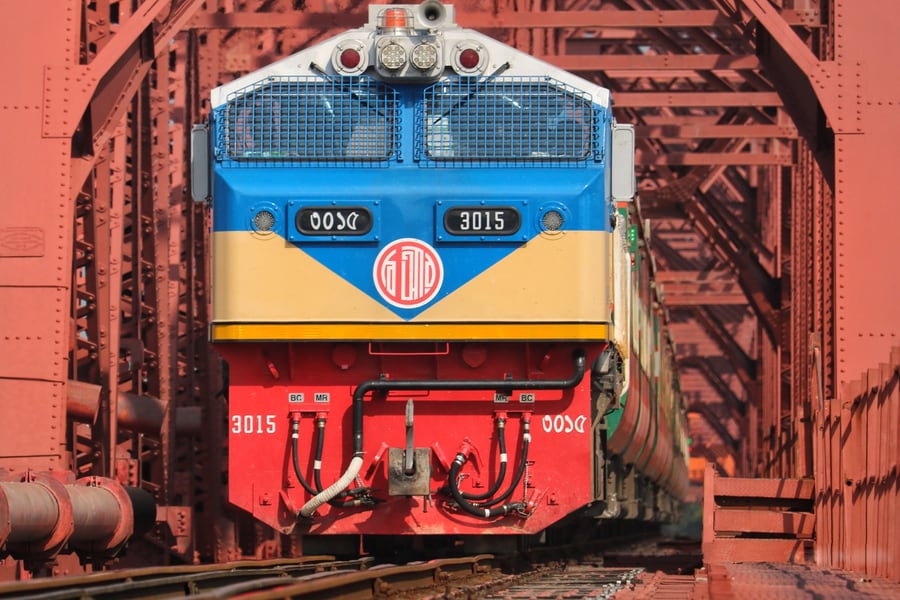
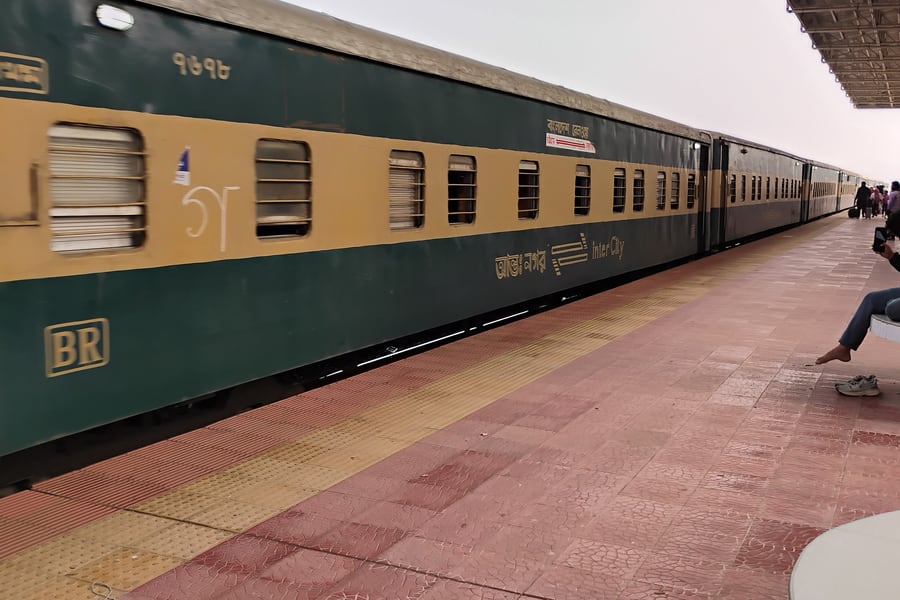
The train that leaves Kamalapur at eleven at night is a metre-gauge intercity of the kind Bangladesh Railway runs everywhere: a long rake in green and cream, or in the newer white, red and green, with an air-conditioned end and a non-air-conditioned one. At the head of it, more often than not, is a locomotive of Class 3000 — an EMD GT38ACL of 2,200 horsepower, built by Hyundai Rotem in South Korea under licence from Electro-Motive Diesel and delivered in 2020. Thirty were bought. The first ten are metre gauge outright; the other twenty can be lifted onto broad-gauge bogies, which is the practical answer to a country that never settled on one gauge.
Twenty-three minutes out, the train calls at Biman Bandar, the station under the flight path at Dhaka airport, and then does not stop again for four hours. This is the Dhaka–Chattogram corridor, the busiest railway in the country, and at night it is mostly a matter of level crossings, bells, and the lights of towns.
Chattogram, and the turn south
Chattogram comes at twenty to four in the morning, and the train stands there for forty minutes — the longest booked halt anywhere on the run, and the point at which the journey stops being a main line trip and becomes something else. The daytime Parjotak Express makes the same pause at twenty past eleven, in daylight, which is the better of the two if you want to see the yard.
South of Chattogram the character changes completely. The line runs through Patiya to Dohazari on rails that have been there since the colonial period and were relaid for this project, and then, at Dohazari, it joins the new railway. From here to the sea everything is 2023: concrete sleepers, fenced boundaries, level crossings with barriers, and stations at Satkania, Lohagara, Harbang, Chakaria, Dulahazara, Islamabad and Ramu that were fields eight years ago.
The elephant overpass
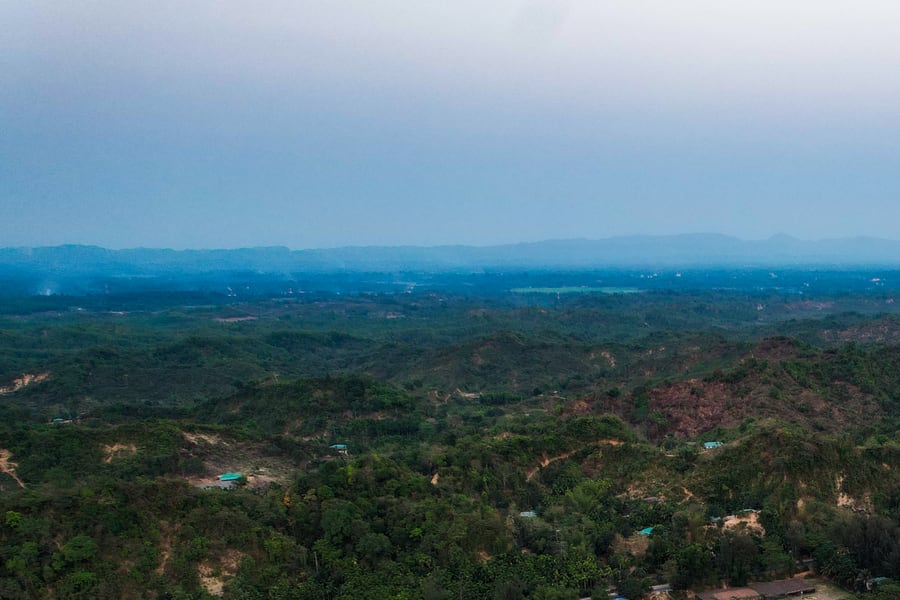
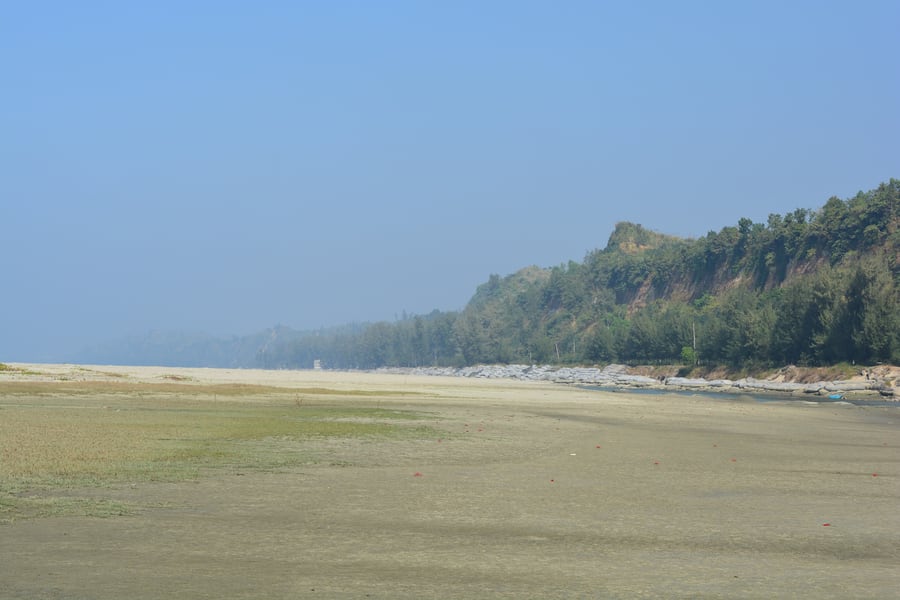
Beyond Satkania the railway enters Chunati Wildlife Sanctuary, and for roughly 27 kilometres it is running through protected forest — Chunati, then Fasiakhali, with Medhakoccopia National Park alongside. This is one of the last corridors used by Bangladesh's wild Asian elephants, and the International Union for Conservation of Nature counted sixteen places along that 27 kilometres where elephants cross.
The Asian Development Bank, which financed the line, commissioned a baseline biodiversity assessment in 2018 and it recommended three structures: one overpass and two underpasses. The overpass is at Chunati, it is the first built over a railway anywhere in South Asia, and it is planted with banana and bamboo to persuade elephants to use it. The project's deputy director told The Business Standard in 2023 that elephants had already been seen eating the banana trees, and that the ADB would monitor the crossing for two years once trains were running. Conservationists who worked on the IUCN survey argued at the time that three structures for sixteen corridors was not enough, and that argument has not gone away.
None of this is visible from a carriage window at three in the morning. On the daytime train it is: green hills to the east, forest close on both sides, and — briefly — a wide vegetated bridge passing overhead.
Ramu, and the oyster
Ramu gave the project its middle name — it was built as the Dohazari–Ramu–Cox's Bazar line — and it is the last station before the sea. From there it is seventeen minutes to Cox's Bazar, where the train runs in under a building shaped like an oyster shell. That is deliberate: the architect, Mohammad Foyez Ullah, took the form from the shells on the beach. It cost ৳214 crore, it has five floors, three platforms, left-luggage lockers and a 39-room hotel upstairs, and it stands a short drive inland from 120 kilometres of sand.
Along the route
Shahidul Hasan Roma / Wikimedia Commons · CC BY-SA 4.0 · croppedFour stops in 551 kilometres
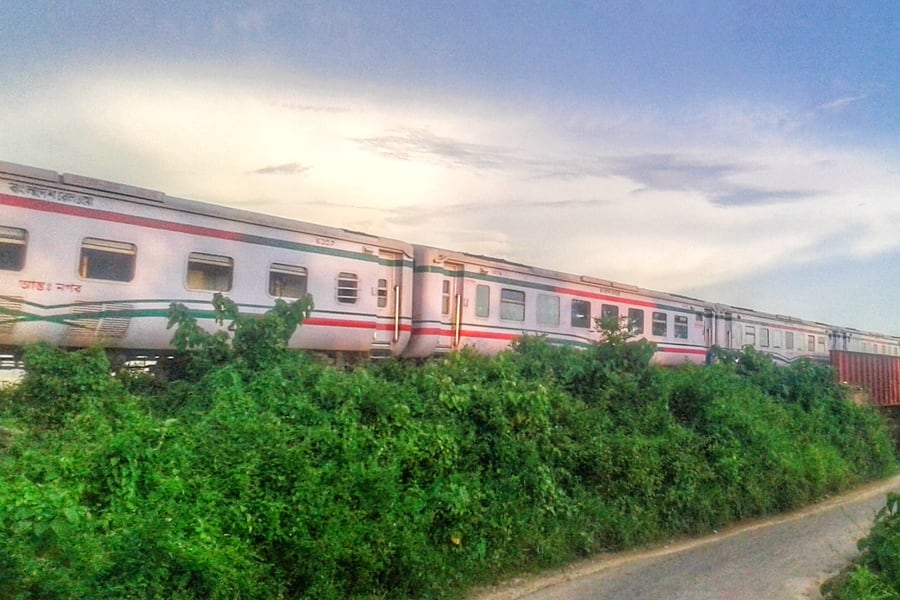
Dhaka, the airport station twenty-three minutes later, Chattogram after four more hours, and the sea. Everything between is passed at line speed, which on this railway is 70 km/h.HASSAN TANVIN AYON / Wikimedia Commons · CC BY-SA 4.0 · croppedThe last 102 kilometres are three years old
South of Dohazari the train joins a railway opened in December 2023 — single track, dual gauge, and built to a 100 km/h alignment. Seven of its stations did not exist in 2018.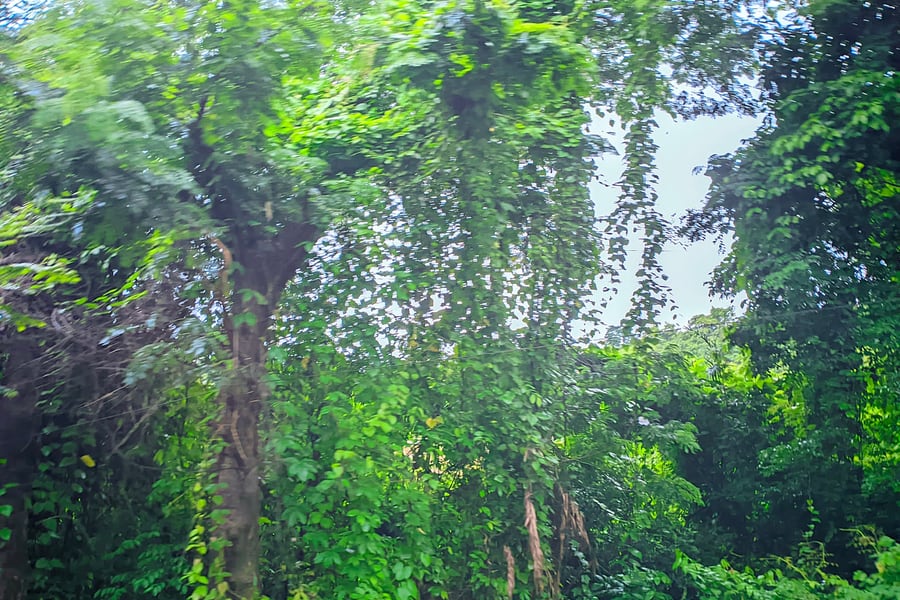 Owais Al Qarni / Wikimedia Commons · CC BY-SA 4.0 · cropped
A bridge for elephants
At Chunati the line runs under a planted green bridge, the first elephant overpass built over a railway in South Asia, with two underpasses further on.A bit of history
Culture & experiences along the way
Tanvir Anjum Adib / Wikimedia Commons · CC BY-SA 4.0 · croppedThe overnight, and what it costs you
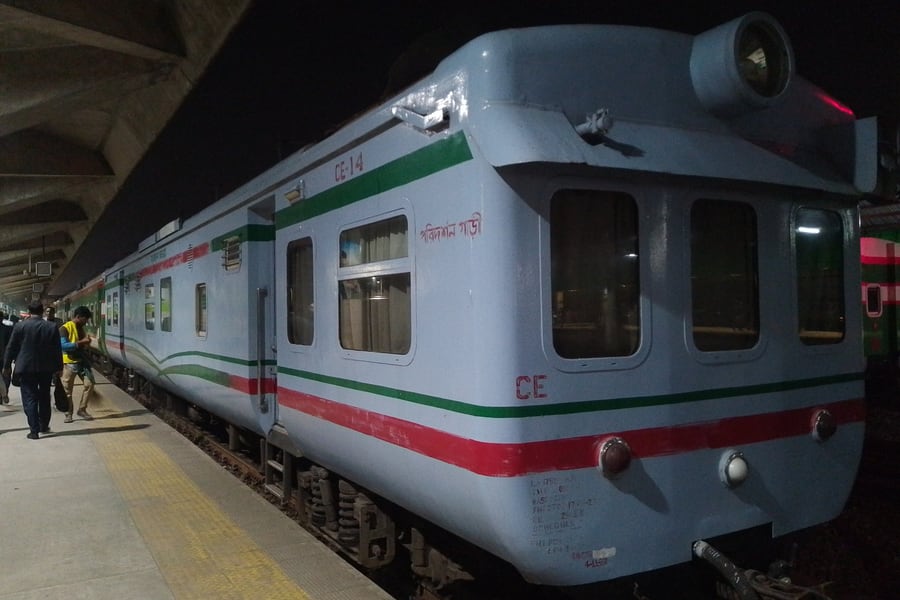
The Cox's Bazar Express leaves Dhaka at 23:00 and arrives at 07:20, which buys a whole day at the coast and spends the entire new railway in the dark. The Parjotak Express leaves at 06:15 and reaches Chattogram at 11:20, so the forest, the hills and the green bridge are all in daylight. The overnight is the popular one and the daytime train is the one worth the seat.Railcrossingbd2614 / Wikimedia Commons · CC BY-SA 4.0 · croppedNine classes, and what they mean
Bangladesh Railway sells by seat type rather than by class number, and the ladder runs from Shulov, a wooden bench, up through Shovan and Shovan Chair to Snigdha, which is an air-conditioned chair, and then to AC Seat and AC Berth. The Cox's Bazar Express carries three AC cabin coaches, five AC chair, six Shovan Chair and one executive chair car.Zitu.madcap0901125 / Wikimedia Commons · CC BY-SA 4.0 · croppedWhat the forest cost, and what was built back
Building this line took 276 acres of de-reserved forest, 720,443 trees and the reshaping of 26 hills. Against that the railway put in one elephant overpass and two underpasses, planted with banana and bamboo, where the IUCN had counted sixteen crossing points. Elephants have been seen using the overpass; conservationists still say three structures for sixteen corridors is not enough.Timetables
Two named intercity trains work the full 551 kilometres between Dhaka and Cox's Bazar, each six days a week, and each with a different rest day. Times below are Bangladesh Railway's own, taken from the operator's train-information service in August 2026, and are local time (BST, UTC+6).
Dhaka to Cox's Bazar
| Train | Dhaka | Biman Bandar | Chattogram | Cox's Bazar | Runs |
|---|---|---|---|---|---|
| Parjotak Express 816 | 06:15 | 06:43 | 11:20 / 11:40 | 14:40 | daily except Wednesday |
| Cox's Bazar Express 814 | 23:00 | 23:28 | 03:40 / 04:20 | 07:20 | daily except Monday |
Cox's Bazar to Dhaka
| Train | Cox's Bazar | Chattogram | Dhaka | Runs |
|---|---|---|---|---|
| Cox's Bazar Express 813 | 12:30 | 15:40 / 16:00 | 21:00 | daily except Tuesday |
| Parjotak Express 815 | 19:45 | 22:45 / 23:15 | 04:20 | daily except Wednesday |
The through trains stop only at Dhaka's airport station and at Chattogram, where they stand for twenty to forty minutes. Booked time is 8 hr 20 min to 8 hr 35 min depending on the working.
Chattogram to Cox's Bazar only
Two shorter all-stations trains cover the 150 kilometres from the port city, calling at Sholoshohor, Patiya, Dohazari, Satkania, Lohagara, Harbang, Chakaria, Dulahazara, Islamabad and Ramu. Both run daily except Monday.
| Train | Departs | Arrives |
|---|---|---|
| Shaikat Express 821 | Chattogram 05:50 | Cox's Bazar 09:25 |
| Probal Express 823 | Chattogram 15:10 | Cox's Bazar 19:00 |
| Probal Express 822 | Cox's Bazar 10:00 | Chattogram 14:10 |
| Shaikat Express 824 | Cox's Bazar 20:00 | Chattogram 23:50 |
Bangladesh Railway republishes the running days and times whenever a working is altered, and single trains are re-timed at short notice after track incidents. The live version is at eticket.railway.gov.bd (opens in a new tab).
Tickets
Bangladesh Railway sells its own seats, online and at station counters, and nobody else does. Online tickets open ten days before travel and the popular classes on this route regularly clear within the hour, so a Thursday-night berth to the coast is not a walk-up proposition. Buying online needs a registered account with the railway.
Fares are set by the railway rather than by demand, and they last changed on 20 December 2025, when the Eastern Zone added a pontage charge — a levy that counts every 100 metres of bridge as 2.5 kilometres of extra distance. That put the biggest single increase in the country onto this route. The cheapest chair class is well below the air-conditioned fares in the cards below, and it is the class most Bangladeshis travel in.
Book your tickets
Shahidul Hasan Roma / Wikimedia Commons · CC BY-SA 4.0 · croppedSnigdha — air-conditioned chair
Tk 1,449 · Dhaka to Cox's Bazar
The cheapest air-conditioned seat on the train, and the one that sells out first when the ten-day booking window opens.
Book Tickets (opens in a new tab, on eticket.railway.gov.bd)via eticket.railway.gov.bdTanvir Anjum Adib / Wikimedia Commons · CC BY-SA 4.0 · croppedAC Seat — cabin, daytime
Tk 1,740 · Dhaka to Cox's Bazar
A seat in an air-conditioned cabin rather than an open saloon, which on the 06:15 Parjotak Express is the whole point.
Book Tickets (opens in a new tab, on eticket.railway.gov.bd)via eticket.railway.gov.bdHASSAN TANVIN AYON / Wikimedia Commons · CC BY-SA 4.0 · croppedAC Berth — the overnight
Tk 2,656 · Dhaka to Cox's Bazar
A berth in an air-conditioned cabin on the 23:00 Cox's Bazar Express, and the fare that rose furthest of any in Bangladesh in December 2025.
Book Tickets (opens in a new tab, on eticket.railway.gov.bd)via eticket.railway.gov.bdRail Passes
No rail pass covers Bangladesh. Interrail and Eurail are European products, the Indian and Sri Lankan passes stop at their own borders, and Bangladesh Railway has never issued a tourist pass of its own — there is no equivalent of an all-line ticket to buy.
That is less of a loss than it sounds. The whole 551 kilometres in an air-conditioned chair is 1,449 taka, and the non-air-conditioned classes are a fraction of that, so a pass would have little to discount. What a pass would not have solved is the thing that actually constrains this route, which is availability: seats open ten days ahead through the operator's own booking service and go quickly, and no ticket type changes that.
Places to Visit
The through trains call at two places between the capital and the sea, so most of what follows is either the destination itself or reachable from it. The one exception is the forest the line runs through in its last hour, which has no station worth getting off at and is the most interesting thing on the route.
 Nafiur14 / Wikimedia Commons · CC BY 4.0 · cropped
Chattogram
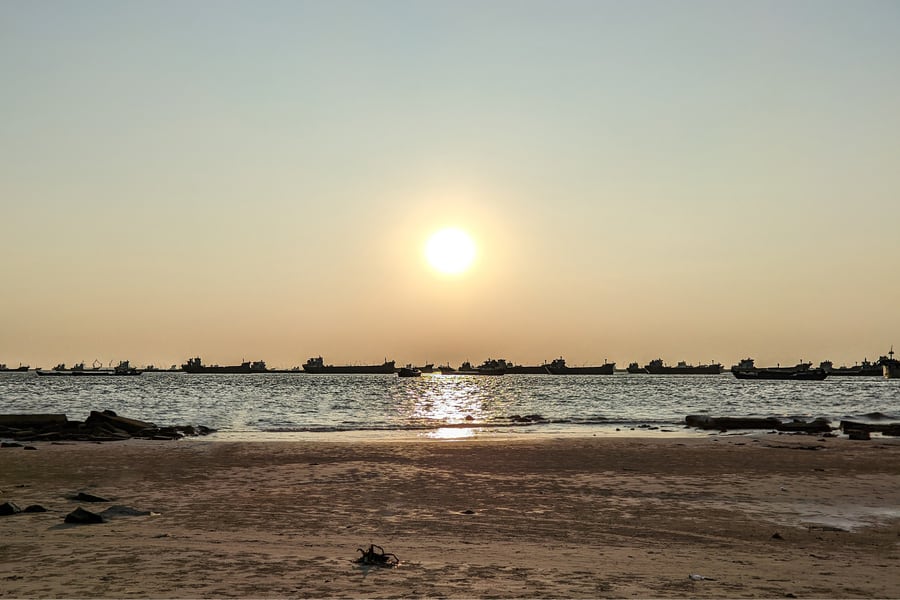
The country's second city and its main port, at the mouth of the Karnaphuli. Patenga is the beach the city goes to — a spit of sand where the river meets the Bay of Bengal, with ships queuing offshore for the port and fishing boats drawn up on the sand. The daytime train stands here for twenty minutes at 11:20; the overnight one at twenty to four in the morning, which is no use to anybody who wants to see it.Owais Al Qarni / Wikimedia Commons · CC BY-SA 4.0 · croppedChunati Wildlife Sanctuary
An IUCN Category IV protected area of hill forest between Lohagara and Chakaria, and the reason this railway has a green bridge over it. There is no visitor infrastructure to speak of and the sanctuary is not a day out in the ordinary sense — it is a working elephant corridor that the Chattogram–Cox's Bazar highway and now the railway both cut through, and it is visible from the train for most of half an hour.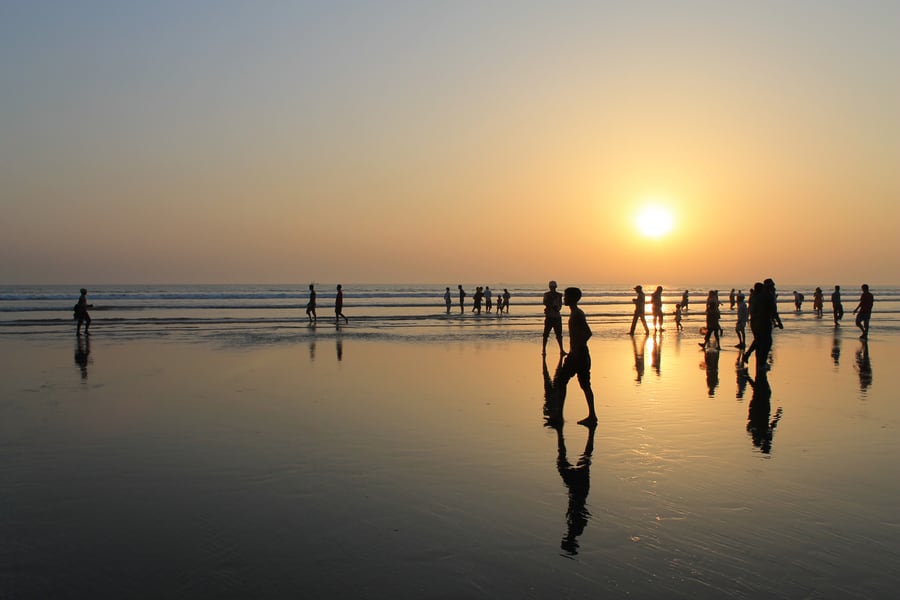 Tanweer Morshed / Wikimedia Commons · CC BY-SA 3.0 · cropped
Cox's Bazar
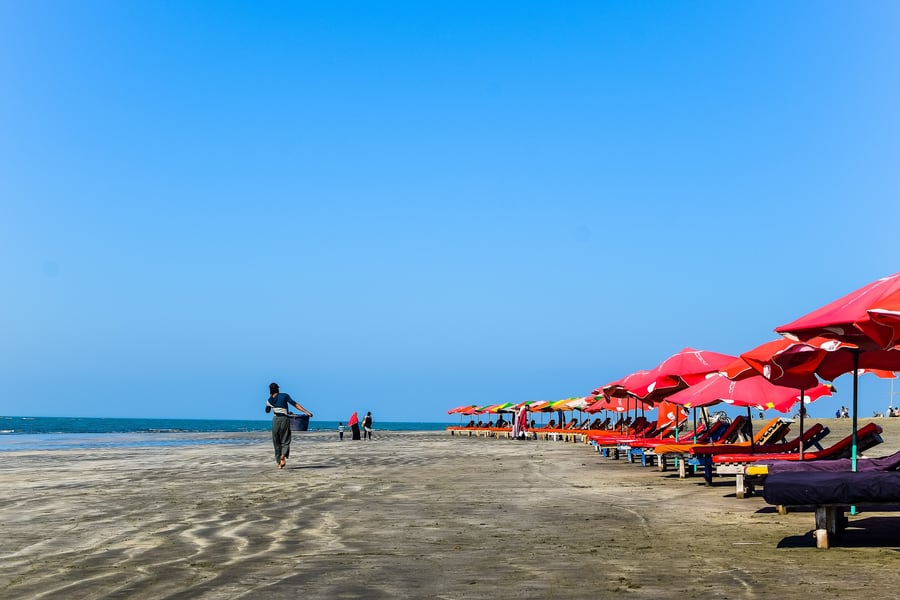
One hundred and twenty kilometres of unbroken sand, the longest natural sea beach in Asia and the fifth longest anywhere. The town end at Laboni and Kolatoli is where the hotels, the umbrellas and the crowds are; walk twenty minutes in either direction and the beach empties. It is a fishing port as well as a resort, and the boats come in at first light.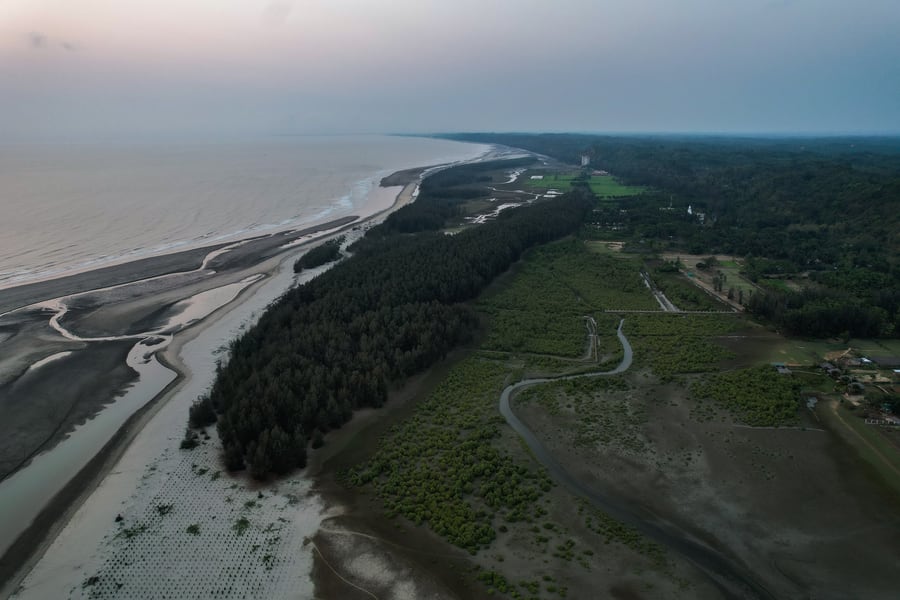 Zitu.madcap0901125 / Wikimedia Commons · CC BY-SA 4.0 · cropped
Himchari National Park
Seventeen square kilometres of mixed evergreen forest on the hills immediately south of Cox's Bazar, protected since 1980, with the Bay of Bengal along its western edge and a waterfall that is worth seeing after rain and not much before it. The Marine Drive road runs between the park and the sea, which makes it the easiest piece of Bangladeshi forest to reach anywhere.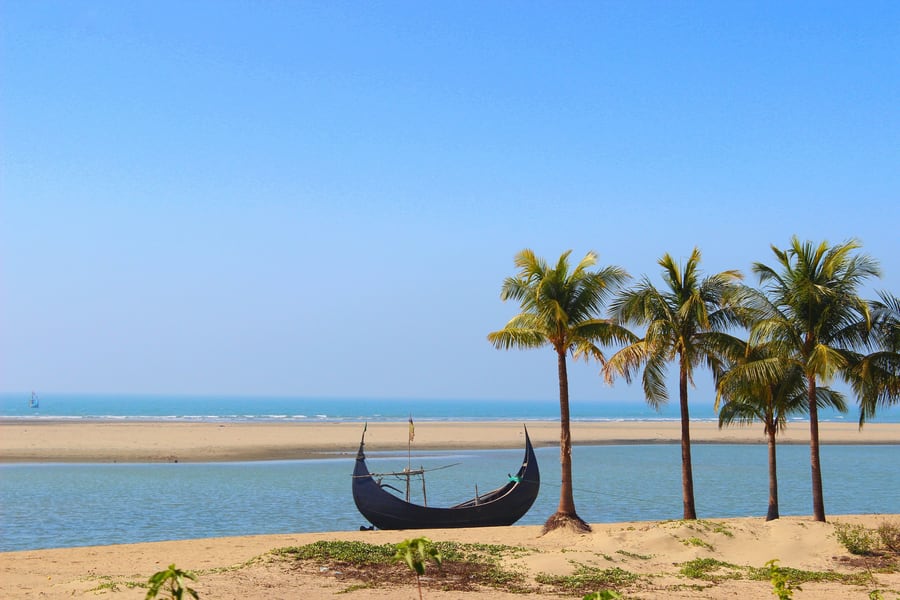 Arjit Chowdhury / Wikimedia Commons · CC BY-SA 4.0 · 2014 · cropped
Inani
Eighteen kilometres of the same beach, in Ukhia, where coral boulders break the sand and the hills come almost to the waterline. The stones are sharp and show black and green in the wet season. It is the stretch people drive down Marine Drive for, and it is quieter than the town end by some distance.Where to Sleep
Cox's Bazar has more hotel rooms than anywhere else in Bangladesh outside Dhaka, and most of them are strung along Marine Drive between Kolatoli and Laboni, a few kilometres from the station. The overnight train arrives at 07:20, which is well before any check-in, and the daytime train arrives at 14:40, which is not — a point worth weighing when choosing between the two.
Where to stay
The Peninsula Chittagong
Bulbul Center, CDA Avenue, Chattogram
Its own site describes 144 rooms with a rooftop pool, gym, spa, two banquet halls and two meeting rooms, in the business district of the city where both Cox's Bazar trains make their long halt.
Check Availability (opens in a new tab, on peninsulactg.com)via peninsulactg.comSayeman Beach Resort
Marine Drive, Kolatoli, Cox's Bazar
The first private hotel in Cox's Bazar, built in 1964 and since rebuilt on a beachfront site at Kolatoli; its own site lists an ocean-view café, an infinity-pool restaurant, a spa and a gym.
Check Availability (opens in a new tab, on sayemanresort.com)via sayemanresort.comQuestions or corrections
Planning this trip and stuck on something, or spotted a time, fare or detail that has changed? Send us a message about Dhaka to Cox's Bazar. We read every one, and we update this page when something has changed.