Dire Dawa to Djibouti City — the electric train to the sea
Skilla1st / Wikimedia Commons · CC BY-SA 4.0 · 2015 · cropped
- Distance282 km, Dire Dawa to Nagad (Djibouti City)
- Duration6 hours, trains K1 and K2
- Best seasonEvery other day, all year · November to March is the cool season
Introduction
Djibouti has one railway, and every train on it is an international train. The line is the electrified standard-gauge railway from Addis Ababa to the sea, opened for commercial traffic on 1 January 2018, and its Djiboutian half is worked as a service of its own: train K1 leaves Dire Dawa in Ethiopia on odd-numbered days, train K2 leaves Nagad — the station for Djibouti City — on even ones. Six hours and 282 kilometres separate them, with a frontier in the middle.
What the train does in those six hours is come off a continent. Dire Dawa stands at 1,113 metres on the eastern edge of the Ethiopian highlands; Nagad is 31 metres above the Gulf of Tadjoura. Between them is the Somali desert — Adigala, Aysha, and then the border station of Dewele at 835 metres, the high point of everything east of Dire Dawa. From there the railway falls away through Ali Sabieh and Holhol to the coastal plain.
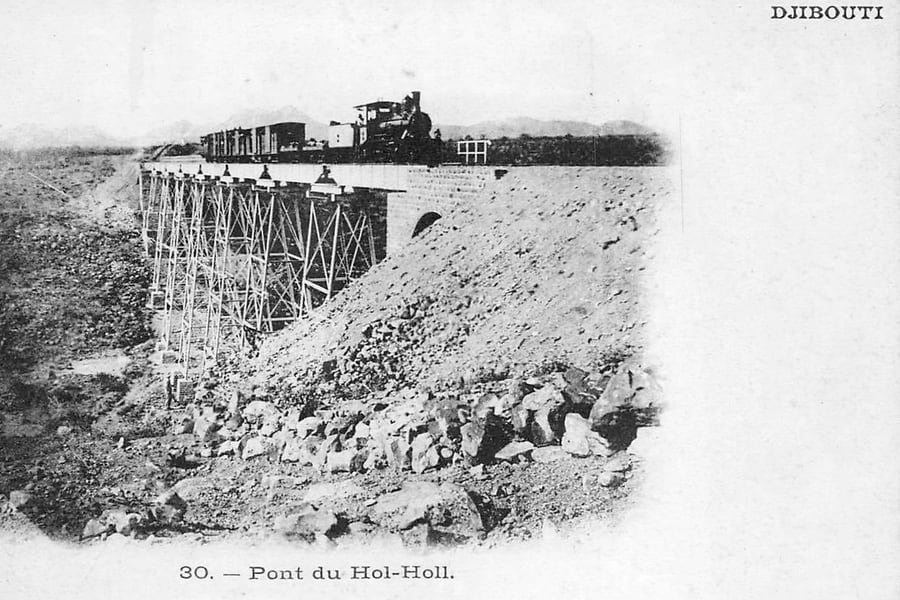
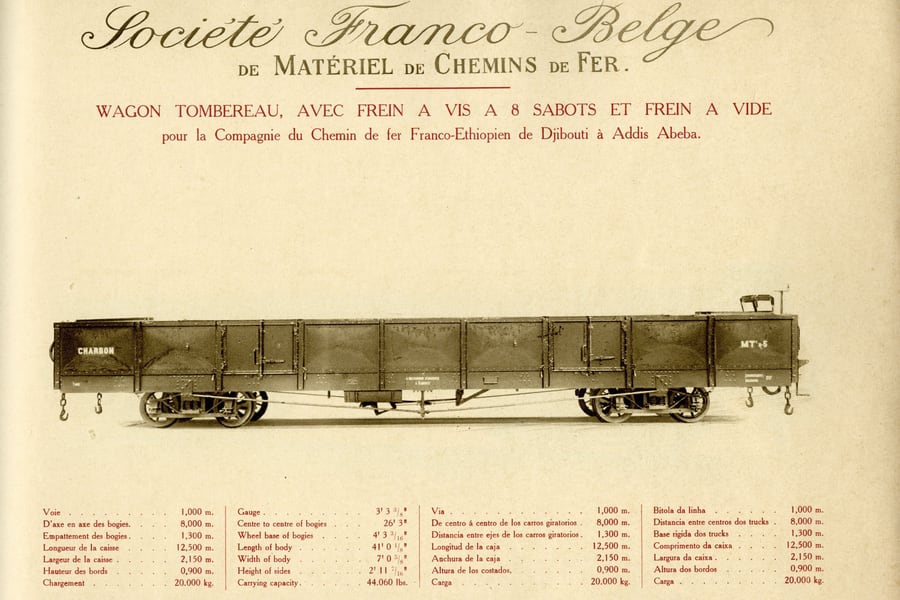
It is also the second railway to do this. The metre-gauge Chemin de Fer Franco-Éthiopien was built along the same corridor between 1897 and 1917, reached Ali Sabieh on 14 July 1900 and carried Ethiopia's trade for a century before it was decommissioned in 2016. Its formation, its bridges and its stations are still out there, close enough to the new alignment to see from the window.
The Journey
Dire Dawa's railway station is not in Dire Dawa. The new line was laid on its own alignment and the station stands about ten kilometres out of town, so the journey begins with a taxi and a gate that reads the QR code off your phone. The train goes at eight in the morning, or on some days at half past — the whole timetable shifts with it — and there are two things to sit in: a reclining seat, or a bed.
The bed is worth explaining, because this is a daylight run. EDR sells a VIP berth on K1 and K2 as well as a seat, and the compartment has a door, four bunks and a window with nobody standing in front of it. On a six-hour crossing of country that has no shade in it, that is less eccentric than it sounds.
Out of the highlands
The first two hours are the descent from the Ethiopian plateau. Dire Dawa is 1,113 metres up; Adigala, the first stop, is 759 metres and two hours and twenty minutes away. The country between is the eastern Somali Region — thorn scrub and dry riverbeds — with the old metre-gauge formation somewhere alongside for most of it. The standard-gauge line was built on a new and straighter right-of-way, so the two keep meeting and parting rather than running together.
Aysha comes an hour after Adigala, and an hour and a quarter after Aysha the train stops at Dewele. This is the frontier, and it is also the high point of everything east of Dire Dawa at 835 metres, which is an odd thing for a border to be: the railway climbs into Djibouti rather than dropping into it. A passport and the right entry permission matter here exactly as they would at an airport — this is not a domestic train that runs near a border, it is the border.
Down to the sea
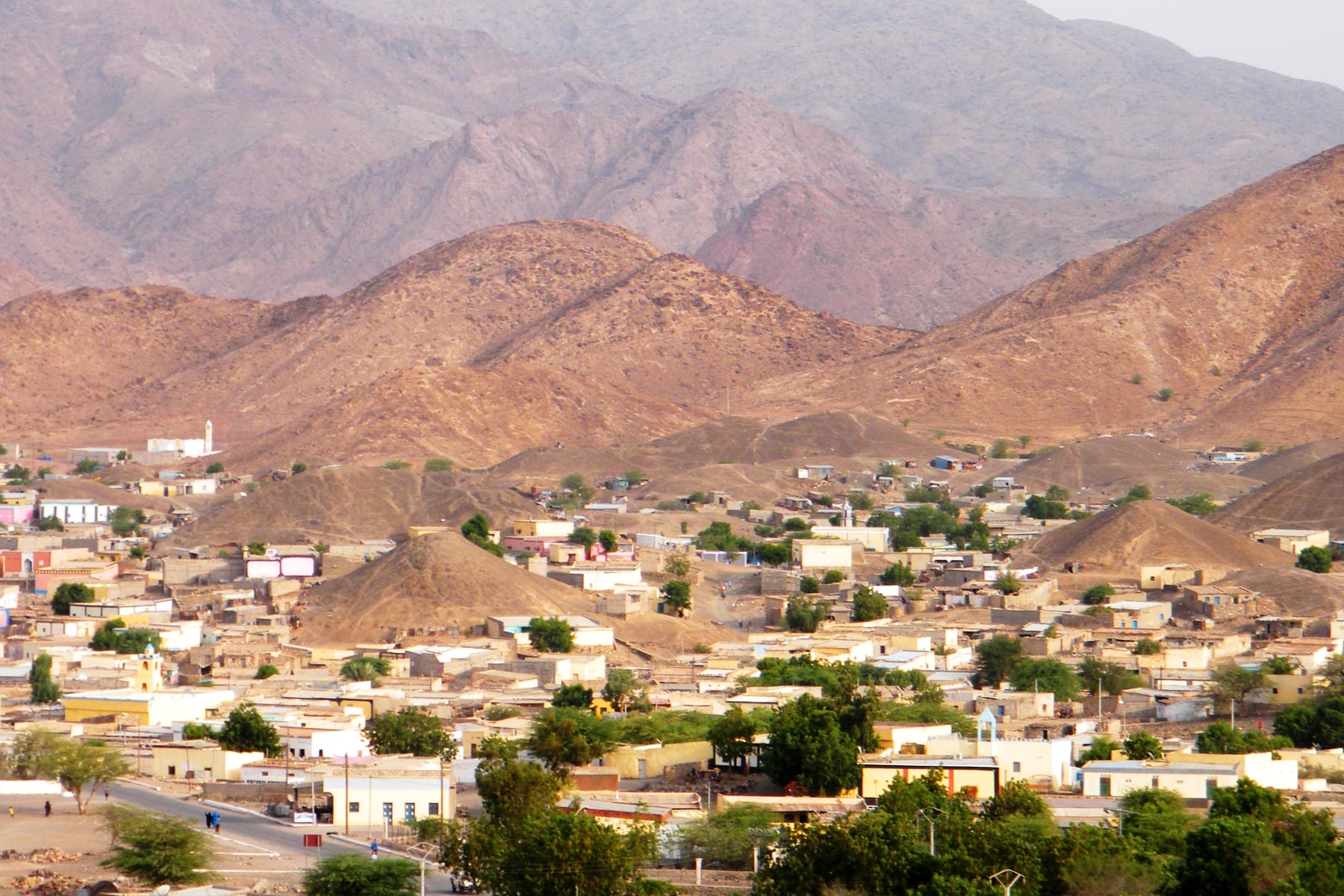
Ali Sabieh is thirty-five minutes past the frontier and 691 metres up: Djibouti's second city, 44,782 people at the 2024 census, sitting in an enclosed valley under granite mountains that are the reddest thing on the journey. The old railway made it. Ali Sabieh was a small place until 14 July 1900, when the metre gauge reached it and it became the town where Ethiopian trade changed hands.
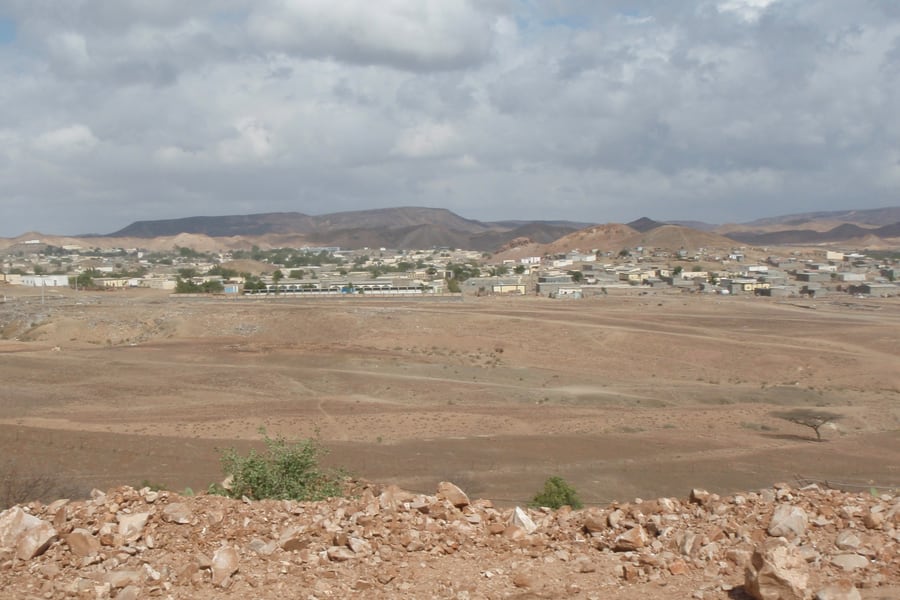
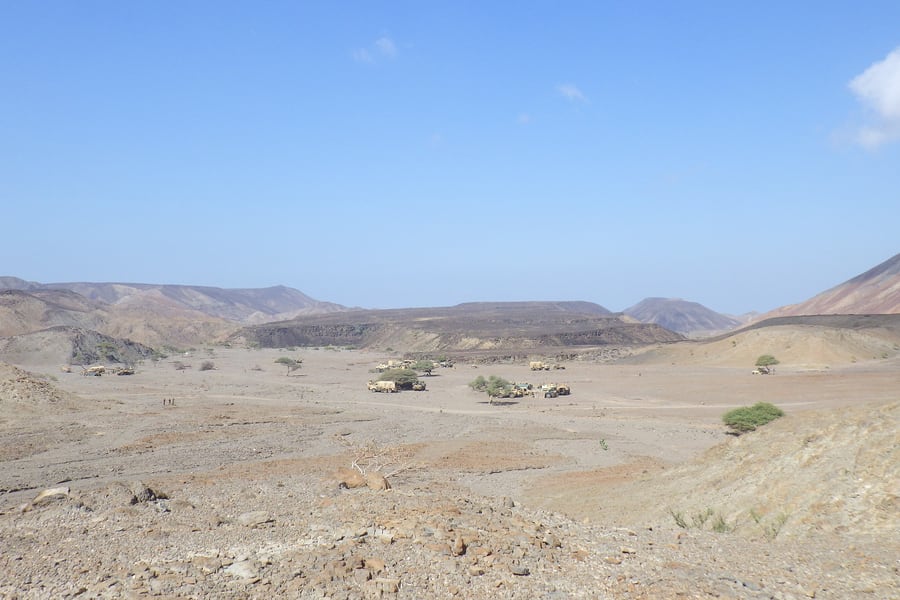
Forty minutes further on is Holhol, a town of 3,875 whose station stands at 406 metres, and the site of the best piece of engineering on the corridor — a viaduct 29 metres high and 45 metres long, thrown across the wadi in 1900 for the metre-gauge line. It is not the bridge the modern train uses, and it is still there.
After Holhol the railway gives up its last four hundred metres and comes out on the coastal plain. Nagad sits on the southern edge of Djibouti City beside the international airport, and the rails run on past it — twelve unelectrified kilometres to the container terminal at Doraleh, which is the reason the whole line was built.
Along the route
Eleven hundred metres, and a border at the top
Dire Dawa is 1,113 m up and Nagad is 31 m. The train does not fall the whole way at once: Dewele, the frontier, sits at 835 m and is the high point of everything after Dire Dawa.Built for fifty degrees
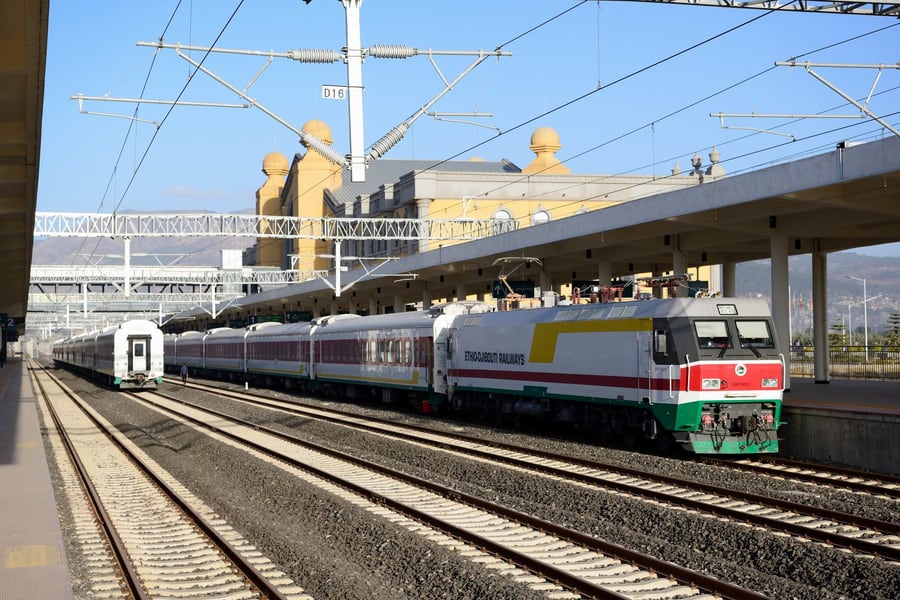
CRRC Zhuzhou supplied the locomotives and had to design for it — the corridor reaches 50 °C in summer, with what the builder calls huge day-night and seasonal differences. Thirty-two freight machines of 7,200 kW, and three for the passenger trains.Ninety-three kilometres of Djibouti
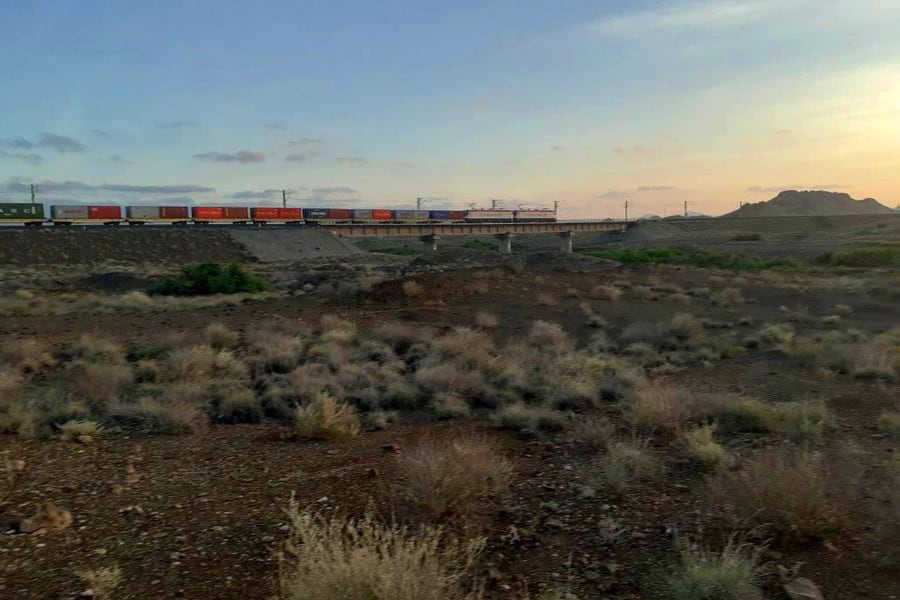
Of the railway's 759 km, 93 are Djiboutian. Eighty-one of those are electrified, from the border post at Guelile to Nagad; the last 12.1 km, on to the port at Doraleh, are not.A bit of history
Culture & experiences along the way
 Ji-Elle / Wikimedia Commons · CC BY-SA 3.0 · cropped
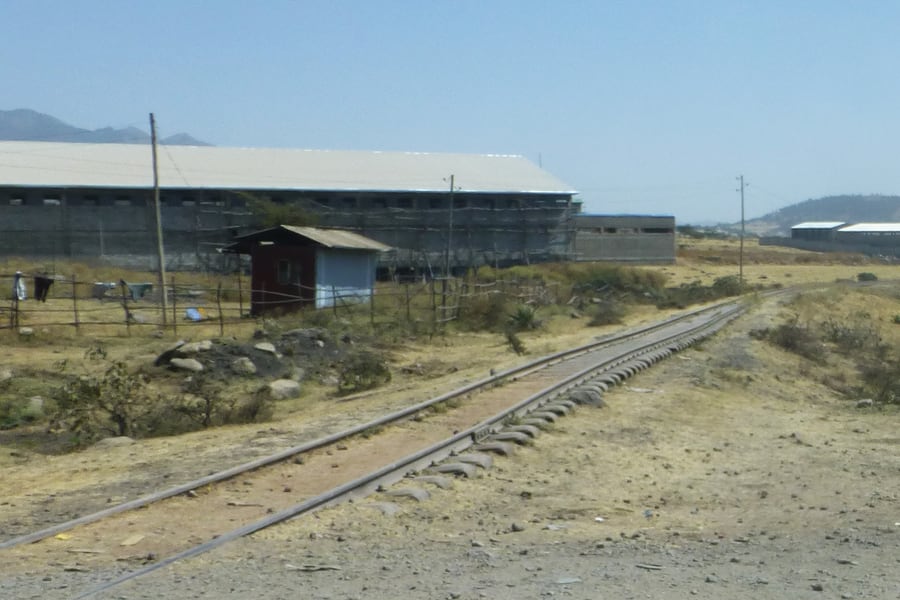
The railway you replaced, out of the window
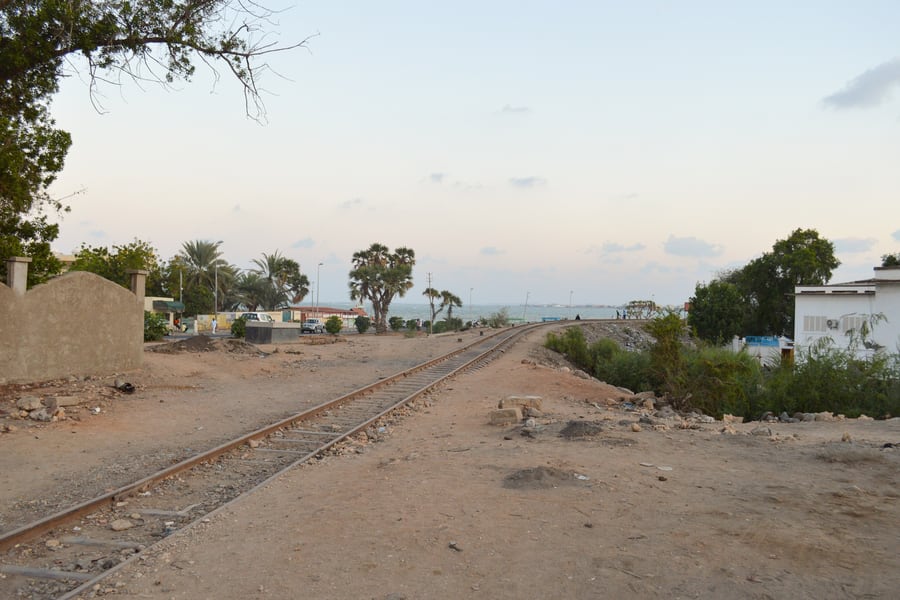
The metre gauge was decommissioned in 2016 and never lifted. Its formation runs the same corridor, its bridges still cross the same wadis, and in Djibouti City its rails are still in the street, heading for Pointe du Serpent. The new line was built straighter, so the two keep converging and separating all the way to the sea.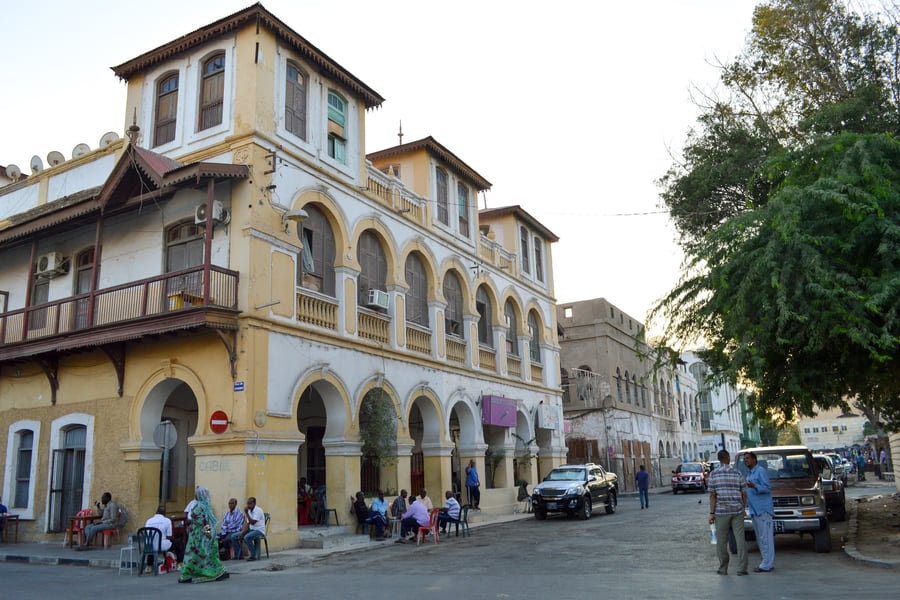 Francisco Anzola / Wikimedia Commons · CC BY 2.0 · cropped
The arcades of Place Ménélik
The old European quarter around Place Ménélik was laid out for the port and the railway, and its whitewashed blocks are built the way the heat demands: deep arcades at street level, shuttered balconies above, and enough shade to sit under all afternoon. It is a short walk from the terminal and the best hour in Djibouti City.Timetables
Train K1 runs east to Djibouti on odd-numbered days of the month; train K2 runs west to Dire Dawa on even-numbered days. Nothing runs in either direction on the days between, and the pattern resets at the start of each month.
The departure hour moves. Most workings leave at 08:00 and some at 08:30, with every calling time shifted by the same thirty minutes; the run is booked at six hours either way. Times below are the 08:00 pattern, in local time (UTC+3 on both sides of the border).
Train K1 — Dire Dawa to Djibouti City
| Station | Departs |
|---|---|
| Dire Dawa | 08:00 |
| Adigala | 10:20 |
| Aysha | 11:20 |
| Dewele | 12:35 |
| Ali Sabieh | 13:10 |
| Holhol | 13:50 |
| Nagad (Djibouti City) | arrives 14:00 |
Train K2 — Djibouti City to Dire Dawa
| Station | Departs |
|---|---|
| Nagad (Djibouti City) | 08:00 |
| Holhol | 08:35 |
| Ali Sabieh | 09:15 |
| Dewele | 10:20 |
| Aysha | 11:40 |
| Adigala | 12:40 |
| Dire Dawa | arrives 14:00 |
The last hour of K1 is best read as approximate. EDR's own calling times allow it ten minutes for the 33 kilometres from Holhol down to Nagad, which is faster than the line is built to run; westbound, the same stretch is booked at thirty-five minutes. The six-hour total is consistent in both directions and the intermediate times are the operator's, printed here as given.
Two names differ between the map and the booking system: Dewele appears in the station list as Dawanle, and Ali Sabieh as Alisabieh. Dates go on sale about ten days ahead and not every running day is loaded at once, so a blank calendar is worth re-checking rather than reading as a cancellation. Booking closes about two hours before departure.
Times as of August 2026, taken from EDR's own booking system at bookingedr.et (opens in a new tab), which publishes each dated departure with its full calling list. The one timetable the operator's corporate site at edrsc.com (opens in a new tab) publishes is for the Ethiopian leg, trains 101 and 102 between Sebeta and Dire Dawa; K1 and K2 appear on it nowhere.
Tickets
Tickets are sold online at bookingedr.et (opens in a new tab), station by station, and a foreign passenger books with a passport number rather than an Ethiopian national ID. The fare depends on the class and the distance, an adult is anyone aged five or over, and the first child under five travelling with an adult goes free. Booking closes about two hours before departure; the ticket arrives as a PDF with a QR code, and a phone screen is accepted at the gate.
The one thing to settle before you travel is payment. EDR takes Telebirr, Waafi, D-Money and CBE Birr — Ethiopian and Djiboutian mobile money — and no international card is offered at checkout. Fares are quoted to a foreign passenger in US dollars and to a Djiboutian in francs, at exactly half the international figure.
Book your tickets
Regular Seat
Reclining seat, Dire Dawa to Djibouti City
The ordinary seated car and the whole of the international leg; a Djiboutian pays half the same figure.
Book Tickets (opens in a new tab, on bookingedr.et)via bookingedr.etVIP Bed
Four-berth compartment with a door
An upper berth is the cheaper of the two grades and a lower berth the dearer, on a run that is entirely in daylight.
Book Tickets (opens in a new tab, on bookingedr.et)via bookingedr.etRail Passes
No rail pass covers this train. Interrail and Eurail are European schemes and their country list stops well short of the Horn of Africa; there is no African equivalent, and no Ethiopian or Djiboutian multi-journey ticket a visitor can buy.
Nor would one help. Djibouti has a single railway with a single passenger service on it, running every other day, and the whole international leg costs a little over twenty US dollars in a seat. The individual ticket for the class you want, bought before the two-hour cutoff, is the only arrangement there is.
Checked against the operator's booking system and the Interrail country list, August 2026.
Places to Visit
There are three passenger stations on the Djiboutian side of the frontier and one of them is the terminus, so the stops are most of the itinerary: Ali Sabieh in its ring of mountains, Holhol above its wadi, and Djibouti City at the end of the rails. The country is small enough that everything else is a day out from the capital, which is how the two lakes below are normally reached — both by road, neither by train.
 Skilla1st / Wikimedia Commons · CC BY-SA 4.0 · 2015 · cropped
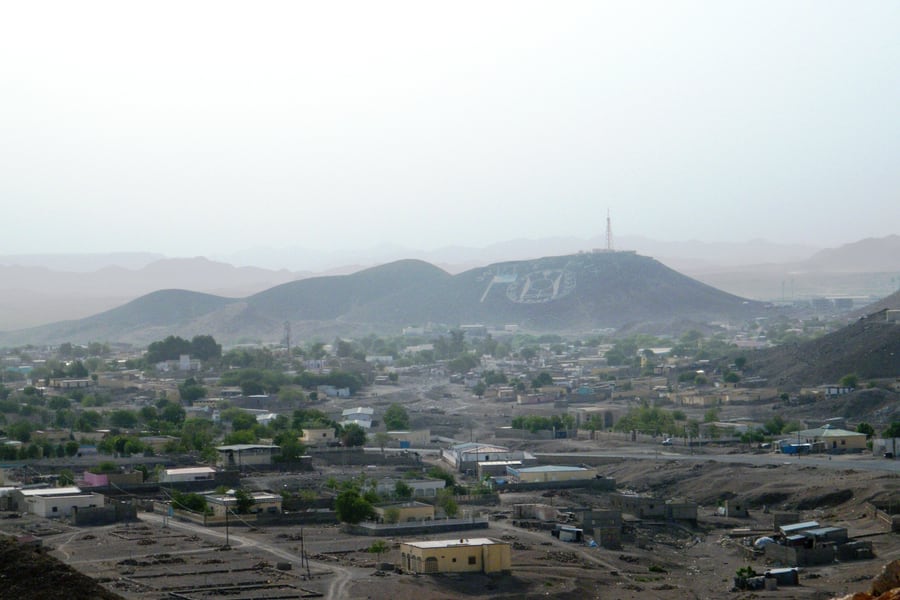
Ali Sabieh
Djibouti's second city, 44,782 people at the 2024 census, ten kilometres in from the Ethiopian border and 756 m up in an enclosed valley of granite hills. It is a railway town in the strict sense: a small place until the metre gauge arrived on 14 July 1900, then the point where Ethiopian trade changed hands. The mountain above it is a national emblem, and the cool nights are the reason people come up from the coast.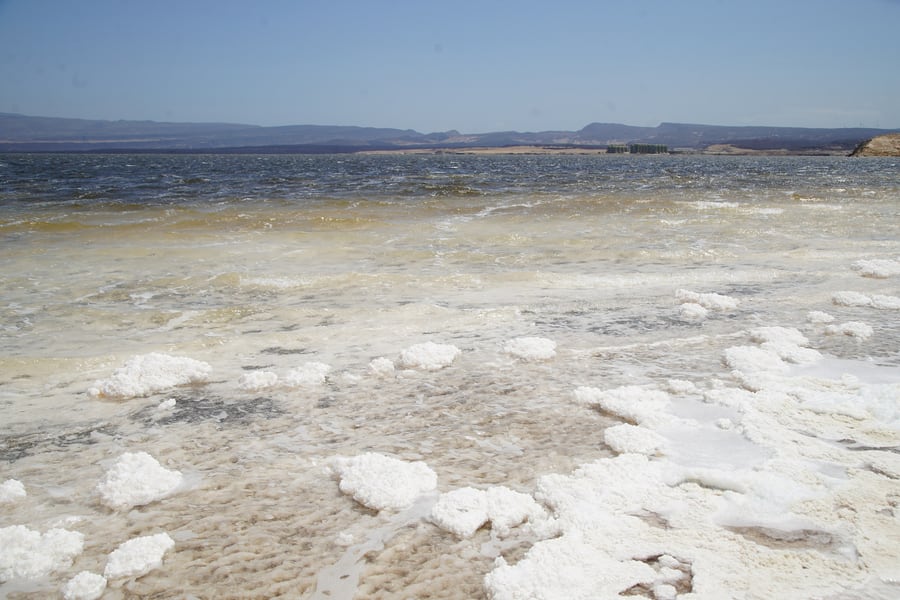 Mheidegger / Wikimedia Commons · CC BY 4.0 · 2024 · cropped
Lac Assal
A lake 155 m below sea level, the lowest point in Africa, and at 300 grams of salt to the litre the second most saline body of water on earth. The shore is a white crust broken into plates, the water behind it is turquoise, and the basin sits in Rift Valley basalt about 120 km west of Djibouti City. Afar and Issa traders have cut salt here for centuries and carried it inland for Ethiopian coffee, ivory and grain.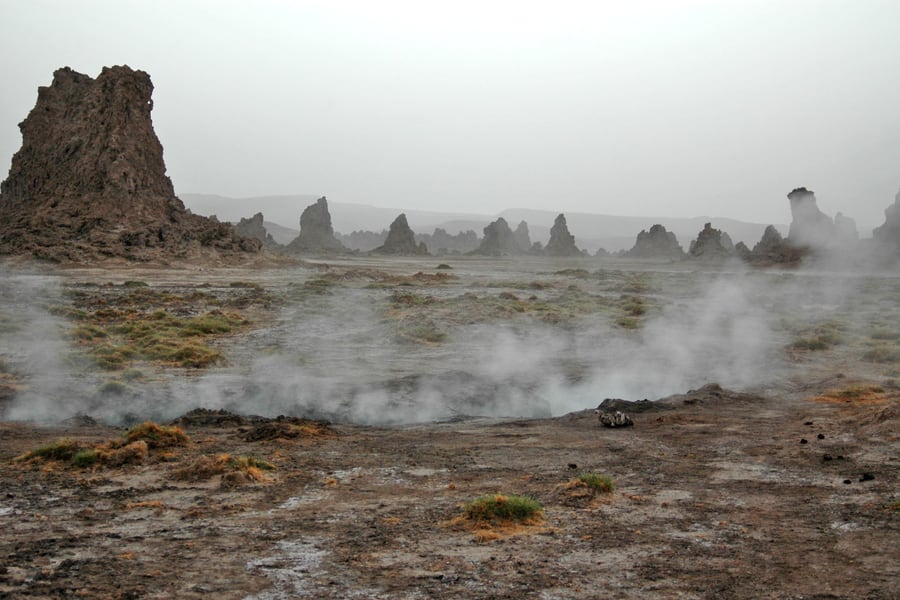 Rolf Cosar / Wikimedia Commons · CC BY 3.0 · 2008 · cropped
Lac Abbé
A hypersaline lake on the Ethiopian border in the south-west of the country, 320 km² of shallow water in a plain of limestone chimneys — towers up to fifty metres high, thrown up where lake water meets geothermal fluid, and still steaming. Flamingos feed on it. It has a fair claim to being one of the least accessible places on earth, and it is the usual reason anyone hires a four-wheel drive in Djibouti.Where to Sleep
The running pattern decides where you sleep. K1 goes east on odd days and K2 west on even ones, so a return trip means at least one night at the far end however short you want the visit to be — and because the train leaves at eight in the morning, a night at the near end as well.
The two ends of the line are where the hotels are: Dire Dawa in Ethiopia, ten kilometres in from the station, and Djibouti City at the other. The three below all keep their own websites, which is where these links go.
Where to stay
East Star Hotel
In the middle of Dire Dawa
A hotel in the centre of Dire Dawa with a restaurant, a spa, a 24-hour gym and its own conference and wedding rooms.
Check Availability (opens in a new tab, on eaststarhotel.com)via eaststarhotel.comDjibouti Palace Kempinski
On the beach at Djibouti City
A beachfront hotel with five restaurants, a spa, and conference and wedding venues, on the water between the Red Sea and the Indian Ocean.
Check Availability (opens in a new tab, on kempinski.com)via kempinski.comDjibouti Ayla Grand Hotel
About 800 m from Plage Sud
A hotel with an outdoor pool, a garden, a Turkish bath and a shuttle service, roughly 800 metres from Plage Sud in Djibouti City.
Check Availability (opens in a new tab, on aylahotels.com)via aylahotels.comQuestions or corrections
Planning this trip and stuck on something, or spotted a time, fare or detail that has changed? Send us a message about Dire Dawa to Djibouti City — the electric train to the sea. We read every one, and we update this page when something has changed.