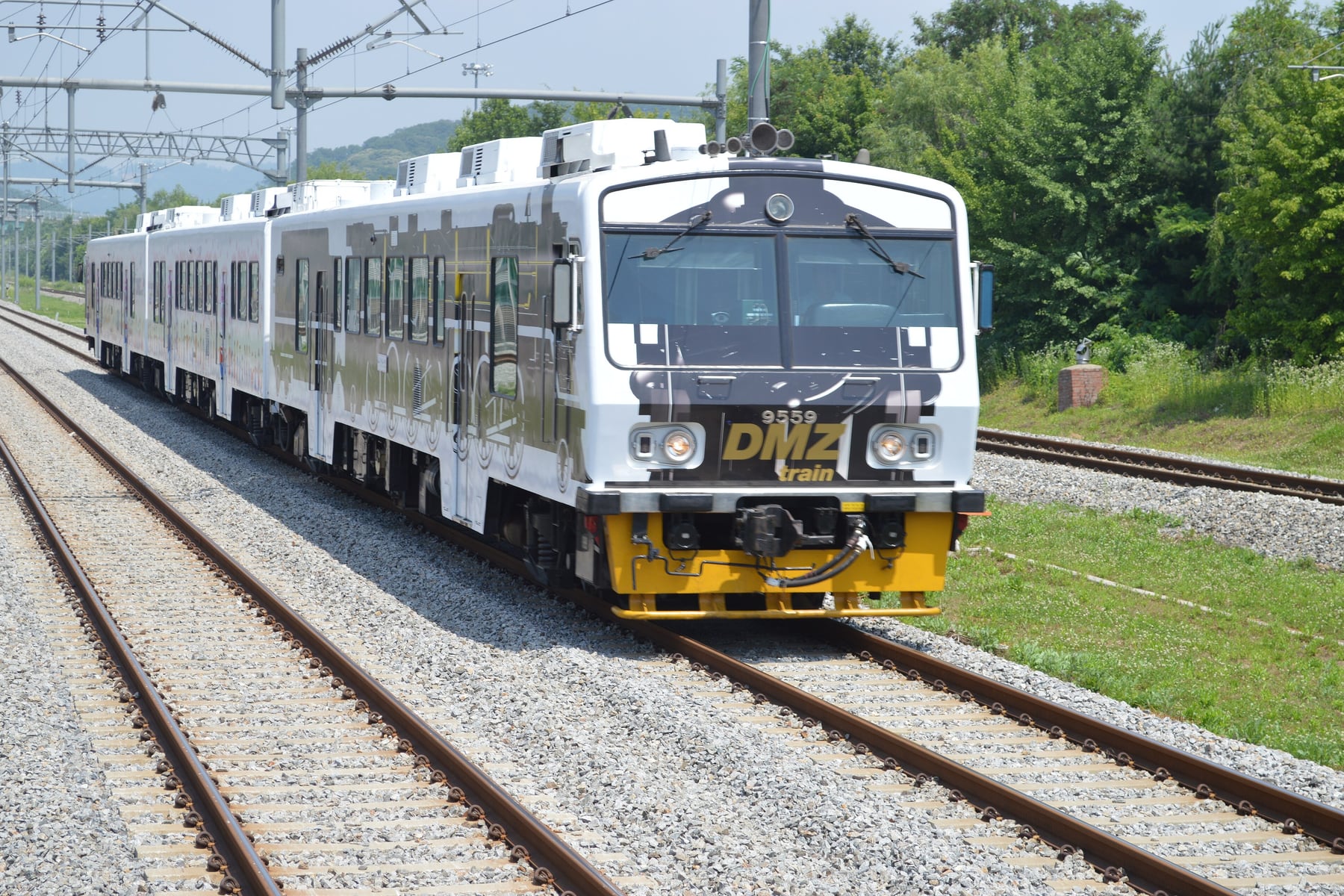
The DMZ Peace Link Train
충북선 무궁화호 / Wikimedia Commons · CC BY-SA 3.0 · 2014 · cropped
- Distance56 km (Seoul–Dorasan)
- Duration1 hr 46 min out · 1 hr 26 min back
- Best seasonAll year, on selected Fridays and Saturdays
Introduction
North of Seoul the Gyeongui Line runs for 56 kilometres to Dorasan, the last station in South Korea, about 650 metres short of the southern edge of the Demilitarized Zone. The line was built through to Kaesong, Pyongyang and Sinuiju on the Chinese border, and the platform signs at Dorasan still point the way to Pyongyang. Since the division of 1945 the only passenger train to go further north was a single test train in May 2007.
The DMZ Peace Link Train is how a visitor gets there. Dorasan stands inside the Civilian Control Zone, where nobody goes without being checked, so the train is not sold as a ticket but as a day tour run by Korail: every passenger is booked by name, the train stops at Imjingang on the near bank of the Imjin River while identity papers are checked, and at Dorasan a coach takes the group on to an observation post that looks across the border into Kaesong.
The service has had a short and broken life. A first DMZ Train began in May 2014, was suspended in October 2019 and formally ended in December 2023. It came back as the DMZ Peace Link in April 2026, after six and a half years, and now runs a few times a month, on Fridays and Saturdays.
The Journey
The group meets at 08:10 at entrance 1 of the Gyeongui Line platforms at Seoul Station, and the train leaves at 08:45. For the first hour it is a commuter run through the north-western suburbs and into Paju, stopping once, at Unjeong. Beyond Munsan, where the through commuter trains end, it runs out across the fields to the Imjin River.
Imjingang and the river
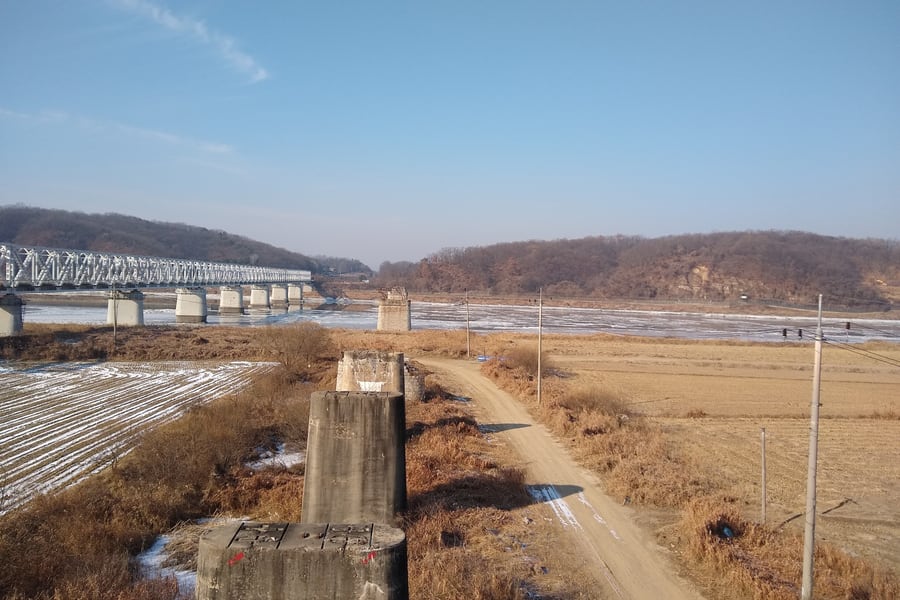
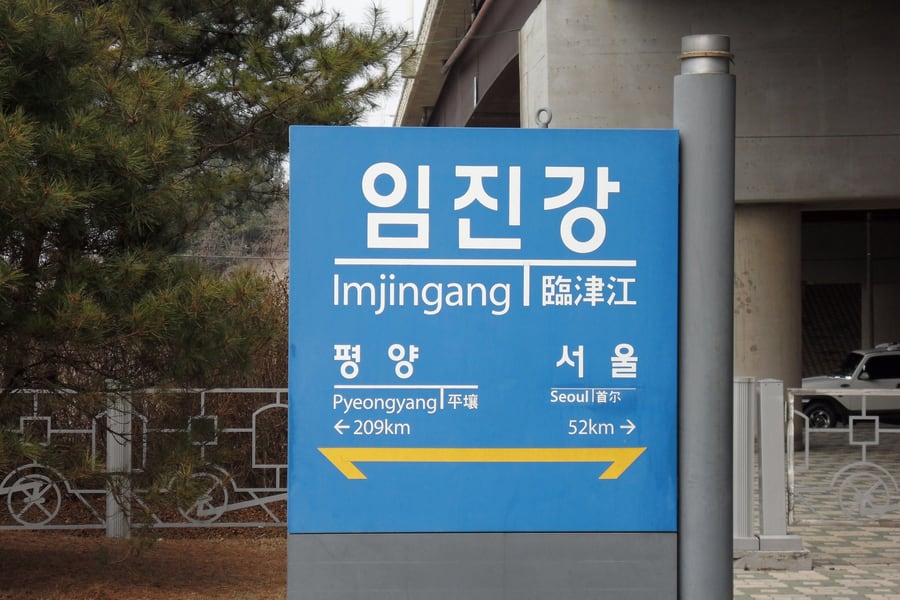
At 10:01 the train stops at Imjingang, the last station before the river, and everyone gets off. Dorasan lies inside the Civilian Control Zone, and here every passenger's identity papers are checked against the details sent in at booking. After twenty minutes the train sets off again and crosses the Imjin on a white steel truss bridge. Beside it stand the bare piers of the line's second bridge, bombed in the Korean War, and the wooden Freedom Bridge, by which 12,773 prisoners of war came home in 1953. Ten minutes later the train is at Dorasan.
Dorasan and the border
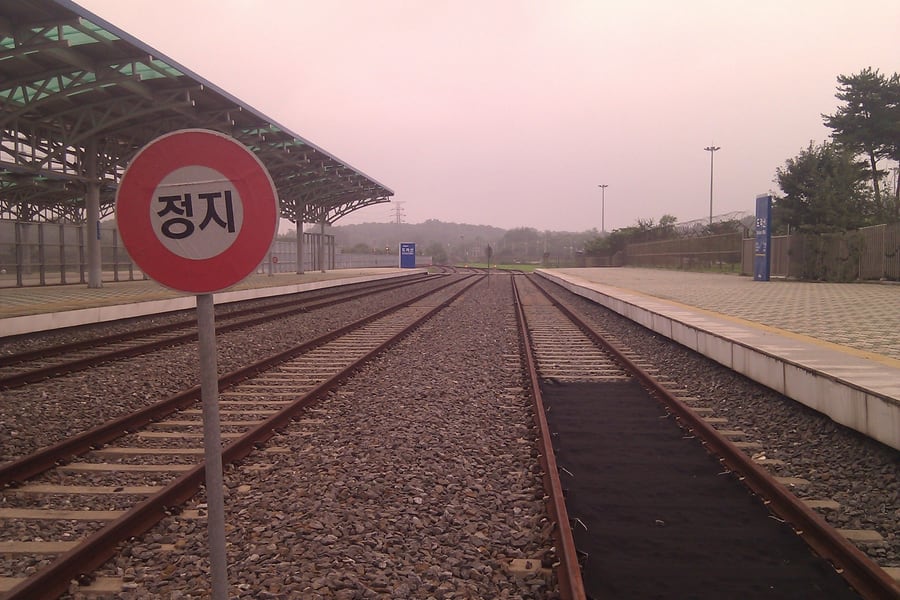
Dorasan station opened in April 2002, built as the South's last stop on a line reconnected to the North. In December 2007 freight trains began running 16 kilometres to the Kaesong industrial zone, one a day on weekdays; a year later the North closed the line again. On 15 October 2024 it blew up the northern ends of the road and rail links to the South.
From the station a coach takes the group up to the Dora Observatory, where binoculars look across the DMZ to Kaesong and the mountain of Songaksan (photography is forbidden beyond a marked line), then to lunch in the village of Tongilchon, and to Camp Greaves, a former American base. The coach is back at Dorasan for a second identity check at 14:45, and the train leaves at 15:09, in Seoul at 16:35.
The train
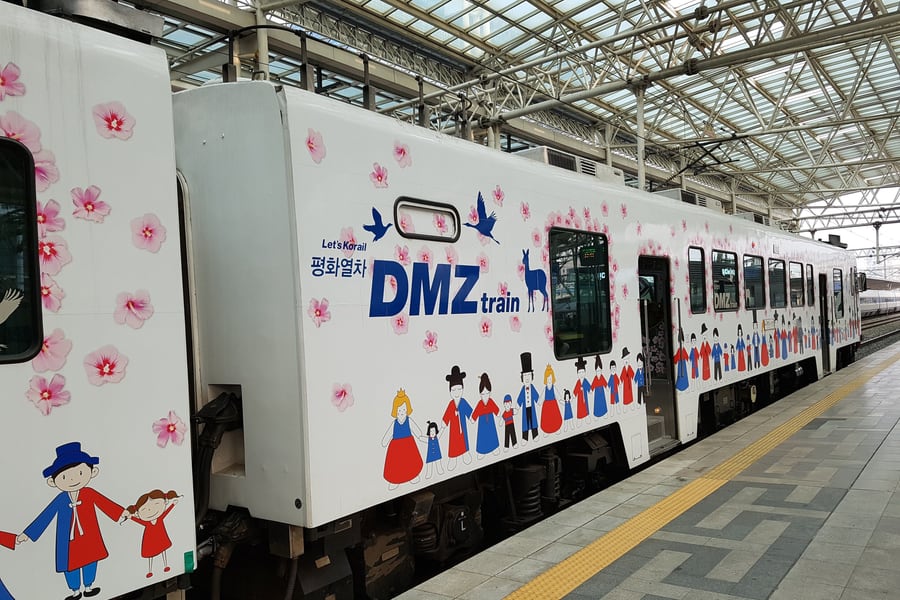
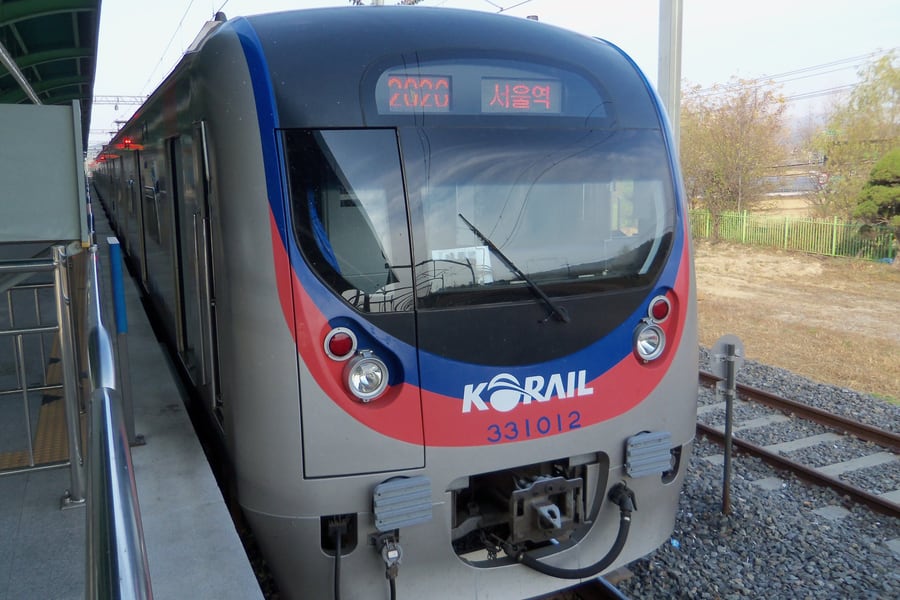
The 2014 DMZ Train ran with diesel railcars painted for the job, each carriage given a theme of peace, harmony or love, with pinwheels on the ceilings. The DMZ Peace Link is an ordinary Korail electric commuter unit, of the kind that works the Gyeongui Line every day. There are no toilets on board. Seats are allotted by carriage, and inside there is a DMZ photo wall, a camera that prints black-and-white photographs on till receipts, and a slow mailbox: a postcard written on the train is posted to you six months later.
Along the route
 Kys951 / Wikimedia Commons · Public domain · 2010 · cropped
The check at Imjingang
Every passenger leaves the train at Imjingang, the last station before the Civilian Control Zone, to show identity papers. Its sign gives the distances both ways: 52 km back to Seoul, 209 km on to Pyongyang.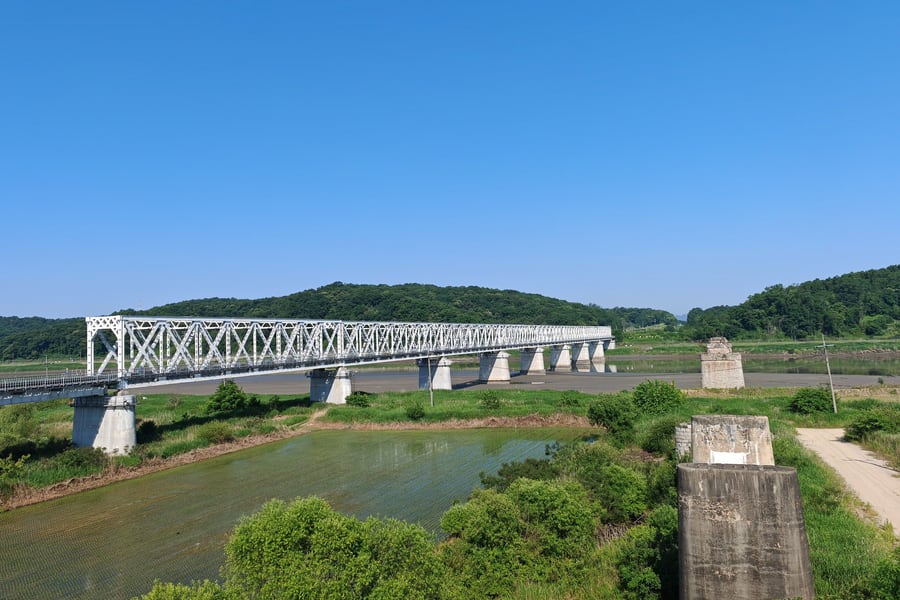 Dwxn / Wikimedia Commons · CC BY-SA 4.0 · 2024 · cropped
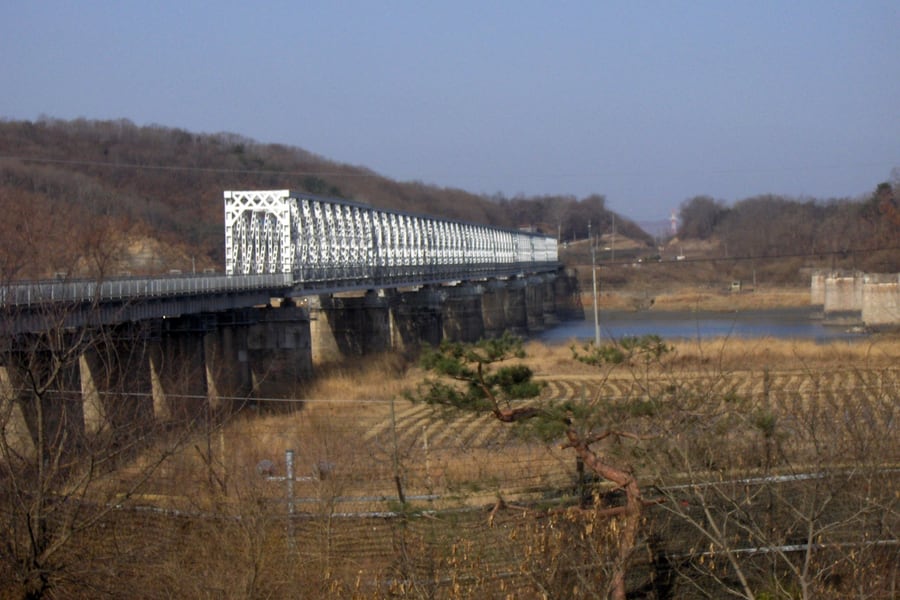
Over the Imjin
The train crosses the Imjin on a white steel truss bridge. The Gyeongui Line once had two bridges here; both were bombed in the Korean War, and the piers of the second still stand in the fields beside the river.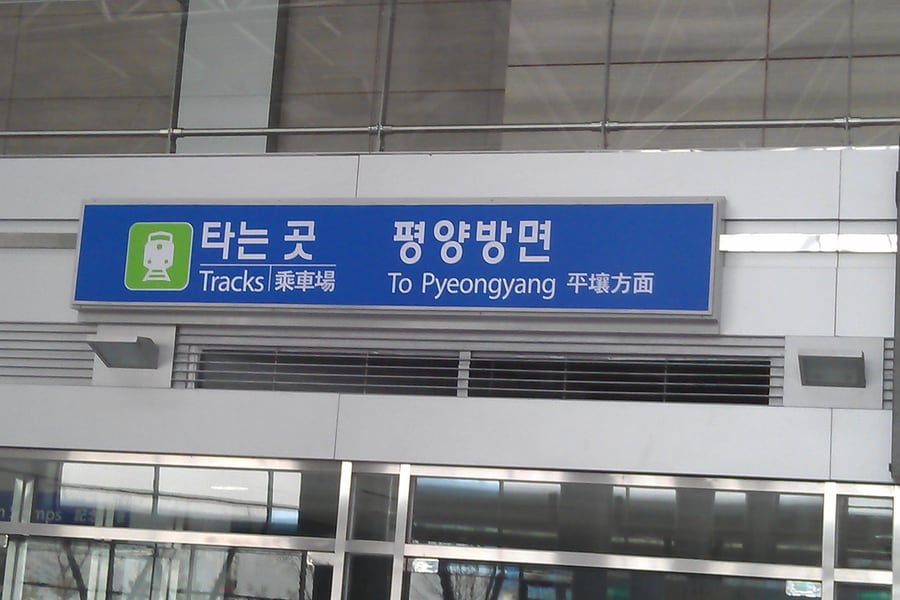 Christian140 / Wikimedia Commons · CC BY-SA 4.0 · 2013 · cropped
To Pyongyang
At Dorasan the sign over the platform still reads "To Pyeongyang". Freight trains ran from here to Kaesong in 2007 and 2008, and on 15 October 2024 the North blew up its end of the line.A bit of history
Culture & experiences along the way
 Dwxn / Wikimedia Commons · CC BY-SA 4.0 · 2024 · cropped
The ribbons on the fence
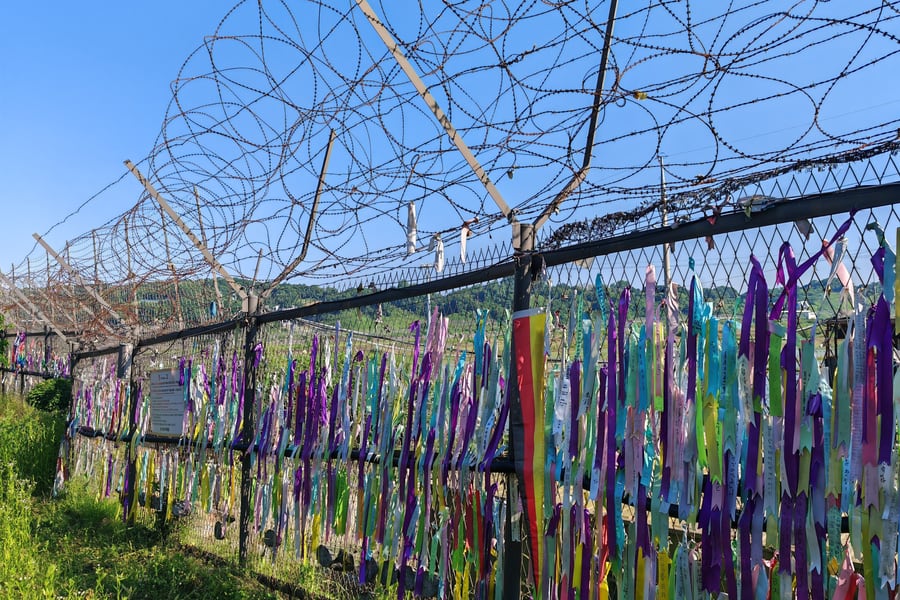
The wire fence at Imjingak, by the Freedom Bridge, is hung with thousands of ribbons, each carrying a written message or prayer for peace and for the two Koreas to be one again. Visiting groups add their own, and the colours run for tens of metres along the wire. 차차PD / Wikimedia Commons · CC BY 4.0 · 2018 · cropped
Jangdan beans
Jangdan soybeans are a native variety from the old county of Jangdan, north of the Imjin, where they are still grown in villages inside the Civilian Control Zone. Every November the Jangdan Bean Festival is held at Imjingak, just across the river from the county the beans are named after. Here they are roasted, as jangdan-kong-bokkeum.Timetables
The DMZ Peace Link makes one return trip on each day it runs, and it runs only as part of the Korail day tour. When it came back in April 2026 Korail scheduled it for the second and fourth Friday of each month; by the autumn some departures had moved to Saturdays, and in October 2026 it ran on Friday 2, Saturday 10, Friday 23 and Saturday 31 October. The tour operator warns that Friday and Saturday timings can differ. The times below are from the Saturday 31 October tour.
| Station | Outward | Return |
|---|---|---|
| Seoul (Gyeongui Line platforms) | 08:45 | 16:35 |
| Unjeong | 09:31 | 15:46 |
| Imjingang | 10:01 · 10:21 | 15:19 |
| Dorasan | 10:31 | 15:09 |
The outward train waits twenty minutes at Imjingang for the identity check, and Unjeong is the only other stop. The group spends about four and a half hours at the Dorasan end, all of it on the coach tour.
A departure goes ahead only when at least 30 people have booked; if it falls short the operator cancels three or four days before. Bad weather or the army's own needs can also cancel a tour on the day.
As of October 2026. Departures are published by the tour operator: Korail Networks · DMZ Peace Link Train (opens in a new tab).
Tickets
There is no train ticket on its own: the DMZ Peace Link is sold only as a day tour, by Korail Networks on korailtravel.com. The October 2026 tour cost ₩47,600 for adults, children and seniors alike, covering the return train, the coach, admissions, a guide and a souvenir ticket; lunch is extra. Enter the names, dates of birth and contact details of everyone in the party when booking: entry to the zone is refused if any of them is wrong.
Every passenger must carry the original of a photo ID on the day: foreign visitors their passport or Korean residence card. Children under 15 must be with a guardian. Drones, action cameras and body cameras are banned, and military installations must not be photographed.
Book your tickets
DMZ Peace Link day tour
Seoul to Dorasan and back, with the coach tour
The only way onto the train, with the return journey, the coach, admissions and a guide included.
Book Tickets (opens in a new tab, on korailtravel.com)via korailtravel.comRail Passes
No rail pass covers the DMZ Peace Link. The train is sold only inside the Korail Networks day tour, and the KORAIL PASS, sold to foreign visitors, is in any case not valid on metropolitan subway trains or on special tourist trains.
Checked October 2026 against Korail's KORAIL PASS details (opens in a new tab).
Places to Visit
Imjingak and the Freedom Bridge stand on the near bank of the Imjin beside Imjingang station, outside the Civilian Control Zone and open to everyone. Camp Greaves lies beyond the river, inside the zone, and can be visited only on an organised tour such as this one.
 Dwxn / Wikimedia Commons · CC BY-SA 4.0 · 2024 · cropped
Imjingak
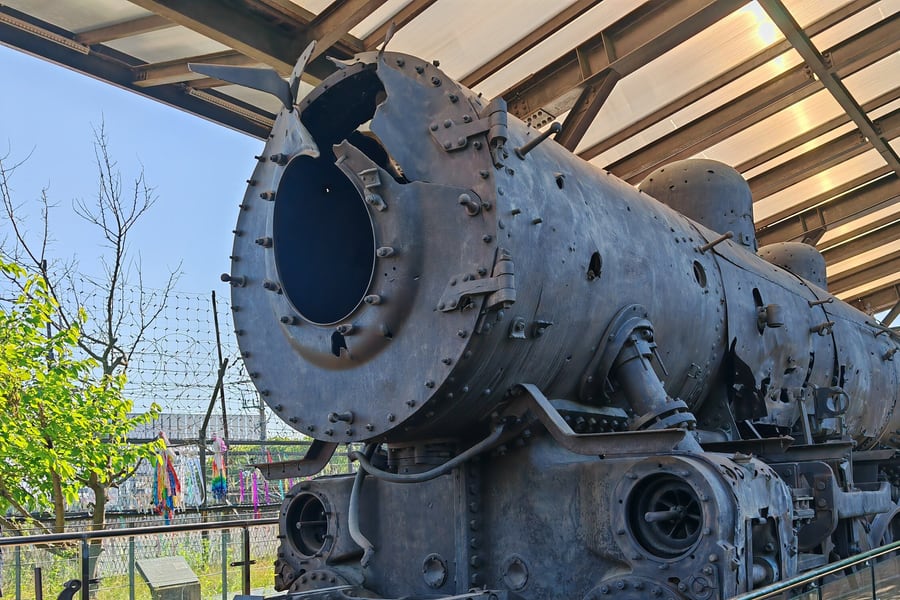
A park on the near bank of the Imjin, built in 1972 for people from both Koreas who cannot go home, and visited by about 1.2 million people a year. At Seollal and Chuseok displaced families bow towards the North at its altar. Here too is the Jangdan station locomotive, derailed by Allied fire there on 31 December 1950 to keep its load from the North, and shown at Imjingak since 2009.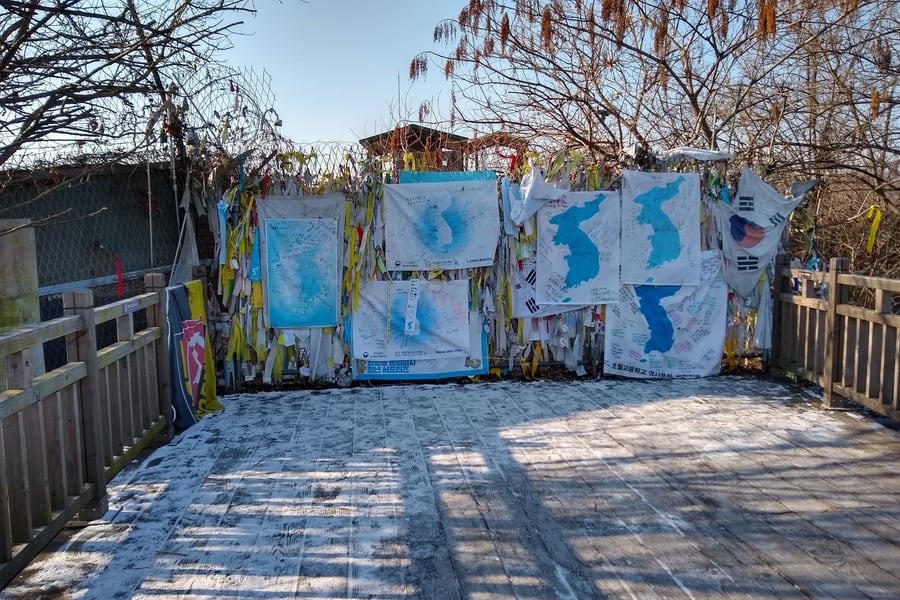 Lance Vanlewen / Wikimedia Commons · CC BY-SA 4.0 · 2018 · cropped
The Freedom Bridge
When the Gyeongui Line's bridges over the Imjin were bombed, one was rebuilt on its old piers and a temporary wooden span laid at its southern end: 83 metres long, on log trestles. In 1953 12,773 South Korean and UN prisoners of war walked across it to freedom, and it has carried the name ever since. Its far end stops at a fence hung with flags and ribbons.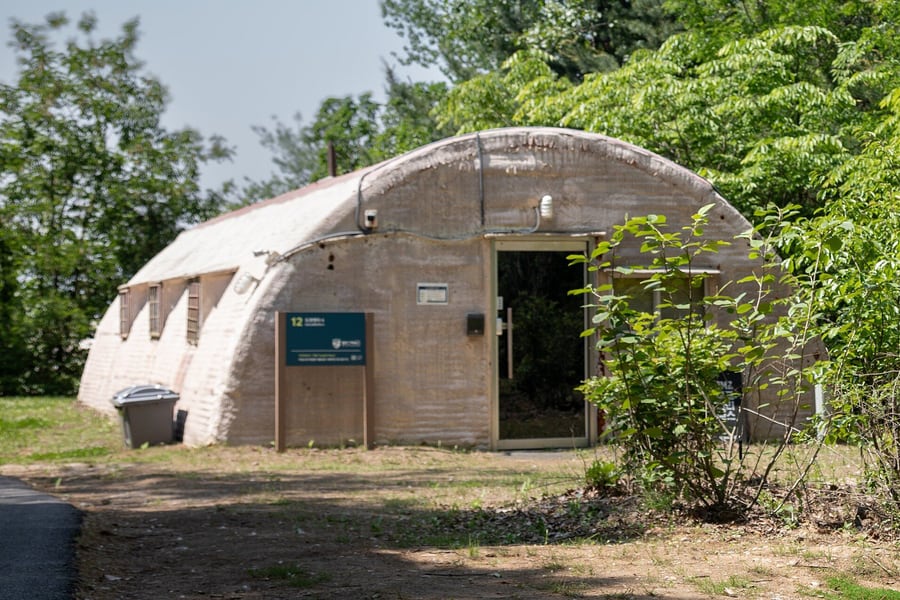 U.S. Army / Pfc. Michelle Lessard-Terry / Wikimedia Commons · Public domain · 2025 · cropped
Camp Greaves
An American army camp from July 1953, home in turn to battalions of the 2nd Infantry Division, closed in 2004 and handed back to Korea in 2007. Its barracks and Quonset huts opened to the public in December 2013 as a hostel and history site, and in 2016 it stood in for a fictional army base in the television drama Descendants of the Sun.Where to Sleep
The tour is a day out from Seoul and meets at Seoul Station at 08:10, so the place to stay is within walking distance of the station.
Where to stay
Fraser Place Central Seoul
78 Tongil-ro, Jung-gu
Serviced one- and two-bedroom apartments with kitchenettes, on Tongil-ro, the road that runs from Seoul Station to Panmunjom.
Check Availability (opens in a new tab, on frasershospitality.com)via frasershospitality.comQuestions or corrections
Planning this trip and stuck on something, or spotted a time, fare or detail that has changed? Send us a message about The DMZ Peace Link Train. We read every one, and we update this page when something has changed.