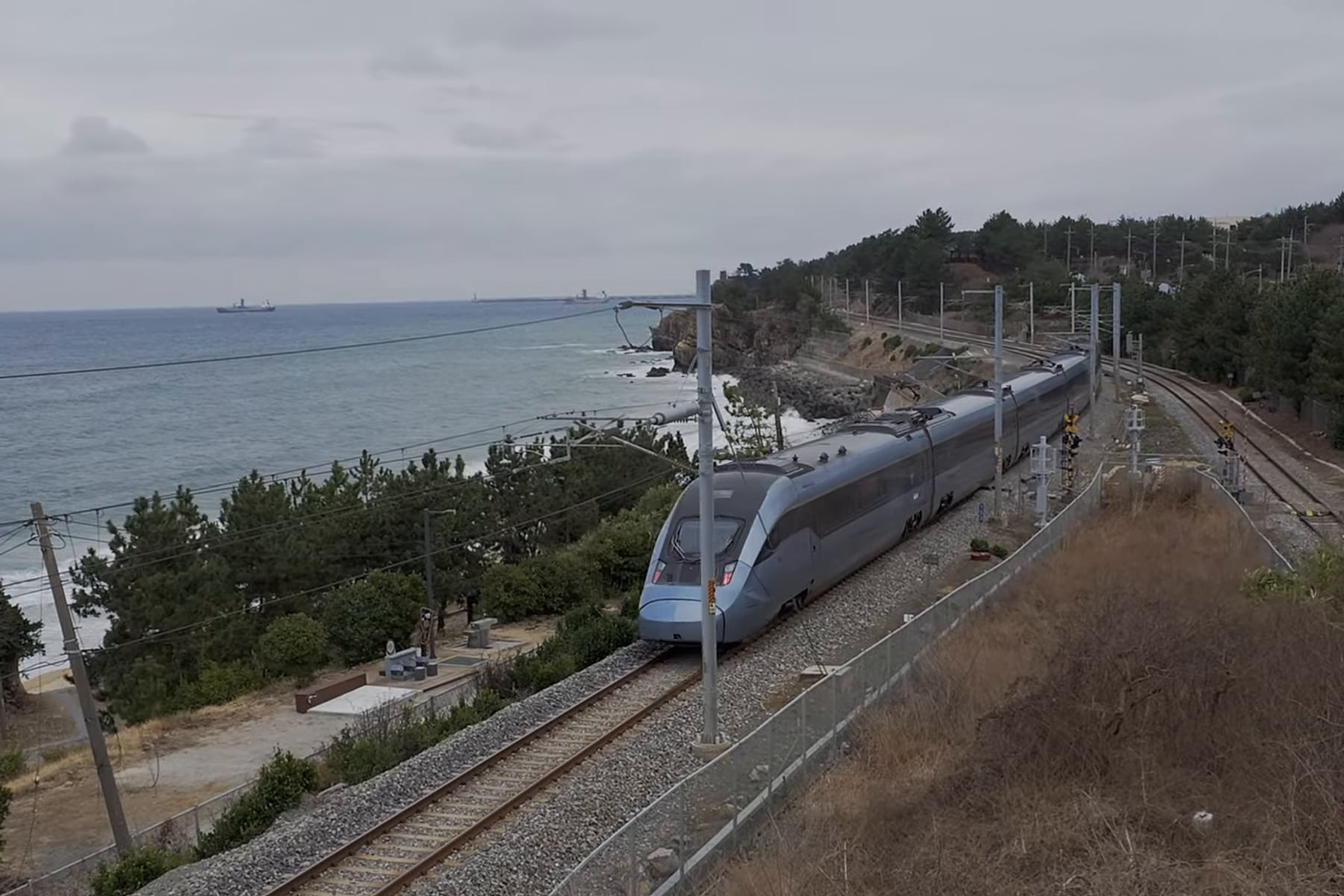
The Donghae Line KTX-Eum
공백 GongBack / YouTube · CC BY 3.0 · 2026 · video frame, cropped
- DistanceAbout 364 km
- Duration3 hr 50 min to 4 hr
- Best seasonAll year; take a daylight train for the sea
Introduction
For most of a century, a railway down Korea's east coast was a line on a map. Work on the missing link north of Pohang began in 1940 and stopped in 1945 with only the trackbed built; a plan of the 1960s was dropped in favour of roads. The 166 kilometres from Pohang to Samcheok finally opened on 1 January 2025, and the coast between Gangneung and Busan was joined by rail for the first time.
On 30 December 2025 Korail put the KTX-Eum on it: three trains a day each way from Gangneung to Bujeon in Busan, in just under four hours, stopping at eleven stations. It is not a fast line, and this is the quickest way to ride the whole of it: from a station on the beach at Jeongdongjin, over the tetrapods at Mukho, through the new line's tunnels and across its viaducts above the sea, to the old Silla capital of Gyeongju and on into Busan.
The Journey
The morning train, 752, leaves Gangneung at 09:36. For the first hour it follows the coast line opened in 1961 and 1962, and this is where the sea is closest. Sit on the left going south, on the right going north.
The shore
Jeongdongjin, seventeen minutes out, is a station on the sand, often claimed as the closest to the sea anywhere. Beyond it the line keeps to the shore through Mukho, where it runs on a ledge above the rocks of Hapyeong beach, and reaches Donghae, where the KTX-Eum trains from Seoul turn back. The Busan train goes on to Samcheok, and from there it leaves the old railway for the new one.
The new line
South of Samcheok the track goes straight into a tunnel, and that is the pattern for the next two hours. The new line to Pohang has 64 tunnels, the longest of them 5.63 km, and the sea comes in flashes between them, often seen from viaducts high above the coast road. Through Uljin the line crosses the mouth of the Wangpi stream and spans National Route 7 on a 108-metre steel truss. Uljin and Yeongdeok, both snow-crab towns, had no railway at all until the line came. South of Yeongdeok the train joins the section that opened in 2018, and at 12:06 it is in Pohang.
Gyeongju and Busan
From Pohang the line turns inland. The train calls at Gyeongju, for the tombs and temples of the Silla kings, and at Taehwagang in Ulsan, then runs down the old Donghae Nambu line, shared with Busan's suburban trains, to Bujeon at 13:36.
The train
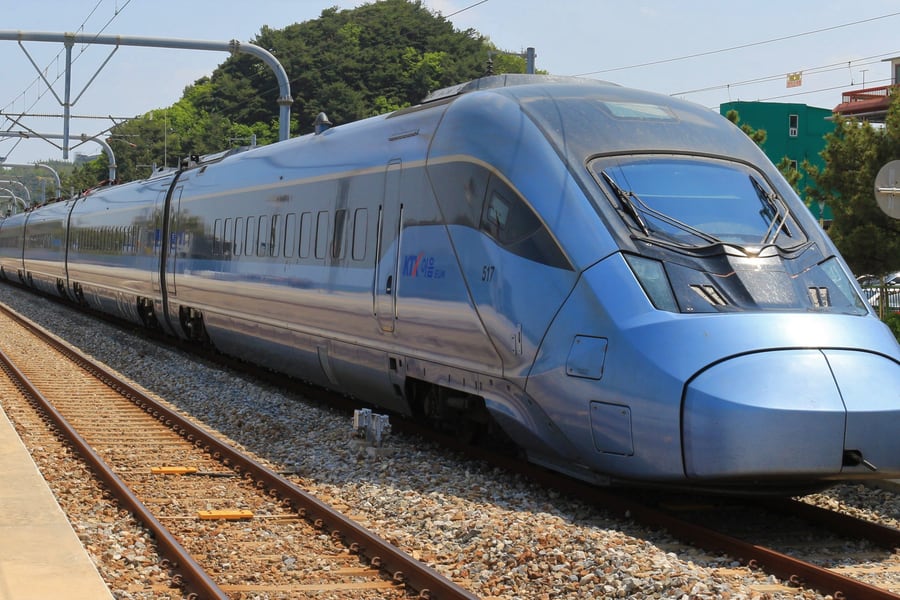
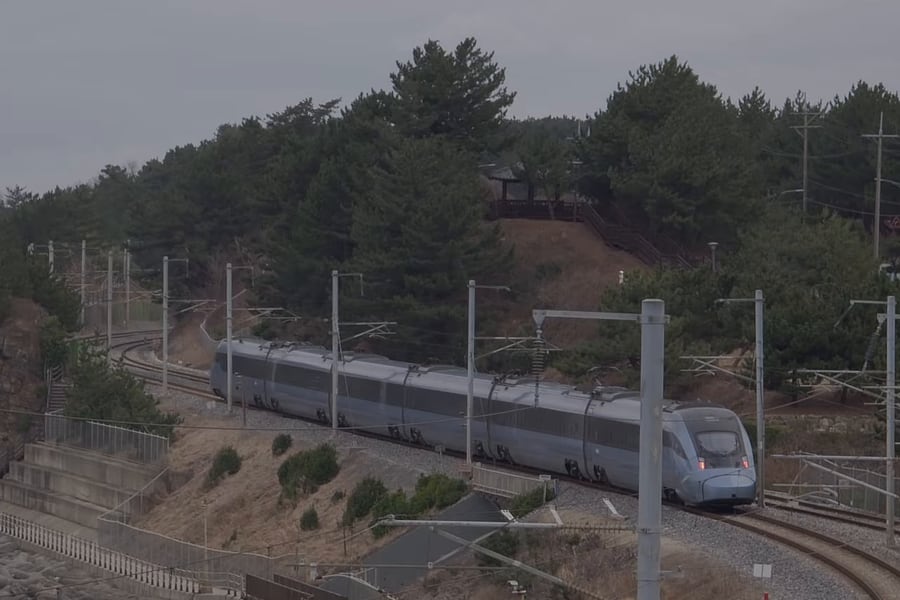
The KTX-Eum is Korail's own six-car high-speed unit, built by Hyundai Rotem and in service since January 2021; eum means a link. It is designed for 260 km/h, and here it never gets near it: the new line is built for 200 km/h at most, and the coast line north of Samcheok for much less. It has premium seats as well as standard class, and every seat is reserved.
Along the route
 공백 GongBack / YouTube · CC BY 3.0 · 2026 · video frame, cropped
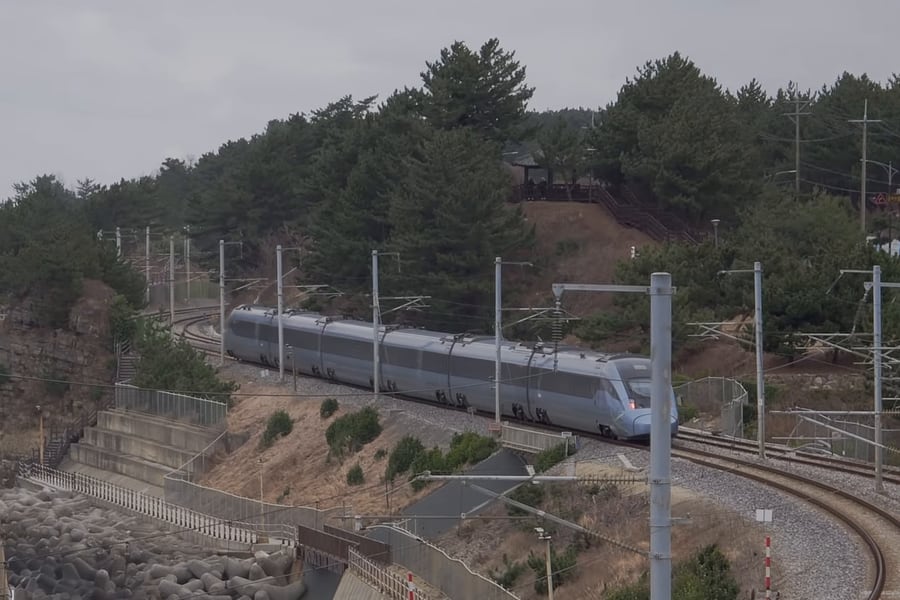
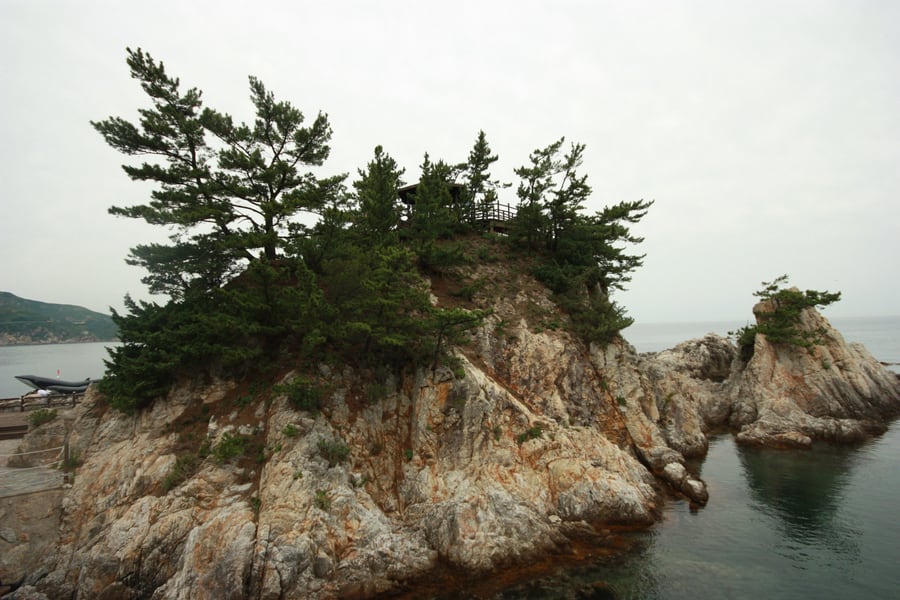
The shore at Mukho
Around Mukho the line runs on a shelf above the rocks and tetrapods of Hapyeong beach, on a stretch of coast railway opened in 1961. Southbound, it comes about forty minutes out of Gangneung: sit on the left. Kamezukakofun / Wikimedia Commons · CC BY-SA 4.0 · 2019 · cropped
Begun in 1940
Work on a railway north from Pohang began in April 1940 and stopped in 1945 with no rails laid. A plan of 1965 was dropped for roads two years later. Building restarted in 2008, Yeongdeok was reached in 2018, and Samcheok on 1 January 2025.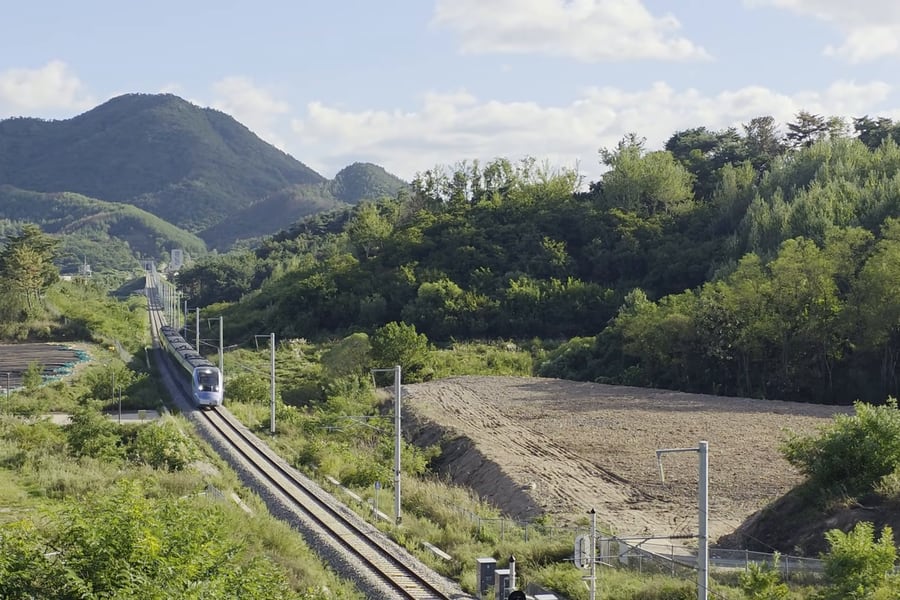 Dynamic / YouTube · CC BY 3.0 · 2025 · video frame, cropped
Mostly in tunnels
The 166 km between Pohang and Samcheok has 64 tunnels; the longest, Okwon, is 5.63 km. The sea comes in flashes between them, often from high viaducts. A Korean travel writer judged the best of it to be between Bongsan 1-ri and 2-ri, in Uljin.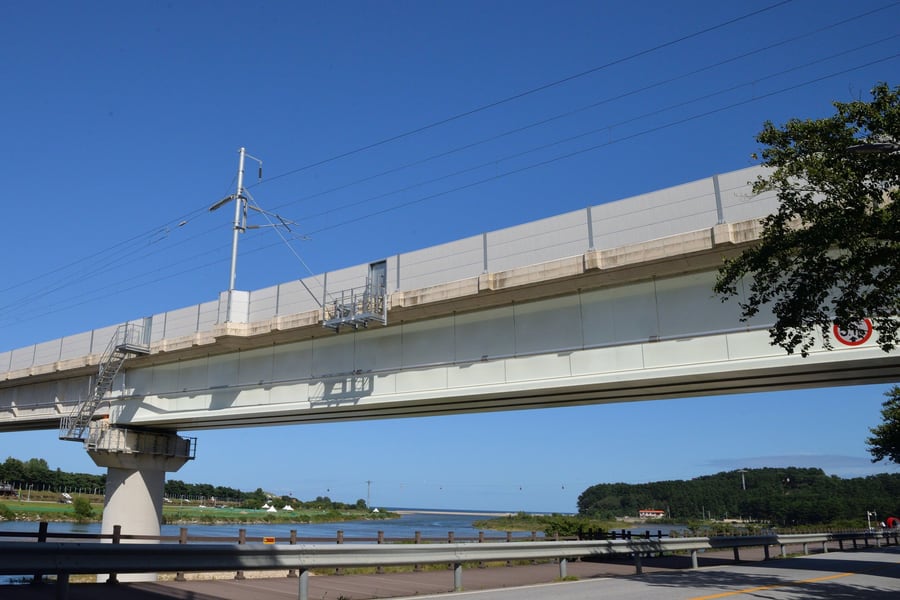 Dittwjfsdgkvkdjg / Wikimedia Commons · CC BY-SA 4.0 · 2024 · cropped
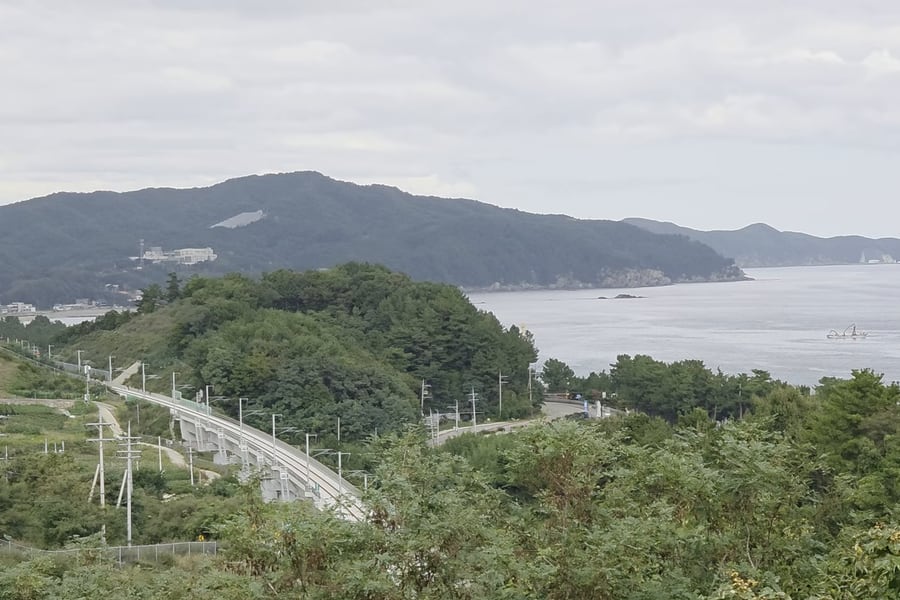
Over the Wangpi
At Uljin the line crosses the mouth of the Wangpi stream on a long viaduct. Close by it spans National Route 7 with a 108-metre steel truss, lifted into place in 2020: the longest single span on any single-track railway in Korea.A bit of history
Culture & experiences along the way
 Studio 4cats / Wikimedia Commons · KOGL Type 1 · cropped
Snow crab
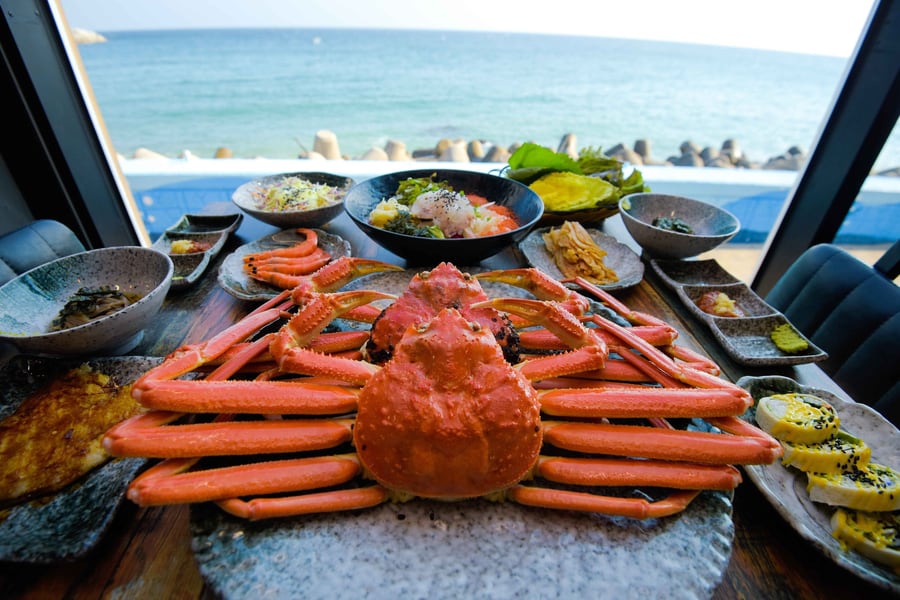
The long-legged snow crab caught off Yeongdeok and Uljin is Korea's largest crab, its shell 13 to 15 cm across. It is called daege for its legs, jointed like bamboo, not for its size. Females and crabs under 9 cm are protected all year; the rest are steamed whole.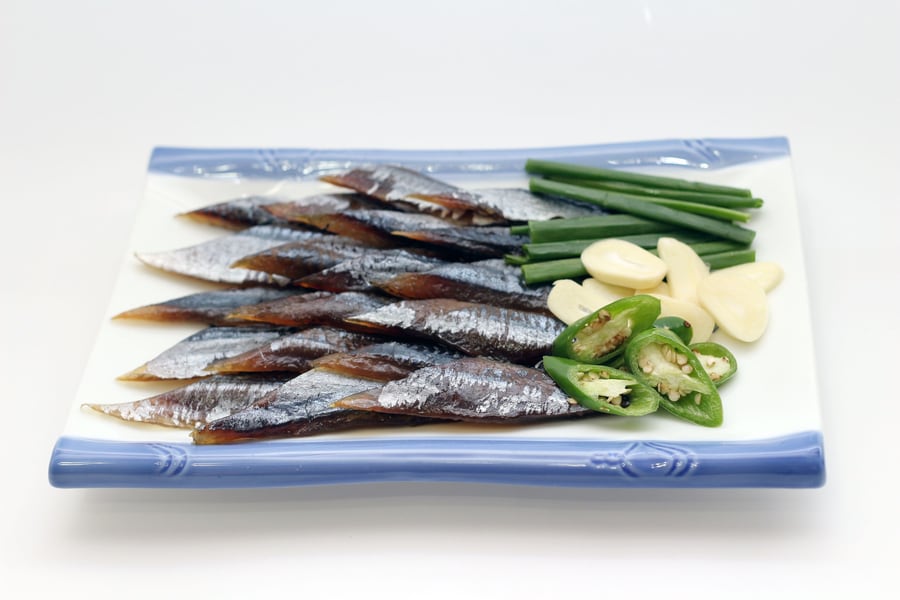 Hyeon-Jeong Suk / Wikimedia Commons · CC BY 2.0 · cropped
Gwamegi
Pohang's winter dish is gwamegi: herring or Pacific saury hung outdoors from December, freezing at night and thawing by day until it is half dry. Guryongpo harbour is the place for it, and Pohang has held a gwamegi festival every November since 1997.Timetables
Three KTX-Eum trains run each way every day, all year. For the sea, take one of the first two: the evening trains run the coast in the dark for much of the year.
Southbound, Gangneung to Bujeon
| Station | 752 | 754 | 756 |
|---|---|---|---|
| Gangneung | 09:36 | 14:56 | 18:35 |
| Jeongdongjin | 09:53 | 15:12 | 18:51 |
| Mukho | 10:14 | 15:32 | 19:11 |
| Donghae | 10:23 | 15:39 | 19:18 |
| Samcheok | 10:42 | 15:56 | 19:35 |
| Uljin | 11:09 | 16:23 | 20:02 |
| Yeongdeok | 11:44 | 16:58 | 20:36 |
| Pohang | 12:06 | 17:20 | 20:58 |
| Gyeongju | 12:33 | 17:46 | 21:25 |
| Taehwagang | 12:54 | 18:08 | 21:46 |
| Bujeon | 13:36 | 18:50 | 22:30 |
Northbound, Bujeon to Gangneung
| Station | 751 | 753 | 755 |
|---|---|---|---|
| Bujeon | 07:50 | 13:58 | 19:40 |
| Taehwagang | 08:34 | 14:42 | 20:24 |
| Gyeongju | 08:57 | 15:04 | 20:46 |
| Pohang | 09:21 | 15:28 | 21:12 |
| Yeongdeok | 09:43 | 15:49 | 21:33 |
| Uljin | 10:17 | 16:24 | 22:08 |
| Samcheok | 10:43 | 16:50 | 22:35 |
| Donghae | 11:00 | 17:08 | 22:52 |
| Mukho | 11:07 | 17:16 | 22:59 |
| Jeongdongjin | 11:26 | 17:37 | 23:18 |
| Gangneung | 11:40 | 17:51 | 23:32 |
Times are departures, except at the ends of each run. The line also has slower ITX-Maeum and Nuriro trains, which stop at more of the small coast stations but take about an hour longer.
As of October 2026, for Korail's timetable in force from 1 November 2026. Korail publishes its timetables on its timetable page (opens in a new tab).
Tickets
The KTX-Eum is booked like any Korail train: on korail.com, in English on its site for foreign visitors, in the Korail Talk app or at a station. Sales open a month ahead at 07:00. A one-way ticket from Gangneung to Bujeon costs ₩46,800 in standard class and ₩56,200 in the premium car; shorter journeys are priced by distance.
There are only three trains a day, and they fill up, above all around New Year, when crowds go to Jeongdongjin for the first sunrise. Book early for a weekend or a holiday.
Book your tickets
Gangneung to Bujeon, standard
One way, a reserved seat
Sold by Korail on korail.com, in the Korail Talk app and at stations, from a month ahead.
Book Tickets (opens in a new tab, on korail.com)via korail.comGangneung to Bujeon, premium
One way, a wider reserved seat
The KTX-Eum's premium car, with a ₩9,400 supplement on the standard fare.
Book Tickets (opens in a new tab, on korail.com)via korail.comRail Passes
The KORAIL PASS, sold to foreign visitors for two to five days, is valid on the KTX-Eum, and with it you can reserve up to two seats a day. It does not cover the SRT.
For this ride alone it is rarely worth it: one ₩46,800 ticket is a small part of the price of a pass. It pays when the same days carry other long journeys, such as Seoul to Gangneung before and Busan back to Seoul after.
Checked October 2026 against Korail's KORAIL PASS details (opens in a new tab).
Places to Visit
The KTX-Eum stops at the towns, so each of these is a short taxi or bus ride from a station: Ojukheon from Gangneung, the cave from Samcheok, and Yangdong from Gyeongju.
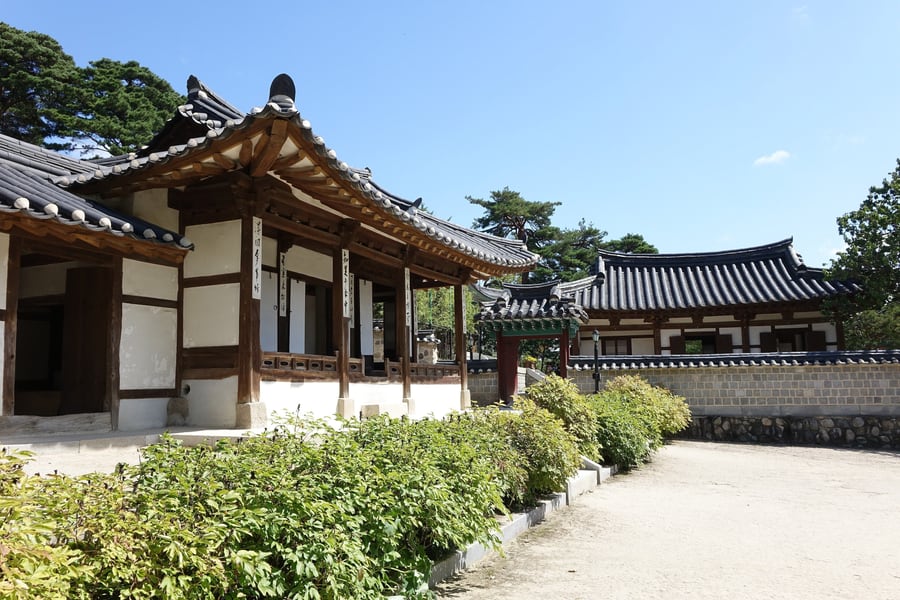 최광모 / Wikimedia Commons · CC0 · 2015 · cropped
Ojukheon
The house where Shin Saimdang and her son Yi I, the Confucian scholar Yulgok, were born. It was built in the late fifteenth century by Choi Eung-hyeon and is one of the oldest buildings in Korea, listed as a Treasure in 1963. The name means the house of black bamboo, which still grows round it, and the house appears on the 5,000-won note.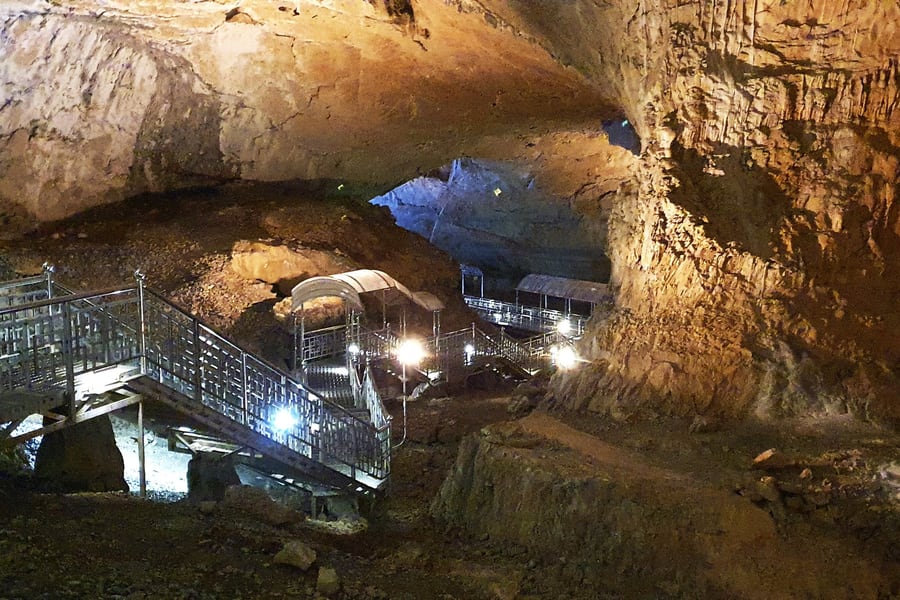 José Carioca / Wikimedia Commons · CC BY-SA 4.0 · cropped
Hwanseon Cave
The longest limestone cave known in Korea, with 6.2 km of mapped passages, in the karst hills inland from Samcheok. About 1.6 km is open, on steel walkways past waterfalls, pools and chambers up to 100 metres high, at 10 to 14°C all year. It has been a natural monument since 1966; a monorail saves the steep climb to the entrance.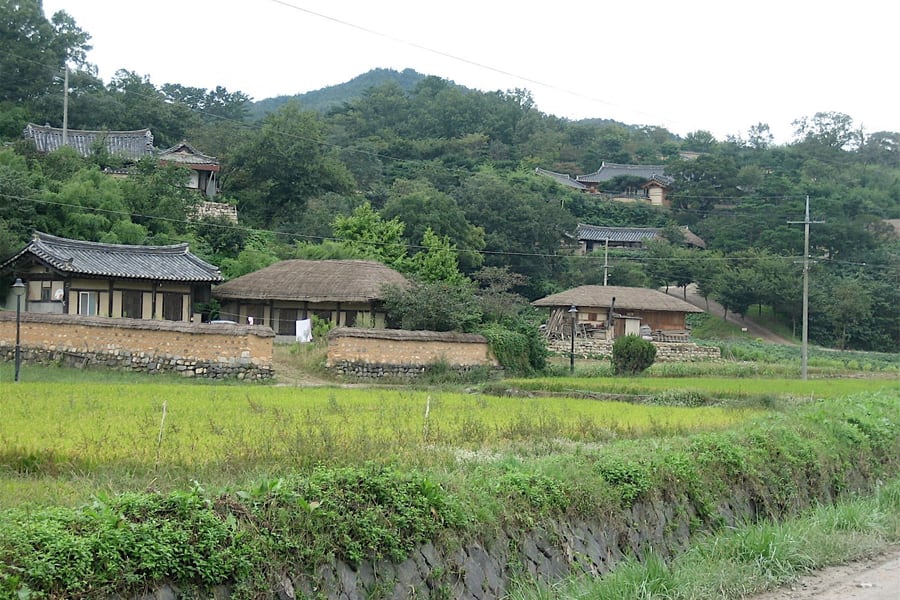 nzj / Wikimedia Commons · CC BY 3.0 · 2007 · cropped
Yangdong Village
A village of Joseon gentry families sixteen kilometres north-east of Gyeongju, founded by Son So in the fifteenth century and shared ever since by the Son and Yi clans. More than 160 tiled and thatched houses climb the wooded slopes, 54 of them over 200 years old, and families still live in many of them. UNESCO listed it in 2010 with Hahoe.Where to Sleep
The first train south leaves Gangneung at 09:36, so a night in Gangneung makes an easy start. Going north, the 07:50 from Bujeon means a night in central Busan. With three trains a day, the ride also breaks well at Pohang or Gyeongju for a night on the way.
Questions or corrections
Planning this trip and stuck on something, or spotted a time, fare or detail that has changed? Send us a message about The Donghae Line KTX-Eum. We read every one, and we update this page when something has changed.