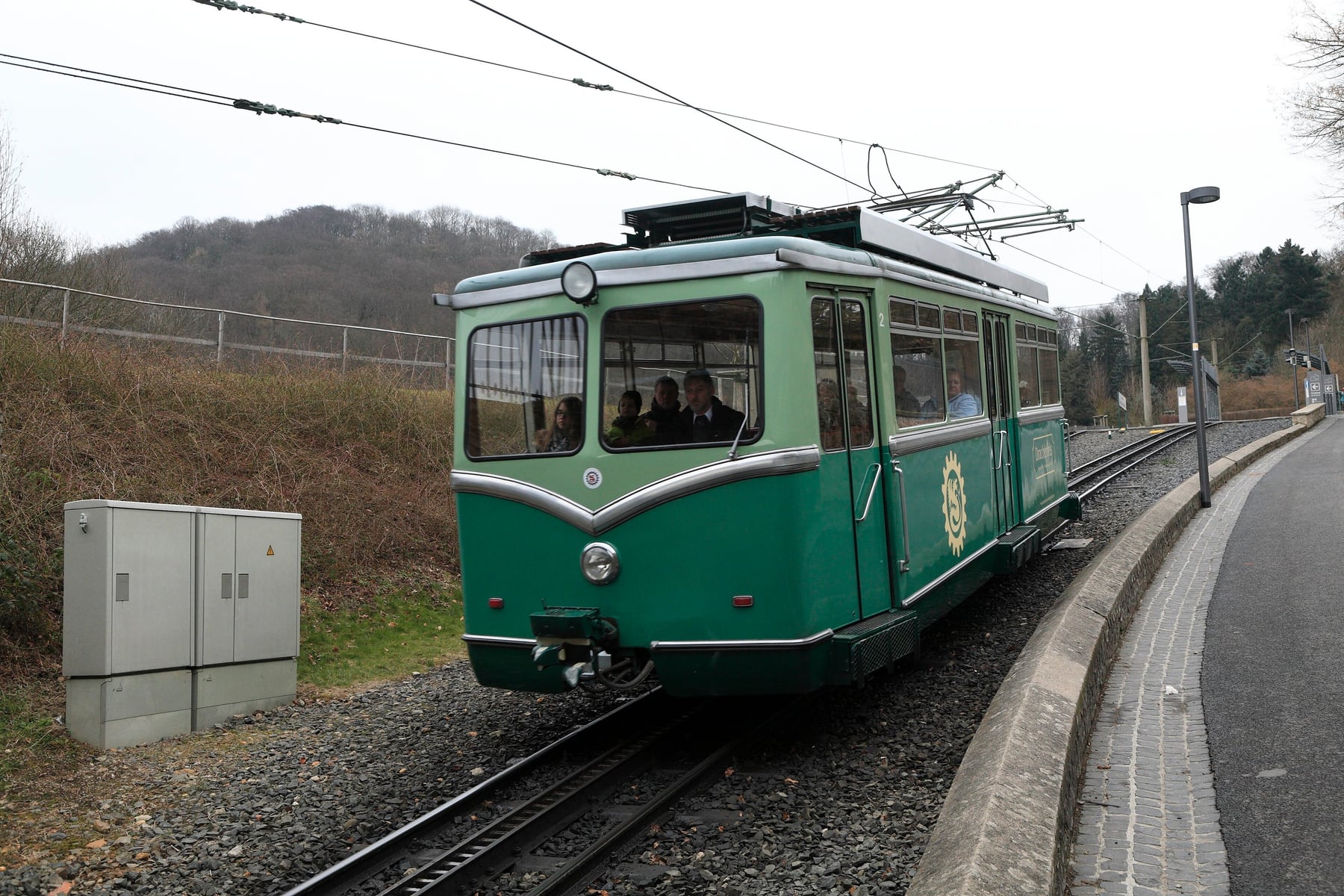
The Drachenfelsbahn to the Drachenfels
Falk2 / Wikimedia Commons · CC BY-SA 4.0
- Distance1.52 km — 1,520 metres of metre-gauge track on a Riggenbach rack
- Duration8 minutes each way, with trains every 30 minutes
- Best seasonMay to September for the 09:00–19:00 day; the four Advent weekends for the only evening service of the year
Introduction
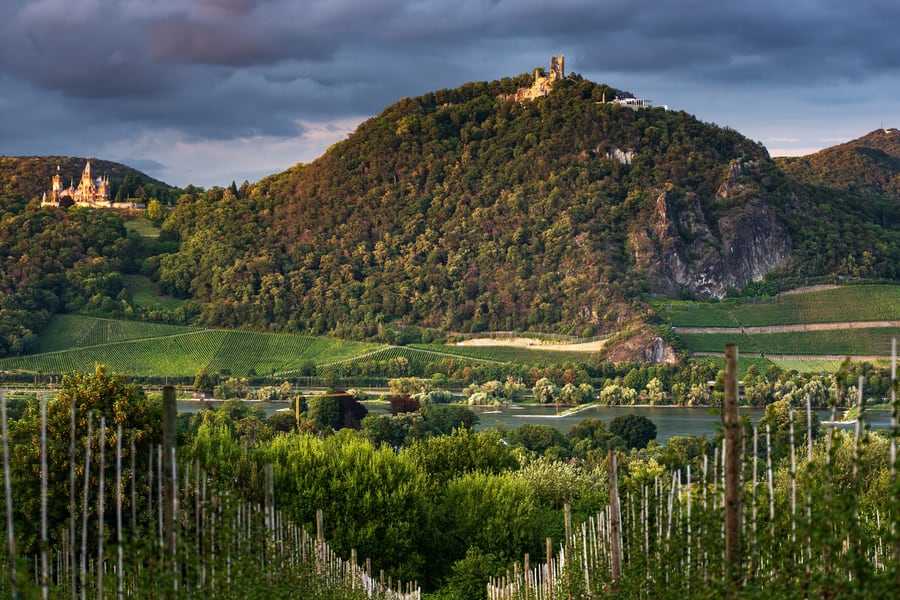
For most of its recorded history the hill this railway climbs was a quarry. Trachyte was cut out of the Drachenfels from Roman times onwards; stone from it went into St Maria im Kapitol in Cologne around the year 1000, and into Cologne Cathedral after building began there in 1248. The hole the cutters left is still open on the south side of the mountain, and the bare wall of rock below the summit — the thing that gives the Drachenfels its profile from the Rhine — is a worked face rather than a natural one.
The quarrying also took most of the castle. The fortress on top had been built for the Archbishop of Cologne after 1138 and finished around 1167, and it was already a ruin: it was slighted in 1634, during the Thirty Years' War. But the shape of what is missing is not the war's doing. In 1788 the workings undermined the summit, and the south-west side of the keep, the hall facing the Rhine and part of the chapel fell away into the quarry below. In 1827 the quarry's owners bought the ruin itself, which put the remainder in question. Prussia ended it in 1836 by buying the quarry for 10,000 taler and shutting it down.
Forty-seven years after that, the Drachenfelsbahn opened. The order matters: the mountain had to stop being worth money by the tonne before anyone thought to sell the view from the top of it.
What the railway is
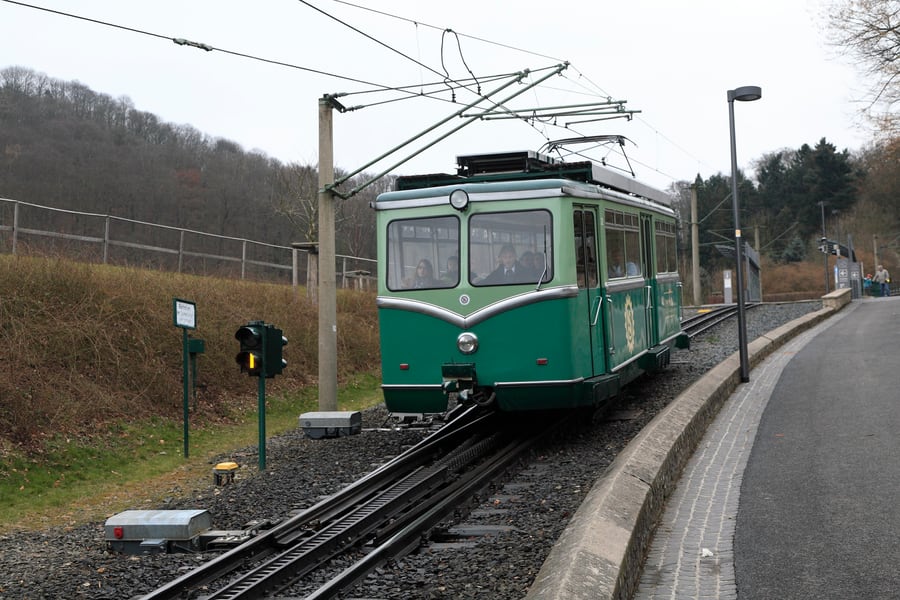
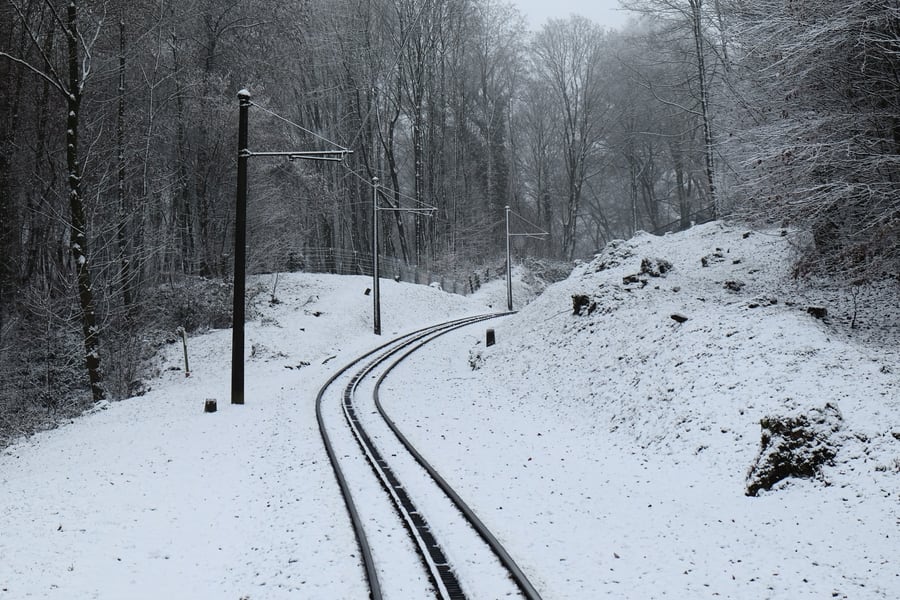
It opened on 17 July 1883 and it is the oldest rack railway still working in Germany. The track is 1,520 metres long and metre gauge, it climbs 220 metres — from 69 metres above sea level at the valley station in Königswinter to 289 metres at the top — and at its steepest it is at one in five. The rack is the Riggenbach ladder pattern, a rung between two rails, which is the oldest of the systems still in use anywhere.
The journey takes eight minutes. That is the whole of it: eight minutes, one intermediate stop, and a view of the Rhine that opens out about two thirds of the way up. It is not a long day out and it does not pretend to be. What it is instead is a piece of Victorian mountain engineering that has never stopped working, running to a thirty-minute headway on a hillside in the middle of a densely populated part of Germany, twenty minutes from the middle of Bonn.
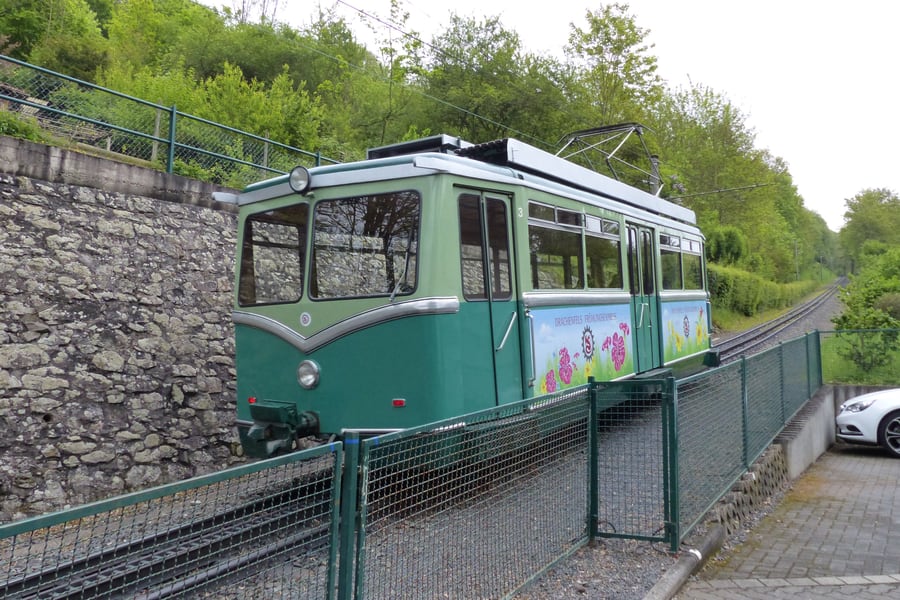
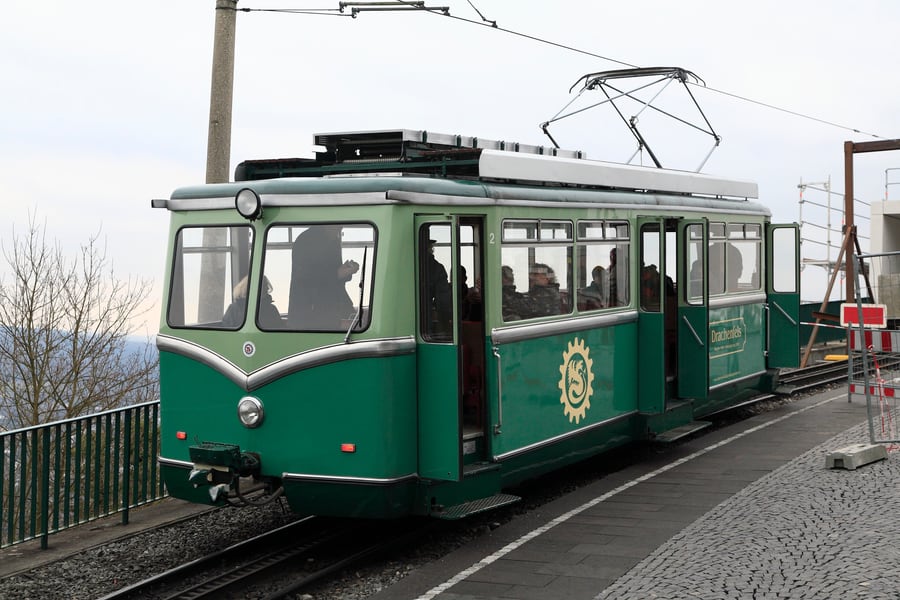
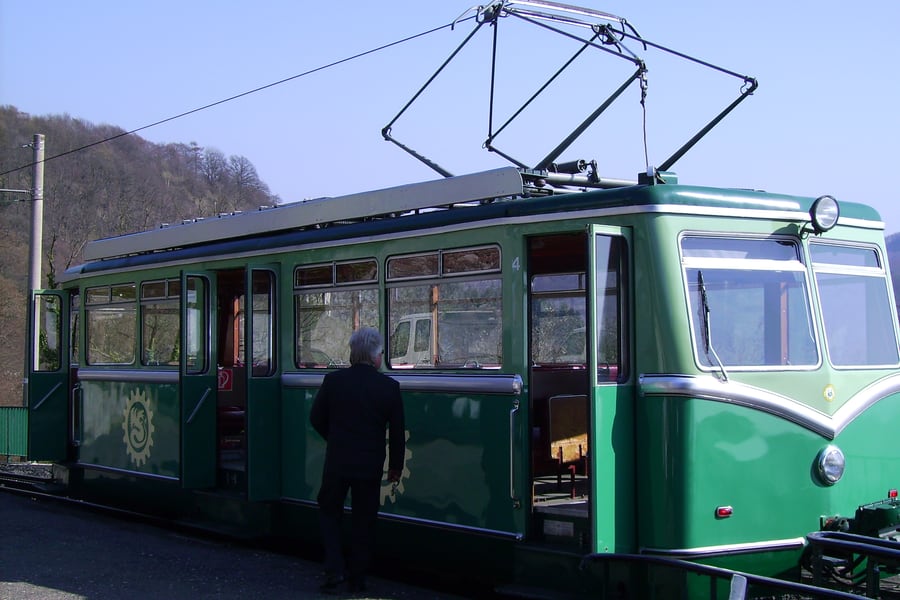
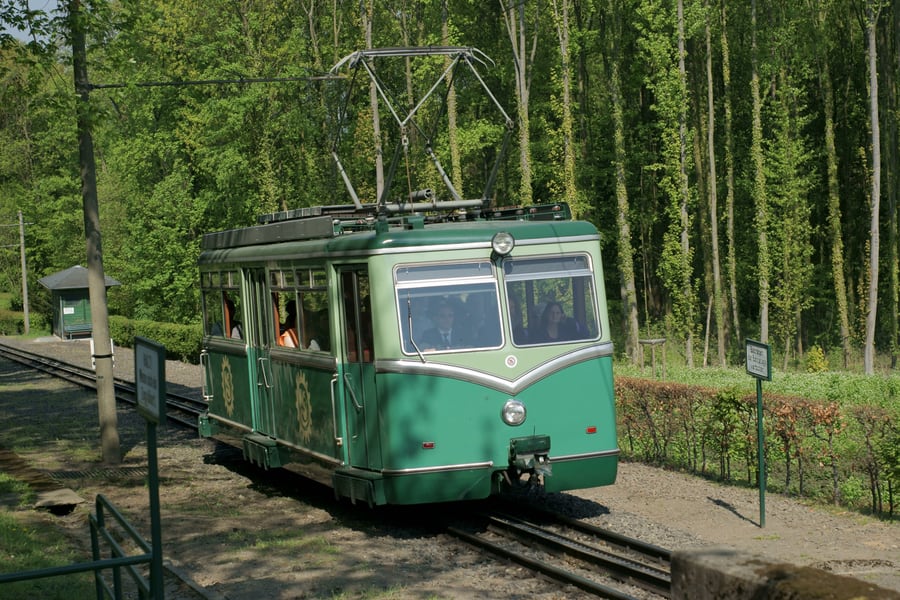
The green railcars that work it are themselves old enough to be interesting. Steam ran here until the end of the 1950s; the electric cars that replaced it were built at Rastatt with Brown Boveri equipment between 1955 and 1960, with a sixth put together by the railway's own workshop in 1979. Five of them are still in traffic. They are not preserved museum pieces brought out for the season — they are the service.
The Journey
The valley station stands in Königswinter a few streets back from the Rhine, about ten minutes' walk from the town's main-line station and a couple of minutes from the boat landings. There is no great architecture to it. A railcar sits waiting with its doors open, the rack running away up the hill behind it, and a queue forms in front of a ticket window.
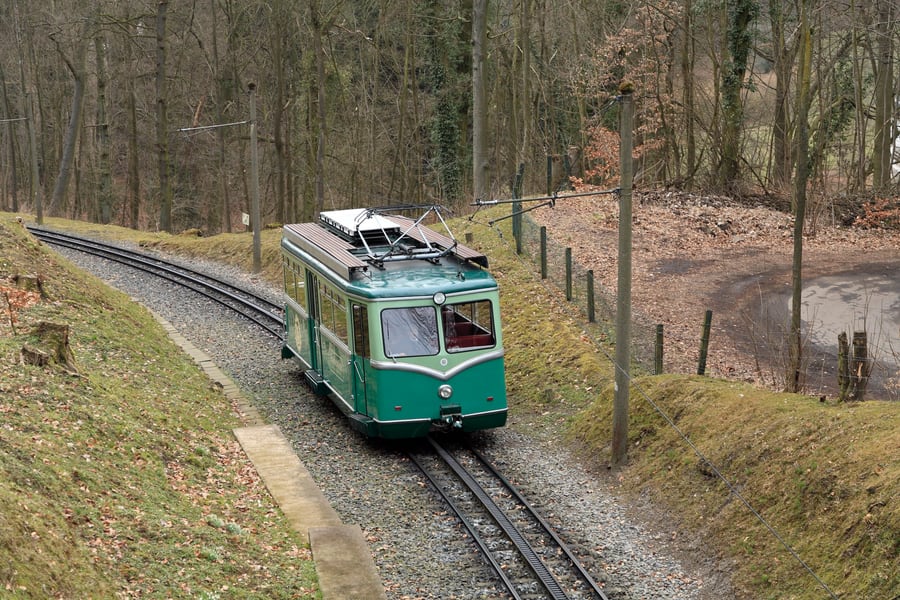
The line leaves in company with the Drachenfelsstraße, the road that climbs the same hill, and for the first stretch the two run side by side with a kerb between them — the train on its ladder rack, cars on the tarmac a metre away, and a level crossing where the road cuts across. Then the houses end, the gradient steepens, and the track goes into woodland for the rest of the climb.
The one intermediate stop is Schloss Drachenburg, 198 metres up. It has not always been there: the railway's middle station was down at the Nibelungenhalle until March 1976, when it was moved to sit directly below the castle. Getting off here is the usual thing to do, because the Drachenburg is five minutes away through the trees and the ticket lets you break the journey.
Above the castle the trees thin and the Rhine appears on the left, a long grey reach of it with barges on it and Bonn spread out on the far bank. The top station is at 289 metres, a short walk below the summit itself, on a plateau with a terrace and a restaurant. The ruin stands above that, on the rock, and the last few metres to it are on foot.
Eight minutes, and what is under them
Riggenbach rack is a ladder: steel rungs set between two side rails, with the driving cog winding itself up the rungs. It was patented in 1863 and it is the oldest rack system anywhere still in regular use, which is a large part of why this line matters beyond its own hillside. The Drachenfelsbahn has run on it continuously since 1883 — through two wars, a change of motive power and a change of owner — without ever closing for good.
The ownership is a small oddity in itself. In 1912 Ferdinand Mülhens, the owner of the 4711 eau de Cologne house, bought both this railway and the Petersbergbahn on the next hill for a million marks, and in 1923 merged them into Bergbahnen im Siebengebirge AG. The company still runs the line and still carries that name.
The two things that happened in September 1958
On 14 September 1958 the last descent of the day was worked by a steam locomotive. Its brakes failed, it ran away, and it derailed. Eighteen people were killed and a hundred and twelve injured. Steam was already going by then — the first electric railcar had been running since 1953 and four more were on order — and it was gone within about a year.
A week later, on 21 September 1958, the Petersbergbahn shut. It was the sister line — metre gauge, Riggenbach rack, 1,750 metres long, opened in 1889, and at 260 in a thousand the steepest rack railway Germany ever had. The two events are often reported as one story, and they were not: the Petersbergbahn closed for want of money, and its closure had already been set for the end of that season before the accident happened. What is left of it is a three-road engine shed near Königswinter, a small monument on the Petersberg, and a piece of a road bridge.
So of the two rack railways that Mülhens bought in 1912, one has been gone for nearly seventy years and the other still runs every half hour. The difference was not the crash.
Along the route
 Johannes Dörrstock / Wikimedia Commons · CC BY-SA 4.0
The rock face is the reason the hill looks like that
Trachyte was cut out of the Drachenfels from Roman times and went into Cologne Cathedral after 1248. The bare wall below the summit is a worked face rather than a natural one. Prussia bought the workings in 1836 and closed them; the railway followed in 1883.Falk2 / Wikimedia Commons · CC BY-SA 4.0The oldest rack railway still working in Germany
It opened on 17 July 1883 and has never closed for good — through two wars, a change from steam to electricity and a change of owner. The Riggenbach rack beneath it is the oldest of the rack systems anywhere still in ordinary service.Falk2 / Wikimedia Commons · CC BY-SA 4.0One of the two rack railways here survived
In 1912 the owner of the 4711 eau de Cologne house bought this line and the Petersbergbahn on the next hill. The Petersbergbahn — at 260 in a thousand the steepest rack railway Germany ever had — shut in 1958. An engine shed and a small monument are what is left.A bit of history
Culture & experiences along the way
 Dmitry Tonkonog and Ksenia Fedosova / Wikimedia Commons · CC BY-SA 3.0
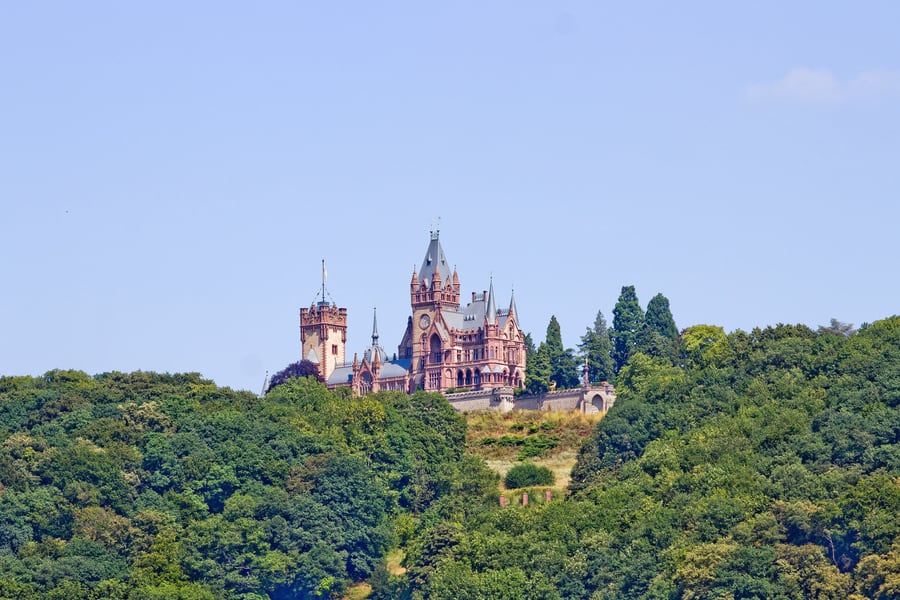
Breaking the journey at the castle
The ticket allows a stop at Schloss Drachenburg, and the intermediate station sits directly below it. The castle went up between 1882 and 1884 for a banker and stockbroker from Bonn, in the historicist manner of its decade, and it is one of the more complete survivals of late nineteenth-century German castle-building. It is five minutes from the platform through the trees.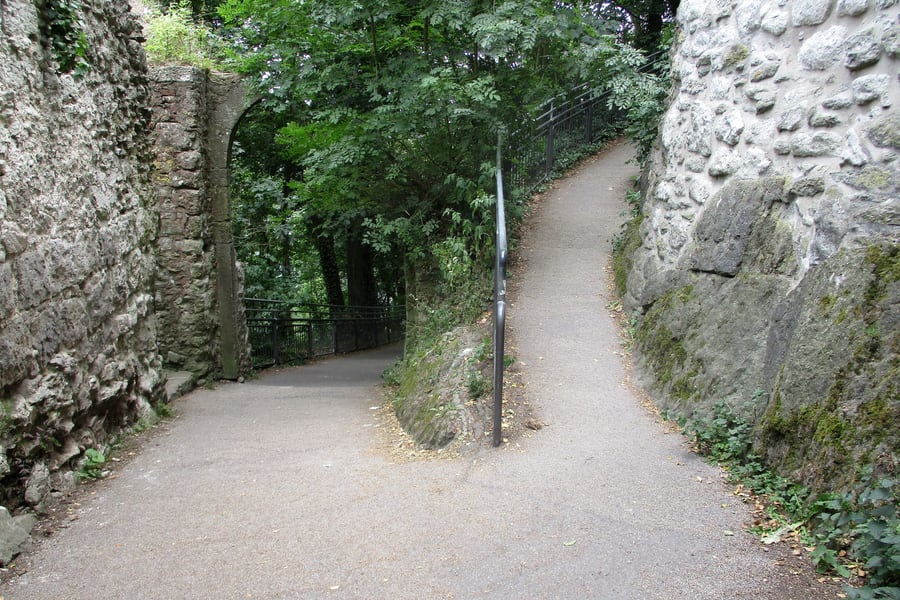 Leit / Wikimedia Commons · CC BY-SA 4.0
Riding up and walking down
A single is €12.00 against €14.00 for the return, so the saving is small — but the path down is good, cut in places between a retaining wall and a face of the same trachyte the quarrymen were after, and it passes the castle. Going up by rail and down on foot is the version of this outing that shows you the most for the least effort.Faldrian / Wikimedia Commons · CC BY 2.0The Advent evenings
The railway shuts from 16 November to the end of the year, with eight exceptions: the four Advent weekends, when it runs from noon until 19:45. That is the only evening service in the calendar, and the only time of year the plateau is reached in the dark with the Rhine lit up below it.Timetables
There is no timetable to memorise. Trains leave the valley station in Königswinter every thirty minutes, on the hour and on the half hour, and leave the summit station fifteen minutes later, at a quarter past and a quarter to. When the hill is busy the interval drops to fifteen minutes, as stock allows. The service runs on public holidays as well.
What changes through the year is not the frequency but the length of the operating day, and there is one long gap. All of the following is as of August 2026, from the operator's own published opening times.
The 2026 season
| Dates | Operating hours |
|---|---|
| 1 May – 30 September 2026 | 09:00 – 19:00, every day |
| 1 October – 1 November 2026 | 10:00 – 18:00, every day |
| 2 – 15 November 2026 | 12:00 – 17:00 weekdays; 11:00 – 18:00 Saturday and Sunday |
| 16 November – 31 December 2026 | closed, except the Advent weekends below |
The winter closure, and the eight days inside it
From 16 November 2026 the railway shuts for the rest of the year. The exceptions are the four Advent weekends — 28 and 29 November, 5 and 6 December, 12 and 13 December, 19 and 20 December 2026 — when it runs from 12:00 to 19:45, an evening service that no other part of the year gets.
It reopens on 1 January 2027, which is itself an exception at 11:00 – 18:00, and then runs 12:00 – 17:00 on weekdays and 11:00 – 18:00 at weekends until 28 February. March 2027 is 10:00 – 18:00 daily, April 10:00 – 19:00, and the long summer day of 09:00 – 19:00 returns on 1 May 2027.
Late openings
The operator publishes occasional extensions for events on the Rhine below, and posts them against the affected dates rather than as a standing rule — in 2026 the railway stayed open until 23:00 for Rhein in Flammen on 2 May. The pattern is worth a look at the opening-times page if a particular evening matters.
Getting to the valley station — and why the train is not the answer this year
Königswinter is on the right bank of the Rhine between Bonn and Koblenz. Ordinarily RE 8 and RB 27 call at Bahnhof Königswinter, ten minutes' walk from the valley station.
They are not running to it at the moment. The right-bank Rhine line between Troisdorf and Wiesbaden is closed completely from 10 July to 12 December 2026 while about 37 kilometres of track, 54 points and 14 kilometres of overhead line are renewed on the North Rhine-Westphalian section alone — and Königswinter station is one of four being rebuilt for step-free access in the same programme. RE 8 and RB 27 terminate at Troisdorf, and from mid-September at Köln Messe/Deutz. Replacement buses cover the line, with express buses every 15 to 30 minutes on the busiest sections.
The Stadtbahn line 66 from Bonn and Siegburg — the Siebengebirgsbahn — is unaffected, and it has been stepped up to a ten-minute interval between Ramersdorf and Königswinter Clemens-August-Str. for the duration. It is the straightforward way to arrive while the works last. The stop Königswinter Fähre is a few minutes from the valley station, past the boat landings. The Rhine ferry between Mehlem and Königswinter has also been folded into the ordinary fares for the closure.
Normal service on the main line is due back on 12 December 2026.
Opening times, exceptions and the ticket shop are published by the operator at drachenfelsbahn.de (opens in a new tab).
Tickets
The railway sells its own tickets at the valley station and through an online shop. A return is €14.00 for an adult and €7.00 for a child of 4 to 13; a single is €12.00 and €6.00, which makes the return unusually good value on a line where nearly everyone comes back down. Under-fours are not charged. Holders of a disability card pay the child fare, and children with one travel free.
Worth knowing before buying: a regular ticket is valid for one day, and that day can be any day up to the end of the season in the year it was bought. A ticket bought in August and unused because the weather closed in is still good in October. The combination tickets with Schloss Drachenburg are sold only at the valley station desk — not online, and not at the top. Prices as of August 2026.
Book your tickets
Return
€14.00 adult · €7.00 child 4–13
The obvious buy, since two singles cost €24.00, and valid any day this season.
Book Tickets (opens in a new tab, on Drachenfelsbahn (Bergbahnen im Siebengebirge))via Drachenfelsbahn (Bergbahnen im Siebengebirge)Schloss+Bahn Erlebnisticket
€21.00 adult · €11.50 child
The return trip and entry to Schloss Drachenburg, sold at the valley station only.
Book Tickets (opens in a new tab, on Drachenfelsbahn (Bergbahnen im Siebengebirge))via Drachenfelsbahn (Bergbahnen im Siebengebirge)Drachenfels Erlebnisticket
€25.50 adult · €15.00 child
The same plus the Nibelungenhalle, worth it only if you were going in anyway.
Book Tickets (opens in a new tab, on Drachenfelsbahn (Bergbahnen im Siebengebirge))via Drachenfelsbahn (Bergbahnen im Siebengebirge)Groups and school parties
From €2.50 a head, arranged in advance
Parties of 25 pay €12.00 return; kindergarten groups pay close to a bus fare.
Book Tickets (opens in a new tab, on Drachenfelsbahn (Bergbahnen im Siebengebirge))via Drachenfelsbahn (Bergbahnen im Siebengebirge)Rail Passes
The short answer is that no rail pass buys this ride. The Drachenfelsbahn is a private mountain railway with its own tariff, published on its own site, and the operator lists no pass, network ticket or through fare against it. Whatever you hold, the €14.00 return is the price at the bottom of the hill.
Interrail and Eurail
Not valid, and there is no pass-holder rate. Interrail's coverage table for Germany names DB and the regional carriers, and everything it has not named is decided by the roster of German companies the table links — a closed list of operators inside the national tariff. Bergbahnen im Siebengebirge AG is not on it, which is the whole of the answer.
That is unremarkable for a rack railway up a hill in a nature reserve, and it is worth knowing only because the Drachenfels sits so close to a main line that people arrive expecting the two to be one journey. They are two.
Where a pass does earn its money is getting to Königswinter, and that is worth separating out, because the journey up the Drachenfels is 1,520 metres long and the journey to reach it is usually much further.
The Deutschlandticket
€63 a month, as of August 2026, and valid on every regional train, bus, tram and light-rail service in the country — which includes the Stadtbahn line 66 from Bonn, the RE and RB services on the right-bank Rhine line, and the replacement buses standing in for them during this year's closure. For anyone already making several regional journeys in the month it is the obvious ticket, and it will carry you to the foot of the railway. It will not carry you up.
Local and day tickets
The regional network here is the Verkehrsverbund Rhein-Sieg, covering Cologne, Bonn and the surrounding districts. Its day tickets and single fares are what most visitors coming for an afternoon will actually want, and Deutsche Bahn's own excursion page for the Drachenfels points at two of them: an ordinary day ticket, or the 24hTicket NRW für 5 Personen at €59.80, which is worth it only for a group of four or five travelling together across the state.
For a single day out from Bonn or Cologne, a plain return on line 66 plus the railway's own €14.00 return is almost always cheaper than any pass. A pass is worth buying here for the week around it, not for the day of it.
Fares from the operator, Bergbahnen im Siebengebirge AG, and pass coverage from Interrail's published list of railway companies, August 2026.
Places to Visit
Everything on this railway is within about a kilometre and a half of everything else, which makes it unusual among the journeys here: the ticket allows a break at the intermediate station, and the whole of the day out fits between the Rhine promenade at the bottom and the ruin at the top.
The order below is the order a train from Königswinter reaches them.
 Tohma / Wikimedia Commons · CC BY-SA 4.0 · cropped
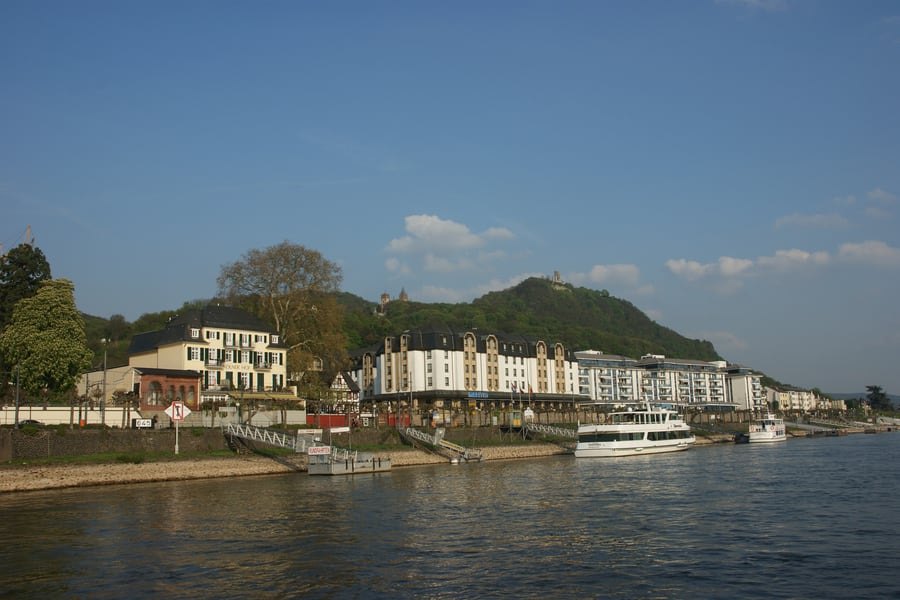
Königswinter
A town of about 40,500 people on the right bank of the Rhine, first named in a document of 25 February 1015 as Winetre, and a town in its own right only since 1889. Its waterfront was a working stone quay until the 1890s, when it was rebuilt as a promenade with an avenue of limes and the big riverside hotels went up behind it. Quarrying, wine and forest were the living here before the railway made it a resort.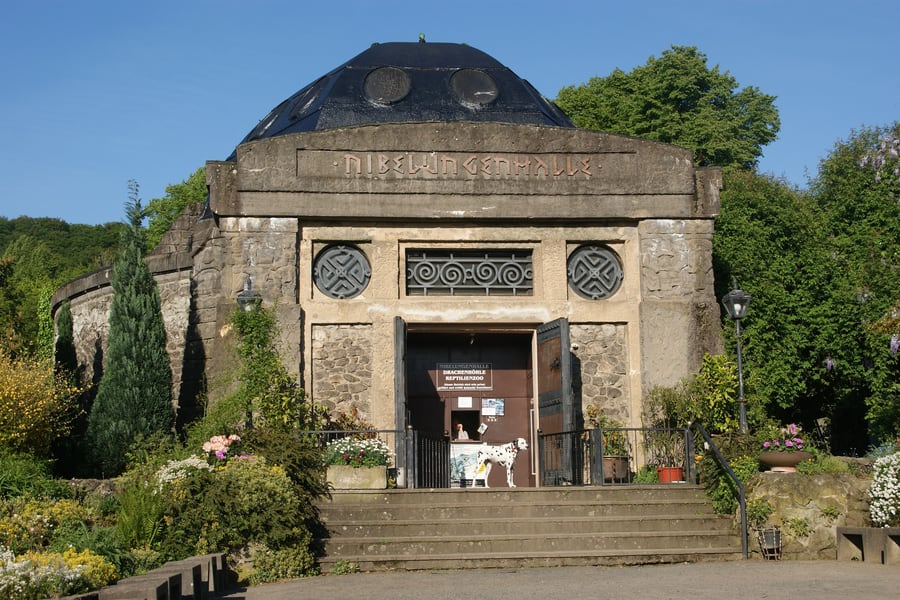 Tohma / Wikimedia Commons · CC BY-SA 4.0 · cropped
The Nibelungenhalle
A domed hall on the Drachenfelsstraße, opened in 1913 for the hundredth anniversary of Richard Wagner's birth, holding twelve large paintings by Hermann Hendrich on the Ring cycle. A dragon's cave was added in 1933 with a moss-covered concrete dragon thirteen metres long, and a reptile house in 1958 that now runs to more than forty terrariums. It was overhauled between 2013 and 2015 at a cost of about €450,000.Dmitry Tonkonog and Ksenia Fedosova / Wikimedia Commons · CC BY-SA 3.0 · croppedSchloss Drachenburg
Built between 1882 and 1884 for a banker and stockbroker from Bonn, and counted among the most significant German castle buildings of the closing nineteenth century — which is a careful way of saying it is a Victorian fantasy of a castle, put up two years before the railway that now stops beneath it. It stands on a shoulder of the hill with the Rhine below, and the grounds are open around it.Leit / Wikimedia Commons · CC BY-SA 4.0 · croppedThe path up
The made path from Königswinter to the summit runs beside the railway most of the way and takes about an hour at an ordinary pace. In places it is cut between a stone retaining wall and a face of bare trachyte, which is the plainest look you get at what the quarrymen were taking out of the hill. A single ticket in one direction and the walk in the other is a common way of doing it.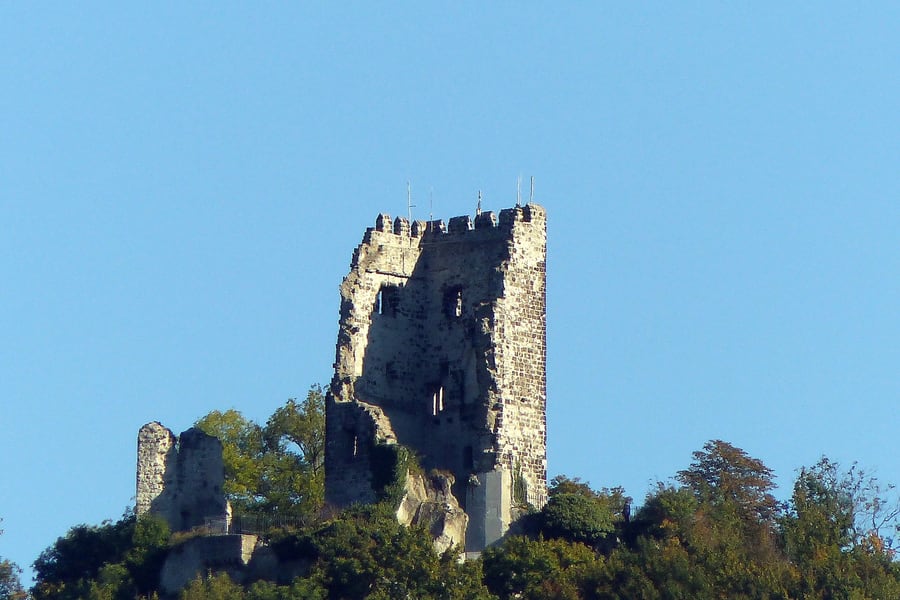 giggel / Wikimedia Commons · CC BY 3.0 · cropped
The castle ruin
Begun for the Archbishop of Cologne after 1138 and finished about 1167, slighted in 1634 during the Thirty Years' War, and then undermined from below. In 1788 the south-west of the keep, the hall facing the Rhine and part of the chapel dropped into the quarry. A masonry buttress was paid for in 1855, the state stabilised the rest in 1891 and 1892, and after a rockfall in 1967 the west and south sides were pinned with steel anchors between 1971 and 1973. It is open to walk into.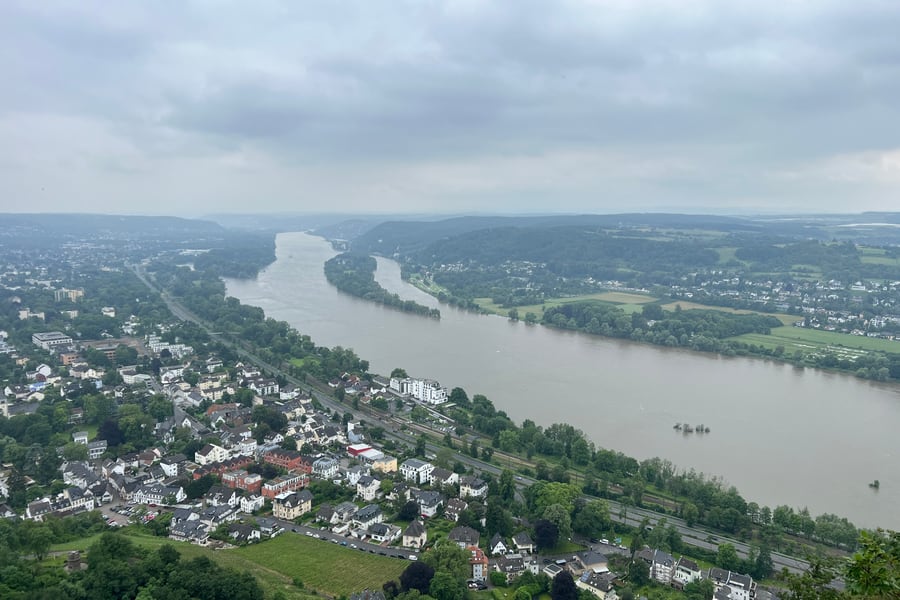 Lukas Beck / Wikimedia Commons · CC BY 4.0 · cropped
The view from the plateau
The reason the whole thing exists. The Rhine runs north below in a long straight reach, with Bonn on the far bank, the Cologne plain beyond it and the other hills of the Siebengebirge behind. The terrace at the top station takes most of it in, and the ruin a few metres higher takes the rest. The hill itself is 320.7 metres, about 270 above the river.Where to Sleep
Königswinter is a short journey from Bonn and about forty minutes from Cologne, so a great many people come for an afternoon and go home again. Staying overnight makes more sense than it sounds, though, because the railway's best hours are its earliest and its latest — the plateau in the hour before it closes is a different place from the plateau at two in the afternoon — and because the Rhine here is worth a morning of its own.
The three below are on the river, in the woods above the town, and on the next hill. All three publish their own rooms directly.
Where to stay
 Leit / Wikimedia Commons · CC BY-SA 4.0 · cropped
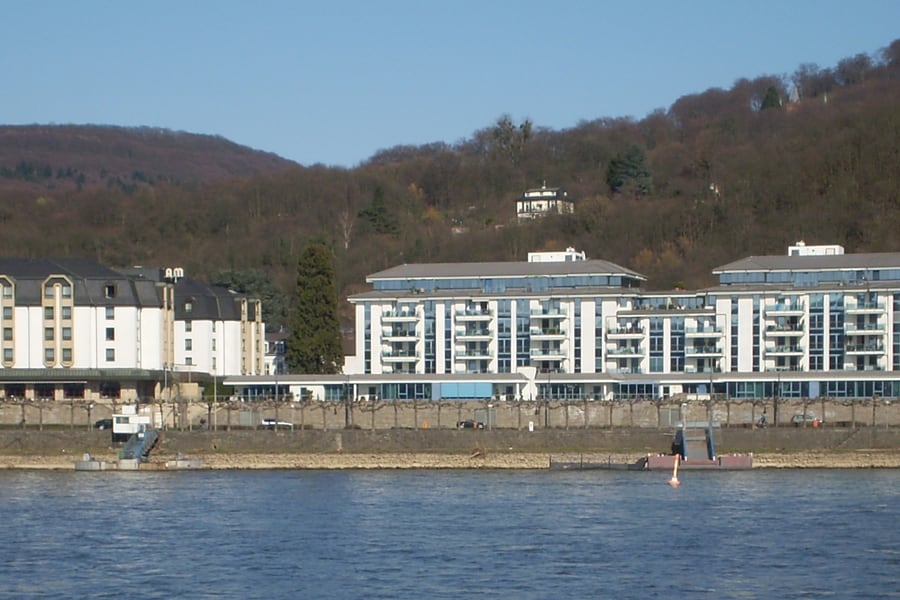
Maritim Hotel Königswinter
On the Rhine promenade, ten minutes from the valley station
Two hundred and forty-eight rooms facing either the river or the Siebengebirge, on the promenade itself with the excursion-boat pier directly in front of the door. There is a restaurant looking at the Rhine, a pool, Finnish and bio saunas, a fitness room and underground parking for 250 cars with fourteen charging points. One wheelchair-accessible room and two further accessible rooms are in the Classic category.
Check Availability (opens in a new tab, on maritim.com)via maritim.comJUFA Hotel Königswinter
In the nature park above the town
Sixty-three rooms in the Siebengebirge nature reserve, with a terrace looking across the Rhine, a café, a concert meadow and a viewing platform. The footpaths to Heisterbach abbey and over the Petersberg start at the door, and the Rheinsteig passes close by. Family rooms have connecting doors, dogs are welcome, parking is on site and the WiFi is free. Packages sold here include admission to the railway, the Drachenburg and the Nibelungenhalle.
Check Availability (opens in a new tab, on jufahotels.com)via jufahotels.com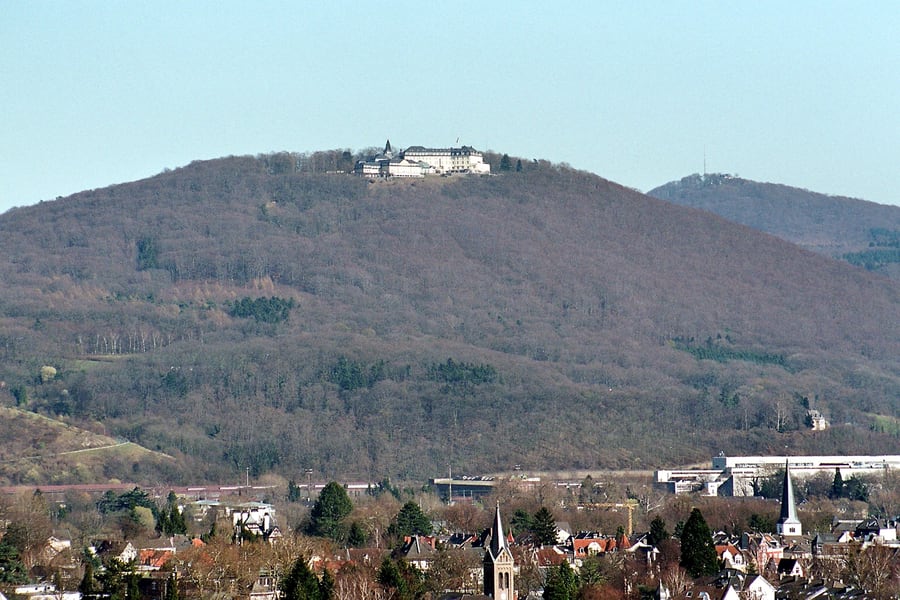 Dguendel / Wikimedia Commons · CC BY 4.0 · cropped
Steigenberger Icon Grandhotel & Spa Petersberg
On the next hill, in the old federal guest house
The house on top of the Petersberg was the official guest house of the Federal Republic of Germany, and took heads of state for decades before it became a hotel open to anyone. It stands about 336 metres up in the woods with the Rhine valley below, and has ten room and suite categories, restaurants, a spa, a pool and a fitness area. The rack railway that once climbed to it closed in 1958; the road remains.
Check Availability (opens in a new tab, on steigenberger.com)via steigenberger.comQuestions or corrections
Planning this trip and stuck on something, or spotted a time, fare or detail that has changed? Send us a message about The Drachenfelsbahn to the Drachenfels. We read every one, and we update this page when something has changed.