Dushanbe to Kulob
Ibrahim Rustamov / Wikimedia Commons · CC BY-SA 3.0 · 2013 · cropped
- DistanceAbout 250 km, Dushanbe to Kulob
- Duration7 hr 46 min
- Best seasonOne train a week each way, all year
Introduction
Tajikistan runs one scheduled long-distance passenger train inside its own borders, and it goes to Kulob. Train 602 leaves Dushanbe I at 08:40 on Saturdays and reaches Kulob at 16:26; train 601 comes back on Sundays, 08:00 to 15:36. That is the entire service — one working a week in each direction, over roughly 250 kilometres of single, unelectrified 1,520 mm track, behind a diesel, because every locomotive on this railway is a diesel.
What makes it worth the day is that the route is younger than the timetable it sits in. Until 2016 there was no rail line at all from Dushanbe to the south of its own country: the only way round was a 432-kilometre loop through Uzbekistan, and in November 2011 the Uzbek railway closed and partly lifted the border section at Galaba–Amuzang, which took southern Tajikistan off the railway map altogether. The answer was 40.7 kilometres of new line from Vahdat to Yovon — three tunnels totalling 3,543 metres, the longest of them 2,209, and eight bridges — opened by President Emomali Rahmon on 24 August 2016. It brought Bokhtar within 119 kilometres of the capital, and trains 601 and 602 began running with it.
The other half of the map is still in pieces. Khujand, the second city, sits on a northern network with no rail connection to this one, and reaching it by train means leaving Tajikistan, crossing Uzbekistan and coming back in. This journey is what the country built so that at least its southern half would not have to.
The Journey
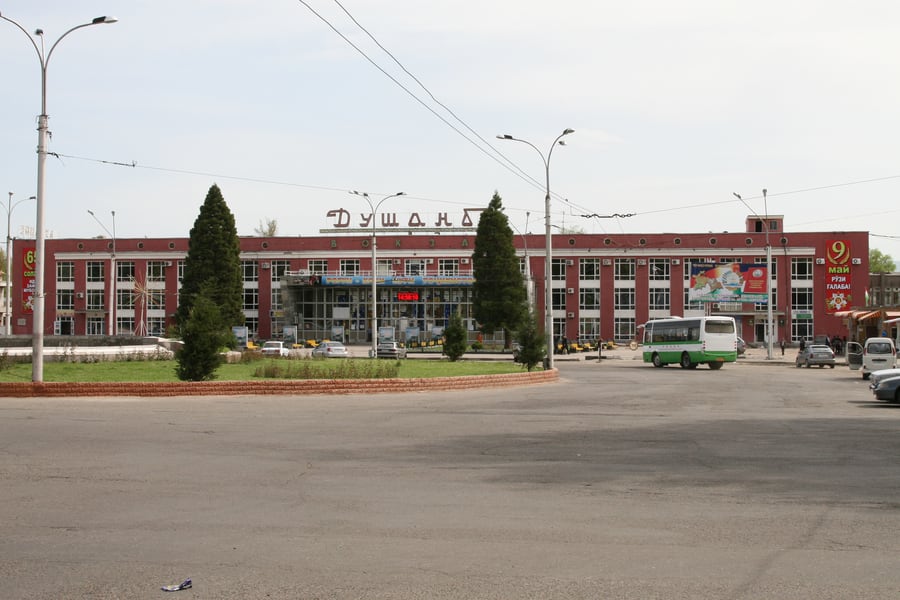
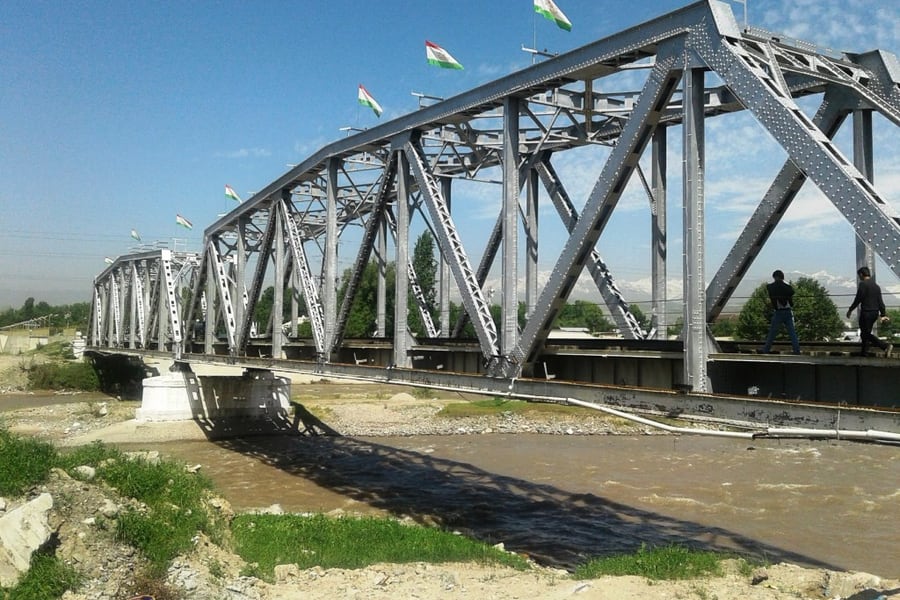
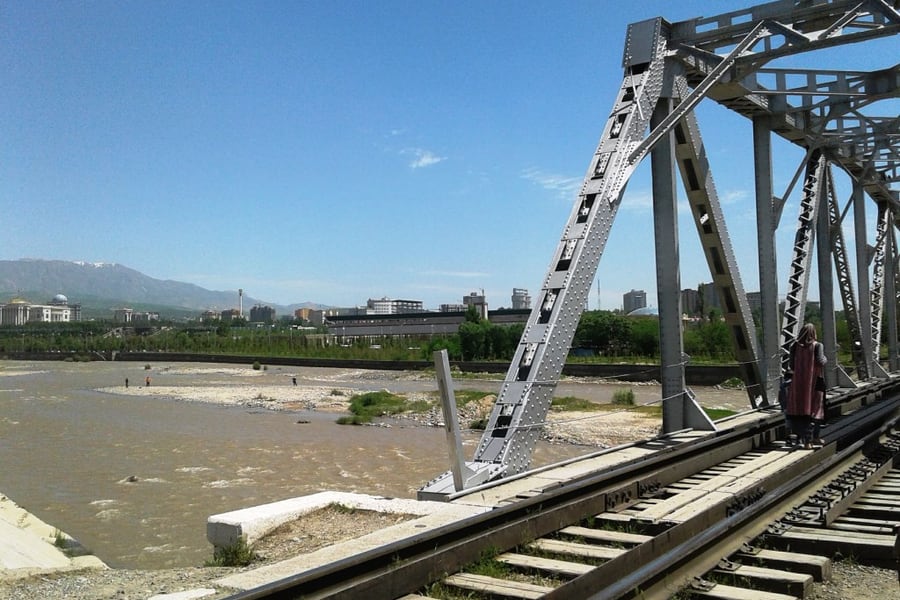
The train starts at Dushanbe I, a low red block on a square at the edge of the capital, on the oldest railway in this half of the country: the line from Termez through Dushanbe to Yangi-Bazar was laid between 1926 and 1930, and Yangi-Bazar is the town now called Vahdat, twenty-one kilometres east on the Kofarnihon. The first few minutes are the best-photographed stretch of Tajik railway there is — steel truss spans over a braided riverbed, flags on the top chords, the Hisor range standing behind them on a clear morning.
The forty kilometres that did not exist
At Vahdat the train turns south onto track that was still a construction site in 2015. Building began in March 2009, funded by a US$68 million credit from China's Export–Import Bank and carried out by the 19th Bureau of the China Railway Construction Corporation, and the terrain made a short line long: 40.7 kilometres to cover a gap of far less, with three tunnels and eight bridges in it. This is the only part of the run that feels engineered rather than inherited, and it is the reason the journey exists at all.
Down to the Vakhsh
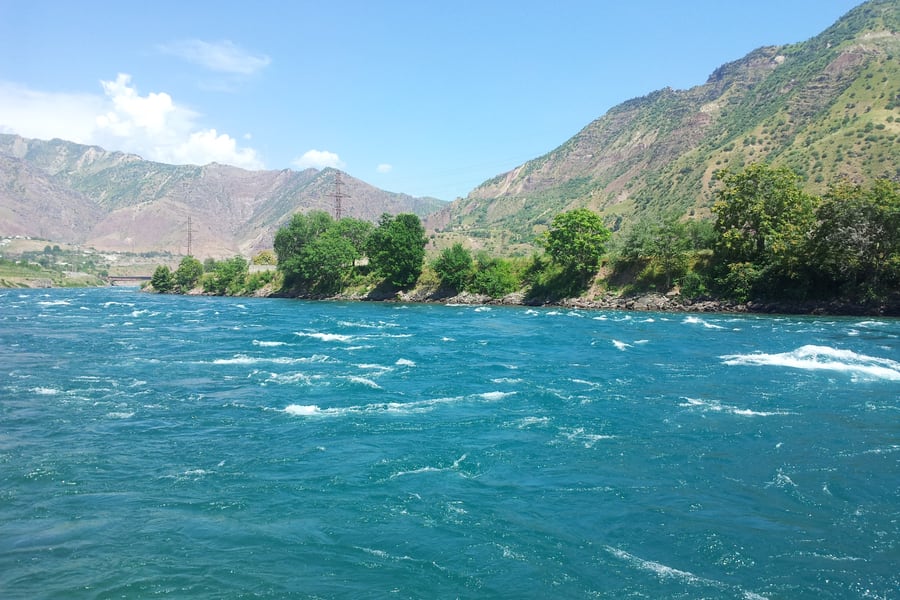
Yovon was the end of the line from the other direction — the Termez–Kurgan-Tyube–Yovon railway of the 1960s and 70s, built to serve a chemical works, and rehabilitated between Yovon and Bokhtar so the new route could use it. From here the train is in Khatlon, the hot agricultural south, and it follows the valley of the Vakhsh: a river the colour of turquoise where it comes out of the mountains, dammed upstream at Norak for the country's electricity and spread across the cotton land below.
Bokhtar, the provincial capital, is the halfway point in every sense. It was Qurghonteppa, and before that Kurgan-Tyube, and it is a hundred kilometres from Dushanbe and a hundred and fifty from Kunduz in Afghanistan.
East to Kulob
The last stretch is the newest railway in the country to have aged a little. Kurgan-Tyube to Kulyab, 132 kilometres, opened in 1999 — the first line Tajikistan built after independence, with Sargazon, Gulistan and Kulob itself put up as new stations. It runs east past Levakant, which was Sarband until it was renamed, under green hills above the Golovnaya reservoir, and finishes at Kulob on the Yakhsu, a city of about 106,000 that celebrated its 2,700th anniversary in September 2006.
What pulls it
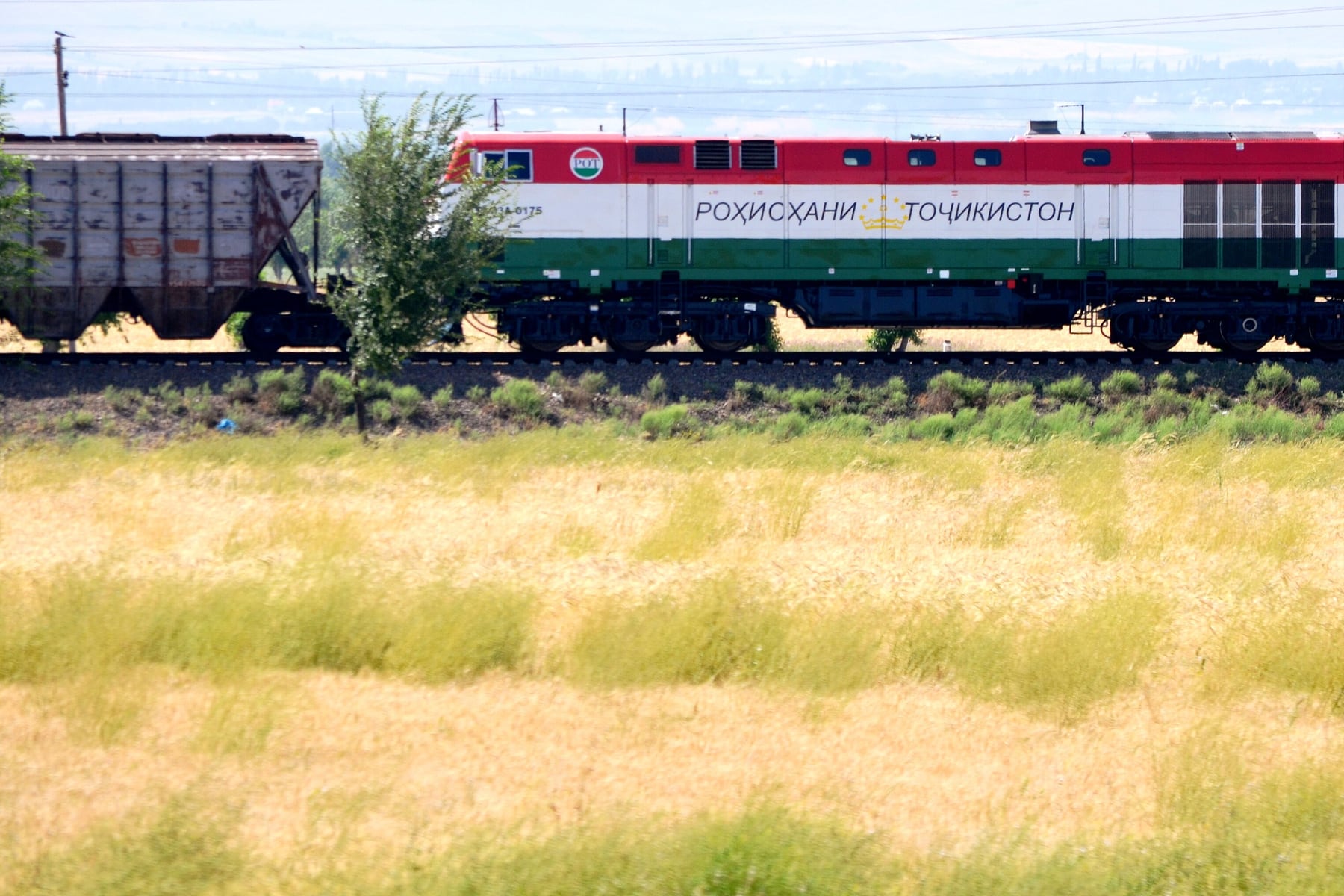
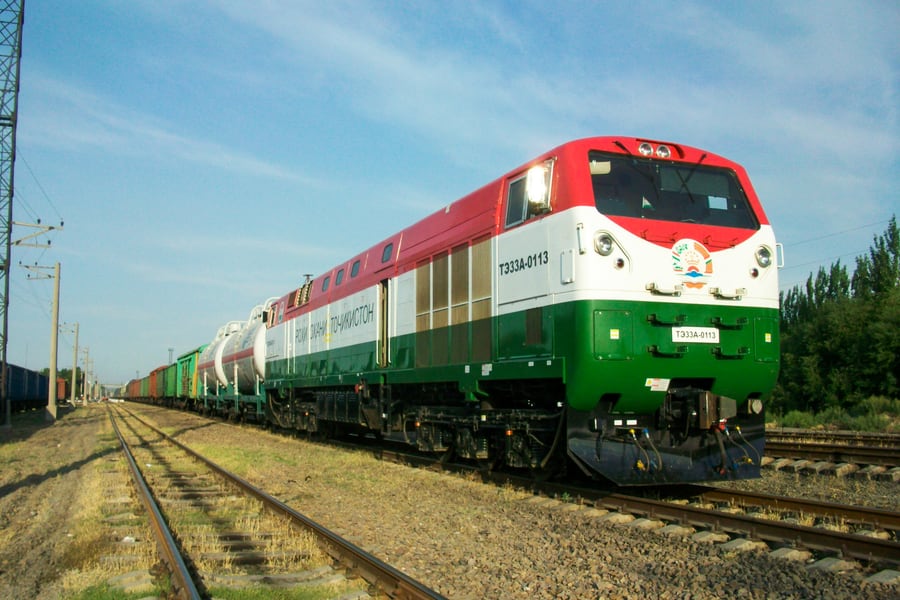
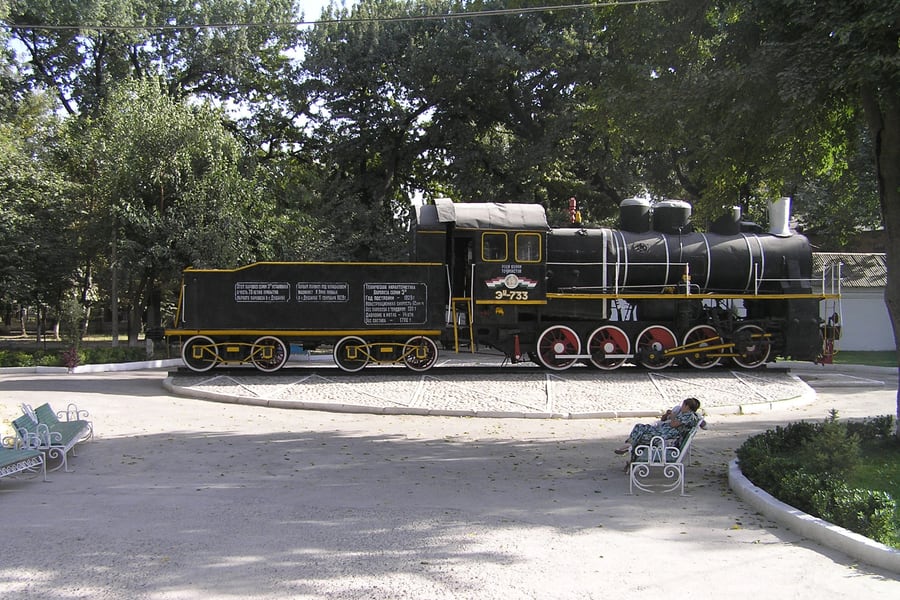
Everything, on the whole network. Tajik Railways is 100 per cent diesel, and its inventory in 2016 was 54 diesel locomotives and 424 passenger carriages. The modern machines are TE33As — GE's Evolution design rebuilt for 1,520 mm gauge, twelve-cylinder GEVO engine, Co-Co, assembled from kits at Astana in Kazakhstan and exported here — and they wear the national flag along the whole body side with РОҲИ ОҲАНИ ТОҶИКИСТОН, Tajik Railways, written across the white band.
Along the route
 Шухрат Саъдиев / Wikimedia Commons · CC BY-SA 4.0 · 2018 · cropped
Out of Dushanbe
The first quarter of an hour is the oldest railway in southern Tajikistan, laid between 1926 and 1930, and it crosses the Kofarnihon on steel trusses with the Hisor range behind.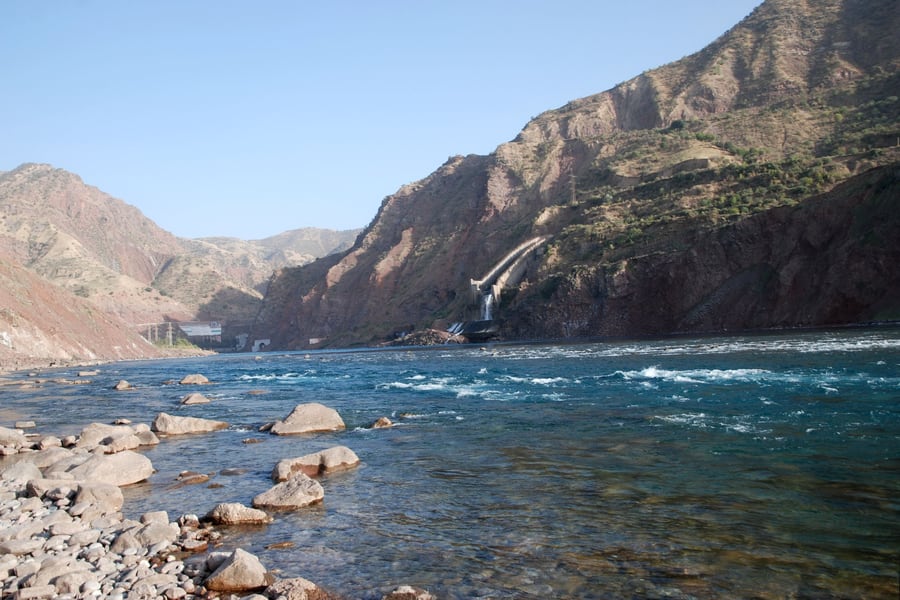 Bertramz / Wikimedia Commons · CC BY-SA 3.0 · 2014 · cropped
Down the Vakhsh
Past Yovon the train is in Khatlon, following the river that lights the country. The Vakhsh runs turquoise out of the gorges and is dammed above the line at Norak.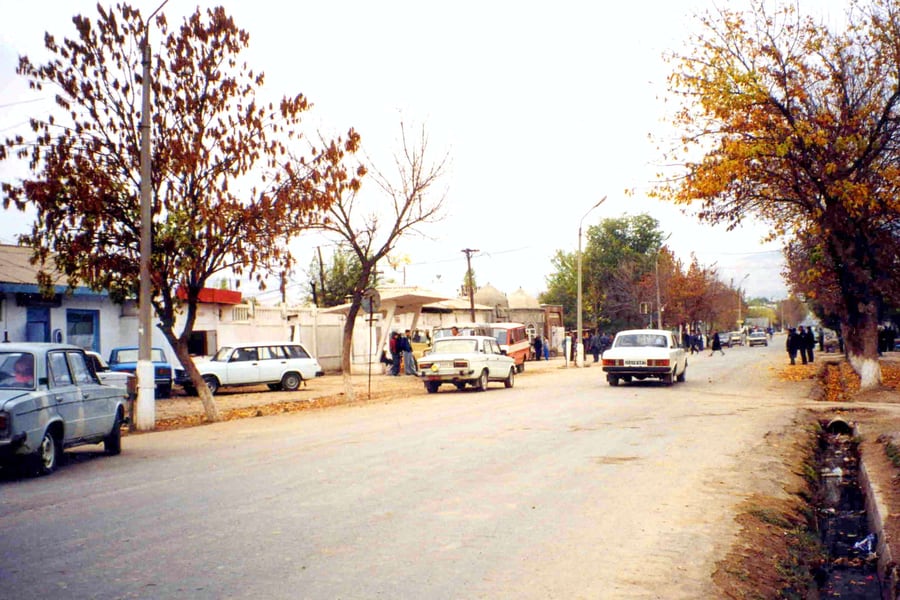 Brian Harrington Spier / Wikimedia Commons · CC BY-SA 2.0 · 2007 · cropped
Into Kulob
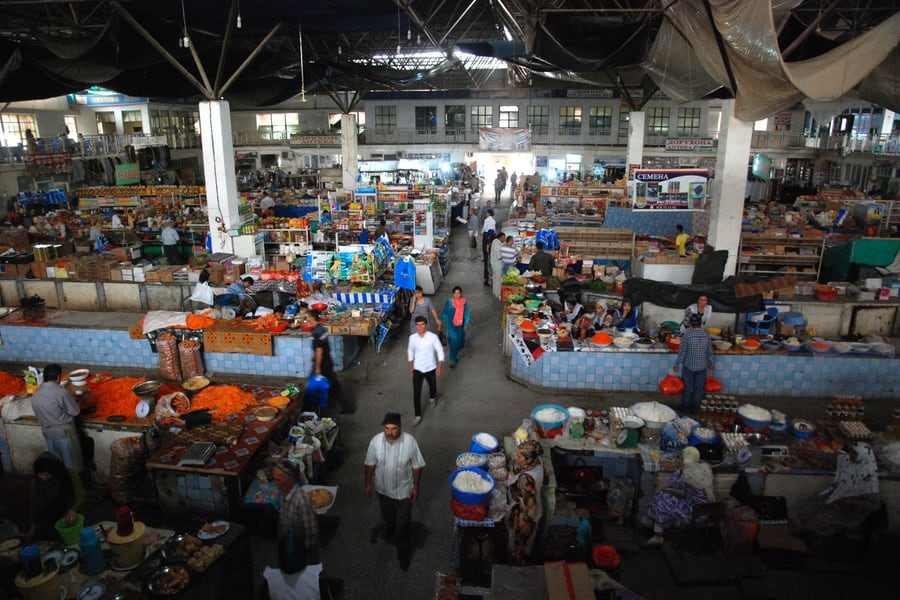
The last stop is a city of about 106,000 on the Yakhsu that kept its 2,700th anniversary in 2006. The station is new; the market outside it is not.A bit of history
Culture & experiences along the way
 Bertramz / Wikimedia Commons · CC BY-SA 3.0 · 2014 · cropped
What the line was really built for
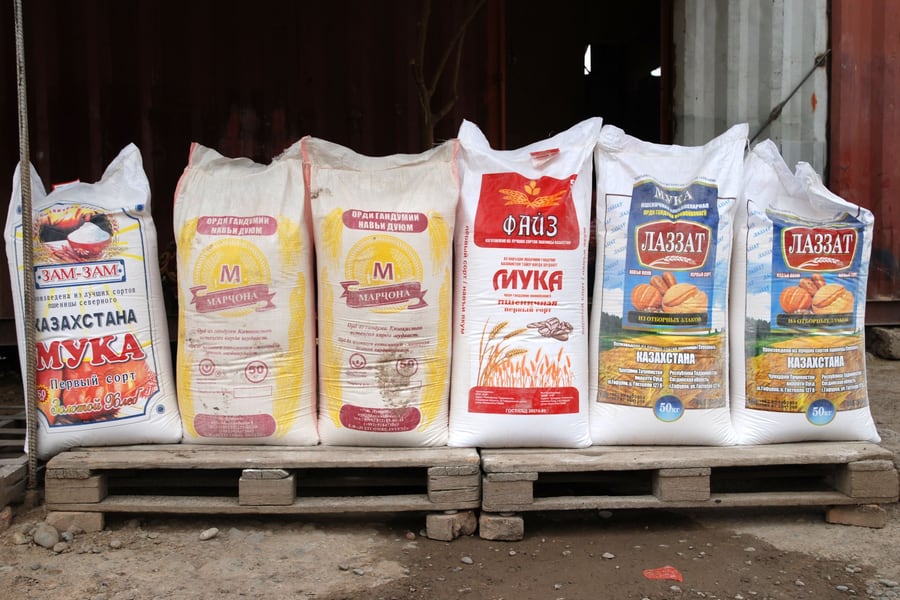
One passenger train a week is not why this railway exists. Rail carried 75.7 per cent of Tajikistan's international freight in the first quarter of 2024, and much of the country's flour arrives on it — the Kazakh sacks stacked in Kulob came a very long way to get there. The weekly working to Kulob is a by-product of a freight corridor.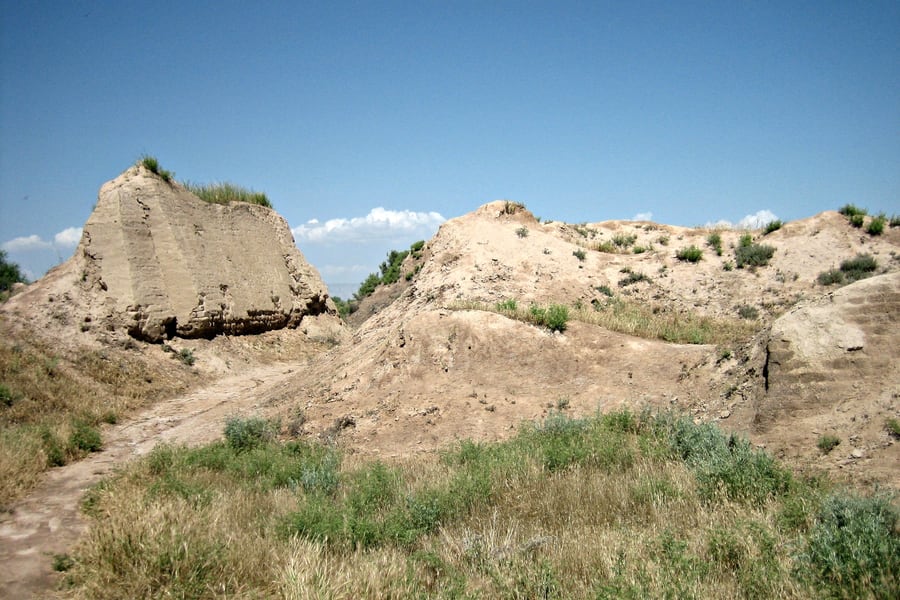 Prince Roy / Wikimedia Commons · CC BY 2.0 · 2015 · cropped
Khuttal, long before the rails
The province the train crosses was Khuttal, and in the seventh and eighth centuries it was Buddhist. The monastery at Ajinateppa, twelve kilometres east of Bokhtar, gave up a reclining Buddha thirteen metres long — now in the National Museum of Antiquities in Dushanbe — and the mud-brick mounds it came out of still stand in the fields.Timetables
Tajik Railways publishes one timetable a year for the whole network, and on the 2026 sheet the Dushanbe–Kulob service is two trains: 602 out on Saturdays and 601 back on Sundays. There is no second working, no seasonal variation and no daily option. Miss it and the next one is a week away.
Dushanbe to Kulob — train 602
| Station | Saturdays |
|---|---|
| Dushanbe I | 08:40 |
| Kulob | 16:26 |
Kulob to Dushanbe — train 601
| Station | Sundays |
|---|---|
| Kulob | 08:00 |
| Dushanbe I | 15:36 |
Southbound is 7 hr 46 min, northbound 7 hr 36 min, for roughly 250 kilometres — an average in the low thirties of kilometres an hour, which tells you most of what there is to know about the state of the track. The operator's sheet gives the departure from the starting station and the arrival at the far end and nothing between, so the times at Vahdat, Yovon, Bokhtar, Sargazon and Gulistan are not published anywhere; ask at the window.
The rest of what leaves Dushanbe
Four other passenger trains use the station, and none of them is a day out. 6373/6374 is the daily suburban working to Pakhtaabad, out at 17:40 and back in the small hours. 367/368 runs to Kanibadam in the northern half of the country on Wednesdays and Thursdays, which means transiting Uzbekistan. 423/424 is the Moscow train, restored on 21 June 2026 after six years, leaving Dushanbe at 03:25 on alternate Sundays. And 319/320 is Kulob to Volgograd and back, calling at Dushanbe on the way, which is the only other train that connects these two cities at all.
As of September 2026, from the 2026 passenger timetable published by the state enterprise Rohi Ohani Tojikiston at railway.tj (opens in a new tab). The operator's e-ticket portal at eticket.railway.tj was returning a server error throughout the checks.
Tickets
No fare for this train is published anywhere the operator controls, and the e-ticket portal was down every time it was checked, so buy at the window at Dushanbe I or Kulob. What the operator does publish are the rules: sales close one hour before departure from your boarding station, seats open 45 days ahead on CIS services and 60 on Russian ones, and children under five travelling without a separate seat go free.
Take the passport you booked with — the identity document the ticket was issued on is the one you must show at the train, and an electronic ticket is not enough on its own: you need a boarding coupon, either from online registration or from a ticket office. Cancel more than 24 hours out and the fare comes back in full; inside six hours you get the ticket price and not the berth fee.
Book your tickets
A seat on train 602 or 601
Sold at the window, Dushanbe I or Kulob
The operator publishes no fare for this train, and cash at the ticket office is how it is bought.
Book Tickets (opens in a new tab, on railway.tj)via railway.tjTajik Railways electronic ticket
45 days ahead, closing an hour before departure
The operator's own e-ticket rules, including the boarding coupon you must collect before you are let on the train.
Book Tickets (opens in a new tab, on railway.tj)via railway.tjRail Passes
No rail pass covers Tajikistan. Interrail's Global Pass is a European product — its own page counts the network at 33 European countries — and the One Country Passes are cut from the same list. Central Asia is not on it, and there is no Tajik, CIS or regional equivalent: the state enterprise Rohi Ohani Tojikiston sells single journeys on its own tariff and nothing else.
That is not a loss worth mourning on a network with one domestic long-distance train a week. A pass earns its price on turn-up-and-go frequency, and there is none here to use. The ticket to buy is a single, at the window, for the specific Saturday or Sunday you mean to travel — and if the plan is Dushanbe to Khujand rather than Dushanbe to Kulob, the honest answer is that no ticket and no pass will do it without a passage through Uzbekistan.
Checked against interrail.com's Global Pass and One Country Pass pages, September 2026.
Places to Visit
The line runs through the archaeology of Khuttal, the medieval province this corner of Central Asia used to be, and almost none of it is signposted from the platform. What follows is worth the taxi ride from the three stops where there is something to see: a Buddhist monastery east of Bokhtar, the green country above the Vakhsh dams, and the shrine that gives Kulob its name in the region.
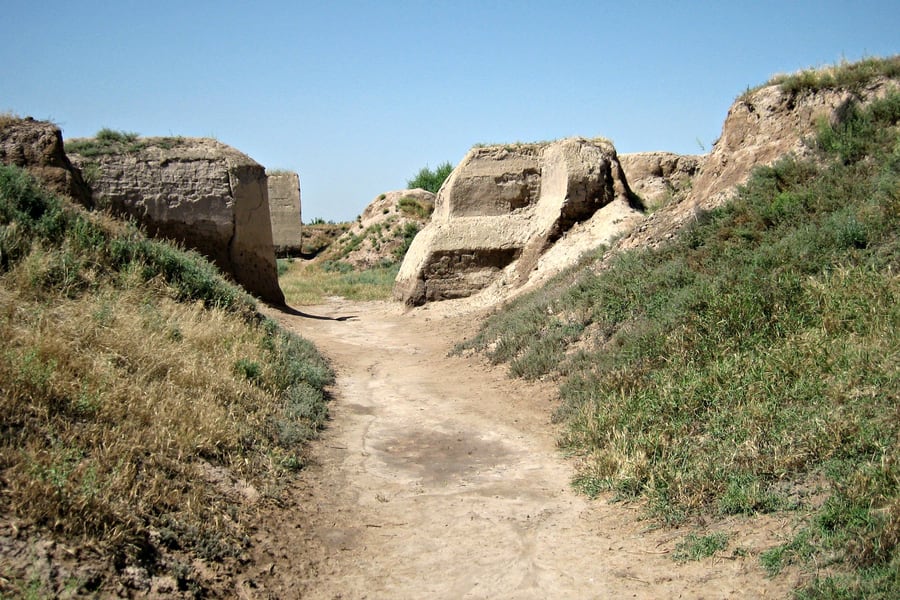 Prince Roy / Wikimedia Commons · CC BY 2.0 · 2015 · cropped
Ajinateppa, east of Bokhtar
Twelve kilometres east of Bokhtar, a Buddhist monastery of the seventh and eighth centuries — courtyards, a stupa and cells, built when this was Tokharistan and Buddhism was enjoying a revival under the Western Turks. Excavation brought out murals and a thirteen-metre reclining Buddha, both now in Dushanbe, and the site has been on UNESCO's tentative list since 11 September 1999. What is left on the ground is eroded mud brick, and it is quietly extraordinary.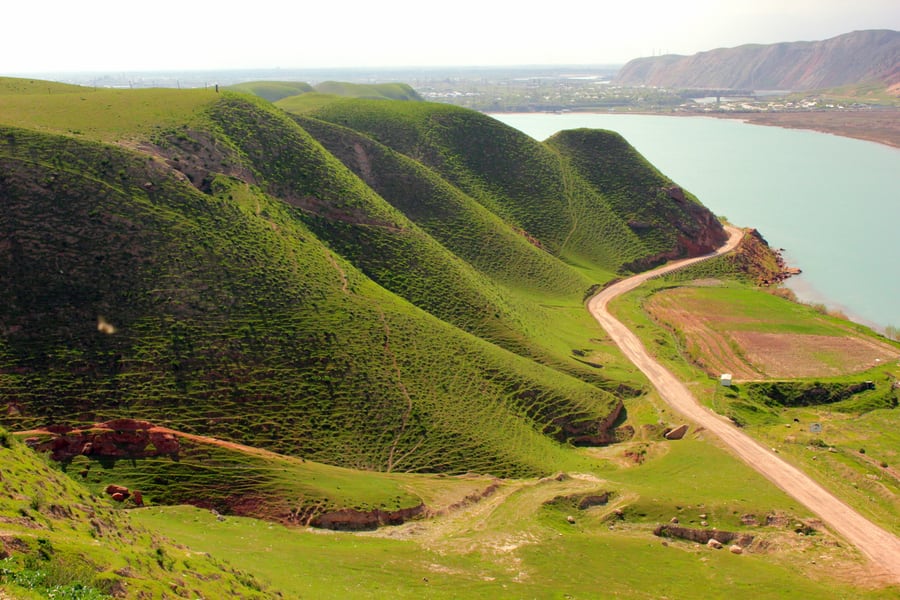 Franawaits / Wikimedia Commons · CC BY-SA 4.0 · 2017 · cropped
Levakant and the Golovnaya reservoir
Levakant — Sarband until it was renamed — sits just east of Bokhtar with the Golovnaya Dam on the Vakhsh immediately beyond it, the lowest of the barrages that make this the hardest-worked river in Central Asia. In spring the hills above the water go an improbable green for a few weeks before the Khatlon summer burns them off, and the track along the crest is the one place on the route where the valley can be seen whole.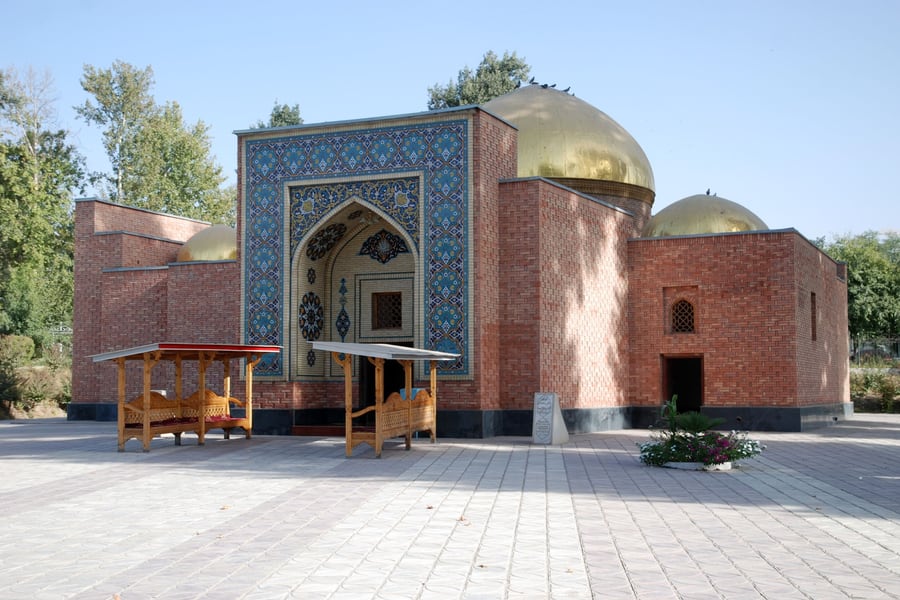 Bertramz / Wikimedia Commons · CC BY-SA 3.0 · 2014 · cropped
The tomb of Mir Sayyid Ali Hamadani, Kulob
The reason most people come to Kulob. Mir Sayyid Ali Hamadani was a Persian Sufi of the Kubrawiya order, a scholar and poet credited with carrying Islam and Persian craft into Kashmir; he died travelling through Central Asia in 1384 and was buried here in Khatlon, in a tomb that still stands. The complex of brick portals and gold domes around it is the centre of gravity of the city, and a short drive from the station.Where to Sleep
The train makes an overnight stay compulsory in one direction or the other. Southbound arrives at Kulob late on Saturday afternoon and the only train back leaves at eight the next morning, so unless you are driving one leg you are sleeping somewhere at the far end — and Kulob's hotels are small, local and, without exception, not on the web under their own names. Ask at the station or book through an agency; there is nothing here we can point you at honestly.
Dushanbe is the opposite problem: plenty of choice, and the international houses are all on Rudaki Avenue rather than out by the station. Dushanbe I is about three kilometres from the centre, which is a five-minute taxi ride at seven in the morning and no reason to stay near it.
Where to stay
Dushanbe Serena Hotel
14 Rudaki Avenue, in the centre of the capital
Ninety-five rooms, five suites and ten serviced apartments on Dushanbe's main avenue, about three kilometres from the station.
Check Availability (opens in a new tab, on serenahotels.com)via serenahotels.comQuestions or corrections
Planning this trip and stuck on something, or spotted a time, fare or detail that has changed? Send us a message about Dushanbe to Kulob. We read every one, and we update this page when something has changed.