El Canfranero — the train to a station that is now a hotel
Enrique Roa Alvarez / Wikimedia Commons · CC BY-SA 4.0 · cropped
- DistanceZaragoza Delicias–Canfranc · seventeen calling points
- Duration3 h 19 from Zaragoza · 2 h 11 from Huesca
- Best seasonTwo trains a day each way · only one of them climbs at weekends
Introduction
Everything at the top of this railway has been found another job.
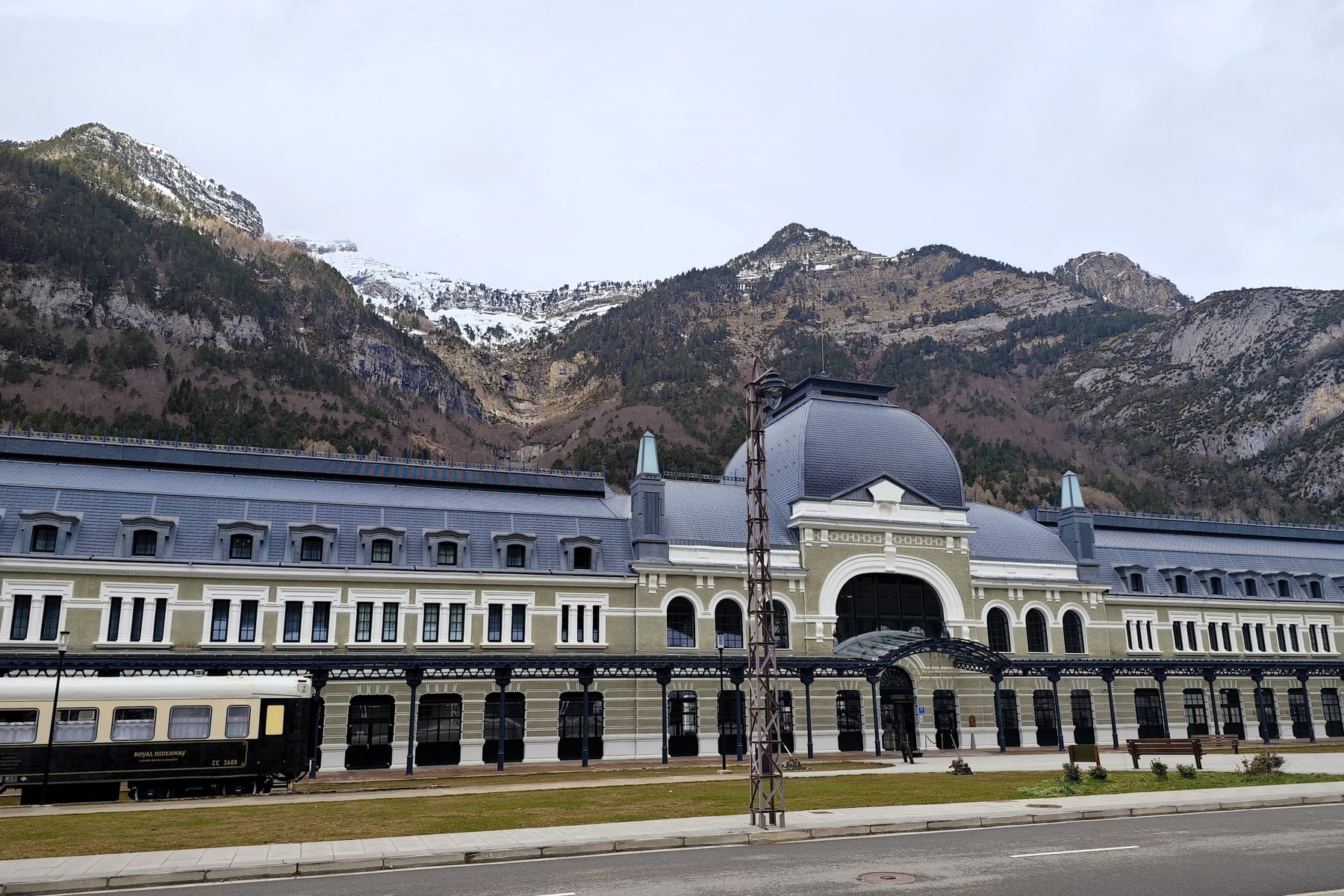
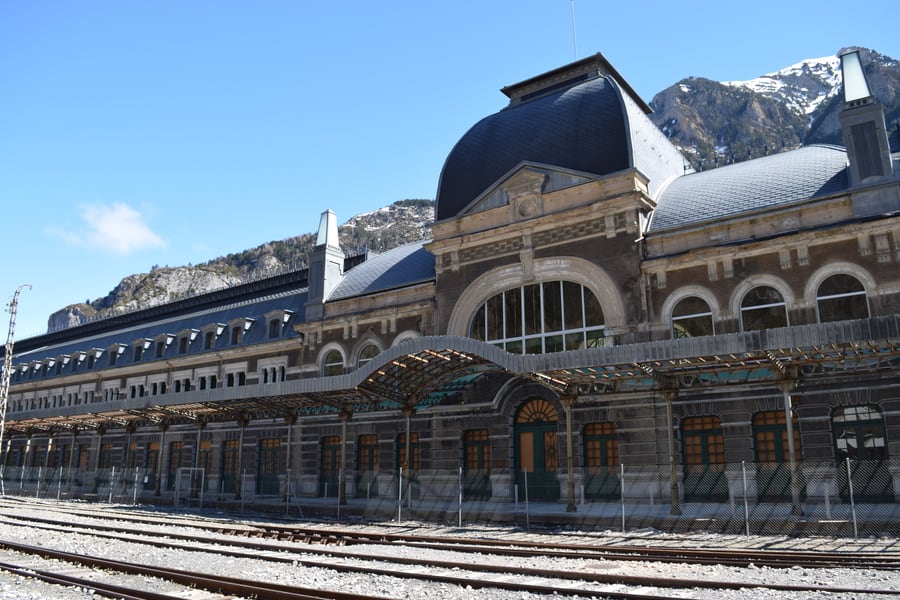
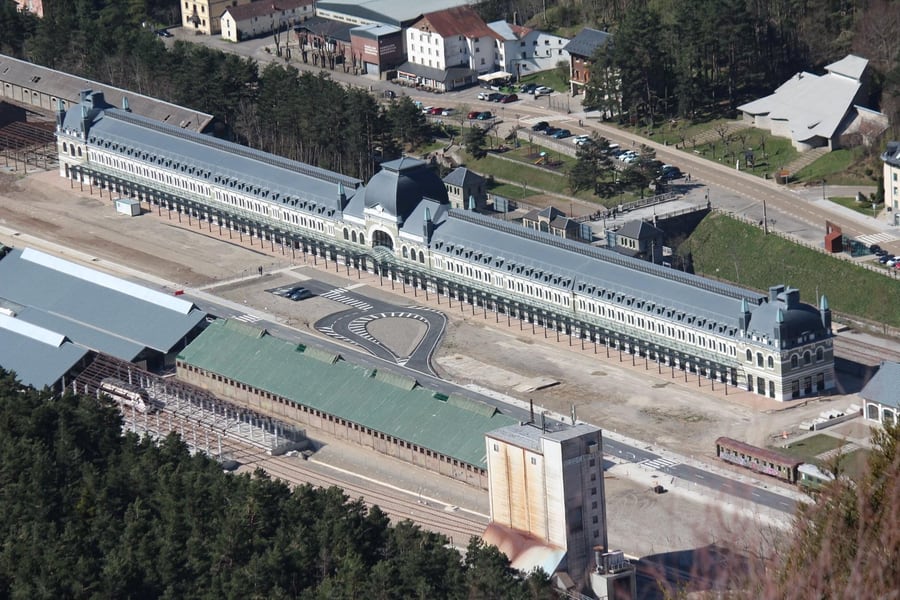
The station at Canfranc was built to be an international frontier post. It opened on 18 July 1928, with the King of Spain and the President of the French Republic both standing on the platform, and it is roughly a quarter of a kilometre long — a customs hall, two sets of railway offices, a hotel and a restaurant under one roof, in a valley that then held a few hundred people. Since January 2023 it has been a hotel again, and only a hotel: 104 rooms, and a reception desk in the vestibule where passengers once changed trains between two countries and two track gauges.
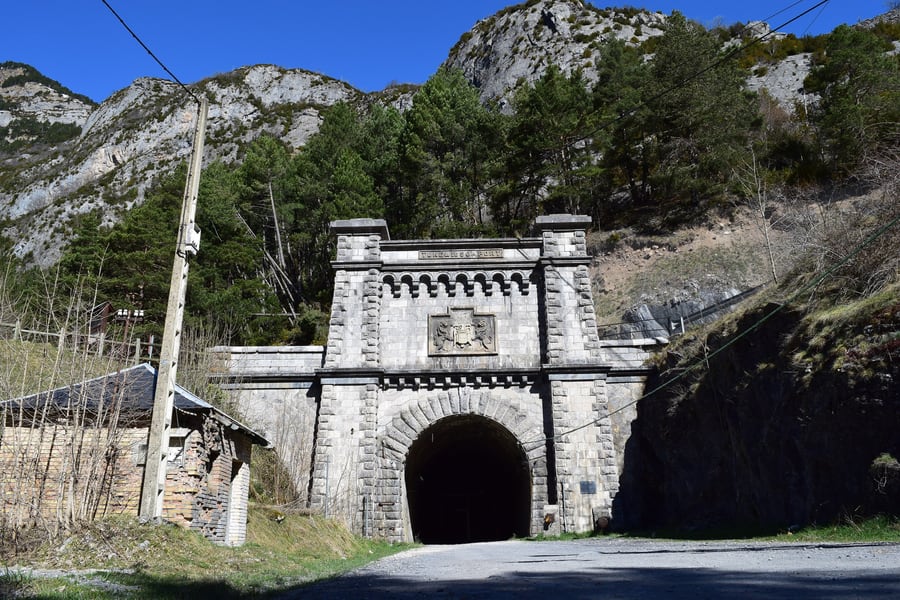
The tunnel it was built to serve is still there, 7.8 kilometres of it, bored under the Pyrenees between 1908 and 1915. No train has been through since 1970. It has not been sealed either, because a road tunnel was later driven almost alongside, and the railway bore is now that tunnel's emergency evacuation gallery. The Somport crossing works perfectly well — for cars.
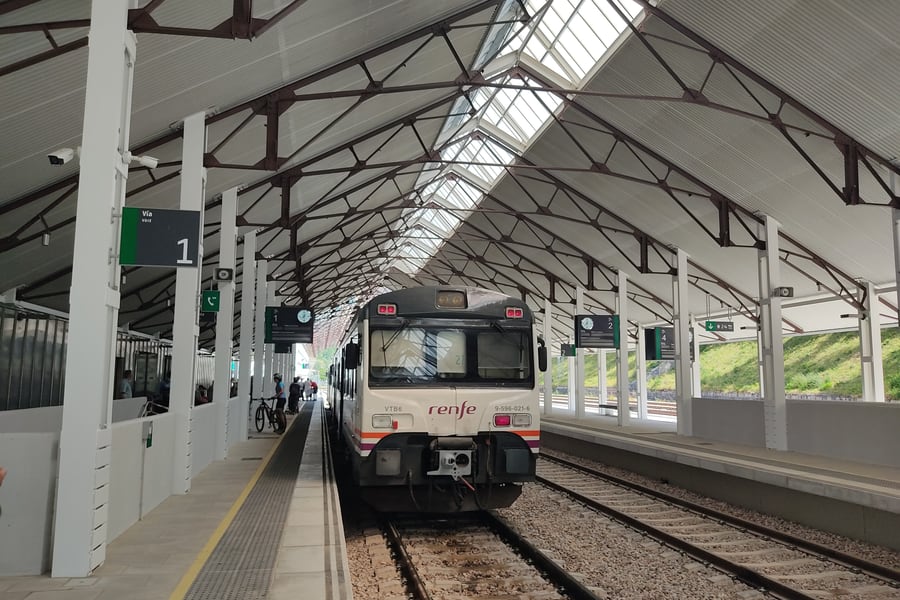
And the trains from Zaragoza, which never stopped coming, no longer arrive in the palace. Since 15 April 2021 they draw up at a plain platform under a re-erected roof a few hundred metres short of it, inside what used to be the Spanish goods halls.
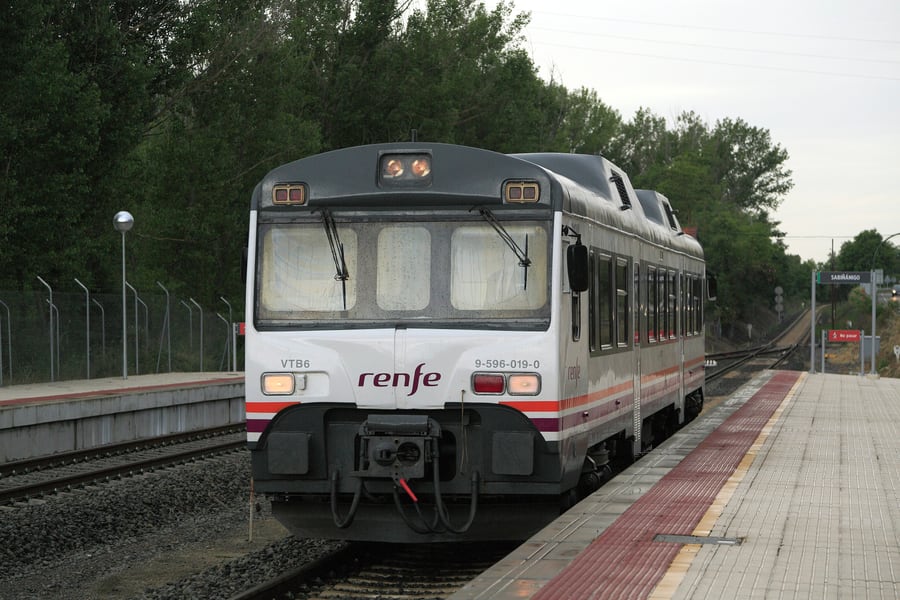
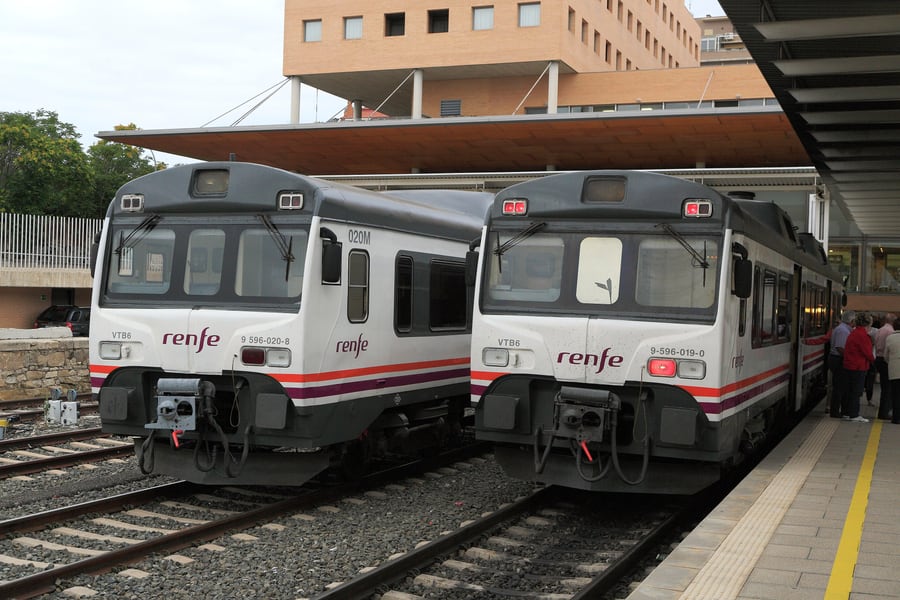
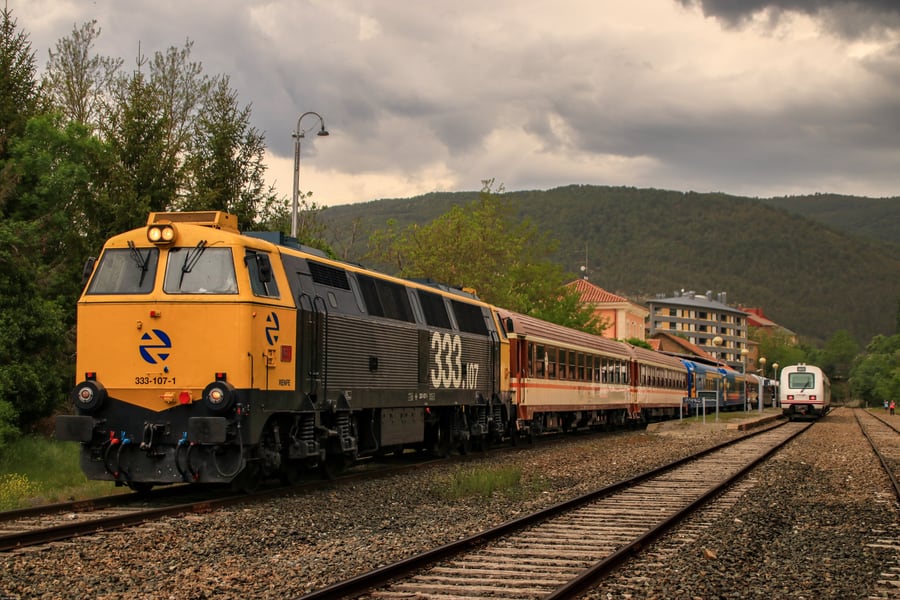
So the one thing at Canfranc still doing what it was designed for is the service itself: two diesel railcars a day up the Aragón valley and two back down, run by Renfe as ordinary medium-distance trains, at eleven euros for the whole mountain section. They were away for two years while Adif spent more than €180 million rebuilding sixty-one kilometres of the line, and they came back on 9 June 2025, half an hour quicker than before.
The result is a journey that looks like a branch line and reads like an unfinished sentence. It ends at a frontier that is still closed, in front of a building whose scale only makes sense if you know what was supposed to happen next.
The Journey
The train that matters leaves Zaragoza Delicias at 08:43, calls at three more Zaragoza stations before the city runs out, and reaches Canfranc at 12:02. Three hours and nineteen minutes, seventeen calling points, and a change of country in everything but the passport.
Out of the plain
The first hour is not mountain railway at all. The line crosses the Ebro basin through cereal country, meets the Zaragoza–Huesca route at Tardienta, and runs into Huesca at 09:46, where it waits five minutes. Huesca is where most people join: it is an hour from Zaragoza, it has the provincial capital's bus and rail station in one building, and everything north of it is a single unelectrified track through the Pyrenees.
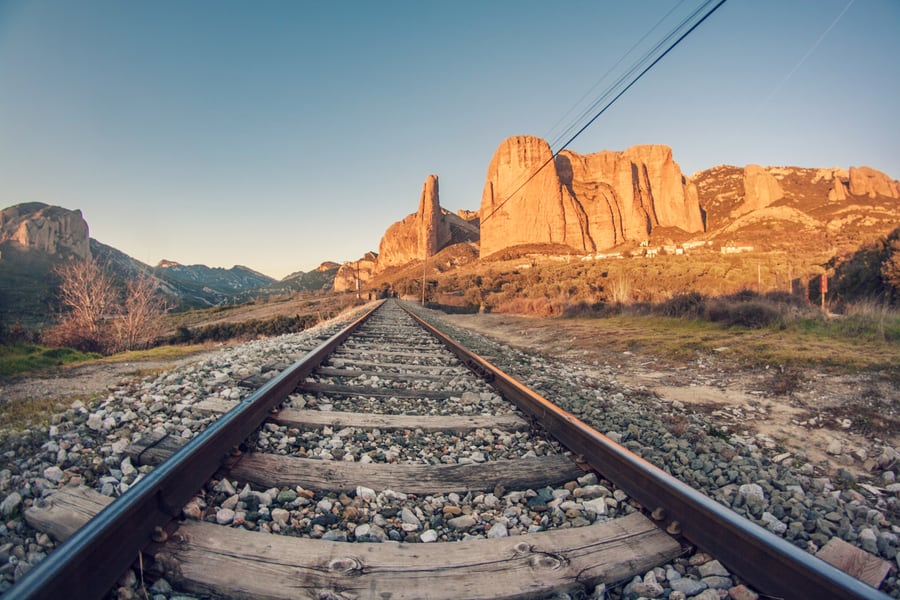
Ayerbe, at 10:18, is the last town before the ground tilts. Ten minutes later the train is at Riglos, and the reason for the window seat is standing over the village: the Mallos, towers of Miocene conglomerate cut back by the Gállego until only the walls remained, the tallest of them 275 metres from base to top. Griffon vultures nest on them, and climbers have been working the same faces for decades. Aragón made them a natural monument in November 2016. The station is a request stop.
The middle, which is where the money went
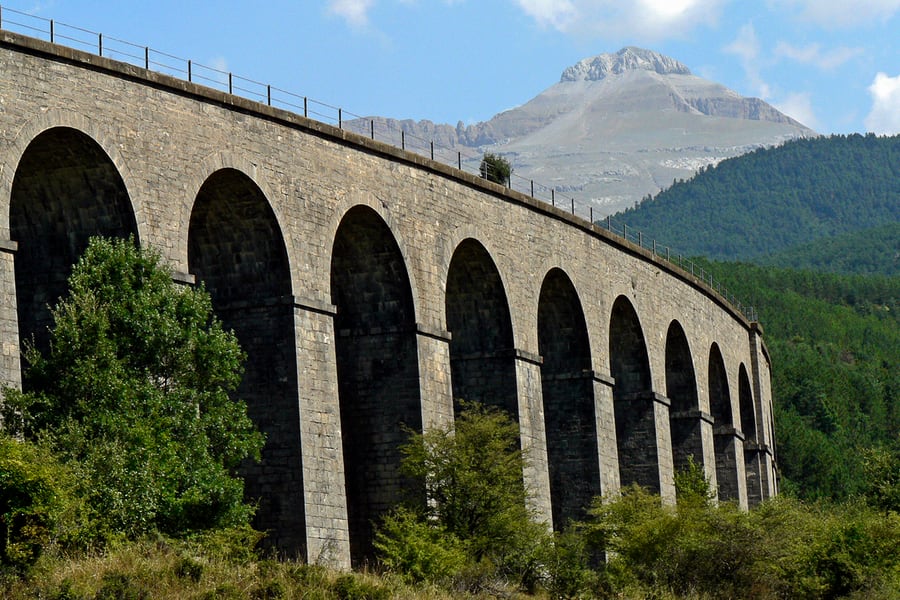
Between Santa María y la Peña and Caldearenas-Aquilué the line threads the gorge of the Gállego and then crosses to the Aragón, and this is the stretch that closed for two years. Trains stopped on 19 June 2023 and did not run again until 9 June 2025. In between, Adif renewed sixty-one kilometres of track and alignment, laid 130,000 metres of rail and about 133,000 sleepers, reinforced twenty-nine tunnels — enlarging the bore of twenty-eight of them and lowering the track in the twenty-ninth — repainted four steel bridges, added thirty-five new drainage works and eased curves so trains could hold a steadier speed. The platforms at Riglos-Concilio, Santa María-La Peña, Castiello-Pueblo, Villanúa-Letranz and Jaca were raised at the same time.
The visible result is thirty minutes. The invisible one is that Renfe had to retrain seventy-one drivers before it could reopen, because most of them had not been over the route in more than a year.
Up the Aragón
Sabiñánigo at 11:16 is the industrial town of the valley, and one of only three stops between Huesca and Canfranc where the train pauses long enough to show a separate arrival and departure time. Jaca at 11:30 is the one place on the mountain section that feels like a town in its own right — the first capital of the Kingdom of Aragon, with an eleventh-century cathedral and a pentagonal citadel of 1592 still inside its moat.
After Jaca the valley closes in. Castiello-Pueblo and Villanúa are both request stops, thirteen minutes apart, and then the train runs between rock walls for the last stretch to Canfranc, 1,195 metres above the sea.
The arrival
It is a deliberate anticlimax. The platform is a modern one under a re-erected roof, opened on 15 April 2021 inside the old freight halls, on a track layout 1.6 kilometres long with three passenger roads and four for goods. The palace of 1928 stands a few hundred metres further on, restored, occupied and doing something else. Walking the length of its frontage takes longer than the run up from Villanúa.
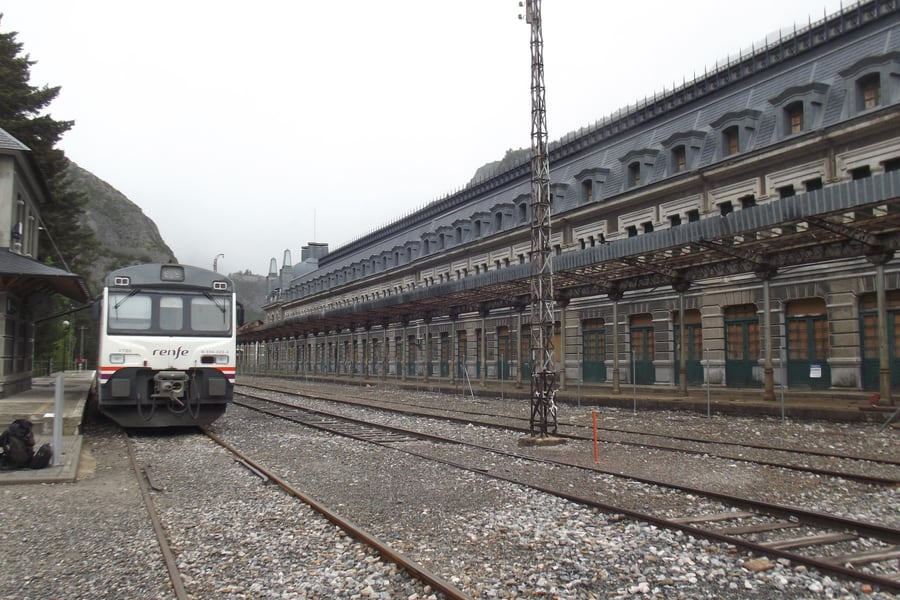
Beyond it, the line stops. The Somport tunnel is shut to trains and has been since a derailing freight destroyed the L'Estanguet bridge on the French side in March 1970. France did not rebuild it. On the far slope the rails resume at Bedous, twenty-five kilometres away, and run down to Pau.
Along the route
Marc Celeiro / Wikimedia Commons · CC BY-SA 4.0 · croppedBuilt for a border, cut off from it in 1970
The station opened in 1928 at the Spanish end of a tunnel under the Pyrenees. In March 1970 a derailment destroyed a bridge on the French side, France declined to rebuild it, and a customs hall the size of a palace was left at the end of a branch line.Marc Celeiro / Wikimedia Commons · CC BY-SA 4.0 · croppedThe tunnel still has a job
The Somport railway tunnel has carried no train since 1970, but it was never abandoned: a road tunnel was driven almost parallel to it, and the railway bore now serves as that tunnel's emergency evacuation gallery. Spain has budgeted €93 million to put track back.Turol Jones / Wikimedia Commons · CC0 · croppedTwo years shut, €180 million, thirty minutes saved
Trains stopped in June 2023 and came back in June 2025. In between, Adif renewed 61 kilometres of mountain railway and reinforced twenty-nine tunnels. Renfe had to retrain seventy-one drivers, because most had not been over the route for more than a year.A bit of history
Culture & experiences along the way
Juanedc / Wikimedia Commons · CC BY 2.0 · croppedWhere the mountains start
The first hour is flat — the Ebro plain, cereal country, the junction at Tardienta, then Huesca, where the train waits five minutes and most people get on. After Ayerbe the line begins to climb in earnest, and within twenty minutes the Mallos de Riglos are filling the windows.Falk2 / Wikimedia Commons · CC BY-SA 4.0 · croppedStations that stop only if asked
Riglos, Santa María y la Peña, Anzánigo, Caldearenas-Aquilué, Castiello-Pueblo and Villanúa are marked in Renfe's own timetable as request stops — the train calls when a passenger has asked it to. Several of them serve villages of a few dozen people, which is why a railway with two trains a day still matters here.Ander Ibarra / Wikimedia Commons · CC BY 2.0 · croppedJaca, and the last half-hour
Jaca is the one real town on the mountain section and the busiest stop after Huesca. Beyond it the valley narrows hard: Castiello-Pueblo, then Villanúa, then a thirteen-minute run between rock walls to Canfranc, which stands at 1,195 metres.Arnaucc / Wikimedia Commons · CC BY-SA 4.0 · croppedArriving in a goods shed, beside a palace
The last thing the line does is anticlimax by design. Trains draw up at a plain platform under a re-erected roof — the new station of 15 April 2021, built inside the old freight halls — and the building that everyone came for stands a few hundred metres away, doing something else entirely. Walking the length of its frontage takes longer than the run up from Villanúa.Timetables
There are two trains a day each way between Zaragoza and Canfranc — and at weekends, only one of them climbs.
Every time below was read on 17 August 2026 from Renfe's own timetable and fare service, which returns the real service for a named date and the full calling pattern of each train. The dates checked were 1, 5, 6, 12 and 13 September, 3, 25 and 31 October and 1 and 4 November 2026.
Up the valley
| 15640 · Mon–Fri | 15642 · daily | |
|---|---|---|
| Zaragoza Delicias | 08:43 | 16:20 |
| Tardienta | 09:31 | 17:13 |
| Huesca | 09:46 / 09:51 | 17:28 / 17:33 |
| Ayerbe | 10:18 | 18:00 |
| Riglos | 10:28 | 18:10 |
| Santa María y la Peña | 10:37 | 18:19 |
| Anzánigo | 10:44 | 18:26 |
| Caldearenas-Aquilué | 10:56 | 18:38 |
| Sabiñánigo | 11:16 | 18:58 |
| Jaca | 11:30 | 19:16 |
| Castiello-Pueblo | 11:37 | 19:23 |
| Villanúa | 11:49 | 19:35 |
| Canfranc | 12:02 | 19:48 |
Down the valley
| 15645 · Mon–Fri | 15655 · Sat & Sun | 15653 · daily | |
|---|---|---|---|
| Canfranc | 06:35 | 08:42 | 18:19 |
| Villanúa | 06:44 | 08:51 | 18:28 |
| Castiello-Pueblo | 06:57 | 09:04 | 18:41 |
| Jaca | 07:03 | 09:10 | 18:47 |
| Sabiñánigo | 07:17 | 09:24 | 19:01 |
| Caldearenas-Aquilué | 07:38 | 09:48 | 19:26 |
| Anzánigo | 07:50 | 10:00 | 19:38 |
| Santa María y la Peña | 07:57 | 10:07 | 19:45 |
| Riglos | 08:07 | 10:17 | 19:55 |
| Ayerbe | 08:18 | 10:28 | 20:06 |
| Huesca | 08:46 / 08:51 | 10:56 / 11:01 | 20:34 / 20:39 |
| Zaragoza Delicias | 09:55 | 12:05 | 21:47 |
Huesca to Canfranc takes 2 h 11 on the morning train and 2 h 15 on the evening one; Zaragoza to Canfranc is 3 h 19 and 3 h 28.
What the pattern means for a visit
On a weekday the shape works. The 08:43 from Zaragoza arrives at 12:02, and the 18:19 back gives six hours at the top — enough for the station, the hotel's public rooms, lunch in the village and a walk.
At a weekend it does not. The morning train, 15640, runs Monday to Friday only, so the first departure that reaches Canfranc on a Saturday or Sunday is the 16:20 from Zaragoza, arriving 19:48. There are still two trains down — 08:42 and 18:19 — but nothing goes up before late afternoon. A weekend day return to Canfranc by train is not possible; an overnight stay is what the timetable assumes.
Several stops are marked in Renfe's printed sheet as request stops, made when a passenger asks: Riglos, Santa María y la Peña, Anzánigo, Caldearenas-Aquilué, Castiello-Pueblo and Villanúa among them.
The season, and one limit worth knowing
Renfe's planner returns this service for every date up to and including 1 November 2026, and nothing at all beyond it. That is the end of the published timetable rather than the end of the railway, but anyone planning past early November has nothing to book against yet.
⚠️ The line is cut as this page is written
At 17:39 on 17 August 2026, Adif's network-status page reported circulation suspended between Sabiñánigo and Ayerbe because of the Las Peñas de Riglos fire, at the request of Aragón's 112 emergency centre. It affects every train between Huesca and Canfranc, and a road transfer plan was in place. Canfranc's own departure board still showed the 06:35 and the 18:19 as scheduled, so this is an emergency rather than a closure — but it is live, and the position on any given day is on Adif's network status page (opens in a new tab).
Timings and fares checked against Renfe and Adif on 17 August 2026.
Tickets
This is one of the cheapest long mountain rides in Europe, because nobody has ever treated it as a tourist railway. It is Renfe Media Distancia — the ordinary regional product — and it is priced accordingly: €11.00 between Huesca and Canfranc, on both daily trains, and the same figure for every date checked between September and November 2026. One class, no compulsory reservation, no supplement. Children from 4 to 13 pay 40% less.
The other ticket on this line is not Renfe's. Alsa runs the Expreso de Canfranc over the top of the route between Jaca and Canfranc from May to October, in coaches restored in 1940s style, at €20.00 return in the panoramic car. The two are not alternatives so much as different lengths of the same idea. Fares checked against Renfe's booking service and Alsa's Trenes Turísticos page on 17 August 2026.
Book your tickets
Falk2 / Wikimedia Commons · CC BY-SA 4.0 · croppedHuesca to Canfranc, one way
€11.00 internet turista, on either daily train
Two hours of single-track mountain railway, with no reservation and no first class.
Book Tickets (opens in a new tab, on renfe.com)via renfe.comAnder Ibarra / Wikimedia Commons · CC BY 2.0 · croppedThe Expreso de Canfranc
€20.00 return in the panoramic car · €17.00 family class
Alsa's tourist train, Jaca to Canfranc in 35 minutes behind a locomotive, May to October.
Book Tickets (opens in a new tab, on trenesturisticos.es)via trenesturisticos.esRail Passes
A pass is valid on this line and is almost certainly not worth using on it. Both halves of that sentence matter, because they are true for different reasons.
Interrail and Eurail
Interrail's own page on trains in Spain, read on 17 August 2026, names RENFE and iryo as the two Spanish companies in its network, and lists regional trains — Media Distancia and Cercanías — among the services covered. The Canfranero is a Renfe Media Distancia service. A pass therefore covers it, with no reservation to make and no supplement to pay, which is not true of Spain's high-speed trains.
That puts it in the small group of Spanish journeys a pass holder can simply board. It is the opposite of the situation on Catalonia's rack railways, where the operator sits outside the network altogether.
Why it still will not pay
The whole mountain section, Huesca to Canfranc, costs €11.00. A pass day used on it is a day spent to save eleven euros, and a Zaragoza–Canfranc return uses two of the two trains a day that exist. Almost any other use of that travel day in Spain is worth more.
The case changes only if the Canfranero is one leg of a longer day — arriving in Zaragoza from Madrid or Barcelona in the morning and going on north, for instance. Then the pass is already being spent on the high-speed leg, and the Canfranero rides free on top of it. That is the arithmetic worth doing, and it turns on the rest of the itinerary rather than on this line.
What the pass does not cover
The Expreso de Canfranc, the Alsa tourist train between Jaca and Canfranc, is a separate commercial service under the Trenes Turísticos brand rather than a Renfe one, so no rail pass applies to it and its own fares are payable in full. Those are set out under Tickets.
On a line where the plain single is €11.00, the only question a pass really answers is whether the day is going anywhere else as well.
Pass conditions checked against Interrail and Renfe on 17 August 2026.
Places to Visit
The Canfranero is a line of four stops worth breaking the journey for, and they arrive in order of increasing altitude: a wall of conglomerate towers, a walled town that was once a kingdom's capital, a cave under the last village but one, and the frontier settlement at the end of the track. All four are within a few minutes of a platform, which on a railway with two trains a day is the whole point.
 Engeser / Wikimedia Commons · CC BY-SA 4.0 · cropped
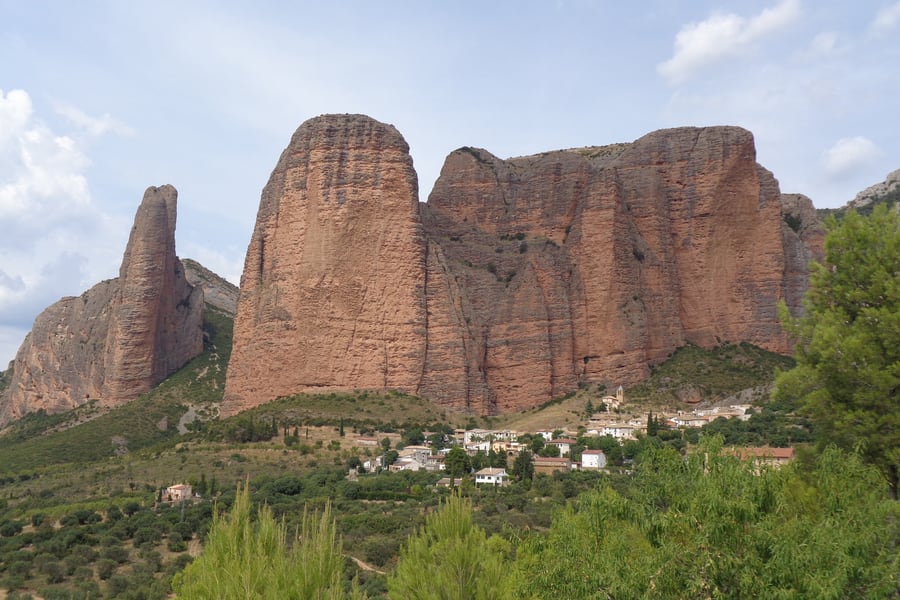
The Mallos de Riglos
Towers of Miocene conglomerate standing over the village of Riglos, thrown up with the Pyrenees and then cut back by the Gállego until only the walls were left. The tallest, the north spur of El Pisón, rises 275 metres. Aragón declared them a natural monument in November 2016. Climbers have been coming here for decades, and griffon vultures nest on the faces the routes go up.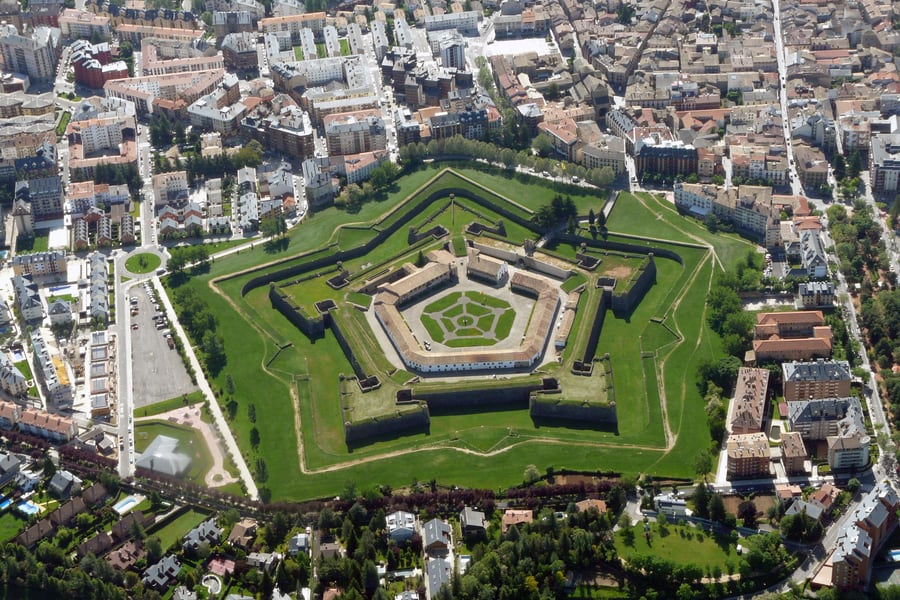 Juan Carlos Gil / Wikimedia Commons · CC BY-SA 3.0 ES · cropped
Jaca
A town of about 14,000 at 820 metres, and the first capital of the Kingdom of Aragon until 1096. Its eleventh-century cathedral is one of the earliest Romanesque buildings in Spain. The pentagonal Ciudadela was ordered by Philip II in 1592 to a design by the Italian engineer Tiburzio Spannocchi, and is still walled, moated and open to visitors.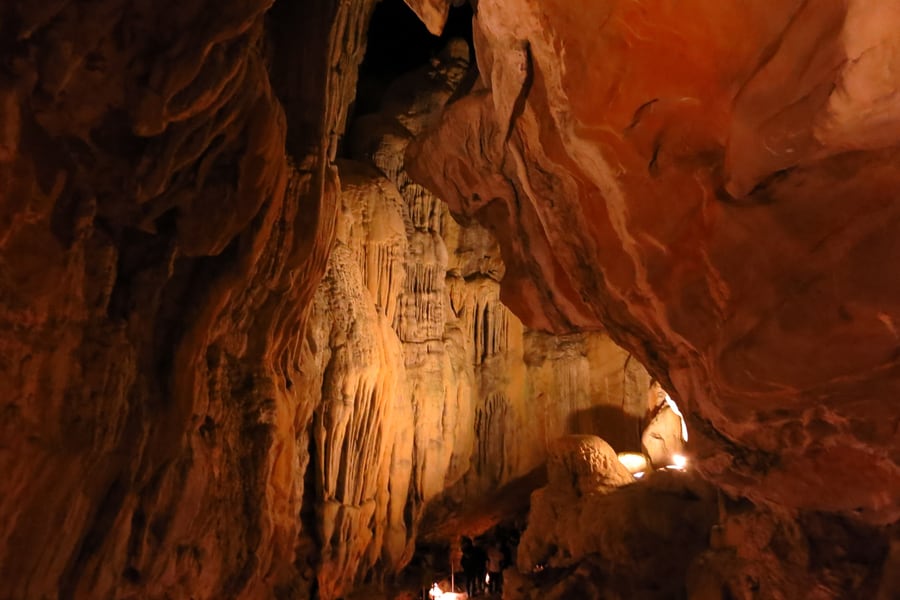 Santos T Gonzalez / Wikimedia Commons · CC BY-SA 4.0 · cropped
The Cueva de las Güixas
A show cave a short walk above Villanúa station, formed in limestone through the Quaternary by water that still runs through it and comes out into the Aragón. The guided visit is a 400-metre circuit taking an hour and a quarter, with several flights of steps and a steady chill whatever the month. Visits are by reservation, in Spanish, with French and English audioguides.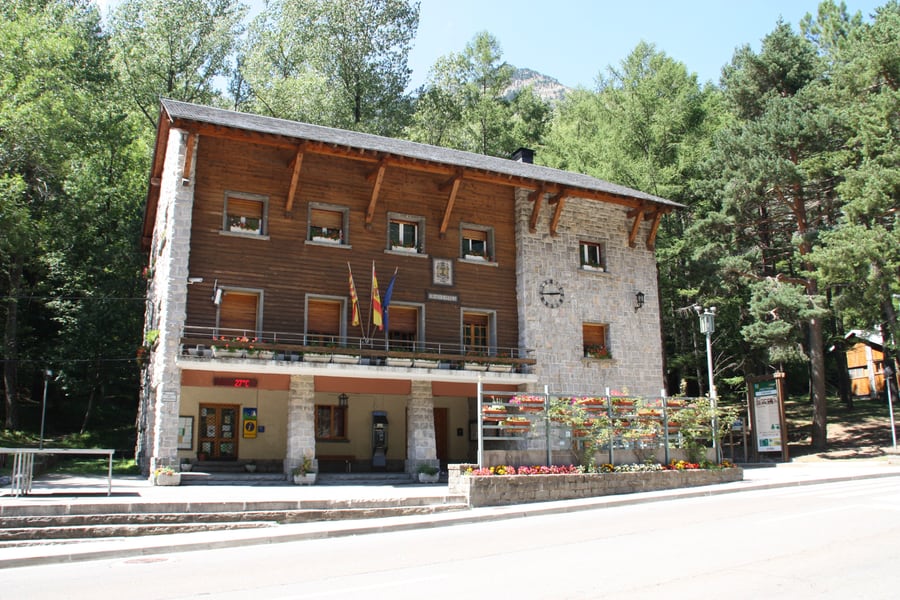 Visentico / Sento / Wikimedia Commons · CC BY 2.0 · cropped
Canfranc-Estación
The village exists because the station does. It sits at 1,195 metres in a valley barely wide enough for a street, with the ski resorts of Candanchú and Astún seven and ten kilometres up the road and the Somport pass above that, where the Aragonese branch of the Camino de Santiago crosses out of France. Everything in it is within a few minutes of the platform.Where to Sleep
The timetable settles this argument before the hotels do. With one train up at weekends and a six-hour window on weekdays, anyone who wants the valley rather than a glimpse of it is staying a night, and the choice is between the two ends of the line and Jaca in the middle.
At the top, the obvious answer is also the strangest one: the station itself. Sleeping in the 1928 building is the only way to see most of it, because the parts a day visitor can reach are the ones the hotel keeps public. Two mid-range hotels in Canfranc-Estación were checked as well and are not listed here, because neither has a website of its own to send anyone to.
Jaca is the practical base for two or three days — it has a town's worth of places to eat, and both the morning and the evening trains call there. Huesca suits the other direction, for anyone taking the 09:51 and wanting to be on it without a dawn start from Zaragoza.
Every link below was opened and read on 17 August 2026. No prices, ratings or star counts appear here that the establishments do not state of themselves.
Where to stay
Canfranc Estación, a Royal Hideaway Hotel
Inside the 1928 station, at the end of the line
The station itself, owned by the Government of Aragón and run by Barceló under its Royal Hideaway name since 27 January 2023. Its own account gives 104 rooms, four of them suites, on the first and second floors; a wellness floor at ground level with a heated pool, four treatment rooms and a gym; a library; and three restaurants, two of which are in a pair of railway carriages rebuilt in the style of the 1920s and standing outside the building. The historic vestibule is the reception.
Check Availability (opens in a new tab, on barcelo.com)via barcelo.comHotel Conde Aznar
Jaca, on the Paseo de la Constitución
A small independent hotel in the middle of Jaca, a few minutes on foot from the cathedral and the Ciudadela, with an apartment of its own two doors along the same street. Its site describes it as a base for walking — the climb up Peña Oroel, or the ride to the Fuerte Rapitán — and it takes bookings directly rather than through an agent.
Check Availability (opens in a new tab, on condeaznar.com)via condeaznar.comHotel Sancho Abarca & Petit Spa
Huesca, where most people join the train
A hotel on the Coso Alto in the old centre of Huesca, close enough to the station to make the 09:51 comfortably. Remains of the city's medieval wall are preserved inside the building. Its own page describes a small spa, and rooms that run to a triple with two single beds and a sofa bed for three people.
Check Availability (opens in a new tab, on gargallo-hotels.com)via gargallo-hotels.comQuestions or corrections
Planning this trip and stuck on something, or spotted a time, fare or detail that has changed? Send us a message about El Canfranero — the train to a station that is now a hotel. We read every one, and we update this page when something has changed.