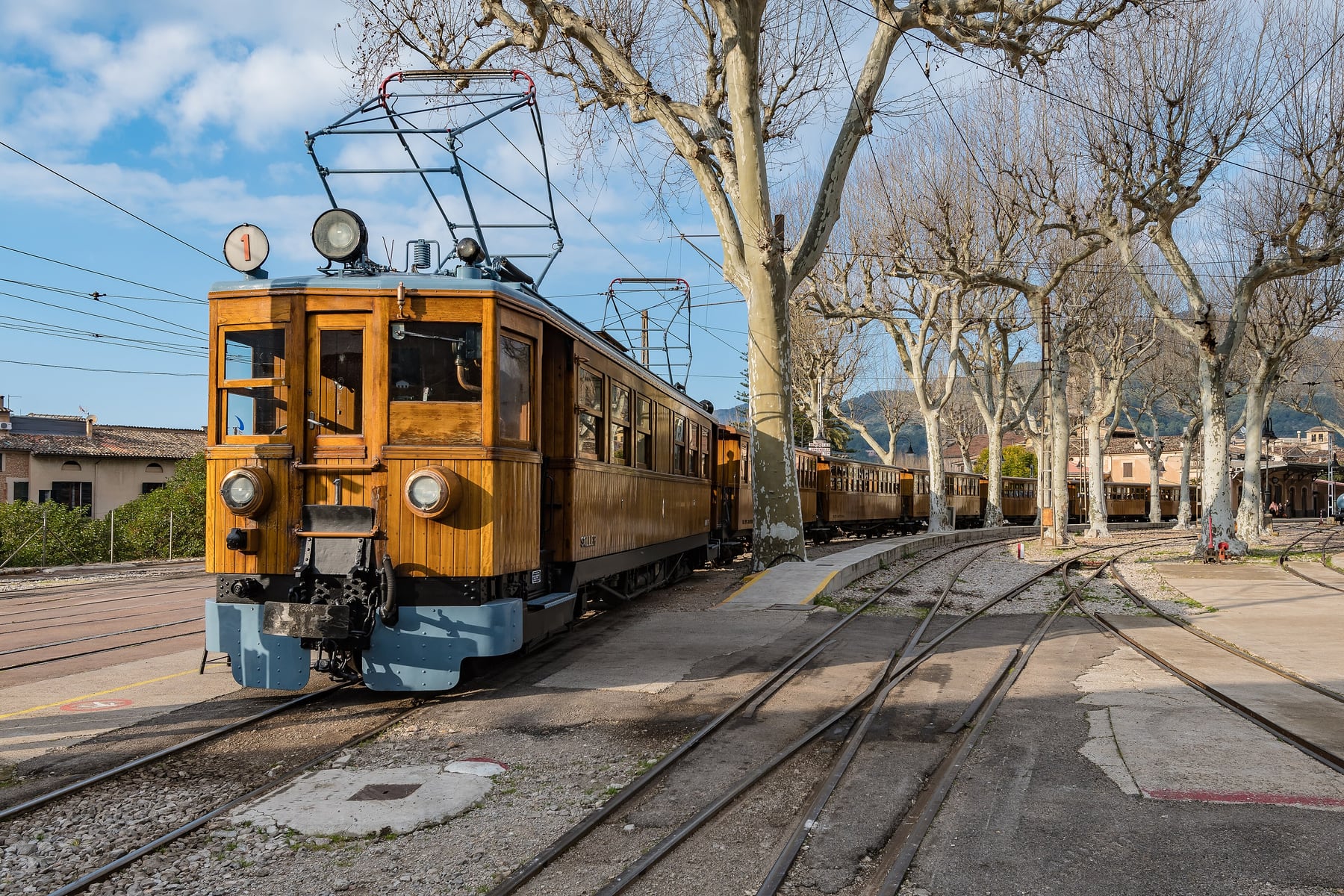
Ferrocarril de Sóller — the railway a town bought for itself
Isiwal / Wikimedia Commons · CC BY-SA 4.0 · cropped
- Distance27.3 km by train · plus 4.9 km by tram to the port
- DurationAbout 1 hour by train · about 30 minutes by tram
- Best seasonDaily, but closed for several weeks each winter for maintenance
Introduction
Almost every railway in Spain belongs to the state. The Ferrocarril de Sóller belongs to Sóller.
The company was founded on 5 November 1905, and its own account of that day is unusually specific about who paid: it was set up "with the support of all the inhabitants of Sóller". The town on the far side of the Serra de Tramuntana had grown rich on oranges and lemons and had no sensible way to move them. A concession had been asked for in 1893 and refused as too expensive. So the townspeople raised the money themselves, drove a tunnel nearly three kilometres long through the mountain, and opened their railway on 16 April 1912.
More than a century later the ownership has not changed hands. The operator still describes itself, in the present tense, as "a privately owned company, mostly from Sóller". It publishes accounts for its shareholders, the most recent filed in April 2026. It came close to failing in 1973 and was kept going by the tourist traffic rather than rescued by a ministry. Nothing about the line was nationalised, absorbed or handed over, and that is the reason the train you board today is the one its shareholders bought: four wooden motor coaches delivered in 1929, still numbered 1 to 4, still working the line they were built for.
What the money bought
Twenty-seven point three kilometres of 914 mm track, thirteen tunnels, and a climb to about 200 metres inside the mountain before the descent into the orange groves. The longest bore, under the Serra d'Alfàbia, runs 2,856 metres. One tunnel turns through nearly 180 degrees in the dark. Outside Sóller the line crosses a torrent on five curved masonry arches that the valley calls els Cinc Ponts, the five bridges.
The town then did it a second time. On 4 October 1913 it opened an electric tramway from the station down to the harbour — the first electric tramway on Mallorca — 4.9 kilometres of the same narrow gauge, worked by open-sided cars that carried oranges, coal, fish and passengers. It still runs, and the through ticket from Palma to the sea still uses both.
The result is a railway that has never been modernised into something else, because there was never an authority in a position to modernise it. An hour from Palma, in varnished wood, at the pace its shareholders settled on in 1929.
The Journey
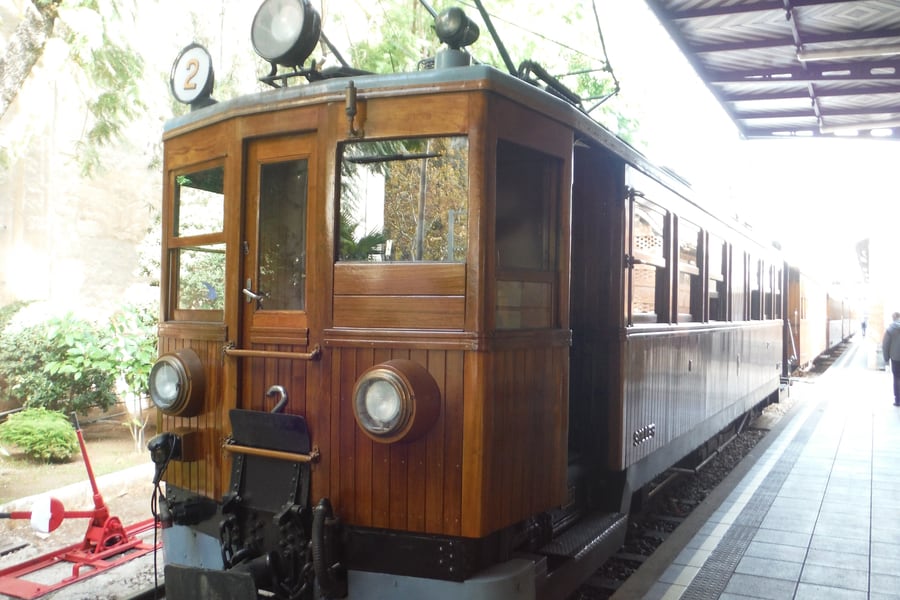
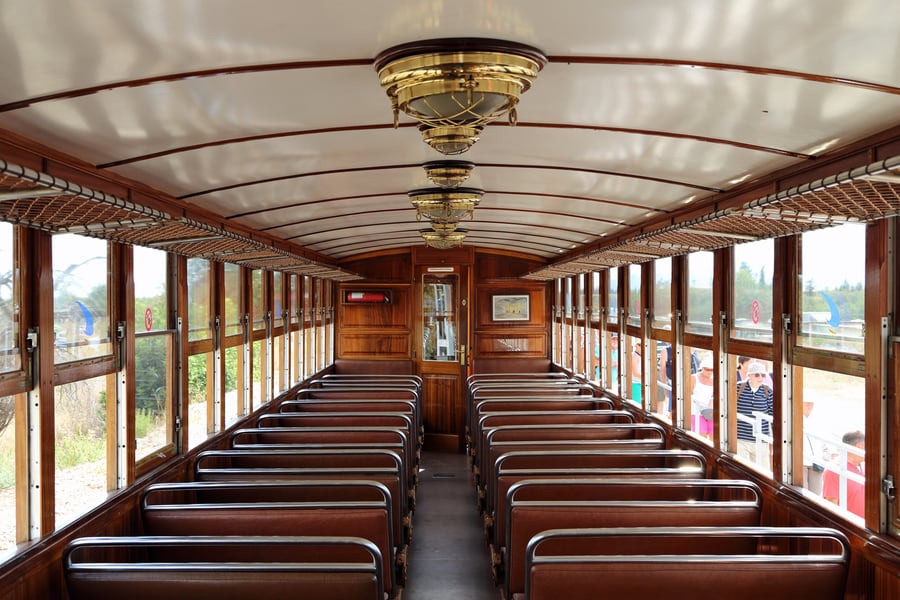
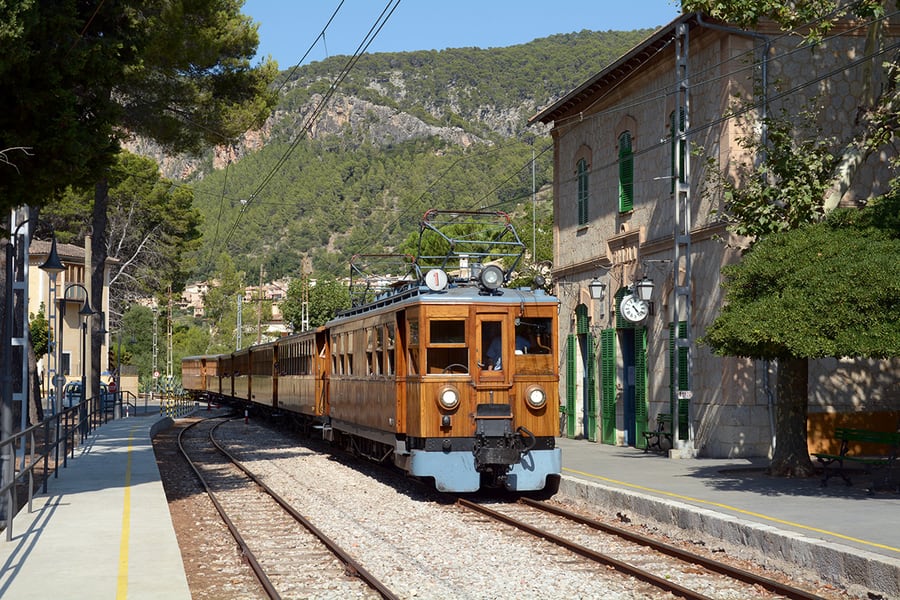
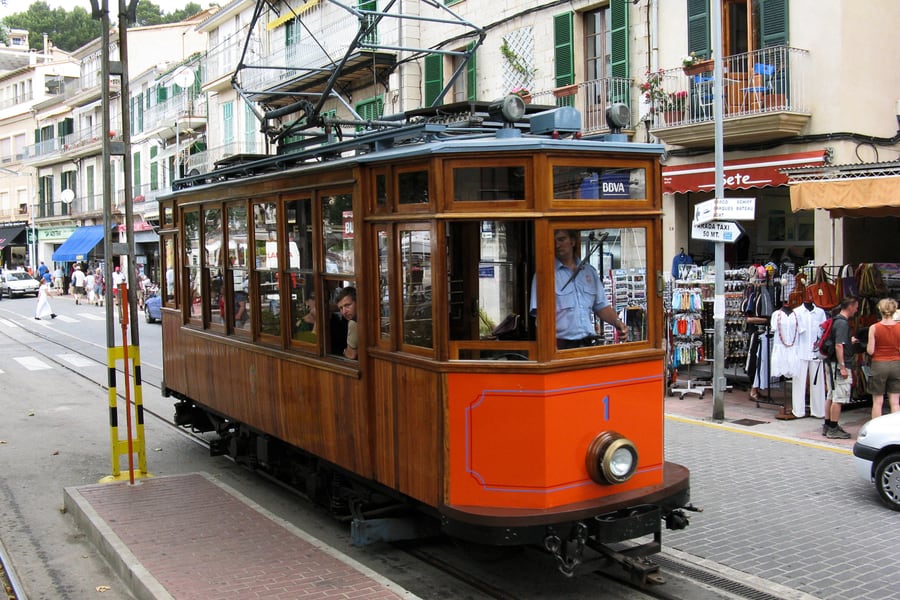
The train leaves from a terminus on Palma's Plaça d'Espanya that looks nothing like the bus and metro interchange beside it. Under the trainshed stand the four motor coaches of 1929 — bodies of varnished timber, a numbered disc above the cab, two brass-rimmed headlamps and a pantograph on the roof. They were built by Carde & Escoriaza of Zaragoza, with electrical equipment by Siemens Schuckert and bogies to a Brill design, and they were the machines that ended seventeen years of steam working on 14 July 1929. The coaches behind them are older still, in the same wood, with slatted seats and brass ceiling lamps.
The first twenty minutes are flat and unhurried. The line runs out past Son Sardina and Santa Maria, through carob and almond country on the Palma plain, with the wall of the Serra de Tramuntana filling more of the windscreen at every kilometre. At Bunyola, twenty-five minutes out, the train stops at a stone station with green shutters and the name carved above the doors. This is the last of the flat.
Into the mountain
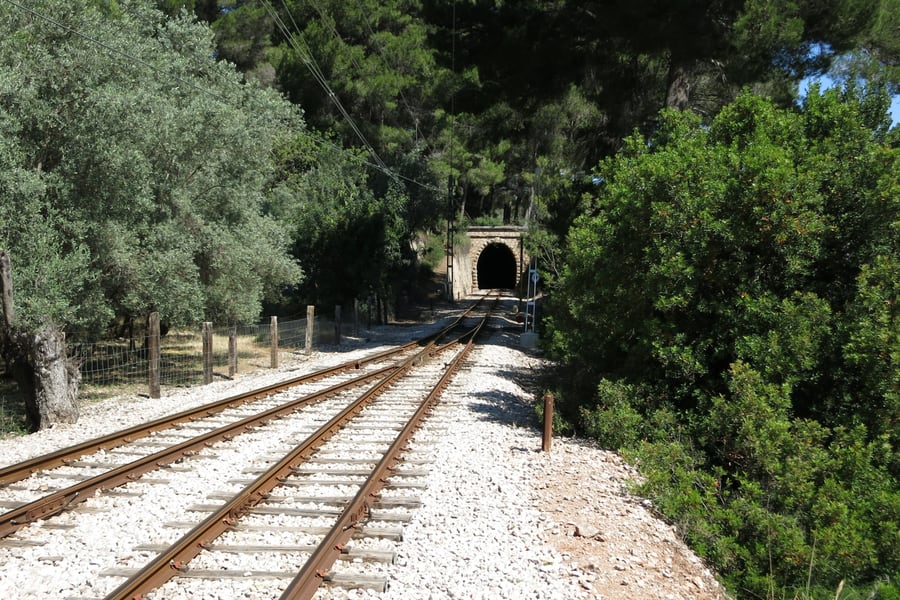
Above Bunyola the railway begins to climb in earnest, and the engineering that the town paid for starts to show. The line curls up the hillside on ledges and small masonry viaducts, doubling back on itself, and enters the first of its thirteen tunnels. One of them — known simply as the 500 — is about half a kilometre long and turns through almost 180 degrees inside the rock, so the train comes out facing the way it came in.
Then comes the long one. The bore under the Serra d'Alfàbia runs 2,856 metres, took the best part of four years to drive, and was the single reason the 1893 concession had been dismissed as unaffordable. Inside it the line reaches its summit, around 200 metres above the sea. It is the quietest part of the journey: the wooden bodywork drums, the lamps come on, and there is nothing to see for something over three minutes.
The far portal opens onto the other side of the island, and this is the view the journey is for — the whole Sóller valley below, terraced in olives and citrus, ringed by the highest ground in Mallorca. Selected departures pause for about ten minutes at the Mirador Pujol d'en Banya, a platform cut into the hillside purely so that people can get out and look at it.
Down to the oranges
The descent runs through pines and then through the groves themselves. Shortly before the town the line crosses the Torrent dels Montreals on the Viaducte dels Cinc Ponts — five curved masonry arches built with the railway in 1912 and strengthened with about 140 tonnes of concrete in 2018. The operator's own advice is that the left-hand side of the carriage has the better of it.
Sóller station is a converted townhouse, Can Mallol, set among plane trees a minute's walk from the main square. The whole run takes about an hour for 27.3 kilometres, which works out at a shade under 28 km/h.
The last 4.9 kilometres
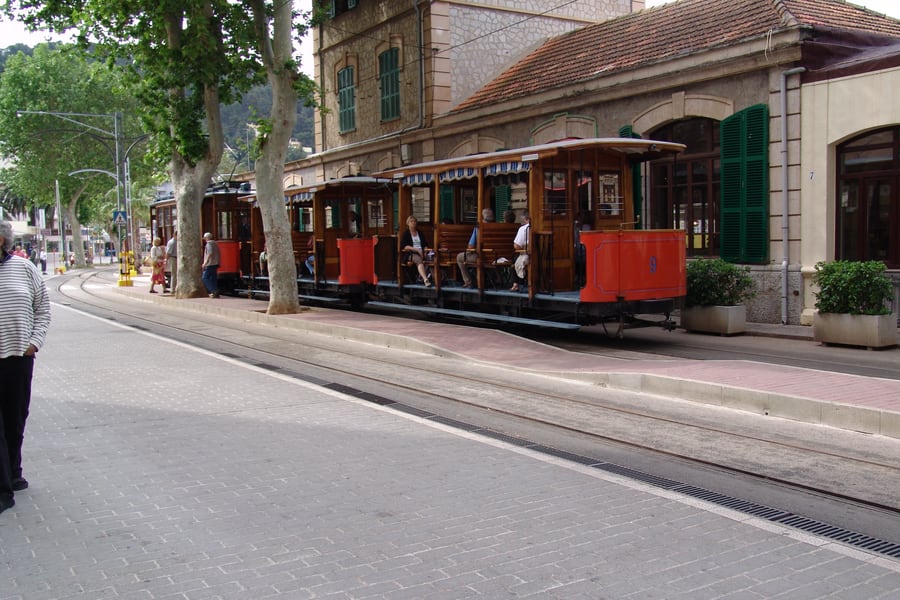
Outside the station door, on the same 914 mm gauge, the tram is waiting. It opened on 4 October 1913 as the first electric tramway on Mallorca, and it is a genuinely different vehicle: three of the cars were built by Carde & Escoriaza for the opening, and five more — numbered 20 to 24 — came second-hand from Lisbon. In warm weather they haul open-sided trailers known as jardineres, which have no glass in them at all.
The tram runs down the middle of the street through Sóller, past the cafés on the Plaça de la Constitució, out between the orange trees, and finishes on the promenade at Port de Sóller, alongside a near-enclosed bay with a lighthouse on the headland. It takes about half an hour. For most of the last century it also carried fish, coal and oranges the other way.
Along the route
Diesellokophren / Wikimedia Commons · CC0 · croppedThe town raised the money itself
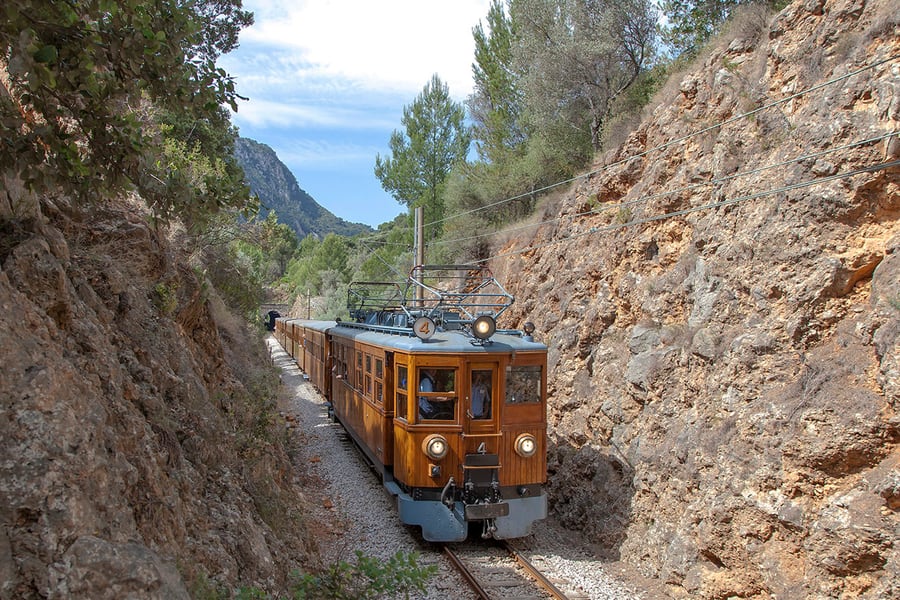
A concession was refused in 1893 as too expensive, the obstacle being the 2,856-metre bore any railway would need under the Serra d'Alfàbia. Sóller had grown rich on oranges and had no good way to move them, so the town formed its own company in 1905.Elgaard / Wikimedia Commons · CC BY-SA 4.0 · croppedNever nationalised, and that is why the 1929 trains survive
Electric traction was inaugurated in July 1929 with four motor coaches, and those same four cars still work the line. They lasted because the company did: it nearly failed in 1973 and was carried through by tourist traffic rather than taken into public ownership.Arno.Ho / Wikimedia Commons · CC BY-SA 3.0 · croppedThen they built a tramway as well
In October 1913 the same company opened 4,868 metres of electric tramway down to the harbour, the first on Mallorca. Five of its cars arrived second-hand from Lisbon. In warm weather it still runs open-sided jardinera trailers with no glass in them.A bit of history
Culture & experiences along the way
Валерий Л. / Wikimedia Commons · CC BY-SA 4.0 · croppedThe flat twenty minutes
Out of Palma the line crosses the plain through carob and almond country, past Son Sardina and Santa Maria, with the Serra de Tramuntana filling more of the windscreen at every kilometre. Bunyola at twenty-five minutes is the last of the level ground.GillyBerlin / Wikimedia Commons · CC BY 2.0 · croppedThirteen tunnels and a 180-degree turn
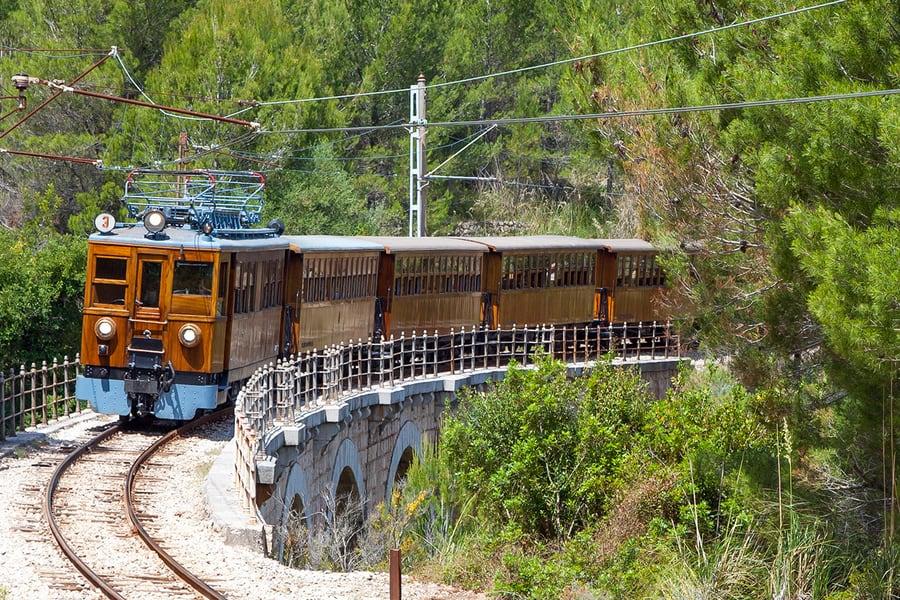
Above Bunyola the railway climbs on ledges and small viaducts, doubling back on itself. One tunnel, known as the 500, is about half a kilometre long and turns through almost 180 degrees inside the rock, so the train emerges facing the way it went in. The long bore under the Serra d'Alfàbia follows, and the summit of the line is inside it.Diesellokophren / Wikimedia Commons · CC0 · croppedThe view the journey is for
The far portal opens onto the Sóller valley — terraces of olives and citrus under the highest ground on Mallorca. Selected departures pause about ten minutes at the Mirador Pujol d'en Banya, a platform cut into the hillside for no purpose but this. Below it the line crosses the Torrent dels Montreals on five curved masonry arches the valley calls els Cinc Ponts; the operator's own advice is to sit on the left.Timetables
All times below were read from the operator's own board at trendesoller.com (opens in a new tab) as of August 2026.
The train
Palma → Sóller, with the Bunyola and Sóller times for each departure:
| Palma | Bunyola | Sóller |
|---|---|---|
| 10:10 | 10:35 | 11:10 |
| 10:50 | 11:15 | 11:50 |
| 12:15 | 12:40 | 13:15 |
| 13:30 | 13:55 | 14:30 |
| 15:10 | 15:35 | 16:10 |
| 18:30 * | 18:55 | 19:30 |
| 19:40 | 20:05 | 20:40 |
Sóller → Palma:
| Sóller | Bunyola | Palma |
|---|---|---|
| 09:00 | 09:25 | 10:00 |
| 10:50 | 11:15 | 11:50 |
| 12:15 | 12:40 | 13:15 |
| 14:00 | 14:25 | 15:00 |
| 17:15 * | 17:40 | 18:15 |
| 18:00 | 18:25 | 19:00 |
| 18:30 | 18:55 | 19:30 |
| 19:30 | 19:55 | 20:30 |
* The 18:30 from Palma and the 17:15 from Sóller are marked on the operator's board as "to consult at the Box Office" — they are not a fixed part of the advertised service, and the counter is the only place that will confirm whether one is running on a given day.
Every advertised journey takes one hour end to end, with Bunyola twenty-five minutes out of Palma. The ten-minute photo stop at the Mirador Pujol d'en Banya is made by selected departures rather than by all of them, and which ones is a question for the ticket office.
The tram
The tram between Sóller and the port runs far more often than the train, and the two are not timetabled to connect.
- Sóller → Port de Sóller: 08:00, 09:00, 10:00, 11:00, then every thirty minutes from 11:30 until 19:30, then a last car at 20:35.
- Port de Sóller → Sóller: 08:30, 09:30, 10:25, 11:30, then every thirty minutes from 12:00 until 20:00, then a last car at 21:05.
The ride takes about half an hour each way.
The winter shutdown
This is the part that most guides leave out. The railway closes completely for several weeks each winter while the company overhauls hundred-year-old equipment, and the train and the tram shut on different dates.
The pattern is documented in the operator's own notices. For the 2023–24 season the train was shut from 11 December 2023 until 5 February 2024, with the tram closed from 8 to 21 January 2024 inclusive. In 2022 the train came back on 1 March. Most recently the company closed on 24 November 2025 and reopened on 1 February 2026, and a revised timetable took effect on 16 March 2026.
The dates move from year to year and are announced in the autumn, so a trip planned for December or January is worth checking against the operator's notices before anything else is booked. The company's marketing copy describes the service as running "uninterruptedly on a daily basis since 1912", which is true of the years but not of every week within them.
Tickets
The Ferrocarril de Sóller sells almost nothing online, and that is the thing most visitors get wrong. Only the combined Palma – Port de Sóller – Palma round trip can be booked in advance, at €40; its calendar opens seven days ahead and excludes the current day, and five departures carry it. Everything else — a single to Sóller at €23, any Bunyola fare, a tram ticket on its own — is a counter sale at Palma, Bunyola or Sóller station, on the day of travel only.
Alongside the €40 ticket the operator lists an online-only combined offer at €32. Driven through the booking flow on two separate dates in August 2026 it resolved both times to the same departure, the 15:10 from Palma — a saving of €8 a head for what is otherwise the same ticket. Bicycles and electric scooters are not carried. Fares read from trendesoller.com (opens in a new tab), August 2026.
Book your tickets
Adrian Pingstone / Wikimedia Commons · public domain · croppedCombined train and tram, online
€40 return, Palma – Port de Sóller – Palma
The only ticket sold online, and the only one bookable before the day of travel.
Book Tickets (opens in a new tab, on trendesoller.com)via trendesoller.comThe 15:10 combined offer
€32, online only
The same round trip on one departure a day, eight euros under the counter price.
Book Tickets (opens in a new tab, on trendesoller.com)via trendesoller.comGillyBerlin / Wikimedia Commons · CC BY 2.0 · croppedEverything else, at the ticket office
€23 single to Sóller · €10 tram only · €11 to Bunyola
Counter sales on the day of travel, at Palma, Bunyola or Sóller station.
Book Tickets (opens in a new tab, on trendesoller.com)via trendesoller.comRail Passes
The short answer is that no rail pass is any use here, and the reason is the same one that gives this journey its character: the Ferrocarril de Sóller is a private company that never joined anything.
Interrail and Eurail publish a list of the operators their passes cover in Spain — RENFE, iryo, SNCF, FEVE Cercanías and CP — together with a list of trains that are excluded. The Ferrocarril de Sóller appears on neither list, because it is not part of the network at all. A pass therefore buys nothing on the train, nothing on the tram, and no discount on either.
Nor is there a fallback on Mallorca. The island's other railway, Serveis Ferroviaris de Mallorca, which runs the lines from Palma to Inca, Sa Pobla and Manacor, is named explicitly on Interrail's excluded list. So a pass covers no railway anywhere on the island: not the Sóller line, not the tram, not SFM.
That is worth knowing before the ferry, because it changes the arithmetic. A pass holder arriving in Palma by boat from Barcelona or Valencia has, in effect, reached the end of what the pass pays for. Everything on Mallorca is bought separately.
What to buy instead
There is no season ticket, carnet or tourist card aimed at visitors on this line, and the operator runs no loyalty scheme. The cheapest way to do the full Palma-to-the-sea round trip is the €32 online combined ticket on the 15:10 from Palma, against €40 for the same thing at the counter; the fares and the booking rules are set out in the Tickets section above.
For anyone whose plans are firmer than that, buying the ordinary combined return at the station and travelling on whichever departure suits is the simpler option, and costs the difference.
Places to Visit
The line has only three stops that matter to a visitor — Palma, Bunyola and Sóller — and then the tram adds a fourth at the sea. It is a short enough journey that most people ride it in a day, but the Sóller valley rewards a longer stay, and two of the finest villages on Mallorca sit a few kilometres beyond the end of the rails.
The cards below run in the order the journey meets them, with the two road-served villages last.
 Horchatamivida / Wikimedia Commons · CC BY-SA 4.0 · cropped
Palma
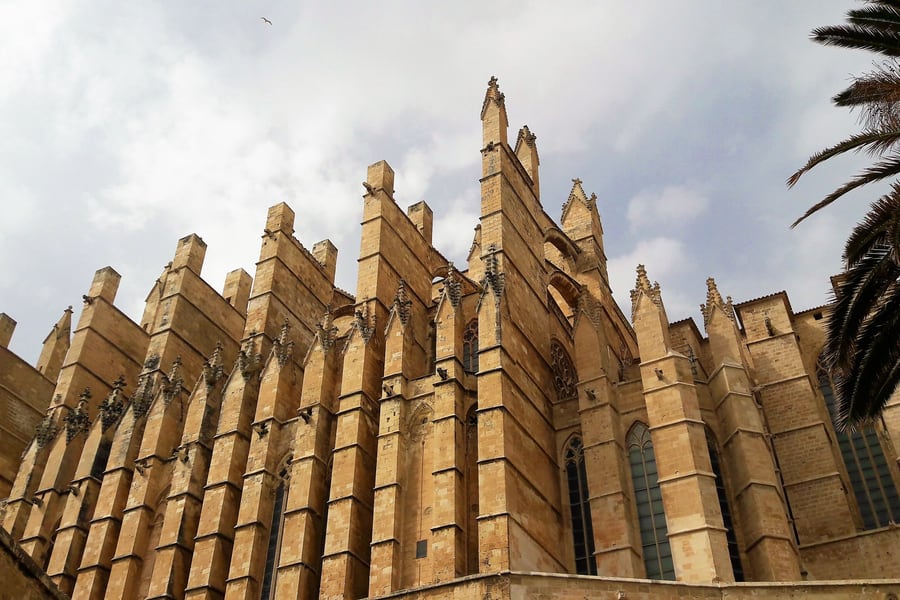
The terminus sits on Plaça d'Espanya, so the city is on the doorstep at both ends of the day. Ten minutes' walk south is La Seu, the Gothic cathedral standing over the bay on the old sea wall. Its rose window is nearly 14 metres across — the second-largest surviving Gothic rose window anywhere.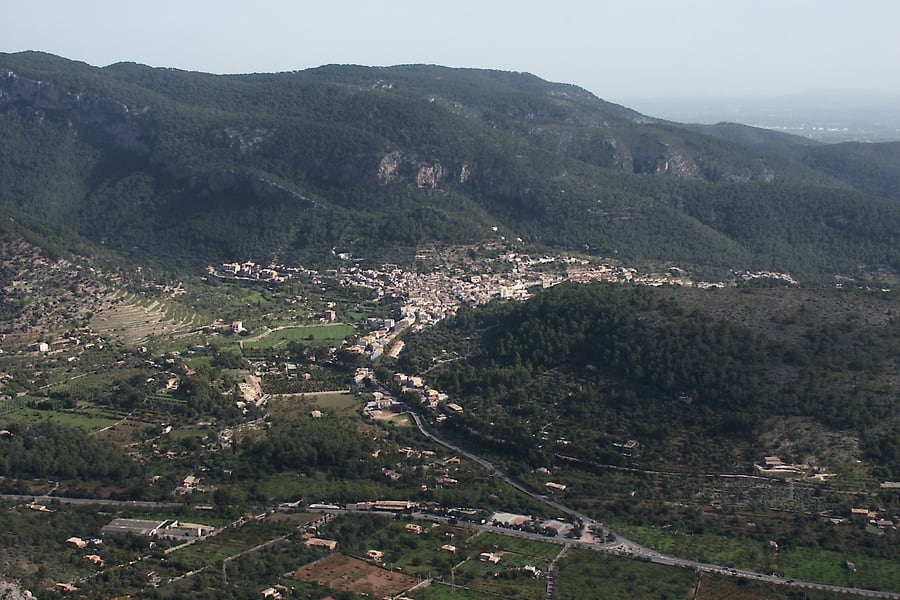 Antoni Sureda / Wikimedia Commons · CC BY-SA 3.0 · cropped
Bunyola
A hill village of terraces and dry-stone walls directly under the Serra, twenty-five minutes out of Palma and the last station before the climb begins. It is the one intermediate stop the operator times, and a single fare from either end costs €11, which makes it the cheapest way to sample the line.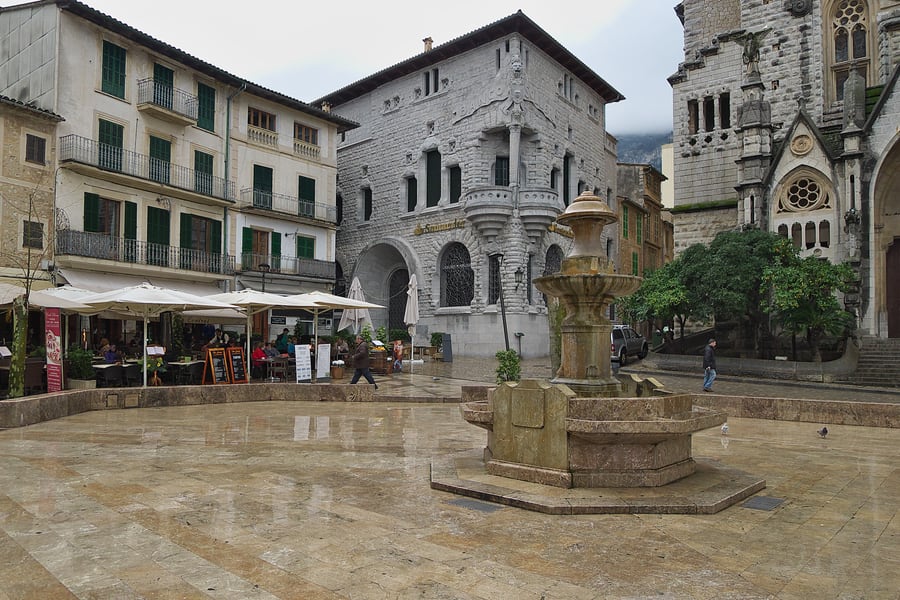 José Luis Filpo Cabana / Wikimedia Commons · CC BY 3.0 · cropped
Sóller
The town the railway was built for, in a large bowl-shaped valley ringed by the Serra de Tramuntana. The station is a converted townhouse, Can Mallol, a minute from the Plaça de la Constitució, where the tram runs past the cafés. The façade of Sant Bartomeu on the square is Joan Rubió's, of 1904; the Banco de Sóller beside it is his too, a Modernista building of 1912 for a bank founded in 1889 with the money of emigrants who came home rich.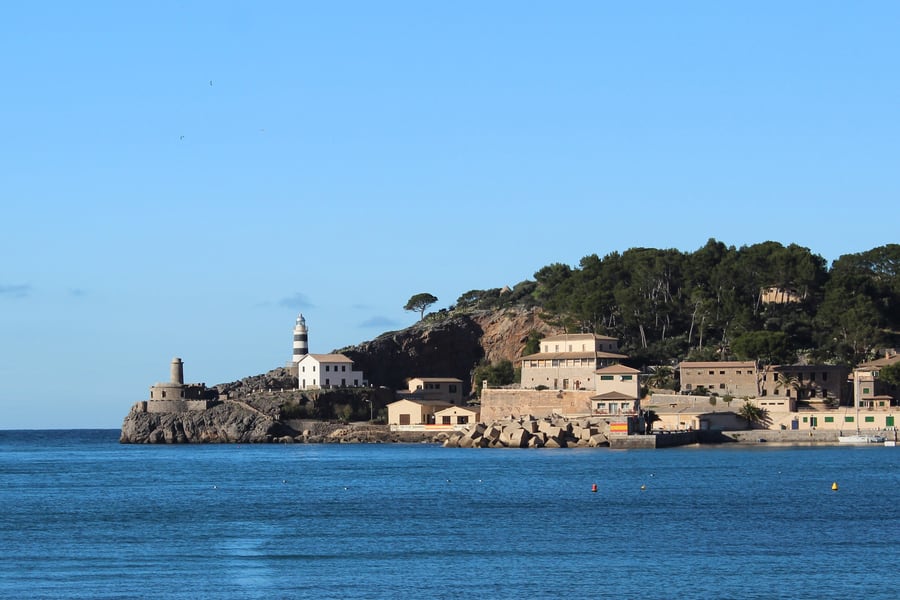 Heuschrecke (Dmitry Tonkonog and Ksenia Fedosova) / Wikimedia Commons · CC BY-SA 3.0 · cropped
Port de Sóller
Sóller sits 3 km inland, and the tram covers that distance and a little more to finish on the promenade of a bay so nearly enclosed that it reads as a lake, with a lighthouse on the headland. The valley's isolation made it easier to trade with French merchants arriving by sea than to cart goods over the mountains — and the tram was built to move fish, coal and oranges between the town and the water.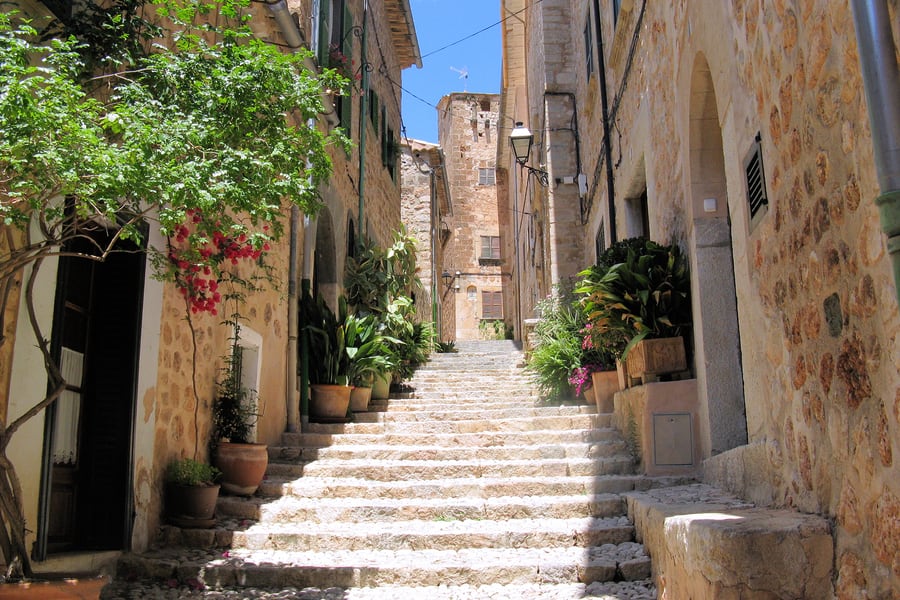 Adrian Pingstone / Wikimedia Commons · public domain · cropped
Fornalutx
A village built on several levels above the Sóller valley, reached by road or on foot rather than by rail. The houses are stone under red roof tiles with green wooden shutters, and many of the higher streets are cobbled and closed to cars. Its upkeep has been decorated more than once — the Mallorcan Tourism Board's Silver Plaque and a national prize for well-kept towns, both in 1983, and the Premi Alzina for conservation in 1985.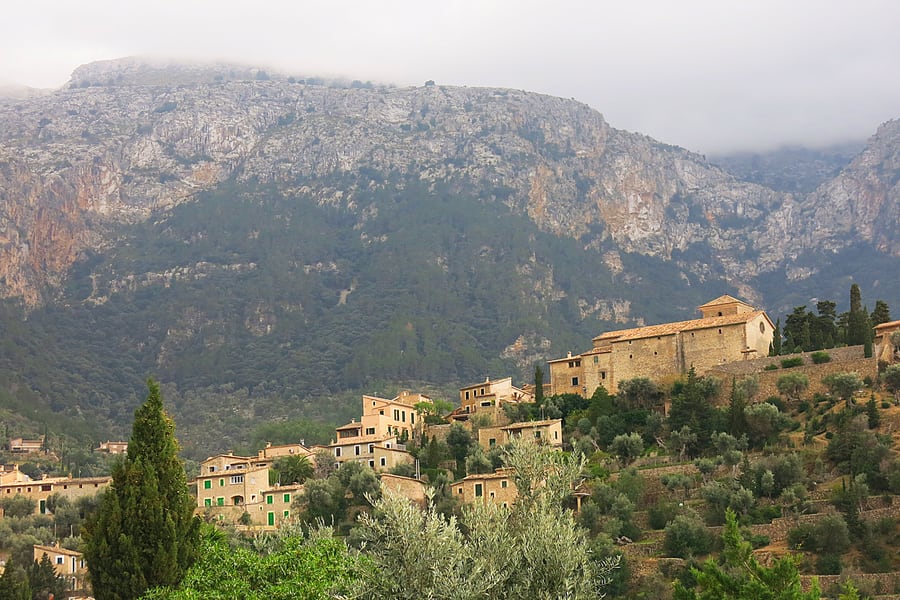 Enric / Wikimedia Commons · CC BY-SA 3.0 · cropped
Deià
Ochre houses stacked on a hill in the Serra de Tramuntana, among orange and olive groves on cliffs above the Mediterranean, on the coast road from Sóller. Robert Graves was one of the first foreigners to settle in the village; he returned after the war and stayed until his death, and his house is now a museum. There is no railway — the road is the only way in.Where to Sleep
The journey works in either direction as a day out, so there is a real choice about which end to sleep at. Palma puts the terminus on the doorstep and everything else the city has behind it. Sóller is the quieter option and the one that lets you take an early tram down to the water before the day trippers arrive on the 11:10. Port de Sóller is the place to stay if the bay is the point.
The three below were each opened and read in August 2026. What follows is what each establishment says about itself; no price, rating or star count is repeated here, because we have verified none of them.
Where to stay
Gran Hotel Sóller
In the centre of Sóller, a few minutes from the station
A nineteenth-century building in the middle of the town, by the architect Joaquín Pavía Birmingham, who also worked on the extension of Palma cathedral and the Diputació building. Its own account gives 38 rooms and suites across seven categories, a small spa with sauna, steam room and gym, a rooftop pool, and a restaurant, Ca'n Blau, inside the hotel. The tram to the port passes close by.
Check Availability (opens in a new tab, on granhotelsoller.com)via granhotelsoller.comEspléndido Hotel
On the front at Port de Sóller
Built in 1956 on the sea front at the port and renovated in 2005 by the family-run Portixol Group, which its site says kept the original period character. It gives 74 rooms with a choice of sea or garden views, a bistro, a bar, a pool bar and a seasonal restaurant, plus a spa and gym. The company puts it fifteen minutes from central Sóller by tram.
Check Availability (opens in a new tab, on esplendidohotel.com)via esplendidohotel.comHotel Born
Palma old town, for the morning train
A small hotel in the historic centre of Palma, in what its own history describes as the sixteenth-century Palace of the Marquises of Ferrandell, since remodelled around its courtyard. It is on Carrer de Sant Jaume, walking distance from Plaça d'Espanya, which makes the 10:10 departure straightforward without a taxi.
Check Availability (opens in a new tab, on hotelborn.com)via hotelborn.comQuestions or corrections
Planning this trip and stuck on something, or spotted a time, fare or detail that has changed? Send us a message about Ferrocarril de Sóller — the railway a town bought for itself. We read every one, and we update this page when something has changed.