Ferrol to Santander — the railway nobody had measured
Nelso Silva / Wikimedia Commons · CC BY-SA 2.0 · cropped
- DistanceAbout 530 km
- DurationAbout 13 hours over two days
- Best seasonMay to September, for the long evenings
Introduction
Spain's metre-gauge north is one railway in the way that a hedgerow is one plant. It was assembled over most of a century out of separate companies and separate state contracts, and it runs from Ferrol, on the Atlantic corner of Galicia, along the whole Cantabrian coast to Bilbao. Two ordinary Renfe trains a day cover the western half of it, and two more cover the next section, and between them they will carry anyone from Ferrol to Santander for about forty euros over two days.
What nobody had, until very recently, was a record of how big it is.
When the Spanish state finally ordered new trains for this network — the first Renfe had ever bought for it, tendered in February 2019 — the specification pointed at the national gauge instruction of 2015. That document sets the clearance envelope for metre-gauge lines being built or renewed. It says nothing about the tunnels already there, some of which were cut in the 1920s and are smaller; for those, it tells the infrastructure manager to declare the real profile instead. For this network the real profile had never been declared. Adif's own laser survey had found, in 2018, more than six hundred points between Oviedo, Santander and Bilbao that did not meet the standard, and it took a separate contract, awarded in 2021, to send a scanner through all 248 tunnels — 33 in Galicia, 160 in Asturias, 18 in Cantabria, 20 in Vizcaya and 17 in Castilla y León — and find out what the railway measured.
Design stopped in January 2021. The newspapers got it two years later, under the headline that Spain had bought trains too big for its tunnels, and on 20 February 2023 the president of Renfe and the Secretary of State for Transport both resigned. The real answer was less lurid and more telling: the old operator had always sized its new stock by measuring it against the trains already running, and nobody had ever written that rule into Spanish law. It was written on 15 February 2023, days after the story broke.
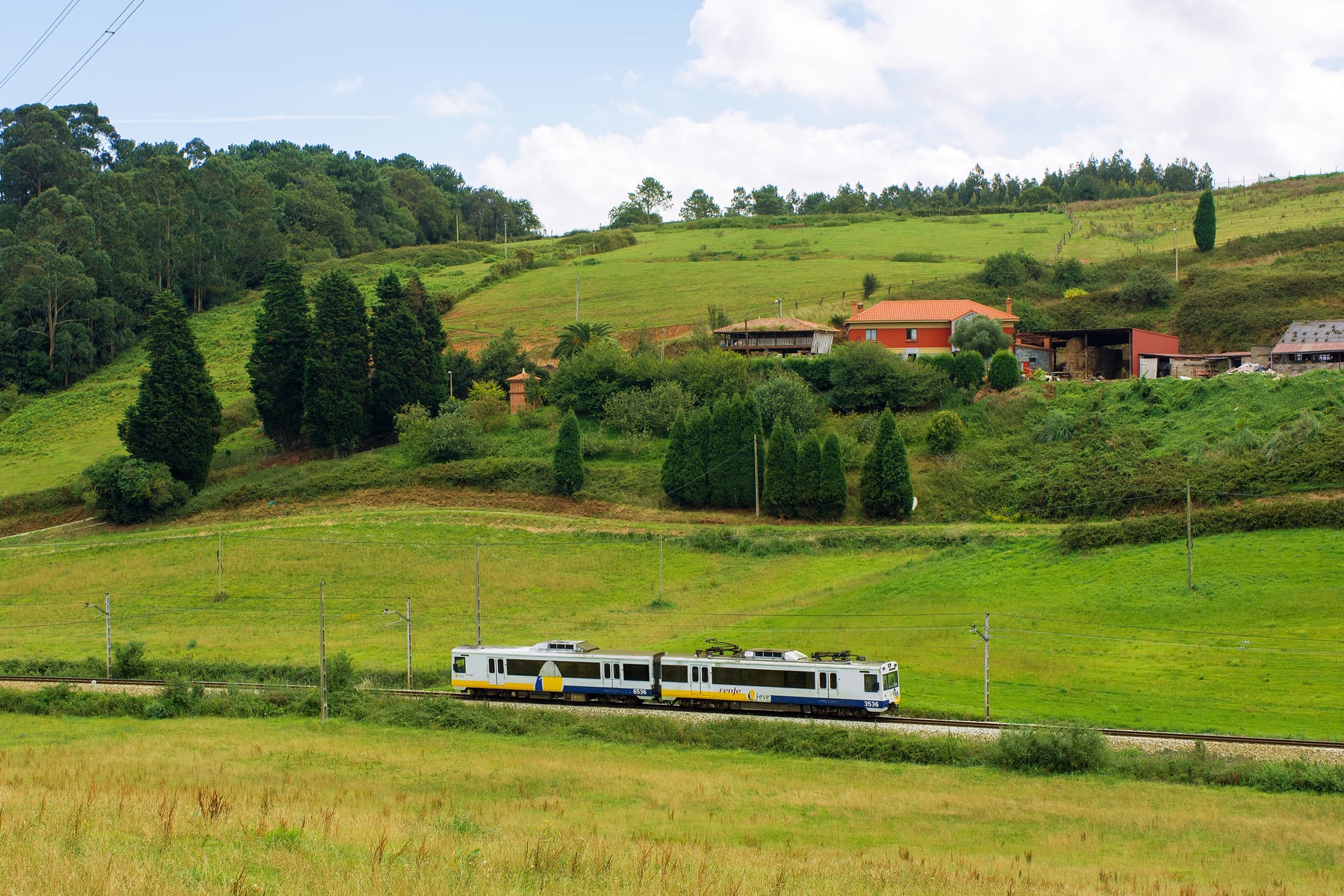
So the trains still running here are the ones that were meant to have been replaced. The fleet averaged twenty-eight years old in 2020, and the units on the Ferrol road are Spanish-built railcars of 2009 and 1980s electrics on the wired sections. The journey they make is five hundred and thirty kilometres of single track laid along the edge of the Bay of Biscay, at a little over forty kilometres an hour, through Galician estuaries and Asturian pasture and under the limestone wall of the Picos de Europa, stopping ninety times between Ferrol and Oviedo alone.
The Journey
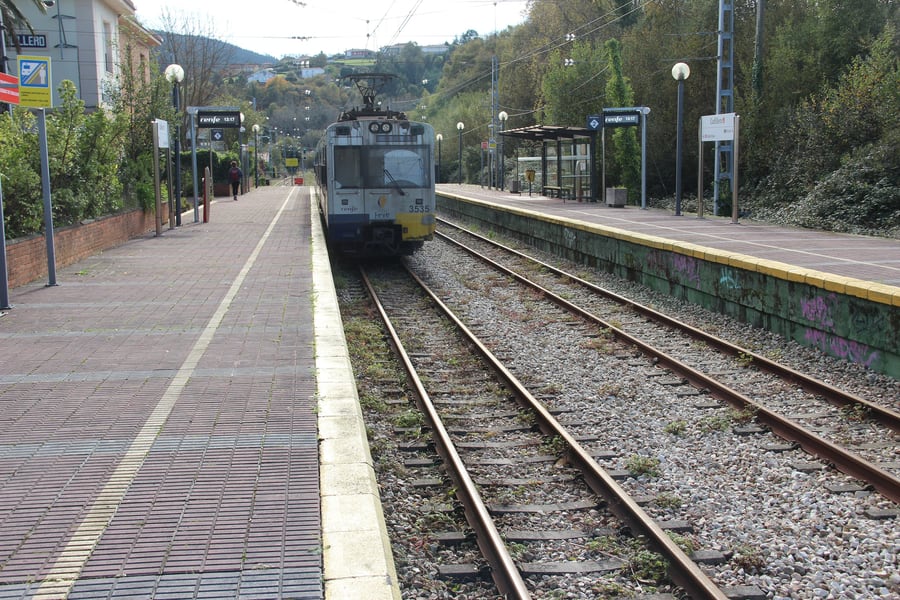
The line begins at Ferrol, where the metre gauge and the Iberian gauge share one station and very little else. The 08:20 is a two-car diesel railcar, and within three minutes of leaving it is at San Xoán, the first of eighty-eight intermediate stops. Some of them are villages. Many are a concrete platform, a nameboard and a lamp, and the train calls at all of them, which is why a journey of 314 kilometres takes seven hours and twenty-two minutes.
For the first hour the railway keeps inland, climbing away from the ría through San Sadurniño and Moeche and over the moorland behind Cerdido, where the map shows almost nothing. It meets the sea properly at Ortigueira, an hour and eighteen minutes out, and from there it works east along the Galician Mariña — O Barqueiro, O Vicedo, the estuary at Viveiro, where it crosses the Landro on a stone viaduct in the middle of the town. Burela and Foz are fishing ports. Then Ribadeo, at kilometre 146, where the train waits four minutes and the Eo estuary opens on the left; the far bank is Asturias.
Where the state ran out of money for fifty years
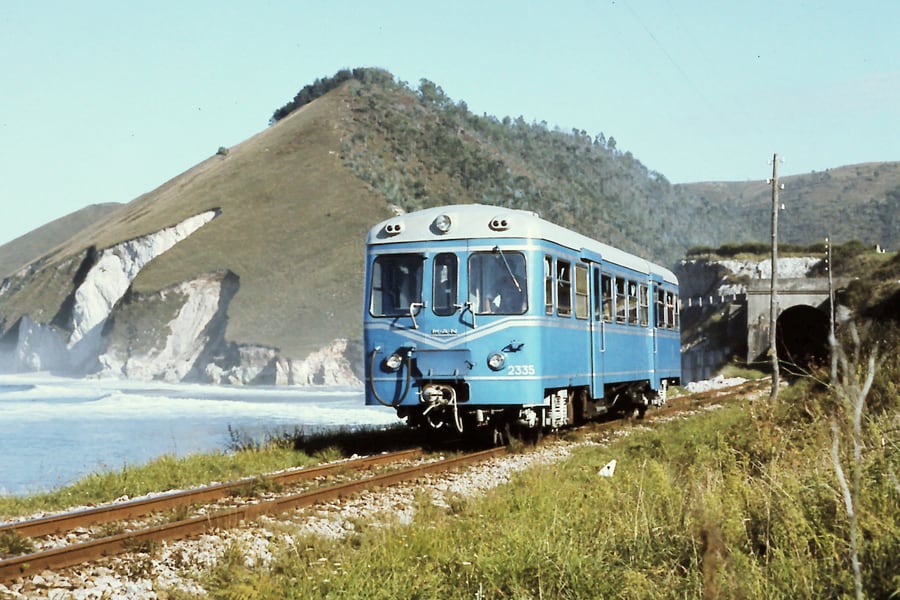
The Galician section is the youngest part of the whole coast, and it took the longest. A railway from Ferrol to Gijón was first approved by the Congress of Deputies in 1886, to connect the artillery barracks at Ferrol with the arms and explosives works of Asturias. It went into the secondary railways plan of 1888 and the Strategic and Secondary Railways Act of 1906, which fixed it at metre gauge. Construction did not start until 1921, and then the state built it in fragments: Avilés to Pravia in 1953, Pravia to Luarca in 1962, Viveiro to Vegadeo in 1968. The last stretch, Luarca to Vegadeo, opened on 6 September 1972, eighty-six years after the first approval. It had needed 110 tunnels and 27 viaducts over 320 kilometres, and cost 4,250 million pesetas.
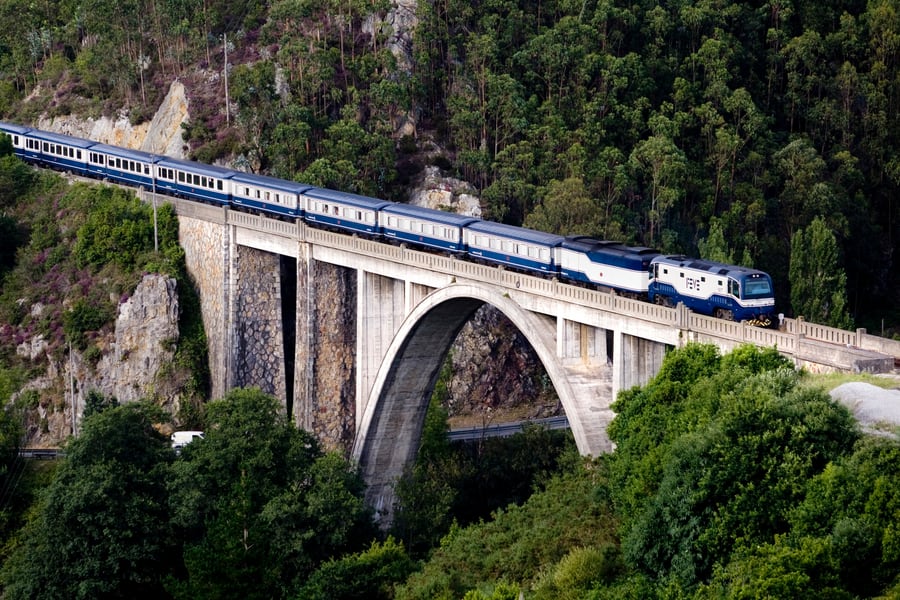
The best of that engineering comes an hour past Ribadeo. The viaduct at Luarca carries the railway over the Negro valley on a single concrete arch, high above the roofs, and the train crosses it slowly enough to look down. Beyond Luarca the line turns inland through Cadavedo and Novellana and drops to Cudillero at 14:08, where the wires begin: from here to Gijón the route is electrified as part of the Asturian suburban network, and the diesel railcar runs under a catenary it does not use.
The turn away from the sea
At Pravia the train leaves the coast and turns inland on a railway built for a different purpose altogether. This is the old Ferrocarril de El Vasco, promoted from Oviedo in 1899 by Basque and Asturian industrialists to carry Asturian coal down the Caudal and the Nalón to the port of San Esteban de Pravia and out by sea to the steelworks of Vizcaya; the Oviedo–San Esteban section was open by 1904, and the company was folded into the national narrow-gauge operator in 1972 — the same year the coast line was finally completed. The train works up it through Grado to Trubia, where it stands five minutes and changes direction, because trains between Pravia and Oviedo reverse here. Oviedo comes at 15:42, and Oviedo is where the journey stops for the night: the day's last through train to Santander left at 14:44. The onward departures are 07:57 and 14:44, and the first of them takes five hours and thirty-nine minutes to cover the remaining 217 kilometres, calling forty-six times.
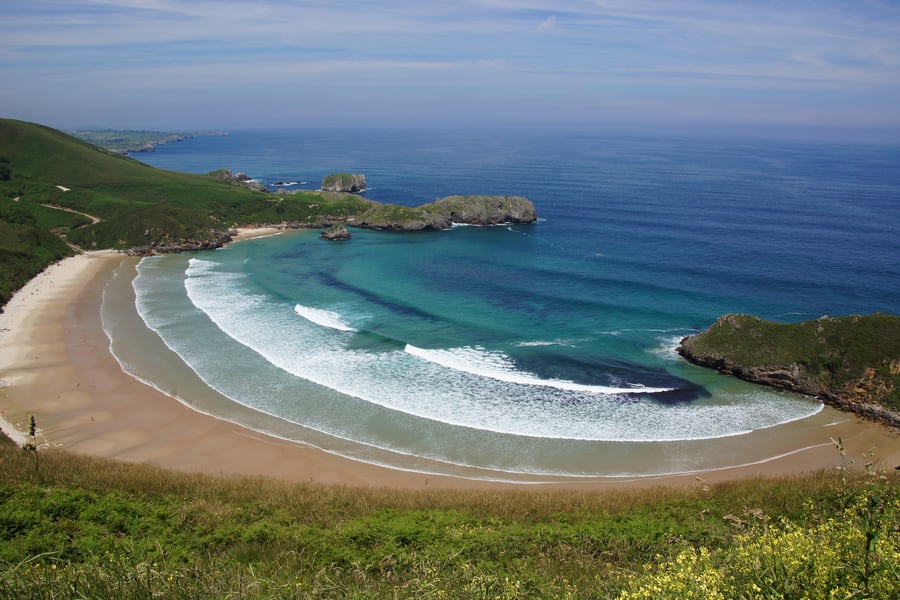
That second day is the better half. The railway runs out through El Berrón and Pola de Siero into the Piloña valley, and by Infiesto the Picos de Europa are on the right — a limestone wall that stays in the window for the next hour. Arriondas is the town for the Sella descent, Ribadesella the estuary where that river reaches the sea, and then the line runs along the Llanes coast through Nueva, Posada, Celorio and Poo, with the Sierra del Cuera inland and a string of horseshoe bays below. Llanes itself gets a seven-minute stand.
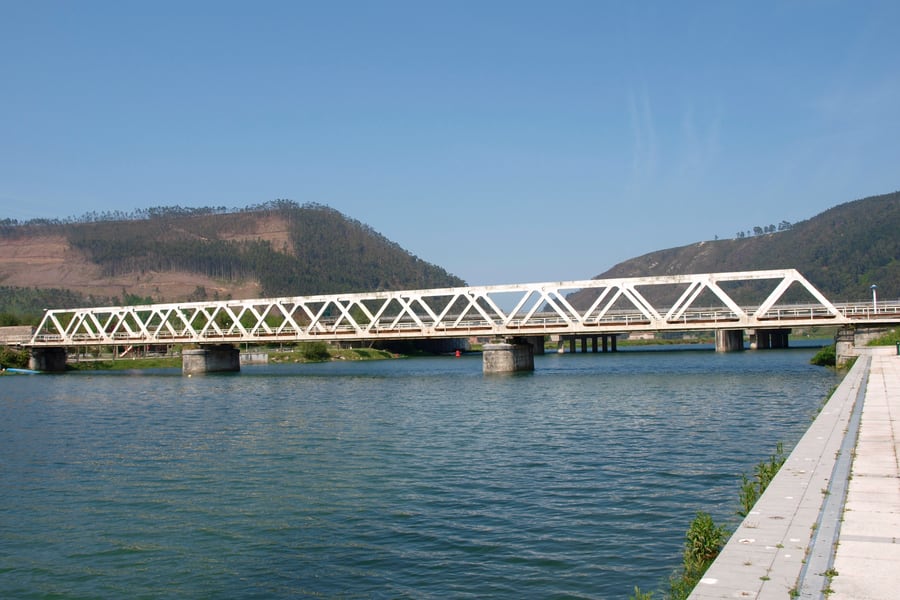
The bridge at Unquera crosses the Deva and the regional boundary in one span: Asturias behind, Cantabria in front. San Vicente de la Barquera, Cabezón de la Sal, then a long slow run through Torrelavega, and Santander arrives at 13:36, on the terminus platforms beside the Iberian-gauge station.
What is actually pulling you
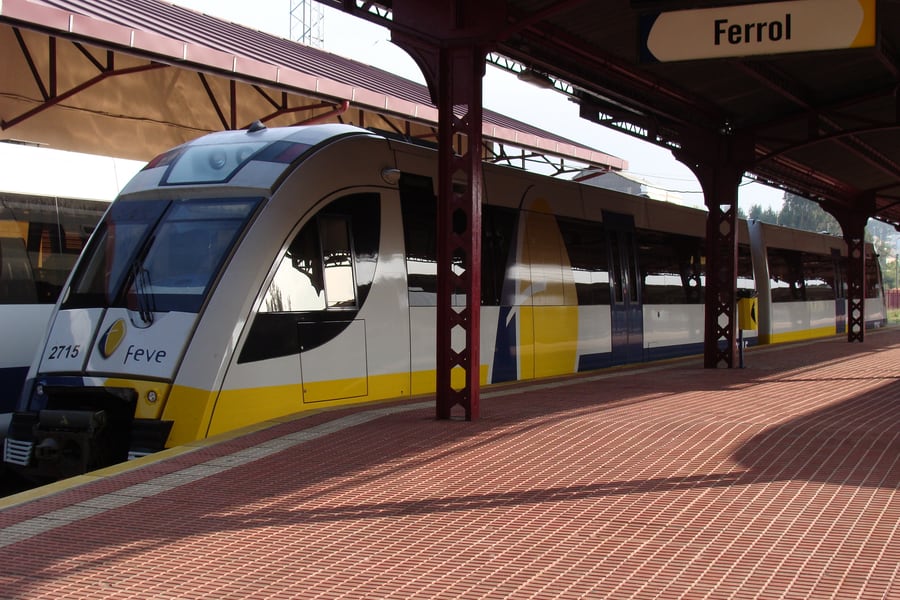
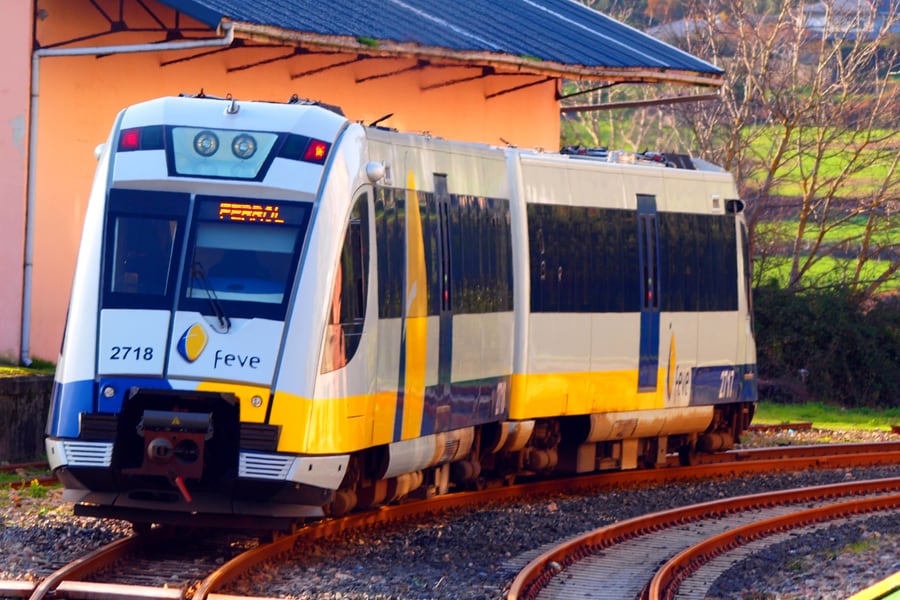
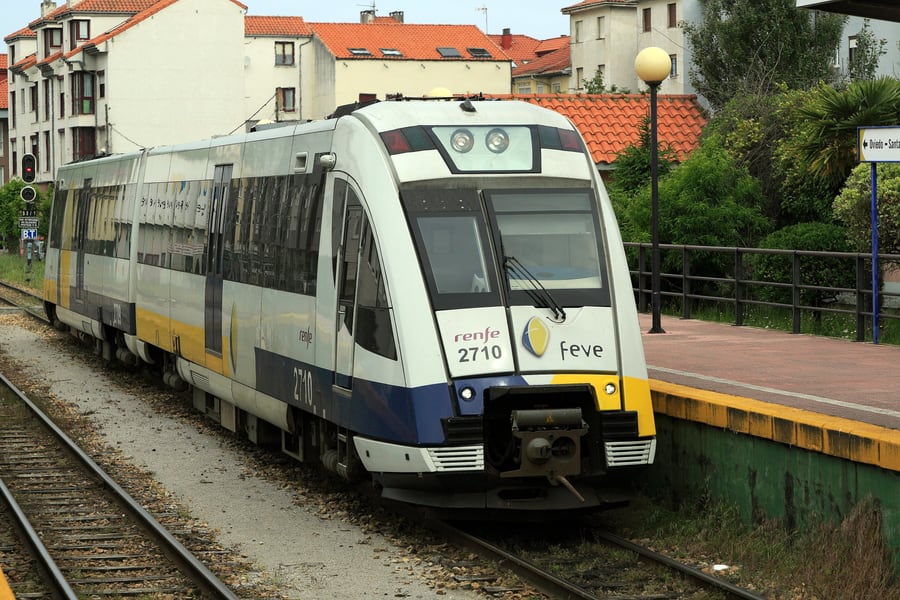
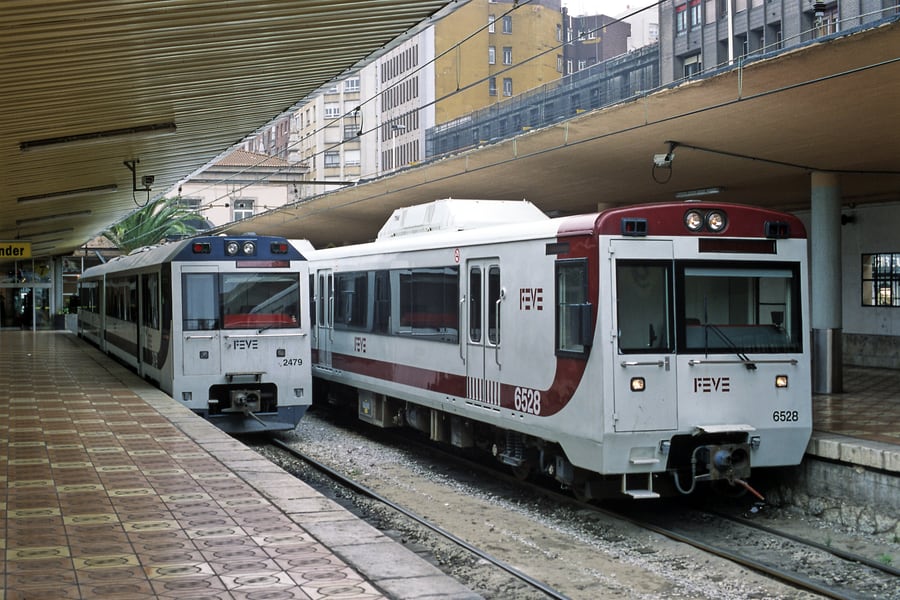
The regionals are series 2700 railcars — Renfe's class 527 — twenty-three two-car diesel sets built by CAF on an order placed in December 2007 and delivered through 2009 and 2010, the first entering service at El Berrón on 18 August 2009. They are 35 metres long, 2.55 metres wide, seat ninety, and were the last stock the old operator bought. Their dimensions were arrived at by the comparative method — measured against the trains already running — which is precisely the practice that the 2015 regulation forgot, and precisely the practice the state had to legalise in 2023 to get their replacements built.
Along the route
Estevoaei / Wikimedia Commons · CC BY-SA 4.0 · croppedTwo hundred and forty-eight tunnels, and no record of any of them
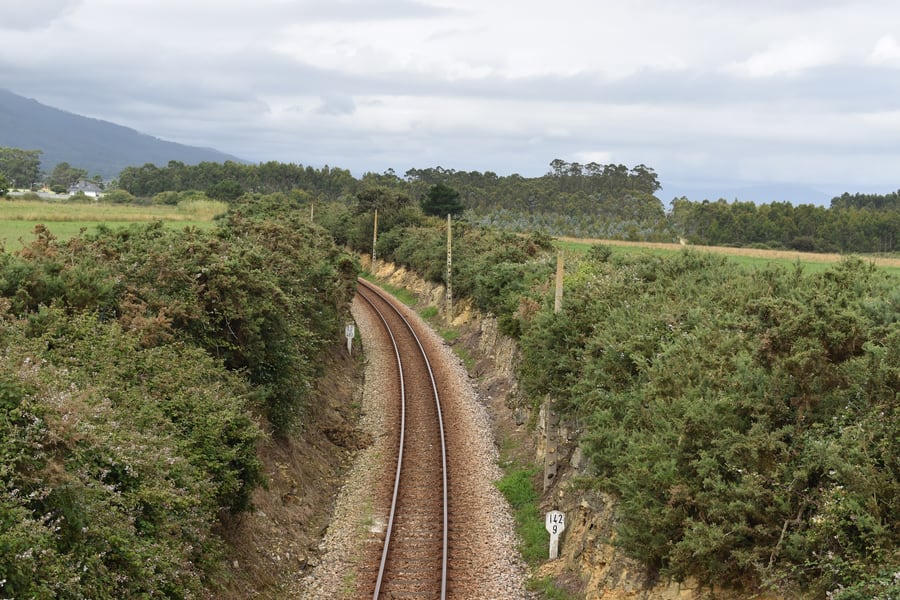
Adif's laser survey found in 2018 more than six hundred points on this network that failed the standard clearance. A separate contract sent scanners through every tunnel on the metre-gauge system — 248 of them — for €543,032. It was the first complete measurement the railway had ever had.Luxury Train Club / Wikimedia Commons · CC BY-SA 2.0 · croppedEighty-six years from approval to the first through train
A Ferrol to Gijón railway was approved in 1886. Building began in 1921 and went in fragments — Avilés to Pravia in 1953, Pravia to Luarca in 1962 — and the last section opened on 6 September 1972, needing 110 tunnels and 27 viaducts.Fernando Losada Rodríguez / Wikimedia Commons · CC BY-SA 4.0 · croppedNinety stops, and the train calls at all of them
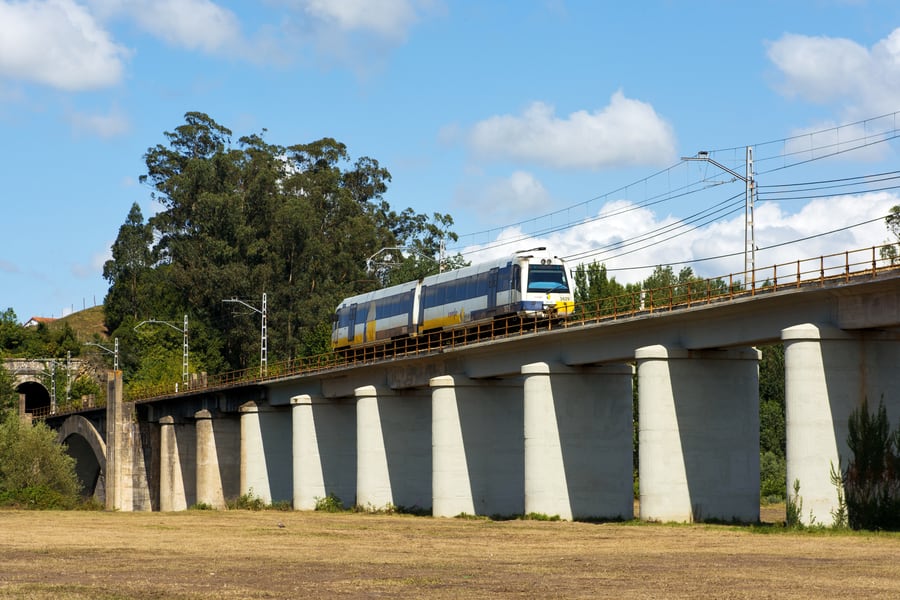
Train 71811 leaves Ferrol at 08:20 and reaches Oviedo at 15:42, having called at ninety stations in 313.8 kilometres — a stop every three and a half kilometres. Several halts are a slab of concrete, a nameboard and a lamp.A bit of history
Culture & experiences along the way
Falk2 / Wikimedia Commons · CC BY-SA 4.0 · croppedThe morning train is the one with the mountains in it
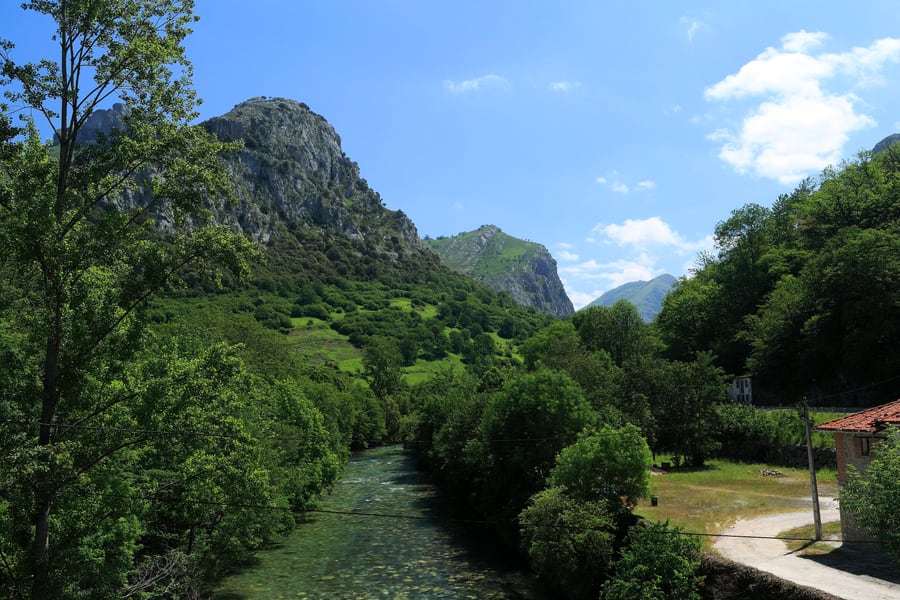
Both eastbound departures from Oviedo take the same five and a half hours, but only the 07:57 puts the Picos de Europa and the Llanes coast in daylight for the whole run. The 14:44 reaches Llanes at 17:51 and Santander at 20:21, which is generous in June and dark by the end of October.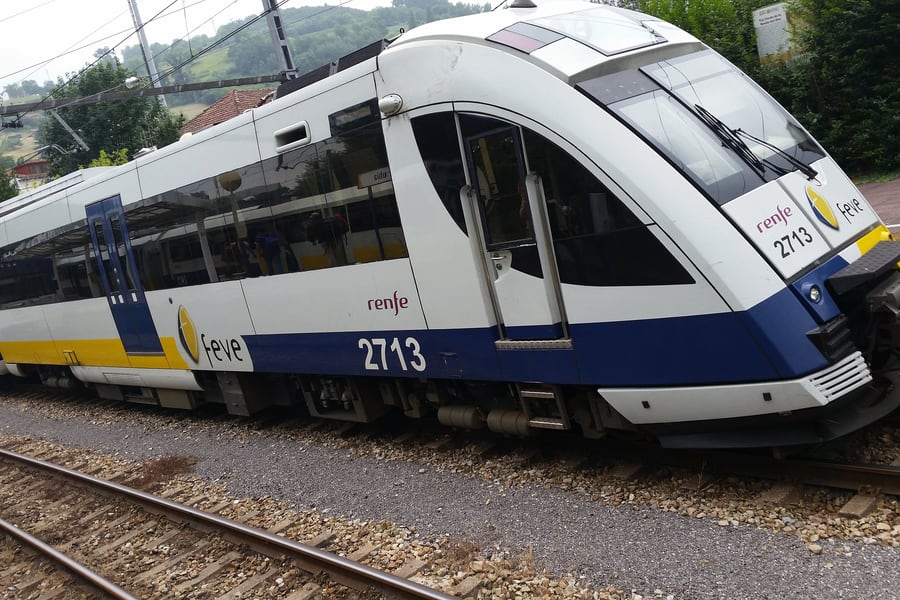 Michel Curi / Wikimedia Commons · CC BY 2.0 · cropped
The train changes direction at Trubia
Past Pravia the route joins the old Ferrocarril de El Vasco, a coal railway opened from Oviedo to the sea by 1904, and at Trubia the train stands five minutes and reverses — one of only three commuter routes in Spain that does. The seats face the wrong way for the last twenty minutes into Oviedo, which is a small price for a junction that has been worked this way for a century.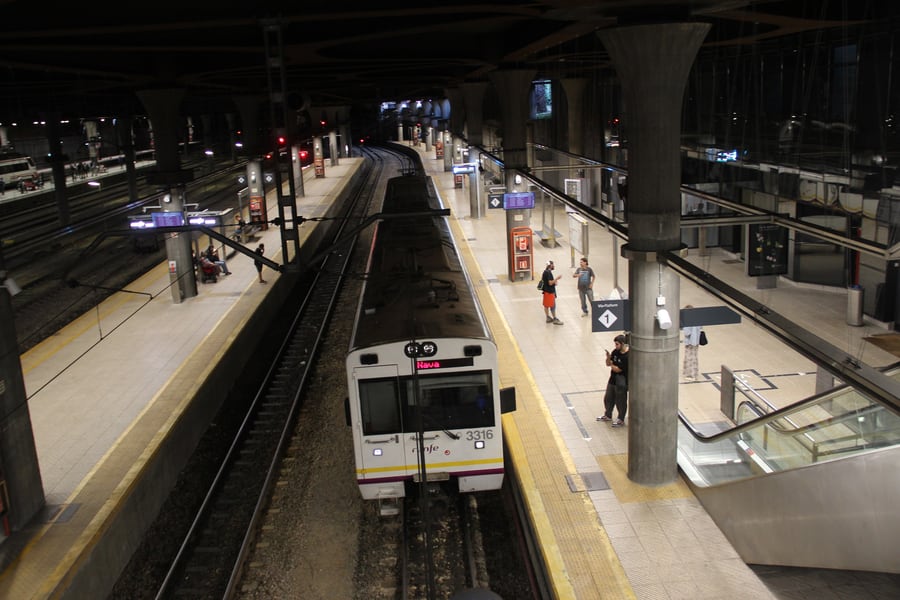 Xuliu Pombar / Wikimedia Commons · CC0 · cropped
The night in Oviedo is part of the timetable
There is no Ferrol–Santander connection. The morning train from Ferrol arrives at 15:42, an hour after the last through service east has left, and the evening train arrives at 23:05. Oviedo's station serves both gauges, the city centre is a short walk from it, and the 07:57 next morning waits on the other side of the same building.Timetables
Two trains a day run the length of each half, every day of the week. All times below were read from Renfe's own timetable service on 19 August 2026, and checked against travel dates in August, September and October 2026, which returned the same pattern each time.
Ferrol to Oviedo — 313.8 km, about 7 h 25
| Train | Ferrol | Ribadeo | Luarca | Cudillero | Oviedo |
|---|---|---|---|---|---|
| 71811 | 08:20 | 11:26 | 12:55 | 14:08 | 15:42 |
| 71813 | 15:30 | 18:38 | 20:11 | 21:27 | 23:05 |
Westbound, train 71830 leaves Oviedo at 07:19 and reaches Ferrol at 14:44; train 71832 leaves at 14:18 and arrives at 21:44.
Two further trains, 71801 at 10:45 and 71803 at 19:05, run from Ferrol as far as Ribadeo only.
Oviedo to Santander — 216.9 km, about 5 h 40
| Train | Oviedo | Arriondas | Llanes | Unquera | Cabezón de la Sal | Santander |
|---|---|---|---|---|---|---|
| 71831 | 07:57 | 09:51 | 10:58 | 11:36 | 12:23 | 13:36 |
| 71833 | 14:44 | 16:42 | 17:51 | 18:30 | 19:16 | 20:21 |
Westbound, train 71850 leaves Santander at 08:29 and reaches Oviedo at 13:56; train 71852 leaves at 15:28 and arrives at 21:01.
Two more departures from Oviedo, 71821 at 11:10 and 71823 at 18:39, run only as far as Llanes.
The connection that does not exist
Ferrol to Santander in one day is not on the timetable. The morning train from Ferrol reaches Oviedo at 15:42, an hour after the last through service to Santander has gone; the evening train arrives at 23:05. A night in Oviedo is part of the journey rather than a mishap, and the 07:57 the next morning is the better of the two eastbound departures, because it puts the Picos de Europa and the Llanes coast in daylight.
Renfe publishes departures, calling points and fares for every one of these trains through the journey planner at renfe.com (opens in a new tab). Engineering work on this network is announced through Renfe's own newsroom rather than in the timetable, and replacement buses have run on sections of the Asturian coast for weeks at a time.
Tickets
These are ordinary Renfe regional trains on ordinary regional fares. Ferrol to Oviedo is €24.10 in Turista, the only class these trains have, and Oviedo to Santander €16.35 — so the whole 530.7 kilometres costs €40.45 in two tickets. Shorter legs are priced in proportion. Children of 4 to 13 pay 40% less. Seats are not reserved and the trains are two cars long, so a bank-holiday Friday out of Oviedo can be standing room. Fares read from Renfe on 19 August 2026.
Cercanías travel in Asturias and Cantabria is free through 2026, but it is a season ticket rather than a free ride: registration with a Spanish identity number, a €10 deposit per four-month period, and one pass per area. It is compensation for replacement trains three years late, and it is for the people who use these lines every day — a visitor riding the regionals pays the fares above.
Book your tickets
 Xuliu Pombar / Wikimedia Commons · CC0 · cropped
Ferrol to Oviedo, and Oviedo to Santander
Renfe regional · Turista, the only class these trains have
Two ordinary tickets cover the whole 530.7 km: €24.10 from Ferrol to Oviedo and €16.35 from Oviedo to Santander, €40.45 in all. Shorter legs are priced in proportion — Ferrol to Ribadeo €11.15, Oviedo to Unquera €10.40, Oviedo to Torrelavega €14.30. Nothing is reserved and nothing needs booking ahead; the trains are two cars long and busiest on Friday evenings out of Oviedo. Children of 4 to 13 pay 40% less, and under-fours travel free.
Book Tickets (opens in a new tab, on renfe.com)via renfe.comNelso Silva / Wikimedia Commons · CC BY-SA 2.0 · croppedThe free Cercanías pass, and who it is for
Asturias and Cantabria · 1 January to 31 December 2026
Local travel on both suburban networks is free for 2026, agreed with the two regional governments in February 2023 as compensation for the undeliverable trains and extended every year since. It is a season ticket: registration on the Renfe site with a Spanish identity number, a €10 deposit per four-month period, refunded only after at least sixteen journeys, and one pass per suburban area. A visitor riding the Ferrol or Santander regionals once pays the ordinary fare.
Book Tickets (opens in a new tab, on transportes.gob.es)via transportes.gob.esRail Passes
These are Renfe trains, and Renfe is an Interrail and Eurail participating operator. Interrail's own guide to Spanish trains, read on 19 August 2026, lists the regional services of the former FEVE network in northern Spain among the trains a pass covers, alongside Cercanías and the rest of Renfe's regional fleet. There is no compulsory reservation on any of them and no seat allocation at all, so a pass holder boards and sits down.
What a pass will not do is save money on this particular journey. Ferrol to Santander in two ordinary tickets comes to €40.45, and the individual legs are €24.10 and €16.35 — fares low enough that a travel day spent on them is worth less than a travel day spent on almost anything else in Spain. The sensible use of a pass here is incidental: someone already holding one for a longer Spanish trip rides the metre gauge at no extra cost, and someone travelling only this route is better served by the ticket office.
One caveat that catches people on the north coast: the Basque operator Euskotren, which runs the metre gauge onward from Bilbao into Gipuzkoa, is not an Interrail participating company. That matters only beyond Santander, where the metre gauge continues to Bilbao under Renfe and then passes into other hands.
Pass conditions change by season and by year, and the ones described here were checked in August 2026 against Interrail's published guidance.
Places to Visit
Almost everything worth stopping for on this line is within a few minutes' walk of a platform, which is the compensation for a train that stops ninety times. The Galician Mariña gives a beach cut into sea caves; Asturias gives two fishing towns built vertically into their own cliffs; and the eastern end runs through the Llanes coast and into Cantabria past a castle on an estuary. The five below are in order along the route, west to east.
 Wolffoxylady / Wikimedia Commons · CC BY-SA 4.0 · cropped
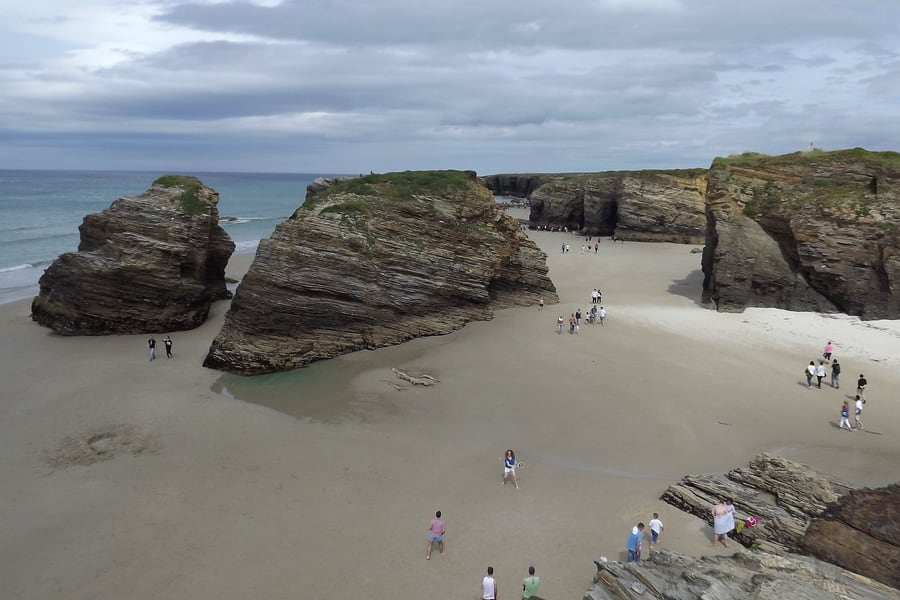
Praia das Catedrais
A beach of sea arches and free-standing stacks cut out of slate, walkable only at low tide. The regional government's own booking site states that authorisation is needed at Easter and from 1 July to 30 September, and that both the entry permits and the guided visits are free. The train stops at Ribadeo at 11:26 eastbound, four minutes before the Eo estuary opens on the seaward side and Asturias appears across it.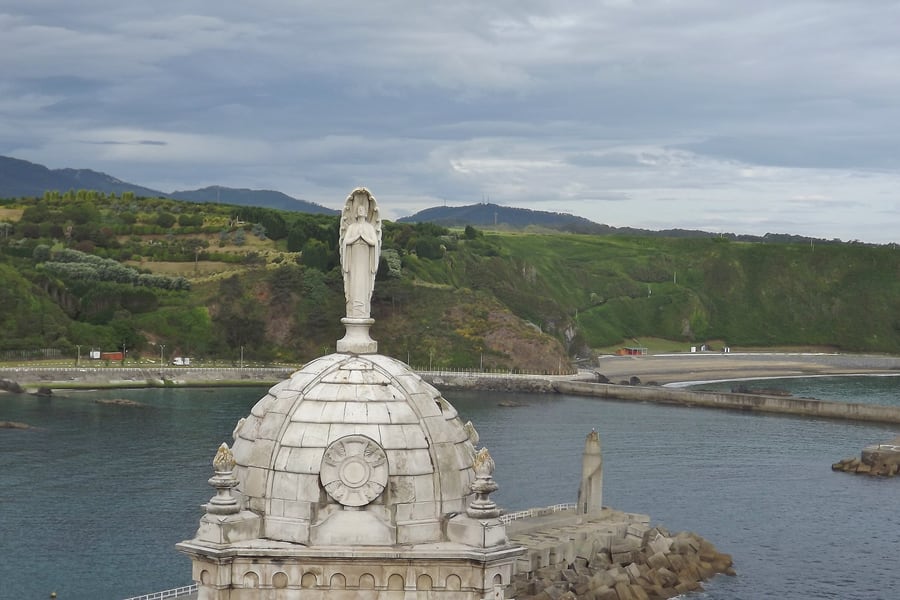 Wolffoxylady / Wikimedia Commons · CC BY-SA 4.0 · cropped
Luarca
A fishing town folded into the mouth of the Negro, with the harbour at the bottom and the houses stacked up both sides. The cemetery stands on the headland above the harbour mouth, its marble mausoleums looking straight out at the Bay of Biscay, and the walk up to it is the standard reason to stop here. The railway crosses the whole valley on a single concrete arch well above the roofs, so the town is seen from the train before it is reached on foot.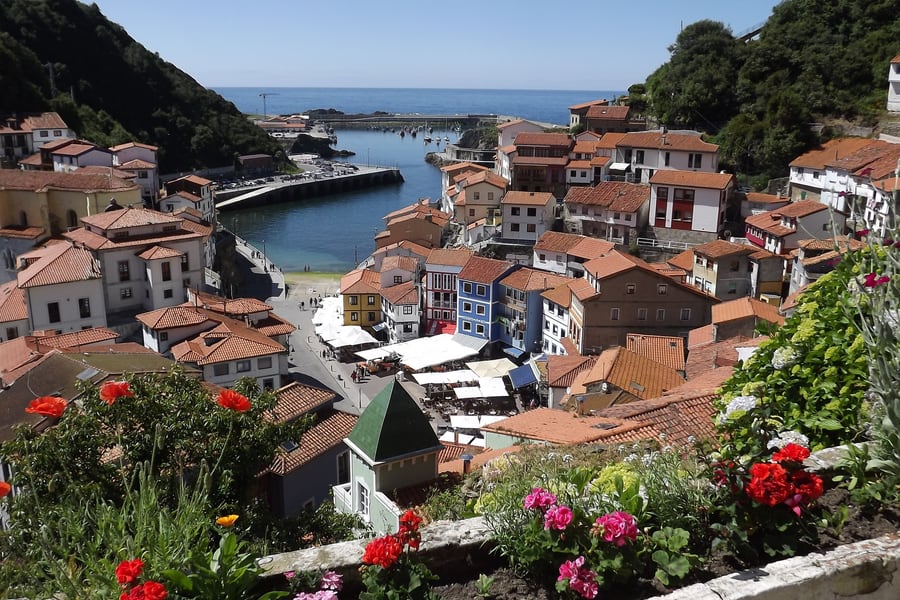 Wolffoxylady / Wikimedia Commons · CC BY-SA 4.0 · cropped
Cudillero
Painted houses in tiers around a bowl above a small harbour, so steep that the main square is effectively the quay and everything else looks down on it. Cudillero is also where the overhead wires begin: from here to Gijón the coast line is electrified for the Asturian suburban trains, though the Ferrol railcar keeps its engine running.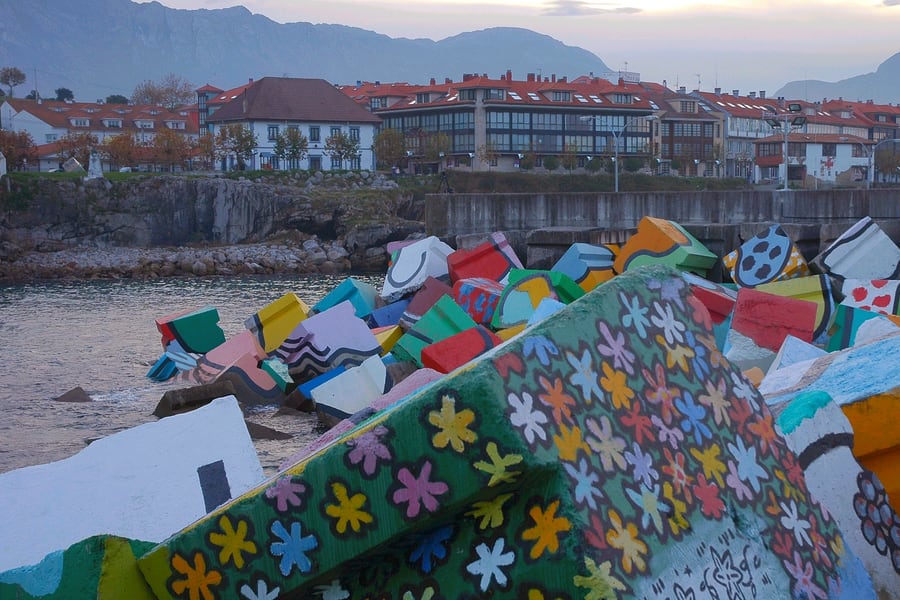 Ramón Noriega / Wikimedia Commons · public domain · cropped
Los Cubos de la Memoria
The concrete blocks armouring the harbour breakwater at Llanes were painted in strong colours by the Basque artist Agustín Ibarrola, and the sea defence is now a work in its own right — a divisive one locally, and the thing most visitors come to photograph, with the town and the Sierra del Cuera behind it. The eastbound train stands seven or eight minutes at Llanes, which is not enough; the walk from the station is about ten.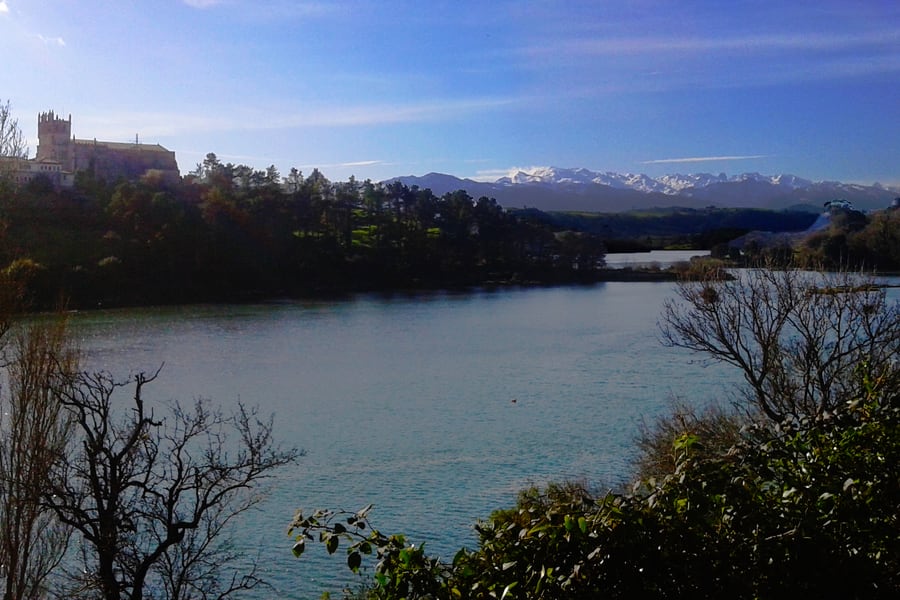 David Ceballos / Wikimedia Commons · CC BY 2.0 · cropped
San Vicente de la Barquera
A castle of the twelfth century and the Gothic church of Santa María de los Ángeles stand on a ridge above a tidal estuary, with the snow line of the Picos de Europa behind them — the mountains are barely twenty kilometres inland here, which is why the view from the bridge does what it does. The railway crosses the ría immediately west of the town.Where to Sleep
The timetable makes one overnight stop compulsory and one optional. Oviedo is the compulsory one, because no train connects Ferrol to Santander in a day. Ferrol repays an early night before the 08:20, and Santander is the end of the line. All three houses below are on their own historic buildings and within reach of the station on foot or by a short taxi ride.
Where to stay
 Paradores / Wikimedia Commons · CC BY-SA 4.0 · cropped
Parador de Ferrol
A Galician manor house above the naval arsenal, by the departure platform
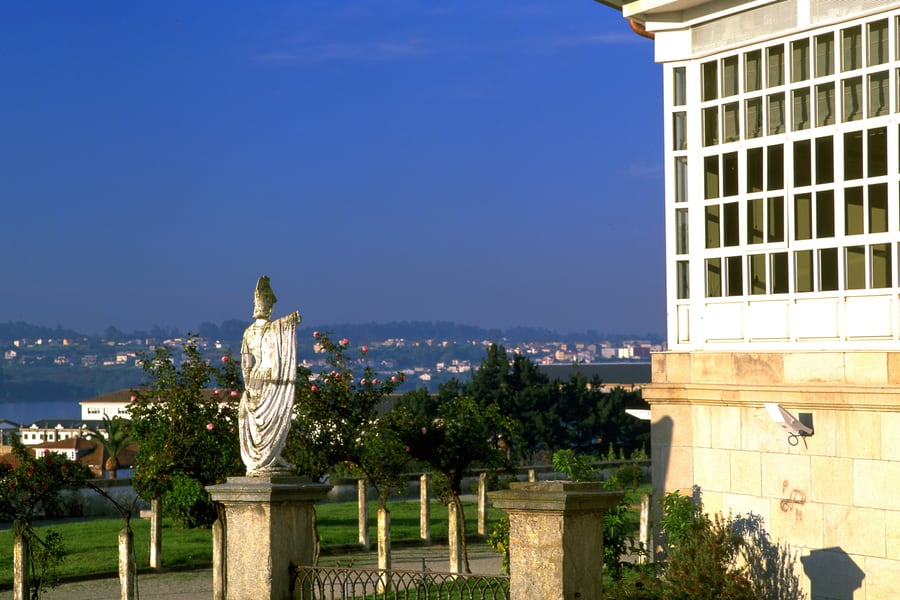
The parador stands in the middle of La Magdalena, Ferrol's grid-planned eighteenth-century quarter, which is listed in its entirety. Its own account describes a typical Galician casona with sea views from some of the rooms, the white-lacquered glazed galleries that were modelled on ships' sterns, and windows over the arsenal and the ría; the nautical theme carries indoors to the ship's lantern on the main staircase.
Check Availability (opens in a new tab, on paradores.es)via paradores.es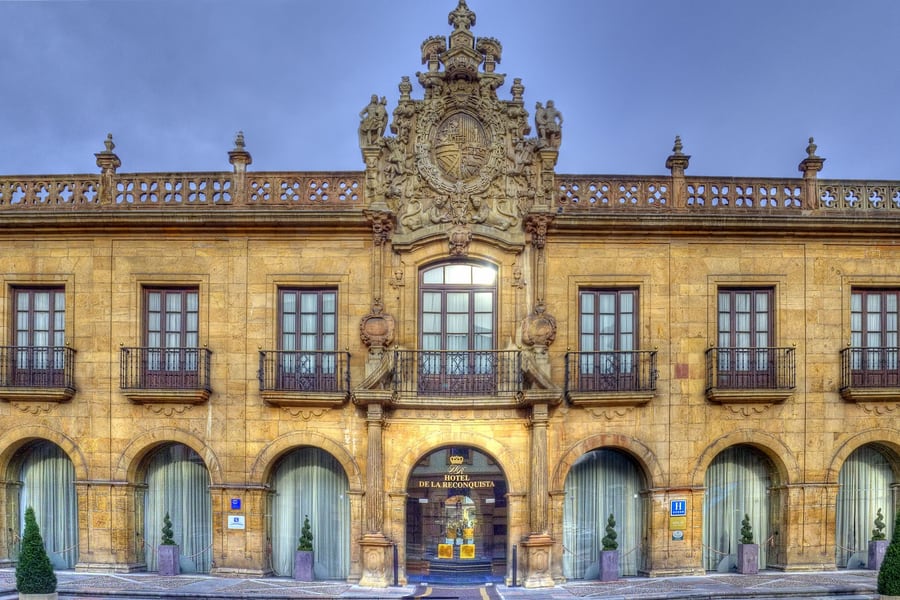 Ángel M. Felicísimo / Wikimedia Commons · CC BY-SA 2.0 · cropped
Eurostars Hotel de la Reconquista
Oviedo · the eighteenth-century hospice, where the journey breaks
The building was the provincial hospice of Oviedo from 1752 until 1965, was listed as a Bien de Interés Cultural in 1973, and opened as a hotel in 1974. Its own account gives a baroque façade, two courtyards, an octagonal chapel designed by Ventura Rodríguez and a collection of Asturian painters; every October it houses the Princess of Asturias laureates. It is a short walk from Oviedo station — which is the practical point, because the timetable makes a night here unavoidable.
Check Availability (opens in a new tab, on eurostarshotels.com)via eurostarshotels.com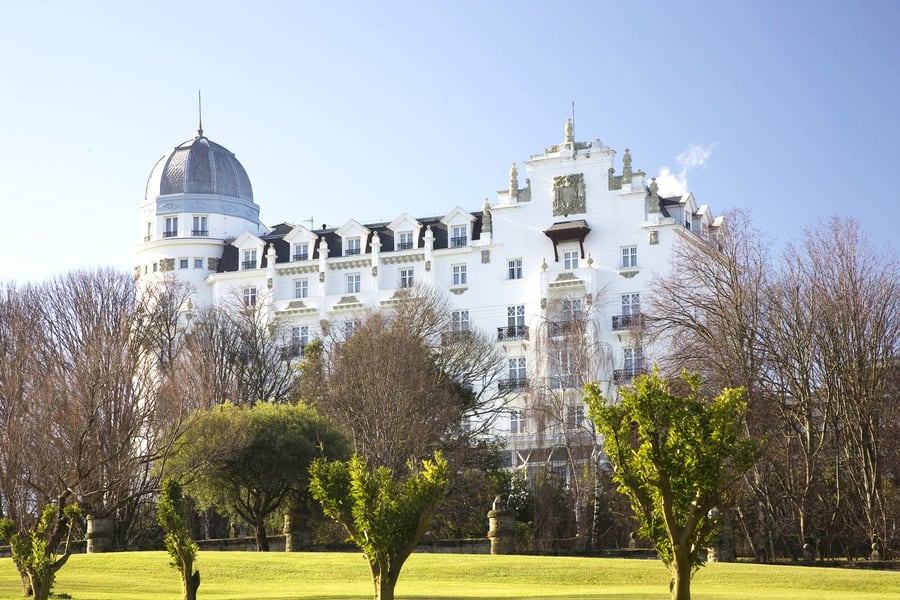 Hotel Real / Wikimedia Commons · CC BY-SA 3.0 · cropped
Eurostars Hotel Real
Santander · the palace hotel on the hill above the bay
The hotel gives its own opening date as 12 July 1917 and its own position as the hill above the Playa de los Peligros, between the old town and El Sardinero, standing in its own gardens with French-style salons looking over the bay — built for the years when the royal family spent its summers at the Palacio de la Magdalena, a few minutes away. It is a short taxi ride from the metre-gauge terminus where this journey ends.
Check Availability (opens in a new tab, on eurostarshotels.com)via eurostarshotels.comQuestions or corrections
Planning this trip and stuck on something, or spotted a time, fare or detail that has changed? Send us a message about Ferrol to Santander — the railway nobody had measured. We read every one, and we update this page when something has changed.