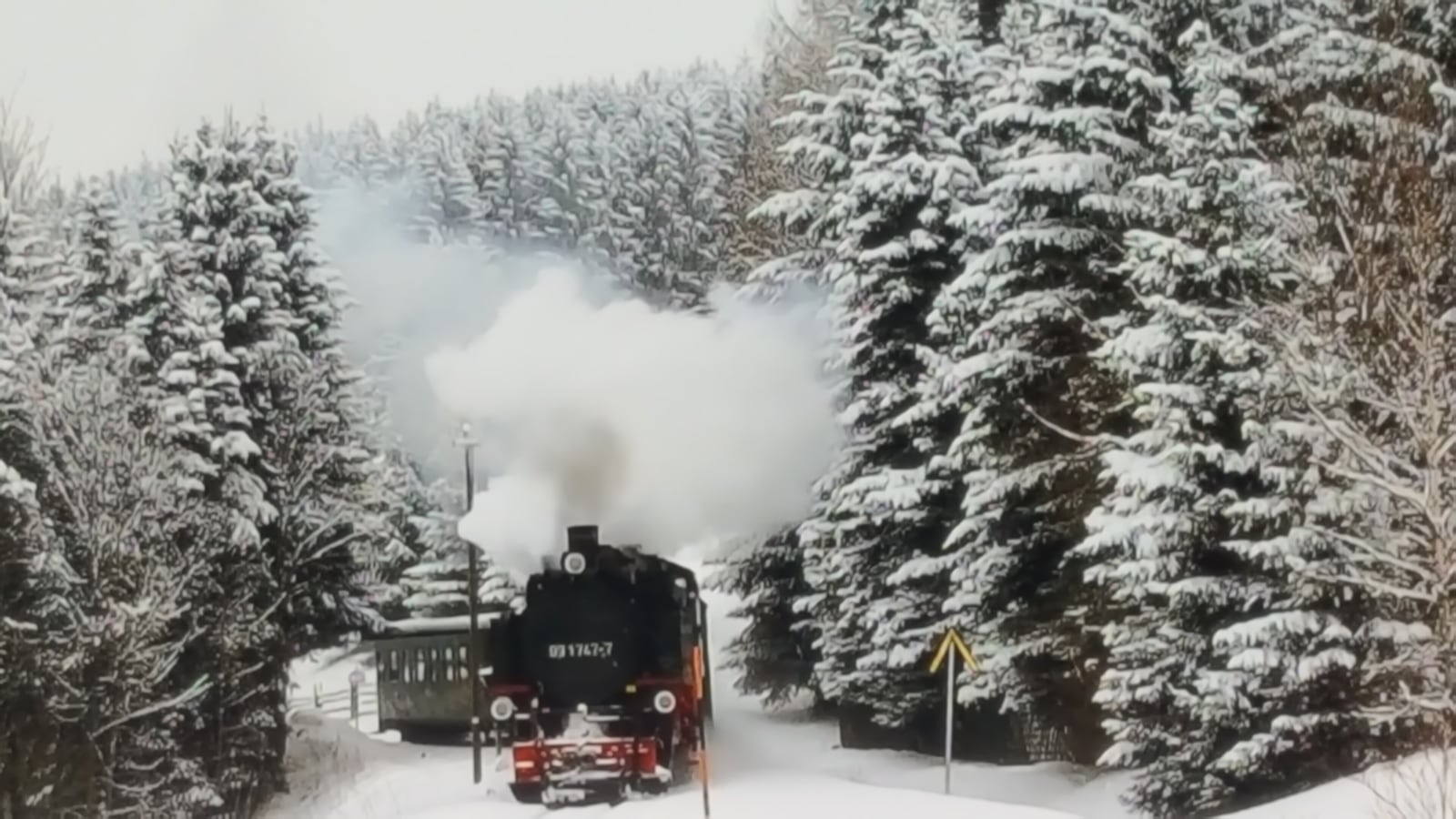
The Fichtelbergbahn to Oberwiesenthal
Bybbisch94, Christian Gebhardt / Wikimedia Commons · CC BY-SA 4.0
- Distance17.35 km (Cranzahl–Kurort Oberwiesenthal)
- Duration55–57 minutes
- Best seasonYear-round — four trains a day in February as in August
Introduction
The Fichtelbergbahn climbs seventeen and a third kilometres from Cranzahl to Kurort Oberwiesenthal, in the Ore Mountains on the Czech border, and it does it behind a working steam locomotive four times a day, every day, all year. The track is 750 millimetres wide, the line speed is 25 km/h, and the journey takes fifty-five to fifty-seven minutes to cover a distance a car does in twenty.
That is the honest summary, and it is also the point. This is not a preserved railway that comes out at weekends. It is a scheduled public service with a published tariff, a place in the regional transport authority's fare system, and a timetable that runs on Boxing Day. The engines happen to have been built in 1928–33 and 1952–56, and nobody has found a reason to replace them.
What it is for
Oberwiesenthal is a small spa town with about two thousand inhabitants, a ski resort, an elite sports school and, at 914 metres, the highest town in Germany. The station at the top, at 893 metres, is the highest in Saxony. Everything about the line follows from the 238 metres of altitude between it and the standard-gauge junction at Cranzahl: the narrow gauge, the hundred-metre curves, the gradients of one in thirty, and the fact that it is slow.
The tariff sheet tells you who rides it. Sledges, skis, prams and folding bikes travel free as hand luggage. A dog is €3.20. Kindergarten groups go for nothing. This is a railway to a mountain in a cold place, and its busiest traffic has always been people going up to play in the snow.
The decade that is missing
The operator publishes a history of the line on its own website. It runs from 1870 to 2020 and it is thorough about locomotive deliveries, track renewals and anniversary celebrations. Between 1949 and 1952 there is nothing, and between 1952 and 1966 there is nothing, and what is missing from that gap is the only period in which this railway mattered to anyone outside the Erzgebirge.
From the end of 1947, uranium was mined in the Bärenstein–Niederschlag district for the Soviet Union. The uranium districts were declared a restricted zone the same year, and the narrow-gauge line ran through the middle of it. It carried the ore out. It also carried the men: at the height of the workings, around 1950, some three thousand miners were employed in the district, and the shift trains ran to ten coaches — so many that rolling stock had to be brought in from other Saxon narrow-gauge railways to cope. The zone was lifted in 1955, the holidaymakers came back, and the line went on being a branch to a ski resort.
You would not know any of it from the railway. You would barely know it from the valley, which has spent the years since 2019 celebrating a UNESCO inscription for eight hundred years of silver, tin and cobalt mining — a listing that is about the Erzgebirge's older wealth, not its Cold War one.
Why go
Because it is beautiful and because it is real, and because those two things are usually a trade. The line runs through spruce forest and across a steel lattice viaduct just short of the terminus, it is quiet enough that you can hear the engine working from three coaches back, and at the top there is Germany's oldest cable car, a mountain a thousand two hundred metres high, and a border you can walk across.
The Journey
Cranzahl (654 m) is where the gauges meet. The standard-gauge RB 80 from Chemnitz runs into one side of the island platform and the narrow gauge stands at the other, engine already coupled and steaming. The connection is tight by design — the 08:36 out of Chemnitz gets in at 09:55 and the narrow gauge leaves at 10:00 — so most passengers cross the platform rather than wait in the village.
The train is out of the village in a minute and climbing. Unterneudorf (685 m) and Neudorf (697 m) come at two and a half and four and a half kilometres, both of them right in the middle of their villages, the train arriving at street level between houses with cars parked alongside. Neudorf is where the soup museum is, across the road.
The middle: forest, and no fences
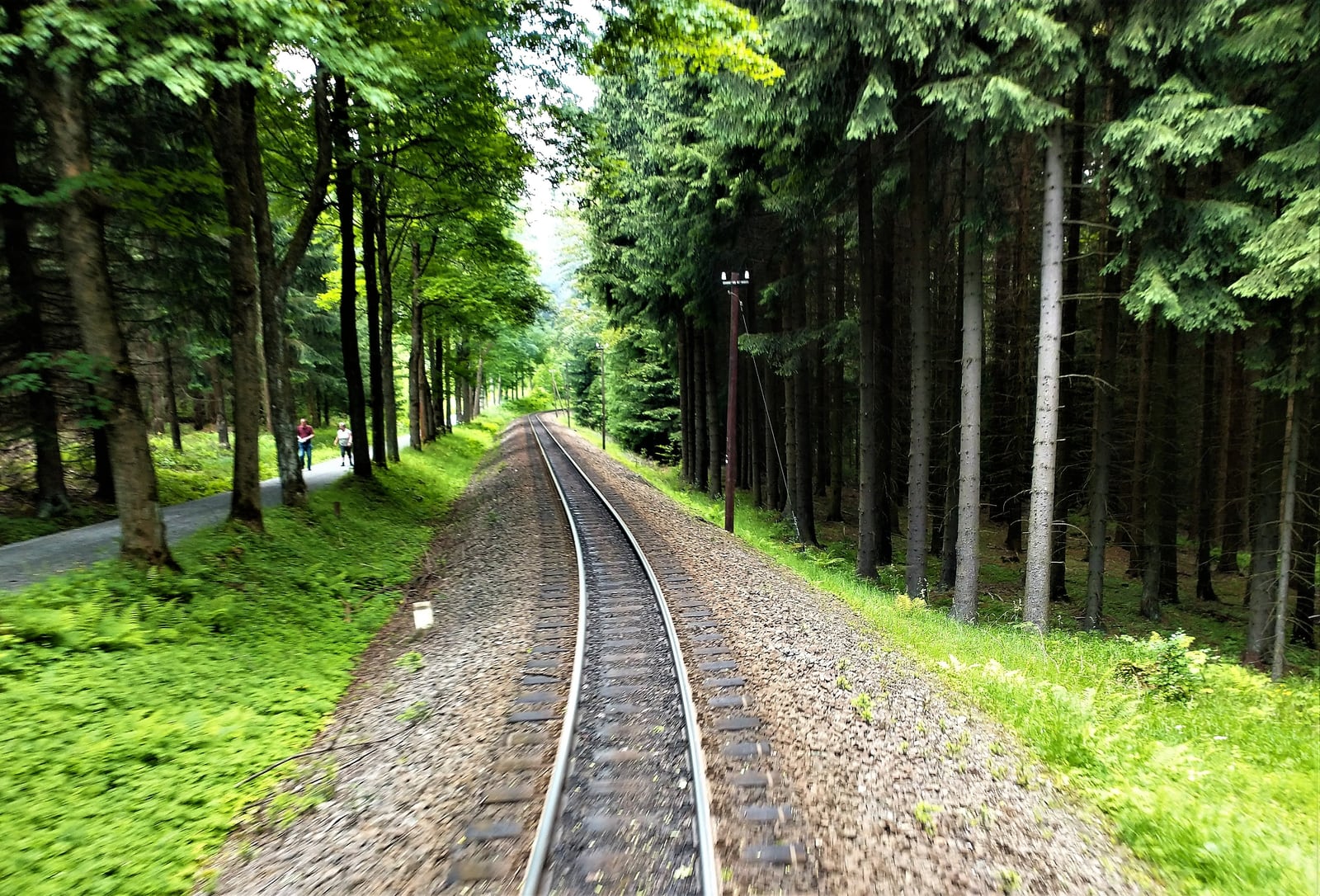
Past Neudorf the line leaves the settlements and spends the next few kilometres in spruce. Vierenstraße (730 m) is a halt with an inn beside it — the hotel there sells the railway's own tickets — and after it the gradient stiffens to the line's maximum of 33 per mille, one in thirty, on curves down to a hundred-metre radius. That combination is what fixed the gauge at 750 millimetres in 1896 and what fixes the speed at 25 km/h now.
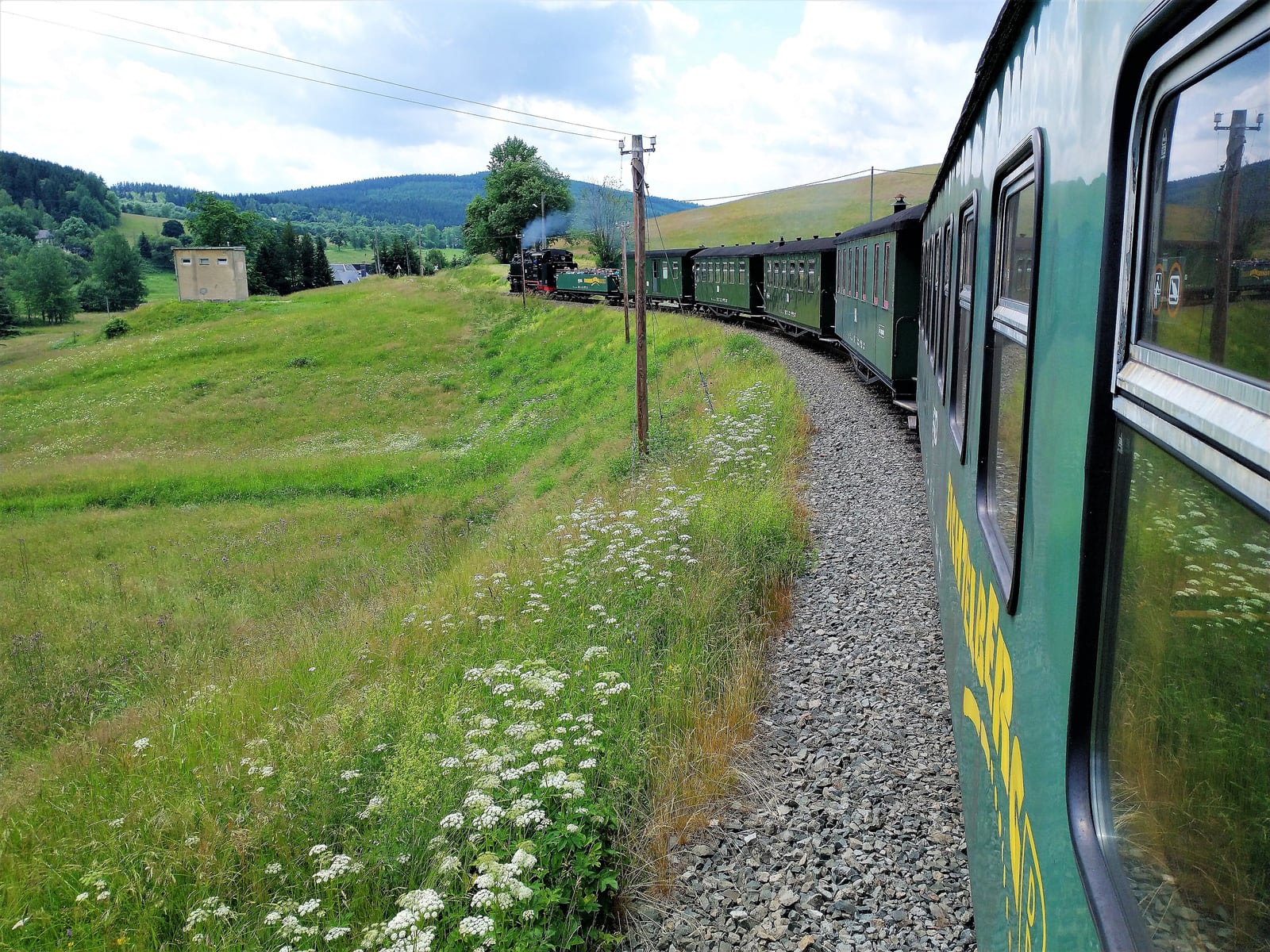
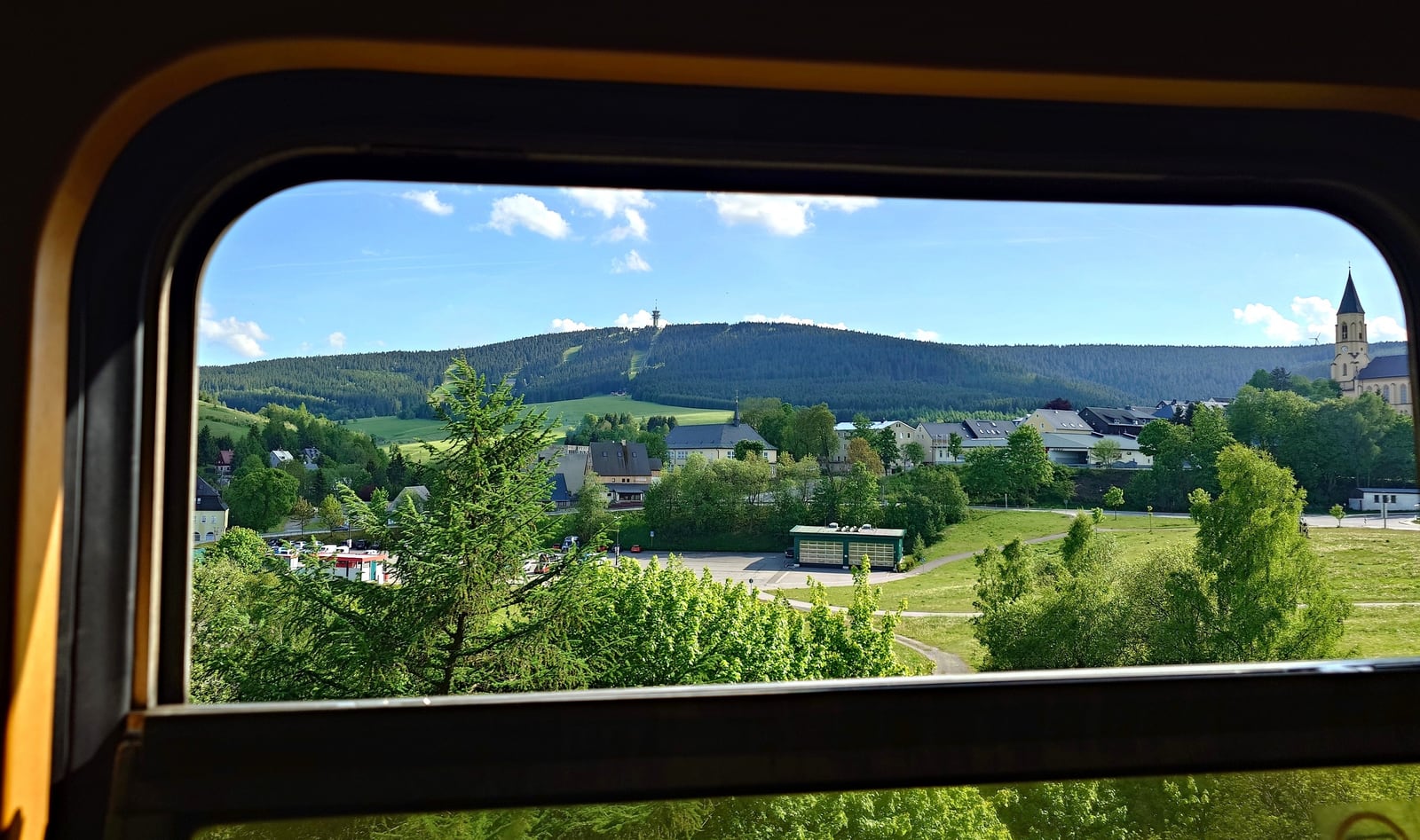
This is the stretch where the railway is at its least like a railway. Single track, no lineside fencing, walking paths crossing on the level, and long enough curves that from a window at the back you can watch your own engine working three coaches ahead. Kretscham-Rothensehma (792 m) and Niederschlag (813 m) are both little more than a platform and a name board.
It is not a continuous climb. Above Niederschlag the track crosses its high point and then loses height again, dropping to Hammerunterwiesenthal (796 m) in the valley of the Pöhlbach — which is the state border, with Czechia on the far bank. Hammerunterwiesenthal has one of the line's crossing loops, and with a single track and four trains each way a day, the whole timetable turns on a handful of these meetings.
The last four kilometres
From the Pöhlbach the line has to win back everything it just gave away, and more: ninety-seven metres in under four kilometres to Unterwiesenthal (847 m) and then the terminus. Marble was quarried at Hammerunterwiesenthal from 1874 and moved by a narrow-gauge tramway of its own; by the 1930s thirty men were getting some thirty thousand tonnes a year out of it. The workings have been a reserve deposit since 1992 and the scars are still in the hillside.
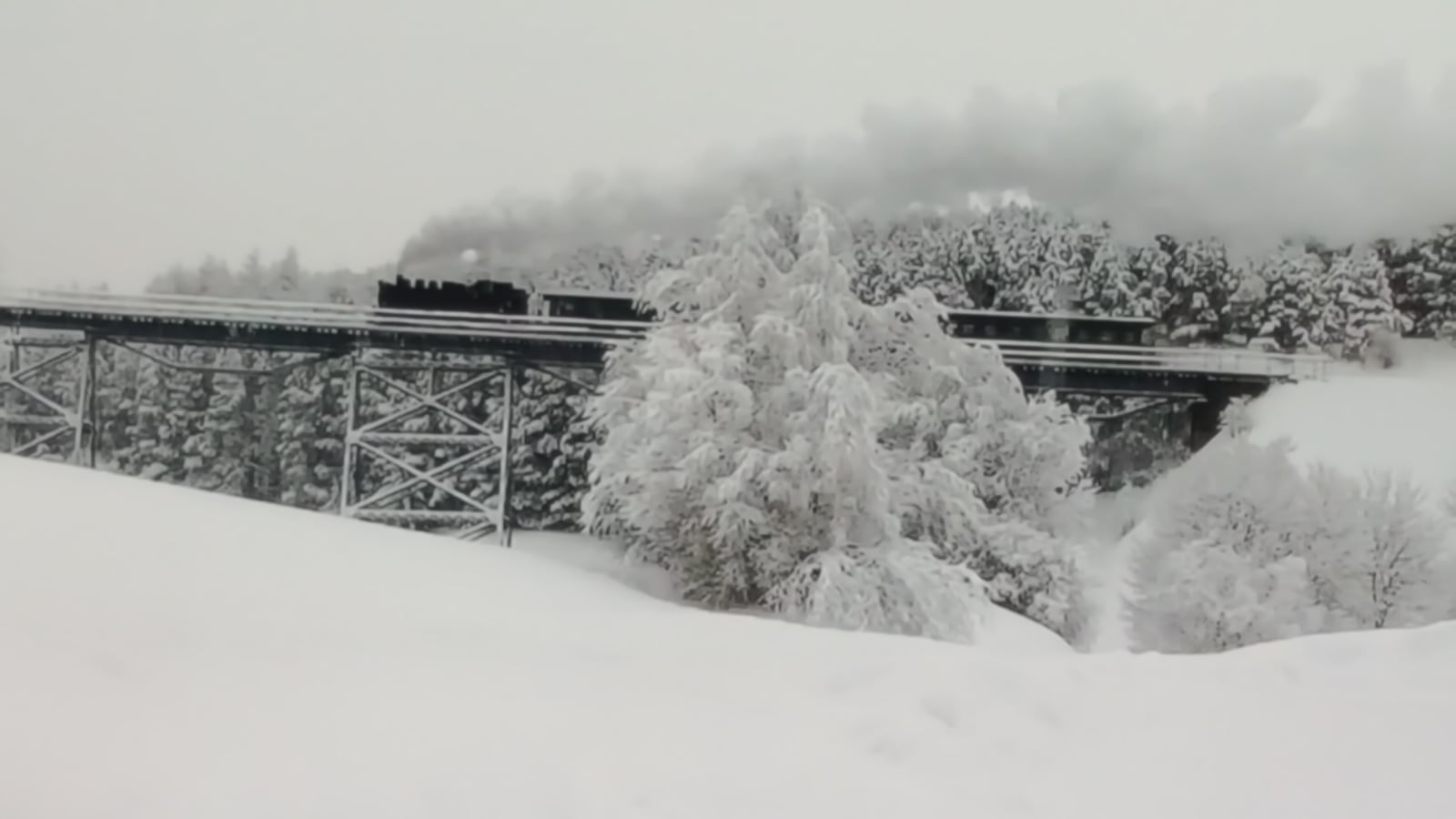
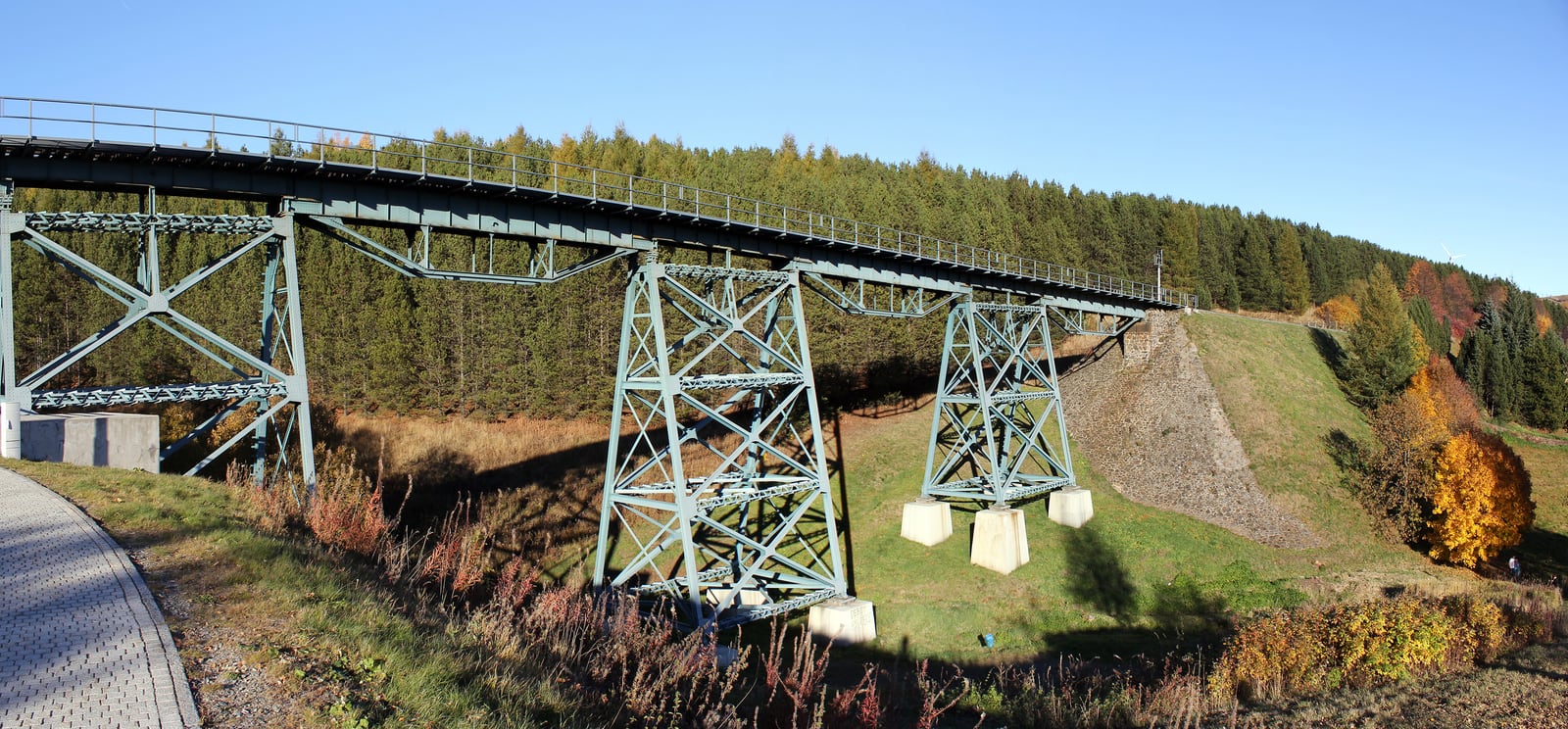
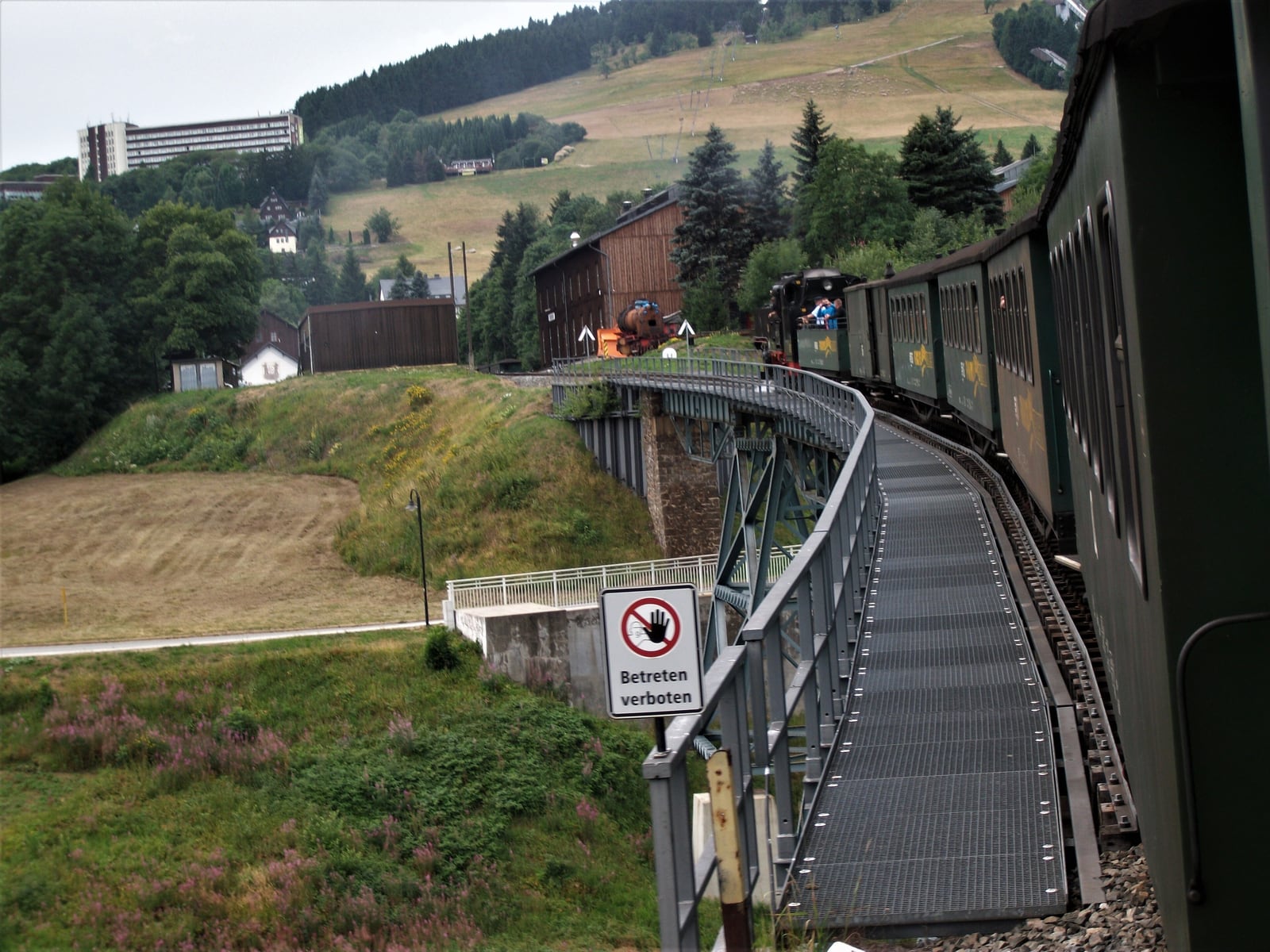
Then the Hüttenbach viaduct — a steel lattice bridge on four piers, about 110 metres long and some 23 metres above the stream, the one structure on the railway that announces itself. Crossing it from the open platform at the end of a coach is the best half-minute of the trip. In February you frequently cannot see the far end.
Kurort Oberwiesenthal (893 m) is a proper terminus with a locomotive shed, a turning triangle and a ticket and souvenir office that opens daily. Six bridges, nine stations, 238 metres of climb, fifty-seven minutes.
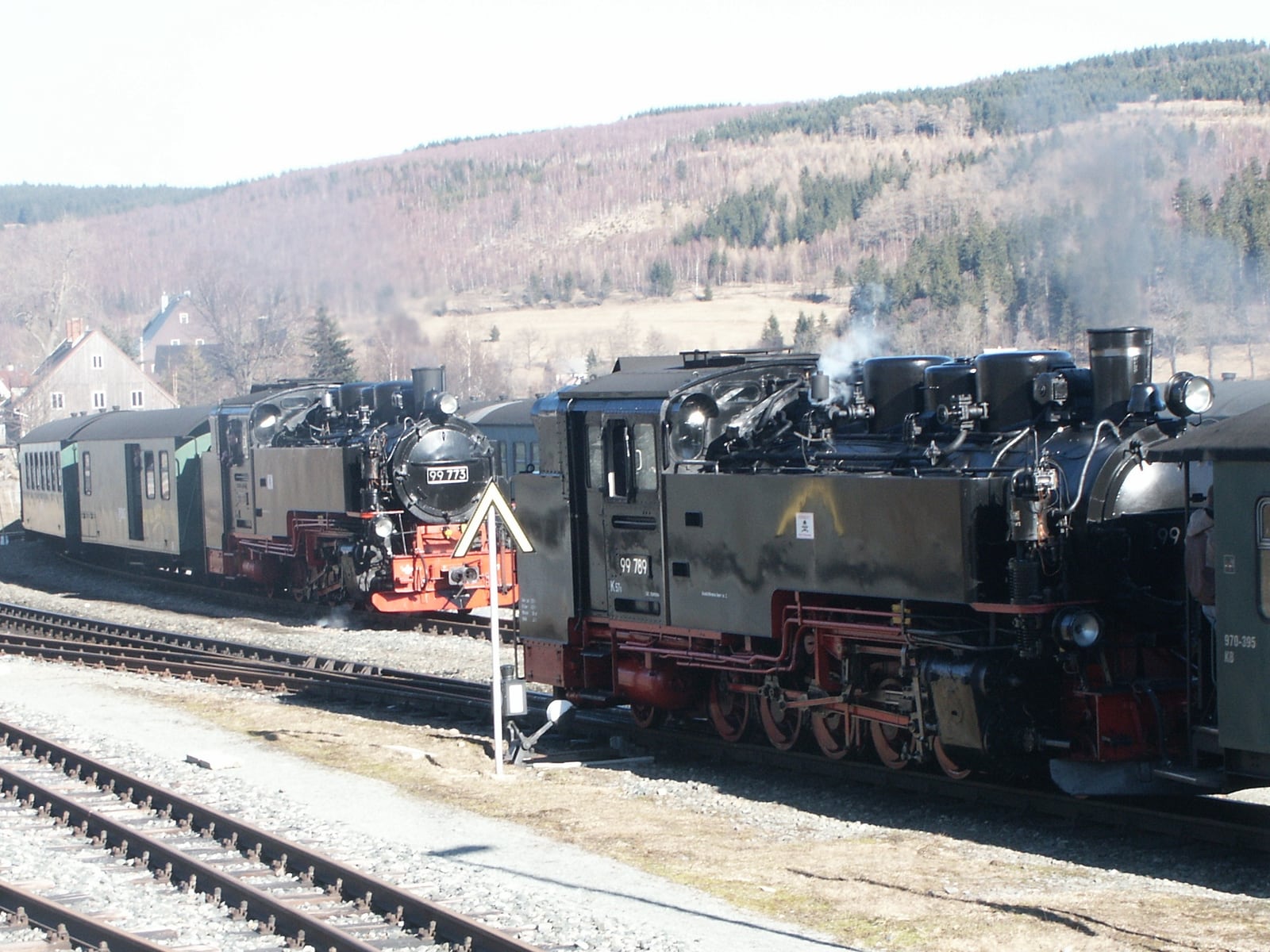
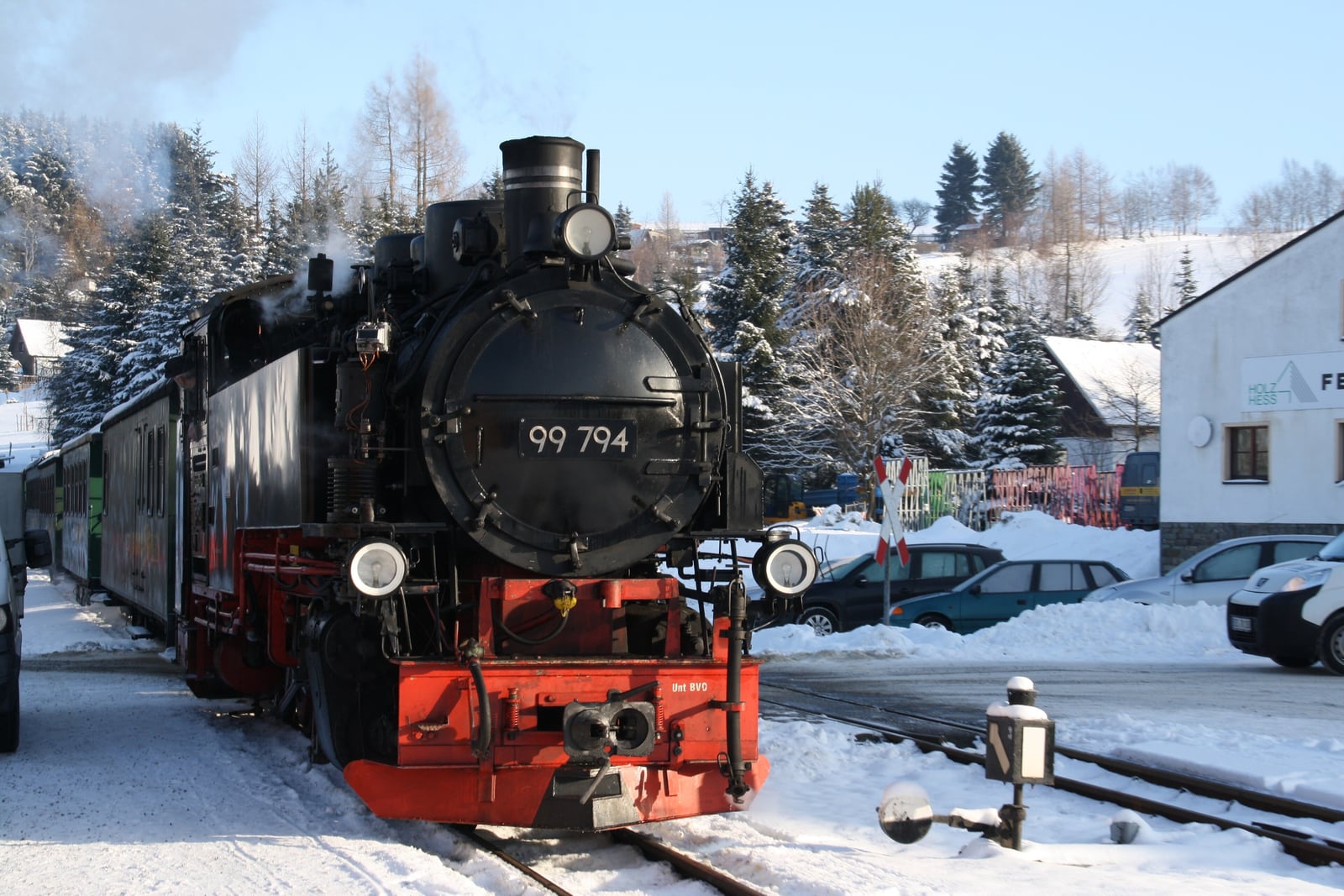
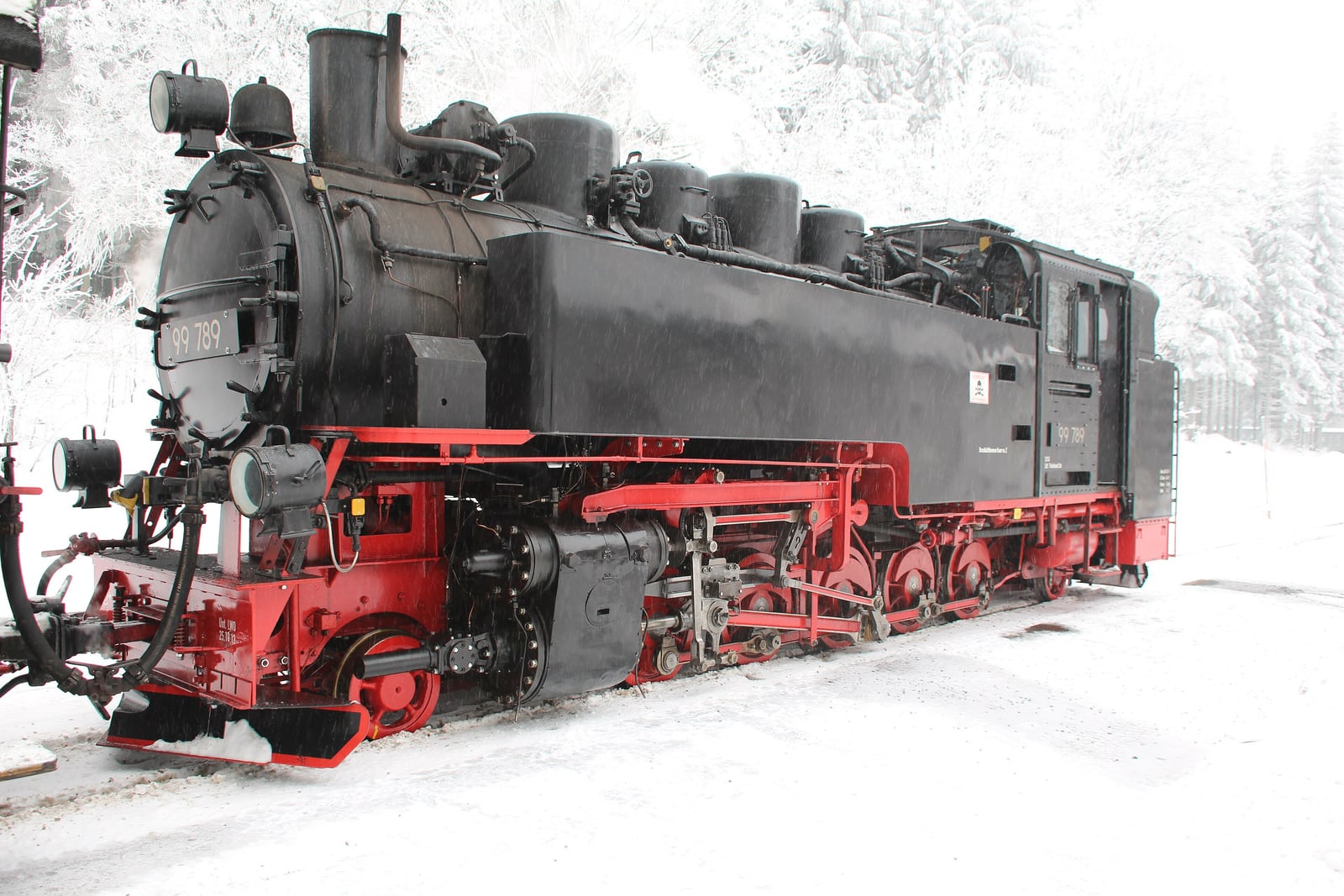
The engines are two classes and both are in daily traffic. The Baureihe 99.73–76 were built in 1928, 1929 and 1933 — thirty-two of them, 1'E1' tanks of 56.7 tonnes and about 600 horsepower. The Baureihe 99.77–79 came from VEB Lokomotivbau Karl Marx at Babelsberg between 1952 and 1956, twenty-six built and twenty-two still in existence. Both are limited to 30 km/h, which on this line is academic.
Along the route
JanSuchy / Wikimedia Commons · public domainThe ten years its own history leaves out
The railway's timeline goes 1949, 1952, 1966 and says nothing in between. From 1947 uranium was mined at Bärenstein for the Soviet Union, the district was a closed zone, and this line hauled the ore and the shift trains for some three thousand miners. It is the only decade nobody advertises.Bybbisch94, Christian Gebhardt / Wikimedia Commons · CC BY-SA 4.0Steam as a timetable, not an event
Four trains each way, every day, at the same times in February as in August — no steam season, no diesel substitute on quiet Tuesdays. The engines are seventy and eighty years old and they are doing a job. The fifty-seven minutes it takes is the same fifty-seven it took in 1897.Mars 2002 / Wikimedia Commons · CC BY-SA 3.0Two hundred and thirty-eight metres, one in thirty
Cranzahl sits at 654 metres and Oberwiesenthal at 893, on gradients of 33 per mille and curves of a hundred-metre radius. It is not a continuous climb: the track tops out above Niederschlag, drops into the Pöhlbach valley, and wins the last hundred metres back in four kilometres.A bit of history
Culture & experiences along the way
Bybbisch94, Christian Gebhardt / Wikimedia Commons · CC BY-SA 4.0Go in winter
Almost everything written about this railway shows it in summer, and almost everything worth seeing on it happens in February. The Fichtelberg weather station has recorded minus thirty and three and a third metres of snow; the spruce along the line ices up white; and the train still leaves Cranzahl at ten. Carriages are heated by steam from the engine, so the warmest seats are the ones nearest it. Nothing needs booking; boots help.Aagnverglaser / Wikimedia Commons · CC BY-SA 4.0Ride the open coach, if it is running
Between 1 May and 30 September some trains carry an open observation coach, marked in the timetable, and it is the only way to hear the engine properly and to cross the Hüttenbach viaduct with nothing between you and the valley. Standing on the coach platforms is allowed for adults with the gate shut. You will get smuts on your clothes; that is what the operator's own conditions warn you about, and it is part of the deal.Ladabohac / Wikimedia Commons · CC0Carry on up the mountain, and over the border
The terminus is not the top. Germany's oldest aerial cableway, running since December 1924, lifts you from the edge of Oberwiesenthal to the Fichtelberg summit at 1,209 metres in three and a half minutes. From up there you look straight across at Klínovec, the highest of the Ore Mountains, and down on Boží Dar — which is higher than the highest town in Germany and about six kilometres away, in another country.Timetables
Four trains each way a day, at the same times every day of the year. There is no summer service and no winter service; 10 December looks exactly like 13 August. That makes this one of the easiest timetables in Germany to plan around and one of the least forgiving to miss.
Checked against Deutsche Bahn's schedule data and the operator's own timetable sheet for the year running 14 December 2025 to 12 December 2026, sampled for Thursday 13 August, Sunday 16 August and Thursday 10 December 2026.
Up the hill — Cranzahl to Kurort Oberwiesenthal
| Train | Cranzahl | Neudorf | Niederschlag | Kurort Oberwiesenthal |
|---|---|---|---|---|
| P 1001 | 10:00 | 10:15 | 10:36 | 10:57 |
| P 1003 | 12:56 | 13:11 | 13:32 | 13:53 |
| P 1005 | 15:21 | 15:36 | 15:57 | 16:18 |
| P 1007 | 18:11 | 18:25 | 18:46 | 19:06 |
Down again — Kurort Oberwiesenthal to Cranzahl
| Train | Kurort Oberwiesenthal | Niederschlag | Neudorf | Cranzahl |
|---|---|---|---|---|
| P 1000 | 08:42 | 09:03 | 09:23 | 09:37 |
| P 1002 | 11:48 | 12:09 | 12:29 | 12:43 |
| P 1004 | 14:13 | 14:34 | 14:54 | 15:08 |
| P 1006 | 17:03 | 17:24 | 17:44 | 17:58 |
Uphill trains take 57 minutes, downhill ones 55. The first train of the day comes down, which is worth noticing: if you are arriving from outside, your first possible departure is the 10:00.
Getting to Cranzahl
The RB 80 runs from Chemnitz Hauptbahnhof to Cranzahl in about 1 h 20, roughly hourly, calling at Annaberg-Buchholz on the way. The 08:36 from Chemnitz arrives at 09:55 and connects into the 10:00 with five minutes to spare — a deliberate connection, and the only really convenient one of the morning. The next arrival, at 11:55, leaves you an hour on the platform.
Three weeks when nothing runs
The line closes completely for maintenance three times in 2026: 9–27 March, 13–24 April and 2–20 November. The operator's own sheet is blunt about what happens then — "Die Züge fallen ersatzlos aus": the trains are cancelled and there is no replacement bus. A journey planner queried inside one of those windows simply returns no service at all, so the dates are worth confirming before a day is built around this railway.
There is also no train on 24 December.
Special-traffic days
On about a dozen dates a year the line runs a six-pair timetable instead of four, with extra departures from Cranzahl at 11:30 and 16:46. In 2026 these are the Advent and Christmas period (14, 20–21 and 26–31 December 2025, and 28–29 November, 5–6 and 12 December 2026), the Easter weekend of 4–5 April, and the holiday weekends of 14–16 and 23–24 May.
The open coach
Between 1 May and 30 September certain trains carry an open observation coach, marked in the printed timetable. Not every train has one, so if that is what you have come for it is worth checking which departures carry it.
Book and confirm at the operator: fichtelbergbahn.de (opens in a new tab).
Tickets
Fares are the railway's own, on a single sheet valid from 1 January 2026, and they are refreshingly simple: three price stages, and the whole line is stage 3. An adult single is €10.00 and a return €20.00, a child of six to fourteen half that, and a family of two adults with up to four children €22.50 and €45.00. Under-sixes travel free. Dogs and bicycles are €3.20; sledges, skis, prams and wheelchairs go free, which tells you who the winter passengers are.
The catch is that a return may be broken only once, on one leg or the other. On a line with four trains a day that bites, which is why the €22.50 day ticket exists — two euros fifty more than a return, and unlimited breaks. Only the railway's own tickets and VMS season tickets are accepted; a Deutschlandticket buys nothing here but the right to pay a €12 supplement.
Book your tickets
Single and return
€10.00 single · €20.00 return · €45.00 family
The whole line, with one break of journey allowed on one leg only.
Book Tickets (opens in a new tab, on Fichtelbergbahn (SDG))via Fichtelbergbahn (SDG)Day ticket
€22.50 adult · €11.30 child · €51.30 family
Worth it the moment you get off twice, which on this line you will.
Book Tickets (opens in a new tab, on Fichtelbergbahn (SDG))via Fichtelbergbahn (SDG)Deutschlandticket supplement
€12, and the only way a national ticket works here
A day ticket for one person — no companions, no bicycle, no dog.
Book Tickets (opens in a new tab, on Fichtelbergbahn (SDG))via Fichtelbergbahn (SDG)Rail Passes
No rail pass carries you on this railway. That is the short answer, and because it catches people out at the platform edge it is worth being precise about which pass fails and how.
Interrail and Eurail
An Interrail or Eurail pass covers Deutsche Bahn and a list of German regional operators — ICE, IC and EC, RE, RB, IRE and S-Bahn. The Fichtelbergbahn is none of those, and Interrail says so from its own end: the roster of German companies its coverage table links runs to some fifty operators, all of them running scheduled public services, and the Sächsische Dampfeisenbahngesellschaft is not among them. The list is closed rather than illustrative, which is what decides the case.
SDG's tariff sheet says the same thing from the other side. It states which outside tickets it will take: its own, and VMS season tickets for zones 32 and 33 of the Mittelsachsen transport authority. "Alle anderen Tickets gelten nicht" — all other tickets are not valid.
So a pass will bring you to Cranzahl free of charge on the RB 80 from Chemnitz, which is genuinely useful, and from there the railway's own €10 single or €22.50 day ticket is what gets you up the valley. It is worth allowing for in advance, because it is not a supplement that can be added to the pass — it is a separate fare.
The Deutschlandticket
Germany's €63-a-month flat-fare ticket does not cover the Fichtelbergbahn either — but it is the one pass that buys you something. A Deutschlandticket holder can pay the SDG-Historik-Zuschlag of €12.00, which then acts as a day ticket for one person.
The conditions on that are tighter than they look:
- It is valid for one person only. There is no companion rule, and no reduction for a second Deutschlandticket holder's child, dog or bicycle.
- Add-on tickets to the Deutschlandticket do not help. Presenting a Zusatzticket alongside it buys nothing extra.
- It is a day ticket, valid on the day of use.
For a lone traveller who already holds a Deutschlandticket, €12 against €22.50 is a clear saving, and against a €20 return it still wins. For a couple it is €24 against a €22.50 day ticket each — worse than nothing only if you were both going to buy singles.
Is any of it worth it?
For this journey specifically, the railway's own day ticket is the simplest answer. €22.50 for unlimited travel over seventeen kilometres is not cheap by the metre, and it is not meant to be — it is the fare for a steam railway that keeps eighty-year-old locomotives in daily service through Ore Mountain winters.
Where a pass earns its keep is everything either side of Cranzahl: the run in from Chemnitz, and the fact that Annaberg-Buchholz, Dresden and the Czech border crossings are all pass territory. The Fichtelbergbahn is best thought of as the paid-for hour in the middle of a pass-covered day.
Pass conditions checked on 20 August 2026 against Interrail's published list of railway companies and the operator's tariff sheet valid from 1 January 2026.
Places to Visit
Everything worth stopping for is strung along the line rather than heaped at the end, which is the argument for the day ticket and against the four-trains-a-day timetable. One thing is not on the list below because it cannot be photographed within German copyright law: the Räuchermann museum at Cranzahl, three hundred metres from the platform in a dye works restored in 2011, holding more than two thousand two hundred of the Erzgebirge's incense-smoking wooden figures. It is well worth the detour even though we cannot show it to you.
 Harke / Wikimedia Commons · CC BY-SA 3.0 · cropped
The Frohnauer Hammer, Annaberg-Buchholz
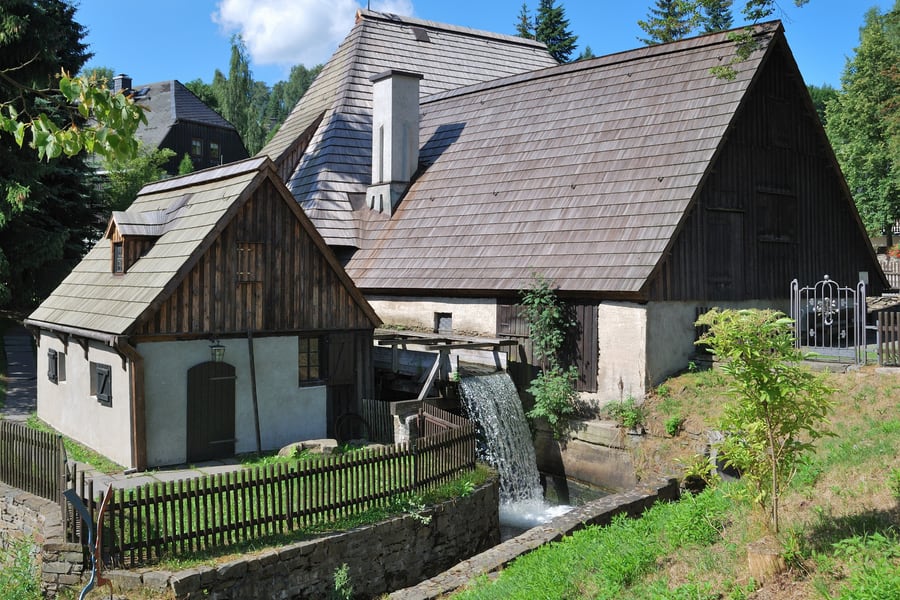
Annaberg-Buchholz is the town the connecting train comes from, and it holds three of the twenty-two component parts of the Erzgebirge mining region inscribed by UNESCO in July 2019. The most enjoyable is at Frohnau: a medieval grain mill turned into a hammer works in 1621, whose water wheel still drives three tilt hammers, and which has been a museum since 1910 — the oldest smithy museum in Germany.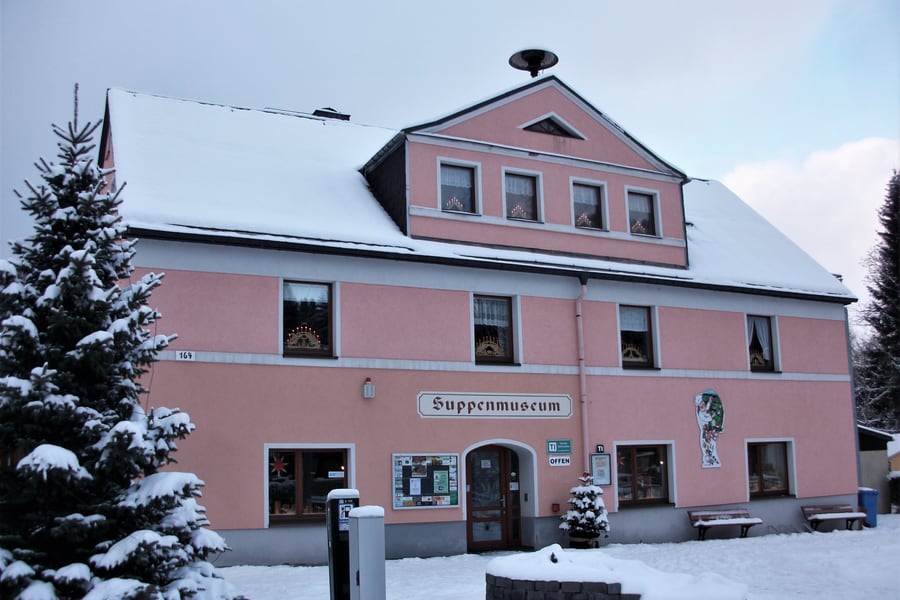 Aagnverglaser / Wikimedia Commons · CC BY-SA 4.0 · cropped
The soup museum at Neudorf
Germany's first museum of soup, founded in 1992 in Neudorf's old town hall and now seven rooms holding more than thirty thousand things: tureens, ladles, packet soups, an entire furnished kitchen. It sounds like a joke and is not one — the Erzgebirge lived on soup because it was poor, and the collection is really about that. Open Monday to Saturday 10.30 to 15.30 and Sundays from 11.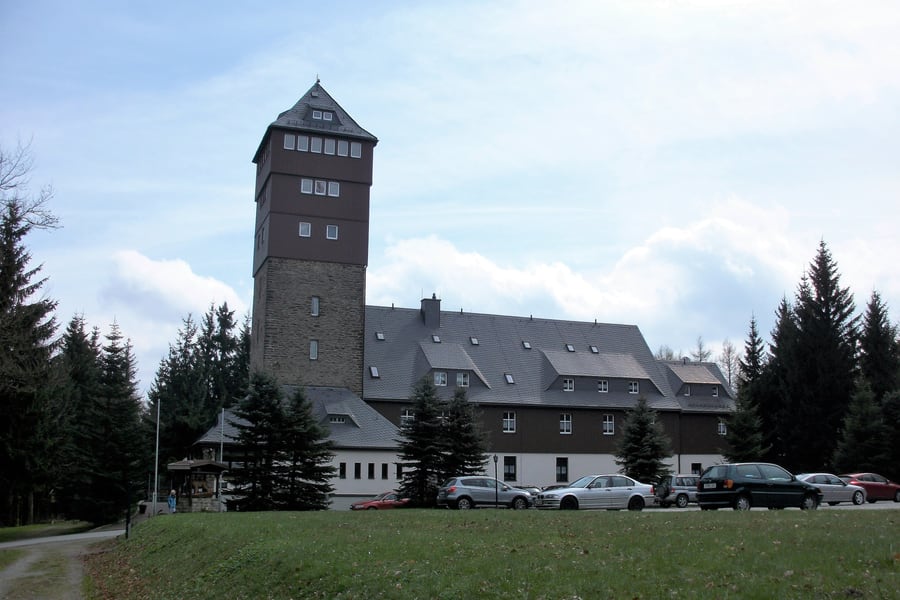 Aagnverglaser / Wikimedia Commons · CC BY-SA 4.0 · cropped
The Bärenstein
A basalt stump left behind when everything softer around it eroded away, 897.8 metres high, with a covered lookout tower whose foundation stone was laid in 1913 and a mountain inn beside it that opened the same year. The disused quarry on the north face shows the columnar basalt in section. From the top you see the Sehma valley, the Cranzahl reservoir and the whole ridge to the Fichtelberg and Klínovec.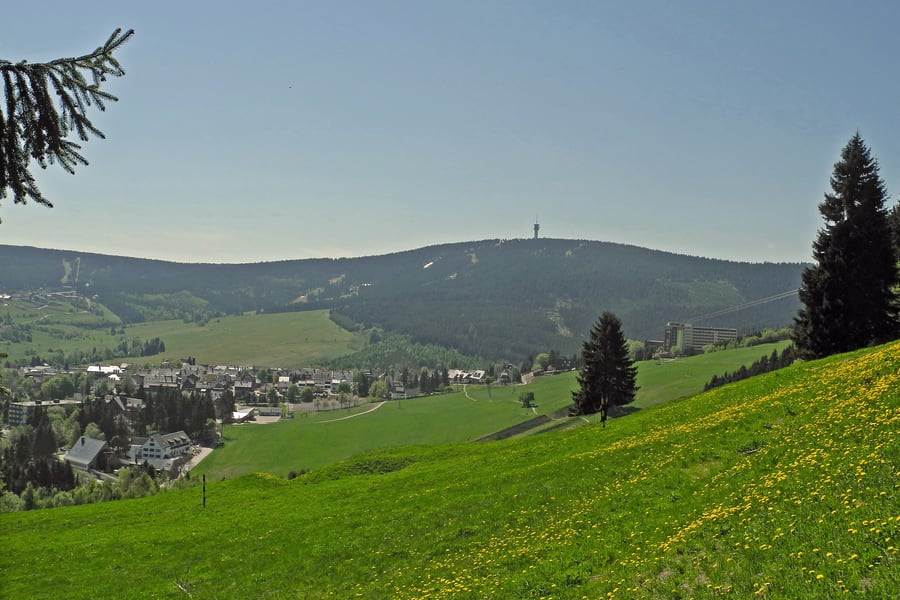 SchiDD / Wikimedia Commons · CC BY-SA 4.0 · cropped
Kurort Oberwiesenthal
At 914 metres this is the highest town in Germany, on a technicality it is entitled to: Garmisch-Partenkirchen and Oberstdorf both sit higher up the map but neither is legally a town. It is a spa and a ski resort and, more unusually, a serious sporting address — an elite winter-sports school with around 110 pupil athletes, and a ski jump on which Jens Weißflog, twice an Olympic champion, set a 102-metre hill record in 1996.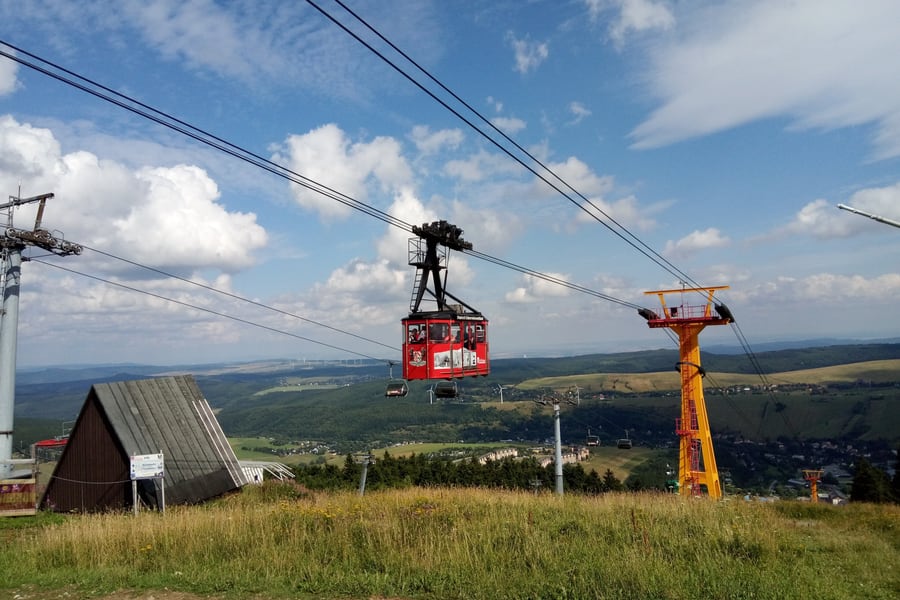 Salino01 / Wikimedia Commons · CC BY-SA 4.0 · cropped
The Fichtelberg and its cable car
At 1,214.9 metres the Fichtelberg is the highest mountain in Saxony, and the cableway that climbs it opened in December 1924, which makes it the oldest aerial ropeway in Germany — thirty-nine years older than the one up the Zugspitze. It rises from 905.5 to 1,208.9 metres in three and a half minutes. The weather station on top has been recording since 1 January 1916; its coldest reading is minus 30.4.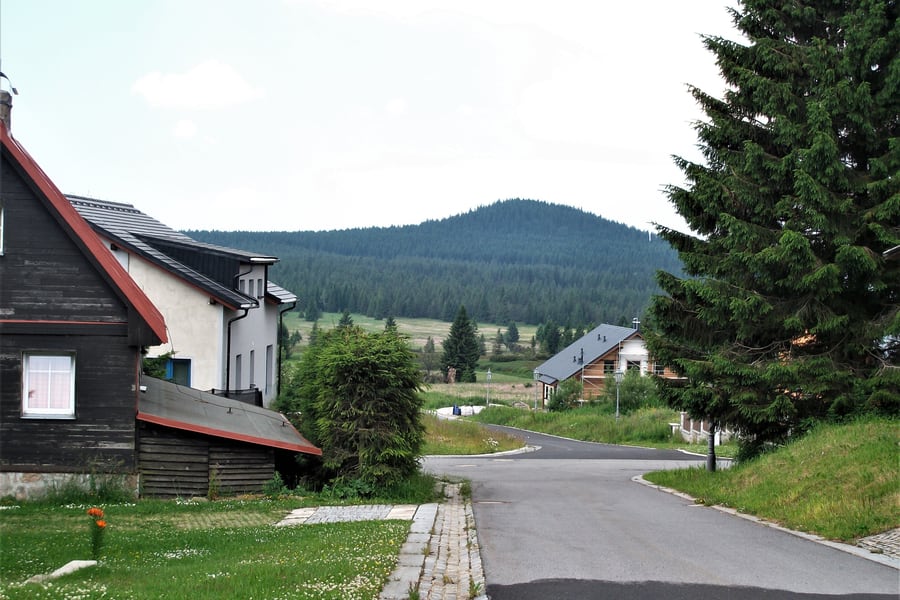 Aagnverglaser / Wikimedia Commons · CC BY-SA 4.0 · cropped
Boží Dar, over the stream
The Pöhlbach that the railway follows for its last few kilometres is the international border, and on the far side of the ridge is Boží Dar: at 1,028 metres, the highest town in central Europe, and therefore a hundred and fourteen metres of quiet rebuttal to the claim Oberwiesenthal makes. Behind it stands Klínovec at 1,244 metres, the highest of the Ore Mountains, with a lookout tower on the summit.Where to Sleep
There is no need to stay overnight to ride this line — it is an hour each way and the middle two trains give you four hours at the top — but the Erzgebirge is a walking and skiing region and the railway is a better way in than the road.
Cranzahl itself has almost nothing; the village is a junction and a reservoir. The useful beds are strung along the line and in the terminus town, and the three below were each opened and read in a browser in August 2026 rather than taken from a listing site.
No prices, no ratings and no star counts appear here, because we have verified none of them.
Where to stay
 Aagnverglaser / Wikimedia Commons · CC BY-SA 4.0 · cropped
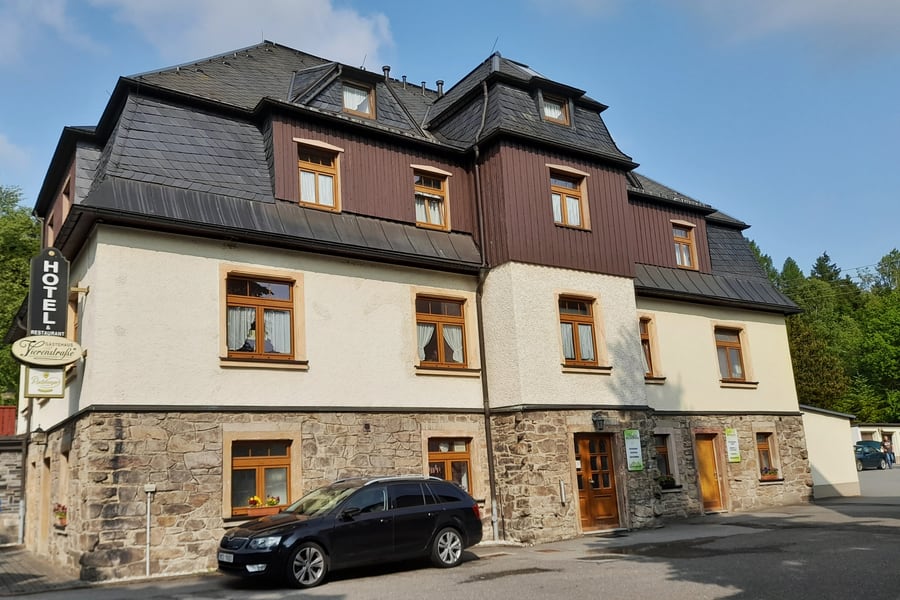
Hotel & Gästehaus Vierenstraße
The station is at the front door
A family house at 729 metres whose own front page points out that the Fichtelbergbahn's Vierenstraße halt is directly outside — and it is one of the four places along the line that sells the railway's tickets. Erzgebirge cooking in its own restaurant, themed rooms including a railway one, free use of the sauna in the guest house next door, and a ski and bicycle store.
Check Availability (opens in a new tab, on hotel-vierenstrasse.de)via hotel-vierenstrasse.de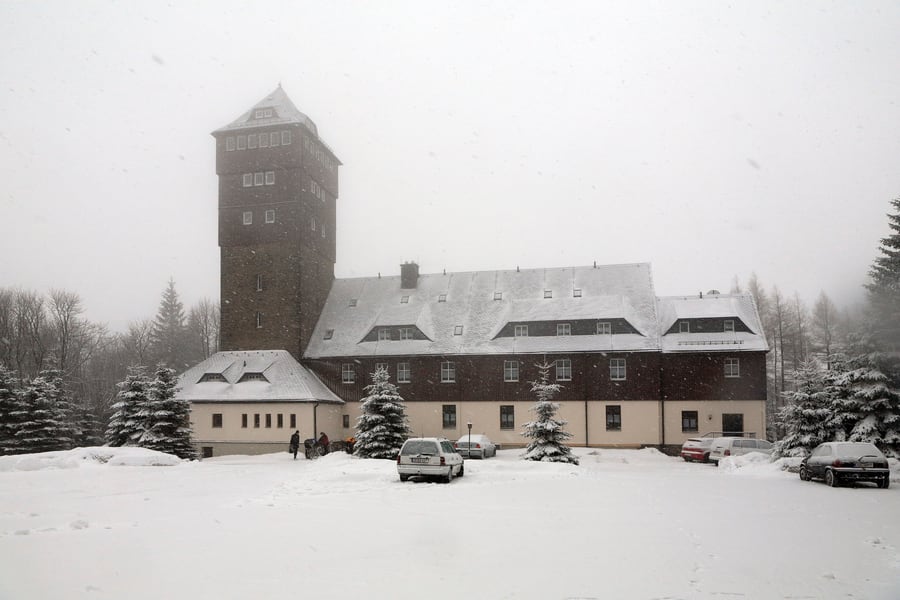 Falk2 / Wikimedia Commons · CC BY-SA 4.0 · cropped
Berghotel Bärenstein
On the summit above Niederschlag, beside the lookout tower
There has been an inn on top of the Bärenstein since 1913. A new operator took it on at the start of 2020, rebuilt every room and has since redone the façade; the restaurant is open daily and the big hall downstairs is the one the village has always danced in. It is a climb from the station and the view from the tower next door is the reason to make it.
Check Availability (opens in a new tab, on berghotel-baerenstein.de)via berghotel-baerenstein.deAlpina Lodge
In Oberwiesenthal, above nine hundred metres
A larger house on the Annaberger Straße in the terminus town, with a buffet restaurant, a lounge bar that brews its own copper beer, and a sauna and wellness floor — which is what you want after a day at this altitude in either season. Walking distance from the station, the cable car and the pistes, and open the whole year rather than for the ski months only.
Check Availability (opens in a new tab, on alpina-lodge.de)via alpina-lodge.deQuestions or corrections
Planning this trip and stuck on something, or spotted a time, fare or detail that has changed? Send us a message about The Fichtelbergbahn to Oberwiesenthal. We read every one, and we update this page when something has changed.