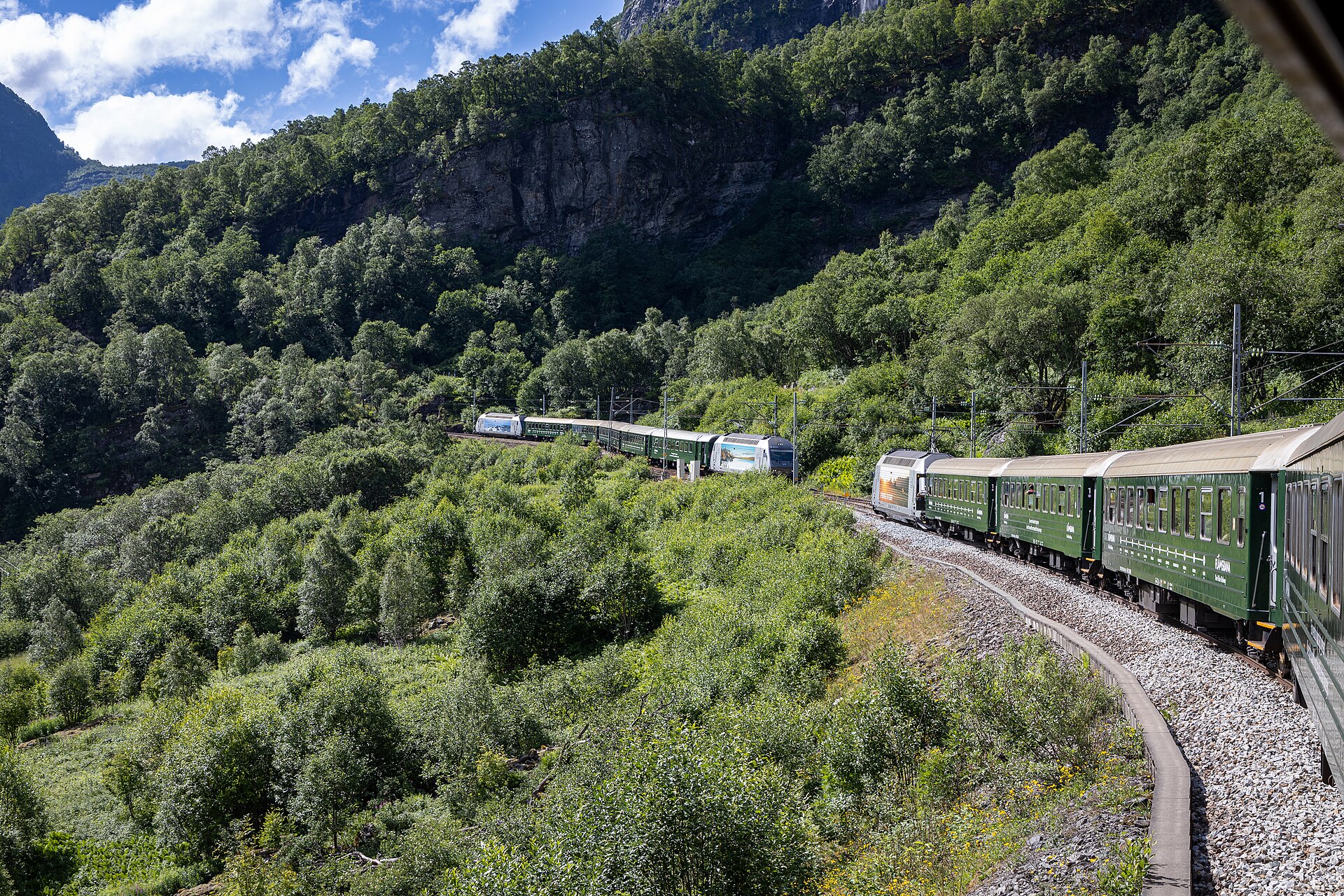
Flåm Railway
Superbass / Wikimedia Commons · CC BY-SA 4.0
- Distance20.2 km
- DurationAbout 1 hour
- Best seasonRuns year-round · ten trains a day in summer, four in winter
Introduction
The Flåm Railway (Flåmsbana) is regularly named one of the most beautiful train journeys in the world — and for once the billing is deserved. In barely 20 kilometres and about an hour, it drops from the bleak mountain station of Myrdal, high on the Bergen Railway, down to the little village of Flåm at the head of the Aurlandsfjord.
What makes it extraordinary is the sheer drama packed into that short distance: a near-continuous descent of some 865 metres past sheer rock walls, hairpin curves cut into the mountainside, and one thundering waterfall after another — all at a gentle enough pace that you can take it in through the big windows.
It is also one of the steepest standard-gauge railways in Europe, worked by ordinary adhesion rather than a rack: the maximum gradient is 5.5 per cent, or 1 in 18, and roughly four-fifths of the route is on a sustained climb. Norwegian sources place it second in Europe, behind Germany's Hunsrückbahn — a ranking worth knowing, because you will often see the Flåm Line described as the steepest in the world, which it is not.
The line was never opened with a ceremony. Trains started running under German occupation, and the formalities were quietly skipped; it took until 1980, the fortieth anniversary, for the Flåm Railway to be officially opened at all.
The Journey
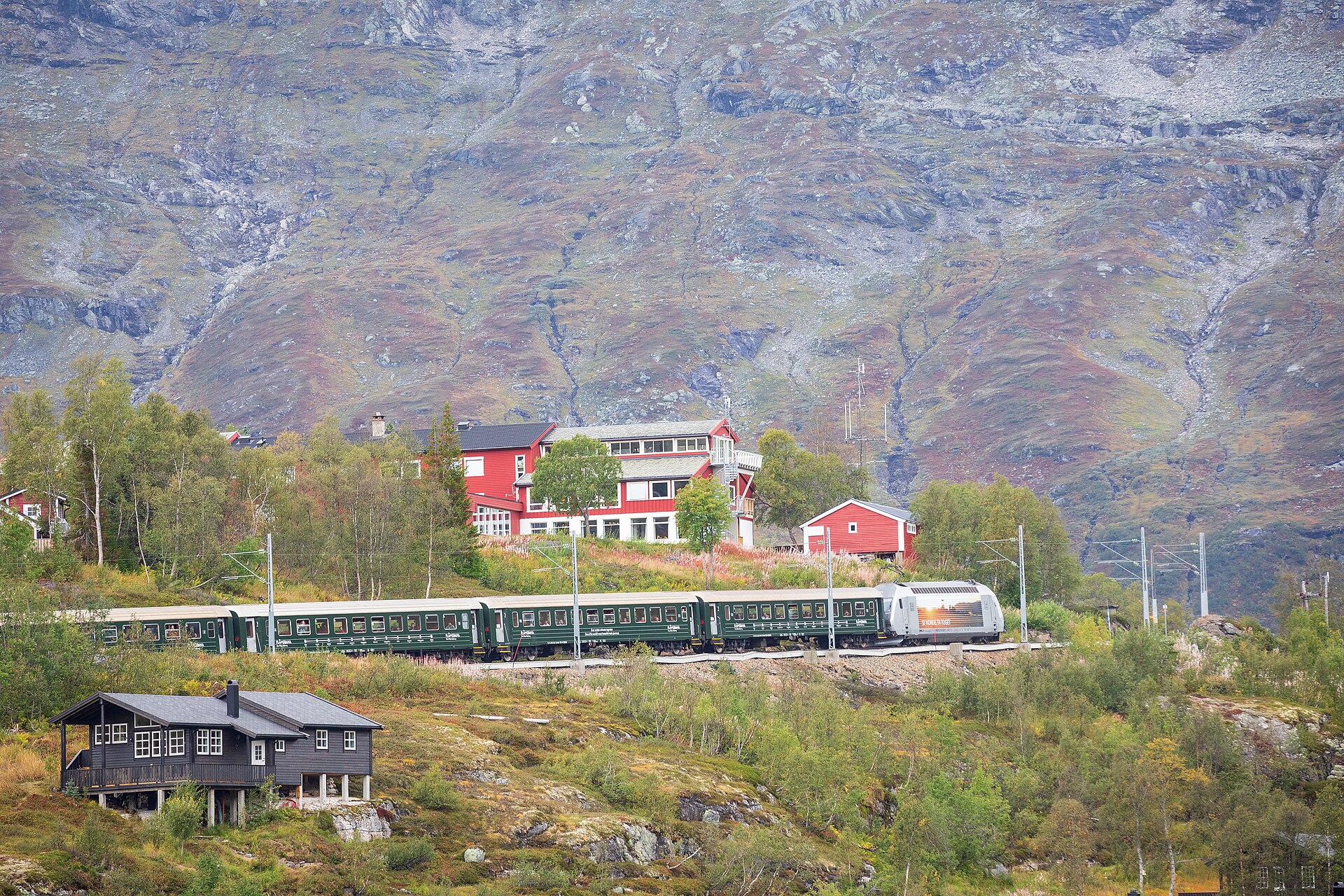
Leaving Myrdal at around 864 metres, the train begins its long, twisting descent toward the fjord. It threads twenty tunnels in twenty kilometres — and only two of them, the 1,341-metre Nåli and the 880-metre Vatnahalsen, were driven by machine. The other eighteen were dug by hand, four metres of drilling and blasting at a time, between 1924 and 1935. The work cost between 116 and 180 man-hours for every metre of tunnel, left men with silicosis from the smoke, and killed two.
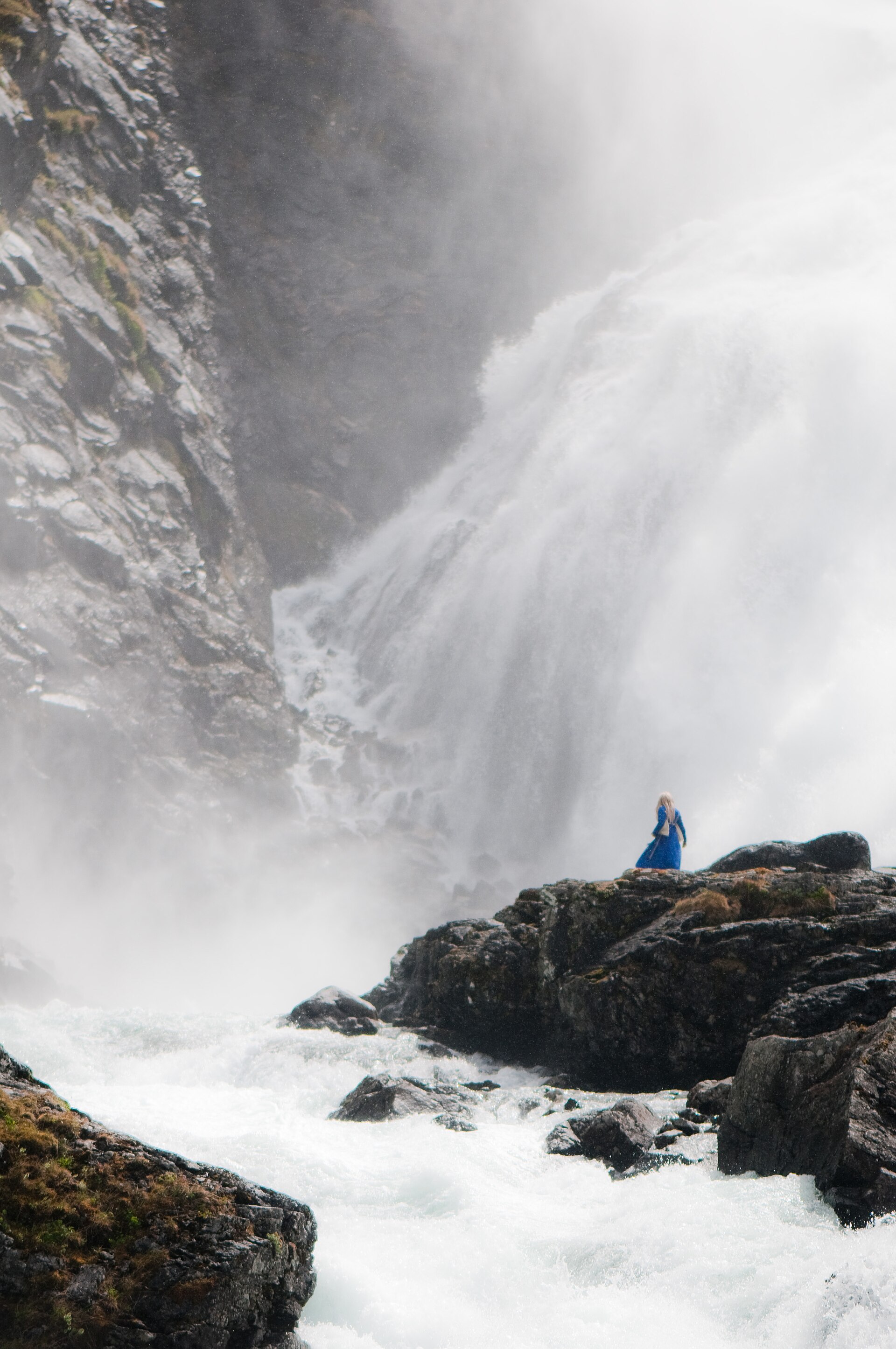
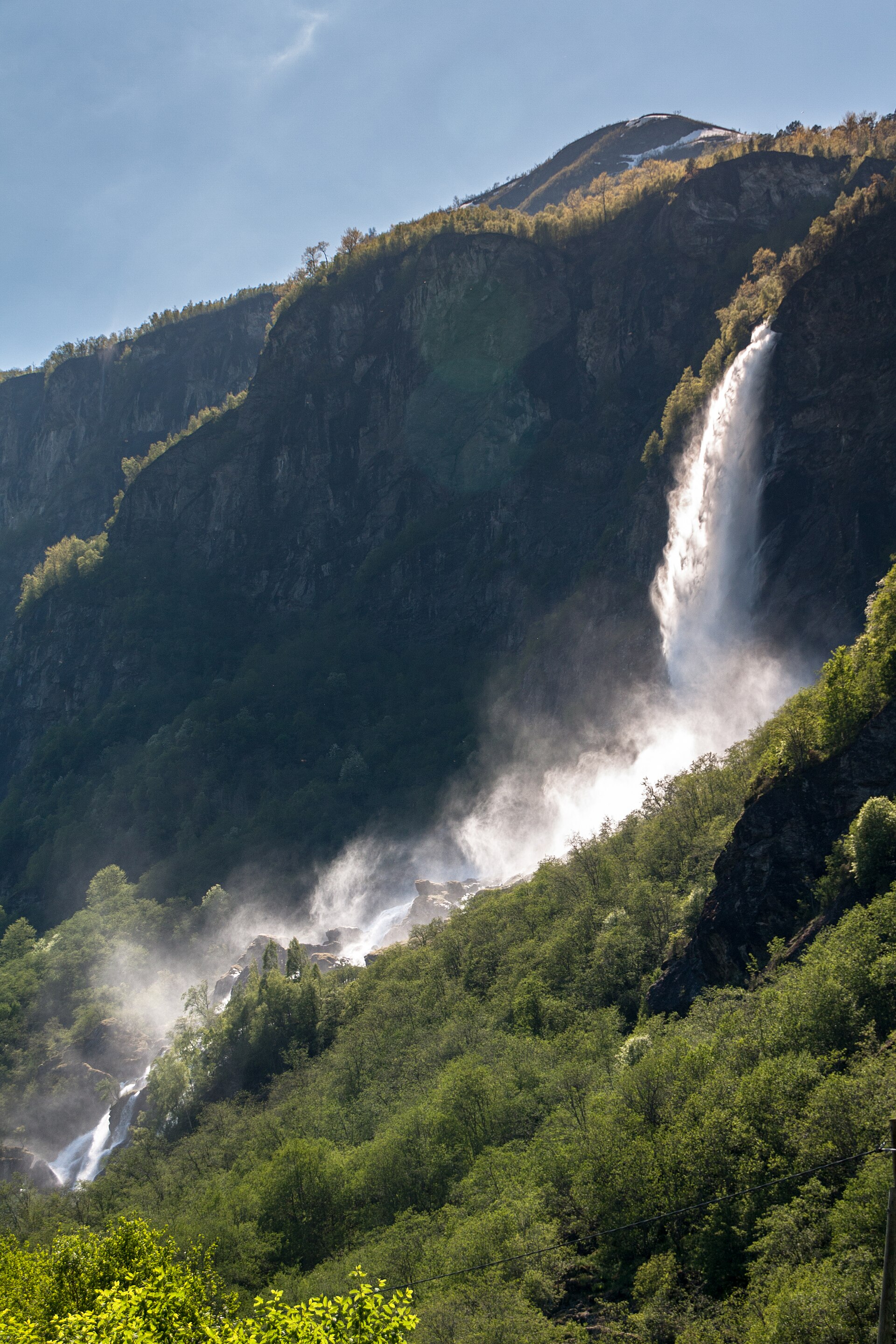
A kilometre down from Myrdal the line loops through a horseshoe curve and comes out onto a shelf cut into a cliff that falls away for hundreds of metres, at the mountain hotel of Vatnahalsen. The most famous stop comes next, at the Kjosfossen waterfall — a station that serves no village at all. It was opened in 1951 purely so that passengers could get out and stand in the spray, and in summer the train waits a booked seven minutes while a performance of the Huldra, the siren of Norwegian folklore, plays out on the rocks below the falls.
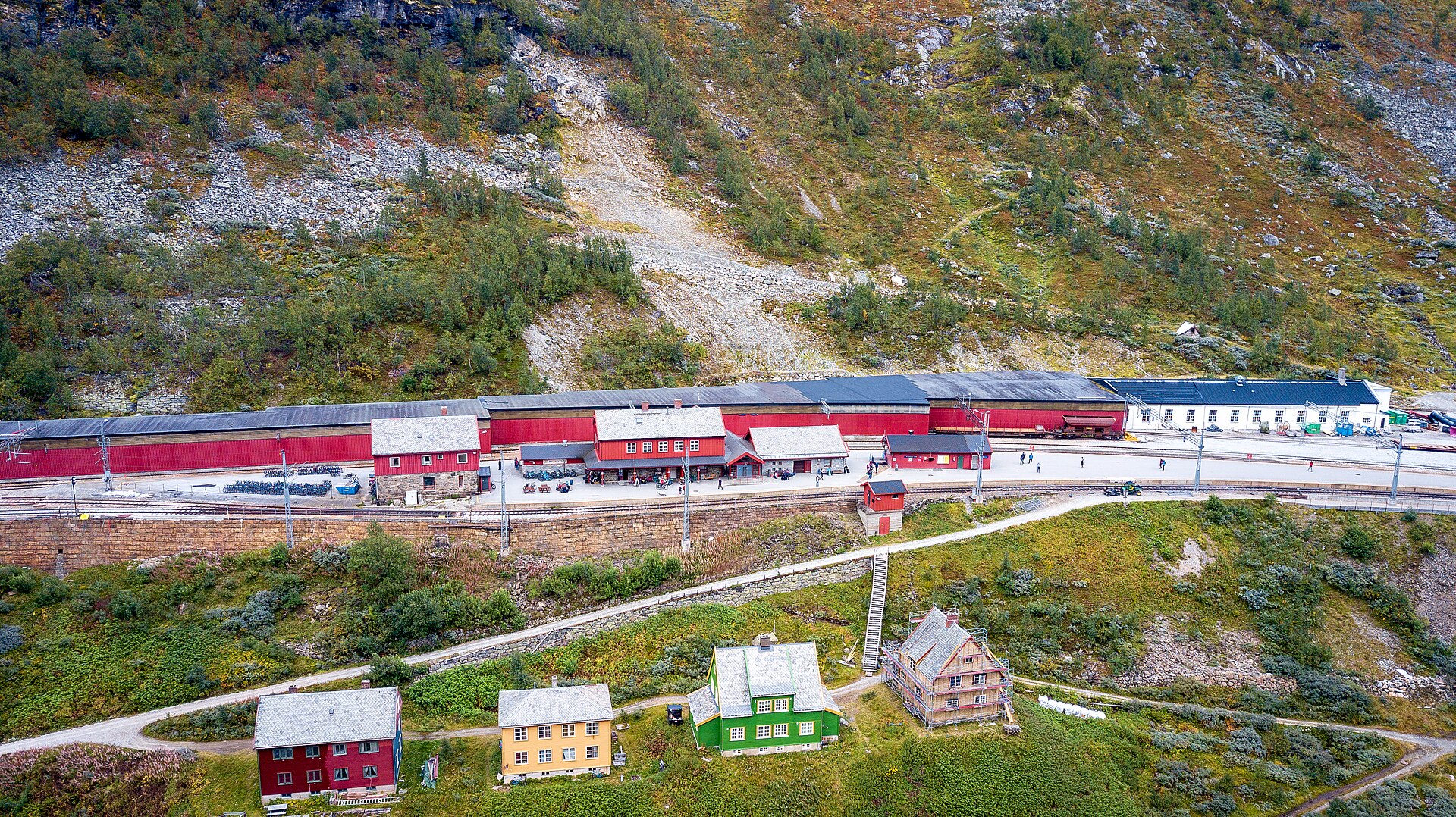
Halfway down is Berekvam, the line's only passing loop — Parliament cut the intermediate stations to a single one to save money, so this is the one place on the whole railway where two trains can meet. It is unstaffed and has no centralised signalling, and the crossing is still set by hand: with flags in daylight, and torches after dark, by staff who travel out from Myrdal or Flåm to do it.
Below Berekvam the line crosses the river, passes Rjoandefossen — a clean 140-metre drop down the valley wall — and follows the Flåm valley down through orchards and farmland to sea level at Flåm, where the fjord and the waiting boats come into view.
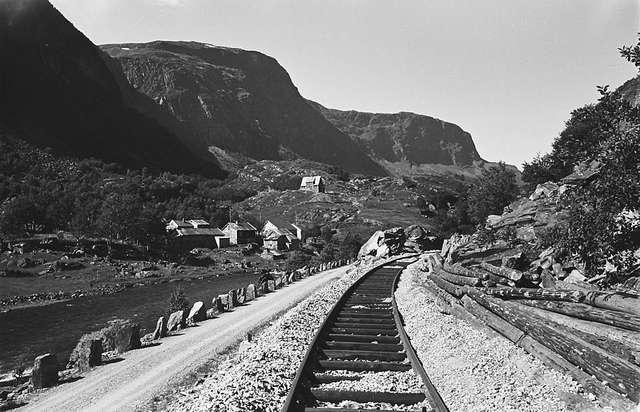
Construction began in 1924, and the railway was finished into a country under occupation. Track-laying was pushed through in the summer of 1940 at German insistence, freight began running that August and passenger trains — behind steam locomotives — from 10 February 1941. Electric working came in 1944, powered by a station built at the top of Kjosfossen for the purpose. Because of the war there was never an opening ceremony, and the line was not formally opened until its fortieth anniversary in 1980.
It nearly did not survive. Freight ended in 1992, and with fares charged by the kilometre a slow twenty-kilometre branch earned almost nothing; closure was close. In 1998 Flåm Utvikling took over the marketing and the ticketing, put the fares up sharply, and turned it into what it is now — a working railway that carries close to a million people a year, and still connects at Myrdal with the Bergen Line between Oslo and Bergen.
Along the route
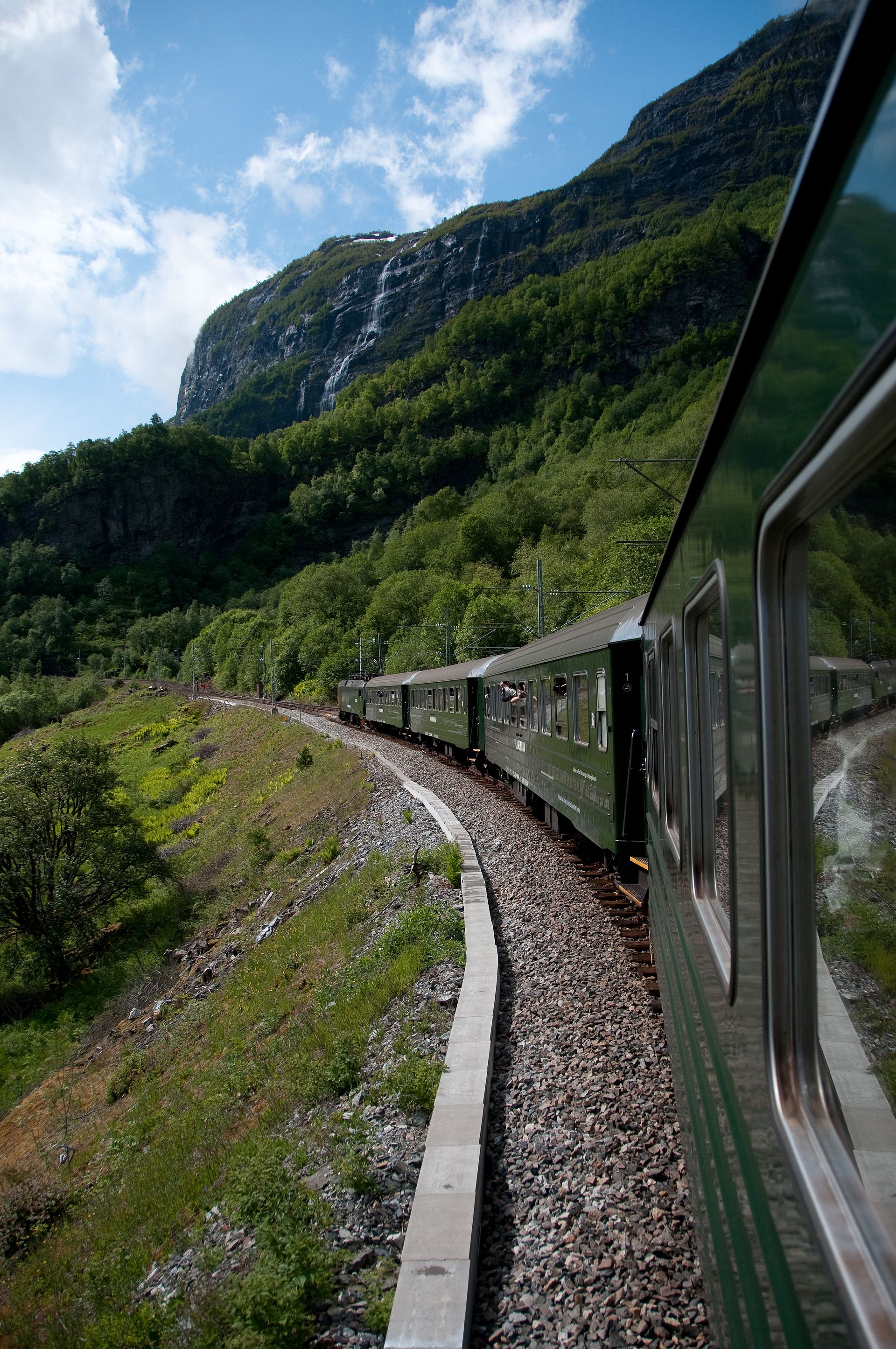
Björn Söderqvist / Wikimedia Commons · CC BY-SA 2.0Eighteen tunnels dug by hand
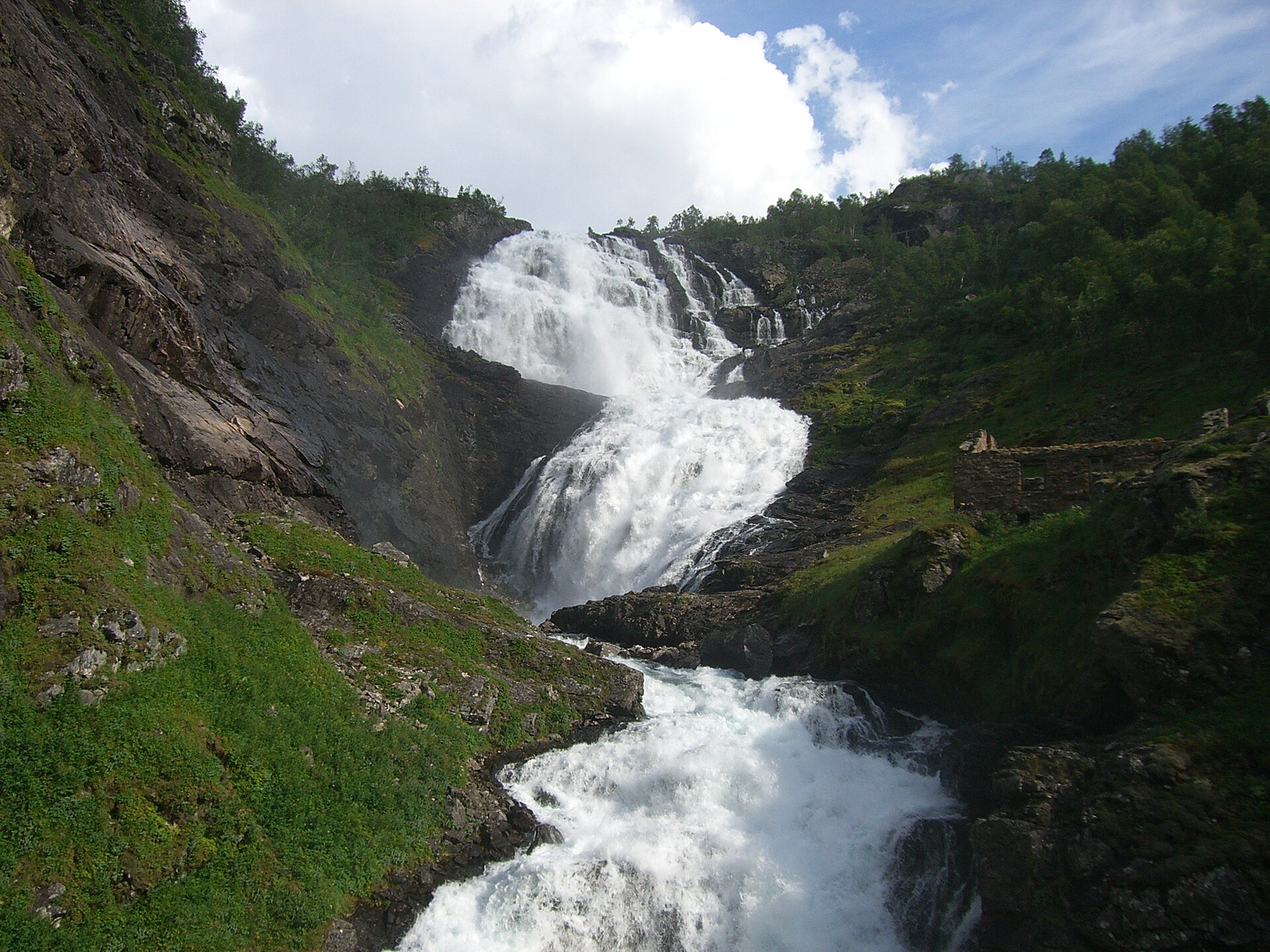
The line has twenty tunnels in twenty kilometres, and machines were used on only two. The other eighteen were cut by hand: drill four metres into the rock, pack the holes with dynamite, blast, clear, repeat. It took from 1924 to 1935, and the smoke left men with silicosis.Björn Söderqvist / Wikimedia Commons · CC BY-SA 2.0The waterfall the train stops for
Kjosfossen has a station that serves no village and no farm. It opened in 1951 purely so passengers could step out into the spray. In summer a figure appears on the rocks and begins to sing: the Huldra of Scandinavian folklore, played by ballet students.Superbass / Wikimedia Commons · CC BY-SA 4.0Flags by day, torches by night
Berekvam, halfway down, is the only passing loop on the line. It is unstaffed and has no centralised signalling, so when two trains cross, the crossing is still set by hand — flags in daylight and torches after dark.A bit of history
Culture & experiences along the way
 Jorge Láscar / Wikimedia Commons · CC BY 2.0
Ride it as the branch of the Bergen Line
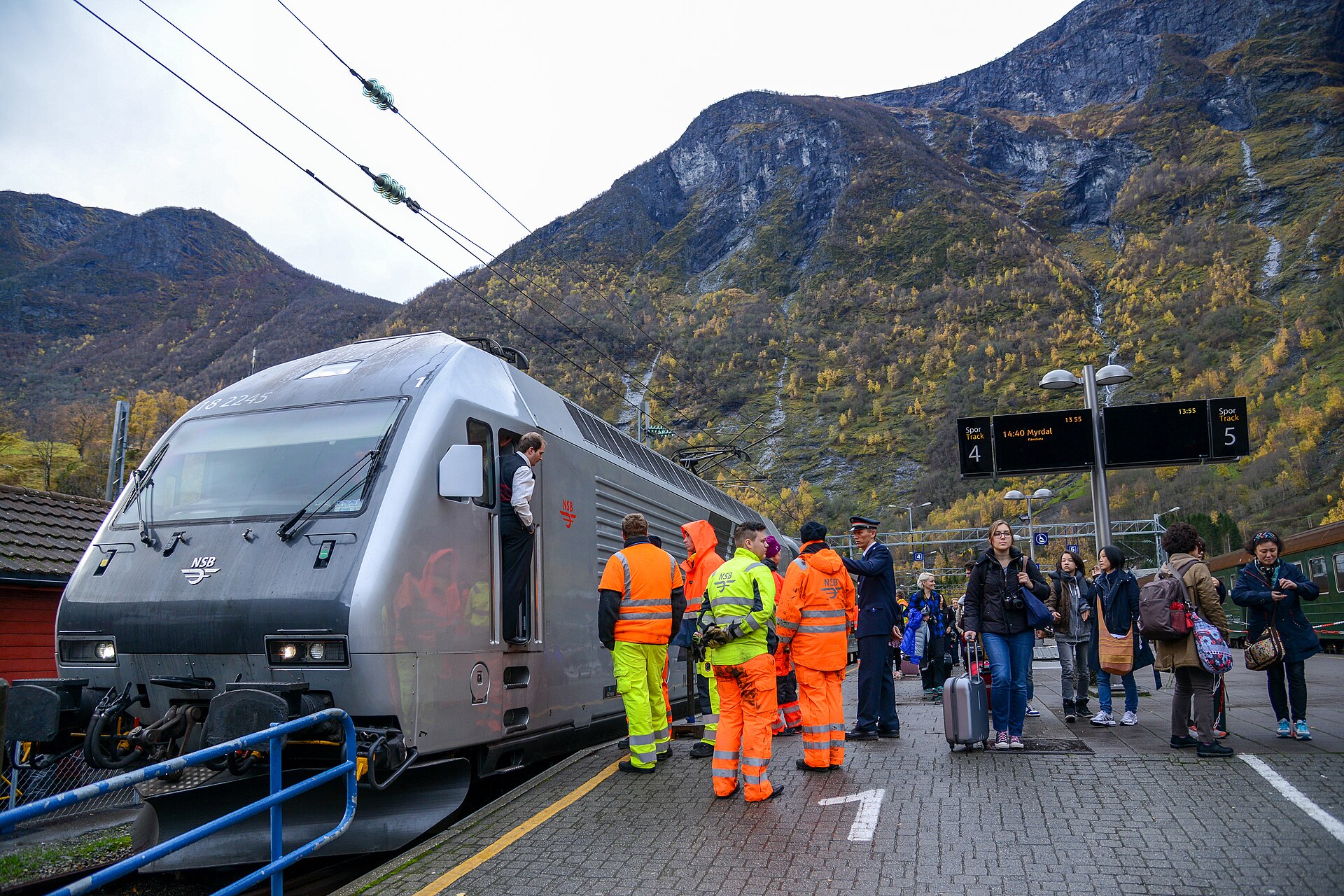
The Flåm Line exists because of the Bergen Railway — it was built to give the mountain crossing a way down to the sea, and it still meets it at Myrdal, where one platform belongs to the green train and the rest to the Oslo and Bergen expresses. Most people arrive on one and leave on the other. Ride the pair together and you get the roof of Norway and the fjord in a single day.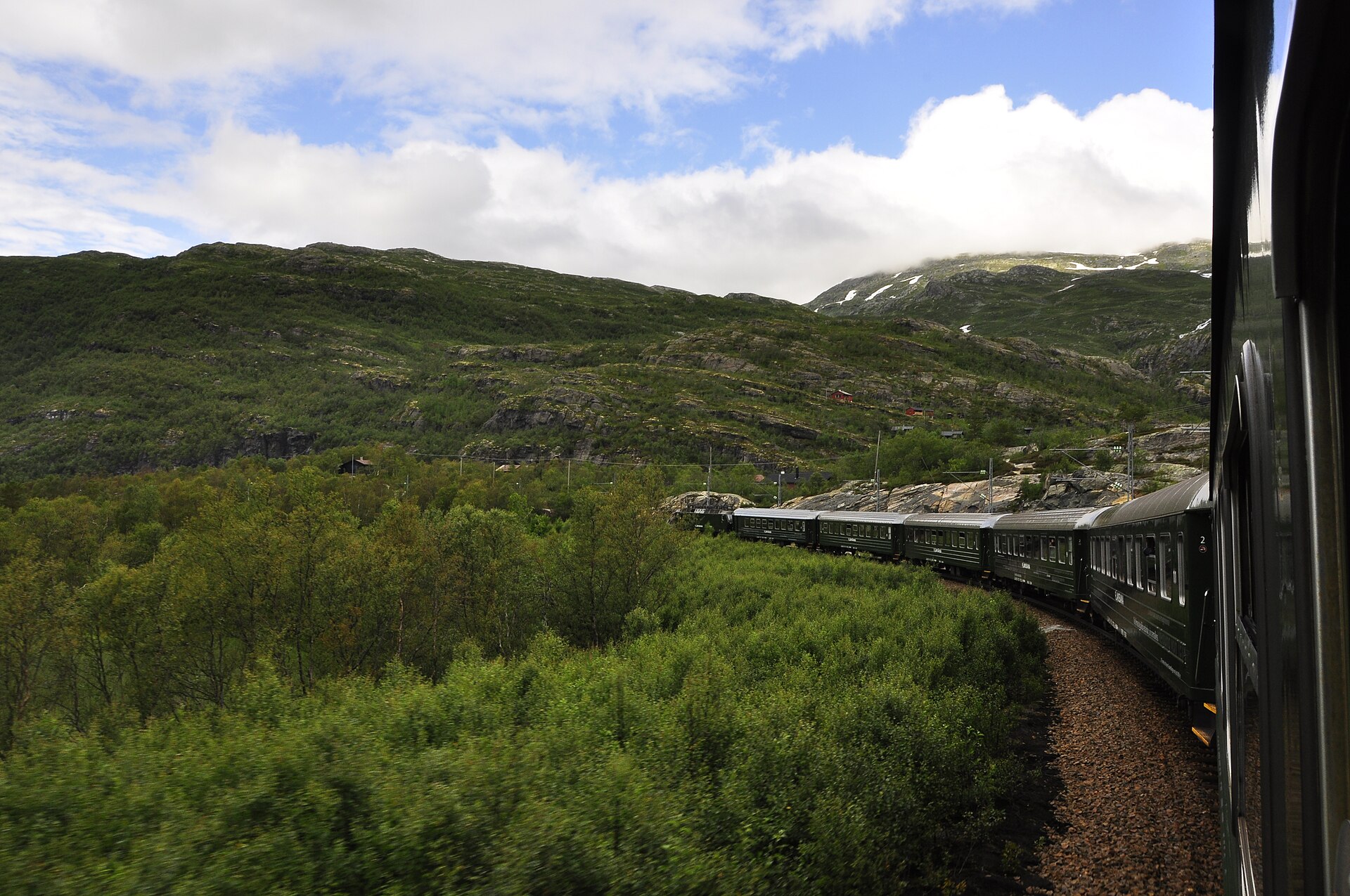 Karen / Wikimedia Commons · CC BY 2.0
Come back down the Rallarvegen
The navvies' road built to construct the Bergen Line runs from Haugastøl through Myrdal and down to Flåm, and the drop into the Flåm valley is the famous part — unpaved, steep and hairpinned, with the railway threading the same valley below you. The trains carry bicycles, so you can ride the line up and cycle back down. The season is short: roughly July to September.Svein Magne Tunli / Wikimedia Commons · CC BY-SA 4.0Stay the night after the ships leave
Flåm handles close to a million passengers a year and most of them are gone by evening — the cruise ships sail, the last connection climbs back to Myrdal, and the village at the head of the Aurlandsfjord empties out. The 19:35 from Myrdal is the quiet one. Stay over and you get the fjord, the valley and the early train more or less to yourself.Timetables
The Flåm Railway runs all year, as line R45, operated by Vy on behalf of Flåmsbana AS. How often it runs changes sharply with the season — ten trains a day at the height of summer, four in winter. The times below are as of July 2026.
High season — to the end of September
Ten departures each way on weekdays. The early 07:20 from Flåm does not run on Saturdays or Sundays, so weekends have nine.
| Flåm → Myrdal | Myrdal → Flåm |
|---|---|
| 07:20 (Mon–Fri) | 08:17 |
| 08:20 | 09:30 |
| 09:35 | 10:45 |
| 10:50 | 12:06 |
| 12:10 | 13:24 |
| 13:30 | 14:41 |
| 14:45 | 15:55 |
| 16:00 | 17:09 |
| 17:10 | 18:21 |
| 18:25 | 19:35 |
Allow 55 to 58 minutes each way in summer. That includes the seven-minute booked stop at Kjosfossen — the 10:45 from Myrdal, for instance, stands at the waterfall from 10:56 to 11:03.
October — the shoulder season
Six departures each way, with a couple of extra Thursday and early-October workings.
| Flåm → Myrdal | Myrdal → Flåm |
|---|---|
| 08:20 | 09:30 |
| 09:35 | 10:45 |
| 10:50 | 12:06 |
| 12:10 | 13:24 |
| 14:45 | 15:55 |
| 16:00 | 17:09 |
Winter — from the start of November
Four departures each way, and the trains are quicker: 40 to 44 minutes, because the long summer photo stop at Kjosfossen shrinks to a minute.
| Flåm → Myrdal | Myrdal → Flåm |
|---|---|
| 09:00 | 10:15 |
| 11:45 | 13:15 |
| 14:30 | 15:39 |
| 16:50 | 18:05 |
Connections at Myrdal. Flåm trains are timed to meet the Bergen Line (line F4, Oslo–Bergen) and the regional R40 service from Bergen and Voss. On a typical summer weekday, Myrdal sees six through Oslo–Bergen expresses each way plus the regional trains, so a Flåm round trip slots into a Bergen Line journey in either direction — see our Bergen Railway page for those times.
Book ahead in summer. Seats are reserved, high-season departures sell out, and the middle of the day is the busiest — cruise passengers walk straight from the quay at Flåm to the platform.
Operator: Flåmsbana — flamsbana.no (opens in a new tab). Tickets are sold through norwaysbest.com (opens in a new tab), and combined Flåm Railway plus Bergen Line journeys through vy.no (opens in a new tab). Times shift at the December and June timetable changes and with the summer and winter seasons, so check before you travel.
Tickets
You can ride the Flåm Railway one way — useful if you are continuing by fjord cruise or picking up the Bergen Line at Myrdal — or as a return from Flåm, which is the usual half-day excursion. It is also the centrepiece of Norway in a Nutshell, the package NSB first assembled in the 1950s, bundling the train with a Bergen Line leg, a fjord cruise and a mountain bus.
Fares do not follow Vy's ordinary per-kilometre pricing: this line is priced as an attraction, and deliberately so, because charging normal rates for a slow twenty-kilometre branch nearly closed it in the 1990s. Eurail and Interrail are not valid for free travel but give a 30 per cent discount. Seats are reserved, so book ahead in high season — the middle of the day goes first, when the cruise ships are in.
Book your tickets
Flåm Railway — one way
Myrdal to Flåm, or Flåm to Myrdal
The classic scenic descent from the mountain to the fjord, about an hour, with the seven-minute waterfall stop at Kjosfossen built into the summer schedule. The one-way ticket is the one to buy if you are carrying on by fjord cruise from Flåm, or joining a Bergen Line train at Myrdal. Seats are reserved and summer departures sell out.
Book Tickets (opens in a new tab, on Flåmsbana)via Flåmsbana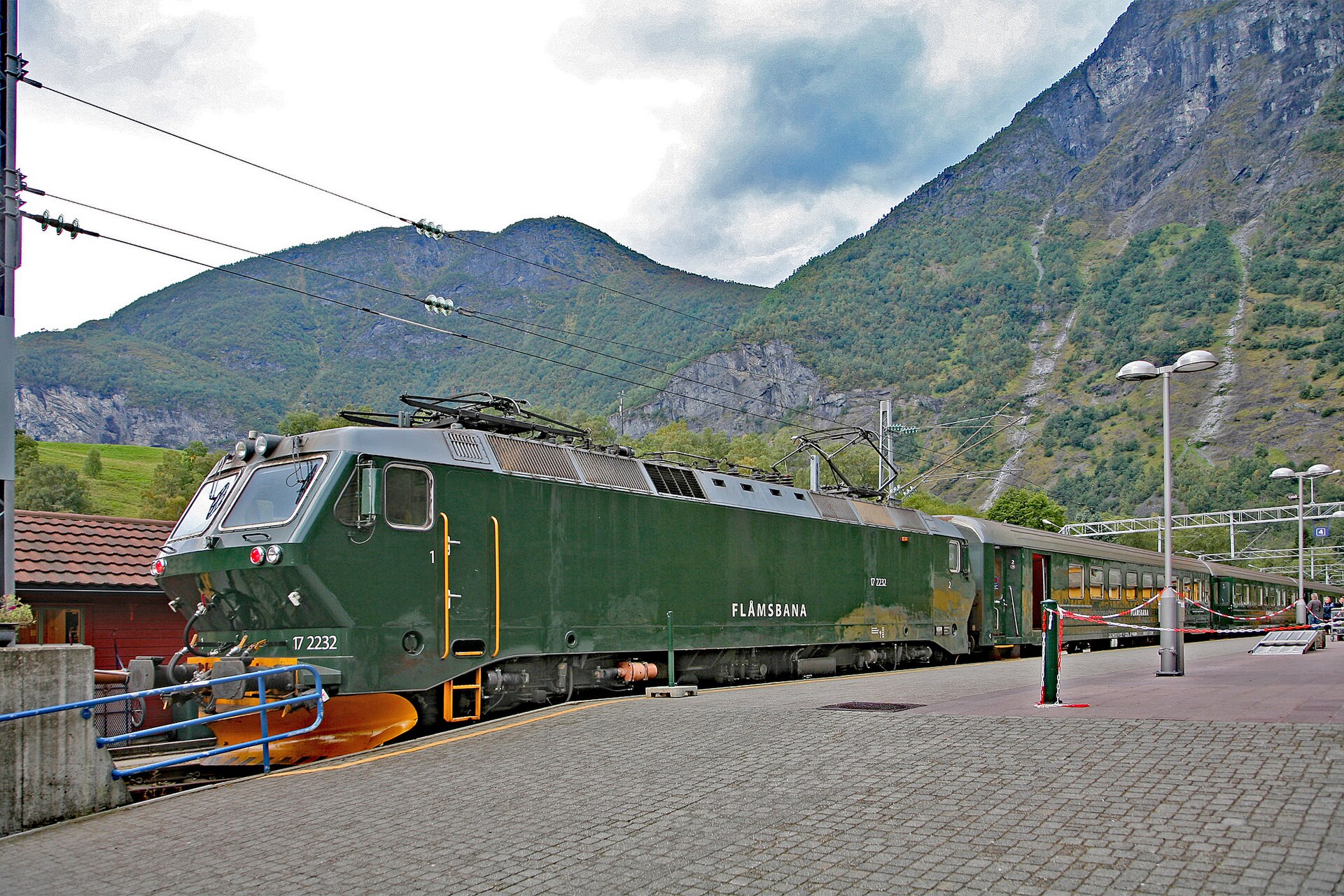
Flåm Railway — return
Round trip from Flåm
Ride up to Myrdal and straight back down, the usual choice if you are based in Flåm or off a cruise ship — about two and a half hours all in. Eurail and Interrail passes are not valid for free travel on this line, but they do give a 30 per cent discount on standard tickets.
Book Tickets (opens in a new tab, on Flåmsbana)via FlåmsbanaRail Passes
Rail passes do not cover the Flåm Railway. Interrail lists it as a discount only: pass holders get 30% off the fare, not free travel. Interrail advises buying the ticket in advance through the Entur customer centre, on +47 61 27 90 88.
A pass still helps with the rest of the trip. The Bergen Railway to and from Myrdal is run by Vy and covered by an Interrail Norway Pass, the Interrail Nordic Pass or a Global Pass, so the pass carries you to the top of the line and the discount takes something off the descent.
Checked October 2026 against interrail.com (opens in a new tab) and Interrail's Norway page (opens in a new tab).
Places to Visit
Flåm sits at the head of the Aurlandsfjord, an arm of the vast Sognefjord, so the scenery does not stop when the train does — and almost everything below is reached by boat or by a bus up the hairpins, not by rail.
The standard way to string it together is the Norway in a Nutshell circuit, which most people buy as a package: train down from Myrdal, boat through the Nærøyfjord to Gudvangen, bus over the mountain to Voss, and the Bergen Railway onward. You can assemble exactly the same thing yourself from ordinary tickets, usually for less, and it lets you stop where the package does not.
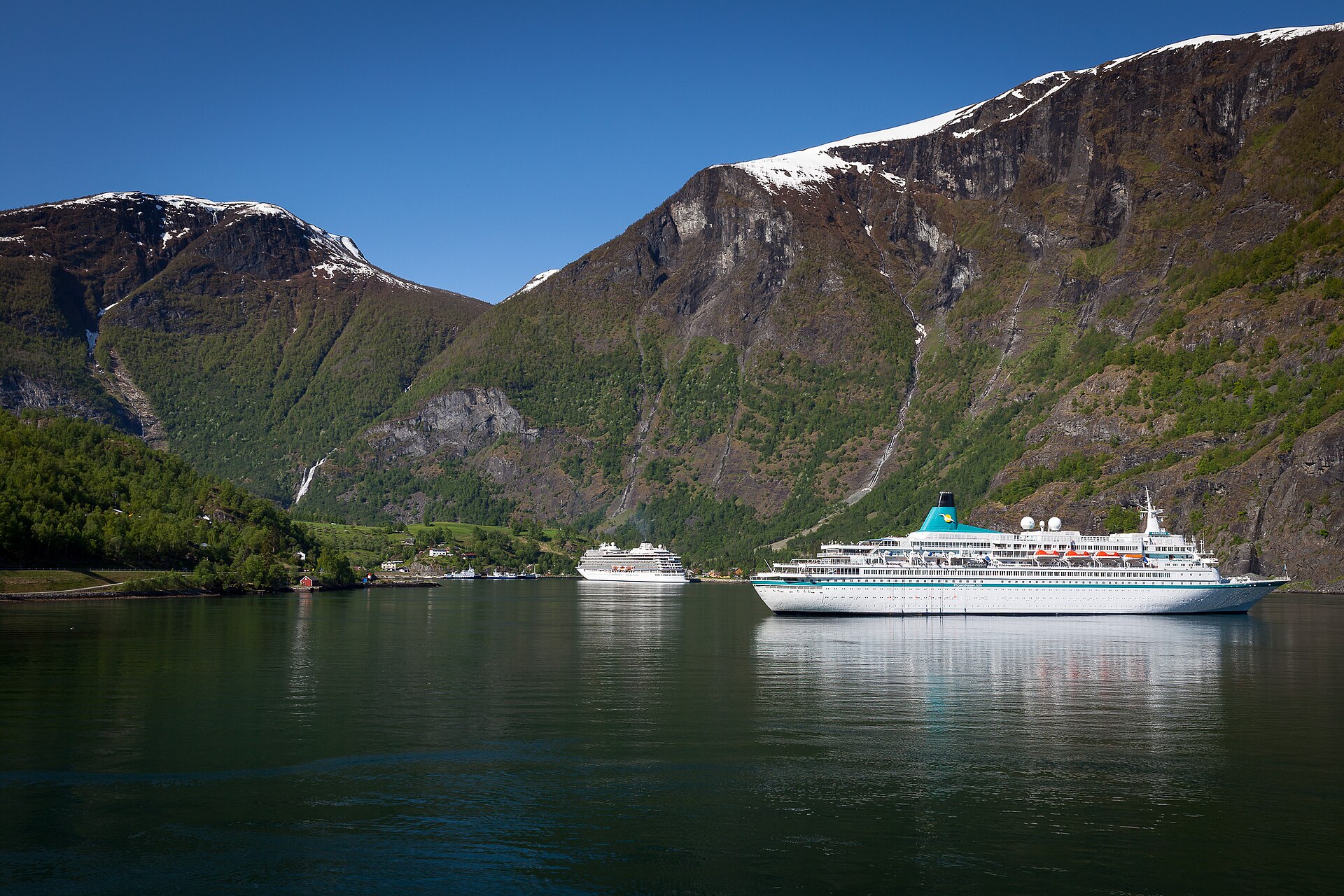
One practical warning. Flåm is a cruise port as well as a railway terminus, and a village this small absorbs a docked ship very visibly — the fjord cruises and the Stegastein buses fill up with it. Going early, or staying the night and going out after the ships have sailed, changes the place completely.
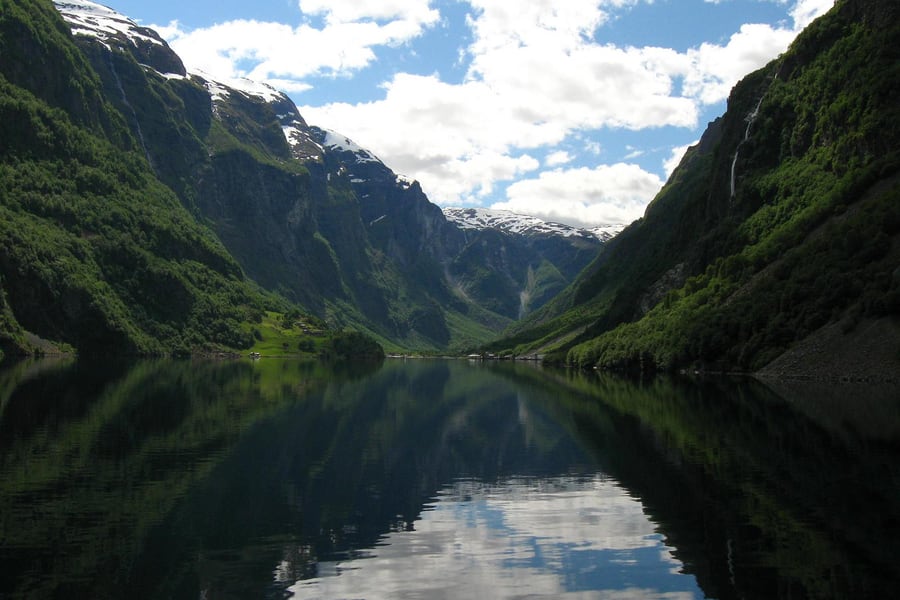 mcxurxo / Wikimedia Commons · CC BY 2.0 · cropped
The Nærøyfjord
A short cruise from Flåm reaches the Nærøyfjord, among the narrowest fjords in the world — a seventeen-kilometre corridor of black water between walls that climb straight to the snowline. It is a World Heritage Site, and the classic next leg of a Norway in a Nutshell trip: boat to Gudvangen, then the bus back over the mountain to Voss.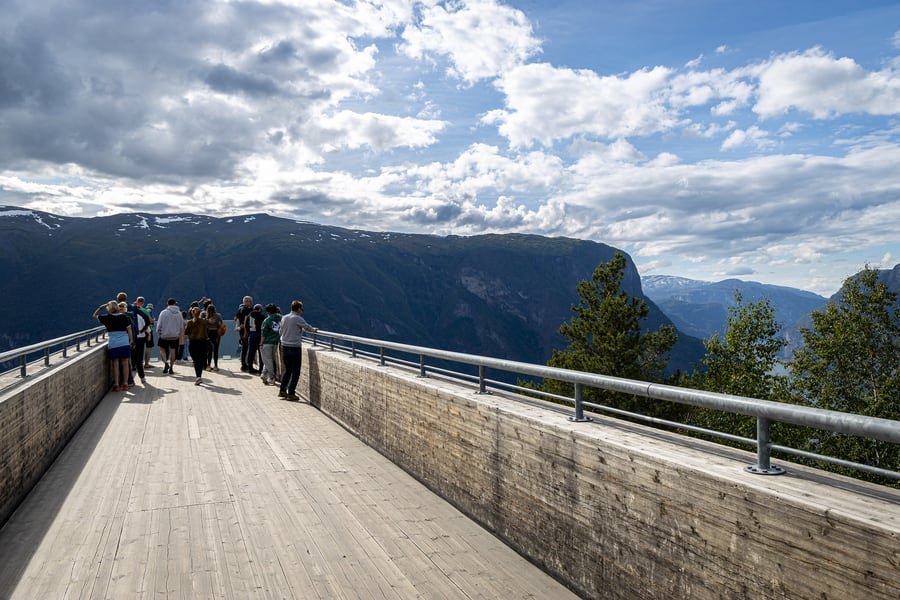 Superbass / Wikimedia Commons · CC BY-SA 4.0 · cropped
Stegastein
High above Aurland, the Stegastein platform runs thirty-one metres out from the hillside and stops at a glass balustrade, 640 metres above the water — one of Norway's most photographed views, and one of the National Tourist Route commissions that put serious architecture on mountain roads. It opened in 2006. A short bus or drive up from Flåm.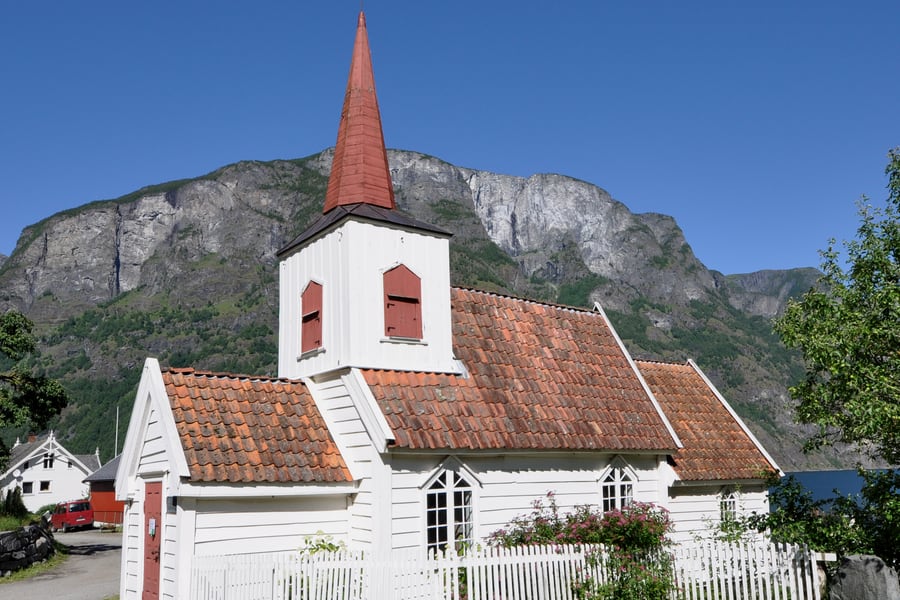 Micha L. Rieser / Wikimedia Commons · Attribution licence · cropped
Undredal
A tiny fjord-side village reached by boat or by the road along the Aurlandsfjord, famous for two things. Its stave church, built around 1147, is 12 by 4 metres with forty seats — the smallest stave church still in use anywhere in Scandinavia. And the village has made its own brown goat's cheese for generations, and still sells it at the door.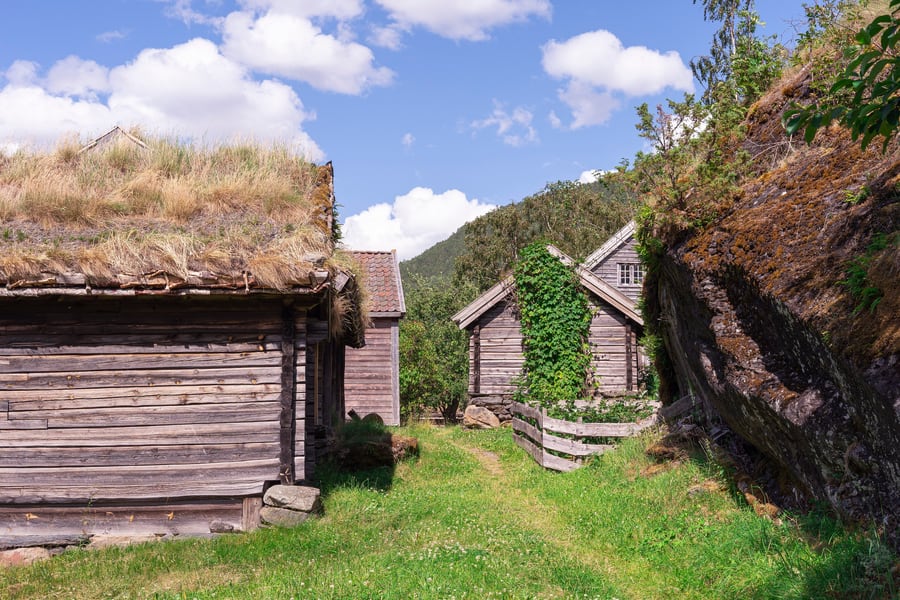 Øyvind Holmstad / Wikimedia Commons · CC BY-SA 4.0 · cropped
Otternes
Halfway between Flåm and Aurland, twenty-seven turf-roofed timber buildings stand on a shelf above the water — a klyngetun, the old west-Norwegian habit of building a farm as a huddle rather than a scatter. Norway's heritage directorate moved to formally protect the site in May 2025. It opens to visitors in summer.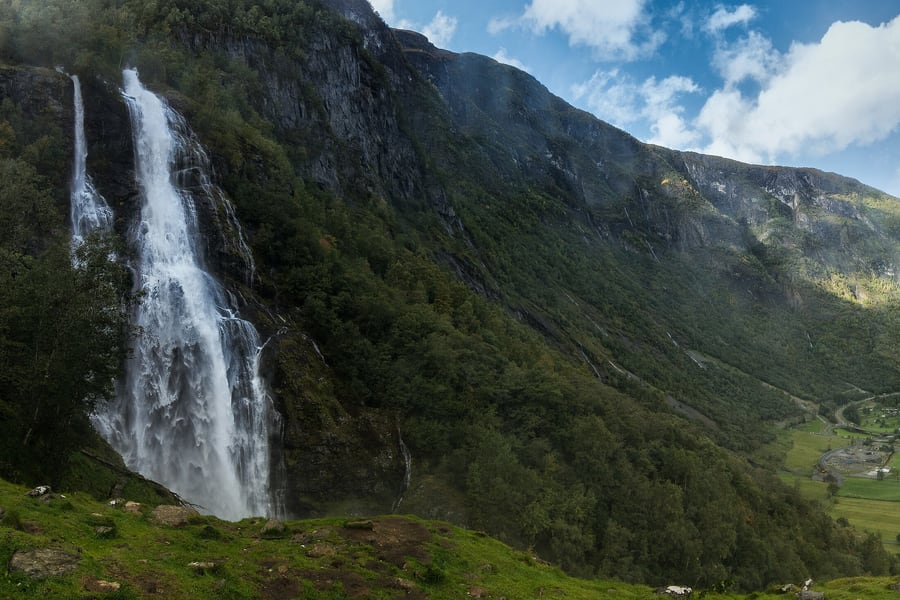 mendhak / Wikimedia Commons · CC BY-SA 2.0 · cropped
Brekkefossen
The waterfall above Flåm, and the obvious short walk from the terminus — a steep path up the valley side that ends level with the falls, looking straight back down the Flåmsdalen at the village, the fjord and the railway you came in on. It is a climb rather than a stroll, and the rock stays wet all summer, so wear something with a grip on it.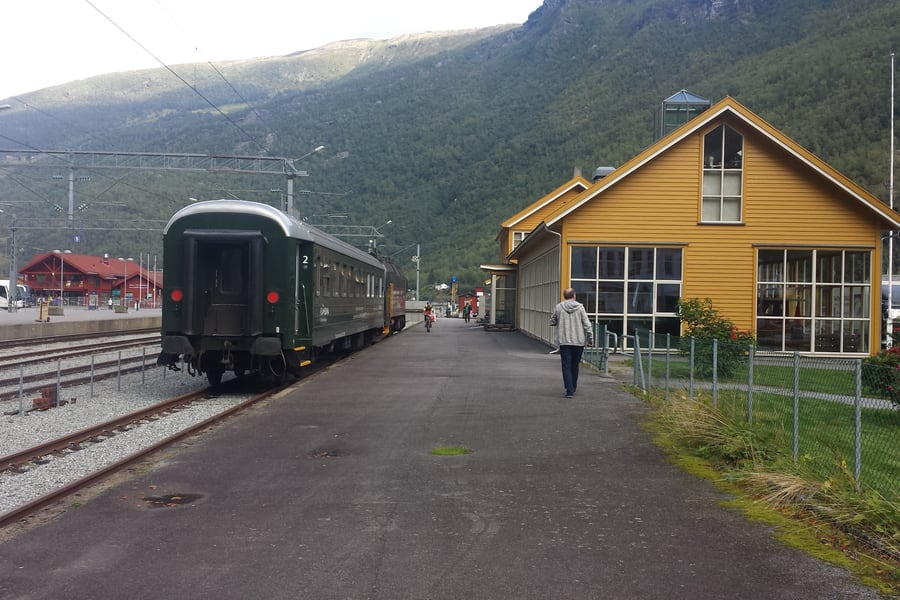 Chris j wood / Wikimedia Commons · CC BY-SA 4.0 · cropped
The Flåm Railway Museum
Right at the end of the line, in the old station building, a museum devoted to the railway itself — how it was surveyed, hand-dug and very nearly abandoned. It opened in 1995 in an annexe of the Fretheim Hotel and moved into the old station building in 1999. Worth the twenty minutes before your train back up.Where to Sleep
Most visitors ride the Flåm Railway as a day trip, but Flåm and the surrounding fjord villages make a lovely overnight stop — and staying over lets you catch the valley in the quiet early morning before the day-trippers arrive.
The historic Fretheim Hotel, right by the railway terminus in Flåm, is the classic choice, with a long history of hosting travellers to the fjord. Aurland and the smaller villages along the Aurlandsfjord offer guesthouses and cabins for a quieter base. Book well ahead in summer, as fjord-side rooms are limited.
Questions or corrections
Planning this trip and stuck on something, or spotted a time, fare or detail that has changed? Send us a message about Flåm Railway. We read every one, and we update this page when something has changed.