Franschhoek Wine Tram
Blyth01 / Wikimedia Commons · CC BY-SA 4.0 · cropped
- DistanceTwo tram sections, about 2 km and 4 km, joined by road · Cape gauge
- DurationA day out; allow at least three hours
- Best seasonDaily all year, except 24, 25 and 31 December and 1 January
Introduction
The branch line to Franschhoek was opened in 1904 so that the valley's farmers could send their produce to market by train instead of by ox-wagon. Steam worked it until diesels took over in the 1970s; by the 1990s the traffic had drained away, and for more than a decade the rails lay idle. In 2012 the line came back, as the Franschhoek Wine Tram — but it came back as its two ends.
One tram runs out of Franschhoek village for about two kilometres, to Rickety Bridge, and back past Grande Provence. The other works the far end around Groot Drakenstein, north to Plaisir, Vrede en Lust and Simondium and east to Boschendal. The thirteen kilometres of branch between them carry no trams: an open-sided tram-bus takes passengers across the middle of the valley by road, and out to the estates the rails never reached.
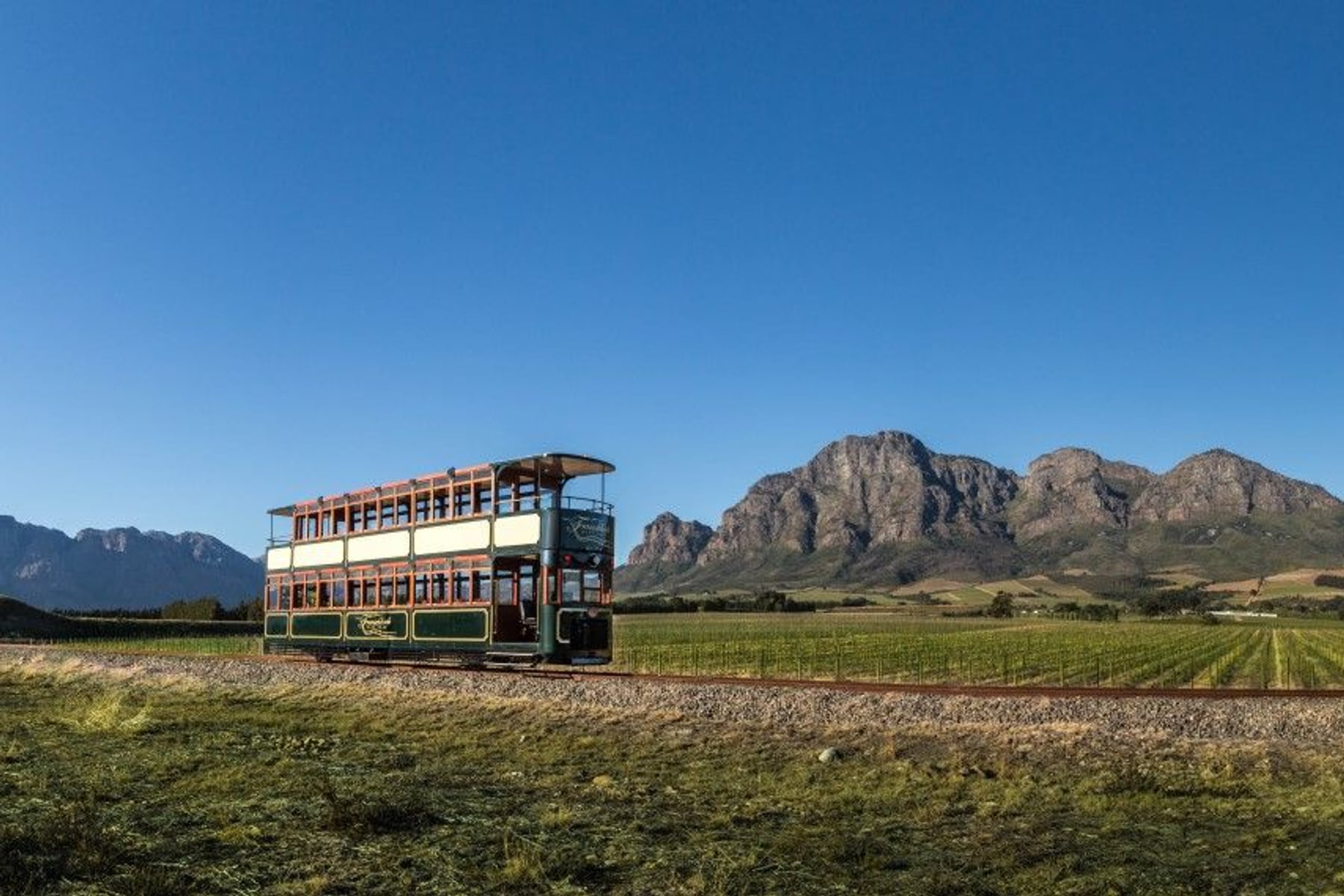
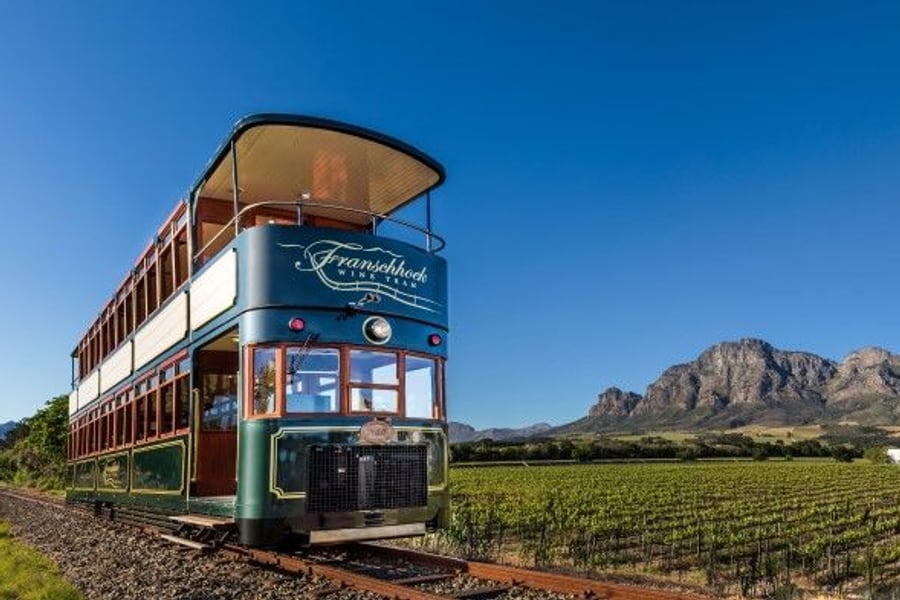
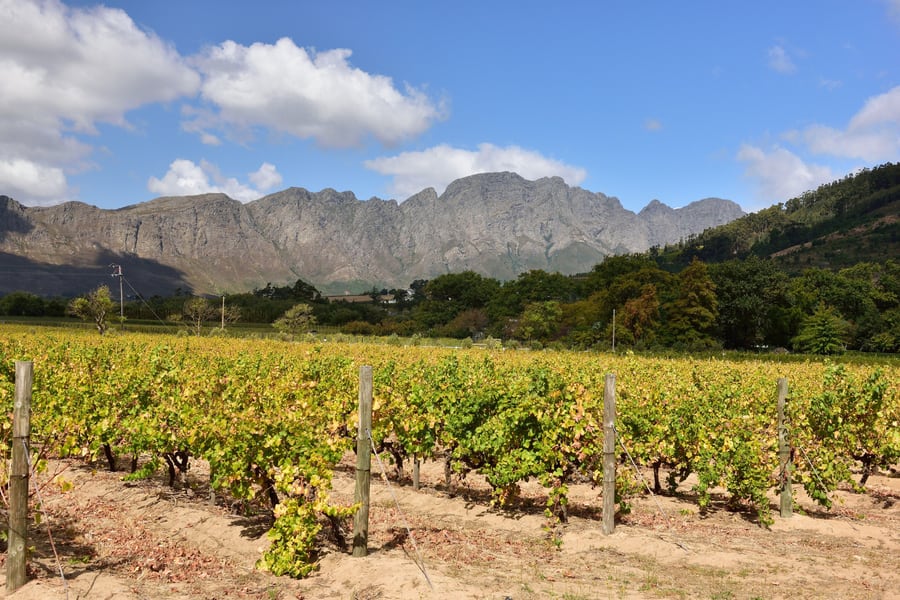
So this is a day among the vines rather than a train ride. You choose one of five colour-coded lines, step off at whichever estates you like, and pick up a later tram or bus to carry on round the loop. The trams are double-deckers built in South Africa in 2017 after the Blackpool balcony cars of about 1923, and from the top deck the Franschhoek and Groot Drakenstein mountains stand over the vineyards on every side.
The Journey
Franschhoek is about 75 kilometres from Cape Town, in a valley hemmed in by mountains. The Huguenot refugees who were given land here in 1688 named their farms after the places they had left behind — La Motte, Cabrière, La Provence, La Dauphine — and many of those farms are wine estates today. The day starts at one of two terminals: the Franschhoek Terminal on Main Road for the Red, Blue and Pink Lines, or the Groot Drakenstein Terminal, at the junction of the R45 and R310 at the other end of the valley, for the Green and Orange Lines. A shuttle runs between the two in fifteen minutes.
The Franschhoek end
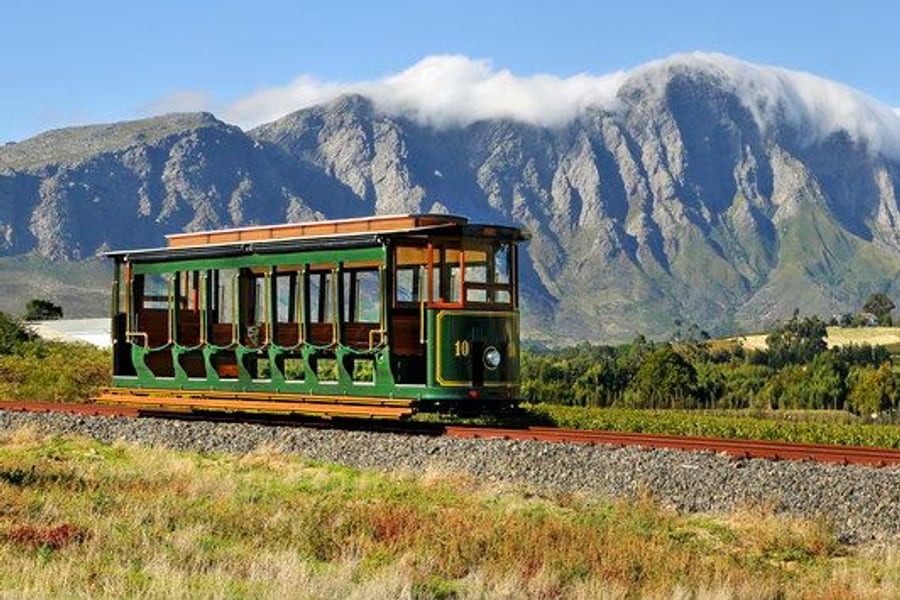
The tram leaves the terminal every half hour and runs down the old branch through open ground and vines to Rickety Bridge, about two kilometres out, then works back with stops at Grande Provence and Franschhoek Cellar: thirty minutes there and back. The Red, Blue and Pink Lines each pair this tram with a bus loop of their own — up towards the Franschhoek Pass to Mont Rochelle and Haute Cabrière, south to La Bri and Holden Manz, or out to Dieu Donné, Chamonix and Leopard's Leap. You book the tram first or the bus first, and at each stop you choose whether to get off.
The Groot Drakenstein end
At Groot Drakenstein the tram shuttles east to Boschendal, then north on the branch towards Paarl to Plaisir and Vrede en Lust, an hour for the round. The Green Line adds a bus loop to Allée Bleue and out towards Stellenbosch for Camberley, Bartinney, Le Pommier and Zorgvliet; the Orange Line goes by bus to Babylonstoren and Baccō, then picks up the tram at Simondium, the hamlet named after Pierre Simond, the Huguenots' minister. At the largest estates — Babylonstoren, Boschendal, Grande Provence, Plaisir, Rickety Bridge, Baccō — a farm vehicle carries you the last 10 to 20 minutes from the platform to the tasting room.
The trams
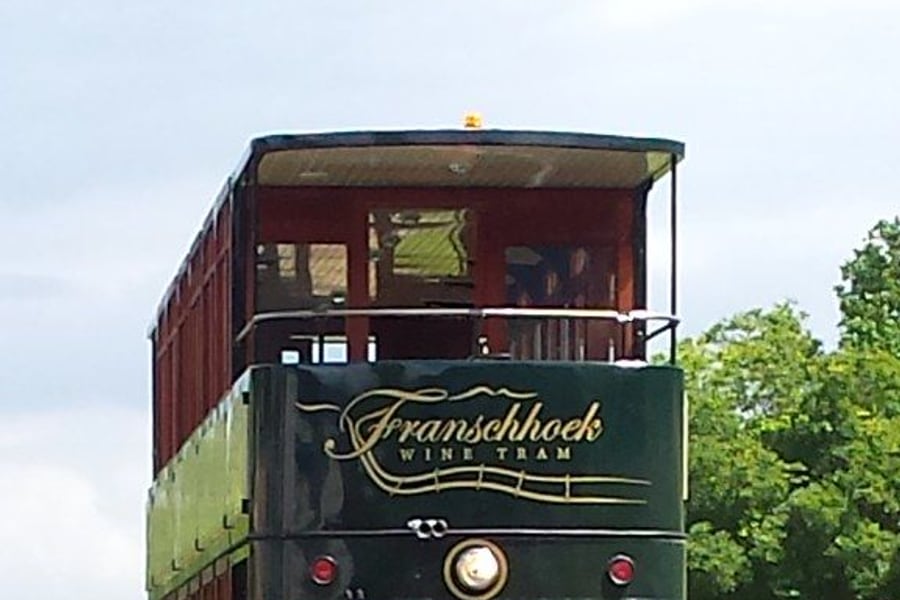
The line was reopened in 2012 with a single open-sided tram. Since 2017 the work has been done by double-deckers built in South Africa by DCD Rolling Stock and modelled on the Blackpool Corporation's double-deck balcony cars of about 1923: almost five metres tall, they seat 78 on flip-over benches so that you can face either way, and they run at up to 32 km/h. The track is the branch's own Cape gauge, 1,067 mm. Both the trams and the buses are open at the sides, which is the point on a fine day and the reason to bring a jacket on a cool one.
Along the route
 South African Tourism / Wikimedia Commons · CC BY 2.0 · cropped
The Franschhoek line
From the terminal on Main Road the tram runs about two kilometres down the old branch to Rickety Bridge, then calls at Grande Provence and Franschhoek Cellar on the way back: a 30-minute round trip, every half hour.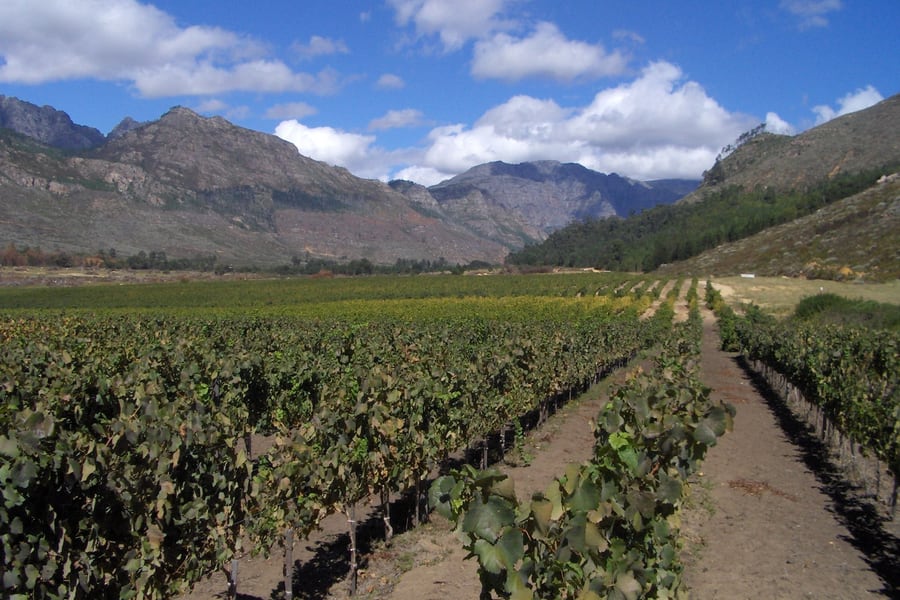 Sara Atkins / Wikimedia Commons · CC BY 2.0 · cropped
Up the valley by tram-bus
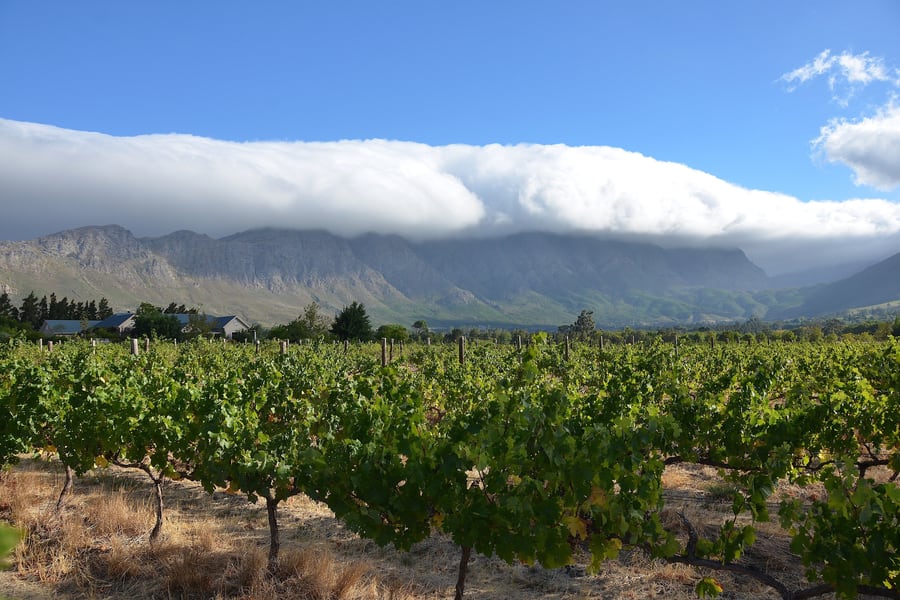
The estates the rails never reached are on bus loops from the same terminal: Mont Rochelle and Haute Cabrière on the Red Line, La Bri and Holden Manz on the Blue, Chamonix and Dieu Donné on the Pink, all on the slopes towards the pass.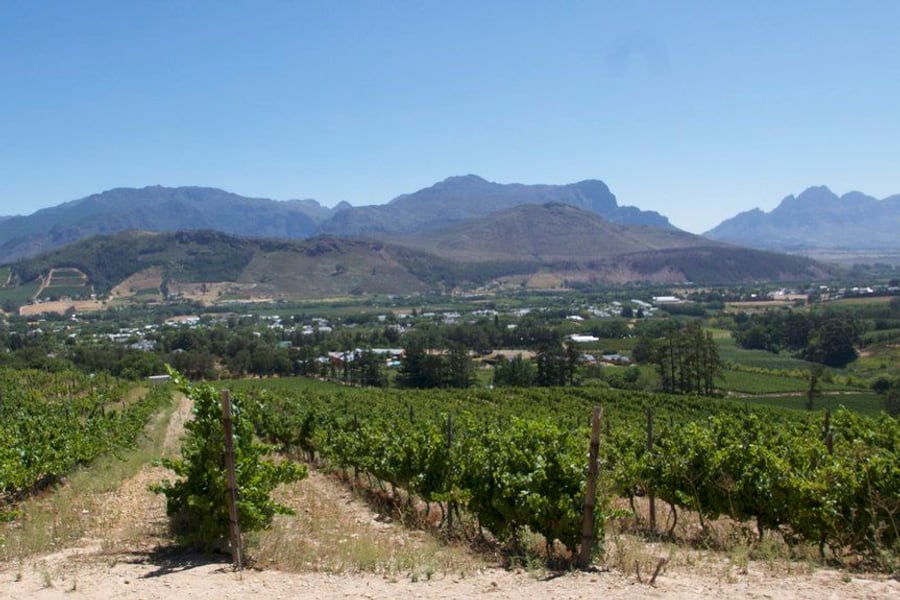 Werner Bayer / Flickr · CC0 · cropped
Across the middle by road
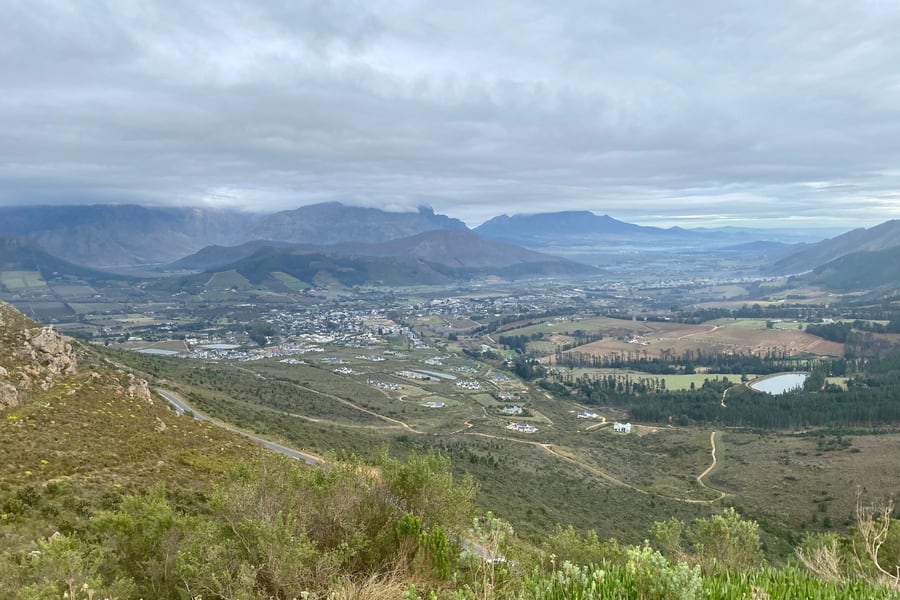
Between the two tram sections some thirteen kilometres of the branch carry no trams. A shuttle takes Green and Orange Line passengers from Franschhoek to Groot Drakenstein in fifteen minutes, past Leopard's Leap on the R45.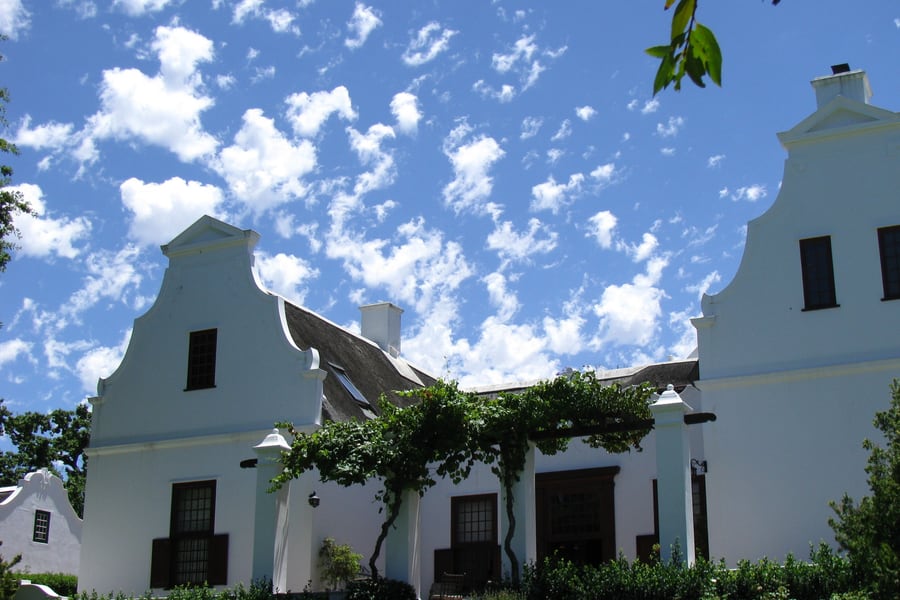 Chris&Kerri / Wikimedia Commons · CC BY-SA 3.0 · cropped
Groot Drakenstein to Simondium
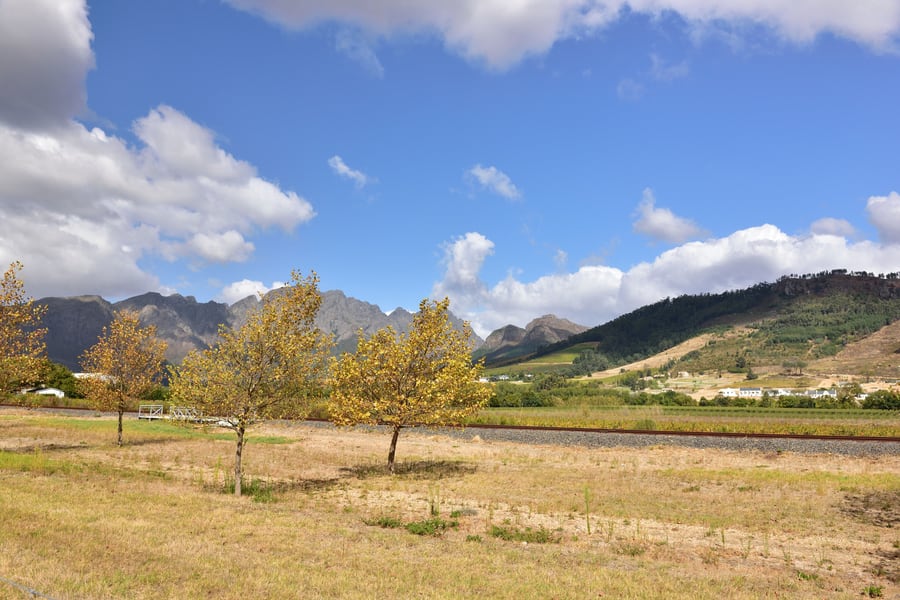
The second tram leaves the Groot Drakenstein terminal for Boschendal, then heads north for Plaisir and Vrede en Lust, whose manor house stands among old oaks below the Simonsberg. Orange Line passengers join it at Simondium, after a bus to Babylonstoren.A bit of history
Culture & experiences along the way
 South African Tourism / Wikimedia Commons · CC BY 2.0 · cropped
The Huguenot Memorial Museum
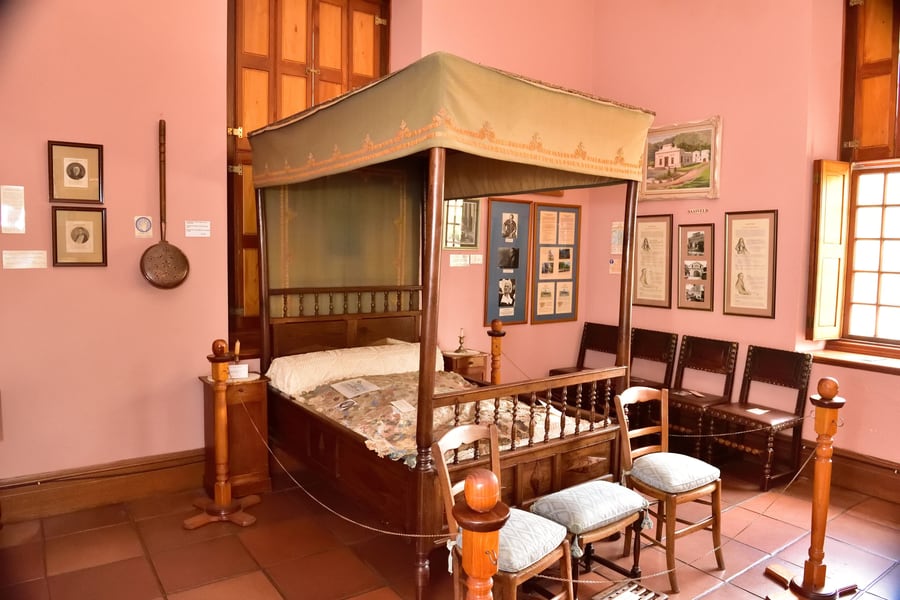
At the end of the main road, beside the Huguenot Monument, the museum tells why almost 300 French Protestants reached the Cape in 1688 and where they farmed. Its main building is Saasveld, a Cape Town house designed by Louis Michel Thibault, taken down and rebuilt here brick by brick in 1967.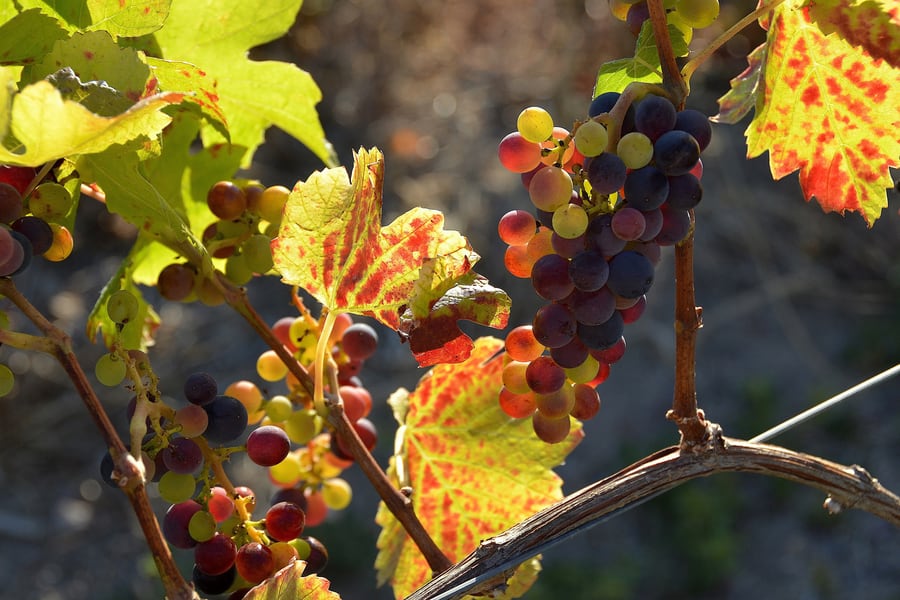 Olga Ernst / Wikimedia Commons · CC BY-SA 4.0 · cropped
Cap Classique
The Cape's sparkling wine is made the classic way, with a second fermentation in the bottle, and the estates on the lines pour plenty of it: Grande Provence pairs it with oysters and Haute Cabrière with macarons, and Haute Cabrière will also open a bottle the old way, with a sabre.Timetables
The Wine Tram runs every day of the year except 24, 25 and 31 December and 1 January. Between mid-May and mid-September only some of the lines run on weekdays. Seats are booked for a line and a starting time, and the lines start between 08:45 and 13:00; after that the trams and buses run on a fixed loop, roughly hourly at each stop, and you get back on whichever one comes next. The loop runs one way only, so each estate gets one chance to step off. The last services of the afternoon only collect, bringing passengers back to the terminal.
The tram at the Franschhoek end — Red, Blue and Pink Lines
| Franschhoek Terminal | Rickety Bridge | Grande Provence | Franschhoek Cellar | Franschhoek Terminal |
|---|---|---|---|---|
| 09:30 | 09:42 | 09:48 | 09:54 | 10:00 |
| 10:00 | 10:12 | 10:18 | 10:24 | 10:30 |
| …every 30 minutes… | ||||
| 17:00 | 17:12 | 17:18 | 17:24 | 17:30 |
| 17:30 | 17:42 | 17:48 | 17:54 | 18:00 |
The tram at the Groot Drakenstein end — Green Line
| Groot Drakenstein | Boschendal | Groot Drakenstein | Plaisir | Vrede en Lust | Groot Drakenstein |
|---|---|---|---|---|---|
| 09:14 | 09:21 | 09:35 | 09:46 | 09:58 | 10:14 |
| 10:14 | 10:21 | 10:35 | 10:46 | 10:58 | 11:14 |
| …every hour… | |||||
| 16:14 | 16:21 | 16:35 | 16:46 | 16:58 | 17:14 |
The Orange Line leaves Groot Drakenstein by bus at 09:35, 10:35, 11:35 and 12:35 for Babylonstoren and Baccō, and joins the tram at Simondium for Vrede en Lust, Plaisir and Boschendal.
Getting to Groot Drakenstein
The starting times sold for the Green and Orange Lines are those of the shuttle from the Franschhoek Terminal, which takes fifteen minutes: 08:45, 09:45, 10:45 and 11:45 for the Green Line, and 09:05, 10:05, 11:05 and 12:05 for the Orange. From the Info Kiosk on Franschhoek Square another runs at quarter past and quarter to the hour from 08:00. Arriving by car, go straight to the Groot Drakenstein Terminal and allow half an hour after the booked time.
As of October 2026, from the operator's timetable of 22 June 2026 and the departures on sale on the Franschhoek Wine Tram's site (opens in a new tab). Be at the terminal 10 to 15 minutes before your departure to collect tickets.
Tickets
The ticket most people buy is the Hop-on Hop-off day on one colour line, booked online for a starting time and collected at the terminal on the day. It covers the trams, tram-buses and shuttle, and the narration on board; wine tastings, at R60 to R260 a person, meals and Babylonstoren's entry are paid at each estate. Children under three ride free, and there are no discounts for students, pensioners or non-drinkers.
Hosted days with tastings and food included are sold on the same site, along with a return transfer from Cape Town. Cancel at least 24 hours ahead for a full refund. From the operator's booking pages, in South African rand, as of October 2026.
Book your tickets
Hop-on Hop-off day ticket
R350 · adults; R90 · ages 3 to 17
A day on one colour line, by tram and tram-bus, with tastings and meals paid at each estate.
Book Tickets (opens in a new tab, on Franschhoek Wine Tram)via Franschhoek Wine TramFlavours of the Vine
R1,900 · per person
A hosted day for adults, from 10:30 to about 17:00, by tram and open-air bus to four estates, with tastings and platters included.
Book Tickets (opens in a new tab, on Franschhoek Wine Tram)via Franschhoek Wine TramRail Passes
No rail pass covers the Wine Tram. It is a private tourist service with its own day tickets, so everyone books it from the operator.
Places to Visit
The estates are the stops, but the valley has older things to see between tastings, most of them within reach of the two terminals.
 Chris&Kerri / Wikimedia Commons · CC BY-SA 3.0 · cropped
Boschendal
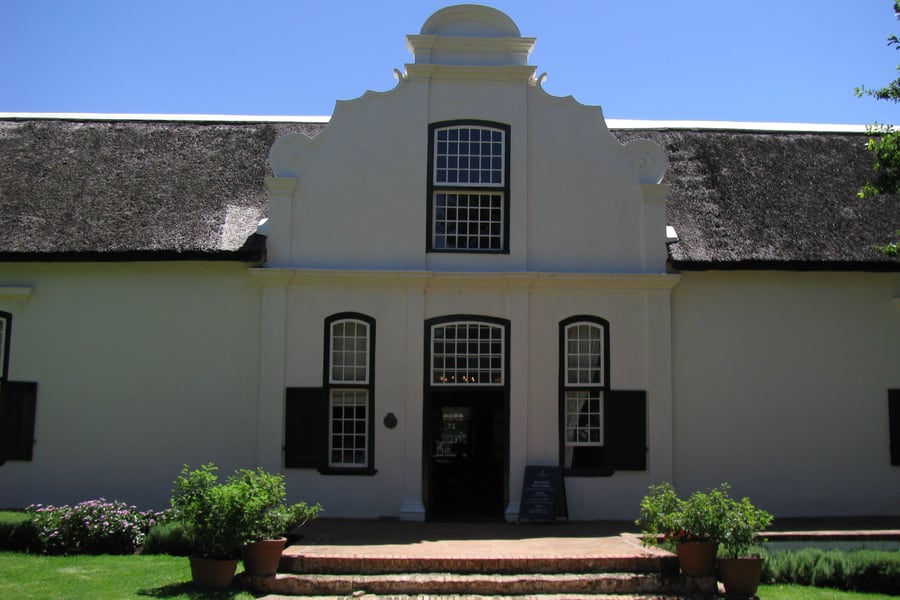
The Huguenot Jean le Long was granted this farm in 1688, and the De Villiers family kept it until 1879; the thatched, gabled manor house was finished by Paul de Villiers in 1812 and is open to visitors. Cecil Rhodes later bought the estate for his fruit farms, and the tram stops at its own platform.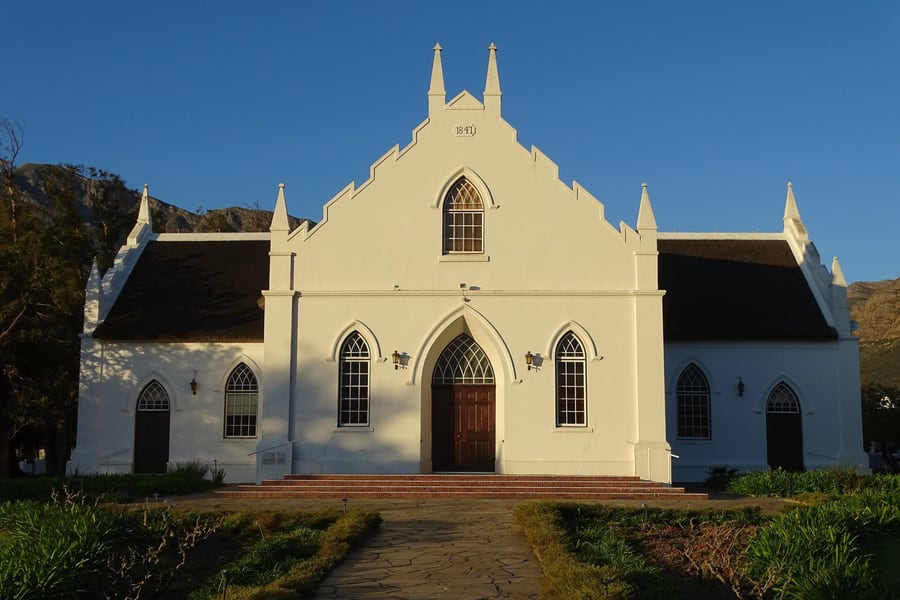 © Ad Meskens / Wikimedia Commons · CC BY-SA 4.0 · cropped
The Dutch Reformed Church
On the main road through the village, the white church with its stepped gable and pinnacles was built in 1847 and declared a national monument in 1972. Its services have been held in Afrikaans rather than Dutch since 1929, and a thorough restoration in 1967–68 meant that the earthquake of the following year did it only minor damage.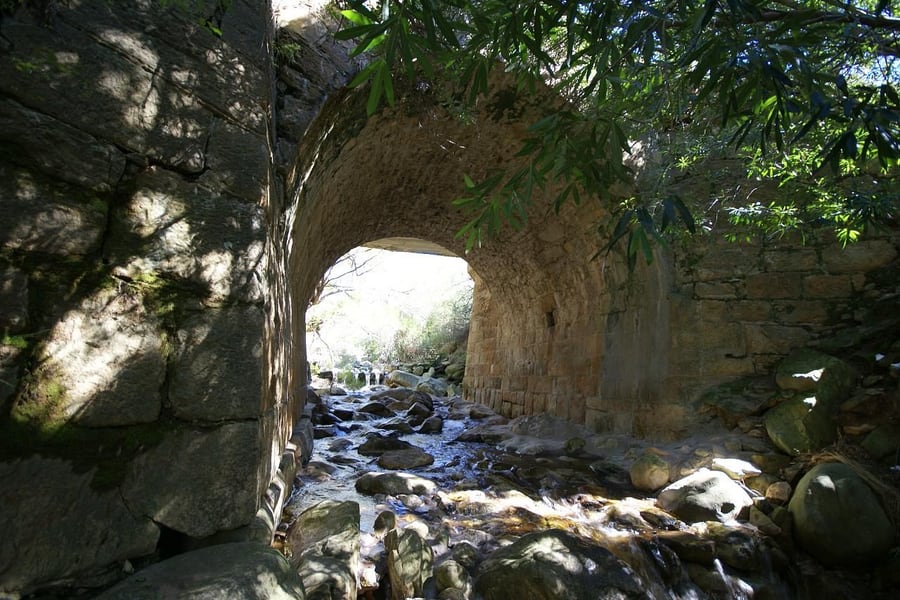 Danie van der Merwe / Wikimedia Commons · CC BY 2.0 · cropped
Jan Joubert's Gat bridge
The road over the mountains east of the village was built for Lord Charles Somerset by 150 soldiers of the Royal African Corps on their way to Sierra Leone, and opened in 1825. Their stone bridge at Jan Joubert's Gat, named for the Jan Joubert who died there, is in the Huguenot museum's words the oldest bridge in the country still in use.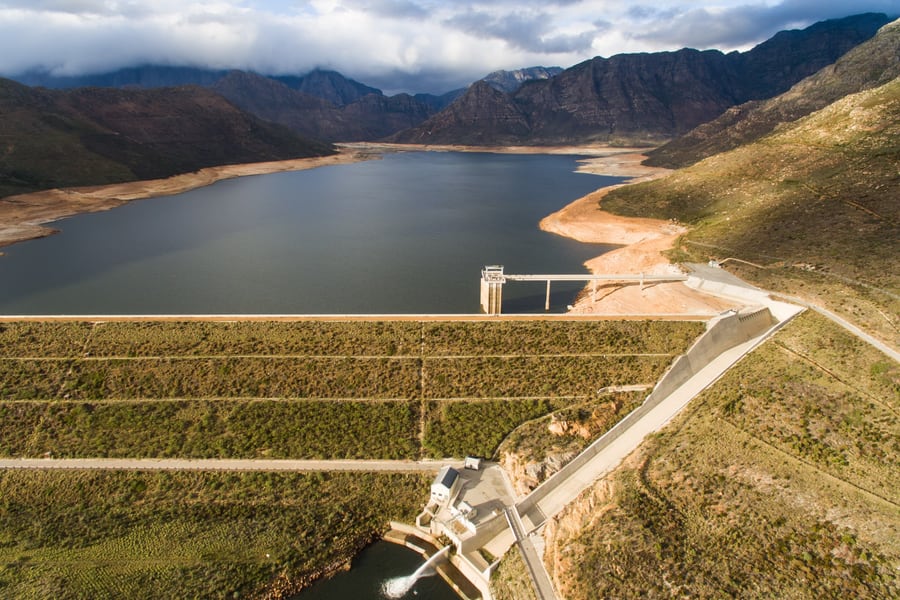 Daniel Saaiman / Wikimedia Commons · CC BY-SA 4.0 · cropped
Berg River Dam
In the mountains just outside the village, a 68-metre dam has held back the Berg River since 2007 to store winter rain for Cape Town's dry summers. It was the first dam in South Africa built to the guidelines of the World Commission on Dams, and its outlet can release floods to keep the river below it alive.Where to Sleep
Franschhoek is about 75 kilometres from Cape Town, so the tram works as a day out from the city, and the operator sells a return transfer. To stay among the vines instead, there are rooms on estates at both ends of the line.
Where to stay
 Glany Saldanha / Wikimedia Commons · CC BY 3.0 · cropped
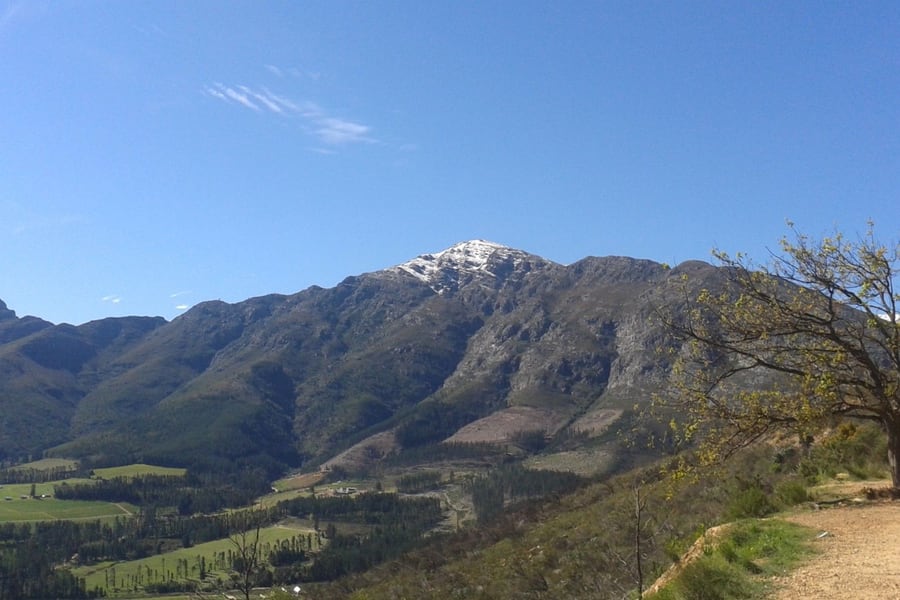
Mont Rochelle
On a wine estate above Franschhoek
A 26-room hotel among the vineyards of a Red Line estate, with views of the Dassenberg mountains.
Check Availability (opens in a new tab, on virginlimitededition.com)via virginlimitededition.com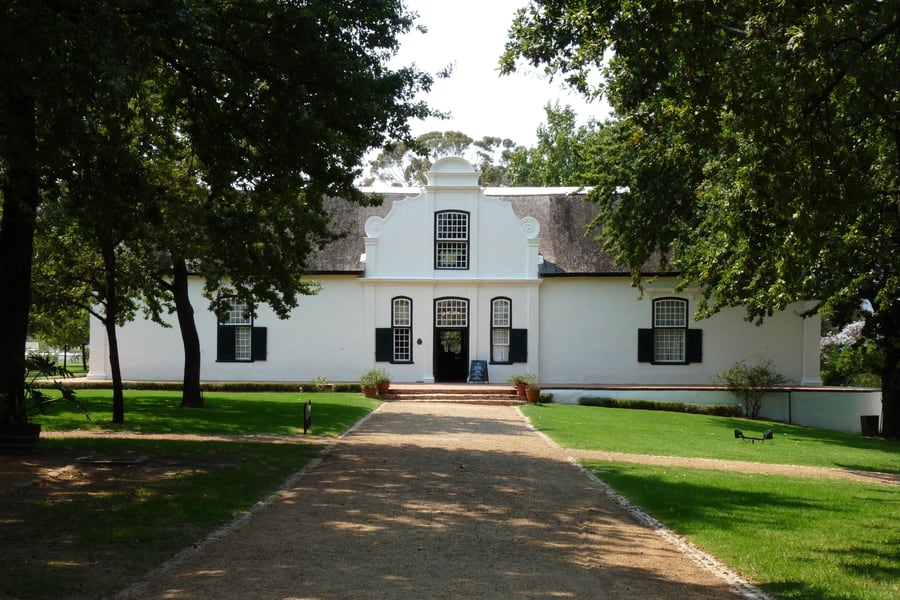 michael clarke stuff / Wikimedia Commons · CC BY-SA 2.0 · cropped
Boschendal
Cottages on the estate at Groot Drakenstein
Farm cottages and garden suites on the estate, which has its own stop on the Green and Orange Lines.
Check Availability (opens in a new tab, on boschendal.com)via boschendal.comQuestions or corrections
Planning this trip and stuck on something, or spotted a time, fare or detail that has changed? Send us a message about Franschhoek Wine Tram. We read every one, and we update this page when something has changed.