Resort Shirakami
MaedaAkihiko / Wikimedia Commons · CC BY-SA 4.0
- DistanceAbout 248 km, Akita to Aomori via the Gonō Line
- DurationAbout 5¼ hours Akita to Aomori, three return trains a day in season
- Best seasonDaily April to early December · weekends and holidays in winter
Introduction
The Gonō Line runs 147.2 km round the north-west corner of Honshu, from Higashi-Noshiro in Akita Prefecture to Kawabe in Aomori. It is single track and unelectrified, and for most of its length it follows the Sea of Japan, under the hills of the Shirakami range, a World Natural Heritage site. Its name joins the two towns it was built to link, Goshogawara and Noshiro.
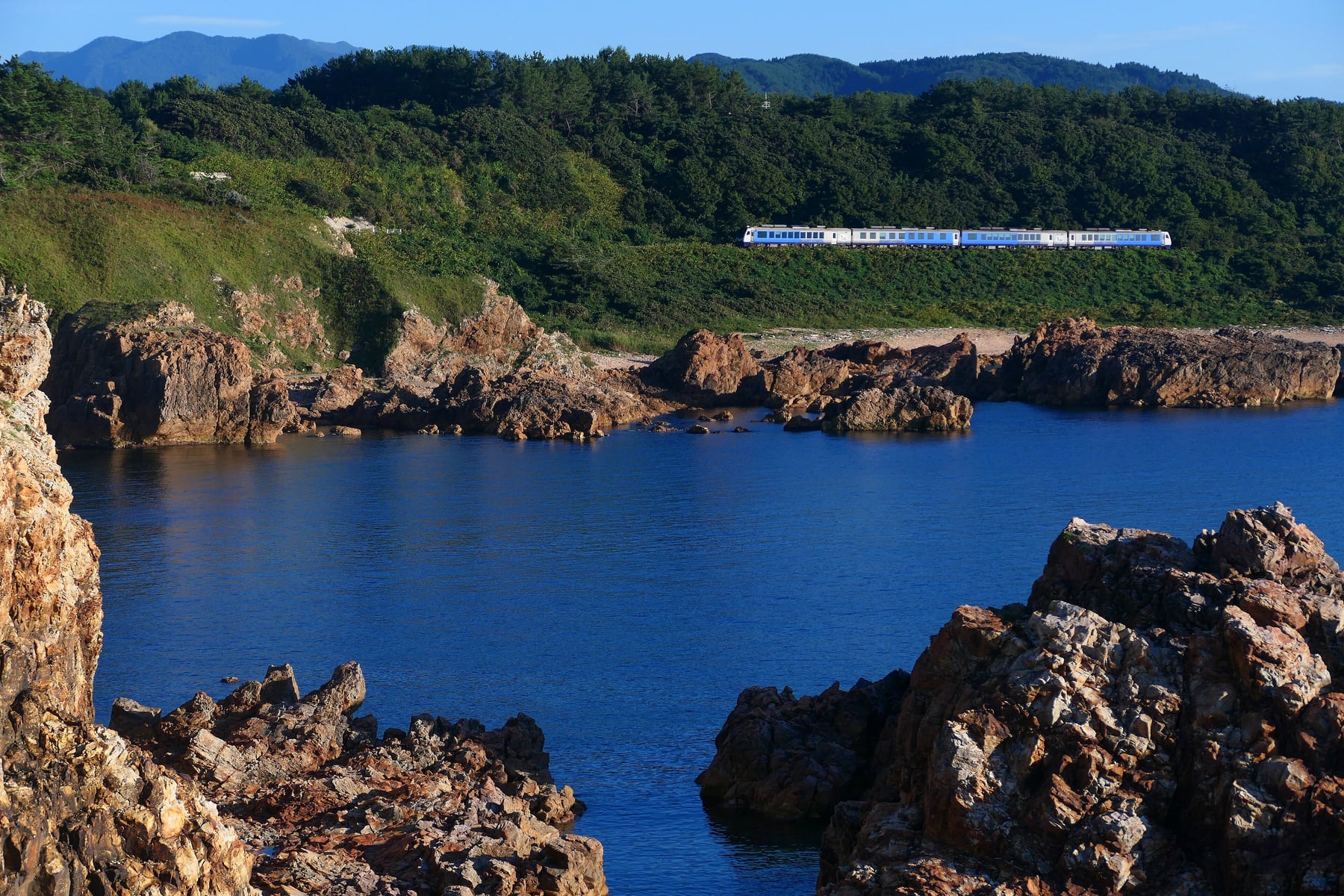
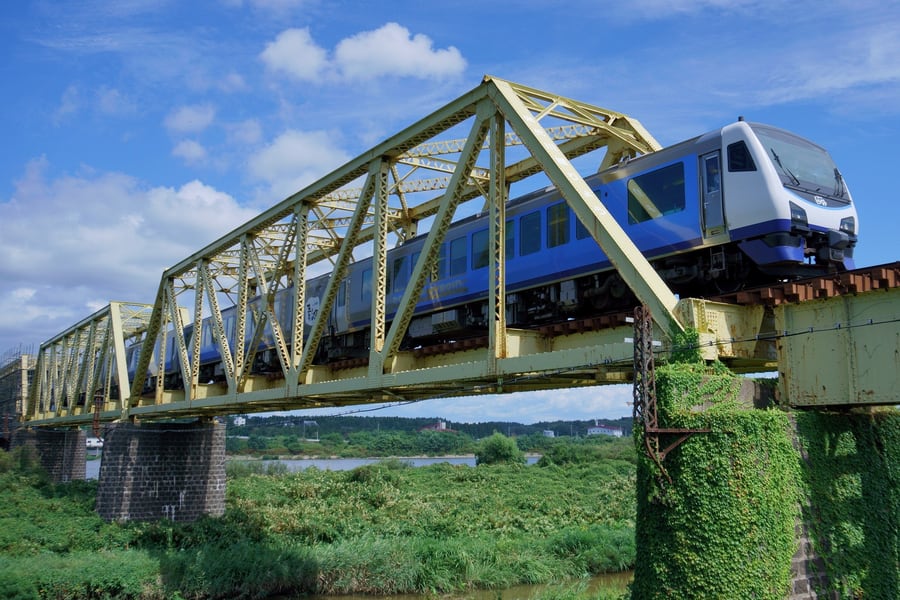
Since 1997 JR East has run a sightseeing train over it, the Resort Shirakami: a rapid from Akita to Aomori, with big windows, observation lounges and box seats. On the coast it slows down for the views, and for a quarter of an hour it stops at Senjōjiki so passengers can walk on the rocks. Local musicians and storytellers board along the way, and in 2026, the line's 90th year, a geopark guide joined them.
Every seat is reserved, and the train is a JR East service like any other: a JR pass covers it.
The Journey
From Akita the train runs north on the Ōu Line past Hachirōgata to Higashi-Noshiro, where it turns onto the Gonō Line. It stops at Noshiro, a basketball town with a hoop on the platform, and then reaches the sea near Akita-Shirakami.
The coast
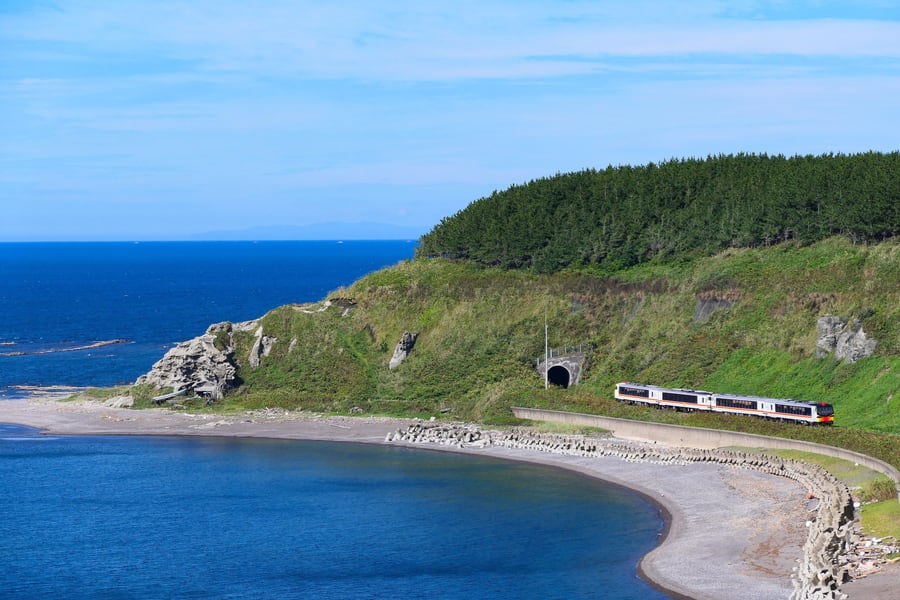
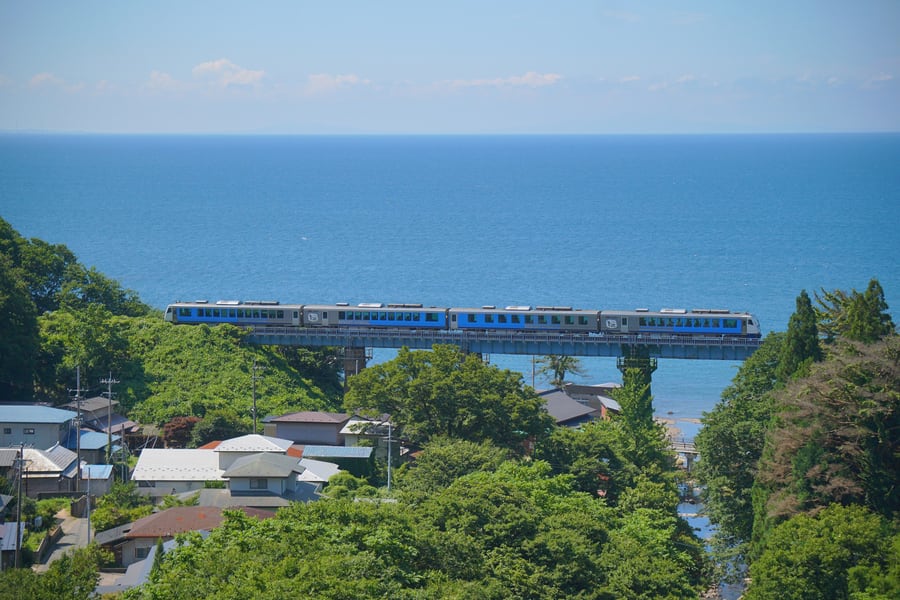
From Iwadate to Ajigasawa the line keeps to the shore, beside the coast road, crossing small rivers on viaducts and running through short tunnels; one, near Jūniko, is only 9.5 m long. On the stretch from Iwadate to Ōmagoshi, between Ōdose and Kita-Kanegasawa, and near Senjōjiki, the Resort Shirakami slows down so the view lasts. Get off at Jūniko for the lakes in the beech forest, or at WeSPa Tsubakiyama for the bath on the rocks at Furofushi.
Fukaura, a port, is known as the town of sunsets; trains 4 and 5 pass it late in the afternoon. At Senjōjiki four of the six trains wait 15 minutes beside a shelf of rock lifted out of the sea in 1792. From the window near Kita-Kanegasawa look for a giant ginkgo, about 31 m tall and the largest in Japan, gold in late autumn.
The Tsugaru plain
At Ajigasawa the line turns inland across rice fields to Goshogawara, the Tsugaru Railway's junction for Kanagi, then through apple orchards to Kawabe. Here the train runs a few kilometres south on the Ōu Line to Hirosaki, reverses, and comes back through Kawabe for Shin-Aomori, on the shinkansen, and Aomori. It is the only train that runs through from the Gonō Line to Aomori. Mt Iwaki stands over the plain.
The trains
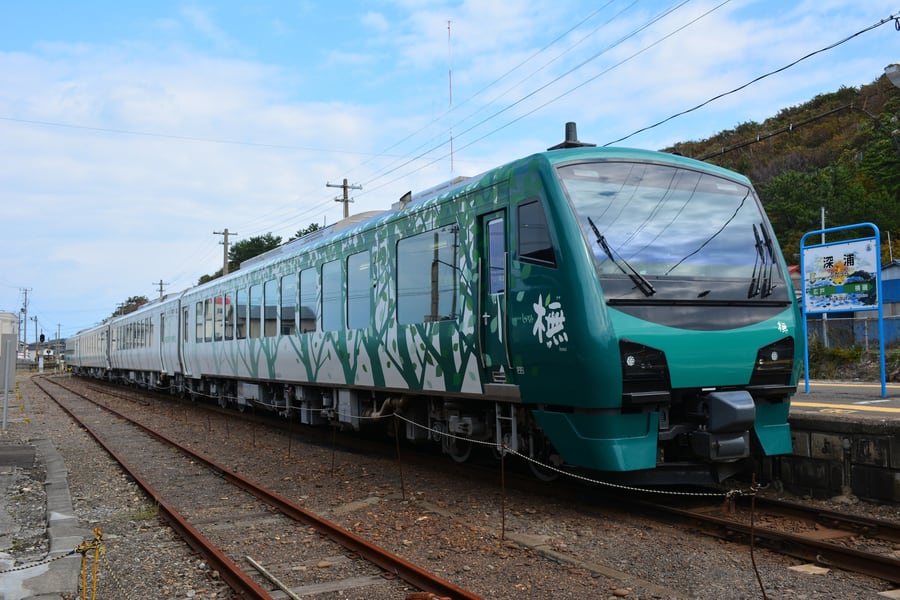
Three four-car trains share the work, named for the Blue Pond, the beech and the black woodpecker. Aoike is blue and white; Buna is green, painted with trees. Both are HB-E300 hybrids: a diesel engine and lithium-ion batteries drive electric motors, and braking recharges the batteries. The third, Kumagera, is converted from older KiHa 40-series railcars. The Buna has observation lounges in its end cars, and all three have four-seat box compartments in car 2.
Along the route
 掬茶 / Wikimedia Commons · CC BY-SA 4.0
The sea at Akita-Shirakami
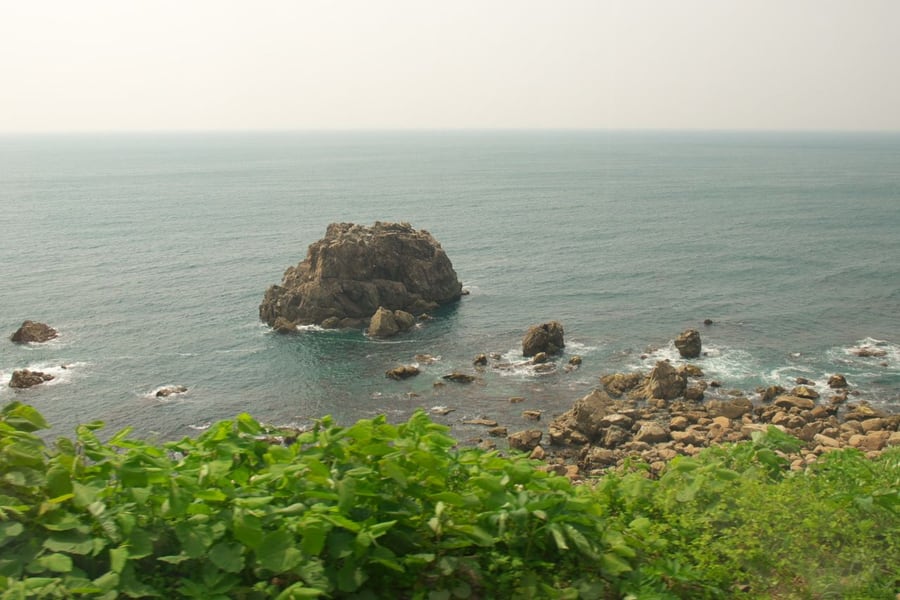
Northbound, the Sea of Japan opens up on the left near Akita-Shirakami. From here to Ajigasawa the track keeps to the shore, beside the coast road, under the hills of the Shirakami range.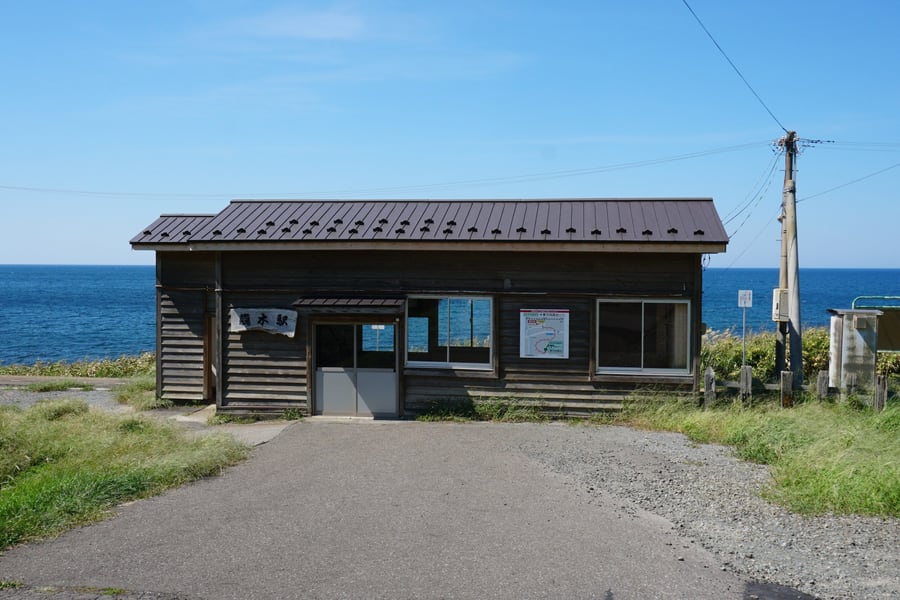 掬茶 / Wikimedia Commons · CC BY-SA 4.0 · cropped
Todoroki
A small wooden station with the sea spread out in front of the platform and the waves booming close by. It has appeared in films, and visitors leave notes in a book inside. The Resort Shirakami passes through without stopping.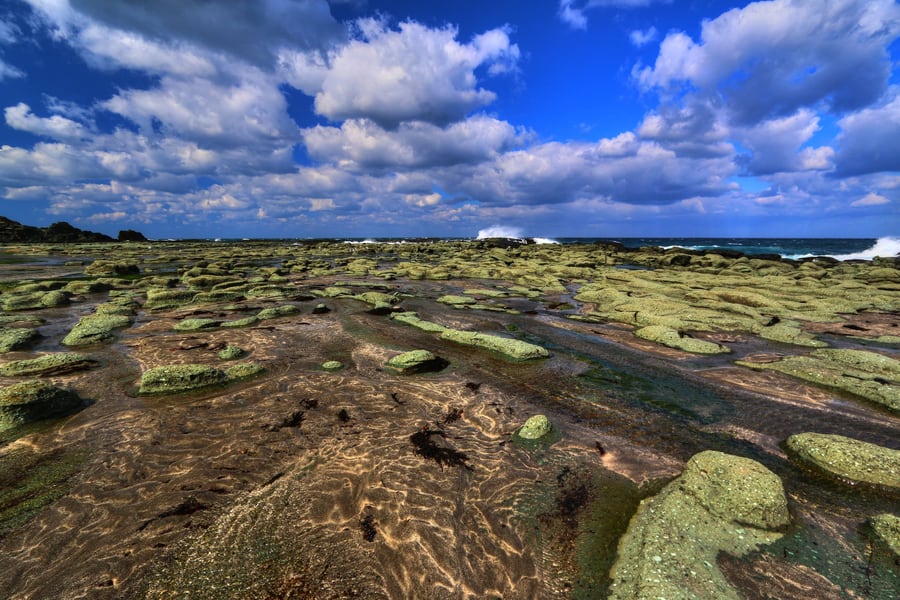 くろふね / Wikimedia Commons · CC BY 3.0
Senjōjiki
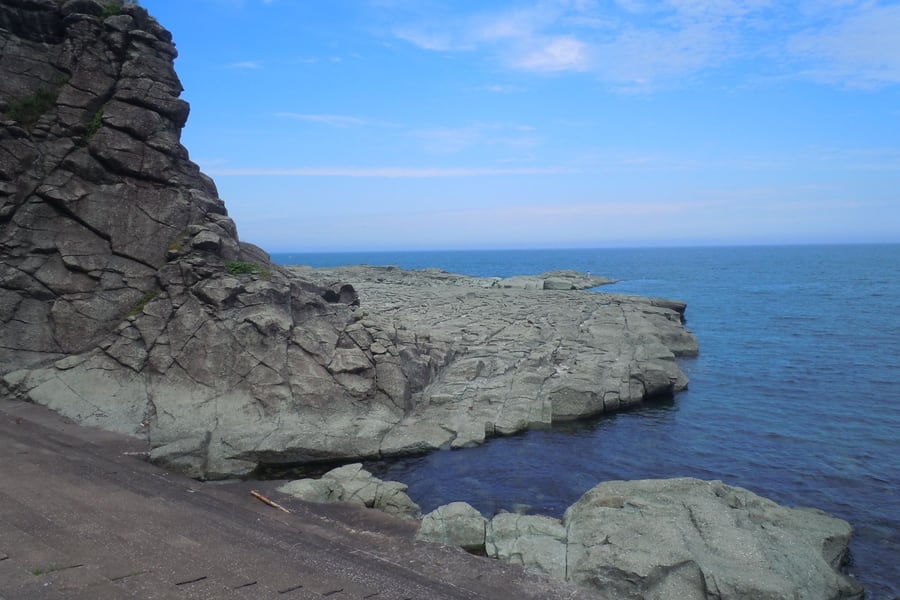
A wide shelf of rock lifted out of the sea by an earthquake in 1792. Legend says a lord once spread a thousand tatami mats here for a banquet. Four of the six trains stop for 15 minutes, long enough to walk out onto it.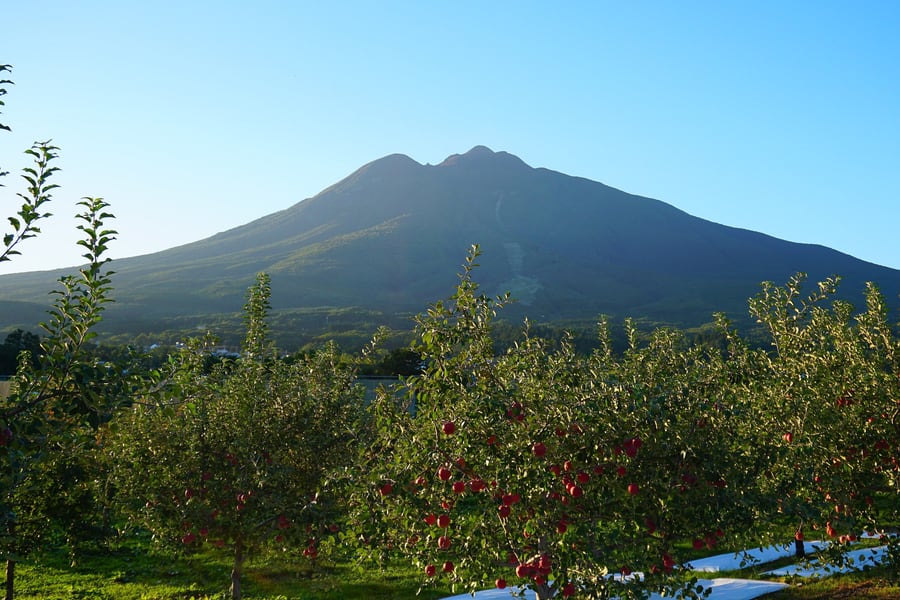 掬茶 / Wikimedia Commons · CC BY-SA 4.0 · cropped
Mt Iwaki and the apples
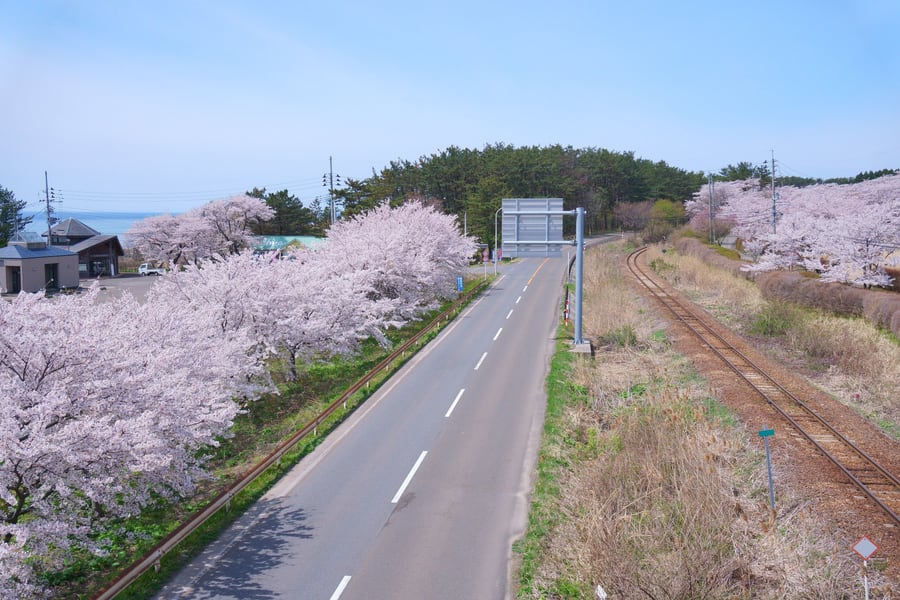
After Ajigasawa the line turns inland across the Tsugaru plain, through rice fields and then apple orchards around Itayanagi. Mt Iwaki, the Fuji of Tsugaru, stands over the plain, on the left of the train as it leaves Hirosaki for the coast.A bit of history
Culture & experiences along the way
 z tanuki / Wikimedia Commons · CC BY 3.0 · cropped
Tsugaru shamisen
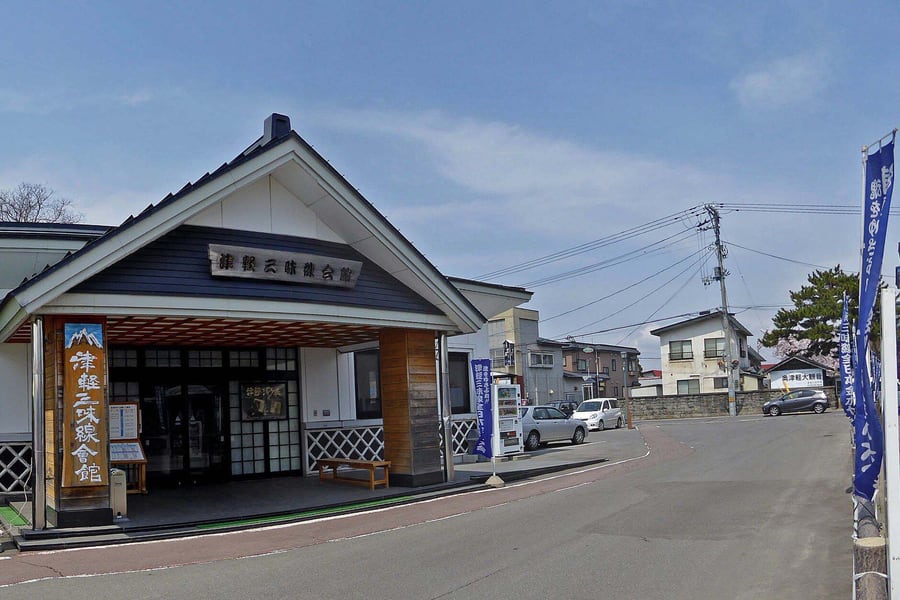
Between Ajigasawa and Goshogawara, trains 1, 2 and 3 carry a live performance of Tsugaru shamisen, the region's fast, percussive style of playing, with folk songs such as Tsugaru Jongara Bushi. Its home is Kanagi, a short ride from Goshogawara, where the Tsugaru Shamisen Kaikan has displays and live playing.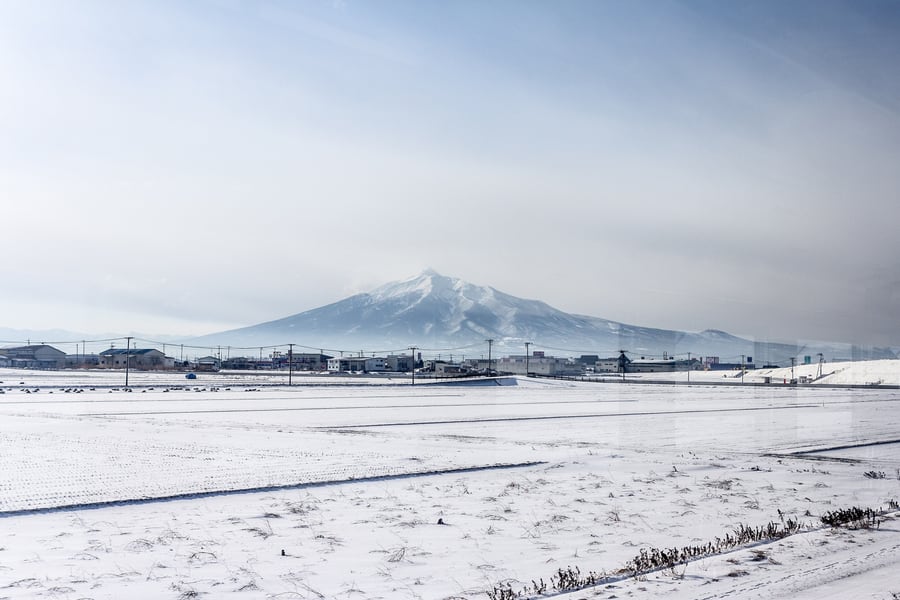 A_CUVE / Wikimedia Commons · CC BY-SA 2.0
Folk tales in Tsugaru dialect
On trains 3 and 4, on set days through the season, a storyteller boards between Mutsu-Tsuruta and Kawabe to tell old Tsugaru tales in the local dialect, with Mt Iwaki across the fields outside. In winter the storytelling moves to train 2.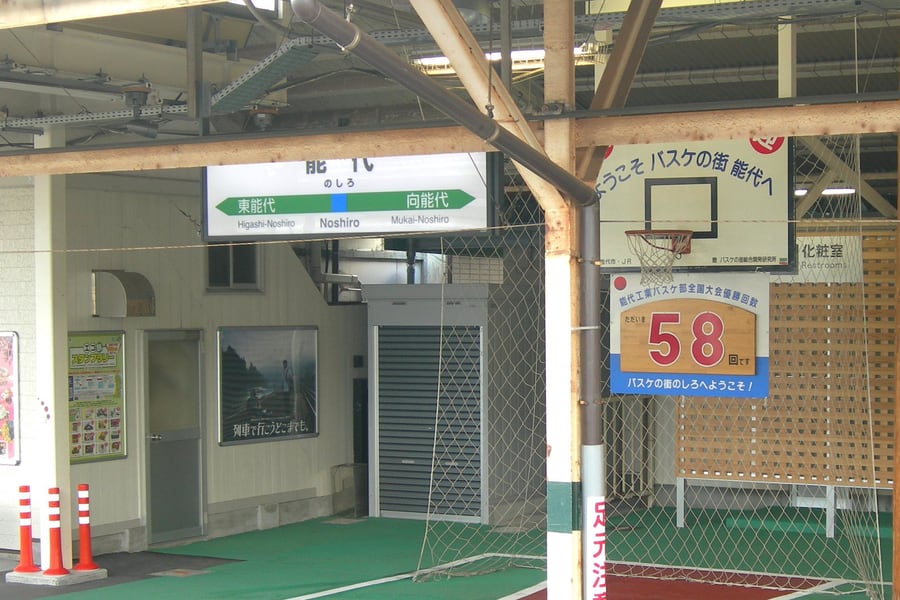 Rsa / Wikimedia Commons · CC BY-SA 3.0 · cropped
A shot at Noshiro
Noshiro is a basketball town, home of a famous high-school team, and its station has a hoop on the platform. Trains 1 and 3 wait ten to fifteen minutes here, so step off and take a shot before the run to the coast.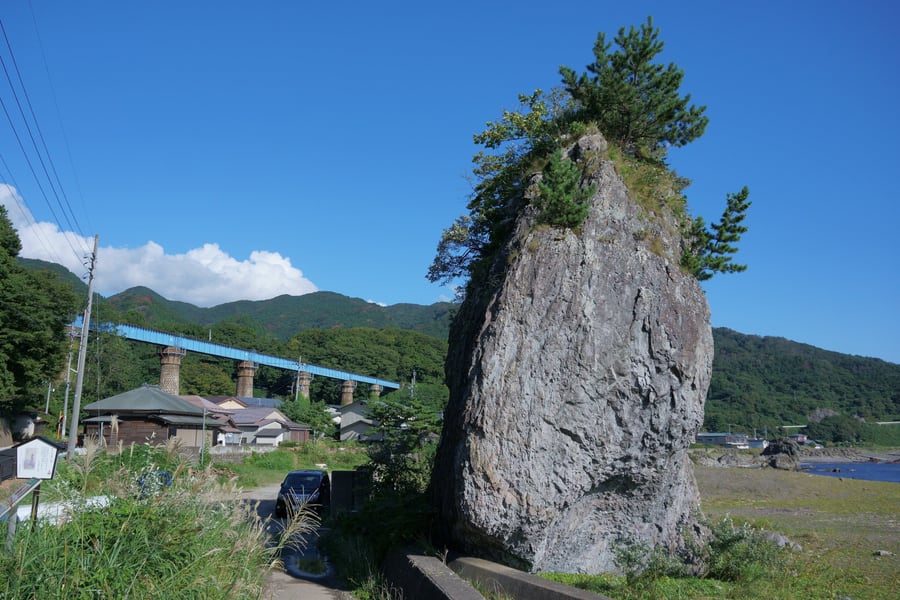 掬茶 / Wikimedia Commons · CC BY-SA 4.0
The geopark guide
New for the line's 90th year, a guide from the Happō-Shirakami Geopark rides between Noshiro and WeSPa Tsubakiyama on set Saturdays, explaining how the Shirakami mountains were formed and how people have lived with the forest. Tate-iwa, a pillar of rock beside the line at Iwadate, is on the way.Timetables
From April to early December the Resort Shirakami runs every day, three trains each way: two between Akita and Aomori and one between Akita and Hirosaki. In winter it runs mainly at weekends and holidays, plus every day over New Year and in the second half of January, with two trains each way and no Hirosaki pair. Every seat is reserved.
Akita to Aomori
| Train | Akita | Noshiro | Jūniko | Fukaura | Senjōjiki | Goshogawara | Hirosaki | Aomori |
|---|---|---|---|---|---|---|---|---|
| No. 1 | 08:19 | 09:33 | 10:25 | 10:58 | — | 12:10 | 12:54 | 13:34 |
| No. 3 | 10:50 | 12:14 | 13:04 | 13:34 | 14:14 | 15:10 | 15:50 | — |
| No. 5 | 14:00 | 15:05 | 15:57 | 16:43 | 17:23 | 18:15 | 18:58 | 19:37 |
Aomori to Akita
| Train | Aomori | Hirosaki | Goshogawara | Senjōjiki | Fukaura | Jūniko | Noshiro | Akita |
|---|---|---|---|---|---|---|---|---|
| No. 2 | 08:09 | 08:48 | 09:27 | 10:30 | 10:59 | 11:24 | 12:14 | 13:29 |
| No. 4 | 13:52 | 14:30 | 15:11 | 16:14 | 16:40 | 17:05 | 17:55 | 19:01 |
| No. 6 | — | 16:06 | 16:47 | — | 18:22 | 18:47 | 19:36 | 20:42 |
Good to know:
- Times are departures. No. 3 ends at Hirosaki and No. 6 starts there; a dash means the train does not call.
- Senjōjiki. Trains 2, 3, 4 and 5 stop for 15 minutes so you can walk on the rocks; the train leaves at the time shown.
- Which train. The three sets, Aoike, Buna and Kumagera, rotate; JR East's calendar shows which set runs each train on each day.
- 2026. On 19–23 October and 10–13 November only trains 1, 2, 4 and 5 run.
- Weather. On the coast, high waves and strong wind can stop or delay the train.
Times as of October 2026, from JR East's Resort Shirakami timetable and its October 2026 station timetables. Check the day and the set on JR East's timetable and calendar (opens in a new tab).
Tickets
The Resort Shirakami needs two tickets: an ordinary ticket for the distance, ¥4,180 from Akita to Hirosaki, and a reserved seat at ¥840, the same on every train and for any distance; children pay half of both. Seats go on sale at 10:00 one month before travel, at JR ticket offices and machines and on JR East's online booking site, and cannot be bought on board. The box seats in car 2 seat four and are booked the same way.
Fares checked October 2026 against JR East's Resort Shirakami pages and its March 2026 fare table; Japanese yen.
Book your tickets
Akita to Hirosaki
One way, adult · ordinary ticket
The fare for the whole Gonō Line route, which the Resort Shirakami needs on top of its reserved seat.
Book Tickets (opens in a new tab, on JR East)via JR EastReserved seat
Resort Shirakami · any train, any distance
Every seat is reserved, ordinary or box seat, and a seat must be booked before boarding; children pay half.
Book Tickets (opens in a new tab, on JR East)via JR EastRail Passes
The JR passes cover the Resort Shirakami, and the reserved seat is free to pass holders — but it must still be booked before boarding, at a ticket office, a machine or JR East's online booking site. The JR EAST PASS, ¥35,000 for five days or ¥50,000 for ten, covers it, and so does the Japan Rail Pass, ¥50,000 for seven days; JR East's page lists its other passes that apply.
For this journey alone, a pass is not worth buying: Akita to Hirosaki costs ¥4,180 plus ¥840 for the seat. It pays when the Resort Shirakami is one day of a longer trip, since Akita is at the end of the Akita Shinkansen and Shin-Aomori is on the Tōhoku Shinkansen, so the line makes a loop from Tokyo out on one shinkansen and back on the other.
Checked October 2026 against JR East's Resort Shirakami (opens in a new tab) and JR EAST PASS (opens in a new tab) pages and the Japan Rail Pass prices (opens in a new tab).
Places to Visit
With three trains a day each way in season, a stop costs a few hours: get off one train and catch the next. The coast stops, Jūniko, WeSPa Tsubakiyama and Fukaura, are the reason to break the journey; the castle towns at either end are easier to see the day before or after.
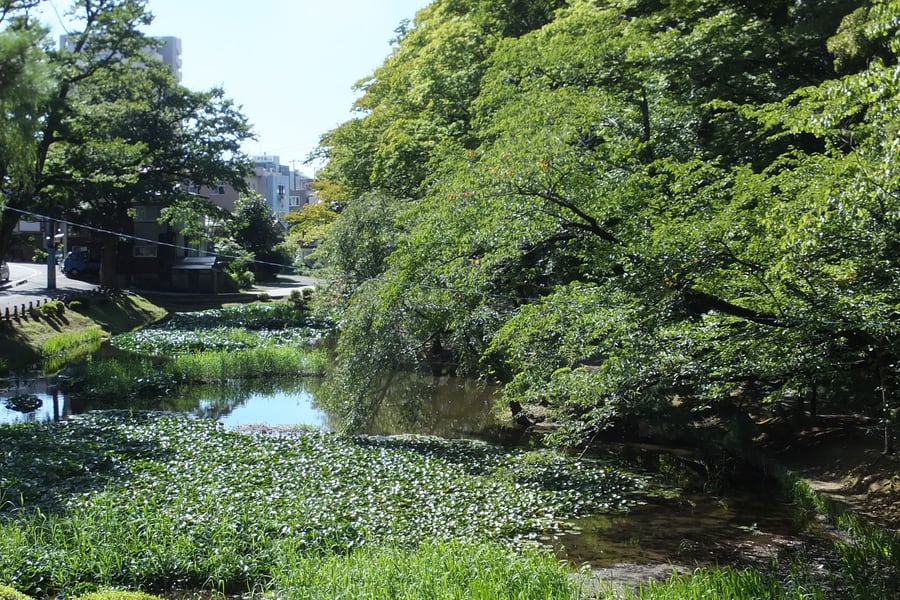 掬茶 / Wikimedia Commons · CC BY-SA 3.0 · cropped
Akita
Fifteen minutes' walk from the station, Senshū Park is the site of Kubota Castle, seat of the Satake lords who ruled Akita. Its corner turret looks out over the city, and cherry, azalea and lotus bloom in their seasons; the turret is closed from December to March.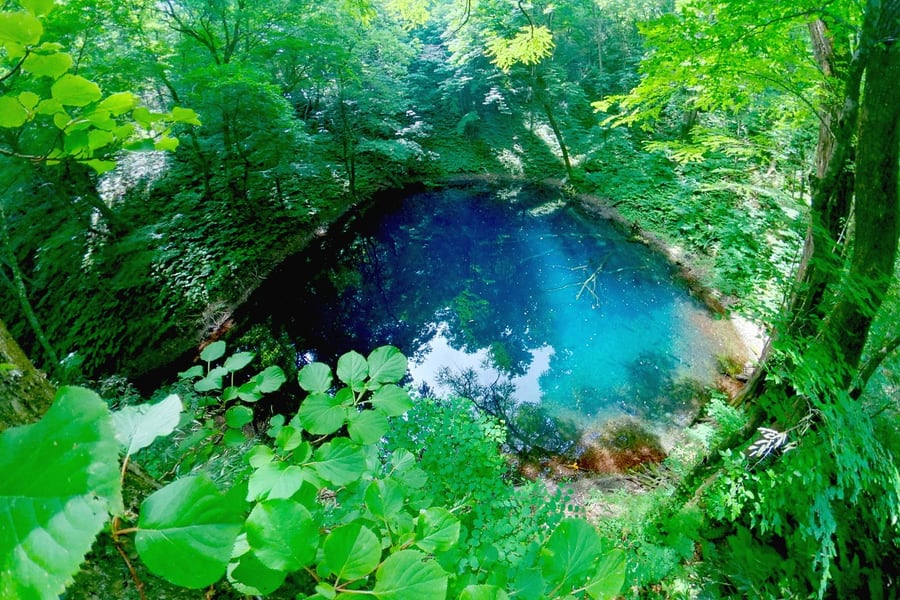 Aomorikuma / Wikimedia Commons · public domain · cropped
Jūniko
Inland from Jūniko station, 33 lakes and ponds lie in the beech forest at the foot of the Shirakami range. The best known is Aoike, the Blue Pond, so clear that fallen trees show on its bed. It is about 15 minutes away by bus or car; from December to March the area is closed except with a guide.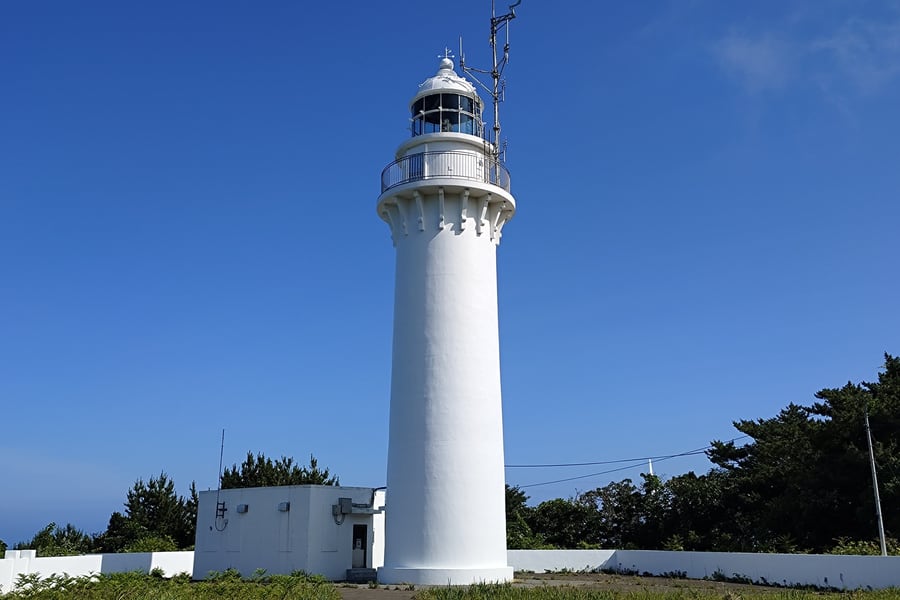 Sashimiteishoku / Wikimedia Commons · CC0 · cropped
WeSPa Tsubakiyama
Five minutes by car from the station, the Henashizaki lighthouse stands on Cape Koganezaki, near the memorial to the Gonō Line's completion. On the same cape, Furofushi Onsen has a gourd-shaped open-air bath at the water's edge; a shuttle meets the trains, and day visitors pay ¥1,000 in cash and can bathe until 16:00.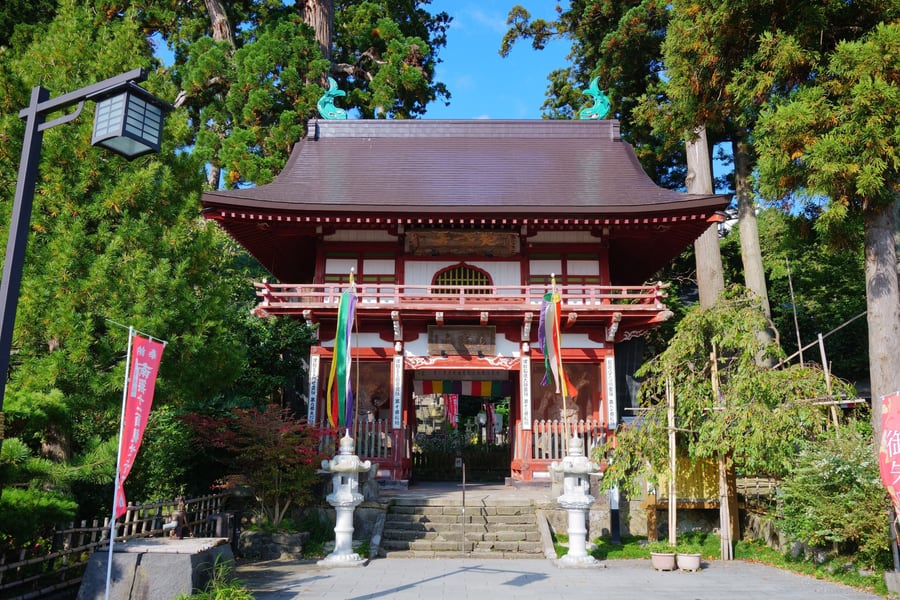 掬茶 / Wikimedia Commons · CC BY-SA 4.0
Fukaura
Twenty minutes' walk from the station, the temple of Engaku-ji keeps about 70 votive paintings of ships left by sailors, among them the only painting in Japan of a Hokkoku-bune, an old northern trading ship. The great rock of Ōiwa, with steps up to a view over the sea, is three minutes from the station.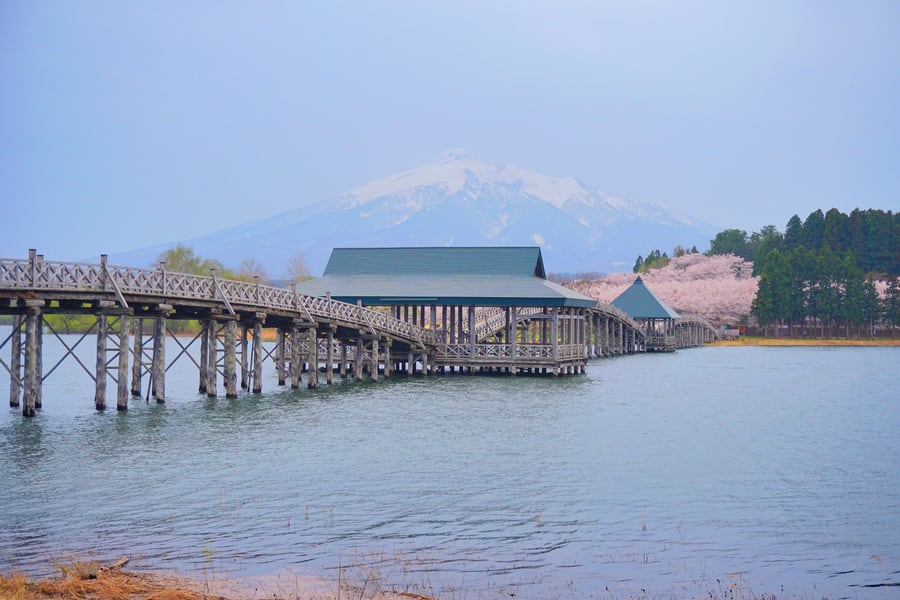 掬茶 / Wikimedia Commons · CC BY-SA 4.0
Mutsu-Tsuruta
Fifteen minutes by car from the station, the Tsuru-no-Mai Bridge crosses Lake Tsugaru-Fujimi in three wooden arches made of local hiba cypress. At 300 metres it is the longest wooden bridge of its kind in Japan, with Mt Iwaki behind it, and it reopened in full in April 2026.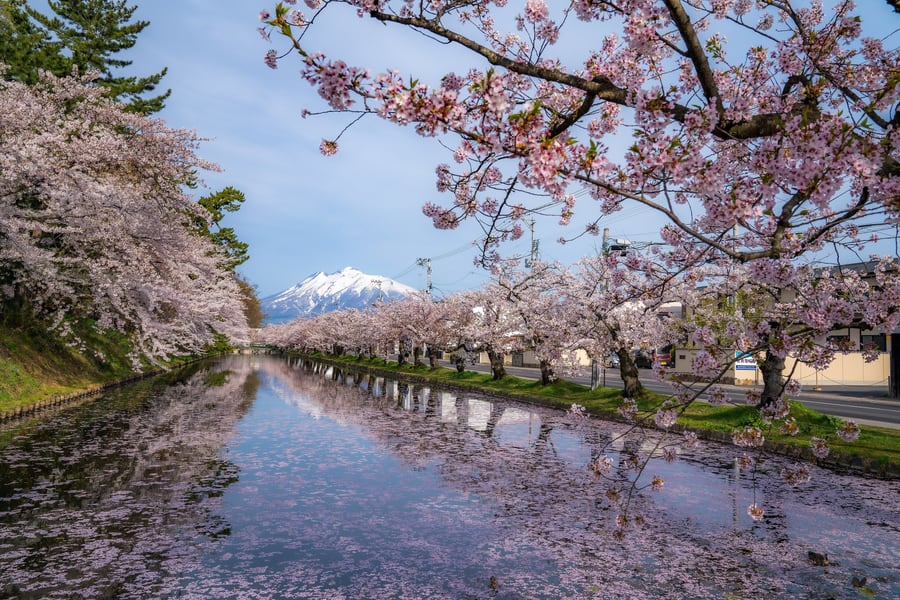 mko294 / Wikimedia Commons · CC BY 4.0 · cropped
Hirosaki
Hirosaki Park holds the keep, turrets and gates of an Edo-period castle, with cherry trees along its moats. The keep was moved in 2015 while the stone walls were rebuilt and is due back on its base in mid-November 2026, though its interior stays closed for some years; the inner grounds cost ¥320 from April to 23 November.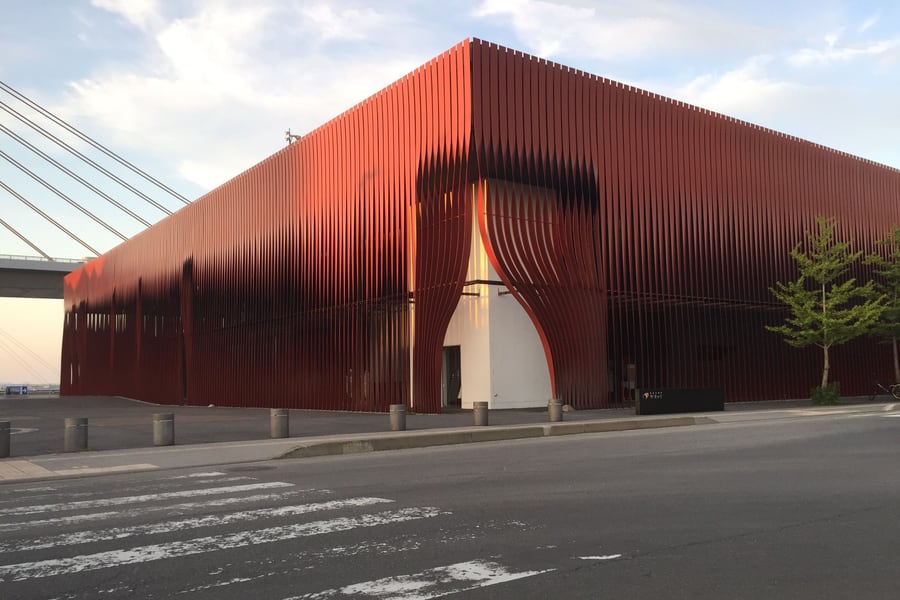 Mccunicano / Wikimedia Commons · CC BY-SA 4.0
Aomori
A minute from the station, Wa Rasse shows four full-size floats from the Aomori Nebuta Festival, giant figures of wire, wood and paper, with sessions where you can try the Haneto dance to the festival band. Entry is ¥620; it opens 9:00–18:00 from September to April.Where to Sleep
Akita, Hirosaki and Aomori have plenty of city hotels near their stations. A night on the coast turns the ride into two easy days: a hot-spring hotel at Akita-Shirakami, a cottage by the Jūniko lakes, or the inn of the seaside bath at Furofushi, where the sunset is the point.
Where to stay
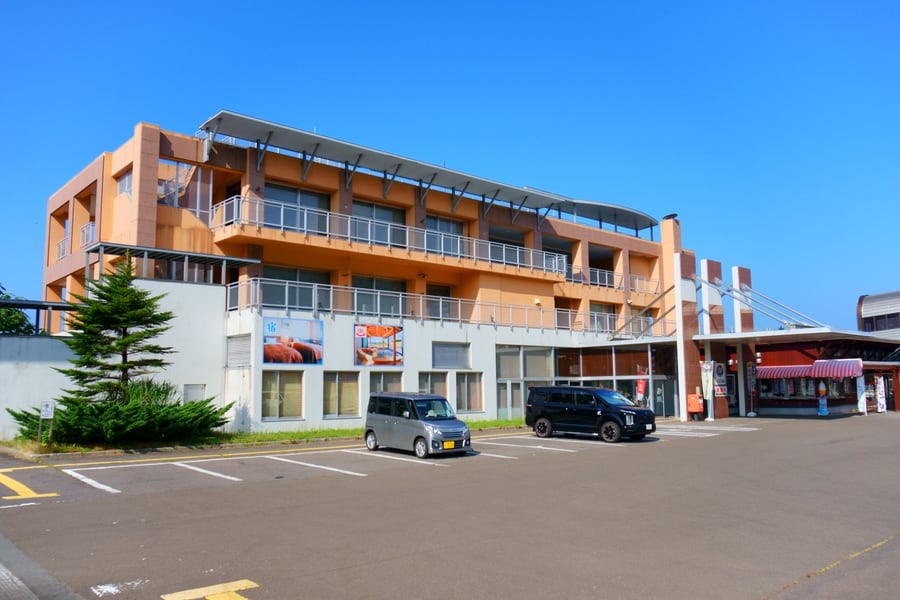 掬茶 / Wikimedia Commons · CC BY-SA 4.0 · cropped
Hachimori Isaribi Onsen Hatahata-kan
Akita-Shirakami · about 3 minutes' walk from the station
A hot-spring hotel on the coast road, with rooms and an open-air bath looking over the Sea of Japan.
Check Availability (opens in a new tab, on hatahatakan.jp)via hatahatakan.jpAoone Shirakami Jūniko
Jūniko · about 5 minutes by car from the station
Nordic log cottages at the foot of the Jūniko lakes, with a free shuttle from Jūniko station booked a day ahead.
Check Availability (opens in a new tab, on shirakami-jyuniko.jp)via shirakami-jyuniko.jpKoganezaki Furofushi Onsen
WeSPa Tsubakiyama · free shuttle bus
The inn of the seaside bath, every room facing the sea, and the bath at sunset kept for staying guests.
Check Availability (opens in a new tab, on furofushi.com)via furofushi.comQuestions or corrections
Planning this trip and stuck on something, or spotted a time, fare or detail that has changed? Send us a message about Resort Shirakami. We read every one, and we update this page when something has changed.