Gornergrat Railway
Oliver Bumann / Wikimedia Commons · CC0
- Distance9.3 km
- Duration33 minutes
- Best seasonDaily all year; closed 2–14 November 2026 for engineering work
Introduction
Three trains coming down the mountain make enough electricity to send one or two of them back up it, and the Gornergrat Railway has worked that way since the morning it opened.
That morning was 20 August 1898, when the first scheduled train left Zermatt at ten o'clock for a ridge nobody had ever reached on wheels. It was the first electric rack railway in Switzerland, and the engineers had chosen three-phase current at 725 volts — which is why there are two contact wires over the track rather than one, and why the motors can be turned into generators on the way down and the current pushed straight back into the line for the train climbing behind. The operator still puts it in the present tense: three descending trains produce enough for one or two ascending ones. The water that made the electricity came from the Findelbach, whose turbine house the company bought the rights to in October 1895 for CHF 100,000.
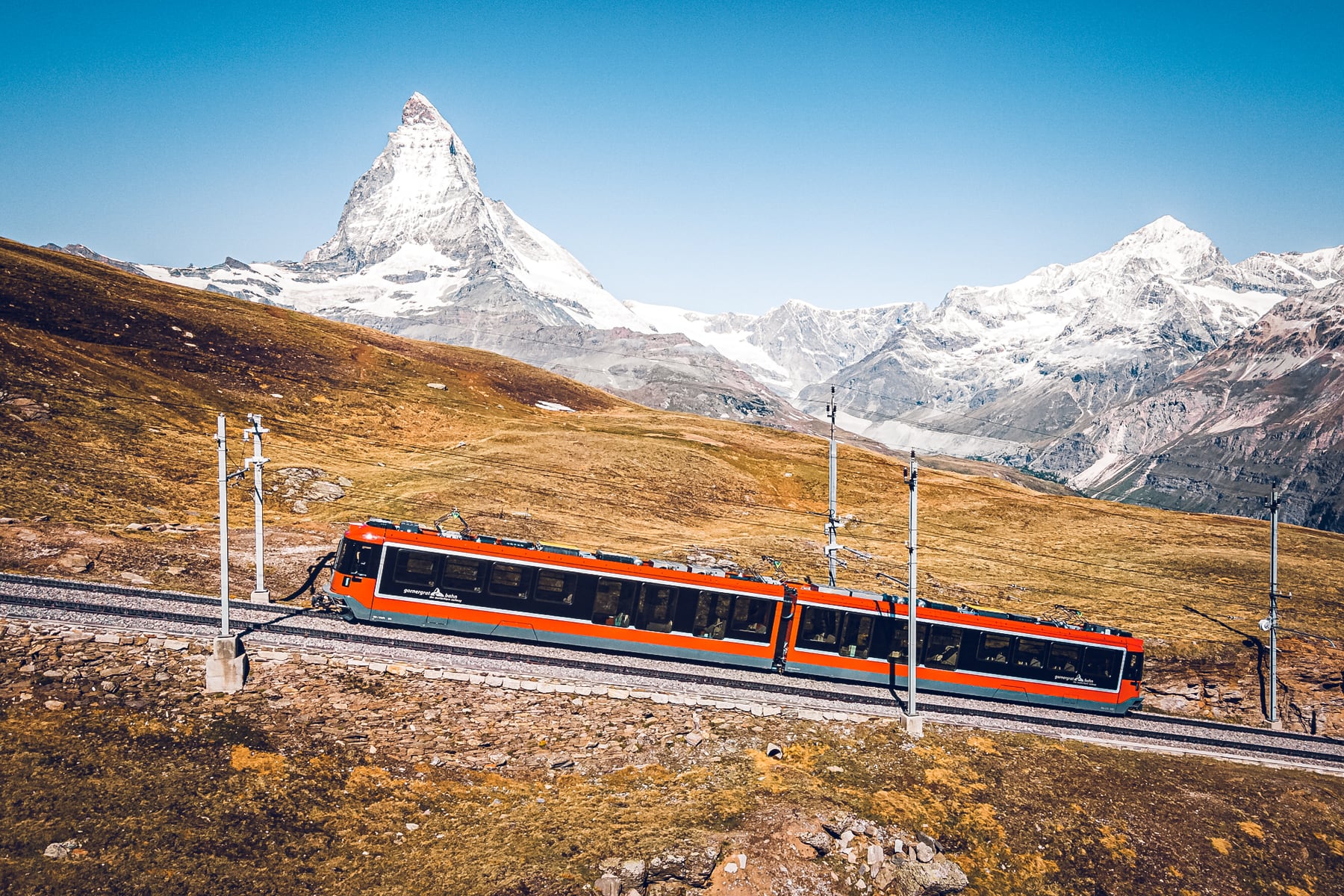
What the line buys with all that is 1,485 metres of height in 9,339 metres of track — from Zermatt at 1,605 metres to the Gornergrat at 3,089 — on Abt rack the entire way, at gradients reaching 20 per cent, with only 2.7 per cent of the route level. It takes 33 minutes. It is the highest open-air railway in Europe, and the ride is a slow climb out of one landscape into another: stone pine forest at Riffelalp, alpine pasture and black-nosed sheep at Riffelberg, then bare rock and, at the top, the Gorner Glacier and twenty-nine peaks over four thousand metres, the Matterhorn among them and never out of sight for long.
The Journey
The valley station is directly opposite the Matterhorn Gotthard Bahn platforms in Zermatt, across the Bahnhofplatz, so the change from the train that brought you up the Mattertal to the train that takes you above it is a walk of about a minute. Zermatt itself is car-free; the vehicles crossing the square are electric taxis and hotel shuttles, and they are the last road vehicles you will see until you come back down.
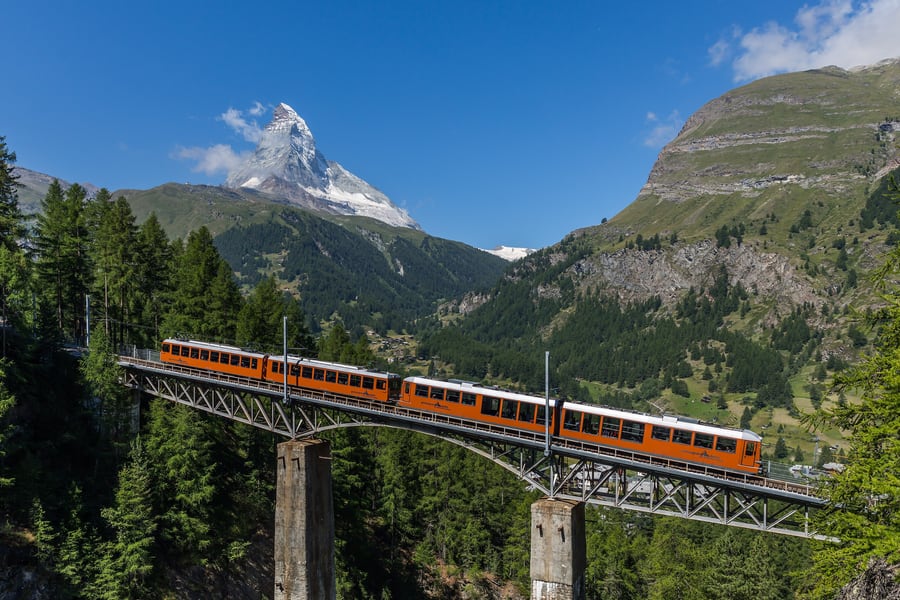
The train leaves and is on the rack almost at once. Within a few hundred metres it crosses the Vispa on a 24-metre bridge, then swings east and climbs into the trees. This first section, Zermatt to Riffelalp, was the hardest to build and it is still the busiest piece of engineering on the line: four tunnels — Gsäss, Bränfluh, Kühlerbrunnen and the 179-metre Landtunnel — and, at Findelbach, an iron truss bridge of some ninety metres over the gorge. The builders had wanted stone arches there and ran out of time. Findelbach station itself, at 1,783 metres, is the first stop out of the village and has no ticket window — fares are settled with the staff at the exit after the descent.
The right-hand side, and why
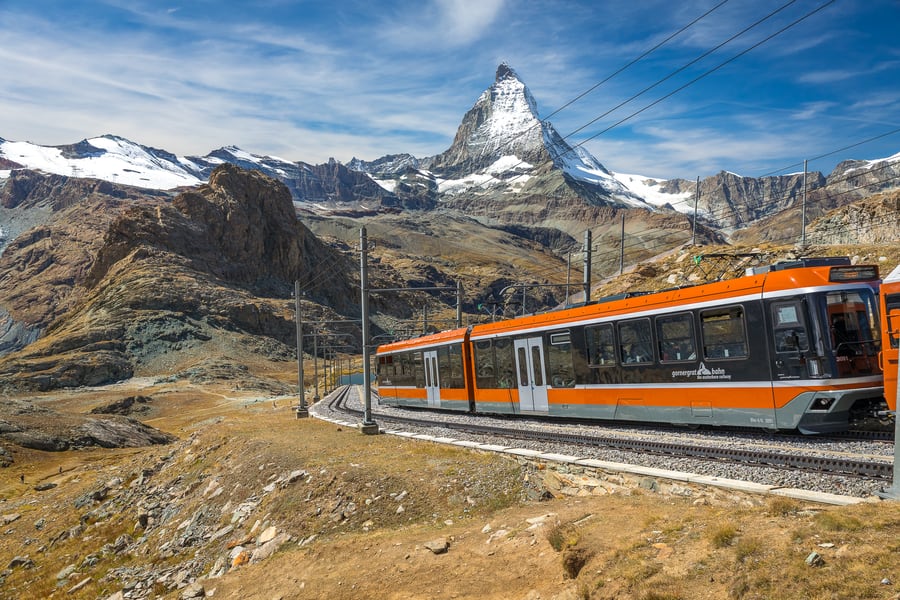
The operator answers the question directly on its own site: both sides are worth having, but a seat on the right-hand side going up gives the best of the Matterhorn, and it holds that view for most of the climb. The train does not turn round at the top, so on the descent the same mountain is out of the windows on the left. The windows in the newest trains drop down, which matters more than it sounds — at this altitude the glass takes a lot of glare. The operator names the spot it thinks is the best of all: the "iconic photo bend" between Riffelalp and Riffelberg, where the curve puts the train and the Matterhorn in the same frame.
Riffelalp, and a tramway of 468 metres
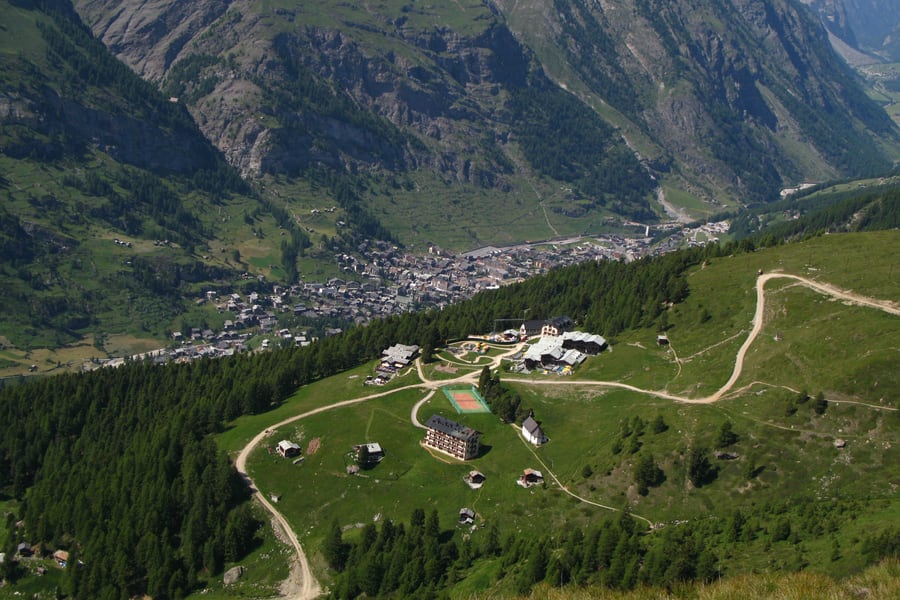
At 2,211 metres the forest thins into a shelf of stone pine and the train stops at Riffelalp. The station is about half a kilometre from the hotel it was built to serve, and that half kilometre has its own railway. Alexander Seiler, who had opened the Grand Hotel Riffelalp in 1884 — twelve years before work on the Gornergrat line began — wanted a station at his door and could not have one, so he applied for a tramway licence instead. It opened in July 1899: 468 metres of 80-centimetre gauge to a terminus at 2,222 metres, the highest tramway in Europe and probably the shortest. The hotel burned down in February 1961 and the trams stopped; two of the cars spent thirteen years as a garden ornament at the Mont Cervin Palace. When the resort was rebuilt in 2001 the original cars were judged too far gone to repair, so the Gornergrat Railway's own workshop in Zermatt built two battery-powered replacements. They run in the hotel's opening season, which is roughly midsummer and midwinter.
Riffelberg, Mark Twain, and the sheep
Above Riffelalp the trees give out and the line crosses open pasture to Riffelberg at 2,583 metres, where Valais black-nosed sheep graze through the summer. The hotel here is older than everything else on the mountain: a vicar and two friends bought the land and built it between 1852 and 1854 with eighteen beds, and for a decade it was the base for the first ascents of the Monte Rosa peaks. Mark Twain walked up in August 1878 and put the Riffelberg into A Tramp Abroad as a seven-day expedition of 198 persons — "including the mules" — with 17 guides, 4 surgeons, 15 barkeepers, 22 barrels of whiskey and 154 umbrellas. He slept in room 32.
Rotenboden and the Riffelsee
Rotenboden, at 2,815 metres, is the second-highest station on the line and the one worth a stop on the way back down. Ten minutes' walk below the platform is the Riffelsee at 2,757 metres, a lake that on a windless morning holds the whole Matterhorn upside down in it, and the reason the operator's Sunday sunrise trains stop here before going on to the summit. The path to it crosses Europe's highest alpine garden at around 2,800 metres. Rotenboden is also the starting point for the four-to-five-hour walk to the Monte Rosa Hut, from which fourteen four-thousanders are within reach the following morning.
The last kilometres
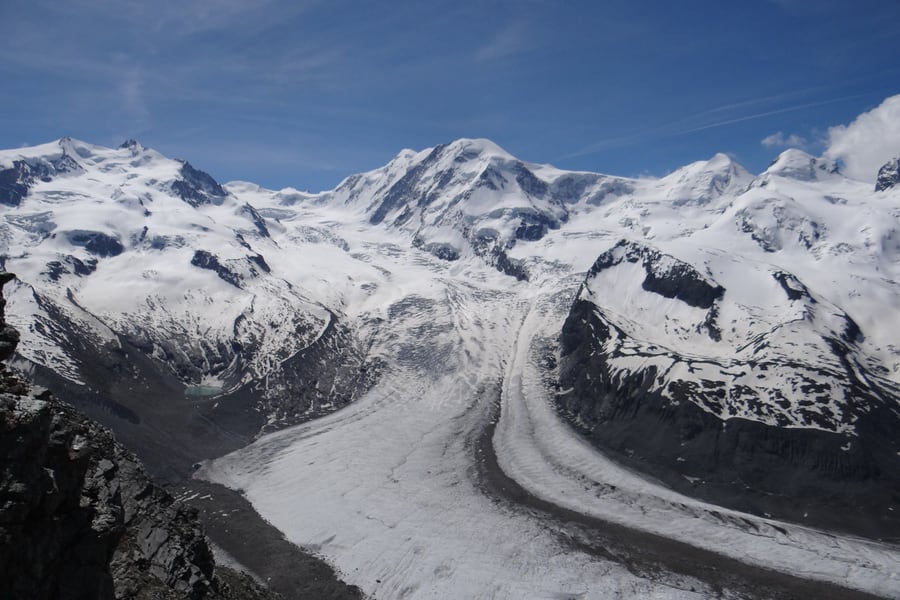
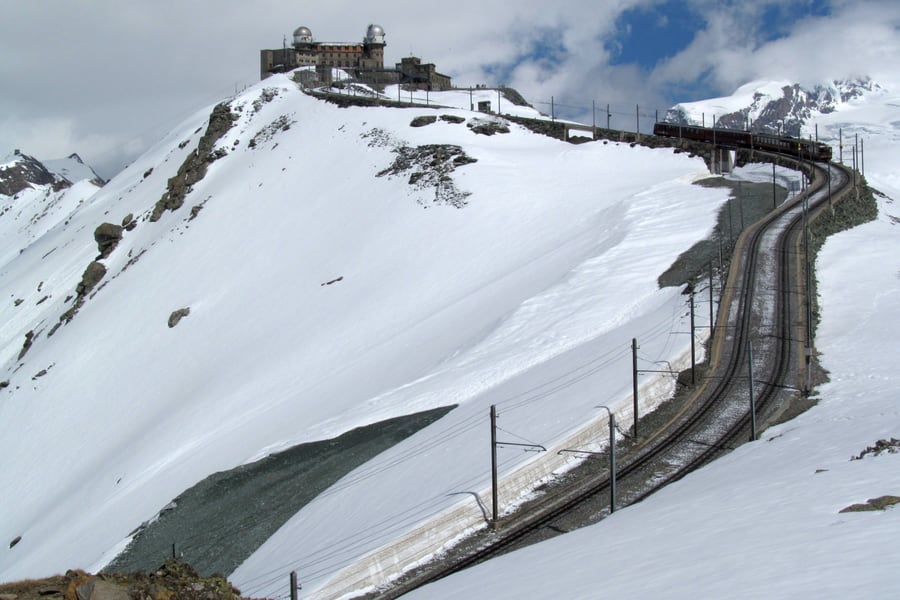
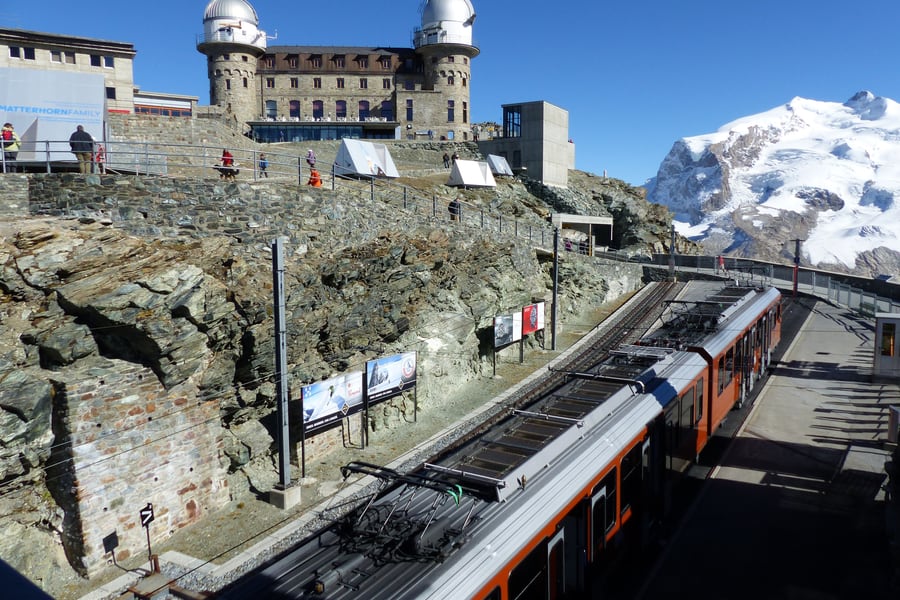
From Rotenboden the line turns onto the ridge itself and the vegetation stops. The Gorner Glacier comes into view on the right, a grey-white confluence of ice running down from Monte Rosa, and the train works up the final bare slope to a terrace of rock with a stone building on it. That building is the 3100 Kulmhotel Gornergrat, opened in 1910 with 43 rooms and two observatory towers added later; the Stellarium inside is a working research station of the Universities of Bern and Geneva, with a 60-centimetre DeepSky telescope.
The station beside it has not always been there. The line first terminated 71 metres lower down, at 3,028 metres. In 1905 the company decided to go higher, demolished the Hotel Belvédère that stood on the spot, and ran its first train into the present Gornergrat station on 1 June 1909. The viewing platform above the hotel is the point of the whole exercise: twenty-nine four-thousanders, including the Dufourspitze at 4,634 metres, which is the highest ground in Switzerland, and the Dom at 4,545, which is the highest mountain standing entirely inside it.
What runs
The Polaris units, built by Stadler and in service since September 2022, do most of the work: 34.6 metres long, 104 seats, 112 standing places, two wheelchair spaces, and 30 km/h uphill. They cost CHF 45 million for the batch. Behind them the earlier low-floor twin railcars of 2006 still run, and those were the vehicles that cut the journey from 42 minutes to 33 and the interval from 36 minutes to 24. One survivor of the light-metal generation of 1947–65 is still in traffic: railcar 3021, rebuilt in 2023 in dark red and cream for the NostalChic Class.
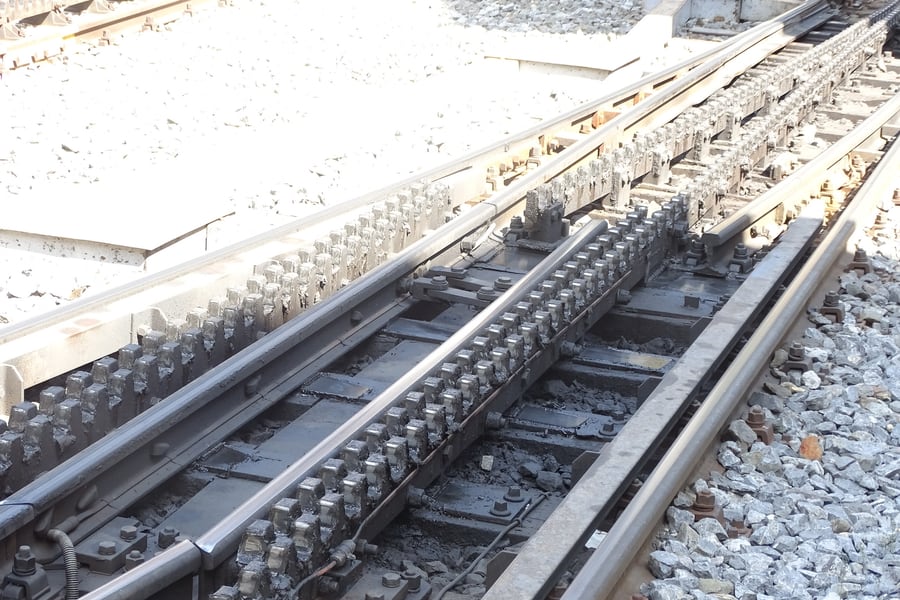
Under all of them is the rack. A passenger covers 9.3 kilometres; the rack itself runs to 28, because it is doubled, and because the passing loops and station tracks have their own. That is about 10,600 racks of 2.64 metres and 67 kilograms each, roughly 710 tonnes of steel and some 155,000 individual teeth. They wear on the downhill face, so after about ten years they are lifted, turned round and put back the other way up.
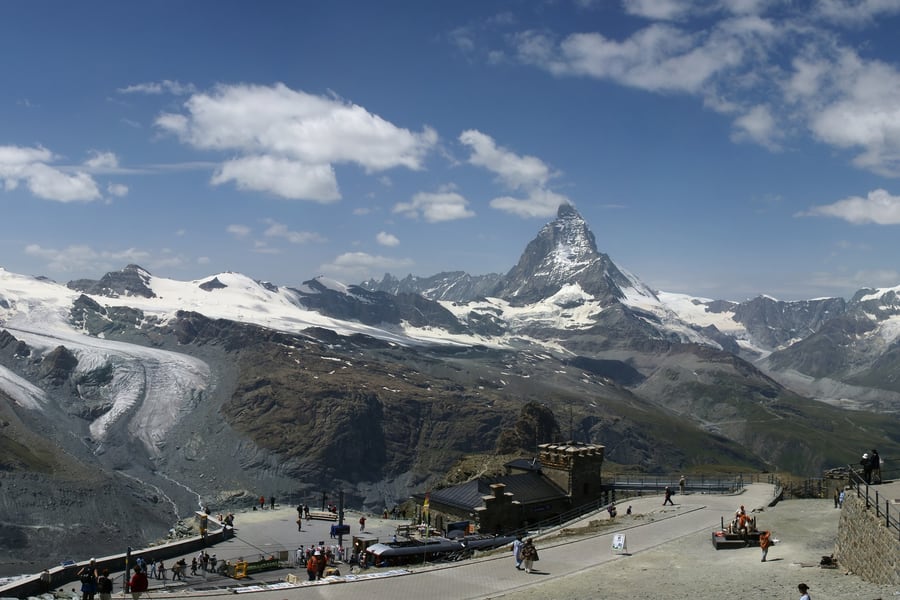
Along the route
 Abxbay / Wikimedia Commons · CC BY-SA 4.0 · cropped
Abt rack, the whole way
Every metre of the climb is on rack, and there is three times as much of it as there is journey — 28 kilometres against a 9.3-kilometre ride. The racks wear on the downhill face, so after about ten years they are lifted, turned round and bolted back the other way up.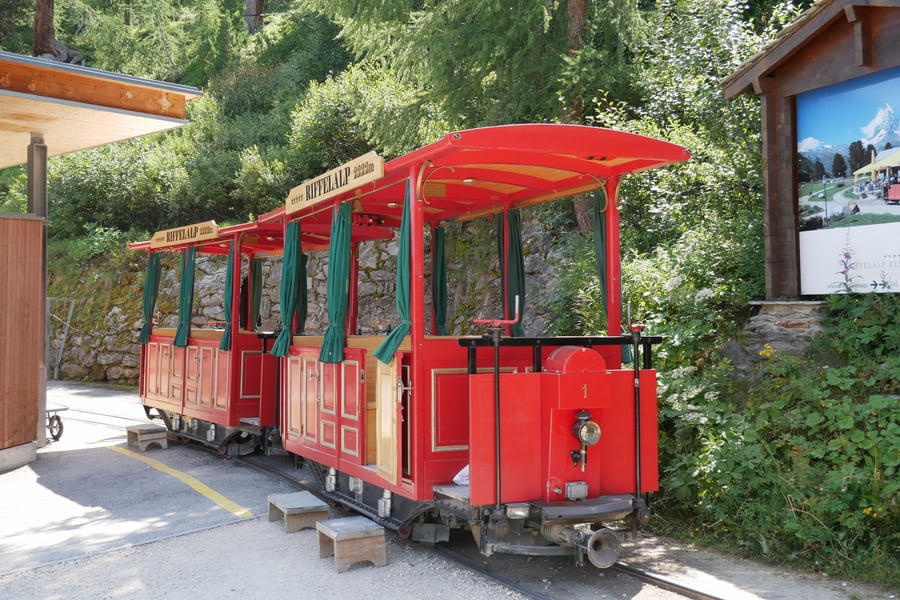 Herbert Ortner / Wikimedia Commons · CC BY 4.0 · cropped
Europe's highest tramway
Riffelalp station stands half a kilometre from the hotel it was built for, so in 1899 the hotelier laid his own 468-metre tramway to close the gap, rising to a terminus at 2,222 metres. Two battery-powered replacements still run it in season.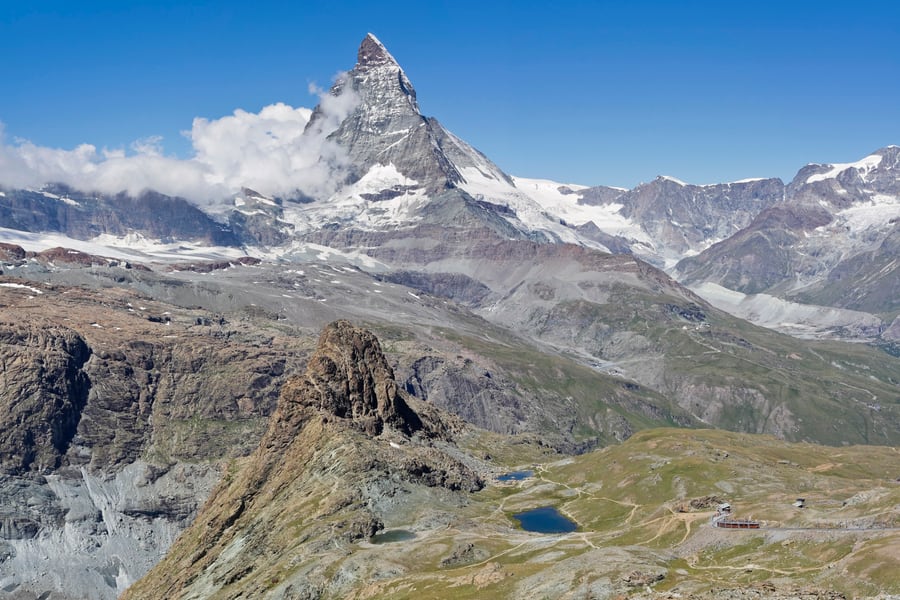 Ximonic (Simo Räsänen) / Wikimedia Commons · CC BY-SA 4.0 · cropped
Twenty-nine four-thousanders
The terrace above the summit station looks out on twenty-nine peaks over 4,000 metres, among them the Dufourspitze at 4,634 m, the highest ground in Switzerland. The Matterhorn is the one everybody photographs.A bit of history
Culture & experiences along the way
 Adrian Michael / Wikimedia Commons · CC BY 3.0 · cropped
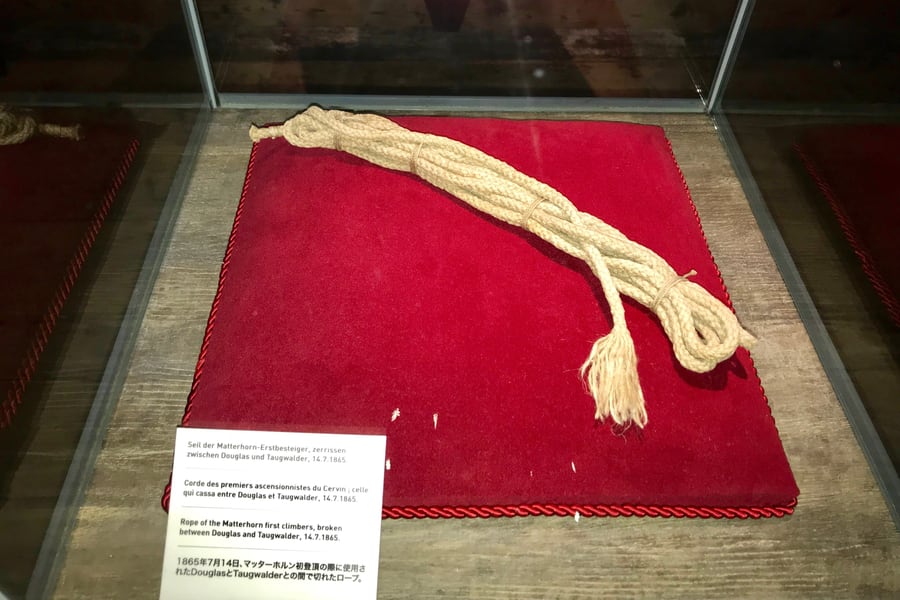
The rope that broke
The Matterhorn Museum keeps the cut end of the line that parted on the first descent in 1865, when four of the seven died.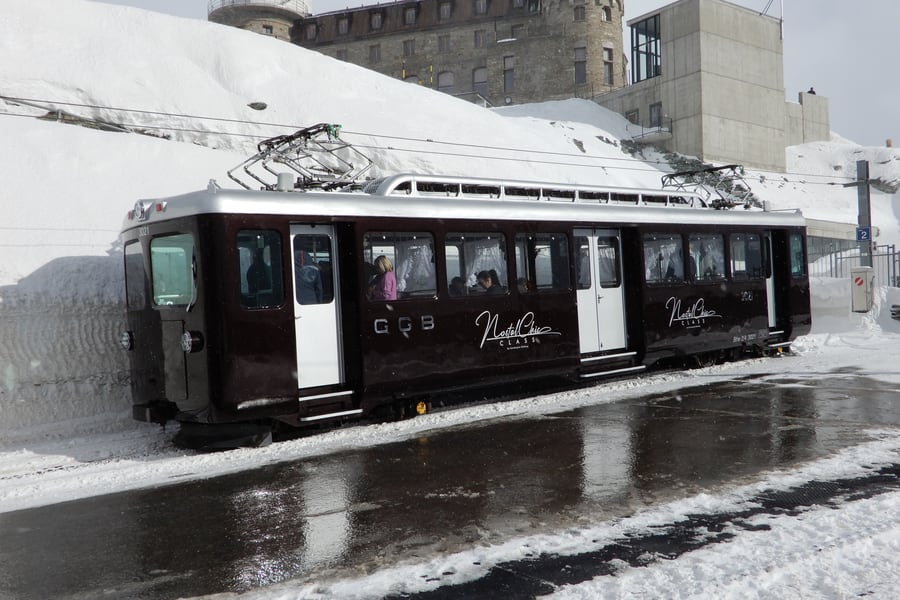 Heitersberg / Wikimedia Commons · CC BY-SA 4.0 · cropped
NostalChic Class
Railcar 3021 of 1961, rebuilt in 2023, with a guide and lunch on the Riffelalp.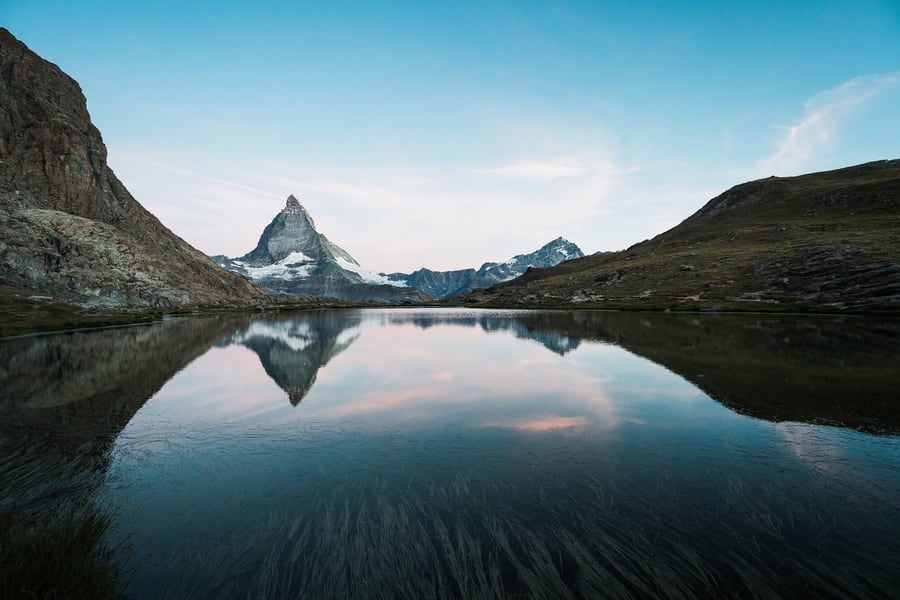 Deralpinbergsteiger / Wikimedia Commons · CC BY-SA 4.0 · cropped
Sunrise at the Riffelsee
Sundays in July, August and September, uphill in the dark with the lights turned off.Timetables
This is not an excursion train that runs once a day — it is a mountain railway with a clockface timetable, and in the main season a train leaves Zermatt every 24 minutes from 08:00 until the late afternoon, with extras before and after.
The 2026 season pattern, from the operator
| Dates | Service |
|---|---|
| 20 April – 1 November 2026 | Every 24 minutes from 08:00; first train from Zermatt 07:00 |
| 2 – 14 November 2026 | No trains — the line is closed for engineering work |
| 15 – 27 November 2026 | Every 48 minutes from 08:24; first train from Zermatt 07:00 (Mon–Fri) |
The ski season that follows returns to the 24-minute interval, with some departures doubled up in the late morning; checked against the Swiss public-transport timetable for 28 December 2026, trains left Zermatt at 08:24 and then every 24 minutes, with a second portion at 09:12, 09:36, 10:00, 10:24 and 10:48.
A working day, checked for 10 September 2026
| Zermatt GGB | Findelbach | Riffelalp | Riffelberg | Rotenboden | Gornergrat |
|---|---|---|---|---|---|
| 08:24 | 08:30 | 08:39 | 08:47 | 08:52 | 08:57 |
| 08:48 | 08:54 | 09:03 | 09:11 | 09:16 | 09:21 |
| 09:12 | 09:18 | 09:27 | 09:35 | 09:40 | 09:45 |
Thirty-three minutes, station to station, and the same at every hour of the day. Departures from Zermatt that day ran 07:00, 08:00, then every 24 minutes from 08:24 to 16:24, followed by 17:30, 18:30 and 19:30, and a last train to Riffelalp only at 21:50 for the resort's guests.
Coming down, the first train off the Gornergrat is at 07:35, then 08:43 and every 24 minutes to 16:19, followed by 16:38, 17:24, 18:24, 19:24 and a final descent at 20:13.
Breaking the journey
A ticket allows getting off and back on at every intermediate station, with one restriction: each section may only be travelled once in each direction. The four intermediate stops are all trailheads — Riffelalp and Riffelberg have restaurants, step-free platforms and boarding assistance for wheelchair users, Rotenboden is ten minutes above the Riffelsee, and Findelbach is a small halt with a waiting room, no ticket machine and no step-free access.
Getting to the start
Zermatt is car-free and reached by rail. Swiss Federal Railways trains run to Visp, where the Matterhorn Gotthard Bahn takes over for the last hour up the Mattertal; the Gornergrat valley station is directly across the square from the arrival platforms. Drivers stop at Täsch, five kilometres short, where the Matterhorn Terminal has 2,100 covered parking spaces and 131 with chargers, and the shuttle train covers the last stretch in 12 minutes.
Winter
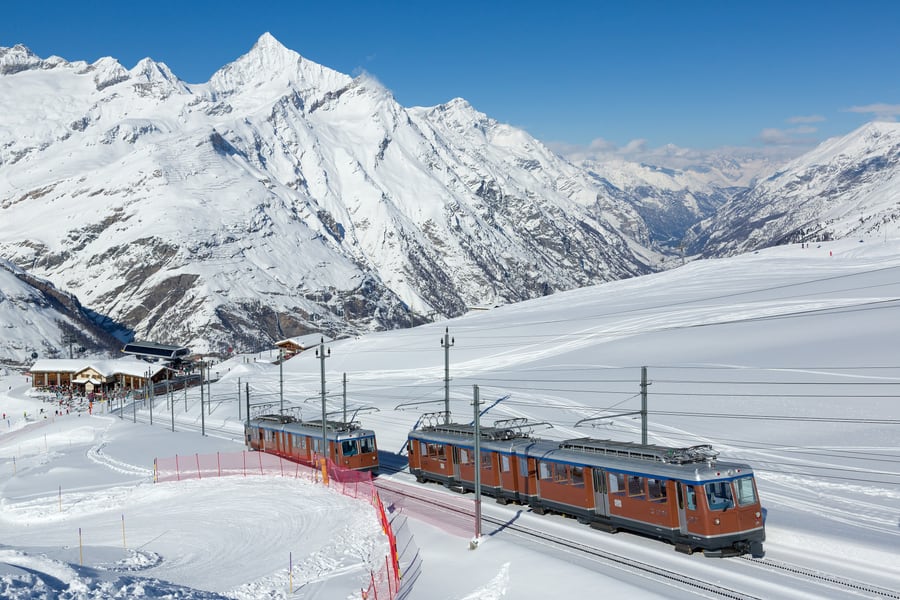
The railway runs all year. The Gornergrat is under snow for around eight months of the year, and clearing it is a nightly operation: a snow-blower pushed by a motorised vehicle, 40 tonnes between them, moving some 3,000 tonnes of snow an hour and clearing a 3.5-metre width by 07:00. In the winter of 2017/18 the Gornergrat took 12.9 metres of new snow and the blower worked for 92 days.
Timetable and season dates from gornergrat.ch, cross-checked against the Swiss public-transport timetable for 10 September 2026, 5 and 20 November 2026 and 28 December 2026. All as of August 2026.
Tickets
Fares are seasonal and the gap is large: the Zermatt–Gornergrat return costs CHF 132 in summer and CHF 102 in winter. A return is valid for ten days, so the descent need not be the same day. The Half Fare Card, GA travelcard and Swiss Travel Pass all take 50% off; Eurail and Interrail passes are not valid here and carry no discount. Children travel free to their sixth birthday in summer and their ninth in winter.
Seats cannot be reserved. What the railway sells instead is Priority Boarding — an exclusive waiting area and three minutes on the train ahead of everyone else, which in practice is what buys a window seat. Bicycles are not carried, in a bag or otherwise. Fares from the operator's 2026/27 price list, edition 06.2026, checked in the shop in August 2026.
Book your tickets
Zermatt – Gornergrat return
Winter CHF 102 · summer CHF 132
The whole line and back, valid for ten days, with breaks allowed at every station.
Book Tickets (opens in a new tab, on Gornergrat Bahn)via Gornergrat BahnAfternoon Ticket
Valid from 12:15 on the chosen day
A cheaper afternoon fare — non-exchangeable, non-refundable, and no travelcard discount applies.
Book Tickets (opens in a new tab, on Gornergrat Bahn)via Gornergrat Bahn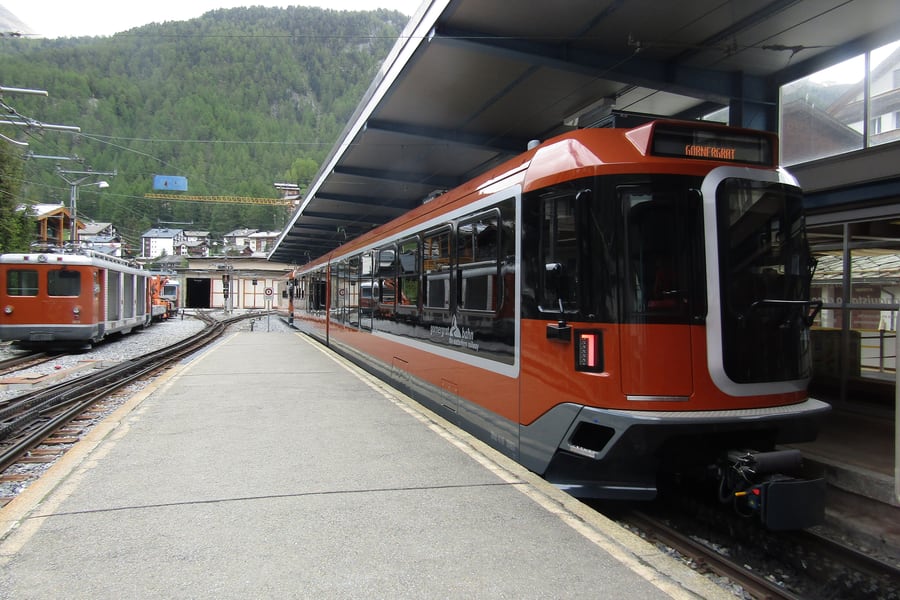
Priority Boarding
Uphill only, per person
Seats cannot be reserved; this buys a waiting area and three minutes' head start on the train.
Book Tickets (opens in a new tab, on Gornergrat Bahn)via Gornergrat BahnSunrise trip
Sundays in July, August and September
Up in the dark with the train lights off, a stop at the Riffelsee and the sunrise from the summit.
Book Tickets (opens in a new tab, on Gornergrat Bahn)via Gornergrat BahnNostalChic Class
The restored 1961 railcar 3021
A guide, a welcome drink, a guaranteed window seat and a four-course lunch on the Riffelalp.
Book Tickets (opens in a new tab, on Gornergrat Bahn)via Gornergrat BahnRail Passes
The Gornergrat is one of the mountains where a Swiss pass helps but does not carry you, and one where the European passes do nothing at all.
Swiss Travel Pass, GA and Half Fare Card — 50%, no more
The operator states it plainly: the Swiss Travel Pass — and the Swiss Travel Pass Flex Combi, the Swiss Travel Pass Youth and Youth Flex, and the Swiss Half Fare Card — entitles the holder to 50% off the Gornergrat Railway. So does the GA travelcard and the ordinary Swiss Half Fare Card. The discount is selected when booking online, or shown at the counter.
That takes the summer return from CHF 132 to CHF 66, and the winter return from CHF 102 to CHF 51.
⚠️ With a Flex pass, a travel day has to be used to get the discount — the reduction is not free-standing.
⭐ Worth knowing when planning several mountains: the Swiss Travel Pass covers only three summits outright — the Rigi, the Stanserhorn and the Stoos. The Gornergrat, like the Jungfraujoch, Pilatus and the Schilthorn, is a discount and not a free ride. The pass does cover the journey to Zermatt in full, including the Matterhorn Gotthard Bahn up the Mattertal, which is where most of its value on this trip lies.
Interrail and Eurail — not valid
⛔ The operator's answer is a flat no: "the Eurail Pass or the Interrail Pass … are not valid with the Gornergrat Railway and do not entitle you to a discount." The same applies to the SBB day pass and to municipal day passes. An Interrail or Eurail pass will get you to Zermatt — the Matterhorn Gotthard Bahn from Visp is a normal pass-covered service — and then stops at the foot of the mountain.
The international FIP card
Railway staff holding an international FIP card get 50%. The FIP ticket booklet and free staff tickets are not accepted.
Is a pass worth buying for this?
Not on its own. What a pass is worth here is one 50% discount — CHF 66 in summer, CHF 51 in winter — and a multi-day pass has to earn its price back several times over. Where it pays is as part of a longer Swiss trip, and the arithmetic on this particular mountain is simpler than most: if the visit is only about the Gornergrat, the Swiss Half Fare Card gives the same 50% on the railway without spending travel days on it, and the Peak Pass from CHF 180 is the better answer for anyone riding Zermatt's mountains for several days rather than passing through.
Pass conditions from the operator's own discounts page and from sbb.ch, August 2026.
Places to Visit
A ticket lets you off at every station and back on again later, which turns a 33-minute ride into a day laid out on a mountainside. These are the five places the line stops at, from the car-free village at the bottom to the ridge with the glacier below it.
 Paradise Chronicle / Wikimedia Commons · CC BY-SA 4.0 · cropped
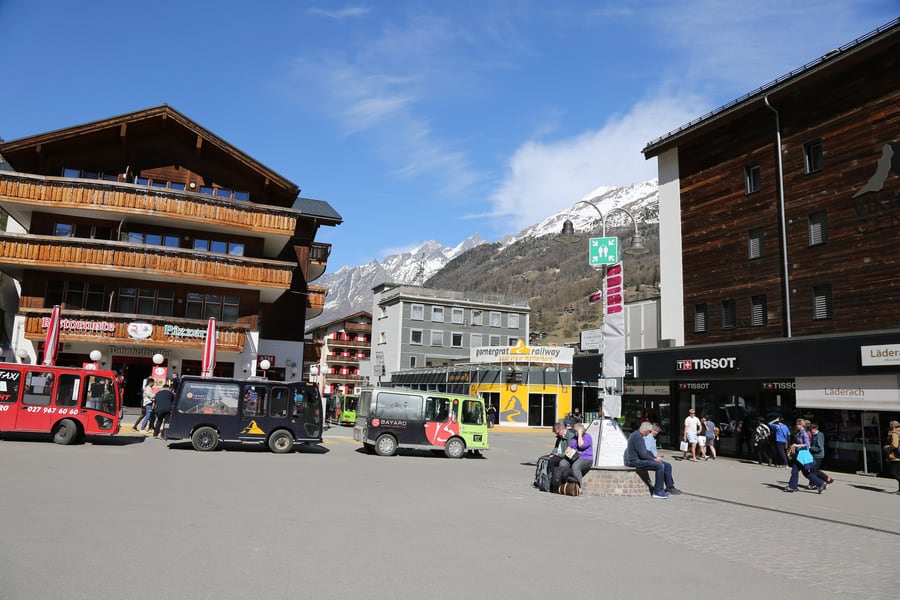
Zermatt
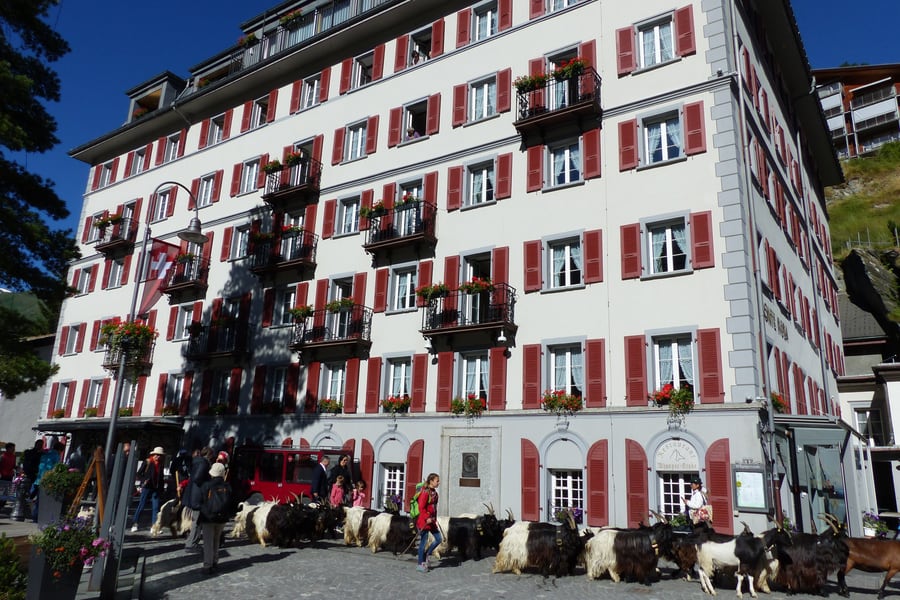
A village of about 5,800 people and no petrol cars: the taxis and hotel shuttles crossing the Bahnhofplatz are electric, and visitors arriving by road leave the car at Täsch. The Gornergrat Bahn's own station faces the Matterhorn Gotthard Bahn platforms across the square, so the change between them is a minute's walk. The Hotel Monte Rosa, a short way along the Bahnhofstrasse, is where Edward Whymper left for the Matterhorn on 13 July 1865.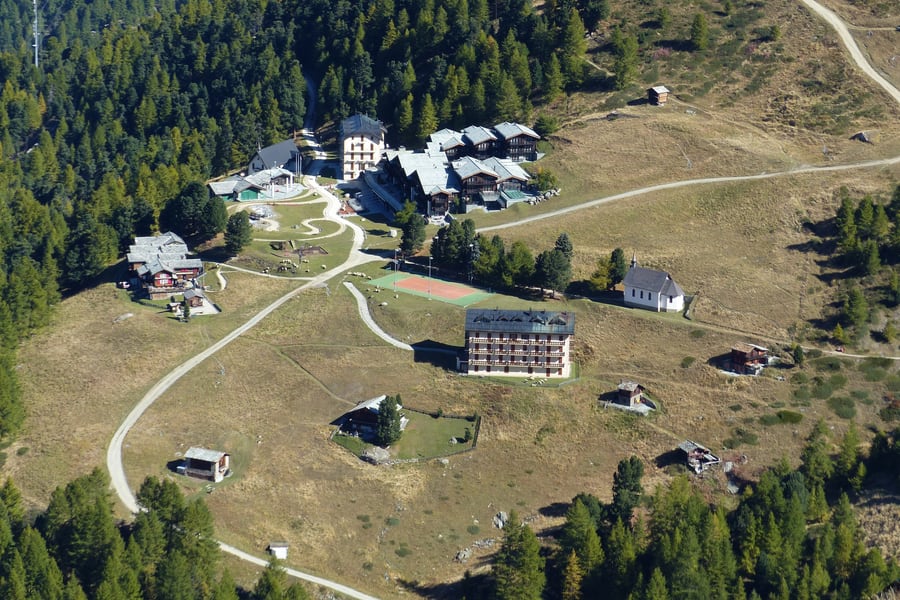 Whgler / Wikimedia Commons · CC BY-SA 4.0 · cropped
Riffelalp
A shelf of stone pine and alpine pasture with a hamlet of hotel buildings on it, cows through the summer and cheese sold where they graze. There is no road: everything and everyone arrives on the railway, and the last half-kilometre to the resort is covered by the highest tramway in Europe. The station has a ticket machine, luggage drop-off and step-free access to the platform.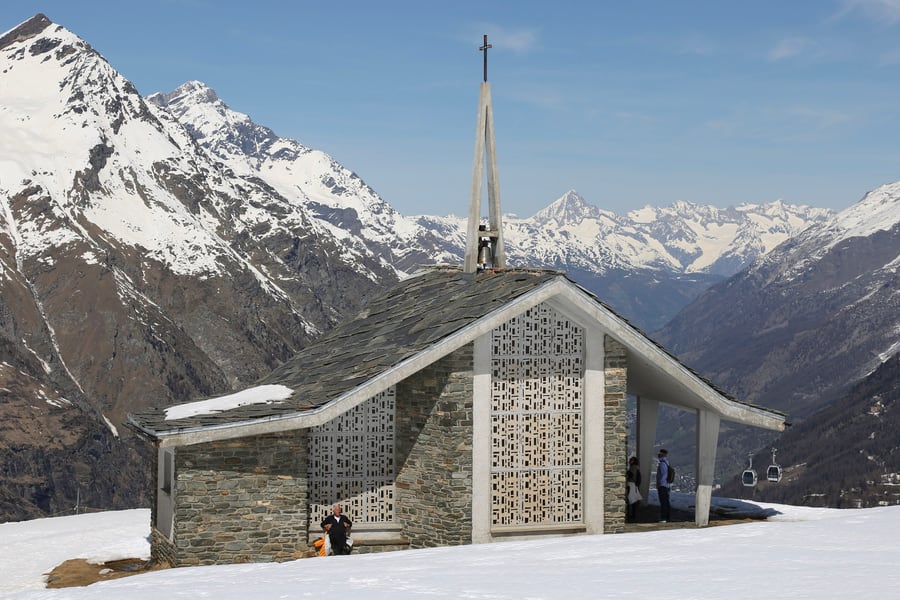 Paradise Chronicle / Wikimedia Commons · CC BY-SA 4.0 · cropped
Riffelberg
Open pasture where Valais black-nosed sheep graze in summer, two restaurants, and a hotel built between 1852 and 1854 that was the base for the first ascents of the Monte Rosa peaks. Mark Twain slept in room 32 in August 1878 and turned the walk up into a seven-day expedition of 198 people in A Tramp Abroad. The Brother Klaus chapel of 1961 stands in the meadows above the station, its roof shaped after the Weisshorn behind it.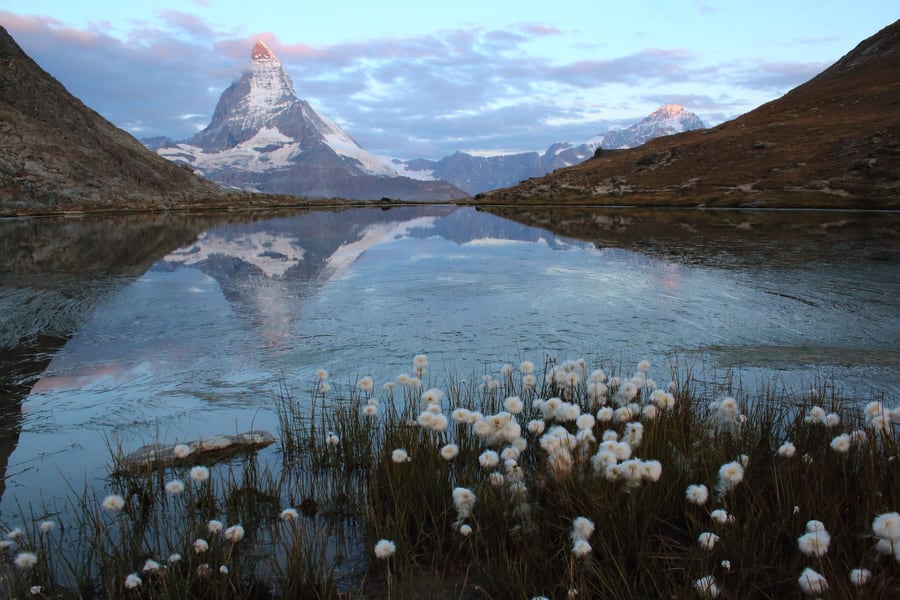 FrDr / Wikimedia Commons · CC BY-SA 4.0 · cropped
Rotenboden
The second-highest station on the line, and the last stop before the summit. Ten minutes down the path is the Riffelsee at 2,757 metres, which on a still morning reflects the whole Matterhorn — the walk to it crosses Europe's highest alpine garden. Rotenboden is also the start of the four-to-five-hour route to the Monte Rosa Hut, from which fourteen four-thousanders are within a day's reach.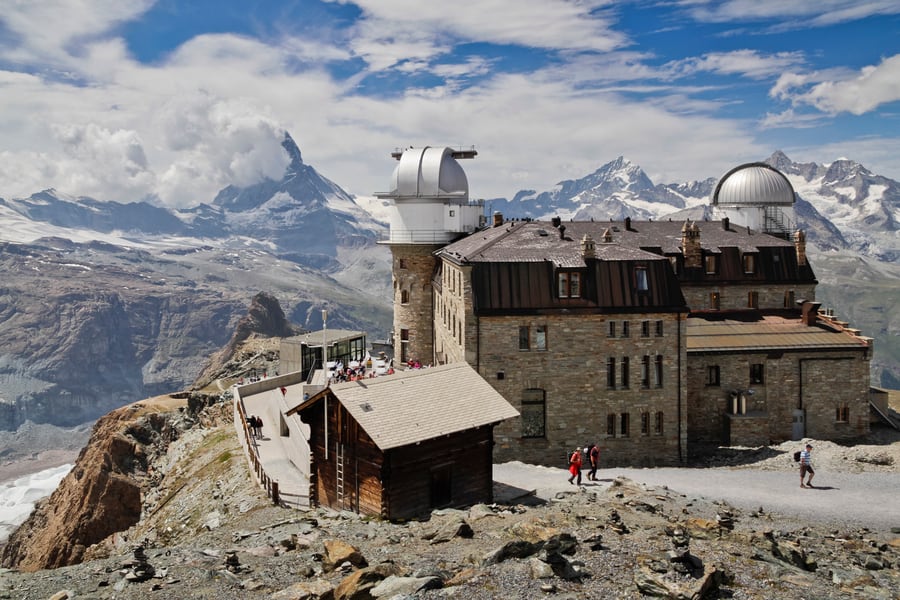 Ximonic (Simo Räsänen) / Wikimedia Commons · CC BY-SA 4.0 · cropped
Gornergrat
A rock terrace with a stone hotel on it, two observatory domes, a chapel and a viewing platform above the station. The Gorner Glacier runs below, twenty-nine four-thousanders stand round the horizon, and the Viscope telescopes on the terrace name them. The Stellarium in the towers is a working research station of the Universities of Bern and Geneva, not generally open to the public.Where to Sleep
This is one of the few railways where the beds are on the line itself. Zermatt has the choice and the restaurants; Riffelalp and Riffelberg are reached only by this train; and the Gornergrat has the highest hotel in the Swiss Alps, which is where the sunrise and the night sky are worth the altitude.
Where to stay
 Whgler / Wikimedia Commons · CC BY-SA 4.0 · cropped
Hotel Monte Rosa
Zermatt, on the Bahnhofstrasse
The foundation walls date from 1839; Alexander Seiler took over the chalet on the site in 1853 and it became the regular lodging of the first Matterhorn climbers. Edward Whymper, a guest since 1860, left it for the summit on 13 July 1865.
Check Availability (opens in a new tab, on monterosazermatt.ch)via monterosazermatt.ch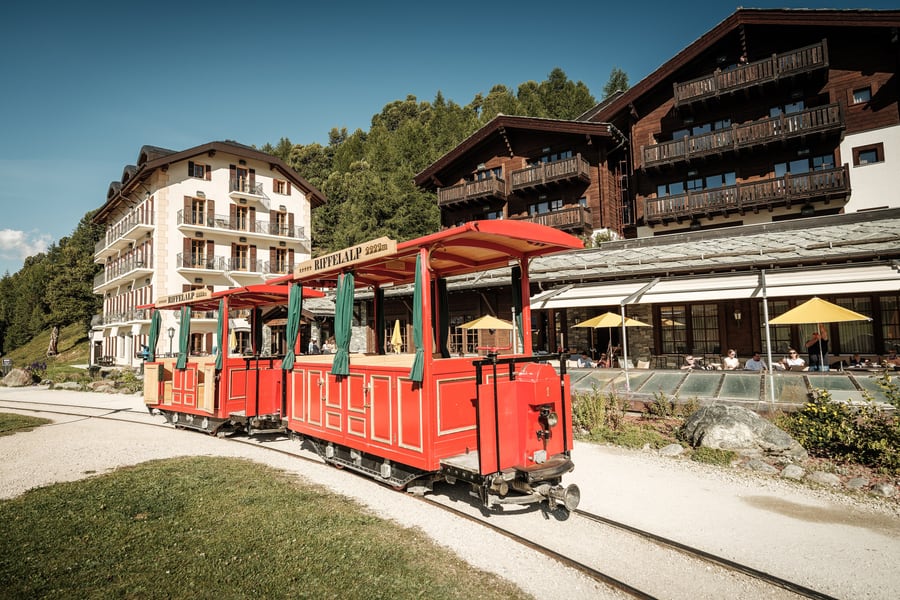 Riffelalp Resort / Wikimedia Commons · CC BY-SA 4.0 · cropped
Riffelalp Resort 2222 m
Reached only by this railway
A five-star resort on the Riffelalp shelf, a 20-minute ride from Zermatt and accessible by no other means. Its own tramway, the highest in Europe, covers the last half-kilometre from the station. Open 19 June – 21 September 2026 and 11 December 2026 – 4 April 2027.
Check Availability (opens in a new tab, on riffelalp.com)via riffelalp.comRiffelhaus 1853
On the Riffelberg at 2,548 m
Built between 1852 and 1854 by a vicar and two friends as, at the time, the highest hotel in Europe, with eighteen beds. Twenty-five rooms and suites today, all facing the mountains, and a Jacuzzi that looks at the Matterhorn.
Check Availability (opens in a new tab, on riffelhaus.ch)via riffelhaus.ch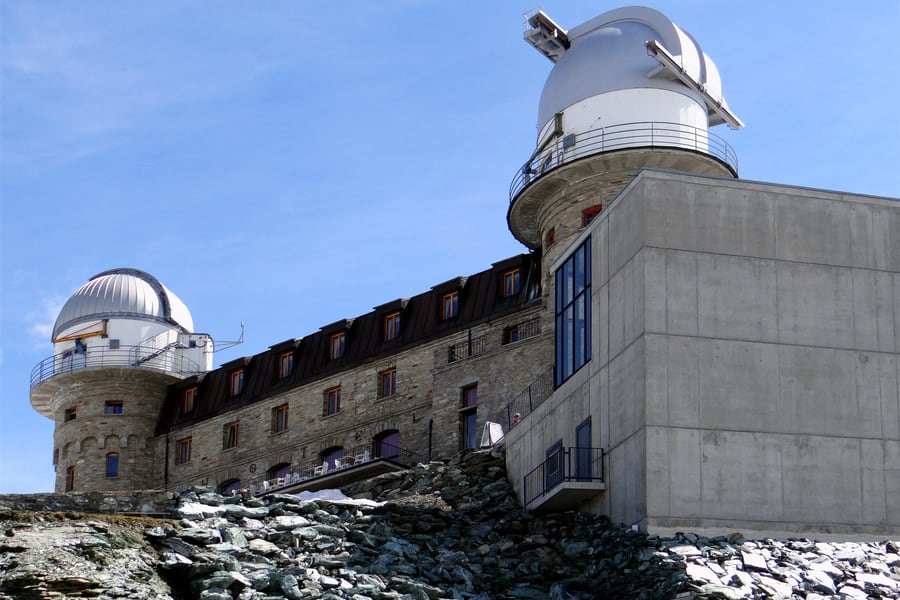 Wayne77 / Wikimedia Commons · CC BY-SA 4.0 · cropped
3100 Kulmhotel Gornergrat
The highest hotel in the Swiss Alps
At the summit station, opened in 1910 after the railway's terminus was moved uphill. Twenty-two rooms, four restaurants and bars, and the Stellarium observatory in its towers, where guests can be shown the sky on set dates.
Check Availability (opens in a new tab, on gornergrat-kulm.ch)via gornergrat-kulm.chQuestions or corrections
Planning this trip and stuck on something, or spotted a time, fare or detail that has changed? Send us a message about Gornergrat Railway. We read every one, and we update this page when something has changed.