Gotthard Panorama Express
Nelso Silva / Wikimedia Commons · CC BY-SA 2.0
- Distance182 km
- Duration~5 h 30 m
- Best season18 April – 18 October 2026, daily
Introduction
You buy one ticket, and the first two hours and forty-three minutes of it are spent on a boat.
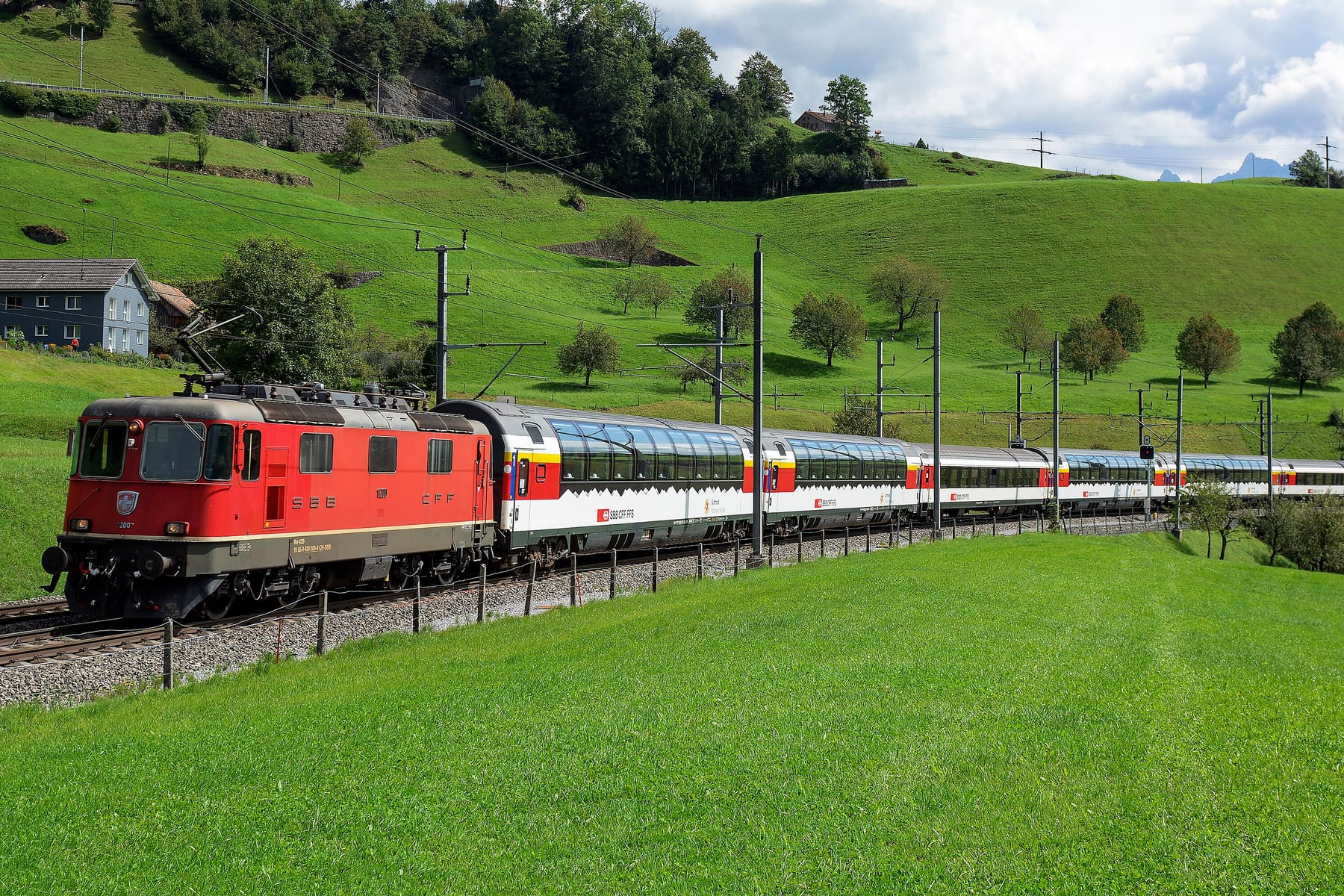
The Gotthard Panorama Express leaves Lucerne at 11:12 from a pier beside the station rather than from a platform inside it. What pulls away is a Lake Lucerne Navigation Company vessel — on a good day one of the five paddle steamers the company still runs, the oldest of them launched in 1901 — and it takes the long southern arm of the lake past the Rütli meadow and Tell's Chapel to Flüelen. Only there, at 14:09, does the railway part begin: a rake of first-class panorama coaches behind a Re 4/4 II, on the old Gotthard mountain line.
That line was, for 134 years, the main route between northern Europe and Italy. In December 2016 the Gotthard Base Tunnel opened fifty-seven kilometres of near-level track beneath it, and the through traffic moved underground. What was left on the mountain is everything the base tunnel cannot offer: gradients of 27 per thousand, seven spiral tunnels bored to gain height where the valley gave none, a village whose baroque church you pass three times at three different altitudes, and a stone portal at Göschenen with 1882 cut into it in Roman numerals.
The slow way over the top is now the reason to come rather than the obstacle in the way of coming. Between Flüelen and Lugano the train runs in first class only, the lights go down inside the 1882 tunnel while a film is thrown onto its wall, and it arrives in a city of palm trees at 16:41.
The Journey
Two hours and forty-three minutes on the water
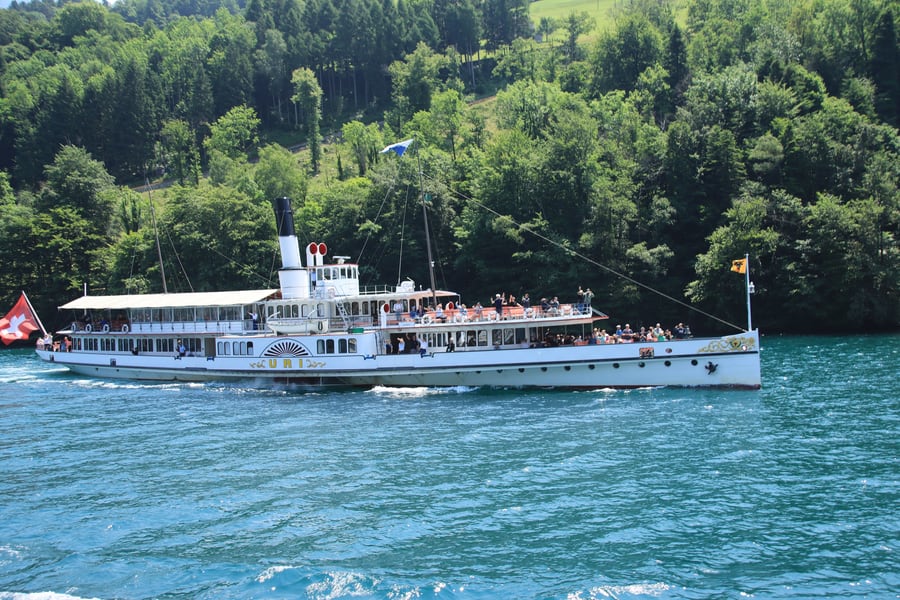
The Lucerne piers sit on the Bahnhofquai, a minute from the station concourse, and the vessel that takes the 11:12 is whichever the Lake Lucerne Navigation Company has rostered — a paddle steamer or the motor ship Diamant. The company keeps nineteen boats, and five of them are Belle Époque paddle steamers: Uri of 1901, the oldest paddle steamer in Switzerland and a designated Historic Mechanical Engineering Landmark; Unterwalden of 1902, the one with a chimney that folds down to clear the Acheregg bridge; Schiller of 1906, whose first-class saloon is panelled in lemonwood, ebony and mother-of-pearl; Gallia of 1913, built for speed by Escher Wyss and good for 31 km/h; and the 1928 flagship Stadt Luzern, the last paddle steamer built for a Swiss lake.
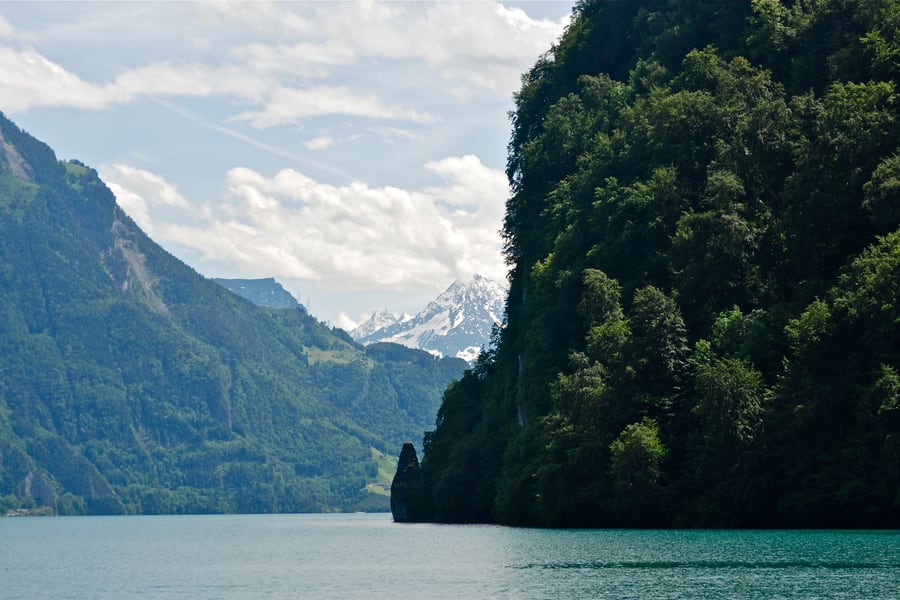
The boat calls at Vitznau at 12:10 and Brunnen at 13:11, and between them the lake narrows into the Urnersee, the fjord-like southern arm that gives Swiss history most of its founding scenery. The Rütli meadow, where the three forest cantons are said to have sworn their alliance in 1291, is a green clearing on the western shore with a jetty and no road. Tell's Chapel stands on the eastern shore at the Tellsplatte, on the slab of rock where the legend has Wilhelm Tell springing from Gessler's boat in a storm; the present chapel was built in 1879 and painted between 1880 and 1882 with four frescoes of the story by Ernst Stückelberg. Flüelen, at the head of the lake, arrives at 13:55.
The change of vehicle
Flüelen has been a transhipment point since long before either the boat or the railway was a tourist proposition — steam vessels were landing goods here from 1837, to be reloaded onto carts and mules for the pass. Today the pier and the station stand side by side, and the fourteen minutes between 13:55 and 14:09 are the whole of the interchange.
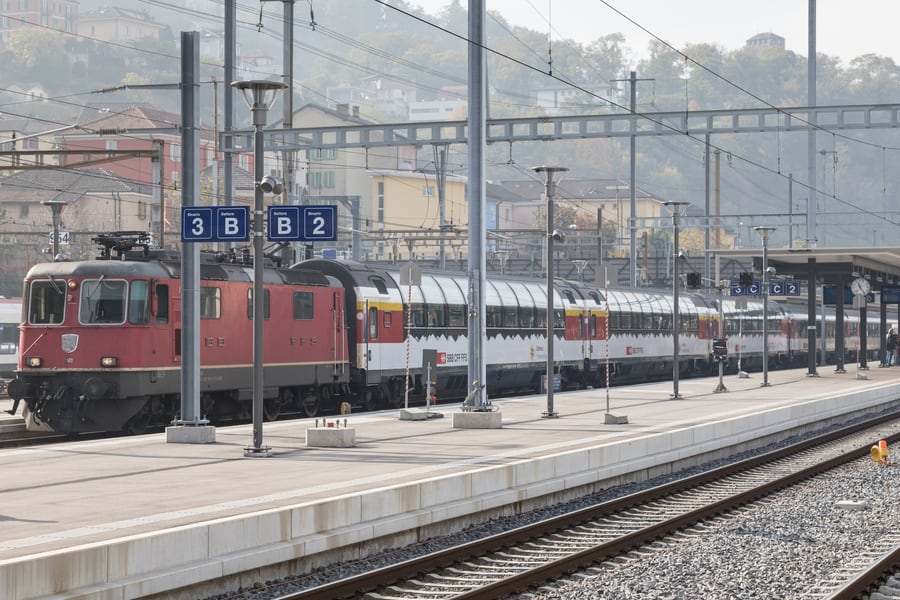
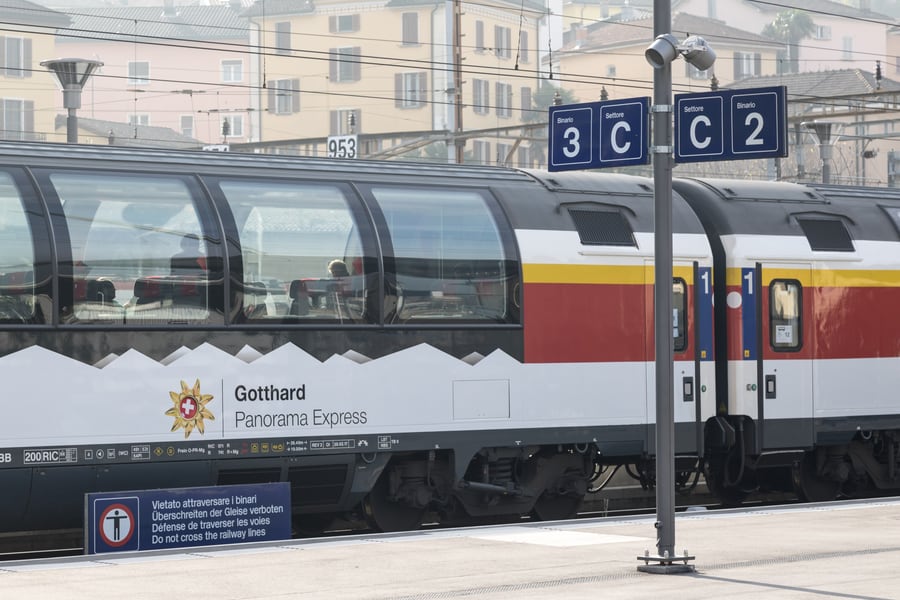
The train is a rake of SBB panorama coaches with a raised, zigzag-edged glazing line, hauled by a Re 4/4 II — class Re 420, the four-axle workhorse the Swiss federal railway has been running since the 1960s. A multilingual guide travels with the train. One coach in the middle is set aside as a photo coach, with a window that opens.
Three views of one church
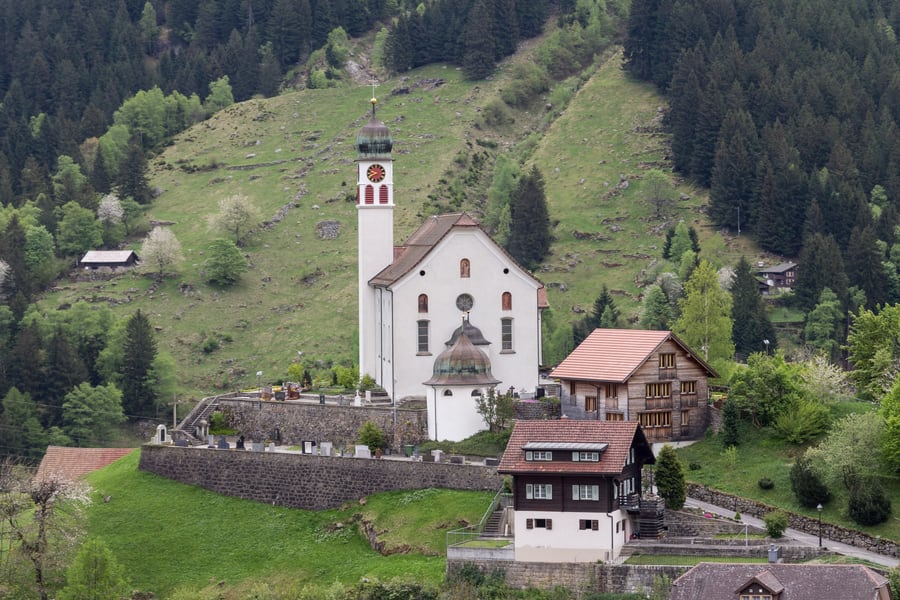
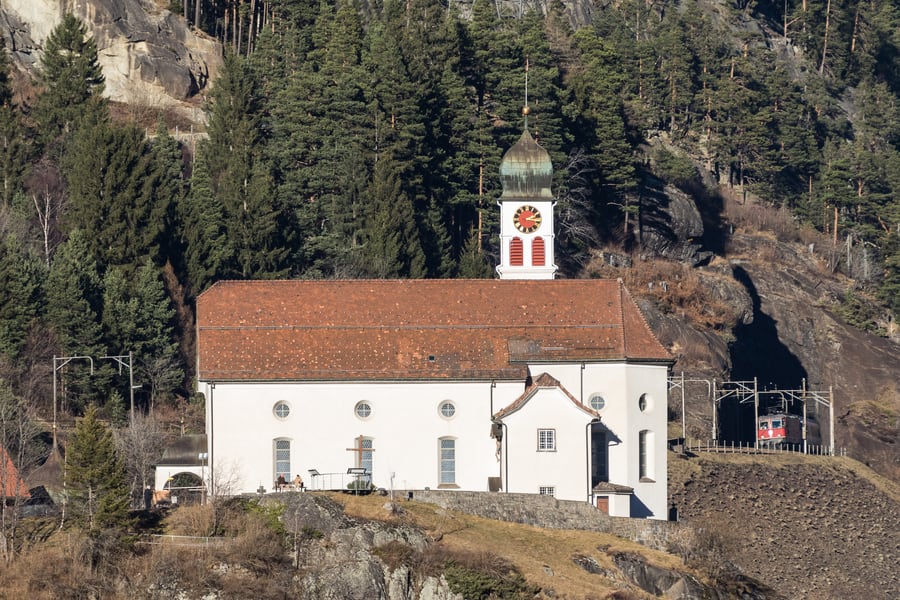
Out of Flüelen the line runs up the Reuss to Erstfeld, then begins to climb in earnest. Above Gurtnellen it enters the first of the spiral tunnels — seven of them on the two ramps, bored to gain height where the valley floor offered no room to gain it. Two of the seven form the double loop at Wassen, and they are the reason the village is famous among people who have never been there: the baroque church of St Gallus appears three times from three different heights, first from below and finally from about two hundred metres above. Passengers who have not been warned spend the interval convinced the train has gone the wrong way.
The tunnel, and the film on its wall
At Göschenen, 1,106 metres up, the mountain runs out of valley. The portal is a stone arch with MDCCCLXXXII carved over it — 1882, the year the line opened — and behind it is the Gotthard Tunnel: 15,003 metres bored between 1872 and 1880, the longest railway tunnel in the world when it was finished, and the summit of the whole route at 1,151 metres. Its engineer, Louis Favre, took the contract on a bid so low that it put him at odds with his backers for the rest of his life, and he died of a heart attack inside the workings on 19 July 1879, seven months before the two headings met on 29 February 1880. Roughly two hundred men were killed building it, most of them by the compressed-air trains that hauled the spoil out; Airolo has a memorial to them, with a relief by Vincenzo Vela titled Vittime del lavoro.
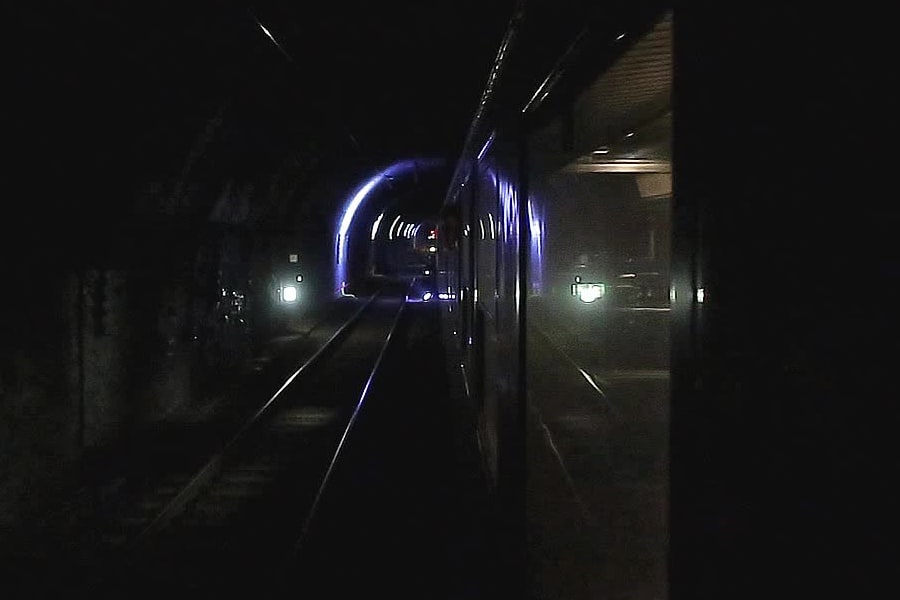
Seven or eight minutes is all it takes at line speed. The Gotthard Panorama Express does not run at line speed. The lights are dimmed, the train slows, and between kilometre 12.7 and kilometre 13.0 from the north portal a set of projectors mounted between the tracks throws images and film onto the western tunnel wall — the building of the railway, told inside the thing that was built.
Down into Italian Switzerland
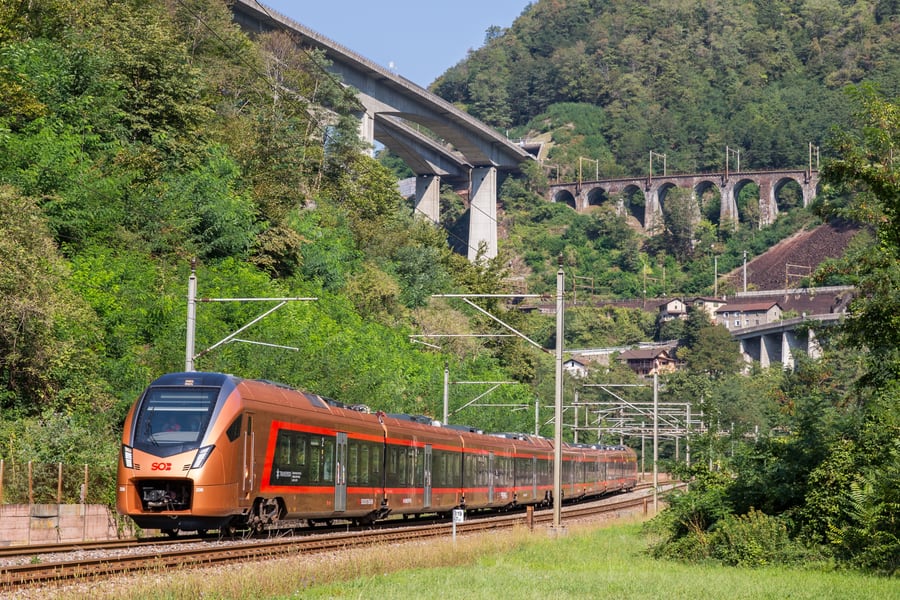
Airolo is on the other side, and the language on the station signs has changed. The southern ramp falls harder than the northern one climbed. Beyond Rodi-Fiesso, at 942 metres, the valley pinches into the Piottino gorge and two spiral tunnels drop the line two hundred metres to Faido; below Lavorgo two more, the Biaschina loops, bring it down to Giornico at 391 metres. From the train you can look across the gorge and see the track you were on ten minutes ago, stacked above the track you are on now.
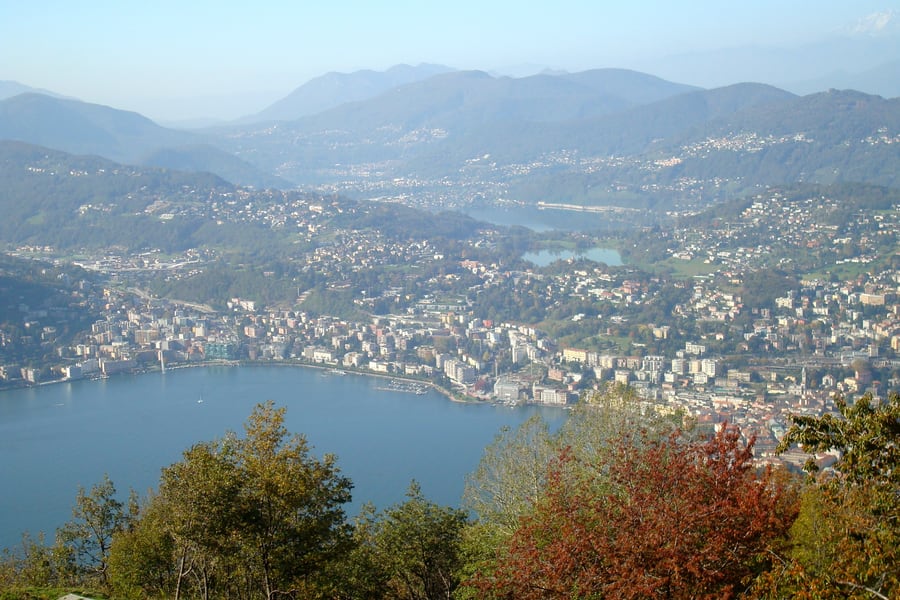
The Leventina flattens into the Ticino plain, and by Bellinzona, at 241 metres, the vines and the Lombard bell towers have taken over. Three castles stand over the town — Castelgrande, Montebello and Sasso Corbaro — together a UNESCO World Heritage Site. Lugano, on its lake under Monte Brè and Monte San Salvatore, is 35 minutes further on, and the train gets there at 16:41.
Along the route
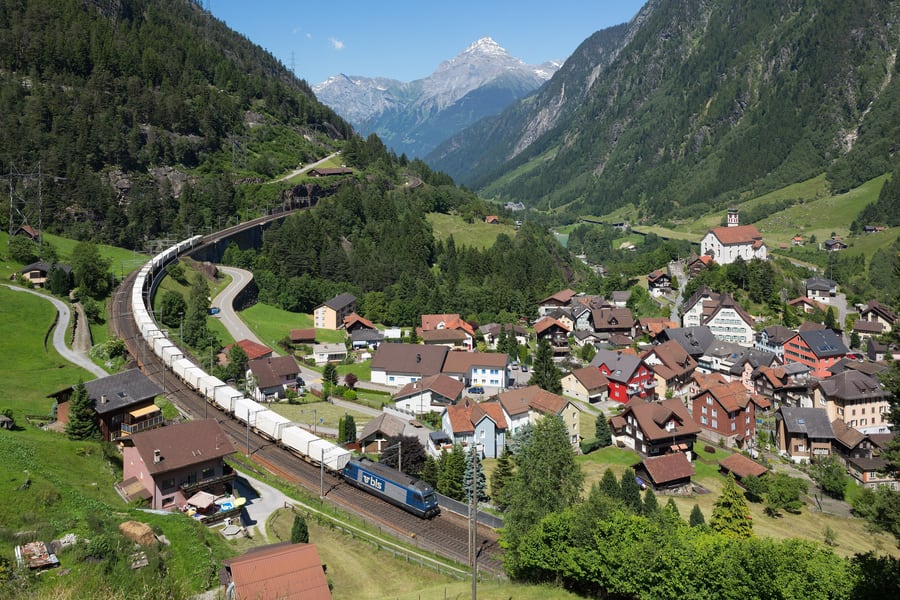
 JoachimKohlerBremen / Wikimedia Commons · CC BY-SA 4.0 · cropped
The double loop at Wassen
Two of the line's seven spiral tunnels stacked above one village, so that the baroque church of St Gallus is passed three times from three different heights — the last of them some two hundred metres above the first.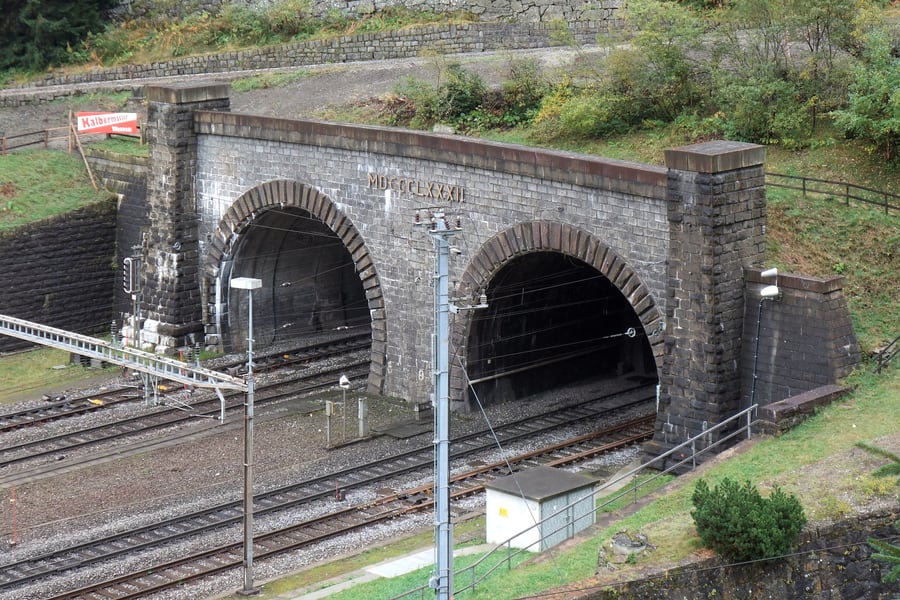 Kecko / Wikimedia Commons · CC BY 2.0 · cropped
The 1882 Gotthard Tunnel
15,003 metres bored between 1872 and 1880, the longest railway tunnel in the world when it opened. The portal at Göschenen carries the opening year in Roman numerals; the arch on the right is the tunnel itself.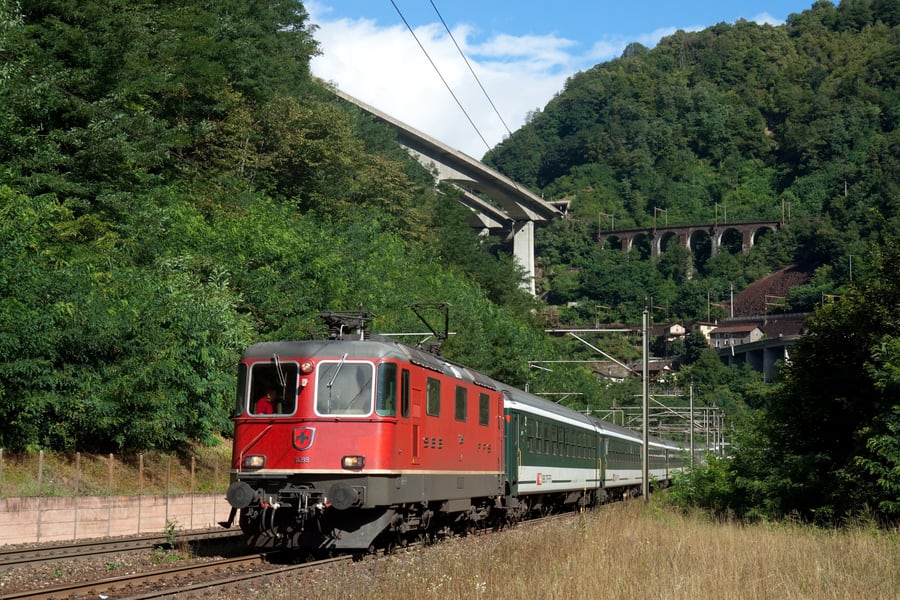 Kabelleger / David Gubler / bahnbilder.ch · public domain
The Biaschina loops
On the southern ramp the line drops from 942 m at Rodi-Fiesso to 391 m at Giornico through four spiral tunnels in two pairs, and from the window you can see the track you were on ten minutes ago stacked above the one you are on now.A bit of history
Culture & experiences along the way
 JoachimKohler-HB / Wikimedia Commons · CC BY-SA 4.0 · cropped
First class, the whole way
The panorama coaches carry no second class at all between Flüelen and Lugano.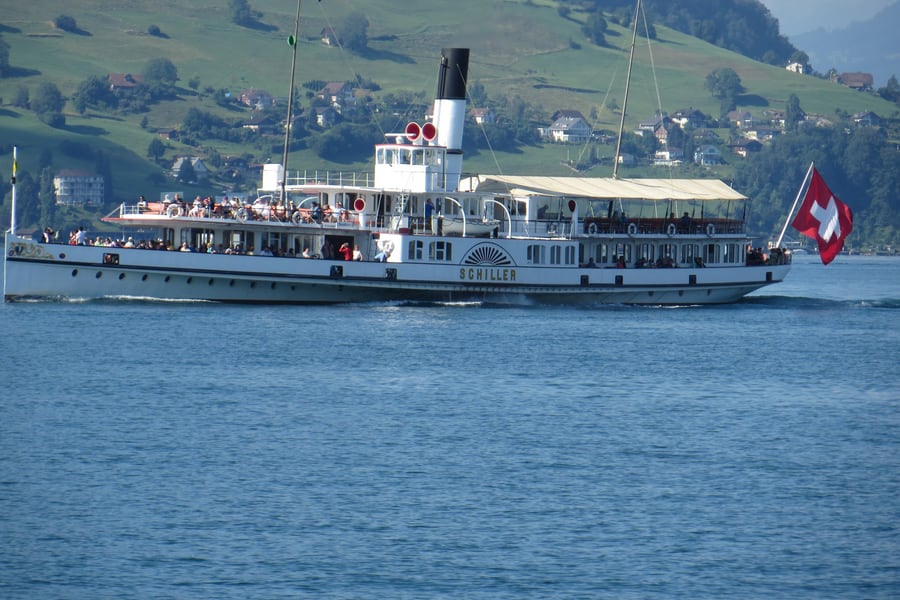 Roel Hemkes / Wikimedia Commons · CC BY 2.0 · cropped
A Belle Époque paddle steamer
Five of the nineteen boats on Lake Lucerne are steamers; the 1906 Schiller is one.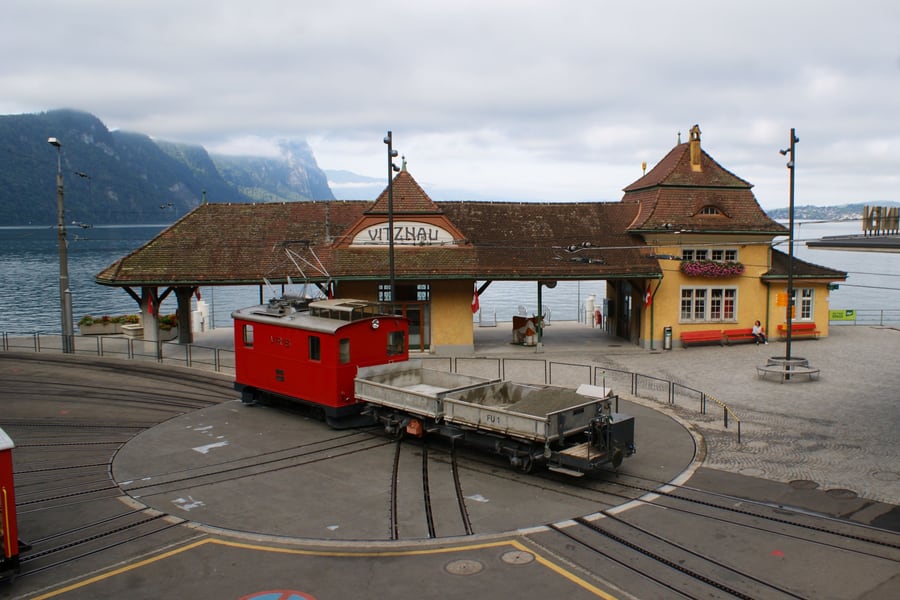 Asurnipal / Wikimedia Commons · CC BY-SA 4.0 · cropped
Step off at Vitznau for the Rigi
The boat calls at 12:10 at the foot of Europe's first mountain railway, opened 1871.Timetables
One train each way, once a day, from mid-April to mid-October. In 2026 the Gotthard Panorama Express runs daily — public holidays included — from Saturday 18 April to Sunday 18 October.
Southbound: Lucerne → Flüelen → Lugano
| Leg | Place | Time |
|---|---|---|
| Boat | Lucerne | 11:12 |
| Boat | Vitznau | 12:10 |
| Boat | Brunnen | 13:11 |
| Boat | Flüelen | 13:55 arr |
| Train | Flüelen | 14:09 |
| Train | Bellinzona | 16:06 |
| Train | Lugano | 16:41 arr |
Northbound: Lugano → Flüelen → Lucerne
| Leg | Place | Time |
|---|---|---|
| Train | Lugano | 09:18 |
| Train | Bellinzona | 09:53 |
| Train | Flüelen | 11:35 arr |
| Boat | Flüelen | 12:00 |
| Boat | Brunnen | 12:47 |
| Boat | Vitznau | 13:48 |
| Boat | Lucerne | 14:47 arr |
End to end that is 5 hours 29 minutes in either direction. Southbound the boat has 2 h 43 of it and the train 2 h 32; northbound the train takes 2 h 17 and the boat 2 h 47, because the two legs are not timed as mirror images of each other.
Train only, without the boat
The panorama train itself runs beyond Flüelen to Arth-Goldau, which is the option for anyone who would rather not spend the morning on the water — or who wants to connect onward. Southbound it leaves Arth-Goldau at 13:35 and reaches Flüelen at 14:09; northbound it arrives at Arth-Goldau at 12:00. Arth-Goldau is on the main line to Zurich, Zug and Basel, is the foot of the Arth–Rigi rack railway, and is where the Voralpen-Express to St. Gallen calls.
The published calls are Arth-Goldau, Flüelen, Bellinzona and Lugano. The operator's own accessibility note is the clearest statement of what the train does not do: boarding with a wheelchair is possible only at those four stations, "the required infrastructure is not available in Göschenen and Airolo", and the panorama coaches have no wheelchair-accessible toilet.
For anyone tracking a specific working, the train is PE 3093 southbound and PE 3092 northbound; the boat is course 13 southbound and course 18 northbound.
What runs the same route in winter
Nothing, under this name — the Gotthard Panorama Express does not operate outside the season. The mountain line itself stays open all year, worked by the Treno Gottardo, the Südostbahn's Flirt Traverso service over the same track. It runs Basel–Lucerne–Locarno and Zurich–Locarno, each every two hours, which together give roughly an hourly train over the Gotthard summit line. Checked for a January date, Lucerne departs at 09:18 and 11:18 for Locarno without a change, taking 3 h 09; from Zurich it is 3 h 22 and from Basel 4 h 23. There is no supplement and no compulsory reservation — it is an ordinary InterRegio, in both classes, over the same seven spirals and the same 1882 tunnel. What it does not have is the boat, the guide, or the film in the tunnel.
Getting to the start
Lucerne is 41 to 50 minutes from Zurich Hauptbahnhof, twice an hour and without a change, and 1 h 01 from Basel SBB; the boat pier is on the Bahnhofquai immediately outside the station. Lugano at the other end sits on the Milan–Zurich main line: 14 minutes from Bellinzona on an ordinary fast train — the panorama train's own 35 minutes over the same stretch is the leisurely version — and 1 h 15 from Milano Centrale by EuroCity, hourly.
Timetable from the operator's own published tables at gotthard-panorama-express.ch, cross-checked against the Swiss public-transport timetable (train PE 3093, boat course 13); winter service checked against the same timetable for 20 January 2027. All as of August 2026.
Tickets
Two things are being bought here and it is worth keeping them apart: an ordinary Swiss ticket for the route, and a compulsory supplement of CHF 24 a head that includes the seat reservation. The supplement is the same whether the journey is Lucerne to Lugano or only Flüelen to Lugano. Between Flüelen and Lugano the panorama train has no second class at all, so the ticket underneath has to be valid in first — which matters most to anyone holding a second-class pass, who needs a class upgrade too.
Full fare Lucerne to Lugano comes to CHF 188 all in; a Half Fare holder pays CHF 106, a second-class Swiss Travel Pass holder CHF 55.50, and a first-class pass holder only the CHF 24. Since the reservation is compulsory and there is one train a day each way, buy the supplement first. Prices from the operator's own page, August 2026.
Book your tickets
Compulsory supplement
Any route, per person
The seat reservation, which every passenger has to hold. The same price for the full run or a short one.
Book Tickets (opens in a new tab, on Gotthard Panorama Express)via Gotthard Panorama ExpressLucerne – Lugano, full fare
Boat and train, no discount card
A first-class ticket for the whole route with the compulsory supplement included.
Book Tickets (opens in a new tab, on Gotthard Panorama Express)via Gotthard Panorama ExpressFlüelen – Lugano
The train section only
For anyone joining at the interchange rather than sailing from Lucerne — ticket plus supplement.
Book Tickets (opens in a new tab, on Gotthard Panorama Express)via Gotthard Panorama ExpressRail Passes
This is one of the journeys where a pass does most of the work — and one where the fine print about class matters more than usual, because the train has no second class.
Swiss Travel Pass and GA Travelcard
Both cover the route itself: the boat across Lake Lucerne, the train over the Gotthard, and the onward connections at either end. Switzerland Tourism describes the journey as fully covered by the Swiss Travel Pass, and it is — but the operator's own price page is the one to read, because it sets out what a second-class pass still has to pay:
- First-class pass or GA: ticket CHF 0.00, plus the compulsory CHF 24 supplement. That is the whole cost of the journey.
- Second-class pass, GA or Day Pass: the pass is not valid in first class on the train, so a class upgrade is due — CHF 31.50 Lucerne–Lugano, CHF 20.00 from Arth-Goldau, CHF 17.00 from Flüelen — plus the CHF 24 supplement. Lucerne to Lugano therefore comes to CHF 55.50.
The Swiss Travel Pass is sold for 3, 4, 6, 8 or 15 consecutive days, or as a Flex pass with the same number of days chosen freely inside a month. It is for people who do not live in Switzerland or Liechtenstein, and is checked against a passport or ID card. Travellers under 25 pay about 30% less, and accompanied children aged 6 to under 16 travel free on the Swiss Family Card.
⭐ Worth knowing if the trip is being built around mountains as well as this one: the Swiss Travel Pass gives free travel on only three summits — the Rigi, the Stanserhorn and the Stoos. Everywhere else, the Jungfraujoch and the Gornergrat included, it is a discount of up to 50%. The Rigi is the relevant one here: the boat calls at Vitznau at 12:10, and the rack railway from there to Rigi Kulm is covered outright.
Interrail and Eurail
A pass covers the train but not the boat, and there are two separate things to sort out:
- On the rail section (Arth-Goldau or Flüelen to Bellinzona and Lugano) the pass has to be valid in first class. A second-class Interrail or Eurail pass needs a class upgrade, bought alongside the reservation in the operator's shop.
- On the Lucerne–Flüelen boat a separate ticket is required from the Lake Lucerne Navigation Company, which gives pass holders 50% off. It can be bought from the crew on board.
The operator's worked examples: with a second-class Interrail or Eurail pass, Lucerne–Lugano costs CHF 75.00 — the class upgrade plus the reduced boat fare — and Flüelen–Lugano CHF 34.00. With a first-class pass, Lucerne–Lugano is CHF 41.00, and from Arth-Goldau or Flüelen, where no boat is involved, it is CHF 0.00. The CHF 24 supplement is payable on top in every one of those cases.
⚠️ One trap for anyone using an Interrail One Country Pass for Switzerland: it cannot be used to travel into or out of the country it covers. That is no obstacle on this journey, which begins and ends inside Switzerland, but it does rule the pass out for the onward run to Milan.
Is a pass worth it here?
For this journey on its own, probably not. The full-fare cost is CHF 188 all in, and CHF 106 with a Half Fare Travelcard — a multi-day pass bought for one crossing has a lot of ground to make up. A pass earns its price when this is one journey among several: it is the mountain railways, the city transport and the other lake boats that repay it, not this ticket by itself.
Pass conditions checked against sbb.ch and the operator's own price page, August 2026.
Places to Visit
The route crosses a language border and a good deal of Swiss founding myth on the way, and both ends of it deserve more than a change of vehicle. These are the stops worth building a day around, from the lake city where the boat casts off to the palm trees at the far end of the tunnel.
 JoachimKohler-HB / Wikimedia Commons · CC BY-SA 4.0 · cropped
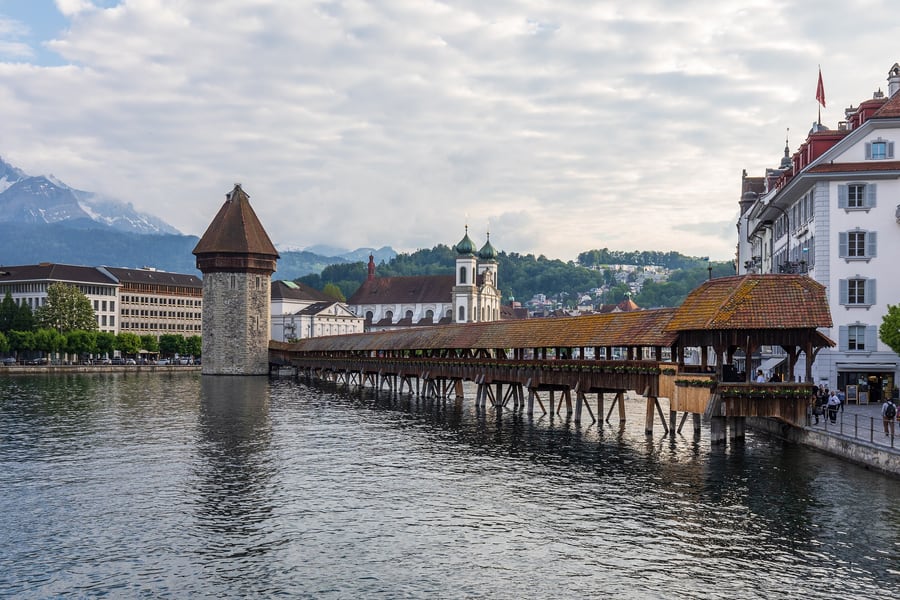
Lucerne
The Chapel Bridge of 1356 crosses the Reuss beside its octagonal water tower, and the nineteenth-century hotel fronts along the quay are there because this is where Alpine tourism was first sold to the rest of Europe. Pilatus closes off the western end of the lake and the Rigi the eastern, each with a railway of its own to the top. The boat piers are on the Bahnhofquai, a minute's walk from the main station.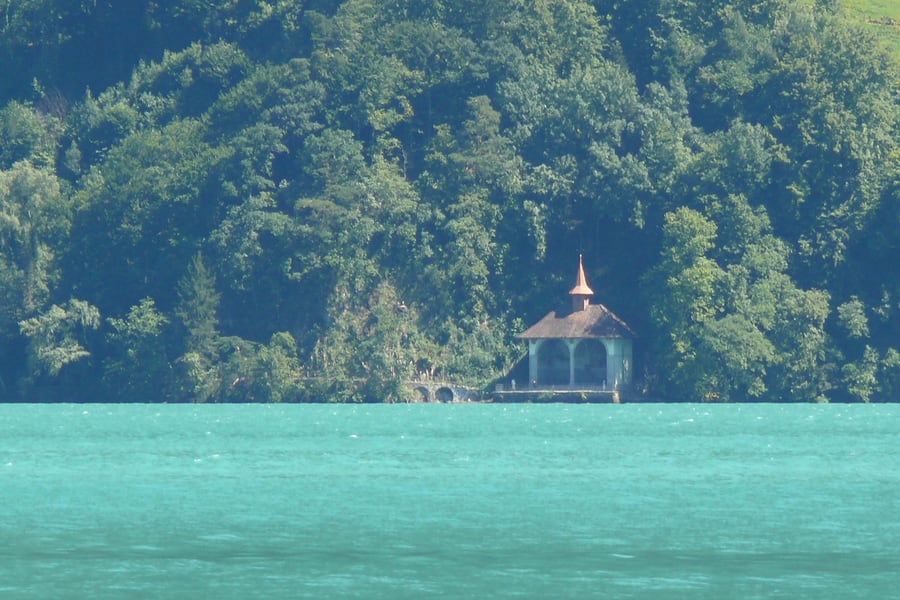 Ad Meskens / Wikimedia Commons · CC BY-SA 3.0 · cropped
Tell's Chapel
A chapel on the slab of rock at the foot of the Axenberg cliffs, where legend has Wilhelm Tell leaping from his captors' boat in a storm. The present building went up in 1879 and was painted inside between 1880 and 1882 with four frescoes of the story by Ernst Stückelberg. It faces the Rütli meadow across the bay, a little over four kilometres away, and the boat passes close enough in to pick out the porch.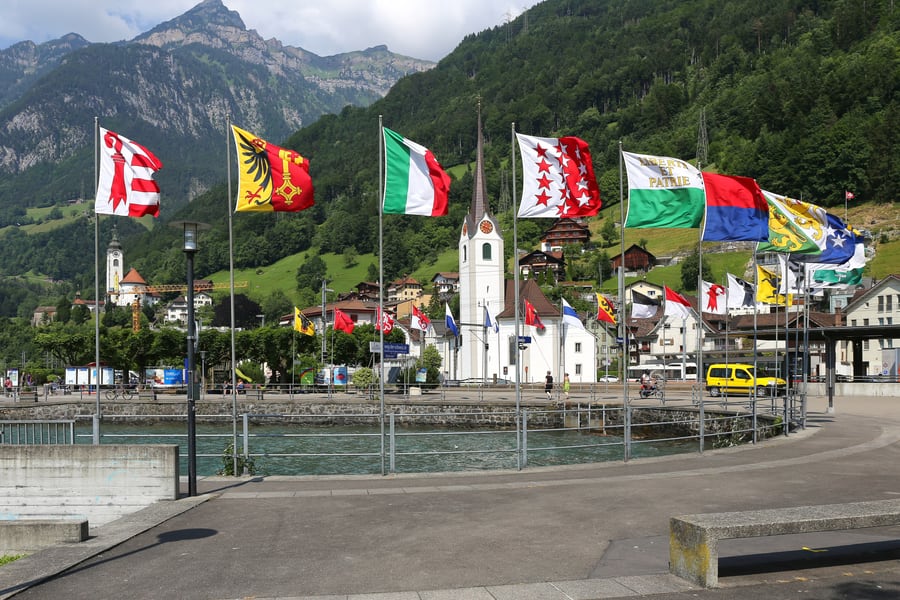 Evelyscher / Wikimedia Commons · CC BY-SA 4.0 · cropped
Flüelen
The interchange, and a transhipment point since 1837, when the first steamers began landing goods here to be reloaded onto ox carts, wagons, mules and horses for the pass — which is the reason there is a station alongside the pier at all. Rudenz Castle of the thirteenth century and the Old Church of 1664 still set the shape of the waterfront, with the Gotthard line climbing away behind it.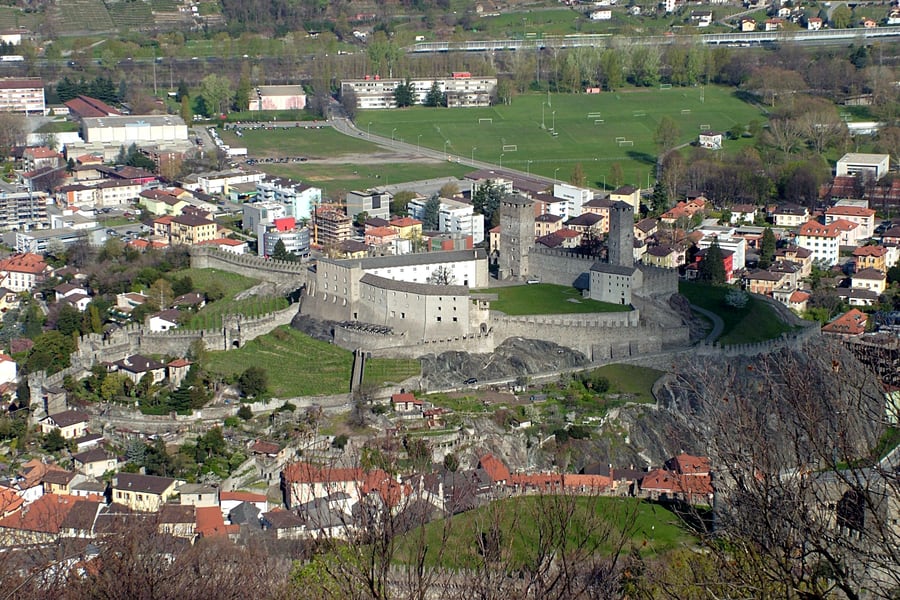 Clemensfranz / Wikimedia Commons · CC BY 2.5 · cropped
Bellinzona
Castelgrande, Montebello and Sasso Corbaro stand over the town, built by the Dukes of Milan in the fifteenth century to hold the road down from the Alps and, together with their defensive walls, a UNESCO World Heritage Site since 2000. Castelgrande sits on a rocky peak with walls running down to enclose the old city; Sasso Corbaro, the highest of the three, stands alone on a promontory to the south-east.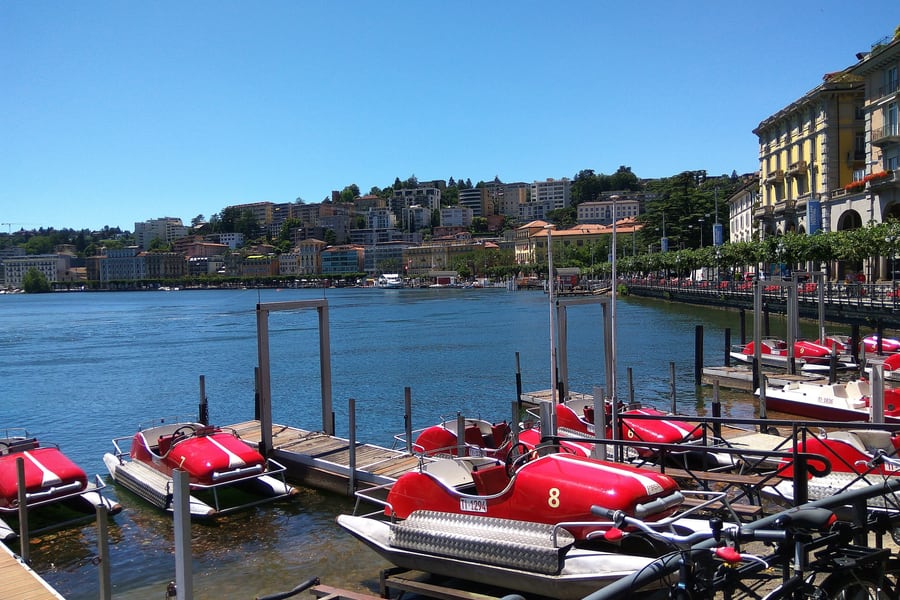 Visem / Wikimedia Commons · CC BY-SA 4.0 · cropped
Lugano
Italian-speaking Switzerland at its most Mediterranean, and with 62,000 people the largest city in Ticino — a lakefront promenade under Monte Brè and Monte San Salvatore, each with a funicular of its own, and palm trees at 283 metres above sea level, which is 868 metres below the tunnel the train came through a couple of hours earlier.Where to Sleep
The journey is a single day, so the beds that matter are at its ends — Lucerne if the boat leaves in the morning, Lugano if the train arrives in the afternoon — with Bellinzona as the halfway option for anyone splitting the run across the Gotthard in two.
Where to stay
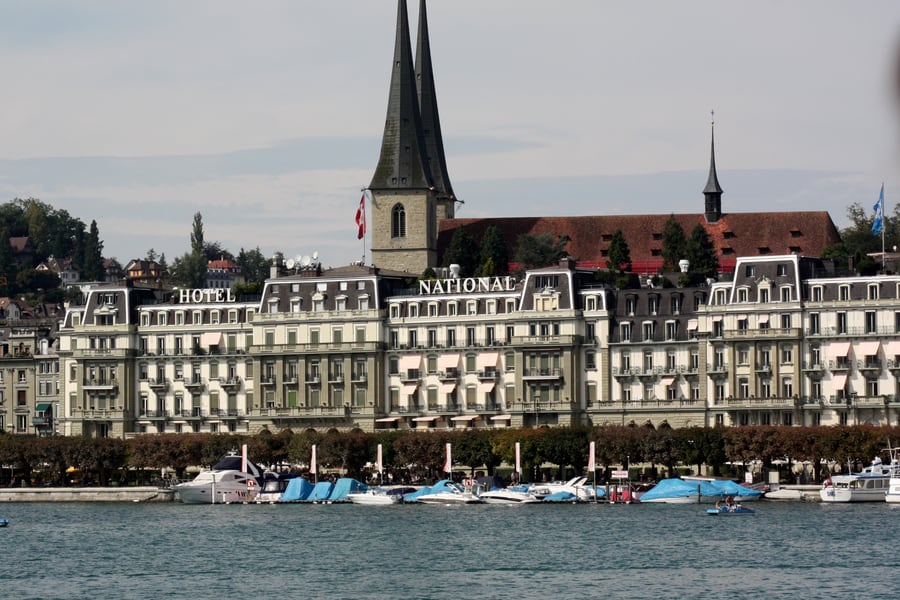 WES1947 / Wikimedia Commons · CC BY-SA 3.0 · cropped
Grand Hotel National
On the Lucerne lakefront, opened 1870
César Ritz took over the running of it in 1877 and Auguste Escoffier arrived in the kitchen in 1881. It has 62 rooms and suites today, on the promenade a walk from the piers.
Check Availability (opens in a new tab, on grandhotel-national.com)via grandhotel-national.comHotel & SPA Internazionale
Opposite Bellinzona station
Two buildings — one from the start of the twentieth century, the other opened in July 2014 — a short walk from the old town and the three castles, and directly across from the station the panorama train calls at.
Check Availability (opens in a new tab, on hotel-internazionale.ch)via hotel-internazionale.ch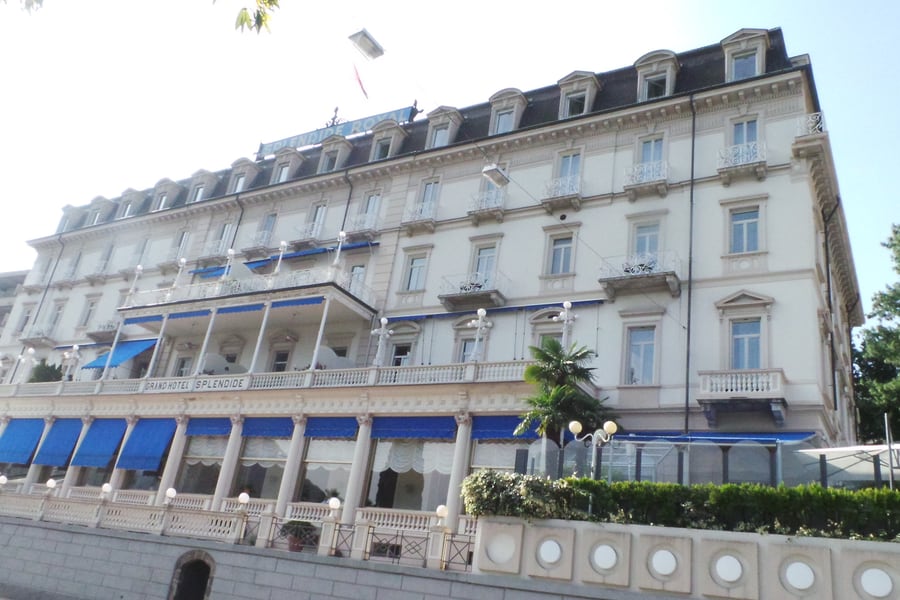 Domi-schnitz64 / Wikimedia Commons · CC BY-SA 3.0 · cropped
Hotel Splendide Royal
Lake Lugano, a hotel since 1887
Built around 1870 as the Villa Merlina and turned into the Hotel Splendide in 1887; the "Royal" was added later, after the guests it had been attracting. On the lakefront promenade below the old town.
Check Availability (opens in a new tab, on splendide.ch)via splendide.chQuestions or corrections
Planning this trip and stuck on something, or spotted a time, fare or detail that has changed? Send us a message about Gotthard Panorama Express. We read every one, and we update this page when something has changed.