The Bānītis — Gulbene to Alūksne
SintijaKola / Wikimedia Commons · CC BY-SA 4.0 · 2020 · cropped
- Distance33 km
- Duration1 hr 25 min
- Best seasonDaily all year; steam on published Saturdays
Introduction
Latvia once had a great deal of narrow gauge — some 432 kilometres at 750 mm in the mid-1930s, and more than 500 km at 600 mm — and almost all of it went. What survives is 33 kilometres between Gulbene and Alūksne, the tail of a 210-kilometre line from Pļaviņas to Valka that opened on 15 August 1903 and was cut back piece by piece until only this stub was left. It is the only narrow-gauge railway in the Baltic states still running a scheduled passenger service. Latvians call the train the bānītis, and it has been worked since January 2002 by a company owned in Gulbene rather than by the state.
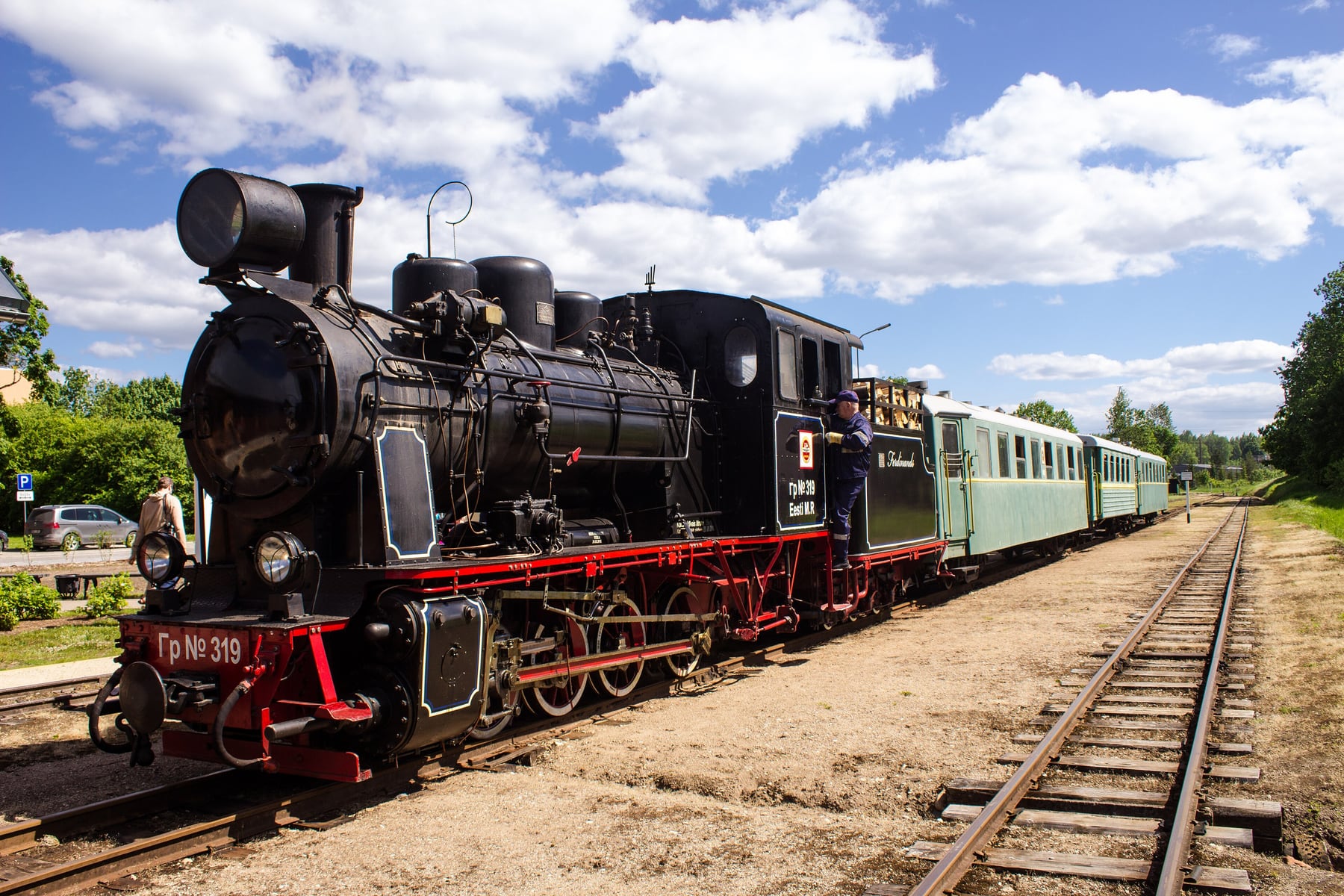
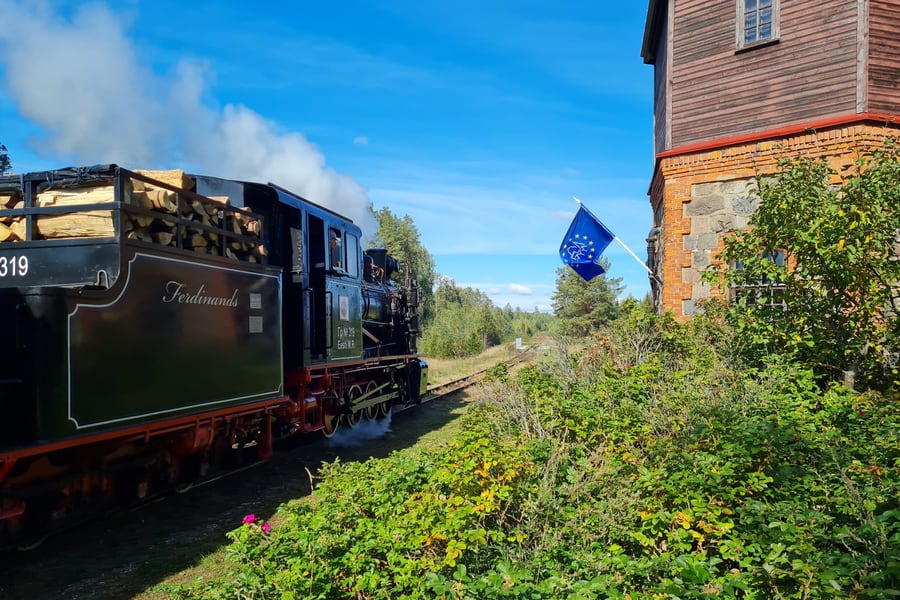
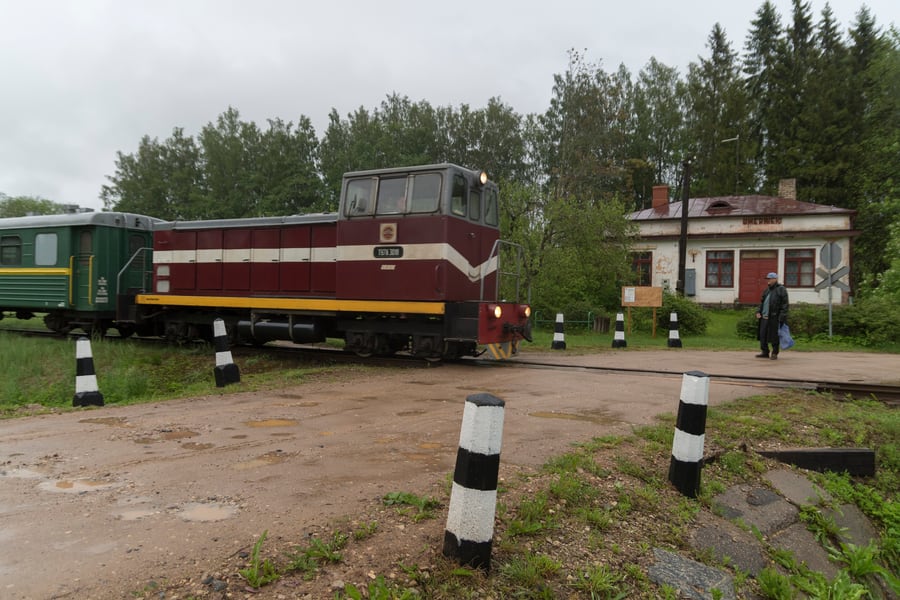
There are two return trips a day, every day of the year, usually a Soviet-built TU7A diesel and a single carriage. On Saturdays, on dates the operator publishes a season ahead, the early-afternoon working is taken instead by Gr-319 — a wood-burning 0-8-0 called Ferdinands, which stops at Paparde to fill its tank from a timber water tower. The line crosses the lake country of eastern Vidzeme at a walking pace, calling at nine places of which five are request stops: you signal from the trackside, or tell the guard before you board. The diesel covers the 33 kilometres in eighty-five minutes. The steam engine takes a hundred and ten.
The Journey
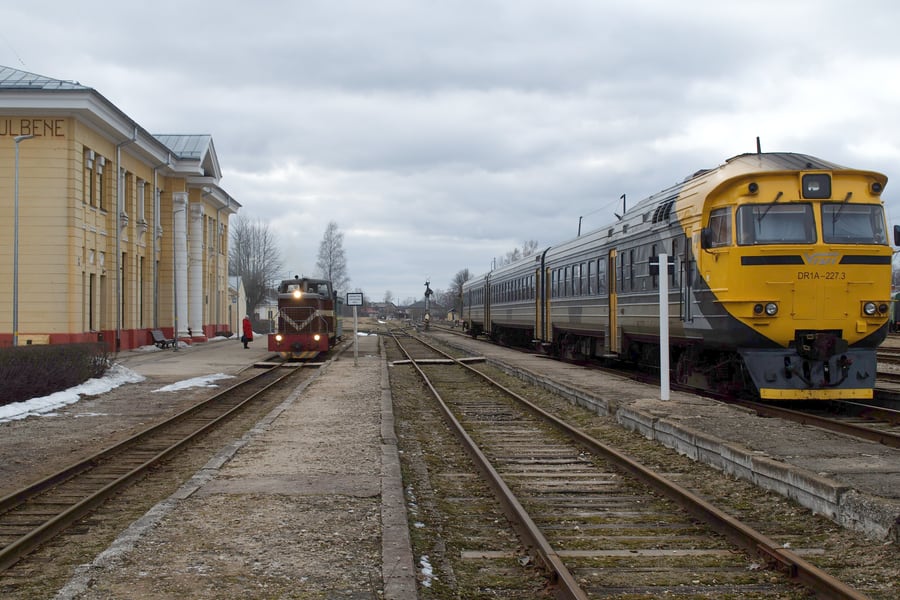
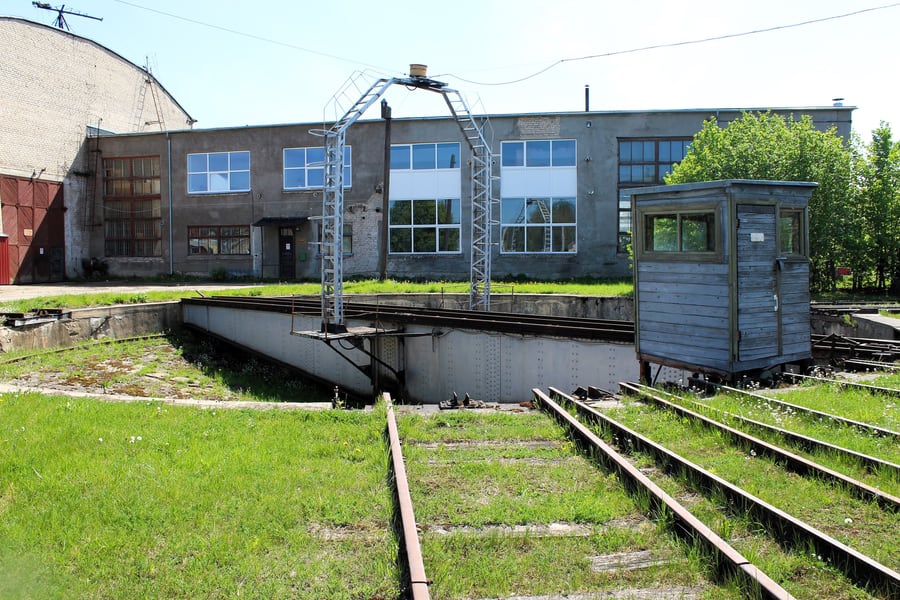
The bānītis starts from a corner of Gulbene station, where two gauges still share a yard. The main building serves the broad-gauge line from Riga; behind it, on 750 mm track, stand the narrow-gauge depot, its workshops and a fan-shaped engine shed built in the first half of the twentieth century. Beside the shed is a turntable laid with rails of both widths at once — the only dual-gauge turntable in Latvia, used both to place engines in the shed and to turn them to run the other way around. Tickets are sold at the depot before departure, by card or in cash, and there is a free exhibition about the line in the ground-floor corridor of the administration building.
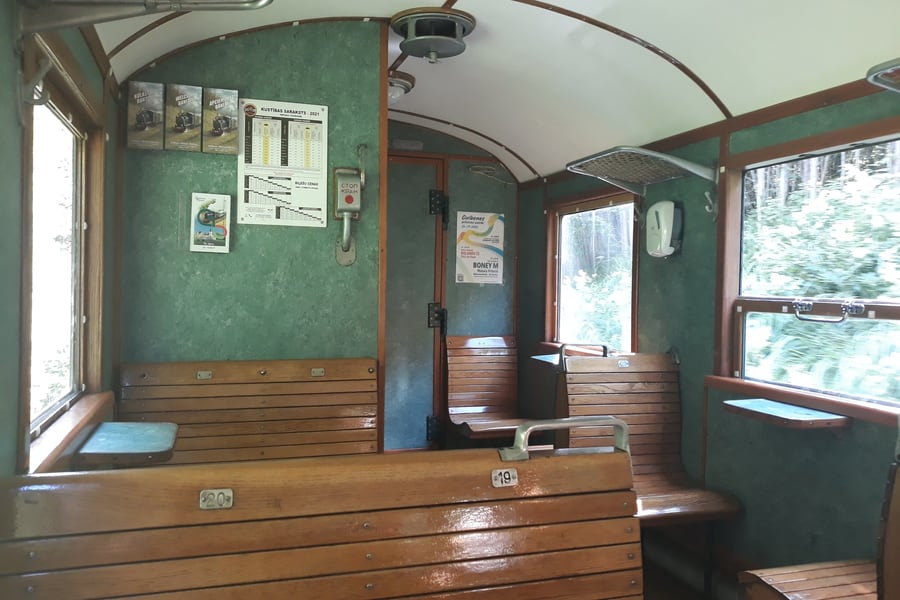
Ordinary trains are a TU7A diesel built in the 1980s and one carriage. The operator keeps two patterns, a 24-seat vehicle it calls the soft carriage and a 40-seat Polish-built one whose interior has been put back to varnished wooden benches; a second carriage is added when the loadings need it, and a van when a party of cyclists has booked. All the carriages have a lavatory and all of them are heated through the winter. Bicycles travel on a luggage ticket, and groups of more than five are asked to say so in advance.
The engine they call Ferdinands
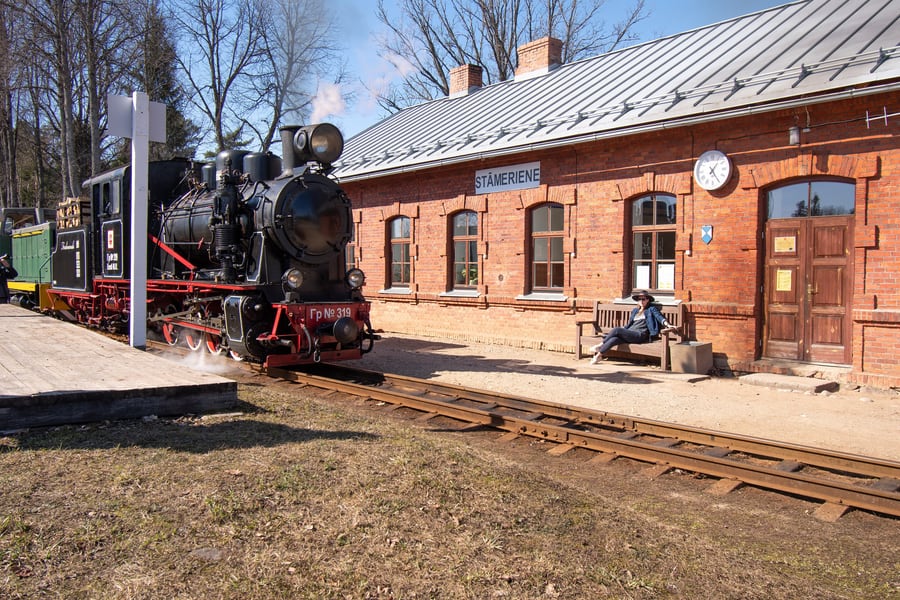
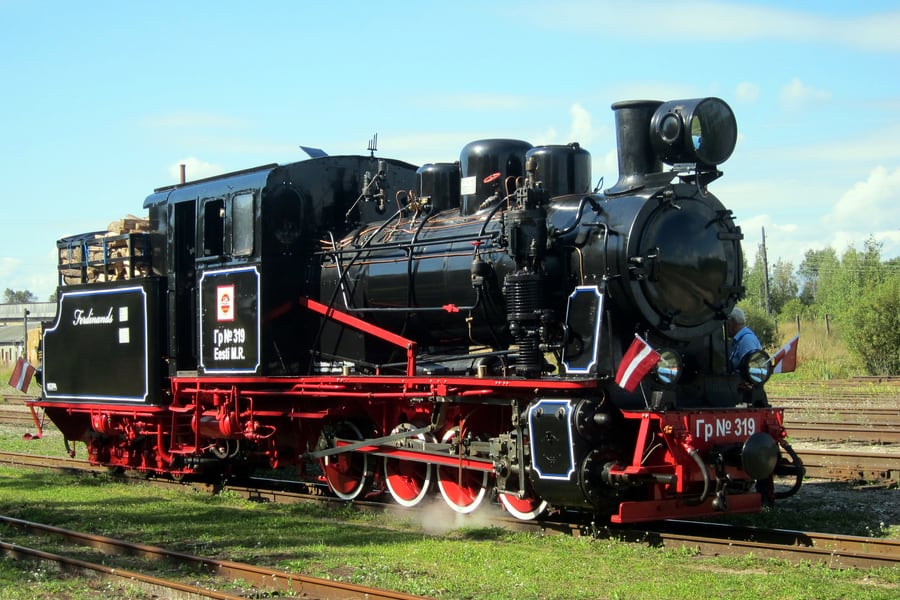
The steam locomotive is Gr-319, an 0-8-0 of a class whose Cyrillic initials, Гр, stand for German reparations. After 1945 the Soviet Union's narrow-gauge lines were desperately short of motive power, and the defeated side was ordered to build 400 of these engines as part of the settlement. They were made at the Orenstein & Koppel works in Babelsberg, renamed the Karl Marx locomotive works in July 1948; 349 were delivered between 1947 and 1956. The design was drawn in a hurry, on the wreckage of the old drawings, and it shows — above about 35 km/h the engine rolls badly, which on this line does not matter at all. It weighs 25.6 tonnes, runs on 800 mm wheels, takes curves of 40 metres, and its grate was built for burning wood, so the tender is stacked with split logs above the height of the bunker. Halfway to Alūksne it stops at Paparde to take water from an octagonal timber tower standing on a stone base, and the stop is printed in the timetable.
Nine stops, five of them by request
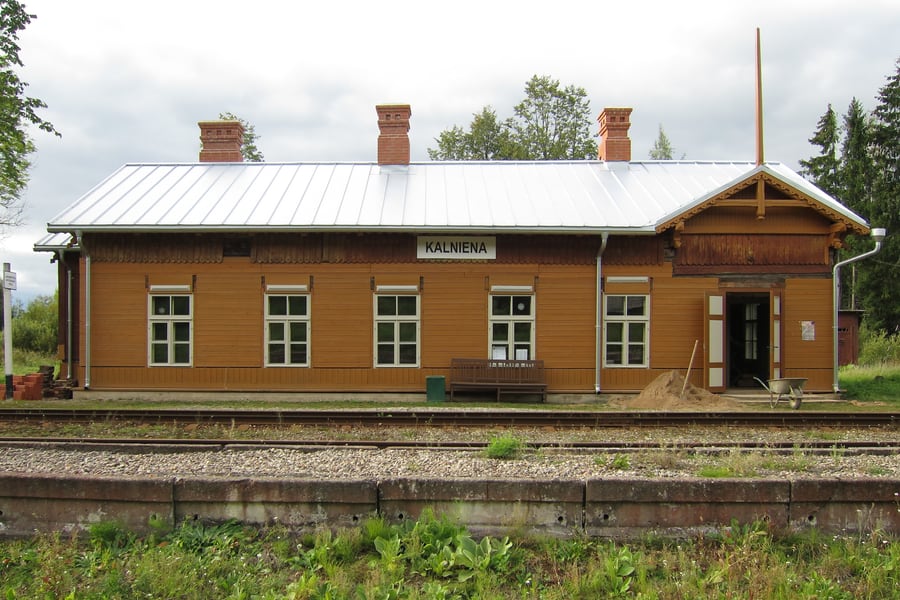
Gulbene is the only place on the line the operator still calls a station. Everything else is a stopping point, and at Birze, Pūriņi, Dunduri, Paparde and Vējiņi the train halts only if it is asked to — passengers waiting on the platform are enough, or a word to the guard when you get on. Five of the stops keep their original buildings: Kalniena, Stāmeriene, Paparde, Umernieki and Alūksne all had station status once, and their timber and brick station houses are still standing beside the track, several of them restored.
Through Bānīša Land
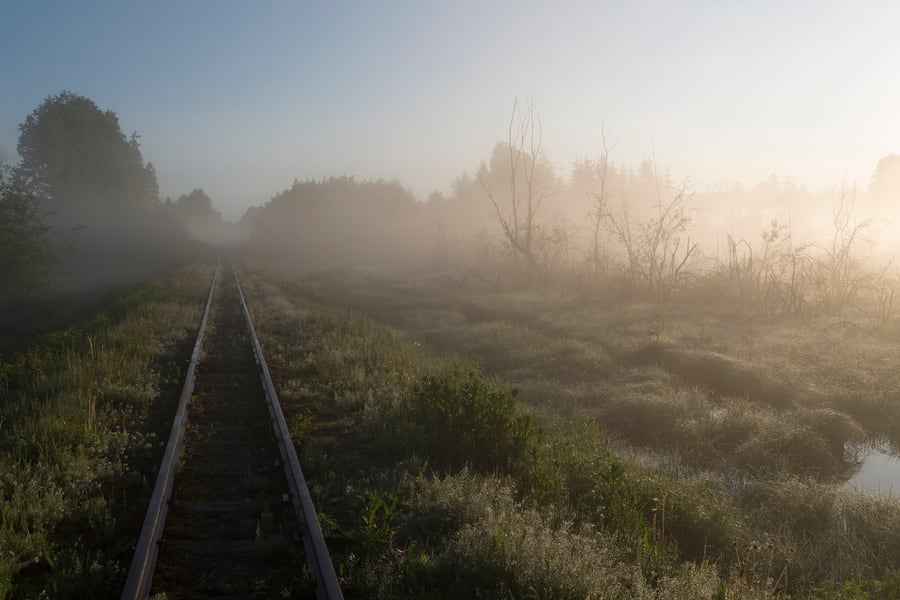
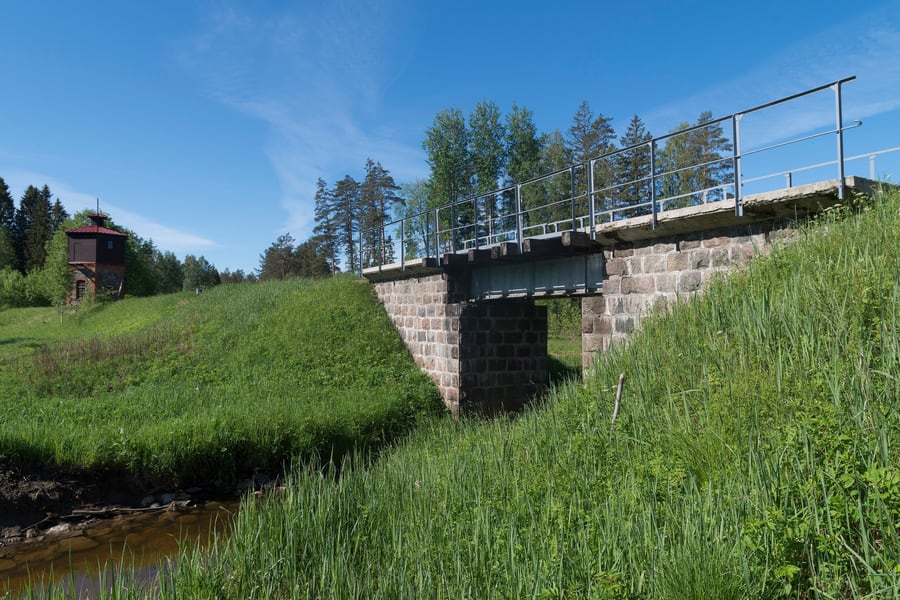
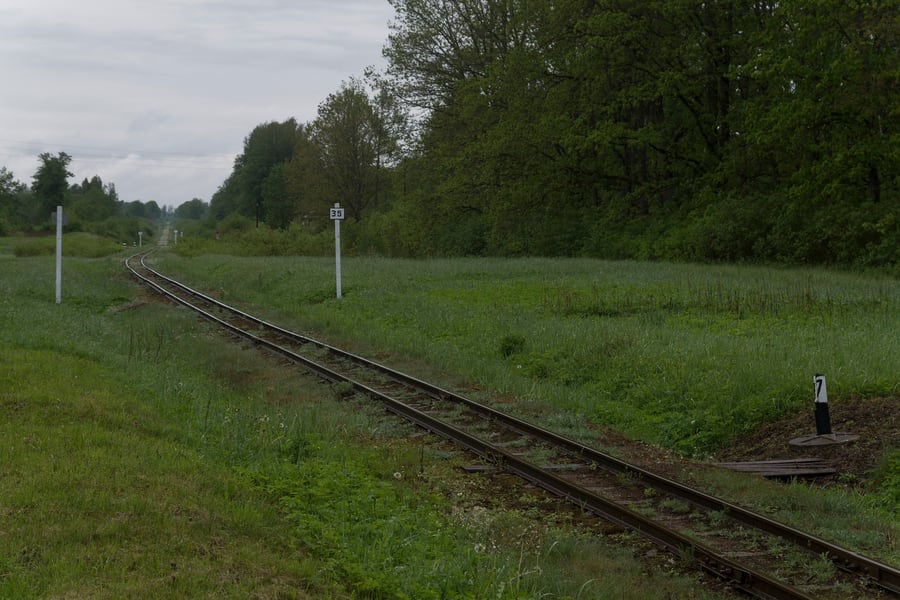
Between the stops the line runs through farmland, birch and pine, and the lakes of eastern Vidzeme, crossing the Umāra on a small girder bridge just short of Paparde. Since 2019 the country either side of it has been marketed as Bānīša Land, with six waymarked cycling routes that each begin or end at one of the stations, so that a ride out and a ride back can be made on different wheels. Two purpose-built points have been laid out for watching the train — one at Stāmeriene, one on Pullāna Hill outside Alūksne.
Alūksne
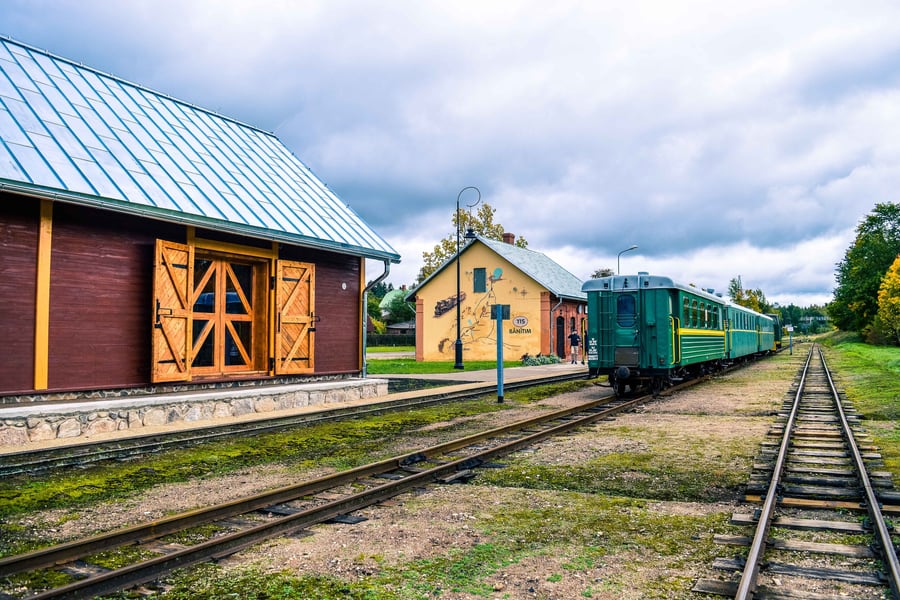
The train ends in the highest town in Latvia, 217 metres up on the East Vidzeme Upland and set on the shore of Lake Alūksne. Its station and the historic goods shed beside it have been restored, and the buildings now hold a multimedia exhibition on what the railway meant to the people who lived along it. Trains have been terminating here since 1973, when the section on to Ape closed; until 1970 they had run further still, to Valga on the Estonian border.
Along the route
 Jānis Vilniņš / Wikimedia Commons · CC BY-SA 3.0 · 2014 · cropped
The engine called Ferdinands
Gr-319 is an 0-8-0 of a class whose Cyrillic initials stand for German reparations: after 1945 the Soviet narrow gauge had almost no motive power left, and the defeated side was ordered to build 400 of these. It weighs 25.6 tonnes, takes curves of 40 metres, and burns wood.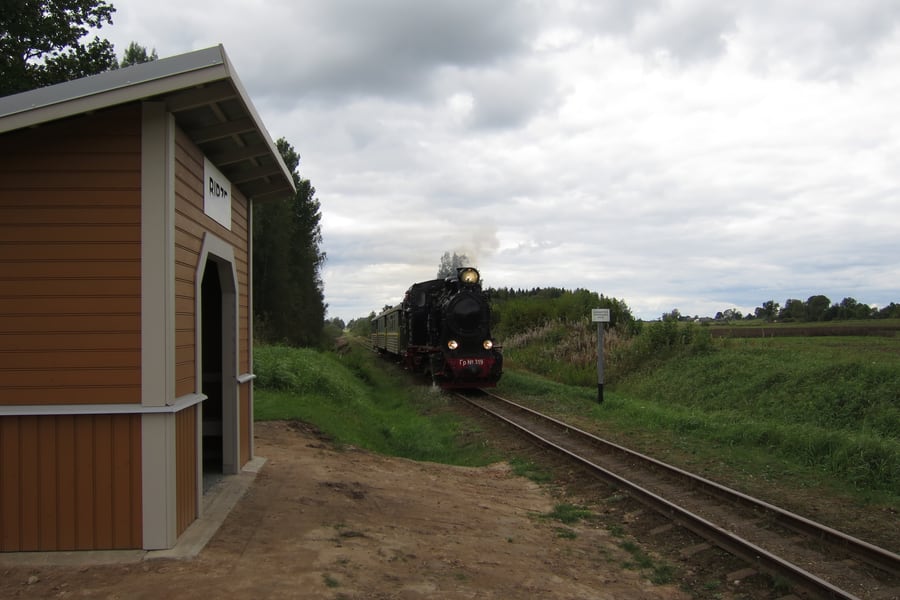 ScAvenger (Jānis Vilniņš) / Wikimedia Commons · CC BY-SA 3.0 · 2016 · cropped
Five stops where you put your hand up
Gulbene is the only place on the line the operator still calls a station. At five of the nine stopping points the train halts only if asked: a hand held high for the driver, or a word to the guard before boarding. The timetable prints a time for each of them anyway.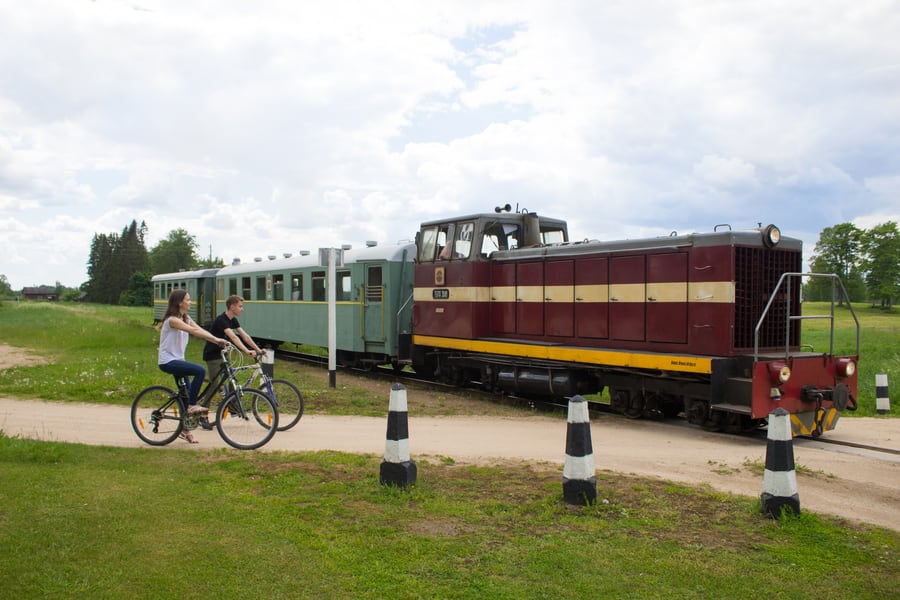 Deiss2002 / Wikimedia Commons · CC BY-SA 4.0 · 2021 · cropped
Out by train, back by bicycle
Since 2019 the country the line crosses has been marketed as Bānīša Land, and its six waymarked cycling routes all begin or end at one of the stops. A bicycle travels the full 33 kilometres for €3.00, so the two halves of the day can be made on different wheels.A bit of history
Culture & experiences along the way
 Dāvis Kļaviņš / Wikimedia Commons · CC BY-SA 2.0 · 2011 · cropped
The other 177 kilometres
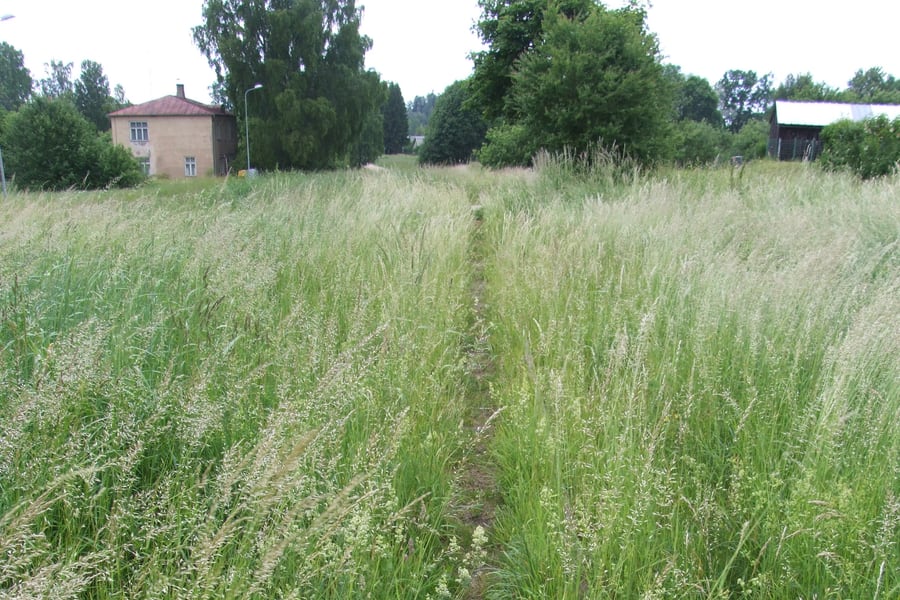
What runs today is the last sixth of a railway that reached from Pļaviņas on the Daugava to Valka on the Estonian border. The stretch from Pļaviņas to Gulbene was rebuilt to broad gauge during the First World War; Ape to Valga closed in 1970 and Alūksne to Ape in 1973. North of Alūksne the formation is still legible as a green lane running between the houses, and the walk along it is the shortest way to understand what was lost.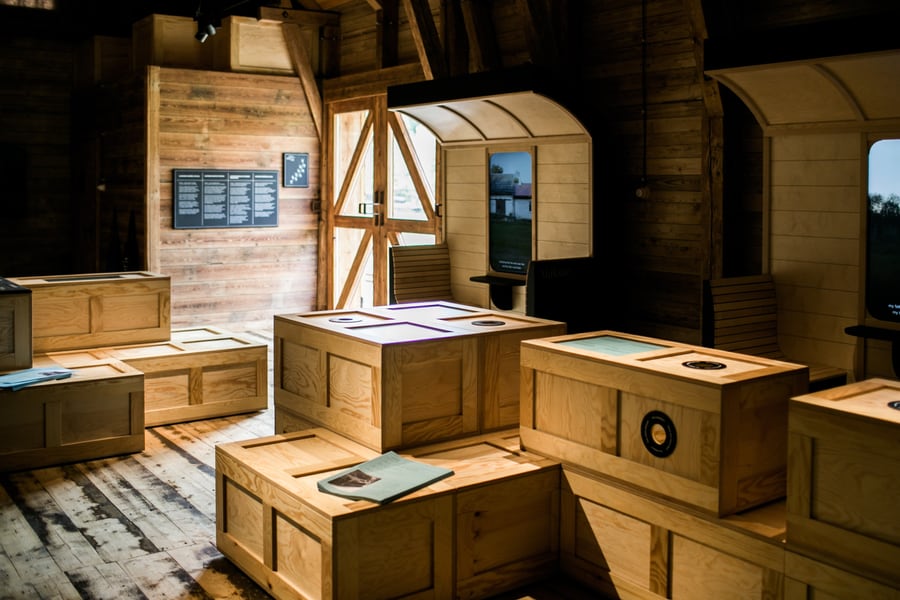 Deiss2002 / Wikimedia Commons · CC BY-SA 4.0 · 2018 · cropped
A station that became a museum
The buildings at Alūksne hold a multimedia exposition on the line, opened in 2018: ten station stories, photographs and film about what a narrow-gauge train meant to the people who lived along it. In 2022 it was one of sixty nominees for the European Museum of the Year Award. It is at Jāņkalna iela 52 and opens Tuesday to Sunday from 10:00 to 18:00.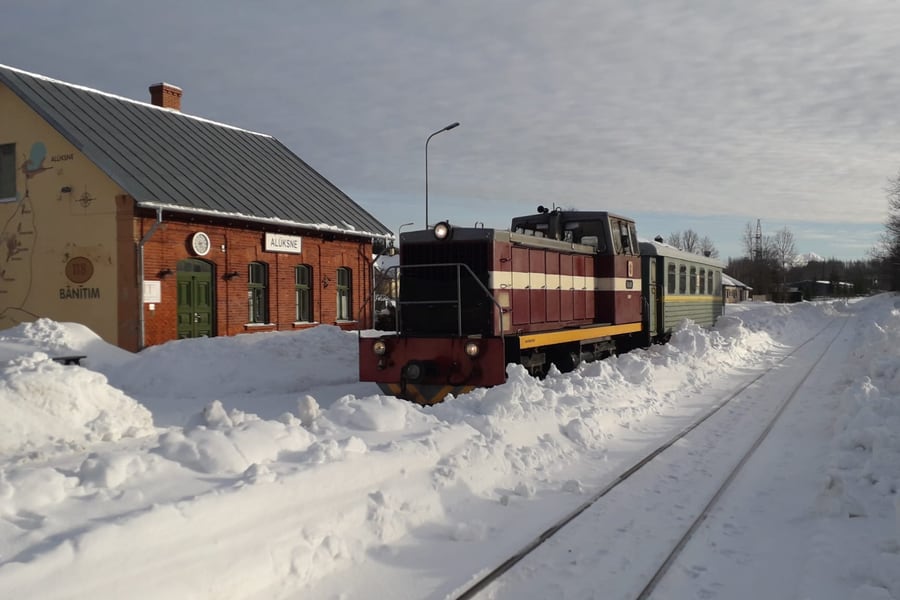 Deiss2002 / Wikimedia Commons · CC BY-SA 4.0 · 2023 · cropped
It keeps running in the snow
The two return trips are daily and year-round, not seasonal. Every carriage is heated through the winter and every one has a lavatory; the railway keeps its own snowplough for the days the line needs clearing. There is a steam working on 19 December 2026, and the operator runs Christmas and Easter trains as well.Timetables
Two return trips run every day of the year. All the times below are the departure times printed in the operator's own kustības saraksts, read on banitis.lv in August 2026, and the fare table further down comes from the same sheet. A trailing * marks a request stop, where the train halts only if passengers are waiting or someone on board has asked the guard.
Gulbene to Alūksne
| Stop | km | Daily · 692 | Steam · Gr-319 | Mon–Fri, Sun · 696 | Sat · 698 |
|---|---|---|---|---|---|
| Gulbene | 0 | 13:00 | 13:00 | 18:00 | 18:30 |
| Birze* | 4 | 13:10 | 13:11 | 18:10 | 18:40 |
| Pūriņi* | 6 | 13:16 | 13:18 | 18:16 | 18:46 |
| Stāmeriene | 10 | 13:26 | 13:33 | 18:26 | 18:56 |
| Kalniena | 14 | 13:38 | 13:44 | 18:38 | 19:08 |
| Dunduri* | 20 | 13:48 | 14:00 | 18:48 | 19:18 |
| Paparde* | 21 | 13:52 | 14:15 | 18:52 | 19:22 |
| Umernieki | 24 | 14:02 | 14:26 | 19:02 | 19:32 |
| Vējiņi* | 28 | 14:11 | 14:34 | 19:11 | 19:41 |
| Alūksne | 33 | 14:25 | 14:50 | 19:25 | 19:55 |
Alūksne to Gulbene
| Stop | km | Mon–Fri, Sun · 691 | Sat · 693 | Steam · Gr-319 | Mon–Fri, Sun · 695 | Sat · 697 |
|---|---|---|---|---|---|---|
| Alūksne | 0 | 15:25 | 16:30 | 16:00 | 19:55 | 20:10 |
| Vējiņi* | 5 | 15:38 | 16:43 | 16:17 | 20:08 | 20:23 |
| Umernieki | 9 | 15:47 | 16:53 | 16:28 | 20:17 | 20:32 |
| Paparde* | 12 | 15:55 | 17:01 | 16:50 | 20:25 | 20:40 |
| Dunduri* | 13 | 15:59 | 17:05 | 16:56 | 20:29 | 20:44 |
| Kalniena | 19 | 16:10 | 17:17 | 17:09 | 20:40 | 20:55 |
| Stāmeriene | 23 | 16:22 | 17:31 | 17:26 | 20:52 | 21:07 |
| Pūriņi* | 27 | 16:31 | 17:40 | 17:38 | 21:01 | 21:16 |
| Birze* | 29 | 16:37 | 17:46 | 17:45 | 21:07 | 21:22 |
| Gulbene | 33 | 16:45 | 17:55 | 17:55 | 21:15 | 21:30 |
The steam column is the Saturday afternoon working on the published dates only; on those days Gr-319 leaves Gulbene at the usual 13:00 but starts back from Alūksne at 16:00 rather than 16:30, because it needs the water stop at Paparde in each direction.
The 2026 steam dates
Gr-319 Ferdinands works on these Saturdays: 4 and 18 April; 2, 16 and 30 May; 13 and 27 June; 11 and 25 July; 8 and 22 August; 5 and 19 September; 3, 17 and 31 October; and 19 December. The Bānīša svētki, the line's own festival, falls on 5 September 2026 and marks its 123rd year; there are also Easter and Christmas trains, and tasting trips through the summer.
Getting to Gulbene
Gulbene is 180 kilometres from Riga and the train from the capital runs at weekends only — a search of the operator's planner for any Wednesday returns nothing at all. Vivi works one service each way, and its Saturday and Sunday timetables have been aligned with the bānītis since 26 October 2025.
| Day | Leaves | Arrives | Journey |
|---|---|---|---|
| Sat & Sun · 806 | Riga 08:31 | Gulbene 11:42 | 3 hr 11 min |
| Sat · 819 | Gulbene 06:47 | Riga 09:59 | 3 hr 12 min |
| Sat · 807 | Gulbene 18:47 | Riga 21:59 | 3 hr 12 min |
| Sun · 805 | Gulbene 17:17 | Riga 20:29 | 3 hr 12 min |
That makes a day return from Riga work in both directions. On a Saturday: in at 11:42, out on the 13:00, back from Alūksne at 16:30 — or 16:00 behind the steam engine — into Gulbene at 17:55, and home on the 18:47. On a Sunday: the 13:00 out, the 15:25 back, and the 17:17 to Riga. Fares checked on vivi.lv in August 2026; the Riga–Gulbene ticket is €8.70.
Times and dates are published by the operator: Gulbenes – Alūksnes bānītis · kustības saraksts (opens in a new tab).
Tickets
Fares are charged by distance and they are small: the end-to-end single from Gulbene to Alūksne is €5.00, the shortest hop is €1.00, and five trips over the full line cost €9.00. There is no premium for the steam train — on its published Saturdays the Gr-319 works the ordinary service at the ordinary fare. Tickets are sold at Gulbene depot before departure, by card or cash, and on board from the guard, who takes cash only. Nothing is sold online and no seat needs booking.
A bicycle is charged separately, from €0.60 for one stop up to €3.00 for the full 33 kilometres — worth knowing, because it is the combination the line is built around: out by train, back along one of the six waymarked cycling routes. Groups of more than five cyclists are asked to book, so the goods van can be coupled on.
Book your tickets
Gulbene to Alūksne
€5.00 single · €9.00 for five trips
The full 33 kilometres, at the same fare whether a diesel or the steam engine is out.
Book Tickets (opens in a new tab, on banitis.lv)via banitis.lvPart of the way
From €1.00 for one stop
Priced by distance between any pair of stops, bought at the depot or from the guard.
Book Tickets (opens in a new tab, on banitis.lv)via banitis.lvA bicycle ticket
€0.60 for one stop · €3.00 for the whole line
What makes the ride out and the ride back possible on different wheels.
Book Tickets (opens in a new tab, on banitis.lv)via banitis.lvRail Passes
No rail pass covers the bānītis, and it barely matters: the whole line costs €5.00.
Interrail's list of the companies a pass is valid with in Latvia — checked in August 2026, when the page carried a last updated 28 August 2026 stamp — names three: Vivi, which runs the national network including the weekend train from Riga to Gulbene; LTG Link, for the Vilnius service; and Elron, for the Estonian expresses. The excluded column is empty. SIA Gulbenes – Alūksnes bānītis, which has operated the narrow gauge since 2002, is not on the list, so a pass buys nothing on the 750 mm section.
What a pass does cover is the way in. A Latvia One Country Pass, or any global pass on a Baltic trip, is valid on the 08:31 from Riga and on the evening train back, which is the only public transport that reaches Gulbene by rail. Whether it is worth buying is a separate question: the Riga–Gulbene fare is €8.70 each way, so a day return costs €17.40 in ordinary tickets, and a pass has to be doing more work than this one journey to pay for itself. On a trip that is only Latvia, ordinary tickets are usually cheaper. On a Tallinn–Riga–Vilnius run they are not.
Checked against the operators' published conditions in August 2026.
Places to Visit
Thirty-three kilometres is short enough that the stops are the journey. Gulbene has the working half — the depot, the workshops and the turntable — while the middle of the line reaches a manor house with an Italian novelist in its history and a water tower that a steam engine still uses. At the far end is the highest town in Latvia, on a lake with a ruined Teutonic castle on an island in it.
 Egilus / Wikimedia Commons · CC BY-SA 4.0 · 2023 · cropped
Gulbene
The narrow-gauge yard behind the main station is a working one: a fan-shaped engine shed of the first half of the twentieth century, workshops that keep five diesels and one steam locomotive running, and a turntable laid with rails of two gauges at once — the only one of its kind in Latvia. Depot tours can be booked, with a demonstration of the turntable and rides on the hand draisine, and the exhibition in the administration building is free in working hours.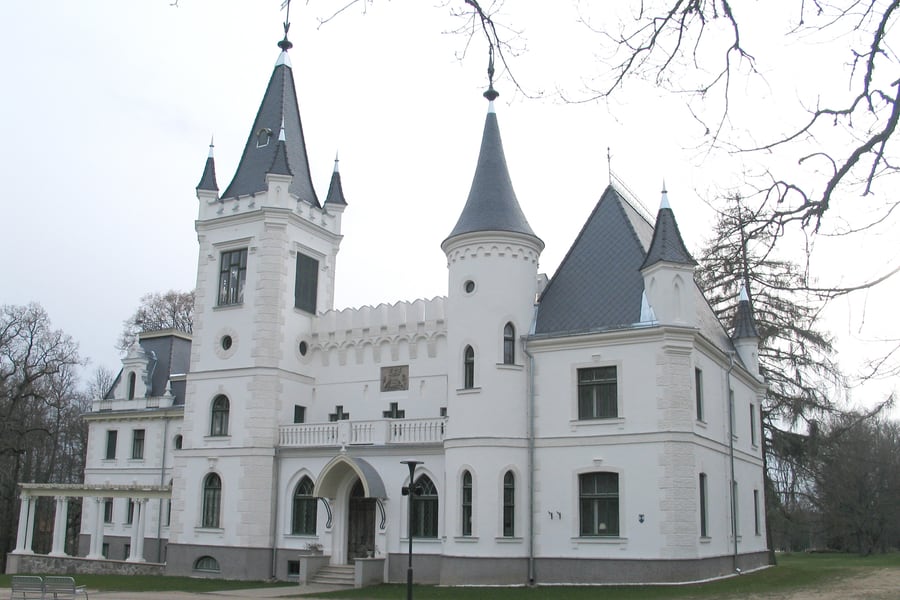 Андрей Романенко / Wikimedia Commons · CC BY-SA 4.0 · 2021 · cropped
Stāmeriena
The von Wolff family bought the estate in 1802 and began the palace in the 1830s; it burned in the revolution of 1905 and was rebuilt in 1908. Boris von Wolff married the Italian singer Alice Barbi, and their daughter Alexandra married Giuseppe Tomasi di Lampedusa in 1932 — the author of The Leopard wintered here, and at first could not walk on snow. The municipality has run the palace since 2016 and it has been open to visitors since the end of 2019.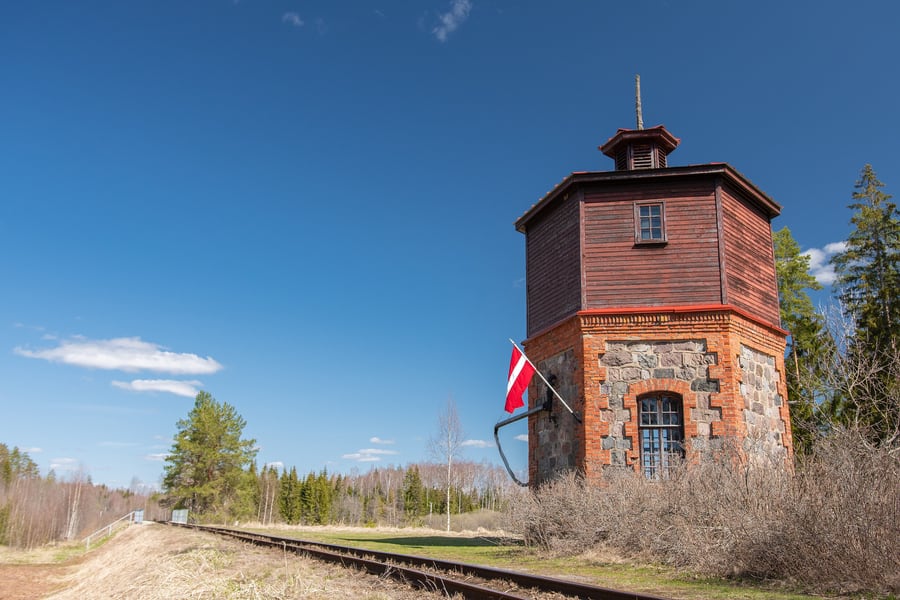 Deiss2002 / Wikimedia Commons · CC BY-SA 4.0 · 2022 · cropped
Paparde
An octagonal timber tower on a base of field stone, standing alone beside the track with a Latvian flag on a pole in front of it. It is not an ornament: the steam locomotive stops here to fill its tank in each direction, which is why the Gr-319 column in the timetable allows fifteen minutes at Paparde where the diesel takes four. The line crosses the Umāra on a girder bridge a few hundred metres before it.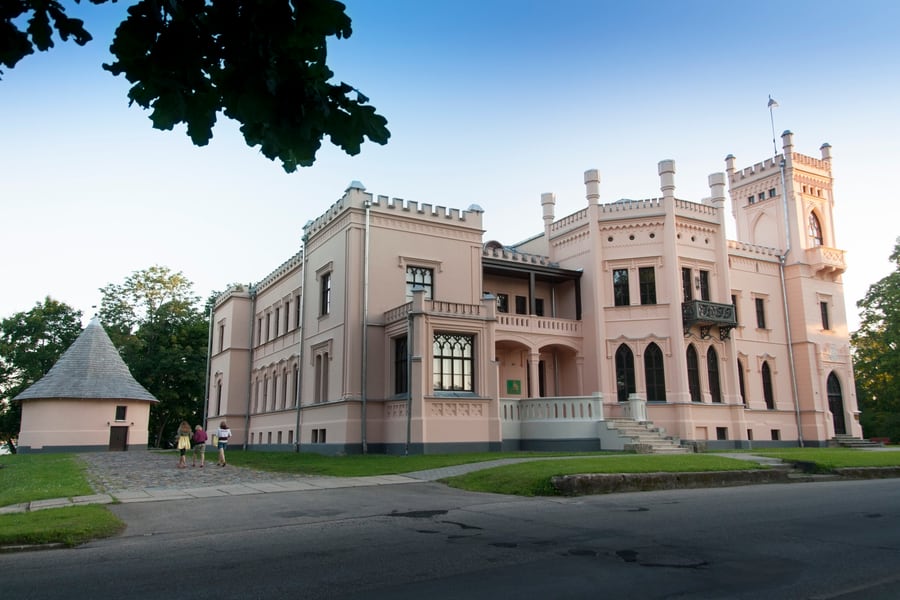 Martins Smits / Wikimedia Commons · CC BY-SA 3.0 · 2012 · cropped
Alūksne
Two hundred and seventeen metres up on the East Vidzeme Upland, on a lake with four islands. The Teutonic Order began a castle on the largest in 1342 and named it Marienburg, which the town stayed until independence. Ernst Glück, who made the first translation of the Bible into Latvian, lived here and founded Vidzeme's first Latvian-language schools in 1683; a museum in the town covers his work. The pink New Palace, built for Baron Alexander von Vietinghoff in 1860–64, holds the town museum.Where to Sleep
Both ends of the line have somewhere to stay, and one of them belongs to the railway. Prices and grades are not listed here because none have been verified; what follows is what each house says about itself on its own website, read in August 2026.
Where to stay
 Guntars Mednis / Wikimedia Commons · CC BY-SA 3.0 · 2015 · cropped
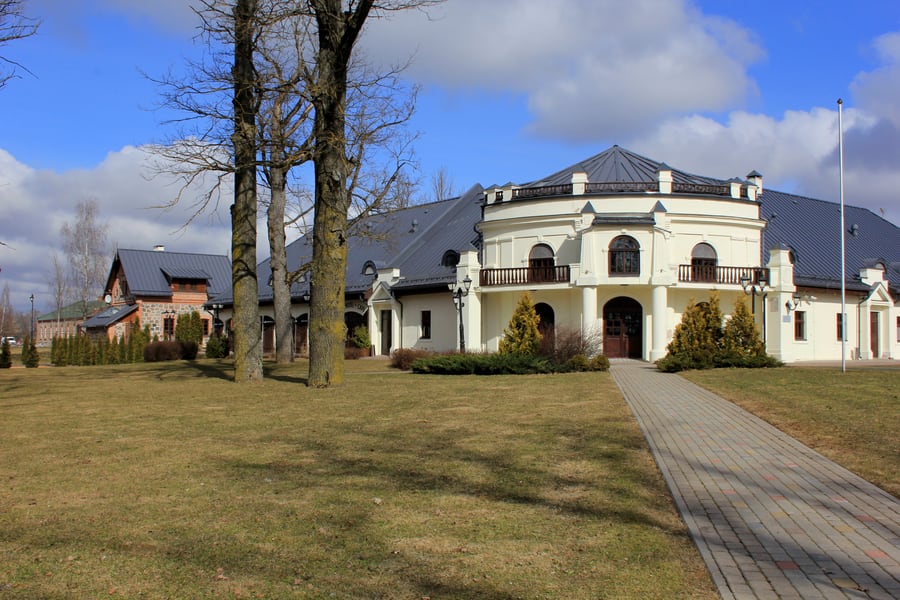
Vecgulbenes muiža
In the manor's riding hall, Brīvības iela 18, Gulbene
The hotel occupies the restored riding hall of the Vecgulbene manor complex, next to the Freedom Monument with the Lutheran church across the road. Its own site counts 14 rooms and 10 hostel rooms, together sleeping up to a hundred, with an apartment house for four to six as well. In the grounds are a restaurant and bar with an outdoor terrace, a hall for three hundred with a stage, a fireplace room for forty, a spa with sauna, steam room and jacuzzi, and a park.
Check Availability (opens in a new tab, on vecgulbenesmuiza.lv)via vecgulbenesmuiza.lvGuest house Depo
Run by the railway, inside Gulbene depot
The railway's own house, in the depot at Viestura iela 16G. Rooms are the restored Soviet-era rest quarters of the enginemen, two on the ground floor with a view of Gulbene station and six above, eighteen beds in all and up to thirty-six when the beds are made up double. The site also offers berths in a saloon car built in 1964 and later fitted out for the first secretary of the Estonian Communist Party, tent pitches in the depot yard, and Kalniena station at kilometre 14 by separate arrangement. Guests share a kitchen and showers, and there is a sauna with a cafe beside it.
Check Availability (opens in a new tab, on banitis.lv)via banitis.lv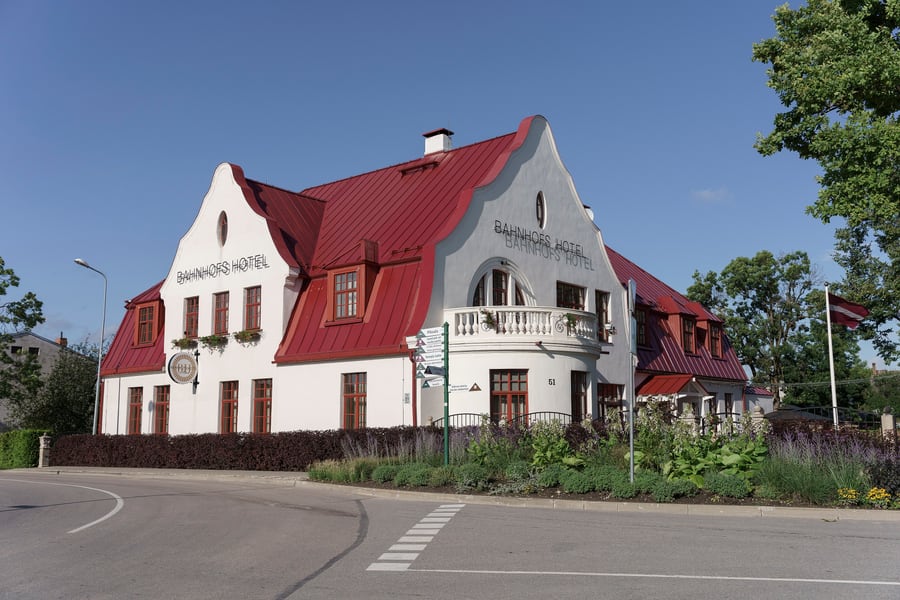 Dāvis Kļaviņš / Wikimedia Commons · CC BY-SA 2.0 · 2021 · cropped
Bahnhofs Hotel
Jāņkalna iela 51, across the road from the station
The only Art Nouveau building in Alūksne, built between 1910 and 1912 for Baroness Helena von Vietinghoff. Old photographs and documents show that for a few years it held a railway hotel, and the house has taken that name back: Bahnhofs is German for a railway station. Since then it has been a barracks, an Estonian primary school, a creamery and a set of offices. It now describes itself as a family design hotel with a banquet hall, seminar rooms, apartments and a restaurant, and it stands at number 51 on the street whose number 52 is the Bānītis station museum.
Check Availability (opens in a new tab, on bahnhofshotel.lv)via bahnhofshotel.lvQuestions or corrections
Planning this trip and stuck on something, or spotted a time, fare or detail that has changed? Send us a message about The Bānītis — Gulbene to Alūksne. We read every one, and we update this page when something has changed.