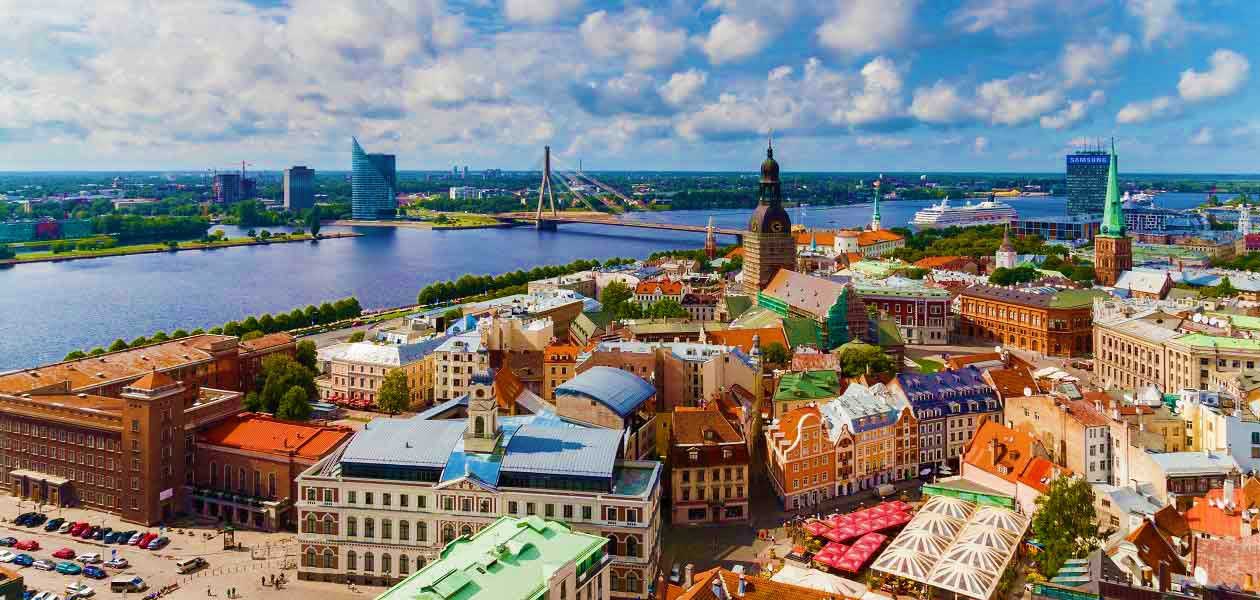
Latvia

Latvia sits in the middle of the three Baltic states, 64,594 km² of low country with about 1.85 million people, roughly a third of them in Riga. Estonia is to the north, Lithuania to the south, Russia to the east and Belarus to the south-east, and a maritime border faces Sweden across the Baltic. The Gulf of Riga bites deep into the coast, and behind the long sandy shoreline the land rises only gently into the forests and lake country of Vidzeme and Latgale.
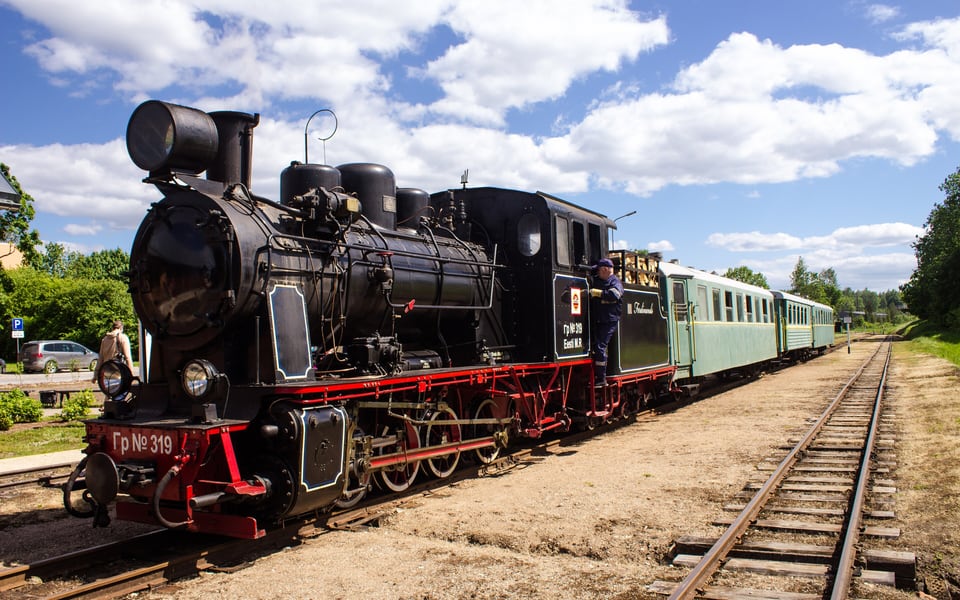
The network is 1,520 mm broad gauge, run by the state company Latvijas dzelzceļš with passenger services worked by its subsidiary Pasažieru vilciens. Latvia once had a great deal of narrow gauge — some 432 km at 750 mm and more than 500 km at 600 mm in the mid-1930s — and almost all of it went. What survived is the reason to look closely: the 33 km between Gulbene and Alūksne, the only narrow-gauge line in the Baltic states still running a scheduled passenger service, and steam-hauled on published dates.
Rail journeys in Latvia
Good to know
What is the bānītis?
Bānītis is the Latvian nickname for the narrow-gauge train between Gulbene and Alūksne, a 33 km survivor of a 212 km line opened in 1903. It is the only narrow-gauge railway in the Baltic states with a regular scheduled passenger service. Ordinary trains are a diesel and a single carriage; on published dates through the year the train is worked by a steam locomotive instead. The area around it is marketed as Bānīša Land, with waymarked cycling routes starting and ending at its stations.
How do you ride the narrow gauge from Riga?
The Gulbene–Alūksne bānītis runs twice each way every day, but the train from Riga to Gulbene runs only at weekends, leaving Riga at 08:31 and taking a little over three hours. Its Saturday and Sunday timetables have been aligned with the narrow gauge, so a day return works: out on the 13:00 from Gulbene, back from Alūksne in the afternoon, and home on the evening train to Riga.
Is an Interrail or Eurail pass worth it in Latvia?
Interrail sells a one-country pass for Latvia, but for most visitors ordinary tickets work out cheaper — the network is small and fares are low. A pass earns its keep when Latvia is one leg of a longer Baltic or European trip rather than the whole journey. Heritage and privately run lines are a separate matter and are not automatically covered, so check before assuming.
Can you reach Lithuania and Estonia by train?
Yes. A direct Vilnius–Riga service returned on 27 December 2023 after nearly twenty years without one, and since January 2025 the Estonian, Latvian and Lithuanian timetables have been coordinated so that Tallinn to Vilnius can be booked on a single ticket with one change at Valga on the Estonian border.
What is Rail Baltica?
A new standard-gauge railway under construction to connect Latvia and its Baltic neighbours to Poland and the rest of the European network. It is a separate line rather than a conversion of the existing broad-gauge one, and none of it carries passengers yet, so it does not affect travel today.