Riga to Valga — through the Gauja valley
Ivo Kruusamägi / Wikimedia Commons · CC BY-SA 4.0 · 2014
- DistanceAbout 168 km · broad gauge
- Duration2 hr 3 min (Elron express) – 2 hr 54 min
- Best seasonThree or four trains a day, all year
Introduction
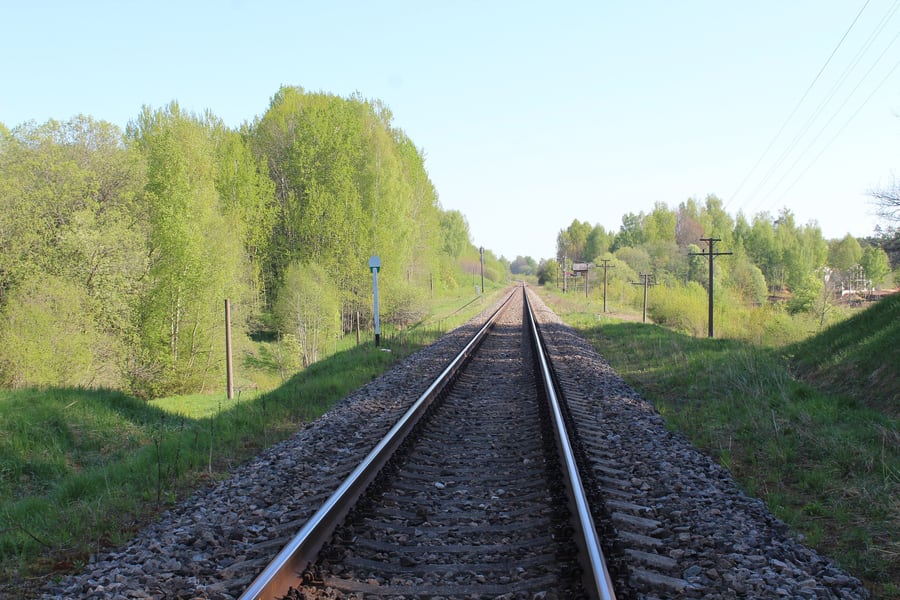
The railway north-east out of Riga was built for somewhere else. It opened on 22 July 1889 as the Riga–Pskov line, the state's link from the Baltic port to the St Petersburg–Warsaw main line, and trains ran along it from Riga to St Petersburg until 1998. What is left is a Latvian line of about 168 kilometres from Riga to the Estonian border town of Valga, on broad gauge, without wires, and worked from one end to the other by diesel trains.
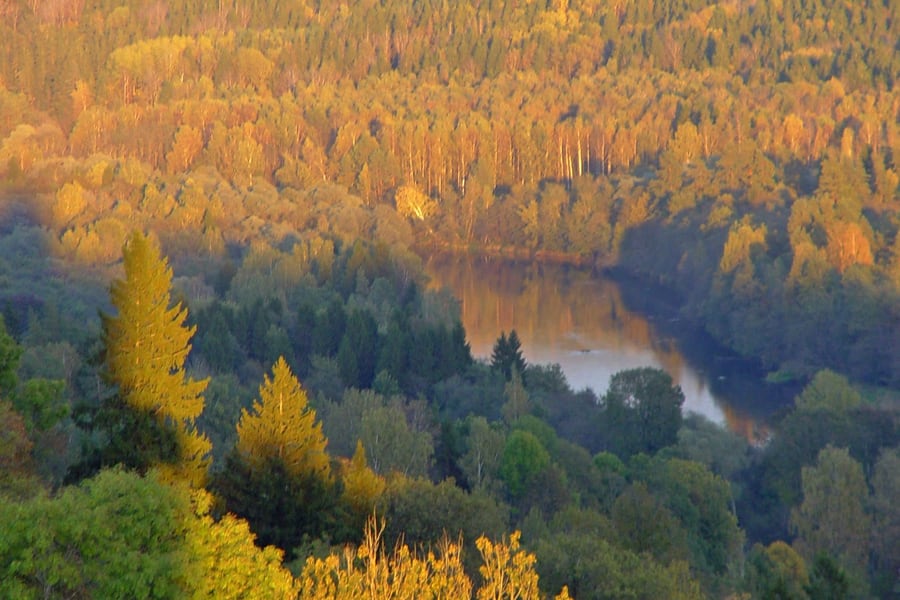
It is also the way into the Gauja valley. An hour out of Riga the line reaches Sigulda, where the river has cut a valley through red Devonian sandstone and three castles look at each other across it. The next stops are Līgatne, with its paper-mill village and cellars dug into the cliffs, and Cēsis, whose castle was the seat of the masters of the Livonian Order. Beyond Valmiera the country flattens into forest and farmland, and the train runs on to a station in another country: the twin towns of Valka and Valga were one town until 1920, and the border was drawn so that the railway station ended up in Estonia.
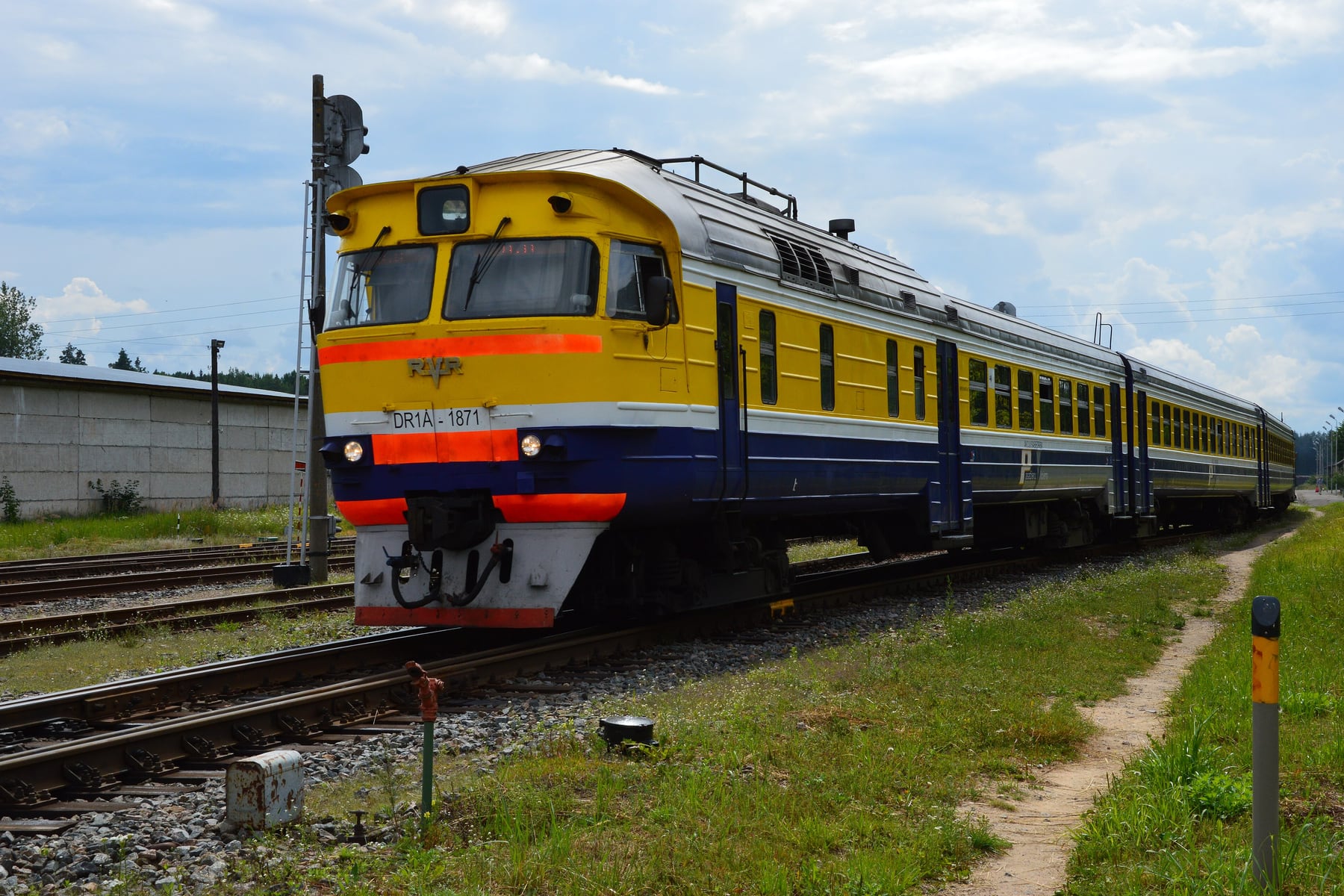
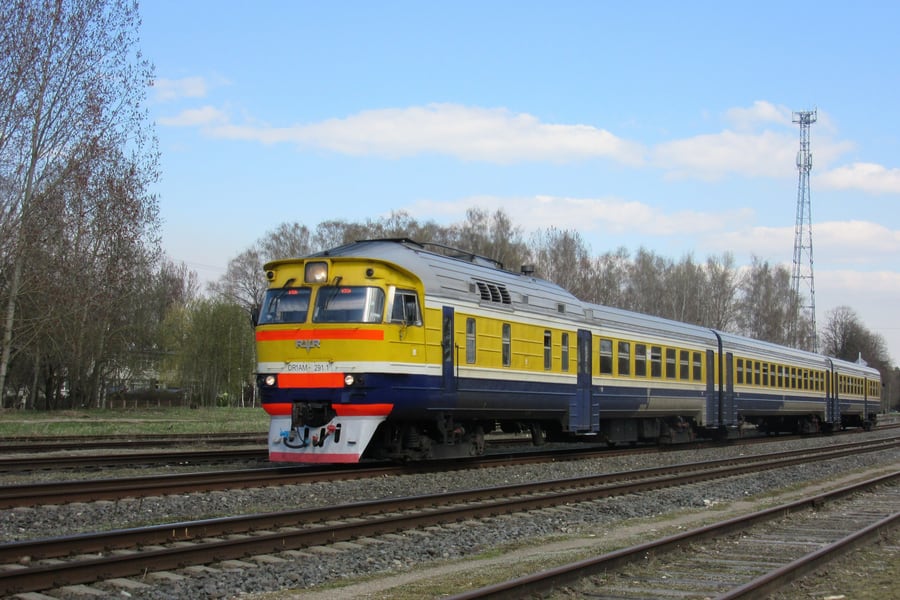
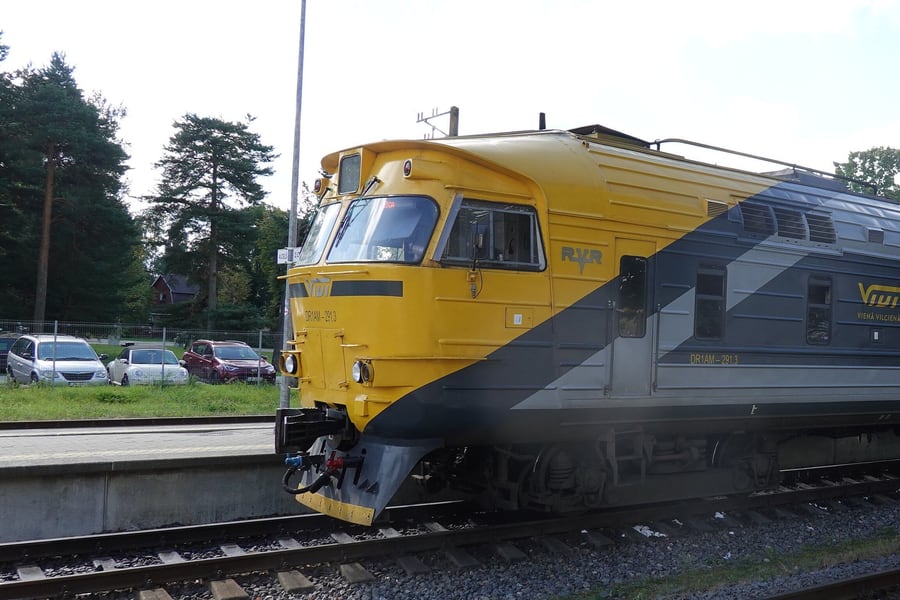
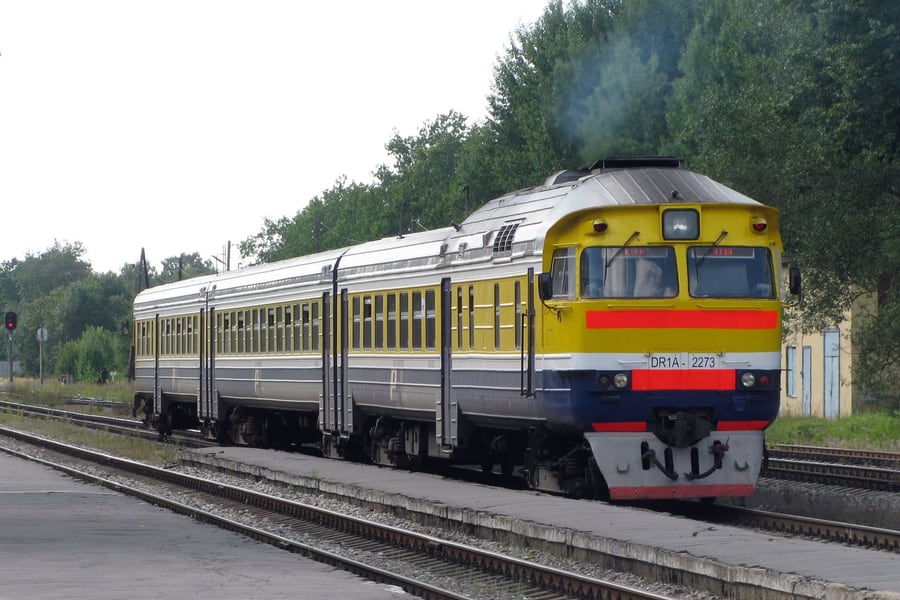
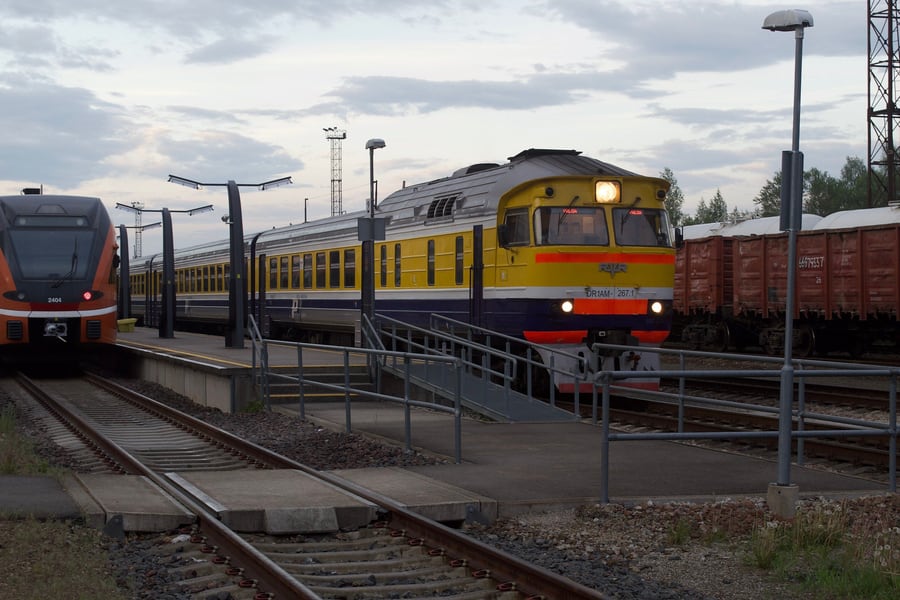
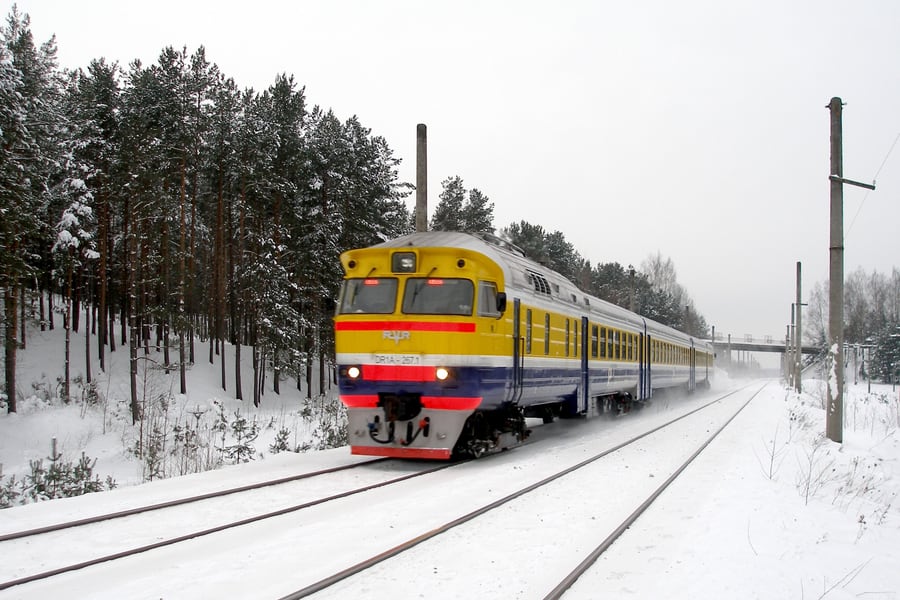
Most trains are Vivi's yellow DR1A diesels. The name stands for Diesel-train Riga 1: they were built in the city the journey starts from, between 1963 and 1998, and the letters on the nose are the works' own. One train a day each way is not Vivi's at all. Since January 2026 an Estonian Elron express has run through from Riga to Tartu and Tallinn, calling in Latvia only at Zemitāni, Sigulda, Cēsis and Valmiera, and making this line the first stage of a Baltic journey as well as a day out.
The Journey
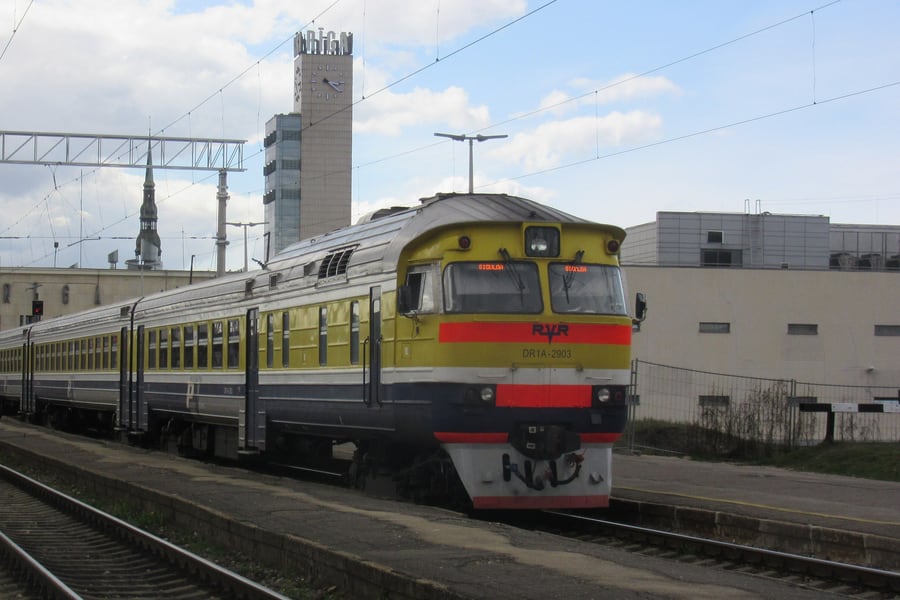
There are three kinds of train on this line, and which one you catch changes the ride. Most are Vivi's DR1A diesel units, with the engine behind the driving cab and a front end of two big windscreens over an orange stripe. They were built by the Riga Carriage Works, Rīgas Vagonbūves Rūpnīca, whose initials RVR are still on the nose. Some now carry Vivi's grey and yellow, others the older yellow and blue. Trains 874 and 873 are a PESA diesel leased from the Lithuanian operator LTG Link since February 2025, and once a day each way the train is an orange Estonian Stadler FLIRT, the Elron express to Tartu and Tallinn.
Out of Riga
Trains leave from Rīga-Pasažieru, the central station, and the first stop, Zemitāni, is where the line began. In 1889 it was the terminus, called Aleksandra Vārti, the Alexander Gate. It was renamed in 1928 after Jorģis Zemitāns, commander of the North Latvian Brigade; Soviet Latvia renamed it again in 1948, and it has been Zemitāni once more since 1995. The line then runs out through Riga's northern suburbs — Čiekurkalns, Šmerlis, a new stop opened in December 2024, and Jugla — on double track that was finished as far as Sigulda in the 1980s.
Beyond Jugla the stopping trains call at Garkalne, Krievupe, Vangaži, Inčukalns and Egļupe; train 874 calls only at Inčukalns. The stopping trains take 1 hour 8 minutes to Sigulda, train 874 47 minutes and the Elron express 43.
Sigulda and the Gauja
Sigulda stands on the edge of the Gauja valley, where the river has cut steep rocks and caves into red Devonian sandstone, and it has long been called the Switzerland of Vidzeme. The station building is not the one Latvia was proudest of: that was put up in 1925 to a design by Professor Pēteris Feders, and was destroyed in the Second World War. The present building dates from 1950 and was rebuilt with new raised platforms in 2012–14. The tourist information centre is inside it.
Līgatne is next, then Ieriķi. Ieriķi opened in 1889 as Ramocki, became a junction when a line to Pytalovo was built during the First World War, and under Soviet rule kept a reserve of steam locomotives for emergencies. In 1918 the German army re-laid the line from Riga as far as here to standard gauge; the Latvian railway administration put it back to the Russian gauge in 1919.
Cēsis and the climb to Jāņmuiža
The stopping trains call at Melturi and Āraiši before Cēsis, the biggest town on the way: 14,899 people, a medieval street plan, and the ruins of the castle that was the seat of the masters of the Livonian Order. The railway reached it in 1889 and the town's breweries, metalworks and printing works grew with it. Just beyond, between Cēsis and Jāņmuiža, is the steepest section of the whole line, and in the 1980s it was given a second track, as the Riga end was.
Valmiera to the border
After Lode comes Valmiera, the last large town in Latvia, then Strenči and Lugaži, the last Latvian station. The line was laid out before there was a border here, and when one was drawn in 1920 the broad-gauge station at Valka was left on the Estonian side. Latvia's nearest station, Saule, was 14 kilometres away, so in 1920 each country built itself a broad-gauge spur to the narrow-gauge station that had served the line to Pärnu. That is why the trip to Valga is two kilometres longer than the original line. Valga is where the Vivi trains terminate and where Estonia's trains to Tartu and Tallinn wait. Latvia's own Valka station is now a freight point that can be reached only by going through Estonia.
What comes next
On 11 December 2025 Vivi signed a contract with Škoda for nine battery-electric trains, to be delivered by 2029, for Riga–Cēsis and Riga–Daugavpils — lines with no overhead wires.
Along the route
 Jānis Vilniņš / Wikimedia Commons · CC BY-SA 3.0 · 2010 · cropped
The Alexander Gate
In 1889 the line ended at Aleksandra Vārti, the Alexander Gate. It was renamed Zemitāni in 1928 after the commander of the North Latvian Brigade, became Oškalni under Soviet rule in 1948 and Zemitāni again in 1995. It is now the first stop out of Riga.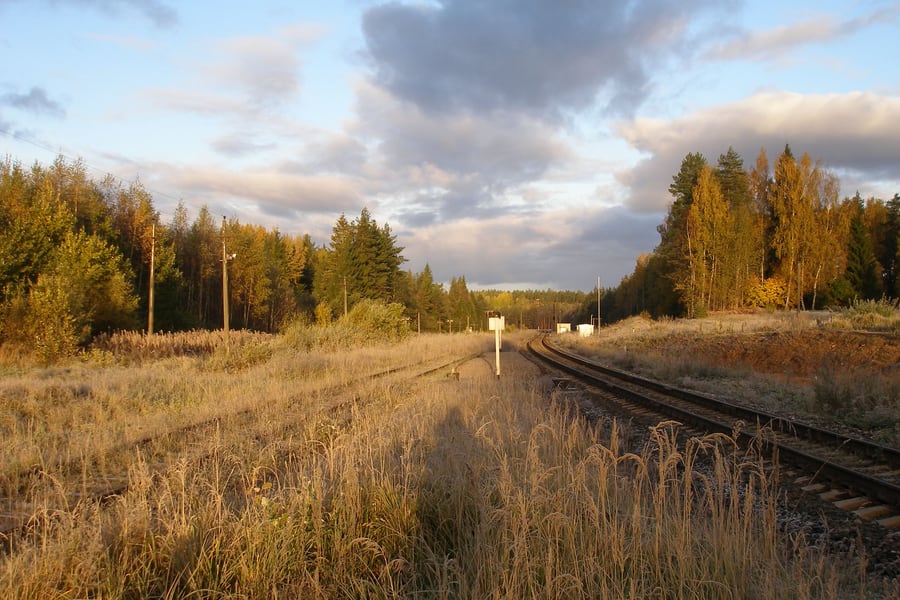 ScAvenger (Jānis Vilniņš) / Wikimedia Commons · CC BY-SA 3.0 · 2009 · cropped
Standard gauge, for a year
In 1918 the German army re-laid the line from Riga as far as Ramocki — renamed Erichshof that year and Ieriķi the next — to standard gauge. In 1919 Latvia's railway administration took it over and put it back to the Russian broad gauge.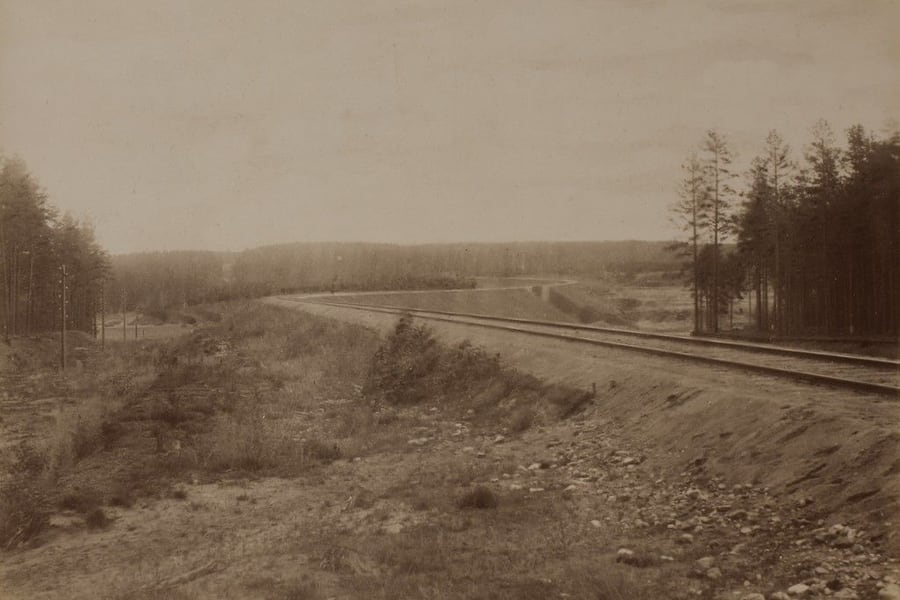 Hugo Hoffers, Peter Sohnwald / National Archives of Estonia · Public domain · 1890 · cropped
Three armoured trains
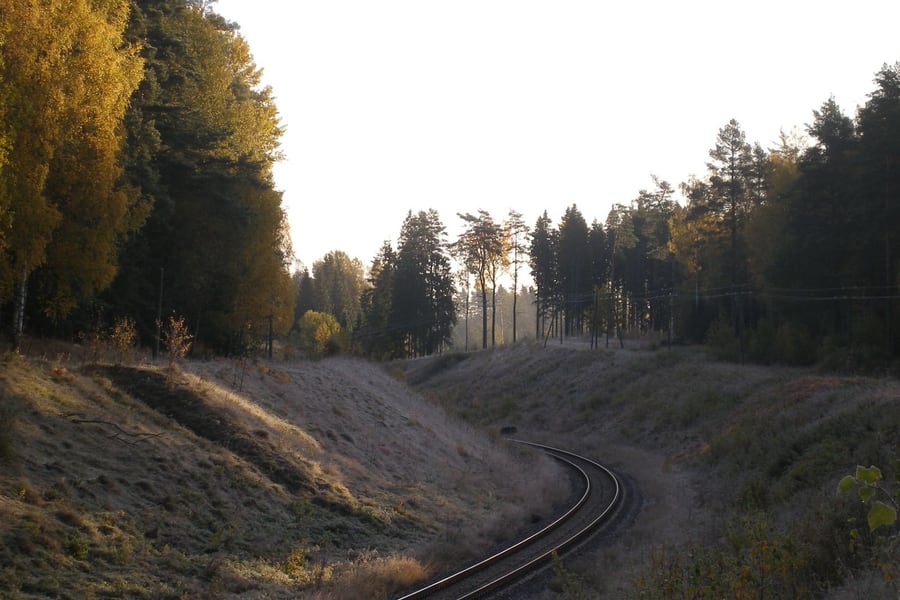
On 21 June 1919 the Landeswehr broke through Latvian positions on the Rauna, near Cēsis. Three Estonian armoured trains and the Kuperjanov partisans stopped the attack, and two days later the Estonian counter-attack retook the town. The photograph is the line at the Rauna ravine in 1890.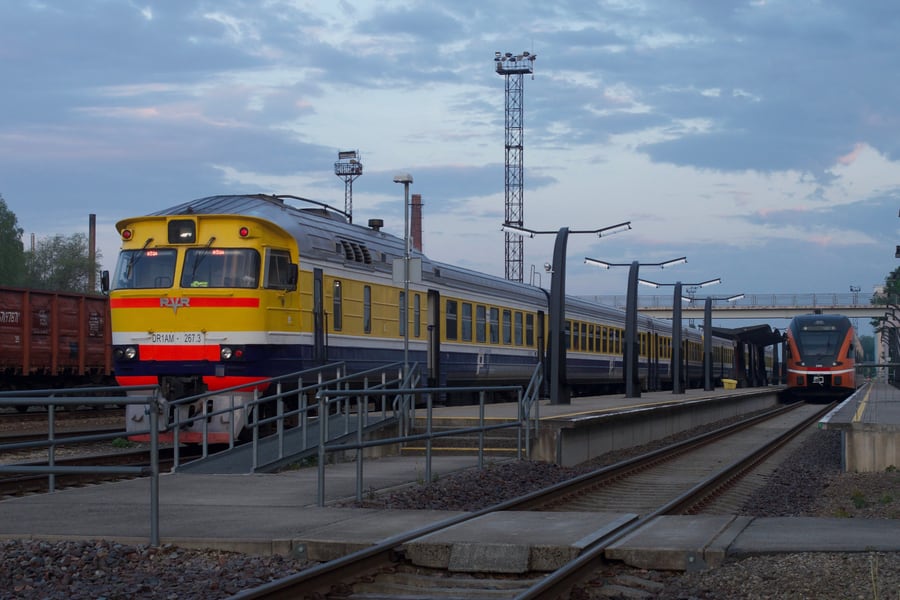 Phil Richards / Wikimedia Commons · CC BY-SA 2.0 · 2019 · cropped
A station across the border
When the border was drawn in 1920, Valka's broad-gauge station fell on the Estonian side and Latvia's nearest was 14 km away. Both countries built spurs to the old narrow-gauge station instead. Vivi's trains still end in Estonia, at Valga.A bit of history
Culture & experiences along the way
 Aldis Dzenovskis / Wikimedia Commons · CC BY-SA 3.0 · 2012 · cropped
The Rose of Turaida
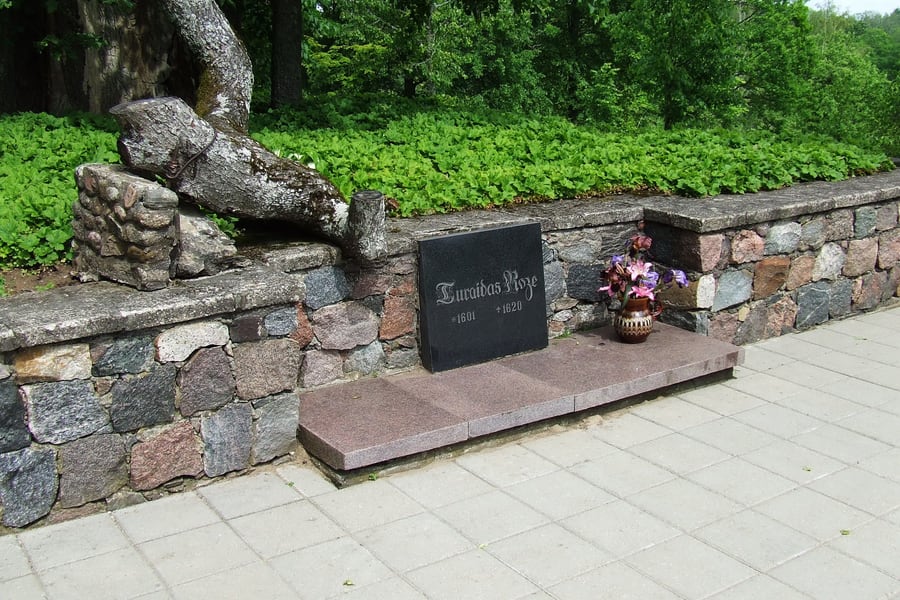
Turaida's legend is of Maija, found as a baby in the castle after the Swedes took it in 1601 and engaged to the gardener of Sigulda Castle. Trapped at Gutmanis Cave in 1620 by a deserter, she told him her red scarf turned blades and let him strike. Her grave is beside Turaida church.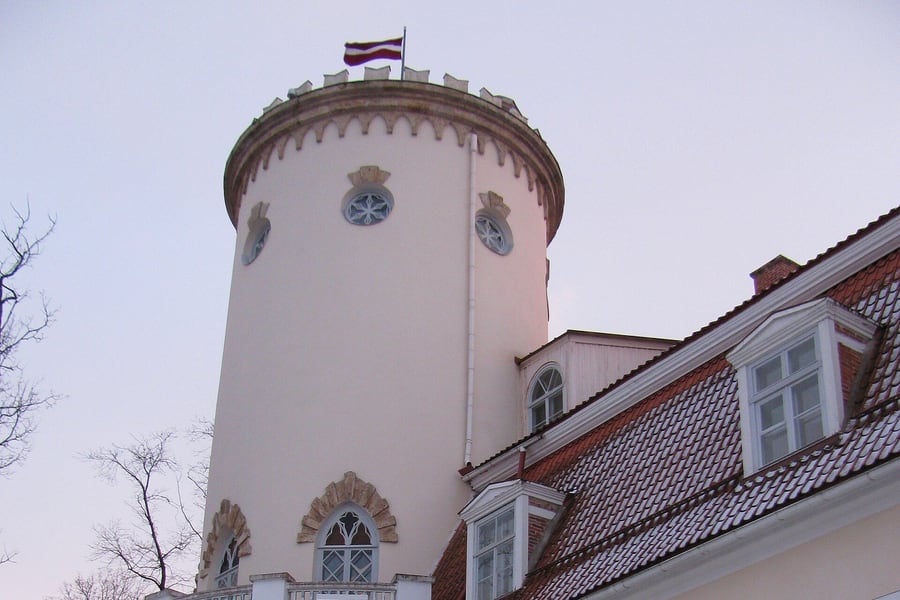 Voll / Wikimedia Commons · CC BY-SA 4.0 · 2014 · cropped
Red, white, red
The Livonian Rhymed Chronicle describes troops from Cēsis carrying a red banner with a white stripe in 1279, and Latvia takes it as the first account of its flag. On 22 October 1988 the flag was raised over Cēsis's New Castle, the first major public building in the country to fly it again.Timetables
Three trains run the whole line each way every day, and a fourth runs on Fridays, Saturdays and Sundays. Two of the daily ones are Vivi's; the third is Elron's express between Riga and Tallinn, which calls in Latvia only at Zemitāni, Sigulda, Cēsis and Valmiera. The times below were read from Vivi's and Elron's own booking engines in October 2026, for travel in early November.
Riga to Valga
| Train | Riga | Sigulda | Cēsis | Valmiera | Valga | Journey |
|---|---|---|---|---|---|---|
| 712 · Elron express | 07:30 | 08:13 | 08:41 | 09:02 | 09:33 | 2 hr 3 |
| 872 · Fri–Sun | 09:30 | 10:37 | 11:16 | 11:44 | 12:24 | 2 hr 54 |
| 874 | 11:53 | 12:40 | 13:11 | 13:36 | 14:13 | 2 hr 20 |
| 876 | 18:30 | 19:25 | 20:04 | 20:31 | 21:12 | 2 hr 42 |
Train 712 runs on to Tartu (11:03) and Tallinn (14:02). Train 874 connects at Valga with Elron's train to Tartu and Tallinn, and 872 with another, both sold as one ticket by Elron.
Valga to Riga
| Train | Valga | Valmiera | Cēsis | Sigulda | Riga | Journey |
|---|---|---|---|---|---|---|
| 875 | 05:13 | 05:52 | 06:17 | 06:49 | 07:44 | 2 hr 31 |
| 873 | 14:25 | 15:02 | 15:26 | 15:55 | 16:44 | 2 hr 19 |
| 871 · Fri–Sun | 17:37 | 18:16 | 18:44 | 19:15 | 20:18 | 2 hr 41 |
| 711 · Elron express | 18:41 | 19:13 | 19:34 | 20:01 | 20:46 | 2 hr 5 |
Train 711 starts in Tallinn at 14:31 and calls at Tartu.
Shorter runs
Sigulda has its own trains as well. On a weekday Vivi runs eight from Riga that go no further, at 08:00, 09:30, 12:30, 14:30, 16:22, 17:58, 20:30 and 22:30, each taking 1 hour 8 minutes; with the longer-distance trains that is more than a dozen a day. Several more run from Riga only as far as Valmiera, among them the 06:30 every day.
Making a day of it
Sigulda is an easy day out: the last train back to Riga leaves at 21:59. For Cēsis, the 11:53 from Riga, any day, is there at 13:11, and the 19:34 Elron express is back in Riga at 20:46; at weekends the 18:44 is an earlier way home.
Times are published by the operator: Vivi · journey planner (opens in a new tab) · Elron · Riga–Tallinn (opens in a new tab).
Tickets
Vivi's fares are low and fixed by distance. Riga to Sigulda is €2.80, Riga to Cēsis €4.60, Riga to Valmiera €5.50 and the whole way to Valga €7.20. Trains 874 and 873, the PESA units, add a €1 surcharge to every fare. Tickets are sold on Vivi's site and app, at station ticket offices and on the train, where €1 more is charged if the station's ticket office was open. ⚠️ A ticket has to be registered as soon as you board, at a validator or with the conductor.
The Elron express is sold by Elron, not Vivi, and costs more: €9.80 from Riga to Valga online, €19.00 to Tartu and €29.00 to Tallinn. Elron also sells the Valga connections from trains 874 and 872 as single through tickets to Tartu and Tallinn. Checked against Vivi and Elron, October 2026.
Book your tickets
Riga to Valga, Vivi
€7.20 · €8.20 on trains 874 and 873
The whole line on a Vivi diesel, registered at a validator or with the conductor as you board.
Book Tickets (opens in a new tab, on vivi.lv)via vivi.lvRiga to Sigulda, Vivi
€2.80 each way
The day out into the Gauja valley, with trains every one to two hours.
Book Tickets (opens in a new tab, on vivi.lv)via vivi.lvRiga to Tartu or Tallinn, Elron
€9.80 to Valga · €19.00 to Tartu · €29.00 to Tallinn
The daily through express, sold online by Elron.
Book Tickets (opens in a new tab, on elron.ee)via elron.eeRail Passes
A pass covers this line, and for this journey alone it does not pay.
Interrail's table of the companies a pass is valid with in Latvia — checked in October 2026, when it carried a last updated 21 October 2026 stamp — lists Vivi with no reservation needed, and the Riga–Valga route as covered by a Global Pass and, on its domestic part, by a One Country Pass. Elron's Riga–Tartu–Tallinn express is listed on the same terms, with a reservation needed only in first class. A Latvia pass therefore takes you as far as Lugaži, the last station before the border, and not into Valga.
The arithmetic is the problem. An adult Interrail Latvia Pass in second class costs €67 for three travel days within a month, €84 for four, €100 for five, €118 for six and €150 for eight; youth prices, for travellers aged 12 to 27, are €50, €63, €75, €89 and €113. A Riga–Valga return on Vivi is €14.40, and a Riga–Sigulda return €5.60. Three travel days would cost more than three return trips to the border.
Where a pass earns its keep is on a longer Baltic run, with this line as the stage between Riga and Tartu — and there a Global Pass, which covers the whole Riga–Valga route and Elron's trains beyond, is the pass to hold.
Prices and conditions read on interrail.com (opens in a new tab) in October 2026.
Places to Visit
Everything below is reached from a station on the line, and the times given are taken from the 11:53 from Riga, which is at Sigulda by 12:40, Līgatne by 12:50 and Cēsis by 13:11. All four are in or beside Gauja National Park, set up in 1973 to protect the old valley of the river.
They come in the order the railway meets them: the valley at Sigulda and the cave below it, the paper-mill village at Līgatne, and the castle at Cēsis.
 PROP1001 / Wikimedia Commons · CC0 · 2023
The Gauja valley at Sigulda
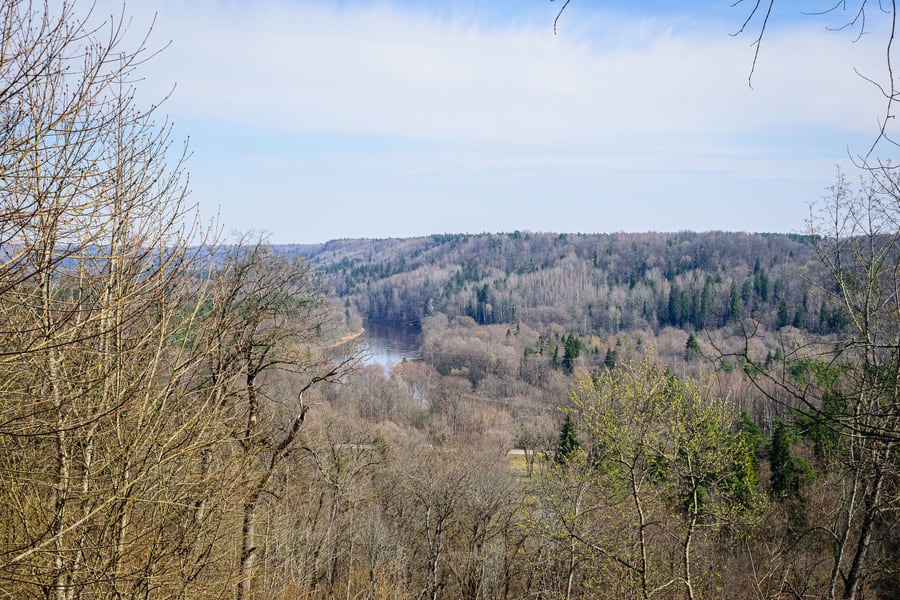
At Sigulda the Gauja runs through a valley of red Devonian sandstone, with steep rocks and caves on both banks, protected as a national park since 1973. Across the river from the town stands Turaida, a brick castle begun in 1214, abandoned after a fire in 1776 and restored since excavations began in 1976; its main tower looks out over the whole valley.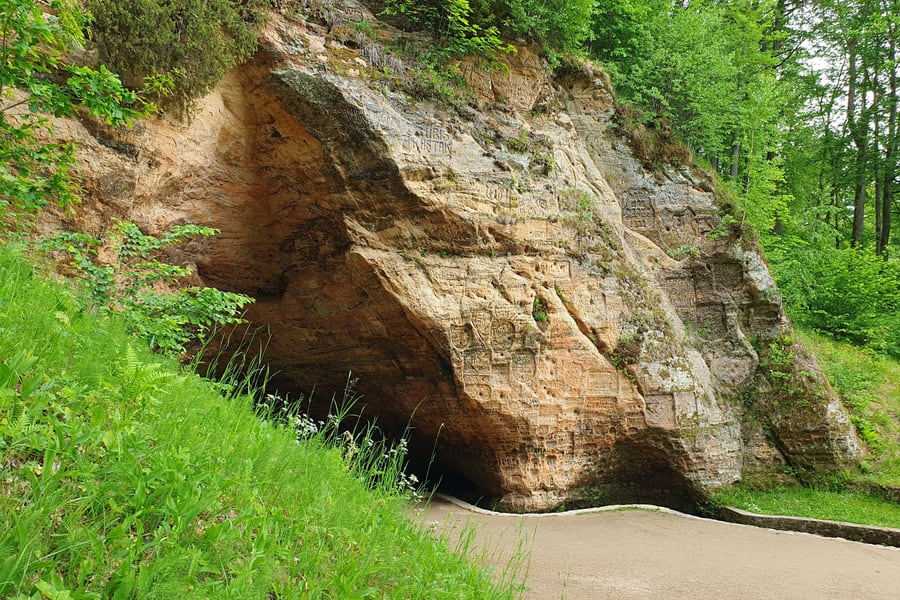 Qasinka / Wikimedia Commons · CC0 · 2023
Gutmanis Cave
The largest cave in the Baltic states, 19 metres deep, 12 wide and 10 high, cut into the sandstone halfway between Sigulda Castle and Turaida Castle, with a small stream running out of it. Visitors have carved their names into its walls since at least the seventeenth century, and its water is said to lengthen your life. It is also where the Rose of Turaida died.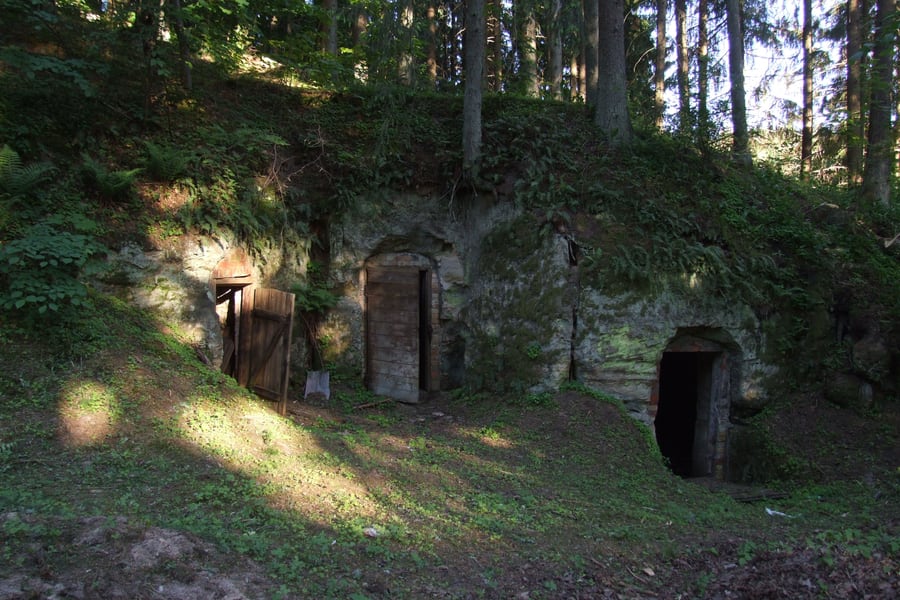 Dāvis Kļaviņš / Wikimedia Commons · CC BY-SA 2.0 · 2011
Līgatne
A village built around a paper mill on the River Līgatne, which made paper from 1816 to 2016 and is now open for industrial tourism. Thirty nineteenth-century wooden row houses for its workers survive, and so do the cellars they dug into the sandstone banks to store food. Downstream on the left bank are the Līgatne Nature Trails, set up in 1975 for bear, lynx, elk and European bison.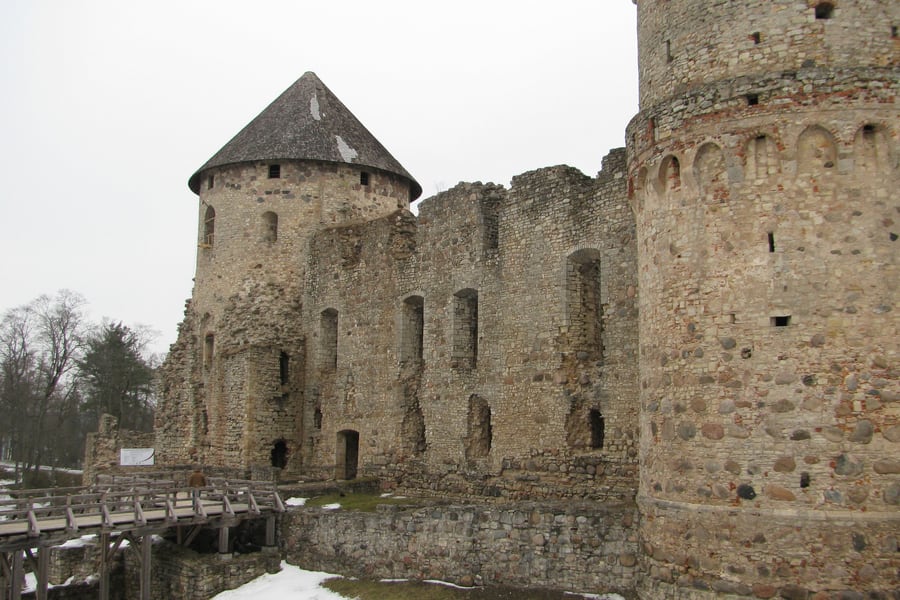 Voll / Wikimedia Commons · CC BY-SA 4.0 · 2014 · cropped
Cēsis Castle
Begun by the Livonian Brothers of the Sword around 1214 and rebuilt by the Teutonic Order as one of its mightiest castles, Cēsis became the permanent seat of the Order's masters in Livonia at the end of the fifteenth century. In 1577, besieged by Ivan the Terrible's army, about 300 people inside blew themselves up with gunpowder rather than surrender. Its ruins and the vaulted Master's Chamber of about 1500 survive.Where to Sleep
The line is short enough to be a day return from Riga, so the houses below are for staying in the Gauja valley itself, two in Sigulda and one in Cēsis. Everything described is what each says about itself on its own site, read in October 2026. No prices, grades or star counts appear here, because none have been verified.
Where to stay
 Voll / Wikimedia Commons · CC BY-SA 4.0 · 2014 · cropped
Hotel Sigulda
Pils iela 6, in the centre of Sigulda
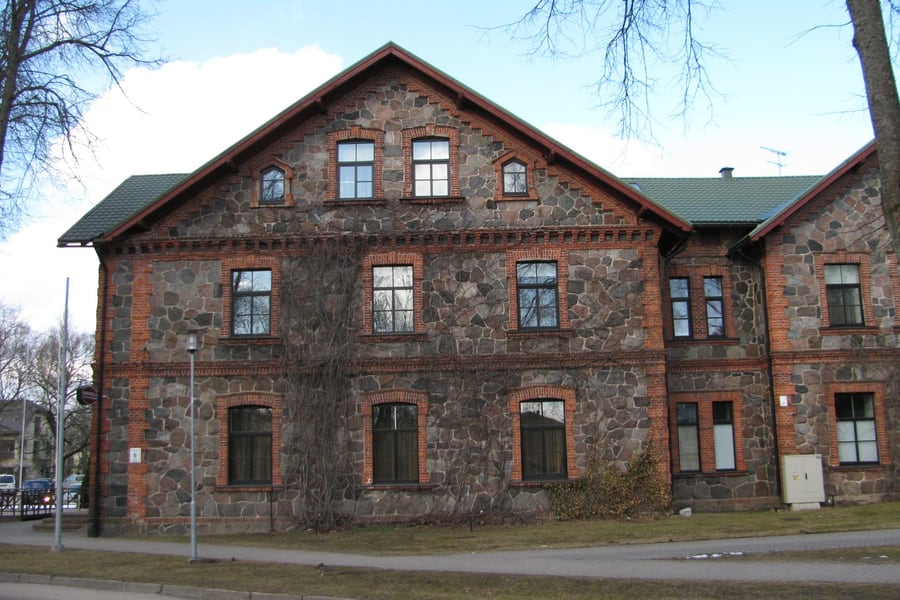
Forty-three rooms in a nineteenth-century masonry building in the middle of the town, with a restaurant, a spa with a pool and conference rooms. Breakfast is served from seven to eleven, on a terrace over Pils iela in summer.
Check Availability (opens in a new tab, on hotelsigulda.lv)via hotelsigulda.lvHotel Pils
Pils iela 4b, in the centre of Sigulda
A hotel in the middle of Sigulda with standard, family and lux rooms, and contactless self check-in.
Check Availability (opens in a new tab, on hotelpils.lv)via hotelpils.lvHotel Cēsis
Vienības laukums 1, in the centre of Cēsis
Built in 1939 and since renovated, with 39 rooms looking over Unity Square or Maija Park, a 24-hour reception, a restaurant and a café, and the old town and castle within walking distance.
Check Availability (opens in a new tab, on hotelcesis.lv)via hotelcesis.lvQuestions or corrections
Planning this trip and stuck on something, or spotted a time, fare or detail that has changed? Send us a message about Riga to Valga — through the Gauja valley. We read every one, and we update this page when something has changed.