Riga to Daugavpils — up the Daugava
Егор Журавлёв / Wikimedia Commons · CC BY-SA 2.0 · 2017
- Distance218 km · broad gauge
- Duration2 hr 40 min (express) – 3 hr 32 min
- Best seasonSeven trains a day each way, all year
Introduction
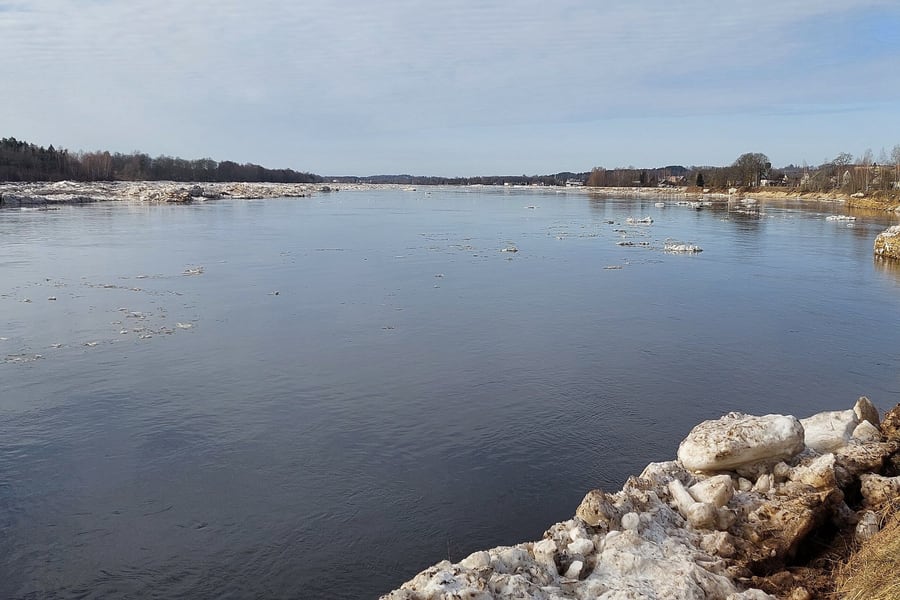
Latvia's national epic is set along this railway. In Andrejs Pumpurs's Lāčplēsis, written between 1872 and 1887, the hero is the son of the Lord of Lielvārde, who earns his name, the Bear-Slayer, by tearing a bear apart with his bare hands. On his way to his studies he stops at the castle of Lord Aizkrauklis, and the gods are visited by Staburadze, who lives in a crystal palace under the whirlpool at the foot of Staburags, a cliff on the Daugava. Lielvārde and Aizkraukle are both stations on the line. Staburags is not there to see: since 1965 it has stood six and a half metres under water, drowned by the reservoir of the Pļaviņas hydroelectric dam.
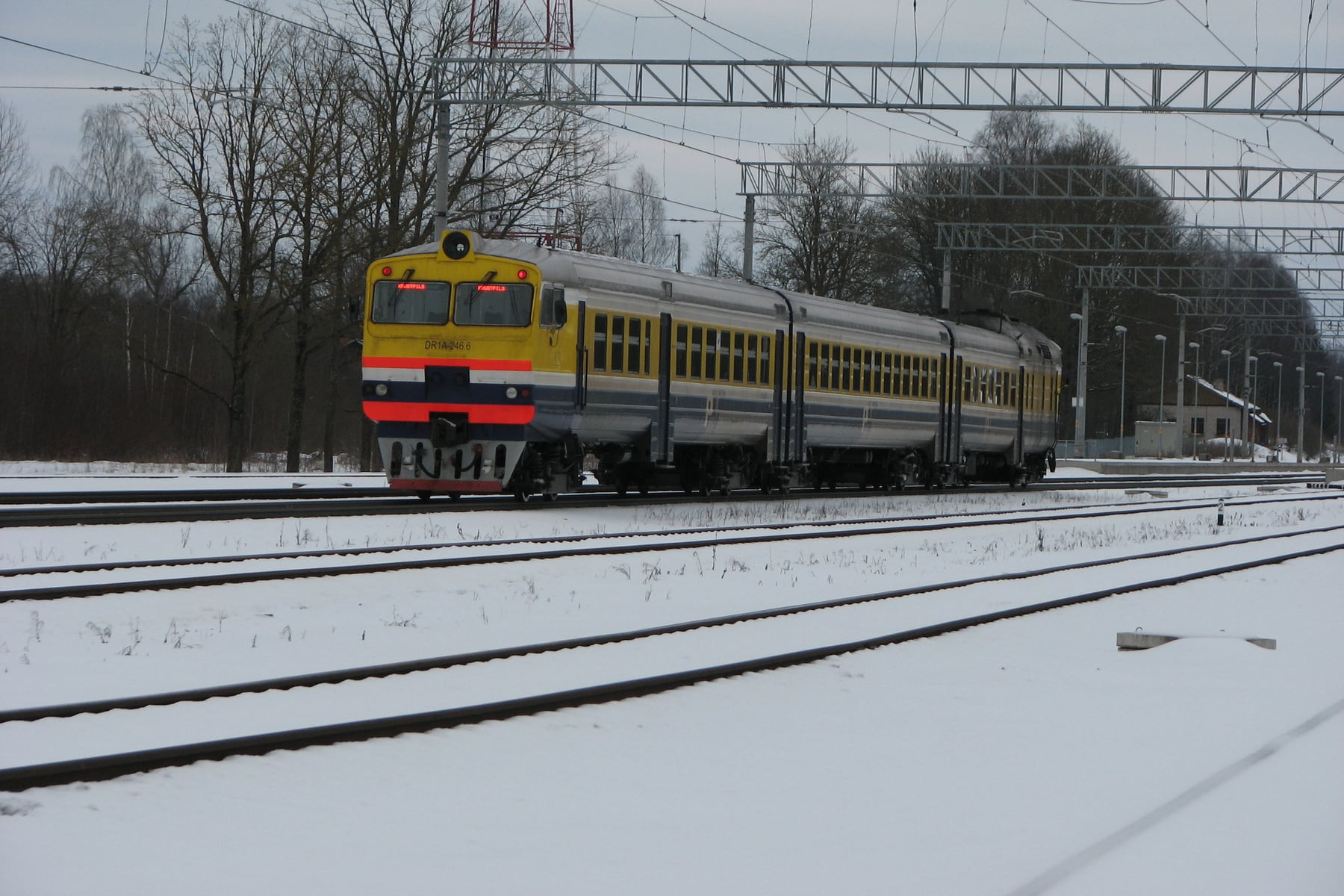
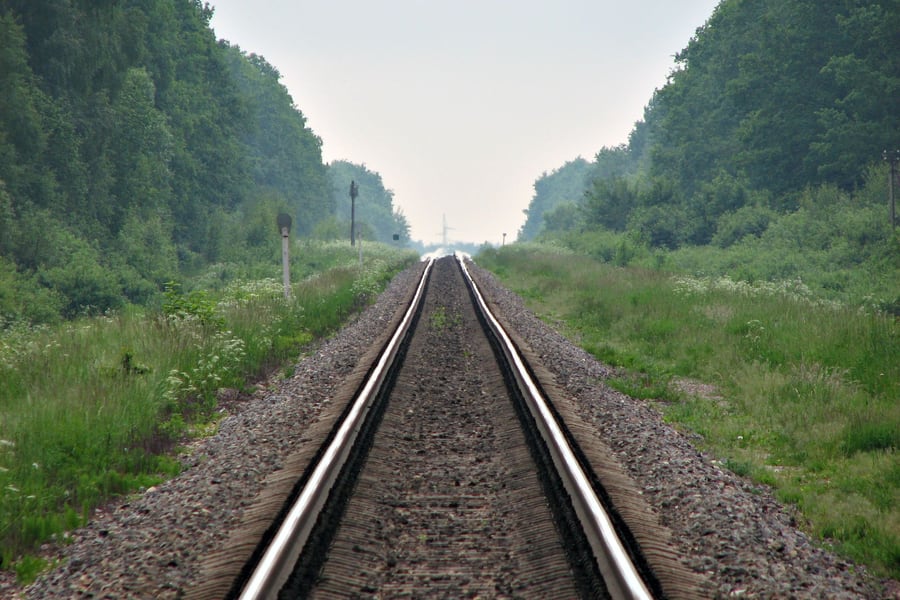
The railway is one of the oldest in the country. It opened on 21 September 1861, 218 kilometres from Riga to the fortress town then called Dinaburg, where it met the St Petersburg–Warsaw Railway and joined Riga to the rail network of the Russian Empire. It keeps close to the Daugava most of the way, on double track as far as Krustpils and single track beyond. The wires stop at Aizkraukle, so every through train is a diesel, built in Riga by the Riga Carriage Works.
Daugavpils, at the far end, is Latvia's second city and the capital of Latgale, the country's eastern region. Since the Second World War most of its people have spoken Russian, and it is a city of an early-nineteenth-century fortress, a hill of four churches of four denominations, and a museum to the painter Mark Rothko, who was born there in 1903. Seven trains a day make the trip in each direction, and the fastest, the evening express from Riga, takes 2 hours 45 minutes.
The Journey
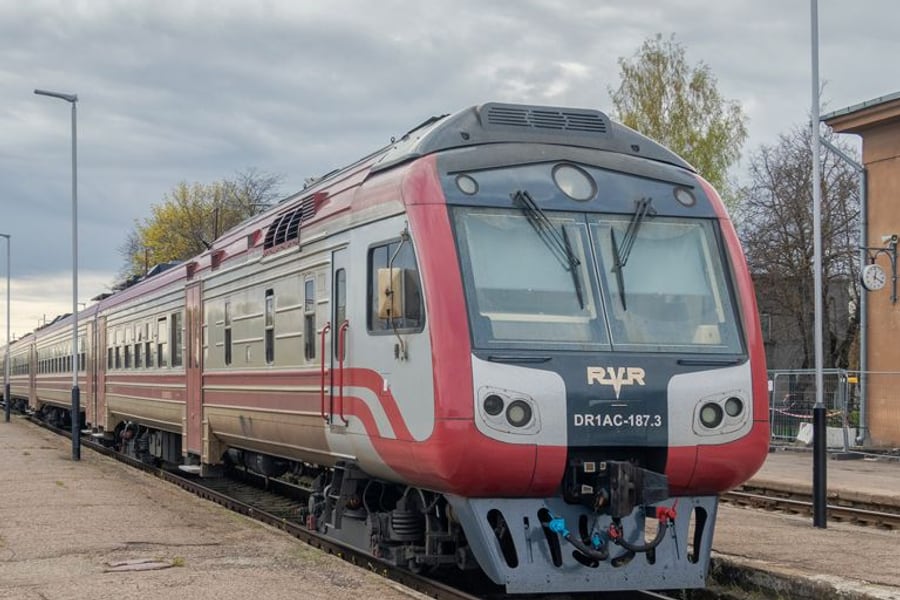
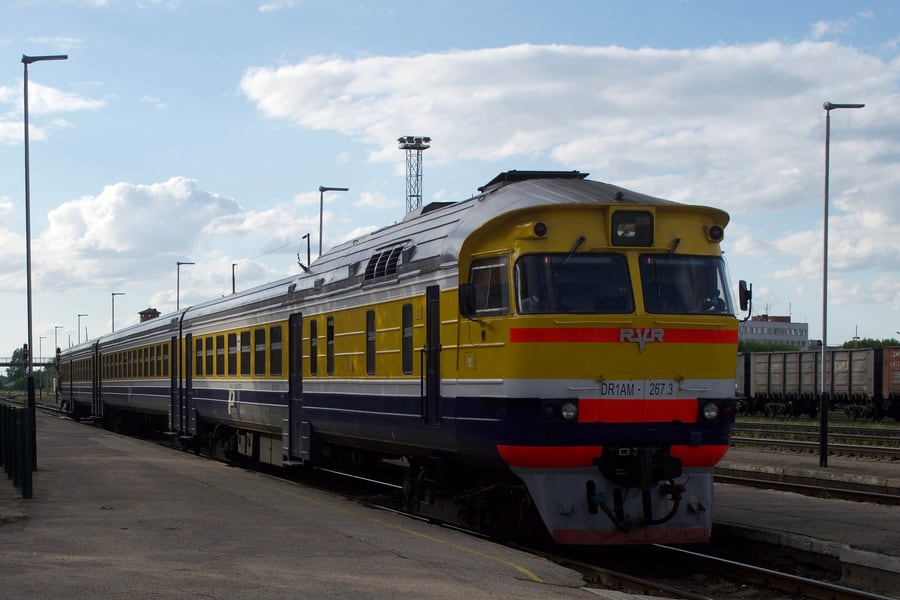
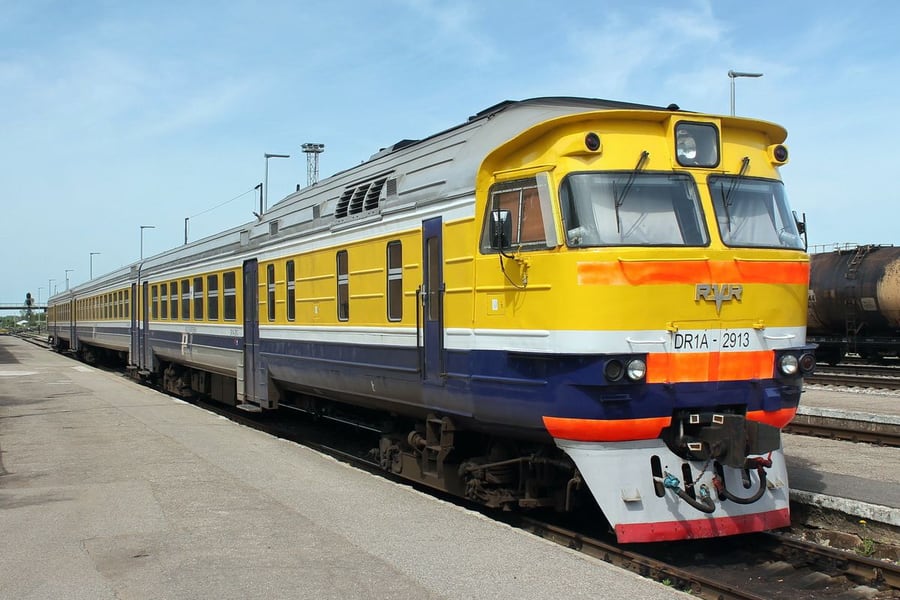
Every through train is a Riga-built diesel unit of the DR1A family, with the engine behind the driving cab and RVR, the initials of the Rīgas Vagonbūves Rūpnīca, on the nose. Most wear the older yellow and blue; some are DR1AC sets, rebuilt in Latvia in a red-and-white livery with a squarer, more modern front. Vivi's planner lists one train each way, the express, as a modernised diesel train with air-conditioning and a toilet.
Along the Daugava to Aizkraukle
Trains leave from Rīga-Pasažieru, the central station, and run out past Jāņavārti and Šķirotava. The fast trains make their first stop at Ogre, half an hour out. The stopping trains also call at Jāņavārti and Lielvārde, and some at Salaspils or Skrīveri.
The line was built with two tracks all the way. It ran close behind the front line for three years of the First World War, and afterwards only one track was put back. The second was relaid from Riga to Ogre in 1953 and later as far as Skrīveri, and the last gap, Skrīveri to Krustpils, was closed between 2011 and 2014. The wires came in stages: electric trains reached Ogre on 20 July 1959 and Aizkraukle in 1972, and they go no further. Until the mid-1990s the kilometres between Riga and Krustpils were counted from Moscow.
Koknese, Pļaviņas and Krustpils
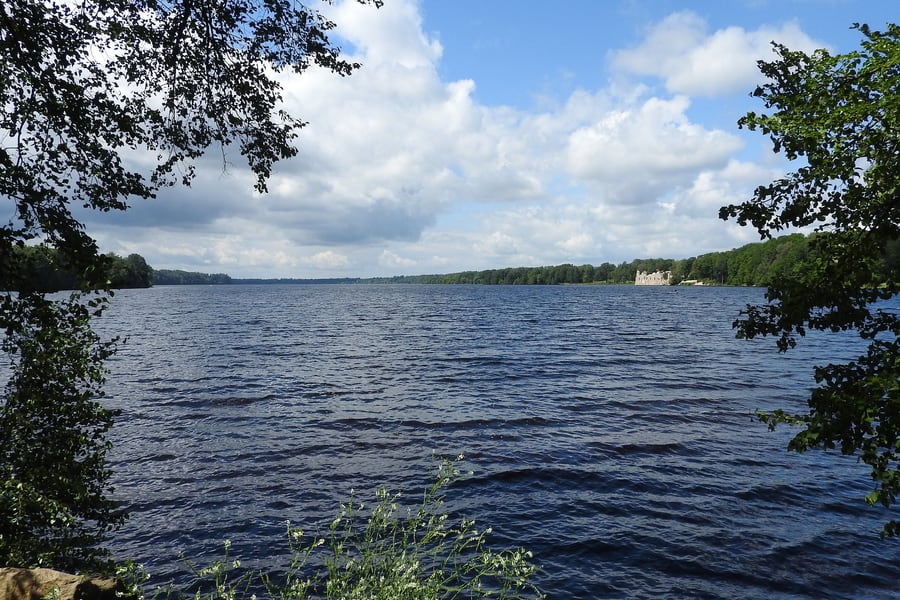
Beyond Aizkraukle the line follows the river past Koknese, where the ruins of a castle begun in 1209 now stand at the edge of the reservoir, and Alotene to Pļaviņas, where the trains for Madona and Gulbene leave the line. The Pļaviņas hydroelectric dam, which raised the river in 1965, also drowned the cliff at Staburags that the Latvian national epic made the home of a goddess.
Krustpils is the biggest station between the two cities and the junction of four lines: from Riga, from Jelgava, to Rēzekne and to Daugavpils. It was built with the line in 1861, and was enlarged when the Moscow–Ventspils railway was joined to it in 1901. Krustpils itself, the town on the station's side of the river, was merged in 1962 with Jēkabpils on the opposite bank.
Into Latgale
From Krustpils the line is single track. It runs through Trepe and Līvāni to Jersika, where the iron-clad garrison church that stood on the site of Daugavpils's Orthodox cathedral was taken down and rebuilt, and on through Nīcgale, Vabole and Līksna to Daugavpils.
In 1861 this was Dinaburg, and the line ended at a junction with the St Petersburg–Warsaw Railway, whose line from St Petersburg had reached the town the year before. A line to Vitebsk followed in 1866. That year the railway built its rolling-stock workshops here, which became the main works of the Latvian railways and are now the Daugavpils Locomotive Repair Plant. The station was badly damaged in the Second World War, and the present building dates from 1951.
Most trains end at Daugavpils. The express carries on to Krāslava, 30 minutes further on, and on Thursdays and Fridays to Indra beyond it, a service added in 2020 and 2021.
Along the route
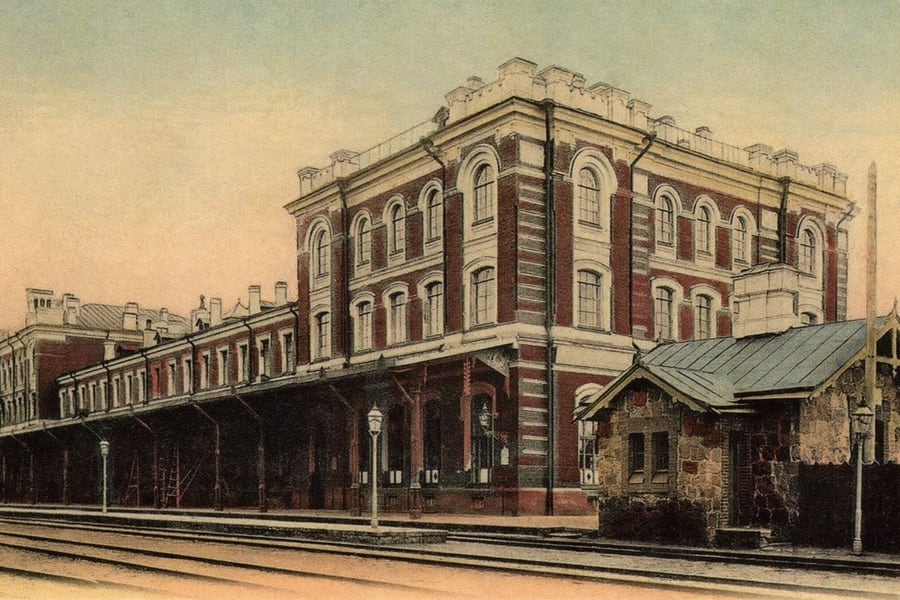 Unknown photographer / Wikimedia Commons · Public domain · c. 1900 · cropped
Where two railways met
The line opened in 1861 at Dinaburg, as Daugavpils was then called, where it met the St Petersburg–Warsaw Railway, whose line from St Petersburg had arrived the year before. This is that railway's station in the town, photographed about 1900.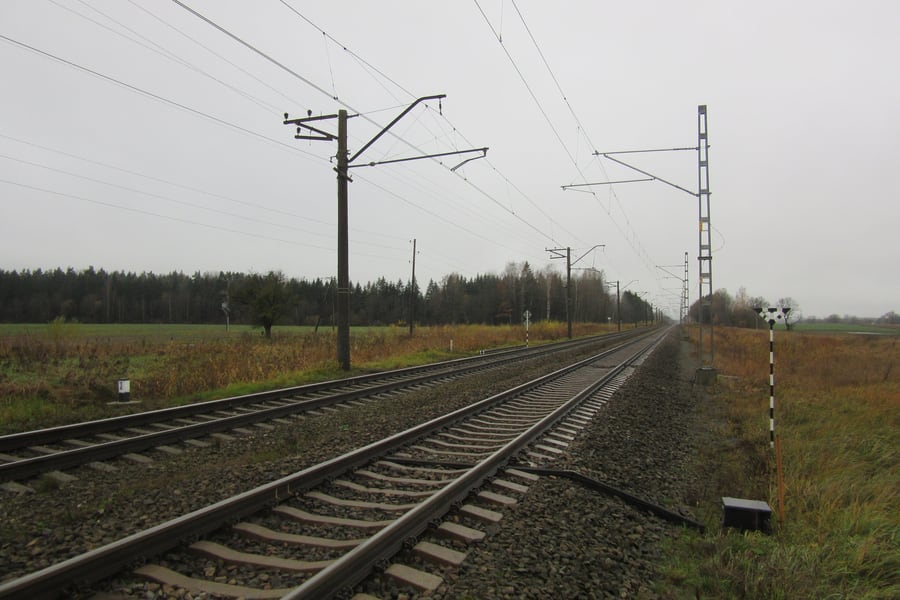 Titāns / Wikimedia Commons · CC BY-SA 4.0 · 2021 · cropped
The end of the wires
Electric trains reached Ogre on 20 July 1959, Pārogre that December, Jumprava in 1968 and Aizkraukle in 1972, and the overhead line has stopped there ever since. Beyond Aizkraukle every train to Daugavpils is a diesel.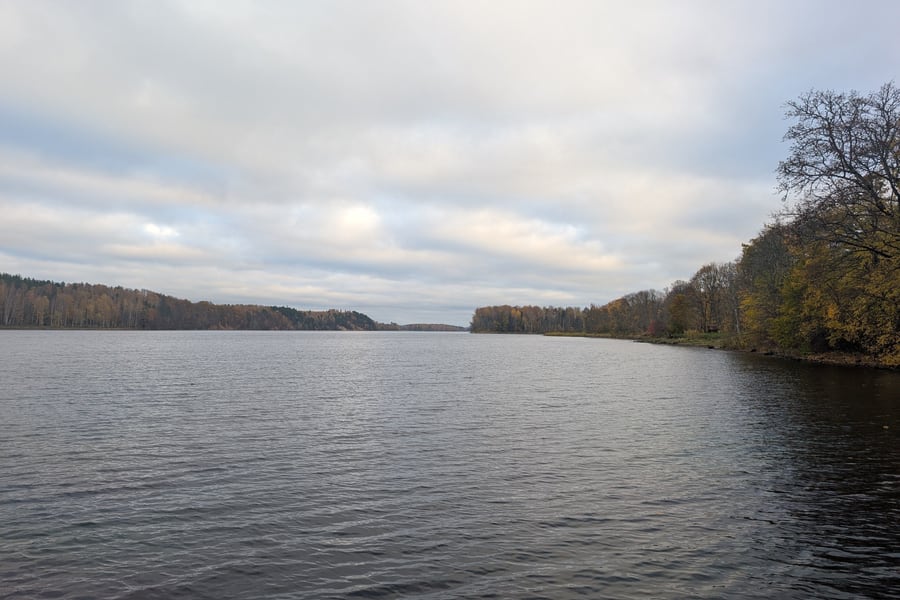 Андрей Романенко / Wikimedia Commons · CC BY-SA 4.0 · 2026 · cropped
A cliff under the reservoir
Staburags was an 18-metre cliff on the Daugava, shaped by lime-rich springs; legend held it was a girl in mourning turned to stone. The Pļaviņas dam put it six and a half metres under water in 1965. This is the river there in October 2026.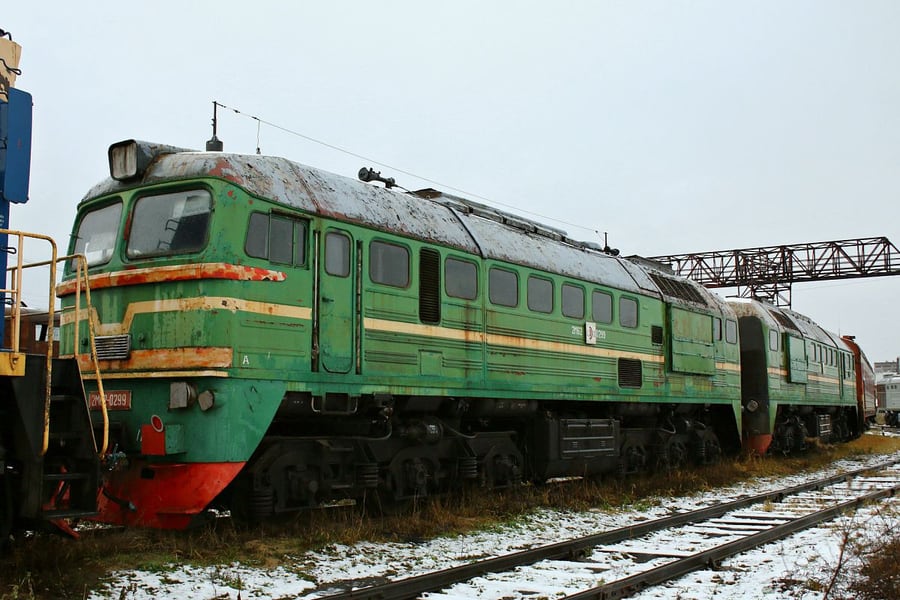 Szabolcs Csatho / Wikimedia Commons · CC BY-SA 4.0 · 2017 · cropped
The works at Daugavpils
The railway built its rolling-stock workshops at Daugavpils in 1866. They became the main works of the Latvian railways and are now the Daugavpils Locomotive Repair Plant, which in 2016 helped rebuild DR1A carriages for the passenger operator now called Vivi.A bit of history
Culture & experiences along the way
 Edgars Košovojs / Wikimedia Commons · CC BY-SA 3.0 · 2014 · cropped
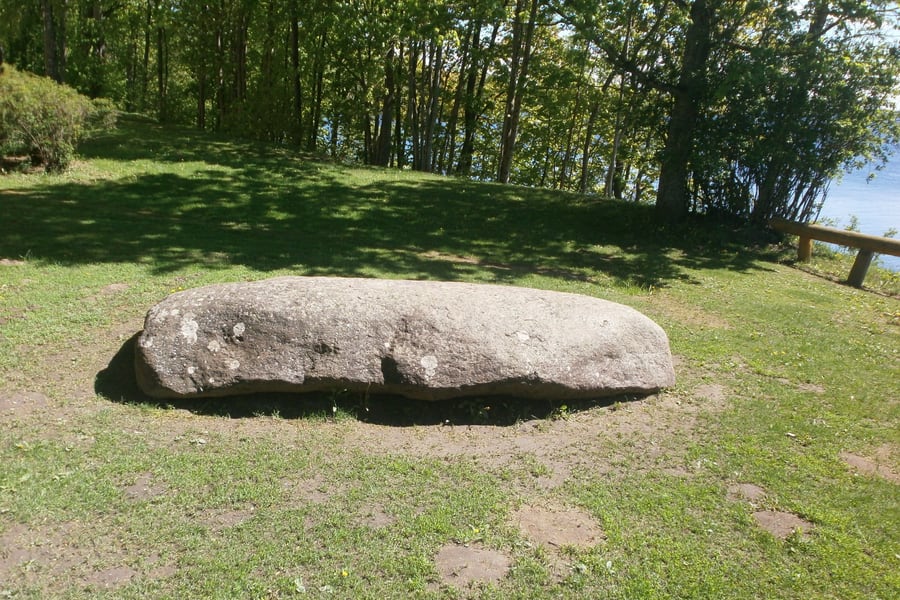
The Bear-Slayer
Andrejs Pumpurs's Lāčplēsis, Latvia's national epic, makes its hero the son of the Lord of Lielvārde. Beside the Pumpurs museum lies a boulder called Lāčplēsis's bed, with a slab split from it, his blanket. The bed lay in the Daugava above the Ķegums rapids until 1938, was moved ashore before the Ķegums reservoir flooded the river, and came to Lielvārde in 1976.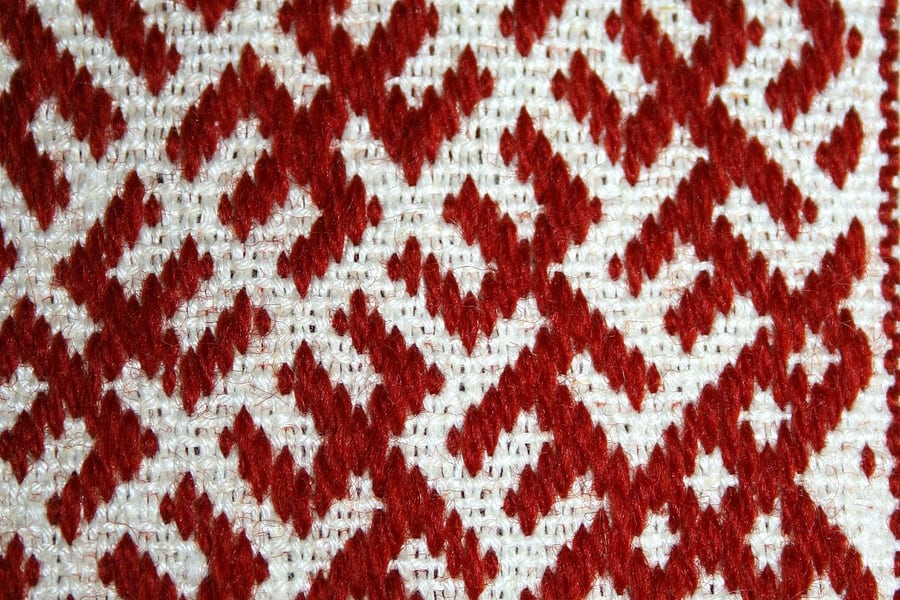 Laima Gūtmane (simka) / Wikimedia Commons · CC BY-SA 3.0 · 2008 · cropped
The Lielvārde belt
A red-and-white sash of linen and wool, up to three metres long and ten centimetres wide, woven in Lielvārde and the parishes along the Daugava around it. Its pattern is built from 29 elements, the National History Museum keeps 72 old ones, and it is on the Latvian Cultural Canon.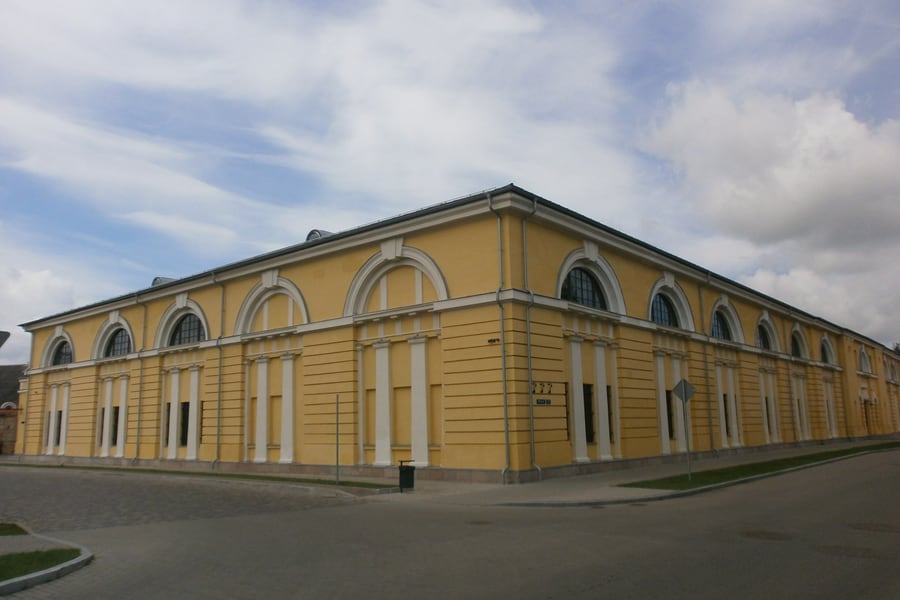 Edgars Košovojs / Wikimedia Commons · CC BY-SA 4.0 · 2015 · cropped
Rothko comes home
Mark Rothko was born Markus Rothkowitz in Dvinsk in 1903 and left for America with his family in 1913. Since 2013 the fortress's artillery arsenal has held a museum in his name, the only place in Europe that permanently shows original Rothko paintings: six, on loan from his estate.Timetables
Seven trains run between Riga and Daugavpils in each direction, every day of the week. Six are through trains; the seventh is an electric train as far as Aizkraukle with a diesel waiting across the platform, sold as one ticket. The times below were read from Vivi's own journey planner in October 2026, for travel in early November, and were the same on a weekday and at the weekend.
Riga to Daugavpils
| Train | Riga | Aizkraukle | Krustpils | Daugavpils | Journey |
|---|---|---|---|---|---|
| 802 | 07:01 | 08:15 | 09:01 | 10:19 | 3 hr 18 |
| 702 | 10:01 | 11:04 | 11:47 | 12:55 | 2 hr 54 |
| 810 | 12:31 | 13:41 | 14:27 | 15:45 | 3 hr 14 |
| 6236 + 824 · change at Aizkraukle | 14:39 | 15:49 / 15:54 | 16:35 | 17:44 | 3 hr 5 |
| 706 / 708 · express | 16:31 | 17:34 | 18:12 | 19:16 | 2 hr 45 |
| 814 | 18:01 | 19:11 | 19:57 | 21:15 | 3 hr 14 |
| 822 | 21:01 | 22:13 | 22:56 | 00:12 | 3 hr 11 |
The express runs on to Krāslava (19:49) as train 706, and on Thursdays and Fridays as train 708 to Indra (20:09).
Daugavpils to Riga
| Train | Daugavpils | Krustpils | Aizkraukle | Riga | Journey |
|---|---|---|---|---|---|
| 821 | 03:48 | 05:03 | 05:48 | 06:59 | 3 hr 11 |
| 705 / 707 · express | 06:19 | 07:21 | 07:59 | 08:59 | 2 hr 40 |
| 813 | 07:42 | 09:01 | 09:46 | 10:59 | 3 hr 17 |
| 801 | 10:52 | 12:05 | 12:47 | 13:59 | 3 hr 7 |
| 823 + 6243 · change at Aizkraukle | 13:19 | 14:45 | 15:30 | 16:51 | 3 hr 32 |
| 809 | 16:29 | 17:41 | 18:21 | 19:30 | 3 hr 1 |
| 825 | 18:10 | 19:36 | 20:20 | 21:29 | 3 hr 19 |
The express starts at Krāslava (05:45) as train 705, and on Fridays and Saturdays as train 707 from Indra (05:25).
Shorter runs
Riga's trains to Rēzekne, Ludza and Zilupe share the line as far as Krustpils, so Krustpils has ten trains a day from Riga. Ogre, Lielvārde and Aizkraukle are on the electrified section and have electric trains from Riga as well, as often as every half hour to Ogre.
Making a day of it
Daugavpils is a long day out from Riga but a possible one: the 10:01 arrives at 12:55, and the 18:10 is back in Riga at 21:29. Koknese and Krustpils are easier, with the 10:01 there at 11:15 and 11:47.
Times are published by the operator: Vivi · journey planner (opens in a new tab).
Tickets
Vivi's fares are fixed by distance. From Riga it is €2.30 to Ogre, €4.60 to Koknese, €5.70 to Krustpils, €6.90 to Līvāni and €8.90 to Daugavpils. The expresses, 706 and 708 out and 705 and 707 back, add a €1 surcharge for the higher speed, so the whole way costs €9.90. Tickets are sold on Vivi's site and app, at station ticket offices and on board, where €1 more is charged if the station's ticket office was open.
⚠️ A ticket has to be registered as soon as you board, at a validator or with the conductor. For a journey that stays between Riga and Lielvārde, the diesels carry a €1 surcharge of their own. Checked against Vivi, October 2026.
Book your tickets
Riga to Daugavpils, Vivi
€8.90 · €9.90 on the express
The whole line on a Vivi diesel, registered at a validator or with the conductor as you board.
Book Tickets (opens in a new tab, on vivi.lv)via vivi.lvRiga to Koknese or Krustpils, Vivi
€4.60 to Koknese · €5.70 to Krustpils
The castle stops halfway up the river, with ten trains a day to Krustpils.
Book Tickets (opens in a new tab, on vivi.lv)via vivi.lvRail Passes
A pass covers this line, and for this journey alone it does not pay.
Interrail's table of the companies a pass is valid with in Latvia — checked in October 2026, when it carried a last updated 21 October 2026 stamp — lists Vivi as covered by both the Global Pass and the One Country Pass, with no reservation needed. Every train on this line is Vivi's, so a pass takes you all the way to Daugavpils, and on to Krāslava and Indra. The table says nothing about the €1 surcharge on the expresses.
The arithmetic is the problem. An adult Interrail Latvia Pass in second class costs €67 for three travel days within a month, €84 for four, €100 for five, €118 for six and €150 for eight; youth prices, for travellers aged 12 to 27, are €50, €63, €75, €89 and €113. A Riga–Daugavpils return is €17.80, or €19.80 by express both ways. Three return trips cost €53.40: less than an adult pass, and only €3.40 more than a youth one.
Hold a pass for this line only if it is one day of a longer journey across the Baltic states, and there a Global Pass is the one to carry.
Prices and conditions read on interrail.com (opens in a new tab) in October 2026.
Places to Visit
Everything below is reached from a station on the line, and the times given are taken from the 10:01 from Riga, train 702, which is at Koknese by 11:15, Krustpils by 11:47 and Daugavpils by 12:55.
They come in the order the railway meets them: the castle ruins at Koknese, the castle at Krustpils, and two sides of Daugavpils, the fortress and the hill of churches.
 Zairon / Wikimedia Commons · CC BY-SA 4.0 · 2014 · cropped
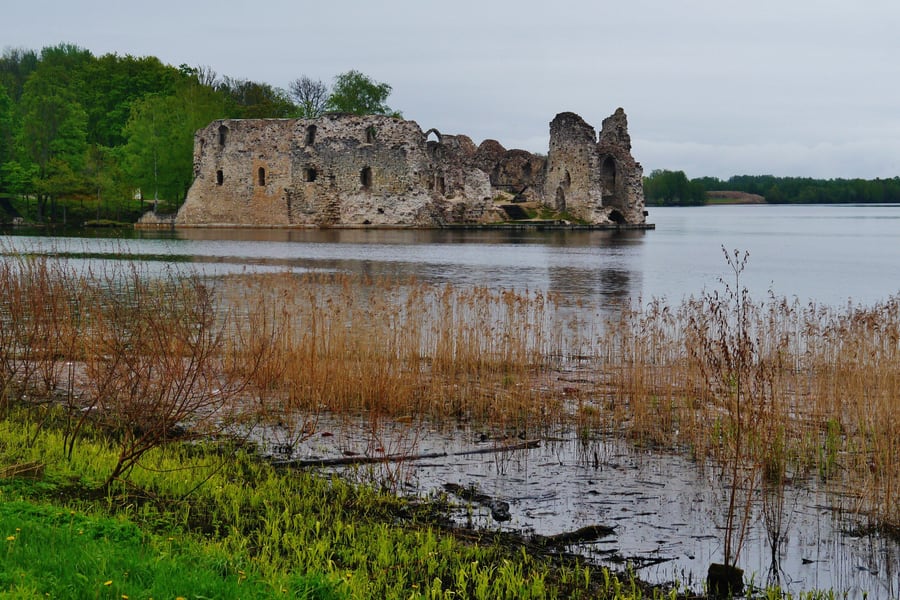
Koknese Castle
Bishop Albert of Riga had a stone castle built in 1209 where the Pērse meets the Daugava, and the town around it joined the Hanseatic League. Poles, Swedes and Russians fought over it through two centuries; on 25 July 1701 a Saxon colonel had its two western towers blown up, and it was never rebuilt. Since a dam downstream raised the river in 1965, the reservoir has lapped at its walls.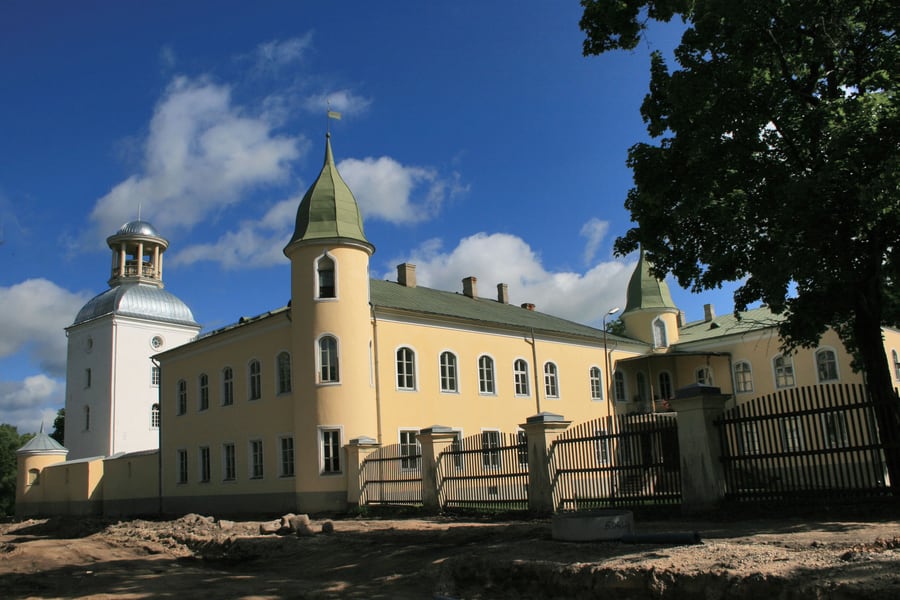 Laima Gūtmane (simka) / Wikimedia Commons · CC BY-SA 3.0 · 2011 · cropped
Krustpils Castle
First recorded in 1237, when the Archbishop of Riga built a castle called Kreutz here, and held by the von Korff family from 1585 until the land reform of 1920. Turkish prisoners of the war of 1877–78 were kept here, and many stayed. From 1561 to 1772 the Daugava below divided it from Courland, and the speech still differs: Latgalian here, Selonian across the river. Jēkabpils History Museum has been inside since 1994.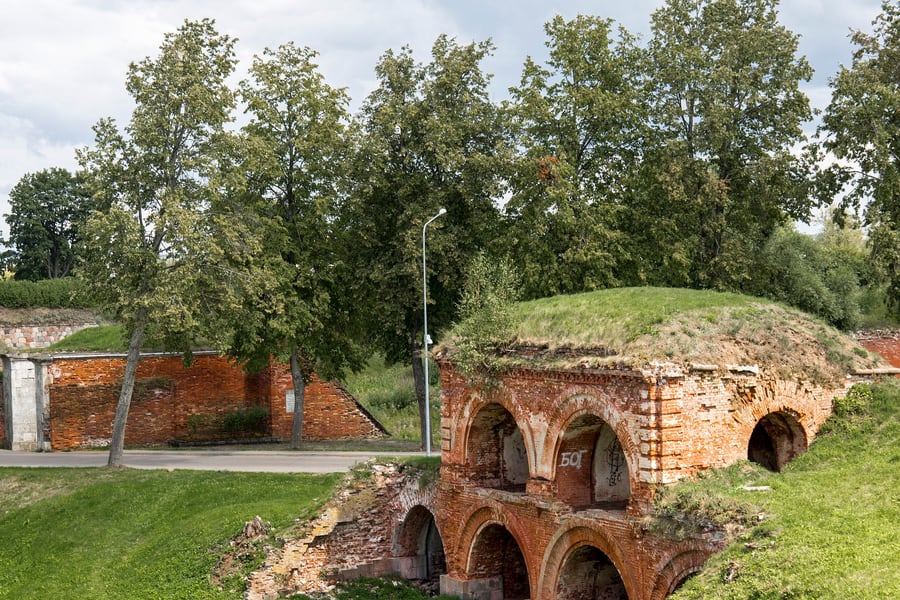 Laima Gutmane / Wikimedia Commons · CC BY-SA 4.0 · 2019 · cropped
Daugavpils Fortress
Begun in 1810 on the orders of Alexander I, as Napoleon's invasion approached, and attacked in 1812 while still unfinished; floods and delays meant it was completed only in 1878. It is the only early-nineteenth-century fortification of its kind in Northern Europe to survive without major alteration. On the road from St Petersburg to Europe, every tsar from Alexander I to Nicholas II stayed there.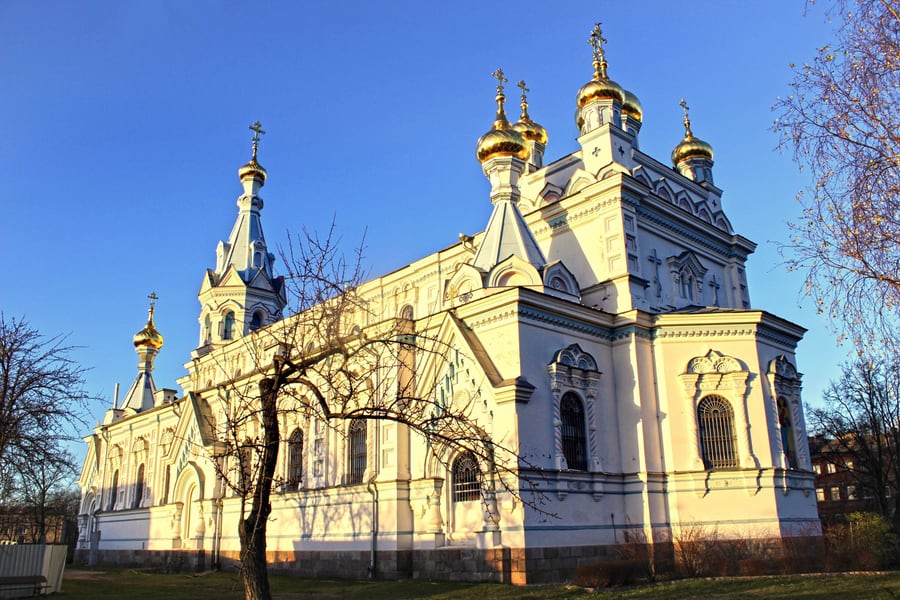 Laima Gūtmane (simka) / Wikimedia Commons · CC BY-SA 3.0 · 2013 · cropped
Church Hill
Four congregations share one hill in the Jaunbūve district: Catholic, Lutheran, Old Believer and Orthodox. The largest building is the Orthodox Cathedral of Saints Boris and Gleb, built for the garrison in 1904–05, with room for 5,000 people and ten gilded cupolas. The iron church it replaced was taken down and rebuilt at Jersika, a stop on the line. Tram 1 stops at Baznīcu kalns.Where to Sleep
Daugavpils is three hours from Riga, and the last train back leaves at 18:10, so the houses below are for a night at the far end, both in the centre of the city and a short walk from the station. Everything described is what each says about itself on its own site, read in October 2026. No prices, grades or star counts appear here, because none have been verified.
Where to stay
Park Hotel Latgola
Ģimnāzijas iela 46, in the centre of Daugavpils
A hotel in the city centre beside the historic Unity House, with standard, business and lux rooms and apartments, the PLAZA restaurant, a lobby bar, and a sauna and jacuzzi.
Check Availability (opens in a new tab, on hotellatgola.lv)via hotellatgola.lvHotel LEO
Krāslavas iela 58, in the centre of Daugavpils
A guest house of seven rooms in a nineteenth-century building, three minutes' walk from the railway and bus stations, with free parking and Wi-Fi.
Check Availability (opens in a new tab, on hotelleo.lv)via hotelleo.lvQuestions or corrections
Planning this trip and stuck on something, or spotted a time, fare or detail that has changed? Send us a message about Riga to Daugavpils — up the Daugava. We read every one, and we update this page when something has changed.