Hakone Tozan Railway
Cassiopeia sweet / Wikimedia Commons · Public domain
- Distance15 km (Odawara–Gōra)
- DurationAbout 40 minutes up the mountain line
- Best seasonJune–July for hydrangeas · autumn for colour
Introduction
Not everything in Japan travels at 285 km/h. An hour and a half from Tokyo, the Hakone Tozan Railway climbs into the hot-spring hills of Hakone at little more than walking pace — and it is all the lovelier for it. This is Japan's oldest mountain railway, a line of tiny two-car trains that hauls itself up an 80‰ (1-in-12.5) gradient by grip alone, zig-zagging through three switchbacks to reach the galleries and onsen of Gōra.
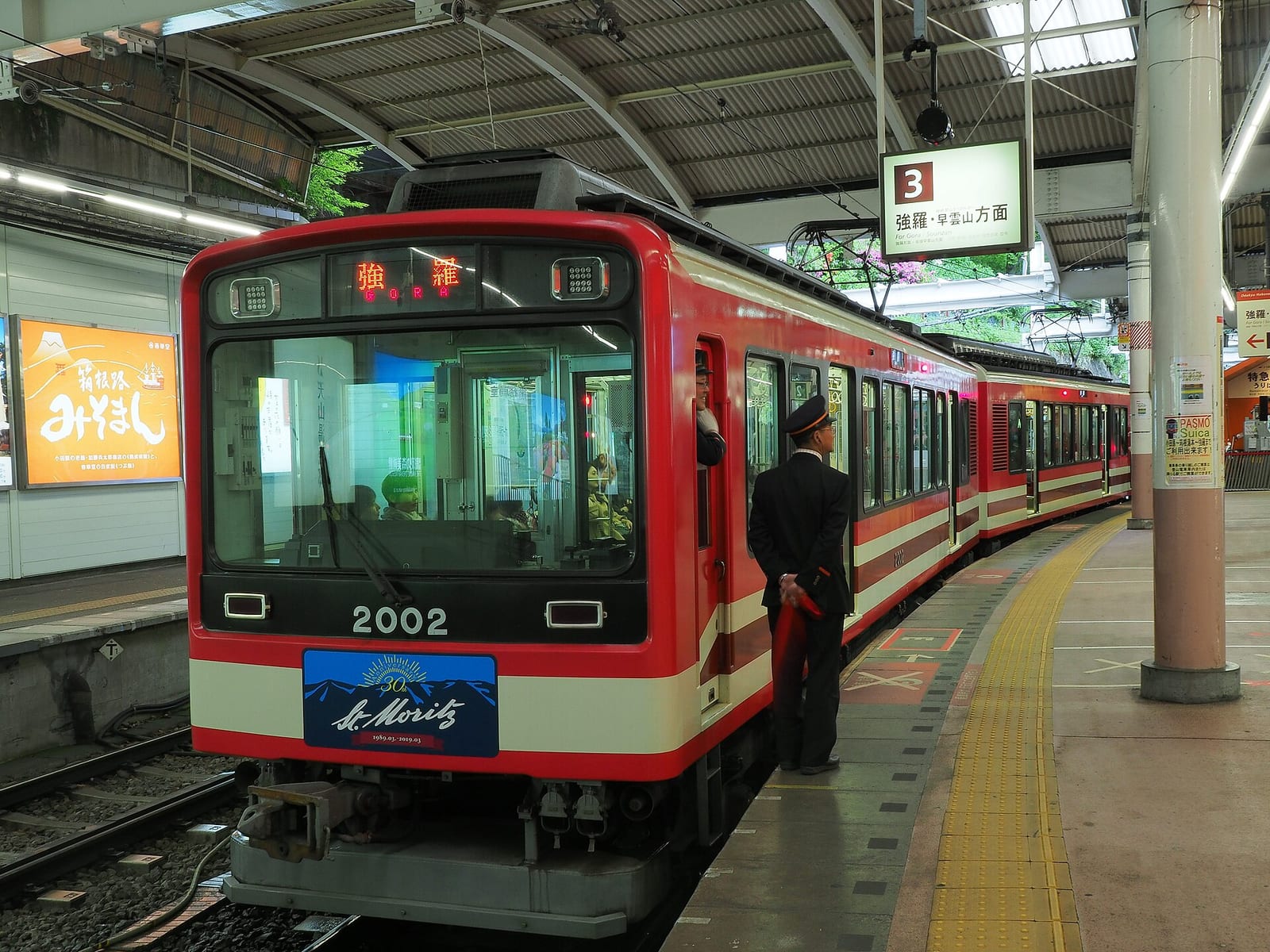
Its builders looked to the Alps for the answer, and the result is a little piece of Switzerland in the Japanese mountains: the line is a formal sister railway to the Bernina line near St. Moritz, and even runs a train dressed in a "St. Moritz" livery. The steepest adhesion railway in the country, it climbs from the gorge at Hakone-Yumoto (108 m) to Gōra (553 m) through tunnels, over bridges and — for a few magical weeks each summer — between walls of hydrangeas.
It is only fifteen kilometres from Odawara to the top, but the Hakone Tozan turns those kilometres into one of the most charming rail journeys in Japan.
The Journey
The journey begins in the valley town of Odawara, where the Hakone Tozan trains connect with the Odakyu line down from Tokyo. The first stretch, up to Hakone-Yumoto, runs on ordinary narrow-gauge track through the gorge of the Haya River. It is at Hakone-Yumoto that the real mountain railway begins — and the character of the line changes completely.
From here the train tackles a wall of mountain the only way it can without a rack: it switches back. Three times — at Deyama, Ōhiradai and Kami-Ōhiradai — it runs into a dead-end siding, stops, and reverses out onto a higher track, the driver and conductor walking through the carriages to swap ends each time. Between the reversals the line clings to the hillside on some of the tightest curves of any adhesion railway anywhere — a minimum radius of just 169 metres — boring through short tunnels and crossing steep ravines.
The details are what make it remarkable:
- It opened as a mountain railway on 1 June 1919, the first of its kind in Japan, electrified from the start.
- The steep section runs on standard gauge (1,435 mm) — unusually, wider than the narrow-gauge line that feeds it — to hold the tight, heavily-graded curves.
- Its 80‰ (8%) ruling gradient is the steepest of any conventional adhesion railway in the country.
- Its engineers modelled it on the Bernina railway in the Swiss Alps, a kinship the two lines still celebrate as sisters.
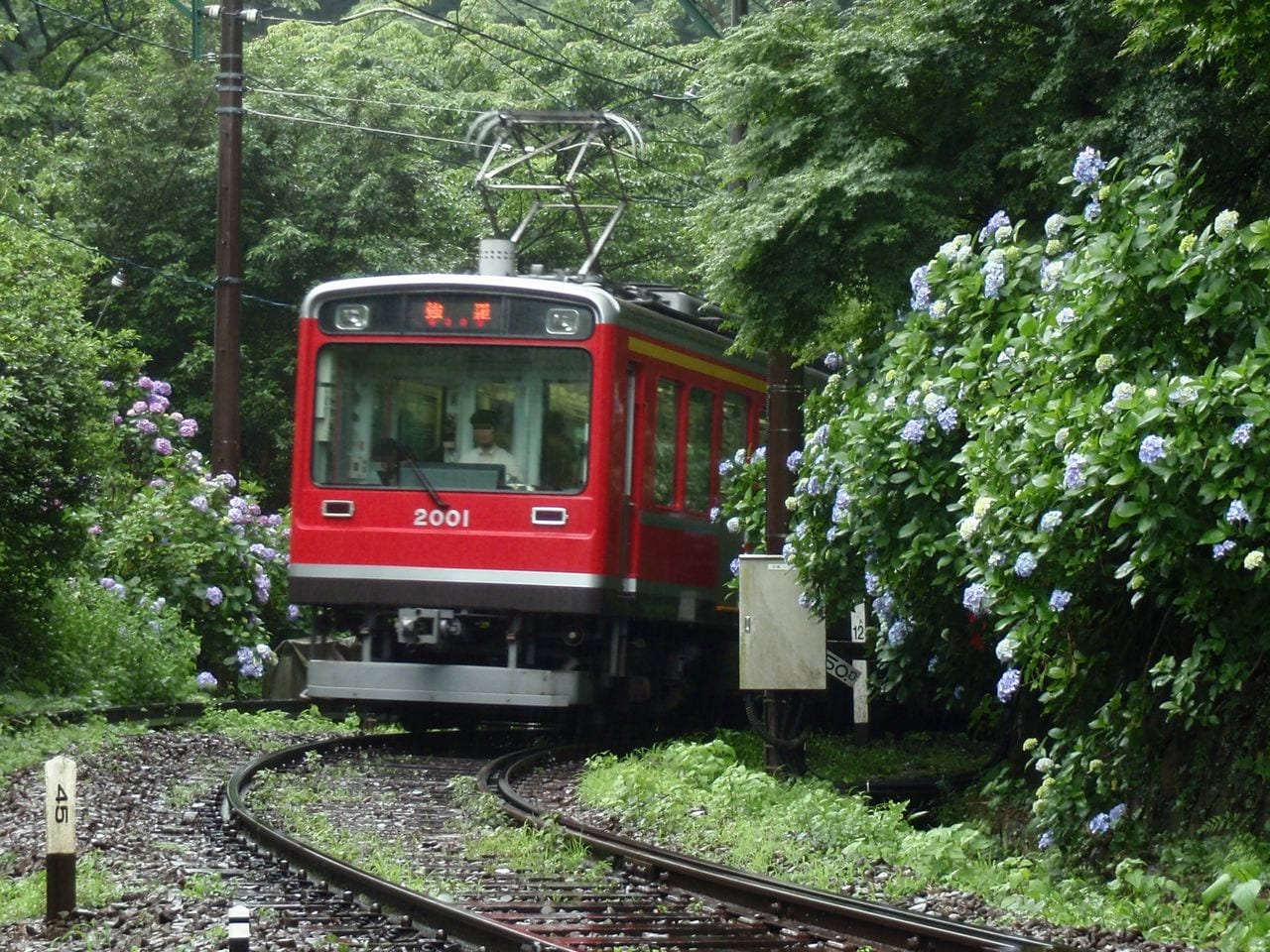
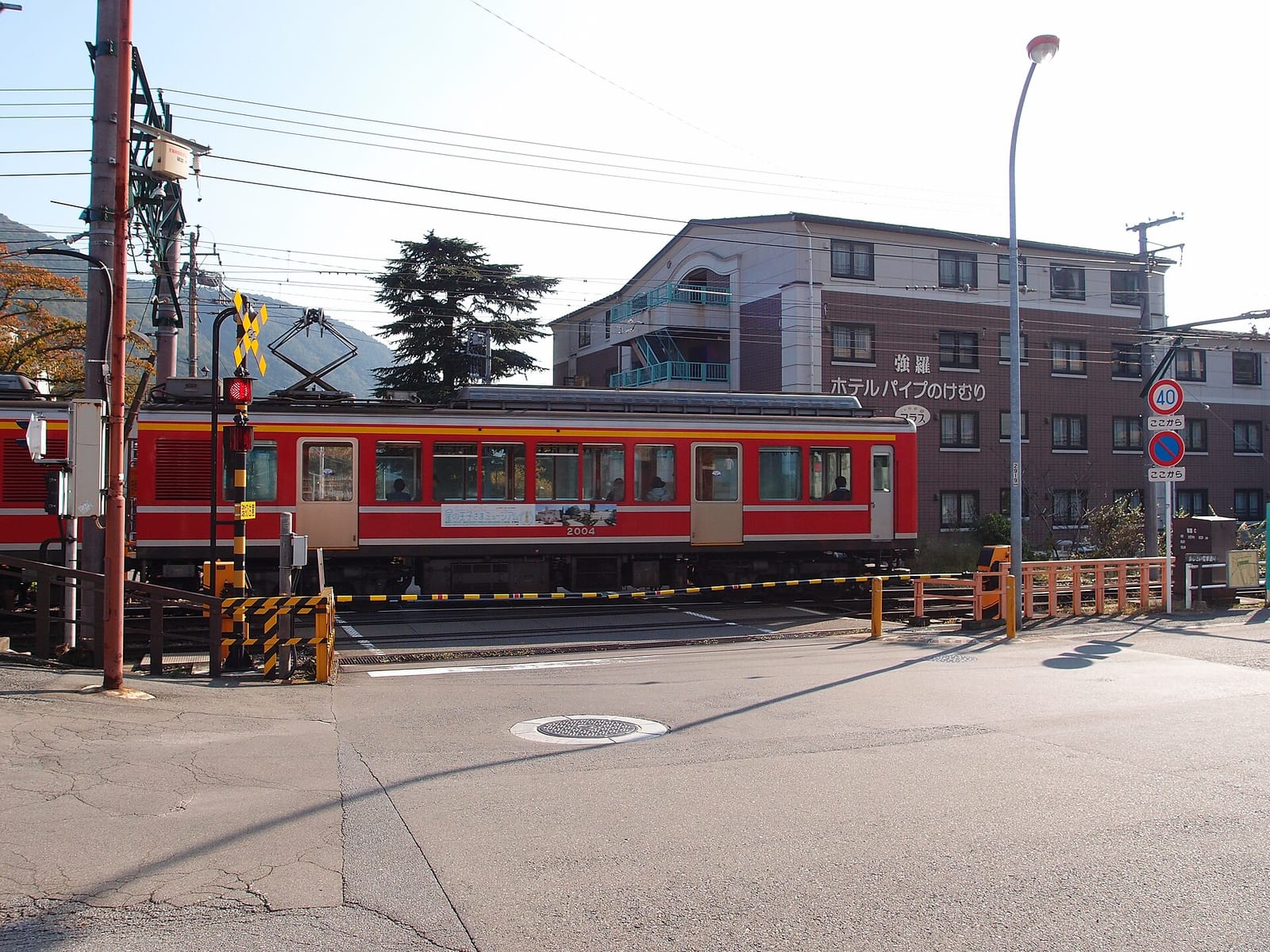
And then there are the flowers. For a few weeks from mid-June the whole climb is lined with hydrangeas, and the little trains become the famous "ajisai densha" — the Hydrangea Train — running between banks of blue and violet, lit up on special evening services. Fifty minutes after leaving Odawara you step off at Gōra, at the foot of the cable car, deep in hot-spring country.
Along the route
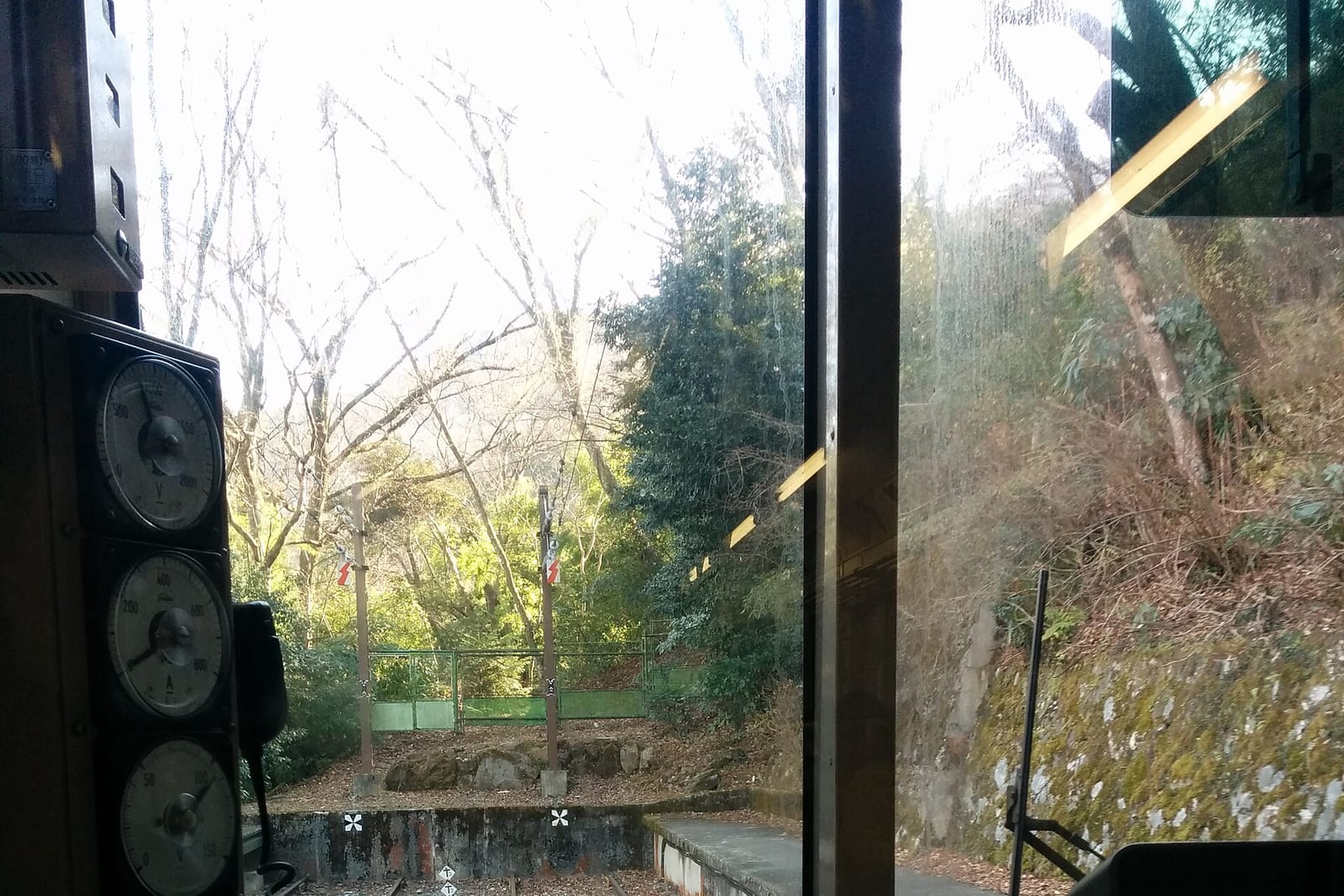
x768 / Wikimedia Commons · CC BY-SA 2.0Three switchbacks
To climb an 80‰ (1-in-12.5) gradient without a rack, the line zig-zags: at each of three switchbacks the train runs into a dead-end, stops, and reverses back out on a higher track. The driver and conductor swap ends each time — a slow, deliberate dance up the mountain.Cassiopeia sweet / Wikimedia Commons · Public domainThe Hydrangea Train
From mid-June into July the whole line is banked with hydrangeas — the famous "ajisai densha," when the slow climb runs through walls of blue and violet blooms, and special evening services light them up after dark.Quercus acuta / Wikimedia Commons · CC0On to Lake Ashi
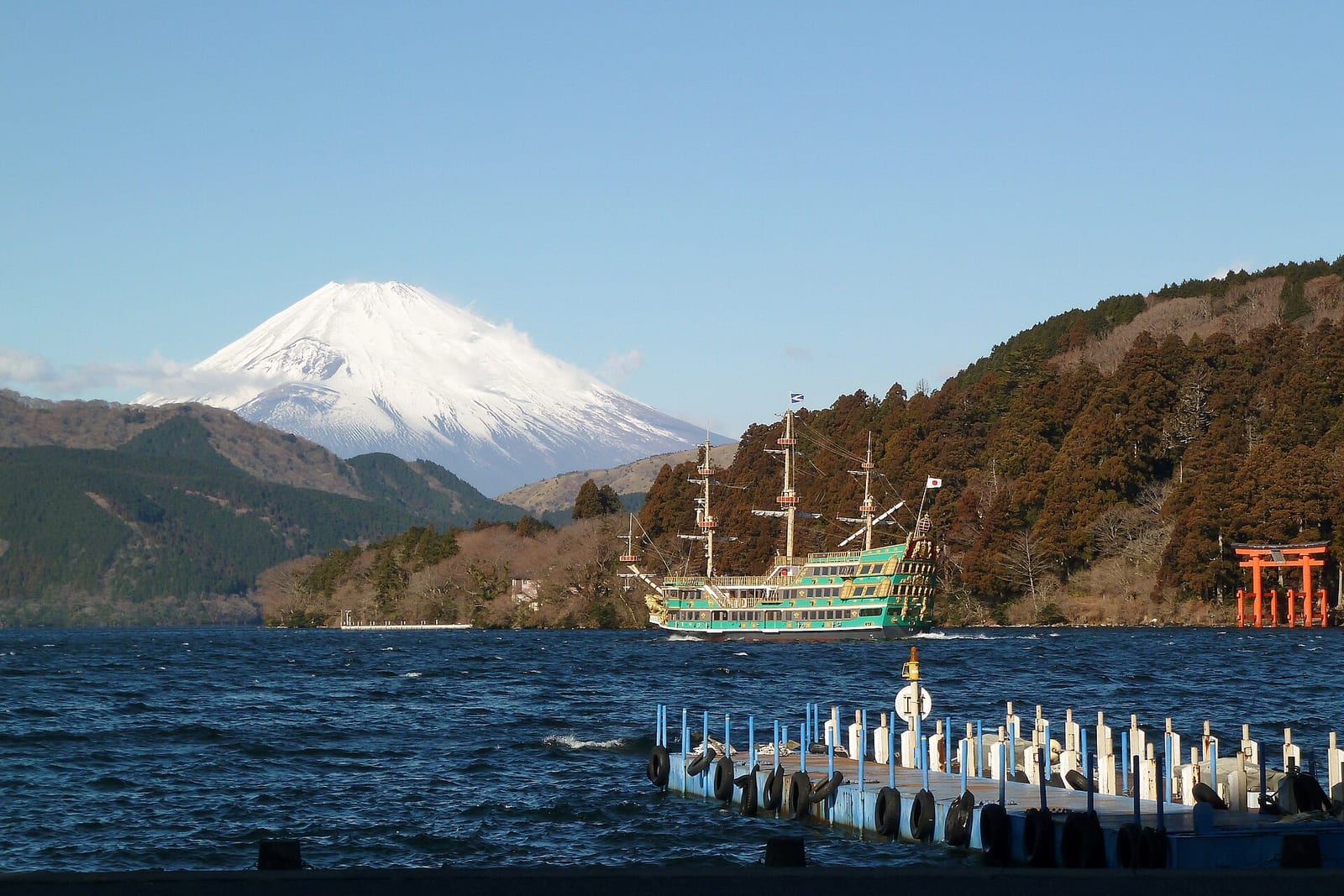
Gōra is not the end of the adventure but the pivot of the "Hakone Round Course": from here a cable car and ropeway climb over the steaming vents of Ōwakudani to Lake Ashi, with its red lakeside torii and, on a clear day, Mount Fuji beyond.A bit of history
Culture & experiences along the way
Kuroc622 / Wikimedia Commons · CC0A little bit of Switzerland
The engineers who built the line studied the Alps, and Hakone Tozan is a formal sister railway to Switzerland's Bernina line — a bond it wears literally, running trains in a "St. Moritz" livery between the two mountain worlds.MaedaAkihiko / Wikimedia Commons · CC0Climbing at walking pace
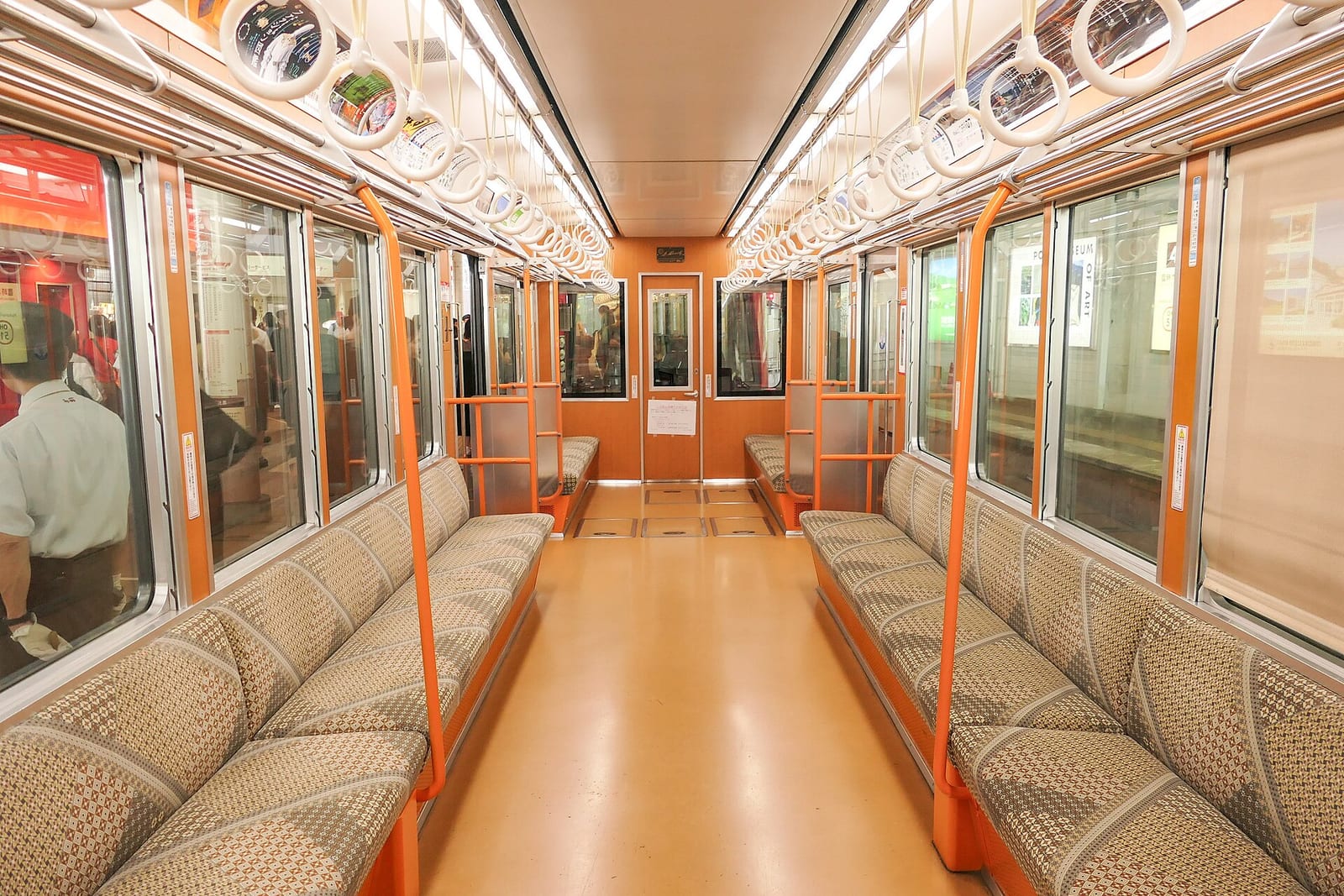
This is a railway to savour slowly — 40 km/h at most uphill, and slower still on the descent, winding between tunnels, bridges and hot-spring hamlets with the forest close enough to touch. The unhurried pace is the whole pleasure.Guilhem Vellut / Wikimedia Commons · CC BY 2.0Into hot-spring country
Hakone is one of Japan's great onsen resorts, and the train is its lifeline — climbing from the gorge at Hakone-Yumoto up to the galleries and gardens around Gōra, with a hot bath and a mountain view waiting at journey's end.Timetables
The Hakone Tozan Railway runs a frequent, turn-up-and-go service all day, every day — trains between Hakone-Yumoto and Gōra run every 15–20 minutes (three or four an hour), so you rarely wait. The first climbs from Hakone-Yumoto around 05:50 and the last around 23:09 (weekdays); no reservations are needed.
Journeys are short and the whole point is to take them slowly:
| Section | Approx. time |
|---|---|
| Odawara → Hakone-Yumoto | ~15 min |
| Hakone-Yumoto → Gōra (the switchbacks) | ~35–40 min |
| Gōra → Sōunzan (cable car) | ~10 min |
The hydrangea season from mid-June to mid-July is the busiest and most beautiful time to ride; the special illuminated evening "Night of the Hydrangeas" services in that window need a reserved seat, so book those ahead.
Times and frequency as of the 2026 timetable. Confirm current schedules with the operator — see the Tickets section below.
Tickets
Riding the Hakone Tozan Railway on its own is simple: buy a point-to-point ticket at the station and go. But most visitors are here for more than the train — Hakone is a whole day's loop of railway, cable car, ropeway, lake boat and bus — and for that the Hakone Freepass is far better value.
Sold by Odakyu, the Freepass gives unlimited rides on the Tozan railway, the Gōra–Sōunzan cable car, the Hakone Ropeway over Ōwakudani, the Lake Ashi sightseeing boats and the local buses, plus a discounted train down from Tokyo — everything you need to ride the complete Hakone Round Course in a day or two. The options below link to the operators. Fares checked July 2026 against the Hakone Tozan Railway (opens in a new tab) and Odakyu.
Book your tickets
Single ride
Odawara / Hakone-Yumoto – Gōra
A point-to-point ticket for the climb, bought at the station. Simple if you only want the railway itself, up to Gōra and back.
Book Tickets (opens in a new tab, on Hakone Tozan Railway)via Hakone Tozan RailwayHakone Freepass
The whole round course
Odakyu's Hakone Freepass covers the Tozan railway plus the cable car, ropeway, Lake Ashi sightseeing boats and local buses — the best-value way to ride the complete Hakone Round Course, with a discounted train down from Tokyo.
Book Tickets (opens in a new tab, on Odakyu / Hakone Navi)via Odakyu / Hakone NaviRail Passes
The Japan Rail Pass does not cover the Hakone Tozan Railway. It is a private railway, not a JR line, and the JR Pass terms say the fare on a private railway must be paid. The pass does cover the JR trains to Odawara, where the Tozan line begins.
The pass that matters here is Odakyu's Hakone Freepass. It gives unlimited rides on eight kinds of transport around Hakone, the Tozan railway among them:
| Hakone Freepass | 2 days | 3 days |
|---|---|---|
| From Shinjuku, adult | ¥7,100 | ¥7,500 |
| From Odawara, adult | ¥6,000 | ¥6,400 |
The Shinjuku version includes the round trip from Shinjuku; a seat on the Romancecar limited express is ¥1,200 extra each way.
If you are doing the Hakone loop, buy the Freepass. For the railway alone, a single ticket at the station is enough.
Checked October 2026 against the Japan Rail Pass scope (opens in a new tab) and Odakyu's Hakone Freepass (opens in a new tab).
Places to Visit
The railway is the first leg of one of Japan's best-loved day trips, and every stop along the Hakone Round Course is worth lingering over.
Together they make a natural one- or two-day circuit — ride up, cross the mountain, sail the lake, and come back down.
 Los Paseos from Earth / Wikimedia Commons · CC BY-SA 2.0 · cropped
Hakone-Yumoto
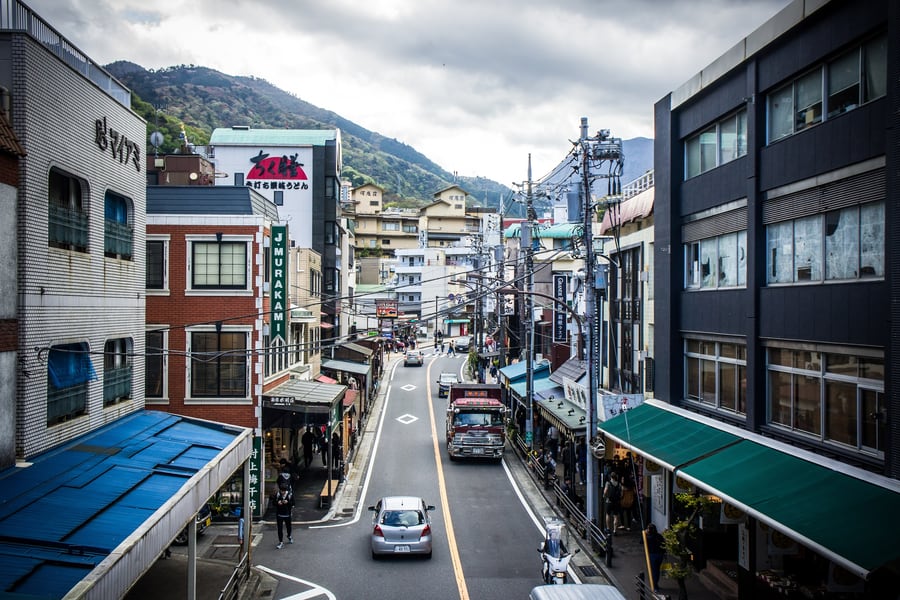
The hot-spring town at the foot of the climb, where the Odakyu Romancecar from Tokyo hands you over to the little red train. Yumoto is the oldest of Hakone's springs — the water was found here somewhere between 721 and 748 — and the streets above the river are still lined with bathhouses, day-visit onsen and inns. The shops sell yosegi-zaiku, the geometric wood marquetry that Edo-period craftsmen developed in nearby Hatajuku out of the many colours of Hakone's own timber.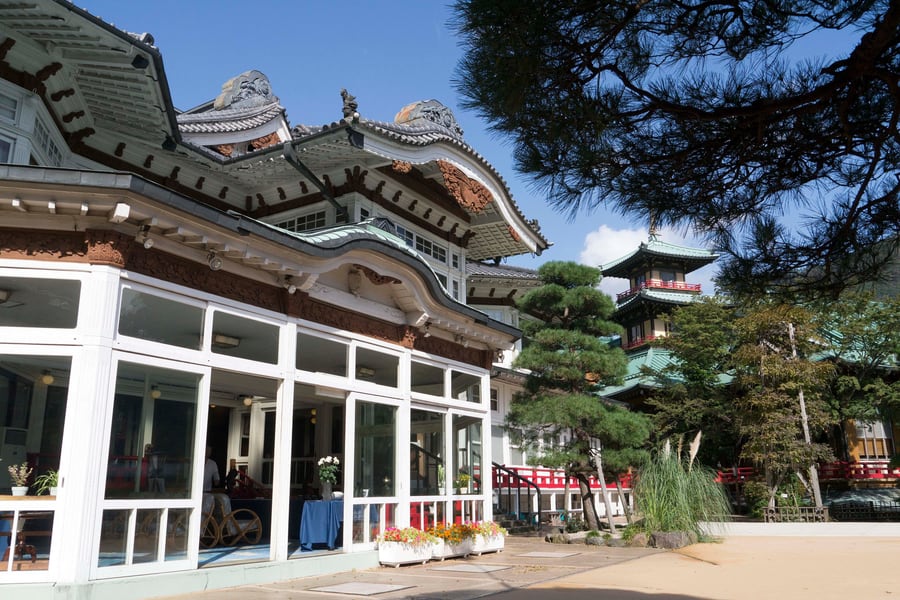 Bryan Ledgard / Wikimedia Commons · CC BY 2.0 · cropped
Ōhiradai & Miyanoshita
Quiet hillside halts among the switchbacks, and the address of Japan's grandest old resort hotel. The Fujiya opened at Miyanoshita in 1878 as the country's first full-scale Western-style resort hotel, and its guest book runs from Archduke Franz Ferdinand in 1893 through Einstein in 1922 to John Lennon and Yoko Ono in 1978. Its buildings are Registered Tangible Cultural Properties, and it came back in July 2020 after two years of restoration and seismic strengthening.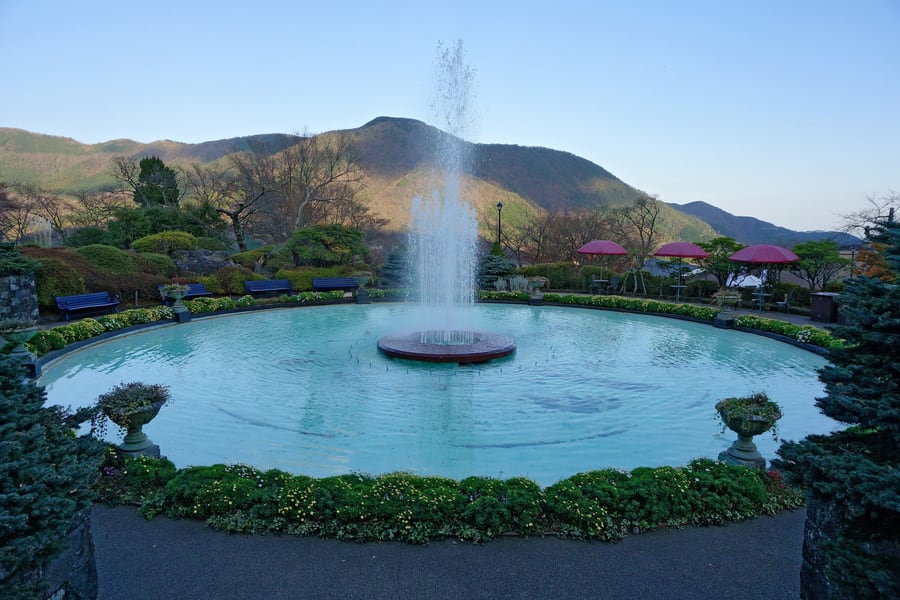 663highland / Wikimedia Commons · CC BY-SA 4.0 · cropped
Gōra
The top of the railway at 553 m, and worth more than the change of trains it looks like on the map. Gōra Park opened in 1914 as Japan's first French-style formal garden — unusually, laid out down a hillside rather than across level ground — with a fountain, glasshouses and a rose garden. Down the hill, the Hakone Open-Air Museum was the country's first outdoor museum when it opened in 1969, and sets Rodin, Henry Moore and a whole pavilion of Picasso against the forested hills.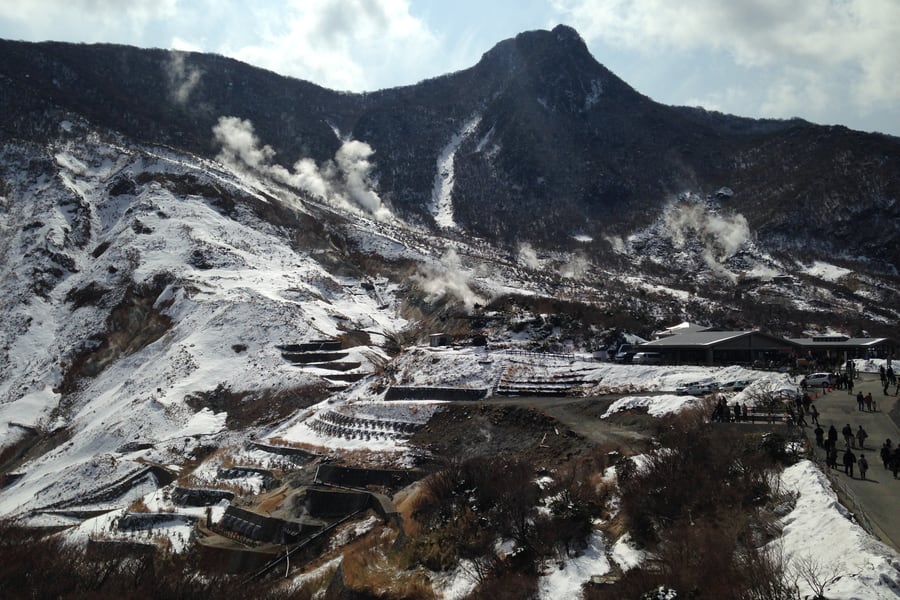 そらみみ (Soramimi) / Wikimedia Commons · CC BY-SA 3.0 · cropped
Ōwakudani
The "Great Boiling Valley," blown open by the Hakone volcano some 3,000 years ago and still venting sulphurous steam across a bare grey hillside. The ropeway crosses directly above it, and the rebuilt Ōwakudani station — reopened in April 2025 with a glass observation deck — is where you queue for kuro-tamago, eggs boiled black in the spring water and said to add seven years to your life. The short trail towards the vents only opens when the day's volcanic alert level allows.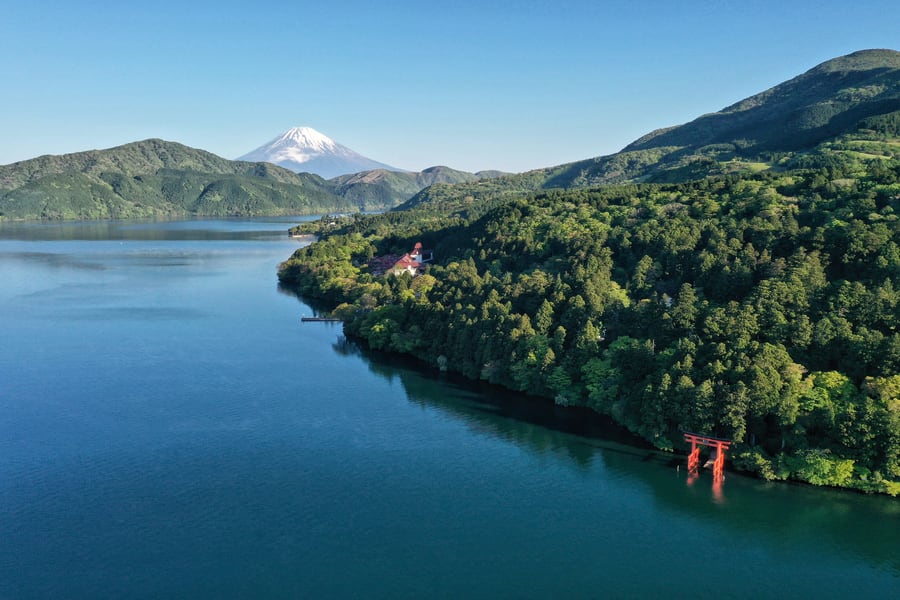 Charlie fong / Wikimedia Commons · CC BY-SA 4.0 · cropped
Lake Ashi (Ashinoko)
The crater lake at the far end of the loop, 723 m up and seven square kilometres of deep water held inside the old caldera. Hakone Shrine has stood in the woods on its shore since 757, and its vermilion Heiwa no Torii — the Torii of Peace — was set out in the shallows in 1952 to mark the peace treaty that ended the occupation of Japan. Sightseeing boats have crossed between Tōgendai, Hakone-machi and Moto-Hakone since 1950, and on a clear day Mount Fuji stands over the whole scene.Where to Sleep
Hakone is one of Japan's classic places to spend a night in a ryokan — a traditional inn with tatami rooms, a multi-course dinner and, above all, an onsen hot bath, ideally an open-air one with a view of the hills. The towns strung along the railway each have their own character: Hakone-Yumoto at the foot is the busiest and easiest to reach, with everything from simple guesthouses to riverside inns; Miyanoshita and Gōra higher up are quieter and grander, home to some of the region's most storied hotels. Wherever you stay, the point is to slow right down — soak in the hot spring, sleep on the mountain, and let the little red train carry you back down in the morning. Book well ahead for the hydrangea and autumn-colour seasons and for weekends, when Hakone fills with visitors from Tokyo.
Questions or corrections
Planning this trip and stuck on something, or spotted a time, fare or detail that has changed? Send us a message about Hakone Tozan Railway. We read every one, and we update this page when something has changed.