Höllentalbahn
Chondriammos / Wikimedia Commons · CC BY-SA 4.0
- Distance76 km (Freiburg–Donaueschingen)
- DurationAbout 1½ hours (46 minutes Freiburg–Neustadt)
- Best seasonYear-round
Introduction
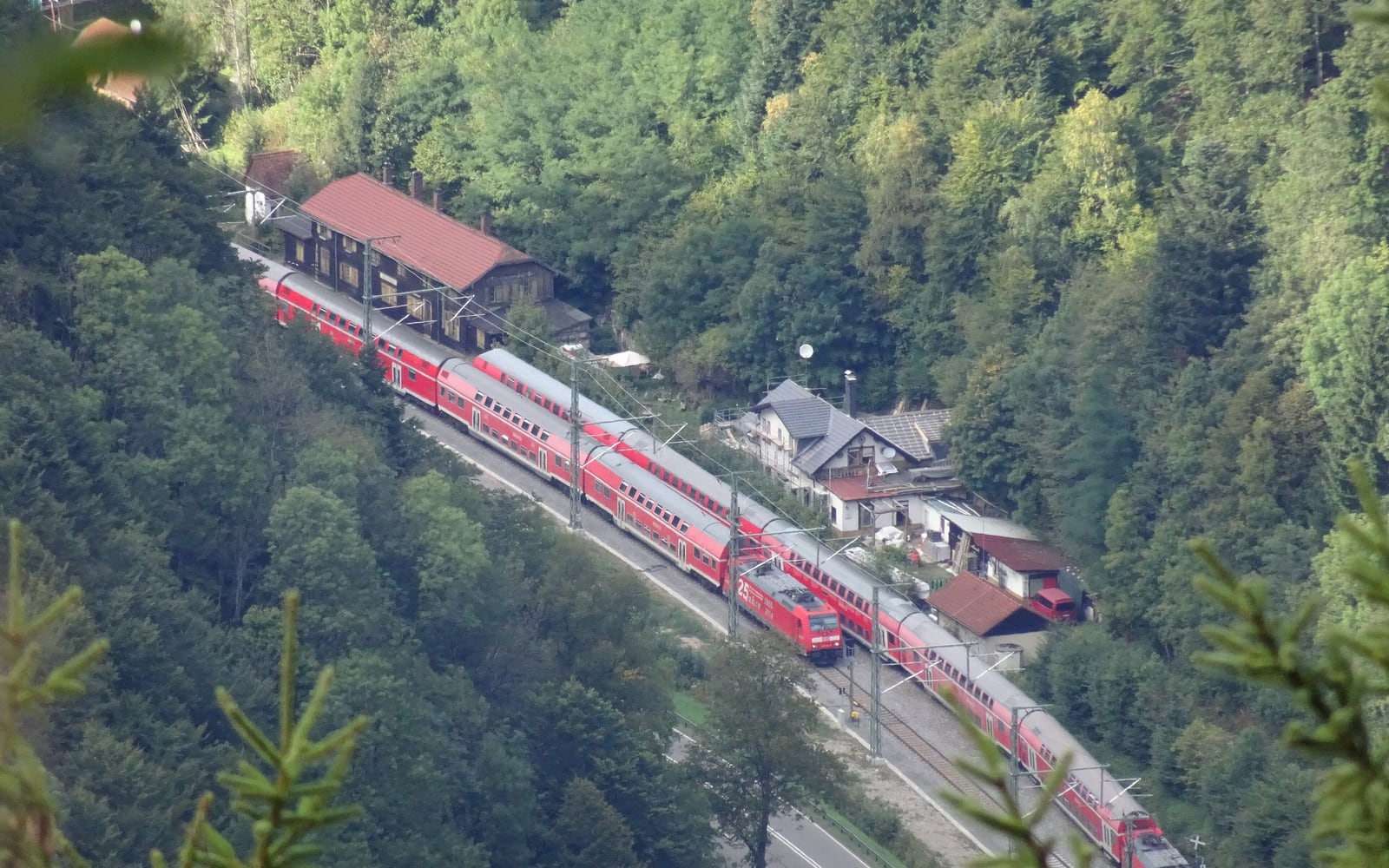
The Höllentalbahn — the Hell Valley Railway — climbs out of Freiburg and straight into the wall of the Black Forest, and it does it more steeply than any other main line in Germany.
In the twelve kilometres between Himmelreich and Hinterzarten the railway lifts itself 430 metres, on gradients reaching 57.8 per mille — steep enough that for the first forty-six years of its life the trains could not manage it on wheel-grip alone and had to be dragged up on a rack rail. The timetable still shows what that costs: a quarter of an hour, for twelve kilometres.
The line runs 76 km from Freiburg (268 m) to Donaueschingen, and the names along it are not subtle. Himmelreich means "kingdom of heaven"; the gorge above it is the Höllental, the valley of hell. Between them the train threads a ravine so narrow it is called the Hirschsprung — the stag's leap — where the rock walls, the road and the railway are squeezed together with barely room to pass.
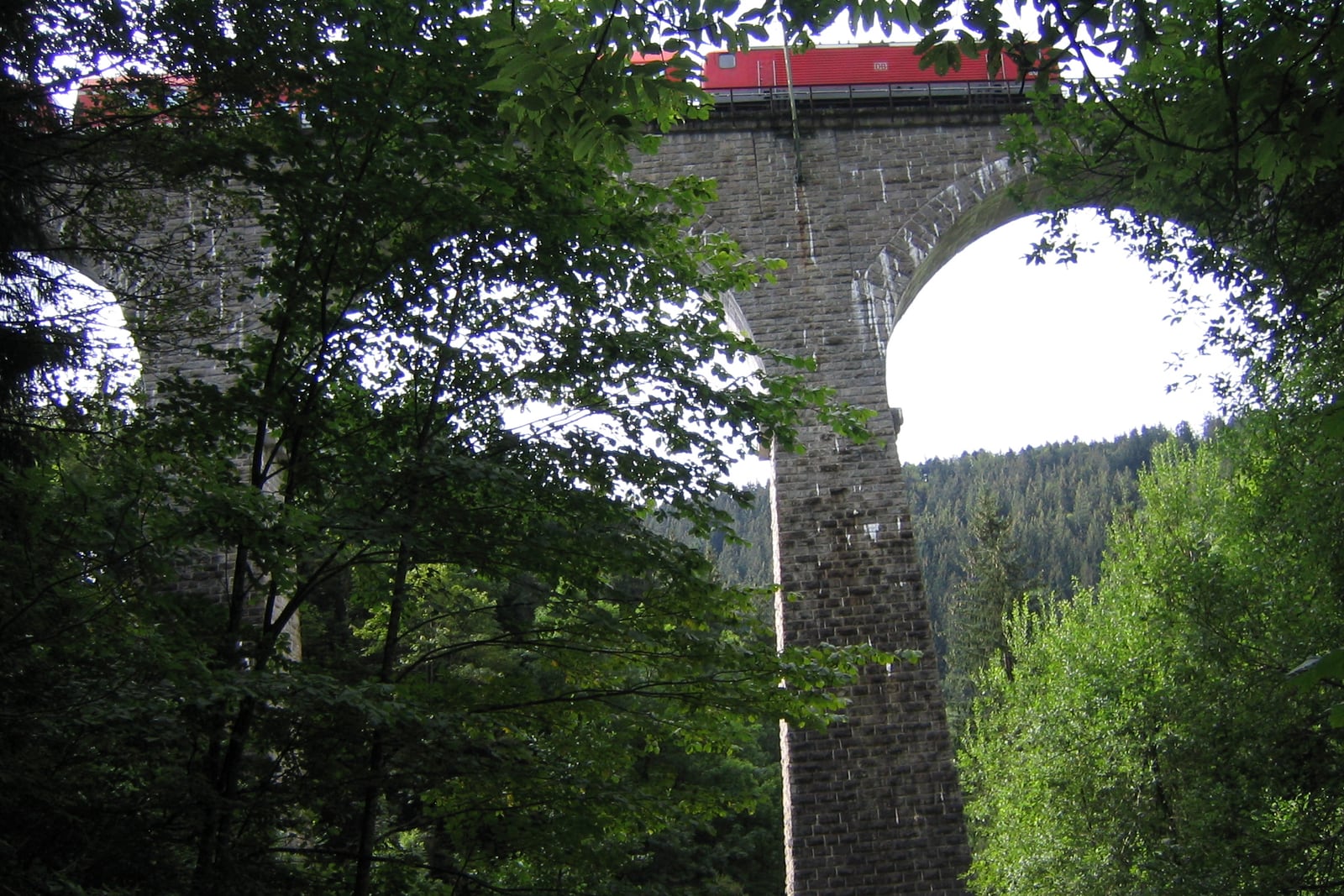
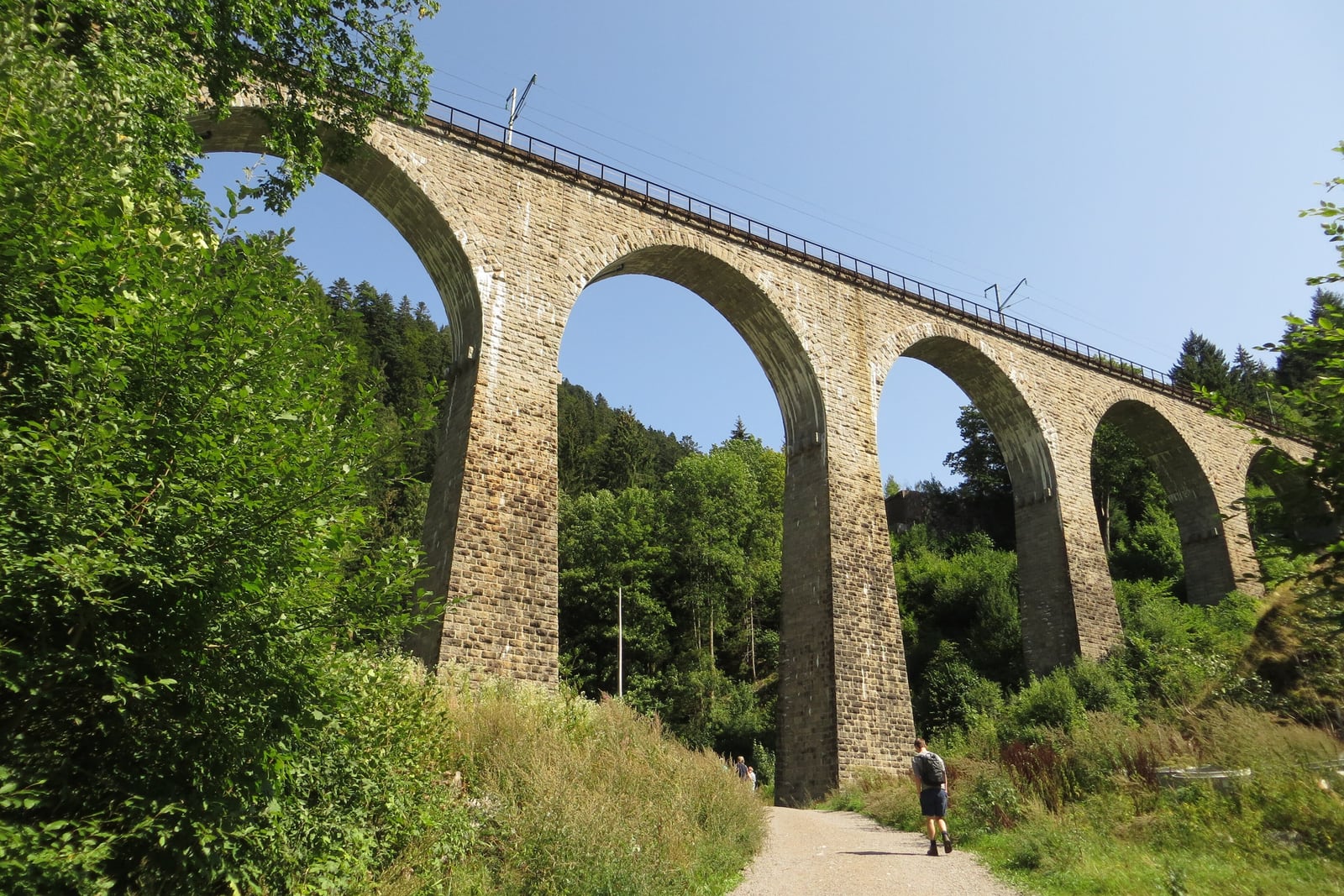
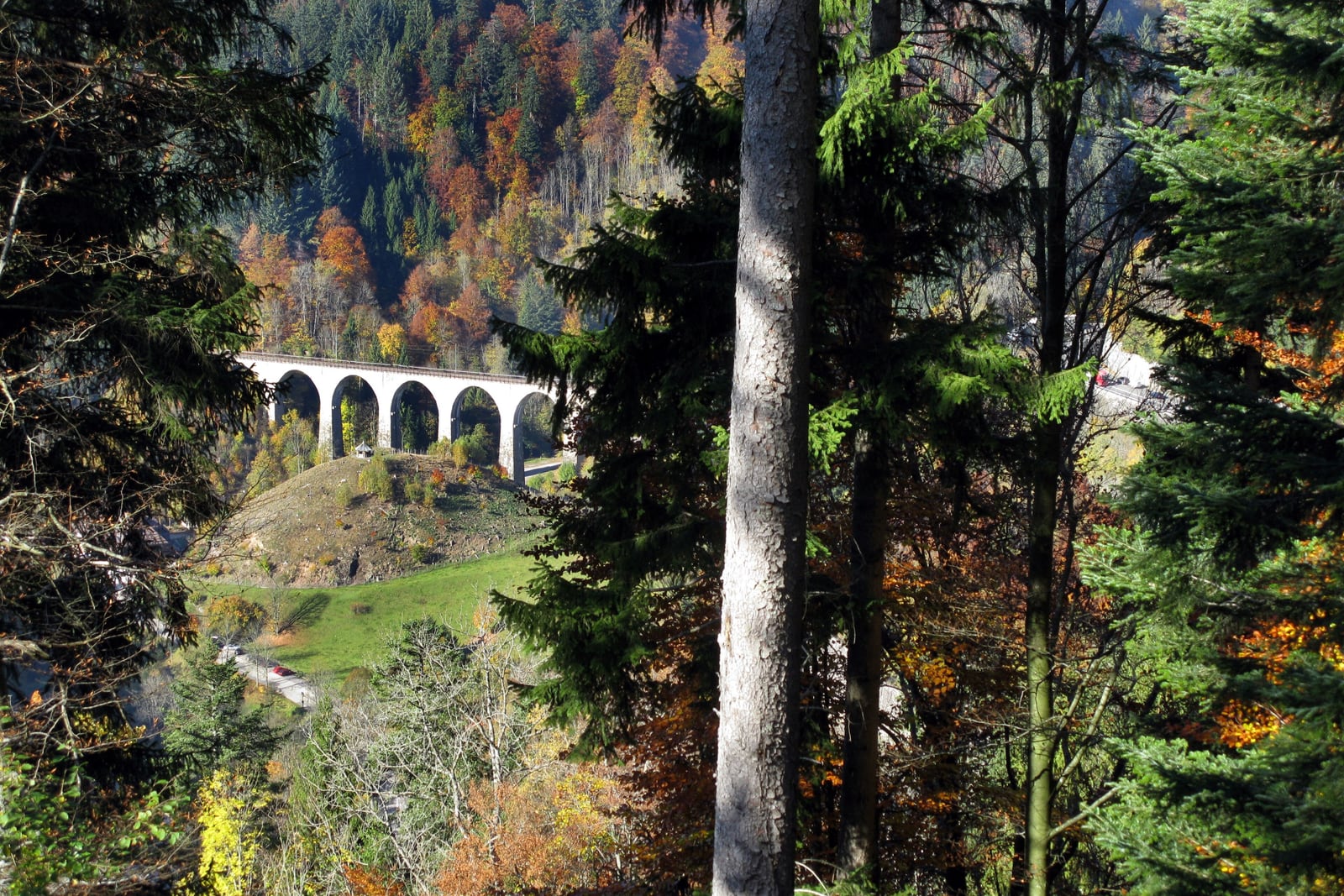
Its masterpiece is the Ravenna viaduct: nine arches, 224 metres long and 36 metres above the floor of a wooded gorge, carrying the line across in one stride.
But the Höllentalbahn's real claim is one you cannot see from the window. In 1936 the German state railway strung this line with 20,000 volts at 50 hertz — ordinary industrial mains frequency — to find out whether trains could simply run off the public electricity grid instead of needing their own dedicated supply. They could. The experiment in this Black Forest valley became the basis for 50 Hz railway electrification worldwide, the system now used across France, Britain, China, India and beyond.
The trains that climb it today are Breisgau S-Bahn regional services, running every half-hour from Freiburg. It costs an ordinary ticket.
The Journey
The Höllentalbahn front-loads everything. The drama is over within forty minutes of leaving Freiburg — after which the line settles into a high, quiet plateau of lakes and moorland that is a different pleasure altogether.
Freiburg to Himmelreich: the approach
Trains leave Freiburg (Breisgau) Hbf, at 268 metres on the floor of the Rhine valley, and run out through the city's eastern suburbs — Wiehre (280 m), Littenweiler (317 m) — before the Black Forest closes in. Kirchzarten (392 m) sits in a broad, sunny basin of farmland, the last easy ground.
Then comes Himmelreich, at 455 metres, and the name is a joke at the railway's expense: the kingdom of heaven is where the hard work starts. Ahead the valley pinches shut.
The Höllental: the steepest main line in Germany
What follows is the reason the line exists in the imagination. The train enters the Höllental — the Hell Valley — and begins to climb at up to 57.8 per mille, a gradient no other German main line matches. There is no rack any more, but there was once, and it is worth knowing why: from the opening in 1887 until 1933, trains on the ramp between Hirschsprung and Hinterzarten were hauled by locomotives engaging a toothed rail laid between the running rails. Only when engines grew powerful enough to grip the steel by adhesion alone could the rack be lifted.
At the Hirschsprung the gorge narrows to a slot barely wide enough for the river, the road and the railway together, with rock rising sheer on both sides. Trains pass each other here on a ledge above the traffic.
Higher up, the line swings out across the Ravenna gorge on the Ravenna viaduct — nine granite arches, 224 metres long, 36 metres above the stream. The bridge you cross dates from 1927; Robert Gerwig's original of 1887 was a shorter structure of 144 metres on stone piers, replaced when it could no longer carry modern traffic.
Twelve kilometres and 430 metres of climb after Himmelreich, the train arrives at Hinterzarten, 885 metres up — the highest station on the line, just below its summit point at 893 m. The gradient vanishes, the forest opens, and cows appear in meadows. You are on the roof of the Black Forest.
Titisee, the lakes and the run down
Titisee (858 m) is four minutes further on, a resort town wrapped around a dark glacial lake — the busiest stop on the route and the junction for the branch that matters.
The Dreiseenbahn, the Three Lakes Railway, leaves here for Seebrugg, running by way of Feldberg-Bärental at 967 metres, which is the highest standard-gauge station in Germany and the highest on the national network. It ends at the Schluchsee, the largest lake in the Black Forest.
The main line continues to Neustadt (805 m), where most Freiburg trains terminate, and where the character of the journey changes for good. Beyond it the railway crosses the open Baar — Löffingen (803 m), Döggingen (748 m) — descending gently through farmland to Donaueschingen (677 m), the source of the Danube, where it joins the Schwarzwaldbahn. Trains run on to Villingen.
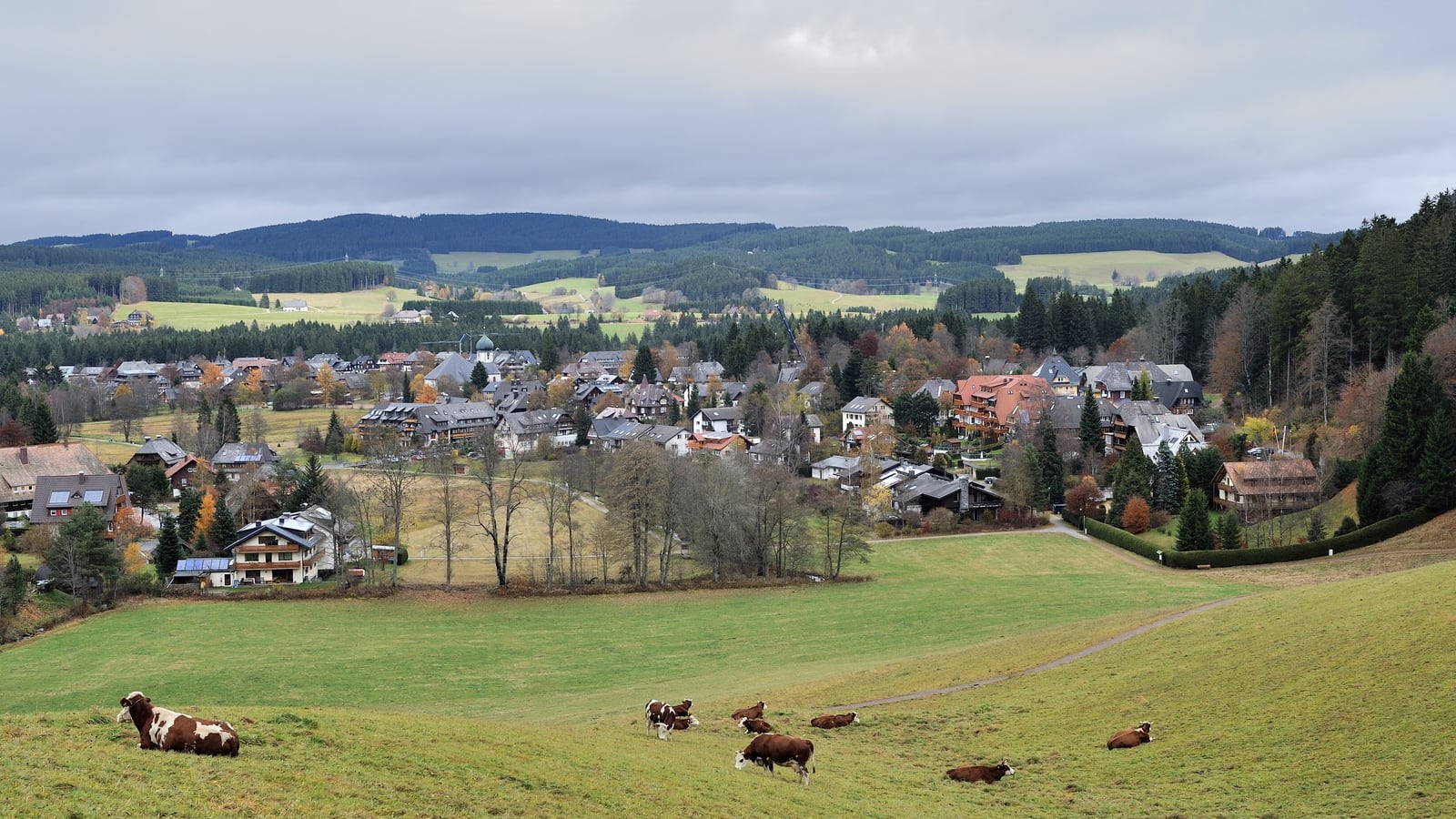
Along the route
Chondriammos / Wikimedia Commons · CC BY-SA 4.0The steepest main line in Germany
Between Himmelreich and Hinterzarten the railway lifts itself 430 metres in twelve kilometres, on gradients reaching 57.8 per mille. No other German main line is as steep, and the timetable shows the price: fourteen minutes for those twelve kilometres.Flominator / Wikimedia Commons · CC BY-SA 3.0Forty-six years on a rack rail
From 1887 until 1933 trains could not grip the steep section by adhesion at all. They were hauled up a toothed rail laid between the running rails, and the rack was lifted only once locomotives had grown powerful enough to manage the climb on wheel-grip alone.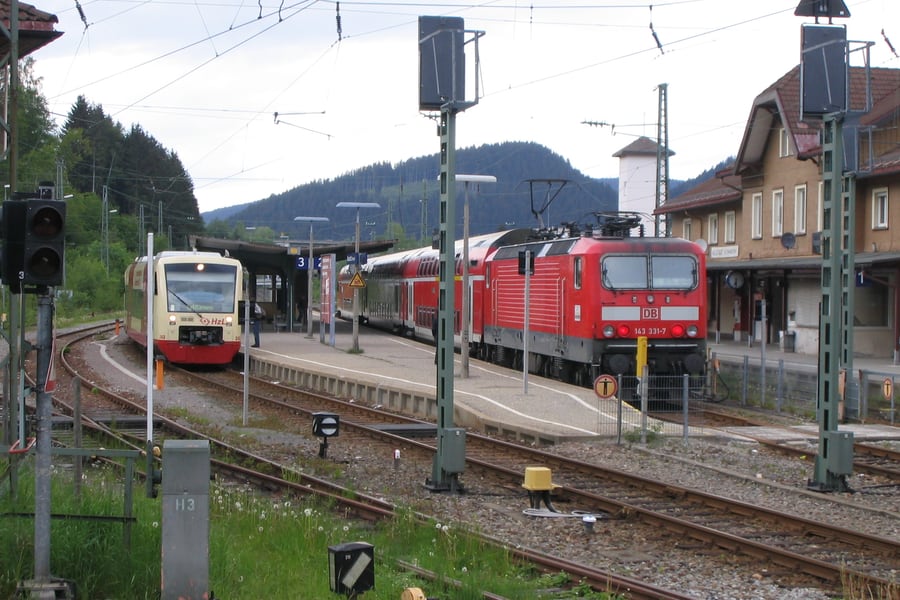 Flominator / Wikimedia Commons · CC BY-SA 3.0 · cropped
The line that taught the world to electrify
In June 1936 the German state railway energised this valley at 20,000 volts and 50 hertz — ordinary mains frequency — to test whether trains could run straight off the public grid. They could, and the experiment became the basis for 50 Hz electrification worldwide.A bit of history
Culture & experiences along the way
Andreas Schwarzkopf / Wikimedia Commons · CC BY-SA 4.0Ride the Hell Valley
The names tell the story: Himmelreich, the kingdom of heaven, is where the climb begins, and the Höllental above it is the valley of hell. At the Hirschsprung — the stag's leap — the walls close to a slot with room for little more than the train.Bermicourt / Wikimedia Commons · CC BY-SA 4.0Walk under the Ravenna viaduct
A footpath runs up the gorge beneath the arches, and the bridge only makes sense from down there — 36 metres of air between the stream and the rails you were sitting on twenty minutes earlier.Cayambe / Wikimedia Commons · CC BY-SA 3.0The highest station in the country
The Dreiseenbahn branch from Titisee climbs to Feldberg-Bärental at 967 metres — the highest standard-gauge station in Germany and the highest on the national network — before running down to the Schluchsee, the largest lake in the Black Forest.Timetables
The Höllentalbahn is worked as part of the Breisgau S-Bahn — lines S1, S10 and S11, plus RB 427 at the eastern end. It is a commuter railway that happens to climb a mountain, and it runs accordingly.
Freiburg to Neustadt is half-hourly, leaving Freiburg (Breisgau) Hbf at :10 and :40 past each hour, and taking about 46 minutes. Southbound:
| Station | Height | Time |
|---|---|---|
| Freiburg (Breisgau) Hbf | 268 m | :40 (depart) |
| Freiburg-Wiehre | 280 m | :45 |
| Freiburg-Littenweiler | 317 m | :48 |
| Kirchzarten | 392 m | :53 |
| Himmelreich | 455 m | :56 |
| Hinterzarten | 885 m | :15 |
| Titisee | 858 m | :19 |
| Neustadt (Schwarzw) | 805 m | :26 (arrive) |
The gap between Himmelreich and Hinterzarten is the whole point of the railway: fourteen minutes to gain 430 metres, and by some distance the steepest thing a scheduled German main-line train does.
Beyond Neustadt the service halves. Trains for Donaueschingen leave Neustadt at :30, reaching Donaueschingen at :09 — 39 minutes — and continuing to Villingen at :20. That makes the full Freiburg–Donaueschingen run about 1 hour 30, with a four-minute connection at Neustadt.
Good to know:
- Most travellers should ride Freiburg to Titisee or Neustadt and stop there. Everything the line is famous for happens in the first 40 minutes; the run beyond Neustadt is pleasant farmland, not spectacle.
- The Dreiseenbahn branch leaves from Titisee for Seebrugg, calling at Feldberg-Bärental (967 m), Altglashütten-Falkau (957 m), Aha (940 m) and Schluchsee (932 m). It is a short, worthwhile detour to the highest standard-gauge station in the country.
- ⚠️ Trains divide at Titisee — sit in the right half. The operator runs a Flügelkonzept: units are split and joined at Titisee (and Gottenheim) every day, one portion going on to Neustadt and the other down the Dreiseenbahn to Seebrugg. The carriage you board in Freiburg decides where you end up, so check the destination shown on your portion, not just on the front of the train.
- Not every Neustadt departure goes to Donaueschingen — the :04 workings turn back at Löffingen. Check the destination before boarding.
- Sit on the right leaving Freiburg for the gorge and the drop from the Ravenna viaduct.
Times from Deutsche Bahn's Kursbuch table KBS 727 (Breisach–Freiburg–Titisee–Seebrugg/Donaueschingen), revision date 21 November 2025, valid 14 December 2025 to 12 December 2026 — verified as of August 2026. Confirm your own train before travelling; see the operator link in the Tickets section below.
Tickets
There is no special fare for the Höllentalbahn and nothing to reserve. It is a local S-Bahn service, so an ordinary regional ticket is all you need, and the steepest main-line climb in Germany costs the same as any other twelve kilometres of German railway. A regional day ticket is usually the right answer, because this is a line to get on and off, and it covers the Dreiseenbahn branch too.
⭐ If you are staying in the Black Forest, you probably travel free. Around 9,000 hosts hand guests a KONUS card at check-in, and it is a free-travel pass: unlimited second-class travel on local buses and trains across the whole holiday region for the length of the stay, for nothing beyond the local visitor tax. It covers this line and the Dreiseenbahn, though not ICE or IC trains. Ask when you book — it can make a rail pass pointless.
Book your tickets
Freiburg to Titisee or Neustadt
The climb, half-hourly
The section worth riding: 46 minutes from Freiburg to Neustadt, taking in the Höllental, the Ravenna viaduct and the whole 430-metre climb. An ordinary regional ticket; nothing to reserve.
Book Tickets (opens in a new tab, on Deutsche Bahn)via Deutsche BahnThe Dreiseenbahn branch
Titisee ⇄ Seebrugg
The side trip from Titisee over Feldberg-Bärental, the highest standard-gauge station in Germany, to the Schluchsee. Covered by the same regional tickets as the main line.
Book Tickets (opens in a new tab, on Deutsche Bahn)via Deutsche BahnRail Passes
Like the Schwarzwaldbahn over the hill, the Höllentalbahn is an ordinary scheduled service on the national network — so every German pass covers it, and none of them is necessary.
Interrail and Eurail
Fully valid. Interrail's operator table covers RE, RB and IRE services from "DB and all other Regional carriers", which is what runs the Höllental.
That table's excluded column names FlixTrain and GoVolta, neither of which runs here — and then adds a third line that matters far more than the first two: anything not named falls to Interrail's linked list of the German companies a pass is valid on. It is a closed list of national and regional operators, which is why Germany's mountain and heritage railways sit outside every pass while an ordinary RB like this one is covered without a thought.
Nothing is reservable and nothing needs to be. Board and sit where you like — and on this line, that decision matters more than the ticket: see The Journey for which side of the train to take through the gorge.
The Deutschland-Ticket
€63 a month, digital, personal, subscription-only, valid on "allen Nahverkehrszügen (RB, RE, S-Bahn) und öffentlichen Verkehrsmitteln". That covers the whole climb from Freiburg to Donaueschingen and the Freiburg trams at the bottom of it.
⚠️ Not valid on IC, EC or ICE — which matters only for getting to Freiburg, not for the journey itself.
The Baden-Württemberg-Ticket
€27 for the first traveller, €9 for each of up to four more, valid midnight to 03:00 the next morning any day of the week, on "alle Nahverkehrszüge aller Eisenbahnunternehmen und alle Verbundverkehrsmittel" — trains, trams and buses alike.
The entire line is inside Baden-Württemberg, so one ticket covers Freiburg to Donaueschingen and the buses at either end. For two people making a day of it, with a walk from Hinterzarten and a stop at the Titisee, it is comfortably the cheapest way to do this.
⚠️ Bicycles need their own day ticket on top.
And the one that beats all of them
⭐ Staying anywhere in the Black Forest? The KONUS guest card comes free with your accommodation and carries you free on this railway for the length of your stay — including the climb, the Titisee branch and the local buses. Nothing on this page competes with that, and the Tickets section explains how to get it.
Is a pass worth it for this journey?
No. This is a short, cheap regional ride, and no pass will pay for itself on it.
The honest ranking: KONUS if you are staying overnight, a Baden-Württemberg-Ticket if there are two or more of you doing it in a day, an ordinary single if you are alone and passing through — and an Interrail or Deutschland-Ticket only if you were already carrying one for other reasons.
Pass conditions checked against Deutsche Bahn and Interrail's own operator list, August 2026.
Places to Visit
Almost everything worth stopping for on this line is within forty minutes of Freiburg, and the half-hourly service makes hopping off cheap in time as well as money.
The stops fall into three groups. Freiburg and Kirchzarten are the warm, open country at the bottom — a university city with one of the great Gothic cathedrals of Germany, and the last farmland before the climb. The Ravenna gorge and Hinterzarten are the mountain section, reached in the most dramatic twenty minutes of the journey. Titisee, Schluchsee and Neustadt are the high plateau beyond the summit: lakes, forest walks and quiet towns at over 800 metres.
If you have one day, take the train to Titisee, walk the lake, then come back down. If you have two, add a stop at Hinterzarten for the Ravenna gorge — the viaduct you crossed is best seen from the path underneath it — and run the Dreiseenbahn branch out to Schluchsee.
 Dietmar Rabich / Wikimedia Commons · CC BY-SA 4.0 · cropped
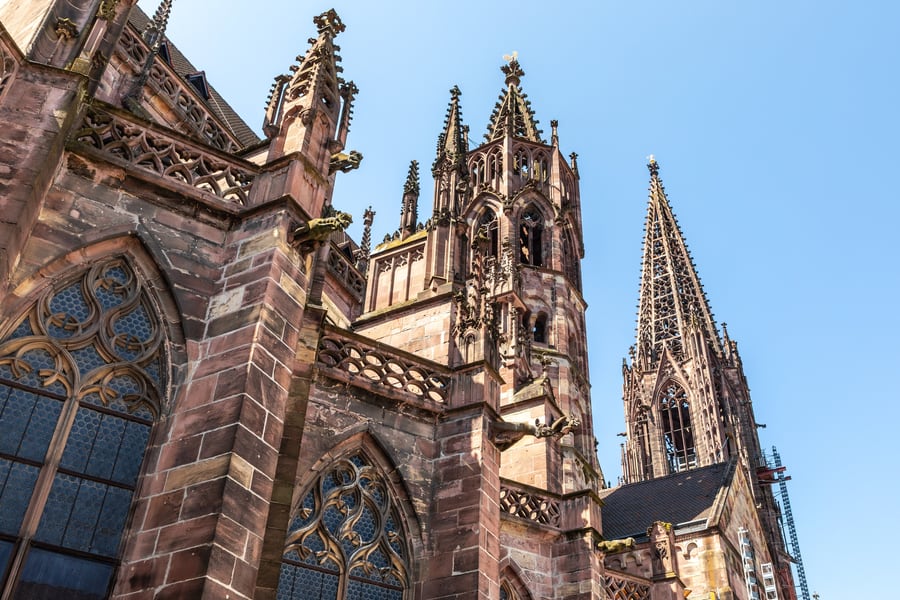
Freiburg im Breisgau
A university city at the warm foot of the Black Forest, and one of the most walkable old quarters in Germany — threaded by the Bächle, the little open water channels that run along the streets. Its minster took three centuries to build and kept its openwork Gothic spire through the war; the market beneath it still runs six mornings a week.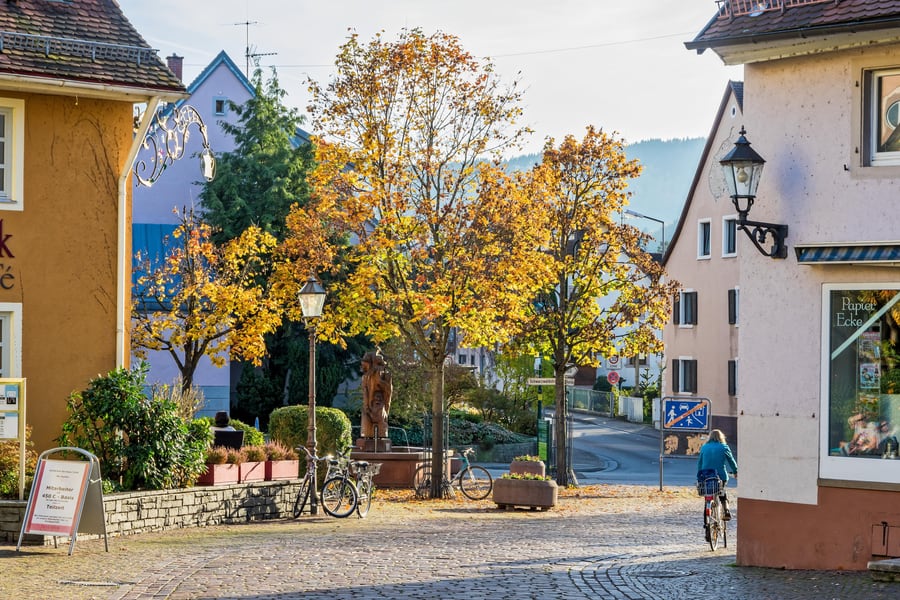 joergens.mi / Wikimedia Commons · CC BY-SA 3.0 · cropped
Kirchzarten
A broad, sunny farming basin ten minutes out of Freiburg at 392 metres, ringed by wooded hills and criss-crossed with walking and cycling routes. This is the last easy ground: three minutes further on the line reaches Himmelreich and tips into the gorge. Being on the half-hourly service and well below the snow line, it makes a quieter and usually cheaper base than the city without giving up any of the convenience.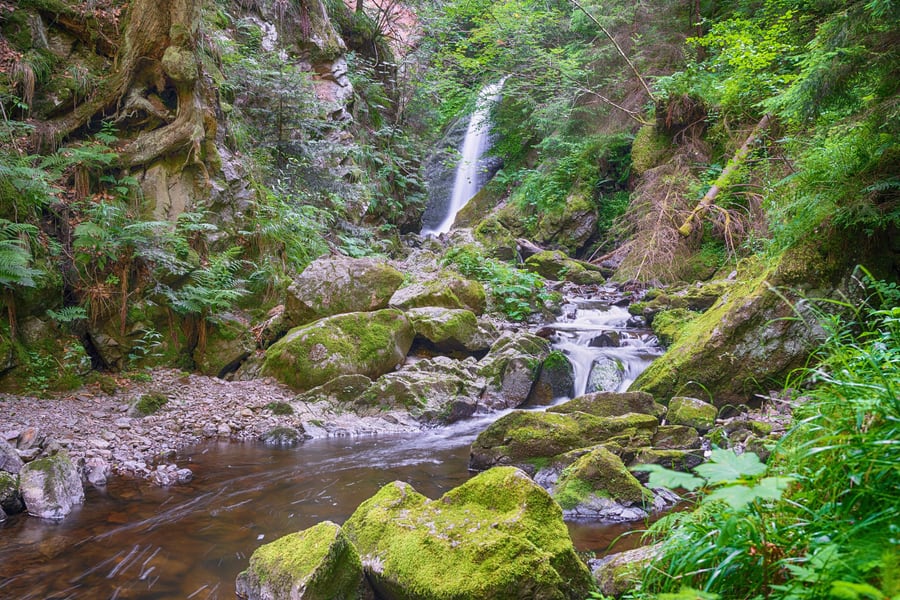 PantaRhei / Wikimedia Commons · CC BY-SA 4.0 · cropped
The Ravenna gorge
A wooded ravine of waterfalls and mossy boulders running below the railway, with a footpath climbing past a succession of cascades and old mill sites. The viaduct strides across the top of it — the one place where you can stand underneath the line and take the measure of what Gerwig's engineers built.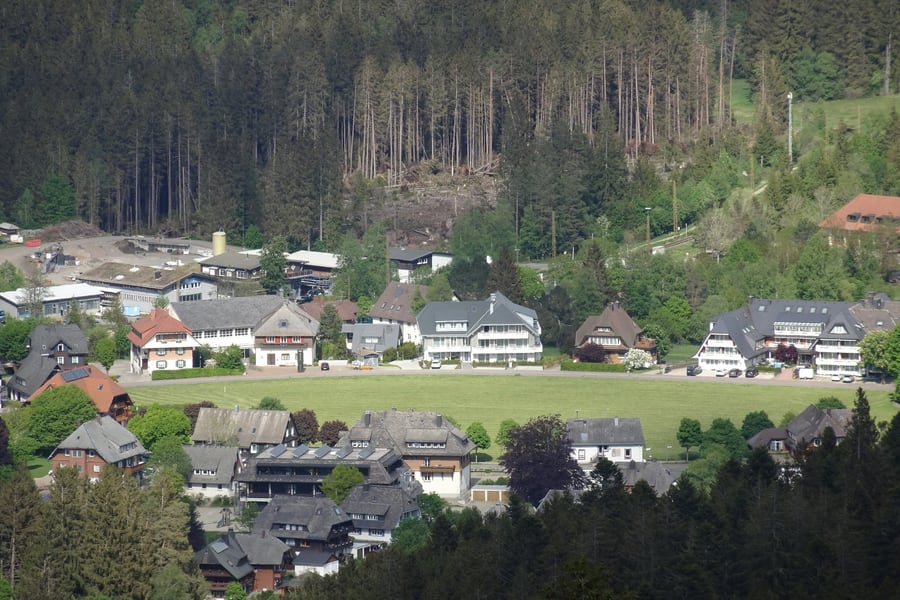 Chondriammos / Wikimedia Commons · CC BY-SA 4.0 · cropped
Hinterzarten
At 885 metres the summit station, in a village of open meadows, grazing cattle and spruce forest with walking trails running straight off the platform. It has been a ski-jumping town for a century: the first jump went up in 1923, the Adlerschanze followed in 1924, and since 2023 the rebuilt hill has again hosted rounds of the women's Ski Jumping World Cup.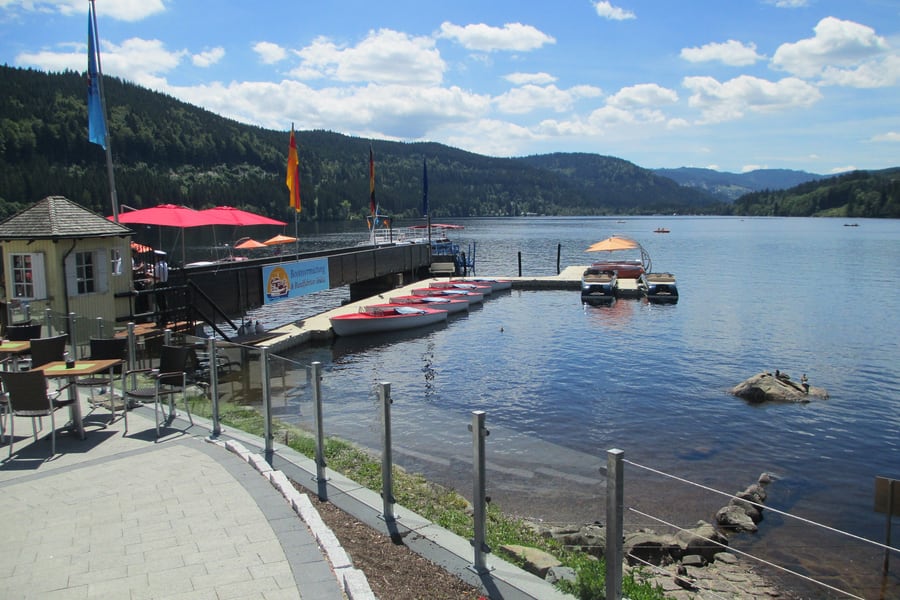 Avi1111 dr. avishai teicher / Wikimedia Commons · CC BY-SA 4.0 · cropped
Titisee
A dark glacial lake at 858 metres with a resort town along one shore — rowing boats and pedalos, a promenade of cuckoo-clock shops, and forest paths circling the water in about an hour and a half. It is the busiest stop on the line and unashamedly touristy; go early or out of season and it is beautiful.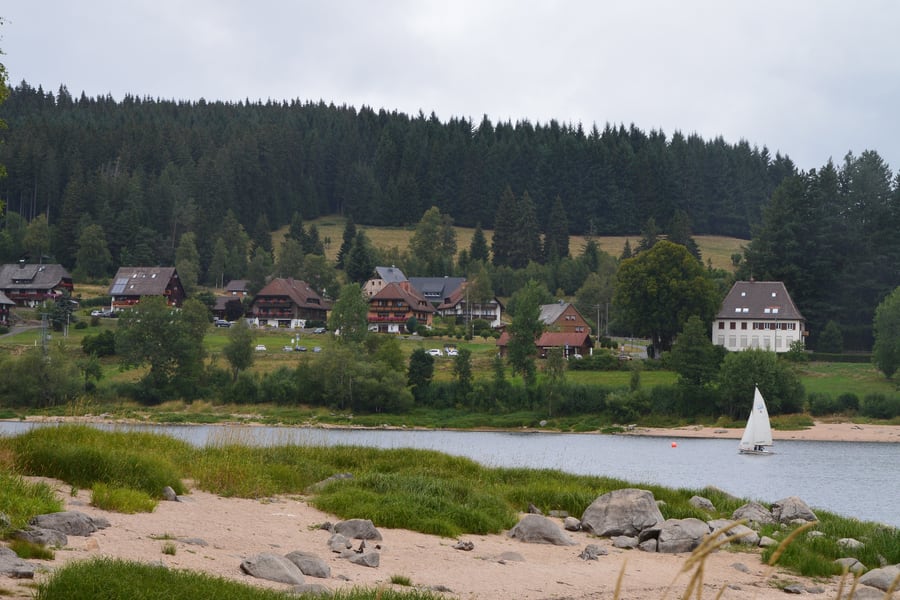 Fideli / Wikimedia Commons · CC BY-SA 4.0 · cropped
Schluchsee
The largest lake in the Black Forest, at 932 metres, and the terminus of the Dreiseenbahn — reached by climbing over Feldberg-Bärental, the highest standard-gauge station in the country. It is markedly quieter than the Titisee and the water is colder: swimming from the shore in high summer, boat trips, and a circular path that takes most of a day to walk right round through the forest. Both Schluchsee and Seebrugg stations sit by the water.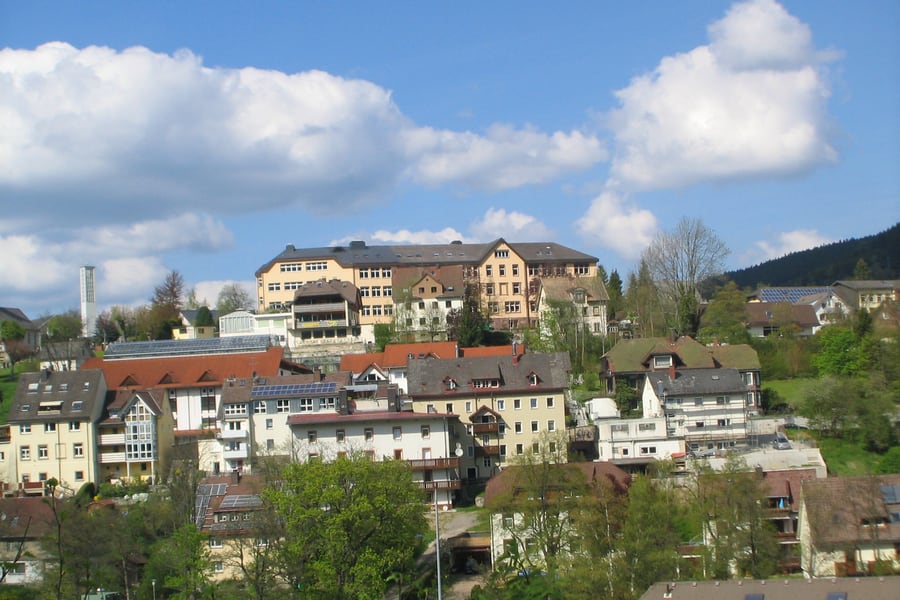 Flominator / Wikimedia Commons · CC BY-SA 3.0 · cropped
Neustadt
The working town of the high valley at 805 metres, sharing a municipality with Titisee a few minutes back down the line but almost none of its crowds. This is where the mountain section ends: most Freiburg trains terminate here, and the service beyond it drops to hourly. That makes it the practical base for the eastern Hochschwarzwald, and much the easier of the two towns to find a bed in at short notice.Where to Sleep
This is one of the easier journeys in Germany to plan a bed around, because the line is half-hourly and short: anywhere between Freiburg and Neustadt puts you within an hour of everything else on it.
Freiburg is the obvious base if you want a city — a walkable old quarter, a cathedral worth an afternoon, and the best food and rail connections on the route. It is also the warmest place on the line by several degrees, which matters in winter.
Hinterzarten is the other choice, and the more atmospheric. At 885 metres it is properly in the mountains, with forest walks from the doorstep and a century of winter-sports history behind it — the village built its first ski jump in 1923 and still hosts World Cup rounds.
Titisee trades quiet for convenience: it is the busiest stop on the line, packed in summer with day visitors from Freiburg, but it has the lake, the boats, and the branch to the Three Lakes.
One practical note that applies wherever you stay: ask about the KONUS guest card when you book. If your host is in the scheme — most in this valley are — your local train travel is already paid for by the visitor tax.
Where to stay
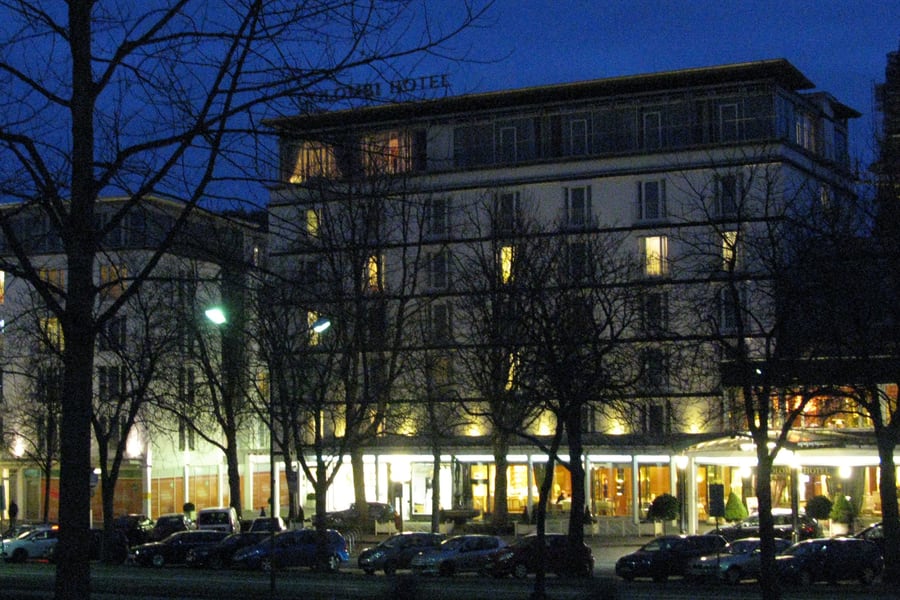
Colombi Hotel
Freiburg, on the Rotteckring
The city's grandest address, facing the Colombipark a few minutes from both the old town and the Hauptbahnhof. Opened in 1957, member of The Leading Hotels of the World since 1995, with a Michelin-starred restaurant that has held its star since 1983.
via colombi.de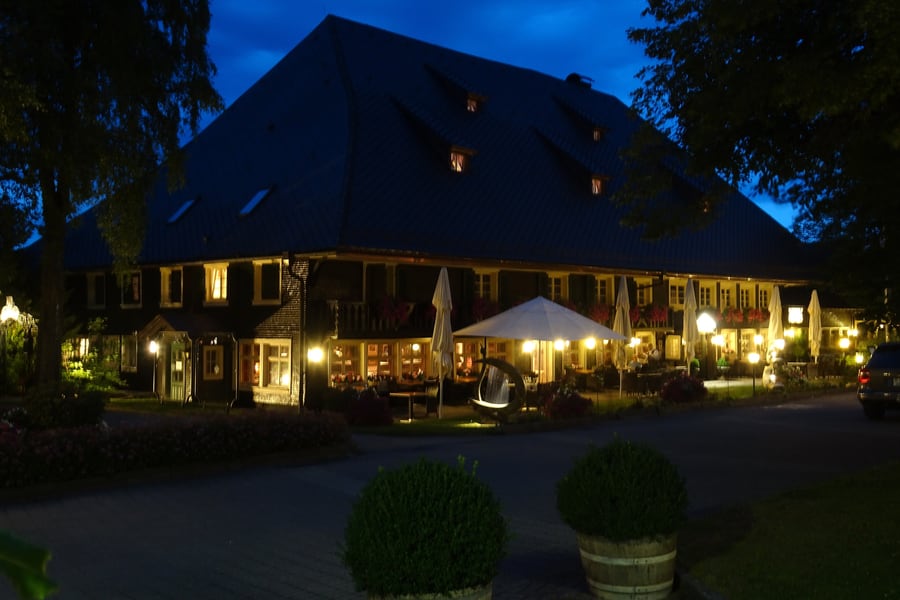
Parkhotel Adler
Hinterzarten, at the top of the climb
A large Black Forest house with its own park and spa at the top of the climb, a few minutes from Hinterzarten station. By the hotel's own account the foundations were laid more than 575 years ago, which would make it one of the oldest continuously run houses in the Black Forest.
via parkhoteladler.de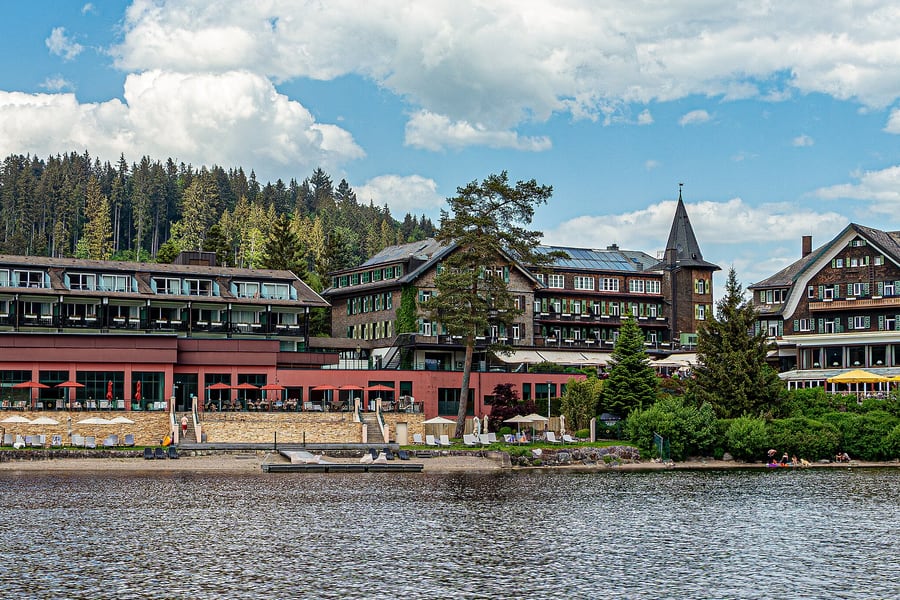
Treschers Schwarzwaldhotel
Directly on the Titisee shore
A long lakeside house with the water at the bottom of the garden and the station a few minutes' walk away — the obvious choice if the point of the trip is to wake up looking at the lake rather than at the forest.
via treschers.deQuestions or corrections
Planning this trip and stuck on something, or spotted a time, fare or detail that has changed? Send us a message about Höllentalbahn. We read every one, and we update this page when something has changed.