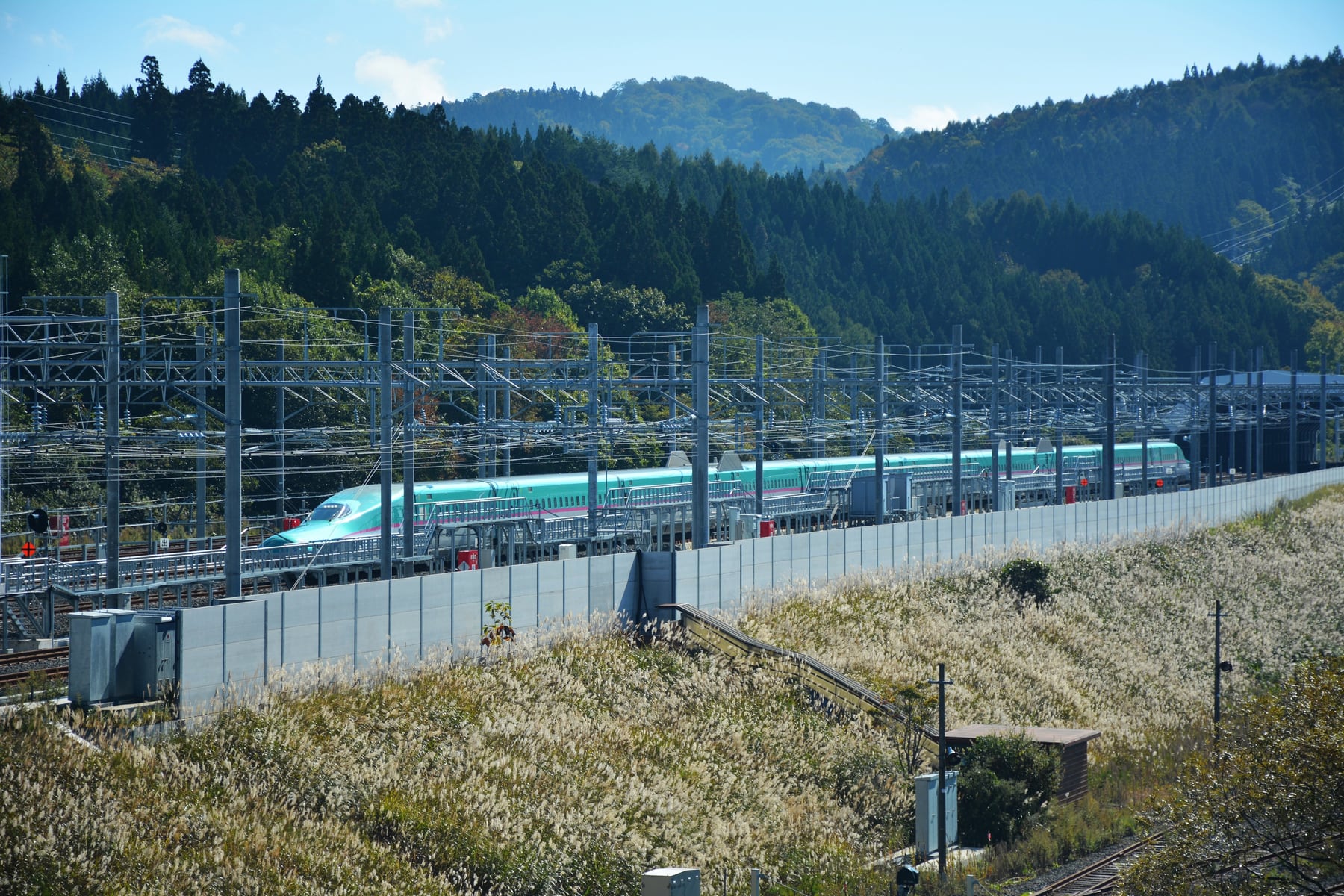
Hokkaido Shinkansen
rail02000 (Cheng-en Cheng) / Flickr · CC BY-SA 2.0
- Distance148.8 km (Shin-Aomori–Shin-Hakodate-Hokuto)
- DurationAbout 1 hour; 3 h 57 min through from Tokyo
- Best seasonYear-round
Introduction
The Hokkaido Shinkansen carries the bullet train from Honshu to Hokkaido, 148.8 km from Shin-Aomori to Shin-Hakodate-Hokuto, and most of its trains run through from Tokyo. The view is not the point: for about twenty minutes the train is inside the Seikan Tunnel, 53.85 km long, 23.3 km of it under the Tsugaru Strait and 240 metres below sea level at its deepest.
What makes the ride unlike any other Shinkansen is that it has to slow down. The tunnel and its approaches are shared with the freight trains that carry Hokkaido's goods south, on track laid with three rails for two gauges, so the bullet train normally runs through at 160 km/h. Only on the busiest holidays, when freight is thin, is it allowed through at 260.
For eighty years before the tunnel opened in 1988, the crossing was made by ferry, and two of the old ferries are moored as museums at either end of the line: the Hakkōda Maru in Aomori and the Mashū Maru in Hakodate.
The Journey
The line begins at Shin-Aomori, where the Tōhoku Shinkansen from Tokyo ends, six minutes from Aomori's old station on the Ōu Line. Northbound trains run out across the Tsugaru Peninsula through low forested hills, and sixteen minutes out the stopping trains call at Okutsugaru-Imabetsu, the last station in Honshu.
Under the strait
A few minutes later the train enters the Seikan Tunnel. Surveys began in 1946, and after five ferries were lost in a typhoon in 1954 the work became urgent. It was built to Shinkansen size from the outset, decades before any Shinkansen ran through it. The two headings met under the strait in 1983 and the tunnel opened on 13 March 1988, the day the ferries stopped. A time capsule buried at the meeting point is to be opened a hundred years after that date.
From the window there is only darkness and the lights of the tunnel wall. The train dips to 240 metres below sea level, about a hundred metres under the seabed, and climbs back out into Hokkaido near Kikonai, the first station on the island.
Shared rails
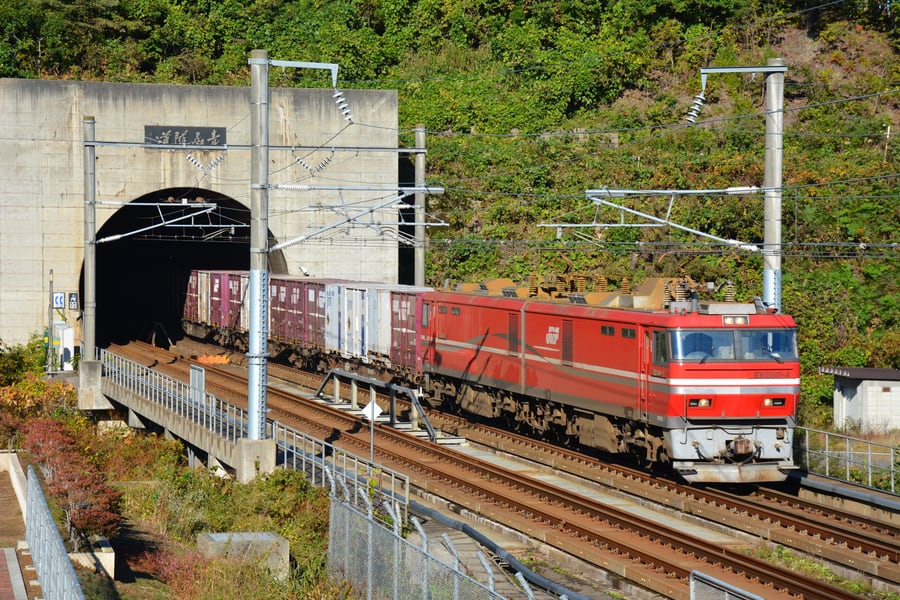
About 82 km of the line, the tunnel included, carries dual-gauge track: a third rail lets JR Freight's narrow-gauge container trains, hauled by locomotives of the EH800 class built for the tunnel's Shinkansen voltage, run on the same line. A bullet train passing a freight train at full speed could unsettle it, so the Shinkansen keeps to 160 km/h here. During the New Year, Golden Week and Obon holidays the two are kept apart by time of day, and the morning trains run through at 260 km/h, five or six minutes faster.
Into Hokkaido
Beyond Kikonai the line crosses farmland and forest to Shin-Hakodate-Hokuto, where the Shinkansen track stops at buffer stops pointing towards Sapporo. The Hakodate Liner meets the Shinkansen for the fifteen- to twenty-minute run into Hakodate, and the limited expresses to Sapporo leave from the same station.
The trains
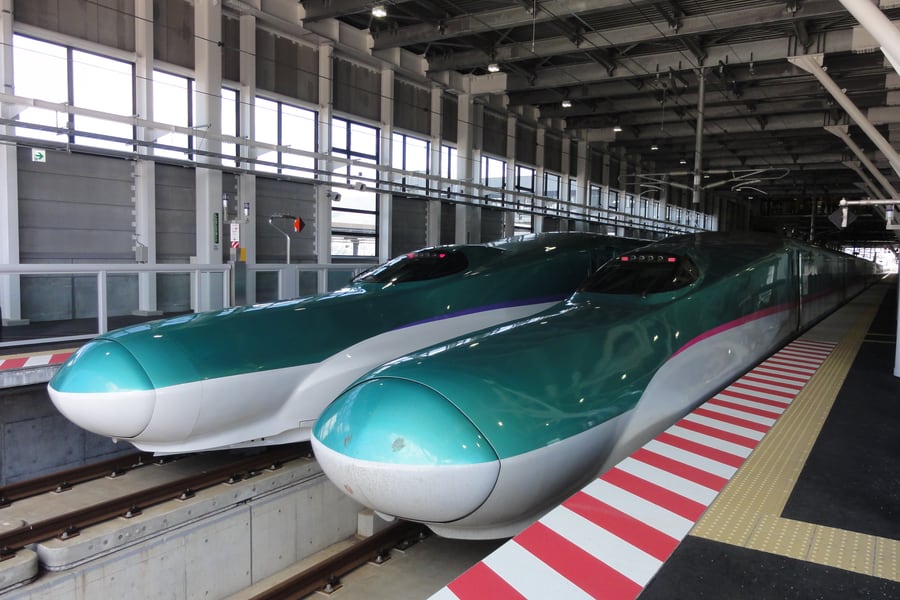
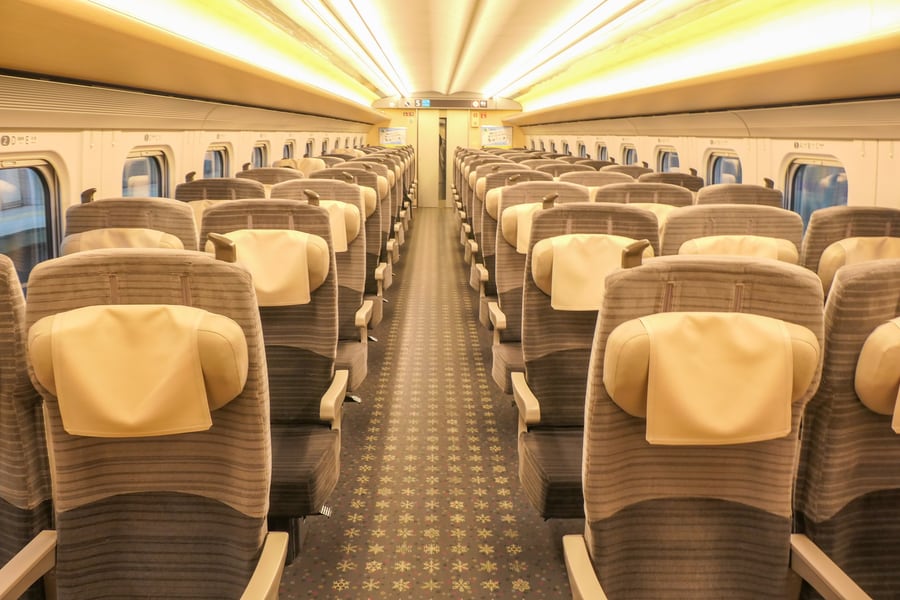
Every train is a ten-car set, either JR East's E5, with a pink stripe, or JR Hokkaido's own H5, with a purple one chosen for the lilacs, lupins and lavender of Hokkaido. The two classes run in one pool, so either may turn up. Each has a Green car and a Gran Class car, the premium class above it; most services are Hayabusa, with a few stopping Hayate early in the morning and late at night.
Along the route
 Mister0124 / Wikimedia Commons · CC BY-SA 4.0
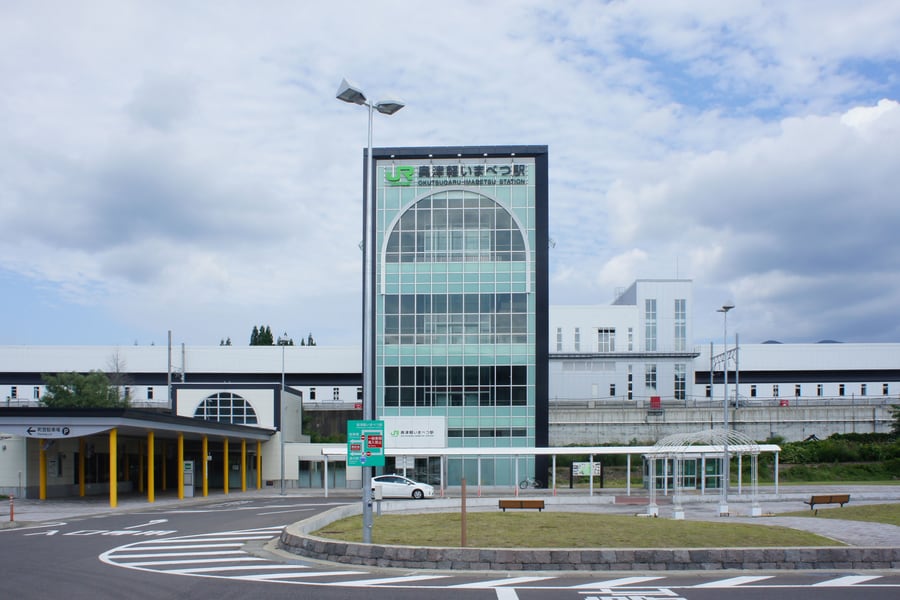
Okutsugaru-Imabetsu
The last station in Honshu, 38.5 km from Shin-Aomori, was designed with the tunnel as its theme: an arched glass entrance standing for the portal. Only some trains stop, and a town bus runs to the Honshu portal.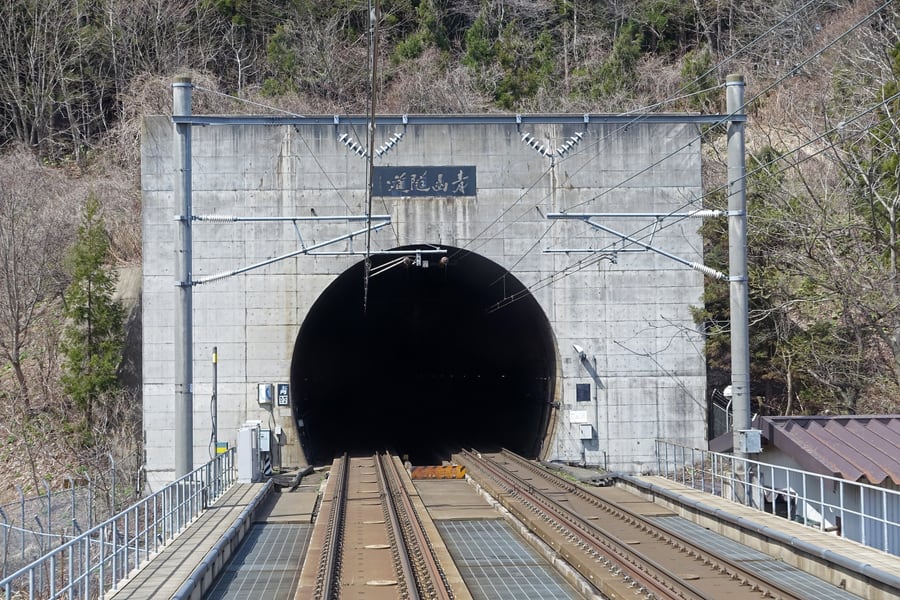 Bmazerolles / Wikimedia Commons · CC BY-SA 4.0
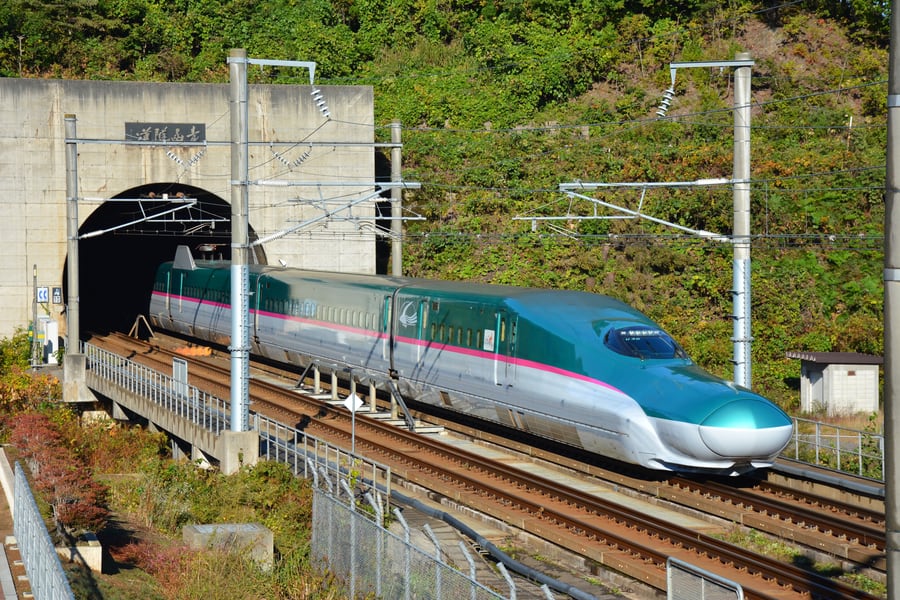
Into the tunnel
The track into the Seikan Tunnel carries three rails, so narrow-gauge freight and the Shinkansen can share it. Built to Shinkansen size from the start, the tunnel runs 53.85 km, 23.3 km of it under the sea.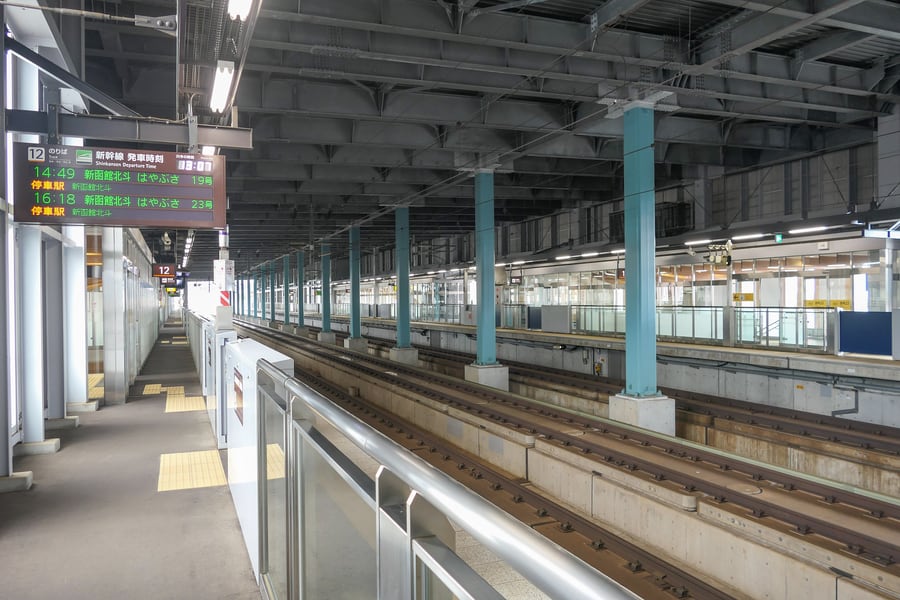 MaedaAkihiko / Wikimedia Commons · CC0
Kikonai
The first station in Hokkaido, twelve minutes from Shin-Hakodate-Hokuto. The old Esashi Line, now the South Hokkaido Railway, runs on from here to Goryōkaku, a slower way into Hakodate in about an hour.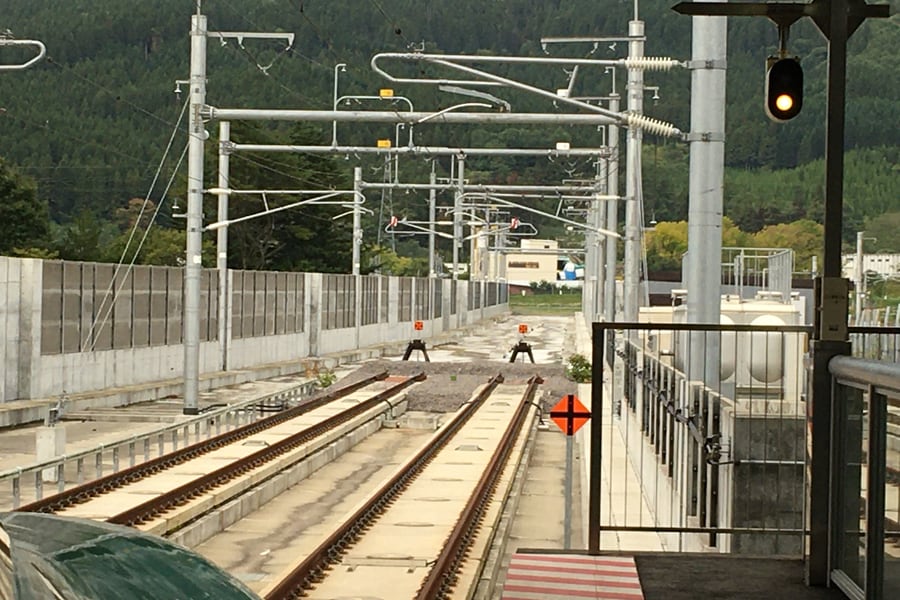 国立寺 / Wikimedia Commons · CC BY-SA 4.0
The end, for now
At Shin-Hakodate-Hokuto the Shinkansen track stops at buffer stops pointing north. The extension to Sapporo is being built beyond them and is now planned to open by the end of fiscal 2038.A bit of history
Culture & experiences along the way
 掬茶 / Wikimedia Commons · CC BY-SA 4.0
A train in the ship's hold
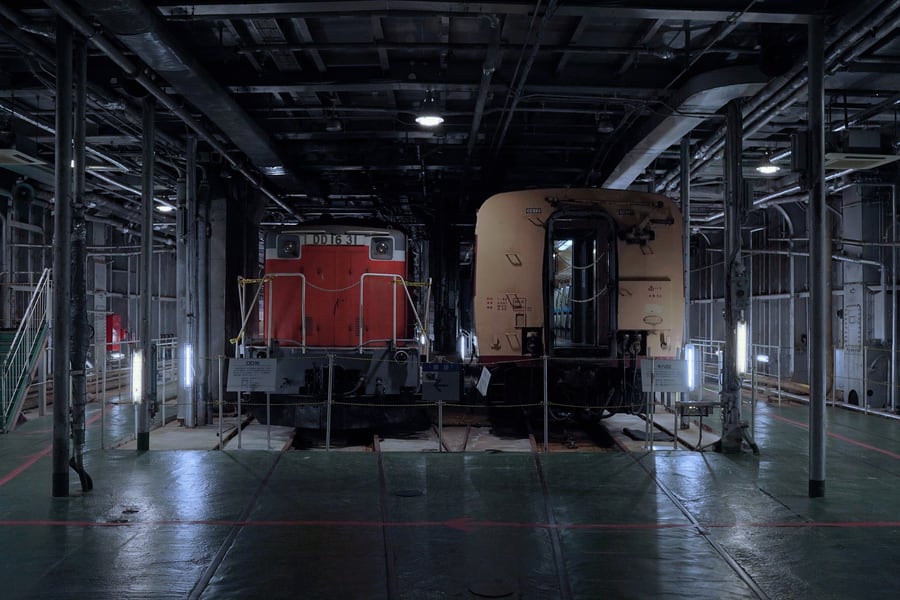
The ferry the tunnel replaced carried railway wagons. Moored five minutes' walk from Aomori station, the yellow Hakkōda Maru keeps its rail deck as it was, with real rolling stock on board, a mail van among it, and the engine room below.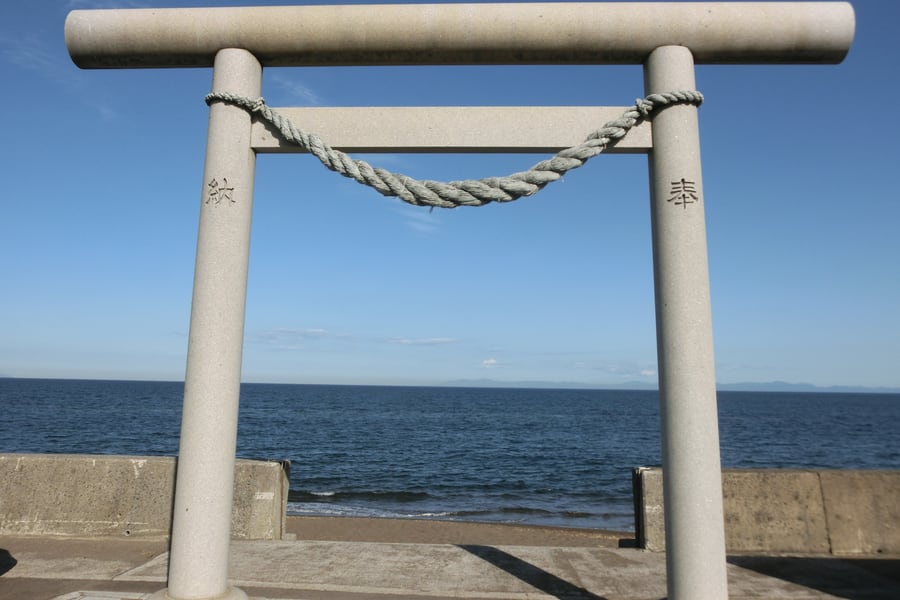 Abasaa / Wikimedia Commons · public domain
Into the winter sea
Every January since 1831, four young men spend three days at Samegawa shrine in Kikonai, pouring cold water over themselves, then carry its sacred objects into the Tsugaru Strait on the 15th to pray for a good catch and harvest. Fireworks and a festival fill the town around it.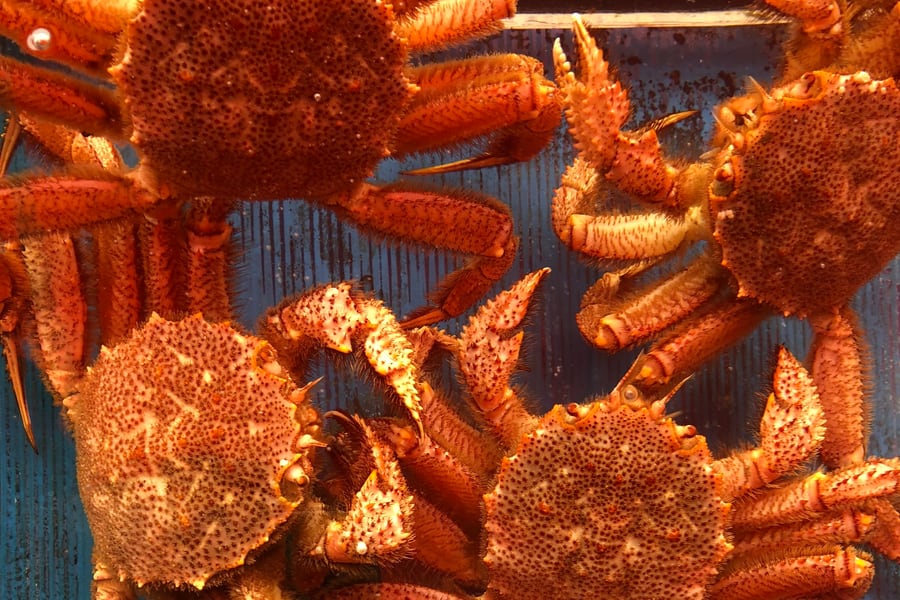 Totti / Wikimedia Commons · CC BY-SA 4.0
Crab for breakfast
Hakodate's morning market, a minute's walk from the station, has around 250 stalls selling crab, salmon and the rest of the night's catch, with small restaurants serving seafood rice bowls. It opens at five from May to December, at six in winter.Timetables
Thirteen trains a day cross the strait in each direction, every day of the year. Most are Hayabusa running through to or from Tokyo; the fastest take 57 minutes between Shin-Aomori and Shin-Hakodate-Hokuto and 3 hours 57 minutes from Tokyo. Every seat is reserved.
Northbound — Tokyo and Shin-Aomori to Hokkaido (a selection)
| Train | Tokyo | Shin-Aomori | Okutsugaru-Imabetsu | Kikonai | Shin-Hakodate-Hokuto |
|---|---|---|---|---|---|
| Hayate 91 | — | 06:33 | 06:49 | 07:23 | 07:35 |
| Hayabusa 1 | 06:32 | 09:51 | 10:07 | 10:41 | 10:53 |
| Hayabusa 5 | 08:18 | 11:18 | — | — | 12:15 |
| Hayabusa 17 | 10:45 | 13:59 | 14:15 | 14:49 | 15:01 |
| Hayabusa 25 | 13:20 | 16:45 | 17:01 | 17:35 | 17:47 |
| Hayabusa 31 | 15:20 | 18:41 | 18:58 | 19:31 | 19:44 |
| Hayabusa 39 | 19:20 | 22:32 | — | — | 23:29 |
Southbound — Hokkaido to Shin-Aomori and Tokyo (a selection)
| Train | Shin-Hakodate-Hokuto | Kikonai | Okutsugaru-Imabetsu | Shin-Aomori | Tokyo |
|---|---|---|---|---|---|
| Hayabusa 10 | 06:39 | 06:52 | 07:26 | 07:43 | 11:04 |
| Hayabusa 16 | 09:35 | 09:48 | 10:22 | 10:39 | 14:08 |
| Hayabusa 18 | 10:53 | — | — | 11:52 | 15:04 |
| Hayabusa 24 | 12:48 | 13:01 | 13:35 | 13:52 | 17:04 |
| Hayabusa 32 | 14:48 | 15:01 | 15:35 | 15:52 | 19:04 |
| Hayabusa 44 | 18:40 | 18:53 | 19:27 | 19:44 | 23:04 |
| Hayate 100 | 21:57 | 22:10 | 22:44 | 22:59 | — |
Good to know:
- Stops. Only about half the trains call at Okutsugaru-Imabetsu and Kikonai; the rest run non-stop across the strait. The times above are departures.
- Into Hakodate. The Hakodate Liner meets the Shinkansen at Shin-Hakodate-Hokuto for the 15- to 20-minute run to Hakodate; after Hayabusa 5, for example, the 12:35 reaches Hakodate at 12:50.
- Holiday running. At New Year, Golden Week and Obon, trains through the tunnel until mid-afternoon run at 260 km/h and keep different times. In summer 2026 that applied from 12 to 17 August, with the fastest Tokyo run cut to 3 hours 51 minutes; the New Year 2026–27 dates had not been announced.
Times as of October 2026, from JR Hokkaido's timetable. Check your date on JR Hokkaido's Hokkaido Shinkansen timetable (opens in a new tab).
Tickets
Every seat is reserved, and a ticket is the fare plus a seat charge. From Shin-Aomori to Shin-Hakodate-Hokuto that comes to ¥8,050, a little more in the busy seasons; from Tokyo, ¥24,200, and ¥24,530 through to Hakodate with the Hakodate Liner included. Buy them at any JR station ticket office.
A Green car seat costs ¥6,800 on top of the fare between Shin-Aomori and Shin-Hakodate-Hokuto instead of the ordinary seat charge, and Gran Class ¥13,800 on a Hayabusa. On some trains Gran Class runs without its attendant service. Fares checked October 2026 against JR Hokkaido's fare search; Japanese yen.
Book your tickets
Shin-Aomori to Shin-Hakodate-Hokuto
One way, adult · reserved seat
Fare and reserved-seat charge on any Hayabusa or Hayate across the strait; slightly more in the busy seasons.
Book Tickets (opens in a new tab, on JR Hokkaido)via JR HokkaidoTokyo to Shin-Hakodate-Hokuto
One way, adult · reserved seat
The through journey from Tokyo without a change, about four hours on the fastest Hayabusa.
Book Tickets (opens in a new tab, on JR Hokkaido)via JR HokkaidoRail Passes
The Hokkaido Rail Pass does not cover this line. JR Hokkaido excludes the Hokkaido Shinkansen from it, so a holder still buys a ticket across the strait.
Two passes do cover it. The JR East–South Hokkaido Rail Pass, ¥40,000 for six consecutive days, covers JR East's lines and the Shinkansen to Hokkaido as far as Hakodate and Sapporo; a return from Tokyo to Shin-Hakodate-Hokuto costs ¥48,400 in reserved seats, so it pays for itself on that trip alone. The Japan Rail Pass, ¥50,000 for seven days, covers it too, but is worth buying only for a longer tour of the country. For the crossing alone, from Shin-Aomori, no pass pays: the single fare is ¥8,050. Green car and Gran Class cost extra on the JR East–South Hokkaido pass.
Checked October 2026 against JR Hokkaido's rail pass page (opens in a new tab), JR East's JR East–South Hokkaido Rail Pass (opens in a new tab) page and the Japan Rail Pass prices (opens in a new tab).
Places to Visit
Both ends repay a night. Aomori has the ferry museum and the nebuta; Hakodate, fifteen minutes beyond the line's end, has the other ferry, the star fort and the view from Mt Hakodate, with Ōnuma nine minutes up the line from Shin-Hakodate-Hokuto.
 Mccunicano / Wikimedia Commons · CC BY-SA 4.0
Aomori
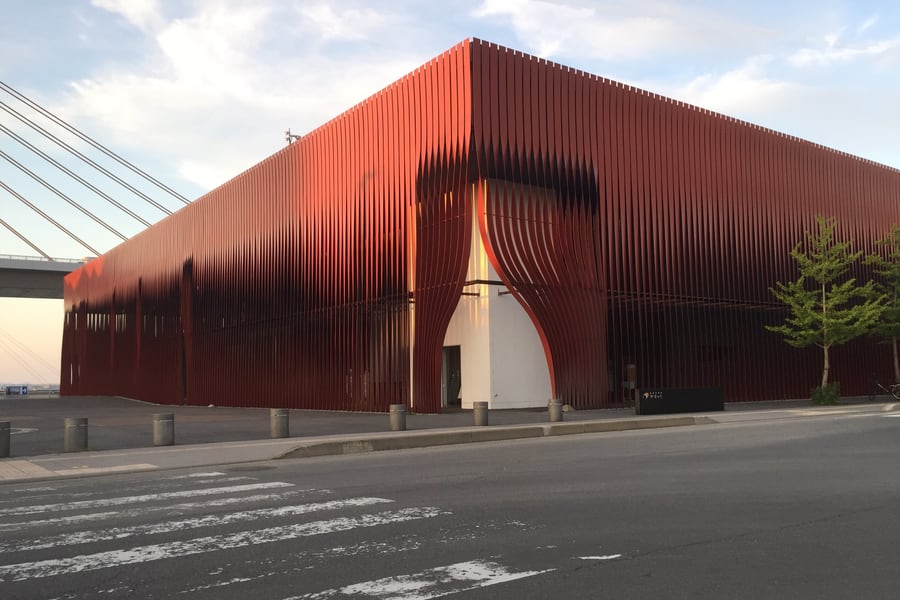
A minute's walk from JR Aomori station, Wa Rasse keeps the giant lantern floats of the city's August Nebuta festival on show year-round: the large nebuta from each summer's parade, with the history of the festival and the craft behind it upstairs. Admission ¥620; the Hakkōda Maru is moored a few minutes away. Shin-Aomori is six minutes away on the Ōu Line.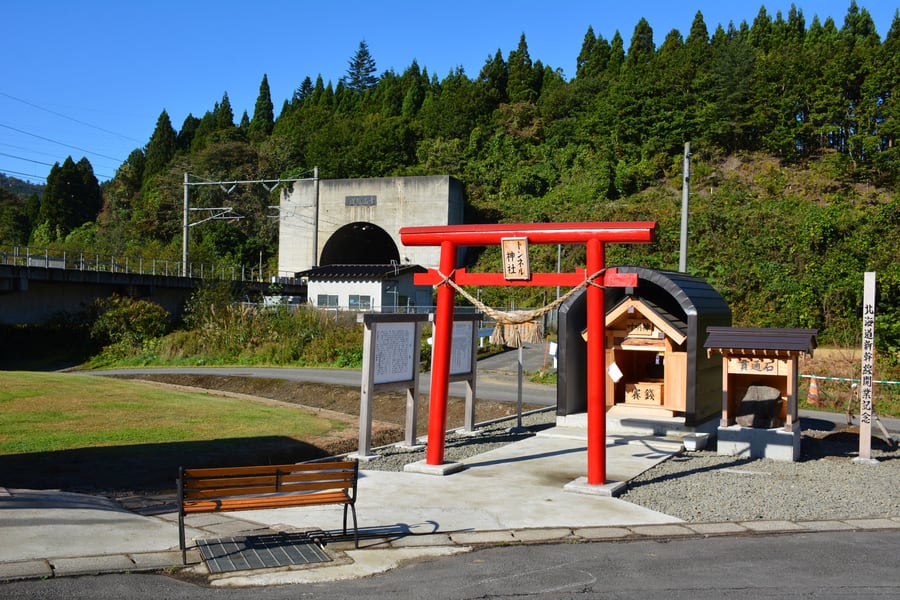 rail02000 (Cheng-en Cheng) / Flickr · CC BY-SA 2.0
Okutsugaru-Imabetsu
The Seikan Tunnel Entrance Plaza looks straight into the Honshu portal, where the name over the arch was written by the prime minister of the day, Yasuhiro Nakasone. A viewing deck faces the line, and by the car park stands the "breakthrough stone", a boulder the builders brought out to the portal. A town bus from the station takes about ten minutes.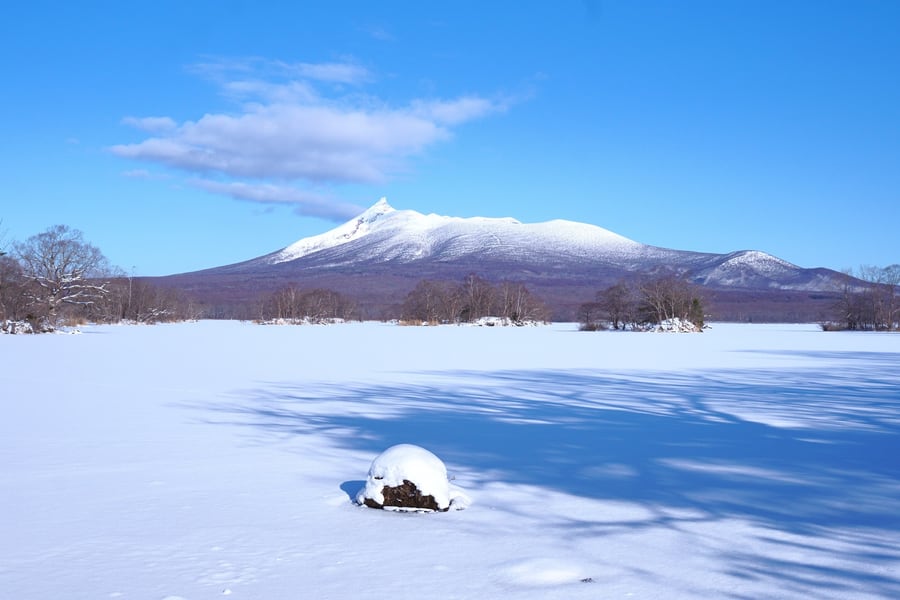 掬茶 / Wikimedia Commons · CC BY-SA 4.0
Ōnuma-Kōen
Nine minutes from Shin-Hakodate-Hokuto by limited express, Ōnuma is a quasi-national park of three lakes and 126 islands under the 1,131-metre cone of Hokkaido Komagatake, the volcano that made them. A sightseeing boat threads the islands in about thirty minutes, and a 14-kilometre road circles the lake for cycling. In winter the lake freezes for ice fishing.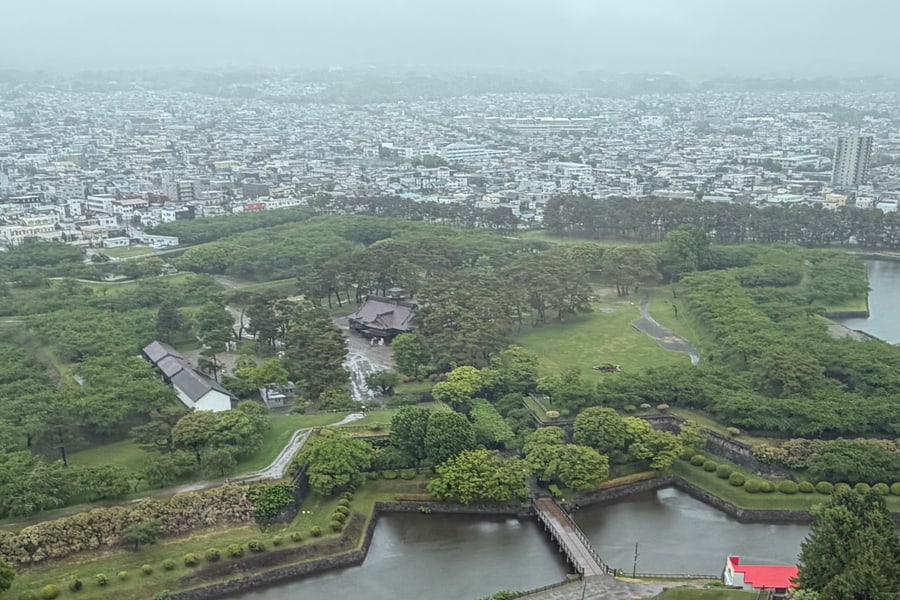 S5A-0043 / Wikimedia Commons · CC BY 4.0 · cropped
Hakodate
Begun in 1857 for the shogun's magistrate when Hakodate opened to foreign ships, Goryōkaku is a European-style five-pointed fort, the last stand of the shogunate's forces in the Hakodate War and Hokkaido's only special historic site; the magistrate's office inside was rebuilt in 2010. The 90-metre deck of Goryōkaku Tower shows the whole star (¥1,200). The tram from Hakodate station takes about sixteen minutes.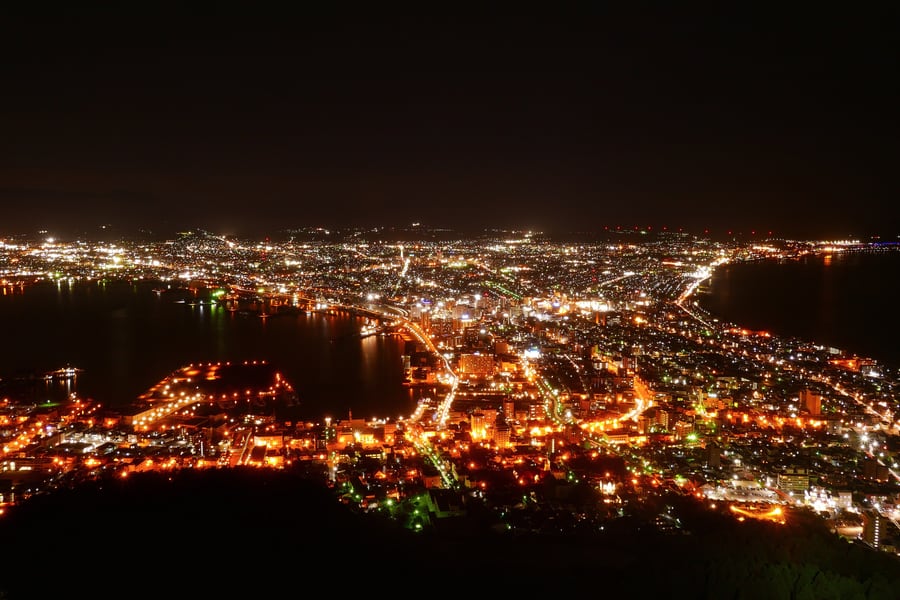 MaedaAkihiko / Wikimedia Commons · CC BY-SA 4.0
Hakodate
A ropeway climbs Mt Hakodate in about three minutes, every fifteen, to the view of the city's lights at night. A return ticket costs ¥1,800 and the last car up leaves at 20:30 in winter. The ropeway is closed from 20 October to 8 November 2026 for its statutory inspection.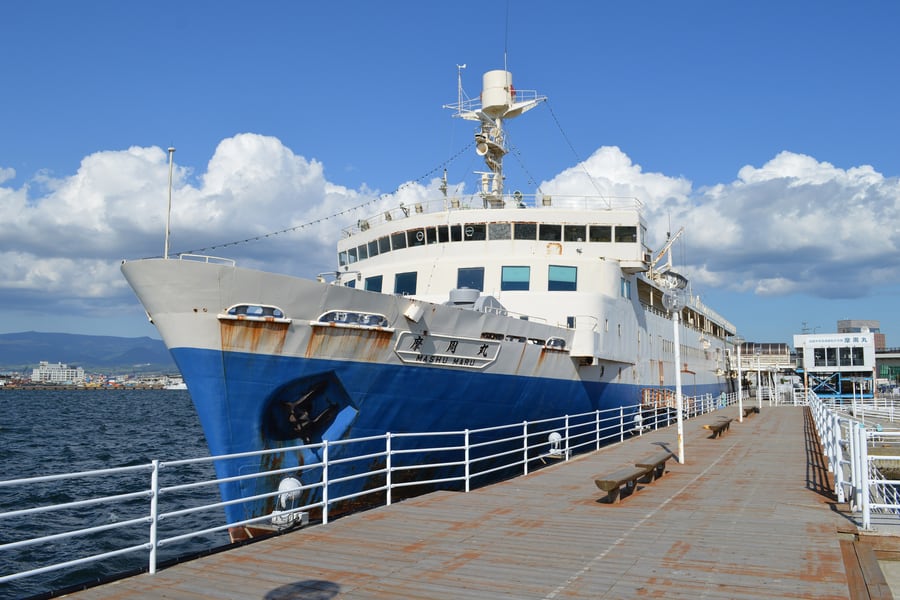 Saigen Jiro / Wikimedia Commons · CC0
Hakodate
Beside Hakodate station, at the berth it sailed from, the Mashū Maru made the last ferry crossing from Aomori on 13 March 1988, the day the tunnel opened. Her bridge and radio room are as they were, and the old first-class saloon tells the story of eighty years of ferries across the strait. Admission ¥500.Where to Sleep
Stay in Hakodate rather than at Shin-Hakodate-Hokuto: the city is a short ride away, and the ferry museum, the morning market and the ropeway are all within reach of its station. On the Honshu side, central Aomori is a better base than Shin-Aomori.
Where to stay
 掬茶 / Wikimedia Commons · CC BY-SA 4.0
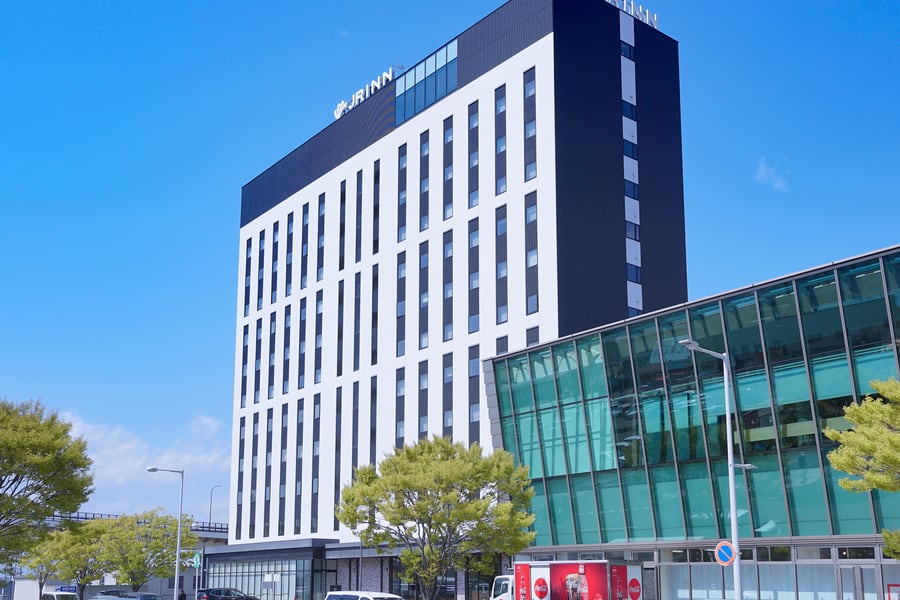
JR Inn Hakodate
Hakodate · reached from the station concourse
A JR Hokkaido hotel joined to Hakodate station by an indoor passage, a short walk from the Mashū Maru.
Check Availability (opens in a new tab, on jr-inn.jp)via jr-inn.jp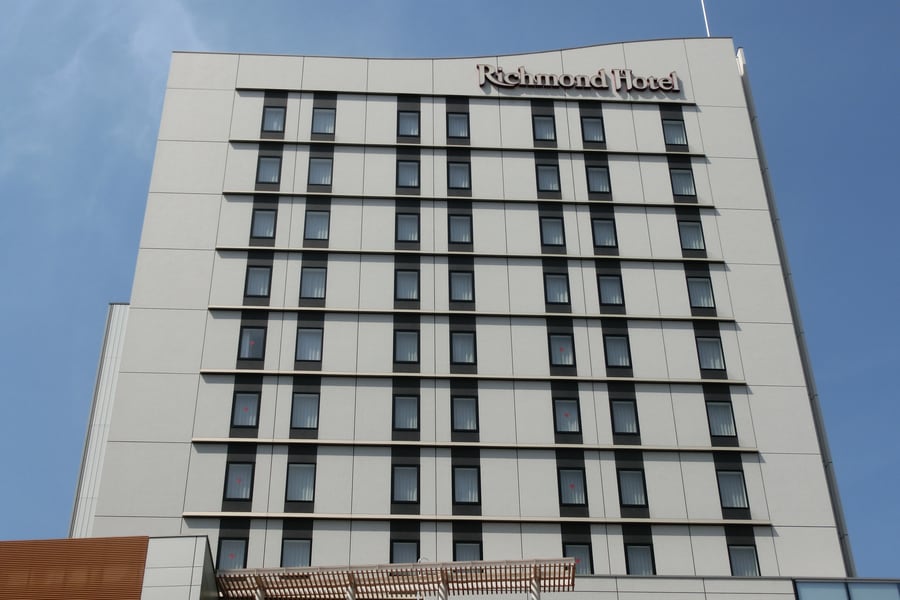 Abasaa / Wikimedia Commons · public domain
Richmond Hotel Aomori
Aomori · city centre, by the city office
A city-centre hotel with buses from both Aomori and Shin-Aomori stations, and Aomori produce at breakfast.
Check Availability (opens in a new tab, on richmondhotel.jp)via richmondhotel.jpQuestions or corrections
Planning this trip and stuck on something, or spotted a time, fare or detail that has changed? Send us a message about Hokkaido Shinkansen. We read every one, and we update this page when something has changed.