Helsingør to Gilleleje: the Hornbækbanen
Bengt Oberger / Wikimedia Commons · CC BY-SA 4.0
- Distance24.9 km · 18 stops
- Duration46–49 minutes end to end
- Best seasonAll year · half-hourly on weekdays
Introduction
The Hornbækbanen runs for twenty-five kilometres along the top of Zealand, from Elsinore — Helsingør, where the ferries cross to Sweden — to the fishing harbour at Gilleleje. It is an ordinary local railway on an ordinary zone ticket, worked by Lokaltog as line 940R, and it takes under fifty minutes end to end.
It very nearly went somewhere else. Parliament put a Helsingør–Hornbæk railway into the Railway Act of 8 May 1894, shares were offered, and then for the better part of a decade nothing was built. What broke the deadlock was not enthusiasm but a threat: a private company proposed a line inland instead, running from Kvistgård through Tikøb to Hornbæk and on to Dronningmølle, which would have served the farms and left the coast villages — and Helsingør's own trade — off the railway map altogether. Helsingør's merchants and the Hellebæk resident Alexander Svedstrup pushed hard to get the coastal route licensed before the ten-year window on the 1894 Act ran out. The exclusive licence was granted on 24 March 1904, in the last weeks of it, and construction began at once.
The railway opened on 22 May 1906 with no ceremony of any kind, because the company could not afford one. Six trains ran each way, normally worked by a single set of carriages, and on busy holidays the parcels van had wooden benches fitted into it. Ten years later the line was pushed on to Gilleleje, and the pattern it set — Copenhagen out for the summer, the beaches at Hornbæk, the fishing boats at the far end — has held ever since.
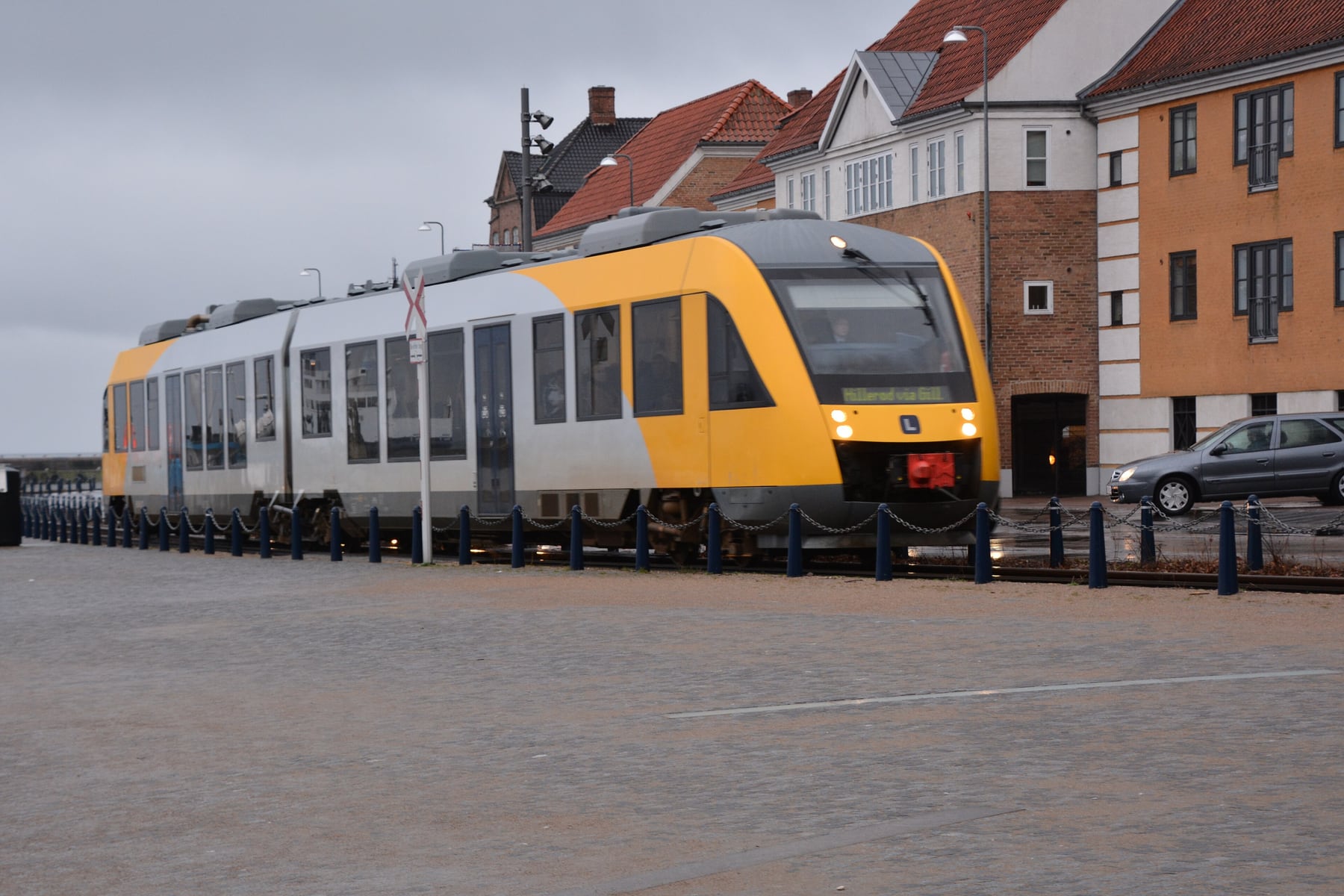
What survives of that scramble is visible on the ground. There are eighteen stops in twenty-five kilometres, most of them bare halts where the train goes past unless somebody presses a button. The last stretch into Helsingør is not a railway alignment at all but the harbour road, the rails laid across the cobbles behind a line of bollards, running past the Scandlines berths to finish beside a station the company never owned.
The Journey
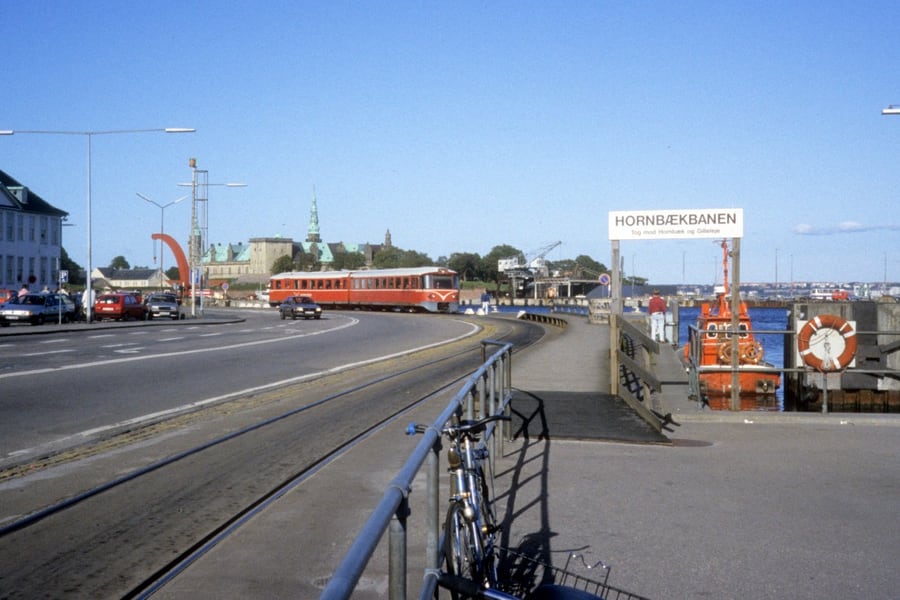
Trains leave Helsingør from the harbour side of the station, and the first thing the railway does is behave like a tramway. The track is laid along Havnegade, in the roadway, separated from the traffic by nothing more than blue bollards and a chain, and it runs the length of the quay with the Helsingborg ferries loading alongside. Kronborg's copper spires stand off to the right. This is not a preserved curiosity: it is how the line has reached the town since 1908, and it is what a Lokaltog railcar was photographed doing in July 2024.
The arrangement is a fix that never got replaced. When the railway opened in 1906 its Helsingør terminus was at Sofiegade — an awkward answer that left passengers changing between this line and the Coast Line two hundred metres apart, on foot. In 1907 a track was laid instead along the harbour to the customs house, directly opposite the back of the state station, and from 1908 every train ran through to a stop in the street there. The company's own headquarters stayed where it had always been, at Grønnehave in the north of the town: traffic control, the offices, the sheds and the workshops. Grønnehave was rebuilt in 1952, when all its tracks were shifted to the south side of the building because the Tretorn factory next door wanted the room, and its station house now holds a shared office for designers and animators.
Along the Sound
Past Grønnehave the line turns north-west and follows the coast. Marienlyst and Højstrup are halts; Hellebæk, five kilometres out, is where the railway earns its keep historically. The stream here drove seven watermills, and those mills with the workshops along Bøssemagergade were the Kronborg rifle factory — gun barrels forged at Hammermøllen from 1601 until the works shut in 1870, after which the valley turned to cloth. The station sits at the edge of Hammermølle Skov, and the mill is a few minutes' walk from the platform. Jørn Utzon, who would go on to design the Sydney Opera House, built his own house in Hellebæk in 1952.
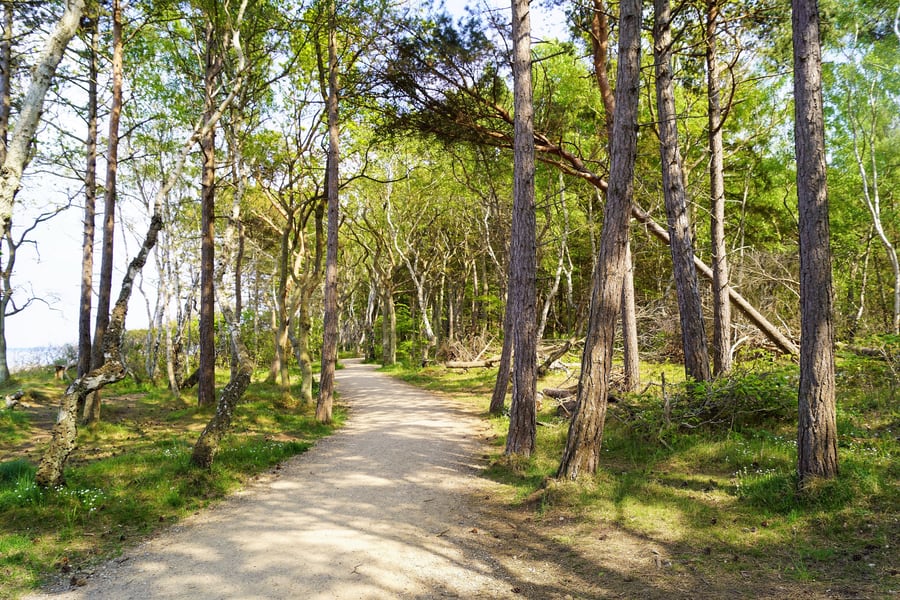
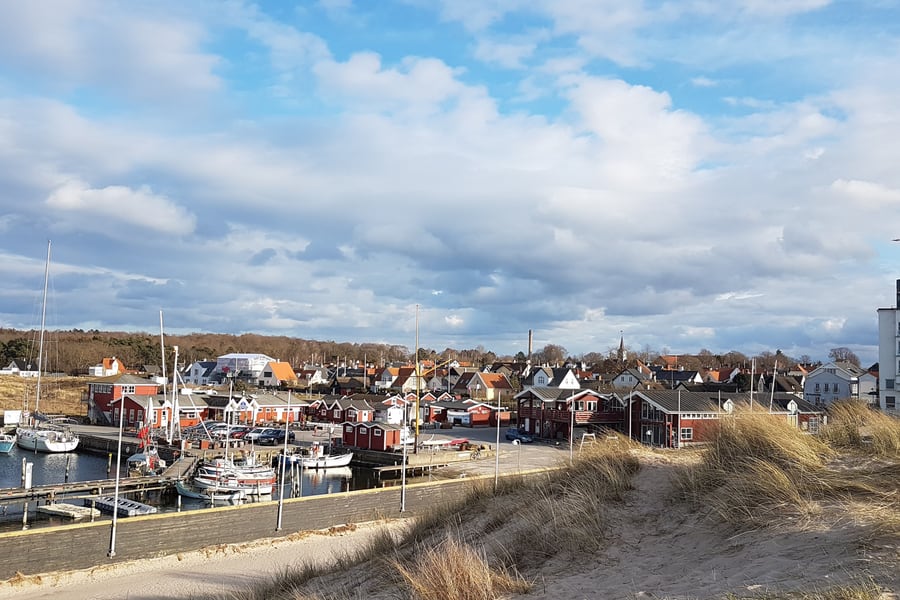
Ålsgårde and Skibstrup follow, then Saunte and Karinebæk, and then Hornbæk — the busiest station on the railway from the day it opened, and still the one most people use. About 3,600 people live in Hornbæk and something like 35,000 arrive for the summer, drawn by a beach that has been fashionable since the painter Holger Drachmann and his friends discovered the place in the 1800s. Behind the dunes the line skirts Hornbæk Plantage, the pine and birch planted to hold the drifting sand.
The last ten kilometres
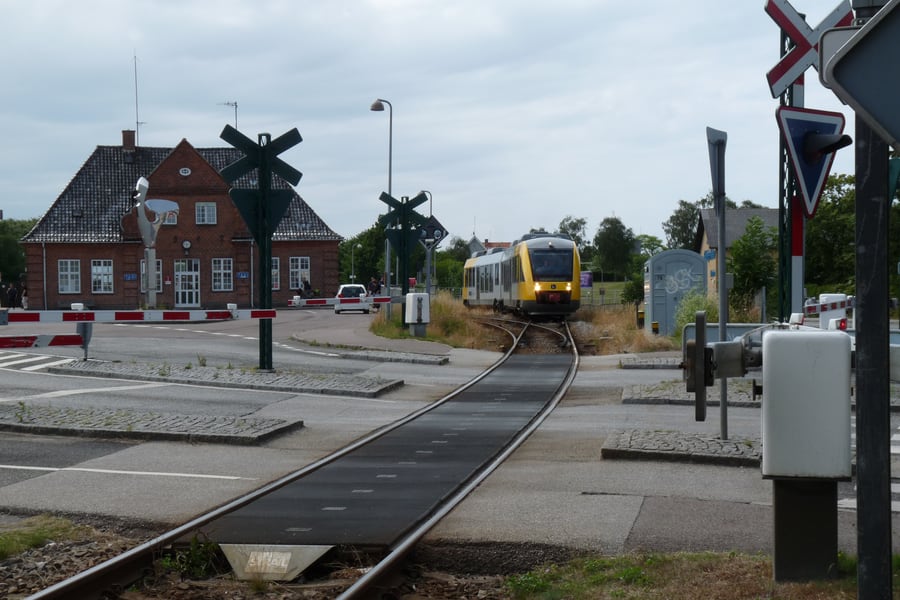
From Horneby Sand the railway crosses the neck of the peninsula. Kildekrog, then Dronningmølle, named for the watermill Queen Sophie built at the mouth of the Esrum Å in 1588; the sculptor Rudolph Tegner's museum and statue park stand on the heath just inland. Firhøj, Søborg and Stæremosen are halts in open country, and then the train comes down to Gilleleje past the level crossing and into the station.
Gilleleje was already on the railway map before this line reached it — the Gribskovbanen had come up from Hillerød in 1896 — and the two companies could not agree on sharing a building. So from July 1916 the Hornbækbanen simply stopped short, at a halt called Østerport on the edge of town, and it was 16 January 1918 before a joint station opened and the trains came in properly. Today the argument is invisible: most departures run straight through, changing their number from 940R to 950R without anybody getting out, and carry on to Hillerød.
Along the route
Mojnsen / Wikimedia Commons · CC BY-SA 4.0 · croppedThe line the coast nearly lost
A railway to Hornbæk went into the Railway Act of 1894, and then nothing happened. What moved it was a competitor: a private scheme for an inland line that would have left the coast towns off the map. The coastal licence came through in March 1904, just inside the ten-year window.Kurt Rasmussen / bahnbilder.de · Wikimedia Commons · croppedOpened without a ceremony
The line opened in May 1906 with no festivities at all, because the finances would not stretch to any. There were six trains each way, and on holidays the goods vans had loose wooden benches fitted. Traffic beat every forecast, and within a year more carriages had been bought.Guillaume Baviere / Wikimedia Commons · CC BY-SA 2.0 · croppedEighteen stops in twenty-five kilometres
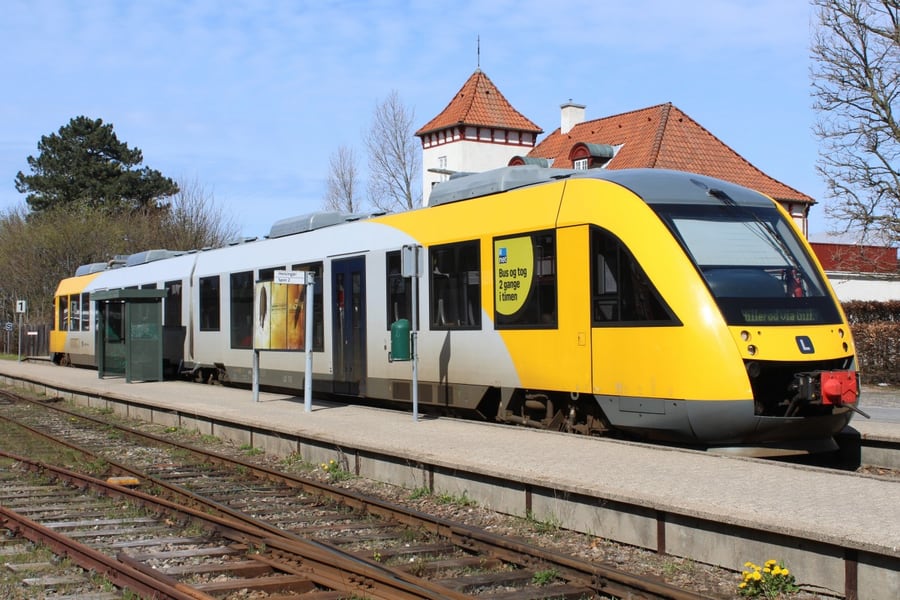
Most are trinbrætter — bare halts — where the train comes past without stopping unless somebody asks. There is a button on the platform, pressed about two minutes before, and another inside the carriage. Stopping only where needed is what keeps the end-to-end time under fifty.Leif Jørgensen / Wikimedia Commons · CC BY-SA 4.0 · croppedThe veteran train, every summer since 1971
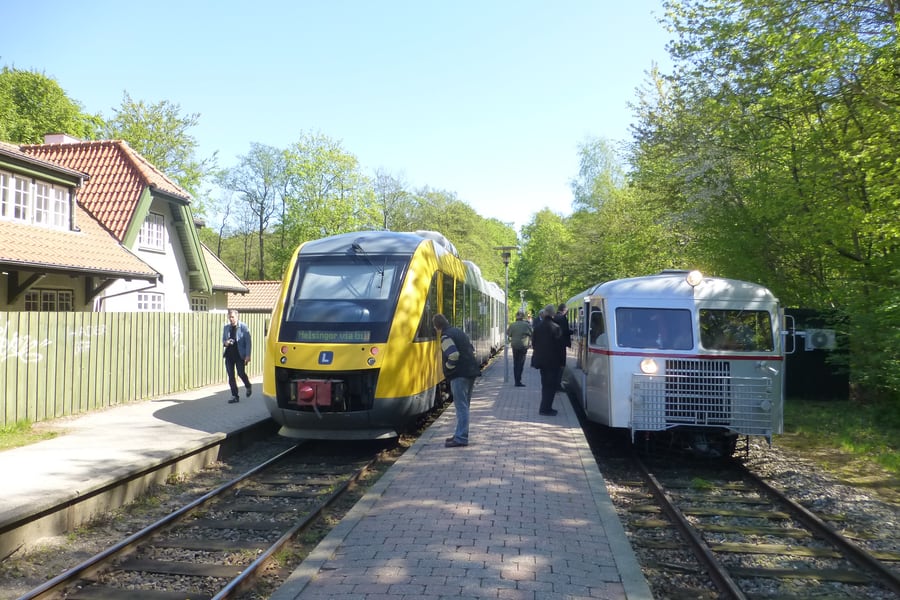
Helsingør Jernbaneklub began running preserved trains over these rails on summer Sundays in 1971 and has not stopped since, now working through to Hornbæk and Hellebæk behind a diesel of 1952 with open end balconies.A bit of history
Culture & experiences along the way
 Thomas Vedelsbøl / Wikimedia Commons · CC0 · cropped
The church loft at Gilleleje
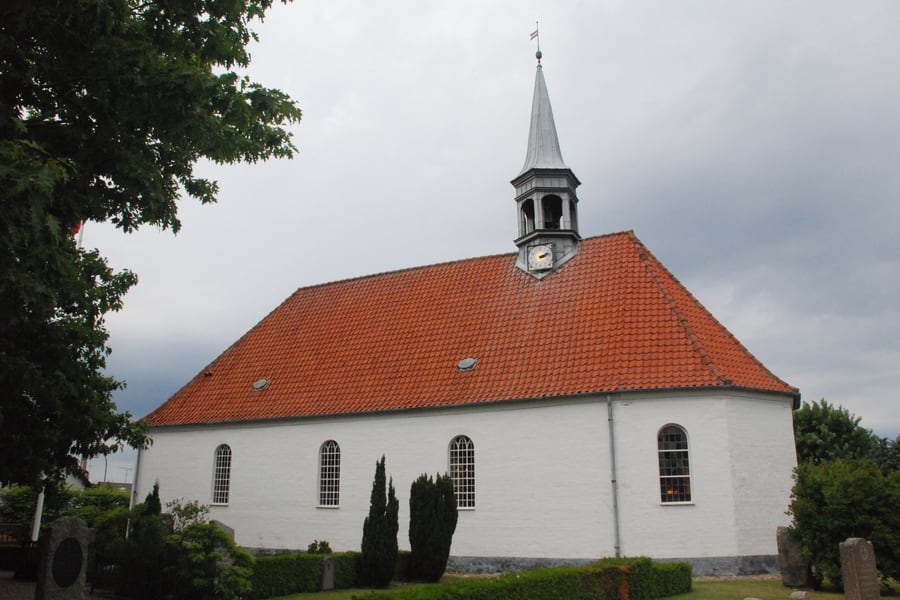
In the first days of October 1943 the fishermen of this coast carried Danish Jews to Sweden by the boatload. Some 80 were hiding in the loft of Gilleleje church when an informer gave them away and the Gestapo came before dawn on 6 October. The town went on running boats the following week regardless.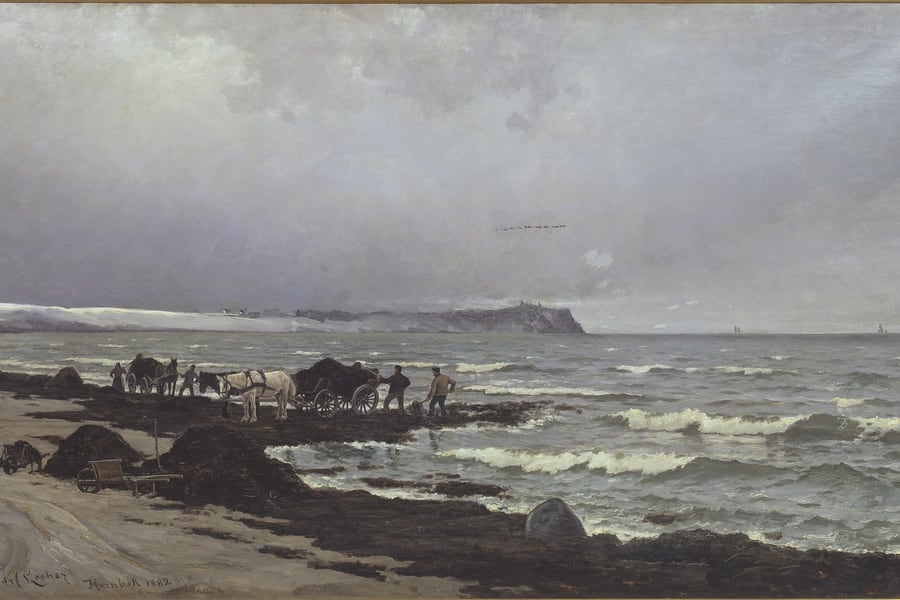 Carl Locher, *Der læsses tang ved Hornbæk Strand* · Statens Museum for Kunst · public domain
The painters got here first
Before Skagen there was Hornbæk. From the 1870s painters took the summer here for the light, the dunes and the fishermen hauling seaweed and boats up the beach — Carl Locher, P.S. Krøyer, Holger Drachmann. Walk the strand and the shoreline in their pictures is still recognisably the one in front of you.Timetables
Figures below are from Lokaltog's own printed timetable for line 940R, valid from 29 June 2026 and read in August 2026. The current sheet is always at lokaltog.dk (opens in a new tab).
Journey time is 49 minutes from Helsingør to Gilleleje and 46 minutes the other way.
Monday to Friday the service is half-hourly all day. Trains leave Helsingør at :21 and :51 past each hour, from 05:51 in the morning until 23:47 at night. From Gilleleje they leave at :25 and :55, first train 04:55, last 23:52.
Saturdays, Sundays and public holidays are hourly through the middle of the day — roughly 07:42 to 17:42 from Helsingør, and 08:46 to 16:46 from Gilleleje — with a half-hourly pattern early and late.
Reduced weekends until October 2026
The hourly weekend service is temporary. Lokaltog's planned-changes page, read on 20 August 2026, states that from Monday 29 June the Hornbækbanen has run its normal weekday timetable but with hourly running at weekends and night trains replaced by buses, and that from the weekend of 3–4 October 2026 the normal timetable returns on every day of the week for the rest of the timetable year. The same reduction applies to the three neighbouring North Zealand lines.
Overnight after Fridays and Saturdays, between 29 May and 27 September, a togbus replaces the last trains and calls at road stops near each station rather than at the platforms.
Pressing the button
Most of the eighteen stops are trinbrætter, bare halts, and the train passes them unless it is asked to stop. There is a button on the platform and another in the carriage; Lokaltog's guidance is that the platform button wants pressing about two minutes before the train is due, since a train takes time to brake. A time printed in the timetable column is what makes a stop possible at all — where the column shows a vertical bar instead, no train calls there on that working. The operator is straightforward about why: stopping only where somebody needs it saves fuel and is what keeps the end-to-end time under fifty minutes.
Through to Hillerød
Most departures do not end at Gilleleje. The timetable marks them with an asterisk and the note that the train continues as line 950R to Hillerød without a change at Gilleleje — the exception being the last train of the day at weekends. That makes the whole run Helsingør–Gilleleje–Hillerød a single seat, which is how the line has worked since the two routes were joined in January 2008.
At the Helsingør end, the Coast Line to Copenhagen, the Lille Nord to Hillerød and the Scandlines ferry to Helsingborg are all within a few minutes of the Hornbækbanen's platform.
Tickets
The Hornbækbanen is inside the Copenhagen region's shared zone fare system, so there is no special ticket for it and no tourist supplement. Lokaltog prints the zone number against every station in its own timetable, which makes the arithmetic unusually easy: end to end is six zones, at 50 kr for an adult single, or 48 kr on a Rejsekort. Children travel at half fare. Prices are from DOT's Takstblad 2026, valid from 18 January 2026.
⚠️ There is no ticket machine anywhere on this line. A ticket has to be bought before boarding, from the Rejsebillet app, or by tapping in with a Rejsekort; travelling without one carries an on-the-spot penalty. Bicycles, by contrast, travel free on every Lokaltog line with no reservation, and this one takes up to ten a train — which on a coast where the beaches and the clifftop path sit some way from the platform is the most useful thing on this page.
Book your tickets
Single, six zones
50 kr adult · 48 kr on a Rejsekort · children half fare
Helsingør to Gilleleje, the whole line, with no machine at any station to buy it from.
Book Tickets (opens in a new tab, on dinoffentligetransport.dk)via dinoffentligetransport.dkShort single, two zones
24 kr adult, rising to 40 kr over four zones
A ring-zone ticket, valid for any journey within that many zones of where it was bought.
Book Tickets (opens in a new tab, on dinoffentligetransport.dk)via dinoffentligetransport.dkCity Pass Large
200 kr for 24 hours
Only worth it alongside a day on Copenhagen's own trains, metro and buses.
Book Tickets (opens in a new tab, on dinoffentligetransport.dk)via dinoffentligetransport.dkRail Passes
Lokaltog is fully included in an Interrail or Eurail pass. Interrail's railway-companies table, last updated 28 August 2026 and read in October 2026, lists Lokaltog under Denmark for Regional (RE) services with nothing against it in the excluded column. The only Danish operator Interrail excludes is Midtjyske Jernbaner, which is in Jutland and nowhere near this line. Seat reservations do not exist on Danish domestic trains, and none is needed here.
That settles whether a pass works. Whether it is worth spending a travel day on this journey is a different question, and the honest answer is usually no.
The whole line costs 50 kr, and a return 100 kr. A pass day is worth considerably more than that, so a day given over to the Hornbækbanen and nothing else is a day wasted. The line is worth adding to a day that already carries a long leg — Copenhagen to Aarhus or Aalborg, or a crossing into Sweden or Germany — rather than being the reason for one. A visitor coming up from Copenhagen purely for the coast is better off with an ordinary DOT ticket, which is what the tickets section covers.
Interrail also sells the Nordic Pass (opens in a new tab), valid in Denmark, Norway, Sweden and Finland and across the borders between them: €218 for 3 travel days in a month for an adult in second class, against €137 for the Denmark Pass. It cannot be used in the country you live in, only in the other three. It pays only when the trip goes on into another Nordic country. Checked October 2026.
Where a pass does pay is the full North Zealand circuit: the Coast Line from Copenhagen to Helsingør, the Hornbækbanen along the top to Gilleleje, and the Gribskovbanen back down through the forest to Hillerød and into Copenhagen from the other side. DSB, S-tog and Lokaltog are all covered, so the whole loop is one pass day — and because most Hornbækbanen departures continue as line 950R without a change at Gilleleje, the turn at the top of the loop happens without leaving the seat.
The replacement bus that runs in place of the last trains on summer weekend nights is a Movia road service calling at street stops, not a train, and pass coverage for it is not something Interrail's table addresses either way.
Places to Visit
Everything on this line is within walking distance of a platform, which is the point of a railway with eighteen stops in twenty-five kilometres. The coast itself is the main attraction — beach after beach from Julebæk round to Gilleleje — but four or five stops repay getting off for something more particular than sand.
The order below follows the train from Helsingør. Hellebæk comes first, five kilometres out, where a valley full of watermills once made the Danish army's guns. Hornbæk is the busiest stop and the one most people use, for a beach that has been fashionable for two hundred years. Dronningmølle has a sculptor's museum standing alone on a heath. Gilleleje, at the end, is a working fishing town, and the cliff a short walk west of it is the northernmost land in Zealand.
Kronborg, the castle at Elsinore, is a ten-minute walk from Helsingør station at the other end — it belongs to the Coast Line's page rather than this one, but anybody arriving from Copenhagen passes it on the way to this platform.
 Ramloser / Wikimedia Commons · CC BY-SA 3.0 · cropped
Hammermøllen, at Hellebæk
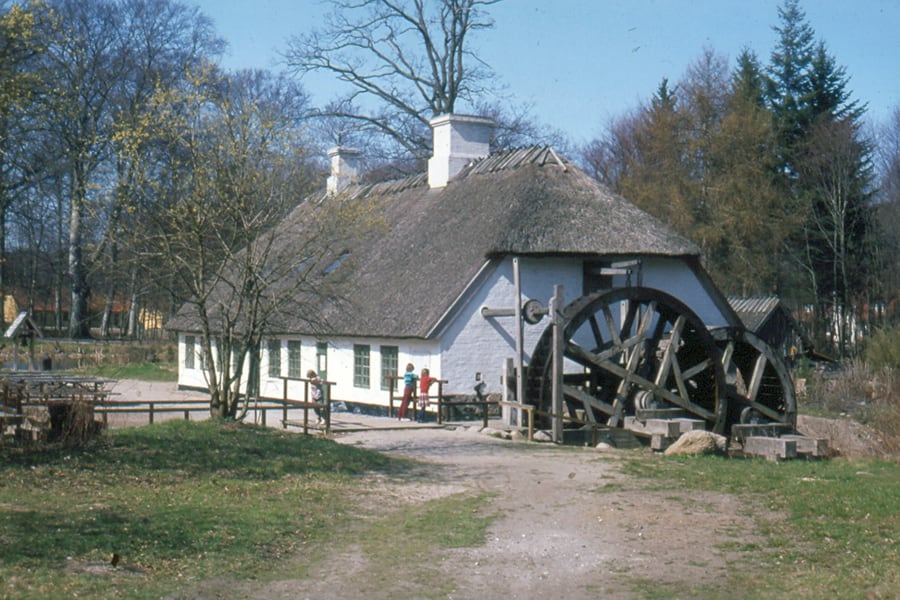
A thatched watermill with a wheel the height of the building, at the edge of the wood a few steps from Hellebæk halt. It was one of seven watermills that, with the workshops along Bøssemagergade, made up the Kronborg rifle factory. There has been a mill on the stream since 1576; weapons were made here from 1601, the present building dates from 1765, and gun barrels were forged in it until the works closed in 1870. It reopened in 1982 after two decades of restoration.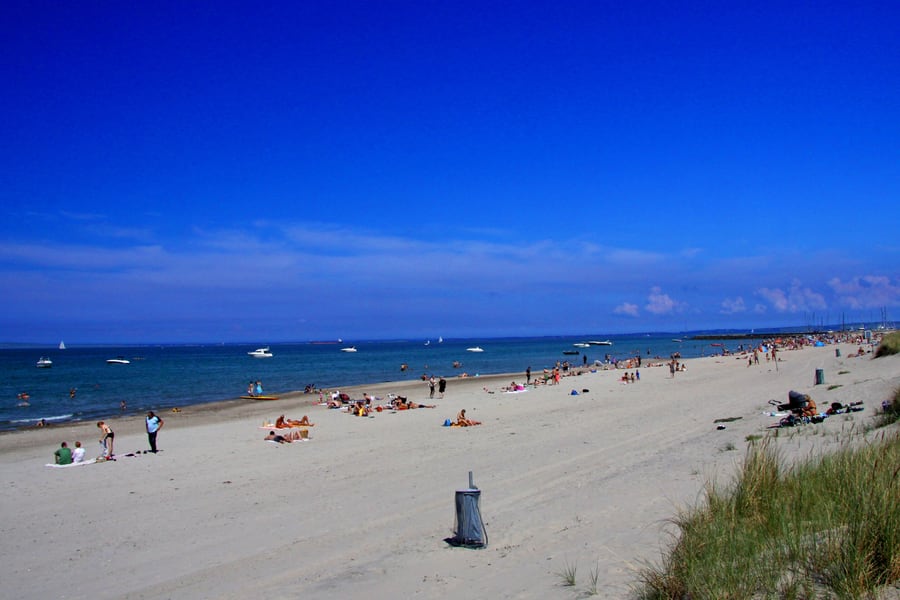 Guillaume Baviere / Wikimedia Commons · CC BY 2.0 · cropped
Hornbæk Strand
The broad sand beach that made Hornbæk's name, a few minutes downhill from the station. The village was a fishing hamlet until the painter Holger Drachmann and his circle made it fashionable in the 1800s, and the pattern has held: about 3,600 people live here and roughly 35,000 arrive for the summer. Behind the dunes is Hornbæk Plantage, planted to stop the sand, and Hornbæk Sø beyond that.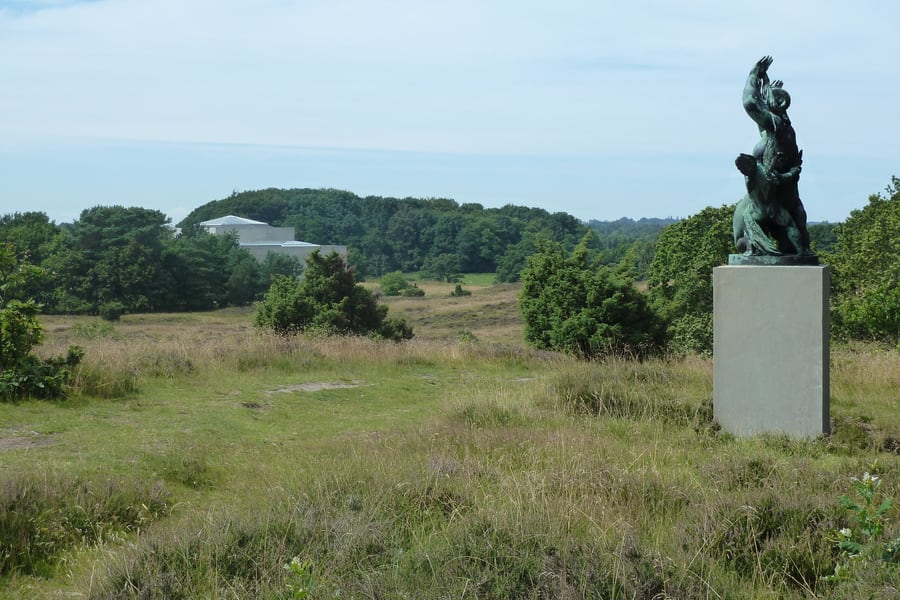 Ramblersen / Wikimedia Commons · CC BY-SA 3.0 · cropped
Rudolph Tegners Museum, Dronningmølle
The sculptor Rudolph Tegner (1873–1950) was argued about all his working life for the sheer size and violence of his figures. In 1916 he bought a tract of heath between Hornbæk and Gilleleje called Rusland and built his own museum and mausoleum on it, with the bronzes standing out in the open ground around. The statue park is open all year; the museum keeps to a season, Tuesday to Sunday. Dronningmølle station is the stop.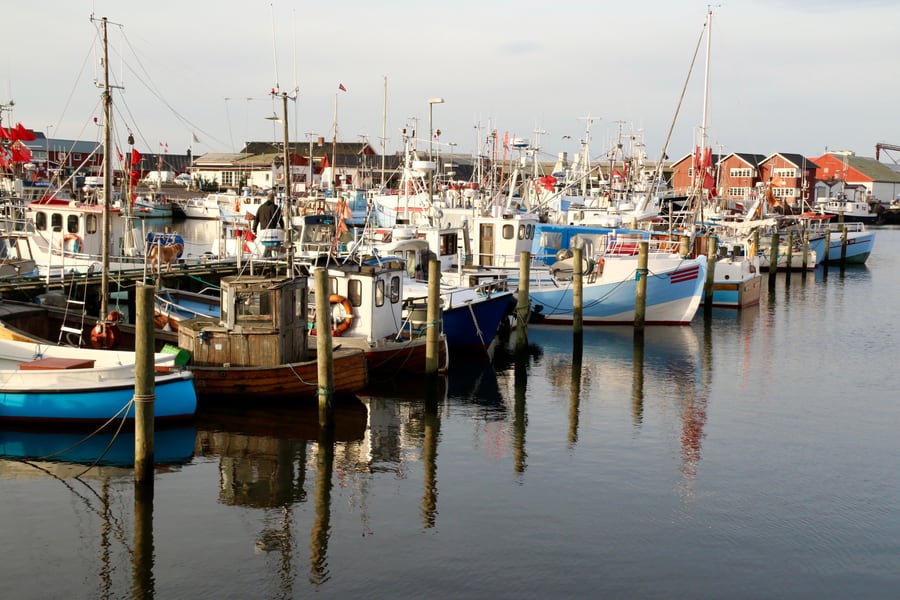 Ampo2020 / Wikimedia Commons · CC BY-SA 4.0 · cropped
Gilleleje Havn
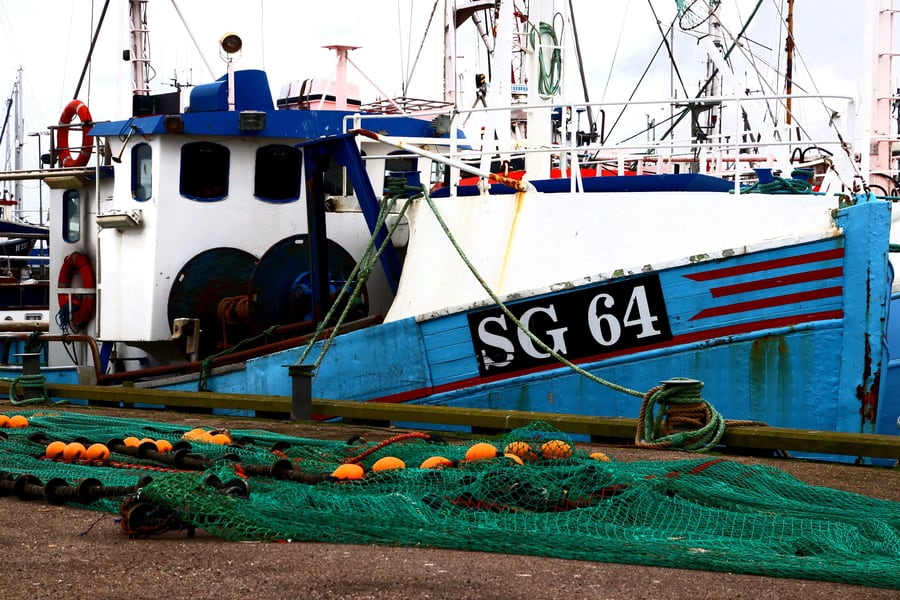
A fishing harbour that still fishes, at the end of the line. The name joins gil, a cleft, to leje, the word for a place fishermen came to in season and eventually stayed — and about 6,600 people live there now. The cutters lie in the inner basin with their nets spread on the quay, the boatyard is still at work, and the smokehouses and fish stalls are along the same few hundred metres.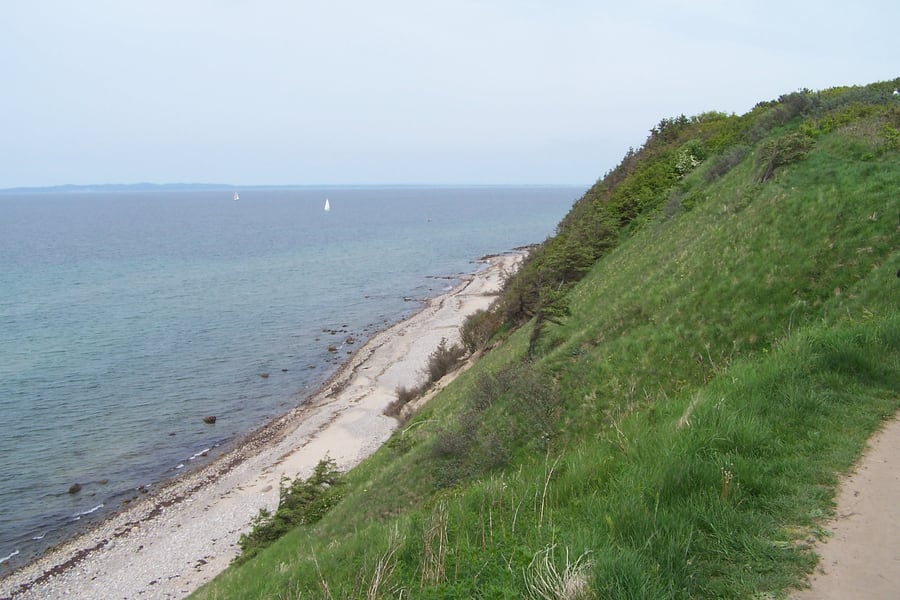 Niels Elgaard Larsen / Wikimedia Commons · CC BY-SA 3.0 · cropped
Gilbjerg Hoved
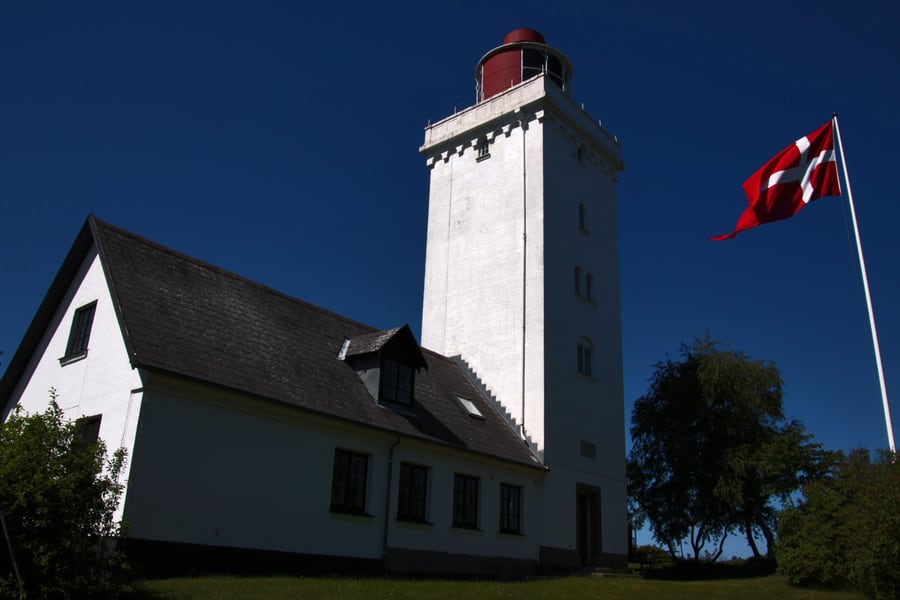
The northernmost point of Zealand, a bare cliff about 33 metres high a short walk west of Gilleleje along the Gilbjergstien. The line drawn from here to Kullen in Sweden is where the Øresund ends and the Kattegat begins, which makes this the top corner of the water the whole railway has been following. About 25 hectares are protected, and a memorial stone to Søren Kierkegaard stands at the edge.Where to Sleep
This coast was built for staying on. The railway arrived in 1906 and the badehotel — the Danish seaside hotel, a wooden house with a veranda and a dining room, filled by families who came up by train and stayed for weeks — arrived with it. Several of the originals are still trading, and both of the ones below predate the line they now sit on.
Helsingør at the near end has its own hotels, including the big Victorian seaside house north of Kronborg. The two cards here are further along, where the train is the natural way to arrive: Hornbæk in the middle of the line, and Gilleleje at the end of it.
Neither card quotes a price or a rating, because neither has been verified. What is stated below — the dates, the room count, the position — comes from each hotel's own site, read in August 2026.
Where to stay
Hotel Hornbækhus
A red timber house of 1904 in Hornbæk
A red wooden house built in 1904, up the hill from the beach and a few minutes from Hornbæk station. It has 36 rooms, each furnished separately, and guests and locals eat together at long tables in the dining room every evening. The same owners run Villa Strand in the village.
Check Availability (opens in a new tab, on hornbaekhus.com)via hornbaekhus.comGilleleje Badehotel
Above the coast near Gilbjerg Hoved
Built as a pension in 1895, on the shore road out towards Gilbjerg Hoved at the northern tip of Zealand. It keeps to the Danish badehotel pattern — a seaside house run for people who came by train and stayed a fortnight — and there are cabins in the wood behind it as well as rooms in the house.
Check Availability (opens in a new tab, on gillelejebadehotel.dk)via gillelejebadehotel.dkQuestions or corrections
Planning this trip and stuck on something, or spotted a time, fare or detail that has changed? Send us a message about Helsingør to Gilleleje: the Hornbækbanen. We read every one, and we update this page when something has changed.